On Jan. 13, Chevrolet will introduce the world to the seventh-generation Corvette.
This blog is about what that Corvette will not look like. The purpose of concept cars is to show what could be done, such as the 1961 Mako Shark …

… which became (after practical design considerations) the C2 Corvette:
In the Corvette’s early days, GM experimented with the two-seat formula. The C1 had a trunk and either a soft-top or removable hardtop. The 1954 Corvette Corvair may have tipped off the prescient about the future direction of the Corvette:

Want a Corvette with a back seat? Consider the 1955 Corvette Impala:

One year earlier, Chevy built five Corvette Nomad wagons:

I noted here previously that General Motors has danced with the idea of a mid-engine Corvette for decades, only to stay with the tried and true (as in profitably selling) front-engine rear-drive ‘Vette.
The mid-engine idea started as early as design for the C3 Corvette. This is the XP-819 concept car, which you must admit looks more than a little like a C3:

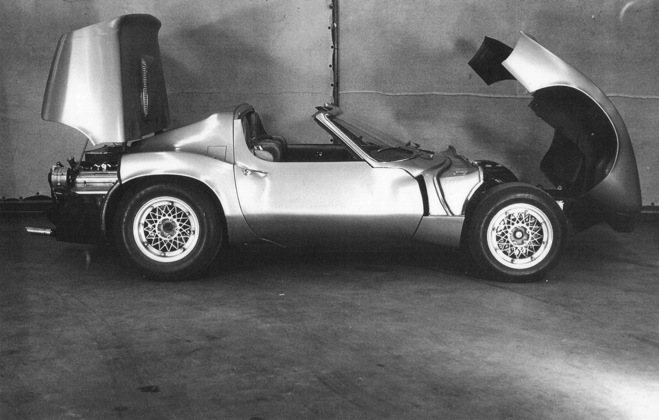
Remarkable Corvettes tells the story:
Actually, the XP-819 was the result of a clash between Zora Arkus-Duntov and engineer Frank Winchell, who’d been involved with the Corvair project. Winchell contended that you could make a balanced, rear-engine, V-8 powered sports car by using an aluminum engine and larger tires on the rear to compensate for the rear weight bias. Duntov adamantly disagreed. A loose design was drawn that received some very unflattering comments from Duntov and Dave McLellan. Winchell asked designer Larry Shinoda if he could make something beautiful with the layout, to which Shinoda told him that a tape drawing could be shown after lunch. Shinoda and designer John Schinella sketched out the basic shape shown here. Duntov asked Shinoda, “Where did you cheat?”. It didn’t look “too bad”, so a working prototype was ordered. Shinoda supervised the styling and Larry Nies’ team of fabricators built the car. In only two months the XP-819 was on the test track. …
This car was definitely a Corvette, even though the back end was big. Unfortunately, with all that weight behind the rear axle, it was only a matter of time before it crashed during a high-speed lane change test. Paul vanValkenberg crashed it because he put the same (standard) size Corvette rim on the car front and rear and then wet down the track and went out and lost it. He bounced it off the wall a couple of times and pretty well wrecked it.
Wrecking the XP-819 didn’t kill the dreams of mid-engine Vettes. Consider the Astro II, which is neither a GMC tractor-trailer nor a Chevrolet minivan:
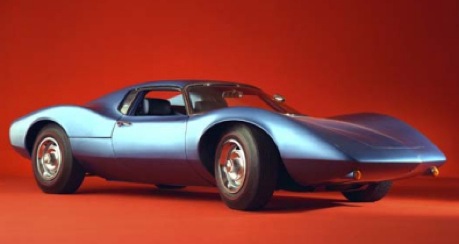

The Astro II, revealed at the 1968 New York Auto Show, was less extreme in its styling than Astro I. It was designed primarily to showcase its rear-mounted powertrain application. Unlike the Astro I, Astro II had doors to access the passenger compartment. The rear compartment hatch still lifted up – this time, to provide access to the engine compartment. The front compartment was designed as a storage area. Chevy R&D’s first mid-engine Corvette positioned a big-block V-8 backwards so the starter and ring gear nestled under the reclined seats and the tall accessory drive rode in back. The Tempest transaxle’s torque converter bolted to what’s usually the front of the crankshaft. The finished car weighed 200 pounds less than a stock 427 Corvette, but the transaxle was far too weak. …
By using off-the-shelf parts, the designers were able to deliver the car quickly, and at a relatively low cost. However, because of a lack of serious commitment by Chevrolet, the car was made using an out of production, ’63 Pontiac Tempest, two-speed transaxle. Ford, on the other hand, had a race-proven, four-speed manual gear box for the Mach 2. The big question was, if pushed into production, would a two-speed automatic Corvette be taken seriously. Probably not.
In 1970 came the XP-882:


The experimental XP-882 looked production-ready, thus fueling hopes that the next new Corvette would have a similar mid- engine design. It definitely looked like a Corvette, with overtones of the 1968- vintage “Shark” model in its low vee’d nose and four-lamp tail treatment. The car would have stayed under wraps, but was shown to counter Ford’s announced sale of Italian-built DeTomaso Panteras. GM built two XP-882 chassis for evaluation, but only the first one had the bodywork shown here.
Zora Arkus-Duntov’s solution to the XP-880’s transaxle problem was to mate a 454 V-8 to a Toronado transmission and mount it all transversely to lower the mass. A bevel gear allowed a prop-shaft to run back through the oil pan to a Chevrolet differential. It worked and paved the way for future all-wheel drive, but the powertrain weighed a significant 950 pounds.
The Corvette has always been made of fiberglass, though GM looked at an aluminum-bodied Corvette, the XP-895:

The story took a rotary turn, you might say, in the early ’70s. In November 1973 Motor Trend magazine (which in its history has been on rumors of new Corvettes like dogs to raw meat) breathlessly reported …

… that GM was considering two Corvettes powered by a Wankel rotary engine — one with two rotors …

… and one with four rotors:

First, the two-rotor, which as a 10-year-old (I saw this first in fifth grade and used it as a Pinewood Derby car model):
This little concept mounted a 266ci and 180-horse Wankel (called RC2-266) transversely, driving a new automatic transaxle being developed for the forthcoming X-body Citation. Designed by GM’s Experimental Studio and built in 6 months on a modified Porsche 914 chassis by Pininfarina (the car was ready on April of 1972), the 2-Rotor made its debut at the 1973 Frankfurt show. Like the original XP-882, it was widely believed to be a precursor of the next-generation Vette.
The concept that got much more attention was the four-rotor …
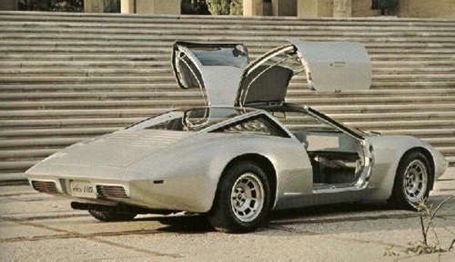
The same XP-882 that had been shown in New York in 1970 served as the basis for this Wankel motor prototype. Under Bill Mitchell, Henry Haga was responsible for it’s design. Called the “Four-Rotor Car”, it was arguably more stunning than the Two-Rotor XP-897GT, that appeared a bit later in 1972. Built on the first XP-882 chassis under the aegis of company design chief Bill Mitchell, it carried a pair of GM’s experimental two-rotor engines bolted together into a 420 horsepower “super Wankel.” A Corvette-like face and obvious high performance potential were taken as strong suggestions that GM was brewing a radical new Corvette for the late Seventies or early Eighties.
GM design chief Bill Mitchell kept its original lines intact, however — not that there was reason to fiddle. Charles Jordan oversaw the design, which included radical bifold gullwing doors, and deformable plastic body-colored nose and tail sections which are common today, but revolutionary in the mid-1970’s. The sterling silver paint, with silver leather interior and forged alloy turbine wheels later seen on the 1978 Corvette Indy Pace Car, gave the Corvette a space craft like appearance unmatched by any other advanced sports car. The interior was more fully engineered than the show-car norm, another indication this model was indeed a serious production prospect.
… which, after GM junked the rotary idea, got a 400 V-8 …
Bill Mitchell, the ardent Corvette styling department magnate, gave the car a new life by removing the Wankel engine and reinstalling a small-block Chevrolet V8 and christening it the AeroVette. A stunningly dramatic looking car, it was promoted as the new 4th generation Corvette for 1980, but never saw series production.
Why not? The GM Heritage Center has your answer:
Bill Mitchell, Vice President of Design, lobbied for the Aerovette as the next Corvette and GM chairman and CEO, Thomas Murphy actually approved the Aerovette for 1980 production. In the end, management decided that they were selling every fiberglass bodied, front engine V8 “traditional” Corvette they could build, so why make a huge risky investment in a mid-engine car. The Aerovette project was cancelled and the Aerovette is now part of the GM collection at the GM Heritage Center.
Given GM’s shaky quality reputation in the 1970s, it seems unlikely GM could have successfully pulled off gull-wing doors:
One Aerovette idea that may have (unfortunately) gotten into the C4 Corvette was a digital instrument panel (see the right photo):
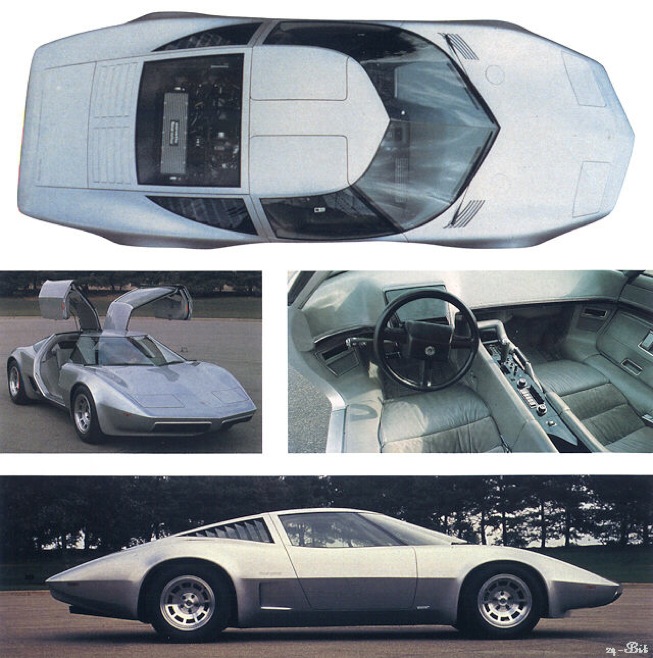
The last attempt for a mid-engine Corvette was the CERV III …

… which would have been the first bazillion-dollar GM car because …
The body of the CERVIII is made of carbon fibre, nomex and kevlar, reinforced with aluminum honeycomb. This material forms a one-piece composite unit. Highlighting the structure is an exceptionally low drag at 0.277 Cd.
Powering the car is a Lotus-tuned 5.7-liter V8. Mahle pistons, stonger connecting rods and twin Garett Turbochargers help the engine achieve 650 horsepower. This engine combined with the low-drag body give CERVIII a calculated top speed of 225 mph!
With such high speed capability, a strong braking system is a must. On each wheel a dual disc setup is used. This creates a sandwich of brakes which effectively doubles the surface area. As a drawback, having 8 disc brakes instead of the usual four does increase overall weight.
With the transmission setup another innovation is achieved. Six forward speeds compliment the CERVIII by means of two transmissions! That’s right, a three-speed Hydramatic unit is linked to a custom two-speed transmission resulting in six gears. With this setup shifting is done automatically by computer control.
From the transmissions, power is transferred to all four wheels though a viscous-coupling system. This system helps achieve maximum traction by varying the torque to the front and rear wheels. No doubt this setup is influenced by the Porsche 959.
The ultimate reason there will be no mid-engine Corvette Jan. 13, despite enthusiast interest, is because GM already makes money on every front-engine Corvette it sells, and has for decades. The new Corvette V-8 will find its way into other GM V-8-powered vehicles, including pickup trucks. The current Corvette V-8 is found in the Chevy Camaro and the Cadillac CTS-V. The engineering involved in a mid-engine design, one that probably could be used in no other GM car, would make it cost-prohibitive, making a mid-engine Corvette either too costly for most would-be buyers or unprofitable. And as we know, GM needs to make all the profit it can.

 Steve Prestegard.com: The Presteblog
Leave a comment