Because I can laugh at myself, I present my two brackets for the NCAA Division I men’s basketball tournament, which started Tuesday but gets going for real later this morning.
Which I guess makes me, according to the New York Times …
You combine favorites with underdogs that you carefully selected based upon their strength of schedule, assist-to-turnover ratio and the expert opinions of the other message board posters at UnhealthyHoopsObsession.com. Your bracket is the product of 36 hours of painstaking research; you took breaks only to rank players 300 through 770 for your nine fantasy baseball drafts. …
Data are your friends, perhaps your only friends. You understand that the purpose of a tournament pool is not to add zest to your basketball-watching experience or promote water cooler bonding, but to gain the 0.07 percent advantage over your co-workers that comes from turning a small diversion into a life-consuming chore. You believe co-workers admire your ability to steer all break-room conversations away from movies, family and life’s pleasures and toward Baylor’s R.P.I. rating. All the effort was worthwhile, however, when you finished tied for sixth in the pool in 2003, winning $56 and gloating for two days before beginning your research for the next year’s pool.
(The 36-hour estimate is about 18 times too long, and only that long because of my slow laptop. I don’t play fantasy sports other than imagining myself catching touchdown passes for the Packers or replacing Prince Fielder at first place for the Brewers.)
The first bracket, for a contest involving alumni of the University of Wisconsin Marching Band, was picked based on some concepts listed earlier this week from Luke Winn of Sports Illustrated.
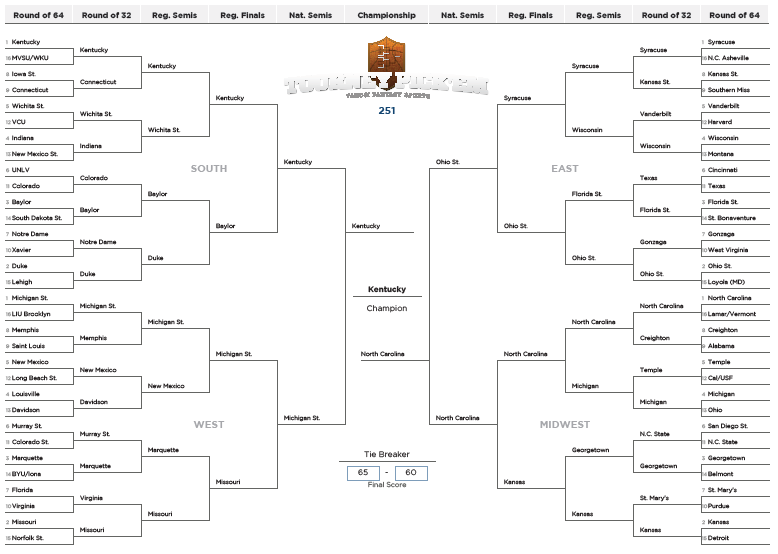
This bracket is largely based on a composite of four national rankings Winn listed, with the higher ranked team winning. There are six first-round upsets in this one — #9 Connecticut over #8 Iowa State, #11 Colorado over #6 UNLV in the South, #13 Davidson over #4 Louisville and #10 Virginia over #7 Florida in the West, #11 Texas over #6 Cincinnati in the East, and #11 North Carolina State over #6 San Diego State in the Midwest. And I wouldn’t call it exactly daring to pick three number one seeds and a number two to reach the Final Four.
If a theme other than rankings dominates in this bracket, it’s the importance of defense. This bracket tends to discount the highly ranked teams not known for their defense, such as Missouri and Duke. Perhaps that explains why Wisconsin, which has been unusually inconsistent this year, and yet leads the country in points allowed per game, goes to the Sweet 16.
The next bracket is for a contest I’ve been in since I worked at Marian University:

This bracket was spurred by the statistics of offensive and defensive efficiency — points scored and given up, respectively, per possession. The efficiency statistic measures production taking out the effects of tempo. Basketball fans know that the faster tempo a team plays, the more points it will score and give up (exhibit A: Grinnell, perennially first in the Midwest Conference in offense and last in defense), and the reverse applies for such slow-paced teams as, well, nearly everyone in the Big Ten, particularly Wisconsin.
I simply matched the 60 teams (not including the eight First Four teams that played Tuesday and Wednesday) by subtracting their defensive efficiency from their offensive efficiency, and whichever team had the higher number was that game’s winner. Some would suggest defensive efficiency is more important than offensive efficiency, but I decided to weigh each the same.
This one has more fun upsets. If my formula is right, prepare to meet the Lehigh Mountain Hawks, which I have not just pulling off the fifth 15-vs.-2 upset in NCAA history, but reaching the South Regional final. I also have 14th-seed South Dakota State beating third-seed Baylor and then sixth-seed UNLV, 14th-seed Belmont beating third-seed Georgetown (and like Lehigh getting all the way to the regional final), another Davidson upset of Louisville, 12th seed Harvard beating fifth-seed Vanderbilt, plus 13th seed Ohio upsetting fifth-seed this weekend.
It is interesting to note that both approaches came up with three of the same Final Four teams — Kentucky, North Carolina and Ohio State — and the same champion, Kentucky. The Old Farts bracket has Kentucky beating Michigan State and North Carolina beating Ohio State, and then the Wildcats triumphing over the Tar Heels. The Efficiency bracket has Kentucky beating Missouri and Ohio State beating North Carolina, and then the Wildcats beating the Buckeyes.
It is also interesting to note that using either system with no rooting interest, Wisconsin beats Montana and then either Vanderbilt or Harvard to get to the Sweet 16. That demonstrates the value of defense, boring though it may be to watch.

 Steve Prestegard.com: The Presteblog
Leave a reply to March Madness (about the lack of spring) | The Presteblog Cancel reply