The Independence Day holiday is not always a three-day weekend, but when it is, it’s my favorite weekend.
One reason is fireworks, one of the lesser known fields of endeavor that has seen tremendous advancements over the years.
We decided to watch, schedules and weather and so on permitting, as much in fireworks as we could get to over the next few days. There were fireworks Friday, there are fireworks Saturday through Monday, and there is even a display Tuesday night. (Which we were going to until a wave of illness and fatigue hit the house.)
Our fireworks odyssey starts with these photos Michael took at the Waushara County Fairgrounds in Wautoma Friday:
On Saturday, we went to Princeton (where we once went hoping the booms would induce labor):
On Sunday we went to Murray Park in Ripon:
On Independence Day, we saw the Fond du Lac fireworks from a distance:
I was trying to figure out what to write for the United States of America’s 235th birthday.
And then the answer fell from the sky onto our sidewalk.
It was a piece of fireworks, shot from a birthday party a couple houses north of ours. It was preceded by a big bang, followed by a louder boom.
Those who watched this week’s Ripon Channel Report know that state law prevents use of fireworks that launch or explode — firecrackers, Roman candles, bottle rockets and mortars — without a permit. Even though they’re legal to buy in this state, they’re not legal to use in this state.
What sort of twisted logic makes an item legal to purchase but not use? The same logic that bans smoking in all public places (including privately owned businesses), yet doesn’t ban sale of tobacco products. That same logic pervades government at every level today, and is utterly foreign to any concept the Founding Fathers intended from either the Declaration of Independence, the original Constitution or the Bill of Rights.
It is fashionable today to ignore the origins of our country because we reflect poorly on those origins. President Obama‘s comments about whether the U.S. is exceptional or not were, well, misinterpreted, which was partly either his own fault or his speechwriter’s fault. But there is no question that some supporters of Obama do believe this country is nothing exceptional, such as those who try to enforce the “right” of public employee collective bargaining using the precedent of UN resolutions.
Remember, though, that the Founding Fathers noted our “inalienable rights, that among these are life, liberty and the pursuit of happiness.” My “pursuit of happiness” was sitting in our front yard reading a World War II book (no “pursuit of happiness” in the first couple of years of the war, to be sure), while our neighbors’ pursuit of happiness was celebrating someone’s birthday.
Or perhaps they were rebelling against what you should think is a stupid law. Rebellion goes back before our existence as an independent country to the Boston Tea Party. Everyone who came (or now comes) to this immigrant country by choice came here because they thought their lives would be better here, however they defined “better,” than wherever they left.
Our founding fathers recognized the concept of Natural Law; a set of universal rights and responsibilities endowed to us by our Creator that precedes any governments we might form for the purposes of protecting and enforcing them. Numbers 5-10 of the Ten Commandments are sufficient for us to live in peace with each other, and most of us instinctively follow them, whether or not we believe in the God of the first four.
When six is the upper limit of our tolerance of things we will be told we can’t do, 2,000 pages of “shall” and “shall not” don’t stand a chance. We are Americans; we don’t do “shall.” That seems so obvious.
Americans are the perfected DNA strand of rebelliousness. Each of us is the descendant of the brother who left the farm in the old country when his mom and dad and wimpy brother told him not to; the sister who ran away rather than marry the guy her parents had arranged for her; the freethinker who decided his fate would be his own, not decided by a distant power he could not name. How did you think we would turn out?
Those other brothers and sisters, the tame and the fearful, the obedient and the docile; they all stayed home. Their timid DNA was passed down to the generations who have endured warfare and poverty and hopelessness and the dull, boring sameness that is the price of subjugation.
They watch from the old countries with envy as their rebellious American cousins run with scissors. They covet our prosperity and our might and our unbridled celebration of our liberty; but try as they might they have not been able to replicate our success in their own countries.
Why? Because they are governable and we are not. The framers of the Constitution were smart enough not to try to limit our liberty; they limited government instead. …
Those who cling to the promise of government ignore its reality. Which side of liberty are you on – the Department of Energy side, or the Internet side? Which do you trust to deliver your prosperity – yourself or the government? Who owns you?
That is the question for our time. A self-owned person is ungovernable; and ungovernable is our natural state. Liberty is our birthright, and prosperity is its reward.
Neither the Declaration of Independence nor the Constitution were perfect documents. Both were written in an era in which the term “all men are created equal” applied only to white property-owning men. And yet the presence of those five words paved the eventual path to the elimination of slavery and the extension of full rights to non-white men and to women.
I argued in the previous blog that the Constitution needs an economic Bill of Rights similar to what economist Milton Friedman proposed, limiting government spending and its ability to tax, mandating sound money, and opening borders and trade. (That last position has become increasingly unpopular since 9/11, and I wonder what Friedman would have had to say about open borders today.) Friedman believed that economic freedom was part of political freedom, and the Declaration of Independence is certainly about economic freedom as well.
Economic and personal freedom are interdependent, as Victor Davis Hansen points out:
Yet there has never been any nation even remotely similar to America. Here’s why. Most revolutions seek to destroy the existing class order and use all-powerful government to mandate an equality of result rather than of opportunity — in the manner of the French Revolution’s slogan of “liberty, equality and fraternity” or the Russian Revolution’s “peace, land and bread.”
In contrast, our revolutionaries shouted “Don’t tread on me!” and “Give me liberty or give me death!” The Founders were convinced that constitutionally protected freedom would allow the individual to create wealth apart from government. Such enlightened self-interest would then enrich society at large far more effectively that could an all-powerful state.
Such constitutionally protected private property, free enterprise and market capitalism explain why the United States — with only about 4.5 percent of the world’s population — even today, in an intensely competitive global economy, still produces a quarter of the world’s goods and services. To make America unexceptional, inept government overseers, as elsewhere in the world, would determine the conditions — where, when, how and by whom — under which businesses operate.
Individual freedom in America manifests itself in ways most of the world can hardly fathom — whether our unique tradition of the right to gun ownership, the near impossibility of proving libel in American courts, or the singular custom of multimillion-dollar philanthropic institutions, foundations and private endowments. Herding, silencing or enfeebling Americans is almost impossible — and will remain so as long as well-protected citizens can say what they want and do as they please with their hard-earned money.
That part about “herding, silencing or enfeebling Americans” would be a good description of what the instigators and participants in Protestarama would accuse the state GOP of doing to their alleged constitutional rights to hold up the taxpayers for billions of dollars — I mean, take away public employees’ collective bargaining.
(Billions of dollars, you say? Do the math: The average state employee costs the state $71,000 in salary and benefits. The state has about 69,000 FTEs. Multiply, and the state spends about $4.899 billion every year on state employee salaries and benefits.)
The recall elections are a perfect example of the political left’s contempt for our republic, as in the decisions made by our duly elected officials. (As if we’ve needed evidence for that since the Vietnam War.) Democrats swept every statewide office except one in the 2006 election, and captured control of both houses of the Legislature in 2008. What did Republicans do? They found candidates, generated money for their campaign spending, and persuaded the voters to vote most Democrats out of office in 2010. And like a petulant two-year-old, those whose side lost Nov. 2 refuse to understand that they lost and why they lost. They also fail to grasp that, should their candidates win in the recall elections in August, the GOP will certainly redouble their efforts to make their political careers last 17 months. (Two can play the same game, as Sens. Dave Hansen, James Holperin and Robert Wirch are finding out.)
However, our republican form of government does not guarantee us political happiness. It doesn’t guarantee political tranquility either. Nor does it guarantee a job, government-provided health care, nice weather, etc., etc., etc. Ben Franklin’s answer to the woman who asked what had been created — “a Republic, if you can keep it” — applies today, and it will apply tomorrow and every other day this country continues to exist. And regardless of what you may think about Protestarama, it still doesn’t rise to the level of the Federalist vs. Democratic–Republican battles, or for that matter the Civil War.
Still, after reading this, you may need evidence that America is really an exceptional place. I pass on a story from Ambassador to Tanzania Mark Green (former state legislator and Congressman from Green Bay), who tells the story of an Independence Day celebration at the embassy in 2008, when Tanzania’s Minister for Home Affairs, a Georgetown University law school graduate, spoke after Green:
After a few brief sentences thanking us for the evening and for the opportunity to speak, he scanned his audience, seeming to single out the Americans with his eyes. He paused again, and as he did, he suddenly seemed to relax . . .the formality of his position melted away.
“What I would say to you tonight is simply this: we want to have what you have. We want to be who you are.”
This being Independence Day, you wouldn’t think there would be many music anniversaries today. I love this one, though: WOWO radio in Fort Wayne, Ind., celebrated the nation’s 153rd birthday by burning its transmitter to the ground.
Independence Day 1970 was not a holiday for Casey Kasem, who premiered “America’s Top 40”:
Birthdays (besides non-rockers Stephen Foster and Louis Armstrong) include Bill Withers:
Al “Blind Owl” Wilson of Canned Heat was born the same day …
… as Dave Rowberry of the Animals:
Jeremy Spencer of the blues incarnation of Fleetwood Mac:
Ralph Johnson played drums for Earth Wind & Fire:
Kirk Pengilly of INXS:
Finally, an American rock fan must play this today:
An interesting anniversary considering what tomorrow is: Today in 1978, the U.S. Supreme Court upheld a Federal Communications Commission ruling punishing WBAI radio in New York City for broadcasting George Carlin’s Seven Dirty Words. (If you click on the link, remember, you’ve been warned.)
Birthdays begin with Fontella Bass:
Damon Harris of the Temptations:
The late Laura Brannigan:
Stephen Pearcy of Ratt:
Taylor Dayne:
Two notable deaths happened today: Brian Jones of the Rolling Stones, who contributed, according to Wikipedia, “guitars, sitar, keyboards, accordion, marimba, harmonica, dulcimer, autoharp, percussion, recorder, cello, mandolin, saxophone, [and] backing vocals,” drowned in his swimming pool …
… two years before Jim Morrison of The Doors died in Paris of a heart attack.
This being Independence Day weekend, which is one of the major vacation/trip weekends, it seems appropriate to bring up a former American automaker with deep Wisconsin roots.
Hot Rod magazine committed one of the great April Fool’s jokes in the history of magazine publishing when it breathlessly reported in its April 2008 issue that a group of private investors were working to bring back the late American Motors Corp. (The disclaimer at the beginning of the Web page didn’t appear until the last paragraph of the printed version.)
As with any successful practical joke, this one worked because of the appearance of plausibility. Given that the 2008 Ford Mustang looked like the 1967–68 Mustang, and given that Chrysler resurrected the Dodge Challenger and General Motors Corp. brought back the Chevrolet Camaro, is it possible that someone might want to resurrect the AMC Pacer …
… or, even better, the Javelin?
First, some history: AMC, the child of the marriage of the Nash and Hudson brands, was the smallest member of the Big Four automakers, until Chrysler purchased it in 1987 to get the Jeep brand into the Chrysler fold. AMC’s corporate headquarters were in the Detroit area, but its cars were built in Kenosha and Milwaukee (a Nash plant built in 1901).
AMC first had a reputation for building compact cars, such as the Rambler, in an era in which compact cars were only sporadically popular. One of AMC’s presidents was Gerald Romney, a later governor of Michigan and Republican presidential candidate, and father of presidential candidate Mitt Romney.
Having much less capital than its bigger three competitors, AMC nonetheless built some cars that were ahead of their time, thanks in large part to the work of chief stylist Richard Teague. The company first took its sporty Javelin, chopped off the rear end …
… and created the two-seat AMX, a cult car among collectors today.
A couple years later, AMC took its compact Hornet, similarly sliced off the rear end …
Whoever thought of adding four-wheel-drive to the compact Concord (born as the aforementioned Hornet 10 years earlier) created the Eagle, America’s first crossover sport utility (car with four-wheel-drive-truck-like capabilities), predating the Subaru Outback and other all-wheel-drive-equipped cars by 15 years.
Then, in 1983, came the downsized Jeep Cherokee, the first sport utility not based on a full-size pickup truck. An AMC subsidiary, AM General, began work in the late 1970s on something the U.S. Army called the “High Mobility Multipurpose Wheeled Vehicle” — which, two owners and a marketing agreement with General Motors later, the world came to know as the Hummer.
Other AMC cars were not great cars, but at least they stood out on the street, such as the Marlin …
… which arguably looked better as the Tarpon show car, based on a smaller model than the Marlin ended up being …
… the aforementioned Gremlin and …
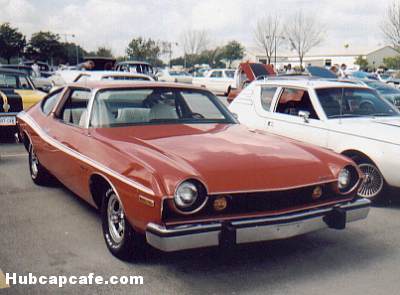
… the final two-door and four-door versions of the Matador. Like the Pacer, the Matador coupe was in a class of one, while the last four-door Matador was referred to as “coffin-nose.” AMC seemed to have two kinds of styling: staid and really out there.
Of course, AMC had long history with, shall we say, interesting-looking large cars. The Hudson Hornet, which detractors said looked like an upside-down bathtub with wheels …
… was, in the not-intended-as-a-compliment words of car magazine editor David E. Davis Jr., resurrected as the early 1990s Chevrolet Caprice:
On the other hand, the aforementioned Hornet (which you’ve seen if you’ve seen the movie “Cars”) was also an example of AMC’s ability to do more with less. Despite having just a six-cylinder engine, the Hornet was one of the dominant cars of the early years of NASCAR, thanks to its lower center of gravity from said upside-down-bathtub design, and the heavily-breathed-upon six.
The car I wish AMC had brought out would have been the replacement for the AMX when it was merged into the Javelin line (which meant the AMX wouldn’t have just two seats anymore) was …
… the AMX/3, a mid-engine/rear-drive halo car designed in Italy but with an AMC 390 V-8. I have a 1970 issue of Popular Mechanics that includes the AMX/3 as one of AMC’s 1971 offerings. The AMX/3 was unveiled one day after Lincoln–Mercury unveiled its De Tomaso Pantera, and that supposedly scared off AMC. (The Pantera didn’t last long either, which is too bad; while I should favor Ford since, unlike GM and Chrysler, it received no government aid, Ford also doesn’t have anything like the Corvette either.)
AMC and its predecessors also had a history of some unusual design and engineering decisions. Early 1960s Ramblers had push-button shifting for its automatic transmissions. On the other hand, AMC for some reason thought it would be innovative to remove the zeros from speedometers, making them read from 0 to 12 instead of 0 to 120 mph. To get the most out of one steering wheel design, the steering wheel was mounted upside down on the Gremlin and Hornet models. The last Javelin’s air conditioning controls required the owner to read the owner’s manual more than once — one slide controlled the fan, one controlled the heat, one controlled the outlets from which the air blew, and the last was for the air-conditioned air, including a “Desert Only” setting, prolonged use of which, owners were warned, could lead to loss of cool air due to coolant freezing.
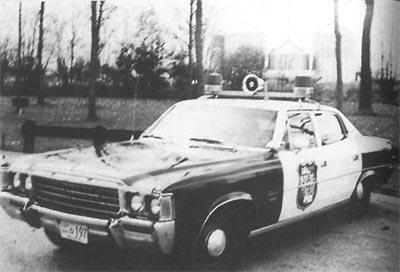
One unusual AMC niche was in police cars. Anyone who watched “Adam-12,” “The Rockford Files” or “The Dukes of Hazzard” (I plead guilty to all three — any series with cool cars got my attention) might remember that those series all featured Matador police cars. Many law enforcement agencies used Matadors because they probably were less expensive than their Big Three competition. (I once saw a sign in a National Guard armory that reminded everyone that all of their equipment was produced by the lowest bidder.) I don’t remember seeing Matador police cars in Wisconsin, but for several years in the early ’70s the Wisconsin State Patrol used Ambassador squad cars. So did a few sheriff’s departments, including Dane County, at least until a well-publicized spat between either AMC or the Madison AMC dealer and the sheriff over sheriff’s deputies’ habit of crashing said Ambassadors. (The dealership, from which we purchased a 1973 Javelin (read further), is still in business today, though it sells used cars now.) The Alabama Highway Patrol and the Muskego police used Javelins for a while.
The Nash+Hudson=AMC merger came right after Studebaker and Packard merged, which lasted only until 1966, when Studebaker–Packard closed its Hamilton, Ont., plant, two years after it closed its South Bend, Ind., plant. Studebaker and AMC apparently were talking about merging before AMC president George Mason, well, died in 1954. That put Romney in charge of AMC, and Romney was opposed to using Studebaker parts, and that ended the merger idea. Which seems too bad, given that StudePackAMC might have had enough brands to compete with every Big Three brand, from Nash at the Chevrolet/Ford/Plymouth level to Packard at the Cadillac/Lincoln/Chrysler level. (As owners of Plymouths, Pontiacs, Oldsmobiles, Mercurys — Mercuries? — and Saturns know, that wouldn’t have been sustainable long-term, but one crisis at a time.)
There are conflicting schools of thought as to why AMC finally folded with its purchase by Chrysler. Patrick Foster, author of American Motors: The Last Independent, argues that AMC did fairly well in the 1960s, offering economical (for the day), sturdily built, stolid cars (similar to Mercedes-Benz in the day), until AMC management decided it needed to offer what the other members of the Big Four were offering — sporty cars (although the Javelin was quite successful in the Trans Am series) and big cars, products where AMC lacked the ability to compete with GM, Ford and Chrysler.
I maintain that the reason AMC doesn’t exist today as an independent manufacturer has to do with a decision the company made during the early 1970s to discontinue building its Javelin “pony car.” Chevrolet built many more Camaros and Ford built many more Mustangs than AMC built Javelins, but the Javelin and its AMX two-seat cousin developed a reputation as race cars whose performance exceeded their reputation. The last year of the Javelin was 1974, just before the pony car market exploded and General Motors sold as many Camaros and Pontiac Firebirds as they could build.
This (minus the vinyl roof, and the horses, and my parents didn’t look like that) was our 1973 Javelin, our first new second car. It was also the first car I drove on public roads. It had a 304 V-8, automatic transmission with floor shifter (first I’d ever seen in a car), bucket seats and console, power steering (but not brakes), and AM radio. It was a cool-looking car from the front seats forward, with a back seat suitable only for dolls, and a trunk large enough for the spare tire and a golf bag, and that’s it.
The Javelin was an example of AMC’s less-than-sterling quality reputation, although to be fair many ’70s cars were similarly lacking. The gold tape stripe on the side started cracking seconds after the 12-month 12,000-mile warranty expired. The car started rusting shortly thereafter, although rust on a brown car is easier to not notice. Even at age 8 I could tell that things didn’t seem to fit together that well. Most of the interior screws were dislodged after a Boy Scout camping trip in which the camping spot was at the end of a rough gravel road.
The Javelin was killed after the 1974 model year. Instead of the Javelin (and the luxury Ambassador, killed at the same time), AMC built …
… the Pacer, a car that was small in length, but wider and thus roomier (or so AMC wanted the consumer to believe) than the average small car. It was, however, heavy for its length due to big windows and slow yet fuel-inefficient even for that time, and, as the New York Times put it, it “looked like nothing else on the road,” a plus perhaps only in the minds of Wayne and Garth.
With AMC lacking money, 25 percent of AMC was sold to Renault (leading to the AMC Alliance and Fuego) before Chrysler purchased all of AMC in 1987. Chrysler closed the Milwaukee manufacturing plant in 1988, and closed the Kenosha plant (which was being used to build Chrysler engines) in 2008, just before GM closed its Janesville plant. (My family must be a curse upon carmakers, since our family’s garage simultaneously housed a Kenosha-built Javelin and a Janesville-built Chevrolet Caprice. My parents also owned two of the last Oldsmobiles, and my father owned a Studebaker Hawk many years ago. Someone should warn Cadillac, Subaru and Honda of this.)
Given how things for the remaining Big Three automakers today — as in GM owned by the taxpayers and Chrysler owned by Fiat — it’s hard to imagine how AMC could have made it to today had the sale to Chrysler not occurred. It is fun to contemplate, though, what could have happened had the“group of like-minded venture capitalists pooling billions of dollars to create the ultimate U.S. car company, and without the hindrance that comes with being a public company” been more than the figment of a creative writer’s imagination. That, however, would give the lie to the old saw that the difference between fiction and reality is that fiction has to make sense.
Today in 1963, the Beatles recorded “She Loves You,” yeah, yeah, yeah:
Four years later, the Beatles’ “Sgt. Pepper’s Lonely Hearts Club Band” reached number one, and stayed there for 15 weeks:
Birthdays begin with Robert Byrd (no, not the older-than-dirt Ku Klux Klan member who became the senator from West Virginia), whom you may know better as Bobby Day:
Delaney Bramlett, of Delaney and Bonnie and Friends:






























 Steve Prestegard.com: The Presteblog

