One reason, I believe, for the appeal of vehicles beyond their point-A-to-point-B utility is the sensory experience of driving them. It’s not just about rolling down the road; there are the sounds the car makes, the feel of the road rushing by (smoothly or, in the case of a certain pothole on East Sullivan Street near Ripon High School, not).
That came to mind because of two recent blogs. The first was a Jalopnik.com blog and reader poll about, of all things, car startup sounds. The other was a Top Gear blog about, of all things, car instrument panels.
My pre-driving car experiences were all sitting in the left rear seat of our various cars. Perhaps that’s where I started getting interested in the layout of the speedometer, fuel gauge, lights and wiper controls, and climate and audio controls. As for the starter, a car starter motor represents going somewhere, and as we know cars are the highest expression of vehicular freedom.
Back in the 1960s and 1970s, one of the (largely unrecognized) innovations of Chrysler Corp. was its high-speed starter, helpful in getting high-horsepower engines to start. The sound (which I first heard from my grandfather’s station wagons used for his farm implement sales) was termed the “Highland Park hummingbird,” named for Chrysler’s corporate headquarters.
Before the Highland Park Hummingbird, this Chrysler starter would get your attention, because it was attached to a 1950s Hemi V-8, which powered an air raid siren:
Before GM and Ford adopted their own gear-reduction starters (and in the days of carburetors), starting a car used to sound like this:
My favorite car I’ve ever had custody of, our 1975 Chevrolet Caprice, had the loudest starter I’ve ever heard when started in our garage:
My 1988 Chevy Beretta GT and Jannan’s 1992 Pontiac Sunbird SE had similar V-6 engines. However, her ownership experience was much more positive than mine:
From Jalopnik’s list of great startup sounds, the most out-there is Brutus, a car powered by a 48-liter V-12 engine, described thusly: “It sounds Teutonic. Not a clean, emotionless, modern executive car kind of Teutonic. Not a clean, gray business park kind of Teutonic, but a tear a hole in the world, pagan god kind of teutonic.”
Until 1969, cars were started from a switch mounted somewhere on the dashboard. (Ford ignition switches were often mounted on the left side, supposedly because Henry Ford was left-handed.) Then in 1969, GM (followed one year later by Ford, Chrysler and AMC) debuted its ignition switch on the steering column, designed to lock the steering wheel as an anti-theft measure. Nearly three decades later, at Marketplace Magazine, I got a news release from GM about the new Chevrolet Malibu, which featured the innovation of … an ignition switch on the dashboard. Now, of course, cars can be started without a key, just like in the 1950s, when the key could be removed from the ignition switch while the car was running.
One of the several reasons I’m not a fan of hybrids is the fact that turning on some of them is like flipping a light switch. I drove a Lexus LS250h, which is the upscale version of the Toyota Prius. The driving experience starts on the wrong foot when you can’t figure out whether the car is on or not.
The aforementioned left rear seat gave me a view of our cars’ instrument panels, from a 1966 Chevrolet Nova station wagon …
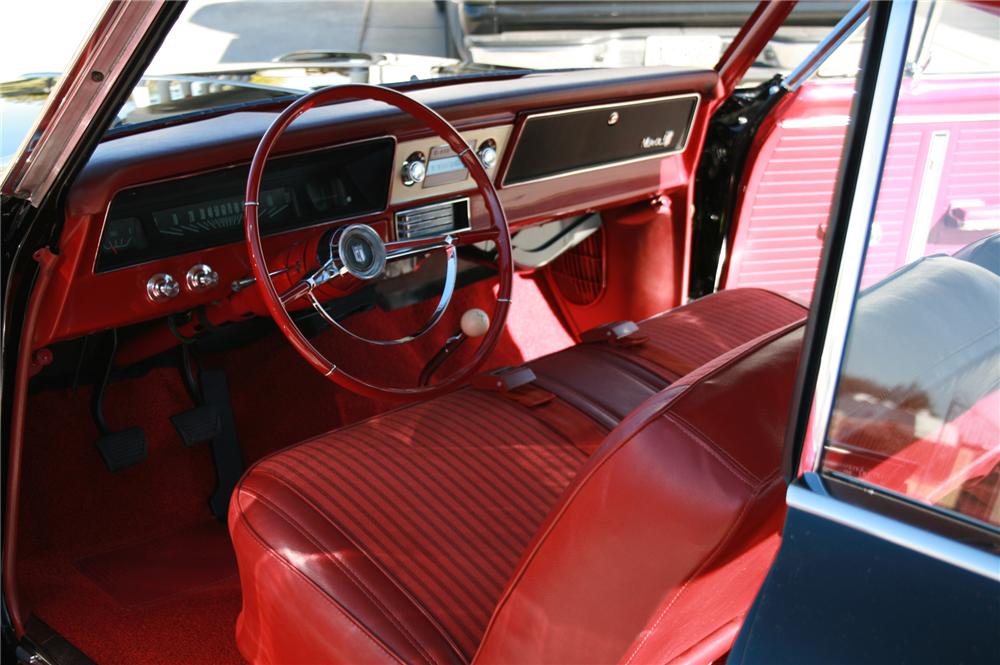
… to a 1969 Chevy Nomad …

… to a 1973 AMC Javelin …

… to the aforementioned Caprice …

… to the 1981 Chevy Malibu:

Most of these cars had merely a speedometer, gas gauge and odometer. The Javelin had the upgrade of a temperature gauge. My parents declined to buy the Caprice’s optional temperature and fuel economy gauge package. (Why a fuel economy gauge is helpful for a car rated at 13 city and 18 mpg is a good question.) Tachometers started becoming standard equipment during the 1980s, which is sort of ironic given that manual transmissions have been doing a slow fade for a couple of decades.
Gauges instead of idiot lights are helpful to be able to determine how your car is operating. If the oil light goes on, does that mean the engine is about to seize, or is it low oil pressure resulting from low oil level? If your battery is dying, it would be helpful to see a voltmeter show the battery or alternator putting out fewer volts before the battery light comes on and it’s probably too late.
It’s kind of ironic that the one car I’ve owned that had the complete set of instruments — speedometer, tachometer, fuel gauge, temperature gauge, voltmeter and oil pressure gauge — was also the worst car I’ve ever owned, the aforementioned Beretta GT:

My wife’s favorite car was the aforementioned Sunbird, which had a well-designed instrument panel, including its radio; too bad the tall had great difficulty getting in and out:
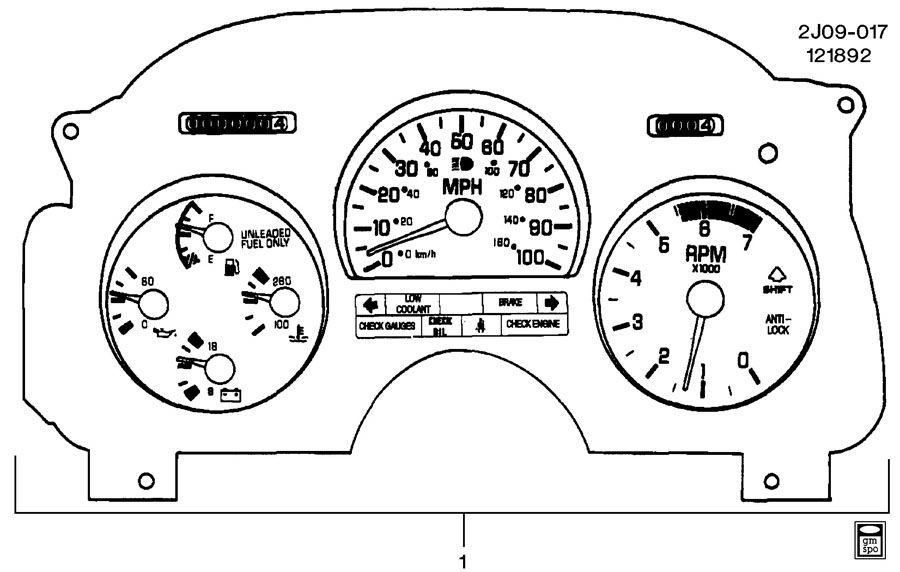
Time was when additional gauges were optional. The base Sunbird offered just a speedometer and fuel and temperature gauge. One level of options added a voltmeter and oil pressure gauge, and Jannan’s added a tachometer. The automakers now generally don’t offer additional gauges, consumer choice having lost out to efforts to improve build quality through fewer variations.
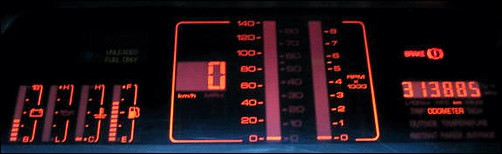
One innovation, if that’s what you want to call it, that reared its garish head in the 1980s was the option of all-digital gauges. I think one reason for the comparative lesser popularity of the fourth-generation Corvette is that between 1984 and 1989 drivers had to stare at this …
… which not only looks like an ’80s video game, but apparently dies, requiring increasingly expensive replacement. A similar instrument panel was available on the late ’80s Beretta, which I declined to purchase:
Since, other than the windshield, the instrument panel is what the driver looks at the most, badly designed instrument panels would drive me nuts. (For a few years in my youth, I drew instrument panels based on drawings in the owner’s manuals of cars of family and friends of my parents. Yes, I was a strange kid.) There were a few cars in the ’50s and ’60s where the interior designer got the brilliant idea of removing the zeroes from the speedometer, leaving the impression that the car could go no faster than 12 mph.
Top Gear’s most out-there instrument panel design comes from a Lancia Orca, a concept car in the height of the digital dashboard craze:
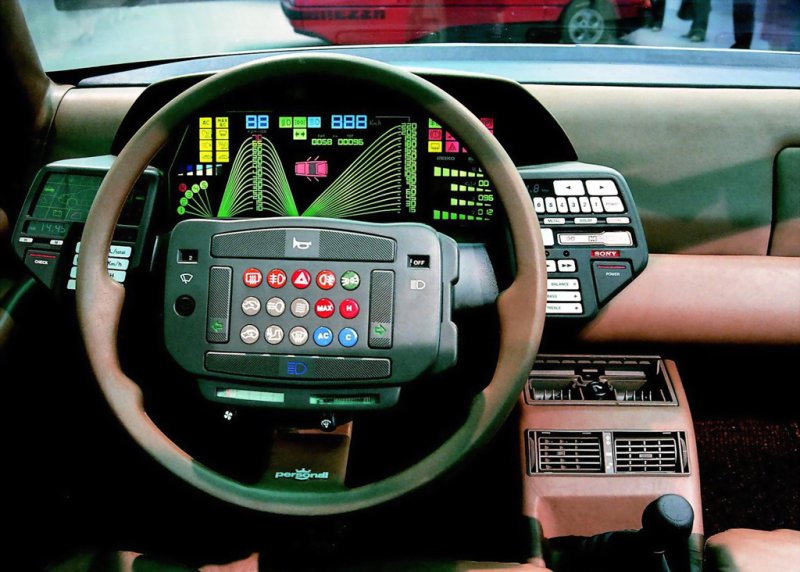
I think I could put 100,000 miles on this car and still not know how to do certain things with the car.
With increasing interest in ergonomics in the 1980s, car instrument panels started becoming less, shall we say, creative. In the late ’60s, a couple of GM cars featured speedometers with a drum-like display — the needle was stationary and the numbers rolled vertically by as the car sped up.

Some Lincolns had a thermometer-like speedometer — instead of a needle, a bar would go to the right as the car accelerated. Pontiac and Oldsmobile started putting controls on steering wheels in the ’80s and ’90s, which lasted until airbags started getting installed.
(A former employer of mine once owned an Olds Toronado with pushbuttons on the steering wheel. This proved to be a design flaw when he left the car windows open before a sudden rainstorm, and a few miles later the radio decided to increase volume to maximum level.)
One sign of how serious the car is (or so the carmaker wants you to believe) as a performance vehicle is the location of the speedometer vs. the tachometer. The Porsche 911 traditionally has had a five-gauge layout with the tachometer in the middle:


BMW’s Mini Cooper has the tachometer in front of the driver, and the speedometer and other gauges between driver and passenger:

The coolest interior option presently available on an American car might be the Ford Mustang’s MyColor option, where you can set your own favorite instrument panel lighting color, based on red, green and blue as with a TV. Two people with a lot of time on their hands created two guides for creating your own instrument panel colors. (My wife liked the red of her two Sunbirds. I recall the bright green of the aforementioned Javelin.)
No employee of a car manufacturer has ever asked me, but if they did, I would tell them that as far as gauges are concerned, more is better. If I ever got the money to do a car project where I could design my own instrument panel, it might have more gauges than an aircraft — speedometer, tachometer, fuel level and pressure, engine temperature, oil temperature and pressure, volts, engine vacuum, and who knows what else. A month ago, I spent an afternoon in my brother-in-law’s tractor–trailer, and while he was filling the trailer with corn I was trying to figure out what the gauges indicated. And numbers are preferable to letters; “C” and “H” don’t mean much on a temperature gauge.
Beyond that, I’m surprised the aforementioned MyColor option hasn’t been copied by other car manufacturers, because it is a great idea. (My Subaru Outback has white for the instruments and red for the air and audio controls.) I once drove a BMW that had three main air controls, for fan speed, temperature and outlets (the panel, floor and defroster outlets, plus combinations thereof), with buttons for air conditioning and rear defrost. I prefer that to trying to decipher an electronic display — how do I get the air to blow out of the air outlets? — and attempting to figure out whether I’d prefer the air at 68 degrees or 70. I’m fine with the headlight switch on the turn signal stalk and the wipers on an opposite stalk, but I prefer transmission shifters off the steering column — either on the floor or, as with newer Honda Odysseys and 1960s Dodge vans, on the instrument panel. And I’d like to be able to easily figure out, without consulting the owner’s manual, how to change the radio station.
This instrument panel from a Koenigsegg CCX certainly provides a lot of information, but not at one glance …

… similar to the Koenigsegg Agera:

The most exotic instrument panel I saw as a youth doesn’t count as very exotic today, but you can imagine why I thought it was:









 Steve Prestegard.com: The Presteblog