Graduates of the Class of ____:

Several jobs ago, I wrote a sample graduation speech for a weekly newspaper graduation section. I’ve had the chance to do this speech once, and this is the middle of the college and high school graduation season, so …

Members of the Class of 20__: Let me be among the first to congratulate you on your impending graduation. This event is called “Commencement,” not “Graduation,” because, even though you are ending something today, you are supposed to begin something new after today.I am under no misapprehension about my role here today. I fully realize that, in most cases, the only thing graduates remember about their commencement speaker is how long he or she spoke. I therefore resolve to give a speech that fits in between the two poles of speaking — between “Why did we bother inviting him if he was going to say that little?” and “Can you believe how long he talked?”. I also realize that I am one of the few people standing between you and your graduation party. So you can determine for yourselves if Shakespeare was correct in “Hamlet” when he had Lord Polonius say that brevity is the soul of wit.

I have three pieces of advice to give you today. You are, of course, free to follow this advice, or not.

The first is to stand up and speak out. Today, fewer than half of people bother to vote, and a larger percentage than that — most people, in fact — don’t bother to express themselves on issues of the day, whether that’s in a government meeting, the letters to the editor section of the local newspaper, or on a Web site. More than 1 million American soldiers died to preserve your right to stand up and speak out, whether or not — and perhaps, especially if not — your views adhere to conventional wisdom or are politically correct. Remember the words of Edmund Burke: “All that is necessary for the triumph of evil is that good men do nothing.” It is not that those who oppose your point of view are evil, but no one listens to the silent.

My second piece of advice is something it took me a long time to learn. You may be sick of where you are right now, ready to get out of school; you may think to yourself that, if I could only get out into the work world, or if I could get a higher educational degree, then my life will really begin. And then you may find your first job out of school is not only not what you really had in mind upon graduation, but that this job of yours is clearly beneath you, and you may think to yourself, if I could only find a better job than this, then my life will really begin. Or you may be dissatisfied with your social life, and you may think to yourself, if I could only meet a special someone, then my life will really begin. Or you may not really like where you live, and you may think to yourself, if I could find a bigger and better house, then my life will really begin.

I hope you can see where this point is going. Your life is what is happening while you’re waiting for your idealized life to begin. There’s nothing wrong with self-improvement, with looking to better your circumstances. But ultimately your circumstances should not define who you are or how you feel about yourself or your life. And if you’re determining your overall level of contentment based on your job, or your status, or how much stuff you have, I predict that you will have an ultimately unfulfilling life.

Finally: Go home. (I’ll pause now while your parents recover from the shock.) What I mean by “go home” is to remember where you grew up. A lot of you may have plans to move to a bigger metropolitan area — Chicago or Minneapolis–St. Paul, for instance — with the idea in mind that you’ll have more opportunities there. You should remember, though, that your education up through high school was paid for by your parents and your neighbors, whose tax dollars footed the bill for the education you have. More to the point: If you feel any connection to the area where you were raised, you should realize that if you want to see, for instance, jobs where people of your educational level can work, and jobs where people can afford to live in the same place where they work, or vice versa, it may be up to you to provide them. There are few places in the world where that kind of opportunity exists today. This is one of them.

Congratulations, good luck, and thanks for listening.

Presty the DJ for May 31

We started and ended with jazz yesterday, so it’s worth noting that today is the anniversary of the release of the first jazz record, “Darktown Strutters Ball”:

Ray Stevens’ “Gitarzan” reached number eight today in 1969 …

… the same day John Lennon and Yoko Ono recorded “Give Peace a Chance”:

Johnny Paycheck, who sang something everyone who’s ever worked for a living wanted to say at at least one point:

Mick Ralphs played guitar for Mott the Hoople …

… and Bad Company:

John “Bonzo” Bonham, drummer for Led Zeppelin …

… was born the same day as Mike Edwards of ELO:

Vicki Sue Robinson, a one-hit wonder of the ’70s:

This Corey Hart is not the Brewers’ centerfielder but the two-hit wonder of the 1980s:

Presty the DJ for May 30

Two more Beatles anniversaries today: “Love Me Do” hit number one in 1964 …

… four years before the Beatles started work on their only double album. Perhaps that work was so hard that they couldn’t think of a more original title than: “The Beatles.” You may know it better, however, as “the White Album”:

Birthdays today start with Benny Goodman, who asks us to …

Guitarist Lenny Davidson, one of the Dave Clark 5:

Drummer Nicky “Topper” Headon of The Clash:

Since we’ve already mentioned one woodwind player, we should mention another — today is the anniversary of the death of saxophonist Paul Desmond, who collaborated with Dave Brubeck on this classic:

Presty the DJ for May 29

This is more a pop than rock anniversary: One of the two funniest songs Johnny Cash performed, “One Piece at a Time,” hit number 29 today in 1976:

Birthdays start with Gary Brooker of Procol Harum:

Bassist Mike Porcaro of Toto:

Drummer Mel Gaynor of Simple Minds:

Here is a varied career: David Palmer played drums for ABC …

… and AC/DC:

Today is also the anniversary of the death of Jeff Buckley, who drowned today in 1997:

Presty the DJ for May 28

Paul McCartney must like releasing albums in May. Today in 1971, he released his second post-Beatles album, “Ram,” which included his first post-Beatles number one single:

Birthdays today include Papa John Creech of the Jefferson Airplane:

Gladys Knight:

John Fogerty of Creedence Clearwater Revival:

Roland Gift of the Fine Young Cannibals:

Kylie Minogue:

The first three-day weekend

Today starts Memorial Day weekend, the first of this year’s three three-day weekends and historically in Wisconsin, the three-day weekend of the most dubious weather.

This is the point where some commentators harrumph that Memorial Day, which is supposed to honor those who died in military service to our country, has instead become the unofficial first weekend of summer. (Which it is.) It’s not clear to me why those two things need to be mutually exclusive. It’s also not clear to me what setting Memorial Day at its old date, May 30 (which is actually Memorial Day this year), would accomplish.

The reason for Memorial Day was stated by Supreme Court Justice Oliver Wendell Holmes in 1884:

… It celebrates and solemnly reaffirms from year to year a national act of enthusiasm and faith. It embodies in the most impressive form our belief that to act with enthusiasm and faith is the condition of acting greatly. To fight out a war, you must believe something and want something with all your might. So must you do to carry anything else to an end worth reaching. More than that, you must be willing to commit yourself to a course, perhaps a long and hard one, without being able to foresee exactly where you will come out. All that is required of you is that you should go somewhither as hard as ever you can. The rest belongs to fate. One may fall — at the beginning of the charge or at the top of the earthworks; but in no other way can he reach the rewards of victory.

Memorial Day is a reminder of the cost of the reality that there are some things worth fighting for. As has been said by many others, freedom is not free. At the World Economic Forum in Switzerland in 2003, former Secretary of State Colin Powell was asked by the then-Archbishop of Canterbury whether the U.S. relied too much on “hard power,” the military, instead of “soft power,” diplomacy. Powell’s answer:

“We have gone forth from our shores repeatedly over the last hundred years and we’ve done this as recently as the last year in Afghanistan and put wonderful young men and women at risk, many of whom have lost their lives, and we have asked for nothing except enough ground to bury them in, and otherwise we have returned home to seek our own, you know, to seek our own lives in peace, to live our own lives in peace. But there comes a time when soft power or talking with evil will not work where, unfortunately, hard power is the only thing that works.”

(More from Powell on Memorial Day can be read here.)

In contrast, the live version of Bruce Springsteen’s remake of Edwin Starr’s “War” begins with these deep thoughts: “… Blind faith in your leaders, or in anything, will get you killed.” (Did he mean his wife, his family, God or whatever religion he has, too?) As for the premise stated in the song’s refrain — “War! Huh! What is it good for? Absolutely nothing!” — the survivors of several concentration camps and other victims of Nazi Germany may have a different opinion. For that matter, the fact that one-fourth of the Cambodian population was killed after the end of the Vietnam War suggests that U.S. withdrawal from Southeast Asia may not have been the best thing for Southeast Asia.

You can argue the merits of the war in Iraq, or how the Bush and Obama administrations are prosecuting the war on terror. (As if there’s a difference.) You can even argue whether World War I accomplished anything except for paving the way for World War II. The idea, however, that war is something that can be eliminated if we just all resolve to get along assumes that human nature can be defeated, and that there’s no moral difference between sides. Would pacifists be pleased with a country where the southern third of it owned slaves and no one did anything about it because all viewpoints, even a viewpoint that approved of enslaving human beings, are valid?

John Stuart Mill put it best:

War is an ugly thing, but not the ugliest of things. The decayed and degraded state of moral and patriotic feeling which thinks that nothing is worth war is much worse. The person who has nothing for which he is willing to fight, nothing which is more important than his own personal safety, is a miserable creature and has no chance of being free unless made and kept so by the exertions of better men than himself.

As with many things, the real spirit of Memorial Day can be best found in small towns. (In a general sense, those who live in small towns seem much more rooted in reality and traditional values than the big-city elites.) Back in my weekly newspaper days, I wrote an annual story previewing Memorial Day events, with members of the American Legion and Veterans of Foreign Wars visiting any cemetery in which a veteran was buried. The observance culminated in a small parade and program at the high school, where “In Flanders Fields” would be read and “Taps” would be played. (I was a bugler in Boy Scouts, so I played “Taps,” though never at a funeral.)

Our traditional Memorial Day weekend plans are to head southwest to the in-laws, so my wife can see her sister and brother and our children can see their aunts, uncles and cousins. The fourth Saturday of most months is the scheduled date for the steak fry held by the Jacob J. Berg–Albert A. Averkamp VFW Post 5276 in Potosi, across the street from the original site of the Potosi Brewery. I have been attending Potosi steak fries for 18 years, usually preceding them with a Brandy Old Fashioned, the official mixed drink of Wisconsin.

On the Sunday of Memorial Day weekend is the annual Glen Haven Fire Department Catfish Fry, with my four favorite words: “All You Can Eat.” Glen Haven is, I believe, one end of Wisconsin, just as Northport is the other end — the county highway that goes into Glen Haven dead-ends into a Mississippi River boat landing, and even though there are roads northwest and southeast out of Glen Haven, it feels like that’s the end of the state.

Memorial Day has turned into an occasion to remember not just military dead, but members of the family who have passed on as well. The weekend includes a visit to my in-laws’ section of Hillside Cemetery in Lancaster. Most years, if it works schedule-wise, I stop this weekend at Resurrection Cemetery in Madison, the gravesite of my older brother, who died of a brain tumor before his second birthday, a year before I was born. The saddest part about that is that he is buried in a section of the cemetery that was reserved in the early 1960s for babies and young children, many of whom died younger than he did. And yet there’s something about having your own children running around a cemetery — strange as it sounds, it’s a reminder that life does go on.

Resurrection Cemetery is also the final resting place of someone who grew up in Madison the same time I did, comedian Chris Farley. (I highly recommend his biography, The Chris Farley Show: A Biography in Three Acts, cowritten by his older brother. Since I read it, I’ve been trying to figure out where our paths crossed; he was born and raised in the Madison area and attended Edgewood High School, graduating one year before I graduated from La Follette High School. I think our paths might have crossed at an Edgewood–La Follette football game in 1980 or 1981; he played defensive line, and I played trumpet.)

This weekend makes one think what this nation’s military dead died for. “They died for our country” is the obvious answer, but what does that specifically mean? Joseph Campbell defined a hero as “someone who has given his or her life to something bigger than oneself,” which our military dead certainly did. In the case of this country, “something bigger” isn’t just the flag or something that symbolizes our country; it’s all the things, great and small, that make up our way of life — our right to make a living the way we want, to live where we want, to express opinions about the state of things and to express ourselves in other ways — even something seemingly mundane like three-day weekends.

Jack Buck, one of the great sportscasters, was a World War II veteran who survived the Battle of the Bulge. He visited Normandy, the site where the Allied invasion of Europe began on D-Day, and, upon seeing visitors to the cemetery in a less-than-solemn mood, penned this poem (from his autobiography That’s a Winner):

They chatter and they laugh as they pass by my grave
And that’s the way it should be.
For what they have done, and what they will do, has
nothing to do with me.
I was tossed ashore by a friendly wave
With some unfriendly steel in my head.
They chatter and they laugh as they pass by my grave
But I know they’ll soon be dead.
They’ve counted more days than I ever knew
And that’s all right with me too.
We’re all souls in one pod, all headed for God
Too soon, or later, like you.

President Benjamin Harrison gets the last word about the holiday formerly known as Decoration Day:

I have never been able to think of the day as one of mourning; I have never quite been able to feel that half-masted flags were appropriate on Decoration Day. I have rather felt that the flag should be at the peak, because those whose dying we commemorate rejoiced in seeing it where their valor placed it. We honor them in a joyous, thankful, triumphant commemoration of what they did.

The Class of 1983

What you are about to read was first written in July 2008, which was Reunion Month at the Prestegard household — my high school’s 25th class reunion, followed two weeks later by my wife’s 25th class reunion.

That makes us two of the older members of Generation X, which means we supposedly are slackersunhappy at workseeking balance between work and lifewanting independence to do our worktech-savvy, blunt, independent, skeptical, knowledge-seeking, and so on. And, according to this, we Gen Xers believe Generation Y suffers from Attention Deficit Hyperactivity Disorder. (Damn kids.)

I am skeptical about generational attributes, although some are probably valid since people of similar age have common experiences. My personality wasn’t changed by Ronald Reagan’s election to the presidency in 1980, although my worldview was. Unlike many of the people with whom I graduated from college (23 years ago this year, the year I turned 23 — yes, my college graduation was half my life ago), I had a job lined up almost two months before I graduated. Is the fact I didn’t get married until I was 27 an attribute of my generation, the result of my exciting single social life, or merely due to the fact that my wife-to-be took her own sweet time returning from her Peace Corps service in Guatemala? (As if she was supposed to know about a timetable that didn’t exist.)

La Follette High School in Madison is certainly not the same place I went to high school (nice to see, though, that the principal and other administrators are alumni; the current prinicipal, who replaced another alumnus, was a sophomore my senior year), and it’s not the same high school whose athletes I covered for a weekly newspaper while I was in college. (I figured that out the first time I read about drive-by shootings at La Follette.) There are four public high schools in Madison, and when I was in high school, West was where the university professors’ children went, Memorial was for the West Side snobs, East was for the blue-collar families (although Maple Bluff residents also went there), and La Follette was the high school of the East Side white-collar families. (The demographics at La Follette have changed substantially since my days there.) Our biggest rival was East, as demonstrated by the police presence at La Follette–East hockey games — common today, but not in those days. (And speaking of hockey, my class provided Madison’s, and perhaps Wisconsin’s, first female varsity hockey player, Sue Mussey, who went on to play at Providence.)

Four years ago, after my aunt’s funeral, I drove past La Follette, since the mausoleum my aunt chose as her final resting place is in the neighborhood, to show our children where I went to high school. Out front, I saw a Madison police car and a Madison TV reporter doing a story about some kind of incident there. In the four years I went to La Follette, the only incident worth a TV story that I recall was a large underage drinking party outside of Madison put on by the class of 1982 on Senior Skip Day. (The biggest incident involving our class, about which speculation still occurs, was an epic food fight at lunch outside one day. It probably is a Rashomon-like experience for those who witnessed it or participated in it.)

La Follette was a good place to go to high school, although with more than 2,000 students, it’s not as if I knew that many people with whom I graduated. As with attending large colleges, you’re better off joining groups of people with whom you have common interests. In my case, that was the La Follette bands (directed for two years by an alumnus of and assistant for the world famous University of Wisconsin Marching Band) and the student newspaper, The Lance. (Not named for someone named Lance, but a short version of the athletic nickname, “Lancers.”) My first big journalism moment was covering a controversy that took place over a group of cheerleaders who quit due to some kind of conflict with the athletic director. (And that’s all the details I remember after more than 25 years.)

Those kinds of student groups, though, mean that you spend less time with your own classmates, since groups like those include students your age, older than you, and younger than you. (My first girlfriend, who I met in the band, was in the aforementioned Class of 1982, although she was not present at the epic drinking party.) Until I joined Facebook, there wasn’t anyone from the Class of 1983 with whom I’ve kept in even semi-regular touch since graduation. It’s not as if I deliberately shunned my classmates (a group of us attended the same schools from first grade to graduation), although I didn’t pine for my high school days after graduation either. Our paths simply went in different directions after graduation.

Our class’ biggest accomplishment (other than winning the Homecoming class competition three years in a row, which is not something most people put on their résumé) was our contribution to La Follette’s state championship in Class A boys basketball in 1982, our junior year. La Follette’s team included one starter who went on to become the University of Wisconsin’s fifth leading men’s basketball scorer, another (a classmate of mine) who also played Division I basketball at Western Michigan, and another starter who played football at Wisconsin and with the New England Patriots. And yet La Follette, with five regular-season losses, was the underdog in the Class A championship game against Stevens Point, which was undefeated going into the title game … but not undefeated afterward. (As it happens, Stevens Point’s leading scorer played for Wisconsin, where he was a teammate of his state championship game rival. Also as it happens, his sister opened a PR firm in Appleton; her reaction to the state title game was different from mine.) My contribution to the state championship was in the band.

(Watching the game 25 years later, I was struck by (1) the quality of that game, final score 62–61 in a game played years before the three-point shot came to high school; (2) the amazing free throw shooting (one miss in the entire game … by the losing team); and (3) how free-flowing the game was, even though neither team would be considered an up-tempo team. In contrast, the style of Wisconsin high school basketball these days is much lower-scoring, much more defense-oriented, and not particularly fun to watch if you have no rooting interest.)
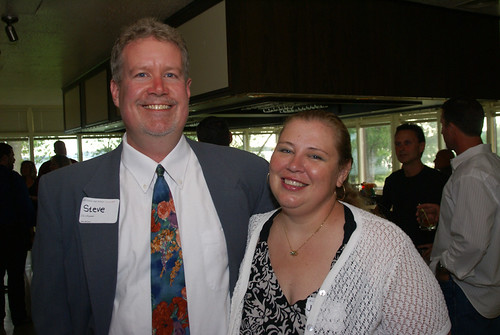
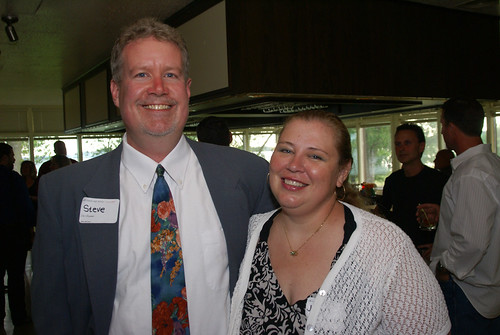
After attending my 10th class reunion (also the same month as hers), my wife noted that she had more in common with my classmates than with hers. That’s probably the difference of going to a suburban high school with expectations that graduates would go to college, vs. going to a rural high school where more people didn’t go on to college than did. (One result: Her class has a larger proportion of grandparents than mine.) I think she is the only member of her class who graduated from college and then went to the Peace Corps.

The La Follette Class of 1983 graduated at the University of Wisconsin Fieldhouse June 4, 1983. (One of the speeches can be read here.) With more than 500 graduates, it’s pretty remarkable to note that everyone who was there for day one in August 1979 and didn’t drop out or move away was still there for graduation. In other words, none of my classmates died while I was in high school; there were no memorial pages for seniors in the La Follette 1983 yearbook.

Of course, that wasn’t the case for long. Since graduation, 15 have died (and possibly more since the whereabouts of 145 of us can’t be found). The deaths I’m familiar with include car crashes, a racing accident, and a heart attack (someone with Down Syndrome or something like it). For a while, every time I picked up a Sunday Wisconsin State Journal, I read an obituary of someone I knew.

Unless you had a miserable high school experience, class reunions are a choice between dread at going and regret that you didn’t. The former is in the inevitable comparisons between yourself and your classmates — who has aged better than you have, who is more successful than you are, who has experienced more horizontal growth (in my case, about 60 pounds of horizontal growth), who has become follically challenged, will your ex-girlfriend be there, etc.

The latter comes after you find out that you actually get along with your classmates better now (at least for one weekend every five years) than you did when you were in high school. In the hormonally and emotionally supercharged environment of high school, if you are not a loner, you’re competing for, among other things, grades, athletic-team playing time, opportunities for what our student handbook called “Inappropriate Displays of Affection,” placement in band, and favored jobs. Since high school is not a place where emotional maturity can usually be found, slights occur, feelings get hurt, and grudges build. (That’s my experience as a male; for females, take this paragraph and multiply by 50.) After a while, though, for those who attend, the negatives don’t matter; those for whom the negatives matter simply don’t go to their reunions.

Class reunions also are a reminder of the march of time. La Follette opened in 1963, and if you do the math, you’ll discover that the Class of 1983 went to La Follette during the first half of the school’s existence to date. (Sigh.) I notice that “oldies” radio stations such as WOGB (103.1 FM) and WVBO (103.9 FM) have now decided that ’80s music fits into their programming. Yes, we are the generation that foisted Madonna, Duran Duran, Culture Club, Twisted Sister and heavy metal upon the world. Judge the music of 1979198019811982 and 1983 for yourself.

(Before any snide comments from you Baby Boomers out there: May I point out that the Four Seasons’ 1975 hit “December 1963 (Oh What a Night)” depicts an event that occurred nearly 50 years ago. Moreover, disco is your fault. You’re welcome.)

It’s odd to suddenly be in a favored retail demographic. Almost as odd as having music you listened to in high school be on an oldies radio station. Or realizing that everyone with whom you graduated from high school is now between 45 and 47.

Presty the DJ for May 27

Today in 1975, Paul McCartney released “Venus and Mars” (not to be confused with “Ebony and Ivory”):

Birthdays include Ramsey Lewis:

April Wine drummer Jerry Mercer:

Left-wing singer Bruce Cockburn:

Bass player Pete Sears of Jefferson Starship:

Neil Finn played for Split Enz …

… and Crowded House:

Eddie Harsch (born Edward Hawrysch in Canada) played keyboards for the Black Crowes:

Alice in Chains drummer Sean Kinney:

And finally for those from the ’00s (aughts?) Andre 3000 of OutKast:

Venturing capital, or, If not this, then what?

When people on opposite sides of the ideological divide are skeptical about something, you too should be skeptical. (When they agree on something, you should also be skeptical, but that’s a subject for another day.)

Milwaukee Magazine’s Bruce Murphy and the Milwaukee Journal Sentinel’s Patrick McIlheran are similarly skeptical about the venture capital bill in the Legislature. So is Thomas Hefty, who has for years campaigned for a better business climate in this state.

One reason for our business climate problems is the small amount of venture capital — money invested in companies that usually fit in the “high risk/high reward” investment category. Promoting venture capital was part of nearly every economic development study conducted in 2010 in advance of the election.

The Milwaukee Journal Sentinel reports:

The program is called the Jobs Now Fund and represents part of the $400 million Wisconsin Jobs Act. It aims to jump-start job creation in Wisconsin by promising $200 million in future tax credits in exchange for $250 million raised from insurance companies.

The money would be invested in Wisconsin businesses through management companies known as certified capital companies, or “CAPCOs.” …

In written testimony submitted for the hearing, Tom Hefty, the former chief executive of Blue Cross/Blue Shield of Wisconsin, called the program “the largest special interest Wisconsin tax cut in history masquerading as an economic development initiative.”

The $200 million in tax credits would never have to be repaid to the state. The payback, supporters say, would come from the job creation and business growth that would result from the investments.

There is no question this state needs more business investors. Not only have we lagged the national average in personal income growth for the past three decades, but we are low on business start-ups as well. (And for all the left’s braying about the evil “rich,” Wisconsin has very few people who could be defined as really “rich,” which helps show the state’s economic problems as well. The fact that the really “rich” can be named by those who pay attention to such things shows we don’t have nearly enough of them.) The question is how to encourage business investment, particularly in the fast-growth companies that were meant for venture capital.

Wisconsin Technology Council President Tom Still explains how the bill would work:

 The bill would create two funds totaling $400 million under the umbrella of a new Wisconsin Venture Capital Authority. The complementary funds — the Jobs Now Fund and the Badger Jobs Fund — are designed, respectively, to address Wisconsin’s short-term and long-term investment needs.

The proposal builds on the success of the widely acclaimed and often duplicated Act 255 Tax Credits, which were passed in 2005 and enhanced in 2009. Those tax credits have helped enhance early-stage investing in Wisconsin — but largely at the “angel” capital level, thus creating a need for follow-up investing by venture capital firms in emerging companies.

The credits helped spawn angel networks across Wisconsin, and those networks have dramatically increased both the number of deals and the dollars invested in those deals. But many angels are tapped out. They need “exits” — company mergers, acquisitions or venture investments — to recoup their money. And the companies in which those angels have invested are struggling to survive.

Senate Bill 94 would create the Wisconsin Venture Capital Authority and two funds:

The Jobs Now Fund is envisioned as rapid-response fund. It would issue $200 million in tax credits to insurance companies over time in return for investments in certified capital funds. The tax credits would be for 80% of the value of the investments made, so $200 million in credits could attract $250 million in investments. The credits could not be claimed for a minimum of five years, so the money would be put to work well before the credits are paid. It would invest only in Wisconsin companies that meet specific guidelines. In other states, this approach is called a “certified capital company,” or CAPCO, approach.

The Badger Jobs Fund is the longer-term tool. It would invest in qualified venture capital funds on a “fund of funds” basis. The authority could issue up to $200 million in private placement bonds for the Badger Jobs Fund, with the bonds supported by investment returns, the incremental growth of state tax collections from financed companies and contingent tax credits. Bonds would not be a debt of the state, and no more than 15% of the funds could go to any single venture capital firm. For every $1 a qualified venture capital fund receives from the Badger Jobs Fund, it would need to raise $3 on its own.

Murphy goes so far, commenting on the Journal Sentinel story, as calling the Jobs Now Fund a scam:

… the law allows the CAPCOs to keep all the money invested in them by the state, plus 80 percent of the profits generated.  Critics have called it a “massive corporate giveaway,” [reporter Kathleen Gallagher] writes.

One new point in her story is a Minnesota study of Wisconsin’s earlier CAPCO program, which found that rather than increasing it may have actually displaced the total amount of venture capital funding in Wisconsin. …

The language of the bill is quite convoluted, and most legislators never understand it.  I’d love to hear a detailed explanation of the Wisconsin bill by its sponsors, Sen. Randy Hopper (R-Fond du Lac) and Rep. Gary Tauchen (R-Bonduel).

The CAPCOs have a set game plan and typically grab all the state funding before any real venture capital companies can get a dollar of it. “Local venture capital people often support the bill because they think they’ll get the money,” says [Rutgers University Prof. Sass] Rubin. “But they never do. It’s a con.” …

Rubin cites an earlier law passed in Wisconsin, a 25 percent tax credit for angel investors, as a far more sensible way to go. “It’s just enough money to encourage investment, but you’re not screwing up the market and becoming the only reason they invest.”

Rubin’s aforementioned position happens to dovetail with a previous Murphy column that describes CAPCOs thusly:

Wisconsin previously passed a CAPCO bill in 1998 which created a $50 million venture capital fund.  Normally, experts say, a venture capital fund attracts money from investors, invests it in start-up companies and then returns the principal plus 70 to 80 percent of the profits to the investors. But under the CAPCO model, the state was the investor and got nothing back: None of the profits flowed back to it, and none of the principal was returned.

The state Legislative Audit Bureau found it cost $90,000 per job for that CAPCO program. That’s an outrageous cost, but actually better than the experience in most states. Florida spent $150 million and lost 150 jobs. New York spent $280 million but lost 88 jobs.

A study done for the National Association of Seed and Venture Funds found that state subsidized CAPCOs  gained  “10 times the return” of unsubsidized companies.

One problem is that your favorite lefty (go here and find the list under “Left” for starters) inevitably describes anything that promotes business development, including business investment, as a giveaway for the “rich.” The same people President Obama has been ordering to hire more employees are the same people accused of trying to run the state (the Koch brothers, owners of Georgia–Pacific, one of this state’s largest employers), ruin the state (any business that objects to the overregulation of the Department of Natural Resources), or rob the state (any business person who complains about the state’s tax hell, as in the fourth highest state and local taxes in the U.S.).

Tax credits for business should not be used because businesses should not be taxed on their income. The benefits of a profitable business — employees being paid, customers being served and contributions made to their communities — are sufficient to our society if a business was not taxed on any of its income. And businesses don’t pay taxes anyway; every tax assessed on a business — corporate income taxes, personal property taxes, payroll taxes, and taxes to fund Unemployment Compensation, among others — is part of what the business charges for its products or services. Every dollar of cost government dumps upon a business means one less dollar that can go into employee salaries, into owner dividends (and half the households in this country are in the stock market, directly or indirectly), or back into the business.

McIlheran identifies the specific problem and the general solution:

The plan would offer $200 million in future tax credits to insurers not because anyone likes them but because they’re giant pools of investment money. They’d put up the cash, $250 million, that other management companies would parcel out to entrepreneurs, and the tax credits would ensure they wouldn’t lose their shirts. The credits are a lure, nothing more.

Still, why the special inducements? Why the tax gimmicks, which are what high-tax, regulatory hells offer? Why not stick with the program of making taxes more reasonable generally and regulation more rational for all? Sen. Glenn Grothman called it “the most dubious giveaway I’ve seen since I’ve been in the legislature,” and Tom Hefty, Mr. Business Climate, calls it suspect. Experts get quoted by the Journal Sentinel as saying it’s a deal of dubious worth.

Hit the brakes. Read the prospectus carefully, as they say in those ads, because if forgoing future tax revenue is to be considered an investment in luring capital to Wisconsin start-ups, it isn’t an investment that state lawmakers have spent enough time examining.

The “tax gimmicks, which are what high-tax, regulatory hells offer,” were the preferred approach of the Doyle Administration. They worked well for the companies that were able to take advantage of them. They were better than no tax incentives at all, but the state’s business climate certainly did not improve during the 2000s. Had the state’s business climate improved at all, then the trend of per-capita personal income growth trailing the nation’s, which started during the Patrick Lucey administration (for those ignorant of Wisconsin political history, Lucey was governor in the 1970s), would have ended during the Doyle administration. It hasn’t.

There is also a potential problem with any kind of state-sponsored venture capital approach that has been demonstrated  by the alternative energy industry in the past few years. The Obama administration has offered huge amounts of tax credits to encourage use of wind and solar power and other green energy technology. People and businesses take advantage of the tax credits, and then when they expire, business drops off the face of the earth, so to speak. And one should hesitate when the government anoints a preferred business sector (in the present case, any business with the word “green” in its title), because government operates on politics and not on what is the best potential investment.

I do not believe the proponents of this bill are trying to perpetuate a scam on the state. I think there are reasonable objections to what they propose that are more meaningful than the reflexive anti-business attitude we’ve seen in this state for far too long. It is, for one thing, easier to pass one bill than to pass an entire program, contained within several pieces of legislation, to eliminate business taxes, cut personal income taxes, reduce regulation and defang the regulators. That is what needs to happen in Wisconsin.

Presty the DJ for May 26

Another Beatles anniversary today: Their “Beatles 1967–1970″ album (also known as “the Blue Album”) reached number one today in 1973:

Levon Helm, drummer for The Band:

Terrence Verdan “Phally” Allen, keyboard player for Mott the Hoople:

Gary Peterson of guess who? The Guess Who:

Stevie Nicks:

Patti Smith Group pianist Richard Sohl:

Lenny Kravitz, who though he records in this century sounds as if he recorded about 40 years ago:

Kristin Pfaff, bassist for Hole: