Tonight through Saturday night at the UW–Madison Kohl Center:
No comments on The flying band director returns
Tonight through Saturday night at the UW–Madison Kohl Center:
My efforts to avoid political advertising around elections meant I missed this …
… specifically this shot:
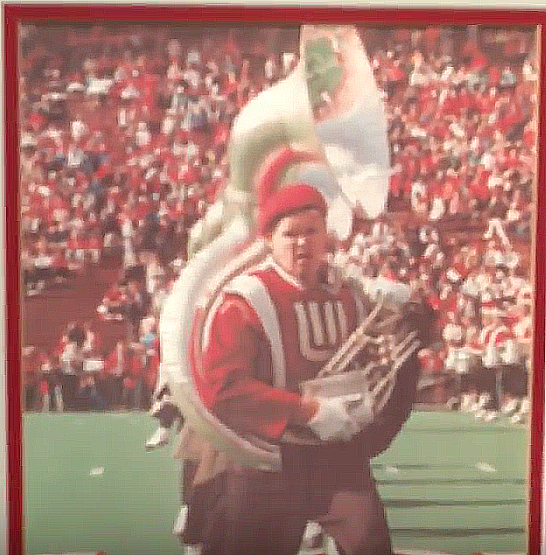
That is future Sauk County Circuit Judge and state Supreme Court candidate Michael Screnock, a tuba player in the UW Marching Band (whose annual concerts in the Kohl Center are April 19–21, by the way) while I was a trumpet player in the world’s best college marching band. (Mike — I mean, Judge Screnock — graduated in 1990, two years after I did, which means we are both of the era when the band didn’t get to perform at bowl games and NCAA tournament games because UW didn’t play in those games.)
A sign of my advanced age, or something else, is that I have personal connections with at least four present members of this state’s judiciary. One of my coworkers (with whom I shared political ideology) at my only daily newspaper job is now a Columbia County judge. One of my high school classmates (with whom I did not share political ideology, to put it mildly) is now a state administrative law judge. One of the two local circuit judges (with whom I have never discussed politics) was a teammate of mine on the softball team of my first full-time employer, a team utterly lacking in athletic talent with few exceptions (one of them being a guy nicknamed “Baseball”), yet somehow not the worst team in the league.
Even though I haven’t paid attention to the commercial, this mailer from the Republican Party of Wisconsin appeared in the mail yesterday:
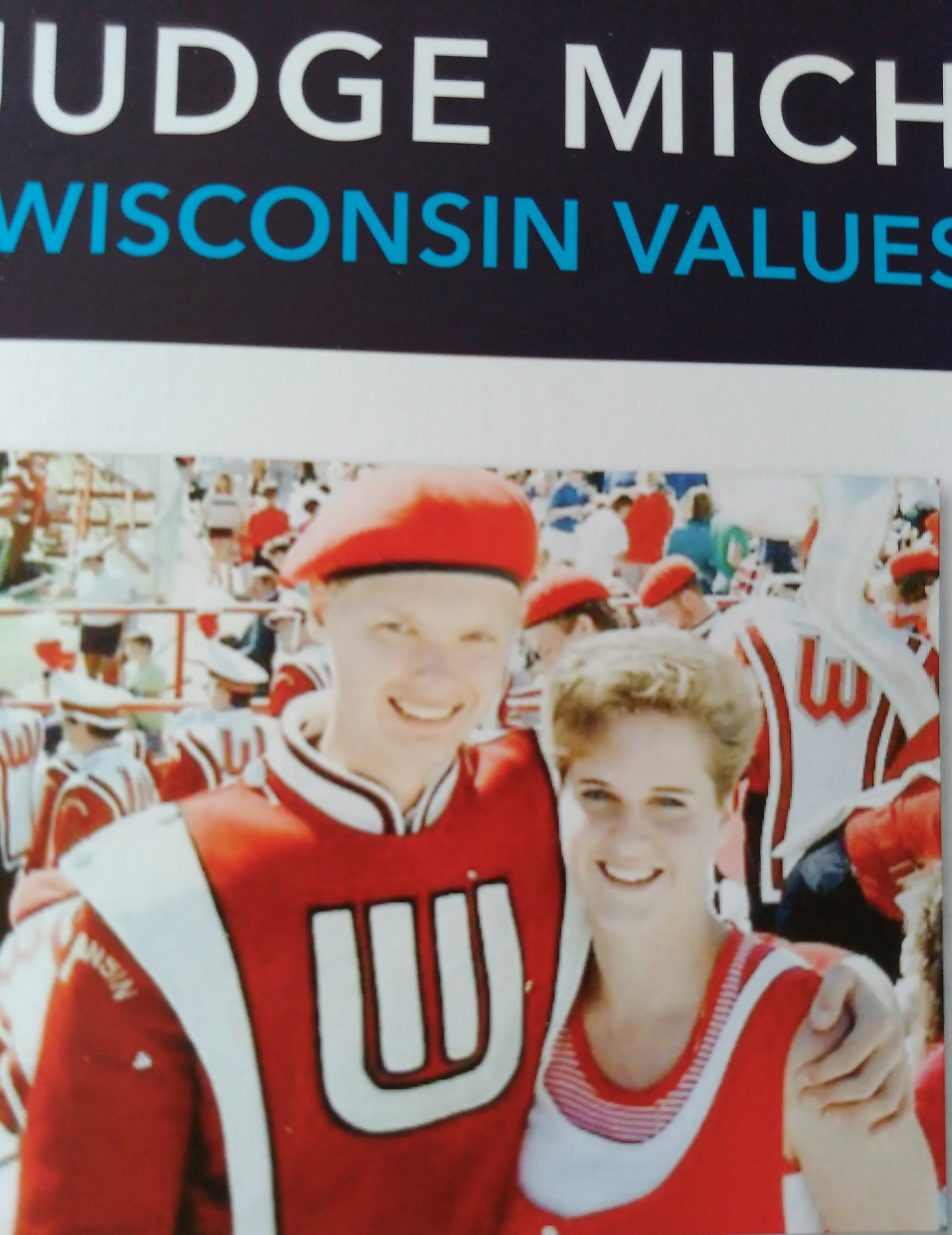
It should be obvious (but requires saying in our hyperpolitical times) that the UW Marching Band does not endorse political candidates, then or now. (Including in 1978, when UW Marching Band members played on the school bus procured by or for Republican gubernatorial candidate Lee Dreyfus.) At least in my (or our) day, I think it’s safe to say that band members skewed rightward, perhaps in part because there were more of them from small towns than from Madison (including, yes, me) and Milwaukee, or because we had some military reservists in our ranks, or because we were in the band during the Age of Reagan. (One of the aforementioned reservists finished a concert at the State Capitol by exhorting a vote for Reagan, “the official presidential candidate of the UW Band!”, which wasn’t met with unanimous agreement in the band. However, Reagan did win Wisconsin.)
Then again, politics in the 1980s, certain victims of Reagan Derangement Syndrome notwithstanding, was not as stupid as it is today. Every part of Madison skewed Democrat, but no adult I knew — that is, the parents of my classmates and friends — took the extreme leftist viewpoints that appear commonplace today in the People’s Republic of Madison. Politics obviously got discussed at UW–Madison, and even at my high school, but not to the extent it is today, certainly not with the nasty tone of today (with the exception of those were seen as a few bubbles off plumb), and people rarely made personal decisions (as far as I was aware of) based on political considerations. (An exception: My high school journalism teacher refused to take us to Madison Newspapers Inc., a place budding journalists might like to have seen, because the Wisconsin State Journal and The Capital Times broke the newspaper strike. On the other hand, we didn’t go to field trips anywhere, which may have been for nonpolitical reasons, and we got to talk to reporters in our classroom. I was in fifth grade during the state’s last teachers’ strike, but I don’t recall the subject coming up at all after the strike ended.)
The band certainly was and is patriotic, and that came from the top. In those days, and I assume today, the National Anthem was preceded by a patriotic drill that started with “Songs to Thee Wisconsin,” and then included some combination of “Bound for the Promised Land,” the spiritual “Simple Gifts” (from which came part of Aaron Copland’s “Appalachian Spring”), versions of “God Bless America” and “America the Beautiful,” and like songs. That was probably a bigger challenge when UW Band director Mike Leckrone arrived on campus during the height of the anti-Vietnam War movement.
There were a few political moments, but not many in my band days. One inadvertent controversy came when, during a debate over whether the band should play “You’ve Said It All” …
… selected because fans at the 1973 NCAA hockey tournament wanted a polka …
… which became a country song …
… that when Budweiser used it in its commercials was criticized for allegedly promoting drinking …
… Leckrone pointed out, correctly, that the melody of “The Star Spangled Banner” came from a British drinking song, “To Anacreon in Heaven.”
(For those who think political issues have metastasized into ridiculousness in the 21st century, I present this as evidence that this has been the case longer than you might think.)
I somehow managed to miss band members’ playing at an appearance of Gov. Anthony Earl shortly before he lost the 1986 election. I did, however, play at an event for state Sen. Carl Otte (D–Sheboygan), because I was told he was a “friend of the Band,” and more importantly for the free food and beer. (Afterward we ended up at a tavern — I’ll pause to allow readers to recover from the shock of that statement — to see Earl and a couple of his aides playing cribbage at a nearby table.) The band has also played for governors since Earl. If the governor calls, what are you going to do?
Which brings to mind this amusing paraphrased story from Rick Telander’s book From Red Ink to Roses: The band generated some more controversy by greeting the Chicago Bears as all Wisconsinites should during a Packers game at which the band played. That apparently prompted a phone call from Gov. Tommy Thompson (a Republican) to UW–Madison chancellor Donna Shalala (not a Republican), during which (perhaps not with complete seriousness) Thompson asked Shalala what she was going to do about the band. To that, Shalala replied that she couldn’t very well reprimand the band for telling the truth.
The biggest political incident in my band days came before the 1984 UW–Ohio State football game, which (in those days when not every game was on TV) was nationally televised by CBS. That meant an 11:05 a.m. kickoff, which pushed everything else back from the usual 1 or 1:30 p.m. starts. We played the National Anthem around 10:45 a.m. When we got to the line “And the rocket’s red glare” there came a sight so bizarre that it didn’t register at first — people running on the field past us. They were members of the anti-nuclear dance group (really) Nu Parable, previously known for getting kicked out of Madison shopping malls for their mime-like “die-in” in which they simulated becoming victims of a nuclear attack. This was during the 1984 presidential campaign, when left-leaning UW students (but I repeat myself) were absolutely convinced that, having inexplicably failed to destroy the world in a giant mushroom cloud during his first term, Ronald Reagan would certainly accomplish that feat during a second term in office.
The crowd’s reaction was probably not what Nu Parable had in mind — booing once fans figured out what was going on, accompanied by the student section’s chanting “Nuke ’em!” A few of them made the mistake of “dying” in front of band members (unfortunately, not me), who literally marched over them, with one of the Nu Parables getting literally punted by a Marine reservist.
After we were done playing, a few of us went over to watch them get arrested by UW police. One of them was our drum major, who always reminded me of the Grim Reaper. If looks could have killed, there would have been no second Nu Parable die-in, because they all would have dropped dead on the spot. As it was, when they had another “die-in” before the next pre-election home game, they stayed away from the band.
The obligatory inside joke here is my having to contemplate voting for a tuba player. (The obligatory inside joke follow-up is that, I suppose, that beats having to vote for a reed-sucker.)
Readers could correctly conclude that I planned on voting for Screnock before this anyway. Our common experience in the band taught us the value of hard work whether or not anyone notices, doing more than you physically (and otherwise) think you can do, the esprit de corps of being in the world’s best college marching band, and a term you hear a lot of today — accountability without excuses or blaming someone else for your own faults and problems. That doesn’t make the UW Band a right-wing organization, and if anyone thinks it does, they are wrong. If hard work, exceeding your self-imposed limits and personal accountability are values out of favor with liberals, that is their fault.
As for Screnock’s opponent, who announced earlier this week that she has “San Francisco values,” greater San Francisco includes Palo Alto, home of Stanford University and the abomination known as the Leland Stanford Junior University Marching Band …
… known for this list of things, and of course acting as tackling dummies.
Compare and contrast:
The other thing Judge Screnock and I have in common is that we grew up in an era where not everything, even on the UW–Madison campus, was political. As you know, the words “change” and “progress” are not synonyms. (Though I suspect Screnock and I would both agree that change in UW football and basketball since we were in the band is both change and progress.)
UW Marching Band director Mike Leckrone had this to say at the band’s 2017 banquet:
Leckrone and his wife, Phyllis, had been together since seventh grade. They were married for 61 years. Mike has been the UW Band director for 49 years.
When Phyllis died I wrote that parents’ dying is the natural order of things. It’s also the natural order of things that husbands precede their wives in death. That is still the case even with husbands doing more traditional-wife house duties (cooking, laundry, etc.) and wives employed full-time in the workforce. The only evidence you need is a visit to a nursing home, where women outnumber men by a lot, or a look at a weekly newspaper’s obituary page, where the average age of the deceased females will exceed the average age of the deceased males.
I don’t know why that is, but perhaps males are programmed by nature to die earlier, or male behavior prompts earlier deaths. Widowers seem to have a more difficult time with widowerhood than widows with widowhood.
I’ve written a lot here about the UW Band. How does it still affect my life? I have dreams not about exams I forgot about, but about being thrown into Marching Band performances without music, uniform, drill, etc.
During the Fifth Quarter of Saturday’s Maryland–Wisconsin football game …
… Steve Miller conducted his “Swingtown” as played by the UW Marching Band.

That really happened. I am not being by posting this …
… nor am I a …
UW Band director Mike Leckrone has such powers that he asks perhaps Wisconsin’s biggest rock act of all time to come to town, and …
Just another example of …
With the doom news of the past weeks, not to mention the unwanted publicity the world’s greatest marching band has been getting, read this UW Health item:
Music has the power to enliven, encourage, inspire and heal. It’s no wonder, then, that an emblem of Badger spirit and tradition, the UW Madison Marching Band, is joining with theUW Carbone Cancer Center to Band Together to Beat Cancer.
This November 9, as the Badger football team faces Brigham Young University, the marching band will take the field wearing black sashes to show their support for cancer patients and their families. Between now and October 18, people can donate to have the name of a loved one placed on the sash a band member will wear throughout the day. Donors receive the sash after the game.
Donate before Oct. 18 at uwhealth.org/beatcancer
The uniform of each band member is worn with pride, but it’s more than just a uniform. “It’s unadorned,” says band director Mike Leckrone, “and it signifies what we are as a group.”
Yet, on November 9, members’ uniforms will be adorned for the first time.
Leckrone, now starting his 45th year at the helm of the UW Marching Band, is a Wisconsin icon. He, too, will wear a sash, because he is one of the band, and because he knows personally what it’s like to fight cancer. Members of his immediate family have battled the disease and Mike himself was treated for prostate cancer at the UW Carbone Cancer Center.
But it is his focus on the band that frames his desire to help.
When the group met on a muggy late-August evening to discuss Band Together to Beat Cancer, Leckrone guessed aloud that despite their ages, everyone there had probably been touched by the disease. Looking up, he saw each head nodding in the unison.
“In that moment, I knew that every person there was thinking of a loved one who had faced cancer,” says Leckrone. “If nothing else, this partnership will impact the 300 people in that room.”
News about Raiolagate, from the Detroit Lions:
Detroit Lions center Dominic Raiola has personally apologized to University of Wisconsin Band Director Michael Leckrone for inappropriate remarks he made to members of the band before Sunday’s game in Green Bay.
Raiola had a phone conversation with Leckrone on Tuesday and also indicated that he was making a significant donation to The Marching Band Fund, which supports Wisconsin’s Marching Band.
“My interaction with the Wisconsin Marching Band was inappropriate,” Raiola said in a statement released by the team. “I apologize to those I offended along with all of the members of Wisconsin’s Marching Band.
“I also apologize to the Lions’ organization and my teammates. I understand the standards to which we should conduct ourselves, and my actions Sunday fell dramatically short of those standards.”
Team President Tom Lewand, who personally apologized to Leckrone on Monday, issued this statement:
“After investigating the matter and discussing Sunday’s events with Dominic, we are pleased that he has taken ownership of his actions and admitted those actions were wrong and unacceptable,” the statement read.
“As we said yesterday, his actions were not reflective of the standard of behavior that we expect from any player or any member of our organization.
“We are also pleased that he is supporting his apology with a significant donation to the Wisconsin Marching Band Fund.
“Due to Dominic’s sincere and appropriate response, there will be no additional disciplinary action by the team.”
Or, according to Fox Sports Detroit, the NFL.
What does Packer coach Mike McCarthy have to say about this? From WTMJ-TV:
“I saw the headline,” said McCarthy about the story. “We love the Wisconsin band. I don’t know what he’s thinking about, saying anything negative to the band.”
He explained that the UW band has a “phenomenal reputation. They did a great job yesterday.”
So here is an exclusive preview of the next UW Marching Band halftime show (which will include Raiola’s continually marching around the Camp Randall Stadium turf until the show ends or he drops, whichever comes first):
The Packers continued their two-decade-long regular-season streak of winning when the UW Band provides the halftime and Fifth Quarter entertainment.
Sunday’s 22–9 win over Detroit (which has not won in Wisconsin for the same amount of time) was marred by this unpleasantry from the mouth of Lions center Dominic Raiola, as reported by Tom Melton:
According to a Wisconsin tuba player, Raiola and his teammates were engaged in their pregame warm-ups on the field near the goal line when he turned around and called him and the other tubas “Fat mother f**kers” and told them that “they sucked.” According to that tuba player no one in the band had done anything to provoke him, and no other band members I spoke with witnessed anything that could have provoked Raiola. The tuba player I spoke with made sure to point out that the rest of the band hadn’t even been on the field yet, and none of the tuba players said anything to him, so no one in the band could have provoked Raiola prior to him making those comments.
As the band was preparing to play the National Anthem another band member told me Raiola was yelling at him, saying such things such as “Hey fat guy, you want a hot dog?” When this band member did not acknowledge him, he continued to yell at other band members within earshot of him until the band began to play. A third band member told me Raiola was calling a band member near him a “fat fu**” prior to their pregame performance as well.
After the band’s halftime performance multiple band members I spoke with told me he and multiple other band members vividly heard Raiola ridicule a trombone player’s weight while they were performing. One band member reported hearing a female member of the band say “Hey number 51,” referring to Raiola, which multiple band members told me he responded to by calling her “the c-word” as they were walking back to their seats.
This is all in addition to this facebook status which has been shared 243 times as of this writing:
According to this band member Raiola made comments regarding his sexuality, as well as other insults involving his sister and recently deceased mother. An additional band member confirmed this story, adding that one such insult was “[Raiola] was going to take his trumpet and shove it up his sister’s p***y” in addition to Raiola “repeatedly calling him a fag.” According to this band member “as soon as we stopped for our position to play the National Anthem I just heard [Raiola] yelling continually at him.” Multiple other members of the band reported hearing Raiola uttering homophobic slurs throughout his unprovoked denigrating of the students prior to the National anthem. …
It is worth noting that while Raiola’s comments were completely uncalled for, a band member confirmed to me that Lions safety Louis Delmas apologized to him and other members of the band for Raiola’s actions and assured them that he had spoken with him about it. He also added that he enjoyed their performance.
This strikes me as a sign that Sunday’s game was already lost to the Lions before kickoff. If Raiola (whose brother, Donovan, was an offensive lineman at Wisconsin) is focusing on the band, his mind isn’t on the game. The Lions are already known for self-destruction through lack of discipline, specifically stupid personal foul penalties:
This isn’t the first time the UW Band has gotten some non-performance notice during a Packer game. The book From Red Ink to Roses includes a phone conversation between Gov. Tommy Thompson and UW–Madison Chancellor Donna Shalala in which Thompson asks (somewhat tongue in cheek) what Shalala is going to do about the band’s chanting something along the lines of “Da Bears still suck” during a Bears–Packers game. To that, Shalala replied that she couldn’t sanction the band for telling the truth.
And speaking of the tubas, there was this during a Vikings–Packers game:
Note that the tubas’ target, former Viking wide receiver Randy Moss, th0ught it was funny.
If NFL commissioner Roger Goodell is serious about improving player conduct, he needs to fine Raiola. And it seems to me that the Lions franchise should apologize to the UW Band by inviting them to play at the rematch Thanksgiving Day.
Afternoon update: From DetroitLions.com’s Twitter account:
We are aware of the reports involving Dominic Raiola and the University of Wisconsin Marching Band. Those reports are extremely inconsistent with the standard of behavior we expect from our players and from every member of the organization. We currently are gathering more information and will respond further when appropriate.
The writer later added about Lions coach Jim Schwartz:
Schwartz said he’d be disappointed if the reports about Raiola are true and said his players need to be “above that.”
The Wisconsin State Journal’s Andy Baggot creates his own UW version of the Beloit College Mindset List:
When thousands of 18-year-old freshmen descend upon Madison and the University of Wisconsin campus next week they will bring more than wide eyes, a sense of adventure and a credit card revving its engine.
They will come with a specific window of knowledge about the Badgers, a reality tethered to the fact they were born in 1995. This means they come here with great expectations and, likely, a profound sense of sports-related entitlement.
Their earliest memories likely began in 1998, so they don’t know a world without UW basketball and hockey games at the Kohl Center, don’t know what it’s like to lose a Paul Bunyan Axe football game to archrival Minnesota at Camp Randall Stadium and don’t know a period when the Big Ten Conference actually had 10 members. …
“Jump Around’’ has always ushered in the fourth quarter of football games at Camp Randall.
Matt Lepay has always been the Voice of the Badgers.
Mark Johnson has always been a hockey coach. …
Bud Selig, a 1956 grad, has always been commissioner of Major League Baseball.
NCAA men’s basketball tournament berths for the Badgers are an annual occurrence.
UW football games at Camp Randall have never drawn fewer than 73,000. …
UW has always held its own against Michigan, Ohio State and Penn State in football.
The Badgers have always had the upper hand over Indiana in men’s basketball. …
It’s commonplace for the Badgers to win consecutive Big Ten football titles.
Absolutely nothing on that list was the case when I was a UW freshman 30 years ago. The only similarities between then and now would be UW’s colors (even though the current red isn’t really “cardinal”) and the fact that Mike Leckrone is the UW Marching Band director. (Leckrone has been the band director for eight football coaches — John Coatta, John Jardine, Dave McClain, Jim Hilles, Don Mor(t)on, Barry Alvarez, Bret Bielema and Gary Andersen — along with eight men’s basketball coaches — John Powless, Bill Cofield, Steve Yoder, Stu Jackson, Stan Van Gundy, Dick Bennett, Brad Soderberg and Bo Ryan — and three men’s hockey coaches — Bob Johnson, Jeff Sauer and Mike Eaves,)
Meanwhile, the Wall Street Journal created a graphic , explained thusly …
To rank the teams’ 2013 prospects, we calculated a composite of four 1-through-125 rankings: Athlon, Lindy’s, the Orlando Sentinel and football guru Phil Steele. The shame component is based on five categories: each team’s four-year Academic Progress Rate (APR) figure, the metric the NCAA uses to assess academic performance; recent history of major violations and probation; percentage of athletic-department revenues subsidized by student fees; number of player arrests in the off-season, and a purely subjective, overall “ick” factor. (Sorry, Penn State.)
… that should make Badger football fans feel good:

The X axis represents wins and losses, while the Y axis represents the amount of NCAA and legal trouble the team and its players, respectively, have gotten into over the past season. By their measure you want to be in the upper right, and that’s where Wisconsin, along with Northwestern, Minnesota, Indiana, Michigan State and Michigan are.
The Journal also has a map that shows off, by county, college football loyalties as measured by Facebook. For those who observe Wisconsin’s politics and conclude we’re hopelessly divided, note the one color in the Badger State:

I haven’t written about the NCAA men’s basketball tournament since it began in part because my bracket did as well as you’d expect given the few minutes I spent on it.
I managed to pick none of the Final Four teams. I had three Elite Eight teams, but I picked the wrong Duke–Louisville winner, and I missed Gonzaga’s and Miami’s missing the regional-final weekend.
I’m not sure what prompted Grantland’s Wesley Morris to write this analysis of basketball coaches’ appearance, but he did:
For an event that’s nicknamed the Big Dance, has a round called the Sweet 16, and is annually desperate for a Cinderella story, the NCAA basketball tournament should involve more coaches who look ready to go to a ball. It’s true that we ought to be thankful for the little things: no shiny fabrics, no pocket squares, nothing too outfit-y. But little things are all these guys seem to give. …
No one wants to see versions of Bruce Pearl, the former Tennessee coach — not on 64 teams, anyway — just a couple of men willing to go all out, as Pearl once did, maybe in sherbet-orange suspenders and blazers and ties. You don’t want someone to put your eyes in a state of sugar shock. You want someone like Bob Knight to appall you with his certifiable slovenliness or John Thompson to soothe you with perfectly tailored, avuncular classiness (his son is coaching Georgetown now, and it’s always too much suit).
Instead, we get someone like Michigan State’s Tom Izzo, who claps and wails and sweats on the sideline like Jimmy Swaggart. He does so in gray and brown businesswear and patterned ties. There’s nothing wrong with it — he seems, finally, to have found a flattering hair color. But you wish he’d find clothes to complement his coachly theatrics. Or we get men like Temple’s Fran Dunphy, who always looks to be in need of a pack of Rolaids. His hair does, too. Two years ago, he famously shaved off his mustache and appeared the way a lot of men who shaved their mustaches do: like a skinned animal. He hasn’t looked back since.
Rick Pitino would appear to be a proper answer to the question of what to do. He’s 60 now, but his hair still has the shape and volume of one of Frankie Valli’s Four Seasons. If you believe in that hair, it’s only because he does. Watching the tournament from home, you realize, year after year, that almost no one else has his kind of certainty and confidence or star power. During Louisville games, the broadcasters like to cut to him because he looks important. Pitino knows he’s Rick Pitino, and that knowledge gives him the confidence to storm the sidelines in ivory and in lemony yellow. …
My guess is that some coaches look at Pitino and think, All that flash, all those colors? They’re too much, they’re too mobby. These guys are more at home in the warm-up jackets and sweats they wear to press conferences than the suits they wear to games. They might say, “What Pitino’s doing is great for him, but I’m not the point, basketball is.” That’s how you wind up with the literalism of Marquette’s Buzz Williams, whose hair is as long as most Ramones songs.
Shaved heads and baldness so predominate that you sense that the men with hair have it defensively. Tom Crean of Indiana is an if-you-got-it-flaunt-it coach. There’s something moneyed about him. He looks comfortable in his suits, even the ones that don’t fit. But that hair of his — usually a matte chestnut, frequently parted up the middle — can only be described as boastful. It’s long for the sake of being long. It’s long in a way that’s not entirely embarrassing on a man in his latish 40s who’s not also playing bass in a Dire Straits cover band. But it’s also long in a way that’s worn not for style but for men like Buzz Williams. It’s saying, “Doesn’t all this hair look good on me?” It’s singing, “Nyah, nyah, nyah-nyah nyah.” …
Setting aside his legend at Duke, Mike Krzyzewski still has the hair of certain Legos. Neither the length nor the color appears to have changed in decades, which gives him a kind of dolorous boyishness. It’s the most important hair in professional sports, for what it says both about the primacy of youth and the obsessive maintenance of its patina. He could change it no more than Anna Wintour could open up her curtaining bob. … Coach K would be tinkering with the myth of an institution and its notorious sense of majestic immortality.
At this point some visuals are required, in order of mention in what you’ve read, for a few of the more remarkable examples:


There used to be more variety in basketball coach style. Tom Izzo’s predecessor at Michigan State was Jud Heathcote, who made a point of wearing something green for each Spartan game:

Former Iowa coach George Raveling wore a sweatsuit for a while. The Internet has failed to provide a photo of that look.
Former ABA, NBA and college coach Larry Brown had an interesting, shall we say, look in his ABA days, though he wasn’t alone:


The only way in which Wisconsin basketball coaches have been style leaders is in wearing red, most recently Dick Bennett …

… and Bo Ryan:

Both were predated by, probably among others, hockey coach Bob Johnson:

(Note the red banner on the wall. The, uh, head Leckrone Legionnaire has worn a red blazer and white turtleneck for decades.)
It’s unclear to me why anyone looks to coaches for a certain style. Coaches are usually physical education graduates. Name the last well-dressed phy ed graduate you’ve seen. That’s like asking a journalist for style tips.
I never thought we had a very musical family, but apparently we do.
Last weekend, our oldest son performed in Ripon Middle School’s “Another Op’nin’, Another Show,” a musical about musical opening numbers, ranging from “On the Town” to “The Lion King.”
On Monday, Michael played trumpet and sang in the RMS band and chorus as part of the school district’s Music in Our Schools Month concert.

He’s just the most recent performer in the family. Earlier this month, Shaena performed in a Barlow Park concert, and Dylan sang in a Murray Park/Quest concert. (Apparently the Ripon Area School District takes Music in Our Schools Month seriously.)
I guess I’m the musician, if you want to call me that, of longest standing in the house. I had five years in the University of Wisconsin Marching Band, and for the past few years I’ve played trumpet for various Masses at our church. (Including Palm Sunday and the Easter Vigil next Saturday. I’m supposed to lead the procession into the church, but it’s possible the rest of the congregation could head in the opposite direction if my play is particularly bad. I also play at what I call the It’s-Midnight-Somewhere Mass, which one year meant that the first thing I heard on Christmas morning was myself on the radio from the night before.)
I play a retired UW Marching Band trumpet, and I still have the trumpet I played in high school, which was originally my father’s, or more accurately my father’s high school band director. Jannan played baritone in high school and at Ripon College, and sang in the San Juan City Choir during her pre-Peace Corps days in Puerto Rico. We do not have a baritone (at least not the musical instrument) in the house. Jannan does sing in church; as far as I was concerned, playing an instrument prevented me from having to sing.
Perhaps it’s genetics. Readers know that my father was the piano player on southern Wisconsin’s first rock and roll band. My mother sang as part of the talent competition for the 1960 Miss Wisconsin USA pageant. They met because Mom was looking for someone to arrange piano for her competition. (The rest of the story of how they met involves a dentist, chicken soup, fish sticks and tires, but I digress …) My parents made me take several years of piano; I can’t play it anymore, but either I got perfect pitch from that, or I just have perfect pitch. I’m also a much better player-by-ear than a music-reader.
Jannan and I had different, but similarly fulfilling, high school band experiences. The Lancaster High School band has marched for years in parade competitions. One of her fondest memories is of winning a parade in Belmont over their usual archrivals, Cuba City. (The irony is that we later lived in Cuba City.) The fact that early ’80s UW Marching Bands had members from Madison La Follette and Lancaster meant that, I believe, she and I once attended the same UW Band Day football game. (Neither of us remembers seeing the other, which happens when you have a couple thousand band members in a stadium with 60,000 or so people in it.)
After three years in middle school band, I had one unremarkable year in freshman band. And then the new band director pushed me up into the top band at La Follette, the Wind Ensemble, instead of the middle-level band I was expecting. That ended my run of being a first-chair player, because the players in front of me were better than me. Wind Ensemble, though, was a revelation, musically speaking. We played challenging pieces, including Gustav Holst’s suites in E flat …
… and F …
… Ralph Vaughan Williams’ “Folk Song Suite” …
… and two pieces from this guy named Leckrone, “Permutations” and “Intrusions” (which he wrote for us):
High school band was a more cool experience than I could describe. We were playing every day, and while practice is important (or so I’m told, not that I’m an example), there’s a difference between practicing by yourself and practicing with the entire group. Being at high school of 2,000 can be an isolating experience, but I had something in common with 150 at the school, particularly the 50 in Wind Ensemble. (Probably not surprisingly, three of my ex-girlfriends were in band.) Our director gave us a sheet about Holst’s Suite in E Flat that showed that the melody at the beginning was mirrored by a later melody that was upside down from the main melody.
Not only did we have concerts to perform, including a cabaret-type evening in our Commons, but we got to go on tour — the Twin Cities one year, including the musical “Annie Get Your Gun” (along with staying in a hotel with dreadful Hawaiian music and a roommate who fancied himself a rapper), and Chicago the next year, including “Fiddler on the Roof.” (Which was part of Michael’s musical. So was the opening of “West Side Story,” a La Follette and UW Marching Band show, and “A Chorus Line,” which I played senior year at La Follette.) “Fiddler” was at the Marriott Lincolnshire Resort, an evening that followed an afternoon in the hotel pool with a guy who turned out to be Tevye.
I could never have been described as an athlete in high school (which hasn’t changed in the nearly 30 years since then), and even when I was on athletic teams the attributes of athletic teams never sunk in sitting on the bench. I learned those in band — the necessity of preparation, practicing over and over and over again until you get it right, teamwork, the team being more important than you, and most importantly, the importance of performing well whether or not you get recognition for it.
That’s why when I hear people talk about how the only important thing in school is the stereotypical academic subjects — math, English, science, etc. — I start looking for the old trumpet (which weighs more than a baseball bat after several layers of lacquer) to swing at their skulls. Extracurricular activities. including athletics and music, take up 1 to 2 percent of a school’s budget. In addition to the academic benefits, music builds self-esteem not by dubious self-psychology, but by accomplishment and public performance.
Music is an exacting academic field. As the Children’s Music Workshop puts it, “In music, a mistake is a mistake; the instrument is in tune or not, the notes are well played or not, the entrance is made or not.” Performing well whether anyone’s watching was a staple of the UW Band in the bad old days of the ’70s, most of the ’80s and the early ’90s, and I got good preparation for that marching pregames and halftimes of a football team that won nine games in four years. But beyond that, it was good preparation for a professional field that doesn’t include a lot of feedback, a field in which (like any other field of endeavor) it’s important to do good work whether or not anyone recognizes it.
At some point after my UW Band days ended, I came to the realization that I preferred playing in concerts to watching them. I’ve only gone to a few UW Band concerts, and most of them have been outside of Madison, in smaller locations with less grandiose shows. I have not had the Walter Mitty moment of being called out of the crowed at a Chicago concert (I’ve been to three of them, the first with about half of the UW Band) to play.
I had, however, a really neat experience at our church at the end of the All Saints Day Mass Nov. 6. Our priest asked me to play “When the Saints Come Marching In” for the recessional. I asked him how he wanted me to play it, and he only suggested I play as the spirit, or Spirit, moved me. So the first verse was straightforward, and then I swung into New Orleans jazz funeral mode as well as my limited playing and really limited improvisational skills could do. The reaction I got afterward demonstrated I succeeded.

 Steve Prestegard.com: The Presteblog