It’s not hard to come up with the most surprising news of the day from Monday. David Blaska did:
John Sylvester, better known to Madison radio listeners as “Sly,” will be back on the air, but not in Madison. The controversial radio talk show personality starts Monday, Feb. 4, at WEKZ 93.7 FM, based in Monroe.
His show will air weekdays from 3 to 6:30 p.m., confirmed station operations manager Kent McConnell.
After 15 years, Sylvester lost gig at WTDY 1670 AM in Madison just before Thanksgiving Day due to a format change. The station also released its news staff and earlier this month went to syndicated sports radio.
McConnell said of Sylvester, “He reached out to us. We’re always looking for ways to connect with our listeners. It is a bit of a change for us.”
Sly is pleased to announce that he has joined 93.7 WEKZ-FM, and starting February 4th, his distinctive talk radio program will air across south central Wisconsin and northern Illinois. WEKZ’s listening area includes Monroe, Beloit, Freeport, Rockford, Platteville, Janesville, Dubuque, and Madison. …
Sly will take to the air from 3:00-6:30 p.m. weekdays on 93.7 WEKZ. His show will also be streamed live on the the internet and on a smartphone app. The success of slysoffice.com will continue with a redesigned website that will feature Sly’s on-air interviews, and choice segments from his show on 93.7 WEKZ.
It should be pointed out that Blaska is not a fan of Sylvester, to whose nom de air Blaska usually adds the letters M and E. (And this Bob Dole-like referring to himself in the third person seems strange to Steve Prestegard. YouknowitIknowitandtheAmericanpeopleknowit.) But Blaska isn’t the only n0n-fan; in fact, Sly’s detractors aren’t limited to the right side of the political aisle:
Sylvester took a stridently pro-union, anti-Republican stance at WTDY. Although he could engage in intelligent political commentary, albeit from a progressive perspective, he also engaged in attempts at low-brow humor that some, including former Madison mayor Dave Cieslewicz and this author, said amounted to misogyny.
Most notably, he called then-Secretary of State Condoleezza Rice an Aunt Jemima. He suggested that Wisconsin’s lieutenant governor performed sexual favors to win election, rejoiced at her diagnosis of cancer, and made fun of her children. And he seemed to stalk rival talk show host Vicki McKenna.
I got an email disputing Blaska’s characterization of Sly’s commentary about Lt. Gov. Rebecca Kleefisch’s cancer. I didn’t hear the original, so I can’t say whether Blaska is correct or not, but you can listen and decide for yourself …
… while realizing that making fun of someone’s cancer diagnosis really isn’t funny.
As someone connected to southwest Wisconsin in one way or another (in chronological order, family, job and in-laws) for most of my life, I can attest that satire doesn’t always go over well in this part of the state. (If that’s what you want to call what Sly said, or what Blaska said Sly said.) The term “progressive” really doesn’t apply either, as a political or nonpolitical word (i.e. as opposed to “traditional”). For that matter, people in this part of the state are not as lacking in manners as Sly’s WTDY on-air persona was in Blaska’s description. (Try that in person in this area, and you had better have a good plastic surgeon and dentist and health insurance.)
For that matter, while there certainly are Democrats in this part of the state (this area is represented in Congress by either U.S. Rep. Mark Pocan (D–Madison) or Rep. Ron Kind (D–La Crosse), and Democrats do better in legislative races than they did 25 years ago), Democrats here aren’t as completely lacking in common sense as Democrats in the People’s Republic of Madison. Monroe’s state senator is mine too, Sen. Dale Schultz (R–Richland Center), though the Senate districts of Sen. Tim Cullen (D–Janesville) and Jon Erpenbach (D–Middleton) are within view of WEKZ’s stick. The list of Assembly representatives whose constituents will be able to hear Sly ranges from Rep. Sondy Pope (D–Middleton) on the left to Rep. Travis Tranel (R–Cuba City) on the right. (Politically, not geographically.) That means a significant percentage of Sly’s listeners will be people who believe every pejorative statement about the People’s Republic of Madison, as well as Milwaukee.
My opinion may be different from others since I occasionally popped up on Sly’s former show on the late WTDY. I listened to him more often (due to reasons of geography) when Sly was the morning man on WIBA-FM, where he interspersed classic rock with a daily segment called “Social Dilemma,” in which he debated an issue with listeners. He disagreed with listeners more conservative than himself, but not necessarily disrespectfully. The listeners he argued most with where those who (1) were more conservative with himself and (2) couldn’t communicate their views very well. (That was before sports talk host Jim Rome communicated his two rules of calling into his show: “Have a take, and don’t suck.”)
The amusing comment to Blaska’s story is:
I lived in Green County–among the most well-armed counties in the state, if not the nation. On this stand alone, Sly in Green County will go over like a fart in church.
The thing you must realize is that radio is a business, and it is more of a bottom-line business than many. WEKZ is not owned by one of the radio giants like Clear Channel (owner of Sly’s former employer, WIBA-FM in Madison) or Cumulus (which owns several radio stations within Wisconsin ears). WEKZ’s owner also owns four other radio stations in the area. That’s all. So first, obviously Sly came for the right price in WEKZ’s opinion. Secondly, Sly didn’t last as long in radio as he has without knowing his audience and what he’s doing. The egregious violations of taste Blaska chronicled could have been stopped by Sly’s most recent employer, the former WTDY, by telling him to knock it off or firing him. Sly was fired as the result of a decision to switch from news–talk to sports talk, not because of anything he said on the air.
This seems like a departure for WEKZ. While some of its stations have some talk programming, which is typical for a market that size (as is local news and sports), the company’s stations play oldies (WEKZ-FM), rock, country and easy listening. So I’ll be curious about whether Sly’s new show is all talk, or talk and music, or less political over the air with the website for more overtly political bonus content. One wonders how many of the advertisers on Sly’s WTDY show will migrate south-southwestward given that few of their current or potential future customers seem likely to be that far away from Madison.
The other issue Sly will have to deal with is that outside of the Madison–Milwaukee axis, politics is not the be-all and end-all of life as it is in the People’s Republic of Madison. Unions aren’t very popular here, even among their supposed beneficiaries, blue-collar workers. It may well be that, as someone I know in radio predicted, his WEKZ job is something to do on his way to a bigger market.
Which doesn’t mean it won’t be interesting listening:
“He knows his audience may be a little different,” McConnell told me. “He may have to tone it down a smidge. But as he says, he’s still got to be Sly.”
Today in 1967 was not a good day for fans of artistic freedom or the First Amendment. Before their appearance on CBS-TV’s Ed Sullivan Shew, the Rolling Stones were compelled to change “Let’s Spend the Night Together …”
… to “Let’s Spend Some Time Together”:
The number one British album today in 1977 was ABBA’s “Arrival” …
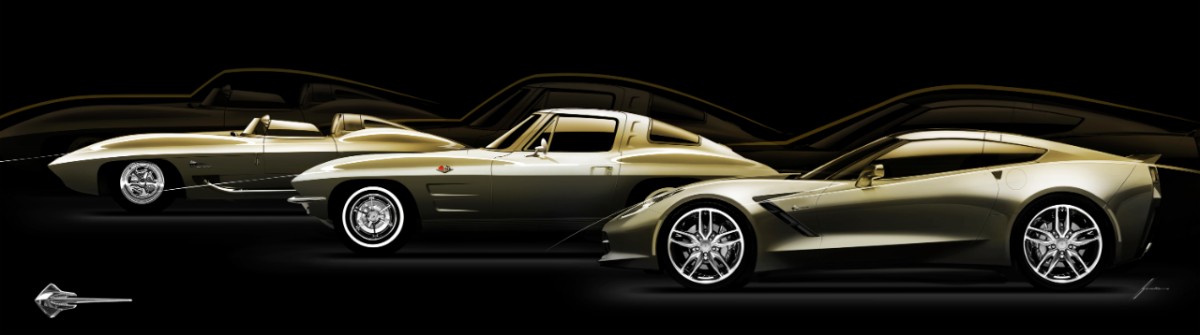
One has to be more discerning than me, apparently, to see the similarities between the C2 in the background and the C7 in the foreground. At least now we know what it looks like, since we knew what it would notlook like.
Corvette’s legacy was forged 60 years ago this month when it was introduced at the General Motors Motorama show in New York City. The Corvette wasn’t born an icon, however. It earned its reputation as America’s sports car through decades of continual refinement and fundamental engineering advancements. …
For nearly all of its history, Corvette’s design, performance and technology has been influenced by the lessons learned on the racetrack. It is a pillar of the development process established by Zora Arkus-Duntov, Corvette’s first chief engineer, through overt and covert racing initiatives, leading up to the factory-backed Corvette Racing program’s 2012 American Le Mans Series championship in the production-based GT class.
Corvette’s iconic status is reflected off the track, as well. In popular culture it has numerous co-starring roles to its credit, from “Route 66” on television (1960-64) to the namesake big-screen performance in “Corvette Summer” (1978) – and countless cameos and supporting roles since. Corvette has inspired songs, artwork and video games, including the current version of the Gran Turismo series, where the seventh-generation appeared in pre-production camouflage. There is even a Corvette child’s bed from Step2 featuring functional headlights.
In other words, what you get in the Corvette you can’t, or don’t, buy may be available in a more affordable car later on. Corvettes get people in the showroom. Corvettes generate positive media attention for GM, as opposed to what GM has been getting (and earning) recently. And, most importantly given GM’s finances, Corvettes make money for GM. (As do pickups, which will be getting a variation of the Corvette’s new engine.)
(Political point: Vice President Joe Biden bought a new Corvette in 1967. He reportedly still has it. Sen. John McCain (R–Arizona) has one too. And if I ever meet Biden, I’m going to ask him why he wants to prevent others from owning Corvettes.)
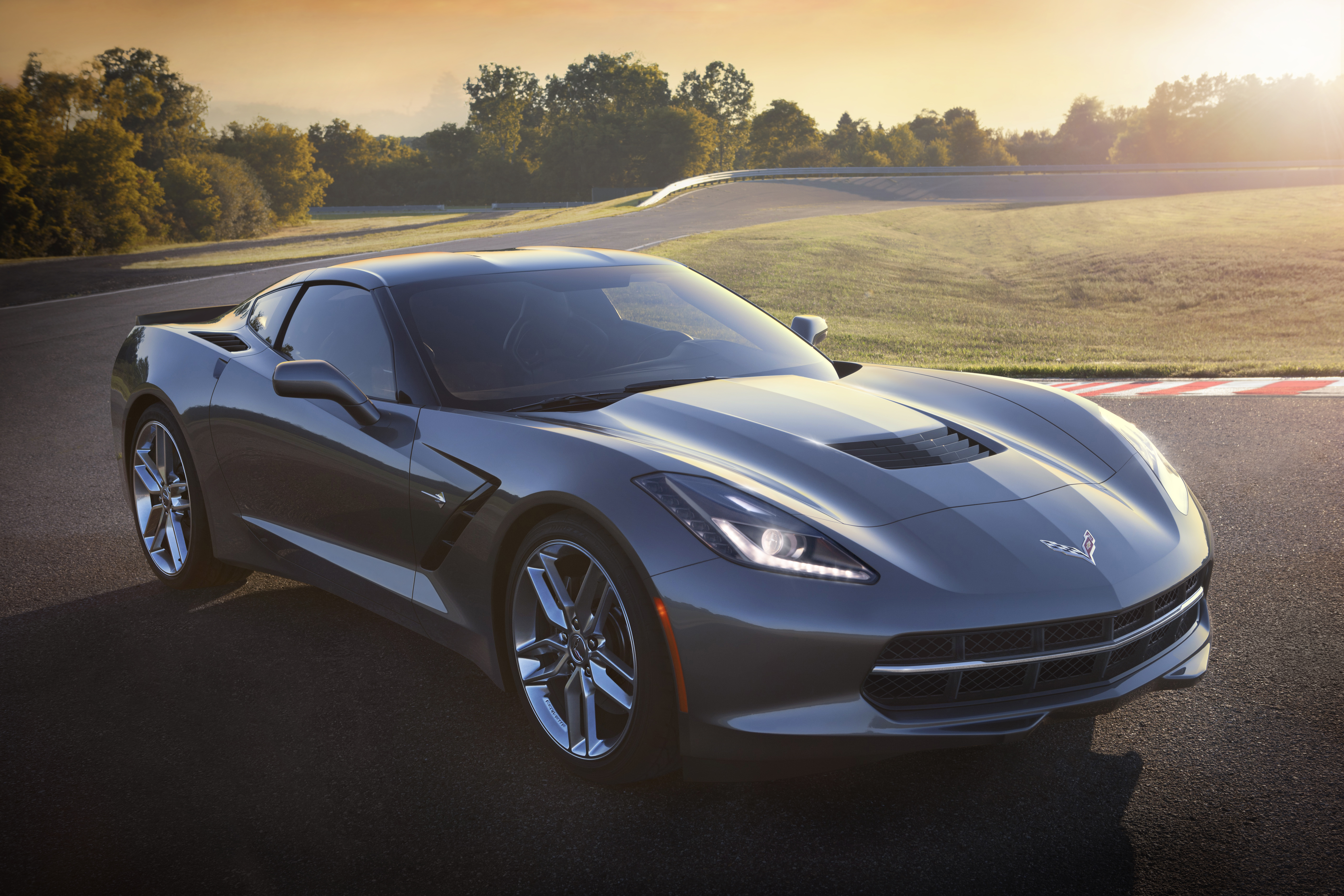
My first impression of the C7’s styling is that it does bear one resemblance to the C2, specifically the first C2 — quite busy. The interesting thing about the five-year C2 is that GM Styling took things off the car, to the point where the 1967 C2 was the cleanest-looking Corvette of that generation. I don’t mind the look, but I wouldn’t say that a miniwindow behind the B-pillar bears much resemblance to the C2’s wraparound rear window.
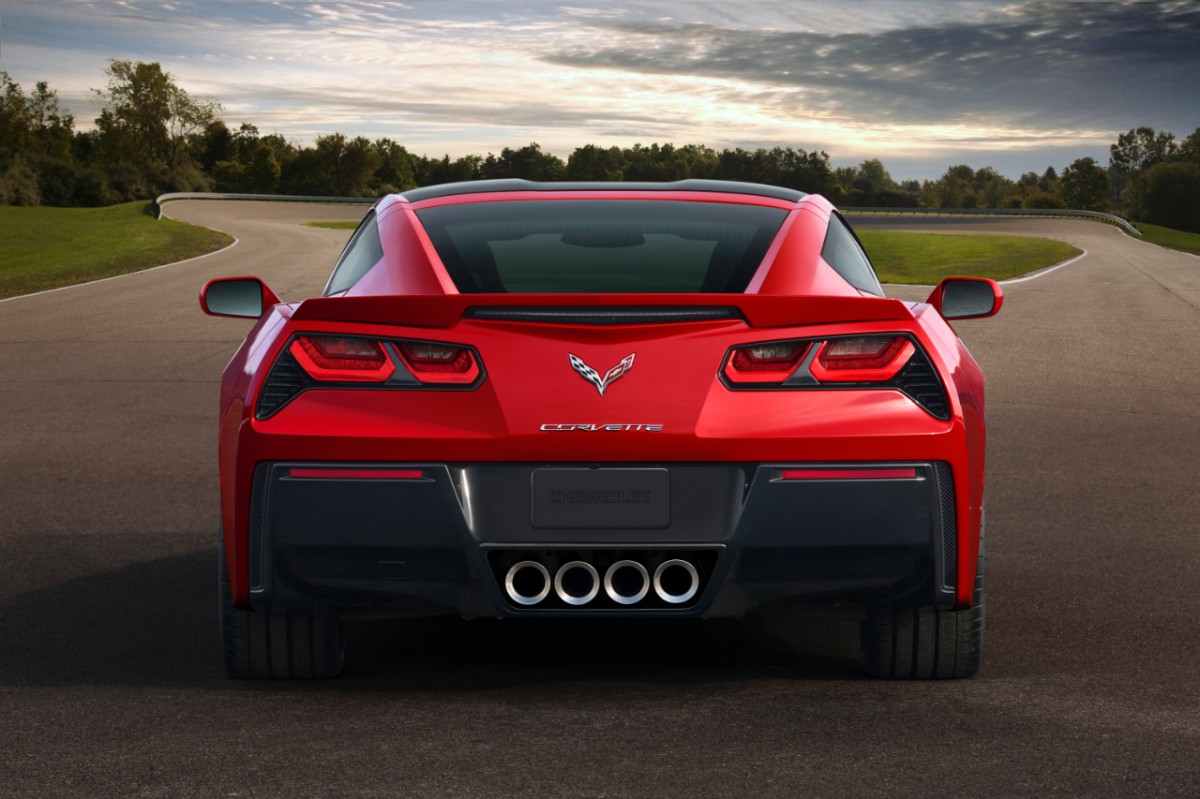
Truth be told, this view looks more like the C2 than the side view.
The C7 is the first Corvette to be called a “Stingray” since the last C3, as GM’s news release puts it, “And only a Corvette with the perfect balance of technology, design and performance can wear the iconic Stingray designation.” (“The perfect balance of technology, design and performance” does not describe the last few years of C3s, but never mind that.)
“Like the ’63 Sting Ray, the best Corvettes embodied performance leadership, delivering cutting-edge technologies, breathtaking design and awe-inspiring driving experiences,” said General Motors North America President Mark Reuss. “The all-new Corvette goes farther than ever, thanks to today’s advancements in design, technology and engineering.”
And what might “today’s advancements” be?
Advanced driver technologies, including a five-position Drive Mode Selector that tailors 12 vehicle attributes to the fit the driver’s environment and a new seven-speed manual transmission with Active Rev Matching that anticipates gear selections and matches engine speed for perfect shifts every time.
An all-new 6.2L LT1 V-8 engine combines advanced technologies, including direct injection, Active Fuel Management, continuously variable valve timing and an advanced combustion system that delivers more power while using less fuel. …
Track-capable Z51 Performance Package including: an electronic limited-slip differential, dry-sump oiling system, integral brake, differential and transmission cooling, as well as a unique aero package that further improves high-speed stability.
That’s the tech. What about how it looks?
Lightweight materials, including a carbon fiber hood and removable roof panel; composite fenders, doors and rear quarter panels; carbon-nano composite underbody panels and a new aluminum frame help shift weight rearward for an optimal 50/50 weight balance that supports a world-class power-to-weight ratio.
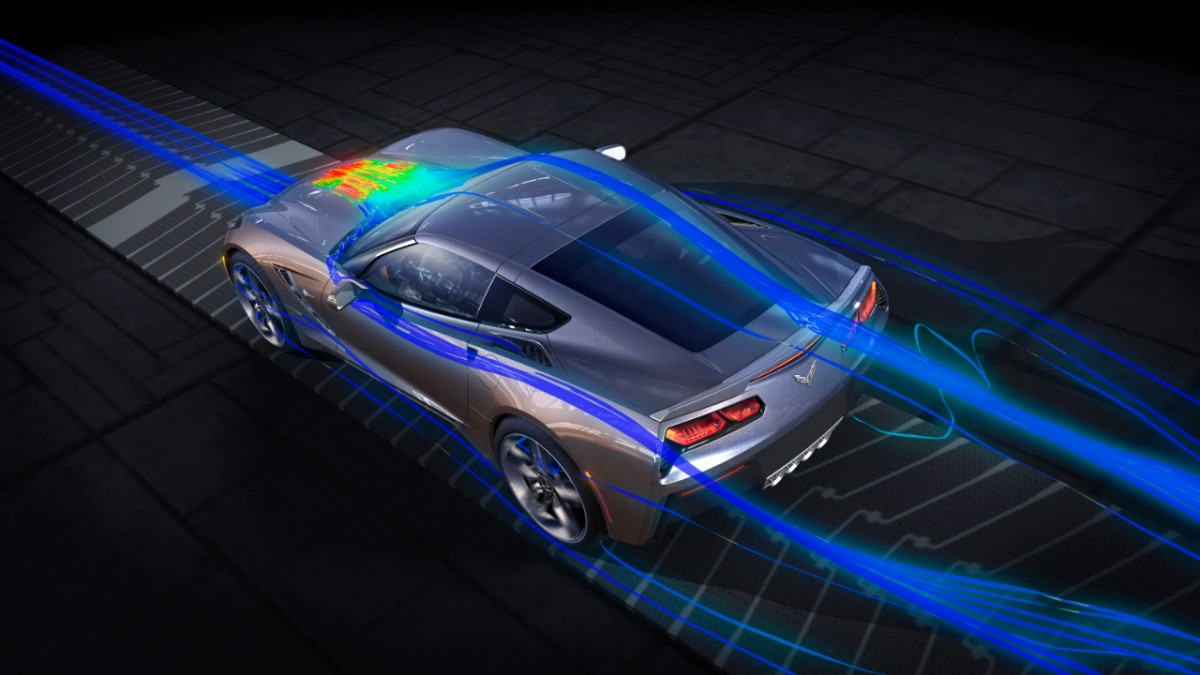
A sculptured exterior features advanced high-intensity discharge and light-emitting diode lighting and racing-proven aerodynamics that balance low drag for efficiency and performance elements for improved stability and track capability.
The last bullet point should be good news for those who have complained about Corvette interiors for years:
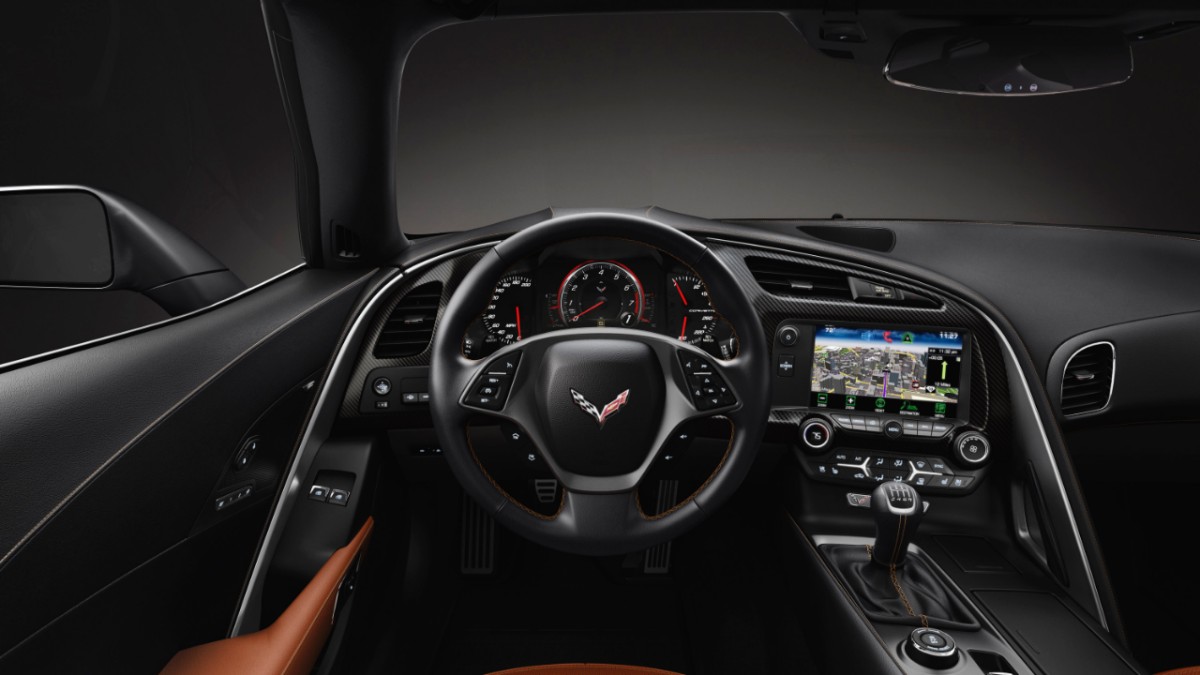
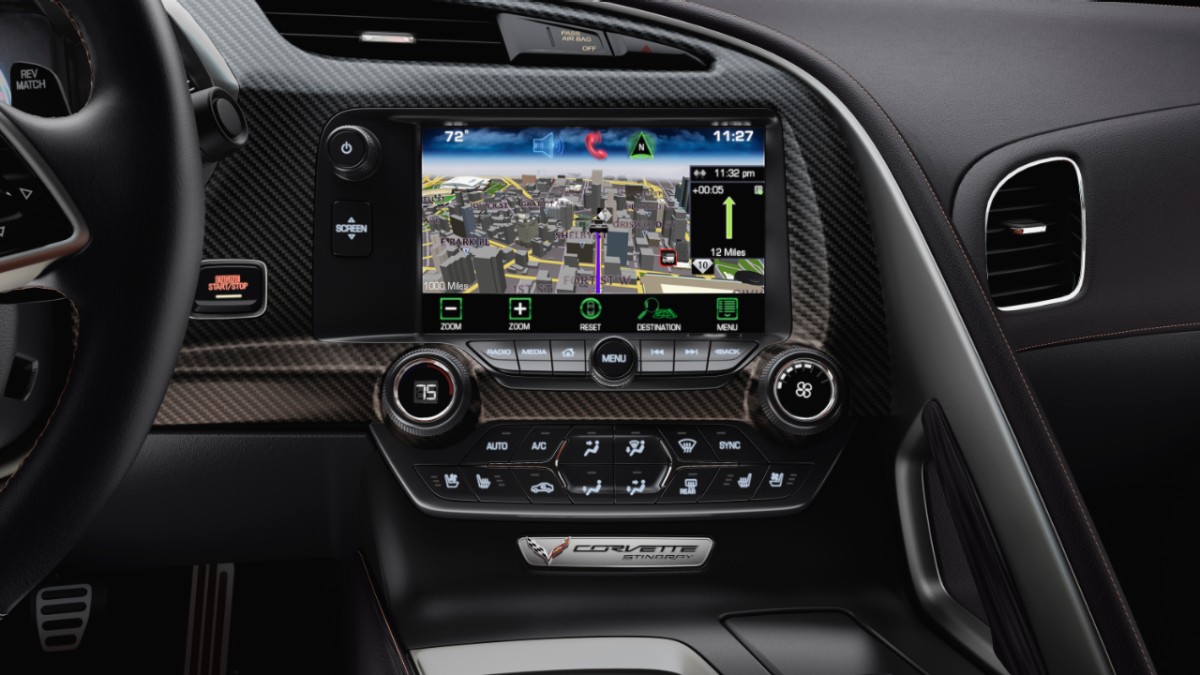
An interior that includes real carbon fiber, aluminum and hand-wrapped leather materials, two new seat choices – each featuring a lightweight magnesium frame for exceptional support – and dual eight-inch configurable driver/infotainment screens.
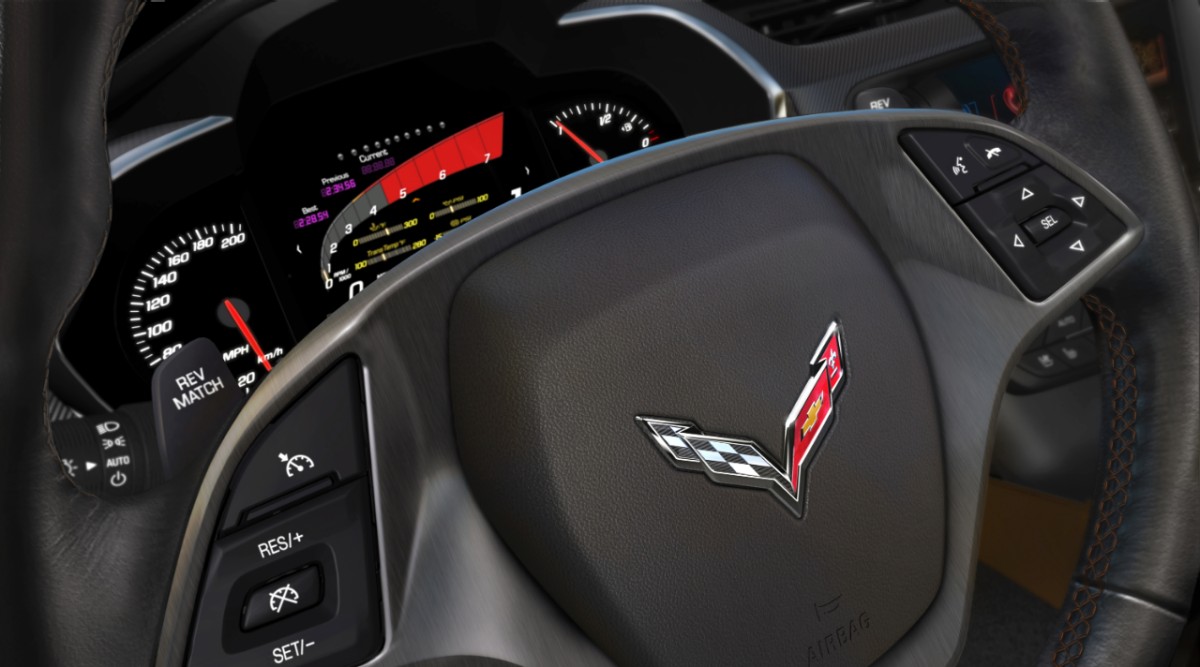
I assume from looking at these photos and from what I’ve read that the C7 has some sort of high-tech instrument panel, in that the driver can program which gauges he or she wants to see. The extent to which that’s good depends on how much information can see. (Speedometer, tachometer, fuel and engine temperature can be seen on cars a fraction of the cost.)
The engine sounds good, although I remain skeptical of any cylinder-deactivation technology. (On the other hand, if the driver keeps his foot down, the cylinders won’t deactivate.) My bigger concern was that Chevy was going to do something stupid and sell it only with a V-6 (first reports were a twin-turbo V-6 to be precise, but a V-6 is a V-6) and a flipper-shifter automatic. Either of those would have terminated my interest in the car, because a manual transmission is required for a true driver experience, and anything besides a V-8 is an abomination to that car.
Corvettes have had two taillights per side (usually round) since the first C2. If you think these taillights look like they came from the Camaro, you are not wrong.
The interesting question will be pricing, which hasn’t been revealed yet. The C6 was arguably the best performance bargain on the planet, as measured by dollars per horsepower. The most expensive, most powerful Corvette cost less by that measure than the least expensive Porsche Boxster. And if price is a concern, you do not want to know the Ferrari California’s cost per horsepower. The question is whether the tech and interior upgrades have priced the new Vette where it is not so much a performance bargain.
Of course, I can’t really say whether the Corvette is a success or not until I get to drive one. (Hint, hint, Chevy dealers reading this.)
Before we discuss Saturday night’s Battle by the Bay, read this excellent Milwaukee Journal Sentinel story about the depth and breadth of Packer Nation:
When the Green Bay Packers meet the San Francisco 49ers in the NFL playoffs Saturday night, the hopes and dreams of a nation will be riding on the outcome.
Packer Nation.
On Guernsey Island, off the coast of Normandy in the English Channel, Paul De La Mare will cheer for the team he adopted in the 1980s, when he discovered American football on the Armed Forces Radio Network.
In Rome, orthopedic surgeon Stefano Ruzzini, 61, will be as emotionally involved as any Packers fan in Appleton or Little Chute. Why? Ruzzini lived in Wauwatosa as an AFS student in 1967-’68, the tail end of the Glory Years in Green Bay. He’s been a die-hard ever since.
In Montreal, Hugues Bertrand, who teaches a high school leadership class and refers often to the example of Vince Lombardi – the iconic coach he read about as a teenager – will be glued to the television.
And, of course, in living rooms across Wisconsin, thousands of fans will jump out of their chairs on one play and sink into them on the next.
The Packers are not the only professional sports franchise with passionate fans scattered across the globe.
But there is something different about Packer Nation.
It’s hard to define. It’s difficult to articulate. It’s something you know to be true but can’t quite explain.
Take it on faith. Take it from the fans themselves.
The Journal Sentinel recently asked for submissions from fans describing how and why they became Packers fans. The response was over whelming: 272 emails poured in, along with four handwritten letters, from 32 states and nearly one dozen countries. …
In many cases, kids cheering for Aaron Rodgers and Clay Matthews today have parents who cheered for Lynn Dickey and James Lofton in the 1980s, grandparents who cheered for Paul Hornung and Ray Nitschke in the ’60s and great-grandparents who cheered for Don Hutson and Tony Canadeo in the ’40s. …
Greg Steffen grew up in Iowa and watched the Ice Bowl with his brother, a Cowboys fan. Steffen did not have a favorite NFL team and decided he’d pledge his loyalty to whichever team won.
“It all came down to that final gutsy call with 16 seconds left,” Steffen wrote. “Starr snuck the ball across the goal line for the victory. I still remember my brother collapsing in front of the TV. And I had a favorite NFL team, the Green Bay Packers, for the rest of my life.
“Not lost on me over the years is the fact that I came one great Jerry Kramer seal block away from being a Cowboys fan for life. Yikes!”
Kelly Mayo of West Bend watched the Ice Bowl with his family and the experience of seeing his tough father – “an Irish cop right out of central casting” – shed tears when Starr scored has stayed with him his entire life.
“I had never seen this giant of a man cry and I have never seen it since,” Mayo wrote. “Not when his mother died, not when his sons went to Vietnam or more importantly when they came back, not ever before or since.
“But watching my Dad cry on that glacial Sunday, I became a rabid, dyed-in-the-wool, lifelong Packer fan! I began to understand what they meant to my Dad – hope, a collective that was bigger than ‘one,’ pride, belonging, something to help escape the mundane and perhaps most essential something human and personal.
“And that is what the Green Bay Packers exemplify to me to this day.”
In 1966, 8-year-old David Welsh of Lexington, Ky., wrote a school report on Starr, an athlete his pastor-father admired and respected. He got an A-plus grade (“Thank you, Mrs. Collins”) and decided to mail a copy of the report to Starr.
“I don’t know if he ever saw it, but a few weeks later I received an autographed picture from the future Hall of Fame quarterback,” Welsh wrote. “That day, standing at the mailbox in a foot of snow, I became a Packer fan for life.”
Never in my life have I ever cried over the result of a sporting event, including the three Super Bowls I remember watching. (I probably watched Super Bowls I and II too, but given that I was 1½ and 2½, respectively, I don’t remember the games.) I have gotten murderously angry at the results of certain Packer games, though not of Super Bowl XXXIII. My wife and I are Packer shareholders, and our kids are on the season ticket waiting list (five digits in each), so we have a personal commitment, as opposed to fans of lesser NFL teams.
If you were asked to identify the Packers’ biggest rival that is not in the NFC North, you probably would answer one of three choices — Dallas, the New York Giants, or San Francisco.
The Packers–Cowboys rivalry dates back to the Packers’ first two Super Bowl appearances, both of which went through Dallas, and was heightened by the three consecutive seasons in the ’90s where the Packers’ playoff trips ended in Dallas. The Packers–Giants rivalry is one of the NFL’s oldest, stoked by the hiring of Giants offensive coordinator Vince Lombardi to be the Packers’ coach (resulting in consecutive NFL championships), and recently amped by the Giants’ ending the Packers’ playoff trips in two of the past five seasons.
However, neither the Cowboys nor the Giants are in the 2012 NFL playoffs. The 49ers are.
Even though the 49ers and Packers have been in the same league since the 49ers moved in from the late All-American Football Conference, the real rivalry dates back to when Packers general manager Ron Wolf hired 49ers offensive coordinator Mike Holmgren to be the Packers’ coach. Before that, the Packers and 49ers were never good at the same time, though in many seasons they were bad at the same time.
Holmgren, a San Francisco native, brought with him not just the 49ers offense as designed by Bill Walsh, in which passing replaced running as a means of ball control. (Which is an interesting story in itself. Walsh was an assistant coach Paul Brown, one of football’s greatest innovators, with the Cincinnati Bengals. which one particular season saw their cannon-armed quarterback get injured. The quarterback’s backup was decidedly not cannon-armed, but lacking much of a running attack, Walsh had to make do with what he had, and it worked, with the Bengals throwing short passes to control the ball through the air.)
Holmgren also brought the absolute insistence of doing things the right way, even off the field. (I’m not sure where I read it, but one Packer book tells the story of Holmgren’s upbraiding the Packers’ traveling staff because of some sort of hotel issue. Whatever the issue was, it never happened again.)
Brett Favre’s autobiography, Favre, tells the story of the Packers’ 27–17 upset in San Francisco in the 1995 playoffs. Packer defensive end Reggie White had a swear jar in which anyone who swore was supposed to put money in the jar. So when Holmgren began the first meeting the beginning of the week before the 49ers game, he announced, “We’re going to beat these fuckers,” and put in a $100 bill. And then to be sure everyone heard him, he said, “We’re going to beat these fuckers!” and added another $100 bill. Favre wrote that that got everyone’s attention.
The Packers went to San Francisco and beat the 49ers 27–17 in the 1995 playoffs.
That win started a run of four consecutive Packers–49ers playoff meetings (usually after regular-season meetings the same season), with the Packers winning the first three — 35–17 in the slop in Green Bay in 1996, and then 21–7 in San Francisco one season later — before the 49ers won 30–27 in Holmgren’s last game coaching the Packers.
Desmond Howard started the 1996 playoffs with a bang by returning a punt for a touchdown in the Packers’ 35–17 win over the 49ers.The Packers went back to San Francisco one season later and beat the 49ers for their second consecutive NFC title.
The 1996 Packers beat the 49ers in an epic Monday Night Football game 23–20 in overtime before their playoff win on the way to New Orleans (the site of Super Bowl XXXI, but also Super Bowl XLVII). The 1998 Packers beat the 49ers 36–22 before losing to the 49ers in the playoffs.
Proving that the postseason is more important than the regular season, the 49ers beat the Packers 30–27 in the 1998 playoffs.
Saturday will be the first Packers–49ers playoff game since 2001, when the Packers won in coach Mike Sherman’s first playoff win.
Gilbert Brown celebrates a tackle for loss in the Packers’ 25–15 win over the 49ers in the 2001 playoffs, the first of coach Mike Sherman’s two playoff wins in four playoff appearances.
Most seasons, though, the Packers and the 49ers have played each other because of the NFL’s scheduling formula. They would play each other anyway every third season because every team plays every team in one other division of their conference each season. But teams also play the other two teams in their conference that finished in the same place in their own division. And in many seasons, the Packers’ NFC North place was the same as the 49ers’ NFC West place.
One unusual thing about this game is that the 49ers the Packers are playing Saturday are rather different from the team that beat them in week one of the season. That team had Alex Smith, who the 49ers famously picked instead of Cal quarterback Aaron Rodgers, at quarterback. Saturday’s game will feature quarterback Colin Kaepernick (who even more ironically was born in Milwaukee, adopted by parents from New London, and lived in Fond du Lac until he was 4 years old), who will be making his first career playoff start after replacing Smith earlier this season.
The 49ers’ choosing Smith over Rodgers was said to be the choice of then-49ers coach Mike Nolan, of whom the San Jose Mercury News reported, “Nolan was no-nonsense, a strong personality who didn’t like to be challenged. He met with Rodgers and Smith before the draft. He caught a whiff of attitude from Rodgers, and that was that.” Who was the 49ers’ offensive coordinator? Mike McCarthy, who is now the Packers’ coach. Nolan is no longer the 49ers’ coach.
The starting quarterback isn’t all that’s changed, Vic Ketcham notes:
The two teams that will face each other in Candlestick Park on Saturday night are not the same teams that kicked off the season in Lambeau Field.
You’ve heard that said repeatedly, but it’s not just coachspeak, it’s the truth. For starters, six Packers players that were in the starting lineup on Sept. 9 will not be in the starting lineup in Saturday’s divisional-round playoff game.
The Packers of today are in no way representative of the team that was dragged up and down the field on Sept. 9 by an overpowering 49ers offense that made it look easy. The Packers defense that will step onto the field on Saturday night is a legitimate postseason outfit that’s ranked 11th in the league overall and fourth in sacks per pass play.
Maybe it’ll be that loss to the 49ers in the opener that’ll be the Packers’ greatest ally. Maybe the 49ers will remember how easy it was in the opener and think it’ll be the same on Saturday. It won’t. By halftime, that fact could be a pie in the face for the 49ers.
The Packers might get a little splash of water themselves when they find out how different the 49ers are. That paint-by-the-numbers offense the Packers faced in the opener is gone. Predictability has been replaced by improvisation, in the form of a hot-blooded young quarterback who has brought energy to the team and its fans.
The Packers, meanwhile, have straightened out the offensive line issues that bedeviled them early this season. (The 30–22 season-opening loss was not as close as the score indicated; one touchdown was a Reggie Cobb kickoff return, and the other was when the 49ers were playing the up-two-scores prevent defense.) Saturday’s game features the fifth-best scoring offense against the second-best scoring defense and the 11th-best scoring offense against the 11th-best scoring defense, which makes one think this game will be decided on what the 49ers do on offense.
That begs the question Saturday of whether the Packer defense will be able to deal with a balanced 49er offense. That was supposed to be the issue last week, but the Vikings failed to cooperate because quarterback Christian Ponder was unable to play due to injury, and replacement Joe Webb was unable to play due to inability. If the Packers can bottle up 49ers running back Frank Gore close to as effectively as they bottled up Vikings running back Adrian Petersen one week ago, and if they can force Kaepernick to throw instead of run, they have a good chance of winning. Defensive end Justin Smith will return from injury for the 49ers, but he will be sort of one-armed, playing with a triceps injury, which blunts the 49er pass rush. Candletstick Park, or whatever they’re calling it these days, is not a place where road teams go to die, with the 49ers going 6–1–1 at home this year, coming off their NFC Championship loss to the Giants.
It goes without saying that Rodgers needs to have a good night too. Consider this from ESPN.com’s Kevin Seifert:
A total of 29 quarterbacks have won Super Bowl titles. Only 11 have won multiple championships … and that achievement represents the next step on Rodgers’ career path. His style makes him ideally suited for the historic profile of multiple champions, and he isn’t hiding from the meaning of a second Super Bowl as Saturday night’s divisional-round game at the San Francisco 49ers approaches. …
Rodgers is universally considered one of the NFL’s top quarterbacks (near-unanimous, at least). Still, there are many examples in league history of elite quarterbacks who couldn’t win multiple championships. Look no further than Rodgers’ predecessor in Green Bay.
So what could separate Rodgers? Simply put, he is the least error-prone quarterback in league history.
Turnover totals are among the most reliable indicators of team success, and for quarterbacks, that mostly means interceptions. As you may know, Rodgers has, by far, the lowest interception rate — interceptions per attempt — in NFL history.
Most focus on yards, completion percentage and touchdowns in this fantasy age, but you might not realize that Rodgers has thrown only 46 interceptions in 2,665 regular-season attempts over his career. His corresponding interception percentage of 1.73 is well ahead of the second-best in history, the 2.06 percent of the New England Patriots‘ Tom Brady, and is among the few statistics that don’t have to be curved for the modern-day explosion in NFL passing numbers.
In his seven playoff starts, Rodgers has thrown four interceptions over 253 attempts. That percentage of 1.58 is fourth-best in postseason history. It’s worth noting that in his four most recent games — the final three of the regular season and Saturday’s wild-card victory over the Minnesota Vikings — Rodgers hasn’t thrown a single interception while tossing 11 touchdowns. …
The gang at Cold Hard Football Facts tracks this topic in great detail on their insider site. The correlation between interceptions and victories, especially in the playoffs, is overwhelming.
This season, teams that threw fewer interceptions than their opponents won 80 percent of their games. As playoff intensity ramped up beginning in Week 14, that winning percentage jumped to 95.7. Since Rodgers became their starter in 2008, the Packers have won 90.2 percent of their games in those situations.
Taking care of the ball is especially critical in the playoffs between teams that are presumably closer-matched than in the regular season. In a study updated through most of 2009, CHFF found that a team’s chances of winning a playoff game drops about 20 percentage points with every interception it throws. Teams whose quarterback threw just one interception in a playoff game won only 56 percent of their games. Two interceptions dropped that winning percentage to 31.4.
You might think we’re hashing our way to an obvious conclusion. Interceptions are bad. We know that. But it’s not that Rodgers simply avoids interceptions. Over a five-year span, he has avoided them to a substantially better degree than any quarterback in league history. History tells us the Packers have a better playoff advantage with Rodgers than most any other quarterback. Ever.
Ketcham adds something to a comment that because the 49ers defense is more physical than the Packers’ offense, the Packers will want to quicken the tempo of the game, as they did in Super Bowl XLV:
Seeing as how the seventh-generation Corvette will make its world debut Sunday, this seems appropriate, from Corvette Online:
Corvettes have always been something to be admired, as they’re generally driven by people who are in a certain position in life. Usually the discerning Corvette owner is someone who appreciates performance, good looks, and sex appeal, and they’re almost always at a position in life where they actually have the cash required to own a Corvette. That means that most Vettes are not driven by kids in their teens, or even by a lot of people still in their 20′s. Corvettes are driven by successful people. People who have taken risks, and won. People that have made it.
With all of that being said, it should come as no surprise to you that the car of choice by astronauts in the 1960′s was (drumroll please) none other than the Corvette. Astronauts were men that were front and center in the public eye and were symbols of bravery, risk taking, and all out coolness. They hadmade it. They were bigger than rock stars in the United States, at least for a time, and General Motors waned to make sure that the world saw them driving the fastest, coolest, bravest car around, the Corvette.
The program started with the first U.S. astronaut to escape (briefly) Earth orbit, Alan Shepard:
GM saw both a service and a marketing opportunity with the astronauts’ fame. GM President Ed Cole gave Alan Shepard, the first American in space, a 1962 Corvette as a gift for his service to his country, though it was not in character for GM to give away cars; not even to astronauts. According to Dollie Cole, Ed Cole’s widow, the gift made perfect sense, despite GM’s normal tendency to avoid things like that. “The astronauts were incredibly visible,” she recalled in an interview recently re-published on VetteWeb.com. “And good publicity is good publicity.”
She felt the Corvettes were more than a publicity stunt, but were actually a gift of appreciation. “Who more worthy than guys who represent our country?” Dollie declares. “They were literally risking their lives. Space travel today isn’t ‘ho hum’, but people perceive it that way. There were so many unknowns then. The cars were a way of saying ‘Thank you.’”
Aside from Shepard, no astronaut was given a Corvette from GM, and for one big reason that had nothing to do with GM policy; it turned out that astronauts were not allowed to take gifts or do endorsements. That being said, they could lease cars at exceptional rates and thus the $1 astronaut lease program was born.
I met Scott Carpenter when he gave a speech at UW–Platteville in the late 1980s. I wish I’d known about the Corvette thing then. (The $1 rental thing is probably the only way I could ever afford a Corvette.)
Carpenter’s fellow Mercury astronaut, Virgil “Gus” Grissom, decided his $1 Vette needed a little work:
It turned out that the Corvette was the perfect car for space jockeys with a flair for speed, danger, and competition. Gus Grissom, the second American in space, loved his Corvette’s dearly, but hated losing drag races to his fellow astronauts. In the fall of 1966 both he and fellow astronaut Alan Shepard, the first American in space, took delivery of identical brand new 1967 427/435 horsepower Corvette Roadsters. Grissom hated losing races to Shepard so he asked Jim Rathmann, owner of Jim Rathmann Chevrolet/Cadillac in Melbourne, FL to help him with his new Corvette. According to gusgrissomcorvette.com, Rathmann obliged and ever-so-slightly widened the rear wheel openings to allow room for bigger tires and put in a 4:56 posi rear end. Grissom won nearly every race against Shepard as a result, and we have no idea if Alan Shepard ever knew of the modifications!
As Mercury became Gemini and then Apollo, the program continued:
It seemed that all astronauts had a Corvette somewhere in the mix. Neil Armstrong, the first man on the moon, had a Corvette. Jim Lovell, the Commander of the ill-fated Apollo 13 mission, had a Corvette. But perhaps the most interest Astronaut/Corvette story came with the crew of Apollo 12, because they acquired matching Corvettes! Apollo 12 launched for the moon on November 14, 1969 and it’s members were Mission Commander Pete Conrad, Lunar Module Pilot, Al Bean, and Command Module Pilot Dick Gordon. The three were close knit and remained friends even after their NASA days.
The idea of matching cars was unique to the Apollo 12 crew as no other Apollo team did it, despite the fact that it was common for them to be driving a Corvette. In the aforementioned interview, Al Bean recalled the situation. “We liked the idea. It was a way to be a team and build esprit de corps. We all talked about it, and the first couple of ideas didn’t work.” The Corvettes that the astronauts chose were a trio of identical Riverside Gold ’69 coupes. Each was equipped with the stock 427 CI/390HP engine, had Head Restraints (RPO A82), 4-Season Air Conditioning (RPO C60), Special Wheel Covers (RPO PO2), and the AM/FM Pushbutton Radio (RPO U69).
The story doesn’t say, but one assumes they were all correctly equipped with four-speed manual transmissions. And since the Apollo missions launched from Cape Canaveral in Florida, air conditioning was a wise choice.
A newly sworn-in lawmaker – and former Milwaukee County Board member – is gaining traction with a plan that would allow voters to cut Milwaukee County Board supervisors’ pay by 70% and slash their budget by 85%. …
A draft of a bill by Rep. Joe Sanfelippo (R-West Allis) obtained by the Journal Sentinel would require a binding referendum to be held in April that would cut the 18 supervisors’ pay to $15,000 a year and limit the County Board’s budget to 0.25% of the county’s total levy. That latter provision would require supervisors to fire almost all their staffs, according to County Board Chairwoman Marina Dimitrijevic.
“It’s a slap in the face to local control,” Dimitrijevic said. “It’s not about the board or this board. It’s about the million people we represent and democracy.” …
Sanfelippo, who has also backed trimming the size of the county board, said he tried for years to get the board to reform itself, but his ideas were met with resistance.
“It should come as no surprise to anybody,” Sanfelippo said of his effort. “They (on the board) had every opportunity to effectuate some change from within. They didn’t.”
The proposal would reduce supervisors’ pay from the current $50,679 to $15,000. The pay cut would be even greater for Dimitrijevic, who as chairwoman makes more than $71,000.
The proposal would also eliminate supervisors’ ability to collect other benefits they currently receive, such as pensions and health insurance. …
Milwaukee County Executive Chris Abele said Monday he hoped the measure could be passed by the Legislature in time to be put on the April 2 ballot. Abele said that his reasons for seeking the change were not personal and that he wanted to bring Milwaukee County in line with the state’s other counties.
“There’s 72 counties, and there’s only one with a full-time board,” Abele said. “I wouldn’t be doing this or anything else if I didn’t think it was in the best interest of the county.”
Under the proposal, the board’s budget would drop from about $6.5 million to about $1 million, Abele said, a cut Dimitrijevic said would be devastating.
Dimitrijevic said she saw Abele – and the Greater Milwaukee Committee, the civic group that has already been lobbying legislators – as the prime forces behind the measure. Abele, she said, was motivated by an inability to work with the board.
“He seems to not be able to get along with anybody,” she said.
Abele disputed that.
“It doesn’t thrill everybody, but I’ve got a great relationship with Gov. Walker and his cabinet secretaries,” Abele said. “I’ve got a great relationship with (Milwaukee Mayor Tom) Barrett.”
Though aimed at Milwaukee County, Dimitrijevic said the proposal has statewide implications. If lawmakers are willing to force a referendum on the pay of Milwaukee County supervisors, they could easily do the same for the pay of supervisors in other counties. Such a measure would distract lawmakers from their efforts to improve the economy, she said.
Dimitrijevic’s comment should make you roll on the floor laughing. Politicians have done more to harm the economy than improve it, through overtaxation, overregulation, and padding their own nests through excessive pay. benefits and influence for themselves by swelling the size of government.
Somebody forgot to tell Milwaukee County Board Chairman Marina Dimitrijevic that county governments are the creations of the state, and are formed to do the state’s bidding. Maybe if the County Board could have demonstrated that they could be responsible, it might not have come to this. …
Unfortunately, the last two years have been a battle by the Board to protect and expand its turf, and not about making the changes necessary to save taxpayer money while providing services. If the county government is not going to effectively fulfill its mission, it’s time for a change.
The term “local control” is applied, of course, only when advantageous. Dimitrijevic wants to retain “local control” because she doesn’t want the state telling Milwaukee County to do, despite the fact that as the county’s primary source of shared revenue, Lee Dreyfus’ Golden Rule — he who has the gold makes the rules — absolutely applies. Note as well that Dimitrijevic doesn’t trust her own constituents to make what she considers the correct vote should this come to referendum. (The corollary to respect for “local control” is respect for “democracy,” properly defined as “whatever political process produces the result you want.”)
The other point is that the founders of neither this nation nor this state ever intended that we be represented by full-time legislators like Dimitrijevic wants to continue to be. (Nor, for that matter, members of the Milwaukee school board, who are also full-time.) Our elected officials are supposed to serve while living normal lives, and when done serving go back to those lives. Politics is not and should not be a career for anyone. (Yes, that includes members of Congress and state legislators.)
Speaking of “full-time,” I also nearly fell off my chair when I read this:
Milwaukee County had the highest pay for the chair, followed by Waukesha County ($58,586), Grant County ($43,720) and Washington County ($35,820).
For those unfamiliar: Milwaukee County has, of course, Milwaukee. (Dimitrijevic’s pay is about $71,000 too much.) Waukesha County has Waukesha and a bunch of Milwaukee suburbs. Washington County has West Bend. Grant County’s biggest city is Platteville, population 11,000.
The Grant County board chair makes a little less than $1 per county resident. Think that’ll get some local media comment?





 Steve Prestegard.com: The Presteblog