Skip to content
  • Presty the DJ for March 20

    March 20, 2013
    Music

    The number one single today in 1961 was based on the Italian song “Return to Sorrento”:

    Today in 1964, the Beatles appeared on the BBC’s “Ready Steady Go!”

    During the show, Billboard magazine presented an award for the Beatles’ having the top three singles of that week.

    Today in 1968, Eric Clapton, Neil Young, Richie Furay and Jim Messina were all arrested by Los Angeles police not for possession of …

    … but for being at a place where marijuana use was suspected.

    (more…)

    Share this on …

    • Share on X (Opens in new window) X
    • Share on Facebook (Opens in new window) Facebook
    • Share on LinkedIn (Opens in new window) LinkedIn
    • Email a link to a friend (Opens in new window) Email
    • Print (Opens in new window) Print
    Like Loading…
    No comments on Presty the DJ for March 20
  • Argentina vs. Francis

    March 19, 2013
    Culture, History

    The Wall Street Journal’s Mary Anastasia O’Grady:

    One might have expected a swell of pride from Argentine officialdom when the news broke that the nation has produced a man so highly esteemed around the world. Instead the Kirchner government’s pit bulls in journalism—men such as Horacio Verbitsky, a former member of the guerrilla group known as the Montoneros and now an editor at the pro-government newspaper Pagina 12—immediately began a campaign to smear the new pontiff’s character and reputation at home and in the international news media.

    The calumny is not new. Former members of terrorist groups like Mr. Verbitsky, and their modern-day fellow travelers in the Argentine government, have used the same tactics for years to try to destroy their enemies—anyone who doesn’t endorse their brand of authoritarianism. In this case they allege that as the Jesuits’ provincial superior in Argentina in the late 1970s, then-Father Bergoglio had links to the military government.

    This is propaganda. …

    Intellectually honest observers with firsthand knowledge of Argentina under military rule (1976-1983) are telling a much different story than the one pushed by Mr. Verbitsky and his ilk. One of those observers is Adolfo Pérez Esquivel, winner of the 1980 Nobel Peace Prize. Last week he told BBC Mundo that “there were bishops that were complicit with the dictatorship, but Bergoglio, no.” As to the charge that the priest didn’t do enough to free junta prisoners, Mr. Pérez Esquivel said: “I know personally that many bishops who asked the military government for the liberation of prisoners and priests and it was not granted.”

    Former Judge Alicia Oliveira, who was herself fired by the military government and forced into hiding to avoid arrest, told the Argentine newspaper Perfil last week that during those dark days she knew Father Bergoglio well and that “he helped many people get out of the country.” In one case, she says there was a young man on the run who happened to look like the Jesuit. “He gave him his identification card and his [clergy attire] so that he could escape.” …

    None of this matters to those trying to turn Argentina into the next Venezuela. What embitters them is that Father Bergoglio believed that Marxism (and the related “liberation theology”) was antithetical to Christianity and refused to embrace it in the 1970s. That put him in the way of those inside the Jesuit order at the time who believed in revolution. It also put him at odds with the Montoneros, who were maiming, kidnapping and killing civilians in order to terrorize the population. Many of those criminals are still around and hold fast to their revolutionary dreams.

    For them, the new pope remains a meddlesome priest. In the slums where the populist Mrs. Kirchner claims to be a champion of the poor, Francis is truly beloved because he lives the gospel. From the pulpit, with the Kirchners in the pews, he famously complained of self-absorbed politicians. He didn’t name names, but the shoe fit.


    Share this on …

    • Share on X (Opens in new window) X
    • Share on Facebook (Opens in new window) Facebook
    • Share on LinkedIn (Opens in new window) LinkedIn
    • Email a link to a friend (Opens in new window) Email
    • Print (Opens in new window) Print
    Like Loading…
    No comments on Argentina vs. Francis
  • Wisconsin: Indian term meaning “the weather sucks”

    March 19, 2013
    weather

    Wisconsinites will be told that tomorrow is the first day of spring.

    This is a lie.

    There will be no spring this year. Or summer. Or fall.

    201303176-10temp

    This obscenity is the six- to 10-day temperature forecast, released by the National Weather Service Climate Prediction Center Sunday. And this …

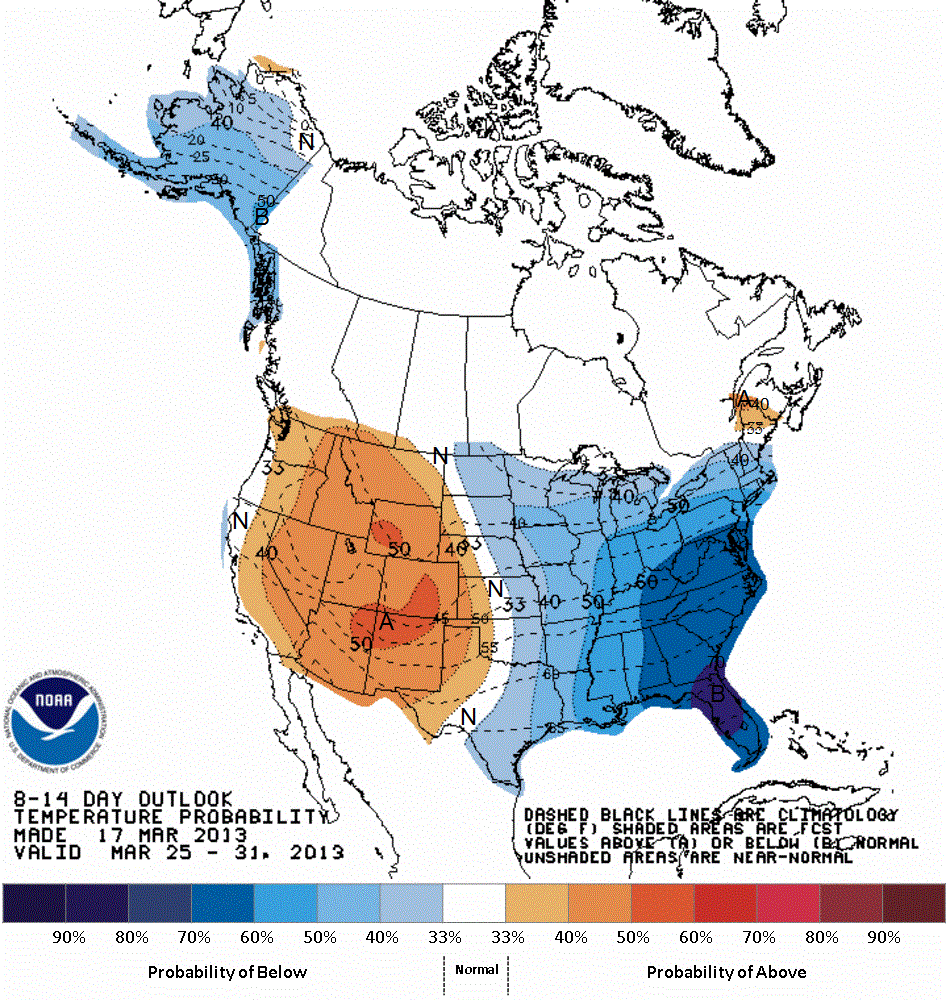
    201303178-14temp

    … is the CPC’s 8- to  14-day forecast — basically next week’s weather. As you can guess, blue means cold.

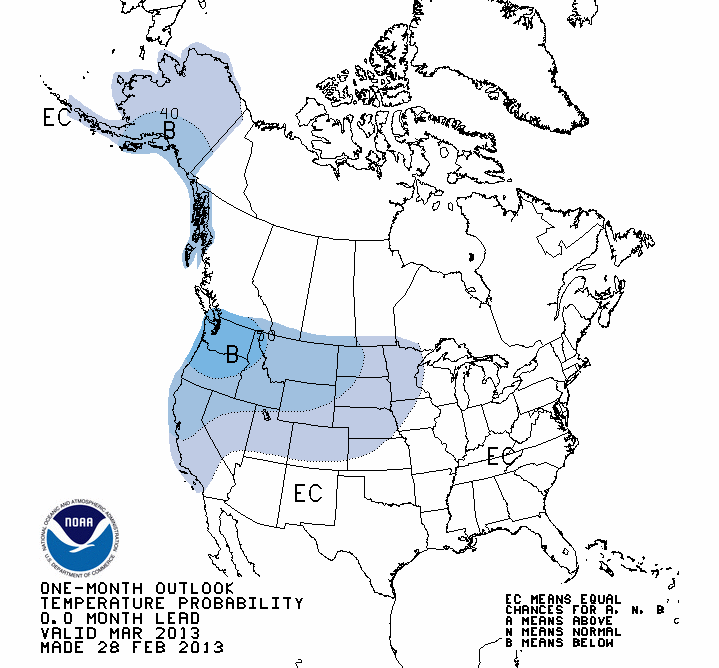
    Either the CPC is incompetent, or Mother Nature is making the CPC look bad. This was the March temperature forecast released at the end of February:

    2013022830temp

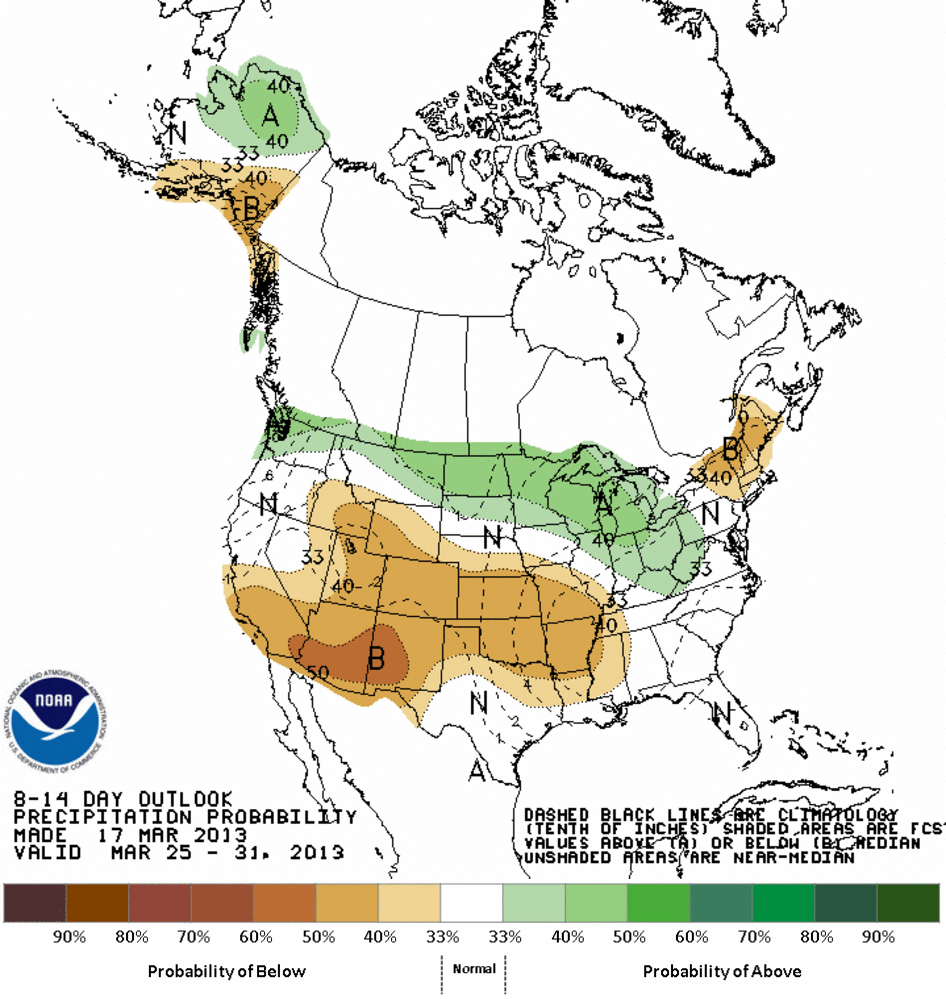
    How do you feel about snow?

    201303178-14precip

    (As you can imagine, green means wet.)

    I conclude from the evidence outside — new snow and, as of tonight, single-digit temperatures — that the words “summer” and “Wisconsin” will never again be uttered in the same sentence. No more boating. No more non-ice fishing. No more driving collector cars, or motorcycles. No air conditioning. No open windows. No shorts or short-sleeve shirts. No golf or outdoor tennis. No baseball anywhere besides Miller Park with the roof closed. You might as well cancel the outdoor concerts, farmers’ markets, school summer vacation, outdoor swimming and everything else that makes this state barely livable. Soon everyone in this damnable state will look like the victims of albinism.

    None of the activities in this new state Department of Tourism photo will be taking place anymore in this state (possibly to the relief of actor Robert Hays, who the commercial’s creators try to kill):

    Consider this: Since Jan. 1, where I live, it has never been warmer than 43. The weather geeks use the term “degree days,” meaning the number of days above or below a certain temperature and the number of degrees below that temperature. The number of cooling degree days — days warmer than 65 — total zero. The number of growing degree days — days warmer than 50 — total zero. The average temperature as defined by heating degree days — days below 65 multiplied by the number of degrees below 65 — totals 23. One day, it was 7 below zero. People die when it’s 7 below zero.

    I hate Wisconsin.

    Share this on …

    • Share on X (Opens in new window) X
    • Share on Facebook (Opens in new window) Facebook
    • Share on LinkedIn (Opens in new window) LinkedIn
    • Email a link to a friend (Opens in new window) Email
    • Print (Opens in new window) Print
    Like Loading…
    No comments on Wisconsin: Indian term meaning “the weather sucks”
  • Presty the DJ for March 19

    March 19, 2013
    Music

    Today in 1965, Britain’s Tailor and Cutter Magazine ran a column asking the Rolling Stones to start wearing ties.  The magazine claimed that their male fans’ emulating the Stones’ refusal to wear ties was threatening financial ruin for tiemakers.

    To that, Mick Jagger replied:

    “The trouble with a tie is that it could dangle in the soup. It is also something extra to which a fan can hang when you are trying to get in and out of a theater.”

    Jagger is a graduate of the London School of Economics. Smart guy.

    Today in 1974, Jefferson Airplane …

    (more…)

    Share this on …

    • Share on X (Opens in new window) X
    • Share on Facebook (Opens in new window) Facebook
    • Share on LinkedIn (Opens in new window) LinkedIn
    • Email a link to a friend (Opens in new window) Email
    • Print (Opens in new window) Print
    Like Loading…
    No comments on Presty the DJ for March 19
  • The stock market vs. the economy

    March 18, 2013
    US business, US politics

    Apologists for the Obama administration claim the economy is recovering based on the Dow Jones Industrial Average reaching record levels.

    Which is ironic, to say the least, given that the standard Democrat/liberal/progressive line is that business is (1) a necessary evil at best that (2) must be taxed and regulated by the smarter people in Washington and the state capital nearest you. It also fails to grasp the fact that, as readers of this blog know, publicly traded companies total all of 0.1 percent of U.S. companies.

    Jerry Bader passes on the Daily Reckoning‘s comparison of the DJIA’s 2007 high and today:

    On the day the Dow logged its first of seven straight new highs, ZeroHedge trotted out a kind of financial “The Way We Were” — comparing today’s economic conditions to that of October, 2007, when the Dow set its previous record high:

    • Dow Jones Industrial Average: Then 14164.5; Now 14164.5
    • Regular Gas Price: Then $2.75; Now $3.73
    • GDP Growth: Then +2.5%; Now +1.6%
    • Americans Unemployed (in Labor Force): Then 6.7 million; Now 13.2 million
    • Americans On Food Stamps: Then 26.9 million; Now 47.69 million
    • Size of Fed’s Balance Sheet: Then $0.89 trillion; Now $3.01 trillion
    • US Debt as a Percentage of GDP: Then 38%; Now 74.2%
    • US Deficit (LTM): Then $97 billion; Now $975.6 billion
    • Total US Debt Outstanding: Then $9 trillion; Now $16.4 trillion
    • Labor Force Participation Rate: Then 65.8%; Now 63.6%
    • Consumer Confidence: Then 99.5; Now 69.6
    • S&P Rating of the US: Then AAA; Now AA+
    • Gold: Then $748; Now $1583

    In other words, the Dow made a new record high despite the economy’s performance, not because of it.

    Why?

    Your editor has no idea what the market knows or sees; he only knows that he doesn’t see it. What your editor does see is a stock market that the masses adore, residing in an economy that the masses abhor.

    So maybe it is not hope that is driving the stock market to record highs, but despair. Maybe stocks are rallying because investors are afraid to do anything else with their capital — maybe they are afraid to risk their capital in an economy that features zero interest rates, stifling regulatory regimes and capricious tax laws.

    Bottom line; the Dow’s record-setting performance tells us nothing about “why.” The stock market is silent on this point. Perhaps it is too terrified to speak. …

    One thing we know; the rallying stock market stands in stark contrast to the bear market in economic vitality. We also know that bull markets are unfolding in all the wrong places. Unemployment, government debt, food stamp participation, “No knock” SWAT raids and “No trial” drone strikes are all in bull market mode.

    The fact that the Dow, priced in gold, remains very far away from a record, suggests that Chairman Bernanke is working overtime. His dollar-printing escapades have played a very big hand in the Dow’s record-setting climb. By devaluing the dollar, in other words, Bernanke “inflated” the Dow price.

    The second and last paragraphs are the “why,” I believe. The ordinary investor should be in the stock market as a long-term investment, and not make decisions based on what one stock, or the entire market, does over one particular short period of time. The aforementioned “zero interest rates, stifling regulatory regimes and capricious tax laws” may indeed make the stock market seem like a safe short-term investment too in comparison to other potential investments.

    Sheldon Richman of the Future of Freedom Foundation adds:

    The Federal Reserve is working hard to keep key interest rates close to zero. The Fed has bought hundreds of billions of dollars in long-term government securities (“Operation Twist”) in order to lower the return from such investments. This drives money seeking a bigger return into the stock market and commodities. If this explains the run-up in stock prices, it sounds more like a bubble than a marker of returning economic growth.

    The government and its central bank, in fact, have done virtually everything wrong if their intention was to put the economy on a sustainable path to prosperity. …

    This is a dangerous path. By definition, such artificially induced frenzies cannot be sustained. When officials get nervous and pull back, the bubbles will burst and the economy will be back in recession. Even if employment gains are made during the apparent recovery, they will be short-lived, and the unemployment rate will turn up again. This government policy, therefore, is a cruel hoax on workers who were harmed by the earlier recession, who have struggled to get back on track, and who are now being set up for a reprise of their misery.

    The architects of this shameful program are would-be social engineers who think they can design something as complex as a modern industrial economy. Such conceit should be obvious to all. Simply put, it is impossible for politicians, bureaucrats, and economic advisers to acquire the knowledge they would need to possess in order to accomplish what they say they want to accomplish. The knowledge most vital for smooth-running markets is not aggregate statistical data available to government agencies. Rather, it consists in the subjective preferences of consumers, the expectations of producers, and the radically decentralized and dispersed information about resources, technologies, and techniques. The market’s price system captures and conveys this information in a way that government operatives could never dream of. In fact, compared to the collective wisdom of the market process, politicians, bureaucrats, and economic advisers are dismal ignoramuses.

    Others have used words like “corporatist” to describe the Obama administration’s attitude toward business — in favor of big corporations like Government Motors — I mean “General Motors” — and opposed to small businesses that employ most Americans. A rising stock market in the midst of a crappy economy would be evidence of that.

    But this stock market “record” means less than it appears because of devaluation of the dollar, which shows up in share prices, on which the DJIA, S&P 500 and other stock indexes are based. Today’s $1 is equivalent to 1963’s 13 cents. Even in an era of historically low inflation, $1 in 1988 is equivalent to $1.99 today, which means the dollar’s value has dropped in half since I entered the workforce.

    This chart demonstrates that the real Dow high was back in 2000, correctly measured for inflation. That was back in the days when the budget was somewhat balanced and the dollar was much stronger than today. As Fred the Intelligent Bear puts it, “It is amazing what massive government spending and quantitative easing can do to boost the stock market.”

    If you’re making investment decisions based on what you think is a recovering, growing economy, you may come to regret those decisions.

    Share this on …

    • Share on X (Opens in new window) X
    • Share on Facebook (Opens in new window) Facebook
    • Share on LinkedIn (Opens in new window) LinkedIn
    • Email a link to a friend (Opens in new window) Email
    • Print (Opens in new window) Print
    Like Loading…
    No comments on The stock market vs. the economy
  • Presty the DJ for March 18

    March 18, 2013
    Music

    Today in 1965, the members of the Rolling Stones were fined £5 for urinating in a public place, specifically a gas station after a concert in Romford, England.

    Today in 1967, Britain’s New Musical Express magazine announced that Steve Winwood, formerly of the Spencer Davis Group, was forming a group with Jim Capaldi, Chris Wood and Dave Mason, to be called Traffic.

    (more…)

    Share this on …

    • Share on X (Opens in new window) X
    • Share on Facebook (Opens in new window) Facebook
    • Share on LinkedIn (Opens in new window) LinkedIn
    • Email a link to a friend (Opens in new window) Email
    • Print (Opens in new window) Print
    Like Loading…
    No comments on Presty the DJ for March 18
  • Presty the DJ for March 17

    March 17, 2013
    Music

    This being St. Patrick’s Day, we should have a bit o’ the Irish, including a video I first watched while eating corned beef at an Irish bar in Cuba City today in 1993 …

    … plus Van Morrison …

    (more…)

    Share this on …

    • Share on X (Opens in new window) X
    • Share on Facebook (Opens in new window) Facebook
    • Share on LinkedIn (Opens in new window) LinkedIn
    • Email a link to a friend (Opens in new window) Email
    • Print (Opens in new window) Print
    Like Loading…
    No comments on Presty the DJ for March 17
  • Presty the DJ for March 16

    March 16, 2013
    Music

    The number one British single today in 1959:

    Today in 1964, the Beatles set a record for advance sales, even though with 2.1 million sales the group would argue …

    The number one single today in 1967:

    (more…)

    Share this on …

    • Share on X (Opens in new window) X
    • Share on Facebook (Opens in new window) Facebook
    • Share on LinkedIn (Opens in new window) LinkedIn
    • Email a link to a friend (Opens in new window) Email
    • Print (Opens in new window) Print
    Like Loading…
    No comments on Presty the DJ for March 16
  • The sacred and the profane

    March 15, 2013
    Culture, media

    My high school political science teacher, now a blogger too, passes on this from The Daily Beast:

    God is dead in literature. According to conventional wisdom and prevailing perceptions, Christian themes, along with faith outside the detached analytical realm of sociology, no longer have a role in the narrative of contemporary novelists. …

    Let us consider an entire “genre.” Crime fiction weaves its tale in the threshold between right and wrong, just and unjust, good and evil. It is because of its naked confrontation with philosophy and ethics, and its depiction of drifters, confidence men, femme fatales, petty criminals, serial killers, and agents of the law beset by iniquity and caught in the web of moral turpitude, that it is so effectively and naturally able to deal with doubt, faith, and the inner combat of spiritual warfare. The case for faith in fiction is to be made by those who deal with cracking cases for a living—the fictional detectives, private investigators, and troubled protagonists who inhabit the scandalous, seductive, and serpentine setting of noir.

    Crime and noir have always told the story of people who decide to cross an invisible but palpable moral line. It then measures the wreckage—physical, emotional, and spiritual—that results from the voluntary crossing over into another ethical universe—a colder, tougher, and uglier universe. These same questions haunt the tales of the Bible and the lives of the saints. …

    [Lawrence Block’s] Hit Me hits shelves on the heels of the release of Walter Mosley’s new e-book,The Parishioner. Mosley is most famous for his Easy Rawlins mystery series—Devil in a Blue Dress was adapted into a film starring Denzel Washington. In Mosley’s new book, Xavier Rule is a reformed gangster attempting to transform his life from criminality to responsibility under the guiding hand of Father Frank, a mysterious and often autocratic preacher at a secluded church in California. …

    Michael Connelly, author of the Harry Bosch series and The Lincoln Lawyer, which served as the basis for the movie starring Matthew McConaughey, navigates noir with a spiritual compass, and, like Mosley, uses crime not only to tell a suspenseful story but also to provoke the reader into evaluating evidence demonstrating the veracity of concepts far larger than any criminal case. The search for redemption and the opportunity for moral transformation provide the pulse to Connelly’s fiction. Mickey Haller, the protagonist of The Lincoln Lawyer, believes that there is “nothing scarier than an innocent client,” and is content to represent obvious criminals, steadily amassing wealth as a defense attorney. When he discovers that he was partially responsible for the conviction of an innocent man, and when he is forced to confront the pure evil of a guilty man, he surrenders to a moral calling. He determines that his life must have meaning.

    Connelly’s most famous character, Harry Bosch, is named after the Dutch painter Hieronymus Bosch, whose religious paintings depict the hellish consequences of earthly sins and, with a frightening blend of realism and surrealism, took on apocalyptic dimensions in their representation of spiritual torment, the battle for justice, and the judgment of God. The homicide detective, like the painter, is motivated by a sense of fairness formed by faith and a nonnegotiable moral code. His stone-cold consistency is the source of his virtue and his vice—he is comfortable with bending the law in an “ends justifies means” philosophy of law enforcement.

    Connelly and Mosley prove that hands of sufficient delicacy and muscularity can transform the genre of crime fiction into the art of literature. No man is more adept at accomplishing such a feat, however, than James Lee Burke. Burke is the winner of two Edgar Awards and is most famous for chronicling the life of David Robicheaux, a New Orleans homicide detective turned New Iberia sheriff’s deputy. Robicheaux is a recovering alcoholic and practicing Catholic who is married to a former nun and is guided by a system of philosophy that combines hardboiled realism and incorruptible mysticism. Burke’s stories might begin with a simple homicide or rape but ultimately feel as if they are anecdotes from the Book of Revelation.

    The Tin Roof Blowdown, released in 2007, is set in the Armageddon atmosphere of New Orleans following Hurricane Katrina. Robicheaux must apprehend a pair of rapists, prevent a vigilante from creating more death and destruction, and save the life of a priest friend with a morphine addiction. Robicheaux believes that the rapist and the priest are equal in the eyes of God. The rapist hand-delivers a letter of apology to try to make amends for a crime that can likely never be forgiven, and he prays for forgiveness and redemption before dying. In one of the most moving conclusions to any book, Robicheaux believes that the rapist and the priest, who died in the days after the hurricane, are “safe inside a pewter vessel that is as big as the hand of God.” …

    “Learn to love sinners.” That’s Catholic priest and author Robert Barron’s advice to his seminary students if they ever hope to become effective priests. God is not dead in literature. He is hiding in the stories of sinners.

    Share this on …

    • Share on X (Opens in new window) X
    • Share on Facebook (Opens in new window) Facebook
    • Share on LinkedIn (Opens in new window) LinkedIn
    • Email a link to a friend (Opens in new window) Email
    • Print (Opens in new window) Print
    Like Loading…
    No comments on The sacred and the profane
  • Presty the DJ for March 15

    March 15, 2013
    Music

    Today being the Ides (Ide?) of March, let’s begin with the Ides of March:

    Today in 1955, Elvis Presley signed a management contract with Andreas Cornelis van Kuijk, an illegal immigrant from the Netherlands who named himself Colonel Tom Parker.

    The number two single that day:

    The number one British album today in 1969 was Cream’s “Goodbye,” which was, duh, their last album:

    (more…)

    Share this on …

    • Share on X (Opens in new window) X
    • Share on Facebook (Opens in new window) Facebook
    • Share on LinkedIn (Opens in new window) LinkedIn
    • Email a link to a friend (Opens in new window) Email
    • Print (Opens in new window) Print
    Like Loading…
    No comments on Presty the DJ for March 15
Previous Page
1 … 893 894 895 896 897 … 1,042
Next Page

Website Powered by WordPress.com.

Steve Prestegard.com: The Presteblog

The thoughts of a journalist/libertarian–conservative/Christian husband, father, Eagle Scout and aficionado of obscure rock music. Thoughts herein are only the author’s and not necessarily the opinions of his family, friends, neighbors, church members or past, present or future employers.

  • Steve
    • About, or, Who is this man?
    • Facebook
    • Twitter
    • Adventures in ruralu0026nbsp;inkBack in June 2009, I was driving somewhere through a rural area. And for some reason, I had a flashback to two experiences in my career about that time of year many years ago. In 1988, eight days after graduating from the University of Wisconsin, I started work at the Grant County Herald Independent in Lancaster as a — well, the — reporter. Four years after that, on my 27th birthday, I purchased, with a business partner, the Tri-County Press in Cuba City, my first business venture. Both were experiences about which Wisconsin author Michael Perry might write. I thought about all this after reading a novel, The Deadline, written by a former newspaper editor and publisher. (Now who would write a novel about a weekly newspaper?) As a former newspaper owner, I picked at some of it — why finance a newspaper purchase through the bank if the seller is willing to finance it? Because the mean bank lender is a plot point! — and it is much more interesting than reality, but it is very well written, with a nicely twisting plot, and quite entertaining, again more so than reality. There is something about that first job out of college that makes you remember it perhaps more…
    • Adventures in radioI’ve been in the full-time work world half my life. For that same amount of time I’ve been broadcasting sports as a side interest, something I had wanted to since I started listening to games on radio and watching on TV, and then actually attending games. If you ask someone who’s worked in radio for some time about the late ’70s TV series “WKRP in Cincinnati,” most of them will tell you that, if anything, the series understated how wacky working in radio can be. Perhaps the funniest episode in the history of TV is the “WKRP” episode, based on a true story, about the fictional radio station’s Thanksgiving promotion — throwing live turkeys out of a helicopter under the mistaken belief that, in the words of WKRP owner Arthur Carlson, “As God is my witness, I thought turkeys could fly.” [youtube=http://www.youtube.com/watch?v=ST01bZJPuE0] I’ve never been involved in anything like that. I have announced games from the roofs of press boxes (once on a nice day, and once in 50-mph winds), from a Mississippi River bluff (more on that later), and from the front row of the second balcony of the University of Wisconsin Fieldhouse (great view, but not a place to go if…
    • “Good morning/afternoon/evening, ________ fans …”
    • My biggest storyEarlier this week, while looking for something else, I came upon some of my own work. (I’m going to write a blog someday called “Things I Found While Looking for Something Else.” This is not that blog.) The Grant County Sheriff’s Department, in the county where I used to live, has a tribute page to the two officers in county history who died in the line of duty. One is William Loud, a deputy marshal in Cassville, shot to death by two bank robbers in 1912. The other is Tom Reuter, a Grant County deputy sheriff who was shot to death at the end of his 4 p.m.-to-midnight shift March 18, 1990. Gregory Coulthard, then a 19-year-old farmhand, was convicted of first-degree intentional homicide and is serving a life sentence, with his first eligibility for parole on March 18, 2015, just 3½ years from now. I’ve written a lot over the years. I think this, from my first two years in the full-time journalism world, will go down as the story I remember the most. For journalists, big stories contain a paradox, which was pointed out in CBS-TV’s interview of Andy Rooney on his last “60 Minutes” Sunday. Morley Safer said something along the line…
  • Food and drink
    • The Roesch/Prestegard familyu0026nbsp;cookbookFrom the family cookbook(s) All the families I’m associated with love to eat, so it’s a good thing we enjoy cooking. The first out-of-my-house food memory I have is of my grandmother’s cooking for Christmas or other family occasions. According to my mother, my grandmother had a baked beans recipe that she would make for my mother. Unfortunately, the recipe seems to have  disappeared. Also unfortunately, my early days as a picky, though voluminous, eater meant I missed a lot of those recipes made from such wholesome ingredients as lard and meat fat. I particularly remember a couple of meals that involve my family. The day of Super Bowl XXXI, my parents, my brother, my aunt and uncle and a group of their friends got together to share lots of food and cheer on the Packers to their first NFL title in 29 years. (After which Jannan and I drove to Lambeau Field in the snow,  but that’s another story.) Then, on Dec. 31, 1999, my parents, my brother, my aunt and uncle and Jannan and I (along with Michael in utero) had a one-course-per-hour meal to appropriately end years beginning with the number 1. Unfortunately I can’t remember what we…
    • SkålI was the editor of Marketplace Magazine for 10 years. If I had to point to one thing that demonstrates improved quality of life since I came to Northeast Wisconsin in 1994, it would be … … the growth of breweries and  wineries in Northeast Wisconsin. The former of those two facts makes sense, given our heritage as a brewing state. The latter is less self-evident, since no one thinks of Wisconsin as having a good grape-growing climate. Some snobs claim that apple or cherry wines aren’t really wines at all. But one of the great facets of free enterprise is the opportunity to make your own choice of what food and drink to drink. (At least for now, though some wish to restrict our food and drink choices.) Wisconsin’s historically predominant ethnic group (and our family’s) is German. Our German ancestors did unfortunately bring large government and high taxes with them, but they also brought beer. Europeans brought wine with them, since they came from countries with poor-quality drinking water. Within 50 years of a wave of mid-19th-century German immigration, brewing had become the fifth largest industry in the U.S., according to Maureen Ogle, author of Ambitious Brew: The Story of American Beer. Beer and wine have…
  • Wheels
    • America’s sports carMy birthday in June dawned without a Chevrolet Corvette in front of my house. (The Corvette at the top of the page was featured at the 2007 Greater Milwaukee Auto Show. The copilot is my oldest son, Michael.) Which isn’t surprising. I have three young children, and I have a house with a one-car garage. (Then again, this would be more practical, though a blatant pluck-your-eyes-out violation of the Corvette ethos. Of course, so was this.) The reality is that I’m likely to be able to own a Corvette only if I get a visit from the Corvette Fairy, whose office is next door to the Easter Bunny. (I hope this isn’t foreshadowing: When I interviewed Dave Richter of Valley Corvette for a car enthusiast story in the late great Marketplace Magazine, he said that the most popular Corvette in most fans’ minds was a Corvette built during their days in high school. This would be a problem for me in that I graduated from high school in 1983, when no Corvette was built.) The Corvette is one of those cars whose existence may be difficult to understand within General Motors Corp. The Corvette is what is known as a “halo car,” a car that drives people into showrooms, even if…
    • Barges on fouru0026nbsp;wheelsI originally wrote this in September 2008.  At the Fox Cities Business Expo Tuesday, a Smart car was displayed at the United Way Fox Cities booth. I reported that I once owned a car into which trunk, I believe, the Smart could be placed, with the trunk lid shut. This is said car — a 1975 Chevrolet Caprice coupe (ours was dark red), whose doors are, I believe, longer than the entire Smart. The Caprice, built down Interstate 90 from us Madisonians in Janesville (a neighbor of ours who worked at the plant probably helped put it together) was the flagship of Chevy’s full-size fleet (which included the stripper Bel Air and middle-of-the-road Impala), featuring popular-for-the-time vinyl roofs, better sound insulation, an upgraded cloth interior, rear fender skirts and fancy Caprice badges. The Caprice was 18 feet 1 inch long and weighed 4,300 pounds. For comparison: The midsize Chevrolet of the ear was the Malibu, which was the same approximate size as the Caprice after its 1977 downsizing. The compact Chevrolet of the era was the Nova, which was 200 inches long — four inches longer than a current Cadillac STS. Wikipedia’s entry on the Caprice has this amusing sentence: “As fuel economy became a bigger priority among Americans…
    • Behind the wheel
    • Collecting only dust or rust
    • Coooooooooooupe!
    • Corvettes on the screen
    • The garage of misfit cars
    • 100 years (and one day) of our Chevrolets
    • They built Excitement, sort of, once in a while
    • A wagon by any otheru0026nbsp;nameFirst written in 2008. You will see more don’t-call-them-station-wagons as you drive today. Readers around my age have probably had some experience with a vehicle increasingly rare on the road — the station wagon. If you were a Boy Scout or Girl Scout, or were a member of some kind of youth athletic team, or had a large dog, or had relatives approximately your age, or had friends who needed to be transported somewhere, or had parents who occasionally had to haul (either in the back or in a trailer) more than what could be fit inside a car trunk, you (or, actually, your parents) were the target demographic for the station wagon. “Station wagons came to be like covered wagons — so much family activity happened in those cars,” said Tim Cleary, president of the American Station Wagon Owners Association, in Country Living magazine. Wagons “were used for everything from daily runs to the grocery store to long summer driving trips, and while many men and women might have wanted a fancier or sportier car, a station wagon was something they knew they needed for the family.” The “station wagon” originally was a vehicle with a covered seating area to take people between train stations…
    • Wheels on theu0026nbsp;screenBetween my former and current blogs, I wrote a lot about automobiles and TV and movies. Think of this post as killing two birds (Thunderbirds? Firebirds? Skylarks?) with one stone. Most movies and TV series view cars the same way most people view cars — as A-to-B transportation. (That’s not counting the movies or series where the car is the plot, like the haunted “Christine” or “Knight Rider” or the “Back to the Future” movies.) The philosophy here, of course, is that cars are not merely A-to-B transportation. Which disqualifies most police shows from what you’re about to read, even though I’ve watched more police video than anything else, because police cars are plain Jane vehicles. The highlight in a sense is in the beginning: The car chase in my favorite movie, “Bullitt,” featuring Steve McQueen’s 1968 Ford Mustang against the bad guys’ 1968 Dodge Charger: [youtube=http://www.youtube.com/watch?v=GMc2RdFuOxIu0026amp;fmt=18] One year before that (but I didn’t see this until we got Telemundo on cable a couple of years ago) was a movie called “Operación 67,” featuring (I kid you not) a masked professional wrestler, his unmasked sidekick, and some sort of secret agent plot. (Since I don’t know Spanish and it’s not…
    • While riding in my Cadillac …
  • Entertainments
    • Brass rocksThose who read my former blog last year at this time, or have read this blog over the past months, know that I am a big fan of the rock group Chicago. (Back when they were a rock group and not a singer of sappy ballads, that is.) Since rock music began from elements of country music, jazz and the blues, brass rock would seem a natural subgenre of rock music. A lot of ’50s musical acts had saxophone players, and some played with full orchestras … [youtube=http://www.youtube.com/watch?v=9CPS-WuUKUE] … but it wasn’t until the more-or-less simultaneous appearances of Chicago and Blood Sweat u0026amp; Tears on the musical scene (both groups formed in 1967, both had their first charting singles in 1969, and they had the same producer) that the usual guitar/bass/keyboard/drum grouping was augmented by one or more trumpets, a sax player and a trombone player. While Chicago is my favorite group (but you knew that already), the first brass rock song I remember hearing was BSu0026amp;T’s “Spinning Wheel” — not in its original form, but on “Sesame Street,” accompanied by, yes, a giant spinning wheel. [youtube=http://www.youtube.com/watch?v=qi9sLkyhhlE] [youtube=http://www.youtube.com/watch?v=OxWSOuNsN20] [youtube=http://www.youtube.com/watch?v=U9U34uPjz-g] I remember liking Chicago’s “Just You ‘n Me” when it was released as a single, and…
    • Drive and Eat au0026nbsp;RockThe first UW home football game of each season also is the opener for the University of Wisconsin Marching Band, the world’s finest college marching band. (How the UW Band has not gotten the Sudler Trophy, which is to honor the country’s premier college marching bands, is beyond my comprehension.) I know this because I am an alumnus of the UW Band. I played five years (in the last rank of the band, Rank 25, motto: “Where Men Are Tall and Run-On Is Short”), marching in 39 football games at Camp Randall Stadium, the Hubert H. Humphrey Metrodome in Minneapolis, Michigan Stadium in Ann Arbor, Memorial Stadium at the University of Illinois (worst artificial turf I had ever seen), the University of Nevada–Las Vegas’ Sam Boyd Silver Bowl, the former Dyche Stadium at Northwestern University, five high school fields and, in my one bowl game, Legion Field in Birmingham, Ala., site of the 1984 Hall of Fame Bowl. The UW Band was, without question, the most memorable experience of my college days, and one of the most meaningful experiences of my lifetime. It was the most physical experience of my lifetime, to be sure. Fifteen minutes into my first Registration…
    • Keep on rockin’ in the freeu0026nbsp;worldOne of my first ambitions in communications was to be a radio disc jockey, and to possibly reach the level of the greats I used to listen to from WLS radio in Chicago, which used to be one of the great 50,000-watt AM rock stations of the country, back when they still existed. (Those who are aficionados of that time in music and radio history enjoyed a trip to that wayback machine when WLS a Memorial Day Big 89 Rewind, excerpts of which can be found on their Web site.) My vision was to be WLS’ afternoon DJ, playing the best in rock music between 2 and 6, which meant I wouldn’t have to get up before the crack of dawn to do the morning show, yet have my nights free to do whatever glamorous things big-city DJs did. Then I learned about the realities of radio — low pay, long hours, zero job security — and though I have dabbled in radio sports, I’ve pretty much cured myself of the idea of working in radio, even if, to quote WAPL’s Len Nelson, “You come to work every day just like everybody else does, but we’re playing rock ’n’ roll songs, we’re cuttin’ up.…
    • Monday on the flight line, not Saturday in the park
    • Music to drive by
    • The rock ofu0026nbsp;WisconsinWikipedia begins its item “Music of Wisconsin” thusly: Wisconsin was settled largely by European immigrants in the late 19th century. This immigration led to the popularization of galops, schottisches, waltzes, and, especially, polkas. [youtube=http://www.youtube.com/watch?v=yl7wCczgNUc] So when I first sought to write a blog piece about rock musicians from Wisconsin, that seemed like a forlorn venture. Turned out it wasn’t, because when I first wrote about rock musicians from Wisconsin, so many of them that I hadn’t mentioned came up in the first few days that I had to write a second blog entry fixing the omissions of the first. This list is about rock music, so it will not include, for instance, Milwaukee native and Ripon College graduate Al Jarreau, who in addition to having recorded a boatload of music for the jazz and adult contemporary/easy listening fan, also recorded the theme music for the ’80s TV series “Moonlighting.” Nor will it include Milwaukee native Eric Benet, who was for a while known more for his former wife, Halle Berry, than for his music, which includes four number one singles on the Ru0026amp;B charts, “Spend My Life with You” with Tamia, “Hurricane,” “Pretty Baby” and “You’re the Only One.” Nor will it include Wisconsin’s sizable contributions to big…
    • Steve TV: All Steve, All the Time
    • “Super Steve, Man of Action!”
    • Too much TV
    • The worst music of allu0026nbsp;timeThe rock group Jefferson Airplane titled its first greatest-hits compilation “The Worst of Jefferson Airplane.” Rolling Stone magazine was not being ironic when it polled its readers to decide the 10 worst songs of the 1990s. I’m not sure I agree with all of Rolling Stone’s list, but that shouldn’t be surprising; such lists are meant for debate, after all. To determine the “worst,” songs appropriate for the “Vinyl from Hell” segment that used to be on a Madison FM rock station, requires some criteria, which does not include mere overexposure (for instance, “Macarena,” the video of which I find amusing since it looks like two bankers are singing it). Before we go on: Blog posts like this one require multimedia, so if you find a song you hate on this blog, I apologize. These are also songs that I almost never listen to because my sound system has a zero-tolerance policy — if I’m listening to the radio or a CD and I hear a song I don’t like, it’s, to quote Bad Company, gone gone gone. My blonde wife won’t be happy to read that one of her favorite ’90s songs, 4 Non Blondes’ “What’s Up,” starts the list. (However,…
    • “You have the right to remain silent …”
  • Madison
    • Blasts from the Madison media past
    • Blasts from my Madison past
    • Blasts from our Madison past
    • What’s the matter with Madison?
    • Wisconsin – Madison = ?
  • Sports
    • Athletic aesthetics, or “cardinal” vs. “Big Red”
    • Choose your own announcer
    • La Follette state 1982 (u0022It was 30 years ago todayu0022)
    • The North Dakota–Wisconsin Hockey Fight of 1982
    • Packers vs. Brewers
  • Hall of Fame
    • The case(s) against teacher unions
    • The Class of 1983
    • A hairy subject, or face the face
    • It’s worse than you think
    • It’s worse than you think, 2010–11 edition
    • My favorite interview subject of all time
    • Oh look! Rural people!
    • Prestegard for president!
    • Unions vs. the facts, or Hiding in plain sight
    • When rhetoric goes too far
Privacy & Cookies: This site uses cookies. By continuing to use this website, you agree to their use.
To find out more, including how to control cookies, see here: Cookie Policy
 

Loading Comments...
 

    • Subscribe Subscribed
      • Steve Prestegard.com: The Presteblog
      • Join 197 other subscribers
      • Already have a WordPress.com account? Log in now.
      • Steve Prestegard.com: The Presteblog
      • Subscribe Subscribed
      • Sign up
      • Log in
      • Report this content
      • View site in Reader
      • Manage subscriptions
      • Collapse this bar
    %d