• Presty the DJ for Nov. 25

    November 25, 2023
    Music

    Today in 1969, John Lennon returned his Member of the Order of the British Empire medal as, in his accompanying note,  “a protest against Britain’s involvement in the Nigeria–Biafra thing, against our support of America in Vietnam and against ‘Cold Turkey’ slipping down the charts.”

    The number one single today in 1972 should have been part of my blog about the worst music of all time:

    Today in 1976, The Band gave its last performance, commemorated in Martin Scorsese’s film “The Last Waltz”:

    (more…)

    Share this on …

    • Share on X (Opens in new window) X
    • Share on Facebook (Opens in new window) Facebook
    • Share on LinkedIn (Opens in new window) LinkedIn
    • Email a link to a friend (Opens in new window) Email
    • Print (Opens in new window) Print
    Like Loading…
    No comments on Presty the DJ for Nov. 25
  • Presty the DJ for Nov. 24

    November 24, 2023
    Music

    The number one single today in 1968:

    The number one single today in 1973:

    The number one British single today in 1976:

    (more…)

    Share this on …

    • Share on X (Opens in new window) X
    • Share on Facebook (Opens in new window) Facebook
    • Share on LinkedIn (Opens in new window) LinkedIn
    • Email a link to a friend (Opens in new window) Email
    • Print (Opens in new window) Print
    Like Loading…
    No comments on Presty the DJ for Nov. 24
  • Presty the DJ for Nov. 23

    November 23, 2023
    Music

    Today in 1899, the world’s first jukebox was installed at the Palais Royal Hotel in San Francisco.

    (more…)

    Share this on …

    • Share on X (Opens in new window) X
    • Share on Facebook (Opens in new window) Facebook
    • Share on LinkedIn (Opens in new window) LinkedIn
    • Email a link to a friend (Opens in new window) Email
    • Print (Opens in new window) Print
    Like Loading…
    No comments on Presty the DJ for Nov. 23
  • We’re number 13! We’re number 20!

    November 22, 2023
    US politics, Wisconsin politics

    Dan Mitchell starts with …

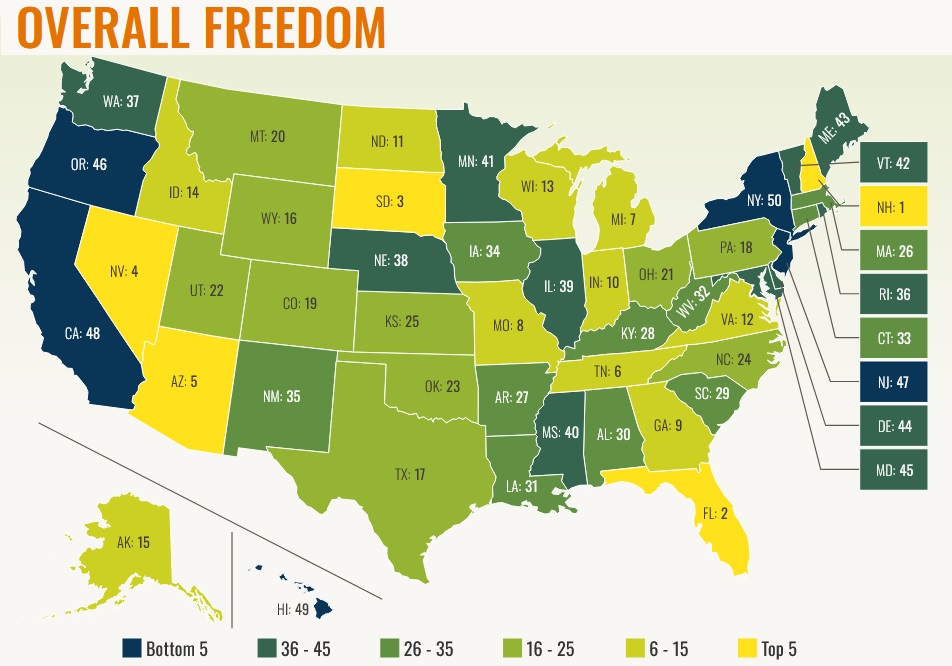
    When I’ve written about Freedom in the 50 States (as I did in 2016, 2019, and 2022), it seems that Florida and New Hampshire routinely get the best scores.

    Well, the same is true for the latest edition. As you can see from this map, New Hampshire is the nation’s most libertarian state with Florida in second place.

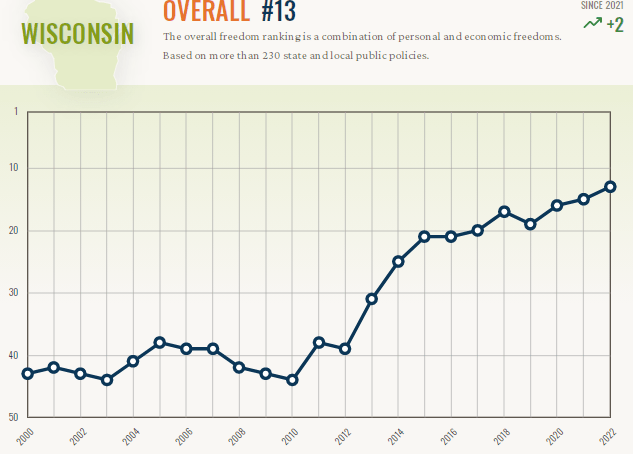
    So where does Wisconsin rank?


    Wisconsin is still one of the most improved states since 2000, and a great deal of the credit for that goes to a rise in personal freedom, not just economic freedom. The Badger State was 48th in the country in personal freedom as recently as 2010 but is now 28th after moving as high as 19th in 2018. Wisconsin shines brightest on regulatory policy.

    In economic freedom, Wisconsin comes in at number 14. But Wisconsin has consistently improved on fiscal policy since its poor showing at 43rd in 2010; it now stands at 23rd. Wisconsin’s taxes are close to the national average, but they have fallen gradually since 2012. State taxes are projected to be 6.4 percent of adjusted personal income in FY 2022, whereas local taxes stood at 3.4 percent of income in FY 2021, slightly below the national average. State and local debt has fallen almost continuously since FY 2007, but state and local financial assets have also fallen despite some recent upticks. Government employment is below average at 11.6 percent after peaking in FY 2010 at 13.0 percent. Government share of GDP is 9.5 percent of adjusted income, below the national average and lower than it has been every year for over a decade. Wisconsin’s fiscal policy score is currently at its highest level in our time series, both absolutely and relatively.

    Regulatory freedom grew in 2015 because of a right-to-work law, but the policy environment at the state level has been stable since. The state ranks in the middle of the pack on land-use freedom; local zoning has not gotten out of hand, though it has grown since 2000. The state has a renewable portfolio standard, which was tightened in 2015. Apart from a right-to-work law, Wisconsin was already reasonably good on labor-market policy. It now ranks second in the country. Health insurance regulation is a bit better than average because of low mandates. Cable and telecommunications have been liberalized. Occupational licensing increased dramatically between 2000 and 2006 and then shrank over the past few years; still, the state is about average overall on extent of licensure. Nurse practitioners enjoy no independent practice freedom. Insurance freedom is generally good, at least for property and casualty lines. The state has no certificate-of-need law for hospitals. It has a price-gouging law, and it also has controversial, strictly enforced minimum-markup laws for retailers. The civil liability system is above average and has improved significantly since 2010 because of a punitive damages cap.

    Wisconsin remains a low-ranking state on criminal justice policies at 35th. However, the incarceration rate has improved over the past few years after previous backsliding. Nondrug victimless crime arrests continued to drop and have been declining steadily for a decade. The state’s asset forfeiture regime is among the best in the country. Equitable-sharing revenues are significantly lower than average. Tobacco freedom is low because of airtight smoking bans and high taxes. The state even has local vaping bans. Wisconsin is a top state for educational freedom, coming in at number seven. Educational freedom grew significantly in 2013–14 with the expansion of vouchers. However, private schools are tightly regulated. There is little legal gambling, even in social contexts, but private sports betting is now legal. Cannabis law is unreformed. Wisconsin remains the best state for alcohol freedom, with no state role in distribution, no keg registration, low taxes (especially—unsurprisingly—on beer), no blue laws, legal happy hours, legal direct wine shipment, and both wine and spirits in grocery stores. The state is now better than average on gun rights after the legislature passed a shall-issue concealed-carry license law in 2011 (one of the last states in the country to legalize concealed carry) and repealed a waiting period in 2015. Sobriety checkpoints are not authorized.

    Note when Wisconsin became a more free state — after Gov. James Doyle and legislative Democrats were replaced by Gov. Scott Walker and legislative Republicans. Republicans continue to control the Legislature despite our Democratic governor. The economic freedom scores are hard to believe given the lack of a Taxpayer Bill of Rights-like constitutional limit on spending on taxes. When limits on government depend on which party is in power, that’s not really economic freedom.

    There are two things that may return Wisconsin to New York-like levels of non-freedom — the left-wing majority on the state Supreme Court, and if Democrats, the only people who actually support redistricting “reform,” succeed in ending GOP control of the Legislature.

    Cato’s suggestions for improvement:

    Fiscal Reduce the income tax burden while continuing to cut spending on employee retirement and government employment.

    Regulatory Remove barriers to independent practice for nurse practitioners.

    Personal Reform the state’s marijuana laws consistent with reforms carried out across the nation, including decriminalizing possession.

    Back to Mitchell:

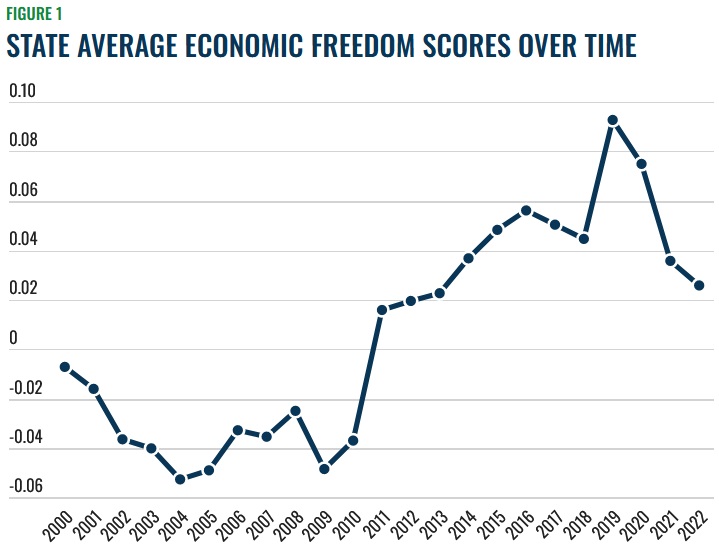
    I always like looking at trends. If we look at what’s happened to economic freedom over time, there’s good news and bad news.

    On the positive side, the average level of economic freedom is higher today than it was about 20 years ago. On the negative side, average scores have plummeted since 2020.

    Mitchell introduces another measure:

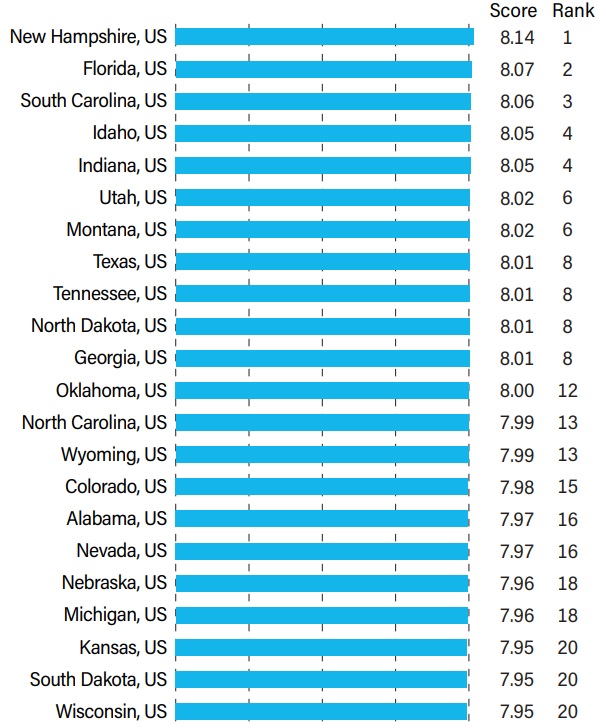
    Today, let’s look at the Economic Freedom of North America, published by the Fraser Institute, which also measures and ranks economic freedom for Canadian provinces and Mexican states.

    Lo and behold, the most laissez-faire jurisdiction in North America is still New Hampshire. Here are the jurisdictions (all from the USA) in the top quartile. ..

    Note the state at the bottom of the graph, which nevertheless is rated more free than every Canadian province and every Mexican state. Canada, of course, is run by the illegitimate son of Fidel Castro (think I’m kidding?), and Mexico has always been fundamentally corrupt.

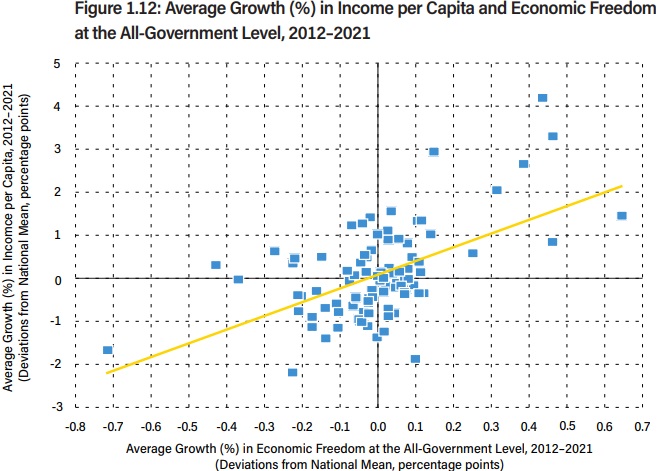
    Why does this matter?

    … Our last image shows that economic liberty has very significant correlation with growth in per-capita income.

    The moral of the story is that jurisdictions that want more prosperity should limit the size and scope of government.


    Share this on …

    • Share on X (Opens in new window) X
    • Share on Facebook (Opens in new window) Facebook
    • Share on LinkedIn (Opens in new window) LinkedIn
    • Email a link to a friend (Opens in new window) Email
    • Print (Opens in new window) Print
    Like Loading…
    No comments on We’re number 13! We’re number 20!
  • Presty the DJ for Nov. 22

    November 22, 2023
    Music

    Today in 1963, the Beatles released their second album, “With the Beatles,” in the United Kingdom.

    That same day, with this song on top of the U.S. singles charts …

    … Phil Spector released a Christmas album from his artists:

    Given what else happened that day, you can imagine neither of those received much notice in this country.

    (more…)

    Share this on …

    • Share on X (Opens in new window) X
    • Share on Facebook (Opens in new window) Facebook
    • Share on LinkedIn (Opens in new window) LinkedIn
    • Email a link to a friend (Opens in new window) Email
    • Print (Opens in new window) Print
    Like Loading…
    No comments on Presty the DJ for Nov. 22
  • Presty the DJ for Nov. 21

    November 21, 2023
    Music

    The number one British single today in 1954:

    Today in 1955, RCA Records purchased the recording contract of Elvis Presley from Sam Phillips for an unheard-of $35,000.

    The number one single today in 1960 holds the record for the shortest number one of all time:

    The number one British single today in 1970 hit number one after the singer’s death earlier in the year:

    (more…)

    Share this on …

    • Share on X (Opens in new window) X
    • Share on Facebook (Opens in new window) Facebook
    • Share on LinkedIn (Opens in new window) LinkedIn
    • Email a link to a friend (Opens in new window) Email
    • Print (Opens in new window) Print
    Like Loading…
    No comments on Presty the DJ for Nov. 21
  • They don’t know that (and what) they don’t know

    November 20, 2023
    International relations, US politics

    Paul Mirengott:

    The response on college campuses and social media to Hamas’ massacre in Israel laid bare the stunning ignorance and absence of moral sense among American students. No, Israel does not “occupy” Gaza. No, there is no recognized “right of return” for 5 million Palestinians. And even there were such an occupation or right of return, Hamas’ crimes against humanity, including rape, torture, and beheadings, would not be defensible.

    How did American students become so ignorant? How did they lose their moral compass?

    The most plausible explanation is that their education has failed them. Peter Berkowitz shows that this is, indeed, the explanation.

    The virus is multicultural in the form preached on American campuses. Berkowitz states:

    In recent decades, the several offshoots of multiculturalism spawned at our universities have further stoked resentment, poisoned moral judgment, and inculcated self-righteousness. Identity politics replaces individual rights with group demands. Intersectionality stresses the “interconnected,” “overlapping,” and “interdependent” forms of discrimination suffered by minorities and women. The diversity, equity, and inclusion industry instructs citizens to view each other primarily through the lens of race, ethnicity, and gender rather than that of individual character and shared humanity.

    The resolute focus on grievance has had baleful consequences. By conceiving of Israel as a prime example of the settler colonialism that must be overcome, the multicultural mindset fuels antisemitism. But multiculturalism’s impact extends far beyond that sordid alliance. If one wanted to infiltrate the bastions of higher education and depreciate human rights, sow discord, and engineer a return to tribalism, it’s hard to imagine where one would depart from multicultural orthodoxy.

    If group demands trump individual rights and if, therefore, group grievances must be remedied without regard to human rights, then it becomes possible for poorly educated Americans to justify Hamas’ slaughter in their weak minds. And if America is racist, colonialist, and generally rotten — as so many professors preach — then our staunch ally in the Middle East deserves all the more whatever horrors terrorists inflict on it.

    Having indicted multiculturalism as taught at our colleges and universities, Berkowitz ends his article with this plea:

    To reclaim human rights, foster comity among citizens, and restore appreciation of the public interest, it is vital to reform our colleges and universities. Institutions of higher education erode the public interest by promulgating an intolerant and anti-pluralist creed under the rubric of multiculturalism while providing outposts for propagandists of barbarism. Instead, America’s colleges and universities should cultivate free minds by preserving and transmitting the traditions of free individuals and free peoples.

    But how do we get there from here? How do we reform our colleges and universities so that they cultivate free minds by preserving and transmitting the traditions of free individuals and free peoples?

    Because our colleges and universities won’t reform themselves, and because they have been almost entirely immune to outside pressure, the problem seems intractable. As Stanley Kurtz states:

    It has seemed next to impossible to remedy th[e] situation. Insulated from outside influence by academic freedom, illiberal academics abused the tenure system to entrench a political and intellectual monopoly. Protections designed to nurture a marketplace of ideas have been converted into bulwarks of orthodoxy. How can we break this monopoly without destroying the very principles of freedom that we hope to restore?

    The answer, Stanley says, lies with state legislatures. But state legislatures can’t remedy the situation reactively — that is, by responding intermittently to abuses and then returning to normal legislative functions. Nor can they exercise permanent supervision over institutions of higher learning.

    Therefore, they need to establish a permanent structure within colleges and universities that bypasses the existing bureaucracy and professoriate. Such a structure, if it can be established legislatively, will bring about the necessary reform without continuous legislative supervision.

    This is what Stanley, working with Jenna Robinson of the James G. Martin Center for Academic Renewal and David Randall of the National Association of Scholars, has proposed through model legislation.

    That remarkably ambitious model legislation will be the subject of my next post, but you can take a sneak peak at the proposal here. Stanley’s discussion of it is here.
     

    Share this on …

    • Share on X (Opens in new window) X
    • Share on Facebook (Opens in new window) Facebook
    • Share on LinkedIn (Opens in new window) LinkedIn
    • Email a link to a friend (Opens in new window) Email
    • Print (Opens in new window) Print
    Like Loading…
    No comments on They don’t know that (and what) they don’t know
  • Presty the DJ for Nov. 20

    November 20, 2023
    Music

    The number one British single today in 1955 …

    … on the day Bo Diddley made his first appearance on CBS-TV’s Ed Sullivan Show. Diddley’s first appearance was his last because, instead of playing “Sixteen Tons”  …

    … Diddley played “Bo Diddley”:

    The number one single today in 1965 could be said to be music to, or in, your ears:

    (more…)

    Share this on …

    • Share on X (Opens in new window) X
    • Share on Facebook (Opens in new window) Facebook
    • Share on LinkedIn (Opens in new window) LinkedIn
    • Email a link to a friend (Opens in new window) Email
    • Print (Opens in new window) Print
    Like Loading…
    No comments on Presty the DJ for Nov. 20
  • Presty the DJ for Nov. 19

    November 19, 2023
    Music

    The Supremes became the first all-girl group with a British number-one single today in 1964:

    The Supremes had our number one single two years later:

    The number one album today in 1994 was Nirvana’s “MTV Unplugged in New York” …

    … on the same day that David Crosby had a liver transplant to replace the original that was ruined by hepatitis C and considerable drug and alcohol use:

    (more…)

    Share this on …

    • Share on X (Opens in new window) X
    • Share on Facebook (Opens in new window) Facebook
    • Share on LinkedIn (Opens in new window) LinkedIn
    • Email a link to a friend (Opens in new window) Email
    • Print (Opens in new window) Print
    Like Loading…
    No comments on Presty the DJ for Nov. 19
  • Presty the DJ for Nov. 18

    November 18, 2023
    Music

    Today in 1954, ABC Radio banned Rosemary Clooney’s “Mambo Italiano” for what it termed “offensive lyrics” (decide for yourself):

    The number one album today in 1978 was Billy Joel’s “52nd Street”:

    (more…)

    Share this on …

    • Share on X (Opens in new window) X
    • Share on Facebook (Opens in new window) Facebook
    • Share on LinkedIn (Opens in new window) LinkedIn
    • Email a link to a friend (Opens in new window) Email
    • Print (Opens in new window) Print
    Like Loading…
    No comments on Presty the DJ for Nov. 18
Previous Page
1 … 82 83 84 85 86 … 1,032
Next Page

Website Powered by WordPress.com.

Steve Prestegard.com: The Presteblog

The thoughts of a journalist/libertarian–conservative/Christian husband, father, Eagle Scout and aficionado of obscure rock music. Thoughts herein are only the author’s and not necessarily the opinions of his family, friends, neighbors, church members or past, present or future employers.

  • Steve
    • About, or, Who is this man?
    • Facebook
    • Twitter
    • Adventures in ruralu0026nbsp;inkBack in June 2009, I was driving somewhere through a rural area. And for some reason, I had a flashback to two experiences in my career about that time of year many years ago. In 1988, eight days after graduating from the University of Wisconsin, I started work at the Grant County Herald Independent in Lancaster as a — well, the — reporter. Four years after that, on my 27th birthday, I purchased, with a business partner, the Tri-County Press in Cuba City, my first business venture. Both were experiences about which Wisconsin author Michael Perry might write. I thought about all this after reading a novel, The Deadline, written by a former newspaper editor and publisher. (Now who would write a novel about a weekly newspaper?) As a former newspaper owner, I picked at some of it — why finance a newspaper purchase through the bank if the seller is willing to finance it? Because the mean bank lender is a plot point! — and it is much more interesting than reality, but it is very well written, with a nicely twisting plot, and quite entertaining, again more so than reality. There is something about that first job out of college that makes you remember it perhaps more…
    • Adventures in radioI’ve been in the full-time work world half my life. For that same amount of time I’ve been broadcasting sports as a side interest, something I had wanted to since I started listening to games on radio and watching on TV, and then actually attending games. If you ask someone who’s worked in radio for some time about the late ’70s TV series “WKRP in Cincinnati,” most of them will tell you that, if anything, the series understated how wacky working in radio can be. Perhaps the funniest episode in the history of TV is the “WKRP” episode, based on a true story, about the fictional radio station’s Thanksgiving promotion — throwing live turkeys out of a helicopter under the mistaken belief that, in the words of WKRP owner Arthur Carlson, “As God is my witness, I thought turkeys could fly.” [youtube=http://www.youtube.com/watch?v=ST01bZJPuE0] I’ve never been involved in anything like that. I have announced games from the roofs of press boxes (once on a nice day, and once in 50-mph winds), from a Mississippi River bluff (more on that later), and from the front row of the second balcony of the University of Wisconsin Fieldhouse (great view, but not a place to go if…
    • “Good morning/afternoon/evening, ________ fans …”
    • My biggest storyEarlier this week, while looking for something else, I came upon some of my own work. (I’m going to write a blog someday called “Things I Found While Looking for Something Else.” This is not that blog.) The Grant County Sheriff’s Department, in the county where I used to live, has a tribute page to the two officers in county history who died in the line of duty. One is William Loud, a deputy marshal in Cassville, shot to death by two bank robbers in 1912. The other is Tom Reuter, a Grant County deputy sheriff who was shot to death at the end of his 4 p.m.-to-midnight shift March 18, 1990. Gregory Coulthard, then a 19-year-old farmhand, was convicted of first-degree intentional homicide and is serving a life sentence, with his first eligibility for parole on March 18, 2015, just 3½ years from now. I’ve written a lot over the years. I think this, from my first two years in the full-time journalism world, will go down as the story I remember the most. For journalists, big stories contain a paradox, which was pointed out in CBS-TV’s interview of Andy Rooney on his last “60 Minutes” Sunday. Morley Safer said something along the line…
  • Food and drink
    • The Roesch/Prestegard familyu0026nbsp;cookbookFrom the family cookbook(s) All the families I’m associated with love to eat, so it’s a good thing we enjoy cooking. The first out-of-my-house food memory I have is of my grandmother’s cooking for Christmas or other family occasions. According to my mother, my grandmother had a baked beans recipe that she would make for my mother. Unfortunately, the recipe seems to have  disappeared. Also unfortunately, my early days as a picky, though voluminous, eater meant I missed a lot of those recipes made from such wholesome ingredients as lard and meat fat. I particularly remember a couple of meals that involve my family. The day of Super Bowl XXXI, my parents, my brother, my aunt and uncle and a group of their friends got together to share lots of food and cheer on the Packers to their first NFL title in 29 years. (After which Jannan and I drove to Lambeau Field in the snow,  but that’s another story.) Then, on Dec. 31, 1999, my parents, my brother, my aunt and uncle and Jannan and I (along with Michael in utero) had a one-course-per-hour meal to appropriately end years beginning with the number 1. Unfortunately I can’t remember what we…
    • SkålI was the editor of Marketplace Magazine for 10 years. If I had to point to one thing that demonstrates improved quality of life since I came to Northeast Wisconsin in 1994, it would be … … the growth of breweries and  wineries in Northeast Wisconsin. The former of those two facts makes sense, given our heritage as a brewing state. The latter is less self-evident, since no one thinks of Wisconsin as having a good grape-growing climate. Some snobs claim that apple or cherry wines aren’t really wines at all. But one of the great facets of free enterprise is the opportunity to make your own choice of what food and drink to drink. (At least for now, though some wish to restrict our food and drink choices.) Wisconsin’s historically predominant ethnic group (and our family’s) is German. Our German ancestors did unfortunately bring large government and high taxes with them, but they also brought beer. Europeans brought wine with them, since they came from countries with poor-quality drinking water. Within 50 years of a wave of mid-19th-century German immigration, brewing had become the fifth largest industry in the U.S., according to Maureen Ogle, author of Ambitious Brew: The Story of American Beer. Beer and wine have…
  • Wheels
    • America’s sports carMy birthday in June dawned without a Chevrolet Corvette in front of my house. (The Corvette at the top of the page was featured at the 2007 Greater Milwaukee Auto Show. The copilot is my oldest son, Michael.) Which isn’t surprising. I have three young children, and I have a house with a one-car garage. (Then again, this would be more practical, though a blatant pluck-your-eyes-out violation of the Corvette ethos. Of course, so was this.) The reality is that I’m likely to be able to own a Corvette only if I get a visit from the Corvette Fairy, whose office is next door to the Easter Bunny. (I hope this isn’t foreshadowing: When I interviewed Dave Richter of Valley Corvette for a car enthusiast story in the late great Marketplace Magazine, he said that the most popular Corvette in most fans’ minds was a Corvette built during their days in high school. This would be a problem for me in that I graduated from high school in 1983, when no Corvette was built.) The Corvette is one of those cars whose existence may be difficult to understand within General Motors Corp. The Corvette is what is known as a “halo car,” a car that drives people into showrooms, even if…
    • Barges on fouru0026nbsp;wheelsI originally wrote this in September 2008.  At the Fox Cities Business Expo Tuesday, a Smart car was displayed at the United Way Fox Cities booth. I reported that I once owned a car into which trunk, I believe, the Smart could be placed, with the trunk lid shut. This is said car — a 1975 Chevrolet Caprice coupe (ours was dark red), whose doors are, I believe, longer than the entire Smart. The Caprice, built down Interstate 90 from us Madisonians in Janesville (a neighbor of ours who worked at the plant probably helped put it together) was the flagship of Chevy’s full-size fleet (which included the stripper Bel Air and middle-of-the-road Impala), featuring popular-for-the-time vinyl roofs, better sound insulation, an upgraded cloth interior, rear fender skirts and fancy Caprice badges. The Caprice was 18 feet 1 inch long and weighed 4,300 pounds. For comparison: The midsize Chevrolet of the ear was the Malibu, which was the same approximate size as the Caprice after its 1977 downsizing. The compact Chevrolet of the era was the Nova, which was 200 inches long — four inches longer than a current Cadillac STS. Wikipedia’s entry on the Caprice has this amusing sentence: “As fuel economy became a bigger priority among Americans…
    • Behind the wheel
    • Collecting only dust or rust
    • Coooooooooooupe!
    • Corvettes on the screen
    • The garage of misfit cars
    • 100 years (and one day) of our Chevrolets
    • They built Excitement, sort of, once in a while
    • A wagon by any otheru0026nbsp;nameFirst written in 2008. You will see more don’t-call-them-station-wagons as you drive today. Readers around my age have probably had some experience with a vehicle increasingly rare on the road — the station wagon. If you were a Boy Scout or Girl Scout, or were a member of some kind of youth athletic team, or had a large dog, or had relatives approximately your age, or had friends who needed to be transported somewhere, or had parents who occasionally had to haul (either in the back or in a trailer) more than what could be fit inside a car trunk, you (or, actually, your parents) were the target demographic for the station wagon. “Station wagons came to be like covered wagons — so much family activity happened in those cars,” said Tim Cleary, president of the American Station Wagon Owners Association, in Country Living magazine. Wagons “were used for everything from daily runs to the grocery store to long summer driving trips, and while many men and women might have wanted a fancier or sportier car, a station wagon was something they knew they needed for the family.” The “station wagon” originally was a vehicle with a covered seating area to take people between train stations…
    • Wheels on theu0026nbsp;screenBetween my former and current blogs, I wrote a lot about automobiles and TV and movies. Think of this post as killing two birds (Thunderbirds? Firebirds? Skylarks?) with one stone. Most movies and TV series view cars the same way most people view cars — as A-to-B transportation. (That’s not counting the movies or series where the car is the plot, like the haunted “Christine” or “Knight Rider” or the “Back to the Future” movies.) The philosophy here, of course, is that cars are not merely A-to-B transportation. Which disqualifies most police shows from what you’re about to read, even though I’ve watched more police video than anything else, because police cars are plain Jane vehicles. The highlight in a sense is in the beginning: The car chase in my favorite movie, “Bullitt,” featuring Steve McQueen’s 1968 Ford Mustang against the bad guys’ 1968 Dodge Charger: [youtube=http://www.youtube.com/watch?v=GMc2RdFuOxIu0026amp;fmt=18] One year before that (but I didn’t see this until we got Telemundo on cable a couple of years ago) was a movie called “Operación 67,” featuring (I kid you not) a masked professional wrestler, his unmasked sidekick, and some sort of secret agent plot. (Since I don’t know Spanish and it’s not…
    • While riding in my Cadillac …
  • Entertainments
    • Brass rocksThose who read my former blog last year at this time, or have read this blog over the past months, know that I am a big fan of the rock group Chicago. (Back when they were a rock group and not a singer of sappy ballads, that is.) Since rock music began from elements of country music, jazz and the blues, brass rock would seem a natural subgenre of rock music. A lot of ’50s musical acts had saxophone players, and some played with full orchestras … [youtube=http://www.youtube.com/watch?v=9CPS-WuUKUE] … but it wasn’t until the more-or-less simultaneous appearances of Chicago and Blood Sweat u0026amp; Tears on the musical scene (both groups formed in 1967, both had their first charting singles in 1969, and they had the same producer) that the usual guitar/bass/keyboard/drum grouping was augmented by one or more trumpets, a sax player and a trombone player. While Chicago is my favorite group (but you knew that already), the first brass rock song I remember hearing was BSu0026amp;T’s “Spinning Wheel” — not in its original form, but on “Sesame Street,” accompanied by, yes, a giant spinning wheel. [youtube=http://www.youtube.com/watch?v=qi9sLkyhhlE] [youtube=http://www.youtube.com/watch?v=OxWSOuNsN20] [youtube=http://www.youtube.com/watch?v=U9U34uPjz-g] I remember liking Chicago’s “Just You ‘n Me” when it was released as a single, and…
    • Drive and Eat au0026nbsp;RockThe first UW home football game of each season also is the opener for the University of Wisconsin Marching Band, the world’s finest college marching band. (How the UW Band has not gotten the Sudler Trophy, which is to honor the country’s premier college marching bands, is beyond my comprehension.) I know this because I am an alumnus of the UW Band. I played five years (in the last rank of the band, Rank 25, motto: “Where Men Are Tall and Run-On Is Short”), marching in 39 football games at Camp Randall Stadium, the Hubert H. Humphrey Metrodome in Minneapolis, Michigan Stadium in Ann Arbor, Memorial Stadium at the University of Illinois (worst artificial turf I had ever seen), the University of Nevada–Las Vegas’ Sam Boyd Silver Bowl, the former Dyche Stadium at Northwestern University, five high school fields and, in my one bowl game, Legion Field in Birmingham, Ala., site of the 1984 Hall of Fame Bowl. The UW Band was, without question, the most memorable experience of my college days, and one of the most meaningful experiences of my lifetime. It was the most physical experience of my lifetime, to be sure. Fifteen minutes into my first Registration…
    • Keep on rockin’ in the freeu0026nbsp;worldOne of my first ambitions in communications was to be a radio disc jockey, and to possibly reach the level of the greats I used to listen to from WLS radio in Chicago, which used to be one of the great 50,000-watt AM rock stations of the country, back when they still existed. (Those who are aficionados of that time in music and radio history enjoyed a trip to that wayback machine when WLS a Memorial Day Big 89 Rewind, excerpts of which can be found on their Web site.) My vision was to be WLS’ afternoon DJ, playing the best in rock music between 2 and 6, which meant I wouldn’t have to get up before the crack of dawn to do the morning show, yet have my nights free to do whatever glamorous things big-city DJs did. Then I learned about the realities of radio — low pay, long hours, zero job security — and though I have dabbled in radio sports, I’ve pretty much cured myself of the idea of working in radio, even if, to quote WAPL’s Len Nelson, “You come to work every day just like everybody else does, but we’re playing rock ’n’ roll songs, we’re cuttin’ up.…
    • Monday on the flight line, not Saturday in the park
    • Music to drive by
    • The rock ofu0026nbsp;WisconsinWikipedia begins its item “Music of Wisconsin” thusly: Wisconsin was settled largely by European immigrants in the late 19th century. This immigration led to the popularization of galops, schottisches, waltzes, and, especially, polkas. [youtube=http://www.youtube.com/watch?v=yl7wCczgNUc] So when I first sought to write a blog piece about rock musicians from Wisconsin, that seemed like a forlorn venture. Turned out it wasn’t, because when I first wrote about rock musicians from Wisconsin, so many of them that I hadn’t mentioned came up in the first few days that I had to write a second blog entry fixing the omissions of the first. This list is about rock music, so it will not include, for instance, Milwaukee native and Ripon College graduate Al Jarreau, who in addition to having recorded a boatload of music for the jazz and adult contemporary/easy listening fan, also recorded the theme music for the ’80s TV series “Moonlighting.” Nor will it include Milwaukee native Eric Benet, who was for a while known more for his former wife, Halle Berry, than for his music, which includes four number one singles on the Ru0026amp;B charts, “Spend My Life with You” with Tamia, “Hurricane,” “Pretty Baby” and “You’re the Only One.” Nor will it include Wisconsin’s sizable contributions to big…
    • Steve TV: All Steve, All the Time
    • “Super Steve, Man of Action!”
    • Too much TV
    • The worst music of allu0026nbsp;timeThe rock group Jefferson Airplane titled its first greatest-hits compilation “The Worst of Jefferson Airplane.” Rolling Stone magazine was not being ironic when it polled its readers to decide the 10 worst songs of the 1990s. I’m not sure I agree with all of Rolling Stone’s list, but that shouldn’t be surprising; such lists are meant for debate, after all. To determine the “worst,” songs appropriate for the “Vinyl from Hell” segment that used to be on a Madison FM rock station, requires some criteria, which does not include mere overexposure (for instance, “Macarena,” the video of which I find amusing since it looks like two bankers are singing it). Before we go on: Blog posts like this one require multimedia, so if you find a song you hate on this blog, I apologize. These are also songs that I almost never listen to because my sound system has a zero-tolerance policy — if I’m listening to the radio or a CD and I hear a song I don’t like, it’s, to quote Bad Company, gone gone gone. My blonde wife won’t be happy to read that one of her favorite ’90s songs, 4 Non Blondes’ “What’s Up,” starts the list. (However,…
    • “You have the right to remain silent …”
  • Madison
    • Blasts from the Madison media past
    • Blasts from my Madison past
    • Blasts from our Madison past
    • What’s the matter with Madison?
    • Wisconsin – Madison = ?
  • Sports
    • Athletic aesthetics, or “cardinal” vs. “Big Red”
    • Choose your own announcer
    • La Follette state 1982 (u0022It was 30 years ago todayu0022)
    • The North Dakota–Wisconsin Hockey Fight of 1982
    • Packers vs. Brewers
  • Hall of Fame
    • The case(s) against teacher unions
    • The Class of 1983
    • A hairy subject, or face the face
    • It’s worse than you think
    • It’s worse than you think, 2010–11 edition
    • My favorite interview subject of all time
    • Oh look! Rural people!
    • Prestegard for president!
    • Unions vs. the facts, or Hiding in plain sight
    • When rhetoric goes too far
Privacy & Cookies: This site uses cookies. By continuing to use this website, you agree to their use.
To find out more, including how to control cookies, see here: Cookie Policy
 

Loading Comments...
 

    • Subscribe Subscribed
      • Steve Prestegard.com: The Presteblog
      • Join 198 other subscribers
      • Already have a WordPress.com account? Log in now.
      • Steve Prestegard.com: The Presteblog
      • Subscribe Subscribed
      • Sign up
      • Log in
      • Report this content
      • View site in Reader
      • Manage subscriptions
      • Collapse this bar
    %d