Last week, like tens of millions of Americans, I filled out brackets for the always-unpredictable NCAA basketball tournament.
So how are things going based on the seeds?
Number 1 seed undefeated Wichita State: No longer undefeated. Also no longer playing.
Number 2 seed Kansas: Dust in the wind.
Number 2 seed Villanova: In Spanish, no va. (“Doesn’t go” for non-Spanish speakers.)
Number 3 seed Duke: Poof.
Number 3 seed Syracuse, about whose zone defense Sports Illustrated wrote approvingly: You can’t win if you can’t score. (Dayton 55, Syracuse 53.)
Number 3 seed Creighton, whose leading scorer, Doug McDermott, was the subject of a SI cover story: In Australian, crikey.
The tournament is seeded from 1 to 16. If every higher seed won every first- and second-round game, there should be no higher seeded team than a fourth seed left. Instead, one of the South Regional semifinals will feature 11th-seed Dayton (which won its two games by four points) and 10th-seed Stanford (which won its two games by eight points). Sixth-seed Baylor, seventh-seed Connecticut, eighth-seed Kentucky and 11th-seed Tennessee are all still in the tournament.
Recall that I had four brackets, three of them based on Ken Pomeroy’s efficiency rankings. The offensive efficiency bracket has one Final Four team, Michigan State.
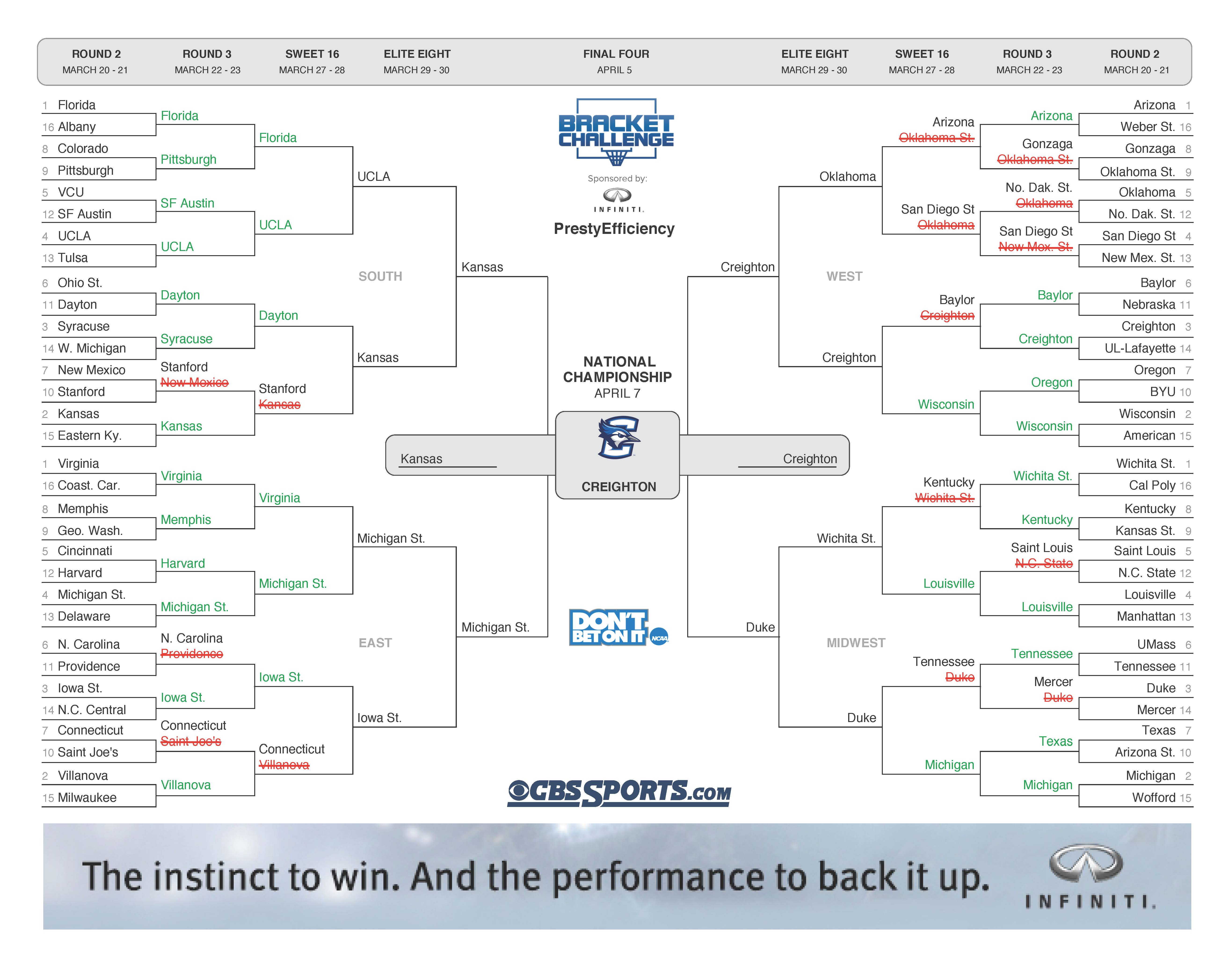
The defensive efficiency bracket has three of the Final Four remaining — Arizona, Louisville and Virginia — though the one that isn’t, VCU, will lose me points by not getting to the national final. (And for some reason that one didn’t register with CBSSports.com, so you’ll just have to trust what I say about that bracket.)
Remarkably, all four of my Final Four teams are left in the net efficiency bracket …
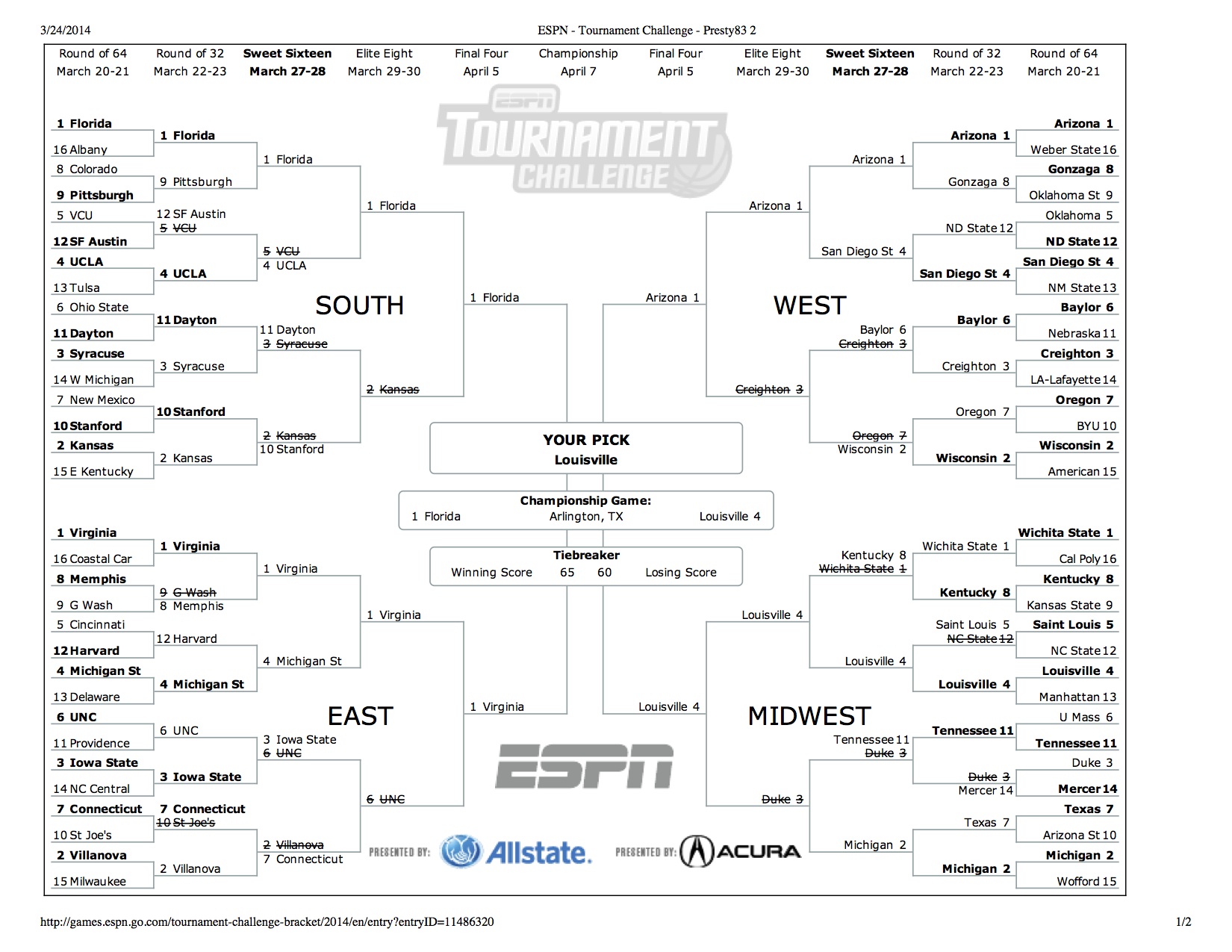
… and in my ESPN bracket — Arizona, Louisville, Virginia and Florida.
Certainly picking three number-one seeds to go to the Final Four is hardly going out on a limb, but I do think Louisville was seeded too low, which makes me still think they will get to cut down the nets in “North Texas.”
The regional semifinal round will feature at least one delicious matchup: Fourth-seed Louisville (my pick to win the national championship) against eighth-seed Kentucky (whose former coach is now Louisville’s coach) in Indianapolis. (A friend who is a Cardinals fan says the biggest winner will be the Indiana State Police. A Facebook Friend says Wichita State, whose season ended at the hands of the Wildcats, will actually end up with a perfect season once the NCAA vacates all of Kentucky’s wins for yet-to-be-disclosed NCAA rules violations.)
And, of course, Wisconsin, having done two things they’re not good at — playing at a quicker pace and coming back from a big deficit — is still in it, with a West Regional matchup against Baylor Thursday. For those who like history: West number one seed Arizona was a number one seed in 2000, until they ran into … Wisconsin.
For those whose brackets have been blown up by all the upsets, keep in mind that it could be worse. Ohio State fans endured Dayton’s ending their men’s basketball season, followed two days later by Wisconsin’s ending the Buckeyes’ men’s hockey season. As with Oregon, you can’t spell Ohio State without a 0.
Maybe you remember Occupy Wall Street. It was a short-lived, flash-in-the-pan, street festival in which iPhone carrying college kids were invited to camp in the road and defecate on police cars. Oh, and while they were there, they were supposed to use all that technology that their parents had purchased them to crab about how evil corporations were. It was idiotic, and it died a mercifully quick death.
Now, one of the movement’s founders has a new plan for America. She likes to describe our shared corporatist future as “post capitalist” and she hopes to make it happen as quickly as possible. To that end, she’s set up a petition at WhiteHouse.gov which asks her favorite President to disband the U.S. government, and give control of the country to Google’s Executive Chairman Eric Schmidt:
WE PETITION THE OBAMA ADMINISTRATION TO:
Transfer all federal administrative authority to the tech industry.
Mister Obama,
I have the utmost respect for you Sir. America is a great country and you’ve worked hard to bring its affairs in order. But I’m afraid you’re fighting a battle that can’t be won. The Washington regime has become incompetent over the years. It is no longer able to face the difficult challenges that lay ahead. I think it’s time for a peaceful change.
I implore you to call a national referendum to do the following:
1. Retire all government employees with full pensions.
2. Transfer administrative authority to the tech industry.
3. Appoint Eric Schmidt CEO of America.
It’s time for the U.S. Regime to politely take its exit from history and do what’s best for America. The tech industry can offer us good governance and prevent further American decline.
—Justine Tunney
Yes, that’s real, and yes, it’s actually up on the White House website right now.
Schmidt is currently the 138th richest person on Earth, with assets somewhere around $8 billion. A quick look at Justine Tunney’s resume shows that she is currently an entry-level coder for — you guessed it — your new overlords at Google. So much for income inequality and an end to cronyism.
No. Of course they’re not capitalists. They just love hauling in reams of cash while helping the government monitor the activities of private citizens.
Actually, at one point in her ramblings, Tunney did manage to admit that Google is nothing more than a profit-driven “megacorp” but don’t worry. It’s a benevolent profit-driven megacorp. …
So congratulations, Occupiers! The founder of your little club works for a massive cash-hungry corporation which she foolishly thinks is “post-capitalist”, and she wants to give the company total control of the United States. You crackpots must be so very, very, proud.
I am shocked. Shocked, that is, that someone in Madison didn’t dream this up.
Today in 1956, a car in which Carl Perkins was a passenger on the way to New York for appearances on the Ed Sullivan and Perry Como shows was involved in a crash. Perkins was in a hospital for several months, and his brother, Jay, was killed.
Today in 1971, members of the Allman Brothers Band were arrested on charges of possessing marijuana and heroin.
The number one single today in 1975:
The number one album today in 1975 was Led Zeppelin’s “Physical Graffiti”:
Not only did Wisconsin win most convincingly, I picked four upsets correctly — ninth-seed Pittsburgh over eighth-seed Colorado (though that’s not much of an upset), 11th-seed Dayton beating sixth-seed Ohio State (“O!S!U!”), 12th-seed Harvard over fifth-seed Cincinnati, and 12th-seed North Dakota State (coached by former UW assistant Saul Phillips) over fifth-seed Oklahoma. Too bad Saint Joseph ran out of gas against Connecticut in overtime and North Carolina State lost to Saint Louis because the Wolfpack missed more free throws than the Billikens.
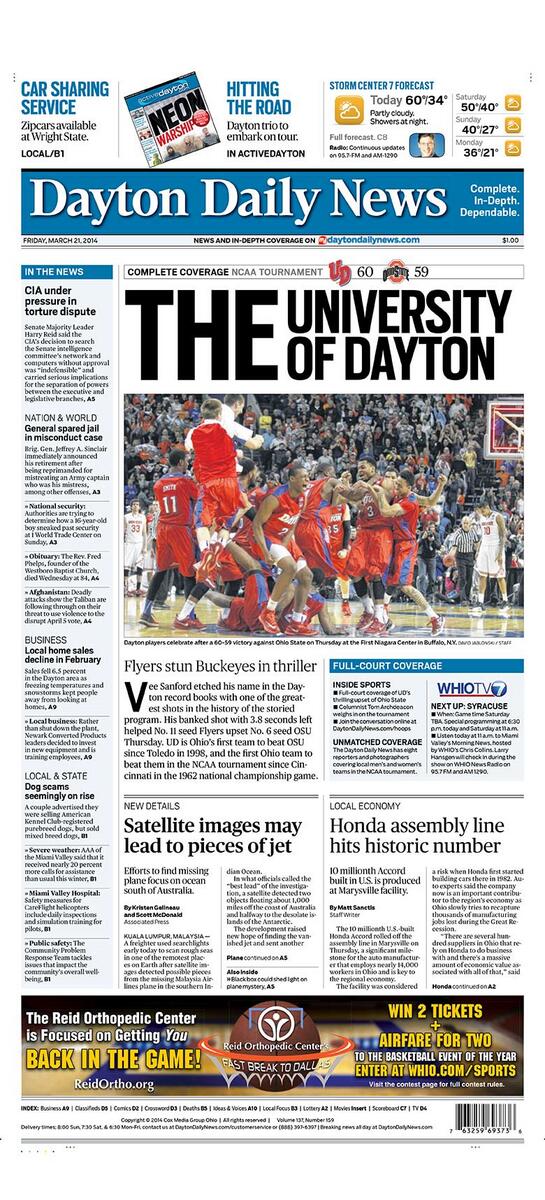
For those who didn’t know: Ohio State refers to itself as The Ohio State University, which is why the Dayton Daily News ran this headline:
A Facebook Friend (and actual friend) reports that fewer than 10 percent of brackets picked the Panthers, Flyers and Crimson correctly. And that was before the next upset:
Which means, in my usual case, that the rest of my bracket(s) are going to go to hell as soon as today.
As readers know from the 2012 Rose Bowl, the Ducks are known for colorful uniforms, at least in football. Wisconsin has a new uniform from adidas for the tournament, which appears to have fewer red parts than the regular-season uniforms and replaces “WISCONSIN” with “BADGERS.” No other changes are discernible.
As for the Ducks, as the lower seed they won’t wear white, so they’ll probably wear one of these:
Yes, you’re seeing correctly. Oregon has yellow, green, dark green and “midnight green” (“black” in the rest of the visual universe”) versions of their “Oregon” and “Fighting Ducks” uniforms, along with a throwback with yellow jersey and pants that, like the camouflage jersey, I assume won’t be used.
This is the second year in a row that the UW first-round game (and, last year, UW’s only game) was broadcast on truTV. The former Court TV isn’t available to very many cable TV customers, which means a lot of UW fans didn’t get to watch the game.
It’s unclear to me why CBS, which has five decades of experience regionally broadcasting simultaneous NFL games, cannot have Wisconsin CBS stations carry the Badgers, moving the other games to TBS, TNT and truTV. Wisconsin fans without cable or satellite TV haven’t been able to watch the Badgers in the Rose Bowl either since it moved from ABC to ESPN.
Meanwhile, if (and I don’t think it’ll happen, but it’s not impossible) UW gets to the Final Four, Badger fans may be in for a treat similar to my Choose Your Own Announcer idea, according to Sports Illustrated:
For starters, TBS will televise both national semifinal games, the first time in tournament history the semifinal games will be televised on a cable network. But here’s an even bigger nod toward the cable side of the partnership: The semifinals will air across three cable networks this year — TBS, TNT and truTV. TBS will air the traditional Final Four broadcast — aiming for neutrality — with Nantz, Anthony and Kerr. But here’s where it gets interesting: The telecasts on TNT and truTV will be team-specific broadcasts where a separate play-by-play announcer, analyst and sideline reporter (Turner and CBS will start negotiating with potential broadcasters after the Sweet 16) will be encouraged to call the game with as much homerism as their pom-poms can muster. The “Teamcast” productions will have separate production crews, a custom halftime show, and custom graphics and stats geared toward each team. Commercials will be the same for all three telecasts. The title game will air on CBS two nights later.
Isn’t this copying what ESPN did with its “Megacast” for the college football title game?
The Turner Sports brass says nyet. “We made that announcement prior to them doing the national championship game and it is going to be a lot different than what they did,” said Turner Broadcasting president David Levy. “They didn’t televise three different ways, so it’s a very different direction. The ultimate thing is how we are doing storytelling for these games.”
Who will be the announcers for these team-specific broadcasts?
That won’t be decided until after the Sweet 16. Turner Sports senior vice president Craig Barry said he has a spreadsheet in his Atlanta office with a list of 120 potential announcers depending on the teams that advance. Ideally, Barry said he wants broadcasters with a level of professional experience who have called games in some form for those schools. It’s not inconceivable a team’s radio broadcasters would freelance for Turner Sports for the day. “If we can create an extended experience that really generates a lot of excitement and differentiates itself from our national telecast, then we have done our job,” Barry said.
Is this a good idea?
Absolutely. Why? Because it offers viewers more options. Whether the teamcasts come off as Wayne World is anyone’s guess. “I want to see how it works,” [Charles] Barkley said. “It’s going to be very interesting. Some of those local guys are such homers. You have to be careful. Some of these guys are ridiculous, it makes you laugh sometimes.”
The choice will probably not be Wisconsin basketball announcer Matt Lepay, since he would be doing the game on radio. (Imagine that conversation at Learfield headquarters.) There are, however, two Wisconsin-based announcers who have considerable basketball experience. One is Brian Anderson, who will be doing Brewers’ TV games next month, but is announcing tournament games this week. The other is Wayne Larrivee, the Packers’ announcer, who used to call Chicago Bulls’ games and has done a lot of college basketball as well.
There’s another obvious choice, someone who has a quarter-century of basketball play-by-play experience, including college, on radio and TV, and who, unlike Anderson and Larrivee, is a UW grad. That would, of course, be me.
Assuming spring takes place this year (and yesterday afternoon’s weather and today’s forecast notwithstanding, I have my doubts), the Rattlers will have, reports announcer Chris Mehring, these alternate jerseys this season, arrayed from semi-conventional to not so much:
I’m not sure how conventional this is, but this is for the Military Appreciation Series July 1-3.
Camo and orange have been done before, believe it or don’t.
Normally this would be the most out-there jersey (Out there? Star Wars? Get it?), except for …
… the jersey for Salute to Cows Night June 12. Really. I’m sure you’re all moooooved by this.
… that signifies it’s time for the three weeks of March Madness. (Which actually started with the “first-round” games in Dayton, Ohio, Tuesday and Wednesday, but never mind that.)
For those who have managed to miss the brackets, here’s one for your own use:
I have tried various systems over the years. You may be familiar with the Blue Jersey Theory, which holds that a team that wears blue jerseys will defeat a non-blue team. Given that the list of traditional basketball powers includes Duke, North Carolina and UCLA, it’s not a bad theory. Indeed, number-one seeds Arizona, Florida and Virginia are all blue schools, as are number-two seeds Michigan, Villanova and Kansas. (What you do if two blues face each other? Good question. And what do you do if two not-blues face each other? Is green blue? Is purple blue? What about black?)
There’s also the Favorite, or Most Fierce, Mascot Theory, in which teams are picked because of their mascots. That in some cases is about as sophisticated as rock/paper/scissors. (What is more fierce — a badger or a wolverine?)
The one rule I have applied over the years is to discount Big Ten teams because the Big Ten is overrated as a basketball conference. Big Ten teams have been the victims of some of the most unbelievable upsets over the years, including Illinois’ loss to Austin Peay (“Let’s go Peay!”) and Indiana’s loss to Cleveland State. It may be heresy to say this, but I think the quality of Big Ten coaching is worse than it used to be. Does anyone seriously think Tom Crean is a better coach than Bob(by) Knight was?
Truth be told, the only year I get the picks mostly right is when an absolutely obvious team — Kentucky in 2012, for instance — wins the national championship. In such situations, everyone picks the same national champion, so I will win no pool.
The fun part is trying to figure out where the jaw-dropping upsets will be. (To wit: 2000 after Wisconsin won its first NCAA team. I guarantee you that no one predicted Wisconsin to play in the Final Four that year.) I have picked a 15-over-2 upset, a 14-over-3 upset, and a few 13-over-4 and 12-over-5 upsets. The problem with those is (1) by nature, upsets are unpredictable, and (2) if you pick one and you’re wrong, you’ve lost not only the next round, but however many rounds the non-upset team goes.
For that reason, it’s considerably easier to pick games by round than to start from today and pick every game. If you pick a team to win the national championship that loses in the regional semifinal (as Duke did one season), well, you can kiss your entry fee goodbye.
This year features, once again, Wisconsin, as well as UW–Milwaukee. It does not include UW-Green Bay, though the Phoenix probably should have been picked, and it doesn’t include Marquette, which also failed to get a National Invitational Tournament and then declined a College Basketball Invitational berth. (As did Indiana, current employer of former Marquette coach Tom Crean.)
The Badgers are perfect under coach Bo Ryan in getting into the NCAAs, unlike the previous decades under Ryan’s predecessors. Once they’re in, well, they haven’t gotten farther than the regional final, and at that just once, 2005. They have five first-round punchouts, including last year to Ole Miss, which ended a two-season streak of getting through the regional semifinal, and a six-season streak of winning at least one tournament game.
The Badgers appear to be an early favorite, at least in the minds of some at ESPN, according to Jeff Potrykus:
If you watched Sunday night as ESPN’s analysts dissected the 2014 NCAA men’s basketball tournament field, you were left with the impression Wisconsin has a legitimate chance to reach the Final Four.
“I love Wisconsin’s draw here,” Jay Bilas said. “I think as a two seed they got a fabulous draw.”
UW, seeded No. 2 in the West Regional, opens Thursday at the Bradley Center against No. 15 American University of the Patriot League.
The winner gets either No. 7 Oregon or No. 10 BYU.
Bilas believes UW is the best defensive team of the four.
“What is the best ball-control, defensive team there?” he asked. “Wisconsin, they haven’t protected the lane as well as they have in the past. But I think they’re the best defensive team out of this group.
“Wisconsin is better offensively than they are defensively but they’re better defensively than anybody else there.”
Bilas, Jay Williams, Digger Phelps, Seth Greenberg and Dick Vitale offered their views on the 68-team field.
Of that quintet, Bilas and Williams picked UW to reach the Final Four for the first time since 2000 and the first time ever under Bo Ryan.
Bilas sees UW defeating No. 4 San Diego State in the regional final but losing to defending champion Louisville, which must fight through the loaded Midwest Regional, in the national semifinals.
“I think this is the Badgers’ year,” he said, referring to a Final Four berth. “They’ve had better teams but I like their draw.”
Bilas likes Louisville better.
“Louisville was mis-seeded in this tournament,” he said. “I think they are playing exceptional basketball right now.”
Williams believes UW will oust Arizona in the regional final. Coincidentally, No. 8 UW upset No. 1 Arizona in the second round of the 2000 NCAA tournament en route to winning the West Regional.
“I love the way this Wisconsin team passes the ball,” Williams said. “The Badgers, with their veteran guards and Frank Kaminsky down low is going to be a handful.”
Alas, UW fans, Williams sees the Badgers falling to Louisville in the national semifinals.
“Louisville is able to change pace,” he said. “They can (turn) Wisconsin over. Montrezl Harrell can be the difference in that ball game down low.”
Phelps and Vitale picked UW to reach the regional final in Anaheim.
Phelps expects sophomore guard Marcus Smart will lead No. 9 Oklahoma State past No. 1 Arizona in the third round and then past UW in the regional final.
“Oklahoma State is the team that’s going to surprise a lot of people,” Phelps said.
Vitale picked Arizona to end UW’s season in the regional final.
“I like their defense,” he said. “I think too much for Wisconsin.”
Greenberg was the only analyst who didn’t pick UW to reach the Sweet 16. He picked No. 7 Oregon to upset UW in the third round in Milwaukee.
All five analysts picked Big Ten tournament champion Michigan State, seeded No. 4 in the East, to win the title.
Call me skeptical (“You’re skeptical!” “No, I’m Steve”), but I’m not on the Badger bandwagon. The last time UW played in Milwaukee, 2004, the Badgers lost to third-seed Pittsburgh at the supposedly friendly Bradley Center. (Truth is, UW plays there only once every other year, against Marquette.) More to the point, I see Saturday opponent Oregon giving Wisconsin problems with its tempo, which is a problem when UW is not a good defensive team by usual Dick Bennett/Bo Ryan standards. Which is too bad, since this team is an order of magnitude better on offense than usually seen with Slow Bo.
Having said all this, I remind Badger fans that we are in an era of unprecedented Badger basketball success. The regular NCAA appointments started in 1994 under Stu Jackson, and picked up in earnest when Dick Bennett arrived in 1997. Before Jackson, the Badgers last played in the NCAA in 1947. My parents were in grade school at the time. In my five years at UW, the Badgers got to .500 exactly once. We thought that might be enough to get an NIT berth. It didn’t happen.
A couple years ago, I did a bracket based on Ken Pomeroy‘s efficiency rankings. Efficiency is an interesting concept, because it tries to create, through statistics whether team A might beat team B based on something other than offensive points per game and defensive points per game.
This year, I decided to do three of those — first based only on offensive efficiency …
… which has what would be a remarkable result — Creighton defeating Kansas to win the national championship.
Another bracket is based on defensive efficiency …
… with Arizona defeating Virginia Commonwealth (coached by Oregon native Shaka Smart) winning the national title.
Bracket number three is where the most efficient team — offensive efficiency minus defensive efficiency — wins.
This bracket has fourth-seed Louisville winning the national championship over Florida. This is not out of the realm of reality, given that at least the CBS Sports selection show experts thought the Cardinals got a ridiculously low seed.
Truth be told, I’m not sure I buy any of those brackets, even though I’m interested in the efficiency concept. It’s true that Wisconsin isn’t exactly a stellar defensive team under Ryan’s usual standards, but do you really think 15th-seed American is going to beat them? Creighton has, as Sports Illustrated will tell you, one player of note — Doug McDermott (son of coach Greg), currently averaging 26.9 points per game. I’m not sure very many NCAA tournament games are won by one player, unless McDermott has Danny Manning-style performances every night, when you know whoever the Bluejays play will be working overtime figuring out how to stop McDermott.
I started to do a bracket that took each team’s offensive and defensive efficiency and figured offense vs. defense for each team, but it came up with 16th-seed Weber State beating number-one-seed Arizona, and stopped. Some year a 16th seed will defeat a number one seed, but not this year.
The problem is that statistics as they currently exist are better explainers than predictors. They can show how a team did over an entire season or a stretch of games. They can’t really predict what happens if the star player gets into foul trouble, or the team suddenly goes cold from the field, or someone gets hurt. Statistics cannot predict intangibles, and intangibles often win games between relatively even teams.
What wins in the NCAAs, I’d argue, is coaching. Which is why I’m picking Louisville, despite its fourth seed, to win another national title over Florida, whose coach Billy Donovan has won two national titles, which is as many as Louisville coach Rick Pitino (former coach of player Donovan).
I have consumed a fair amount of online time (which sounds better than “addicted to,” doesn’t it?) taking online tests that claim to identify me as a fictional character or inanimate object.
Thee latest online test I’ve found actually has a bit of personal relevance. The web site I Write Like claims to take a writing sample and from word choice, sentence structure and other things identify which famous writer the writer most emulates.
(The term “famous writer” appears to famous writers of fiction, which may be personally ironic since I have yet to successfully write fiction. More on that later.)
Well, clearly I have to try that. I took one of my more well read works from this blog, about an event the 32nd anniversary of which is today, and pasted that in. The site claimed I write like David Foster Wallace, a contemporary of mine (or at least he was until he killed himself in 2008 after dealing with depression for 20 years) and writer of such observations as:
This is what the real, no-bull- value of your liberal-arts education is supposed to be about: How to keep from going through your comfortable, prosperous, respectable adult life dead, unconscious, a slave to your head and to your natural default-setting of being uniquely, completely, imperially alone, day in and day out.
The really important kind of freedom involves attention, and awareness, and discipline, and effort, and being able truly to care about other people and to sacrifice for them, over and over, in myriad petty little unsexy ways, every day.
To be, in a word, unborable….It is the key to modern life. If you are immune to boredom, there is literally nothing you cannot accomplish.
I’d like to be the sort of person who can enjoy things at the time, instead of having to go back in my head and enjoy them.
You will become way less concerned with what other people think of you when you realize how seldom they do.
(I’m not putting any of this well. I am not and never have been an intellectual. I am not articulate, and the subjects that I am trying to describe and discuss are beyond my abilities. I am trying, however, the best I can, and will go back over this as carefully as possible when I am finished, and will make changes and corrections whenever I can see a way to make what I’m discussing clearer or more interesting without fabricating anything.)
The fact that the most powerful and significant connections in our lives are (at the time) invisible to us seems to me a compelling argument for religious reverence rather than skeptical empiricism as a response to life’s meaning.
I want to convince you that irony, poker-faced silence, and fear of ridicule are distinctive of those features of contemporary U.S. culture (of which cutting-edge fiction is a part) that enjoy any significant relation to the television whose weird pretty hand has my generation by the throat. I’m going to argue that irony and ridicule are entertaining and effective, and that at the same time they are agents of a great despair and stasis in U.S. culture, and that for aspiring fictionists they pose terrifically vexing problems.
Then I took another well read blog entry, about an event that occurred 24 years ago Tuesday. Now I Write Like H.P. Lovecraft, writer of “weird fiction” known for heavy use of adjectives.
I next selected a newspaper column. Now I Write Like Mario Puzo, author of the Godfather novels.
Next, I tried a piece of unpublished (because it’s unfinished) fiction, and now I’m the next coming of P.G. Wodehouse.
I find all of this amusing because I’ve never been able to define my writing style. (A few years ago someone brought up my “personal brand,” and I had no answer for that either.) Some years back a version of Microsoft Word analyzed my business magazine writing as 12th-grade level, which is four grades ahead of the level newspaper writers are, or were, supposed to write. I try to not write sentences as complicated as (the translated version of) Paul’s New Testament letters, though sometimes my sentences run longer than, say, Ernest Hemingway’s.
If I’m known for anything writing-wise in this blog, it’s probably my affection for parenthetical remarks. (Now he tells me, the reader thinks.) Anyone from the ’80s is automatically tagged with “ironic,” although I’m convinced many people don’t know the difference between irony and sarcasm. (How about this: Barack Obama was recently named the second best president of all time. All the other presidents tied for best.)
Here’s another example of irony: I Write Like suggests I “Improve your writing skills by keeping a journal!” You’d think I get enough writing practice as it is.



 … the jersey for Salute to Cows Night June 12. Really. I’m sure you’re all moooooved by this.


 Steve Prestegard.com: The Presteblog