Skip to content
  • Presty the DJ for Dec. 20

    December 20, 2014
    Music

    The number one British album today in 1969 was the Rolling Stones’ “Let It Bleed”:

    The number one British single today in 1980 came 12 days after its singer’s death:

    The number one song today in 1986:

    The number one album today in 1975 for the second consecutive week was “Chicago IX,” which was actually “Chicago’s Greatest Hits”:

    (more…)

    Share this on …

    • Share on X (Opens in new window) X
    • Share on Facebook (Opens in new window) Facebook
    • Share on LinkedIn (Opens in new window) LinkedIn
    • Email a link to a friend (Opens in new window) Email
    • Print (Opens in new window) Print
    Like Loading…
    No comments on Presty the DJ for Dec. 20
  • C(h)rystal Red (not Blue) Persuasion

    December 19, 2014
    Badgers

    What in the name of Elroy Hirsch am I talking about, you ask? Not …

    … but this, from Mike Lucas:

    After speaking to the group as a whole, Paul Chryst conducted an impromptu meet-and-greet with individual Wisconsin players following a brief team meeting Wednesday afternoon. Some he had met before, some he was greeting for the first time.

    “I had a chance to say, ‘Hey, good to see you again, good to see you got back here,’” recounted quarterback Joel Stave, who had been targeted by Chryst and former UW offensive line coach Bob Bostad during the recruiting process and agreed to walk on with the Badgers in 2011.

    “I knew the kind of coach that he was from my experience with him. Obviously, I’ve never had him as a head coach. But having him as an offensive coordinator and quarterback coach (as a freshman), I got a chance to get to know him and I thought he did a tremendous job. I enjoyed playing for him.”

    Stave’s freshman class included fullback Derek Watt, who was then a linebacker.

    “After the meeting, he (Chryst) went out in the hall way,” Watt said, “and as every guy left the room, they had their minute or two to talk to him. All the kids he didn’t know, he’d ask, ‘Where are you from?’ to get as much information that he could in a quick, short time.

    “You could tell that he definitely cares about the players. The whole meeting was all about us. He was obviously grateful for the opportunity (to coach here) but then it was about us — about the guys who play between the lines like he said (at his press conference).”

    The one-on-ones, however short in length, served a valuable purpose, according to Watt. “He wanted to know where you’re from and where you’re coming from,” Watt said. “I look forward to having more football-related contact with him over the next couple of days.”

    Watt did get a chance to ride over to the Kohl Center with Chryst. “And it was good to catch up with him a little bit and hear what he had to say,” Watt related. “It was small talk. But he actually asked about my exams and how I was doing in school. So I thought that was pretty cool.”

    Sophomore tailback Corey Clement had the most interesting exchange with Chryst.

    Upon greeting Clement, whom he bumped into during a tour of the Badgers’ facilities earlier on Wednesday, Chryst said, “Remember me?”

    Clement nodded and said, “I remember you, Coach.”

    In June of 2012, Clement verbally committed to Chryst and Pittsburgh. In October, he decommitted and eventually signed with Wisconsin.

    On Wednesday, Clement noted, “He said, ‘You can’t run away from me forever.’”

    That spawned further conversation. “That was the first thing we talked about,” Clement said. “We looked back at that moment and laughed. I did verbal to him but things do happen (in recruiting) and Wisconsin came into the picture. Now he’s got me back. This is what it was meant to be.”

    What was Chryst’s recruiting pitch? “He’s a very humble guy,” Clement said. “When I was on my recruiting visit, all he did was talk about his players and how much he appreciated them. He said if I went to Pitt, I was going to be loved like I was one of his own family; it would feel like my second home.

    “I remember just how welcoming he was. He was in the process of building Pitt after it had been down for a few years. And I respected him for being able to create such a positive attitude and path for the university. I wanted to be a part of that initially, but I was premature in where I really wanted to go.”

    All’s well that ends well? “I wouldn’t want anybody but him now,” Clement said.

    Share this on …

    • Share on X (Opens in new window) X
    • Share on Facebook (Opens in new window) Facebook
    • Share on LinkedIn (Opens in new window) LinkedIn
    • Email a link to a friend (Opens in new window) Email
    • Print (Opens in new window) Print
    Like Loading…
    No comments on C(h)rystal Red (not Blue) Persuasion
  • The manly winter drink

    December 19, 2014
    Culture

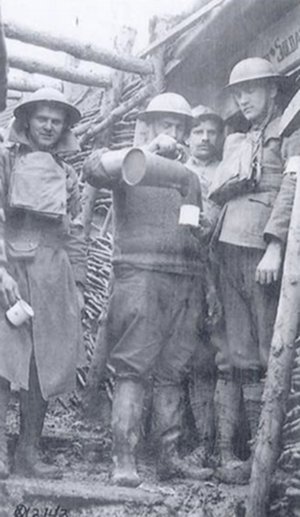
    In contrast to what one would assume from the wuss pictured on the left …

    … The Art of Manliness claims that hot chocolate is in fact a manly drink, based on its history:

    While we tend to think of chocolate today in its solid form, for nine-tenths of its long history, chocolate was a drink – the first true chocolate bar as we now know it was not invented until 1839. In the thousands of years before that time, chocolate was seen as an invaluable, sacred, even magical beverage — a symbol of power, a privilege of warriors and the elite, and a satisfying tonic that was consumed daily and offered the sustenance needed to tackle virile challenges.

    Contrary to its ho-hum, sometimes even junk food-y reputation, real chocolate is an incredibly complex substance, containing 400-500 different compounds. Among those compounds are several with mind and body boosting benefits:

    • Caffeine – a stimulant present in small amounts, depending on the type and amount of chocolate ingredients.
    • Theobromine – a mild stimulant distinct from caffeine which provides the lion’s share of chocolate’s kick and energizes without greatly activating the central nervous system the way the former does. It also enhances mood, dilates blood vessels, can lower blood pressure, relaxes the smooth muscles of the bronchi in the lungs, and can be used as a cough medicine.
    • Tryptophan  — releases the feel-good neurotransmitter serotonin in the brain.
    • Phenylethylamine – functions similarly to amphetamines in releasing norepinephrine, which increases excitement, alertness, and decision-making abilities, and dopamine, which releases endorphins (natural painkillers) and heightens mood.
    • Flavonoids – antioxidants which may improve blood flow to the heart and brain, prevent clots, improve cardiac health, and act as anti-inflammatories.

    Chocolate has also for centuries been rumored to be an aphrodisiac.

    In short, hot cocoa is a powerful elixir – one which boosts mood and vitality and combats stress, anxiety, and pain. For good reason is the chocolate tree’s scientific name — Theobroma cacao — ancient Greek for “food of the gods.” For what other drink tastes great, is filling in nature, and stimulates mind and body?

    No wonder then that this beverage, far from being a kiddie drink, has been a favorite of rulers, warriors, and explorers for centuries. …

    The earliest cultivation of cacao can be traced to ancient Mesoamerica, in which it served a religious, financial, and nutritional purpose.

    The drink that was made with cacao, xocolātl, wasconsidered sacred by the Mesoamericans and used during initiation ceremonies, funerals, and marriages. Cacao beans were also used as currency. Because cacao was both currency and food, drinking chocolate was like sipping on cash — kind of like lighting your cigar with a hundred dollar bill – and for this reason was a privilege mainly limited to elites.

    Cacao was cultivated and consumed by the Olmecs and Mayans, but is most famously associated with the Aztec civilization. Montezuma the II, who kept a huge storehouse of cacao (supplied by conquered peoples from whom he demanded the beans as tribute) and drank 50 golden goblets of chocolate a day, decreed that only those men who went to war could imbibe cacao, even if they were his own sons. This limited chocolate consumption to royals and nobles who were willing to fight, merchants (their travels through hostile territory necessitated their taking up of arms), and warriors. For the latter, chocolate was a regular part of their military rations; ground cacao that had been pressed into wafers and could be mixed into water in the field were given to every solider on campaign. The drink provided long-lasting nourishment on the march; as one Spanish observer wrote, “This drink is the healthiest thing, and the greatest sustenance of anything you could drink in the world, because he who drinks a cup of this liquid, no matter how far he walks, can go a whole day without eating anything else.”

    All Aztecs thought of both blood and chocolate as sacred liquids, and cacao seeds were used in their religious ceremonies to symbolize the human heart – harkening to their famous ritual in which this still-beating organ was torn from a sacrificial victim’s chest. The connection between blood and chocolate was especially strong for warriors, and it was served at the solemn initiation ceremony of new Eagle and Jaguar knights, who had to undergo a rigorous penance process before joining the most elite orders of the Aztec army.

    In peacetime, chocolate was an after-dinner drink, served along with smoking tubes of tobacco, much in the way modern gentlemen once enjoyed brandy and cigars after a meal (and still do). The Mayans liked their chocolate hot, the Aztecs liked it cold, but all Mesoamericans preferred it foamy – a quality that was accomplished by pouring the chocolate back and forth from a bowl held high into one below (a large, foam-creating swizzle stick was added later through a Spanish creolization of the practice).

    Mesoamerican chocolate, unless honey was added, was also bitter. To this strong, bitter brew was added a great variety of spices and seasonings, such as ground up flowers and vanilla. The Aztecs were especially fond of adding chili pepper, which gave the drink a delightful burn going down. …

    When chocolate was brought back to Spain in the 17th century by conquistadors, it quickly spread throughout Europe, where it continued to be considered a luxury and a drink of the elites. Originating on the continent from Spain, and more expensive than coffee, chocolate was seen as southern, Catholic, and aristocratic, while coffee was viewed as northern, Protestant, and middle-class.

    Yet with the Spanish revival of the Mayan practice of drinking chocolate hot and the welcome addition of milk and sugar, the beverage soon won converts from many corners – many of whom began to give the ancient drink some twists of their own. The addition of cinnamon and black pepper was popular, as was ambergris, a solid, fatty substance found in the intestines of sperm whales, and musk, secreted by the glands of the Himalayan musk deer (and believed to be an aphrodisiac). Other drinkers experimented with throwing orange peel, rose water, cloves, ground up pistachios and almonds, or egg yolks into the brew.

    Chocolate was drunk in large cups at Spanish bullfights, and began to be served across Europe both at dedicated “chocolate houses” and at coffee houses, where members of the upper class gathered to sip hot beverages, gamble, and discuss the pressing philosophical and political issues of the day. In England, each establishment was typically associated with one of the Parliamentary parties, and often turned into full-on gentlemen’s clubs. For example, the Cocoa-tree Chocolate House, located on St. James Street in London, was patronized by the Tory party, and then became the Cocoa Tree Club; eminent men like Jonathan Swift and Edward Gibbon were members. Mrs. White’s Chocolate House, another Tory establishment, was created on Chesterfield St. in 1693; it was famous not only for its chocolate but as a notorious center of gambling – the gaming room was nicknamed “Hell” and patrons placed bets on everything from elections to which raindrop would make it to the windowpane first. The chocolate house moved to St. James Street in 1778 and transformed into an official, and highly elite, gentlemen’s club. Over 300 years later, it is still around and now simply called White’s. The club’s rolls have included three monarchs and a huge consortment of other royals, nobles, and prime ministers. …
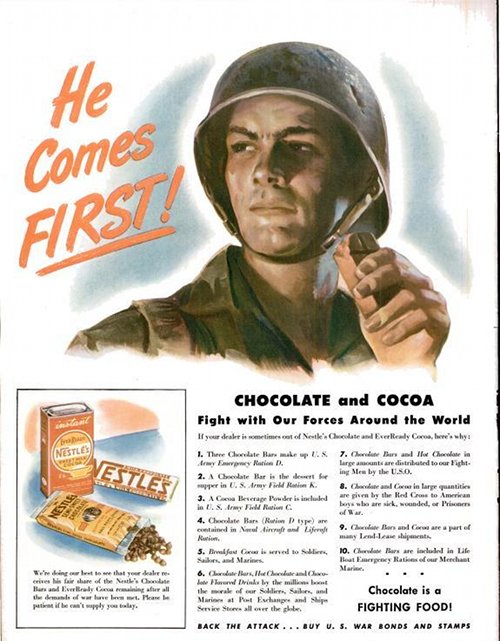
    Beginning with the Aztec warriors, chocolate and cocoa has been included in military rations for centuries.

    During the Revolutionary War, officers often breakfasted on chocolate and members of the Continental army were given a monthly allotment of chocolate according to rank; colonels and chaplains received four pounds of chocolate, majors and captains three pounds, lieutenants two pounds, and so on. This chocolate ration was created by smooshing prepared cacao nibs into a cake. With their pocket knives, soldiers would shave pieces of the cake off into a pot of boiling water. The resulting drink was considered rejuvenating, and much of the chocolate available went to hospitals to help the sick and wounded get their strength back.

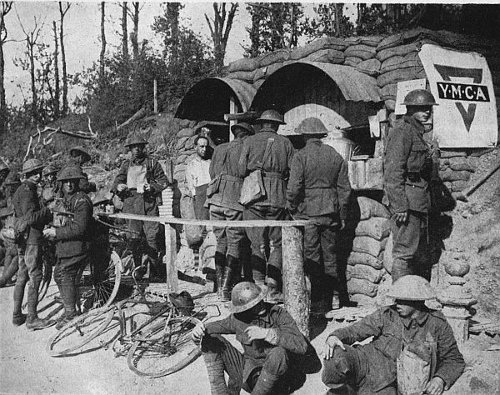
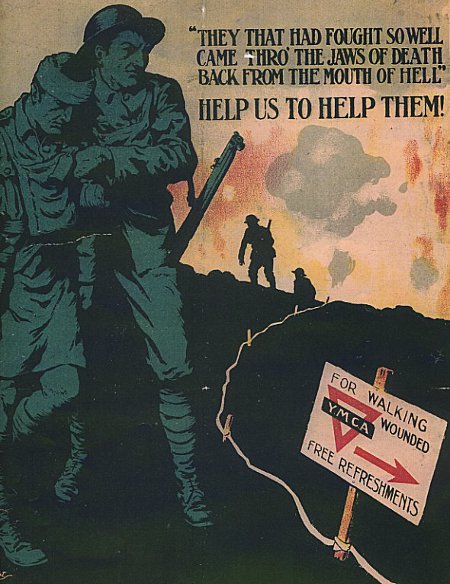
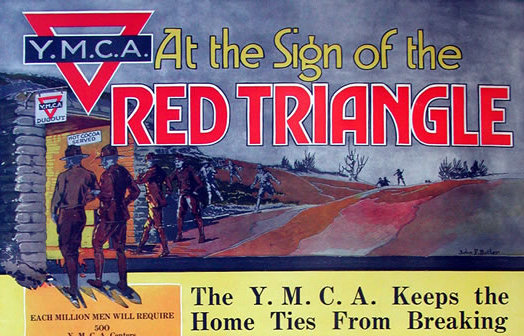
    The invention of cocoa powder made “chocolate” easier for soldiers to carry and prepare while on campaign. But during World War I, before true field rations had been invented, troops were often supplied with hot cocoa by YMCA volunteers. In a time where the military had not yet developed its own morale, welfare, and comfort services, the YMCA took on this role, sending 25,000 volunteers to military units and bases from Egypt to France. Among their many services, “Red Triangle Men,” as they were called, set up comfort huts and canteens, often quite close to the battlefield, where soldiers could come for food, smokes, and cup after cup of piping hot cocoa after a firefight.
    During WWII, new kinds of combat rations were developed, including the C-Ration. The C-Ration was a two-can meal, consisting of an M-unit – an entrée, like meat stew — and a B-unit – bread and dessert. The latter originally contained 5 hardtack crackers, 3 sugar tablets, 3 Dextrose energy tablets, and a packet of beverage mix (instant coffee, powdered lemon drink, or boullion soup powder). In 1944, the beverage list was expanded and a disc of sweetened cocoa was added to the choices.
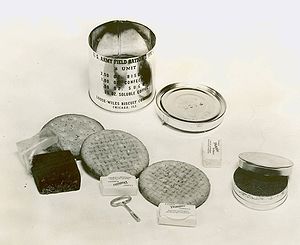
    In the years after the war, the C-Ration was modified and revised and went through several subsequent variations. In 1954, the C-4 was released, which added, among other things, sugar and non-dairy creamer to the mix. Soldiers often used one package of each to enhance their cocoa.

    C-Rations were phased out in 1958, although Vietnam soldiers continued to receive cases of them marked with dates from the 1950s. To replace the C-Ration, the military developed the “Meal, Combat, Individual,” or MCI, which included more variety than its predecessor. Four different B-unit cans were available, including the B-3, which contained 4 cookies and a packet of cocoa mix. Cocoa packets were prized and nonsmokers would trade their cigarettes (4 were included in the MCI’s “Accessory Pack”) for them. Some of the men would add the cocoa to their coffee to make a mocha beverage. If they were out of cocoa, the men would heat up water inside a can, chop up their Tropical Bar (a heat resistant chocolate bar that came in their sundries kit) into the water, and add a packet of creamer and sugar to make a hot and satisfying drink. …

    Dark chocolate has as much as three times more flavonoids than wine and green tea, and cocoa powder has more of them than solid dark chocolate does. However, because the alkalizing process that Dutch cocoa undergoes saps 60-80% of its flavonoids (although cocoa is so high in them that actually still leaves a whole lot), you may want to look for natural cocoa to get the most potent dose. Prepared cocoa mixes also oftentimes contain more sugar than cocoa, so add a little sugar or a natural sweetener (like stevia) to an unsweetened variety as desired. Mark, of Mark’s Daily Apple, drinks it as a rare holiday indulgence (he’s not a proponent of regularly consuming dairy) straight up in his milk, arguing that the leche adds enough natural sweetness on its own. Unfortunately, studies have shown that dairy may inhibit antioxidant activity and absorption in the body, so if you’re looking to get those benefits, you may just want to mix it in almond or coconut milk, or straight up in hot water. You can even create a truly potent tonic using raw, ground-up cacao nibs, just like a proper Mayan. (Bonus: cacao nibs are an excellent source of magnesium, which naturally helps boost testosterone – perhaps there’s something to the old idea of chocolate as an aphrodisiac after all…)
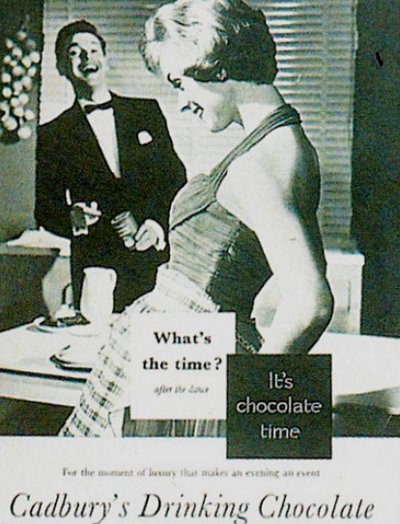
    Of course, as mentioned at the start, antioxidants are not the only benefit of chocolate, and its feel-good properties are only enhanced with a little sugar and milk at the proper time. Like on a backpacking trip, or, say, while riding the Polar Express. Can I be the only one who thought as a boy that the mention of “hot cocoa as thick and rich as melted chocolate bars” was one of the most memorable parts of that book?

    I make hot cocoa the old-fashioned way — put as much cocoa and sugar as you wish, along with a couple shakes of cinnamon and one dash of salt plus enough liquid (leftover coffee works well) to create a watery paste, stir and heat that for 30 seconds in the microwave, then add milk, and heat that for up to 2 minutes.

    Left unmentioned here is what you can add to hot cocoa, including rum (including coconut rum), Kahlua, peppermint Schnapps or other worthy liquors.


    Share this on …

    • Share on X (Opens in new window) X
    • Share on Facebook (Opens in new window) Facebook
    • Share on LinkedIn (Opens in new window) LinkedIn
    • Email a link to a friend (Opens in new window) Email
    • Print (Opens in new window) Print
    Like Loading…
    1 comment on The manly winter drink
  • Presty the DJ for Dec. 19

    December 19, 2014
    Music

    The biggest thing that happened today wasn’t in music, it was in movies, today in 1968:

    The number one British single today in 1958:

    Today in 1961, Elvis Presley got a dubious Christmas gift in the mail — his draft notice:

    (more…)

    Share this on …

    • Share on X (Opens in new window) X
    • Share on Facebook (Opens in new window) Facebook
    • Share on LinkedIn (Opens in new window) LinkedIn
    • Email a link to a friend (Opens in new window) Email
    • Print (Opens in new window) Print
    Like Loading…
    No comments on Presty the DJ for Dec. 19
  • And #MerryChrystMas to you too

    December 18, 2014
    Badgers

    Of course, #MerryChrystMas is trending on Twitter after this news from the Wisconsin State Journal:

    College football’s worst-kept secret is no longer even that.

    The University of Wisconsin officially introduced Paul Chryst as its new coach Wednesday evening, just one week after Gary Andersen departed for Oregon State.

    Chryst compiled a 19-19 record over the past three seasons at Pittsburgh. The Madison native played for the Badgers in the late 80s — most notably at quarterback and tight end — and was the program’s offensive coordinator from 2005-11 after serving as its tight ends coach in 2002.

    “As early as I can remember, Badger football was a part of our lives,” Chryst said. “Then to be able to come back, more than once, is pretty special. I’ve flown into Madison a bunch of times, but this certainly felt different.”

    UW’s offense averaged more than 40 points per game in his final two years as the offensive coordinator.

    Chryst was first reported to be UW’s choice Thursday night, but the school could not officially offer the job until Wednesday.

    “The first person I thought of when Gary Andersen informed me that he was leaving was Paul Chryst,” UW athletic director Barry Alvarez said. “I watched very closely from afar how he was building his program (at Pitt). The things that Paul has learned and how he’s built that team and how he has recruited some of the top players in the ACC, those are all things that resonated with me.

    “He’s ready. The time is right.”

    Chryst reportedly expects to bring Pitt offensive coordinator Joe Rudolph and defensive coordinator Matt House with him to Madison, but sources say House will be the Badgers’ defensive line coach.

    Rudolph was a successful recruiting coordinator for UW when he was the team’s tight ends coach before leaving for Pitt with Chryst.

    UW defensive coordinator Dave Aranda reportedly will not follow Andersen to Oregon State and could retain his role with the Badgers, although he has many other suitors. …

    Alvarez said on his radio show Tuesday night that he promised the Badgers’ assistant coaches that the program’s new coach would “seriously” interview anyone who wanted to remain in Madison.

    “We’ll be able to put together a great staff,” Chryst said. “I look forward to putting a group together but haven’t finalized anything.”

    As for his “great staff”: It’s most likely not Chryst’s call, but you know, Paul, a UW graduate really should announce Badger games. And he and I are classmates (political science, 1988), and we’ve been in at least one other room together (a UW Band concert in Platteville when Chryst was introduced as coming to Madison).

    The Milwaukee Journal Sentinel adds:

    UW athletic director Barry Alvarez introduced Chryst during a news conference in the Nicholas-Johnson Pavilion.

    “I’m thrilled to welcome the entire Chryst family to come back to Madison, to come back home,” Alvarez said.

    Alvarez said he was contacted by “a number of well-known head coaches and high-ranking assistant coaches” about the job but the first person he thought of was Chryst.

    “I have great respect for him as both a football coach and a person,” Alvarez said.

    Said Chryst after being introduced, “Obviously this a big moment. I couldn’t be more grateful, honored and certainly appreciative of such an opportunity.”

    “There is a spirit that is undeniable here,” Chryst said. “As great a day as today is, I don’t want it to be the best day.”

    He said he was looking forward to getting to work and to “truly do something special” at Wisconsin.

    “I grew up in Madison,” Chryst said. “…As early as I can remember it, Badger football was part of our life.”

    Chryst was asked whether Wisconsin was a “destination job” for him, after Bret Bielema and Gary Andersen left for Arkansas and Oregon State before him.

    “I think that when you talk about destination job,” he said. “I think you’ve got to earn the right to stay that long.”

    He cited Alvarez and UW basketball coach Bo Ryan as two examples of coaches who earned that right.

    Chryst acknowledged that his late father, George, a longtime football coach, including at UW-Platteville, would be proud.

    He related a talk he had with Ryan, who asked him, “What do you think George would say if he found out I was coaching the basketball team and you were coaching football?”

    Ryan was a longtime basketball coach at Platteville and was there when George Chryst was the football coach.

    Chryst would not say yet who he would have as assistants, but according to sources, current UW assistants Dave Aranda and Bill Busch are solid candidates to be retained. Both are in their second season at UW and both came to Madison with Andersen.

    UW finished in the top 20 nationally in all four major defensive statistical categories in Aranda’s first season — sixth in scoring defense, seventh in total defense, fifth in rushing defense and 17th in passing defense.

    UW this season is 13th in scoring defense, fourth in total defense, 17th in rushing defense and fifth in passing defense. The Badgers were blown out, though, in the Big Ten title game by Ohio State, 59-0.

    Busch, a graduate assistant under Alvarez in 1994, works with both safeties and linebackers. He is a tenacious recruiter who recently secured an oral commitment from Dallas tailback Jordan Stevenson, who initially committed to Texas.

    According to a source close to the UW program, Chryst hopes to bring offensive line coach Bob Bostad back to UW. Bostad, in his first season with the Tennessee Titans, was on UW’s staff from 2006-’11. During that time he coached tight ends and the offensive line. He also was the running-game coordinator.

    “It would only make the program better if Paul brought back some of those guys,” said former UW offensive lineman John Moffitt, who started a total of 42 games from 2007-’10.

    Some observers are less than enthusiastic because of Christ’s 19-19 record at Pitt. That, however, might be a major accomplishment because of Chryst’s predecessors, in chronological order:

    • Dave Wannstedt (yes, the ex-Bears coach): “Forced out,” to quote CBS Pittsburgh.
    • Mike Haywood: Hired to replace Wannstedt, but fired after one month after he was arrested on domestic abuse charges.
    • Todd Graham: Unlike Haywood, he actually coached the Panthers for a game. He coached the Panthers for an entire season, in fact, before he left for Arizona State.

    CBS Pittsburgh reports this morning that the person who hired Chryst and his predecessors, athletic director Steve Pederson, is being fired.

    This photo also showed up on Twitter:

    That’s Paul and his father, George, who played football for Wisconsin and was an assistant coach before George because UW-Platteville’s athletic director and football coach. That brought the Chryst family to Platteville so that Paul could be part of Platteville High School’s first state football title, in 1983.

    The reasons Chryst is the ideal choice go beyond his UW ties. (If it was about UW ties, then John Coatta, a former UW quarterback, wouldn’t have had three disastrous seasons as the Badgers coach from 1967 to 1969.) UW runs the ball first and foremost. Every defense they play knows that, and yet UW set scoring records when Chryst was the  offensive coordinator, because he effectively worked in the pass and managed to disguise what the Badgers intended to do through formations and motion. Alvarez is at least intimidating to work for, but Chryst has already dealt with that. UW is an academically challenging school, but Chryst has already dealt with that too, and successfully.

    On Wisconsin.


    Share this on …

    • Share on X (Opens in new window) X
    • Share on Facebook (Opens in new window) Facebook
    • Share on LinkedIn (Opens in new window) LinkedIn
    • Email a link to a friend (Opens in new window) Email
    • Print (Opens in new window) Print
    Like Loading…
    No comments on And #MerryChrystMas to you too
  • Presty the DJ for Dec. 18

    December 18, 2014
    Music

    We begin with an entry from Great Business Decisions in Rock Music History: Today in 1961, EMI Records decided it wasn’t interested in signing the Beatles to a contract.

    The number one single over here today in 1961:

    Today in 1966, a friend of Rolling Stones Mick Jagger and Brian Jones, Tara Browne, was killed when his Lotus Elan crashed into a parked truck. John Lennon used Browne’s death as motivation for “A Day in the Life”:

    The number one album today in 1971 was Sly and the Family Stone’s “There’s a Riot Going On”:

    (more…)

    Share this on …

    • Share on X (Opens in new window) X
    • Share on Facebook (Opens in new window) Facebook
    • Share on LinkedIn (Opens in new window) LinkedIn
    • Email a link to a friend (Opens in new window) Email
    • Print (Opens in new window) Print
    Like Loading…
    1 comment on Presty the DJ for Dec. 18
  • Be civil, you $%@^*!!!

    December 17, 2014
    Culture, US politics, Wisconsin politics

    Right Wisconsin has two views on whether civility in politics is even possible, let alone necessary.

    The first comes from former state Rep. Michelle Litjens:

    Not so very long ago, Americans gathered around the radio to listen to the same news programs and the same radio shows every night. Then they read the same newspapers. The entire nation watched M.A.S.H. At work we could discuss what we watched the night before on T.V. and discuss and laugh about it because we all watched the same programs. After all, there were only 3 stations. Despite our political differences, we had far more in common than things that made us different.

    Let’s look at today. Today liberals watch MSNBC and conservatives watch FOX News. Conservatives listen to talk radio and liberals listen to public radio. The internet is filled with thousands of different views and perspectives so that we are able to search for news that fits our specific political viewpoints which solidifies why we are right and they are wrong.

    This polarization effects where we live too. Conservatives are more likely to move out to the country for more land and less government. Liberals are attracted to urban living with smaller living spaces and more government services.

    We are self-segregating and it isn’t making us a stronger country. In fact, when we don’t know anyone who disagrees with us then people with different viewpoints become less like people to us. They become the enemy. And when it comes to enemies, anything goes.You can say anything about your enemy, attack your enemy, and because enemies are seen as less human than you, bad behavior becomes acceptable.

    I was recently the conservative voice on Wisconsin Public Radio for an hour. I do this about every other month. I think it is important to make sure that our side has a voice in the heart of liberalism.

    It was an hour long discussion with a liberal progressive about Washington politics and state issues. Our conversation was very pleasant and we had some great dialogue.

    About an hour after the show, a lady called me. A very angry lady. She was so upset with what I said her voice was shaking. She yelled at me for what I said about the President. She wouldn’t let me speak to defend myself and then when I did, and I was nice, she was more upset for me.

    She was so angry with me that I was shaking after I hung up the phone. Now, could I have hung up on her and evaded this whole thing? Yes. But I quickly learned while dealing with opponents of Act 10 that you need to let angry people vent a bit or the hatred only grows.

    What is happening to our country that people think this kind of behavior is acceptable?  The worst part of this is that the left is especially hateful of conservative women. They attack conservative women with venom. What people write and say about me and my family on the internet would make your skin crawl. Liberal talk radio hosts, bloggers, nameless/faceless commenters, etc. Although I try to not read these things my children read them. And the left says they are the ones who stand up for women? Really?

    We need this to end. We need to become one country again. One country who respects the views of others when we disagree. Every view point has value. Even when their opinions are wrong. This is what separates the United States of America from Russia and China where you can’t have different views than the government or you are silenced.

    Litjens doesn’t mention her own experience with civility, or lack thereof. During an Act 10 debate in the Assembly, state Rep. Gordon Hintz (D-Oshkosh) said to Litjens, “You are f—ing dead!” Did Hintz face any recriminations for what should have earned him at least a punch in the face? No. Did Hintz apologize? You decide. (Then again, Hintz also remained in the Assembly despite his conviction for soliciting a prostitute, which says as much about Hintz’s constituents as himself.)

    As someone with strongly held political views who can nevertheless avoid expressing them, I observe that screaming at someone doesn’t win political arguments. On the other hand, we live in a world with a great deal of irrationality and illogic in, though not limited to, politics.

    The opposing view from Litjens (delivered in a civil fashion, as opposed to Hintz) comes from Chris Rochester:

    I disagree that the demise of mainstream outlets and the rise of biased ones like RedState and HuffPo is a bad thing. Well over a hundred years ago, newspapers were open about who they supported, going so far as to name themselves after the party they shilled for.

    Then they learned to pretend to be unbiased. Today bias shows up in more insidious ways such as selective coverage of stories and of the facts therein. History is cyclical, and it’s just repeating itself as the façade of impartiality has worn thin enough to see through.

    As for the tone of political discourse in America, I agree that a commitment to pluralism should be made, but I propose that “we” is actually “they.”

    Litjens tells the story of a bile-spitting woman who called to tell her off following an interview, her voice trembling with anger. This is the sort of person who must be persuaded to put her prejudice aside and respectfully disagree in a dispassionate way. The problem is this: from the Bush era on, The Left has whipped its base into such a froth that they actually believe their political opponents are bad people who want to hurt them.

    That, as psychologists might say, is the basis of an intractable conflict.

    Spiteful conservatives who truly hate liberals are out there, but they’re kept in check. Conservatism is inherently a pluralistic, intellectual, introspective philosophy. The GOP believes it’s made stronger by internal disagreement, dialogue, and primaries. That’s to our advantage, because hatred is inferior to good ideas and hard work as political tools.

    The Left, by contrast, offers stale ideas that have a proven record of failure and an inherently arrogant philosophy that at its core proposes that liberals and their appointees are uniquely qualified to make decisions for others. They try to prevent partisan primaries. Their ideas can’t withstand much debate – it’s The Left that constantly seeks to shut down debate, not the right.

    President Bush compromised with The Left in the bipartisan manner so many in the media long for today. No Child Left Behind. Medicare Part D. The bipartisan Iraq War. Comprehensive immigration reform. President Bush did exactly what the statist blabbo-sphere wishes from the new GOP majority – bipartisanship and compromise.

    For his conciliation, what did Bush get? He was ridiculed, reviled, tormented, and despised by even mainstream Democrats with a rarely-seen vitriol. He was compared to Hitler. His assassination was depicted in a movie – to great fanfare from The Left.

    He respected them, signed their bills, and in return they hated him even more.

    The goal of civil disagreement is a worthy one, but that commitment must first be made by a seething mass of spiteful people on The Left. I’m not going to hold my breath.

    Like Litjens, I appear from time to time on WPR, including on one segment where, let’s just say, it was a good thing the two of us weren’t in the same studio. It is important for conservatives to not wall off themselves in the Fox News/Rush Limbaugh/Charlie Sykes sphere of right thinking, because all you get is subtle variations on the same school of thought. You’re not going to change anyone’s mind by not encountering anyone with different ideas from yours, and you’re not going to hone your own arguments in an echo chamber.

    The fault for lack of civility in politics lies with those who have created the system as it exists today. That is, to be precise, the incumbent party, the people who benefit when the stakes are too high in elections. If government was half the size it is today (which is what it should be, and would have been had we had constitutional controls on spending and taxes), and if politicians received the correct amount of pay and benefits (none), the stakes would be lower, and politics would be far less unpleasant than it is today.

    Politics is, remember, a zero-sum game. One side wins, thus the other side loses. When government takes away your rights, you lose. When government increases your taxes, you lose. And compromising your core beliefs (for instance, agreeing to increase taxes only a little) for the sake of making a deal is also losing. (See George H.W. “Read My Lips” Bush.)

    I said some time ago, and I maintain the opinion today, that at some point relatively soon someone is going to get killed as a result of the next nasty political debate or campaign. And, unfortunately, I cannot see within the rest of my lifetime any way that Litjens’ plea for unity will ever happen. We’re not one country now, and we haven’t been one country for a very long time. The only thing that unifies partisans is hatred of the opposing side.

    The funny coda to this unfunny subject comes from CSPAN, which featured two brothers, both of which lead diametrically opposite political groups, reports the Washington Post:

    Everybody knows that the best part about CSPAN is the unpredictable nature of the show’s call-in segments, where regular hosts and guests do an admirable job of fielding unusual questions with no advance warning. But brothers Brad and Dallas Woodhouse are now the champions of awkward CSPAN calls, after the politically divided brothers ended up taking a call from their mom.

    “Oh God, it’s mom,” Dallas Woodhouse said as soon as “Joy” from North Carolina started to speak.

    “You’re right, I’m from down south,” she said. “And I’m your MOTHER.”

    She’d called to take issue with something her kids said on air: That the brothers’ political bickering — you see, one is liberal, and the other is conservative — is typical of most families. “I don’t know many families that are fighting at Thanksgiving,” she said. “I’m hoping you’ll have some of this out of your system when you come here for Christmas. I would really like a peaceful Christmas.”

    Steve Scully, the show’s host, jumped in to clarify: “This was not planned. She called in on the normal line.”

    “I love you mom,” Dallas said at one point.

    “And I love politics,” she replied.

    Addressing Scully, she said: “They’re both very passionate about what they believe in, and I love that about them; but I hope they just kinda get this out of their system today on your program.”

    That’s one way to handle political disputes within a family. The other is to ban talking about politics at Christmas. I’m familiar with that family.


    Share this on …

    • Share on X (Opens in new window) X
    • Share on Facebook (Opens in new window) Facebook
    • Share on LinkedIn (Opens in new window) LinkedIn
    • Email a link to a friend (Opens in new window) Email
    • Print (Opens in new window) Print
    Like Loading…
    No comments on Be civil, you $%@^*!!!
  • Presty the DJ for Dec. 17

    December 17, 2014
    Music

    Today in 1963,  James Carroll of WWDC radio in Washington became the first U.S. DJ to broadcast a Beatles song:

    Carroll, whose station played the song once an hour, got the 45 from his girlfriend, a flight attendant. Capitol Records considered going to court, but chose to release the 45 early instead.

    Today in 1969, 50 million people watched NBC-TV’s “Tonight” because of a wedding:

    The number one British single today in 1973:

    (more…)

    Share this on …

    • Share on X (Opens in new window) X
    • Share on Facebook (Opens in new window) Facebook
    • Share on LinkedIn (Opens in new window) LinkedIn
    • Email a link to a friend (Opens in new window) Email
    • Print (Opens in new window) Print
    Like Loading…
    No comments on Presty the DJ for Dec. 17
  • Who’s afraid of Right to Work?

    December 16, 2014
    US business, US politics

    For some strange reason, the meter of the headline (first used by the Wisconsin Club for Growth) matches …

    M.D. Kittle reports about a union leader who isn’t afraid of right to work:

    Gary Casteel, secretary-treasurer of the United Auto Workers, said he prefers organizing in a right-to-work environment.

    “This is something I’ve never understood, that people think right to work hurts unions,” Casteel said in February, according to a July 1 piece in the Washington Post. “To me, it helps them.”

    The blog was written by the Post’s labor reporter Lydia DePillis, and headlined “Why Harris v. Quinn isn’t as bad for workers as it sounds.” The U.S. Supreme Court decision put the brakes on compulsory union dues for some home-care employees.

    “You don’t have to belong if you don’t want to,” Casteel said. “So if I go to an organizing drive, I can tell these workers, ‘If you don’t like this arrangement, you don’t have to belong.’ Versus, ‘If we get 50 percent of you, then all of you have to belong, whether you like to or not.’ I don’t even like the way that sounds, because it’s a voluntary system, and if you don’t think the system’s earning its keep, then you don’t have to pay.”

    Leave it to a big labor guy to crystallize the argument for right-to-work proponents.

    Right-to-work laws, now in 24 states, including Michigan, Florida and Indiana, prohibit firing workers for choosing not to join a labor union or pay dues.

    It’s about choice, and it’s about the free-market principles of competition, right-to-work backers say. Or as Casteel put it, if the union isn’t “earning it’s keep, then you don’t have to pay.” No more than a consumer would have to pay for one cable TV plan over another or any service deemed too costly or ineffective.

    Casteel’s point, at least at the time, was that unions have and can continue to prove their worth to the worker. Fine, say right-to-work proponents, but let the employee ultimately say.

    Public-sector employees have weighed in in Wisconsin, where the state’s Act 10 reformed the state’s long-standing and pioneering government collective-bargaining law. Given the choice, public employees by pretty significant numbers have left their unions and their compulsory dues.

    The Wisconsin Education Association Council, lost more than a third of its membership, declining from about 98,000 to about 60,000 members following the implementation of the public-sector collective-bargaining reform Act 10 in 2011, according to the Wall Street Journal.

    American Federation of State, County and Municipal Employees Council 24’s dues-paying membership fell from about 5,900 security and safety employee members pre-Act 10 to 690 in the early months of 2013 — an 88 percent drop — according to information obtained by Wisconsin Reporter.

    Michigan, the home of the UAW, is just beginning to find out about life after right-to-work. The state became a right-to-work state in 2013, following massive, big labor-led protests at the Capitol in Lansing in late December 2012.

    Earlier this fall, the brunt of the 112,000 active educators and school workers in the state’s largest teachers union, the Michigan Education Association, were for the first time able to drop out of the union and stop paying union dues. Many have.

    According to a new report out this week, MEA membership declined by more than 5,100 education employees, to 142,555, between Sept. 1, 2012, and Aug. 31, 2013.

    The report, published in the Detroit Free Press, shows MEA dues rose $5 between 2013 and 2014. Still, the union reported a negative net asset total of nearly $135 million.

    Despite the changes and challenges, one fact remained the same: MEA’s top bosses got another round of big raises.

    MEA President Steven B. Cook’s gross salary climbed 11 percent, or $20,446, to $203,144, according to the report. Vice President Nancy Strachan booked a 16-percent raise, with her gross salary up $20,097, to $144,700. And Secretary-Treasurer Rick Trainor’s gross salary soared by $48,385, to $158,296.

    Union membership in 2013 rose slightly overall, making up about 16 percent of workers in Michigan. But the jury still is out. UAW has existing contracts with the Detroit’s Big Three automakers until September 2015, when the new agreements will no longer allow compulsory union dues.

    To quote a hysterical pro wrestling announcer: Wait just a minute!

    You won’t find the UAW’s Casteel boldly talking about competing in right-to-work states much these days. He made his comments as director of UAW Region 8, representing a large swath of the South, including Tennessee, where he was engaged in a bitter battle to organize a Volkswagen plant in Chattanooga.

    Now, Casteel mainly talks about those “right-wing extremists” trying to break the backs of American organized labor by laws ending forced unionism.

    couple months after Casteel was elected secretary-treasurer at the UAW’s 36th Constitutional Convention in Las Vegas, the union boss lamented how the big business-backed right “try to thwart workers’ efforts at every turn …”

    “(W)hether it’s making it virtually impossible for unions to collect the resources they need to bargain (as Gov. Scott Walker did to state workers in Wisconsin) or passing dishonest right to work laws that pretend to uphold democracy, but in truth are just their attempt to pit workers against one another,” Casteel wrote in his “Clear View blog. “I’m sure they are not out of ideas, but I am equally sure that we are up to the task of exposing their agenda and building a stronger union through the process.”

    The Washington Post asked the question that Casteel once answered: “So is it really such a terrible thing for unions to have to demonstrate their value convincingly enough for workers to want to join?”

    About the media: Let’s hear from Mike Nichols, a member, like myself, of the Former Journal Communications Employees Club:

    Many years ago, after taking a job as a young reporter at the old Milwaukee Journal, the union leaders in the newsroom — using tactics that were somewhere between cajoling and arm-twisting — tried to persuade me to join The Newspaper Guild, a union affiliate of the Communications Workers of America.

    They were nice guys, my union friends. But it was clear they thought anyone who didn’t hand over some cash in the form of dues was a freeloader. Their argument: Because the paper was (and still is) a unionized “open shop,” employees didn’t have to pay dues if they didn’t want to. But because a majority of newsroom employees had once voted in favor of the union, the union leaders represented everyone.

    Even if you don’t pay the union, you’ll still be part of the “bargaining unit,” the union leaders would argue. You’ll still “benefit” from the collective bargaining process. So pony up.

    I declined for a variety of reasons. The union, I concluded, wasn’t boosting my pay. It was holding it down by repeatedly asking the company to spend whatever money was available on across-the-board salary increases rather than just merit pay; if I screwed up somehow, I wanted to speak for myself; if I was going to donate money to a cause (something reporters and columnists are normally dissuaded from doing) I didn’t want that cause to be part of a national union that pushed a political agenda I disagreed with.

    I never did join the union. I also never stopped wondering how in the world union leaders had the right to represent me at the bargaining table if I didn’t want them to.

    The answer might surprise some people and shed some light on just what right-to-work legislation would mean for workers in this state — and what it wouldn’t.

    Right-to-work legislation would have absolutely no impact on so-called “open shops” such as the one in the Journal Sentinel newsroom, according to Fred Gants, a Madison labor and employment lawyer for Quarles and Brady.

    Right-to-work legislation, according to Gants, would only prevent companies and unions from setting up “union” shops, also sometimes referred to as “agency shops”— places where employees must pay union dues (at least that portion of dues that is not spent on political causes or lobbying) as a condition of employment.

    In other words, even if right-to-work legislation is adopted, Wisconsin workers will still be able to form and join unions if they so choose. And under federal law, once a union is formed, it would still bargain on behalf of its non-union co-workers. The only difference: Nobody could be forced to pay dues. All union shops would become open.

    The burgeoning debate over right-to-work is really over two different things: the rights that workers, either as individuals or collectively, should have in the workplace; and whether right-to-work states are more conducive or less conducive to long-term prosperity.

    Long before specific legislation has even been introduced, my old friends on the Editorial Board at the paper have already stated that they “don’t think workplace freedom is the real objective here” and that Wisconsin should “forget this sideshow.”

    Sidestepping the issue of individual rights, they’ve cherry-picked old studies that have nothing to do with Wisconsin, and seem to have determined there is no link between right-to-work laws and economic growth. In truth, there are reputable studies that conclude such laws have been economically advantageous. Because various studies conflict in some ways, because times change and because Wisconsin is a very unique place, there is a need to seriously examine the specific impact a right-to-work law might have here in the Badger State at this particular point in history.

    Right-to-work laws have been adopted in Michigan and Indiana as well as about half of the other states in America. Is Wisconsin right now at a competitive disadvantage?

    Do Wisconsinites see this as an economic issue, an issue of individual rights, or both?

    The only thing that would have bothered me more than being forced into the bargaining unit would have been being forced to pay dues. Many people in Wisconsin’s newsrooms clearly disagree. But all that really matters is what everyone else in the state thinks, and whether right-to-work laws are good for both Wisconsin as a whole as well as its individual citizens.

    Any worker who understands the concept of self-interest would, you would think, want the best possible deal for himself or herself, irrespective of what his or her coworkers get. Any worker with self-respect would, you would think, want to be judged and rewarded based on his or her own work and value to the company, not a collective everybody-gets-X arrangement you get from a union.

    Share this on …

    • Share on X (Opens in new window) X
    • Share on Facebook (Opens in new window) Facebook
    • Share on LinkedIn (Opens in new window) LinkedIn
    • Email a link to a friend (Opens in new window) Email
    • Print (Opens in new window) Print
    Like Loading…
    No comments on Who’s afraid of Right to Work?
  • Presty the DJ for Dec. 16

    December 16, 2014
    Music

    The number one British single today in 1965 wasn’t just one song:

    Today in 1970, five Creedence Clearwater Revival singles were certified gold, along with the albums “Cosmo’s Factory,” “Willy and the Poor Boys,” “Green River,” “Bayou Country” and “Creedence Clearwater Revival”:

    (more…)

    Share this on …

    • Share on X (Opens in new window) X
    • Share on Facebook (Opens in new window) Facebook
    • Share on LinkedIn (Opens in new window) LinkedIn
    • Email a link to a friend (Opens in new window) Email
    • Print (Opens in new window) Print
    Like Loading…
    No comments on Presty the DJ for Dec. 16
Previous Page
1 … 744 745 746 747 748 … 1,042
Next Page

Website Powered by WordPress.com.

Steve Prestegard.com: The Presteblog

The thoughts of a journalist/libertarian–conservative/Christian husband, father, Eagle Scout and aficionado of obscure rock music. Thoughts herein are only the author’s and not necessarily the opinions of his family, friends, neighbors, church members or past, present or future employers.

  • Steve
    • About, or, Who is this man?
    • Facebook
    • Twitter
    • Adventures in ruralu0026nbsp;inkBack in June 2009, I was driving somewhere through a rural area. And for some reason, I had a flashback to two experiences in my career about that time of year many years ago. In 1988, eight days after graduating from the University of Wisconsin, I started work at the Grant County Herald Independent in Lancaster as a — well, the — reporter. Four years after that, on my 27th birthday, I purchased, with a business partner, the Tri-County Press in Cuba City, my first business venture. Both were experiences about which Wisconsin author Michael Perry might write. I thought about all this after reading a novel, The Deadline, written by a former newspaper editor and publisher. (Now who would write a novel about a weekly newspaper?) As a former newspaper owner, I picked at some of it — why finance a newspaper purchase through the bank if the seller is willing to finance it? Because the mean bank lender is a plot point! — and it is much more interesting than reality, but it is very well written, with a nicely twisting plot, and quite entertaining, again more so than reality. There is something about that first job out of college that makes you remember it perhaps more…
    • Adventures in radioI’ve been in the full-time work world half my life. For that same amount of time I’ve been broadcasting sports as a side interest, something I had wanted to since I started listening to games on radio and watching on TV, and then actually attending games. If you ask someone who’s worked in radio for some time about the late ’70s TV series “WKRP in Cincinnati,” most of them will tell you that, if anything, the series understated how wacky working in radio can be. Perhaps the funniest episode in the history of TV is the “WKRP” episode, based on a true story, about the fictional radio station’s Thanksgiving promotion — throwing live turkeys out of a helicopter under the mistaken belief that, in the words of WKRP owner Arthur Carlson, “As God is my witness, I thought turkeys could fly.” [youtube=http://www.youtube.com/watch?v=ST01bZJPuE0] I’ve never been involved in anything like that. I have announced games from the roofs of press boxes (once on a nice day, and once in 50-mph winds), from a Mississippi River bluff (more on that later), and from the front row of the second balcony of the University of Wisconsin Fieldhouse (great view, but not a place to go if…
    • “Good morning/afternoon/evening, ________ fans …”
    • My biggest storyEarlier this week, while looking for something else, I came upon some of my own work. (I’m going to write a blog someday called “Things I Found While Looking for Something Else.” This is not that blog.) The Grant County Sheriff’s Department, in the county where I used to live, has a tribute page to the two officers in county history who died in the line of duty. One is William Loud, a deputy marshal in Cassville, shot to death by two bank robbers in 1912. The other is Tom Reuter, a Grant County deputy sheriff who was shot to death at the end of his 4 p.m.-to-midnight shift March 18, 1990. Gregory Coulthard, then a 19-year-old farmhand, was convicted of first-degree intentional homicide and is serving a life sentence, with his first eligibility for parole on March 18, 2015, just 3½ years from now. I’ve written a lot over the years. I think this, from my first two years in the full-time journalism world, will go down as the story I remember the most. For journalists, big stories contain a paradox, which was pointed out in CBS-TV’s interview of Andy Rooney on his last “60 Minutes” Sunday. Morley Safer said something along the line…
  • Food and drink
    • The Roesch/Prestegard familyu0026nbsp;cookbookFrom the family cookbook(s) All the families I’m associated with love to eat, so it’s a good thing we enjoy cooking. The first out-of-my-house food memory I have is of my grandmother’s cooking for Christmas or other family occasions. According to my mother, my grandmother had a baked beans recipe that she would make for my mother. Unfortunately, the recipe seems to have  disappeared. Also unfortunately, my early days as a picky, though voluminous, eater meant I missed a lot of those recipes made from such wholesome ingredients as lard and meat fat. I particularly remember a couple of meals that involve my family. The day of Super Bowl XXXI, my parents, my brother, my aunt and uncle and a group of their friends got together to share lots of food and cheer on the Packers to their first NFL title in 29 years. (After which Jannan and I drove to Lambeau Field in the snow,  but that’s another story.) Then, on Dec. 31, 1999, my parents, my brother, my aunt and uncle and Jannan and I (along with Michael in utero) had a one-course-per-hour meal to appropriately end years beginning with the number 1. Unfortunately I can’t remember what we…
    • SkålI was the editor of Marketplace Magazine for 10 years. If I had to point to one thing that demonstrates improved quality of life since I came to Northeast Wisconsin in 1994, it would be … … the growth of breweries and  wineries in Northeast Wisconsin. The former of those two facts makes sense, given our heritage as a brewing state. The latter is less self-evident, since no one thinks of Wisconsin as having a good grape-growing climate. Some snobs claim that apple or cherry wines aren’t really wines at all. But one of the great facets of free enterprise is the opportunity to make your own choice of what food and drink to drink. (At least for now, though some wish to restrict our food and drink choices.) Wisconsin’s historically predominant ethnic group (and our family’s) is German. Our German ancestors did unfortunately bring large government and high taxes with them, but they also brought beer. Europeans brought wine with them, since they came from countries with poor-quality drinking water. Within 50 years of a wave of mid-19th-century German immigration, brewing had become the fifth largest industry in the U.S., according to Maureen Ogle, author of Ambitious Brew: The Story of American Beer. Beer and wine have…
  • Wheels
    • America’s sports carMy birthday in June dawned without a Chevrolet Corvette in front of my house. (The Corvette at the top of the page was featured at the 2007 Greater Milwaukee Auto Show. The copilot is my oldest son, Michael.) Which isn’t surprising. I have three young children, and I have a house with a one-car garage. (Then again, this would be more practical, though a blatant pluck-your-eyes-out violation of the Corvette ethos. Of course, so was this.) The reality is that I’m likely to be able to own a Corvette only if I get a visit from the Corvette Fairy, whose office is next door to the Easter Bunny. (I hope this isn’t foreshadowing: When I interviewed Dave Richter of Valley Corvette for a car enthusiast story in the late great Marketplace Magazine, he said that the most popular Corvette in most fans’ minds was a Corvette built during their days in high school. This would be a problem for me in that I graduated from high school in 1983, when no Corvette was built.) The Corvette is one of those cars whose existence may be difficult to understand within General Motors Corp. The Corvette is what is known as a “halo car,” a car that drives people into showrooms, even if…
    • Barges on fouru0026nbsp;wheelsI originally wrote this in September 2008.  At the Fox Cities Business Expo Tuesday, a Smart car was displayed at the United Way Fox Cities booth. I reported that I once owned a car into which trunk, I believe, the Smart could be placed, with the trunk lid shut. This is said car — a 1975 Chevrolet Caprice coupe (ours was dark red), whose doors are, I believe, longer than the entire Smart. The Caprice, built down Interstate 90 from us Madisonians in Janesville (a neighbor of ours who worked at the plant probably helped put it together) was the flagship of Chevy’s full-size fleet (which included the stripper Bel Air and middle-of-the-road Impala), featuring popular-for-the-time vinyl roofs, better sound insulation, an upgraded cloth interior, rear fender skirts and fancy Caprice badges. The Caprice was 18 feet 1 inch long and weighed 4,300 pounds. For comparison: The midsize Chevrolet of the ear was the Malibu, which was the same approximate size as the Caprice after its 1977 downsizing. The compact Chevrolet of the era was the Nova, which was 200 inches long — four inches longer than a current Cadillac STS. Wikipedia’s entry on the Caprice has this amusing sentence: “As fuel economy became a bigger priority among Americans…
    • Behind the wheel
    • Collecting only dust or rust
    • Coooooooooooupe!
    • Corvettes on the screen
    • The garage of misfit cars
    • 100 years (and one day) of our Chevrolets
    • They built Excitement, sort of, once in a while
    • A wagon by any otheru0026nbsp;nameFirst written in 2008. You will see more don’t-call-them-station-wagons as you drive today. Readers around my age have probably had some experience with a vehicle increasingly rare on the road — the station wagon. If you were a Boy Scout or Girl Scout, or were a member of some kind of youth athletic team, or had a large dog, or had relatives approximately your age, or had friends who needed to be transported somewhere, or had parents who occasionally had to haul (either in the back or in a trailer) more than what could be fit inside a car trunk, you (or, actually, your parents) were the target demographic for the station wagon. “Station wagons came to be like covered wagons — so much family activity happened in those cars,” said Tim Cleary, president of the American Station Wagon Owners Association, in Country Living magazine. Wagons “were used for everything from daily runs to the grocery store to long summer driving trips, and while many men and women might have wanted a fancier or sportier car, a station wagon was something they knew they needed for the family.” The “station wagon” originally was a vehicle with a covered seating area to take people between train stations…
    • Wheels on theu0026nbsp;screenBetween my former and current blogs, I wrote a lot about automobiles and TV and movies. Think of this post as killing two birds (Thunderbirds? Firebirds? Skylarks?) with one stone. Most movies and TV series view cars the same way most people view cars — as A-to-B transportation. (That’s not counting the movies or series where the car is the plot, like the haunted “Christine” or “Knight Rider” or the “Back to the Future” movies.) The philosophy here, of course, is that cars are not merely A-to-B transportation. Which disqualifies most police shows from what you’re about to read, even though I’ve watched more police video than anything else, because police cars are plain Jane vehicles. The highlight in a sense is in the beginning: The car chase in my favorite movie, “Bullitt,” featuring Steve McQueen’s 1968 Ford Mustang against the bad guys’ 1968 Dodge Charger: [youtube=http://www.youtube.com/watch?v=GMc2RdFuOxIu0026amp;fmt=18] One year before that (but I didn’t see this until we got Telemundo on cable a couple of years ago) was a movie called “Operación 67,” featuring (I kid you not) a masked professional wrestler, his unmasked sidekick, and some sort of secret agent plot. (Since I don’t know Spanish and it’s not…
    • While riding in my Cadillac …
  • Entertainments
    • Brass rocksThose who read my former blog last year at this time, or have read this blog over the past months, know that I am a big fan of the rock group Chicago. (Back when they were a rock group and not a singer of sappy ballads, that is.) Since rock music began from elements of country music, jazz and the blues, brass rock would seem a natural subgenre of rock music. A lot of ’50s musical acts had saxophone players, and some played with full orchestras … [youtube=http://www.youtube.com/watch?v=9CPS-WuUKUE] … but it wasn’t until the more-or-less simultaneous appearances of Chicago and Blood Sweat u0026amp; Tears on the musical scene (both groups formed in 1967, both had their first charting singles in 1969, and they had the same producer) that the usual guitar/bass/keyboard/drum grouping was augmented by one or more trumpets, a sax player and a trombone player. While Chicago is my favorite group (but you knew that already), the first brass rock song I remember hearing was BSu0026amp;T’s “Spinning Wheel” — not in its original form, but on “Sesame Street,” accompanied by, yes, a giant spinning wheel. [youtube=http://www.youtube.com/watch?v=qi9sLkyhhlE] [youtube=http://www.youtube.com/watch?v=OxWSOuNsN20] [youtube=http://www.youtube.com/watch?v=U9U34uPjz-g] I remember liking Chicago’s “Just You ‘n Me” when it was released as a single, and…
    • Drive and Eat au0026nbsp;RockThe first UW home football game of each season also is the opener for the University of Wisconsin Marching Band, the world’s finest college marching band. (How the UW Band has not gotten the Sudler Trophy, which is to honor the country’s premier college marching bands, is beyond my comprehension.) I know this because I am an alumnus of the UW Band. I played five years (in the last rank of the band, Rank 25, motto: “Where Men Are Tall and Run-On Is Short”), marching in 39 football games at Camp Randall Stadium, the Hubert H. Humphrey Metrodome in Minneapolis, Michigan Stadium in Ann Arbor, Memorial Stadium at the University of Illinois (worst artificial turf I had ever seen), the University of Nevada–Las Vegas’ Sam Boyd Silver Bowl, the former Dyche Stadium at Northwestern University, five high school fields and, in my one bowl game, Legion Field in Birmingham, Ala., site of the 1984 Hall of Fame Bowl. The UW Band was, without question, the most memorable experience of my college days, and one of the most meaningful experiences of my lifetime. It was the most physical experience of my lifetime, to be sure. Fifteen minutes into my first Registration…
    • Keep on rockin’ in the freeu0026nbsp;worldOne of my first ambitions in communications was to be a radio disc jockey, and to possibly reach the level of the greats I used to listen to from WLS radio in Chicago, which used to be one of the great 50,000-watt AM rock stations of the country, back when they still existed. (Those who are aficionados of that time in music and radio history enjoyed a trip to that wayback machine when WLS a Memorial Day Big 89 Rewind, excerpts of which can be found on their Web site.) My vision was to be WLS’ afternoon DJ, playing the best in rock music between 2 and 6, which meant I wouldn’t have to get up before the crack of dawn to do the morning show, yet have my nights free to do whatever glamorous things big-city DJs did. Then I learned about the realities of radio — low pay, long hours, zero job security — and though I have dabbled in radio sports, I’ve pretty much cured myself of the idea of working in radio, even if, to quote WAPL’s Len Nelson, “You come to work every day just like everybody else does, but we’re playing rock ’n’ roll songs, we’re cuttin’ up.…
    • Monday on the flight line, not Saturday in the park
    • Music to drive by
    • The rock ofu0026nbsp;WisconsinWikipedia begins its item “Music of Wisconsin” thusly: Wisconsin was settled largely by European immigrants in the late 19th century. This immigration led to the popularization of galops, schottisches, waltzes, and, especially, polkas. [youtube=http://www.youtube.com/watch?v=yl7wCczgNUc] So when I first sought to write a blog piece about rock musicians from Wisconsin, that seemed like a forlorn venture. Turned out it wasn’t, because when I first wrote about rock musicians from Wisconsin, so many of them that I hadn’t mentioned came up in the first few days that I had to write a second blog entry fixing the omissions of the first. This list is about rock music, so it will not include, for instance, Milwaukee native and Ripon College graduate Al Jarreau, who in addition to having recorded a boatload of music for the jazz and adult contemporary/easy listening fan, also recorded the theme music for the ’80s TV series “Moonlighting.” Nor will it include Milwaukee native Eric Benet, who was for a while known more for his former wife, Halle Berry, than for his music, which includes four number one singles on the Ru0026amp;B charts, “Spend My Life with You” with Tamia, “Hurricane,” “Pretty Baby” and “You’re the Only One.” Nor will it include Wisconsin’s sizable contributions to big…
    • Steve TV: All Steve, All the Time
    • “Super Steve, Man of Action!”
    • Too much TV
    • The worst music of allu0026nbsp;timeThe rock group Jefferson Airplane titled its first greatest-hits compilation “The Worst of Jefferson Airplane.” Rolling Stone magazine was not being ironic when it polled its readers to decide the 10 worst songs of the 1990s. I’m not sure I agree with all of Rolling Stone’s list, but that shouldn’t be surprising; such lists are meant for debate, after all. To determine the “worst,” songs appropriate for the “Vinyl from Hell” segment that used to be on a Madison FM rock station, requires some criteria, which does not include mere overexposure (for instance, “Macarena,” the video of which I find amusing since it looks like two bankers are singing it). Before we go on: Blog posts like this one require multimedia, so if you find a song you hate on this blog, I apologize. These are also songs that I almost never listen to because my sound system has a zero-tolerance policy — if I’m listening to the radio or a CD and I hear a song I don’t like, it’s, to quote Bad Company, gone gone gone. My blonde wife won’t be happy to read that one of her favorite ’90s songs, 4 Non Blondes’ “What’s Up,” starts the list. (However,…
    • “You have the right to remain silent …”
  • Madison
    • Blasts from the Madison media past
    • Blasts from my Madison past
    • Blasts from our Madison past
    • What’s the matter with Madison?
    • Wisconsin – Madison = ?
  • Sports
    • Athletic aesthetics, or “cardinal” vs. “Big Red”
    • Choose your own announcer
    • La Follette state 1982 (u0022It was 30 years ago todayu0022)
    • The North Dakota–Wisconsin Hockey Fight of 1982
    • Packers vs. Brewers
  • Hall of Fame
    • The case(s) against teacher unions
    • The Class of 1983
    • A hairy subject, or face the face
    • It’s worse than you think
    • It’s worse than you think, 2010–11 edition
    • My favorite interview subject of all time
    • Oh look! Rural people!
    • Prestegard for president!
    • Unions vs. the facts, or Hiding in plain sight
    • When rhetoric goes too far
Privacy & Cookies: This site uses cookies. By continuing to use this website, you agree to their use.
To find out more, including how to control cookies, see here: Cookie Policy
 

Loading Comments...
 

    • Subscribe Subscribed
      • Steve Prestegard.com: The Presteblog
      • Join 197 other subscribers
      • Already have a WordPress.com account? Log in now.
      • Steve Prestegard.com: The Presteblog
      • Subscribe Subscribed
      • Sign up
      • Log in
      • Report this content
      • View site in Reader
      • Manage subscriptions
      • Collapse this bar
    %d