The number one British single today in 1960:
The number one single today in 1978:
The number one British single today in 1995 came from a Swedish group that did a wacky country-ish song:
No comments on Presty the DJ for Jan. 14
The number one British single today in 1960:
The number one single today in 1978:
The number one British single today in 1995 came from a Swedish group that did a wacky country-ish song:
I think most observers would agree that over the past 20 years or so, we’ve been witnessing a paradox when it comes to free speech. On the one hand, it’s easier than ever before to express oneself, especially in a public way (thank you, internet). On the other hand there is a huge attack on all sorts of speech that can in any way, shape, or form be deemed offensive. From trigger warnings to microaggressions and everything in between, all speech is suspect these days.
In popular culture, there are outliers such as South Park, Family Guy, and Tosh.O, where the envelope of taste and propriety is not so much pushed as shredded completely. Just in terms of comedy, does anyone think Inside Amy Schumer or Curb Your Enthusiasm‘s “Beloved Aunt” episode would have seen the light of day when Janet Reno, the Clinton administration, and all of Congress was voting overwhelmingly for the Communications Decency Act?
That terrible law would have regulated the emergent web like a broadcast network in the name of protecting kids from sexual material. It only was gutted after the Supreme Court struck it down in 1997. Christ, back in the 1990s, Bill Bennett and Joe Lieberman were giving our “Silver Sewer Awards” to Rupert Murdoch and the Fox Network for airing Married…With Children and The Simpsons, and The Weekly Standard was making “The Case for Censorship“!
And yet for all our expressive freedom, there’s a huge pushback against speaking freely, especially on college campuses and in many news platforms. Chris Rock doesn’t play colleges anymore because audiences are buzzkills:
I stopped playing colleges, and the reason is because they’re way too conservative…. Not in their political views — not like they’re voting Republican — but in their social views and their willingness not to offend anybody. Kids raised on a culture of “We’re not going to keep score in the game because we don’t want anybody to lose.” Or just ignoring race to a fault. You can’t say “the black kid over there.” No, it’s “the guy with the red shoes.” You can’t even be offensive on your way to being inoffensive.
As unimpeachable a progressive satirist as Stephen Colbert was targeted with a #CancelColbert campaign while mocking Redskins owner Dan Snyder’s devotion to his team’s nickname and mascot image. Lefty comic and actor Patton Oswalt no longer reads Salon because
…they write articles “Did The Onion Go Too Far?” or “ Is Patton Oswalt Supporting Rape? ” They already know the answer, but they know by feigning ignorance they can create all this debate about it. It upsets me because I used to really, and still do sometimes, love the articles Salon writes. They used to have Heather Havrilesky and Glenn Greenwald, and now they have become Fox News with all this look-y look-y shit. It hurts progressives. It’s very personal but the fact is that that they want comedians to think twice, three times, four times about any kind of comedy.
A YouGov poll taken just last fall found that equal amounts of Americans support and oppose “hate speech laws,” defined as laws that would “make it a crime for people to make comments that advocate genocide or hatred against an identifiable group based on such things as their race, gender, religion, ethnic origin, or sexual orientation.” Thirty-six percent said sure and 38 percent said no way. That’s disturbing enough on its own, but here’s something even more unsettling: Fully 51 percent of self-identified Democrats supported hate-speech laws.
That’s not good.
I will not be surprised if the Charlie Hebdo massacre has the effect of increasing support for hate-speech laws in the United States (as Jacob Sullum has noted, hate-speech laws are already in place in France and most if not all European countries). Many Americans who don’t particularly care about freedom of speech may look on the carnage and conclude it makes sense to avoid such scenes by stifling expression. Social Justice Warrior types will take another long look at Jeremy Waldron’s 2012 book, The Harm in Hate Speech, and gussy up their interest in controlling thought and social interactions with philosophical language and social-scientific “rigor.” Conservatives, sniffing out a possible way to screw liberals and libertarians, may rediscover The Weekly Standard’s case for censorship and decide, hell, it makes a lot of sense. Aren’t Christians the folks who are picked on in America and treated unfairly by the media and intellectuals? It’s always “Piss Christ” and never “Piss Mohammed,” right?
Which makes it more important not simply to show solidarity with the dead and wounded in France but to rehearse the arguments for unfettered trade in ideas and speech. A good place to start is the reissue of Jonathan Rauch’s more-important-than-ever book Kindly Inquisitors. Originally released in 1994, the Cato Institute republished as 20th anniversary edition and Reason.com published a new foreword by Rauch.
The case for hate-speech prohibitions mistakes the cart for the horse, imagining that anti-hate laws are a cause of toleration when they are almost always a consequence. In democracies, minorities do not get fair, enforceable legal protections until after majorities have come around to supporting them. By the time a community is ready to punish intolerance legally, it will already be punishing intolerance culturally. At that point, turning haters into courtroom martyrs is unnecessary and often counterproductive.
In any case, we can be quite certain that hate-speech laws did not change America’s attitude toward its gay and lesbian minority, because there were no hate-speech laws. Today, firm majorities accept the morality of homosexuality, know and esteem gay people, and endorse gay unions and families. What happened to turn the world upside-down?
Rauch tells the story of Franklin Kameny, a government astronomer who lost his job for being gay. How Kameny won it back is an epic story of slow-moving but ultimately triumphant justice. More important, Kameny and others like him never supported laws that would limit speech. Instead, writes Rauch, “They had arguments, and they had the right to make them.”
Read the whole piece by Rauch if you care about the future of free expression, which is integral not just to identity politics but progress in science, religion, culture, economics, and every area of human flourishing. It will help remind you—and everyone you speak with—that threats to free speech do not always come from someone holding a gun and shouting Allahu Akbar. Indeed, they are more likely in America to come from people you know and respect.
The number one single today in 1960 topped the charts for the second time:
The number one album today in 1973 was Carly Simon’s “No Secrets”:
Today in 1973, Eric Clapton performed in concert for the first time in several years at the Rainbow Theatre in London:
I’m still not sure how the Packers managed to beat Dallas 26–21 in their NFC Divisional playoff game Sunday.
I guess the Packers won because, despite the Cowboys’ seeming dominance of the game, the Packers were opportunistic. A missed field goal led to a Packers field goal to cut the halftime deficit to 14–10. A fumble by running back DeMarco Murray led to another field goal to cut the lead to 21–16. The Packers got the game-winning score late in the fourth quarter when they unveiled their no-running-back offense and drove 80 yards through the previously stiff Cowboys defense.
After that, well …


https://vine.co/v/ODZIgmhUxr1/embed/simple
https://vine.co/v/ODZTV7z2UZ2/embed/simple
… here’s the Dallas Morning News’ Tim Cowlishaw:
It looked like a catch. That was true for innocent bystanders and neutral observers and it was painfully true for Dallas fans.
But the Cowboys are the team without a leg to stand on when it comes to sympathy for overturned officials’ calls. And yet it appeared Dez Bryant had gotten one, two, maybe three legs down to put Dallas in position to knock off the Packers right here in Lambeau Field, the site of the Cowboys’ most painful playoff defeat.
Then it was ripped away and, before you knew it, Green Bay was celebrating a 26-21 victory and a date with Seattle.
“I did think it was a catch,” Head Coach Jason Garrett said. “He had three feet down and made a move common to the game. But let me make it really clear. This game wasn’t about officiating. We had 60 minutes…and we didn’t do the things necessary to win the game.”
A week ago Lions fans and Cowboys haters couldn’t believe their eyes and ears when a pass interference flag was picked up, helping to fuel Dallas’ 24-20 rally past Detroit.
This time it was a catch Bryant made inside the one-yard line, a deep throw on fourth-and-two from the Green Bay 32, another roll of the dice from the Cowboys’ ramblin’ gamblin’ head coach. Less than five minutes to play, Packers leading 26-21, it looked like the Cowboys’ playmaking receiver had put Dallas in position to regain the lead it held for most of a cold but windless afternoon here.
In fact, Cowboys owner Jerry Jones said he was unaware the Packers had even challenged the call.
“I thought they were trying to decide where to mark the ball,” Jones said. “It hadn’t even occurred to me we wouldn’t have possession within a yard of the goal line.”
But, like Garrett, he stopped far short of blaming officials for the end of the Cowboys’ best season in five years.
“We’ve all agreed to go with the judgment of the officials in this league,” he said. “I don’t mean to be cavalier about it, but this isn’t a catch in the annals of NFL history. Just like it would have been a catch had it not been overturned, just like it wasn’t interference on 59 (Anthony Hitchens) last week, just like (Ndamukong) Suh played and wasn’t suspended.
“That’s real, and we’ve all said we would live with it.”
The rule might seem contradictory to other rules (the ground cannot cause a fumble, but the ground can cause an incomplete pass?), but that is the rule until the NFL changes the rule. As the previously best known victim of this rule, Lions wide receiver Calvin Johnson, can attest:
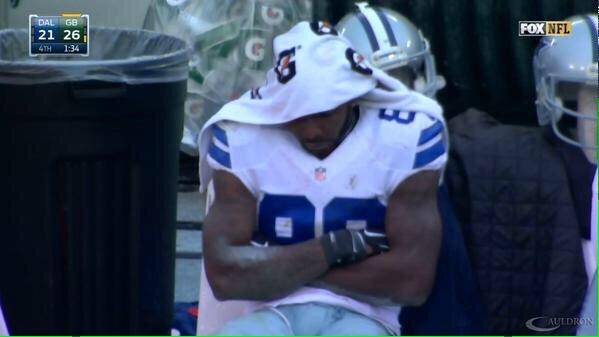
Difference between me and Dez? You’d never see me pout like a little baby
Packers 26, Cowboys 21: “A bad rule, ruled correctly.”
That’s how one longtime NFL operative referred to the call that changed the course of the season for Green Bay and Dallas at Lambeau Field. And when the play was adjudicated by referee Gene Steratore under the hood in Green Bay, connected to NFL vice president for officiating Dean Blandino in the officiating command center in New York, they made the call by the exact interpretation of the rule book. With just over four minutes left and Dallas trailing by five, the Cowboys made a strange call on fourth-and-two with the game on the line: a deep ball down the left sideline. Dez Bryant made a leaping catch over Packers cornerback Sam Shields. But as Bryant landed, the ball became momentarily dislodged. The initial ruling was a completed catch, gain of 31, ball down at the Packer one. Green Bay coach Mike McCarthy challenged the ruling on the field. After a long review, Steratore emerged from the hood and said the call was reversed; Bryant hadn’t completed the act of the catch. Bryant put his hands to his head and, wide-eyed, looked to be saying, “WHAT?! WHAT!”America said the same thing. It looked like a catch. By my Twitter feed, a good 80 percent of the fans who opined considered it a catch.
For Steratore, this had to be an agonizing case of déjà vu. He’s the referee who ruled on a similar replay in 2010, overturning a potential winning touchdown catch by Calvin Johnson in Chicago. On that play, Johnson rolled over in the end zone, using the ball to try to spring up, and the ball skittered away. Steratore ruled that Johnson didn’t complete the process of the catch, and the league backed him on it.
The vital and controversial part of this rule is that as a player falls to the ground in the continuation of the act of trying to make a catch, he has to maintain control of the ball when he hits the ground.
Here, Bryant leaped high in the air, had the ball in his control, took a couple quick steps and fell to the ground. Bryant said later he was attempting to stretch the ball across the goal line as he fell. That is a questionable claim. I’ve looked at the replay from different angles at least 25 times, and there’s no clear evidence Bryant was trying to reach across the goal line.
Bryant failed to maintain possession of the ball when he hit the ground. The ball popped from his grasp when his body hit the turf, and it momentarily left his grip. He caught it while on the ground without the ball hitting the ground. But by rule, that’s not important. Bryant would have had to possess the ball without it leaving his grasp when he hit the ground.
Crucial point two: If Steratore and Blandino had ruled that Bryant fumbled the ball while making a football act “common to the game,” they could have ruled the catch good and the ball down at the one. For instance, if they ruled that he caught the ball and then extended both arms “while making a football act common to the game”—that is, while trying to extend the ball across the goal line, and with the ball never being lost from his grasp—it would have been a catch. By a very close interpretation, Steratore and Blandino ruled that Bryant lost control, and not while making a football act common to the game.
Talking to a pool reporter after the game, Steratore said: “Although the receiver is possessing the football, he must maintain possession of that football throughout the entire process of the catch. In our judgment, he maintained possession but continued to fall and never had another act common to the game. We deemed that by our judgment to be the full process of the catch, and at the time he lands and the ball hits the ground, it comes loose as it hits the ground, which would make that incomplete; although he re-possesses it, it does contact the ground when he reaches, so the repossession is irrelevant because it was ruled an incomplete pass when we had the ball hit the ground.”
To me, this is a classic case of: Hate the rule, don’t hate the ref. I agree that it looked like a catch, but by rule, it wasn’t. “That’s an incomplete pass by rule,” said FOX rules analyst Mike Pereira, who used to have Blandino’s job. “The rule is very specific. In the process of going to the ground, you must maintain possession. That’s what happened here. The ball hit the ground and popped out immediately.” Two other former officials—Mike Carey on CBS and Jim Daopolous on ESPN—were similarly decisive.
“I want to know why it wasn’t a catch,” Bryant asked one wave of reporters. And then another: “Why? Explain why that wasn’t a catch.”
I just did, but Bryant may get some satisfaction this offseason because the rule is going to be debated. Again. For years, I’ve gone to league meetings and listened to debates about the rule. (Actually, the debates are fierce in the 24 or 48 hours after egregious plays; by the time the March meetings roll around, there are often long discussions but little passion about it. That could change this year, with the intensity of interest around this call.) One league source told me Sunday night that the Competition Committee will certainly look at the rule this offseason, beginning (likely) at the group‘s first meeting in February.
Maybe there will be enough momentum for a revolutionary change—for a catch to be catch as soon as a receiver gets two feet down and possesses the ball clearly. The problem with that in the past, as another source said Sunday, is “the cheap fumble.” Think of what happens when a pass, a catch by a receiver, a thudding hit by a defender and a fumble all occur at lightning speed. Did the receiver actually have possession before getting whacked and losing control of the ball? I can recall Jeff Fisher and Rich McKay, the Competition Committee co-chairs, explaining the debate over the rule at one recent meeting and saying, basically, We all agree we don’t love this current rule. We just don’t have a better one. It’s not an easy problem to solve.
With the anger over this call, expect debate to center on either two feet down and possession constituting a catch (with the requisite likely rise in the “cheap fumble”), or a proposal that a receiver doesn’t have to maintain control when going to the ground after taking two steps.
This being a schadenfreude column, we must include memes:

Not only is it ironic that the Cowboys benefited from an official’s call one week and then didn’t the next, the Packers are now going to Seattle, home of the infamous Interceptouchdown.

“All the unsuspecting Ramada Inn guests, opening their freebie USA Today [Friday] morning to the illiterate ravings of a British jihadist,” quipped the Daily Beast’s Michael Moynihan last night on Twitter. He was referring to an op-ed by Anjem Choudary, whose author shirttail describes him as “a radical Muslim cleric in London and a lecturer in sharia“ in response to yesterday’s massacre at the Charlie Hebdo offices in Paris.
On one point Moynihan is unduly harsh: Choudary’s ravings were not illiterate, or if they were, his editors did a decent job of cleaning them up. The piece is readable and mostly coherent. It’s the substance that raised hackles.
Choudary opens with a frank rejection of a cherished Western ideal: “Contrary to popular misconception, Islam does not mean peace but rather means submission to the commands of Allah alone. Therefore, Muslims do not believe in the concept of freedom of expression.” He asks: “Why in this case did the French government allow the magazine Charlie Hebdo to continue to provoke Muslims, thereby placing the sanctity of its citizens at risk?” (One assumes he means “safety,” though it’s possible he has in mind the “sanctity” of French Muslims.)
Sonny Bunch of the Washington Free Beacon, guest-blogging at the Washington Post, defends USA Today’s decision to publish the op-ed against criticism on Twitter (including from your humble columnist). “If this were actually the opinion of the USA Today editors, people would be right to be outraged,” Bunch observes. “But it’s not; it’s rather explicitly couched as the “opposing view” to the newspaper’s editorial, which is rather stridently pro-free-speech.”
Fair enough, though all the tweets Bunch cites acknowledge that fact. Ours observed: “This ‘opposing view’ thing is a really bad idea.” We’ve thought so for a long time, irrespective of the substance of any particular opposing view.
According to the USA Today website, “most editorials are accompanied by an opposing view—a unique USA Today feature that allows readers to reach conclusions based on both sides of an argument rather than just the Editorial Board’s point of view.” It is unique, if it is, only in print journalism; before the Fairness Doctrine’s abolition, it was common practice in broadcast radio and TV to air editorials by the station manager and editorial replies by members of the community. In 1991 we contributed a reply to New York’s WCBS (AM) on the topic of federal aid to New York state and city.
Those broadcast commentaries—including ours—were usually a snooze, and we dare say the same is true of USA Today’s editorial debates (though we should acknowledge we don’t read the paper nearly as closely as we do some of its competitors). The practice also involves a moral hazard: The editorial board might choose weak opponents in order to make its own positions look strong by comparison.
We don’t think that’s what happened here. The propositions that free speech is valuable and terrorism is repugnant are uncontroversial enough that it’s hard to find someone to argue against them.
The paper could have found a non-Muslim to denounce Charlie Hebdo without endorsing the terror attack as Time’s Bruce Crumley did in 2011, after Charlie Hebdo’s offices were firebombed (“such Islamophobic antics . . . openly beg for the very violent responses from extremists their authors claim to proudly defy in the name of common good”) and the Catholic League’s Bill Donahue did yesterday (“Stephane Charbonnier, the paper’s publisher, was killed today in the slaughter. It is too bad that he didn’t understand the role he played in his tragic death”). Both included disclaimers to the effect that they opposed the violent attacks, though Crumley’s was especially grudging: “So, yeah, the violence inflicted upon Charlie Hebdo was outrageous, unacceptable, condemnable, and illegal. But apart from the ‘illegal’ bit, Charlie Hebdo’s current edition is all of the above, too.”
This was the approach USA Today took last month, when it editorialized against Sony Pictures’ decision to withdraw “The Interview” in the face of North Korean threats. “Sony Pictures did not respond to requests for an opposing view,” the paper noted after the bio of the guy who did: David Austin, who “served for five years as Mercy Corps’ program director in North Korea.”
Austin acknowledged that “the First Amendment gives people and institutions—Sony included—the right to make whatever movie they want.” But he insisted that “by dangerously teasing a nuclear state with artistic license, Sony doesn’t really honor our freedom of speech.” But his view was rather a narrow one:
When North Korea is provoked, there are consequences on real people, most of whom are already suffering terribly. I have been to North Korea nearly a dozen times, and life there for 95% of the people is brutally hard. Only a few U.S. humanitarian agencies have access into the country, where they treat tuberculosis patients, feed orphans, or provide medical equipment to helpless people.
No doubt it’s true that doing humanitarian work in North Korea necessitates some enormous moral compromises. But it is unreasonable to scapegoat Sony or Seth Rogen for the oppressive conditions the communist regime has imposed on North Korea’s people for nearly 70 years.
Compared with Austin’s opposing view, Choudary’s at least has the virtue of clarity. That’s the core of Sonny Bunch’s defense of its publication: “It’s important that USA Today published a terrorist-sympathizer like Choudary who believes that freedom of expression is not an absolute right. It’s important to make people understand that liberal democracy isn’t quite as secure as we’d like to think it is.”
We agree on the latter point: It’s important that citizens of America and other Western nations be aware of views like Choudary’s. Those views are certainly newsworthy; Reuters, for instance, had a dispatch yesterday titled “Islamic State Fighter Praises Attack on Paris Satirical Magazine.”
But giving someone like Choudary an op-ed platform and whatever legitimacy comes with it is necessary to raise awareness, perhaps it means news reporters aren’t doing enough.
By the way: Who is Choudary? Him:
In an op-ed in USA Today on Thursday, Choudary seemed to try to justify the attacks. “[T]he potential consequences of insulting the Messenger Muhammad are known to Muslims and non-Muslims alike,” Choudary said. “The strict punishment if found guilty of this crime under sharia (Islamic law) is capital punishment implementable by an Islamic State,” he continued.
Choudary, radical extremists, and anti-Islam polemicists alike often resort to quoting scripture out of context, or taking advantage of transliteration, as a way to distort the messages of Islam. Sharia law varies upon interpretations of scripture—and like any religion, some interpretations are more radical than others.While extremist governments like Iran and Saudi Arabia use the death penalty as a punishment for blasphemy, its justification isn’t found in Islam. The word “blasphemy” isn’t even mentioned in the Quran, or the stories of Mohammed and his companions that make up the hadiths, which form the basis for Islamic tradition. Prominent Islamic scholars like Pakistan’s Javed Ahmad Ghamidi have repeatedly said that “blasphemy laws have no justification in Islam.” Neither does the horrible attack that took place on Wednesday.
The Quran doesn’t explicitly ban depictions of Mohammed, and it certainly does not call for violence against those who display such images, even in a mocking or offensive way. The Hadith does ban images of Mohammed, the relatives of Mohammed, Allah, and all the major prophets. But, as Reza Aslan noted in Slate in 2006, such depictions have still existed in certain sects of the religion for years without causing mass violence:
[M]uch has been written about Islam’s prohibition against physical representations of the prophet of Islam. In fact, the Muslim world abounds with magnificent images of Mohammed. (In general, Shiites and Sufis tend to be more flexible on this point than Sunnis). In some, the prophet’s face is obscured by a pillar of fire that rises from beneath his chin in a veil of flames. In others, he is unveiled and glorious, a golden nimbus hovering over his head. While some Muslims object to these well-known and widely distributed depictions, there has never been any large-scale furor over them for the simple reason that although they depict the prophet, they do so in a positive light.
So what does Islam say about depictions that are not in a positive light? Islam’s most poignant instance of aniconism came when the Prophet Mohammed returned to the city of Mecca in 630 A.D. After years fleeing from persecution, Mohammed and his followers had marched back to Mecca to rid idol worshiping from the holy city. According to the critically acclaimed book Muhammad: His Life Based on the Earliest Sources, upon entering the most sacred point in Islam’s most sacred mosque, Mohammed destroyed all the pagan idols and paintings that were sacrilegious to Islam. (He specifically guarded images of the Virgin Mary and Jesus.)
Mohammed didn’t seek out the creators of the images or sentence those responsible for the idols and sacrilegious depictions to death.
The Quran does call for condemnation of speech and actions that insult Allah, his prophets, and their relatives, but it also specifically warns against violence as a form of retaliation:Repel evil with whatever is better; there is chance that evil may bellow down, if you repel evil with evil, the conflict flares up and both sides will dig in their heels.
The Quran also specifically states that “there shall be no compulsion in the religion.” And there is a whole Quranic chapter calling for the tolerance of different faiths.
When tragedy takes place in the name of Islam and radical extremists profess that such violence is righteous, or that these atrocities “avenge” the Prophet, they only move further away from the principles of the religion.
The Quran warns Islam’s followers “do not raise your voices above the voice of the Prophet.” Radical extremists and clerics like Anjem Choudary are the ones, religiously speaking, who are committing blasphemy. In their distortion of Islam, they attempt to raise their voices above Mohammed and Allah.
It figures after War and Peace-size Presty the DJ entries the past few days, today’s is relatively short.
The number one album today in 1974, a few months after the death of its singer, was “You Don’t Mess Around with Jim”:
The number one single today in 1974 introduced the world to the word “pompatus”:
Today in 1982, Bob Geldof was arrested after a disturbance aboard a 727 that had been grounded for five hours:
The number one album today in 1964 was “Ring of Fire: The Best of Johnny Cash,” the first country album to reach the top of the album chart:
The number one single today in 1964, whatever the words were:
The number one British single today in 1957 was the same single as the previous week, though performed by a different act:
The number one British single today in 1958:
The number one album for the fifth consecutive week today in 1976 was “Chicago IX,” which was actually “Chicago’s Greatest Hits”:
One great thing about the Packers’ standing in the NFL is the great journalism covering the Packers. Here are two examples.
If you go by the measurement of Super Bowl wins, then, in the same way that Bart Starr should be considered the greatest Packer quarterback of all time (five NFL titles and two Super Bowl wins), Joe Montana should be considered the greatest quarterback of the Super Bowl era.
As it happens, Packer coach Mike McCarthy had Montana as one of his quarterbacks when he was the Chiefs’ quarterback coach, as Grantland points out:
McCarthy had gone to K.C. to work with his mentor Paul Hackett, the Chiefs’ new offensive coordinator and a former assistant for Bill Walsh’s San Francisco 49ers. While working together at the University of Pittsburgh, Hackett and McCarthy had installed a version of Walsh’s legendary West Coast offense, which had powered four Super Bowl titles in the 1980s. McCarthy became enamored of the system during those years with the Panthers, immersing himself in the offense that was taking over football. By the time he went to the Chiefs, McCarthy felt he was ready for any challenge.
Well, almost any challenge: Prior to the 1993 season, the Chiefs traded for Montana, the veteran quarterback with extensive West Coast offense experience and four Super Bowl titles, and the man Jerry Rice referred to as “God.” McCarthy told Milwaukee’s JournalSentinel that the gravity of the assignment didn’t register until he excitedly let some of his close friends know that he’d be coaching Montana, and one responded by asking, “What in the [expletive] are you going to teach Joe Montana?” It was a good question, and it led McCarthy to become as much Montana’s student as his teacher, soaking in all the knowledge he could from the future Hall of Famer.
More than 20 years later, on the brink of a divisional-round playoff game against the Dallas Cowboys, McCarthy again finds himself in a teacher-student partnership with an elite pupil: Packers quarterback Aaron Rodgers. Though McCarthy is facing a similar challenge of figuring out how to help one of the game’s best quarterbacks get even better, his relationship with Rodgers is far more collaborative than his pairing with Montana ever was, allowing coach and quarterback to try to improve themselves, each other, and the very offense Walsh taught Montana so long ago. …
When the Packers fired Mike Sherman and hired McCarthy as head coach after Rodgers’s first season, it altered the direction of both McCarthy’s and Rodgers’s careers.
McCarthy was hardly a slam dunk hire, having coached relatively pedestrian offenses in New Orleans from 2000 to 2004, and having spent the 2005 season as offensive coordinator for the 49ers, a 4-12 team that finished a woeful 30th in the league in scoring and 32nd in total yards. But Packers general manager Ted Thompson brought in McCarthy hoping the coach’s deep knowledge of the West Coast offense and renowned touch with quarterbacks would tame Favre after a 29-interception season, while also developing Favre’s anointed replacement. Though Favre bounced back under McCarthy, throwing for 4,155 yards, 28 touchdowns, and only 15 interceptions in 2007 en route to the NFC title game, he began to threaten retirement, and by 2008 Thompson and the organization were ready to switch to Rodgers, convinced after witnessing his dramatic improvement that the QB had the makings of a future star.
Since his days as an assistant under Hackett at Pitt, McCarthy has run a “QB school” every offseason, where, away from the pressure of preparing for a weekly opponent, McCarthy can teach his quarterbacks the finer points of the position. In addition to extensive drill work, McCarthy often gives his quarterbacks lengthy written tests, once (according to the Sentinel) even asking his non-Montana quarterbacks in Kansas City to write an essay describing the Chiefs’ version of the West Coast offense “from a philosophical perspective.”
Rodgers has clearly benefited from McCarthy’s training. As good of a prospect as Rodgers was coming out of Cal, it’s striking how different he looks now: he’s more athletic, more natural, and has a stronger arm. While primary credit goes to the long hours Rodgers spends developing his craft on his own, McCarthy provided a structure for that process.
Specifically, when Rodgers arrived in the NFL, there was what McCarthy has labeled a “stiffness” to his game. Under McCarthy’s tutelage, that has since melted away to reveal the fluid, smooth quarterback we see today. Tedford, Rodgers’s college coach and a current CFL head man, is an excellent quarterback teacher, but his college passers tended to be a bit robotic: They all dropped back, held the ball, and released it the same way. That made sense for raw high school and junior college passers who had to quickly learn the fine points of quarterbacking in order to execute Tedford’s pro-style attack, but great NFL passers must make their fundamentals serve them, not the other way around. …
The offense Rodgers operates in Green Bay is based on the same ideas, concepts, and even specific plays that Hackett, McCarthy, and Montana used in Kansas City and that Montana and Hackett had run with the 49ers, all of which is rooted in Walsh’s West Coast offense. While most people think of short timing passes when they hear the term “West Coast offense,” Walsh’s coaching tree — and the coaching tree of his coaching tree — is so long because his insights extended beyond well-designed pass plays to encompass a uniquely thorough, detailed approach to game planning, analyzing defensive weaknesses, and teaching and developing players. Those precepts are Walsh’s true legacy, and they now fuel the Packers’ offensive success.
In McCarthy’s early years, he immersed himself in Walsh’s ideas and language — 22 Z-In, 2 Jet X-Sluggo Seam, and so on. But rather than adhering religiously to those lessons, McCarthy and Rodgers have crafted a version of Walsh’s offense that constantly evolves to keep pace with a changing game. Quoting former Chiefs assistant Jimmy Raye, McCarthy once told USA Today: “‘Football is a cycle. You’re going to see things in this league or out of this league and in college football.’ It’s very important to stay on the front side of that cycle.” The Packers’ offense may be rooted in the playbook McCarthy learned from Hackett 20-plus years ago, but it works because he and Rodgers have subtly blended in new-school tactics.
While the West Coast offense dominated the NFL in the 1990s and early 2000s, it has increasingly fallen out of favor because its emphasis on precision and preparation has too often translated into inflexibility and needless complexity. The traditional West Coast offense features a seemingly countless number of plays — former Packers coach Mike Holmgren once said his playbook contained at least 1,500 plays — because on each play each player had a specific job, such as running a post or a slant. As a result, the only way to take advantage of a shifting, evolving defense was to add yet another new play and hope to call it at the right time, in what amounted to an impossibly hard game of rock-paper-scissors.
That’s not a feasible approach against modern, malleable defenses, and with Rodgers under center, it’s also not necessary. For example, one of the Packers’ most productive pass plays is “three verticals,” in which Green Bay’s receivers have the option to change their routes based on the coverage, trusting Rodgers to see their adjustments in real time.
Chris B. Brown
On this play against the Panthers, both outside receivers, Jordy Nelson and Davante Adams, can run either straight down the field on “go” routes (as Nelson does to Rodgers’s right) or stop after 12 to 15 yards if the defender is playing soft coverage (as Adams does to Rodgers’s left). Meanwhile, the slot receiver, Randall Cobb, runs a “middle read”: If the defense plays with two safeties deep, Cobb will split the safeties and run deep down the middle, but if there’s a deep middle safety like on this play, he’ll turn his route into a square-in and break across the field into Rodgers’s vision.
While this play, which the Packers run over and over again, requires Rodgers and his receivers to all be on the same page — and requires Rodgers to process all of this information and make an accurate throw in fractions of a second — it also replaces as many as 10 different plays from the traditional West Coast offense.
This idea of multiple concepts within each play flows through Green Bay’s offense. Under Favre and in Rodgers’s early seasons, this typically meant combining multiple pass concepts within the same play and letting the QB pick the side based on the defense. More recently, however, the Packers have made extensive use of “packaged plays,” which combine run blocking from the offensive line with screens or downfield passes by the receivers, while the QB has the option to hand off to a running back or throw downfield.
Under McCarthy, Green Bay was among the first NFL teams to begin using packaged plays, which first began bubbling up in college football roughly five years ago. (McCarthy has several friends coaching college on whom he leans for new ideas, including Kevin Sumlin, the forward-thinking coach at Texas A&M.) The above inside zone running play married to quick “pop” or seam routes by the slot receivers is straight from college football, and is a simple way to keep defenses honest if they try to crash down on Eddie Lacy and Green Bay’s increasingly productive run game. It’s also a way for the Packers to use Rodgers’s quick decision-making ability without putting him in harm’s way.
But the Packers’ success doesn’t stem solely from their ability to embrace the latest and greatest; while Green Bay excels at innovating, it’s also better than any other NFL team at executing many of the same plays Walsh used with Montana, most notably the slant pass. Hard as it is to believe, few NFL teams consistently throw the quick slant anymore, as most have replaced it with skinny posts or quick square-ins, or stopped bothering altogether. Put on a Packers game, though, and it can feel like watching old 49ers game film.
It’s not uncommon for Rodgers to complete five to 10 slant passes in a game — he likes them against soft coverage because they give him easy access, and he loves them against the blitz. When New England tried to bring pressure on Rodgers late in the half, he checked into a basic slant to Nelson and, 45 yards later, Green Bay had scored.
… Rodgers is a few Super Bowls shy of earning direct comparisons to Montana, but — particularly compared to Peyton Manning’s manic nerdiness and Tom Brady’s newfound love of high fives, head butts, and F-bombs — he’s the closest thing we have to a modern-day Joe Cool: This season alone, Rodgers pointedly told Packers fans to R-E-L-A-X after a loss and, on one of the most remarkable plays I’ve ever seen, calmly threw a game-winning touchdown pass without even bothering to buckle his chin strap.
pass without even bothering to buckle his chin strap.
By all accounts, Rodgers has always been this way. At a coaching clinic in 2011, Tedford recalled that, before the aforementioned crucial game against USC, Rodgers “was just walking around in the locker room with a smile on his face and getting [his teammates] going, but also getting them relaxed. He was not going haywire and yelling and screaming. He had this confidence about himself, and his leadership ability was unbelievable.”
Of course, similarities in demeanor between Rodgers and Montana wouldn’t matter if the two weren’t also so similar on the field. “When I think about fundamental quarterback play, I think of Aaron and Joe Montana,” McCarthy told the Sentinel. “The productivity is obviously there, but just the way they play the position — their footwork, the balance, the athletic ability, the accuracy of the football, the vision.” I see it too. Montana’s gifts were his accuracy, his decision-making, and his feet, and Rodgers boasts those same attributes — plus a stronger arm.
Michael Silver flashes back to the Packers’ last game:
The counterintuitive cheer rang out like a crescendo, just after Detroit Lions defensive lineman Jason Jones charged through the line and came crashing down upon quarterback Matt Flynn, and five confused Green Bay Packers offensive linemen weren’t sure what had hit them.
“We were like, ‘What the hell is going on?’ ” said Packers guard Josh Sitton, recalling the third play from scrimmage of the second half of Green Bay’s NFC North-deciding regular-season finale. “We had just given up a sack, and we’re going, ‘Are they sarcastically cheering?’ It was about to be a new low.
“Then we got to the sideline and our offensive line coach said, ‘Hey, 12’s back out here. We’ll see what happens.’ ”
As the Packers, 78,408 fervent fans at Lambeau Field and millions of TV viewers would soon be reminded, magic happens quite frequently when Aaron Rodgers emerges from the tunnel and steps onto a football field. For the second consecutive year, Rodgers’ timely return from an injury in Week 17 would deliver a dramatic division title for the Pack. In this case, Green Bay secured a first-round bye with its 30-20 triumph over the Lions, setting up Sunday’s divisional-round clash at home against the Dallas Cowboys.
It also, in all likelihood, clinched a second regular-season Most Valuable Player trophy for a quarterback whose growing standard of greatness mesmerizes fans, coaches, opponents and teammates alike. …
And now, remarkably, Rodgers is every bit the Titletown treasure that predecessor Brett Favre was — and, true to his unrelenting nature, he’s far from satisfied. Though many highly astute football figures, including future Hall of Fame quarterback Tom Brady, have said that Rodgers is playing quarterback at the highest level the sport has seen, the 31-year-old superstar dismisses such proclamations as “idle talk.”
As Rodgers said in a recent interview at Lambeau, “I still know I can play better, and I’m always looking for ways to get better. Whether it’s a six-touchdown game, and I’m pissed about a check I didn’t make in the second half that would have given me a chance to get seven … it’s that desire to be perfect. It’s the greatest asset sometimes, and it can be the greatest curse, because it’s hard to turn off.”
In the process, he’s turning out to be one of those players his teammates will tell their grandkids about, and whose heroic feats may only be slightly exaggerated long after his bust has settled into its permanent resting spot in Canton.
Consider the scene at Lambeau two Sundays ago. Nursing a painful left calf injury as he took the field against the Lions, Rodgers was slipping away from the pass rush late in the first half when he suddenly felt a shooting pain in the afflicted leg. That Rodgers managed to thread a 4-yard touchdown pass to receiver Randall Cobb before hitting the ground, giving the Packers a 14-0 lead, was of small consolation to the stunned masses. Rodgers would later concede that he initially thought he had torn his Achilles tendon.
“When he went down, it looked like he got shot,” said Packers linebacker A.J. Hawk, one of Rodgers’ closest friends on the team. “I didn’t think he was coming back. We figured, as a defense, ‘Let’s stand up — we need to do this.’ Then I heard the crowd.”
Just after Flynn absorbed that drive-killing sack to start the second half, Rodgers emerged from the tunnel, blessedly still in uniform. Though the Lions would score a touchdown on the ensuing drive, tying the score at 14, the sight of Rodgers taking warmup tosses on the sideline infused the stadium with a surreal sense of serenity.
“It was like a cliché movie thing,” Hawk said. “The crowd’s cheering, but this isn’t the right time. Then I saw that he had come back out — and he wasn’t in street clothes. I honestly wasn’t sure if he would try to play … or, if he did, if he was gonna last more than a few plays.
“And, of course, it was a magical second half. It was like Willis Reed, limping back out of the tunnel. Just one more story to add to his legend.”
Certainly, Rodgers earned the comparison to Reed, who stunned a Madison Square Garden crowd by surfacing just before tipoff of Game 7 of the 1970 NBA Finals and, despite a torn thigh muscle, propelling the New York Knicks to a victory over the Los Angeles Lakers.
On a more contemporary — and personal — level, he channeled the unrivaled resilience of Favre, whose penchant for playing through pain was immortalized by his record streak of 297 regular-season starts. …
In the process of affirming his ability, Rodgers has proven to be a strong-willed, ultra-competitive and exacting leader, one who carries himself with almost a coach-like presence among his peers.
“He expects everyone to put the work in just like he does,” Sitton said. “He brings a pad and a pen to every meeting and takes notes. It might be s— that he’s seen 100 times, but he prides himself on knowing every facet of this offense.”
That, not surprisingly, provokes creative tension with the man in charge of the Packers’ offense, and of the team as a whole: Mike McCarthy, who took over after Rodgers’ rookie season and is now the league’s fourth-longest-tenured head coach with his current team.
Upon hearing the suggestion that he and McCarthy are like Spinal Tap’s “two visionaries,” a reference to the infamous recording-session screaming match between guitarists David St. Hubbins and Nigel Tufnel in the cult-classic rockumentary, Rodgers laughed and said, “That’s a good analogy.”
Said Seneca Wallace, the veteran who spent the 2013 season as a Rodgers backup: “It was interesting. You hear different stories about coaches and quarterbacks (clashing), and when the head coach also calls the plays, it’s a whole other dynamic. They’re both very opinionated. Aaron’s a very intelligent quarterback, and Mike is a very intelligent and headstrong head coach who wants things done his way.
“When you’ve got two headstrong guys going at it, it’s kind of like a chess match. Each one is trying to figure out what the next move is. They’re going to war together, and if something goes on, they’ll come back and hug it out. It’s not like it gets out of hand. Whatever they’ve got going on with their chemistry, it works for them.”
To McCarthy, the challenge is to balance “the responsibility of calling plays with Aaron, but also the responsibility of managing the game for the whole team. There’ve been times, especially as a young coach, where I was too emotionally aggressive on the sidelines.”
Rodgers, suffice it to say, is not emotionally passive — be it in practice, meetings or games.
“Coach McCarthy always talks about alpha dogs — well, they’re like two alphas going at it,” Hawk said. “Man, it’s intense. It’s really fun to watch. They spend a lot of time together, one-on-one … watching film, going over the game plan, talking over plays. There’s so much respect back and forth, and they’re both passionate.”
The two visionaries made beautiful music together this year, as Rodgers threw for 4,381 yards, completed 65.6 percent of his passes and tallied 38 scoring tosses while serving up just five interceptions. His 112.2 passer rating was second only to Tony Romo’s 113.2, and the Packers’ 12-4 record was their best since the then-defending champions went 15-1 in 2011, with Rodgers earning MVP honors.
“Mike and I have got a really good relationship,” Rodgers said. “It’s been tested over the years. There’ve been so many highs, and a couple of moments of friction. But the moments of friction just make things better between us. Because, at the end of the day, we both want the same thing: We desperately want to win, and we want to do it all the time. And we are passionate about doing things the right way, and winning.
“We love to win. And we hate to lose. We probably hate to lose more than we love to win. And that’s why we want it so badly. Our relationship has grown so much over the years. It’s just a trust that he allows me to do some things on the field, and I trust him to make the right calls. He gives me enough freedom. I try not to abuse that.
“For sure, there’s some fiery moments. But I think we both know each other well enough that the last thing that either of us want to do is disrespect each other.”
Sometimes, the friction occurs because Rodgers goes off script and doesn’t include McCarthy in the improv sketch. Whereas Saints coach Sean Payton and quarterback Drew Brees seem, in a football sense, to be completing one another’s sentences, McCarthy and Rodgers can be more like screenplay collaborators who divvy up the scenes.
“Mike might call two plays, and then they’ll go no-huddle,” Wallace said. “So of the 70 plays in a game, Aaron might end up calling 40. But it really eats at Mike when he doesn’t know what play Aaron is calling. He’ll be like, ‘What the f—? What is he calling?’ ”
In Rodgers’ defense, he’s pretty damned good at it. For starters, his football IQ is Mensa-esque. Hawk says that he occasionally picks the quarterback’s brain about offenses the Packers are preparing to face, “and he’ll start to go into a 30-minute dissertation about what defenses do, what works, what the upcoming opponent will do and why it won’t work. He goes into such depth and detail. He’s one of those dudes who thinks like 10 steps ahead. So if you ask him a question like that, you’d better not be in a hurry.”
Asked if he could emulate his old-school predecessors who routinely called their own plays, Rodgers said, “I think so.” He’s being modest — he knows so.
“Remember that game at the end of the (2011) season, after they’d already clinched home-field (advantage throughout the playoffs), when (then and current backup) Matt Flynn went off against Detroit?” Wallace said, referring to the 45-41 Green Bay victory in which Flynn set franchise records for passing yards (480, since tied by Rodgers in 2013) and touchdown passes (six, also since tied, twice, by Rodgers — before halftime of the Pack’s blowout victory over the Bears last Nov. 9).
“I think Aaron called 100 percent of those plays, or darn near close, from what he told me. That just tells you the respect level Mike has for him, and the level that they’re both on intellectually.”
It was that respect level that led McCarthy to implement more no-huddle packages in 2012, thus increasing Rodgers’ play-calling responsibilities. He reduced them in 2013, concluding that he was putting too much on his quarterback.
“It’s not that he couldn’t (call his own plays),” McCarthy said. “When you talk football with him, he’s ‘coach-smart’ now — he knows the line call, the blocking schemes and what every receiver is doing. Really, what we learned through our process is, it’s not that he can’t. It’s how much responsibility can one man carry on a team?
“Nobody plays faster in the league than this guy — the way he sees the game, the way he gets the ball out of his hands. I realized I was stressing out, and potentially slowing down, the best player on my team.” …
Midway through last season, a groan reverberated throughout Lambeau after Rodgers went down with a broken left clavicle during a Monday night defeat to the Bears. As the Packers struggled to stay afloat during his eight-week absence, Rodgers spent much of his time in the training room, where he and the people treating him amused themselves by sifting through letters, voicemails and emails from fans offering unconventional remedies.
“Our training staff started collecting this stuff, and we’d read them, just as a way to deal with the frustration of not being out there, to provide some comic relief at times,” Rodgers recalled. “The root of it was that people wanted to help. Some of them were interesting ideas that made you go, ‘Hmmm.’ Some of them were just pure comedy — different things they could put on (the clavicle), whether it was some sort of cream or rub, or animal extract, or some sort of light therapy that would be the cure-all.”
And what was Rodgers’ favorite suggestion? “Energy therapy,” he said, laughing. “It was a letter (in which) somebody wrote, ‘If I can just touch him … just touch his affected area, he’ll be back on the field next week.’ ”
Eight weeks later, Rodgers returned for the team’s final regular-season game, a division-title showdown with the Bears in Chicago, and delivered a miracle of his own.
Down 28-27 and facing a fourth-and-8 with 46 seconds remaining, Rodgers took a shotgun snap and faced immediate pressure from Bears pass rusher Julius Peppers (now a Packers teammate). After sliding to his left to evade the sack, Rodgers launched a 48-yard touchdown pass to Randall Cobb that ranked as one of the most stirring plays in franchise history.
Carrying on the Packers’ storied legacy is important to Rodgers. While things were understandably chilly with Favre during that surreal summer of 2008, Rodgers has made a point of helping to repair relations, ultimately facilitating plans for Favre’s jersey to be retired at Lambeau next season.
“I think Brett deserves his due for what he did for this organization, this city and this franchise,” Rodgers said. “So, it’s time to bring him back. I think that in some people’s eyes, they were worried about how I would react to that. And so it was just important for me to show those people that, you know what, I’m 100 percent on-board with this. Because it has nothing to do with me — Brett should be back in the fold, and should be honored the way he deserves to be honored.”
Rodgers, understandably, has never felt so secure in his position, even as he pushes himself and his teammates toward that elusive standard of perfection. He’s still adjusting to life as a celebrity — and now has a famous girlfriend in actress Olivia Munn, further intensifying a “life (that is) not really normal anymore.”
That said, Rodgers is determined not to stay ensconced in a football-centric bubble.
“I think he takes pride in being intellectual and in touch with what’s going on around the world,” Hawk said. “He’s obviously all about football, but it’s not just football. He’s so curious. If I mention a book that he hasn’t read yet, or hasn’t heard of, he’ll take out his phone, make a note, and actually buy it and read it.
“He’s curious, always asking questions, always learning. There are a million things he’s interested in … politics, entertainment, current events. If he walks by your lunch table and hears you talking about something, he’ll sit down and give you his opinion — and he’s not shy about debating you.”
And when Rodgers debates, as with everything he does, he’s in it to win it.
“You wanna know how competitive he is?” Sitton asked. “One day early this season, we have this play (in practice) where he basically has to launch the ball as far as he can out of bounds … running time off the clock when there are six or seven seconds left and it’s fourth down so there’s no time left for another play. I told him, ‘You don’t have the arm for that anymore. You’re too old.’ He looked at me like, ‘FU,’ and launched that ball so f—– far, it was ridiculous. That’s how he is.”
Said Hawk: “We hang out with him, and we’re big into board games and different types of charades-type games. If your team is trying to come up with topics, he’ll sit in the corner by himself coming up with terms he’s so proud of. He wants to come up with some stuff you’ve never heard of. If one of his references comes up, and the other team gets it, he’ll get so mad. He wants to dominate.” …
After emerging from the tunnel to finish off the regular-season finale against the Lions, Rodgers was clearly uncomfortable, yet he refrained from playing up the drama to his teammates. Even when he scored on an improbable sneak to put the Pack up by two touchdowns in the fourth quarter, a decision that apparently was his brainchild — “I didn’t think it was the brightest call by Aaron,” Sitton said — Rodgers was all business.
“It wasn’t really a big production,” Sitton said. “At one point, he said, ‘I’m gonna need some time, guys.’ But it was definitely that feeling that the competition, that going to battle with us, was more important than his injury. It was definitely a big moment.”
Perhaps, for a man whose path to football stardom has seldom been paved with gold, Rodgers’ muted reaction to such challenging circumstances isn’t surprising. Adversity, be it Ndamukong Suh’s foot bearing down on his tender left leg late in that Lions game or a van full of sneeringly skeptical high schoolers, has been a constant part of the journey — but, in Rodgers’ eyes, his has been the road best traveled.
“It’s a lot better,” he said. “As tough as it’s been, at times, that road is a satisfying one. And as you move forward, you take the high road and try and do things the right way — you try to make it about the team, and you try to stay humble when you’re having great success. That’s the satisfying road.”
In the fall of 1976, General Motors did something revolutionary for the day. They replaced their enormous (I speak from experience) B- and C-body cars …


… with smaller, more efficiently packaged cars:


The redesign worked so well (at least from the perspective of GM’s accountants) that it took 13 years for Chevrolet to redesign the Caprice.

This is a reasonable facsimile of my in-laws’ 1991 Caprice, which was a restyling, though not really redesign, of the 1977–90 Caprice. I liked it so much I wish, two decades later, that we had purchased it from them. (Even though the cars we had at the time were perfectly fine, unlike the previous, and quite possibly last, Chevrolet I owned, a 1988 Beretta, un pezzo di merda.) Like my 1975 Caprice, it was roomy, had adequate acceleration, handled well for a large car, and got decent fuel economy. (Which cannot be said about the 1975 Caprice, EPA-rated at 13 city and 18 highway mpg.)
Autos of Interest interviewed Dick Ruzzin, who as chief designer of Chevrolet designed the last Caprice:
All in all, the Caprice was a very successful car and used for many personal and commercial applications. Once I told a group of police that I was responsible for the design and they could not stop the adulation. Basically, they really enjoyed working with a car that was really neat looking, the best looking police car ever, which was their opinion. It looked fast and aggressive in police trim.
I still see some Caprices and in spite of all the cultural changes in design, over twenty five years later, they are still intriguing and stand up very well. The flush side glass and futuristic headlights for the time helped push its character into the future.
The design effort was a fun time; we had a lot of great people working in the studio and did a lot of work. The Caprice followed the design of the Cavalier, Celebrity and Eurosport, and Lumina Sedan and APV, as well as a small car program to replace the Chevette that was cancelled after it was released. We also had design responsibility for all three Japanese small cars sold by Chevrolet from Isuzu, Suzuki and Toyota, as well as the Chevette. That meant a lot of responsibility and effort on everyone’s part. The quality of the people shows through in the quality and reach that our designs had as we see them now, so many years later. …
We decided to challenge the Chevrolet engineers. Since the car was done over an existing platform our Studio Engineer, Dick Olsze, suggested a goal for them: reduce the size of all the structural criteria by 10 percent—not the strength but the size—giving us an advantage over the old car. In some areas they were able to achieve that. The biggest challenge was the small block V8 distributor that sat right under the base of the windshield. It had to be redesigned with a two-piece distributor shaft.
When the model was blocked in and in color we took it outside for the first time to participate in a large show. It included a number of cars from other studios so that our management could get a good idea of what was being done and to also see strengths and weaknesses of each program. The Caprice looked like a moon rocket compared to the others.
It was the first time in many years that a car was being done that was not being downsized. Everyone loved it; it was the newest design in the show. The further we went the more the design was cemented into place because we added a lot of detail with sophisticated surfaces that made it look like we had worked on it a lot longer. When Chevrolet saw it they loved it.
The engineer in charge of the project was so enthusiastic that Chevrolet built a running car to demonstrate the concept to the GM Board of Directors. The car was all released for production, although we were still making small changes when he drove it over one Saturday morning. We all took it for a ride and it looked incredible; it was our favorite color, dark red metallic like our fiberglass model, with a light tan interior. It was a real hit.
About a year later, I was in Cadillac Studio and we then did the Cadillac version, called the Fleetwood. I just saw a maroon one today in excellent condition. We also did the Presidential Limousine. Two years later I was in Chicago on a beautiful sunny day walking out of Bloomingdales and there parked in front of the store was the regular limousine that we also designed. Those cars were all done on the side while we were really pushing hard on the Seville and Eldorado.
Last spring I was in Detroit and there parked at a gas station were two black Fleetwoods in absolutely pristine condition. They looked great. The design for those cars, the Caprice and the Fleetwoods were done a long time ago, about thirty years.
They did look terrific.
The thing about the Caprice was that, because it was over a very old platform, the design expectations were low. The studio that had responsibility for the Caprice was Chevrolet #1. It was a shock to me when we were given the assignment but we were really doing a lot of great work at the time and were very well respected by Chevrolet Engineering for how we did things, how we helped them do their job. We had sold the Celebrity Eurosport program to Chevrolet and that was something that they really admired, that is, how we accomplished it.
The Caprice profile was like no car ever done at design to that point because it broke fifty years of tradition. The car was taller than it had to be. We did that to have a smooth flowing line from the bottom of the windshield, over the passengers and to the bottom of the back-lite. Our VP, Irv Rybicki, asked me about that; our internal engineers had found out and told him. I explained why we did it and he accepted it without a problem. …
Autos of Interest: What was the target clientele for the new Caprice?
Ruzzin: Caprice customers. They had to see it as their car, it had to have some touches that identified it as the new Caprice. We could not make it smaller due to the carry-over platform but we did everything possible to make it “look” smaller. Interior space was huge.
Autos of Interest: Did other GM divisions (or law enforcement) have input relative to their needs?
Ruzzin: The car originally was going to be a Chevrolet only at 300,000 cars a year. When Oldsmobile, Buick and Cadillac saw it they lobbied to get it also which resulted in a lot more production, some of it hard to sell.
There was no law enforcement involvement but I do know that when the car went out of production, Chevrolet had 90,000 police car orders in hand for the future; they wanted to continue building them in Mexico and the UAW stopped it. They did make great looking police cars, aggressive and dynamic. …
Autos of Interest: Was the wagon a definite model from the start and why did it debut later?
Ruzzin: It was a model to be executed from the beginning but the geometry of the sedan design had to be developed, first, before you could do the wagon. The plan view of the doors had to be capable of extension to the rear to make a wagon. It also had to enclose the carryover rear tailgate hinges. Also, for Chevrolet, as the sedan moved along they could then shift manpower to the wagon.
Autos of Interest: Was a coupe considered, or toyed with? Even in concept?
Ruzzin: No coupe was ever considered. Coupes were on a sales down-slide at that time.
There were a few changes in the last five years of the Caprice, most notably the rear wheelwells …

… due in large part to the creation of the 1994–96 Impala SS:

To me, the 1991–93 Caprice looks better. The rear wheelwells emulate fender skirts, which Caprices had, either as options or standard, until the 1977 downsizing. That design, however, resulted in a narrow rear wheel track on sedans, though apparently not on wagons, which had a different rear suspension.

On the other hand, the 1994–96 Caprice had the Corvette’s LT1 350 V-8, which developed 260 horsepower. The Buick Roadmaster sedan …

… and wagon …

… and the Cadillac Fleetwood of those three years had the same V-8.

The observant will notice one major difference between the Roadmaster Estate and the Caprice Estate: the second-row skylight, which was meant to remind buyers of the former Oldsmobile Vista Cruiser:

The 1991–93 Olds Custom Cruiser had one too …

… which is a bit ironic since the original Custom Cruiser wagon, like all the big GM wagons, didn’t have a vista roof.
As I’ve written here before, big wagons died because of EPA fuel economy regulations and resulting buyer interest in sport utility vehicles and minivans instead of station wagons. Which is too bad, because I at least would like to have one of these.


 Steve Prestegard.com: The Presteblog