Skip to content
  • The infrastructure deficit, and how to fix it

    April 14, 2015
    Wheels, Wisconsin politics

    State Sen. Frank Lasee (R–De Pere):

    The debate over Wisconsin Prevailing Wage law is reaching a fevered pitch. Many are still unclear about what prevailing wage is and how repealing it will save taxpayers millions and help local and state government reduce their building costs for years to come.

    Prevailing wage is a mandatory, government-set price for wages on taxpayer funded projects based on the average of the highest paid workers doing the same type of work in that county (that’s right, when a road project crosses a county line the workers all have to paid a different rate for the work they do on each side of the county line). Prevailing wage artificially inflates the cost of construction by setting wages higher than other free market rates for the same work. Whenever government bureaucracy gets in the way of business, experience has shown us that it becomes less efficient and more costly.

    The current prevailing wage law costs taxpayers and small businesses more in two different ways:

    First, is the increased costs to taxpayers. The artificially high wages drive up the cost of public projects like school buildings, roads, and work on government buildings. Since the price is fixed at the highest union wage in the area, there are no bargains in the competitive bid process like there are on private sector projects that drive down prices. This lack of competition and government-set wages and benefits higher than private sector building projects results in higher costs for projects which use our tax dollars.

    Second, the way the system is set up is confusing, complicated, and difficult for business and contractors doing the work. As I have talked with constituents who own contracting or trucking businesses, they always tell me that calculating prevailing wage is an “accounting nightmare”.

    Here’s a story that illustrates how overlapping prevailing wage boundaries and rates makes work less efficient and more costly.

    Imagine you’re at the grocery store buying milk. You get your gallon, make your way to the front of the store, but there’s an error message when the milk is scanned. The clerk tells you the price is different depending on how you’re going to use it. You pause because that just doesn’t make sense–it’s the same milk in the jug. How does the price change depending on where I pour it? The clerk asks you how much of the milk you plan to use for cereal. Baking? Mac n’ Cheese? Drinking? You end up paying four different prices for four different uses of milk based on the percentage of use in each category. By now your head is spinning, you’ve been at the register for 10 minutes, and you end up paying more money for the same milk. You leave the store angry and thinking about switching to *gasp* pressed soy drink to avoid the hassle over purchasing milk in the future.

    Many Wisconsin contractors go through this same, unnecessary headache when calculating prevailing wage job costs. There is a prevailing wage set by the federal government in Washington, DC, and a county-specific wage rate and a job-specific wage rate. Then there is a state prevailing wage rate, different from the federal rate, for use on projects that don’t have federal tax dollars paying for them. The state and federal rates are different.

    Workers on road building projects will often work on more than one project with different rates on the same day, with the multiple prevailing wage rates in the same week. The time worked on each project has to be tracked and the worker has to be paid the right government-set prevailing wage rate.

    By eliminating prevailing wage mandates, Wisconsin taxpayers win and save hundreds of millions of dollars because smaller, qualified companies that previously couldn’t or didn’t want to handle the administrative burdens of prevailing wage will be able to bid for taxpayer funded construction projects. As with everything else – from TV’s to toasters – competition drives down costs, increases innovation, and allows our government tax dollars to be more wisely spent. We will get more building for our tax dollars.

    Labor costs are the number one component of nearly everything we purchase. Reduce labor costs, and you reduce the costs of what you’re buying, including refurbished roads.

    Share this on …

    • Share on X (Opens in new window) X
    • Share on Facebook (Opens in new window) Facebook
    • Share on LinkedIn (Opens in new window) LinkedIn
    • Email a link to a friend (Opens in new window) Email
    • Print (Opens in new window) Print
    Like Loading…
    No comments on The infrastructure deficit, and how to fix it
  • Presty the DJ for April 14

    April 14, 2015
    Music

    A former boss of mine was a huge fan of the Rolling Stones. His wife was a huge fan of the Beatles. The two bands crossed paths today in 1963 at the Crawdaddy Club in Richmond, England.

    The number one British single today in 1966:

    Today in 1971, the Illinois Crime Commission released its list of “drug-oriented records” …

    You’d think given the culture of corruption in Illinois that the commission would have better and more local priorities. On the other hand, the commission probably was made up of third and fourth cousins twice removed of Richard Daley and other Flatland politicians, so, whatever, man.

    (more…)

    Share this on …

    • Share on X (Opens in new window) X
    • Share on Facebook (Opens in new window) Facebook
    • Share on LinkedIn (Opens in new window) LinkedIn
    • Email a link to a friend (Opens in new window) Email
    • Print (Opens in new window) Print
    Like Loading…
    No comments on Presty the DJ for April 14
  • Interstate 41

    April 13, 2015
    History, US politics, Wheels, Wisconsin politics

    I was born in the back seat of a Greyhound bus,
    Rollin’ down Interstate 41 …

    OK, the Allman Brothers’ “Ramblin’ Man” doesn’t particularly fit here. (For one thing, the narrator is the son of a Georgia gambler who wound up on the wrong end of a gun; nevertheless them Delta women thought the world of him.) It does, however, commemorate the news Gov. Scott Walker’s office released Thursday:

    Wisconsin Governor Scott Walker announced today that U.S. 41 in the eastern part of the state has been officially added to the Interstate System as I-41.

    “The Interstate designation is the culmination of years of hard work by federal, state, and local officials that will stimulate economic opportunities from Milwaukee to Green Bay and beyond,” Governor Walker said. “Our Interstate system is a critical part of our infrastructure, which fuels commerce, helps grow the economy, and create jobs.”

    The Federal Highway Administration (FHWA) officially approved the Interstate designation – the final step in a process that began nearly 10 years ago.  Installation of about 3,000 new signs will begin this summer with signing expected to be completed by November 2015.

    “The official designation of I-41 is tremendous news that will support the safe, efficient movement of people and commerce for many years to come,” said Wisconsin Department of Transportation Secretary Mark Gottlieb.  “Along with Governor Walker’s leadership, I want to thank former Congressman Tom Petri, our current Congressional delegation, state legislators, local government officials, and community leaders who helped make I-41 a reality.

    Wisconsin’s newest Interstate route runs concurrently with US 41 for the entire route.  I-41 begins at the I-94/US 41 interchange located about one mile south of the Wisconsin/Illinois border.  It follows I-94 north to the Mitchell Interchange, I-894 and US 45 around Milwaukee and then joins US 41 north to Green Bay where it ends at the I-43 Interchange.

    Existing US 41 in the Milwaukee area will be re-routed to follow I-41 along I-894 and US 45.  Current US 41 along Lisbon Avenue and Appleton Avenue from I-94 at the Stadium Interchange northwesterly to the interchange with US 45 will be re-numbered WIS 175.

    Got all that?

    This was one of the issues I watched in my previous life as a business magazine editor. The great (though apparently not currently updated) Wisconsin Highways website brings some history of Wisconsin’s efforts at Interstates from the state Department of Transportation:

    The State Highway Engineer, in 1945, submitted tentative route designations that included the currently used I-94 in southeast Wisconsin plus the Highway 18 zone between Madison-Prairie du Chien; Highway 51 northerly from the present Interstate toward Hurley; Hwy. 53 between Eau Claire-Superior; a route between Milwaukee-Green Bay; and an east-west loop between Green Bay-Eau Claire where it would have linked with the present I-94.

    The first Washington response was to substitute Tomah-La Crosse for Madison-Prairie du Chien. Other responses followed.

    In the meantime, the Turnpike Commission, established by Wisconsin Laws of 1953, was looking over the situation.

    Wisconsin had anticipated the Interstate, in a way, with studies of a possible toll road-turnpike. Consulting engineers from Baltimore, Md., and New York City in 1954 submitted, respectively, a preliminary engineering statement and traffic-revenue study.

    The latter concluded that a toll road between Hudson and Hwy. 41, the Hwy. 29 loop, would be “cost beneficial” for motorists and profitable for the state.

    The Maryland consultant’s study looked at routes in the present I-90/94 corridor, except Tomah-La Crosse, along with a loop between Madison-Wisconsin Dells through Sauk City and another connecting Hwy. 41 near Kenosha through Burlington and Fort Atkinson to Madison. This study inferred that parallel routes might reduce potential tolls and lead to unprofitability.

    In June 1955, the Turnpike Commission reported to the Legislature that the Illinois-Wisconsin corridor was not feasible at the time and recommended delay “until future developments can be fully appraised.”

    Another toll road study was conducted at the State Legislature’s request in 1982. Both a cursory Departmental analysis and a consultant’s subsequent assessment reached negative conclusions.7
    Meanwhile, Washington-Madison negotiations continued. In 1955, assuming that there would be 2,400 miles of urban additions to the Interstate system, the Commission asked for four more sections in the city of Milwaukee. This included a loop around the central district, Howard Avenue-South 44th Street, a 2.3 mile extension toward Glendale, and a 7.3 mile extension toward Hwy. 100.

    Letter exchanges continued in 1956 with requests for extensions into Madison, La Crosse, and Eau Claire—all denied.

    Other decisions came in December. Washington denied the state’s request for a route between Genoa City-Beloit, opting instead for Madison-Janesville-Beloit. A Milwaukee-Green Bay (Hwy. 41) route was approved, but the state failed to get plans completed in time to meet a deadline and the effort failed, according to G. H. Bakke, a legislator at the time.

    The Commission made another try in March 1958 for additional mileage between Marinette-Milwaukee. This was denied is less than a month.

    In February 1963, a request was submitted for a route between Milwaukee and Superior by way of Green Bay, Wausau, Hurley and Ashland. The additions, the covering letter said, could be done in “increments, if necessary: Milwaukee-Green Bay, Green Bay urban extension, Green Bay-Wausau, Wausau-Superior.” Except for Milwaukee-Green Bay [in 1972] this, too, was denied.

    Nearly a decade later, still another try was made. In separate booklets, emphasizing necessary connections, the Department of Transportation asked for approval of Interstates between Milwaukee-Beloit and Milwaukee-Janesville; for connections again via Hwys. 52[sic] and 53 to the northlands, for the east-west (Hwy. 29) freeway, for extensions southerly in the Milwaukee area, for Green Bay-Milwaukee, and the Airport Spur.

    The Green Bay-Milwaukee (now I-43), the Lake Freeway (I-794), and Airport Spur extensions were subsequently approved. From what had been some 480 miles of Interstate, the Wisconsin system became 578 miles.

    Immediately ahead lay controversy about the location and numbering of the Milwaukee-Green Bay route. The first proposal was a Hwy. 57 corridor about midway between Hwy. 141 along Lake Michigan on the east and Hwy. 41 through the Fox Valley to the west. The ultimate compromise was to use most of existing Hwy. 141 between Milwaukee-Sheboygan, then to angle mostly on new location between Sheboygan-Green Bay, and to call it I-43.

    The final Wisconsin Interstate project was authorized in 1985 in the form of an I-43 ramp connection in Sheboygan.

    In a concluding word about the Interstate discussion to this point, state statistics supported claims for more corridors. As a two percent state (population, vehicles, other common indicators) but with only a shade over one percent of the national Interstate mileage, Wisconsin authorities felt deprived.

    They also felt Wisconsin met all of the criteria for Interstate corridors: serving national defense; integrating the national system by filling missing links; assisting industrial, recreational and commercial movement, and “providing direct access to, for, and from rural and urban areas.”

    Apparently, being tucked away from major east-west and north-south routings, perhaps lacking enough aggressiveness, and being out of federal political favor at the wrong times, were handicaps too great to be overcome by logic.

    At the same time, there was evidence of limited foresight and apathy, according to Bakke.

    Bakke added that lack of state vision and local enthusiasm—especially in Madison—also contributed to the shortchanging of the state. He noted the Turnpike Commission estimated Beloit-Madison traffic would reach 4,000 by 1980. In reality, it was 16,000-plus.

    (As I wrote here Saturday: Government incompetence is not a recent development.)

    It is interesting to note that of the original proposed list of Interstates, the only one that didn’t become an Interstate was the Madison-to-Prairie du Chien route. There apparently also was a proposal at some point to make what now is U.S. 14 from La Crosse to Madison a freeway instead of the route that became Interstate 90 to Tomah. That would have eliminated the instant bottleneck that I-90/94 from Tomah to Madison became (particularly when you got to the Dells, thanks to Tommy Bartlett and his successors), and it certainly would have been an economic shot in the arm to southwest Wisconsin.

    Wisconsin Highways also has an exhaustive history of 41 dating back to when it went through downtown Fond du Lac, Oshkosh, Appleton and Green Bay, beginning with:

    While the State of Wisconsin is home to several US Highways and four Interstates, US-41 has always seemed to outshine them all for some reason. From its inception, it has not only served the state’s largest city, Milwaukee, but also serves or connects more of the state’s other large cities together than any other primary route. From Racine and Kenosha south of Milwaukee to Fond du Lac, Oshkosh, Appleton and the rest of the Fox Cities up to Green Bay and Marinette on the Michigan state line. US-41 was also the first highway to see major upgrades and realignments, even before the Interstate highway system was a glint in someone’s eye.

    I look at 41 as the highway that builds things too. Go from Fond du Lac to Green Bay, and you find Mercury Marine, Oshkosh Corp., a huge number of other manufacturers, and major paper operations.

    State transportation officials hoped that what now is I-41 could become an extension of Interstate 55, which runs from Chicago to New Orleans. WisDOT’s Illinois counterparts were uninterested. Other numbers then were considered, but it’s a good thing, absent extending I-55, that it will be known as I-41, even though it follows U.S. 41 and part of U.S. 45 along the way. It would be nice to extend I-41 to the Wisconsin/Michigan state line, but that would require the state of Michigan to care at all about its Upper Peninsula. (North of I-43 U.S. 41 is now four lanes into Marinette, but 41 is two lanes once you get into Michigan. The only Upper Peninsula Interstate is I-75 from the adventure that is the Mackinac Bridge up to Sault Ste. Marie.)

    I last drove 41 a month ago when I got to cover the state girls basketball tournament. I am a little surprised the state is putting up Interstate shields; I thought WisDOT would just put up green flags, given that if you’re going the speed limit, you’re going to get passed.

    One interesting fact about I-41 is that as an Interstate it is now subject to the Highway Beautification Act. All the billboards you see along 41 will be the only billboards you see on 41, because said Highway Beautification Act prohibits new or expanded billboards along Interstates. Given that it seems like half the state’s billboards are along 41, well, what you see is what you will get.

    Interstate 41 is an example of one of the few actually worthwhile big-ticket government spending projects, because (1) Interstates get goods from manufacturer to seller, and (2) Interstates are the best current example of transportation freedom, where you go where you want to go when you want to go, unlike airplanes, trains or buses.

    I-41 also is an example that political clout matters. The credit for pushing I-41 where it counts, since Interstates are federal highways, goes to former U.S. Rep. Tom Petri (R-Fond du Lac), who was in his third decade in Congress when he was able to successfully get the Interstate designation through Congress. Petri represented Wisconsin much better than the two U.S. senators who claimed to be representing Wisconsin but weren’t in the 1990s and 2000s, Herb “Nobody’s Senator But” Kohl and Rusty the Phony Maverick Feingold. Neither did one thing to promote 41 as an Interstate. Petri did, and Republicans thanked him by hounding him out of office.

    At any rate, Interstate 41 is important for Wisconsin for the reasons Walker mentioned and others. Just make sure you keep up with the traffic.
     

    Share this on …

    • Share on X (Opens in new window) X
    • Share on Facebook (Opens in new window) Facebook
    • Share on LinkedIn (Opens in new window) LinkedIn
    • Email a link to a friend (Opens in new window) Email
    • Print (Opens in new window) Print
    Like Loading…
    No comments on Interstate 41
  • Presty the DJ for April 13

    April 13, 2015
    Music

    You might think the number one British single today in 1967 is …

    The number one single today in 1974:

    Today in 1980, Grease was no longer the word: The musical closed in New York, after 3,883 performances.

    (more…)

    Share this on …

    • Share on X (Opens in new window) X
    • Share on Facebook (Opens in new window) Facebook
    • Share on LinkedIn (Opens in new window) LinkedIn
    • Email a link to a friend (Opens in new window) Email
    • Print (Opens in new window) Print
    Like Loading…
    No comments on Presty the DJ for April 13
  • Presty the DJ for April 12

    April 12, 2015
    Music

    Today in 1966, Jan Berry of Jan and Dean crashed his Corvette into a parked truck in Los Angeles, suffering permanent injuries.

    The number one single today in 1969:

    Today in 1975, David Bowie announced, “I’ve rocked my roll. It’s a boring dead end, there will be no more rock ‘n’ roll records from me.”

    (more…)

    Share this on …

    • Share on X (Opens in new window) X
    • Share on Facebook (Opens in new window) Facebook
    • Share on LinkedIn (Opens in new window) LinkedIn
    • Email a link to a friend (Opens in new window) Email
    • Print (Opens in new window) Print
    Like Loading…
    No comments on Presty the DJ for April 12
  • 50 years ago today

    April 11, 2015
    History, weather

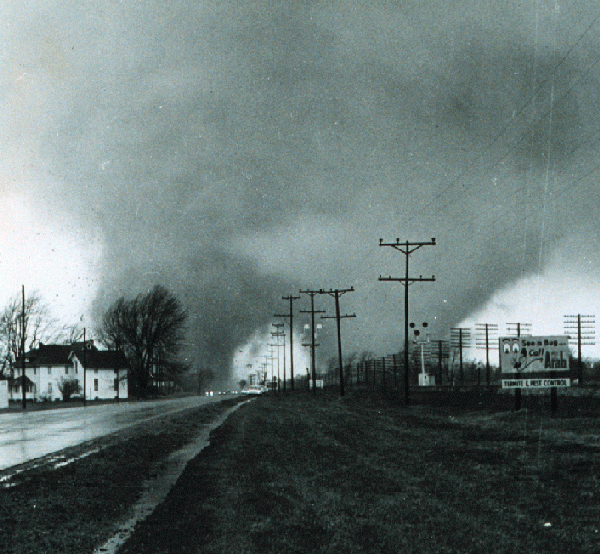
    Today is the 50th anniversary of perhaps the worst tornado outbreak that, unlike nearly all of them, involved Wisconsin.

    Weather forecasting was considerably different in those days. The first reported tornado, near Tipton, Iowa, was reported not by the National Weather Service, nor by law enforcement, but by a radio reporter, whose station, WMT in Cedar Rapids, had a surplus aircraft radar it used for weather coverage. That gave WMT something that the NWS office in Waterloo did not have.

    There were no tornado watches that day. That’s because tornado watches didn’t exist. To summarize what is found in more detail in Mike Smith’s excellent Warnings: Between the end of World War II and 1950, what then was called the U.S. Weather Bureau wouldn’t even use the word “tornado” because its “leadership” felt people would panic if they heard the T-word. The NWS started issuing what it called “tornado forecasts” in 1950, but the Federal Communications Commission banned their on-air use for four years for the same reasons. (For those who think government incompetence is a recent development: It’s not.) The Weather Bureau issued “severe storms forecasts” that were probably too large in land area and too unspecific to be useful.

    Not every NWS office had radar, and those that did were using surplus World War II plane radar units. Warnings (known then as a “tornado alert”) that were issued were sent to radio and TV stations (all of which were staffed by the weekend people, at least until the seriousness of the situation became apparent) by teletype. You can type faster than teletype speed. That, jammed telephone lines in (reporting the 47 tornadoes, most likely more than once each) and out (warning about said tornadoes), the fact a lot of people were at churches (including one where the tornado was recorded) because it was Palm Sunday or outside because it was a warm day (which means they weren’t at home or work where they could get warnings, such as they were, from radio or TV), and public unfamiliarity with the terms used are blamed for the high number of deaths. (The South Bend Weather Bureau office had so many tornado reports that it issued a tornado warning for every county in its forecast area.)

    There were five tornadoes in Wisconsin that day. The strongest, an F2 that went from between Lake Mills and Jefferson to Watertown, killed three people (in two cars that went flying in the wind on what was U.S. 16, now Wisconsin 16) and injured 28. The longest, an F1 that started at the Illinois state line and went through Monroe and Evansville around 2 p.m, injured 40 people. The three other tornadoes — from Williams Bay into Lake Geneva, one in Crawford County, and another in Walworth County — resulted in no injuries.

    The unfortunate reality of disasters is they instruct what to do and not do.

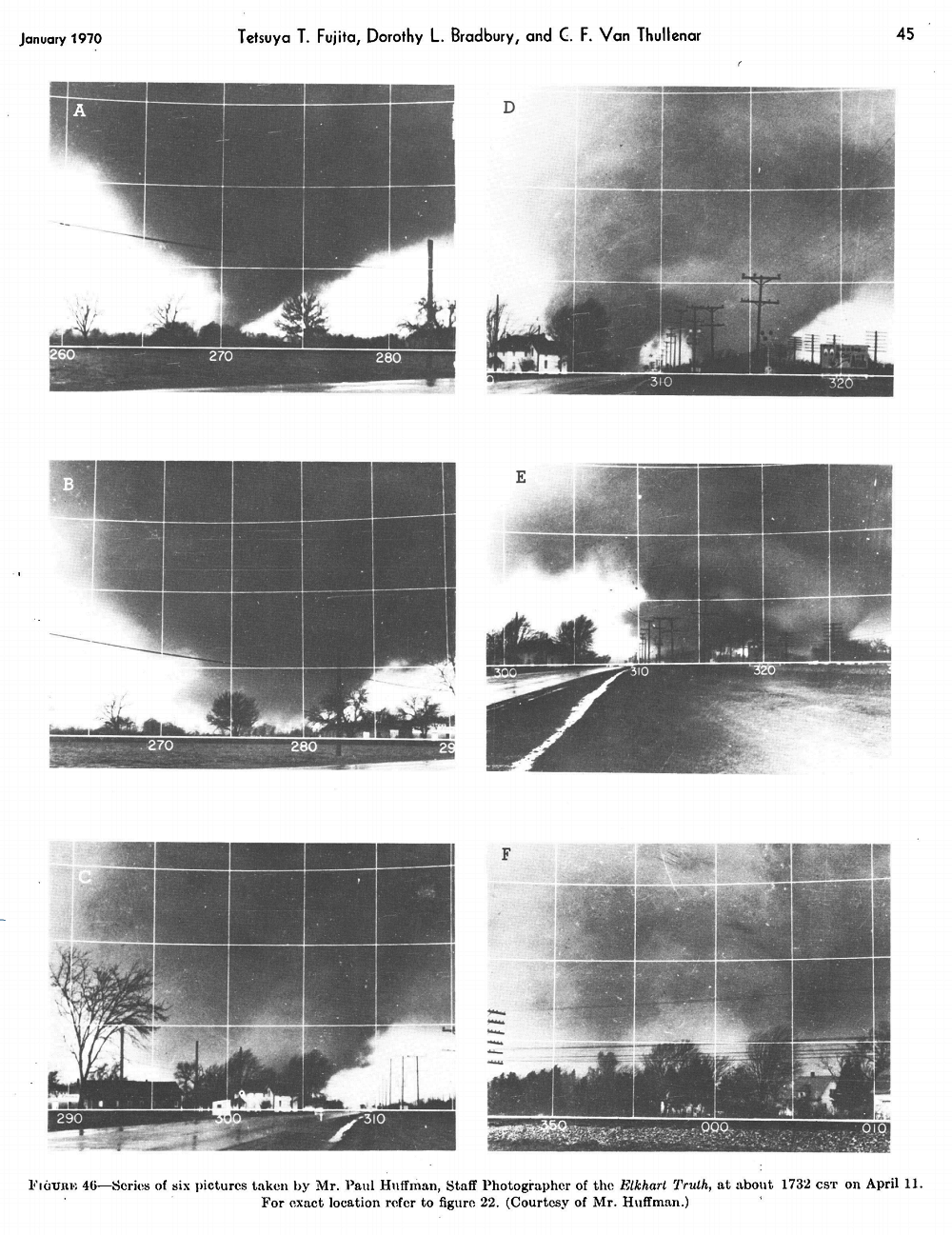
    Elkhart (Ind.) Truth photographer Paul Huffman shot this and the previous photos of this multiple-vortex tornado near Dunlap, Ind. This and another tornado within an hour in the same place caused 50 of the 271 deaths that day.

    The difficulty of getting out warnings led to improved communications among NWS offices and, within a few years, the development of NOAA Weather Radio. (That in turn got a big push after the April 3, 1974 outbreak.) Study of damage showed how tornadoes cause damage, as well as the best and worst places to be if a tornado finds you.


    Share this on …

    • Share on X (Opens in new window) X
    • Share on Facebook (Opens in new window) Facebook
    • Share on LinkedIn (Opens in new window) LinkedIn
    • Email a link to a friend (Opens in new window) Email
    • Print (Opens in new window) Print
    Like Loading…
    No comments on 50 years ago today
  • Presty the DJ for April 11

    April 11, 2015
    Music

    The number one single today in 1954:

    Today in 1964, the Billboard Hot 100 could have been called the Beatles 14 and the non-Beatles 86, topped by …

    The number one single today in 1970:

    (more…)

    Share this on …

    • Share on X (Opens in new window) X
    • Share on Facebook (Opens in new window) Facebook
    • Share on LinkedIn (Opens in new window) LinkedIn
    • Email a link to a friend (Opens in new window) Email
    • Print (Opens in new window) Print
    Like Loading…
    No comments on Presty the DJ for April 11
  • The Terminating Two

    April 10, 2015
    Badgers

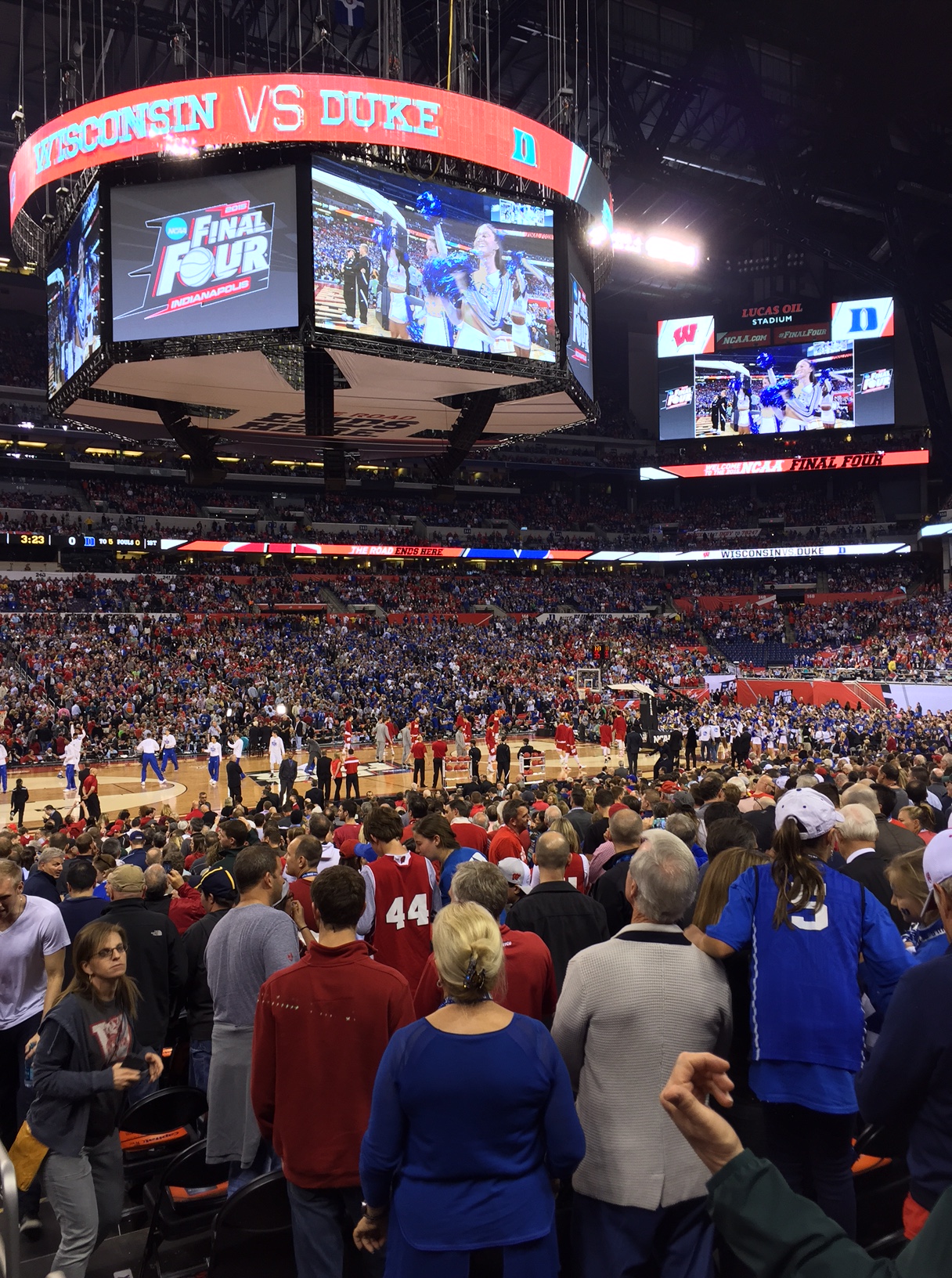
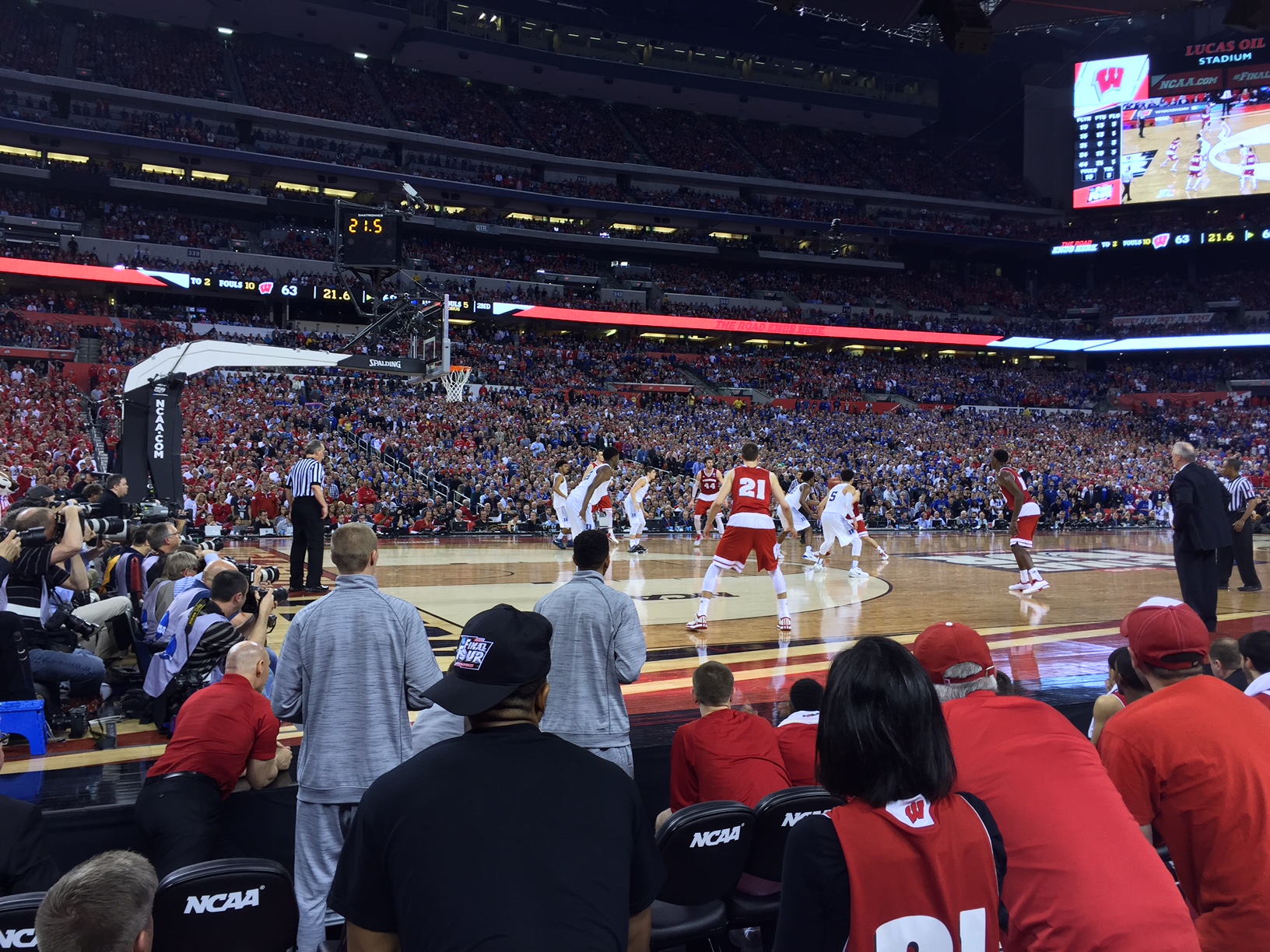
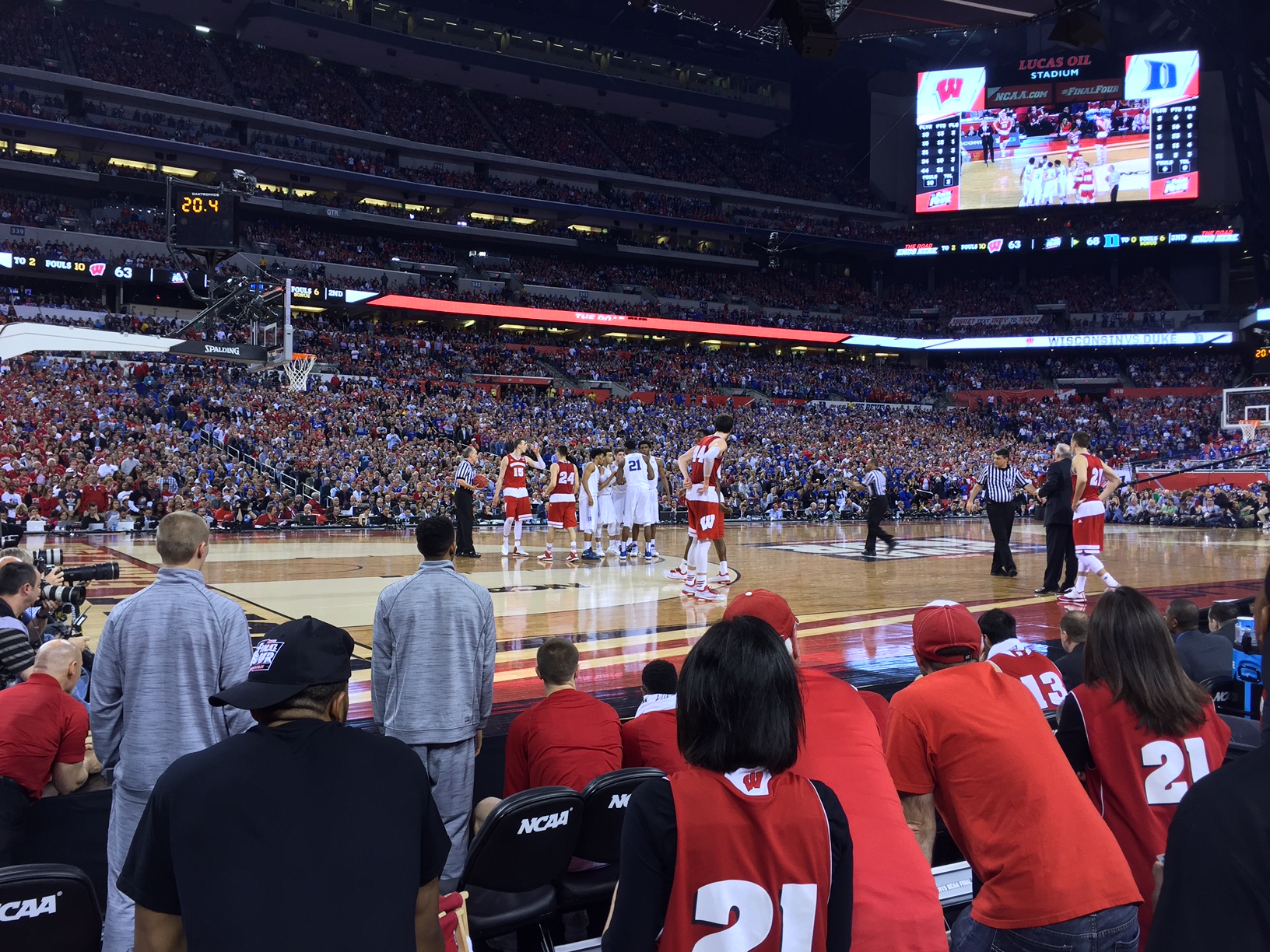
    The Presteblog staff photographer, who doubles as my aunt, got these photos from Lucas Oil Stadium in Indianapolis Monday night:

    IMG_0331
    They are from Wisconsin’s first NCAA men’s basketball championship game appearance since 1941.
    IMG_0335
    Wisconsin lost 68–63, two days after ending Kentucky’s undefeated season, ending the careers of seniors who went into Wisconsin unheralded and left having won Big Ten regular-season and tournament titles, back-to-back Final Four berths, UW’s first number one NCAA seed, and a championship game appearance.
    IMG_0337
    The painful part is that there is no guarantee that Wisconsin will get back to the Final Four. Certainly not next year, with the irreplaceable Frank Kaminsky graduating and Sam Dekker possibly departing too. Coach Bo Ryan has coached longer than he will coach, so the last, best chance for a national championship in my lifetime more likely than not ended at the buzzer Monday night.
    IMG_0338
    However, UW lost to Duke, which if you’re not a Dook-hater is certainly not a terrible program to lose to. Sports Illustrated has quite a story this week on all the things coach Mike Krzyzewski had to do to get this title. And there should be great satisfaction in defeating Kentucky, which was so flummoxed by Wisconsin’s play that coach John Calipari was yelling at his assistants “What do we do?!” toward the end.
    IMG_0339
    And of course, for those of us who grew up with a .500 season being a highlight, this is still somewhat surreal. Badger fans of today really don’t know how good this is, unless you remember how bad it used to be.


    Share this on …

    • Share on X (Opens in new window) X
    • Share on Facebook (Opens in new window) Facebook
    • Share on LinkedIn (Opens in new window) LinkedIn
    • Email a link to a friend (Opens in new window) Email
    • Print (Opens in new window) Print
    Like Loading…
    No comments on The Terminating Two
  • Presty the DJ for April 10

    April 10, 2015
    Music

    The number one single today in 1965:

    The number one album today in 1976 was Peter Frampton’s “Frampton Comes Alive,” the best selling live album in rock music history:

    The number one album today in 1993 was Depeche Mode’s “Songs of Faith and Devotion”:

    Birthdays start with one-hit wonder Sheb Wooley:

    (more…)

    Share this on …

    • Share on X (Opens in new window) X
    • Share on Facebook (Opens in new window) Facebook
    • Share on LinkedIn (Opens in new window) LinkedIn
    • Email a link to a friend (Opens in new window) Email
    • Print (Opens in new window) Print
    Like Loading…
    No comments on Presty the DJ for April 10
  • The GOP, the press, and two options

    April 9, 2015
    media, US politics

    Option 1 in the continuing battle of the Republican Party and the media is the approach of Rich Galen:

    Rand Paul’s official campaign began with a speech on Tuesday.

    By yesterday he had been in arguments with two reporters.

    First he went at it with the Today show’s Savannah Guthrie. Guthrie, according to National Journal.

    “You once said Iran was not a threat,” Guthrie said to Paul. “Now you say it is. You once proposed ending foreign aid to Israel. You now support it, at least for the time being. And you once offered to drastically cut defense spending but now you want to increase it by 60 percent.”

    At that time Paul tried to interrupt and said,

    “Before we go through a litany of things you say I’ve changed on, why don’t you ask me a question: ‘Have I changed my opinion?’”

    After Guthrie tried again, Paul said:

    “Listen, you’ve editorialized. Let me answer a question. You ask a question, and you say, ‘Have your views changed?’ instead of editorializing and saying my views have changed.”

    That is a difference without a distinction, if you ask me, which Rand Paul did not.

    Later in the day, he got cranky again, this time with an AP reporter who asked him about his position(s) on abortion.

    According to The Hill newspaper, “AP reporter Philip Elliott’s interview with Paul became heated after Elliott pressed the presidential candidate to say whether victims of rape should be able to get abortions.”

    Paul told Elliott:

    “I gave you about a five-minute answer. Put in my five-minute answer … The thing is about abortion – and about a lot of things – is that I think people get tied up in all these details of, sort of, you’re this or this or that, or you’re hard and fast (on) one thing or the other.”Not bad for the first 24 hours of the campaign.

    Some Republicans have made a living arguing with reporters. During the 2012 cycle, Newt Gingrich would wait for a moderator to ask a “gotcha” question so he could launch into a tirade.

    The GOP audiences stomped and cheered but Rand Paul is no Newt Gingrich when it comes to baiting reporters.

    There used to be a saying in politics, “Never argue with the guy who buys his ink by the barrel.”

    Given the number of on-line outlets, former Governor Tom Ridge has updated that to:

    “Never argue with the guy who buys his bandwidth by the gigabyte.”My background is as a press secretary. When I was doing that I wasn’t the “Communications Director” with a staff of thousands. When I was Dan Quayle’s Senate press secretary I was it. Same thing when I was press secretary to Newt with he was Republican Whip. My successors were also one-man shows.

    Having been press secretary to Quayle and Gingrich and having run GOPAC you might think that reporters would have crossed the street rather than have to say “hello” to me in Washington.

    That has never been the case because I have lived by three rules:

    First, “Don’t sell out your boss to curry favor with the press.” They will treat you like cops treat a stool pigeon. They’ll use you until you have nothing for them, then they’ll lose your number.

    Second, “You don’t have to know everything about everything.” Some of the smartest responses I’ve ever given to reporters have been the ones where I said “I don’t know,” rather than trying to pretend I was on the inside of everything.

    Third, “Don’t lie.” You don’t have to tell a reporter everything you know; and you can be slippery with an answer, but if you lie you will, sooner or later, get caught and your credibility will be shot.

    Part of being a good press secretary is to brief your boss on what questions might be asked, and how you recommend they be answered.

    Even the best press secretary won’t catch them all, but by having your boss prepared, over time, reporters will come to appreciate the effort.

    To battle reporters all day every day is exhausting for the candidate and for the staff and, because they buy their bandwidth by the gigabyte, if they can’t make your boss look bad in an article, they can do it in a blog. If not in a blog then in a Tweet.

    Dealing with reporters is just another skill candidates have to develop.

    Approach number two comes from Jon Gabriel:

    This new generation of GOP hopefuls understands what only Newt Gingrich knew in 2012. If you want a chance at the White House, you need to beat the other candidates and you need to beat the press.

    Mitt Romney, decent fellow that he is, tacitly accepted the press’ claims of objectivity, even if he didn’t believe it in his heart. Romney grinned and nodded at reporters from CNN, ABC, CBS and NBC, even though their initials could have been DNC.

    Right-leaning partisans watched moderator George Stephanopoulos concoct the fictional “War on Women” and moderator Candy Crowley actively support Obama during live debates. Many of us spent 2012 yelling at our TVs and laptop screens, “the press isn’t neutral. They’re on the other side!”

    Coming of age during the Obama years, the 2016 candidates know all too well that the press is as much of an opponent as the rival campaigns. Ted Cruz, Rand Paul, and Scott Walker all know that the mainstream media despises them. This new breed acts accordingly by questioning the press and their flawed premises.

    After Planned Parenthood spent all yesterday attacking Sen. Paul, two reporters coincidentally asked him if he would accept any exemptions on abortion. Come on, senator: is there no limit to your cruel oppression of women? Paul knew the fix was in and responded accordingly.

    “Here’s the deal — we always seem to have the debate waaaaay over here on what are the exact details of exemptions, or when it starts,” Paul said, moving his hand to one side. “Why don’t we ask the DNC: Is it okay to kill a seven-pound baby in the uterus? You go back and you ask Debbie Wasserman-Schultz if she’s okay with killing a seven-pound baby that is not born yet. Ask her when life begins, and you ask Debbie when it’s okay to protect life. When you get an answer from Debbie, get back to me.”

    Paul knows that Democrats rarely get questions about whether they support partial-birth abortion, if gender selection is acceptable, or if parental consent should be required. The press naturally doesn’t want to put their candidates on the hot seat, so why ask them hot-button questions? Instead, just let the Republicans sweat and damage their chances among low-info voters. To his credit, Paul didn’t play along with this old game; he questioned the premise and threw it back in the reporters’ faces.

    Instead of waiting for her newsroom allies, Wasserman-Schultz released a huffy statement. “Here’s an answer,” the DNC Chair wrote. “I support letting women and their doctors make this decision without government getting involved. Period. End of story.”

    She forgot to mention that Obamacare ensures government is intimately involved with this life-or-death decision, but I appreciate the clarity. To use Paul’s phrasing, Debbie Wasserman-Schultz and the Democratic National Committee are okay with killing a seven-pound baby in the uterus. She doesn’t care when life begins and has no intention of protecting the life of any baby in the womb, even if it’s a minute from being delivered. The baby can be killed anytime and for any reason. Period. End of story.

    I hope the other GOP candidates are taking notes. They need to stop trying to placate the reporters who hate them and go on offense for a change. Like Gingrich and Paul, use a little verbal jujitsu to trip up the Democrat-Media Complex. Beltway liberals are wildly out-of-touch with the average voter’s values and concerns. Use that to our advantage.

    In two minutes, I came up with several questions to ask of Hillary Clinton and her supporters. It’s only fair that moderate voters know her answers:

    • “Do you believe that Officer Darren Wilson racially profiled Mike Brown? Explain.”
    • “Will you have a gender-neutral bathroom in the White House? Why isn’t there one now?”
    • “What made you finally agree with Dick Cheney that same-sex marriage should be legalized?”
    • “How much should taxes be increased to combat climate change? Did your record-setting number of State Department trips contribute to the problem?”
    • “Should we increase immigration while African-American unemployment is at record highs?”

    Have at it, press corps; prove your neutrality. And Republicans, prove that you’ll be able to handle the hostile press if and when you get to the Oval Office.

    One of the comments on Gabriel’s piece mentions option 2.5:

    But when dealing with adversarial media, you should never agree to an interview without your own camera recording the whole thing and reserving the right to publish it in its entirety.

    I first heard of this strategy on the Wall Street Journal op-ed page in the 1980s and used it in my own take-down of one of their attack reporters in a front page hit piece in 1992.  (Keep hitting “Next” for the transcript and a link to the audio recording.)

    It doesn’t reach the low-information people, but forever discredits the “attack reporter” and the outlet which employs him or her.  Further, it alerts others potential victims to do the same.

    It is also intensely entertaining.

    I’d like to see a candidate, ideally all of them, make regular postings on YouTube with “What I said” versus “What you saw”.

    Of course, it’s never been clear to me that a candidate’s going to war with the news media helps that candidate’s standing with undecided, independent voters.

    Share this on …

    • Share on X (Opens in new window) X
    • Share on Facebook (Opens in new window) Facebook
    • Share on LinkedIn (Opens in new window) LinkedIn
    • Email a link to a friend (Opens in new window) Email
    • Print (Opens in new window) Print
    Like Loading…
    No comments on The GOP, the press, and two options
Previous Page
1 … 734 735 736 737 738 … 1,057
Next Page

Website Powered by WordPress.com.

Steve Prestegard.com: The Presteblog

The thoughts of a journalist/libertarian–conservative/Christian husband, father, Eagle Scout and aficionado of obscure rock music. Thoughts herein are only the author’s and not necessarily the opinions of his family, friends, neighbors, church members or past, present or future employers.

  • Steve
    • About, or, Who is this man?
    • Facebook
    • Twitter
    • Adventures in ruralu0026nbsp;inkBack in June 2009, I was driving somewhere through a rural area. And for some reason, I had a flashback to two experiences in my career about that time of year many years ago. In 1988, eight days after graduating from the University of Wisconsin, I started work at the Grant County Herald Independent in Lancaster as a — well, the — reporter. Four years after that, on my 27th birthday, I purchased, with a business partner, the Tri-County Press in Cuba City, my first business venture. Both were experiences about which Wisconsin author Michael Perry might write. I thought about all this after reading a novel, The Deadline, written by a former newspaper editor and publisher. (Now who would write a novel about a weekly newspaper?) As a former newspaper owner, I picked at some of it — why finance a newspaper purchase through the bank if the seller is willing to finance it? Because the mean bank lender is a plot point! — and it is much more interesting than reality, but it is very well written, with a nicely twisting plot, and quite entertaining, again more so than reality. There is something about that first job out of college that makes you remember it perhaps more…
    • Adventures in radioI’ve been in the full-time work world half my life. For that same amount of time I’ve been broadcasting sports as a side interest, something I had wanted to since I started listening to games on radio and watching on TV, and then actually attending games. If you ask someone who’s worked in radio for some time about the late ’70s TV series “WKRP in Cincinnati,” most of them will tell you that, if anything, the series understated how wacky working in radio can be. Perhaps the funniest episode in the history of TV is the “WKRP” episode, based on a true story, about the fictional radio station’s Thanksgiving promotion — throwing live turkeys out of a helicopter under the mistaken belief that, in the words of WKRP owner Arthur Carlson, “As God is my witness, I thought turkeys could fly.” [youtube=http://www.youtube.com/watch?v=ST01bZJPuE0] I’ve never been involved in anything like that. I have announced games from the roofs of press boxes (once on a nice day, and once in 50-mph winds), from a Mississippi River bluff (more on that later), and from the front row of the second balcony of the University of Wisconsin Fieldhouse (great view, but not a place to go if…
    • “Good morning/afternoon/evening, ________ fans …”
    • My biggest storyEarlier this week, while looking for something else, I came upon some of my own work. (I’m going to write a blog someday called “Things I Found While Looking for Something Else.” This is not that blog.) The Grant County Sheriff’s Department, in the county where I used to live, has a tribute page to the two officers in county history who died in the line of duty. One is William Loud, a deputy marshal in Cassville, shot to death by two bank robbers in 1912. The other is Tom Reuter, a Grant County deputy sheriff who was shot to death at the end of his 4 p.m.-to-midnight shift March 18, 1990. Gregory Coulthard, then a 19-year-old farmhand, was convicted of first-degree intentional homicide and is serving a life sentence, with his first eligibility for parole on March 18, 2015, just 3½ years from now. I’ve written a lot over the years. I think this, from my first two years in the full-time journalism world, will go down as the story I remember the most. For journalists, big stories contain a paradox, which was pointed out in CBS-TV’s interview of Andy Rooney on his last “60 Minutes” Sunday. Morley Safer said something along the line…
  • Food and drink
    • The Roesch/Prestegard familyu0026nbsp;cookbookFrom the family cookbook(s) All the families I’m associated with love to eat, so it’s a good thing we enjoy cooking. The first out-of-my-house food memory I have is of my grandmother’s cooking for Christmas or other family occasions. According to my mother, my grandmother had a baked beans recipe that she would make for my mother. Unfortunately, the recipe seems to have  disappeared. Also unfortunately, my early days as a picky, though voluminous, eater meant I missed a lot of those recipes made from such wholesome ingredients as lard and meat fat. I particularly remember a couple of meals that involve my family. The day of Super Bowl XXXI, my parents, my brother, my aunt and uncle and a group of their friends got together to share lots of food and cheer on the Packers to their first NFL title in 29 years. (After which Jannan and I drove to Lambeau Field in the snow,  but that’s another story.) Then, on Dec. 31, 1999, my parents, my brother, my aunt and uncle and Jannan and I (along with Michael in utero) had a one-course-per-hour meal to appropriately end years beginning with the number 1. Unfortunately I can’t remember what we…
    • SkålI was the editor of Marketplace Magazine for 10 years. If I had to point to one thing that demonstrates improved quality of life since I came to Northeast Wisconsin in 1994, it would be … … the growth of breweries and  wineries in Northeast Wisconsin. The former of those two facts makes sense, given our heritage as a brewing state. The latter is less self-evident, since no one thinks of Wisconsin as having a good grape-growing climate. Some snobs claim that apple or cherry wines aren’t really wines at all. But one of the great facets of free enterprise is the opportunity to make your own choice of what food and drink to drink. (At least for now, though some wish to restrict our food and drink choices.) Wisconsin’s historically predominant ethnic group (and our family’s) is German. Our German ancestors did unfortunately bring large government and high taxes with them, but they also brought beer. Europeans brought wine with them, since they came from countries with poor-quality drinking water. Within 50 years of a wave of mid-19th-century German immigration, brewing had become the fifth largest industry in the U.S., according to Maureen Ogle, author of Ambitious Brew: The Story of American Beer. Beer and wine have…
  • Wheels
    • America’s sports carMy birthday in June dawned without a Chevrolet Corvette in front of my house. (The Corvette at the top of the page was featured at the 2007 Greater Milwaukee Auto Show. The copilot is my oldest son, Michael.) Which isn’t surprising. I have three young children, and I have a house with a one-car garage. (Then again, this would be more practical, though a blatant pluck-your-eyes-out violation of the Corvette ethos. Of course, so was this.) The reality is that I’m likely to be able to own a Corvette only if I get a visit from the Corvette Fairy, whose office is next door to the Easter Bunny. (I hope this isn’t foreshadowing: When I interviewed Dave Richter of Valley Corvette for a car enthusiast story in the late great Marketplace Magazine, he said that the most popular Corvette in most fans’ minds was a Corvette built during their days in high school. This would be a problem for me in that I graduated from high school in 1983, when no Corvette was built.) The Corvette is one of those cars whose existence may be difficult to understand within General Motors Corp. The Corvette is what is known as a “halo car,” a car that drives people into showrooms, even if…
    • Barges on fouru0026nbsp;wheelsI originally wrote this in September 2008.  At the Fox Cities Business Expo Tuesday, a Smart car was displayed at the United Way Fox Cities booth. I reported that I once owned a car into which trunk, I believe, the Smart could be placed, with the trunk lid shut. This is said car — a 1975 Chevrolet Caprice coupe (ours was dark red), whose doors are, I believe, longer than the entire Smart. The Caprice, built down Interstate 90 from us Madisonians in Janesville (a neighbor of ours who worked at the plant probably helped put it together) was the flagship of Chevy’s full-size fleet (which included the stripper Bel Air and middle-of-the-road Impala), featuring popular-for-the-time vinyl roofs, better sound insulation, an upgraded cloth interior, rear fender skirts and fancy Caprice badges. The Caprice was 18 feet 1 inch long and weighed 4,300 pounds. For comparison: The midsize Chevrolet of the ear was the Malibu, which was the same approximate size as the Caprice after its 1977 downsizing. The compact Chevrolet of the era was the Nova, which was 200 inches long — four inches longer than a current Cadillac STS. Wikipedia’s entry on the Caprice has this amusing sentence: “As fuel economy became a bigger priority among Americans…
    • Behind the wheel
    • Collecting only dust or rust
    • Coooooooooooupe!
    • Corvettes on the screen
    • The garage of misfit cars
    • 100 years (and one day) of our Chevrolets
    • They built Excitement, sort of, once in a while
    • A wagon by any otheru0026nbsp;nameFirst written in 2008. You will see more don’t-call-them-station-wagons as you drive today. Readers around my age have probably had some experience with a vehicle increasingly rare on the road — the station wagon. If you were a Boy Scout or Girl Scout, or were a member of some kind of youth athletic team, or had a large dog, or had relatives approximately your age, or had friends who needed to be transported somewhere, or had parents who occasionally had to haul (either in the back or in a trailer) more than what could be fit inside a car trunk, you (or, actually, your parents) were the target demographic for the station wagon. “Station wagons came to be like covered wagons — so much family activity happened in those cars,” said Tim Cleary, president of the American Station Wagon Owners Association, in Country Living magazine. Wagons “were used for everything from daily runs to the grocery store to long summer driving trips, and while many men and women might have wanted a fancier or sportier car, a station wagon was something they knew they needed for the family.” The “station wagon” originally was a vehicle with a covered seating area to take people between train stations…
    • Wheels on theu0026nbsp;screenBetween my former and current blogs, I wrote a lot about automobiles and TV and movies. Think of this post as killing two birds (Thunderbirds? Firebirds? Skylarks?) with one stone. Most movies and TV series view cars the same way most people view cars — as A-to-B transportation. (That’s not counting the movies or series where the car is the plot, like the haunted “Christine” or “Knight Rider” or the “Back to the Future” movies.) The philosophy here, of course, is that cars are not merely A-to-B transportation. Which disqualifies most police shows from what you’re about to read, even though I’ve watched more police video than anything else, because police cars are plain Jane vehicles. The highlight in a sense is in the beginning: The car chase in my favorite movie, “Bullitt,” featuring Steve McQueen’s 1968 Ford Mustang against the bad guys’ 1968 Dodge Charger: [youtube=http://www.youtube.com/watch?v=GMc2RdFuOxIu0026amp;fmt=18] One year before that (but I didn’t see this until we got Telemundo on cable a couple of years ago) was a movie called “Operación 67,” featuring (I kid you not) a masked professional wrestler, his unmasked sidekick, and some sort of secret agent plot. (Since I don’t know Spanish and it’s not…
    • While riding in my Cadillac …
  • Entertainments
    • Brass rocksThose who read my former blog last year at this time, or have read this blog over the past months, know that I am a big fan of the rock group Chicago. (Back when they were a rock group and not a singer of sappy ballads, that is.) Since rock music began from elements of country music, jazz and the blues, brass rock would seem a natural subgenre of rock music. A lot of ’50s musical acts had saxophone players, and some played with full orchestras … [youtube=http://www.youtube.com/watch?v=9CPS-WuUKUE] … but it wasn’t until the more-or-less simultaneous appearances of Chicago and Blood Sweat u0026amp; Tears on the musical scene (both groups formed in 1967, both had their first charting singles in 1969, and they had the same producer) that the usual guitar/bass/keyboard/drum grouping was augmented by one or more trumpets, a sax player and a trombone player. While Chicago is my favorite group (but you knew that already), the first brass rock song I remember hearing was BSu0026amp;T’s “Spinning Wheel” — not in its original form, but on “Sesame Street,” accompanied by, yes, a giant spinning wheel. [youtube=http://www.youtube.com/watch?v=qi9sLkyhhlE] [youtube=http://www.youtube.com/watch?v=OxWSOuNsN20] [youtube=http://www.youtube.com/watch?v=U9U34uPjz-g] I remember liking Chicago’s “Just You ‘n Me” when it was released as a single, and…
    • Drive and Eat au0026nbsp;RockThe first UW home football game of each season also is the opener for the University of Wisconsin Marching Band, the world’s finest college marching band. (How the UW Band has not gotten the Sudler Trophy, which is to honor the country’s premier college marching bands, is beyond my comprehension.) I know this because I am an alumnus of the UW Band. I played five years (in the last rank of the band, Rank 25, motto: “Where Men Are Tall and Run-On Is Short”), marching in 39 football games at Camp Randall Stadium, the Hubert H. Humphrey Metrodome in Minneapolis, Michigan Stadium in Ann Arbor, Memorial Stadium at the University of Illinois (worst artificial turf I had ever seen), the University of Nevada–Las Vegas’ Sam Boyd Silver Bowl, the former Dyche Stadium at Northwestern University, five high school fields and, in my one bowl game, Legion Field in Birmingham, Ala., site of the 1984 Hall of Fame Bowl. The UW Band was, without question, the most memorable experience of my college days, and one of the most meaningful experiences of my lifetime. It was the most physical experience of my lifetime, to be sure. Fifteen minutes into my first Registration…
    • Keep on rockin’ in the freeu0026nbsp;worldOne of my first ambitions in communications was to be a radio disc jockey, and to possibly reach the level of the greats I used to listen to from WLS radio in Chicago, which used to be one of the great 50,000-watt AM rock stations of the country, back when they still existed. (Those who are aficionados of that time in music and radio history enjoyed a trip to that wayback machine when WLS a Memorial Day Big 89 Rewind, excerpts of which can be found on their Web site.) My vision was to be WLS’ afternoon DJ, playing the best in rock music between 2 and 6, which meant I wouldn’t have to get up before the crack of dawn to do the morning show, yet have my nights free to do whatever glamorous things big-city DJs did. Then I learned about the realities of radio — low pay, long hours, zero job security — and though I have dabbled in radio sports, I’ve pretty much cured myself of the idea of working in radio, even if, to quote WAPL’s Len Nelson, “You come to work every day just like everybody else does, but we’re playing rock ’n’ roll songs, we’re cuttin’ up.…
    • Monday on the flight line, not Saturday in the park
    • Music to drive by
    • The rock ofu0026nbsp;WisconsinWikipedia begins its item “Music of Wisconsin” thusly: Wisconsin was settled largely by European immigrants in the late 19th century. This immigration led to the popularization of galops, schottisches, waltzes, and, especially, polkas. [youtube=http://www.youtube.com/watch?v=yl7wCczgNUc] So when I first sought to write a blog piece about rock musicians from Wisconsin, that seemed like a forlorn venture. Turned out it wasn’t, because when I first wrote about rock musicians from Wisconsin, so many of them that I hadn’t mentioned came up in the first few days that I had to write a second blog entry fixing the omissions of the first. This list is about rock music, so it will not include, for instance, Milwaukee native and Ripon College graduate Al Jarreau, who in addition to having recorded a boatload of music for the jazz and adult contemporary/easy listening fan, also recorded the theme music for the ’80s TV series “Moonlighting.” Nor will it include Milwaukee native Eric Benet, who was for a while known more for his former wife, Halle Berry, than for his music, which includes four number one singles on the Ru0026amp;B charts, “Spend My Life with You” with Tamia, “Hurricane,” “Pretty Baby” and “You’re the Only One.” Nor will it include Wisconsin’s sizable contributions to big…
    • Steve TV: All Steve, All the Time
    • “Super Steve, Man of Action!”
    • Too much TV
    • The worst music of allu0026nbsp;timeThe rock group Jefferson Airplane titled its first greatest-hits compilation “The Worst of Jefferson Airplane.” Rolling Stone magazine was not being ironic when it polled its readers to decide the 10 worst songs of the 1990s. I’m not sure I agree with all of Rolling Stone’s list, but that shouldn’t be surprising; such lists are meant for debate, after all. To determine the “worst,” songs appropriate for the “Vinyl from Hell” segment that used to be on a Madison FM rock station, requires some criteria, which does not include mere overexposure (for instance, “Macarena,” the video of which I find amusing since it looks like two bankers are singing it). Before we go on: Blog posts like this one require multimedia, so if you find a song you hate on this blog, I apologize. These are also songs that I almost never listen to because my sound system has a zero-tolerance policy — if I’m listening to the radio or a CD and I hear a song I don’t like, it’s, to quote Bad Company, gone gone gone. My blonde wife won’t be happy to read that one of her favorite ’90s songs, 4 Non Blondes’ “What’s Up,” starts the list. (However,…
    • “You have the right to remain silent …”
  • Madison
    • Blasts from the Madison media past
    • Blasts from my Madison past
    • Blasts from our Madison past
    • What’s the matter with Madison?
    • Wisconsin – Madison = ?
  • Sports
    • Athletic aesthetics, or “cardinal” vs. “Big Red”
    • Choose your own announcer
    • La Follette state 1982 (u0022It was 30 years ago todayu0022)
    • The North Dakota–Wisconsin Hockey Fight of 1982
    • Packers vs. Brewers
  • Hall of Fame
    • The case(s) against teacher unions
    • The Class of 1983
    • A hairy subject, or face the face
    • It’s worse than you think
    • It’s worse than you think, 2010–11 edition
    • My favorite interview subject of all time
    • Oh look! Rural people!
    • Prestegard for president!
    • Unions vs. the facts, or Hiding in plain sight
    • When rhetoric goes too far
Privacy & Cookies: This site uses cookies. By continuing to use this website, you agree to their use.
To find out more, including how to control cookies, see here: Cookie Policy
Loading Comments...
  • Subscribe Subscribed
    • Steve Prestegard.com: The Presteblog
    • Join 195 other subscribers
    • Already have a WordPress.com account? Log in now.
    • Steve Prestegard.com: The Presteblog
    • Subscribe Subscribed
    • Sign up
    • Log in
    • Report this content
    • View site in Reader
    • Manage subscriptions
    • Collapse this bar
%d