The number one album today in 1980 was Genesis’ “Duke”:
Today in 1985, more than 5,000 radio stations played this at 3:50 p.m. Greenwich Mean Time, which is 9:50 a.m. Central time (but Standard or Daylight?):
Not since the days of Stu Jackson, Michael Finley and Rashard Griffith have Wisconsin basketball teams been known for their offense.
Thanks, however, to defining offense and defense by ways other than the score, which reflects tempo almost as much as the ability to put the ball in the basket, the 2014-15 Badgers are believed by the stats types to be better on offense than defense.
Tonight’s national semifinal is a battle of the number one defense, Kentucky, and the number one offense, Wisconsin, in terms of efficiency. Matt Norlander asks:
Let’s get into this, because one of the big reasons this is among the most enticing and attractive Final Fours ever is this game — which has the elements for topping last weekend’s Kentucky-Notre Dame classic — and the diametric forces at work. UK-Wisconsin might end up among the best national semifinals in the history of the sport. It’s obvious why the Wildcats are the five-point favorites and rightfully being framed as presumed winners.
But they’re not likely winners. There are arguments to be had on both sides here. This undefeated Wildcats defense is going to be remembered for its length, size, speed and skyline-high fortification. It’s without debate among the most impressive defensive units in the past decade, if not the best. Kentucky’s 85.6 adjusted defensive efficiency mark on KenPom.com ties 2013 Wisconsin’s crew, of all teams, for second-best ever. A John Calipari team, coincidentally enough, has the best per-possession defensive rating in the KenPom era (i.e. since 2002): Memphis in 2008-09 posted an 85.1 DRtg.
“Having so many tall, athletic players, it definitely doesn’t make it easy,” Wisconsin’s Frank Kaminsky said. “At the same time we know that we’re going to be able to get some stuff just like they’re going to be able to get some stuff going on on offense. It’s going to be a battle, we know that. They have like seven guys over 6-10. … It’s going to be fun. I can’t wait. It’s not going to be easy to prepare because obviously there’s no scout team in the country that can replicate what they have on their team.”
But for as superb as UK is on defense, it’s now facing Wisconsin, which boasts far and away the best offense in modern college basketball history. In a sentence: the Badgers are better with the ball than Kentucky is without it.
“One of our biggest things in the Notre Dame game was giving up backdoors, easy baskets,” Cauley-Stein said. “They utilized that. They kind of pride themselves on, you know, exploiting people’s weakness and taking over from it. So that’s our biggest thing is not giving up easy baskets, not letting them play angles against us.”
If Notre Dame was a river for Kentucky to ford, Wisconsin is a white-capped rapid. The Badgers have an offensive rating of 127.5, meaning they are dousing foes at a blazing rate. UW’s scoring nearly 128 points per 100 possessions. Unheard of at the college level.
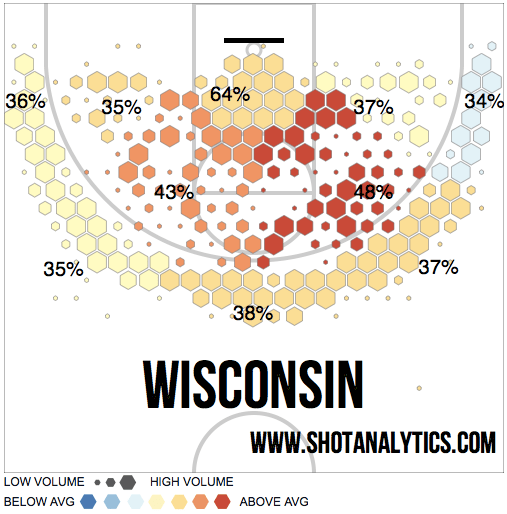
Here’s how their shot chart looks. This is every basket attempted this season:
That UW is flirting with 1.3 PPP on a per-game basis is flatly freaky. We should’ve expected a continuation from last season, when the Bucky O clocked out at 120.8, but it’s gotten ridiculous.
And the team’s efficiency keeps rising.
Since March began, Wisconsin’s offense has only gotten better — against better opponents in the biggest time of the season, mind you. …
That Sconnie embarrassed Arizona’s elite defense to the point of jumping its overall O rating almost two full points in the Elite Eight has to be one of the most impressive achievements any team’s had in the NCAA Tournament — ever.
While we don’t have data from prior teams/decades, it’s very possible no group has ever been this efficient on offense in the history of college hoops. It’s all the more likely when you consider the 3-point line didn’t come into play until the 1980s. This team has five guys averaging more than one 3-pointer made per game. …
Kentucky’s defensive assignments are going to be fascinating. Will Cauley-Stein match up on Kaminsky, and if so, who does Karl-Anthony Towns guard? And Trey Lyles? Expect shifts by the possession.
“I think with the guys that we have, we’re going to do a lot of switching anyway,” Cauley Stein said. “Not one person is going to be on that set player during the whole game. You know, everybody in practice has been guarding guards and bigs. We’re just kind of ready for everything.”
Additionally, this year’s Final Four is so intriguing because it’s got the headliner of undefeated Kentucky and that wowing defense — then you see Wisconsin, Duke at 119.8 points per 100 possessions, which is third in the country, and Kentucky with a 115.6 O rating, fifth-best in the sport this season. And then you factor in how Wisconsin doesn’t slice at itself. The team’s foul-per-game rate is 12.4, the lowest in the country, and its turnover percentage sits at 12.3 percent of possessions. That’s also the lowest in the country. It’s done this against the eighth-toughest schedule nationally.
Your offense gets much better the less you give the ball away. No one has mastered this like Wisconsin.
Through this lens, it’s a little surprising we haven’t seen more people make a bigger deal out of what UK’s dealing with. Especially when you factor in that Kentucky and Wisconsin played each other in last year’s Final Four, and that game was a classic.
“How much better he’s gotten over a two-year period, it’s almost scary,” Calipari said.
To ask or expect a rematch in the Final Four and for both teams to be putting up peerless numbers is a treat for fans and proof Calipari and Bo Ryan are all-time greats. It’s only fitting they’re both up for Naismith Hall of Fame nominations. (We’ll find out Monday morning if Calipari and/or Ryan earned enough votes for induction this year.)
Kentucky’s the one with the undefeated record, but as Calipari’s repeated often this month, it’s not perfect. His guys faced their best opponent of the season last weekend in Cleveland and they barely won. Notre Dame more than likely wins that game if it scores just one basket in the final two and a half minutes.
Wisconsin going two and a half minutes without a point would be Halley’s Comet-rare.
The question isn’t: How is Wisconsin going to be Kentucky?
The question is: How incredibly lucky are we to get a game of this caliber on the sport’s ultimate stage?
So what does that mean when the No. 1 defense in the country and the second-best defense of any team since 2002 (Kentucky) plays against the best offense, by a wide margin, in college basketball since 2002 (Wisconsin)? Do we have a cliche to easily solve this? Is there any precedent at all for excellence at these levels in direct competition?
That since 2002 was established because that’s when KenPom.com started tracking data in college basketball. Since then, the best offense in college basketball is this year’s Wisconsin team. The Badgers score 127.5 points per 100 possessions. The 2014 Michigan Wolverines (124.1) and 2005 Wake Forest Demon Deacons (124.0) are the only two teams to top 124 since 2002. This is a historic offense.
Kentucky’s defense hasn’t let it down yet. The Wildcats remained undefeated in the regional final because their defense found just enough to slow down Notre Dame — the second-best offensive team in the country — despite the Irish’s near-perfect plan to pull off the upset. The Wildcats’ 85.6 points allowed per 100 possessions is the best in college basketball this year, and the only team better since 2002 was John Calipari’s 2009 Memphis team. This is a historic defense.
The beauty of these two teams playing in the Final Four rather than the title game is that the two coaches will have been planning against each other for a full week in preparation for a direct battle between the nation’s best at each end of the floor. And both teams are great because of how well the coaches deploy their players.
I hesitate to call either Wisconsin’s offense or Kentucky’s defense art, because the most common reaction to watching either at its best is along the lines of, How did they do that?, and the term artistry implies that technical execution is invisible. Moments of artistry-relative-to-basketball pop in and out between strict sessions of regimented offense (in Wisconsin’s case) and defense (in Kentucky’s case).
For instance, the Wildcats: A defense as good as Kentucky’s has to be intensely structured. Calipari is a master of teaching defense on a short timetable. Whereas Jim Boeheim can allow a player to prosper for a few years and quietly master the intricacies of the 2-3 zone, Kentucky has four freshmen that each average at least 50 percent of Kentucky’s available team minutes.
Still, Kentucky’s defense is characterized by its understanding of Calipari’s defense and commitment to execution, paired with immense size and athletic ability used creatively to react to lapses (or perhaps even to proactively take more risks). …
Whereas Kentucky’s athleticism likely overshadows its defensive execution, Wisconsin is the other way around. The Badgers are clinicians. They perfectly mix patience and urgency, rarely taking shots too soon or not soon enough unless they are doing so with a specific end in mind. …
Ryan’s offense is so efficient because of the open looks it creates, but Ryan also allows his players the freedom to use their athleticism and attack the basket at will. ..
Both Dekker and Frank Kaminsky have such a handle on Ryan’s offense that reading ripples in opposing defenses and riffing off of them is a big part of why Wisconsin is so dangerous, and that both of them can move as well as they do enables Ryan to let them loose.
Predicting which will prevail — Wisconsin’s offense or Kentucky’s defense — isn’t the point of the build-up to Saturday. No, the point is embracing the talent and unity of both teams. Neither would be in the Final Four and the best in the country at what they do if it weren’t for the right mixture of talent, unity, coaching and a hundred other factors I nor most readers would ever come up with on our own. One team will win Saturday because the rules of basketball demand it, and the other team, whether it’s Kentucky or Wisconsin, should be remembered for its excellence rather than falling short against the team designed perfectly to stop it.
Well, my rule of postseason sports is that defense is more important than offense. And that’s why I am still picking Kentucky to win today. Sadly.
We begin this special national semifinal post with USA Today‘s attempt at race-baiting:
When the Final Four is played Saturday in Indianapolis, all five starters for Kentucky, Duke and Michigan State will be African American. Wisconsin’s starting lineup, by contrast, includes one African American, forward Nigel Hayes. (Traevon Jackson, who also is African American, was a starter this season before he missed two months with a broken foot.)
It’s a racial makeup that has been noticed, says Jordan Taylor, an African-American point guard who starred for the Badgers from 2008 to 2012. He plays for Hapoel Holon in the Israeli professional league and says he was needled by a teammate this week about Wisconsin’s chances against undefeated Kentucky.
“He was just saying we’ve got too many white guys,” Taylor says with a chuckle. “I still get kind of poked at, teased about it, because it always seems like there are about four white guys and a black point guard all the time (in Wisconsin’s starting lineup).”
Taylor and Kaminsky were among current and former players, former assistant coaches, authorities on the African-American experience at the University of Wisconsin and the state and others who spoke to USA TODAY Sports to answer: Why is the Badgers’ roster predominantly white?
The average Division I men’s basketball team this season includes nine African-American players and four white players, according to data provided by the NCAA. At Wisconsin, the roster includes five African Americans, 10 whites and one Native American.
“It’s an interesting question,” says Alando Tucker, an African American who was a forward for Wisconsin between 2002 and 2007 before playing three years in the NBA and later overseas. “It is surprising.”
What has become familiar is the Badgers’ success under coach Bo Ryan, whose teams have made the NCAA tournament in each of his 14 seasons, reached the Sweet 16 seven times and are in Final Four for the second year in a row.
“White, black, whatever,” says Jackson, a point guard for the Badgers. “We all worked hard, and Coach Ryan is a tough-nosed coach who gets the most out of you. We’re in back-to-back Final Fours, and we’re looking for more.”
USA TODAY
This year’s starting lineup is no aberration. When Wisconsin played Kentucky in the Final Four last year, it had one African American in the starting lineup. When the Badgers reached the Final Four under previous coach Dick Bennett in 2000 — in the school’s only other appearance since 1941 — it had one African-American starter.
A number of factors contribute to Wisconsin’s predominantly white teams, including: state and university demographics; coaching at the lower levels; and Ryan’s system, which features a methodical, half-court offense that is key to his success but according to players and coaches can make it a challenge to recruit top African-American players.
Ryan, through a Wisconsin spokesman, declined to comment.
“I think the misconception is that Bo just likes to recruit the big, white kids,” says Howard Moore, who was an assistant coach under Ryan from 2005 to 2010, played at Wisconsin from 1990 to 1995 and is African American. “Those (assistant coaches at Wisconsin) have done a great job of recruiting to Bo’s system and staying true to what Bo believes in and going and getting the kids that believe in what they do. That’s the key.”
THE SYSTEM
Statistics from this season show the essence of Ryan’s system: The Badgers ranked second in Division I in assist-to-turnover ratio, 12th in scoring defense and 17th in field goal shooting percentage.
For DeShawn Curtis, who offers private basketball lessons in the Milwaukee area and coaches on the AAU circuit, the numbers are further evidence that Ryan wants his recruits to have strong fundamentals. Curtis says that is not an emphasis on the AAU teams he has seen in the area, especially in the inner city of Milwaukee.
“They don’t teach their kids how to play basketball,” says Curtis, who has worked with Diamond Stone, a Milwaukee product and one of the nation’s top high school seniors. “The majority of the programs, it’s about, ‘We’ve got better athletes than you.’”
Top recruits — regardless of race — also tend to favor a uptempo style because they think it will help them get to the NBA, according to Curtis, other high school coaches and former Wisconsin players.
Taylor, who was an all-Big Ten Conference point guard for Wisconsin, says, “I think the style of play we have doesn’t appeal to the premier athlete.”
That’s what led Jerry Smith, a top-rated recruit from Milwaukee, to sign with Louisville in 2006, according to Smith’s high school coach, George Haas.
“Louisville, their push is, ‘We get you ready for the pros,’” Haas says. “For a lot of those kids, that’s the most important thing.”
Tucker, one of three players to be selected in the NBA draft during Ryan’s tenure at Wisconsin, says pro scouts complained about the Badgers’ style of play.
“It’s just hard to watch one of those (low-scoring) games,” Tucker says. “No one really wants to see a 55-50 game. They want want to see 80, 90 points scored.”
Yet Ryan’s style has helped elevate the program to among the elites, with the team being ranked in the Top 25 in 13 of his 14 seasons in Madison.
Wisconsin-Milwaukee coach Rob Jeter, a former assistant to Ryan, says there is a misconception about the Badgers’ game that dates to the 2000 Final Four. That’s where Wisconsin and its slowdown offense orchestrated by Ryan’s predecessor, Dick Bennett, managed 41 points in a loss to Michigan State.
Meanwhile, Ryan’s offense has opened up. This year the Badgers ranked fourth in scoring among the 14 teams in the Big Ten Conference at 72.4 points a game. And in its NCAA tournament victories, Wisconsin has averaged 80.5 points.
THE DEMOGRAPHICS
Numbers off the court might be contributing to the relative paucity of top African-American recruits at Wisconsin. African Americans represent 6.5% of Wisconsin’s population, about half the national percentage.
By far the highest concentration of African Americans in the state — about 240,000, almost 70% of the state’s black residents — live in Milwaukee. The city’s four-year graduation rate for black students in public high schools is 58%, among the lowest graduation rates in the nation’s urban cities, according to the Wisconsin and federal departments of education.
“We’ve got a lot of work to do on the ground level here as far as the quality of education and the coaches here preparing athletes before you get to high school,” Curtis says.
The problem is exacerbated at Wisconsin because of the school’s high academic standards, according to Curtis and high school coaches. In January, when Gary Andersen quit as Wisconsin’s football coach to take the same position at Oregon State, he cited Wisconsin’s admissions standards as motivation.
But even top African-American recruits from Wisconsin who are eligible out of high school elude Ryan. The latest disappointment was the loss of Stone, who had Wisconsin on his list of finalists but committed to Maryland, which has not made the Final Four since 2002.
Kevon Looney, a five-star recruit from Milwaukee who signed with UCLA coming out of high school in 2013, told the Milwaukee Journal-Sentinel that the lure of Southern California, UCLA’s campus, Bruins coach Steve Alford and the team’s style of play led to his decision.
J.P. Tokoto, a top-100 recruit who signed with North Carolina coming out of high school in 2012, said his decision came down to coaching style.
THE UNIVERSITY
The racial makeup of the student body at Wisconsin could be another underlying factor, says Ronald V. Myers Sr., founder of the University of Wisconsin’s African-American Alumni Association who remains active with the group.
African Americans comprise about 2.2% of the student body at Wisconsin — 956 of 43,193 students, according to the university. That percentage ranks last with Nebraska among the schools in the Big Ten, according to the U.S. Department of Education.
Myers, who was a Wisconsin undergrad and medical school student in the 1970s and ’80s, says the school’s history as an overwhelmingly white university means minority students “run into situations and circumstances where you face racism.”
“You also have situations where people will come and support you and go to bat for you,” Myers says. “But as an alumni, you’re not really that quick to tell a young man, ‘Hey, you’re a star player from Milwaukee, I enthusiastically push you to sign up for basketball at Wisconsin.’”
Craig Werner, chair of the school’s Afro-American studies program, says it has been difficult to attract African-American professors to his program. He notes he is one of the few white people in the country in charge of an Afro-American studies program.
Before an influx of African-American female professors that began in the 1980s, Werner says the low number of white professors in the Afro-American studies program was as visible as the number of white basketball players.
“Part of that is it was harder to recruit a first-rate black scholar to come to Madison,” he says. “They legitimately wanted to be somewhere where there is a large black professional class. It isn’t Madison.”
Taylor says the racial makeup of Wisconsin’s roster created an eclectic environment. As a freshman in 2008, Taylor says, he and an African-American teammate who supported then-Sen. Barack Obama for president engaged in good-natured banter with two white players who preferred Sen. John McCain.
“It was never anything that created dissension on our team, but we always had fun conversations,” he says. “Every Wisconsin team I played on from my freshman year to my senior year was like family.”
Gannett, USA Today’s owner, also owns the Green Bay Press–Gazette, Appleton Post~Crescent, Oshkosh Northwestern, Fond du Lac Reporter, Sheboygan Press, Manitowoc Herald Times Reporter, Wausau Daily Herald, Stevens Point Journal, Wisconsin Rapids Daily Tribune and Marshfield News Herald. Given that all of those newspapers run pages from the previous day’s USA Today (which makes it, yes, two-day-old news), I wonder how many of those will have the guts to run this story.
The C(r)apital Times did, but that’s no surprise, although it showed the (lack of) courage of its convictions by not allowing reader comments.
IF the Badgers win tonight and IF they win Monday night, it will be their first NCAA men’s basketball title … since 1941 …
Ask any college basketball fan about the championship legacies of Duke, Kentucky and Michigan State and the odds are good they’ll be able to rattle off many of those title-winning squads.
Ask any college basketball fan whether the fourth Final Four team — Wisconsin — has ever won an NCAA title and they’re likely to tell you the Badgers are still looking for their first crown.
Those people would be wrong.
Here’s an interesting piece of Final Four trivia you might be able to use to win some money this weekend:
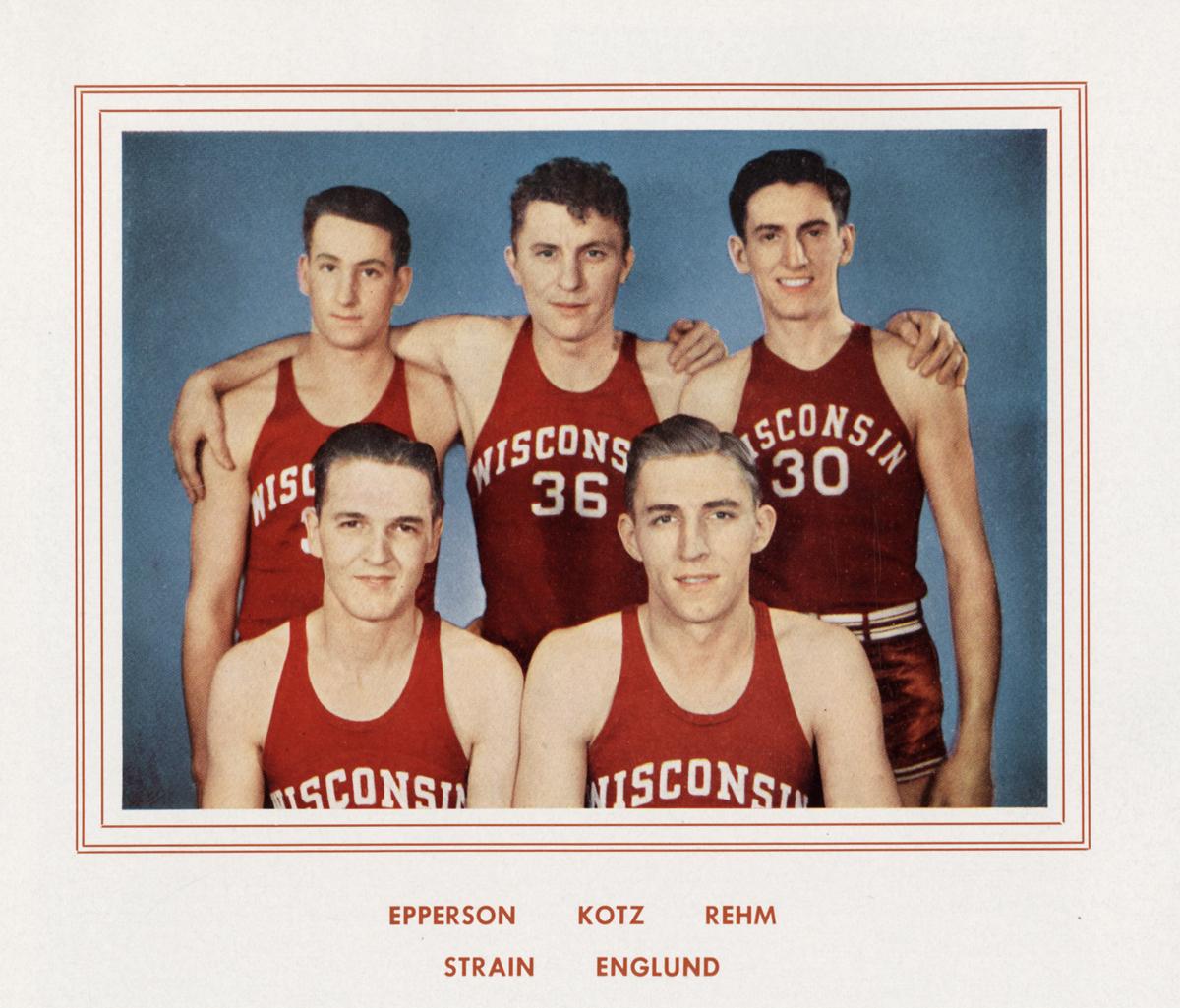
Wisconsin actually won a NCAA title in 1941, the first of any of these four schools to do so. That’s seven years before Kentucky’s first of eight titles, 38 years before Magic Johnson led Michigan State to the first of two and 50 years before Mike Krzyzewski and Duke finally got on the board.
The NCAA tournament was much different back in 1941, of course. Established only two years earlier, the tournament was only an eight-team affair and the terms “March Madness” and “Final Four” were still decades away. The United States’ entry into World War II, meanwhile, was just a few months off.
That year’s Badgers were nowhere near as heralded as this year’s top-seeded squad. As researched by the Capital Times, they had gone 5-15 the previous season and their record stood at 5-3 after losing their Big Ten opener — a 44-27 road loss to Minnesota that saw Wisconsin held to zero field goals in the second half.
Wisconsin, however, would not lose again, ripping off 12 straight wins under coach Harold “Bud” Foster to finish the regular season (including defending national champion Indiana) and enter an NCAA field consisting of Dartmouth, North Carolina, Pittsburgh, Arkansas, Creighton, Washington State and Wyoming.
The UW Field House in 1941 (UW Library)
After beating Dartmouth and Pittsburgh at the UW Field House in Madison (where tickets were priced at two levels — 50 and 75 cents), Wisconsin headed to Kansas City, Mo., to face Washington State at Municipal Auditorium. The Badgers were considered underdogs, just like this year’s team in Saturday night’s matchup against undefeated Kentucky.
“Reading the newspapers, it was as though we were only going to Kansas City for the train ride,” said UW star Gene Englund, who later played for the OshKosh All-Stars in the National Basketball League before a refereeing career in the Big Ten and NBA. “That riled me up.”
A column in the Kansas City Star the morning of the game was titled “Don’t Go Cougar-Hunting With a Badger” and Wisconsin apparently used it as bulletin-board material. The Badgers took home a 39-34 victory in front of 9,350 fans for the school’s first and only NCAA basketball title.
Washington State uploaded footage of the game to YouTube three years ago. Needless to say, the action looks just a tad different from today’s game.
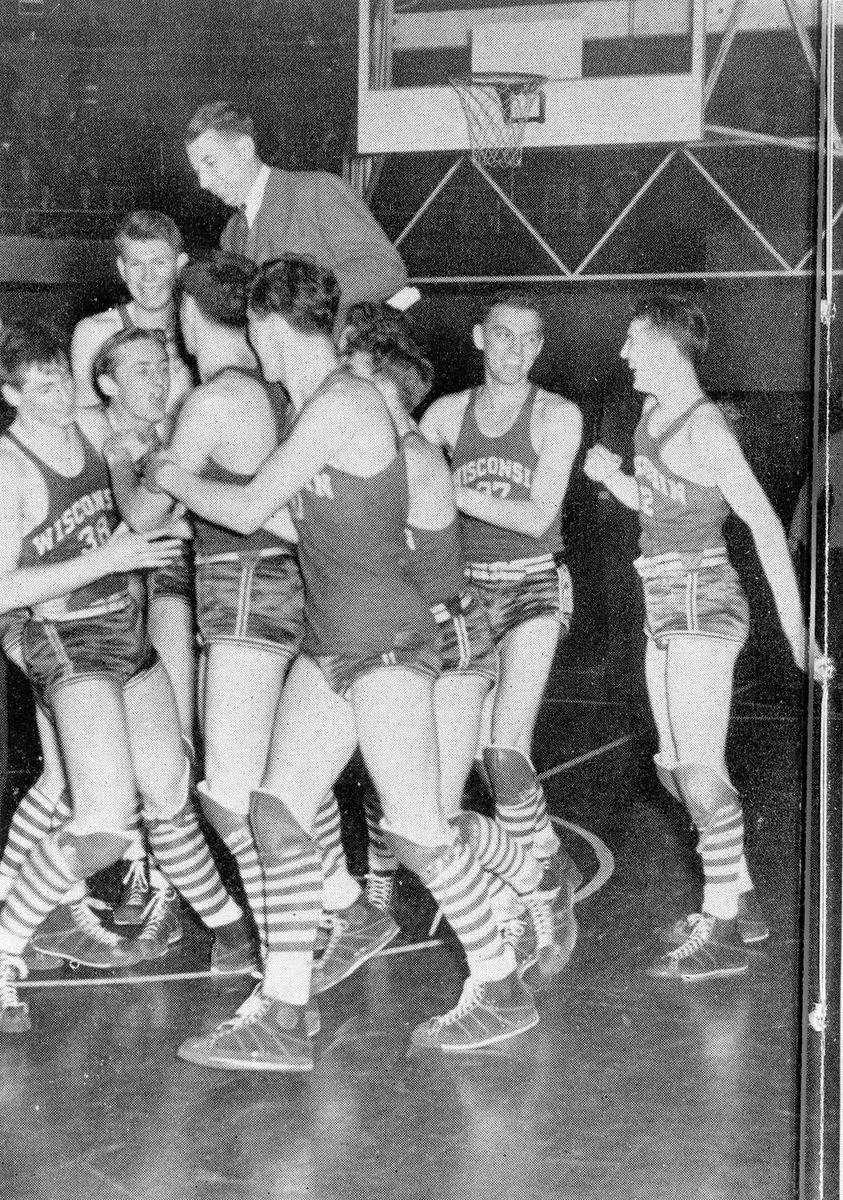
The Badgers then celebrated while wearing some pretty sweet socks:
After securing the title, the Wisconsin team returned to Madison where they were greeted at the train station at 1:20 in the morning by an estimated crowd of 10,000-12,000 people. “House mothers even suspended the rules and allowed female students to stay out for the event,” it was written.
Not all stories have happy endings, however. According to the Cap Times, the players hopped “on a fire truck for a ride around the Capitol that was cut short when the engine caught fire.”
Some footage of the 1941 champions (whose coach, Harold “Bud” Foster, I met back in 1986, when a Final Four berth seemed like a fantasy) can be seen here:
Wisconsin is not favored to defeat Kentucky in the NCAA men’s basketball semifinal Saturday.
Why might the Badgers win? It starts with coach Bo Ryan. Myron Medcalf explains:
Freddie Owens didn’t trust Bo Ryan, who will lead Wisconsin to its second consecutive Final Four matchup against Kentucky later this week.
Not at first.
Ryan left UW-Milwaukee to coach Wisconsin in 2001. During his first practices with his new team, the basketball fundamentalist from Chester, Pennsylvania, instructed Owens, then a 6-foot-2 point guard for the Badgers, and Wisconsin’s other perimeter players to venture into the post for the first time in their careers.
Um … OK, Coach?
“I didn’t know what to think of him,” said Owens, most recently an assistant at Utah Valley University. “When he started teaching us how to post up, I thought he was crazy. I’m a point guard. I’d never posted up in my life. I’m used to coming off ball screens. And I’m in the post, and I’m working on Kevin McHale [drop-steps].”
For more than 30 years, Ryan has espoused the same message from pulpits at UW-Platteville (Platteville, Wisconsin), UW-Milwaukee and Wisconsin. His Platteville guys will tell you the same thing that his UW-Milwaukee guys will tell you about him. And his Wisconsin guys will confirm it all.
Ryan’s knack for developing blue-collar players such as Owens — a contrast from John Calipari’s grab-every-McDonald’s-All-American-in-sight, Minute-Rice approach — stems from his constant emphasis of the basics, his cerebral maneuvering that sprouts confidence and accountability in the locker room, and consistency.
“He’s obviously got me much more disciplined as a player and as a person, realizing [that] the little things in life go a long way,” Sam Dekker said. “And if you wake up each morning with the mentality that you have to get better … you can do a lot in that 24-hour span to improve and build on your life. You know, if you wake up every day like that, you’re going to get a lot of things done.”
By the end of his time at Wisconsin, Owens enjoyed the paint. He felt comfortable there, and he finally understood why Ryan taught his point guards post moves. And he benefited from an expanded skill set.
Ryan is a purist who preaches efficiency and versatility at all positions. His practices commence with simple passing and catching drills. He demands proper ballhandling and ball rotation. Want to see Ryan spaz? Commit a turnover in practice or throw a pass from midair.
He values stingy, hands-free defense. Sometimes, his players spend entire chunks of practice, without a basketball, shadowing one another like cornerbacks in man-to-man schemes. His father coached youth football, so Ryan has always had a jones for the gritty, gridiron types: tough, smart, relentless.
That’s the kind of player that Ryan craves. Those are the athletes who want more for themselves than any coach could ever desire on their behalves. He convinces his players, the unheralded kids and the rare blue-chippers too, that if they fall short of their potential, they’re only failing themselves, not him.
“I feel as though I got better as a college player, obviously, more so than in high school,” Owens said. “That’s the thing with him. You can look back during his whole time at Wisconsin. Every player that played under him left a better player, skill-wise and numbers. The main thing with him is he gets you to believe you’re capable of doing the things you want to do. He does the most to dig those goals out of you, to push you past those limits to get to the goals you have for yourself.”
It’s unfair and inaccurate to suggest Ryan recruits only overlooked two- and three-star recruits. Devin Harris was Wisconsin’s Mr. Basketball, who committed to former coach Dick Bennett. But he blossomed into an NBA first-round draft pick under Ryan. Brian Butch was a McDonald’s All American selection. Jon Leuer was a top-100 prospect who now plays for the Memphis Grizzlies. Dekker, a five-star recruit, would have been on every powerhouse’s wish list had he not decided to commit to Wisconsin after his sophomore season in high school.
On this season’s team, Nigel Hayes was a top-100 prospect before he arrived, and North Carolina‘s Roy Williams expressed his admiration for Bronson Koenig, whom he recruited in high school, during the buildup to last week’s Wisconsin-North Carolina meeting in the Sweet 16.
But most of those athletes were local products who wanted to play for the Badgers and stay home. Ryan has built his legacy on the under-the-radar types who’ve developed into elite performers.
Alando Tucker wasn’t a nationally coveted recruit, but he left Wisconsin as an All-American and NBA draftee. Jordan Taylor and Mike Bruesewitz led the Badgers to the Sweet 16 in 2012. Traevon Jackson was ranked 68th among shooting guards in the 2011 recruiting class per RecruitingNation. He was the starting point guard on last year’s Final Four squad.
“Bo is going to get the most out of you,” said former Wisconsin guard (2005) Sharif Chambliss, now an assistant at UW-Milwaukee. “He’s not going to accept you taking breaks. He’s not going to accept you turning the ball over.”
It started at Platteville.
Ryan didn’t have the recruiting budget or the access to players he has now. He had to teach college courses at the non-scholarship, Division III school, too. With limited time, Ryan had to pack valuable information into his sessions. But he never force-fed those teams. They watched film. A lot of film. And they discussed and implemented Ryan’s strategies in morsels instead of mouthfuls.
“Well, it was my first chance to be a college head coach, so I was putting together a system that I had in my mind of what I wanted to do, offensively, defensively, and then tweak it a little bit as I go along,” Ryan said. “It kept getting better because guys would buy in because they’re paying for their own education so they had to really want to be there.”
It worked. In the 1984-85 season, Ryan’s first Platteville squad finished with a 9-17 record. Three years later, the Pioneers were 24-5 and conference champions. Platteville won the first of Ryan’s four Division III national championships in 1991.
Rob Jeter, a captain on that 1991 squad, said Ryan’s concepts became religion to his teams. Proof? Whenever they played pickup ball together, they’d run the swing offense.
“We just played the same way all the time,” said Jeter, head coach at UW-Milwaukee. “I think the biggest thing with Coach [Ryan], you always knew where you stood with him. There was no guessing. It was always clear.”
Ryan’s strategic expertise has been an essential tool in his ability to help players reach their peaks, as are his psychological tactics.
Chambliss led Penn State in scoring before he transferred to Wisconsin in 2003. Ryan often conveyed his expectations to Chambliss and his teammates via indirect criticism. If Chambliss and former Wisconsin star Kammron Taylor had botched a play, Ryan wouldn’t rip them. He’d warn the rest of the team.
“He told somebody else, ‘If you all keep turning the ball over like [Taylor] and [Chambliss], you’re gonna be sitting on the sidelines,’” Chambliss recalled. “In a family culture like that, it definitely feels like you’re not pulling your weight. Everybody at Wisconsin, you’ve gotta pull your weight.” …
“I’m a completely different person and player than I was four years ago, and I think a lot of that has to do with coach,” said Frank Kaminsky, the Wooden Award favorite and NBA prospect who averaged 1.8 points per game and 7.7 minutes per game as a freshman in 2011-12. “He knows how to get the best out of us, from the time we step on campus to the time we’re seniors. He really makes a commitment to us. It’s hard to put into words how much he actually does for us, because you start to realize in these times how much he has an effect on us, the way we say things, the way we do things on the court, how we interact with each other. It’s really just a true, great program.”
The other reason is difficult-to-defend players, as Robert Mays points out:
As Sam Dekker’s impossible 3 fell from the height of the shot clock through the bottom of the net, Rondae Hollis-Jefferson’s shoulders dropped. It was Dekker’s fifth — and the Badgers’ 10th — 3-pointer of the half, and with the lead now at eight, it was the final dagger in Wisconsin’s West Regional Final win over Arizona. After the shot went down, Badgers senior Josh Gasser turned to announcer Reggie Miller for some affirmation.
“I said, ‘Sam’s got stones like you,’” Gasser said.
“Kidney stones,” coach Bo Ryan interjected, trying to keep things family-friendly.
“Kidney stones, yeah,” Gasser said. “I don’t know. He laughed. He agreed with me. He gave me a good head nod.”
All tournament — from Frank Kaminsky hitting SportsCenter in capri sweatpants to Nigel Hayes’s stenography fascination — it’s been obvious that no one has been having more fun than Wisconsin. Saturday was proof. This was a team that’s done it before and knew what it would take to do it again. This team can turn it up, and this time, it turned it way up.
“That was cold-blooded,” Ryan said about Dekker’s dagger. “I can tell you that.” He was talking about one shot, but he could have been talking about nine others. No matter how Arizona tried to defend Dekker and Wisconsin in the second half Saturday, the ball was going in. “I think they had two 3s at the half,” Arizona coach Sean Miller said after the game. “Think about that. Two made 3s at the half, and they had eight in the second half.” When the moderator corrected him, it still seemed hard for Miller for believe.
Wisconsin’s offensive display — 55.6 percent from the field, a scorching 12-of-18 from 3 — would be a sight against any team this deep in the tournament, but putting on that sort of show against Arizona made it all the more remarkable. The Wildcats were among the best defensive teams in the entire country, led by a pair of excellent wing defenders and defined by constant, stifling ball pressure. In the first half, Wisconsin was scraping for buckets on just about every possession. Kaminsky, as he had so many times before, was getting his against Arizona’s defense, but the rest of the Badgers went into halftime with only 17 of Wisconsin’s 30 points.
Despite finishing with a career-high 27 points, Dekker was quiet for most of the opening 20 minutes. His seven first-half points came in unspectacular ways — an easy lob inside, a trip to the line, a lucky putback off a bad Kaminsky miss. It wasn’t the slashing, rim-attacking version who had a career-high 23 against North Carolina two days earlier. Twice after the game, Dekker brought up the challenge of finding lanes against Hollis-Jefferson and Stanley Johnson. And with Johnson on him for much of the first half, Dekker rarely looked to put the ball on the floor.
What he did instead was put the final touches on his most complete weekend as a college player. Offensively, Dekker’s biggest limitation, both this year and last, has been his ability as a 3-point shooter. After hitting less than 33 percent from behind the arc as a sophomore, he checked in at 33.8 percent this season. His 5-of-6 showing on Saturday was comfortably the best 3-point performance of his college career. And when that shot is falling, it turns Dekker into a serious problem for any defense.
The game he had against North Carolina saw Dekker taking anyone he pleased off the dribble. “[I] try to be an attack-first guy,” Dekker said Saturday. “I have the ability to use my athleticism. Sometimes I don’t use it the way I should, and when I’m in tune with that and doing it and using it to my advantage, it makes the game come a lot more smoothly and naturally.” At times against the Tar Heels, he looked like a 6-foot-9 running back, tucking the ball away as he barreled toward the rim. That’s a trick typically reserved for guys built like Derrick Rose, not small forwards with a wingspan pushing seven feet.
Even with his ability to put the ball on the floor and finish, the best part of Dekker’s game is what he does without the ball in his hands. He’s a fantastic cutter, always moving and seeking out easy buckets. It’s the exact sort of trait that makes him so valuable to his team. At the same time, Dekker knows why a lot of those cuts are open to him. “It also helps to have this guy next to me getting a lot of attention,” Dekker said, nodding Kaminsky’s way.
Dekker was named the most outstanding player of the West regional, but for the second straight year, Frank the Tank burned Arizona’s season down. Sean Miller’s team had no answer. Three Wildcats tried their hands at guarding Kaminsky; none of them had much luck. Typically, a player with talents as varied as Kaminsky’s tries to find the perfect tool to take advantage of what a particular defender lacks. With his ability to handle the ball, opposing big men have little chance stopping him off the dribble. And with his ability on the block, smaller, quicker players just don’t have a chance down low. It’s gotten so Kaminsky doesn’t even think like that anymore. “I don’t really care who is guarding me at this point,” he said afterward.
Concerns about whom he can guard — Kaleb Tarczewski had his way a couple of times on the block, and for all of Kaminsky’s strengths, quickness is not one of them — will persist as people ponder Kaminsky’s NBA future. But his sheer level of skill is remarkable. And it goes beyond being able to step out and shoot. At this point, he can do it all, against anyone. His game defines Wisconsin’s offense because of how he breaks defenses — even the best ones. Now, he and the Badgers will get a shot at the best defense anyone has seen in a long, long time.
Kentucky is one of the only teams in the country better than Arizona on that end of the floor, and the difference between the Wildcats in blue and the ones in red is that Kentucky may have the array of big bodies to slow Kaminsky down.
If they can, that’s where Wisconsin’s peaking new star may come in handy. A team that went to the Final Four a year ago and scored better than anyone in America did it without Dekker hitting the level he’s reached this week. That’s a frightening thought, and sadly for Sean Miller, one he had to experience firsthand. “When Sam Dekker does what he did — and I think some of the shots were very well defended — when he does that with Kaminsky, maybe Kentucky is that school that can beat them,” Miller said. “But I’m telling you, I don’t know if there is another one out there when they’re clicking with that one-two punch.”
I assume Kentucky will win Saturday night. It is interesting, though, that ESPN.com‘s survey of NCAA coaches and assistant coaches predicted a Badger win.
Awful Announcing reports that a cool feature of last year’s Final Four is returning Saturday:
The Team Streams will be on TNT and truTV for the national semifinals while the traditional national telecast will be found on TBS.
Jim Nantz, Bill Raftery, and Grant Hill will have the call on TBS with Tracy Wolfson on the sidelines. Here’s the Team Stream roster, straight from Turner Sports and CBS…
“Duke Team Stream” on TNT at 6 p.m.
Tom Werme, play-by-play – Werme is a 20-year broadcasting veteran who has hosted the ACC Blitz and has provided commentary for the ACC Network, ACC Digital Network and Raycom Sports, among others.
Alaa Abdelnaby, analyst – Abdelnaby is a former Duke standout that played for the Blue Devils from 1996-2000 and was All-ACC third team during his senior year. He is currently a CBS Sports Network studio analyst and commentator for Westwood One.
Chris Spatola, reporter – Spatola is a former director of basketball operations at Duke and current CBS Sports Network commentator. He is also the son-in-law of Duke head coach Mike Krzyzewski.
“Michigan State Team Stream” on truTV at 6 p.m.
Brian Anderson, play-by-play – Anderson is a veteran and versatile Turner Sports commentator who has done play-by-play for leading properties such as the NCAA Division I Men’s Basketball Championship, NBA on TNT and MLB Postseason on TBS, among others. He has also previously called games for the Big Ten Network.
Mateen Cleaves, analyst – A former Michigan State legend, Cleaves led the Spartans to an NCAA Championship in 2000 and was names the NCAA Final Four Most Outstanding Player. Cleaves is the only three-time All-American is school history and was named Big Ten Player of the Year twice. Currently a studio analyst for CBS Sports Network, Cleaves’ Michigan State jersey was retired in 2007.
Shireen Saski, reporter – a Michigan State alum, Saski is currently a CBS Sports Network reporter and has previously worked for the Big Ten Network. The veteran broadcaster has also been the recipient of three Michigan Emmy Awards, then working for Fox Sports Detroit.
“Kentucky Team Stream” on TNT (following first game)
Dave Baker, play-by-play – Baker is a long-time sports broadcaster at WKYT in Lexington and television play-by-play commentator for UK/IMG’s University of Kentucky basketball coverage. He has spent more than two decades being involved with broadcasting events surrounding the Southeastern Conference.
Rex Chapman, analyst – A former Kentucky star, Chapman was a two-time All-SEC player who helped lead the team to an SEC Championship and run to the NCAA Tournament’s Sweet 16 during his sophomore year. Chapman amassed more than 1,000 points in only two years at Kentucky, which was followed by a 12-year NBA career.
Michael Eaves, reporter – a Kentucky alum, Eaves has previously covered University of Kentucky basketball extensively as a sports anchor, reporter and producer at WKYT in Lexington. He is currently an anchor and reporter for Al Jazeera America.
“Wisconsin Team Stream” on truTV (following first game)
Wayne Larrivee, play-by-play – Larrivee is the radio play-by-play voice of the Green Bay Packers on the Packers Radio Network and has called college basketball for the Big Ten Network. He has also provided play-by-play for Westwood One during the NCAA Tournament.
Mike Kelley, analyst – A former Wisconsin standout, Kelley helped guide the team to the Final Four in 2000 and, during his collegiate career, he helped lead the team to its best four-season win total in school history. Kelley was inducted into the UW Athletics Hall of Fame in 2014.
Phil Dawson, reporter – Dawson is host of the Badger Radio Network, as well as a talk show host in Milwaukee and Wisconsin.
There are some notable returnees from last year including UK analyst Chapman and the Wisconsin team of Larrivee and Kelley. I think in switching around between the different feeds last year, that Badgers group was probably the closest Turner/CBS got to what they were looking for out of the Teamcast – broadcasters not just coming in to cheerlead, but to tell the story of the game from one team’s perspective. That’s no surprise, Larrivee has done great work for the Bears, Packers, and Big Ten for years.
The fact that Larrivee, Kelley and Dawson are doing the UW version of the Final Four is great. (Larrivee — who I would like to see replace Ted Davis as the Bucks’ radio announcer — announced the West Regional final on Westwood One. That means that both Larrivee and CBS announcer Kevin Harlan called Sam Dekker’s last three-pointer a “DAGGER!”) The fact they’re on truTV again, a channel most cable subscribers don’t get (as we found out during the games in Omaha), is not.
Anderson is an interesting choice only because he is the Brewers TV announcer, but you knew that:
He has done great NCAA work, but I’m not clear about his Michigan State or state of Michigan connections, if any.
Today in 1956, Elvis Presley appeared on ABC-TV’s “Milton Berle Show” live from the flight deck of the U.S.S. Hancock, moored off San Diego.
An estimated one of every four Americans watched, probably making it ABC’s most watched show in its history to then, and probably for several years after that.
When Bo Ryan was hired to lead the University of Wisconsin men’s basketball program, Sports Illustrated referred to him as “a coach no one heard of.”
Chris Dufresne of The Los Angeles Times wasn’t a fan of Ryan being hired, either: “What was Wisconsin thinking?” Dufresne wrote. “You don’t fire Brad Soderberg, Dick Bennett’s hand-chosen successor, unless you have Rick Majerus or Ben Braun signed, sealed and delivered. Don’t the Badgers look silly now that Majerus has formally rejected the school’s overtures and Braun has signed a four-year extension at California? It appears Wisconsin will hire fall-back candidate Bo Ryan of Wisconsin-Milwaukee, not exactly a household name. How is Bo Ryan better than Brad Soderberg?”
Earlier this week, Dufresne wrote a column setting up the Final Four, which begins Saturday at Lucas Oil Stadium in Indianapolis. He wrote that the field — UW, Kentucky, Duke and Michigan State — is as “traditional as the Rose Parade.”
Reporters don’t write headlines for their stories, but it’s worth noting the one on Dufresne’s column: “The Final Four will be where elite meet — only blue bloods need apply.”
Indeed, Ryan has changed a lot of people’s opinions since he was hired on March 29, 2001.
He has helped UW win four Big Ten Conference regular-season championships and three conference tournament titles. He’s 172-68 in Big Ten play, the best conference winning percentage (.717) of any Big Ten coach.
The Badgers are 14-for-14 on trips to the NCAA tournament under Ryan, with seven Sweet 16 appearances, three trips to the Elite Eight and now back-to-back Final Four appearances.
By Monday, Ryan could be announced as a member of the Naismith Hall of Fame. By Monday night, he could have a Division I national championship to go along with the four Division III titles he won at UW-Platteville.
The Badgers (35-3), who meet Kentucky (38-0) in the national semifinals for the second consecutive season, set lofty goals when the season began. They wanted to sweep the Big Ten regular-season and tournament titles and return to the Final Four after last season ended with a heartbreaking loss to the Wildcats in Arlington, Texas.
“They said it and they did it,” Ryan said. “I told them I would go along with them, I would patrol the sidelines, I’m with you. But I don’t ever put that on teams, ‘Hey, you’ve got to do this or you’re not fulfilling anything.’ (It’s), ‘OK, guys, you ready? Let’s go. Roll your sleeves up, let’s get after it.’ They’ve lived up to what they said they were going to do, to this point.”
UW associate head coach Greg Gard has been with Ryan for more than two decades, including stops at Platteville and UW-Milwaukee. Gard is well aware there were doubters — inside the state borders and beyond — back in 2001.
“When Coach got here, we’ve always set goal No. 1 as trying to win the conference championship, and if you can strive for that and you put yourself in good position there, whether you win it or come close or whatever, that usually sets you up for having a chance in March and into April. And then it’s a matter of playing well at the right time, having the right matchup, being healthy, having a good team.” …
Ryan spoke earlier this week about all the people he was grateful to for giving him a chance. His coaching career, which spans more than four decades, has included stops at a junior high school and high school in Pennsylvania; an eight-year stretch as an assistant under Bill Cofield at UW; the dominant era at UW-Platteville, his first head coaching job at the college level; and a two-year run at UW-Milwaukee that paved the way for Ryan to be hired by former UW athletic director Pat Richter.
In the 14 years since, Ryan has won 356 games and silenced many a critic along the way.
“The best way to say thank you to people … is to do your job the best you can,” Ryan said. “When I was an assistant, (my) eyes, ears, and mind were constantly open. Thank goodness, because it helped me later.”
Ryan paused.
“That,” he said, “and I didn’t like losing.”
As far as the previously preferred candidates: Majerus would have been a fun coach to watch, but he died at 64. (I question how successful he would have been at UW anyway given UW’s academic standards and Madison’s culture.) Soderberg, fired after he replaced Dick Bennett upon Bennett’s midseason retirement, was fired after an awful NCAA tournament loss to Georgia State. He went to Saint Louis and was fired there, replaced by … Majerus. He is now the coach at Division II Lindenwood University in Missouri. Braun, a Wisconsin graduate who played for John Powless, was fired by Cal in 2008, then resigned after six years at Rice, where he was 63-128.
Ryan got, and gets, criticized because his teams play a style of basketball casual fans don’t like to watch. (Of course, winning overrides style complaints. As it is, Ryan’s teams are considerably more enjoyable to watch than teams coached by Bennett, who seemed to want to be the first college basketball coach to win a game 2-0.) Ryan does, as Bennett did, recruit players who don’t seem as athletically gifted as those who choose not to go to UW. (Most recently, Whitefish Bay Dominican’s Diamond Stone, who is going to Maryland, although Stone’s decision may have been based more on not being able to get into UW due to academics.) Ryan also has a public image of being bristly with the media, and the media retaliates by claiming that a coach who won four national championships in the division of the NCAA where no scholarship money is available can’t coach.
Oakland/Los Angeles/Oakland Raiders owner Al Davis was fond of this answer to his critics: “Just win, baby.” I doubt Ryan is a Raiders fan, but wouldn’t you like to see the geniuses of the sports keyboard after Ryan cuts down the nets Monday night?
Those of us who marched in the greatest marching band on the planet probably wondered at one point what UW Band director Mike Leckrone was like when he was closer to our age.
WISC-TV in Madison has the answer from Leckrone’s sister:
Pat Egolf looks at her big brother Mike Leckrone, or more specifically the flamboyant outfits he’s fond of wearing at the head of the UW-Madison marching band, and simply shakes her head with a smile.
“It’s not what we saw back here,” she said in an interview in the Manchester, Indiana school library, just a few miles from where they grew up. “It amazes me how he’s at the university with the sparkle jackets and the way he talks to the audience because he was rather laid-back.”
The portrait of the legendary UW band director starts with his father, Harold Leckrone, who students called “Leck.” He was a perfectionist, an avid and prolific composer, writing the Manchester High School fight song that was used as the fictional Hickory High’s song in the movie “Hoosiers.”
That attention to detail was not lost on Mike. However, his style and flair came from his mother.
“My father was very quiet,” Pat said. “He’d give you a big smile, but you’d better do and play as he says.”
Growing up in a small Indiana town in the 1940s and 50s, there were two extracurricular activities every boy aspired to participate in: basketball and band. During his time in high school, Mike was in the varsity starting five and served as first trumpet in the band, often pulling double duties during games.
“At halftime, he would run as soon as the buzzer went off, straight to the dressing room, jump in a band uniform because the high school band put on a show on the gym floor just like they do at the football fields now,” Pat said.
Leckrone, who graduated from the now-closed down Chester High School, was given a distinguished alumni award from the Manchester School District last summer. He was valedictorian of his 1954 class and followed in his father’s footsteps to earn undergraduate and graduate degrees from Butler University and Indiana University.
“Everything was so simple for him,” Pat said. “It was just natural for him, anything he did.”
His love of music came through at an early age, said Tom Airgood, who played the trombone in the high school band with Mike. Even after basketball games, he’d gather some of the band members for a 1950s version of a jam session.
“We would play together some extra down in the locker room, impromptu jazz,” Airgood said. “We’d play extra stuff from our usual pieces. We had a lot of fun with it.”
Leckrone’s love of jazz may be the one negative he’s left with his younger sister. She said his passion for it and the cramped nature of their three-bedroom house leaves her unable to enjoy it to this day.
“He played it all the time,” she said with a sigh. “It’s not like it’s a song either. He’d play up and down keys, and he was always in his room blasting away. That just wasn’t for me.”
Butler, by the way, is in Indianapolis, as are the Badgers for Saturday’s Final Four national semifinal. Wisconsin once played Butler in men’s basketball, and yes, Leckrone made us play the Butler fight song. Wisconsin also once played Ball State, apparently a Butler archrival, and Leckrone labeled the week’s marching instructions as Wisconsin against “Fruit Jar U.” (Home canners should appreciate that joke.)


 Steve Prestegard.com: The Presteblog
