Today in 1963, the Beatles played two shows in Sundstavagen, Sweden, to begin their first tour of Sweden. The local music critic was less than impressed, claiming the Beatles should have been happy for their fans’ screaming to drown out the group’s “terrible” performance, asserting that the Beatles “were of no musical importance whatsoever,” and furthermore claiming their local opening act, the Phantoms, “decidedly outshone them.”
Three thoughts: Perhaps the Beatles did have a bad night. But have you heard a Phantoms song recently? It is also unknown whether the Beatles’ “Norwegian Wood” was intended as revenge against the Swedes.
One year later, a demonstration of why the phrase “never say never” holds validity: Today in 1964, the Rolling Stones made their first appearance on CBS-TV’s Ed Sullivan Show.
A riot broke out in the CBS studio, which prompted Sullivan to say, “I promise you they’ll never be back on our show again.” “Never” turned out to be May 2, 1965, when the Stones made the second of their six performances on the rilly big shew.
In the four-year history of this blog, I have written little about clothing except for athletic uniforms.
Then I read Grantland, which was inspired by the next Star Wars movie:
A long time ago, in a galaxy far, far away, dudes wore dope space jackets. Judging from the just-released and possibly final trailer for Star Wars: The Force Awakens, that tradition — like Stormtroopers that can’t shoot straight — continues. And it’s all for the good. Just because there’s a devastating galactic civil war in progress that has already involved multiple planetary genocides doesn’t mean that a man can’t look his dashing best while bull’s-eyeing womp rats in his T-16, or zipping betwixt the lumbering legs of an AT-AT in a snowspeeder, or flying an X-wing into a superweapon’s utility trench. Say what you will about those scruffy, neosocialist Rebel Alliance hippies, but they understood the important branding message of looking rad. How else are you going to get people to sign up for a suicidal war or fly the Y-wing, the scrub vehicle of the Rebel Alliance?
Cool jackets are integral to Star Wars and the wider sci-fi/fantasy realm. They’re what separates a pop-culturally important work of imaginative fiction from the Star Wars kid; make your characters look cool or they will come off like nerds. From the trailer, it appears J.J. Abrams gets the cool-jacket aspect of Star Wars absolutely right. Which is yet another reason the Episode I-III prequels were unmitigated space trash. Those movies contain zero dope jackets. Because of the overtly wack Jedi focus of those films, every dude was stuck wearing those lame-ass brown monk bathrobes and loose-fitting, rough-spun kimono tunics. Also, pro tip: When a Jedi starts wearing black robes, maybe keep an eye on that person. Just a thought. …
Now that we’re done running through what didn’t work and disqualifying these cosmic affronts to fashion, here are the definitive Star Wars jacket ratings:
1. Luke Skywalker’s Battle of Yavin Medal Ceremony Jacket, A New Hope
LUCASFILM
This look is untouchable. Equally at home in the vast galactic void, the roller rink, or on your princess/sister’s bedroom floor, this maize-colored space-satin-and-polyester lady slayer is the jacket that started it all. Accept no substitutes.
2. Han Solo’s Cloud City Casual, The Empire Strikes Back
LUCASFILM
Han wears this dark navy space-cotton windbreaker for basically the entirety of The Empire Strikes Back. Smart man. When you’re trying to smash with royalty, you want to look cool, of course, but equally important is looking like you don’t really give a shit if you smash or look cool. This jacket says, “I’m awesome, I know it, and so do you.” Han even wears it while being brutally tortured on Darth Vader’s rack-of-random-car-parts machine.
3. Han Solo’s Hoth Parka, The Empire Strikes Back
LUCASFILM
Want to look fresh as uncut conflict diamonds while tucking your too-turnt best dude into the sliced-open stomach cavity of a dead bipedal pack animal? Then this military-style anorak with fur-lined hood is for you. Canada Goose — which accounts for two out of every three winter jackets in New York City — legit charges almost $1,000 for knockoffs of this coat.
4. Han Solo’s Jacket, The Force Awakens
LUCASFILM
Old-ass Han Solo, meanwhile, is — as per usual — still rocking out with a rakish fashion sensibility even if this jacket isn’t quite as awesome as others he’s worn throughout the series.
Han always knew the value of a great jacket. And what are those three metal vials on his left breast? High-caliber bullets? Space whippets? Corellian Viagra? Whatever they are, it’s probably illicit. Smugglers gotta smuggle.
Han-related aside: My low-key favorite part of Return of the Jedi is that everyone in the rebel raiding party sent to Endor, including Luke and Princess Leia, are wearing forest-green camo ponchos and helmets — the better to blend into the sylvan woods — and Han just wears a cowboy-style duster and his regular vest-over-shirt look because, like, whatever. The whole galaxy depends on stealthily turning off the new Death Star’s energy shield? Doesn’t mean you can’t still look great. …
6. Finn’s Bomber, The Force Awakens
LUCASFILM
Take a look at our man Finn (John Boyega) and his possibly Empire-issued leather quasi-bomber jacket, which is pretty OK from a Star Warsouterwear perspective.
Finn is giving off that vibe of like “Hey, this jacket is OK and hopefully I get a doper one for the sequel.” It actually looks cooler from the back.
LUCASFILM
7. Bossk’s Yellow Flight Suit and Greedo’s Biker Jacket, Empire and A New Hope(Tie)
LUCASFILM
You see Bossk for only like 30 seconds in Empire, which meant that owning his action figure was a mark of status among the neighborhood kids. Owning a Bossk figure said “I know Star Wars.” I prefer Bossk’s flight suit to the semi-wack jumper Luke wears in Empire when he goes to Dagobah. Greedo, meanwhile, doesn’t get enough credit for the two-tone biker jacket he wears under his totally unnecessary but very Star Wars–ian vest. The guy — or fish or seahorse or whatever — really knew how to accessorize his skin.
8. Lando’s “I’m a General Now” Officer’s Jacket and Cape, Return of the Jedi
I’ve always been confused at the ease with which various characters got promoted up the ranks of the Rebel Alliance. In Empire, Lando betrayed our heroes to the Empire, which got Han tortured, frozen, and hung on Jabba’s wall like a Rothko. Yes, he had little choice and felt bad about it, and he later helped Leia, Chewie, Luke, and the droids escape, but facts is facts. Then, by the middle of Return of the Jedi, Lando was not only accepted into the rebellion, but he became a general. I guess beggars can’t be choosers; if the rebellion turned away everyone who used to snitch for the Empire, who’d be left to volunteer to fly suicide missions into the new Death Star? …
10. Ponda Baba’s Orange Biker/Bomber Jacket, A New Hope
LUCASFILM
Ponda Baba is an Aqualish pirate and thug who you may remember as the alien who tried beefing with a young Luke Skywalker only to get his arm sliced off by Obi-Wan Kenobi. Which is sad. Not because of the arm — those, as we’ve seen time and again, are easily replaced in the galaxy far, far away — but because that saber slice ruined a perfectly fly jacket.
11. Luke’s Dagobah Jacket, The Empire Strikes Back
LUCASFILM
The Empire Strikes Back came out in 1980, so it’s kind of weird Luke so rarely wore a jacket with a poppable collar. Sadly, it’s the weakest sartorially of his non-Jedi kimono jackets, a tan canvas safari number. Which, yeah, he was in the swamp.
NON–STAR WARS SPECIAL MENTION SECTION
Two other jackets in the wider sci-fi/fantasy realm deserve attention.
Star-Lord’s crimson Han Solo–inspired space jacket:
MARVEL STUDIOS
Jaime Lannister’s “Going to Dorne” jacket:
HBO
Whether it’s in outer space or the Seven Kingdoms, cool dudes wear cool jackets.
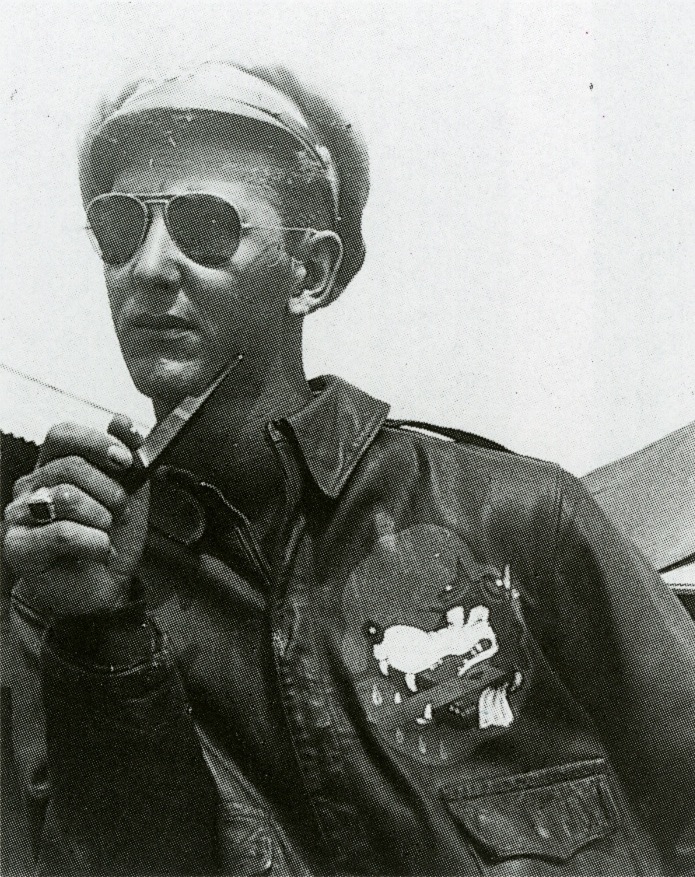
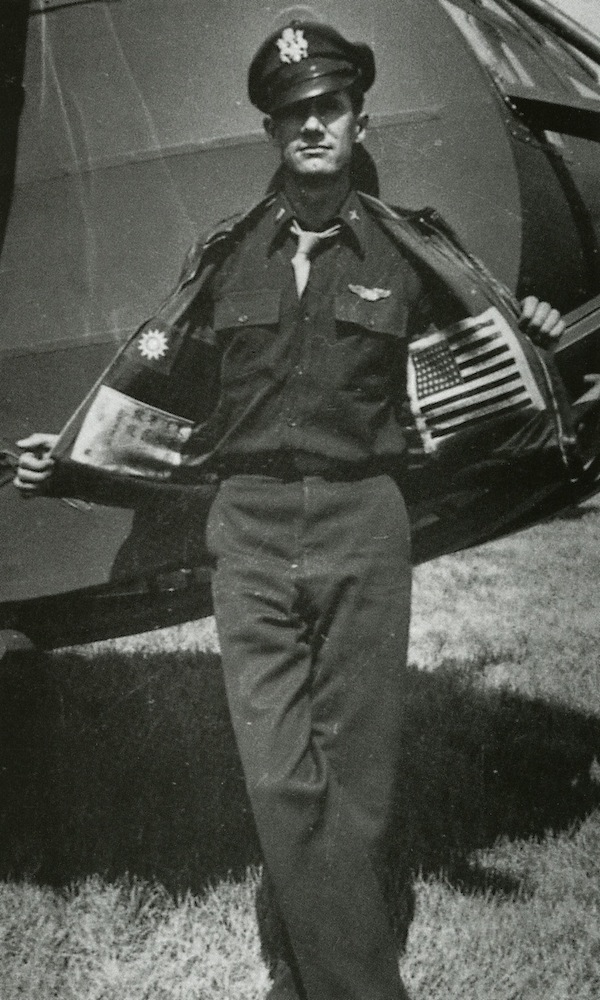
Or dope or wack jackets, apparently. But this is not a new development. In the real world, flight jackets date back to the first days of military flight, World War I, though they started to shorten from overcoat length toward World War II.
… World War II fliers wore what became called “bomber jackets” because the jackets were warm at high altitude in nonpressurized airplanes. That didn’t mean jackets weren’t worn in slightly inclement (as in Great Britain) weather, of course.
The weather for ground troops got dicey as well, and once the Army figured out what it had wasn’t appropriate for a worldwide war, the Army developed …
… a jacket that could be worn underneath a longer wool coat for layering. However, Gen. Dwight Eisenhower requested around the same time a jacket that looked like the British “battle jacket,” though more distinctive. So Eisenhower’s idea for a jacket became known as …
… the Eisenhower jacket, or the “Ike” jacket, in part because of Eisenhower’s popularity among his troops.
After World War II ended, police found that a waist-length jacket allowed better access to guns, batons, clubs, etc., and so police started wearing them:
Yes, that photo depicts fictional officers Malloy and Reed of “Adam-12,” but creator Jack Webb was a stickler for accuracy, much more so than others in Hollywood:
You might reasonably ask why a Navy pilot assigned to San Diego, which has arguably the nicest weather in the entire country, would wear a leather jacket. Because style, man. (There are bigger issues with “Top Gun” than what Tom “Maverick” Cruise is wearing.)
In the post-World War II days leather jackets started showing up in pop culture …
Marlon Brando in “The Wild One”James DeanElvis Presley
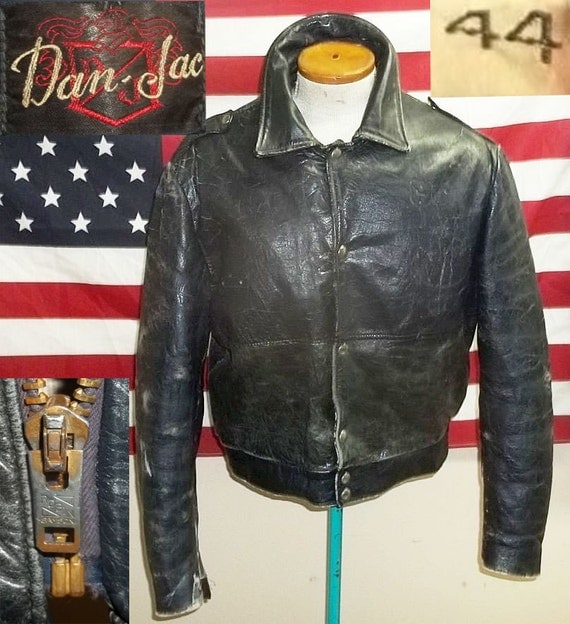
I have served in neither the military nor the police (bad eyesight, among other things), and I’m not an actor. But I recognize the value of a stylish, yet usable, jacket. In fact, I have managed to accumulate several leather jackets, though I don’t have the first one I purchased due to its 1970s/1980s reddish-brown color. (I purchased it with $104 of my own money in 1982. One week later for unrelated reasons my first girlfriend broke up with me while I was wearing that jacket. It’s a good thing I bought it then anyway, though, because one week after that my first employer closed its doors.) I do have a black Top Gun-style jacket with zip-liner, a beaten-up-brown bomber jacket, a black leather blazer, and a longer (though not trenchcoat-length) brown leather “car coat.”
After our oldest son was born, I found myself in Sheboygan to do a story near Sheboygan Harley–Davidson. With a bit of time to kill, I walked into the store not to look at the motorcycles, which I was not about to purchase, but in the clothing session. And there I saw a toddler-sized leather-looking biker jacket. I didn’t have a cellphone with camera at the time; I just called Mrs. Presteblog and said we have to have this. The three of us wore black leather for a family photo.
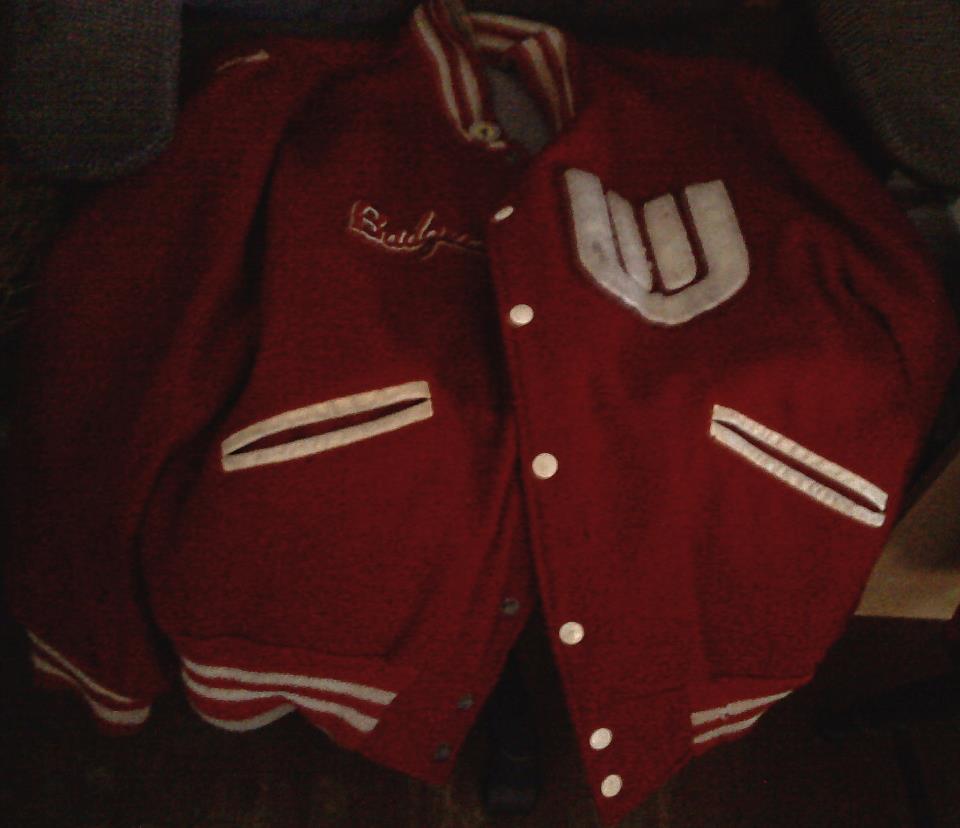
The jacket with sentimental value, though, is not leather:
This is my UW Band jacket from my five years in the world’s greatest college marching band. It obviously is similar to a letter jacket (though reversible for going incognito), which I never got to wear because of my athletic suckage. You have to buy the jacket, but the band W goes to those who complete two years in the band, and the pin on the collar goes to three-year marchers. Obviously I have almost no opportunity or reason to wear it, but at least it fits again now that I weigh about what I did when I graduated from UW–Madison.
Back to science fiction: Stylish jackets also can be found in the Star Trek universe, though they are much harder to find …
… and elsewhere in the TV universe:
Col. Ryan’s jacket in the movie “Von Ryan’s Express …”… ended up on “Hogan’s Heroes” …… while the A2 was also worn by Steve McQueen, one of the Three Cool Steves. As for the other Steves, I found no photo of the Six Million Dollar Man, Steve Austin, wearing a leather jacket, and why would Steve McGarrett wear leather in Hawaii?“Voyage to the Bottom of the Sea,” where Captain Crane flies the Flying Sub while Admiral Nelson apparently is the navigator.Starsky and Hutch also wore leather jackets, despite the temperate weather in Los Angeles, or “Bay City.”
As a second-generation (out of three, as you know) musician (if that’s what you want to call it in my case), I had to post this, from MainStreet:
The band geeks are having the last laugh. Considering all forms of music education – whether it was being in a choir, taking formal instrument lessons, or playing gigs in a garage band – American adults say such early experiences pay off later in life.
Seven in ten (71%) adults responding to a Harris poll say that the lessons and habits gained from music education equip people to be better team players in their careers. More than two-thirds say the “Glee” factor provides people with a disciplined approach to solving problems (67%) and prepares someone to manage the tasks of their job more successfully (66%).
And it wasn’t just about being in the marching band. Over three-quarters of Americans (76%) have had some sort of music education during school – half (49%) were in a chorus and more than two in five (43%) took formal instrument lessons. Many (39%) played in a school orchestra or band, while some played in an informal group, such as a garage band (14%) or took formal vocal lessons (13%).
The benefits of a music education may be even more tangible. The U.S. Department of Education compiled data on more than 25,000 secondary school students and found that students with high levels of involvement in instrumental music in their middle and high school years had “significantly higher levels of mathematics proficiency by grade 12.”
A 2007 study from the University of Kansas reported that students in elementary schools with top-quality music education programs scored 19% higher in English than students in schools without a music program – and 17% higher in mathematics.
Those who are looking to relocate, particularly with children, might want to consider somewhere named one of the Best Communities for Music Education. (We moved from one to another one.)
A horrible irony today in 1964: A plane carrying all four members of the group Buddy and the Kings crashed, killing everyone on board. Buddy and the Kings was led by Harold Box, who replaced Buddy Holly with the Crickets after Holly died in a plane crash in 1959:
Today in 1976, Chicago had its first number one single, which some would consider the start of its downward slope to sappy ballads:
Some people feel the Republican Party is in chaos, with no obvious front-runner for president, no one apparently willing to be Speaker of the House of Representatives, and the party in danger of losing control of the U.S. Senate in an election year that seems to favor Democrats.
But if you think the GOP has it bad, James Taranto reports on a lefty writer who thinks the opposite is the case:
Matt Yglesias delivers this cheery news to readers of the liberal young-adult website Vox.com: “The Democratic Party is in much greater peril than its leaders or supporters recognize, and it has no plan to save itself.” He has a pretty good argument. Look past President Obama’s “victory lap” and the current disarray in the House and the GOP presidential contest, and Republicans dominate elected politics in most of the country.
The GOP holds majorities in both houses of Congress. Thirty-one governors are Republicans, as are majorities of state attorneys general and secretaries of state. Republicans hold majorities in 69 of 99 state legislative chambers (including Nebraska’s unicameral Senate, which is formally nonpartisan) and have “unified control”—governor and legislative majorities—of 24 state governments (Yglesias erroneously says 25).
The most surprising fact in Yglesias’s piece: Apart from California, the most populous state with unified Democratic control is Oregon, which ranks 27th in population. That surprised Yglesias, too. At the end of his piece is this correction: “Earlier versions of this article said that Minnesota or Washington was the biggest non-California Democratic-controlled state, but in fact the Republicans control one legislative house in both of those states.”
Yglesias argues that even the House Republican leadership crisis is a sign of Democratic weakness: It “reflects, in some ways, the health of the GOP coalition. Republicans are confident they won’t lose power in the House and are hungry for a vigorous argument about how best to use the power they have.”
That confidence, in his view, is well-founded. Republicans have a natural geographic advantage in district-based lawmaking bodies—state legislatures and the U.S. House—because their voters are dispersed, whereas Democrats’ tend to be concentrated in big cities. Majorities are self-perpetuating, both because incumbents tend to win and because control of state government usually entails the power to draw district lines with the goal of enhancing the majority party’s advantage.
And “ ‘wave’ elections in which tons of incumbents lose are typically driven by a backlash against the incumbent president. Since the incumbent president is a Democrat, Democrats have no way to set up a wave.” Recent history bears out that point. The House majority last switched in a sitting president’s favor in 1948; since then, the president’s party has lost its majority five times, three of them since the 1990s.
Washington Monthly’s Ed Kilgore offers a rebuttal, the strongest point of which is that “even if you regard the presidency as a thin, fragile thread by which the Democratic Party holds onto a share of power, it’s a pretty damn important thread.”
To which we would add that Yglesias doesn’t dwell much on the Senate, where a Democratic majority after 2016 is well within reach. Republicans will be defending seven seats in states Obama carried in 2012, and a four-seat pickup would be sufficient for a majority assuming the Democrats win the presidency. A Democratic president and Senate could populate both the administrative agencies and the courts with liberal ideologues. With Justices Antonin Scalia and Anthony Kennedy both turning 80 next year, a reliably liberal Supreme Court majority is a serious possibility.
In 1981-86, the situation was reversed: Democrats dominated the down-ballot offices, but Republicans held the White House and Senate majority. In terms of enacting their agenda, Republicans were much better off then than they are now. (Here a caveat: Because the parties were less ideologically polarized in the ’80s, a House from the opposite party was not as great an obstacle to the president’s legislative agenda as it is today.)
Not that Yglesias would disagree with any of this. He leaves no doubt about the urgency, in his view, of electing a Democratic president:
Winning a presidential election would give Republicans the overwhelming preponderance of political power in the United States—a level of dominance not achieved since the Democrats during the Great Depression, but with a much more ideologically coherent coalition. Nothing lasts forever in American politics, but a hyper-empowered conservative movement would have a significant ability to entrench its position by passing a national right-to-work law and further altering campaign finance rules beyond the Citizens United status quo.
A subtext of Yglesias’s argument is a warning to those Democrats who are (and have excellent reasons to be) wary of Mrs. Clinton that if she loses, they would find the consequences dire.
That complements another recent Yglesias piece, in which he argued that Mrs. Clinton’s contempt for “procedural niceties”—i.e., laws, rules and customs—would make her an “effective president,” one willing to do whatever it takes to get things done. (As we argued, Yglesias may be engaged in wishful thinking if he expects Mrs. Clinton to employ her amoral tactics in the service of a cause other than herself. Recall that Bill Clinton’s boldest assertion of executive power was Clinton v. Jones, the 1997 case in which the Supreme Court unanimously rejected his assertion that his office immunized him against a private lawsuit for sexual harassment.)
Yglesias’s piece is weaker on the question of just what the Democrats should do about their down-ballot predicament. He accuses them of “complacency and overconfidence” and observes that “the party is marching steadily to the left on its issue positions . . . even though existing issue positions seem incompatible with a House majority or any meaningful degree of success in state politics.” He cites the example of Wendy Davis, the pro-abortion extremist who thrilled national Democrats but was an obvious mismatch for her state. She got trounced in last year’s Texas governor race.
But his only real advice is this: “The first step for Democrats is admitting they have a problem.” Gee, thanks.
He is weaker still on the question of how the party ended up in this situation. Indeed, he doesn’t address it at all. But when Obama took office in 2009, his party had large majorities in both House and Senate and was considerably better off by every other measure Yglesias cites. It is probably already accurate to say that no president since Herbert Hoover has overseen such a calamitous down-ballot performance by his party. And Hoover was in office at the time of a financial crisis. Obama was supposed to play the role of FDR.
One word that never appears in the Yglesias essay is “ObamaCare.” (Nor does he refer to it by its euphemistic formal title, the Patient Protection and Affordable Care Act, or by a generic term like “health-care reform.”) Putting aside the question of its merit as policy, can anyone deny that the politics of ObamaCare were and have remained disastrous? Obama’s “signature achievement” was an ideological act of recklessness that put the diminished and discredited GOP back on the right side of public opinion. More than any other factor, it enabled the overwhelming Republican victories in 2010 and, after its effects began becoming clear, in 2014.
The Democrats’ best hope for 2016 is that voters will conclude the Republican nominee is manifestly unqualified. The latest NBC News/Wall Street Journal poll finds Donald Trump still leading the Republican field, with 25%. Ben Carson is second, with 22%. If the Obama years have made Democrats overconfident, they’ve made many Republicans desperate enough to turn to men who’ve never even run for public office. Recklessness can as easily be born of anger as of complacency.
This schizoid view is represented in Wisconsin as well. Republicans control both houses of the Legislature, all but one partisan statewide office, and five of eight Congressional seats. On the other hand, a majority of Wisconsin voters haven’t voted for a Republican for president since Ronald Reagan in 1984, and while there is one U.S. senator of each party, U.S. Sen. Ron Johnson (R–Wisconsin) is not favored for reelection next year.
The Hill quotes the former potential next candidate for president:
Vice President Joe Biden on Tuesday took a swipe at Democratic presidential front-runner Hillary Clinton, saying it’s “naive” to think the country can be governed without working with Republicans.
At a gala honoring former Vice President Walter Mondale, Biden said it’s critical to “end this notion that enemy is the other party.”
“End this notion that it is naive to think we can speak well of the other party and cooperation,” he added. “What is naive is to think it is remotely possible to govern this country unless we can.”
It was Biden’s sharpest critique yet of Clinton’s remark during last week’s Democratic debate that she sees the GOP as her “enemy.” …
Clinton was asked during last week’s debate which enemy she is most proud of. Clinton listed the National Rifle Association, the Iranians, drug companies and “probably the Republicans.”
“It’s most important that everyone in this room understand the other team is not the enemy,” the vice president said. “If you treat it as the enemy, there is no way you can ever resolve the problems we have.”
Biden has taken repeated subtle jabs at Clinton for the comment, albeit without mentioning her by name. At a panel discussion with Mondale on Monday morning, Biden emphasized that “I still have a lot of Republican friends.”
“I don’t think my chief enemy is the Republican Party,” he added. “This is a matter of making things work.”
Biden said he’s fond of former Vice President Dick Cheney, a deeply unpopular figure with Democrats, even though he disagrees with how he used his office.
“I actually like Dick Cheney, for real,” Biden said. “I get on with him. I think he’s a decent man.”
Given that Democrats believe Cheney (who I met 20 years ago) is the devil incarnate, Biden may have lost some Democratic support right there, and perhaps that’s why he announced Wednesday he wasn’t running. On the other hand, Biden is the first actual or potential candidate of either party who, as far as I have noticed, has made a statement that acknowledges the legitimate existence of the opposition party. It’s as if he wanted to get crossover votes or something.
Of course, bipartisanship goes both ways. U.S. Rep. Paul Ryan (R–Janesville) probably lost support in his own party when he was endorsed, sort of, for the job no one seems to want, Speaker of the House, by U.S. Sen. Harry Reid (D–Nevada) and former speaker Nancy Pelosi (D–California). It’s hard to believe that Ryan isn’t a conservative, but that’s what the House Freedom Caucus would have you believe.
Biden’s statement that begins this blog was on Tuesday. Here’s what happened Wednesday, reported by Facebook Friend Ron Fournier:
“I believe we’re out of time,” Joe Biden said Wednesday of his opportunity to seek the Democratic presidential nomination. Then the vice president warned Washington’s political class that its time was running out.
Stop fighting, he said. Stop the madness.
“I believe that we have to end the divisive partisan politics that is ripping this country apart. And I think we can. It’s mean-spirited, it’s petty, and it’s gone on for much too long,” Biden said in Rose Garden alongside his wife Jill and President Obama. “Four more years of this kind of pitched battle may be more than this country can take.” …
Biden projected confidence in his standing among Democrats. “While I will not be a candidate,” he said, “I will not be silent.”
Proving his point, he made a thinly veiled jab at Clinton.
“I don’t believe, like some do, that it’s naive to talk to Republicans. I don’t think we should look at Republicans as our enemies. They are our opposition. They’re not our enemies. And for the sake of the country, we have to work together.”
… While partisan voters love political combat—encourage it, actually—a growing numbers of voters are wary. They’re identifying themselves as independents, even if they tend to routinely support one party over another. They’re disconnecting from the political process or hanging out at the fringes with the likes of Sanders, Donald Trump and Ben Carson.
Clinton says she gets it, and she promises to work with Republicans if elected. It’s hard to imagine that happening.
The vice president certainly is a partisan, but Biden is also the product of a time—he was first elected to the Senate in 1972—when political leaders worked together, when party voters allowed their leaders to bargain, and when members of Congress lived in Washington and made friends on both sides of the political divide. It wasn’t perfect, but it was in many ways better than now.
Biden remembers when there was an incentive to solve problems.
“As the president has said many times,” he said, “compromise is not a dirty word. But look at it this way folks, how does this country function without consensus? How can we move forward without being able to arrive at consensus?”
Good questions. We need answers. Time is running out.
Time for what is running out? Let’s remember that politics is and remains a zero-sum game in which one side wins, therefore the other side loses, and therefore the only goal is winning. This is the logical result of every political development from Franklin D. Roosevelt to today. Congressmen make nearly $200,000 a year, which is four times what the average Wisconsin family takes in each year.
I am starting to think that, like the bizarre Vietnam War statement “we had to destroy the village in order to save it,” we need to destroy our government as it exists today in order to save our country.
Jonah Goldberg noticed something during the Democratic presidential debate:
But of course Hillary Clinton won the debate! Her opponents were like Mohammed, Jagdish, Sidney, and Clayton from Animal House. It was like a line-up at the station house where all the other suspects are cops in uniform, except for Hillary. …
I’m being unkind to Jim Webb, who was kind of fascinating and awesome. He seemed almost like a different species than [Lincoln] Chafee. I loved Webb’s last line about his real enemy being the guy who threw a grenade at him in Vietnam for all the reasons David French gives here. (Still, I keep using my Ron Burgundy voice to say, “Jim killed a guy!”) Webb’s a great reminder that serious men once found a home in the Democratic party.
But he has no chance of getting the nomination. None of them do, really — with the possible exception of Bernie Sanders. But Sanders is like Colonel Nicholson in Bridge on the River Kwai; he’s sticking to a principle in spite of what is actually required of him. At some point he’s going to look over his shoulder at the Clinton locomotive barreling down the tracks and say, “My God, what have I done?”
That said, for what it’s worth, I don’t think Sanders meant to give a gift to Hillary on the e-mail controversy by saying he was “sick and tired of hearing about [her] damn e-mails.” I’m told that on the stump he blames Clinton for her poor judgment, which made the scandal possible. He may have just flubbed the line. Or it may have been smart politics, as I wrote here and here:
That’s one reason why Sanders wasn’t as foolish as some think for his “gift” on the e-mail scandal. Many Democrats now reflexively take the view that if Republicans or Fox News think something is bad, then it must be an illegitimate issue. Lending even rhetorical aid and comfort to the enemy is counted as “unprogressive” even on issues that progressives should be horrified by. The Clinton Foundation’s incestuous cronyism should horrify the Elizabeth Warren wing of the Democratic party. But saying so would be seen as using “right-wing talking points” so they stay mum on the issue. The same people who freaked out over the leaking of Valerie Plame’s identity should properly want Clinton indicted for what she did with her e-mail. But if the Republicans think so too, it must not be so.
Clinton did well. She’s had a lot of experience in these things. But to the extent she shined, it was because the competition was so pathetic. Put me out on the basketball court with a bunch of second graders and I will go Dikembe Mutombo on their asses. Boom! “Not in my house, Timmy!” I’d be like Billy Madison playing dodgeball.
And then there’s the substance. I guess a more meaningful cause for my resentment is that the debate was a joyless ass ache of a reminder of what liberalism really is. Bernie Sanders thinks you can pay for an 18 trillion dollar expansion of the welfare state — to make it align with a Denmark that doesn’t actually exist — simply by taxing “the billionaire class.” There are 536 billionaires in America. Even if you confiscated everything they had — which, by the way, would surely destroy the American economy by triggering the greatest round of capital flight in human history and amount to government seizure of countless businesses — it wouldn’t come close to covering the tab of Sanders’s proposals.
But saying stupid things about economics is why God put socialists on this planet. Sanders has to say such things because that is what socialists do. It’s Aesopian: The scorpion must sting the frog; water must seek its level; Anthony Weiner must text junk pics; and socialists must pretend that they have serious ideas.
What really bothered me was Hillary Clinton’s “We need a new New Deal” line. Ever since I started working on Liberal Fascism, I’ve had a heightened sensitivity to this liberal obsession. I can’t count how many times I’ve written about it. Here’s what I wrote in 2008:
The New Deal is 75 years young this month.
A host of commentators have invoked the current mortgage credit crisis as justification for a sweeping intrusion of the government into the economy, not just into the credit markets. American Prospect editor Harold Myerson says, “Bring on the new New Deal.”
For all this talk of newness, you might be surprised at how old the idea is. Liberals were calling for a “new New Deal” when the first New Deal was barely out of diapers. That’s one reason FDR launched a “second New Deal” from 1935-1937. In 1944, he attempted to jump-start a third New Deal with his “second Bill of Rights.”
Let’s set aside Harry Truman’s “Fair Deal,” JFK’s “New Frontier,” LBJ’s “Great Society” and Bill Clinton’s “New Covenant.” I’m sure Jimmy Carter had something like this, too; I just try to avoid paying any attention to the man.
Even the New Deal wasn’t as new as many claimed (as I argue in my book, Liberal Fascism). FDR himself sold the New Deal as a continuation of the war socialism of the Wilson administration, in which FDR had served. For example, the Tennessee Valley Authority, the signature public-works project of the New Deal, had its roots in a World War I power project. (As FDR explained when he formally asked Congress to create the thing, “This power development of war days leads logically to national planning.”)
If the CNN moderators had been doing their job, you might expect someone to ask Hillary Clinton why, after seven years of Barack Obama(!), we still need a new New Deal. I mean, does anyone remember this?
The depressing answer is that for progressives — and please forgive the all caps — IT IS ALWAYS TIME FOR A NEW NEW DEAL.
You can explain all day how the New Deal prolonged the Great Depression and they won’t care. They’re like our new canine visitor Pippa, who apparently thinks every moment is the best moment for a New Throw of the tennis ball. After 9/11 Chuck Schumer raced to the pages of the Washington Post to explain that terrorism requires a new New Deal. After Katrina, liberals said “Aha! This proves we need a new New Deal.” Thomas Friedman has a shortcut macro on his keyboard that allows him to vomit up a column arguing that pretty much everything (but especially climate change!) requires, nay demands, a new New Deal.
They don’t always use the phrase “new New Deal.” Often, they use the hackneyed language of the “moral equivalent of war” instead (see this latest installment at The Atlantic of this ancient trope). But, as I’ve written 8 trillion times, that’s the same frickin’ argument.
The real appeal of the New Deal wasn’t its alleged success, it’s that the New Deal is synonymous with a time when progressives had nearly unfettered political power to do what they wanted. Liberals don’t really worship the New Deal, they worship themselves. The New Deal is just a talisman in their undying faith in their own ability to guide society and make decisions for others better than people can make for themselves.
And, at a fundamental level, the desire for an unending string of New Deals going on forever, is indistinguishable from socialism. Liberals used to be honest about this point, as when Arthur Schlesinger let slip in the pages of Partisan Review that “There seems no inherent obstacle to the gradual advance of socialism in the United States through a series of New Deals.”
It’s all just so exhausting. And I guess what I resent most of all is the fact that I will spend the rest of my life arguing with people who not only think that their faith in progressivism and the State is smart and modern, but that their opponents are the ones who are stuck in the past. And in the process, they’ll keep making the country worse, with every failure providing the latest evidence that now, now, is the time for a new New Deal.

 LUCASFILM
 LUCASFILM
 LUCASFILM
 LUCASFILM
 LUCASFILM
 LUCASFILM
 LUCASFILM
 LUCASFILM
 LUCASFILM
 MARVEL STUDIOS
 HBO
HBO







 Steve Prestegard.com: The Presteblog