Barack Obama’s entire foreign policy has, for his entire administration, been one of undermining the American position in the world on the theory that our foreign policy was founded by a bunch of white imperialists and the rest of the world would be better off if we keeled over dead. So he aims to make that happen if he can.
Around the world, the safeguards put in place after World War II and through the Cold War that were designed to provide stability are coming undone because Barack Obama thinks the world would be better off if the United States were less well off. Our relationship with Egypt is deteriorating with the new leadership in Egypt flirting with the Russians. Our relationship with Israel is degrading. Our relationship with Saudi Arabia too is fraying. Our relationships with western powers including Japan, Britain, and Australia are also being stressed by a feckless President who seems keen on rewarding our enemies and punishing our friends.
Barack Obama has, in fact, decided to realign the world in his image. He treats dictatorships better than democracies while here at home he is abusing his executive powers to ignore congress. He blames others for his missteps like training Syrian rebels, which he now says he opposed all along.
Barack Obama is running a beta male foreign policy where he sees the world in terms of victims and victimizers and concludes that the white privileged United States is the key victimizer in the world and must be stopped.
Unfortunately for Barack Obama, like all men who squat to pee soon realize, the world actually wants men who do not wear mom jeans. So our allies are beginning to flirt with Mother Russia. Vladimir Putin is reasserting himself in the Middle East, boxing in American foreign policy. Putin is leading an effort to save the Assad regime, kill off American backed rebels, and fight ISIS.
Unlike Barack Obama, Vladimir Putin actually realizes ISIS is a serious threat and can walk up to Russia, as opposed to having to hop airplanes to the United States. Putin does not see ISIS as poor little victims of American imperialism, but a cancer likely to spread. Putin sees Syria as an access point to the Mediterranean, a base of operations for Middle Eastern excursions, a way to control oil pipelines, and the keystone to undermining the United States.
Barack Obama has nothing. The leader of the free world is now ball gagged, unable to respond unless Vladimir Putin lets him. He’s turned the land of the free and the home of the brave into a nation that is playing second fiddle to the second coming of the Soviet regime.
But Obama is okay with that. Because he sees this as comeuppance for the United States. He’s perfectly happy to be beaten like Vladimir’s submissive in a dominatrix relationship because it is payback for all the sins of the United States. Barack Obama actually believes white privilege is a thing and America has taken advantage of it for too long.
No, it is not a grown up foreign policy. It is not really even a foreign policy at all. It is Barack Obama adopting the left’s view of social change to the world stage. It will fail him and it will fail the United States. A lot more people in the world will die because of it and many more than that will find themselves in war and tyranny.
-
No comments on Obama vs. Putin
-
The number one British album today in 1973 was the Rolling Stones’ “Goats Head Soup,” despite (or perhaps because of) the BBC’s ban of one of its songs, “Star Star”:
Who shares a birthday with my brother (who celebrated his sixth birthday, on a Friday the 13th, by getting chicken pox from me)? Start with Paul Simon:
Robert Lamm plays keyboards — or more accurately, the keytar — for Chicago:
Sammy Hagar:
Craig McGregor of Foghat:
John Ford Coley, formerly a duet with England Dan Seals:
Rob Marche played guitar for the Jo Boxers, who …
One death of note: Ed Sullivan, whose Sunday night CBS-TV show showed off rock and roll (plus Topo Gigio and Senor Wences) to millions, died today in 1974:
-
David Harsanyi applies reason (get it?) to calls to eliminate your Second Amendment individual right to own guns:
After the horrific mass shooting at a community college in Oregon, President Barack Obama made an impassioned case that gun violence is “something we should politicize”:
This is a political choice that we make, to allow this to happen every few months in America. We collectively are answerable to those families who lose their loved ones because of our inaction.
Everything in that statement is wrong. What happened in Oregon is tragic, and the nation should comfort families and look for reasonable and practical ways to stem violence, but there is only one murderer. Now, if government somehow bolstered, endorsed or “allowed” the actions of Chris Harper-Mercer—as it might with, say, the civilian deaths that occur during an American drone action—a person could plausibly argue that we are collectively answerable as a nation.
Then again, when the president asserts that Americans are collectively answerable, what he really suggests—according to his own broader argument—is that conservatives who’ve blocked his gun control legislation are wholly responsible. The problem with that contention, outside of the obvious fact that Republicans never condone the use of guns for illegal violence (in fact, these rampages hurt their cause more than anything), is that Democrats haven’t offered a single bill or idea (short of confiscation) that would impede any of the mass shootings or overall gun violence. This is not a political choice, because it’s likely there is no available political answer.
For the liberal, every societal problem has a state-issued remedy waiting to be administered over the objections of a reactionary Republican. But just because you have a tremendous amount of emotion and frustration built up around a certain cause doesn’t make your favored legislation any more practical, effective or realistic. It doesn’t change the fact that owning a gun is a civil right, that the preponderance of owners are not criminals or that there are 300 million guns out there.
And if it’s a political argument you’re offering—and when hasn’t it been?—you’ll need more than the vacuousness of “this is bad, so we have to do something.” That’s because anti-gun types are never able to answer a simple question: What law would you pass that could stop these shootings?
Many liberals see the Second Amendment as tragically misinterpreted or useless and guns as abhorrent, so they do not believe that any legislative imposition is a trade-off—even an ineffective law. Many conservatives view guns as a civil right, so this is an unacceptable trade-off. Some don’t even view mass shooting as primarily a gun problem. Now, that doesn’t mean guns have nothing to do with it, as Ramesh Ponnuru puts it well responding to a Slate piece:
“One can simultaneously believe that the high volume of firearms contributes to our high homicide rate and that these laws aren’t good ideas. It’s actually pretty easy to believe both of these things at once, since none of the regulations at issue would do much at all to reduce our high volume of firearms.”
Jeb Bush took a lot of heat for asserting that “stuff happens” (out of context). Now, horrific stuff happens, and we should do what we can, balanced with a host of other concerns, to stop these shootings. But it’s worth pointing out that less stuff has been happening. Despite all the Obama administration’s fearmongering and as horrifying as any shooting is, gun violence has precipitously declined over the decades without any meaningful federal law being enacted. This most likely tells us there are a number of other social currents driving this kind of violence. The left believes that the number of guns is at fault rather than social ills—because no person can be evil. So the debate takes on the same old contours, and we focus on firearms and nothing else. That kind of political debate only makes it less likely that anything good will happen.
When we politicize a tragedy, it is immediately sucked into a broader ideological conflict. Then conservatives (at least when out of power) will see (rightfully, I believe) an intrusive agenda that is a perpetual slippery slope. (Can you blame them when they hear this? “No, we don’t want confiscation, but look at what the Australians did! They confiscated guns. We don’t want confiscation, but isn’t that Second Amendment interpretation so stupid?!”) Trust me, it’s not unreasonable to treat liberal policies as if they have a tendency for mission creep and unwieldy expansion.
-
Amanda Carpenter gives examples of why conservatives should not favor Donald Trump for president:
Last week Hillary Clinton threatened a conservative political action committee with a lawsuit, angrily boycotted Fox News, complained about unflattering media photos, and demanded that a National Review editor be fined for making politically incorrect comments about her.
Oh, wait. That wasn’t Hillary Clinton doing any of those things. That was Donald Trump.
Trump’s seemingly endless capacity to bully and insult his critics has been entertaining, sure, but is quickly becoming dictatorial. His calls for (mostly conservative) political pundits to be silenced, fined, and boycotted should give pause to anyone in America who cares about free speech.
The Club for Growth, a political action committee dedicated to supporting free-market, limited-government conservatives recently produced an ad critical of Trump over his past comments promoting a socialized healthcare system, higher taxes, and Wall Street bailouts. How did Trump respond? With a cease and desist letter warning that a lawsuit would follow if the ads didn’t stop.
Trump also launched a boycott against Fox News this week because the network had allegedly been “unfair” In its coverage. The issue? The network reported CNN poll numbers that found Trump’s winning margin over the other Republican candidates dropping from 35% to 24%. In response, Trump said he’s refusing interviews until he is guaranteed favorable coverage.
One Fox source told The Hill Trump decided to boycott because he “doesn’t seem to grasp that candidates telling journalists what to ask is not how the media works in this country.”
Despite the boycott, Trump was still watching and dictating orders from afar.
Last Wednesday, National Review Editor Rich Lowry made a somewhat crass remark about Donald Trump’s manhood on Fox News. Trump responded with a furious tweet: “Incompetent @RichLowry lost it tonight on @FoxNews. He should not be allowed on TV and the FCC should fine him!”
(Never mind that the FCC doesn’t issue fines against cable news.)
There you have it. In just a few days, Trump offered three draconian responses to political speech he deemed unfriendly. And that barely scratches the surface. He also went on a tirade against CNN, the New York Times, Politico, and the Associated Press for citing the empty chairs at a campaign event in South Carolina. And who can forget his calling Fox’s Megyn Kelly a “bimbo,” and his endless stream of insults against well…any idiot loser who fails to clap loud enough every time Trump speaks?
Although he’ll use any format to issue broadsides, the courts are, by far, Trump’s preferred remedy for conflict.
The Daily Beast recently posted a piece about his long-documented history of deploying lawyers to combat anyone who speaks ill of his name. And that piece doesn’t even include his threats to fellow Republicans for copyright infringement if they utter Ronald Reagan’s well-known 1982 campaign slogan “Make America Great Again,” which Trump trademarked for himself after stealing it from the Gipper. Or the fact he also fired off a cease and desist letter to a Boston-based t-shirt maker selling shirts that said, “Donald is Dumb” and “Stop Trump.”
His actions are much more aligned with far-left Democrats who want to pass rules and regulations to keep conservative personalities such as Rush Limbaugh and Mark Levin off the air.
You want tort reform? Start by limiting the number of lawsuits Donald Trump can file against political enemies.
It would all be fun and games if Donald Trump weren’t actually campaigning for the highest office in the land—and leading in the polls, a fact he believes earns him the right to laudatory media coverage.
One can only imagine how many press passes would be revoked by the Trump White House, if he deigned to keep a press corps around at all. Much more likely a Trump-approved reality TV camera would simply follow him around, unquestioningly documenting his greatness, similar to how President Obama restricted independent media access in favor of government-controlled media. WHTrumpTV! It’ll be yuuuuuge! NBC will pay for it! Right?
More seriously, Trump’s eagerness to use the courts and other agents of government power against his political opposition is not the mark of a leader. It’s a common trait among tyrants.
Trump may be campaigning as a Republican but his actions don’t reflect any understanding or appreciation for the core values enshrined in the First Amendment that guarantee Americans the right to criticize politicians.
His actions are much more aligned with far-left Democrats who want to pass rules and regulations to keep conservative personalities such as Rush Limbaugh and Mark Levin off the air.
Conservatives have suffered through the era of Obama where the IRS was used as a political weapon against Tea Party groups, a filmmaker’s attempt to air an anti-Hillary Clinton film went all the way to the Supreme Court with Citizens United v. The Federal Elections Commission, and Democrats have relentlessly campaigned to silence those who donate to conservative causes.
Donald Trump is telling us he, like Hillary Clinton and Barack Obama, also believes in using the brute machinery of government to savage political enemies. Pay attention. Free speech is at stake.
-
We begin with an entry from the It Seemed Like a Good Idea at the Time Dept.: Today in 1956, Chrysler Corp. launched its 1957 car lineup with a new option: a record player. The record player didn’t play albums or 45s, however; it played only seven-inch discs at 16⅔ rpm. Chrysler sold them until 1961.
Today in 1957, Little Richard was on an Australian tour when he publicly renounced rock and roll and embraced religion and announced he was going to record Gospel music from now on. The conversion was the result of his praying during a flight when one of the plane’s engines caught fire.
Little Richard returned to rock and roll five years later.
The number one song today in 1963:
-
Britain’s number one song today in 1961:
The number one song today in 1975 (and I remember when it was number one) was credited to Neil Sedaka, with a big assist to Elton John, making it arguably Sedaka’s most rock-like song even with flutes:
The number one album today in 1980 was the Police’s “Zenyattà Mondatta”:
-
Proving that there is no accounting for taste, I present the number one song today in 1960:
The number two single today in 1970 was originally written for a bank commercial:
Britain’s number one album today in 1970 was Black Sabbath’s “Paranoid”:
-
My high school days coincided with the publication of a book named Real Men Don’t Eat Quiche, about, as described by the always accurate Wikipedia …
” … a man who is a dilettante, a trend-chaser, an over-anxious conformist to fashionable forms of lifestyle, and socially correct behaviors and opinions, one who eschews (or merely lacks) the traditional masculine virtue of tough self-assurance. A ‘traditional’ male might enjoy the ironically not so exotic egg-and-bacon pie if his wife served it to him; a quiche-eater, or Sensitive New Age Guy is alleged to make the dish himself, call it by its French name quiche, and serve it to his female life partner to demonstrate his empathy with the Women’s Movement. …
The book’s humor derives from the fears and confusion of contemporary 1980s middle-class men about how they ought to behave, after a decade of various forms of feminist critique on traditional male roles and beliefs.
The satire prompted others to write their own “Real ________” pieces, including my contribution, a “Real Lancers” piece in my high school’s student newspaper, as well as Real Men Don’t Cook Quiche, Real Women Don’t Pump Gas, Real Pets Don’t Eat Leftovers, and Real Kids Don’t Say Please.
Thirty or so years later, the New York Times apparently found an actual stereotypical quiche-eater to write this, responded to in boldface by the writer of the Monster Hunter Nation blog, with creative expletives retained:
Being a modern man today is no different than it was a century ago. It’s all about adhering to principle. Sure, fashion, technology and architecture change over time, as do standards of etiquette, not to mention ways of carrying oneself in the public sphere. But the modern man will take the bits from the past that strike him as relevant and blend them with the stuff of today.
My sons, as you go through life you will learn that libprog rags like the NYT, Slate, and HuffPo usually start their bullshit articles with a paragraph that sounds all sorts of reasonable. Beware. It is a trick.
What follows is one dude’s bizarrely specific pronouncements, which range from preachy but passable, to full turnip. Now, if this jackass had just lived his life according to his own code, real men wouldn’t give a shit, but of course not… This is the New York Times, bastion of bullshit, which will not be content unless it is telling you how you’re living your life wrong.
1. When the modern man buys shoes for his spouse, he doesn’t have to ask her sister for the size. And he knows which brands run big or small.
Who the hell buys shoes for their wife? As you grow older you will learn that many women like to shop for clothing and shoes. No. I don’t understand it either. But as a manly man, your duty is to work and provide money to your woman, so that she may go and do this sort of thing if she wants.
As for knowing sizes, no. As children, your mother buys clothes for you. Right now your requests for her seem to be “Get a shirt with Deadpool on it” and that is good. But as men large of stature you will eventually purchase your own clothing from the Extra Large Casual Male Outlet or the Cabela’s Catalog.
For you who are descended from giants, you know man sizes starts at 2XL (or 3X if you need to carry your pistol concealed under an untucked shirt) and shoes sizes begin at 15, but unlike the wimpy New York Times reporter, manly men understand that all men are different, and we do not judge them, even if they shop in the children’s section.
As for knowing your woman’s sizes, no. Your mother owns like 40 pairs of running shoes. She doesn’t even know which brands run big or small, and she has a uterus.
2. The modern man never lets other people know when his confidence has sunk. He acts as if everything is going swimmingly until it is.
This sounds like good advice, boys, but it is trickery. A real man assesses his situation and does what is best. A real man must know when to ask for help. You have had the opportunity to grow up around warriors, and some of them have experienced terrible things. Even these great men need help at times. Hiding depression leads to things like suck starting your 12 gauge.
3. The modern man is considerate. At the movie theater, he won’t munch down a mouthful of popcorn during a quiet moment. He waits for some ruckus.
Or you could just close your stupid face hole as you chew your food, you slack jawed idiot.
And by “ruckus” I’m guessing he wasn’t watching something like The Expendables, but rather he’s talking about the song and dance numbers on Mamma Mia.
4. The modern man doesn’t cut the fatty or charred bits off his fillet. Every bite of steak is a privilege, and it all goes down the hatch.
A real man lets other men eat what they want and isn’t a self-righteous prick about it.
But this talk of steak is just more trickery, sons. This is a Pajama Boy trying too hard to sound like a man, because steak is considered a manly food. Note that he spells filet wrong. That piece of meat isn’t fatty, and what kind of doofus burns a good piece of meat?
5. The modern man won’t blow 10 minutes of his life looking for the best parking spot. He finds a reasonable one and puts his car between the lines.
Again, a real man doesn’t care what other men do as long as it doesn’t infringe upon him.
In real life, park wherever you feel like. You will either spend time looking for a close space, or you will spend time walking from a far one. That is your decision to make.
6. Before the modern man heads off to bed, he makes sure his spouse’s phone and his kids’ electronic devices are charging for the night.
No. That is their problem. If you fail to plug your crap in, and you run out of power tomorrow, then you’ll learn. If your father comes and bails you out every time you make a stupid little mistake, then you will never become accountable for your actions, and then you will grow up and make foolish choices, like becoming a New York Times reporter.
7. The modern man buys only regular colas, like Coke or Dr Pepper. If you walk into his house looking for a Mountain Dew, he’ll show you the door.
Look, boys, nobody likes a bossy asshole. I like Coke the best, but since I’m not a pretentious dickweed, I don’t presume to speak for other men. The thing about “taste” is that it is subjective, and so can’t be wrong.
Besides, do you know what manner of man drinks Mountain Dew? Coal miners and Boyd Crowder. Men like your uncle Jack, who can bench press like 400 pounds because he pulls industrial electrical cables at construction sites all day, drink Mountain Dew. Do you truly believe that this effeminate, limp wristed, debutante could “show them the door”?
Also, Dr Pepper isn’t even a cola, idiot.
8. The modern man uses the proper names for things. For example, he’ll say “helicopter,” not “chopper” like some gauche simpleton.
Yet “GET TO THE CHOPPA!” will always remain a thousand times cooler than anything this Pajama Boy ever says.
I am a bestselling novelist. Words are my profession. So I really hate the Word Police. Beware anyone who tells you what words you can, and can’t use. They only want to control you. That said, when you see somebody using the word “gauche” they’ll usually prove to be a pretentious dipshit.
9. Having a daughter makes the modern man more of a complete person. He learns new stuff every day.I have daughters as well. I actually agree with this one.
Don’t worry. I’m sure he’ll fuck it up somehow.
10. Te modern man makes sure the dishes on the rack have dried completely before putting them away.
Can’t the “modern man” afford a dishwasher?
Boys, as you are aware every family will have a division of labor known as chores. You will take your assignment and fulfill it to the best of your ability. Doing a half ass job is unacceptable. This Pajama Boy is bragging about merely not doing a half ass job. It is sad that he is so proud of this minor achievement that he felt the need to put it on this list.
11. The modern man has never “pinned” a tweet, and he never will.
I do not know what these words mean.
However, because each generation is more technologically savvy than the one that came before, I’m not going to presume to tell anyone else what they can and can’t do. That is naïve. That would be like your grandfather telling me not to “internets” or his father telling him that color TV is a fad.
12. The modern man checks the status of his Irish Spring bar before jumping in for a wash. Too small, it gets swapped out.
And Real Men have more important things to do than worry about how another man bathes himself.
I don’t care if you take all the little bits of soap and smoosh them together into a ball of mutant soap. I don’t even know what brand soap we have, because your mother buys it. The only time a real man cares about the bathing habits of another man, is if he smells bad, because then his stink is now intruding on your turf. Then you will inform him to get his shit together.
Besides, I’m betting this New York Times reporter smells of lilacs… and shame.
13. The modern man listens to Wu-Tang at least once a week.
Who is she?
Okay, seriously, yes, I do know who Wu-Tang Clan is, but only because of the Dave Chappelle Show.
Here’s the thing. In grown up life, nobody gives a flying fuck what you listen to, and only pretentious cock nozzles feel the need to judge others based upon their tastes. He could have changed that to Frank Sinatra, Pearl Jam, or Garth Brooks, and it would be just as pointless. Being a fan of something doesn’t make you inherently better than someone else. That’s hipster nonsense.
14. The modern man still jots down his grocery list on a piece of scratch paper. The market is no place for his face to be buried in the phone.
Who cares?
No, really. You write it on a piece of paper, put it on your phone, scribble it on your hand with Sharpie, fly by the seat of your pants buying whatever you feel like, or your wife does the shopping… NOBODY GIVES A FUCK.
You sensing a trend yet, boys?
This guy is a symptom of a much bigger problem. People like to make themselves feel more important by telling other people that they are having Wrongfun. Judging others makes them feel special.
15. The modern man has hardwood flooring. His children can detect his mood from the stamp of his Kenneth Cole oxfords.
Most real men have whatever flooring their wife wanted when they built their house, because we don’t care, because we’re working all day so don’t get to stand on it much. Or they have whatever flooring came with the house when they moved in, and eventually when they can afford to they’ll put in whatever flooring their wife wants, because they don’t care. Some men do care, and they can put in whatever floor they feel like. Good for them.
All of those men think this reporter is a douche.
I don’t even know what a Kenneth Cole is. I’m not sure what an oxford is, but from the context I believe it is a type of shoe. As a man who usually wears size 15 Danner boots, this is my Not Impressed Face.
16. The modern man lies on the side of the bed closer to the door. If an intruder gets in, he will try to fight him off, so that his wife has a chance to get away.
This one sounds good, but as we go down the list you’ll see the reporter is completely full of shit again. His ability to fight off an intruder is as questionable as his understanding of manhood.
Plus, kids, your mom isn’t going to “get away” she’s going to go for her gun too.
17. Does the modern man have a melon baller? What do you think? How else would the cantaloupe, watermelon and honeydew he serves be so uniformly shaped?
I’m picturing an Army Special Forces A-Team, somewhere in Afghanistan right now, questioning their manhood because of their complete lack of melon ballers.
My sons, when you grow up, if you want to uniformly shape cantaloupes, I will not judge you, but I will profoundly wonder where I went wrong.
18. The modern man has thought seriously about buying a shoehorn.
Hell, I’m surprised this fucker didn’t say what brand of shoehorn was mandatory!
19. The modern man buys fresh flowers more to surprise his wife than to say he is sorry.
Boys, this is actually good advice. So I think we’re at 2 for 19. But since you both understand sports, you can see that he’s not doing well.
20. On occasion, the modern man is the little spoon. Some nights, when he is feeling down or vulnerable, he needs an emotional and physical shield.
See? That’s the kind of bullshit that you just never need to know about another dude! This is just as bad as pontificating on what somebody else does in the shower.
But hang on. Isn’t this the same inconsistent twit who wrote #2?
Fuck it. Real talk time, boys. Women don’t respect pansies. Those who say they do are lying, and once they marry their sensitive little Pajama Boy, they will dream about actual manly men, who take care of business rather than fretting about melon ballers.
21. The modern man doesn’t scold his daughter when she sneezes while eating an apple doughnut, even if the pieces fly everywhere.
That is so insanely specific… What is this, Leviticus? But if thy daughter doth sneeze while eating a maple bar, though shall beat her with a rod!
22. The modern man still ambles half-naked down his driveway each morning to scoop up a crisp newspaper.
My kids were all like, what’s a newspaper? …
And next, half-naked? Which half? Are the neighbors going “Damn it, there’s that Lombardi asshole without his pants again!”
23. The modern man has all of Michael Mann’s films on Blu-ray (or whatever the highest quality thing is at the time).
I call bullshit on this one. This is a Pajama Boy trying too hard. The only thing he has on Blu-Ray is the Sisterhood of the Travelling Pants.
I like Michael Mann movies. I’m trying to think of a Michael Mann main character who wouldn’t call this reporter a pussy to his face. …
24. The modern man doesn’t get hung up on his phone’s battery percentage. If it needs to run flat, so be it.
You are out of batteries because you were plugging in your kid’s shit in #6, you inconsistent spaz!
Now kids, listen carefully. If you’ve got a friggin’ clue, you know that a phone is just another tool, and if you’re going to carry the stupid thing around, you might as well have it charged, that way if you need it to call 911 after you see this Pajama Boy get beaten up for insulting Mountain Dew drinkers you’re ready.
25. The modern man has no use for a gun. He doesn’t own one, and he never will.
This is probably the stupidest one in the whole bunch.
You have no use for the gun? What about in #16? Oh, that’s right. We’re dealing with a chickenshit talking out of his ass about a subject he doesn’t even begin to comprehend.
So, you’re going to fight off that intruder with what? Your shoe horn? Clue time, fuckwit, the kind of guy (let’s call him T-Bone) who invades your house in the middle of the night doesn’t give a shit about melon ballers. Uh oh! T-Bone drinks Mountain Dew. SHOW HIM THE DOOR. Only he spent time in prison learning how to fuck people up, and his idea of winning at Modern Manhood is being a pitcher rather than a catcher in the prison showers. What are you going to do to defend your wife and children now? Talk to him about your shared love for Wu-Tang? Show him your Kenneth Cole oxford collection?
No. T-Bone is going to hurt you in ways you can’t even imagine, and then you’re going to lie on your hardwood floor, bleeding, praying that your wife got to the phone in time so that a Real Men with guns might come and save your pathetic hipster ass.
Boys, the single most important responsibility of a man is to provide for the safety and well-being of his loved ones. Period. The gun is simply the single most effective tool to stop a violent aggressor. Real men understand that. Which is why I’ve also taught you, your sisters, and your mom to shoot, so if I go down, you still have a chance.
This bullshit modern man is a selfish, irresponsible child, banking on good intentions and wishful thinking to ward off evil. Only real evil simply does not give a shit about your good intentions.
26. The modern man cries. He cries often.
I’d cry too if T-Bone murdered my family because I was a useless sack of crap.
But wait… #2 is pretend everything is okay, but #26 is cry like a big baby.
To my sons, I’m not going to feed you a bunch of nonsense about how real men never cry, because I’ve seen some bad asses cry. But damn it, I try to save it for a good reason, like somebody died, or one of you did something that I’m ridiculously proud of. You’re overcome in a particularly spiritual or emotional moment, and you tear up? Great. I’ve known men far better than I who do that.
All that said, if you cry all the time like this doofus, then you’ll be seen as a loser, and if you’re lucky enough to trick a woman into marrying you, she will eventually cheat on you with the mail man, because at least he isn’t a wimp. Women don’t desire men who cry freely about wanting to be the little spoon.
27. People aren’t sure if the modern man is a good dancer or not. That is, until the D.J. plays his jam and he goes out there and puts on a clinic.
How much you want to bet his jam is really “It’s Raining Men”?
##
If this is modern manhood, then I’m proud to be an old fashioned man.
One good thing about reaching the age I’ve reached is that the older you get, the more you can ignore others’ opinions of you, as well as opinions like Lombardi’s. (Assuming it wasn’t satire as well.)
I admit to not fitting Monster Hunter Nation’s stereotype of he-manness. I’m a hideously bad athlete and a poor shot. I am pretty inept with tools. (My abilities go up to assembling toys and Ikea furniture.) I do know how to cook and wash dishes and clothes. (Of course, MHN is an accountant and fiction writer, neither of which qualify as macho vocations.) To quote Bill Belichick, by now it is what it is.
One point in which Lombardi is completely wrong and MHN is completely correct is the gun issue. I’m always amused when I hear a Wisconsin liberal preface comments in favor of gun control by talking about his or her gun ownership or use. (Which is a rhetorical feint, but that’s a subject for another day.) I am unconvinced Lombardi is from the Midwest (he’s listed as living in DeKalb, Ill.), because Midwesterners hunt. With guns. And even if you’re not a hunter, the husband in a family must protect his family if a situation comes up by any means necessary — guns, knives, baseball bats, your own fists, whatever.
As for the rest, while Dr. Pepper is clearly not a cola and Mountain Dew is something you drink only to rot your insides, I agree more with MHN than Lombardi that most of the stuff on Lombardi’s list isn’t anyone else’s business. John Boehner is one of the most powerful politicians in the U.S. (for now), and apparently his personal waterworks flows for few apparent reasons.
Manhood is more about doing what you say you’re going to do, doing your work and other things well, and setting an appropriate example for your own children, your sons and daughters. (For one thing, children’s models of how they should treat their future spouses inevitably comes from their own parents, for better or worse.) I’d add knowing when to use, and not use, profanity is a helpful skill as well, which is why I don’t use it in this blog except when quoting others.
My favorite comment was:
I’m highly disappointed he didn’t have this:
#28: Modern Man drives a Hybrid or all-electric car.
Frankly, If you can’t drive a stick, your father was a failure. And the only hybrid you should ever even be allowed to consider is a Denali… and even that is pushing your manly man manhoodliness to the edge; it is only allowed because you can rub the ‘hybrid’ in the pretentious face of some Prius driving college professor. -
With the cardinal and white of Wisconsin playing the scarlet and cream of Nebraska Saturday, this news comes from the Wisconsin State Journal:
The University of Wisconsin athletic department appears poised to enter into a sponsorship agreement with Under Armour after 15 years with Adidas. …
According to the resolution, UW would receive an annual cash contribution of $4 million from Maryland-based Under Armour on top of $3.3 million in product for the school’s 23 sports programs during the first year of the deal. During the Badgers’ contract with Adidas, they received somewhere between $750,000-$800,000 each year in cash compensation.
Product contributions following the first year of the Under Armour deal would be worth between $2.45 million and $3.05 million annually. Adidas provided $1.375 million in product this season.
Schools currently sponsored by Under Armour include Maryland, Auburn, Boston College, Northwestern, Notre Dame and South Carolina.
UW’s contract with Adidas expires on June 30, 2016.
Athletic director Barry Alvarez told the State Journal in April that he met with Under Armour representatives when the UW men’s basketball team played at Maryland in late February.
Alvarez said in April that Under Armour wouldn’t be able to cover all of UW’s footwear needs right away — specifically mentioning volleyball and track and field — but various shoe lines are being developed.
“They’ll allow you to purchase other shoes,” Alvarez said in April. He said Under Armour would prefer Adidas and Nike not be used as replacements, “but I think there would be some flexibility if there was a big drop-off on quality. We’ll figure that out if we get there.”
The contract also states that “Under Armour would acknowledge its plan of action with respect to human rights issues and allow UW access to archives and contemporary inspection and monitoring reports for all facilities producing goods for the university.”
This is obviously a business deal (and a rather lucrative one for UW, it seems), not an aesthetics deal. Under Armour’s client schools have football uniforms ranging from traditional (Auburn and Notre Dame except for their many special games) to, well, not (Maryland). So to expect UW to change its look, which it has had ever since the year after Alvarez’s first year (when the motion W appeared), is unlikely.
As I’ve written here before, UW doesn’t wear the right color uniforms, because the university’s colors are supposed to be cardinal and white, not bright red and white. (For those counting, the last three schools added to what was the Big T1e1n, Nebraska, Maryland and Rutgers, all are red, which makes the 14-team Big Ten half red and half everything else.)
The Big T1e4n’s red color spectrum, from light to dark, should be:
Red matching the state flag: Maryland (and gold, black and white).
Scarlet: Ohio State (and gray), Nebraska (and cream), Rutgers.
Cardinal: Wisconsin (and white).
Crimson: Indiana (and cream).
Maroon: Minnesota (and gold).
Purple: Northwestern (and white), which I just added to show that maroon and purple are not the same color.(Wisconsin is not alone in cardinal confusion. The local high school is supposed to have cardinal uniforms, but the football uniforms are more maroon than cardinal or Badger red. The local team also has black alternate jerseys, which I call “midnight red” on the air.)
Certainly coach Paul Chryst has bigger things to deal with than football uniforms (for instance, finding better running backs and offensive linemen since his predecessor couldn’t find either), but when he has a minute, he should talk to his boss about …

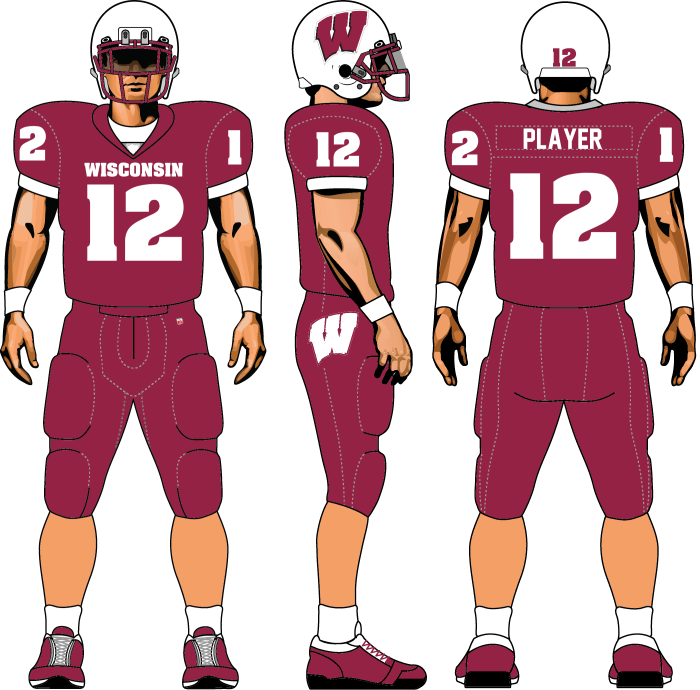

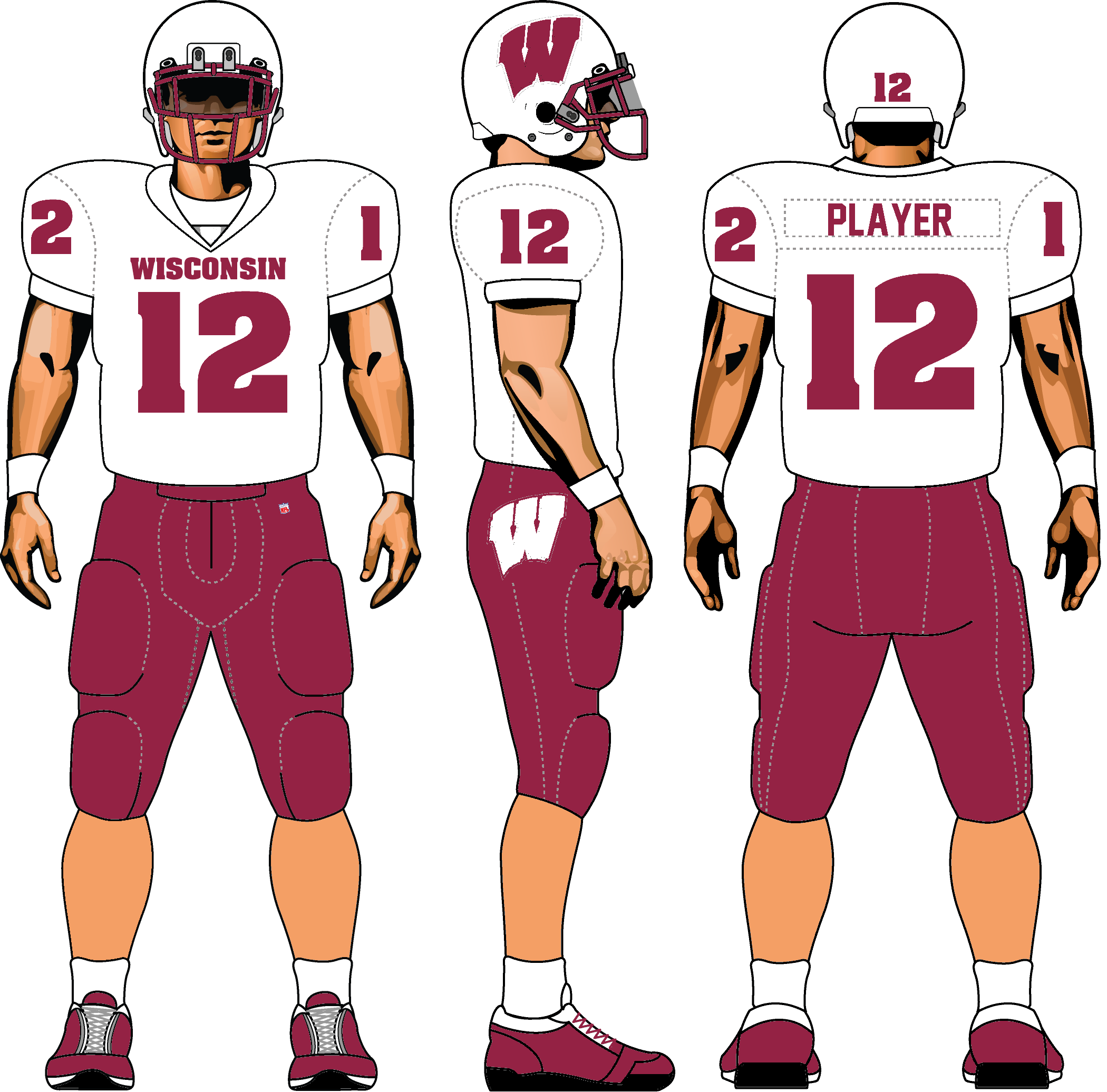
These uniforms (1) are the correct color red, (2) are neater than the awkward-looking stripes of the current uniforms while not being a significant departure from the current uniforms, (3) use the current UW-approved numbers and (4) harken to the 1960 and 1963 Rose Bowl uniforms. Wear the red pants on the road, and your fat players won’t look like Michelin Men.
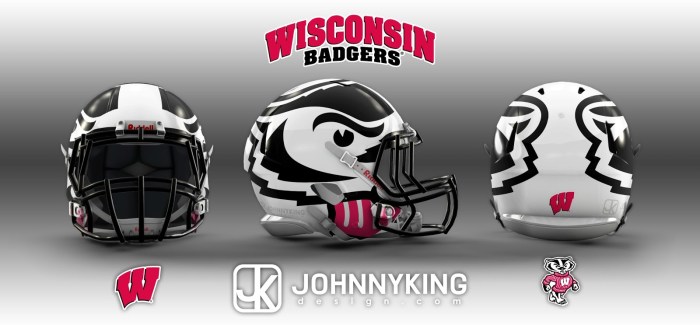
The red helmets coach Gary Andersen introduced appear to have gone nowhere with the fans. Something like these might be better for at least an alternative helmet, though there is far too much black in them.
-
My favorite Ray Charles song was number one today in 1961:
Today in 1969, the BBC’s “Top of the Pops” refused for the first time to play that week’s number one song because of what singers Serge Gainsbourg and Jane Birkin were supposedly doing while recording “Je T’Aime … Moi Non Plus”:
According to a classmate of mine, Madison radio stations play Britain’s number one single today in 1971 too often:



 Steve Prestegard.com: The Presteblog