Skip to content
  • Maybe Americans are smarter than their votes

    May 10, 2016
    US politics

    Five Thirty Eight writes:

    The Democratic primary will technically march on, but Hillary Clinton is almost certainly going to be her party’s nominee. Same with Donald Trump. And voters don’t appear thrilled at the prospect: Clinton and Trump are both more strongly disliked than any nominee at this point in the past 10 presidential cycles.

    Normally, when we talk about candidate likability, we use favorability ratings, which combine “strongly favorable,” “somewhat favorable,” “somewhat unfavorable” and “strongly unfavorable.” But that didn’t work so well in the Republican primary, where Trump was able to win despite arelatively low net favorability rating because his “strongly favorable” rating with Republican primary voters was among the highest in the field. So let’s look at Trump and Clinton’s “strongly favorable” and “strongly unfavorable” ratings among general election voters.

    These are people who don’t just like or dislike the candidates, they reallylike or dislike them.

    No past candidate comes close to Clinton, and especially Trump, in terms of engendering strong dislike a little more than six months before the election.

    Clinton’s average “strongly unfavorable” rating in probability sample pollsfrom late March to late April, 37 percent, is about 5 percentage points higher than the previous high between 1980 and 2012. Trump, though, is on another planet. Trump’s average “strongly unfavorable” rating, 53 percent, is 20 percentage points higher than every candidate’s rating besides Clinton’s. Trump is less disliked than David Duke was when Duke ran for the presidency in 1992, but Duke never came close to winning the nomination. In fact, I’ve seen never anything like Trump’s numbers heading into a general election for someone who is supposed to be competitive.

    Part of the negativity voters feel toward Clinton and Trump probably has something to do with growing political polarization in our country. But polarization doesn’t explain everything. If Trump and Clinton’s strongly unfavorable ratings were simply a byproduct of polarized politics, you’d expect them to have high “strongly favorable” ratings too. They don’t. You can see this in their net strong favorability ratings (the “strongly favorable” rating minus the “strongly unfavorable” rating):

    No major party nominee before Clinton or Trump had a double-digit net negative “strong favorability” rating. Clinton’s would be the lowest ever, except for Trump.

    In previous cycles, the nominees of each party almost always had a strongly favorable and unfavorable rating within 10 percentage points of each other. The only exception was Michael Dukakis in 1988; only 19 percent of Americans felt strongly about Dukakis, either favorably or unfavorably. Over 50 percent of Americans give Clinton and Trump either a “strongly favorable” or “strongly unfavorable” rating, and most of that feeling is negative.

    Maybe it’s because Clinton is a pathological liar …

    … but so is Trump:

    Perhaps some smart person out there can explain how we Americans get past this after Nov. 8, when half or more of the American people will hate whoever wins.


    Share this on …

    • Share on X (Opens in new window) X
    • Share on Facebook (Opens in new window) Facebook
    • Share on LinkedIn (Opens in new window) LinkedIn
    • Email a link to a friend (Opens in new window) Email
    • Print (Opens in new window) Print
    Like Loading…
    No comments on Maybe Americans are smarter than their votes
  • GOP vs. Obama

    May 10, 2016
    US politics

    Charles C.W. Cooke:

    The more I speak to supporters of Donald Trump, the more convinced I become that a significant portion of the man’s apologists are blissfully unaware of what is actually at stake in 2016. Time and time again, I’m told blithely that it doesn’t really matter if Trump loses in 2016, because a loss could not possibly be worse than the status quo. Trump, I am informed, is a “Hail Mary.” And if the Senate and the House go down, too? Well that’s just the price of trying to shake things up.

    This, I’m afraid, is flat-out wrong. Disastrously wrong. Apocalyptically wrong. The Republican party is an imperfect vehicle and it has, of course, made mistakes. But the idea that it hasn’t effectively and consistently opposed President Obama’s agenda is little more than a dangerous and ignorant fiction. Had the GOP not been standing in the way — both from 2008, when it was in the minority everywhere, and from 2010, when it regained the House — the United States would look dramatically different than it does today. Without the GOP manning the barricades, Obamacare could well have been single payer, and, at the very least, the law would have included a “public option.” Without the GOP manning the barricades, we’d have seen a carbon tax or cap-and-trade — or both. Without the GOP manning the barricades, we’d have got union card check, and possibly an amendment to Taft-Hartley that removed from the states their power to pass “right to work” exemptions. Without the GOP standing in the way, we’d now have an “assault weapons” ban, magazine limits, background checks on all private sales, and a de facto national gun registry. And without the GOP standing in the way in the House, we’d have got the very amnesty that the Trump people so fear (it’s fine to oppose Marco Rubio for his support for the “Gang of 8″ bill, but it’s not fine to pretend that it didn’t matter that the Republicans ran the House when the reform bill left the Senate; it did).

    A similar truth obtains at the state level. Had the GOP not taken over the vast majority of the country’s local offices since 2010, we’d have seen significantly less progress on right to work, the protection of life, school choice, and the right to keep and bear arms; we’d have seen a whole host of new sanctuary cities; we’d have had considerably fewer attorneys general rising up against Obama’s executive overreach; and, perhaps most importantly, we’d have seen Obamacare entrenched almost everywhere as state after state chose to expand Medicaid.

    If the general election polls prove to be as accurate as were those that marked the primaries, Donald Trump is likely to lose in a blowout in November, and possibly to take the House and the Senate and a whole host of states with him. Or, put another way, a Trump nomination is likely to return the GOP to where it was back in 2008. And then? Well, then you can count on all of the above items being passed permanently into law.

    Truth be told, the vast majority of the criticisms of the GOP’s performance since 2010 revolve around a willful misunderstanding of how the American constitutional system actually works, often coupled with a preference for saying — absent any real evidence — that Republicans just haven’t “fought hard enough.” Like it or not, the Constitution gives President Obama a veto, and that veto can be used both to kill legislation (as it was when Congress repealed Obamacare and defunded Planned Parenthood last year), and to force a shutdown in such cases as the president dislikes the budget. Simply saying that Congress enjoys the “power of the purse” does not change this. Yes, the House can refuse to include the president’s priorities in its spending bills. But, by virtue of the powers he is granted by the same document, the president can then refuse to sign off on those spending bills. At the moment, at least, Republicans are simply not popular enough to win the fights that result. To acknowledge this is not to “cave,” it is to accept political reality.

    Which is to say that, absent super-majorities in both houses (super-majorities that the Republican party has enjoyed at no time since 2010), the scope for reversing rather than blocking Obama’s gains has always been slim. There is only one way in which the Republican party is going to usher in the sort of sweeping change that its voters would like to see, and that is to add the White House to its collection of public offices. Sadly, the party’s voters seem to have chosen another course. Worse still, they seem to have decided to risk their backstops as well, thereby rendering it likely that a loss at the presidential level will be transmuted into a loss everywhere else. I suspect that those responsible for this approach will only come to understand how utterly foolish is the idea that the GOP doesn’t matter when, having weakened it to an ignominious rump, they are forced to sit and watch in horror as the dam finally breaks.

    One wonders if Trump supporters think Obama should have been overthrown in a coup d’etat.


    Share this on …

    • Share on X (Opens in new window) X
    • Share on Facebook (Opens in new window) Facebook
    • Share on LinkedIn (Opens in new window) LinkedIn
    • Email a link to a friend (Opens in new window) Email
    • Print (Opens in new window) Print
    Like Loading…
    No comments on GOP vs. Obama
  • Presty the DJ for May 10

    May 10, 2016
    Music

    You may remember a couple weeks ago I noted the first known meeting of the Beatles and the Rolling Stones. Today in 1963, upon the advice of George Harrison, Decca Records signed the Rolling Stones to a contract.

    Four years to the day later, Stones Keith Richard, Mick Jagger and Brian Jones celebrated by … getting arrested for drug possession.

    I noted the 54th anniversary May 2 of WLS in Chicago going to Top 40. Today in 1982, WABC in New York (also owned by ABC, as one could conclude from their call letters) played its last record, which was …

    Four years later, the number one song in America was, well, inspired by, though not based on, a popular movie of the day:

    (more…)

    Share this on …

    • Share on X (Opens in new window) X
    • Share on Facebook (Opens in new window) Facebook
    • Share on LinkedIn (Opens in new window) LinkedIn
    • Email a link to a friend (Opens in new window) Email
    • Print (Opens in new window) Print
    Like Loading…
    No comments on Presty the DJ for May 10
  • Obama’s foreign policy, written by a novelist

    May 9, 2016
    media, US politics

    James Taranto:

    David Samuels’s lengthy profile of Ben Rhodes, President Obama’s deputy national security adviser for strategic communication, is meant to be a puff piece. In some ways it is: Rhodes comes across in the New York Times magazine story as very effective and powerful, but also as morally dubious. Even more dubious, in Samuels’s presentation, is the state of American journalism in the Obama era.

    Consider this passage:

    Like Obama, Rhodes is a storyteller who uses a writer’s tools to advance an agenda that is packaged as politics but is often quite personal. He is adept at constructing overarching plotlines with heroes and villains, their conflicts and motivations supported by flurries of carefully chosen adjectives, quotations and leaks from named and unnamed senior officials. He is the master shaper and retailer of Obama’s foreign-policy narratives, at a time when the killer wave of social media has washed away the sand castles of the traditional press. His ability to navigate and shape this new environment makes him a more effective and powerful extension of the president’s will than any number of policy advisers or diplomats or spies.

    To put it less flatteringly, Rhodes is a masterful propagandist. Not that there’s anything wrong with that—an administration, like any large organization, needs people to speak to the public on its behalf, and to engage in such advocacy is not, in itself, dishonorable.

    But lying to the public is. The describes what Samuels calls the “innovative campaign to sell” Obama’s Iran nuclear deal:

    The way in which most Americans have heard the story of the Iran deal presented . . . was largely manufactured for the purpose for selling the deal. Even where the particulars of that story are true, the implications that readers and viewers are encouraged to take away from those particulars are often misleading or false. . . .

    In the narrative that Rhodes shaped, the “story” of the Iran deal began in 2013, when a “moderate” faction inside the Iranian regime led by Hassan Rouhani beat regime “hard-liners” in an election and then began to pursue a policy of “openness,” which included a newfound willingness to negotiate the dismantling of its illicit nuclear-weapons program. The president set out the timeline himself in his speech announcing the nuclear deal on July 14, 2015. . . . While the president’s statement was technically accurate . . . it was also actively misleading, because the most meaningful part of the negotiations with Iran had begun in mid-2012, many months before Rouhani and the “moderate” camp were chosen in an election among candidates handpicked by Iran’s supreme leader, the Ayatollah Ali Khamenei.

    This is the section of Samuel’s profile that has received the most attention, and understandably so. “Congratulations, liberals of the Washington press corps and elite organizations: You’re a bunch of suckers,” writes John Podhoretz in the New York Post. “We all know this because the Obama White House just told us so.” Make that the Obama White House and the New York Times!

    The campaign for the Iran nuclear deal will likely draw comparisons with the Bush administration’s effort to promote military action in Iraq. There are similarities, but also key differences. Before joining the Obama campaign in 2007, Rhodes had worked as “chief note-taker” for the bipartisan Iraq Study Group, where, Samuels writes, he “developed a healthy contempt for the American foreign-policy establishment, including editors and reporters at The New York Times, The Washington Post, The New Yorker and elsewhere, who at first applauded the Iraq war and then sought to pin all the blame on Bush and his merry band of neocons when it quickly turned sour.”

    The Iraq effort was promoted using false information, but even Rhodes does not claim the deception was deliberate. As Samuels writes: “For Rhodes . . . the Iraq war was proof, in black and white, not of the complexity of international affairs or the many perils attendant on political decision-making but of the fact that the decision-makers were morons.” The Obama administration decision-makers aren’t morons, just con artists.

    Not that the public fell for the con. Most polls found the public skeptical of the deal, and the administration succeeded in attracting only the bare minimum of support (all from Democrats) necessary to avoid rejection by Congress. In those respects it is similar to ObamaCare, passed with only Democratic votes and over strong public opposition—and sold, as we now know, though a campaign of deliberate deception that implicated the president himself.

    Another similarity with ObamaCare is that the administration can count on its allies in the press to relay its propaganda uncritically. The Samuels piece describes this in especially stark terms:

    Rhodes has become adept at ventriloquizing many people at once. Ned Price, Rhodes’s assistant, gave me a primer on how it’s done. The easiest way for the White House to shape the news, he explained, is from the briefing podiums, each of which has its own dedicated press corps. “But then there are sort of these force multipliers,” he said, adding, “We have our compadres, I will reach out to a couple people, and you know I wouldn’t want to name them—”

    “I can name them,” I said, ticking off a few names of prominent Washington reporters and columnists who often tweet in sync with White House messaging.

    The fault here lies not with the ventriloquist but with journalists who decide to be dummies.

    Samuels observes that we no longer live “in a world where . . . carrying water for the White House was a cause for shame, no matter which party was in power.” That last qualification is telling: It suggests that the Washington press corps is partisan as well as (selectively) servile, and leaves open the possibility that the journalists would some of their adversary spirit in the event of a Trump administration.

    That seems likely to us, though the effect might be surprisingly similar. Candidate Trump has proved rather effective at using the press’s hostility to advance his “narrative” and “messaging.”

    John Podhoretz is more scathing:

    Congratulations, liberals of the Washington press corps and elite organizations: You’re a bunch of suckers. We all know this because the Obama White House just told us so. …

    The mastermind of the Obama machine is Ben Rhodes, a New Yorker who joined the Obama campaign as a speechwriter in 2007 and has risen to become the most influential foreign-policy hand in the White House.

    Rhodes drips with contempt for almost everyone but his boss. He consigns all those who do not share every particular of the Obama-Rhodes foreign-policy perspective to a gelatinous mass called “The Blob” — including, Samuels writes, Hillary Clinton.

    He thinks as little of them as he does of the journalists he and his team must spoon-feed. “The average reporter we talk to is 27 years old, and their only reporting experience consists of being around political campaigns,” Rhodes says. “They literally know nothing.”

    Then there are others his assistant Ned Price refers to as “force multipliers,” more senior reporters and pundits who parrot what they’re told. “I’ll give them some color,” Price says, using the journalistic term for juicy bits of inside-baseball detail, “and the next thing I know, lots of these guys are in the dot-com publishing space, and have huge Twitter followings, and they’ll be putting this message out on their own.” …

    Why on Earth was such conduct remotely acceptable? Because, Samuels makes clear, Rhodes and Obama believe they’re the only sensible thinkers in America and that there’s no way to get the right things done other than to spin them. “I mean, I’d prefer a sober, reasoned public debate, after which members of Congress reflect and take a vote,” he tells Samuels. “But that’s impossible.”

    Impossible? There was a sober, reasoned public debate over the Iran deal. Its opponents were deadly serious. In the end, 58 senators voted against it on sober, reasoned grounds.

    What the Samuels piece shows is that the Obama administration chose to attempt to get its way not by winning an argument but by bringing an almost fathomless cynicism to bear in manipulating its own clueless liberal fan club.

    The headline says it all in Foreign Policy’s piece, which is not written by a conservative:

    A stunning profile of Ben Rhodes, the asshole who is the president’s foreign policy guru

    The profile of one Ben Rhodes running in Sunday’s New York Times Magazine is not unsympathetic, which makes it all the more devastating.

    Perhaps the key sentence is this: “His lack of conventional real-world experience of the kind that normally precedes responsibility for the fate of nations — like military or diplomatic service, or even a master’s degree in international relations, rather than creative writing — is still startling.”

    Rhodes comes off like a real asshole. This is not a matter of politics — I have voted for Obama twice. Nor do I mind Rhodes’s contempt for many political reporters: “Most of the outlets are reporting on world events from Washington. The average reporter we talk to is 27 years old, and their only reporting experience consists of being around political campaigns. That’s a sea change. They literally know nothing.”

    But, as that quote indicates, he comes off like an overweening little schmuck. This quotation seems to capture his worldview: “He referred to the American foreign policy establishment as the Blob. According to Rhodes, the Blob includes Hillary Clinton, Robert Gates, and other Iraq-war promoters from both parties who now whine incessantly about the collapse of the American security order in Europe and the Middle East.” Blowing off Robert Gates takes nerve.

    I expect cynicism in Washington. But it usually is combined with a lot of knowledge — as with, say, Henry Kissinger. To be cynical and ignorant and to spin those two things into a virtue? That’s industrial-strength hubris. Kind of like what got us into Iraq, in fact.

    Rhodes and others around Obama keep on talking about doing all this novel thinking, playing from a new playbook, bucking the establishment thinking. But if that is the case, why have they given so much foreign policy power to two career hacks who never have had an original thought? I mean, of course, Joe Biden and John Kerry. I guess the answer can only be that those two are puppets, and (as in Biden’s case) are given losing propositions like Iraq to handle.

    Fact check: Obama’s hasn’t been an original foreign policy as much as it has been a politicized foreign policy. And this Rhodes guy reminds me of the Kennedy smart guys who helped get us into the Vietnam War. Does he know how awful he sounds? Kind of like McGeorge Bundy meets Lee Atwater.

    Share this on …

    • Share on X (Opens in new window) X
    • Share on Facebook (Opens in new window) Facebook
    • Share on LinkedIn (Opens in new window) LinkedIn
    • Email a link to a friend (Opens in new window) Email
    • Print (Opens in new window) Print
    Like Loading…
    No comments on Obama’s foreign policy, written by a novelist
  • The failures of government, municipal water edition

    May 9, 2016
    US politics

    The Wall Street Journal:

    The Flint, Michigan, water crisis began in April 2014. This week, two years later, President Obama stood before a crowd of Flint residents and said: “I’ve come here to tell you that I’ve got your back, that we’re paying attention.”

    And people wonder why Bernie Sanders is doing so well.

    This being Barack Obama, he went on, embellishing his commitment to the people of Flint: “I will not rest, and I’m going to make sure that the leaders at every level of government don’t rest until every drop of water that flows to your home is safe to drink and safe to cook with and safe to bathe in, because that’s part of the basic responsibilities of a government in the United States of America.”

    It’s worth parsing that last sentence about clean water being a basic responsibility “of a government in the United States of America.”

    A government? Which government? Flint’s, or Michigan’s, or Barack Obama’s government in Washington?

    After two years, what we know about this water crisis is that governments indeed failed at the local, state and federal level. That may have something to do with why the presidential campaign is overflowing, from right to left, with the idea that government is “failing” in virtually every imaginable respect. So maybe Mr. Obama has touched on something important, to wit: Why is it that government, whether in Flint or Washington, is in a failed state?

    It looks to us as if Mr. Obama sensed that the narrative of the Flint failure was turning against his view of government, so he decided it was necessary to reframe the problem. He told the Flint residents that their crisis was the result of “a larger issue,” which was a certain mindset toward government. “It’s a mindset,” Mr. Obama said, “that believes that less government is the highest good no matter what.”

    No matter what? No one believes that. The anger coursing through the electorate now is over a government that doesn’t seem to be able to do its job—no matter what.

    The Flint water crisis is a case study in government that has become a morass of conflicting regulations and authorities, which in turn ensures that instead of responsibility or accountability—at any level—the agents of government spend their time buck-passing.

    At congressional hearings in March, EPA Administrator Gina McCarthy bucked it over to the state of Michigan, which had given her people “confusing, incomplete and incorrect information.” And so EPA staff was “unable to understand the problem” until it was too late.

    But the EPA Region 5 administrator who later resigned, Susan Hedman, told Congress at that hearing she didn’t intervene in September 2015 for fear the Michigan Attorney General might sue her agency.

    Worth noting here is the Clean Water Rule that Mr. Obama waved into existence in May, and with which the EPA now claims federal dominion over ditches and prairie potholes. But for Flint’s purposes, the more relevant directive is the 1991 federal Lead and Copper Rule, which gave EPA authority to control lead and copper in drinking water. Scientists have been urging a clarifying revision of that rule for the last decade. The update isn’t expected until sometime in 2017.

    As to Ms. Hedman’s fear of being sued by Michigan, maybe she had a point. Another recent Obama directive, the Clean Power Plan, is creating tension with the states and has made state officials defensive about their turf.

    In Mr. Obama’s telling, Flints happen because of a “corrosive attitude” that forces us to “underinvest” in pipes, bridges and roads. That is, any government failure is due to a lack of funding. And the opposite: Spend more and government failure goes away.

    A counter-view would be that “we” underinvest in better infrastructure because entitlement spending has first claim on so much of the revenue taxpayers send government, at every level. In Flint, pensions and retiree health benefits consumed one-third of the city’s budget.

    The default solution, for Mr. Obama, is that Washington’s rainbow pot can be expanded to pay for Flints everywhere. This is what he means by, “I’ve got your back.” The prudent might slip a hand around to their back pocket.

    Last week a supposed conservative claimed the state needs to invest more in its roads. The counterargument is that (1) road construction costs are inflated by the prevailing-wage law, and (2) the state spends tax dollars that are supposed to go to roads to non-roads such as bike trails and mass transit. Near Presteblog World Headquarters the state is spending more than $600,000 to pave (an impermeable surface, of course) and light (with non-solar lights) a bike trail.


    Share this on …

    • Share on X (Opens in new window) X
    • Share on Facebook (Opens in new window) Facebook
    • Share on LinkedIn (Opens in new window) LinkedIn
    • Email a link to a friend (Opens in new window) Email
    • Print (Opens in new window) Print
    Like Loading…
    No comments on The failures of government, municipal water edition
  • Presty the DJ for May 9

    May 9, 2016
    Music

    The number one single today in 1964 was performed by the oldest number one artist to date:

    The number one single today in 1970:

    The number one British single today in 1981:

    (more…)

    Share this on …

    • Share on X (Opens in new window) X
    • Share on Facebook (Opens in new window) Facebook
    • Share on LinkedIn (Opens in new window) LinkedIn
    • Email a link to a friend (Opens in new window) Email
    • Print (Opens in new window) Print
    Like Loading…
    No comments on Presty the DJ for May 9
  • Presty the DJ for May 8

    May 8, 2016
    Music

    Today in 1954, the BBC banned Johnny Ray’s “Such a Night” after complaints about its “suggestiveness.”

    The Brits had yet to see Elvis Presley or Jerry Lee Lewis.

    The number one British single today in 1955:

    The number one single today in 1964 was from a group that had had number one with three different songs for 14 consecutive weeks:

    Today in 1965, what would now be called a “video” was shot in London:

    (more…)

    Share this on …

    • Share on X (Opens in new window) X
    • Share on Facebook (Opens in new window) Facebook
    • Share on LinkedIn (Opens in new window) LinkedIn
    • Email a link to a friend (Opens in new window) Email
    • Print (Opens in new window) Print
    Like Loading…
    No comments on Presty the DJ for May 8
  • Presty the DJ for May 7

    May 7, 2016
    Music

    The number one single today in 1966 was presumably played on the radio on days other than Mondays:

    Today is the anniversary of the last Beatles U.S. single release, “Long and Winding Road” (the theme music of the Schenk Middle School eighth-grade Dessert Dance about this time in 1979):

    The number one album today in 1977 was the Eagles’ “Hotel California”:

    (more…)

    Share this on …

    • Share on X (Opens in new window) X
    • Share on Facebook (Opens in new window) Facebook
    • Share on LinkedIn (Opens in new window) LinkedIn
    • Email a link to a friend (Opens in new window) Email
    • Print (Opens in new window) Print
    Like Loading…
    No comments on Presty the DJ for May 7
  • Country’s top four

    May 6, 2016
    Culture, Music

    Those who are not fans of country music stereotype by creating lyrics like:

    My girl left me
    My dog died
    My truck blew up
    Mama’s goin’ back to prison
    So let’s all get drunk!

    Those who are not fans of today’s country music take the tack with which Peter Lewis begins:

    If you know any fans of classic country music, you know how much we like to complain about today’s country scene and how it’s all gone wrong. What used to be a genre full of wry, bittersweet songs about bad luck and heartbreak, has become an endless series of interchangeable party anthems and syrupy love songs. (You could tell a similar story about R&B, but one problem at a time.)

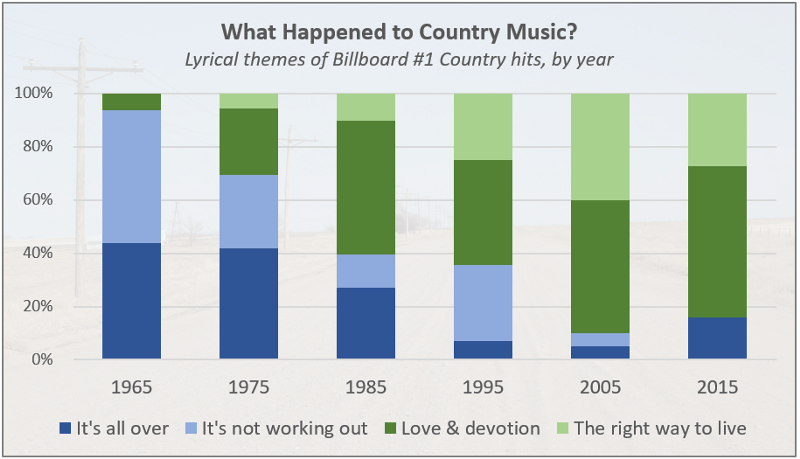
    Of course, in today’s world, no one believes anything without an infographic. And after years of waiting for Nate Silver to take an interest, I realized it was up to me to make one.

    My initial plan was to take the annual Billboard country #1 hits for the last 50 years, tag every song according to its lyrical content, and then chart the trends over time. I quickly realized that would be way too much work, so I decided to use every tenth year as a sample: 2015, 2005, 1995, and so on. I made up abbreviated tags to summarize each type of song as I was going through the lists, like WCYBT (why can’t you be true) or CGOY (can’t get over you), and then tried to hammer them into a few larger categories.

    What I learned is that there are four main types of country song, two sad types and two happy ones. After removing one instrumental track and a few novelty songs (mostly about truck drivers), the rest of the list fell into one of these four buckets:

    1. It’s all over

    What unites these songs is a core theme of regret or loss. Usually what’s over is a romantic relationship, but it could be about anything else good that the singer has lost, often by actively screwing it up. I JustCan’t GetOver You and You’ll Get Yours are among the subtypes; common elements include drinking, cheating, bad luck and bad decisions. In some ways this was once the quintessential country song, the one that spawned jokes like “What do you get when you play a country song backwards? You get your girl back, your job back, your dog, your truck, your house…”

    2. It’s not working out

    Again it’s usually about a relationship, but a little earlier in the timeline — and the main theme here is frustration. Subtypes include You Don’t Love Me Anymore, Why Can’t You Be True, Don’t Leave Me, and Why I’m Leaving You.

    3. Love and devotion

    I actually tagged most of these as SLS, for “sappy love song,” but decided to go with a more neutral label. It’s not so different from the same category of pop song, although some variations are particularly popular with country singers, including They Said We’d Never Make It (who did?), Back Together, and assurances of fidelity (maybe because so many country songs in the first two categories are about cheating).

    4. The right way to live

    The other type of upbeat country song, which turns out to be a key part of this story, has a dominant theme of pride and homespun wisdom. Other than the generic party anthem mentioned above, variants include Things Were Better Back Then, Me and My Rowdy Friends, and Let’s Get Back to Basics.

    Diagnosis

    There are still some common threads in the genre; one thing I noticed in going through the newer songs is how the old lyrical templates from the first two categories have been updated to be more positive. For example, “I’m over you (but clearly I’m not),” as practiced by George Jones, Connie Smith, Tammy Wynette and many others, has had the subtext stripped away in this song by Cole Swindell to become “I’m really over you, time to party” — which completely misses the central joke of the premise (why would you be singing about someone if you’re really over them?) and just comes off as mean-spirited. Or the classic “don’t screw up your life like I did,” often delivered by an old man in a bar (here are two examples from Vern Gosdin and Robbie Fulks), which has been inverted in this song by Lee Brice to make the old man a positive role model and source of trite life advice.

    In any case, that chart pretty much speaks for itself: modern country fans are more interested in healthy relationships, motivational speeches and having a good time than sadness and misery. And on a certain level, who can blame them? But that tiny uptick in sad songs last year offers a ray of hope for those of us who still like a few tears in our beer now and then.

    This also got picked up by MetaFilter, which included this comment …

    A guy I know who works in Nashville pointed out to me that all the producers who were doing hair metal in the ’80s ended up doing country in Nashville in the 2000s. That probably explains something, but I’m not sure what. Maybe nothing? Hard to tell, without doing the same analysis for rock and pop that he’s done with country. I’d be interested in that analysis. Is it just country fans who are getting more into “healthy relationships, motivational speeches and having a good time”, or is it everybody?

    … answered by Lewis:

    Don’t know, but I’ve seen a few studies suggesting that pop songs are actually getting more sad over time, both in terms of more minor-key songs and more downbeat lyrics — here’s a recent podcast that discusses some of the lyrics research — so that could suggest that country music is even more of an outlier. I do feel subjectively though that country’s not the only genre that’s gotten happier, I mention R&B in the post as another potential example..

    Someone else asked about the “damned drinking songs.”

    I spent most of January working with someone who listened to country music all day–specifically, to a station that played the same twenty songs, over and over again, all day every day. It was my first major exposure to modern country music. One of the things that struck me (aside from how abjectly terrible and derivative the songs were), was that roughly half of them included some reference to drinking. Sometimes just a line about getting a beer with the boys, but drinking to forget also seemed to be a reoccurring theme.

    Unrelatedly, there’s an actual song called She Thinks My Tractor’s Sexy and I honestly cannot tell if it’s supposed to be an ironic send-up of country music themes or like a proud embrace of stereotypes or what. I’m guessing proud embrace, but it kinda breaks my irony meter.

    Someone else found the need to inject politics:

    I wonder whether this could be connected to the polarisation in American politics/culture/society between the blue-state/coastal/secular/liberal folks and the red-state/conservative/religious folks, with each consuming their own media and regarding the other as an alien enemy. As such, if country-listening folks are a fortified camp at war against the other side, country music (the musical genre that defines them) could be pressed into service to rally the troops and reinforce shared values that differentiate Us from Them; something that songs about The Right Way To Live are much more suited for than melancholy ballads about having lost everything.

    This is probably a minority opinion today, but current country music is, to me, much better to listen to than steel guitars, fiddles and twangy singing of the heartbreaks and sucky life of the songwriter. (I am also, as you know, one of those cretins who doesn’t generally listen to the words of songs, which is how I am able to listen to music that doesn’t correspond to my worldview but sounds good to me.) Life is hard enough without being reminded of it on every song on the radio or your favorite MP3 playback device. I prefer to listen to music that doesn’t make me want to drive into a bridge support at 100 mph.

    It’s not as if rock or pop are suffused with originality either. At least half, and probably more than half, of rock and pop songs since the beginning of the rock era in the 1950s have to do with love and/or sex, including lack thereof or end thereof. The other half is comprised of partying, cars (’60s), protest (late ’60s and early ’70s), shaking your booty (’70s), angst (particularly ’80s and ’90s) and weird stuff (“MacArthur Park, “Mexican Radio,” etc.).

    There may be a legitimate observation about how country songs sound alike …

    … but country is far from the only offender in that regard:

    It may also be true that country singers are more likely to get airplay if they look like, say, Carrie Underwood or Miranda Lambert instead of Betty Friedan or Hillary Clinton. This is not a new thing. For that matter, none of the male country singers of today look like Willie Nelson or Mick Jagger.

    Share this on …

    • Share on X (Opens in new window) X
    • Share on Facebook (Opens in new window) Facebook
    • Share on LinkedIn (Opens in new window) LinkedIn
    • Email a link to a friend (Opens in new window) Email
    • Print (Opens in new window) Print
    Like Loading…
    No comments on Country’s top four
  • The cultural cold civil war, fiction edition

    May 6, 2016
    Culture, US politics

    Because apparently everything today must be political, someone named Machine Trooper writes:

    There is a surging groundswell in the grass roots of America. I’ve noticed it (I daresay I’ve been a part of it) for the last few years. It is pushing back against the left-wing cultural svengalis and their Narrative. It’s not huge or sensational (yet), but it is widespread.

    Anti-war protestors in the 1960s had a saying that went something like this: “What if there was a war, but nobody showed up?” Well, I’ll tell you what happens when one side doesn’t show up: that side loses.

    For generations centrists and everyone right-of-center simply have not shown up for the culture wars. Predictably, the leftists have blitzed right through battlefields of opinion and ideas unopposed–like the Red Army rolling through eastern Poland in 1939–so that their monopoly on the flow of information, including creative expression, was ironclad.

    It took some irritated computer nerds to show us that the left is far from invincible.

    In fact, #gamergate showed the world that the SJWs, feminists and Marxists (cultural and otherwise) are not only vulnerable, they’ve become arrogant from never being challenged for so long, and prove to be weak, inept cowards when confronted by a smart, determined opposition. They are beatable. Very much so.

    But you have to actually show up to the fight if you’re going to beat them.

    In greater and greater numbers, the right wing is finally showing up to fight in the war for the mind and soul of our posterity.

    One of the armies joining battle now is the Conservative/Libertarian Fiction Alliance.

    Looking for a good book to read, but tired of sucker punches and nihilistic misery when all you want to do is relax? You’re in luck … Behold! A gallery of conservative and libertarian-friendly fiction.

    The CLFA has expanded from Facebook into their own website, and are compiling a wish-list library of books written by non-leftists (or at least sans the ubiquitous leftist Narrative rammed down our throat at every turn).

    Books need not be political or moral message fiction; we’re mainly looking for good, entertaining stories that happen to embrace things we love, like individualism, self-reliance, the importance of liberty, and so on. Sometimes these books are even written by self-proclaimed leftist authors. But whatever – a good story is a good story!

    Hoowah. At least one of my favorite books was written by an author who I later met, and it turned out we were quite at odds, politically.But by whatever arrangement of circumstances, he told a great story.

    It’s nice to read a novel with a political slant that cuts against The Narrative. But often, it’s even nicer to read a book that’s apolitical–no message or counter-message; just a good story, told well. But even those are more and more difficult to find, so it pleases me that such books won’t be excluded from the CLFA gallery.

    (BTW, have you ever noticed how right-wingers are open about their political biases, but left-wingers pretend to be impartial centrists and throw a fit when you call them out ontheir biases? Hmm…there’s at least one blog post in that curious state of things.)

    CLFA’s gallery of fiction is in its infancy right now, but already it is proving  to be as diverse as the right wing writ large.  Authors run the gamut from “social libertarians” and “establishment conservatives” all the way to radical “religious right” rebels like me. You’ll find not only tradpubbed popular authors like Larry Correia and Andrew Klavan, but plenty of indie authors you’ve been missing out on until now.

    The CLFA has also organized its own award. I believe this is the second year of said award. The finalists have been chosen for 2015 and voting begins in June to determine the winner.

    WWII was the last time the USA fought a war with the intention of pursuing absolute victory. It wasn’t just the soldiers, sailors and marines committed to the war effort–the wives, children, parents, grandparents and 4Fs also did what they could. They bought War Bonds, collected cans, organized bake sales, wrote letters to GIs overseas, and fed them or danced with them when they came home.

    If you are a reader, consider doing your part on the home front of the Culture War. When you’re looking for a good book, go somewhere like the CLFA first. (And buy using their links, to help them offset the cost of their website–and provide them incentive for the time and effort they put into doing this for us.) If you’re going to spend your “voting dollars” on a book anyway, why not vote for books written by authors who are fighting to take our culture back?  When you discover a good read, don’t just finish it and go about your business–write a review and increase the book/author’s chances of being discovered by others who would appreciate it like you did. Then tell another reader about your discovery.

    It’s natural to assume that documentary films and nonfiction books would be the most influential weapons in the culture war, but they’re not. Entertainment, in its various forms (fiction, movies, music, etc.) has been an enormous influence on how people think. Consider which political faction has dominated entertainment; then examine the state of our culture today. If that dominance isn’t challenged now, while it’s still possible, you are only going to get more of the same and worse…but to a greater degree.

    The soldiers on our side in this war are marching to the sound of the guns. Your support would be dearly appreciated, down in the trenches.

    There is a kind of joke called the “Russian reversal,” overattributed to Russian comedian Yakov Smirnoff, that goes something like: “In America, you pick government; in Soviet Russia, government picks you!” We conservatives and libertarians may not have chosen to participate in a cultural civil war, but as Gen. Douglas MacArthur was fond of saying, in war there is no substitute for victory.


    Share this on …

    • Share on X (Opens in new window) X
    • Share on Facebook (Opens in new window) Facebook
    • Share on LinkedIn (Opens in new window) LinkedIn
    • Email a link to a friend (Opens in new window) Email
    • Print (Opens in new window) Print
    Like Loading…
    No comments on The cultural cold civil war, fiction edition
Previous Page
1 … 645 646 647 648 649 … 1,057
Next Page

Website Powered by WordPress.com.

Steve Prestegard.com: The Presteblog

The thoughts of a journalist/libertarian–conservative/Christian husband, father, Eagle Scout and aficionado of obscure rock music. Thoughts herein are only the author’s and not necessarily the opinions of his family, friends, neighbors, church members or past, present or future employers.

  • Steve
    • About, or, Who is this man?
    • Facebook
    • Twitter
    • Adventures in ruralu0026nbsp;inkBack in June 2009, I was driving somewhere through a rural area. And for some reason, I had a flashback to two experiences in my career about that time of year many years ago. In 1988, eight days after graduating from the University of Wisconsin, I started work at the Grant County Herald Independent in Lancaster as a — well, the — reporter. Four years after that, on my 27th birthday, I purchased, with a business partner, the Tri-County Press in Cuba City, my first business venture. Both were experiences about which Wisconsin author Michael Perry might write. I thought about all this after reading a novel, The Deadline, written by a former newspaper editor and publisher. (Now who would write a novel about a weekly newspaper?) As a former newspaper owner, I picked at some of it — why finance a newspaper purchase through the bank if the seller is willing to finance it? Because the mean bank lender is a plot point! — and it is much more interesting than reality, but it is very well written, with a nicely twisting plot, and quite entertaining, again more so than reality. There is something about that first job out of college that makes you remember it perhaps more…
    • Adventures in radioI’ve been in the full-time work world half my life. For that same amount of time I’ve been broadcasting sports as a side interest, something I had wanted to since I started listening to games on radio and watching on TV, and then actually attending games. If you ask someone who’s worked in radio for some time about the late ’70s TV series “WKRP in Cincinnati,” most of them will tell you that, if anything, the series understated how wacky working in radio can be. Perhaps the funniest episode in the history of TV is the “WKRP” episode, based on a true story, about the fictional radio station’s Thanksgiving promotion — throwing live turkeys out of a helicopter under the mistaken belief that, in the words of WKRP owner Arthur Carlson, “As God is my witness, I thought turkeys could fly.” [youtube=http://www.youtube.com/watch?v=ST01bZJPuE0] I’ve never been involved in anything like that. I have announced games from the roofs of press boxes (once on a nice day, and once in 50-mph winds), from a Mississippi River bluff (more on that later), and from the front row of the second balcony of the University of Wisconsin Fieldhouse (great view, but not a place to go if…
    • “Good morning/afternoon/evening, ________ fans …”
    • My biggest storyEarlier this week, while looking for something else, I came upon some of my own work. (I’m going to write a blog someday called “Things I Found While Looking for Something Else.” This is not that blog.) The Grant County Sheriff’s Department, in the county where I used to live, has a tribute page to the two officers in county history who died in the line of duty. One is William Loud, a deputy marshal in Cassville, shot to death by two bank robbers in 1912. The other is Tom Reuter, a Grant County deputy sheriff who was shot to death at the end of his 4 p.m.-to-midnight shift March 18, 1990. Gregory Coulthard, then a 19-year-old farmhand, was convicted of first-degree intentional homicide and is serving a life sentence, with his first eligibility for parole on March 18, 2015, just 3½ years from now. I’ve written a lot over the years. I think this, from my first two years in the full-time journalism world, will go down as the story I remember the most. For journalists, big stories contain a paradox, which was pointed out in CBS-TV’s interview of Andy Rooney on his last “60 Minutes” Sunday. Morley Safer said something along the line…
  • Food and drink
    • The Roesch/Prestegard familyu0026nbsp;cookbookFrom the family cookbook(s) All the families I’m associated with love to eat, so it’s a good thing we enjoy cooking. The first out-of-my-house food memory I have is of my grandmother’s cooking for Christmas or other family occasions. According to my mother, my grandmother had a baked beans recipe that she would make for my mother. Unfortunately, the recipe seems to have  disappeared. Also unfortunately, my early days as a picky, though voluminous, eater meant I missed a lot of those recipes made from such wholesome ingredients as lard and meat fat. I particularly remember a couple of meals that involve my family. The day of Super Bowl XXXI, my parents, my brother, my aunt and uncle and a group of their friends got together to share lots of food and cheer on the Packers to their first NFL title in 29 years. (After which Jannan and I drove to Lambeau Field in the snow,  but that’s another story.) Then, on Dec. 31, 1999, my parents, my brother, my aunt and uncle and Jannan and I (along with Michael in utero) had a one-course-per-hour meal to appropriately end years beginning with the number 1. Unfortunately I can’t remember what we…
    • SkålI was the editor of Marketplace Magazine for 10 years. If I had to point to one thing that demonstrates improved quality of life since I came to Northeast Wisconsin in 1994, it would be … … the growth of breweries and  wineries in Northeast Wisconsin. The former of those two facts makes sense, given our heritage as a brewing state. The latter is less self-evident, since no one thinks of Wisconsin as having a good grape-growing climate. Some snobs claim that apple or cherry wines aren’t really wines at all. But one of the great facets of free enterprise is the opportunity to make your own choice of what food and drink to drink. (At least for now, though some wish to restrict our food and drink choices.) Wisconsin’s historically predominant ethnic group (and our family’s) is German. Our German ancestors did unfortunately bring large government and high taxes with them, but they also brought beer. Europeans brought wine with them, since they came from countries with poor-quality drinking water. Within 50 years of a wave of mid-19th-century German immigration, brewing had become the fifth largest industry in the U.S., according to Maureen Ogle, author of Ambitious Brew: The Story of American Beer. Beer and wine have…
  • Wheels
    • America’s sports carMy birthday in June dawned without a Chevrolet Corvette in front of my house. (The Corvette at the top of the page was featured at the 2007 Greater Milwaukee Auto Show. The copilot is my oldest son, Michael.) Which isn’t surprising. I have three young children, and I have a house with a one-car garage. (Then again, this would be more practical, though a blatant pluck-your-eyes-out violation of the Corvette ethos. Of course, so was this.) The reality is that I’m likely to be able to own a Corvette only if I get a visit from the Corvette Fairy, whose office is next door to the Easter Bunny. (I hope this isn’t foreshadowing: When I interviewed Dave Richter of Valley Corvette for a car enthusiast story in the late great Marketplace Magazine, he said that the most popular Corvette in most fans’ minds was a Corvette built during their days in high school. This would be a problem for me in that I graduated from high school in 1983, when no Corvette was built.) The Corvette is one of those cars whose existence may be difficult to understand within General Motors Corp. The Corvette is what is known as a “halo car,” a car that drives people into showrooms, even if…
    • Barges on fouru0026nbsp;wheelsI originally wrote this in September 2008.  At the Fox Cities Business Expo Tuesday, a Smart car was displayed at the United Way Fox Cities booth. I reported that I once owned a car into which trunk, I believe, the Smart could be placed, with the trunk lid shut. This is said car — a 1975 Chevrolet Caprice coupe (ours was dark red), whose doors are, I believe, longer than the entire Smart. The Caprice, built down Interstate 90 from us Madisonians in Janesville (a neighbor of ours who worked at the plant probably helped put it together) was the flagship of Chevy’s full-size fleet (which included the stripper Bel Air and middle-of-the-road Impala), featuring popular-for-the-time vinyl roofs, better sound insulation, an upgraded cloth interior, rear fender skirts and fancy Caprice badges. The Caprice was 18 feet 1 inch long and weighed 4,300 pounds. For comparison: The midsize Chevrolet of the ear was the Malibu, which was the same approximate size as the Caprice after its 1977 downsizing. The compact Chevrolet of the era was the Nova, which was 200 inches long — four inches longer than a current Cadillac STS. Wikipedia’s entry on the Caprice has this amusing sentence: “As fuel economy became a bigger priority among Americans…
    • Behind the wheel
    • Collecting only dust or rust
    • Coooooooooooupe!
    • Corvettes on the screen
    • The garage of misfit cars
    • 100 years (and one day) of our Chevrolets
    • They built Excitement, sort of, once in a while
    • A wagon by any otheru0026nbsp;nameFirst written in 2008. You will see more don’t-call-them-station-wagons as you drive today. Readers around my age have probably had some experience with a vehicle increasingly rare on the road — the station wagon. If you were a Boy Scout or Girl Scout, or were a member of some kind of youth athletic team, or had a large dog, or had relatives approximately your age, or had friends who needed to be transported somewhere, or had parents who occasionally had to haul (either in the back or in a trailer) more than what could be fit inside a car trunk, you (or, actually, your parents) were the target demographic for the station wagon. “Station wagons came to be like covered wagons — so much family activity happened in those cars,” said Tim Cleary, president of the American Station Wagon Owners Association, in Country Living magazine. Wagons “were used for everything from daily runs to the grocery store to long summer driving trips, and while many men and women might have wanted a fancier or sportier car, a station wagon was something they knew they needed for the family.” The “station wagon” originally was a vehicle with a covered seating area to take people between train stations…
    • Wheels on theu0026nbsp;screenBetween my former and current blogs, I wrote a lot about automobiles and TV and movies. Think of this post as killing two birds (Thunderbirds? Firebirds? Skylarks?) with one stone. Most movies and TV series view cars the same way most people view cars — as A-to-B transportation. (That’s not counting the movies or series where the car is the plot, like the haunted “Christine” or “Knight Rider” or the “Back to the Future” movies.) The philosophy here, of course, is that cars are not merely A-to-B transportation. Which disqualifies most police shows from what you’re about to read, even though I’ve watched more police video than anything else, because police cars are plain Jane vehicles. The highlight in a sense is in the beginning: The car chase in my favorite movie, “Bullitt,” featuring Steve McQueen’s 1968 Ford Mustang against the bad guys’ 1968 Dodge Charger: [youtube=http://www.youtube.com/watch?v=GMc2RdFuOxIu0026amp;fmt=18] One year before that (but I didn’t see this until we got Telemundo on cable a couple of years ago) was a movie called “Operación 67,” featuring (I kid you not) a masked professional wrestler, his unmasked sidekick, and some sort of secret agent plot. (Since I don’t know Spanish and it’s not…
    • While riding in my Cadillac …
  • Entertainments
    • Brass rocksThose who read my former blog last year at this time, or have read this blog over the past months, know that I am a big fan of the rock group Chicago. (Back when they were a rock group and not a singer of sappy ballads, that is.) Since rock music began from elements of country music, jazz and the blues, brass rock would seem a natural subgenre of rock music. A lot of ’50s musical acts had saxophone players, and some played with full orchestras … [youtube=http://www.youtube.com/watch?v=9CPS-WuUKUE] … but it wasn’t until the more-or-less simultaneous appearances of Chicago and Blood Sweat u0026amp; Tears on the musical scene (both groups formed in 1967, both had their first charting singles in 1969, and they had the same producer) that the usual guitar/bass/keyboard/drum grouping was augmented by one or more trumpets, a sax player and a trombone player. While Chicago is my favorite group (but you knew that already), the first brass rock song I remember hearing was BSu0026amp;T’s “Spinning Wheel” — not in its original form, but on “Sesame Street,” accompanied by, yes, a giant spinning wheel. [youtube=http://www.youtube.com/watch?v=qi9sLkyhhlE] [youtube=http://www.youtube.com/watch?v=OxWSOuNsN20] [youtube=http://www.youtube.com/watch?v=U9U34uPjz-g] I remember liking Chicago’s “Just You ‘n Me” when it was released as a single, and…
    • Drive and Eat au0026nbsp;RockThe first UW home football game of each season also is the opener for the University of Wisconsin Marching Band, the world’s finest college marching band. (How the UW Band has not gotten the Sudler Trophy, which is to honor the country’s premier college marching bands, is beyond my comprehension.) I know this because I am an alumnus of the UW Band. I played five years (in the last rank of the band, Rank 25, motto: “Where Men Are Tall and Run-On Is Short”), marching in 39 football games at Camp Randall Stadium, the Hubert H. Humphrey Metrodome in Minneapolis, Michigan Stadium in Ann Arbor, Memorial Stadium at the University of Illinois (worst artificial turf I had ever seen), the University of Nevada–Las Vegas’ Sam Boyd Silver Bowl, the former Dyche Stadium at Northwestern University, five high school fields and, in my one bowl game, Legion Field in Birmingham, Ala., site of the 1984 Hall of Fame Bowl. The UW Band was, without question, the most memorable experience of my college days, and one of the most meaningful experiences of my lifetime. It was the most physical experience of my lifetime, to be sure. Fifteen minutes into my first Registration…
    • Keep on rockin’ in the freeu0026nbsp;worldOne of my first ambitions in communications was to be a radio disc jockey, and to possibly reach the level of the greats I used to listen to from WLS radio in Chicago, which used to be one of the great 50,000-watt AM rock stations of the country, back when they still existed. (Those who are aficionados of that time in music and radio history enjoyed a trip to that wayback machine when WLS a Memorial Day Big 89 Rewind, excerpts of which can be found on their Web site.) My vision was to be WLS’ afternoon DJ, playing the best in rock music between 2 and 6, which meant I wouldn’t have to get up before the crack of dawn to do the morning show, yet have my nights free to do whatever glamorous things big-city DJs did. Then I learned about the realities of radio — low pay, long hours, zero job security — and though I have dabbled in radio sports, I’ve pretty much cured myself of the idea of working in radio, even if, to quote WAPL’s Len Nelson, “You come to work every day just like everybody else does, but we’re playing rock ’n’ roll songs, we’re cuttin’ up.…
    • Monday on the flight line, not Saturday in the park
    • Music to drive by
    • The rock ofu0026nbsp;WisconsinWikipedia begins its item “Music of Wisconsin” thusly: Wisconsin was settled largely by European immigrants in the late 19th century. This immigration led to the popularization of galops, schottisches, waltzes, and, especially, polkas. [youtube=http://www.youtube.com/watch?v=yl7wCczgNUc] So when I first sought to write a blog piece about rock musicians from Wisconsin, that seemed like a forlorn venture. Turned out it wasn’t, because when I first wrote about rock musicians from Wisconsin, so many of them that I hadn’t mentioned came up in the first few days that I had to write a second blog entry fixing the omissions of the first. This list is about rock music, so it will not include, for instance, Milwaukee native and Ripon College graduate Al Jarreau, who in addition to having recorded a boatload of music for the jazz and adult contemporary/easy listening fan, also recorded the theme music for the ’80s TV series “Moonlighting.” Nor will it include Milwaukee native Eric Benet, who was for a while known more for his former wife, Halle Berry, than for his music, which includes four number one singles on the Ru0026amp;B charts, “Spend My Life with You” with Tamia, “Hurricane,” “Pretty Baby” and “You’re the Only One.” Nor will it include Wisconsin’s sizable contributions to big…
    • Steve TV: All Steve, All the Time
    • “Super Steve, Man of Action!”
    • Too much TV
    • The worst music of allu0026nbsp;timeThe rock group Jefferson Airplane titled its first greatest-hits compilation “The Worst of Jefferson Airplane.” Rolling Stone magazine was not being ironic when it polled its readers to decide the 10 worst songs of the 1990s. I’m not sure I agree with all of Rolling Stone’s list, but that shouldn’t be surprising; such lists are meant for debate, after all. To determine the “worst,” songs appropriate for the “Vinyl from Hell” segment that used to be on a Madison FM rock station, requires some criteria, which does not include mere overexposure (for instance, “Macarena,” the video of which I find amusing since it looks like two bankers are singing it). Before we go on: Blog posts like this one require multimedia, so if you find a song you hate on this blog, I apologize. These are also songs that I almost never listen to because my sound system has a zero-tolerance policy — if I’m listening to the radio or a CD and I hear a song I don’t like, it’s, to quote Bad Company, gone gone gone. My blonde wife won’t be happy to read that one of her favorite ’90s songs, 4 Non Blondes’ “What’s Up,” starts the list. (However,…
    • “You have the right to remain silent …”
  • Madison
    • Blasts from the Madison media past
    • Blasts from my Madison past
    • Blasts from our Madison past
    • What’s the matter with Madison?
    • Wisconsin – Madison = ?
  • Sports
    • Athletic aesthetics, or “cardinal” vs. “Big Red”
    • Choose your own announcer
    • La Follette state 1982 (u0022It was 30 years ago todayu0022)
    • The North Dakota–Wisconsin Hockey Fight of 1982
    • Packers vs. Brewers
  • Hall of Fame
    • The case(s) against teacher unions
    • The Class of 1983
    • A hairy subject, or face the face
    • It’s worse than you think
    • It’s worse than you think, 2010–11 edition
    • My favorite interview subject of all time
    • Oh look! Rural people!
    • Prestegard for president!
    • Unions vs. the facts, or Hiding in plain sight
    • When rhetoric goes too far
Privacy & Cookies: This site uses cookies. By continuing to use this website, you agree to their use.
To find out more, including how to control cookies, see here: Cookie Policy
  • Subscribe Subscribed
    • Steve Prestegard.com: The Presteblog
    • Join 195 other subscribers
    • Already have a WordPress.com account? Log in now.
    • Steve Prestegard.com: The Presteblog
    • Subscribe Subscribed
    • Sign up
    • Log in
    • Report this content
    • View site in Reader
    • Manage subscriptions
    • Collapse this bar
%d