Skip to content
  • Presty the DJ for Dec. 8

    December 8, 2016
    Music

    Today in 1940, the first NFL championship game was broadcast nationally on Mutual radio. Before long, Mutual announcer Red Barber probably wondered why they’d bothered.

    Today in 1963, Frank Sinatra Jr. was kidnapped from a Lake Tahoe hotel. He was released two days later after his father paid $240,000 ransom. The kidnappers were arrested and sentenced to prison.

    The top selling 8-track today in 1971:

    (more…)

    Share this on …

    • Share on X (Opens in new window) X
    • Share on Facebook (Opens in new window) Facebook
    • Share on LinkedIn (Opens in new window) LinkedIn
    • Email a link to a friend (Opens in new window) Email
    • Print (Opens in new window) Print
    Like Loading…
    No comments on Presty the DJ for Dec. 8
  • 75 years ago today

    December 7, 2016
    History, media

    Share this on …

    • Share on X (Opens in new window) X
    • Share on Facebook (Opens in new window) Facebook
    • Share on LinkedIn (Opens in new window) LinkedIn
    • Email a link to a friend (Opens in new window) Email
    • Print (Opens in new window) Print
    Like Loading…
    No comments on 75 years ago today
  • Uniquely American war heroes

    December 7, 2016
    History

    Today is the 75th anniversary of the Japanese attack on Pearl Harbor.

    The Pearl Harbor attack is in the beginning of one of my favorite World War II movies, “In Harm’s Way.” The film depicts, during the attack, a Navy lieutenant junior grade, the most senior person on his ship (because everyone more senior planned to show up late after a Saturday night officers’ dance), ordering his ship to get out of the harbor and not pick up his superior officers.

    If that scene were just a figment of the writer’s imagination, it still would have captured the American viewer’s imagination, because Americans have a soft spot for those who bend, twist or even ignore orders from above for a better reason. The most contemptuous feature of World War II atrocities was probably those in Nazi Germany who facilitated the Holocaust on the grounds that they were just following orders.

    But the scene in “In Harm’s Way” was based on two actual incidents at Pearl Harbor. Professor Walter’s History Lesson explains the first:

    The USS Aylwin (DD-355) was moored with her squadron, only a small boiler operating to provide power for auxiliary services.  About half of her crew was on leave that Sunday morning when, at 7:55 a.m., the sound of airplane engines caught everyone’s attention. Three minutes later the skeleton crew of the Aylwin returned fire.  Five minutes later the “black gang” lit the main two boilers, bringing them fully online in 15 minutes.  At 8:29 a.m. the commander of the fleet ordered all able ships to get underway.  At 8:50 a.m. a Japanese bomb went off 75 yards from the Aylwin’s bow.  Eight minutes later the Aylwin, leaving her stern wire and anchor chain behind, left for the open sea.

    The 50% skeleton crew performed admirably in taking the vessel out to sea.  The only officers on board were four ensigns.  The senior most was Ensign Stanley B. Caplan, who had only served at sea for eight months.  They guided the ship out while maintaining continuous fire.  As they left Pearl Harbor the men topside were able to see a small motor launch 1,000 yards off the entrance buoys. In that launch they saw their captain, Lt. Commander Robert H. Rodgers, and other officers of the Aylwin in a small WWI destroyer following them.  Orders were to make way for the open sea so they could not slow down.  The officers were left behind on the their small vessel.  In the battle one of the screws was damaged.  For 36 hours the ship patrolled and worked chasing down a potential submarine before heading back to dock for repairs on December 12.  Lt. Commander Rodgers spoke highly of his men who continued without him:

    The conduct of the personnel was magnificent…. Every man more than did his job and was eager to fight.”

    Then went on to speak of Ensign Caplan:

    “The conduct (of this man) … in superbly taking command for 36 hours during war operations of the severest type is a most amazing and outstanding achievement.”

    Nate Nickel adds:

    When the Japanese attack began, Ensign Caplan suddenly found himself in the middle of an unexpected war, with only a skeleton crew and no commanding officer. He was now the person who had to make the decisions and he had to make them fast.

    The first thing Ensign Caplan did, without being told by any superior officer, was to order the ship’s boilers started so that they could get under way. Some 30 minutes later, he received formal orders to get the ship steaming and out of Pearl Harbor as soon as possible.

    Since the boilers had already been started, the Aylwin was able to start moving, avoiding a nearby bomb blast in the process. In fact, the ship left the mooring pier so quickly that the anchor chain and a stern line were torn off. Other ships were not so fortunate that day.

    As the ship was leaving the harbor, under full aerial attack, the crew saw a strange sight. Trailing about a thousand yards behind the ship was a small motorboat carrying the Aylwin’s commanding officer and the other senior officers, who had scrambled after the attack began to join their shipmates.

    The officers were waving frantically for the ship to stop so they could get on board and resume command. (If you’ve ever watched the 1965 movie In Harm’s Way starring John Wayne, there is an early scene in it that’s based on this event.)

    So what did the inexperienced young officer do when faced with this situation? Did he stop and wait for his commander to get on board? Under normal conditions, that decision would not have required much thought, especially if Ensign Caplan valued his future Navy career. In this circumstance, however, doing so would have jeopardized both the ship and the lives of the crew.

    As a result, Ensign Caplan never hesitated in making his decision and continued at full speed toward the ocean, leaving the motorboat and its occupants bouncing around helplessly in his wake. The officers eventually had to quit the chase and later unceremoniously boarded another ship.

    We can only guess, but it’s probably a safe bet that the commander and his senior officers used some choice language while watching their young subordinate leave them all behind without a second thought. Unlike many ships that day, however, the Aylwin made it safely out of Pearl Harbor, survived the attack unscathed, and was ready for further combat operations in the Pacific Ocean. …

    So, what happened to Ensign Caplan? His commanding officer, the same one left behind waving and yelling for him to stop, recommended him for special commendation. He specifically cited Ensign Caplan for “superbly taking command” and his conduct aboard the USS Aylwin as “a most amazing and outstanding achievement.”

    Caplan wasn’t the only ensign suddenly in command of a destroyer. Seymour Brody writes about the USS Blue:

    Ensigns Nathan Asher and Milton Moldane were aboard the U.S. S. BLUE, a destroyer that was at sea protecting the shores of Pearl Harbor. That morning, the BLUE was docked for refueling. The skipper of the destroyer was on shore and Ensign Asher was in charge of the ship.

    Ensign Moldane was a graduate of the Washington University Law School and a native of St. Louis. Ensign Asher was a graduate of the Naval Academy at Annapolis. Both men were having breakfast when they were informed that the Japanese had attacked the battleships anchored at Ford Island in Pearl Harbor and that they were to take the BLUE out to sea.

    Asher directed the crew in heading the BLUE out. Moldane took charge of the forward machine guns and watched the ARIZONA, a battleship, take a direct hit and sink. He describes what he saw as the BLUE battled its way out to sea:

    “I could see Japanese planes coming down about 30 or 40 feet over our heads. dropping bombs and shooting at anything that happened to come along. Our ship kept firing at the planes as it headed out to sea. I went out to the bridge to help Asher when we both saw a Japanese plane that the BLUE’s guns had hit go into a pineapple field. The men gave out a cheer when they saw the plane burst into flames. It took the BLUE one hour and a half to reach the open seas.”

    Anthem Jim adds this detail:

    Both the Commanding Officer and the Executive Officer of USS Blue were ashore for the weekend. The Commanding Officer had directed in the Night Order Book, that under no circumstances whatsoever was the ship to get underway without either he, or the Executive Officer being onboard.

    Said commanding officer later wrote:

    Attention is invited to paragraph 3 of the basic letter, to which should be added Ensign N.F. Asher, U.S.N., who, as acting commanding officer from the commencement of the raid until the ship returned to Pearl Harbor the following evening, performed most commendably and efficiently in assuming prompt offensive action, conducting emergency sortie under existing trying conditions, attacking submarine contacts in offshore area, screening heavy ship proceeding to attack a reportedly greatly superior force off Barber’s Point, and subsequently standing watch and watch as O.O.D. for a period of 30 hours at sea.
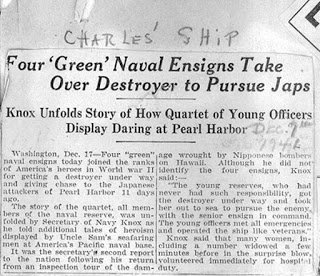
    Anthem Jim, a civilian coworker of Asher’s, adds:

    Over time his associates all came to realize that he had absolutely expended his entire lifetime supply of adrenaline during the day of 7 December 1941, at a place called Ford Island, Pearl Harbor, Hawaii. Nothing, and I mean absolutely NOTHING, could phase Fred!

    Meanwhile, obviously the Navy saw command potential in Ensign Caplan, who became a lieutenant and came to command the destroyer USS Long. Wartime Express explains what happened three years later:

    They were on screening station when that suicide plane suddenly jumped down at them from a low cloud bank and landed right smack on the deck. There wasn’t much left of the plane, but the gas caught fire; the bombs the pilot hadn’t dropped yet exploded, and in less than a minute the Long was sheathed in flames from stem to stern. With a bone in her teeth the Hovey raced to the aid of her sister, but even her hoses, added to those of the long, couldn’t stem the fire. After a heroic fight, Lieut. Stanley Caplan, the skipper of the Long, had to give the order to abandon ship. The Hovey had meanwhile taken off the casualties; now she took aboard the rest of the survivors.

    Still, Lt. Caplan did not want to leave his ship, and asked Lieut. Ben N. Cole, the skipper of the Hovey, to stand by a little longer. Slowly, the fire was burning itself out. There was a slight shift in the wind, and a salvage party volunteered to be put back aboard. They had barely reached the deck of the disabled ship again, when another Jap flier buried himself deliberately in the floating wreck. It was a death thrust. Somehow the magazines that until then had escaped the effect of the fire, were touched off. The LONG burst asunder.

    It was not the end of the harassing day. That night the Hovey, her decks filled with the wounded and dying and those who had escaped with their bare lives from her sister vessel, became the victim of another Jap attack. It has never been established whether the attacker was aircraft, surface craft or submarine. The end came even faster for the brave twin than it had come for the long herself. The few survivors, including the two skippers, Lieut. Cole and Caplan, were picked up by the boats of the California.

    Asher retired as a commander in the Navy in 1960. He died in 2005. I was unable to find any details about Caplan’s life after his service.

    The other common thread with Caplan and Asher is both were Jewish. Readers know what Nazi Germany was doing to Jews at the time.

    Share this on …

    • Share on X (Opens in new window) X
    • Share on Facebook (Opens in new window) Facebook
    • Share on LinkedIn (Opens in new window) LinkedIn
    • Email a link to a friend (Opens in new window) Email
    • Print (Opens in new window) Print
    Like Loading…
    No comments on Uniquely American war heroes
  • Maybe it’s Friday somewhere

    December 7, 2016
    media, US politics, Wisconsin politics

    Wisconsin Public Radio decided to have a Joy Cardin Week in Review in the middle of the week instead of (or maybe in addition to) its usual Friday Week in Review (which I guess makes it the Mid-Week in Review, or the Week in Mid-Review), and at 7 a.m. instead of 8 a.m.

    Whatever day of the week it is, Joy and I can be heard on WLBL (930 AM) in Auburndale, WHID (88.1 FM) in Green Bay, WHWC (88.3 FM) in Menomonie, WRFW (88.7 FM) in River Falls, WEPS (88.9 FM) in Elgin, Ill., WHAA (89.1 FM) in Adams, WSSW (89.1 FM) in Platteville, WHBM (90.3 FM) in Park Falls, WHLA (90.3 FM) in La Crosse, WRST (90.3 FM) in Oshkosh, WHAD (90.7 FM) in Delafield, W215AQ (90.9 FM) in Middleton, KUWS (91.3 FM) in Superior, WHHI (91.3 FM) in Highland, WSHS (91.7 FM) in Sheboygan, WHDI (91.9 FM) in Sister Bay, WLBL (91.9 FM) in Wausau, W275AF (102.9 FM) in Ashland, W300BM (107.9 FM) in Madison, and of course online at www.wpr.org.

    My opponent will be Dane County Sup. Jenni Dye of Fitchburg. We’ll probably agree on nothing.


    Share this on …

    • Share on X (Opens in new window) X
    • Share on Facebook (Opens in new window) Facebook
    • Share on LinkedIn (Opens in new window) LinkedIn
    • Email a link to a friend (Opens in new window) Email
    • Print (Opens in new window) Print
    Like Loading…
    No comments on Maybe it’s Friday somewhere
  • Presty the DJ for Dec. 7

    December 7, 2016
    Music

    The number one British album today in 1963 will be at number one for 21 weeks — “Meet the Beatles”:

    The number one single here today in 1963 certainly was not a traditional pop song:

    Today in 1967, Otis Redding recorded a song before heading on a concert tour that included Madison:

    The number one British album today in 1968 was the Beatles’ “White Album”:

    The number one British single today in 1974 was originally a country song:

    See the comment from 1963 about the number one single today in 1974:

    The number one song today in 1985:

    The number one British song today in 1991:

    The number one album today in 1991 was U2’s “Achtung Baby”:

    The number one single today in 2003:

    Only one birthday of note today: Tom Waits, whose voice was described as “like it was soaked in a vat of bourbon, left hanging in the smokehouse for a few months, and then taken outside and run over with a car” makes him better known as writing for others:


    Share this on …

    • Share on X (Opens in new window) X
    • Share on Facebook (Opens in new window) Facebook
    • Share on LinkedIn (Opens in new window) LinkedIn
    • Email a link to a friend (Opens in new window) Email
    • Print (Opens in new window) Print
    Like Loading…
    No comments on Presty the DJ for Dec. 7
  • The year in global populism

    December 6, 2016
    International relations, US politics

    Bret Stephens:

    Leo Tolstoy wrote that all happy families are alike, while each unhappy family is unhappy in its own way. Among the lessons of 2016 is that, politically speaking, Tolstoy was wrong.

    This was the year in which everything that couldn’t, shouldn’t and wouldn’t happen, happened. In May, Filipinos elected a man who said he’d be happy to slaughter millions of drug addicts the way Hitler slaughtered millions of Jews. In June, the British tossed out the European Union, along with the toffs who had told them to stay in it. In October, Colombians rejected a deal with the FARC for which their president was awarded the Nobel Peace Prize. A month later: President-elect Donald Trump.

    Now Italians have overwhelmingly rejected proposed constitutional changes that were supposed to make their political system functional and economic reform possible. Beppe Grillo, the populist politician who led the charge against the changes, crowed on his blog Sunday that “times have changed.” Yes, they have.

    What happened? In 2014,Daniel Drezner, a professor at Tufts, published a book extolling the International Monetary Fund and other institutions of “economic global governance” for putting out the fires of the 2008 financial crisis. The global economy had been teetering on the brink of another Great Depression, but it didn’t fall in. Ergo, success.

    The book was called The System Worked. Except it didn’t. The system did more to mask problems than it did to solve them.

    Government statistics can show a drop in the unemployment rate, but they give scant indication of whether the jobs available now have the status or pay of the jobs available previously. Giving unlimited credit to a panicked patient will always have a narcotic effect; it can also have an addictive one. Near-zero (or sub-zero) interest rates will goose stock markets to the delight of sophisticated investors—and the dismay of savers. Bank bailouts may make “systemic” sense. But they divorce behavior from consequence. Pushing economic management from elected officials into the hands of unelected central bankers and regulators flatters the vanity of the intelligentsia while offending the normal person’s sense that his vote should count toward his own livelihood.

    In other words, the “system,” with its high-toned rationale and its high-handed maneuvers, struck millions of people as unaccountable and unjust. It might have been a good thing that the sky didn’t fall on everybody, but shouldn’t it at least have fallen on somebody? Bernie Sanders got remarkably close to winning the Democratic nomination by calling Wall Street a fraud and demanding prosecutions. Hillary Clinton lost the White House by so perfectly typifying the system that supposedly worked so well. Donald Trump is what he is, and readers know what I think of that. But Mrs. Clinton’s unforgivable sin was her outsized—and unearned—sense of entitlement.

    Look again at this year’s other big political surprises.

    Colombians rejected the peace deal because they would not abide having terrorists lightly let off for their crimes. Filipinos electedRodrigo Duterte because they wanted to exact moral justice against drug dealers, never mind the finer details of legal justice. Britons disregarded dire warnings about the consequences of leaving the EU because the powers of Brussels violated their sense of democratic sovereignty. Italians told Prime Minister Matteo Renzi to shove off because they weren’t sympathetic to plans they see as having been made in Berlin for the benefit of Germans.

    The populist wave now cresting across much of the world is sometimes described as a revolt against globalization: immigrants failing to assimilate the values of their hosts, poorer countries drawing jobs from richer ones, and so on. But the root complaint is not about economics. It’s about justice. Why does the banker get the bailout while the merchant goes bankrupt? Why does the illegal immigrant get to jump the citizenship queue? What right does a foreign judge have to tell us what punishments our criminals deserve? Why do our soldiers risk their lives for the defense of wealthy allies?

    Those of us who believe in the liberal international order (now derisively called “globalism”) ought to think about this. There are powerful academic arguments to be made for the superiority of free trade over mercantilism, or of Pax Americana over America First. But liberalism’s champions will continue to lose the argument until we learn to make our case not in the language of what works, but of what’s right.

    Share this on …

    • Share on X (Opens in new window) X
    • Share on Facebook (Opens in new window) Facebook
    • Share on LinkedIn (Opens in new window) LinkedIn
    • Email a link to a friend (Opens in new window) Email
    • Print (Opens in new window) Print
    Like Loading…
    No comments on The year in global populism
  • When more unemployment improves the nation

    December 6, 2016
    US politics

    Daniel Mitchell comments on what Donald Trump’s Cabinet nominees should do — basically, unemploy (deemploy?) themselves:

    President-Elect Trump has picked Ben Carson as his Secretary for the Department of Housing and Urban Development (HUD), which immediately produced two thoughts.

    First, since he had the best tax plan of all the 2016 candidates, too bad he wasn’t named Secretary of Treasury.

    Second, I hope his job at HUD is to shut down the department, raze the building, and get the federal government out of the housing business.

    Then I realized I was thinking too narrowly. Shouldn’t all Trump appointees start with the assumption that their department, agency, or program is an unconstitutional waste of money? I’ve already written columns explaining why some cabinet-level bureaucracies should be abolished.

    • Department of Agriculture
    • Department of Housing and Urban Development
    • Department of Education
    • Department of Transportation

    Now let’s expand this list by taking  a look at the Department of Energy.

    And our job will be easy since William O’Keefe has a very persuasive column for E21. Let’s look at some of the highlights, starting with the observation that the bureaucracy was created based on the assumption that the world was running out of energy and that somehow politicians and bureaucrats could fix that supposed problem.

    The Department of Energy (DOE) traces its roots to the energy crisis of 1973, which was made worse by misguided government policy.  …there was, at the time, a firm belief that the world was going to run out of oil by the end of the century. Not only does the world have plenty of oil, but the United States is now a net exporter of natural gas–and would be exporting more if DOE was faster with its approvals. …Prior to DOE, the federal government played a very limited role in energy policy and development.  Presumed scarcity, excessive dependence on OPEC nations, distrust in markets, and the search for energy independence became the foundation for what is now a $32.5 billion bureaucracy in search for relevance.

    In other words, the ostensible problem that led to the creation of the department was preposterously misdiagnosed.

    The market produced lots of energy once the shackles of government intervention (including those from the Energy Department) were sufficiently loosened.

    So what, then, does the department do?

    What DOE has done is squander money on the search for alternative energy sources. In the process, it enabled Bootlegger and Baptist schemes that enriched crony capitalists who are all too willing to support the flawed notion that government can pick winners and losers.  For 2017, a large chunk of DOE spending–$12.6 billion, or 39 percent—is earmarked to “support the President’s strategy to combat climate change.” This is not a justifiable use of taxpayer dollars. Over 36 years, DOE’s mission has morphed from energy security to industrial policy, disguised as advanced energy research and innovation.  There is a long and failed history of industrial policy by the federal government.

    Here’s the bottom line.

    DOE has become the Department of Pork. …Energy firms do not need government subsidies to innovate and develop new technologies.  Horizontal drilling and fracking came from the private sector because the incentives to develop shale oil and gas were stronger than the illusions driving alternative energy sources. …Abolishing DOE would punish only the crony capitalists who have become addicted to its support.

    Amen.

    By the way, Mr. O’Keefe’s argument is primarily based on the fact that DOE doesn’t produce value.

    Since I’m a fiscal wonk, I’ll add another arrow to the quiver. We also should abolish the department so that we can save a lot of money.

    My colleague Chris Edwards has an entire website filled with information about the uselessness of the department. You can – and should – spend hours perusing all of the information he has accumulated.

    But here’s the part that jumped out to me. Over the years, the federal government has squandered hundreds of billions of dollars on a department that is most famous for wasteful Solyndra-style scams.

    By the way, there are a small handful of activities at DOE that should be shifted to other departments (such as transferring nuclear weapons responsibilities to the Department of Defense).

    But the vast majority of DOE activities never should have been created and produce zero value, so the sooner the bureaucracy is eliminated, the better.

    P.S. We can have tons of evidence about the desirability of shutting down the Department of Energy, but it doesn’t matter if there aren’t politicians who think it is more important to protect taxpayers rather than to funnel money to cronyists and interest groups. We’ll have to wait and see whether Trump chooses wisely, though I’m not holding my breath.

    Share this on …

    • Share on X (Opens in new window) X
    • Share on Facebook (Opens in new window) Facebook
    • Share on LinkedIn (Opens in new window) LinkedIn
    • Email a link to a friend (Opens in new window) Email
    • Print (Opens in new window) Print
    Like Loading…
    No comments on When more unemployment improves the nation
  • Presty the DJ for Dec. 6

    December 6, 2016
    Music

    The number one British single today in 1967:

    Today in 1968, the Nelson Riddle Orchestra backed The Doors for the Smothers Brothers Comedy Hour on CBS:

    The number one single today in 1969:

    On that day, a free festival in Altamont, Calif., featured the Rolling Stones, Jefferson Airplane, Santana, the Flying Burrito Brothers and Crosby Stills Nash & Young.

    (more…)

    Share this on …

    • Share on X (Opens in new window) X
    • Share on Facebook (Opens in new window) Facebook
    • Share on LinkedIn (Opens in new window) LinkedIn
    • Email a link to a friend (Opens in new window) Email
    • Print (Opens in new window) Print
    Like Loading…
    No comments on Presty the DJ for Dec. 6
  • Follow Wisconsin forward

    December 5, 2016
    US politics, Wisconsin politics

    The Wall Street Journal:

    The GOP will control the state houses and legislatures in 30 states in 2017, and if Republicans want to use this new power they could do worse than look at the Wisconsin example. Governor Scott Walker’s reform of public union laws has transformed the state’s politics.

    Mr. Walker’s 2011 reforms, known as Act 10, removed the ability of public unions to collectively bargain for benefits and required that unions be recertified every year by a majority of all members. The law ended the government’s role as the union’s automatic dues collector, and in 2015 Wisconsin also became a right-to-work state.

    Given a choice for the first time, workers have left the union in droves. A recent analysis by the Milwaukee Journal Sentinel found that since 2011 the state has seen the largest decline in the country in the concentration of union members in the workforce. By 2015 union members made up some 8.3% of workers in Wisconsin, down from 14.2% before Mr. Walker’s reforms. The Badger State has some 187,000 fewer union members than in 2005, and the Milwaukee Teachers’ Education Association has lost some 30% of its members.

    Unions still have clout but they must now operate on the same footing as other groups that represent member interests—such as trade associations—by providing services in exchange for financial support.

    Union reforms and right-to-work laws aren’t the only drivers of economic growth, but they do attract many businesses that won’t consider operating in states without them. The reduction in union power has stabilized public finances that were spiraling upward. This in turn gives businesses confidence that they won’t be hit with tax increases year after year, a la Illinois, Connecticut and other states where politics is still dominated by the nexus of public-union donations and government officials.

    In 2016 Forbes ranked Wisconsin the 27th state in the country for business, up from 40th in 2011. A survey of CEOs by the Wisconsin Chamber of Commerce found that 84% say the state is heading in the right direction.

    In 2011 Mr. Walker’s union reforms and the public Battle of Madison looked like a huge political risk. This year the GOP added two seats to its state Senate majority, which is now 20-13, and one in the Assembly (64 to 35). Break up the duopoly of politicians and government unions, and good things can happen.

    Share this on …

    • Share on X (Opens in new window) X
    • Share on Facebook (Opens in new window) Facebook
    • Share on LinkedIn (Opens in new window) LinkedIn
    • Email a link to a friend (Opens in new window) Email
    • Print (Opens in new window) Print
    Like Loading…
    No comments on Follow Wisconsin forward
  • Los Stupidos

    December 5, 2016
    International relations, media, US politics

    George Neumayr:

    The left allows itself any number of rhetorical excesses about Donald Trump. He is a “fascist,” a dangerous “strongman,” a “tyrant” in waiting, and so forth. But when an actual tyrant dies such as Fidel Castro the left quickly adopts more measured rhetoric. Its hysterical editorialists suddenly turn sedate. They urge people to see a reviled figure in perspective. Castro’s legacy is “divisive,” as the New Yorker hesitantly put it. “Cuba today is a dilapidated country, but its social and economic indicators are the envy of many of its neighbors.”

    Casting about for a circumspect word to describe a mass murderer, Barack Obama hit upon “singular.” Canadian Prime Minister Justin Trudeau offered the slightly more daring description “remarkable.” Pope Francis called him a “deceased dignitary,” in a telegram that the Vatican normally doesn’t send (it typically only sends telegrams for leaders who die while still in office, according to the Catholic press).

    Careful not to mourn his death too obviously, the press peppered its stories with similarly evasive and hedging language: Castro was a “controversial” and “charismatic” figure who, in the laughably neutral words of the New York Times, “transformed Cuba.” Many newspapers made reference to his repression but didn’t want their readers to forget his “achievements” either, as if “free” access to crumbling hospitals balanced out his slaughtering of tens of thousands of people and displacing more than a million people. Under Castro, said the BBC, “Cuba registered some impressive domestic achievements. Good medical care was freely available for all, and Cuba’s infant mortality rates compared favorably with the most sophisticated societies on earth.”

    The nods to his monstrous crimes by leftist pols, to the extent any came, were quick and breezy. British Labour Party leader Jeremy Corbyn deserves first prize in this category: “For all his flaws, Castro’s support for Angola played a crucial role in bringing an end to Apartheid in South Africa and he will be remembered both as an internationalist and a champion of social justice.” In that “for all his flaws” lie how many murders?

    Naturally, Donald Trump’s honest reaction to Castro’s death generated criticism for its “tone.” In the Washington Post, former Treasury Secretary Lawrence Summers called it “highly problematic.” This, of course, comes from the same media that now openly congratulates itself for its lack of balance in covering Trump. The other day, CNN correspondent Christiane Amanpour was pleading with her fellow journalists to abandon the sham pretense of objectivity and adopt the “Edward R. Murrow standard” for Trump. She believes in “being truthful, not neutral.” She will not stand idle during this “post-truth,” “post-values” age. She will “fight against normalization of the unacceptable.”

    She conceives of journalism as a high priesthood that defines good and evil for the unenlightened masses. But not long after cheering her comments, journalists returned to their keyboards to normalize the evil of Castro with evasive pieces on his passing. Even Amanpour got into the act, interviewing international figures about the “unclear” legacy of Castro. She can find nuance in Castro but not in Trump.

    Journalists who wouldn’t have survived a day in Castro’s Cuba treat Trump as an enemy of press freedom (for such grave offenses as not informing his press pool that he was going out to dinner). They gasp at Trump’s health care plans, while praising Castro’s hospitals. They freak out over Trump’s “Muslim ban,” while minimizing Castro’s suppression of religious freedom. They couldn’t have voted in Castro’s Cuba but demand a recount in America (Jill Stein called Castro a “symbol of the struggle for justice”).

    After Trump won, the New Yorker’s David Remnick nearly fainted from fear. It was a “sickening event,” a “tragedy for the American republic,” and a victory for “authoritarianism” at home and abroad, he wrote. But Castro never elicited such breathless denunciations from his magazine. Castro was merely a “controversial” figure. His totalitarianism generated less outrage from it than Trump’s tweets.

    Now the media, never too worried about the jingoism of Castro, is harrumphing over Trump’s flag-burning comments. It can forgive nationalism in foreign leaders but not its own.

    Meanwhile, the press continues to push the storyline that Trump’s coming administration is causing the great and good of the world to tremble, a claim to which the American people rightly shrug, especially since many of these international luminaries appalled by Trump’s inauguration will soon turn up at Castro’s funeral

    The idiots who praised Castro need to read Humberto Fontova:

    Fidel Castro jailed and tortured political prisoners at a higher rate than Stalin during the Great Terror. He murdered more Cubans in his first three years in power than Hitler murdered Germans during his first six.

    Fidel Castro shattered — through mass-executions, mass-jailings, mass larceny and exile — virtually every family on the island of Cuba. Many opponents of the Castro regime qualify as the longest-suffering political prisoners in modern history, having suffered prison camps, forced labor and torture chambers for a period three times as long in Fidel Castro’s Gulag as Alexander Solzhenitsyn suffered in Stalin’s Gulag.

    Fidel Castro and Che Guevara beat ISIS to the game by over half a century. As early as January 1959 they were filming their murders for the media-shock value.

    Fidel Castro also came closest of anyone in history to (wantonly) starting a worldwide nuclear war.

    In the above process Fidel Castro converted a highly-civilized nation with a higher standard of living than much of Europe and swamped with immigrants into a slum/sewer ravaged by tropical diseases and with  the highest suicide rate in the Western hemisphere.

    Over TWENTY TIMES as many people (and counting) have died trying to escape Castro’s Cuba as died trying to escape East Germany. Yet prior to Castroism Cuba received more immigrants per-capita than almost any nation on earth—more than the U.S. did including the Ellis Island years, in fact.

    Fidel Castro helped train and fund practically every terror group on earth, from the Weathermen to Puerto Rico’s Macheteros, from Argentina’s Montoneros, to Colombia’s FARC, from the Black Panthers to the IRA and from the PLO to AL Fatah.

    Would anyone guess any of the above from reading or listening to the mainstream media recently? …

    On Christmas Eve 1961, Juana Diaz Figueroa spat in the face of the Castroite executioners who were binding and gagging her. They’d found her guilty of feeding and hiding “bandits.” (Castro and Che’s term for Cuban peasants who took up arms to fight their theft of their land to create Stalinist kolkhozes.) Farm collectivization was no more voluntary in Cuba than in the Ukraine. And Cuba’s kulaks had guns–at first anyway. Then the Kennedy-Khrushchev pact left them defenseless against Soviet tanks, helicopters and flame-throwers. When the blast from Castro’s firing squad demolished Juana Diaz’ face and torso, she was six months pregnant.

    Rigoberto Hernandez was 17 when Castro’s prison guards dragged him from his jail cell, jerked his head back to gag him and started dragging him to the stake. Little “Rigo” pleaded his innocence to the very bloody end. But his pleas were garbled and difficult to understand. His struggles while being gagged and bound to the stake were also awkward. The boy had been a janitor in a Havana high school and was mentally retarded. His single mother had pleaded his case with hysterical sobs. She had begged, beseeched and finally proven to his “prosecutors” that it was a case of mistaken identity. Her only son, a boy in such a condition, couldn’t possibly have been “a CIA agent planting bombs.”

    “Fuego!” and the firing squad volley riddled Rigo’s little bent body as he moaned and struggled awkwardly against his bounds, blindfold and gag. “We executive from Revolutionary conviction!” sneered the man whose peaceful death in bed President Obama seems to mourn.

    Carlos Machado was 15 years old in 1963 when the bullets from the firing squad shattered his body. His twin brother and father collapsed beside Carlos from the same volley. All had resisted Castro’s theft of their humble family farm.

    According to the scholars and researchers at the Cuba Archive, the Castro regime’s total death toll–from torture, prison beatings, firing squads, machine gunning of escapees, drownings, etc.–approaches 100,000. Cuba’s population in 1960 was 6.4 million. According to the human rights group Freedom House, 500,000 Cubans (young and old, male and female) have passed through Castro’s prison and forced-labor camps. This puts Fidel Castro political incarceration rate right up there with his hero Stalin’s.

    It’s not enough that liberals refuse to acknowledge any justification for these Miami celebrations. No, on top of that here’s the type of thing the celebrants are accustomed to hearing from the media and famous Democrats:

    “Viva Fidel! Viva Che!” (Two-time candidate for the Democratic presidential nomination Jesse Jackson, bellowed while arm in arm with Fidel Castro himself in 1984.)

    “Fidel Castro is very shy and sensitive, I frankly like him and regard him as a friend.” (Democratic presidential candidate, Presidential Medal of Freedom winner, and “Conscience of the Democratic party,” George Mc Govern.)

    “Fidel Castro first and foremost is and always has been a committed egalitarian. He wanted a system that provided the basic needs to all Cuba has superb systems of health care and universal education…We greeted each other as old friends.”  (Former President of the United States and official “Elder Statesman” of the Democratic party, Jimmy Carter.)

    “Fidel Castro is old-fashioned, courtly–even paternal, a thoroughly fascinating figure!” (NBC’s Andrea Mitchell.)

    “Fidel Castro could have been Cuba’s Elvis!” (Dan Rather)

    “Castro’s personal magnetism is still powerful, his presence is still commanding. Cuba has very high literacy, and Castro has brought great health care to his country.” (Barbara Walters.)

    “Fidel Castro is one helluva guy!” (CNN founder Ted Turner.)

    Whatever else you might say about Fidel Castro, nobody ever accused him of misreading the U.S. mainstream media.

     “Much more valuable to us than military recruits for our guerrilla army were recruiting American reporters to export our propaganda.” (Fidel Castro’s sidekick Che Guevara, 1959.)

    “Without the help of the New York Times, the Revolution in Cuba would never have been.” (Fidel Castro while pinning a medal on NYTimes reporter Herbert Matthews, April, 1959.)

    As seen from  the quotes above, the propaganda services by much of the mainstream media for the Castro regime continues apace—despite half a century of terror-sponsorship, mass-murder, and mass-torture by the object of their adulation.

    Share this on …

    • Share on X (Opens in new window) X
    • Share on Facebook (Opens in new window) Facebook
    • Share on LinkedIn (Opens in new window) LinkedIn
    • Email a link to a friend (Opens in new window) Email
    • Print (Opens in new window) Print
    Like Loading…
    No comments on Los Stupidos
Previous Page
1 … 579 580 581 582 583 … 1,042
Next Page

Website Powered by WordPress.com.

Steve Prestegard.com: The Presteblog

The thoughts of a journalist/libertarian–conservative/Christian husband, father, Eagle Scout and aficionado of obscure rock music. Thoughts herein are only the author’s and not necessarily the opinions of his family, friends, neighbors, church members or past, present or future employers.

  • Steve
    • About, or, Who is this man?
    • Facebook
    • Twitter
    • Adventures in ruralu0026nbsp;inkBack in June 2009, I was driving somewhere through a rural area. And for some reason, I had a flashback to two experiences in my career about that time of year many years ago. In 1988, eight days after graduating from the University of Wisconsin, I started work at the Grant County Herald Independent in Lancaster as a — well, the — reporter. Four years after that, on my 27th birthday, I purchased, with a business partner, the Tri-County Press in Cuba City, my first business venture. Both were experiences about which Wisconsin author Michael Perry might write. I thought about all this after reading a novel, The Deadline, written by a former newspaper editor and publisher. (Now who would write a novel about a weekly newspaper?) As a former newspaper owner, I picked at some of it — why finance a newspaper purchase through the bank if the seller is willing to finance it? Because the mean bank lender is a plot point! — and it is much more interesting than reality, but it is very well written, with a nicely twisting plot, and quite entertaining, again more so than reality. There is something about that first job out of college that makes you remember it perhaps more…
    • Adventures in radioI’ve been in the full-time work world half my life. For that same amount of time I’ve been broadcasting sports as a side interest, something I had wanted to since I started listening to games on radio and watching on TV, and then actually attending games. If you ask someone who’s worked in radio for some time about the late ’70s TV series “WKRP in Cincinnati,” most of them will tell you that, if anything, the series understated how wacky working in radio can be. Perhaps the funniest episode in the history of TV is the “WKRP” episode, based on a true story, about the fictional radio station’s Thanksgiving promotion — throwing live turkeys out of a helicopter under the mistaken belief that, in the words of WKRP owner Arthur Carlson, “As God is my witness, I thought turkeys could fly.” [youtube=http://www.youtube.com/watch?v=ST01bZJPuE0] I’ve never been involved in anything like that. I have announced games from the roofs of press boxes (once on a nice day, and once in 50-mph winds), from a Mississippi River bluff (more on that later), and from the front row of the second balcony of the University of Wisconsin Fieldhouse (great view, but not a place to go if…
    • “Good morning/afternoon/evening, ________ fans …”
    • My biggest storyEarlier this week, while looking for something else, I came upon some of my own work. (I’m going to write a blog someday called “Things I Found While Looking for Something Else.” This is not that blog.) The Grant County Sheriff’s Department, in the county where I used to live, has a tribute page to the two officers in county history who died in the line of duty. One is William Loud, a deputy marshal in Cassville, shot to death by two bank robbers in 1912. The other is Tom Reuter, a Grant County deputy sheriff who was shot to death at the end of his 4 p.m.-to-midnight shift March 18, 1990. Gregory Coulthard, then a 19-year-old farmhand, was convicted of first-degree intentional homicide and is serving a life sentence, with his first eligibility for parole on March 18, 2015, just 3½ years from now. I’ve written a lot over the years. I think this, from my first two years in the full-time journalism world, will go down as the story I remember the most. For journalists, big stories contain a paradox, which was pointed out in CBS-TV’s interview of Andy Rooney on his last “60 Minutes” Sunday. Morley Safer said something along the line…
  • Food and drink
    • The Roesch/Prestegard familyu0026nbsp;cookbookFrom the family cookbook(s) All the families I’m associated with love to eat, so it’s a good thing we enjoy cooking. The first out-of-my-house food memory I have is of my grandmother’s cooking for Christmas or other family occasions. According to my mother, my grandmother had a baked beans recipe that she would make for my mother. Unfortunately, the recipe seems to have  disappeared. Also unfortunately, my early days as a picky, though voluminous, eater meant I missed a lot of those recipes made from such wholesome ingredients as lard and meat fat. I particularly remember a couple of meals that involve my family. The day of Super Bowl XXXI, my parents, my brother, my aunt and uncle and a group of their friends got together to share lots of food and cheer on the Packers to their first NFL title in 29 years. (After which Jannan and I drove to Lambeau Field in the snow,  but that’s another story.) Then, on Dec. 31, 1999, my parents, my brother, my aunt and uncle and Jannan and I (along with Michael in utero) had a one-course-per-hour meal to appropriately end years beginning with the number 1. Unfortunately I can’t remember what we…
    • SkålI was the editor of Marketplace Magazine for 10 years. If I had to point to one thing that demonstrates improved quality of life since I came to Northeast Wisconsin in 1994, it would be … … the growth of breweries and  wineries in Northeast Wisconsin. The former of those two facts makes sense, given our heritage as a brewing state. The latter is less self-evident, since no one thinks of Wisconsin as having a good grape-growing climate. Some snobs claim that apple or cherry wines aren’t really wines at all. But one of the great facets of free enterprise is the opportunity to make your own choice of what food and drink to drink. (At least for now, though some wish to restrict our food and drink choices.) Wisconsin’s historically predominant ethnic group (and our family’s) is German. Our German ancestors did unfortunately bring large government and high taxes with them, but they also brought beer. Europeans brought wine with them, since they came from countries with poor-quality drinking water. Within 50 years of a wave of mid-19th-century German immigration, brewing had become the fifth largest industry in the U.S., according to Maureen Ogle, author of Ambitious Brew: The Story of American Beer. Beer and wine have…
  • Wheels
    • America’s sports carMy birthday in June dawned without a Chevrolet Corvette in front of my house. (The Corvette at the top of the page was featured at the 2007 Greater Milwaukee Auto Show. The copilot is my oldest son, Michael.) Which isn’t surprising. I have three young children, and I have a house with a one-car garage. (Then again, this would be more practical, though a blatant pluck-your-eyes-out violation of the Corvette ethos. Of course, so was this.) The reality is that I’m likely to be able to own a Corvette only if I get a visit from the Corvette Fairy, whose office is next door to the Easter Bunny. (I hope this isn’t foreshadowing: When I interviewed Dave Richter of Valley Corvette for a car enthusiast story in the late great Marketplace Magazine, he said that the most popular Corvette in most fans’ minds was a Corvette built during their days in high school. This would be a problem for me in that I graduated from high school in 1983, when no Corvette was built.) The Corvette is one of those cars whose existence may be difficult to understand within General Motors Corp. The Corvette is what is known as a “halo car,” a car that drives people into showrooms, even if…
    • Barges on fouru0026nbsp;wheelsI originally wrote this in September 2008.  At the Fox Cities Business Expo Tuesday, a Smart car was displayed at the United Way Fox Cities booth. I reported that I once owned a car into which trunk, I believe, the Smart could be placed, with the trunk lid shut. This is said car — a 1975 Chevrolet Caprice coupe (ours was dark red), whose doors are, I believe, longer than the entire Smart. The Caprice, built down Interstate 90 from us Madisonians in Janesville (a neighbor of ours who worked at the plant probably helped put it together) was the flagship of Chevy’s full-size fleet (which included the stripper Bel Air and middle-of-the-road Impala), featuring popular-for-the-time vinyl roofs, better sound insulation, an upgraded cloth interior, rear fender skirts and fancy Caprice badges. The Caprice was 18 feet 1 inch long and weighed 4,300 pounds. For comparison: The midsize Chevrolet of the ear was the Malibu, which was the same approximate size as the Caprice after its 1977 downsizing. The compact Chevrolet of the era was the Nova, which was 200 inches long — four inches longer than a current Cadillac STS. Wikipedia’s entry on the Caprice has this amusing sentence: “As fuel economy became a bigger priority among Americans…
    • Behind the wheel
    • Collecting only dust or rust
    • Coooooooooooupe!
    • Corvettes on the screen
    • The garage of misfit cars
    • 100 years (and one day) of our Chevrolets
    • They built Excitement, sort of, once in a while
    • A wagon by any otheru0026nbsp;nameFirst written in 2008. You will see more don’t-call-them-station-wagons as you drive today. Readers around my age have probably had some experience with a vehicle increasingly rare on the road — the station wagon. If you were a Boy Scout or Girl Scout, or were a member of some kind of youth athletic team, or had a large dog, or had relatives approximately your age, or had friends who needed to be transported somewhere, or had parents who occasionally had to haul (either in the back or in a trailer) more than what could be fit inside a car trunk, you (or, actually, your parents) were the target demographic for the station wagon. “Station wagons came to be like covered wagons — so much family activity happened in those cars,” said Tim Cleary, president of the American Station Wagon Owners Association, in Country Living magazine. Wagons “were used for everything from daily runs to the grocery store to long summer driving trips, and while many men and women might have wanted a fancier or sportier car, a station wagon was something they knew they needed for the family.” The “station wagon” originally was a vehicle with a covered seating area to take people between train stations…
    • Wheels on theu0026nbsp;screenBetween my former and current blogs, I wrote a lot about automobiles and TV and movies. Think of this post as killing two birds (Thunderbirds? Firebirds? Skylarks?) with one stone. Most movies and TV series view cars the same way most people view cars — as A-to-B transportation. (That’s not counting the movies or series where the car is the plot, like the haunted “Christine” or “Knight Rider” or the “Back to the Future” movies.) The philosophy here, of course, is that cars are not merely A-to-B transportation. Which disqualifies most police shows from what you’re about to read, even though I’ve watched more police video than anything else, because police cars are plain Jane vehicles. The highlight in a sense is in the beginning: The car chase in my favorite movie, “Bullitt,” featuring Steve McQueen’s 1968 Ford Mustang against the bad guys’ 1968 Dodge Charger: [youtube=http://www.youtube.com/watch?v=GMc2RdFuOxIu0026amp;fmt=18] One year before that (but I didn’t see this until we got Telemundo on cable a couple of years ago) was a movie called “Operación 67,” featuring (I kid you not) a masked professional wrestler, his unmasked sidekick, and some sort of secret agent plot. (Since I don’t know Spanish and it’s not…
    • While riding in my Cadillac …
  • Entertainments
    • Brass rocksThose who read my former blog last year at this time, or have read this blog over the past months, know that I am a big fan of the rock group Chicago. (Back when they were a rock group and not a singer of sappy ballads, that is.) Since rock music began from elements of country music, jazz and the blues, brass rock would seem a natural subgenre of rock music. A lot of ’50s musical acts had saxophone players, and some played with full orchestras … [youtube=http://www.youtube.com/watch?v=9CPS-WuUKUE] … but it wasn’t until the more-or-less simultaneous appearances of Chicago and Blood Sweat u0026amp; Tears on the musical scene (both groups formed in 1967, both had their first charting singles in 1969, and they had the same producer) that the usual guitar/bass/keyboard/drum grouping was augmented by one or more trumpets, a sax player and a trombone player. While Chicago is my favorite group (but you knew that already), the first brass rock song I remember hearing was BSu0026amp;T’s “Spinning Wheel” — not in its original form, but on “Sesame Street,” accompanied by, yes, a giant spinning wheel. [youtube=http://www.youtube.com/watch?v=qi9sLkyhhlE] [youtube=http://www.youtube.com/watch?v=OxWSOuNsN20] [youtube=http://www.youtube.com/watch?v=U9U34uPjz-g] I remember liking Chicago’s “Just You ‘n Me” when it was released as a single, and…
    • Drive and Eat au0026nbsp;RockThe first UW home football game of each season also is the opener for the University of Wisconsin Marching Band, the world’s finest college marching band. (How the UW Band has not gotten the Sudler Trophy, which is to honor the country’s premier college marching bands, is beyond my comprehension.) I know this because I am an alumnus of the UW Band. I played five years (in the last rank of the band, Rank 25, motto: “Where Men Are Tall and Run-On Is Short”), marching in 39 football games at Camp Randall Stadium, the Hubert H. Humphrey Metrodome in Minneapolis, Michigan Stadium in Ann Arbor, Memorial Stadium at the University of Illinois (worst artificial turf I had ever seen), the University of Nevada–Las Vegas’ Sam Boyd Silver Bowl, the former Dyche Stadium at Northwestern University, five high school fields and, in my one bowl game, Legion Field in Birmingham, Ala., site of the 1984 Hall of Fame Bowl. The UW Band was, without question, the most memorable experience of my college days, and one of the most meaningful experiences of my lifetime. It was the most physical experience of my lifetime, to be sure. Fifteen minutes into my first Registration…
    • Keep on rockin’ in the freeu0026nbsp;worldOne of my first ambitions in communications was to be a radio disc jockey, and to possibly reach the level of the greats I used to listen to from WLS radio in Chicago, which used to be one of the great 50,000-watt AM rock stations of the country, back when they still existed. (Those who are aficionados of that time in music and radio history enjoyed a trip to that wayback machine when WLS a Memorial Day Big 89 Rewind, excerpts of which can be found on their Web site.) My vision was to be WLS’ afternoon DJ, playing the best in rock music between 2 and 6, which meant I wouldn’t have to get up before the crack of dawn to do the morning show, yet have my nights free to do whatever glamorous things big-city DJs did. Then I learned about the realities of radio — low pay, long hours, zero job security — and though I have dabbled in radio sports, I’ve pretty much cured myself of the idea of working in radio, even if, to quote WAPL’s Len Nelson, “You come to work every day just like everybody else does, but we’re playing rock ’n’ roll songs, we’re cuttin’ up.…
    • Monday on the flight line, not Saturday in the park
    • Music to drive by
    • The rock ofu0026nbsp;WisconsinWikipedia begins its item “Music of Wisconsin” thusly: Wisconsin was settled largely by European immigrants in the late 19th century. This immigration led to the popularization of galops, schottisches, waltzes, and, especially, polkas. [youtube=http://www.youtube.com/watch?v=yl7wCczgNUc] So when I first sought to write a blog piece about rock musicians from Wisconsin, that seemed like a forlorn venture. Turned out it wasn’t, because when I first wrote about rock musicians from Wisconsin, so many of them that I hadn’t mentioned came up in the first few days that I had to write a second blog entry fixing the omissions of the first. This list is about rock music, so it will not include, for instance, Milwaukee native and Ripon College graduate Al Jarreau, who in addition to having recorded a boatload of music for the jazz and adult contemporary/easy listening fan, also recorded the theme music for the ’80s TV series “Moonlighting.” Nor will it include Milwaukee native Eric Benet, who was for a while known more for his former wife, Halle Berry, than for his music, which includes four number one singles on the Ru0026amp;B charts, “Spend My Life with You” with Tamia, “Hurricane,” “Pretty Baby” and “You’re the Only One.” Nor will it include Wisconsin’s sizable contributions to big…
    • Steve TV: All Steve, All the Time
    • “Super Steve, Man of Action!”
    • Too much TV
    • The worst music of allu0026nbsp;timeThe rock group Jefferson Airplane titled its first greatest-hits compilation “The Worst of Jefferson Airplane.” Rolling Stone magazine was not being ironic when it polled its readers to decide the 10 worst songs of the 1990s. I’m not sure I agree with all of Rolling Stone’s list, but that shouldn’t be surprising; such lists are meant for debate, after all. To determine the “worst,” songs appropriate for the “Vinyl from Hell” segment that used to be on a Madison FM rock station, requires some criteria, which does not include mere overexposure (for instance, “Macarena,” the video of which I find amusing since it looks like two bankers are singing it). Before we go on: Blog posts like this one require multimedia, so if you find a song you hate on this blog, I apologize. These are also songs that I almost never listen to because my sound system has a zero-tolerance policy — if I’m listening to the radio or a CD and I hear a song I don’t like, it’s, to quote Bad Company, gone gone gone. My blonde wife won’t be happy to read that one of her favorite ’90s songs, 4 Non Blondes’ “What’s Up,” starts the list. (However,…
    • “You have the right to remain silent …”
  • Madison
    • Blasts from the Madison media past
    • Blasts from my Madison past
    • Blasts from our Madison past
    • What’s the matter with Madison?
    • Wisconsin – Madison = ?
  • Sports
    • Athletic aesthetics, or “cardinal” vs. “Big Red”
    • Choose your own announcer
    • La Follette state 1982 (u0022It was 30 years ago todayu0022)
    • The North Dakota–Wisconsin Hockey Fight of 1982
    • Packers vs. Brewers
  • Hall of Fame
    • The case(s) against teacher unions
    • The Class of 1983
    • A hairy subject, or face the face
    • It’s worse than you think
    • It’s worse than you think, 2010–11 edition
    • My favorite interview subject of all time
    • Oh look! Rural people!
    • Prestegard for president!
    • Unions vs. the facts, or Hiding in plain sight
    • When rhetoric goes too far
Privacy & Cookies: This site uses cookies. By continuing to use this website, you agree to their use.
To find out more, including how to control cookies, see here: Cookie Policy
  • Subscribe Subscribed
    • Steve Prestegard.com: The Presteblog
    • Join 197 other subscribers
    • Already have a WordPress.com account? Log in now.
    • Steve Prestegard.com: The Presteblog
    • Subscribe Subscribed
    • Sign up
    • Log in
    • Report this content
    • View site in Reader
    • Manage subscriptions
    • Collapse this bar
%d