Daniel J. Mitchell watched President Obama’s farewell speech so you and I didn’t have to … or maybe he didn’t, because like the rest of us he’s endured the past eight years:
President Obama gave his farewell speech last night, orating for more than 50 minutes. As noted by the Washington Examiner, his remarks were “longer than the good-bye speeches of Ronald Reagan, Bill Clinton and George W. Bush combined.”
But this wasn’t because he had a lengthy list of accomplishments.
Unless, of course, you count the bad things that happened. And there are three things on my list, if you want to know Obama’s legacy for domestic policy.
In other words, Obama’s legacy will be failed statism.
Writing for the Orange County Register, Joel Kotkin is not impressed by Obama’s overall record.
Like a child star who reached his peak at age 15, Barack Obama could never fulfill the inflated expectations that accompanied his election. …The greatest accomplishment of the Obama presidency turned out to be his election as the first African American president. This should always be seen as a great step forward. Yet, the Obama presidency failed to accomplish the great things promised by his election: racial healing, a stronger economy, greater global influence and, perhaps most critically, the fundamental progressive “transformation” of American politics. …Eight years after his election, more Americans now consider race relations to be getting worse, and we are more ethnically divided than in any time in recent history. …if there was indeed a recovery, it was a modest one, marked by falling productivity and low levels of labor participation. We continue to see the decline of the middle class.
And Seth Lipsky writes in the New York Post that Obama’s economic legacy leaves a lot to be desired.
Obama’s is the only modern presidency that failed to show a single year of growth above 3 percent… Plus, the Obama economy failed to prosper even though the Federal Reserve had its pedal to the metal. Its quantitative easing, $2 trillion balance-sheet expansion and zero-interest-rate policy all produced zilch. …The recent declines in the unemployment rate are due less to the uptick in employed persons than to an increasing number of persons leaving the labor force.
All these accusation are very relevant, and I would add another charge to the indictment. what happened under Reagan.
By the way, the bad news isn’t limited to economic policy.
Here’s what Tim Carney of the Washington Examinerwrote about Obama’s cavalier treatment of the Bill of Rights.
The Bill of Rights is a barricade protecting Americans from their government. Part of President Obama’s legacy will be that he inflicted damage on that barricade, eroding freedom of speech, free exercise of religion, the right to bear arms and the right to due process. Through his political arguments, executive actions and political leadership, Obama has taken some of the holes punched by previous presidents and made them broader or more permanent. This means that after Obama leaves office, people will be more easily silenced, killed or disarmed by their own government.
Tim extensively documents all these transgressions in his article. The entire thing is worth reading.
To be sure, there are people who defend Obama’s legacy.
From the left, Dylan Matthews wants readers of Vox to believe that Obama has been a memorable President. And he means that in a positive sense.
Barack Obama is one of the most consequential presidents in American history — and that he will be a particularly towering figure in the history of American progressivism. He got surprisingly tough reforms to Wall Street passed as well, not to mention a stimulus package that both blunted the recession and transformed education and energy policy.
All of those presidents changed America in very substantial (and very bad) ways.
Obama, by contrast, wanted to “fundamentally transform” America but instead turned out to be an incremental statist. Sort of like Bush.
And I can’t help but laugh at the assertion that Obama got “tough reforms to Wall Street” Dodd-Frank was supported by Goldman-Sachs and the other big players!
Let’s get back to the Matthews’ article. His strongest praise is reserved for Obamacare.
He signed into law a comprehensive national health insurance bill, a goal that had eluded progressive presidents for a century. …it established, for the first time in history, that it was the responsibility of the United States government to provide health insurance to nearly all Americans, and it expanded Medicaid and offered hundreds of billions of dollars in insurance subsidies to fulfill that responsibility.
I’ll agree that this is Obama’s biggest left-wing accomplishment. I’ve even noted that it may be a long-term victory for the left even though Republicans now control the House and Senate in large part because of that law (and it may not even be that if GOPers get their act together and actually repeal the law).
But I hardly think it was a game-changing reform, even if it isn’t repealed. Government was already deeply enmeshed in the healthcare sector before Obama took office. Obamacare simply moved the needle a bit further in the wrong direction.
Again, that was a victory for the left, just as Bush’s Medicare expansion was a victory for the left. But it didn’t “fundamentally transform” anything.
And here’s his conclusion.
You can generally divide American presidents into two camps: the mildly good or bad but ultimately forgettable (Clinton, Carter, Taft, Harrison), and the hugely consequential for good or ill (FDR, Lincoln, Nixon, Andrew Johnson). Whether you love or hate his record, there’s no question Obama’s domestic and foreign achievements place him firmly in the latter camp.
I strongly suspect that Obama will wind up in the former camp. He was bad, but largely forgettable. At least if the metric is policy.
Let’s close with a couple of observation on the political side.
I’m amused, for instance, that Obama’s bitter that he couldn’t rally the nation behind has anti-gun ideology.
President Obama said his biggest policy disappointment as president was not passing gun control laws, according to an interview CNN aired… Obama was unable to convince Congress to pass legislation that would change those policies, including enhancing background checks and not selling firearms at gun shows and other venues.
And I’m also amused that he believes the American people would have reelected him if he was on the ballot.
Arguing that Americans still subscribe to his vision of progressive change, President Barack Obama asserted in an interview recently he could have succeeded in this year’s election if he was eligible to run.
To be sure, he may be right. He definitely has better political skills than Hillary Clinton, and I’ll be the first to acknowledge that he was better at campaigning rather than governing.
But his victories in 2008 and 2012 were against very weak Republican candidates. And it’s interesting that a hypothetical poll showed him and Trump in a statistical dead heat. Given Trump’s low approval rating, that doesn’t exactly translate into a vote of confidence for Obama.
Once again, that’s hardly a sign of Obama being a memorable or transformative President.
And I imagine Reagan would have an even bigger lead if there was a new version of the poll.
For what it’s worth, I think the most insightful analysis of Obama’s legacy comes from Philip Klein. He notes that Obama wanted Americans to believe in big government. But he failed. Miserably.
President Obama entered office in 2009 with the twin goals of expanding the role that government plays in the lives of individuals and businesses and proving to Americans that the government could be trusted to achieve big things. He was only half successful. …the gulf between his promises and the reality of what was implemented dramatically hardened public skepticism about government. …As the Obama epoch wanes, trust in government has reached historic lows. A Pew poll last fall found that just 19 percent of Americans said they could trust the government to do the right thing most of the time — a lower percentage than during Watergate, Vietnam or the Iraq War. …Obama saw himself as the liberal answer to Reagan who could succeed where Clinton failed, putting an optimistic face on government expansion, passing historic legislation and getting Americans believing in government again. …Obama’s failure to repair the image of the federal government as a bungling institution — think of the DMV, just on a much bigger scale — will create enormous challenges for any Democratic successors trying to sell the public on the next wave of ambitious government programs.
This is spot on. I joked several years ago that the Libertarian Party should have named Obama “Man of the Year.”
But given how his bad policies have made people even more hostile to big government, he might deserve “Man of the Century.”
Want some graphic evidence?
That kind of economic record would get a Republican president impeached or worse. The likelihood of my saying anything positive about Obama on any subject is as great as my moving back to the People’s Republic of Madison.
Conservative critics of higher education in Wisconsin have opened a new chapter of their long-running complaints about institutions such as UW-Madison, scrutinizing specific university courses and even a class reading they consider biased or inappropriate.
The shift is yet another sign of the divide between an increasingly conservative state government and a university system that houses programs, research and courses that some Republicans view as frivolous and liberally biased at best and hostile indoctrination at worst.
It could also foreshadow new legislation that seeks to change what many Republicans see as a lack of “intellectual diversity” on college campuses, by pushing institutions to invite more conservative speakers and hire more right-leaning faculty.
How, exactly, the Legislature would accomplish that goal remains to be seen, but the issue could emerge soon as lawmakers craft the state budget this spring and summer.
To proponents of academic freedom on and off campus, the push from state Sen. Steve Nass, R-Whitewater, and others to seek out bias in the operations of the university — and to use the prospect of budget cuts as a means to push for changes, as Nass has — is a troubling overreach.
“If you’re using the power of the purse to police certain courses, you’re really putting yourself in the position of managing the university in a way that I think elected officials should avoid,” said Donald Moynihan, director of UW-Madison’s La Follette School of Public Affairs.
Republicans have countered that they are speaking on behalf of their constituents, and say universities have drifted far to the left of mainstream opinion.
“If we can’t comment on these issues, why are they coming to the taxpayers and saying, ‘You have to fund it’?” said Mike Mikalsen, a spokesman for Nass.
Long a critic of the University of Wisconsin System, Nass has made headlines over the past six months by deriding programs and curriculum at UW-Madison.
In July he raised concerns about a reading in a sociology course that explored the sexual preferences of men using gay dating apps, calling the essay “offensive.”
In December he and Rep. David Murphy, R-Greenville, criticized a course on white identity and racism titled “The Problem of Whiteness.”
And last week Nass told his colleagues that a program in which students discuss masculinity amounted to the university declaring a “war on men.”
“They’re preaching, they’re not teaching,” Mikalsen said of UW-Madison.
In each case Nass has invoked the UW System’s funding and called for lawmakers to reform the university.
UW officials are requesting $42.5 million in new funding in the 2017-19 state budget, after recent budgets have slashed its share of public money.
While Republicans and Democrats have long sought to reshape universities through their governing boards and other means, the extent to which Nass has delved into the specific details of courses and readings is new and troubling, said Hans-Joerg Tiede, associate secretary for the Department of Academic Freedom, Tenure and Governance at the American Association of University Professors.
Democrats, faculty and others have joined in that criticism.
“The crux of the problem is Republican legislators, believing they can micromanage, attack free speech and use the budget as blackmail whenever the university espouses ideas that are even remotely challenging to conservative orthodoxy,” said Rep. Terese Berceau, D-Madison. “We are going down a very dangerous road when Republicans try to dictate what our university offers in terms of learning opportunities.”
UW-Madison officials have responded that the classes Nass has taken issue with are voluntary, and that having courses that explore controversial viewpoints is an important part of the open exchange of ideas in higher education.
Asked what message Nass wants to convey by drawing attention to courses and materials he finds objectionable, Mikalsen said he wants to show the “tremendous lack of balance” in how professors and administrators present ideas.
That has long been a Republican criticism of academic institutions, which many regard as ivory towers where overwhelmingly liberal faculty present conservative ideas unfairly or not at all.
In September Assembly Republicans identified “ideological diversity” as one of their priorities for the next session, writing that they planned to challenge UW to “ensure diverse perspectives are present and protected in our classrooms and faculty lounges.”
Speaker Robin Vos, R-Rochester, who last year called for UW institutions to invite more conservative speakers, has indicated that he wants to see the System’s funding tied to the variety of voices on campus, as part of a package of performance metrics that Gov. Scott Walker said could determine new funding for universities.
“He would like to see a metric that advances free speech and intellectual diversity when it comes to the diversity of professors and speaker invitations,” said Kit Beyer, a spokeswoman for Vos, who did not elaborate on how that diversity would be measured.
Without knowing more specifics about Vos’ idea, a spokesman for UW-Madison declined to respond to it.
Moynihan said he supports having more conservative speakers on campus, and noted that his department has brought in right-leaning intellectuals as well as Republican lawmakers — including Vos and Murphy — to speak with classes and the public in the past.
But, Moynihan said, a “checked-box approach” that calls for hiring or inviting a certain numbers right-leaning people raised problems — starting with the question of whether legislators can or should spell out in law what makes someone conservative or liberal.
“It would be impossible,” Moynihan said. “Would you start looking at people’s voting registrations, or who they had donated money to? The degree to which this would be government intrusiveness on people’s lives would be mind-boggling.”
Murphy, the chairman of the Assembly’s Committee on Colleges and Universities, said lawmakers want to “feel as if both sides of some of the stories are being told” at UW institutions.
“I don’t want to micromanage anything at the university, but I think lots of legislators feel like they would like to see a more diverse opinion at the university,” Murphy said.
“A university’s commitment to academic freedom and free speech is a commitment that allows all ideas to be presented and discussed,” Chancellor Rebecca Blank wrote in a blog post Sunday.
“Ideas should be dismissed only after research and debate proves them inadequate, rather than being dismissed out of hand without debate because they challenge perceived wisdom or offend current beliefs.”
Asked what message Nass wants to convey by drawing attention to courses and materials he finds objectionable, Mikalsen said he wants to show the “tremendous lack of balance” in how professors and administrators present ideas.
That has long been a Republican criticism of academic institutions, which many regard as ivory towers where overwhelmingly liberal faculty present conservative ideas unfairly or not at all.
In September Assembly Republicans identified “ideological diversity” as one of their priorities for the next session, writing that they planned to challenge UW to “ensure diverse perspectives are present and protected in our classrooms and faculty lounges.”
Speaker Robin Vos, R-Rochester, who last year called for UW institutions to invite more conservative speakers, has indicated that he wants to see the System’s funding tied to the variety of voices on campus, as part of a package of performance metrics that Gov. Scott Walker said could determine new funding for universities.
“He would like to see a metric that advances free speech and intellectual diversity when it comes to the diversity of professors and speaker invitations,” said Kit Beyer, a spokeswoman for Vos, who did not elaborate on how that diversity would be measured.
Without knowing more specifics about Vos’ idea, a spokesman for UW-Madison declined to respond to it.
Moynihan said he supports having more conservative speakers on campus, and noted that his department has brought in right-leaning intellectuals as well as Republican lawmakers — including Vos and Murphy — to speak with classes and the public in the past.
But, Moynihan said, a “checked-box approach” that calls for hiring or inviting a certain numbers right-leaning people raised problems — starting with the question of whether legislators can or should spell out in law what makes someone conservative or liberal.
“It would be impossible,” Moynihan said. “Would you start looking at people’s voting registrations, or who they had donated money to? The degree to which this would be government intrusiveness on people’s lives would be mind-boggling.”
Murphy, the chairman of the Assembly’s Committee on Colleges and Universities, said lawmakers want to “feel as if both sides of some of the stories are being told” at UW institutions.
“I don’t want to micromanage anything at the university, but I think lots of legislators feel like they would like to see a more diverse opinion at the university,” Murphy said.
The first observation is the “Golden Rule” definition of former UW–Stevens Point chancellor Lee Sherman Dreyfus, who later became Gov. Lee Dreyfus: “He who has the gold makes the rules.” That would be the Legislature. The second comes from Thomas Sowell, who said, “The next time some academics tell you how important diversity is, ask how many Republicans there are in their sociology department.”
As with too many people in government, Moynihan wants to have it both ways. He wants the state to give the UW System as much money as the UW System wants with no strings attached at all. As Dreyfus could have told you, that’s not how the world works.
I went to UW in the 1980s. The number of professors I knew to be conservative totaled zero. (I found out after the fact in two cases.) The number of professors I knew to be liberal was more than that. Those professors, incidentally, didn’t disrespect non-liberal points of view when brought up in class, but that’s obviously not what Nass and Murphy are concerned about. (No one should use the term “libertarian” to describe the state GOP.)
Kevin D. Williamson picked up on last week’s kerfuffle over how many Washington media types know pickup truck owners:
Living in Texas, I have a rarefied point of view on this. Because I have decided today to be an unbearable cliché, I am writing this column at a Starbucks (America’s leading psych ward and homeless shelter, with pretty good coffee), about five feet from a Ford F-150 and with seven other pick-ups in my immediate field of vision.
But there are pick-ups and there are pick-ups. In the nothing-but-mansions Houston neighborhood of River Oaks (Molly Ivins grew up there after her family moved to Texas from California; her salt-of-the-earth act was developed at the yacht club), the residential streets are clogged during the day with white pick-ups bearing largely Mexican work crews who keep the sprawling faux-Tudor country houses and Rococo palaces spruce and spiffy; inside the garages are more pick-ups, $60,000 and $70,000 specimens that are never used to haul anything other than grass-fed steaks from Whole Foods and never go farther off road than the gravel trail leading to the weekend “ranch,” which is what rich Texas oil guys call their country homes. …
Pick-ups are taken as an emblem of American life outside the coastal metropolises, an indicator of heartland authenticity. In reality, a pick-up truck indicates about as much connection to the farming and laboring life as the plaid flannel shirt on a Seattle barista does to the world of lumberjacks. Perhaps it is in some part aspirational or affiliation-oriented, in the same sense that most people wearing North Face gear don’t climb mountains on the weekends but would very much like to be the sort of people who do, if life weren’t so full already.
Which is to say, this is about that most mythical of places: “The Real America.”
A few years ago, Glenn Beck announced on his radio program that he was in search of a scenic barn. (I feel okay about picking on Glenn Beck: I am a big Glenn Beck fan, and my few personal encounters with him suggest that he is an extraordinary man.) He was working on a book to be called The Real America, and he wanted to take a picture of himself in front of a pretty, virtuous farmscape for the book cover. I assume this was good marketing (it would be easier to measure his book sales in tons than in units), and I get the emotional place this comes from. Farming America is, indeed, part of the real America.
But so is Broadway. So is Wall Street. So is Hollywood and Malibu and glorious Big Sur, and Chicago and Detroit and Miami and all the weird old places in America that don’t even feel like America at all, like New Orleans and Aroostook County, Maine. So is Muleshoe, Texas, and the campus of Harvard. America is a big, splendid place.
My parents and grandparents worked on farms, and I’ve done a (very) little bit of that myself. We have pick-up trucks and live in places where the economic indicators are corn and cotton prices — and, increasingly, oil and gas prices. We may be tied more directly into the physical world than are people who live and work in different environments: In the Texas Panhandle, a drought is a great deal more than an occasion to think about the nuances of climate-change rhetoric.
Russell Kirk, describing his “canons of conservative thought,” argued that to be a conservative is to appreciate genuine diversity, “the proliferating variety and mystery of human existence, as opposed to the narrowing uniformity, egalitarianism, and utilitarian aims of most radical systems.” The Left is living up to Kirk’s expectations: The increasingly sneering attitude of coastal elites toward the more conservative interior, particularly for the poor communities there, is as undeniable as it is distasteful. But conservatives are not immune to these Kulturkampf tendencies, either. No, the whole country does not need to be Williamsburg, Brooklyn. It doesn’t need to be Lubbock, Texas, either.
We instinctively understand that an economically healthy community has lots of different kinds of productive activities going on, that one-horse economies, whether in our state capitals or in Arab oil emirates, are almost always stunted in some way. And sneer all you like at Wall Street, nobody appreciates the value of effective financial services (especially commercial banking and insurance) more than an American farmer. The loan on his F-150 is hardly his most important financial obligation. But our diversity indicates more than economic health. It indicates a culture and a society that are genuinely alive and genuinely vital.
Our politics is less and less about using the clumsy machinery of the state to try to mitigate the effects of this or that problem, and more and more about what kind of people we are, what kind of people we aspire to be, and — not least, never least — what kind of people we hate: effete Santa Monica liberals who don’t know where their food comes from, small-minded prairie bigots who shop at Walmart and have never visited Europe. We have a keen understanding for the vices of those who are unlike us. Their virtues, less so. But the farmers and the bankers need each other.
It is a big country, and there is room for both.
A few years ago, there was a controversial Republican political figure who spoke to this under rather more intense circumstances: “We are not enemies, but friends. We must not be enemies. Though passion may have strained, it must not break our bonds of affection.” The election of 2016 was divisive, to be sure. It wasn’t Appomattox. The Real America has been through worse.
The Packers ended their two-postseason-game losing streak to the New York Giants yesterday, 38–13, by playing one great half and three plays:
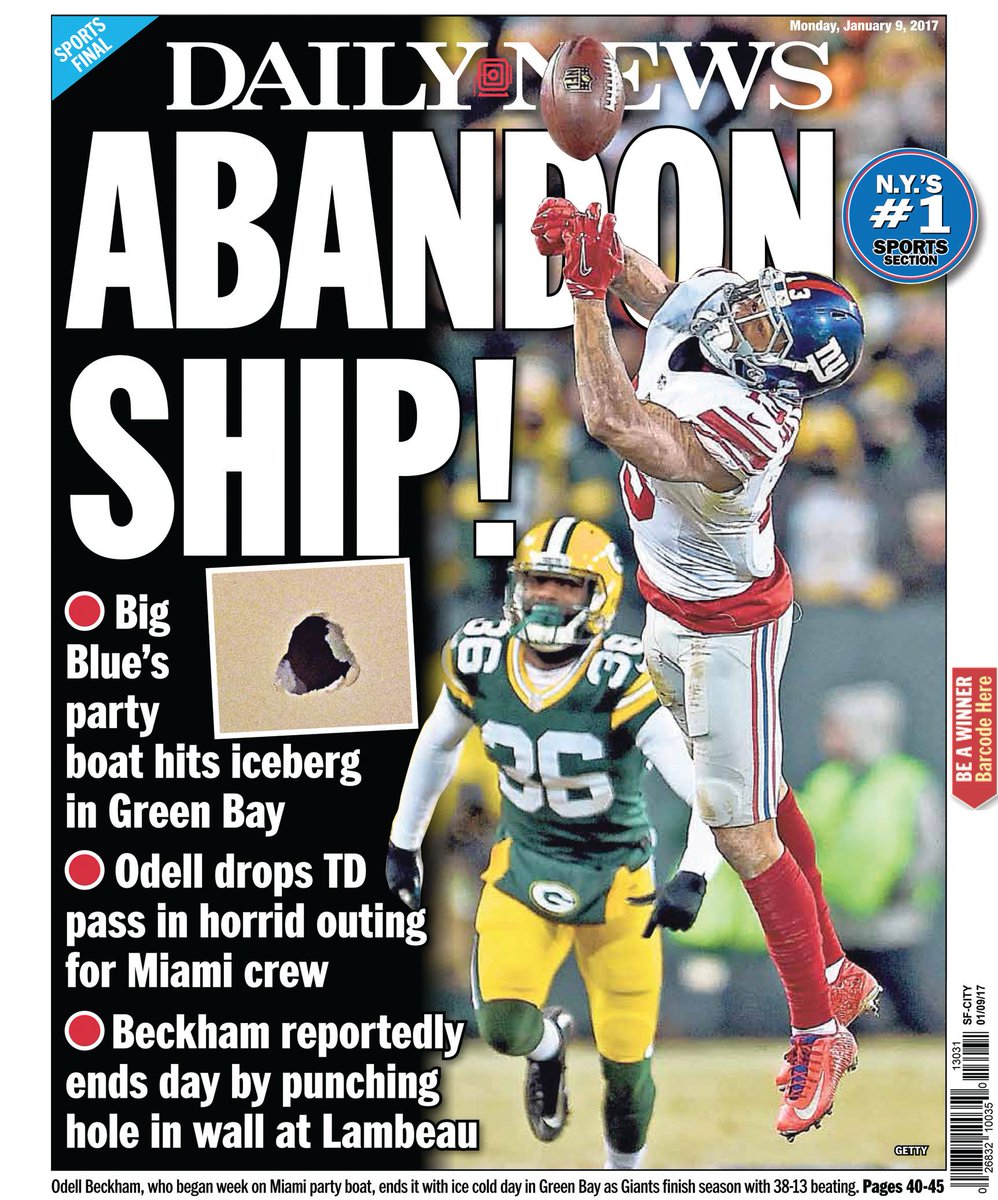
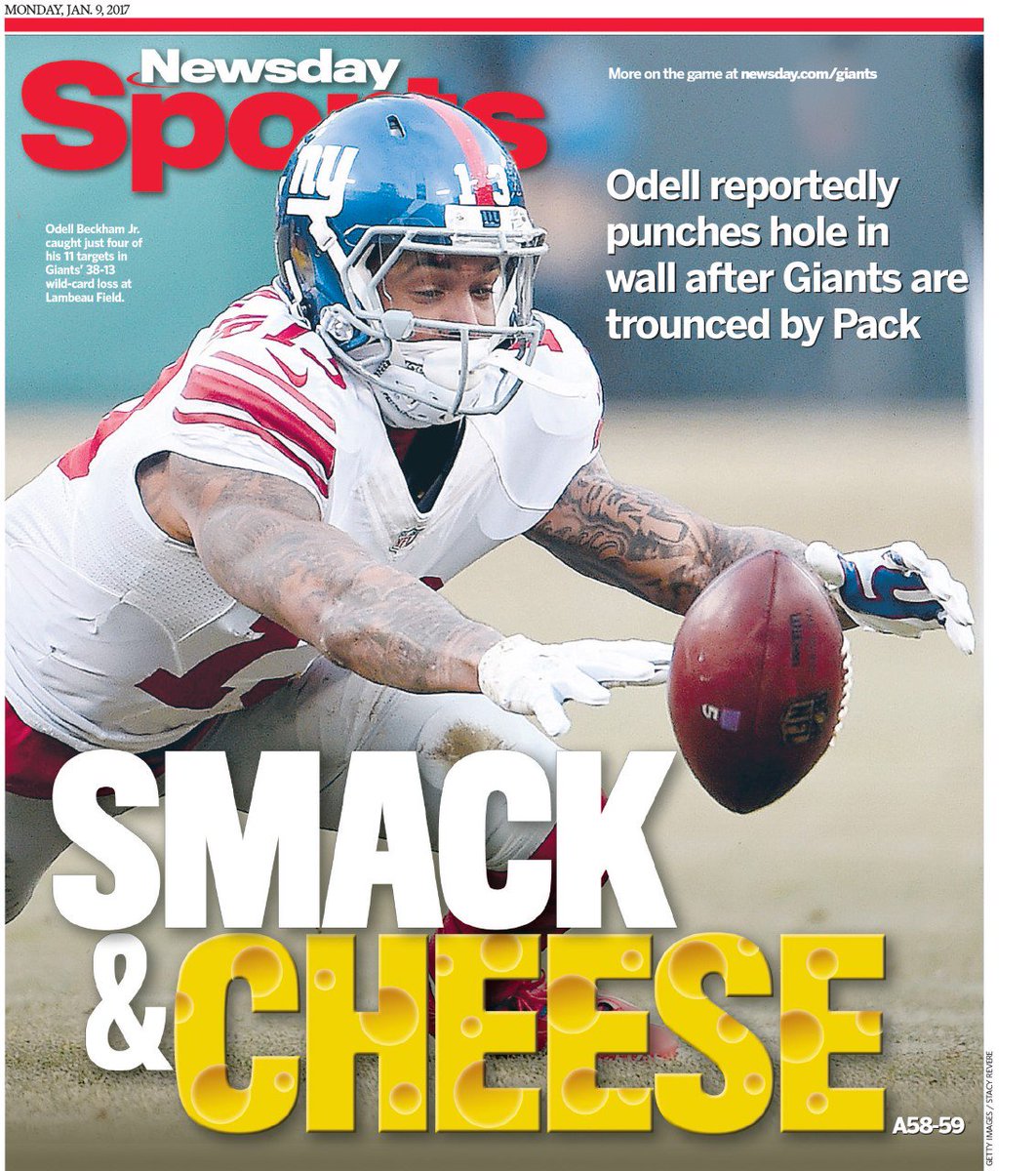
The New York media is unparalleled in objective, impartial, dispassionate analysis of the home team’s season’s conclusion, as shown by front and sports pages:
The New York Post’s evisceration of the Giants starts with Mark Cannizzaro‘s obligatory reference to the mid-week player trip to Miami:
Yacht’s all, Giants.
Their season of such progress and promise sank like a stone in a stunning 38-13 NFC wild-card loss to the Packers on Sunday night at Lambeau Field six days after four of their receivers partied in a well-publicized bender in Miami with Justin Bieber and other celebs.
To exacerbate matters, the receivers, led by star Odell Beckham Jr., came up smaller than small. Beckham caught only four passes for 28 yards on 11 targets and — worse yet — he had three key drops, a potential TD in the second quarter and two others on third-down conversions.
If you bet Tavarres King as the Giants leading receiver with three catches for 78 yards and a touchdown, you won a lot of money.
As bad as Beckham was in the biggest game of his career, the Giants first playoff appearance in five years, the Giants really were done in by a Hail Mary at the end of the first half.
Honest.
Yes, the Giants had seen this movie before.
But five years ago, they were the stars of the show. They were the ones basking in the glow of a euphoric happy ending. They were the ones moving on to an even better place and eventually the Super Bowl.
In an utterly uncanny occurrence, the climactic moment of both the 2012 show and the one that played out Sunday night took place at the same time of the game in the same end zone of the same stadium.
It came via the Hail Mary pass.
This time, though, the Packers were the stars of the show, moving on to play the Cowboys in Sunday’s divisional round in Dallas.
Five years ago in a divisional playoff game between the Giants and Packers, it was Eli Manning connecting with Hakeem Nicks on a 37-yard Hail Mary on the final play of the half to give the Giants a 20-10 lead in a game they’d go on to win 37-20 en route to the Super Bowl.
This time, it was Packers quarterback Aaron Rodgers and Randall Cobb crushing the wills of the Giants defense, with Rodgers launching a Hail Mary into the frigid Green Bay night sky as the Packers’ faithful watched it land into the arms of Cobb with no time remaining for a stunning 14-6 Green Bay lead at the half.
It was the second of four touchdown passes by Rodgers, who completed 25-of-40 for 362 yards.
On the play, Cobb got away with a push-off on Giants safety Leon Hall just before he leaped into the air and caught the ball in the back of the end zone with Landon Collins, Eli Apple, Keenan Robinson among others around the play.
The play capped a demoralizing final few minutes of a first half the Giants defense had mostly dominated.
The Giants’ worst sin of the half — other than yielding the killer Hail Mary — was trying to beat Rodgers with field goals.
When the Packers took possession of the ball from the Giants’ 38-yard line with 3:45 remaining in the half, they’d produced a total of 29 yards of offense in the game.
On the first play of that series, Rodgers connected with receiver Davante Adams on a 31-yard pass play over the head of Apple, the Giants rookie cornerback, to the Giants 7-yard line.
So in one play, the Packers outgained their previous output by 2 yards.
Two plays later, Rodgers, after dancing, darting and dodging around the Giants pass rush for a whopping eight seconds, hit Adams on a 5-yard scoring pass to give the Packers a 7-6 lead with 2:20 remaining in the half.
So all that work, nearly 28 minutes worth of dominating, and the Giants, who’d taken a 6-0 lead on two Robbie Gould field goals, were losing a game they would soon lose complete control of.
You don’t think athletes have long memories? You don’t think things stay with them as much as they stay with you? This was Aaron Rodgers, talking about one of the daggers of his career, delivered late on the afternoon of Jan. 15, 2012.
“It’s a 13-10 game,” Rodgers said, shaking his head, frowning at a memory exactly one week shy of five years old. “And then it’s a 20-10 game.”
Rodgers was on the sideline for that one, watching Eli Manning float a 37-yard prayer toward the north end zone at Lambeau Field in an NFC Divisional playoff game. When Manning launched it, the Packers were losing, but they were 15-1 and believed they were invulnerable. When it landed somehow in Hakeem Nicks’ arms, it was the Giants who were suddenly bulletproof — and who would win a championship three weeks later.
“That,” the Green Bay quarterback said, “was a momentum change.”
So now, here was Rodgers, six seconds to go in the half. The Giants had dominated the first 25 or so minutes of the game, chasing Rodgers down, blanketing his receivers, frustrating him — “I looked up at one point,” he would say, “and we had like 7 total yards” — beyond measure. …
So when Rodgers led a late touchdown drive, it put the Giants in a 7-6 hole, but on the road, at the half, you’ll take that, especially as well as they’d played. So Rodgers dropped back, and if it’s true nobody ever has thrown these Hail Mary balls better than him — “He gave it a great arc, so the receivers really have a chance,” Packers coach Mike McCarthy would say — it’s still a ball that winds up on the ground 98 percent of the time.
Except this time, it landed in Randall Cobb’s arms. In the exact same northern end zone where another ball landed in Nicks’ arms four years and 51 weeks earlier.
“I’m supposed to be the guy who boxes their guys out and opens things up for the other guys,” Cobb would explain. “But I got behind the defense.”
“I thought it was overthrown,” Giants safety Landon Collins said.
“They just chuck it up there,” Odell Beckham Jr. said. “And score.”
Said Rodgers: “Suddenly, you feel like maybe this is going to be your day.”
Actually, as it happened, that was exactly the message this one play delivered, a devastating memorandum the Giants were going to pay for their early reluctance to place their cleats on the Packers’ necks.
But Beckham made that boat, and now he’ll have to sink with it. He failed to make the big-time catches that big-time players are supposed to make. The catches that Randall Cobb (three touchdowns) was making all night.
Beckham’s bid to be legendary turned into a legendary drop of the ball.
Sterling Shepard dropped a touchdown pass as well, so he apparently should have been home with milk and cookies instead of partying with Beckham and Victor Cruz and Roger Lewis Jr. in Miami Beach on the most infamous day off in the history of days off.
Party’s over now for all the Giants — losers to the Packers.
For a boatload of reasons.
Ship of fools everywhere you turned Sunday night in Lambeau Field.
There were six seconds left in the first half of the 2011 divisional round when Eli Manning lofted a prayer toward the end zone marked GREEN BAY in gold letters and Hakeem Nicks answered it and the Giants were on their way to San Francisco and then Super Bowl XLVI.
There were six seconds left in the first half of Sunday’s wild-card game when Aaron Rodgers lofted a prayer toward the very same end zone and somehow, some way, Randall Cobb shoved Leon Hall out of the way and answered the prayer in the back of the end zone behind an army of Giants and it was Packers 14, Giants 6 at the half.
The Hail Mary five years ago was 37 yards. This one was 42 yards.
Lambeau fell silent five years ago. Lambeau exploded in ecstasy this time.
What the football gods giveth, the football gods taketh away sometimes.
Hail No.
Hail No the Ben McAdoo Giants won’t be headed to Dallas next weekend.
Hail No there won’t be any fifth Lombardi Trophy in the Lobby showcase.
NYPD — New York Pass Defense — was an abbreviation for New York Putrid Defense.
Manning was more Playoff Eli than Regular-Season Eli, but against Rodgers (four touchdowns), you better be Playoff Eli on every possession. …
Rodgers had been flustered. He threw incomplete left when Aaron Ripkowski was wide open in the right flat. He was sacked out of field-goal range by Coty Sensabaugh, filling the void left by the early departure of Dominique Rodgers-Cromartie (thigh).
Then, on his third possession, Rodgers was sacked by Kerry Wynn and Romeo Okwara.
Manning found Will Tye with a seam pass worth 51 yards and soon it was 6-0.
A dangerous game, kicking field goals when you almost always need touchdowns against Rodgers.
But with Rodgers third-and-4 at the Giants 34, Rodgers scanned the field and found no one open and was flagged for intentional grounding.
Finally, Rodgers broke through.
Brad Wing’s 37-yard punt positioned Rodgers at the NYG 38. With a flick of the wrist Rodgers found Adams streaking past Eli Apple along the right sidelines for 31 yards. Two plays later, as the Packers double-teamed Olivier Vernon, Rodgers had all the time he needed to thread the needle to Adams against Sensabaugh and the 5-yard TD made it Packers 7, Giants 6.
Then came the crusher.
Party’s over.
The New York Daily News’ Pat Leonard must have been looking over Vaccaro’s shoulder:
No prayers could save the Giants from the wrath of Aaron Rodgers on Sunday, least of all the holy Hail Mary they used to beat the Packers five years ago.
The Giants, twice in a decade the NFL’s team of destiny, saw their postseason hopes slip away at Lambeau Field in an agonizingly cruel twist of fate.
In one of the most unbelievable cases of karmic symmetry in football history, Big Blue’s season-ending 38-13 Wild Card loss swung on a 42-yard Aaron Rodgers Hail Mary touchdown pass to Randall Cobb on the final play of the first half. …
Rodgers’ rope from the right hash marks similarly put Ben McAdoo’s first Giants team on the ropes. His pass improbably fell to Cobb in the back-middle left side of the end zone with Giants defensive backs Leon Hall, Eli Apple and Landon Collins closest in coverage, but none of them leaping high enough to defend the pass. …
And as Manning’s offense floundered and the Tom Quinn-coached Giant special teams had an awful game that is going to get somebody fired, Rodgers picked the Giant defense apart in a bloodbath of a second half. …
But the Giants’ shortcomings began with big drops by the two most prominent members of the Giants receivers Miami boat party last Monday: Odell Beckham Jr. and Sterling Shepard. They wasted a terrific start by Manning, who came out throwing the ball better than he had all season.
Beckham and Shepard dropped two passes apiece in the first half, including dropped touchdowns for each. Beckham dropped a touchdown pass on the Giants’ second drive, Shepard on the Giants’ third drive.
FOX’s Jimmy Johnson, the former Dallas Cowboys coach, said at halftime of the receivers who partied in Miami on Monday: “The Boat Crew was 8-for-15 in the first half on targets their way. The rest of the receivers were 5-for-6.”
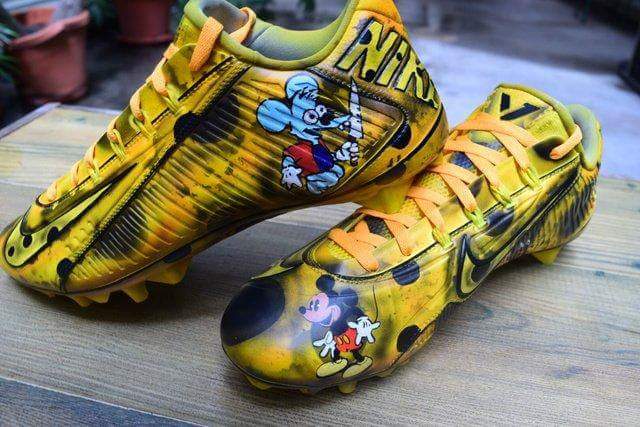
Beckham wore these shoes, by the way:
And how did Beckham respond to the loss?
Odell Beckham’s hands reportedly did more damage after the Giants’ 38-13 loss to the Packers than they did during Big Blue’s season-ending Wild Card playoff game.
Beckham, the Miami Monday party-goer who dropped a touchdown and two total passes to squander a hot start by Eli Manning, punched a hole in the wall outside the visiting locker room at Lambeau Field after the defeat, according to multiple reports.
Beckham also reportedly banged his head against the wall and had to be calmed down by stadium security.
When you are Odell Beckham Jr. and draw attention to yourself the way only a few athletes do, there is no in-between.
You either capture the imagination of the sports world with magnificent plays, like that impossible one-handed catch against the Cowboys in 2014. Or you become the object of scorn when you act out and turn into an uncontrollable diva, like the Josh Norman set-to in 2015 or the fits of temper through the first half of this season.
Or when you go on a jaunt to South Florida with a few teammates, hang out with Justin Bieber and two rappers and are shown shirtless on a boat a week before your first playoff game. And then underperform by dropping two key passes early on and another later in the game and finish with just four catches for 28 yards and no touchdowns. One of his drops was a key third down on the Giants’ first series, and another a would-be touchdown later in the quarter.
There were several miserable performance by several Giants in a 38-13 beatdown by the Packers in Sunday’s NFC wild-card game, but none was as scrutinized or criticized as much as Beckham’s. He draws attention with his play and his off-field lifestyle, and you cannot help but focus in on him more than anyone else on this team. More than the coach and more than the quarterback, almost invariably the most scrutinized people on any team. …
The optics were certainly not good, especially when a picture of a shirtless Beckham and teammates Victor Cruz, Sterling Shepard and Roger Lewis Jr. swirled around social media and created plenty of heated discussion. But coach Ben McAdoo dismissed the issue almost immediately, saying the players could do as they wished on their day off. Eli Manning joked that the only disappointment he felt was that they didn’t dress accordingly because they forgot to bring shorts and flip-flops.
After the game, Manning said he saw no evidence of a carryover from last week’s trip.
“I thought our preparation was wonderful,” he said. “Guys made plays all during practice and were ready for today and ready for the moment. No one knows why you don’t go out and play your best. Overall, the Packers played better than we did and I think that’s what it came down to. I guess we’re used to (Beckham) making unbelievable catches. He didn’t come down with some of those tough catches today. This game doesn’t come down on him, it comes down on the whole offense and on everybody. Everybody had their miscues today, and those add up.”
Linebacker Jonathan Casillas said he knew how the storyline might go.
“At the end of the day, we all knew if he had a bad game or we lost the game or if he dropped a pass it would come back to him, but I don’t question his focus and I don’t question his loyalty to the team, either,” he said.
If anything, Beckham might have been too fired up.
“The guy was so fired up before the game he was emotional about it,” Casillas said. “That had nothing to do with last week. It’s the type of person he is, preparing for the game emotionally. It might have been too much for him. You have to have somebody like that who is a spark, an emotional spark, not only himself but for our team. I know he didn’t finish the way he wanted to, for sure.”
Beckham could have stayed home and read a few chapters of “War and Peace” or meditated on his day off, and he still might have played poorly. After all, how many times have prominent athletes — from Babe Ruth to Mickey Mantle to Max McGee to Jim McMahon — partied on their down time and come back to shine when the games started? There’s no evidence of cause and effect here, because Beckham has been the subject of controversy before and still gone on to produce signature games.
This was not one of them, and he’ll have to live with the consequences. And the criticism. It doesn’t help his image that he reportedly punched a hole in a piece of sheetrock inside the Giants’ locker room area after the game. But we’ve known all along that Beckham is a hot-tempered competitor, and this is in keeping with that narrative.
The New York Times even got in on the South Florida snark:
The Giants were not in Miami, and there were no boats in sight. But once again, Odell Beckham Jr. and several Giants wide receivers bared their chests, this time in defiance of the 12-degree temperature at Lambeau Field on Sunday.
The Giants players did it in early warm-ups, more than two and a half hours before their N.F.C. wild-card game against the Green Bay Packers.
“You want to come and get used to the elements,” Beckham said. “We just kind of wanted to come out and say, forget about the cold.”
The show of toughness, however, did not carry over to the game. Packers quarterback Aaron Rodgers threw four touchdown passes in a 38-13 rout, a loss that began with Beckham and his fellow wide receiver Sterling Shepard dropping four passes on the Giants’ first two series. They each dropped one in the end zone.
The Giants dominated most of the first half, but they managed only two field goals by Robbie Gould. The Packers, however, came to life in the final three minutes of the second quarter as Rodgers threw for two touchdowns, including a 42-yard heave to Randall Cobb that six Giants defenders failed to knock down as time ran out on the half. …
Beckham caught four passes for 28 yards in his first playoff game, and he said that the trip he and three other receivers made to Miami last Monday after a victory over the Washington Redskins had nothing to do with it.
“It put it in people’s minds that O.K., if the Giants lose, it’s because you went to Miami,” Beckham said.
He added: “At the end of the day, I went through practice, had zero drops, zero missed assignments. There was nothing that can connect seven days ago to today and how we came out and executed, nothing in the world. It’s not realistic. It created a distraction for us. It’s unfortunate, but that’s the way the world is. The connection is just not there, in my opinion, but everybody is going to have their own opinion.” …
The game carried a certain revenge factor for Rodgers, who had lost to Manning and the Giants in their two previous playoff matchups, both in Green Bay. And as many have noted, the winner of a Packers-Giants playoff game has gone on to win a championship in all five instances.
Mark Belling, the dean of Wisconsin conservative talk radio, wrote a strange column in the Waukesha Freeman that starts off fine …
Newt Gingrich, the former House speaker and staunch supporter of President-elect Trump, said on national TV over the weekend his biggest fear is that Trump and his administration will cave to the enormous blowback he’ll be getting from the left. Gingrich mentioned issues like school choice and environmental policy where liberals are likely to go ballistic if Trump follows through on his plans. Gingrich fears that Trump might step back and say, “Oh well, we tried,” and then back down.
Trump needs to learn about Wisconsin. Our state has proven the left’s bark is unbelievably loud but its bite is nonexistent. Democrats, activists, unions and the media went crazy when Governor Walker and the Republican Legislature moved forward with Act 10. But six years later, the Republicans have more power than ever in this state and the Democrats and the unions are in tatters. The key was in not backing down. Belligerent crybaby teachers made fools of themselves. Democrat state senators bugged out of the state. Activists seized control of the Capitol. Walker faced a recall. But in the end, Walker won and the Republicans have gained seats in the Legislature.
The same will happen nationally if Trump stands his ground. The backlash will be even more ferocious than what we saw in Wisconsin. Some Republican senators will no doubt wilt (Lindsay Graham is probably already wilting). But the Wisconsin experience is instructive. Walker and the GOP were rewarded for standing their ground. America, especially the millions of alienated citizens who flocked to Trump, is screaming out for strong leadership and will reward the Republicans and Trump for passing their agenda and not bowing to pressure.
Here’s what liberals don’t get: Most people don’t like them. Remember the “blue fist?” It was the symbol of the anti-Walker resistance. The day of the governor’s recall election lefties were standing along highway overpasses all over the state with blue fist banners. It’s not possible to more badly miscalculate. The Democrat goon squad was trying to bully voters into turning on Walker. What else would a fist represent? Walker became more popular than ever because ordinary citizens saw backing the governor as a way of standing up to thuggish elites trying to shove them around.
The same shoving will come against Trump. The tactics will be over the top. The left will overplay its hand. If Trump and the GOP stand firm, they will be backed by voters in the same way Walker and the Wisconsin Republicans were supported.
Six years after Act 10, it is apparent that none of the doom and gloom that was forecast has materialized. The only people upset about the reforms were the ones who were bawling six years ago. Nobody give’s a rat’s patriot that some teachers are kicking in for their pensions. The only remnants of the brutal fight are the hacked-up “RECALL WALKER” bumper stickers still half-sticking to some spoilsport unionista’s car. This will be America in 2021 if Trump and the GOP repeal the excesses of liberalism and refuse to cave to the thunderous opposition.
… and then jumps off the rails:
Wisconsin has been blessed in recent years with some wonderful think tanks and advocacy organizations that advanced conservatism. On the national level there is the Bradley Foundation. A partial list of groups with more of a state focus is: the MacIver Institute, Media Trackers, Wisconsin Institute For Law and Liberty, and the Wisconsin Policy Research Institute. But it’s time for conservatives to question if these groups are still worth supporting. It is not clear whose side they are on.
The organizations are the homes of every prominent conservative “Never Trumper” in the state. Egghead anti-Trumpers like James Wigderson, Christian Schneider, Jerry Bader, Charlie Sykes, Brian Fraley and a slew of others either work for or allied with these groups. This crowd is showing no sign of admitting it was wrong about Trump and is not celebrating the many positive conservative signals sent by Trump since the election.
With a new war coming over Trump’s Revolution, it is not clear that these groups will support a President that so many of their principles loathe. As was the case with Walker and Act 10, the first few months of Trump’s presidency will require the full support of all committed conservatives. Will these groups in Wisconsin, led by anti-Trumpers, ally themselves with the leftist opposition? Someone needs to serve as a watchdog on them.
If MacIver, WILL, WPRI and others allow themselves to be co-opted by spoilsport brats who hop in bed with the enemy, they are not only no longer needed in this state but will be counter-productive. I’m not suggesting a purge. I am clearly implying that treason against the new conservative cause is possible.
Charlie Sykes can go out and do his new MSNBC Trump-bashing thing. But if his fellow travelers in the “I Hate Trump Club” use Wisconsin organizations to fight against their own groups’ very mission, it is imperative that the organizations’ boards clean house. The fight we are embarking on is larger than the bruised egos of a bunch of faux intellectuals.
Belling, it should be pointed out, wrote a column upon Sykes’ departure from the radio by claiming:
Charlie has always wanted to be an insider and has relished his close access with people like Scott Walker, Paul Ryan and other Republican powerhouses. He often seemed like a cheerleader rather than a commentator. He criticized me when I ripped one of these Republicans as if I had some obligation to join him in shaking the pom-poms. It often seemed like he thought of himself as a spokesman for a cause rather than an independent analyst. Self-serving as this sounds, I feel my influence has always been greater than his because our audiences never considered me to be in the tank for any Republican.
No inflated self-importance there, hmmm? I admit to not listening to Belling’s show (which due to WISN radio’s lesser power has much less range than WTMJ), but what role did Belling have getting, say, Scott Walker elected governor, or Paul Ryan elected to Congress, or David Clarke elected Milwaukee County sheriff, or the GOP’s getting near-complete control of state government two years after the GOP controlled almost none of it? It’s also rather hypocritical for Belling to accuse Sykes of being in the tank for certain Republicans when Belling is totally in the tank for Trump.
Belling’s screed prompted this response from Bader …
Last year will be remembered as the year Donald Trump defied the laws of political physics and was elected President of the United States. It will also go down as the year it was revealed that there was no consensus among the conservative community as to what it meant to be a conservative. Neither Trump’s history nor his behavior during the campaign indicated that he was what many of us considered to be conservative. Yet many voters, who consider themselves very conservative, branded as RINOs those of us who had the audacity to point out that Trump didn’t act like a conservative, nor did he believe in things that have been generally accepted as conservative.
And it’s clear that some conservatives who supported Trump believe that those of us who did not should now fall in line, never uttering a discouraging word about the president-elect.
This brings me to an unseemly rant that Milwaukee talk show host Mark Belling published in the Waukesha Freeman. Belling questions whether Wisconsin conservatives should continue to support think tanks with a proud conservative heritage because, in hiring anti-Trump conservatives, they dared to violate the Belling Conservative Purity Act of 2017. …
Belling also mentioned Media Trackers. In November, in addition to doing my radio show, I became Communications Director for Media Trackers. I’ll let the others Belling attempts to tar as traitors speak for themselves; I will speak for myself here.
First, Belling inaccurately states that I am “not celebrating the many positive conservative signals sent by Trump since the election.” On my radio show I have given Trump high praise for many of his cabinet selections. Specifically, retired General James Mattis as Defense Secretary; Tom Price at HHS; Betsy DeVos as Education Secretary; and Rick Perry as Energy Secretary are particularly impressive. And if reports are true that Diane Sykes is at or near the top of his list for Supreme Court picks, that would be welcome news indeed. Those “positive conservative signals, as Belling calls them, do not, however, require me or anyone else to admit we were “wrong” about Trump.
First, we cannot be wrong about Trump before January 20. “Signals” do not a president make. If Trump impresses as president I will say so. Second, we weren’t wrong about his character. Winning doesn’t mean he’s not the person he demonstrated himself to be during the campaign.
It also doesn’t mean that we need to be comfortable with a “Twitter presidency.” It’s hardly traitorous to be deeply uncomfortable with the leader of the free world blurting out random thoughts to the globe in 140 characters or less, especially when those thoughts bully American corporations or antagonize nuclear powers. All of that said, most of my post-election criticism of Trump focuses on his shocking indifference to the security threat Russia poses to the United States.
I would ask Belling to imagine his own response to President Obama had the outgoing administration taken more seriously the espionage estimations of Julian Assange than he did those of the U.S. Intelligence community, as Trump did in a tweet Wednesday.
On Tuesday, Trump claimed a security briefing he was to receive on allegations of Russians hacking DNC emails was delayed. He suggested the intelligence community needed additional time to build its case. U.S. officials insisted there was no delay in the briefing. Anyone who considers himself a conservative should be deeply, deeply concerned about Trump’s bizarre behavior toward the Russian hack allegations. But that’s not the case with Belling; he believes that refusing to overlook Trump’s ongoing erratic behavior makes us the enemy. …
I trust Wisconsin conservatives to judge the work of all the above organizations on the merits. If Belling believes a McCarthyistic rant in a local paper will hold more sway with conservatives than the product our organizations deliver, perhaps iHeart Media should change the name of his show to CSI:Milwaukee (Completely Self-Important).
OK, I’m old enough to remember when Belling prided himself on his independence from the Republican Party. Now he’s abandoning conservative principles and insisting that I do the same just so we can support the team.
Yes, I was a “Never Trumper,” along with a number of other prominent movement conservatives whom Belling derides as “eggheads.” The reasons were spelled out on the pages of the Waukesha Freeman, at Right Wisconsin and at my website, and they remain unchallenged by Belling despite his demand to conform to the Trump Revolution.
Trump is not a conservative. Trump is personally unfit for public office. Trump’s erratic behavior actually makes him dangerous on foreign affairs. Trump’s authoritarian tendencies and his use of the “bully pulpit” to attack free speech and bully companies should cause concern to anyone who believes in limited government. We can even add that his business interests are already compromising his administration. The only thing that has changed is that Trump, despite everyone’s predictions to the contrary, managed to win the election.
Trump deserves the same respect that is owed to any elected official. He should be treated like Gov. Scott Walker or President Barack Obama, praise when Trump does something right andcriticism when he does something wrong. Just because Trump ran with an “R” instead of a “D” or an “I”, it doesn’t mean he’s above criticism. He needs to be judged on his policies, his actions and his personal conduct, and we should resist the empty-headed scribbling of Ann Coulter who said she didn’t care if Trump allowed abortions in the Lincoln Bedroom.
So when Trump makes good Cabinet picks like Betsy DeVos at Education and Scott Pruitt at the Environmental Protection Agency, hurrah! And when Trump announces his infrastructure spending plan or causes a company’s stock to crash because of a Twitter rant, then we’ll criticize him. It’s not treason, it’s the American way.
Let me take a moment to remind Belling, a Milwaukee east sider, the last time he sided with an erratic political figure: former Waukesha Mayor Jeff Scrima. Despite warnings to the contrary from people actually in the city of Waukesha, including me, Belling defended Scrima nearly to the end despite embarrassment after embarrassment. Belling should have learned not to become so personally invested in politicians.
It’s sad that Belling has adopted the attitude that unless we join “Trump’s Revolution,” we should all lose our heads. He even questioned whether the MacIver Institute, the Wisconsin Institute for Law & Liberty and the Wisconsin Policy Research Institute will be “counter-productive” if they continue to provide a home to conservatives that stand on the principles Belling once espoused but now mocks. These organizations are invaluable to the conservative renaissance in Wisconsin. Belling could find that out just by asking his Milwaukee east side neighbors what they think of the conservative organizations.
It’s ironic that many of those now being attacked by Belling stood up for him when he was being attacked by the left for remarks he made on-air about Hispanics and on other occasions. You would think that someone like Belling who demands so much team loyalty would show some gratitude and team loyalty of his own. Engage us on our ideas, not demand we be silenced. But that’s not the new Trump Revolution style.
Belling’s 180 on Trump is also interesting given that he wasn’t a fan of Trump’s during the primary campaign (in which talk radio helped defeat Trump in Wisconsin), and he called himself a “reluctant” supporter after Trump got the GOP nomination. Now he’s apparently drunk the Kool-Aid and wants a purge of those who don’t swear fealty to The Donald.
Politicians get policies into law, which means the ideas have to exist first. That also means the ideas are more important than those who support them. Cults of personality are pathetic from liberals (the Kennedys, the Clintons, Obama, Russ Feingold); they should not be taken up by conservatives.
Any politician, regardless of letter (or lack thereof) that follows his or her name, deserves support only to the extent that politician does his or her job correctly. (Which means, in my case, representing my views.) Elected officials are supposed to represent us; we do not work for them, and we owe no loyalty to them beyond what they earn for doing what they should be doing.
Forbes interviewed state Rep. Dale Kooyenga (R–Brookfield):
Occupational licensing, the requirement that individuals gain government permission before entering certain professions, creates substantial barriers to work and limits economic opportunity. This reality is acknowledged by those with ideological viewpoints as diverse as President Obama and Senator Mike Lee.
Despite a growing momentum for change, it remains difficult to pass effective reforms. Many established businesses and trade associations support higher government-imposed barriers to entry because increased costs limit their competition.
Wisconsin stands out as one of the few states that overcame opposition and passed meaningful occupational licensing reforms . Last year, Representative Dale Kooyenga sponsored a bill that stopped local governments from creating new occupational licenses or levying additional fees. This was a welcome first step because occupations including Christmas tree sellers and secondhand dealers currently require licenses in a number of Wisconsin communities. If this reform was passed a decade ago, it is estimated that 100 fewer occupations across the state would require a local license. …
Jared Meyer: When did you first realize that occupational licensing made it harder for people to start working?
Dale Kooyenga: I’m the son of a garbage man, so I had to figure out how to pay for my college after high school graduation. As a result, I attended a two-year college before enrolling in a small private college in Wisconsin. When I arrived, the guidance counselor told me that my anticipated graduation date would be May 2002. I corrected him and pointed out that I was on track to graduate in four years, or in May 2001.
But I was mistaken. Wisconsin, like most other states, passed a law that required all certified professional accounting candidates to have 150 credits (approximately five years of courses), effective January 2001. I did the quick math—$30,000 for tuition plus $45,000 in a year of lost income—and found that the new law was going to cost me $75,000. As a result, I doubled up on my class load, took summer classes, and barely graduated in the three and a half years that allowed me to be grandfathered in under the old standards.
Since I was elected as a legislator, I have had the opportunity to meet many middle- to low-income citizens who face limited work opportunities because of licensing. These people are hardworking, but government-imposed burdens make it too costly or time consuming to start working. Stories like this are common as one in five Wisconsinites needs a license to work. This is why a major focus of my years in the Wisconsin Assembly has been on rolling back occupational licensing injustices.
JM: Based on your experience in Wisconsin, what advice do you have for policymakers who want to reform occupational licensing in their states?
DK: The simple question to ask when evaluating licenses is, “Is the license and related education and training the only way to provide clear consumer health and safety protection?” If not, the requirements should fall or go away completely. Because of this, it is tempting for legislators to attempt to pass a large licensing reform bill—one that immediately ends dozens of unnecessary licenses or reduces education or experience requirements across-the-board.
Comprehensive licensing reform bills will rarely pass because the opposition is simply too strong. I have found it more effective to first play defense by stopping new licenses and other associated requirements. I also select very specific, particularly egregious examples to pass narrow bills that eliminate individual licenses or lower the education and experience requirements.
JM: I noticed that your bill did ban municipalities from licensing one occupation—photographers. This must be one of your particularly egregious licensing examples. People seriously needed government’s permission to take pictures for a living?
DK: Yes, believe it or not, the city of Milwaukee required a license to take photos . As a pragmatic move, our bill banned local units of government from creating new licenses. But beyond that, we thought it was important to highlight examples of what we were banning. This is why we specifically said in the bill that no city could require a license for photography. Photography clearly poses no threat to public safety.
JM: What do you think is the next step for occupational licensing reform in Wisconsin?
DK: We need to continue eliminating individual licenses and making sure that our education and experience requirements are not outliers. For example, if 20 states can get by without licensing midwives, Wisconsin does not need to require 730 days of professional training to work in that profession.
I am also working with other states to establish licensing reciprocity. This will allow individuals to offer their services from state to state without jumping through the bureaucratic hoops of obtaining separate licenses in every state that they operate in. This especially helps families that move often such as military families, which I am sensitive to as a Captain in the U.S. Army Reserves.
There is a lot more to do in Wisconsin, but I am proud that we can serve as an example of how successful licensing reform sets the table for continued progress. …
Each occupational license creates its own set of entrenched interests. For proof, look no further than the nationwide push to license interior designers. When all the various factions band together behind the façade of public safety, reforms go nowhere. To get the ball rolling and restore sanity to occupational licensing, state policymakers can follow Representative Kooyenga’s lead.



 Steve Prestegard.com: The Presteblog