Today in 1955, the Louisiana Hayride TV show broadcast this concert live from Shreveport, La.:
No comments on Presty the DJ for April 2
Today in 1955, the Louisiana Hayride TV show broadcast this concert live from Shreveport, La.:
Today is April Fool’s Day. Which John Lennon and Yoko Ono celebrated in 1970 by announcing they were having sex-change operations.
Today in 1972, the Mar y Sol festival began in Puerto Rico. The concert’s location simplified security — it was on an island accessible only by those with tickets.
The Detroit News decided to do a thought exercise:
What if Chevrolet made a Corvette SUV?
Maybe that’s not so far-fetched. Corvette is a singular car within Chevrolet, and in many ways is a performance brand unto itself. Almost every performance brand now has its own crossover; the most prominent of which is Porsche’s money-machine, the Cayenne.
If Corvette did make an SUV, what would it look like? Detroit News presentation editor Jamie Hollar drew his own concept car, shown here. And The Detroit News talked to ex-GM big wigs, auto analysts and car enthusiasts for their ideas on what the high-performance SUV should be.
Since the first Jeep sport utility appeared in 1984, the automotive landscape has been transformed by high-riding, five-door SUVs with visibility and utility to spare. Even legendary performance brands that once built only ground-hugging sports cars have jumped in. Beginning with Porsche in 2003, SUVs have become a performance-maker’s goldmine. Nearly every performance badge wants a piece of the lucrative ute market.
Notably absent is the Corvette, America’s V-8-powered workingman’s superhero.
Though technically a Chevrolet product, the Corvette long ago became an iconic nameplate that’s equal to Europe’s elite sports car names. It’s faster than the Porsche 911, Jaguar F-Type, Alfa Romeo 4C and Lamborghini Huracan. And while those brands have all exploited their athletic images to expand into sport utilities — the Jaguar F-Pace, Alfa Stelvio and Lamborghini Urus — the Corvette remains a one-off.
“There’s certainly precedent for non-traditional SUV makers to jump into the market,” says Karl Brauer, senior analyst for Kelley Blue Book. “Every time one of them has jumped in, it has worked.”
With nearly two-thirds of Porsche buyers opting for SUVs, Porsche makes up a whopping one-third of Volkswagen Group’s profits while generating only 2.3 percent of its sales, according to MotleyFool.com. “The idea of a Porsche SUV still rubs sports-car purists the wrong way, but it has been a spectacularly profitable product for the brand,” says John Rosevear, senior auto specialist for the website.
GM executives won’t talk about future vehicles — and even if they did, there’s no evidence a sport utility is in the works. But everywhere we went, car fans loved the idea. The consensus was if Corvette were to build it, it would be a home run.
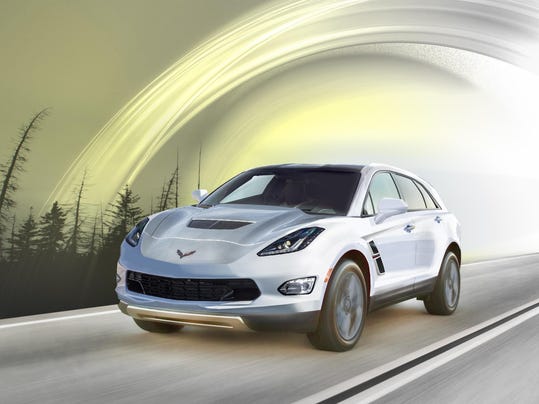

The News story posits the Corvette XC7 or X06 as a five-door (four doors plus tailgate) all-wheel-drive SUV with one of the real Corvette’s 6.2-liter V-8s, the supercharged one going in the X06, and either an eight- or 10-speed automatic.
Right away you should be able to see the problems in that paragraph. The traditional truck engine was designed less for horsepower than for torque. (Of course, if your standard V-8 has 460 horsepower and 455 pound-feet of torque, with the upgrade adding 190 horsepower and 195 pound-feet, maybe that’s not an issue after all.) Corvettes have two doors, two seats and front-engine V-8s that power the rear wheels, along with a choice between manual and automatic transmissions.
Other details?
“XC7 and X06 (mirroring the high-performance version’s Z06 name) are great starters for naming,” says Tom Wallace, the retired GM engineer who ran Chevrolet’s Corvette program from 2006-08. “Stingray is off limits.”
It would be essential that any Corvette crossover share the sports car’s DNA.
“Front engine, rear drive, with AWD option. Lots of aluminum in the structure,” muses Wallace. “Aluminum is mandatory to support the theme that Corvette embraces to be the lightest vehicle in its class. The two V-8s from the Corvette stable are also a must.”
That means the 460-horse V-8 shared with the base C7 sports car — or for the Z06 version, the supercharged 650-horsepower V-8 for what might be the fastest SUV ever built. Considering the rear-wheel drive Z06 sports car is slightly slower from 0-60 than its all-wheel drive 540-horsepower Porsche Turbo rival, an all-wheel drive X06 crossover should be competitive with the all-wheel drive Cayenne Turbo’s 3.8-second, 0-60 romp.
“Maximum Bob” Lutz, the ex-vice president of GM product design who is revered for bringing back The General’s design mojo, agrees with Wallace’s assessment: “Like the Cayenne, the appeal of the ’Vette SUV would be RWD proportions. It should, in fact, have a silhouette not too different from a Cayenne.”
Start with the C7’s dramatic, sculpted lines created by Tom Peters and widely recognized as one of the best designs in Corvette’s 54 years. All performance SUVs are essentially vertically stretched, five-door versions of familiar sports coupes, giving them an inherently heavy look compared to low-slung two-seaters.
But angular designs like our mock XC7 or Lamborghini’s Urus show that it’s possible to break with the soap-bar shapes of the Porsche Cayenne and Maserati Levante. With Corvette’s trademark shark nose, scooped hood and quad exhaust pipes, it would drip with menace.
Inside, the XC7 would share the C7’s acclaimed interior: comfortable seats, stitched dash and quality trim materials. Naturally, the signature “oh, crap” passenger grab-handles from the sports car would carry over (for those times when dad is seized by the need for speed).
Other parts like transmissions and all-wheel drive systems could come from common GM parts bins, which has been key in keeping Corvette costs down over the years. “To engineer the vehicle, I would have to combine some of the Corvette team with some of the SUV team,” says Wallace.
Price? “More than the $40,000 Cadillac XT5, but about 10 grand below” a $60,000 base V-6 Cayenne, suggests Lutz.
But the chassis might be a deal breaker. “To be successful, this vehicle would require an all-new RWD/AWD architecture, which currently does not exist,” says Lutz. “That’s high investment for relatively low volume.”
Porsche was able to “lunch off” the VW Touareg chassis, which enabled Porsche to package its V-8 engine longitudinally. GM’s new C1XX platform is the backbone for the Cadillac XT5 and GMC Acadia utilities; it has been lauded for its stiffness and light weight. But its front-wheel drive, transverse engine layout appears ill-suited for our ambitious XC7.
“The Corvette ute probably would be a stand-alone architecture (or a major modification of an existing architecture), so volume would be critical to call it a business success,” Wallace believes.
Cost aside, Lutz says there is another obstacle to an XC7: “The reason a Corvette SUV won’t happen is the business case would be tough. Besides cannibalizing ‘normal’ Corvettes, it can also be expected to damage GMC and certainly the Cadillac XT5.”
And yet, Lutz acknowledges the unique draw of the Corvette: “Corvette is a powerful brand that should be developed. Go upmarket with a mid-engine sedan using big Cadillac CT6 architecture, and maybe eventually something like Cayenne. They would split it off from Chevrolet — nobody makes that connection anyway.”
Kelley Blue Book’s Brauer says financial analysts would grill GM on creating another brand so soon after it axed Pontiac, Hummer and Saturn in bankruptcy. “But history would suggest there is no downside to a performance brand expanding into SUVs,” he says. “Non-Corvette owners who couldn’t justify a two-seat sports car could finally put a Corvette badge in their garage.”
There are SUVs with similar performance numbers; besides the aforementioned Porsche Cayenne and its 570 horsepower in Turbo S guise for $161,600, Land Rover makes the Range Rover Sport SVR with 550 horsepower, for the bargain price of $111,350.
One of the problems with a Corvette SUV might be the price, weirdly. The real Corvette supposedly loses sales to Ferrari and Porsche because it’s not exclusive enough. (What kind of fool thinks a car is too inexpensive compared with its competition, particularly when its performance numbers are comparable?) That’s despite the fact the Corvette is one of the great performance bargains of all time. At $79,450, the Z06 costs $122.23 per horsepower. The standard Stingray costs $120.54 per horsepower. The top-of-the-line Porsche, the 911R, costs $369.80 per horsepower. The new Bugatti Chiron produces 1,500 horsepower (really) for a list price of $2.998 million (really), or $1,998.67 per horsepower.
The bigger issue, of course, is brand dilution. That’s what happened when Nissan added two back seats to the 260Z. (But when the Z was reintroduced in 2002, it lost the back seat.) That’s what happened when Porsche, the maker of 2+2 cars, added the Cayenne SUV and the Panamera sedan. Of course, buyers have sucked up Cayennes, and you’d think GM would have noticed that.
Corvette Online adds:
For some reason, the C7 has polarized more than a few folks on its looks. It seems that while a good majority of us love the latest generation Corvette, there are some who are steadfast in their disapproval. That said, we are doubtful that these images will do much to win them over.
Adding a shooting-brake style hatch to the lineup of Corvettes has been an on-and-off discussion for ages. The shooting brake style would seem to be pretty easy to pull off, given the expanse would cover the space already occupied by the large, curved-glass fastback hatch already in place. Just switch it out. The concept seems easy enough that we could see some developments on this in the near future.
Adding an extra pair of doors is a little bit more controversial. Ultra-luxury sedans are all the rage, but to us, it seems like a boxing ring more suited towards Cadillac, than Corvette. After all, the CTS-V is already there fighting. But four-door Corvettes aren’t entirely new, either. Concepts have been made in the past. Their downfall comes from trying to stretch the Corvette lines over a longer wheelbase. It’s close, but it never seems quite right.
Well, if GM would seriously consider an SUV, why wouldn’t GM consider a sedan too?
There is another major problem with this. The next Corvette reportedly will be rear/mid-engine — the engine will be ahead of the rear axle instead of in front — which, unless you’re talking about old Volkswagens …


… is incompatible with a sedan or a wagon. (As it is I have serious doubts about GM’s ability to pull off a mid-engine drivetrain given GM’s record of sending new technology into the world before it’s ready. Also, why GM, which makes money on every front-engine/rear-drive Corvette it has built for decades, wants to mess with success is a mystery to me.)
If a Corvette is going to happen (and there are numerous reasons already stated that it won’t), it might seem logical for GM to split off the Corvette brand into its own line. It’s one thing for a Chevrolet dealer to sell the current Corvette; it’s another thing entirely for a Chevy dealer to sell two-seat, 2+2, four-door and SUV Corvettes. That would also result in Corvettes being less geographically available, because the number of Corvette dealerships would surely be fewer than the number of Chevy dealerships. And given that GM is a decade removed from culling several of its historic brands — Pontiac, Oldsmobile and Saturn plus Saab and Hummer, which GM purchased — adding a brand seems less likely.
The News adds this:
What do you think a Corvette SUV should look like?
Create your own design and enter The Detroit News design contest. Our team of judges — ex-Corvette chief engineer Tom Wallace, Detroit News auto columnist Henry Payne and Detroit News presentation editor Jamie Hollar — will pick a winner. Top entries will be published in The Detroit News and at detroitnews.com.
Entries can be done in any medium: computer rendering, pencil sketch, watercolor, whatever you prefer. Send a high-resolution copy by email to Henry Payne at hpayne@detroitnews.com.
Deadline for entries is April 17.
If I only had drawing skills.
Today in 1949, RCA introduced the 45-rpm single to compete with the 33-rpm album introduced by CBS one year earlier. The first RCA 45 was …
Today in 1964, the Beatles filmed a scene of a “live” TV performance before a studio audience for their movie “A Hard Day’s Night.”
In the audience: Phil Collins.
On Sunday, the Milwaukee Journal Sentinel reported:
After three losses to Scott Walker, Wisconsin Democrats think they finally have a chance at the Republican governor in 2018.
There’s just one catch: They don’t have a candidate. Democrats still have time to find a leader who can raise money, hire staff, craft policies and a message to voters, but they don’t deny the clock is ticking.
“If we get to late summer and early fall and lack one or more than one credible candidate, it’ll be time to be worried,” said Joe Zepecki, a Democratic strategist who worked on businesswoman Mary Burke’s failed bid against Walker in 2014.
At the moment, the Democrats have no one on the field.
Former state Sen. Tim Cullen of Janesville registered a campaign committee for governor this month, but even he isn’t in for sure. The former Senate majority leader looked at a run in the 2012 recall election but decided against it then, noting that unions had greeted his overtures with “respectful indifference.”
“There is a big issue in the room and the issue is money,” he said in an interview.
At this point in 2009, then-Milwaukee County Executive Scott Walker had been basically running against then-Democratic Gov. Jim Doyle for more than two years. When Doyle signed the state budget that year and then decided not to run for re-election, Walker had an advantage against the other candidates that he never relinquished.
Walker will have to make his own decision on whether to run for a third term after he and GOP lawmakers pass their own budget bill this summer.
Here are some of the factors that the GOP governor will consider:
On the plus side for an incumbent, the state’s unemployment rate in February stood at 3.7% — a level that is at or very near full employment. Walker has also proposed a budget that increases funding for schools and cuts taxes — two top priorities for most voters.
At the same time, Friday’s failure of President Donald Trump and House Republicans to pass an Obamacare repeal underlines the difficulties that GOP politicians up and down the ballot could face next year if the party doesn’t deliver on its campaign promises.The governor may be insulated from problems in Washington, D.C. He’s also proved to be a strong campaigner and fundraiser with a statewide machine that could well outperform Republicans nationally.
But there are some issues at home for Democrats to exploit. Walker, for instance, hasn’t convinced even some Republican lawmakers that he’s right to reject new money for the state’s road fund and instead delay projects.
The latest Marquette University Law School poll put Walker at a 45% approval rating, an uptick that puts the governor on higher ground but not necessarily out of danger if a Democratic wave were to crest in 2018.
Scratch one off the list. The Wisconsin State Journal reports:
Former state Sen. Tim Cullen announced Wednesday he won’t seek the Democratic nomination for governor in 2018, citing the hefty amount of necessary fundraising as a deterrent.
Cullen, 73, announced his decision in the Capitol Press Room alongside his daughter and a handful of supporters. He said the decision came in response to being told by others who have run for statewide office that he would need to spend three to four hours a day calling potential donors.
“This is a very sad commentary on the state of democracy and elections in Wisconsin,” Cullen said.
Cullen said he expected Gov. Scott Walker would be able to raise $45 million for the campaign after raising $35 million in his 2014 re-election and building up a larger donor base during his unsuccessful presidential campaign. Walker’s 2014 opponent Mary Burke raised $12 and contributed $5 million of her own wealth.
Cullen said the primary reason he considered a run was because “Governor Walker needs to be replaced. His divide-and-conquer approach is unlike any Wisconsin governor in at least the last 65 years.”
A spokesman for Walker replied: “With the lowest unemployment rate since 2000, more people working than ever before, and a bright economic outlook for Wisconsin families, it’s not surprising that serious Democrats continue to think twice and not run against Governor Walker’s strong record of results and reform.”
Cullen, a Senate majority leader in the 1980s who returned for a single term in 2010, was known as a centrist Democrat willing to make deals with Republicans. He has toured the state recently with retired Republican Sen. Dale Schultz to promote nonpartisan redistricting.
Cullen also wrote a book about his experience during the 2011 Act 10 protests, during which he was one of 14 Democratic senators who fled to Illinois, temporarily blocking passage of the law that curtailed public sector union influence in the state. Cullen considered running for the Democratic nomination during the 2012 recall.Cullen said he has been in contact with a number of other Democrats considering a run, but hasn’t endorsed any of them yet. Possible candidates he noted include Dane County Executive Joe Parisi, Jefferson County District Attorney Susan Happ, Rep. Dana Wachs, Sen. Kathleen Vinehout, former Democratic Party chairman Matt Flynn and businessmen Andy Gronik and Mark Bakken.
Off that list, Parisi has no chance of getting votes outside of Madison. Happ has already lost a statewide race. People have heard of Vinehout, but she elected not to run four years ago, and her interest in the job doesn’t seem to be there. Few know who Wachs, a Democrat from Eau Claire, is. Being a party official doesn’t mean you know anything about governing, which is the point of elections.
Who is Gronik? The Associated Press has the answer:
Milwaukee businessman and entrepreneur Andy Gronik said Tuesday that he hopes to decide “fairly soon” whether to seek the Democratic nomination to run for governor next year.
The political newcomer told The Associated Press that he won’t decide within the next two weeks, but that it won’t be months, either. Gronik is among several Democrats, including those in the business community with no political experience, who are weighing whether to run against Republican Gov. Scott Walker.
Walker is raising money and sending strong signals that he will seek a third term, but he won’t officially announce his decision until this summer.Although Gronik hasn’t decided whether to run, he’s already taking swipes at Walker, saying he’s underperformed as governor. Gronik hit Walker for failing to deliver on his promise to create 250,000 private-sector jobs during his first term, saying he sees no cohesive strategy to grow the economy.
“This isn’t really about blame, this is about performance,” Gronik said. After six years in office, Walker is still about 65,000 jobs short of the promised 250,000. In the private sector, if someone missed their stated goal by that much “he’d get fired,” Gronik said. …Gronik, 59, is founder and president of Stage W, a Milwaukee-based nonprofit that advocates for “bridging the political divide” to “advance ideas that create good jobs and provide great education throughout Wisconsin.”
Gronik has been talking privately for months about the possibility of getting into the wide-open Democratic race for governor. He’s never run for office before and he’s made minimal campaign donations. He gave $750 to three Democratic candidates for state offices last year, according to the Wisconsin Democracy Campaign’s online database.
He said his 35 years of experience working for a variety of other companies around the world give him the skills necessary to help the state. The 2014 Democratic nominee for governor, Mary Burke, also came from the business world and had limited political experience.
Voters have had the chance to fire Walker twice for failing to hit his job goal. Notice that he’s still in office, and by the way unemployment in the state (as measured by how the federal government and every state measures it) is the lowest in Wisconsin since 2000. Whining about redistricting doesn’t seem to be connecting with voters either.
Bakken, meanwhile, helped found Nordic Ventures, a health care consultancy, and HealthXVentures. About the former, Bakken will have to answer questions about this unpleasantness if he decides to run.
Oh, wait a minute: Walker does have an opponent:
There is one declared Democratic candidate, Bob Harlow. Harlow, 25, grew up in Barneveld and graduated with a degree in physics last year from Stanford University. He ran for Congress in California last year, but was eliminated in the primary with just 7 percent of the vote against incumbent Democratic U.S. Rep. Anna Eshoo.
Harlow’s platform for governor includes installing a 200 mph high-speed train line throughout the state, a project said he would help create 35,000 jobs, restoring union collective bargaining rights eliminated by Walker, vetoing all new pipeline or mining proposals, guaranteeing health care costs never exceed 9 percent of total income and ensuring that all Wisconsin schools are funded at or above the national per-student average.
Harlow, who has prior experience writing computer software, said he is working at his family’s woodworking business in Barneveld while he raises money and tours the state in his bid for governor.
“Being a third generation Wisconsinite and having a really strong connection with this state, I see a different direction I’d like to see our state move in,” Harlow said.
Being a first-time candidate, Harlow does have one thing in common with another politician from this state, twice-defeated Russ Feingold — bugging out for California instead of staying in Wisconsin. (An early question I would ask Harlow is why he went to Stanford instead of our own world-class UW–Madison.)
It is amusing to read this given the trainwreck that is the state Democratic Party. I suppose anything would be better than their results in 2016, in which they (1) lost the state’s presidential vote to Donald Trump of all people; (2) failed to get Feingold reelected, (3) failed to gain a single congressional seat and (4) saw their numbers in the Legislature shrink even more. Next year in addition to Walker’s impending reelection, they will have to try to keep U.S. Sen. Tammy Baldwin (D–Wisconsin) in office in an election that, contrary to what Democrats seem to think, is not going to be a wave election for Democrats, whether you like Walker or his fellow Republicans or not.
The number one single today in 1957 was the first number one rock and roll single to be written by its singer:
The number one single today in 1963 …
… which sounds suspiciously similar to a song released seven years later:
While climate change alarmists see the sky falling in President Donald Trump’s executive order rolling back his predecessor’s “Clean Power Plan,” Badger State free-market advocates are celebrating a “Great Day for Wisconsin.”
On Tuesday, Trump announced the Environmental Protection Agency will begin unraveling the Obama administration’s controversial carbon-emissions reduction plan that critics have blasted as a job-killing government overreach.
Brett Healy, president of the MacIver Institute, a Madison-based free-market think tank, said Trump’s decision to review and eventually scrap the “Costly Power Plan” has dramatically improved the lives of Wisconsinites.
“Since Wisconsin is more reliant on coal than most states, this bureaucratic boondoggle would have cost our state dearly in job losses, rate hikes, and lost economic potential,” Healy said in a statement.
A 2015 MacIver Institute and Beacon Hill study found the Clean Power Plan could cost Wisconsin 21,000 jobs and $1.82 billion in disposable income by 2030. The study also estimates the EPA’s array of rules and regulations would cause the average household electric bill to jump $225 and would cost the average Wisconsin industrial ratepayer an extra $105,094 per year if implemented.
In February 2016, the U.S. Supreme Court stayed the CPP, which demands a 30 percent reduction in carbon emissions from U.S. power plants by 2030 – higher in manufacturing-heavy Wisconsin.
At the time, pro-business groups like Wisconsin Manufacturers & Commerce celebrated the pause in the Obama administration plan while anti-Clean Power Plan litigation supported by 28 states moved forward.
“The Clean Power Plan would significantly harm Wisconsin’s economy, increasing electricity rates by more than 20% and eliminating tens of thousands of jobs,” Scott Manley, WMC’s senior vice president of Government Relations, said in a statement at the time.
In December, Wisconsin Attorney General Brad Schimel joined a 24-state coalition of attorneys general urging Trump and congressional leaders to step away from the Clean Power Plan, the critical piece to the Obama-led Paris climate agreement.
“Last year’s stay won by the coalition of states before the U.S. Supreme Court was the first step in putting an end to this misguided policy,” Schimel said Tuesday in a press release. “Today’s Executive Order was the next critical step. We look forward to working with President Trump and EPA Administrator (Scott) Pruitt to complete the legal process necessary to eliminate this unconstitutional overreach once and for all.”
Trump was surrounded by coal miners Tuesday as he signed the executive order. The president has said boosting U.S. fossil fuel production in pursuit of energy independence is a priority for his administration.
“My action today is the latest in a series of steps to create American jobs and to grow American wealth. We’re ending the theft of American prosperity and rebuilding our beloved country,” he said before signing the order at an EPA that clearly is moving in a different direction from the aggressive enforcement agency of the past eight years.
Not surprisingly, the climate change faithful – described by some so-called “climate change deniers” as a “cult” – are furious. Obama EPA Administrator Gina McCarthy sees all of her regulatory work going up in smoke.
“This is not just dangerous; it’s embarrassing to us and our businesses on a global scale to be dismissing opportunities for new technologies, economic growth, and US leadership,” she said in a statement.
Sen. Edward Markey, D-Mass, according to liberal publication Mother Jones, called Trump’s actions “a declaration of war on American leadership on climate change and our clean energy future.”
Free-market advocates say the war on business, on jobs, the economy, the constitution, liberty, is drawing to an end with the review and dismantling of Obama’s overreaching Clean Power Plan.
“The CPP was imposed on Americans by unelected, faceless bureaucrats in Washington. President Trump’s executive order rolls back one of the most draconian overreaches in the history of big government,” MacIver’s Healy said. “By signing this order, the President will preserve thousands of jobs in Wisconsin, prevent a spike in electricity rates for hard working Wisconsin families, and keep more income in peoples’ pockets.”
Before unreasonable exuberance takes place, Ronald Bailey says:
President Donald Trump issued a new executive order today that aims to roll back Obama administration energy policies that sought to address the problem of man-made climate change. The Obama administration’s climate strategy stood on three pillars: Tightening corporate average fuel economy standards (CAFE) for vehicles; the Clean Power Plan designed to cut by 2030 carbon dioxide emissions from electric power generation plants by 30 percent below their 2005 levels; and a moratorium on federal coal leasing. These measures were adopted to meet President Obama’s commitment to reduce U.S. greenhouse gas emissions in 2025 by 26 to 28 percent below 2005 levels under the Paris Agreement on Climate Change.
The CAFE standards are now being reassesed. In February, the chief executives of 18 auto companies sent a letter to the Environmental Protection Agency (EPA) asking that it review the Obama administration’s stringent CAFE standards. EPA administrator Scott Pruitt subsequently announced that his agency will conduct such a review decide by April 2018 if the standards should be loosened. The transportation sector is responsible for 26 percent of U.S. greenhouse gas emissions, amounting to about 1.7 gigatons of carbon dioxide in 2014. That’s down from the 1.85 gigatons pre-global financial crisis peak of vehicle emissions in 2005.
Electric power generation is responsible for about 30 percent of U.S. carbon dioxide emissions. In 2014, burning coal for electric power generation emitted 1.57 gigatons of carbon dioxide. That is down significantly from peak emissions of nearly 2 gigatons in 2007. In 2014 emissions from natural gas burnt for electric power generation amounted to 0.44 gigatons. Basically, burning natural gas to generate electricity produces about half of the carbon dioxide that burning coal does. Since the carbon dioxide emissions from coal are so much greater than those from alternative fuels, the Clean Power Plan’s carbon dioxide reduction goals would essentially force electricity generators to close down many of their coal-fired plants.
President Trump hopes that unraveling the Clean Power Plan will bring back lost coal-mining jobs. “A lot of people are going to be put back to work, a lot of coal miners are going back to work,” President Trump told a rally in Louisville, Kentucky last week. “The miners are coming back.” That is unlikely for two reasons: automation and cheap fracked natural gas.
U.S. coal production has dropped from 1.1 billion tons in 2011 to 0.9 billion tons in 2015. If 2016 fourth quarter coal production remained steady at the 2015 level, that would still mean that overall production will have fallen by nearly a third to 0.74 billion tons in 2016. Coal production in the Appalachian region in 2015 was 44 percent lower than it was in 2000. Power companies have been steadily switching from coal to natural gas as the fracking boom boosted production from 19 trillion cubic feet in 2005 to 28 trillion cubic feet in 2016. Last year, burning natural gas generated 33 percent of America’s electricity compared to 32 percent from coal.
The upshot is that lower demand for coal means fewer jobs. In 2011, 89,500 people worked as coal miners. That has dropped 50,000 now. In addition, higher productivity means lower demand for workers. Due to automation miner productivity soared rising from 1.93 tons per miner hour in 1980 to 6.28 tons per miner hour in 2015.
Rolling back the Clean Power Plan means going through a long regulatory review process that will be opposed at every turn by environmental activist groups. Assuming that it is eventually revoked, what would that mean for future U.S. carbon dioxide emissions? Without the Clean Power Plan, the Energy Information Administration projects that U.S. energy-related carbon dioxide emissions would remain essentially flat up to 2040.
President Trump also lifts the moratorium on federal coal leasing imposed in 2015 by the Obama administration. The moratorium was part of the same “keep fossil fuels in the ground” strategy that motivated the Obama administration’s refusal to approve the Keystone and Dakota Access pipelines to transport oil. Given the low demand for coal it is not at all clear that mining companies will be eager to open new mines on federal lands any time soon.
Trump also ordered federal agencies to drop climate change as a consideration when promulgating new regulations. The Obama administration devised the social cost of carbon (SCC) as a metric accounting for the effects on climate of any project that would result in the emissions of carbon dioxide. Currently, the social cost of carbon is $36 per ton emitted. However, the Obama administration violated various regulatory standards in order to get to this figure including using lower than usual discount rates and making calculations based on global rather than domestic harms.
As I reported earlier, using the $36 per ton SCC, the EPA calculated that implementing the Clean Power Plan would yield climate benefits amounting to $30 billion in 2030. “However, estimated domestic climate benefits only amount to $2–$7 billion, which is less than EPA’s estimated compliance costs for the rule of $7.3 billion,” noted Brookings Institution analyst Ted Gayer in recent congressional testimony. “The use of a global social cost of carbon to estimate benefits means that agencies will adopt regulations that could cost Americans more than they receive in climate-related benefits.”
One side effect of setting aside the Obama administration’s social cost of carbon calculation is that it will likely hasten the shut down of a goodly percentage of America’s nuclear power industry. Why? Nuclear power plants are being out-competed by electricity generated from cheap natural gas and subsidized wind and solar power. Without subsidies tied to social cost of carbon calculations, “more than half the U.S. nuclear fleet may currently be at risk of closure,” according to a new report from the centrist Third Way think tank.
During the presidential campaign, Trump promised to “cancel” the nonbinding Paris Agreement on climate change. On Sunday, new EPA head Scott Pruitt declared that the universal climate agreement was a “bad deal.” However, President Trump will not make a decision about withdrawing from the Paris Agreement in his executive order. The Obama administration submitted a nationally determined contribution that committed to reducing overall U.S. greenhouse gas emissions in 2025 by 26 to 28 percent of their 2005 levels. Instead of withdrawing from the agreement, Rep. Kevin Cramer (R-N.D.) is urging the president to submit “a new pledge that does no harm to our economy.”
There is some evidence that U.S. unemployment rate fluctuates with the fall and rise in gasoline prices. So one way to think about the effects of Obama administration climate policies is to consider how higher energy prices in European countries are affecting their economies. A U.S. Chamber of Commerce study estimated the adopting European energy policies would force the average American household to pay $4,800 more per year for their energy than they to today. Overall, European-style energy policies would eliminate 7.7 million jobs and cut labor incomes $364 billion. Of course, these estimates need to be taken with a grain of salt, but it is undeniable that scaling back the Obama administration’s climate regulations should result in lower energy prices for American consumers. Lower prices mean more money in the pockets of Americans to spend in alternative ways that will tend to boost overall employment.
But what about the climate? By one calculation implementing the Obama administration’s Paris climate pledge fully would reduce the future increase in average global temperature by 0.031 degree Celsius by 2100. Fulfilling all of the Paris pledges together would reduce future temperatures in 2100 by 0.17 degree Celsius. On the other hand, more robust economic growth will produce the wealth and new technologies that will help future generations to cope better with whatever future climate change occurs.
The Wall Street Journal:
Not too long ago our leading media lights were using Mussolini and Hitler analogies to describe the new American President’s threat to “democratic norms.” The Washington Post rolled out a portentous new slogan, “Democracy Dies in Darkness.” Academics like Yale’s Timothy Snyder and Dartmouth’s Brendan Nyhan have used the theme to become mini-media celebrities predicting that America in 2017 is ripe for 1930s European tyranny.
So much for all that. The real story of the Trump Presidency so far is that the normal checks and balances of the American system are working almost to a fault. The courts have blocked Mr. Trump’s immigration order, albeit with some faulty legal reasoning. Congress has rejected the House health-care bill, his first big legislative priority.
The FBI and the House and Senate Intelligence Committees are investigating the Trump campaign’s ties to Russia. Mr. Trump’s Attorney General has recused himself from the FBI probe, and the President’s nominee for deputy AG is held up in a Republican Senate.
The permanent bureaucracy is leaking like a tent in a monsoon, and Mr. Trump is getting the worst press of any President since the final days of Richard Nixon. Mr. Trump may rage against the press, but the Alien and Sedition Acts aren’t coming back. Rest assured that if Mr. Trump’s Internal Revenue Service ever does to liberal groups what President Obama’s did to the tea party, the media will provide nonstop coverage.
The greater likelihood has always been that, as a rookie politician, Mr. Trump would be too weak and ineffective, not too strong. He lacks a solid party base, and the inertial forces of government resist any change that means lost power. His Presidency is young, and perhaps Mr. Trump will still find his bearings and make some progress on his reform agenda.
We can’t say the same about the lost credibility of the many worthies who sold American institutions short while predicting fascist doom. They were always more partisan than principled. As for those quaking Yale and Dartmouth professors, their students should demand a tuition refund.
The number one British single today in 1963 may make you tap your foot:
Today in 1966, Mick Jagger got in the way of a chair thrown onto the stage during a Rolling Stones concert in Marseilles, France.
The title and artist are the same for the number one album today in 1969:
I was asked by a reader if I planned on opining on the proposed federal budget cuts to public broadcasting, where I can occasionally be found on Friday mornings, as you know. (For which I receive nothing more than attention, and some of it negative, which is why I stopped reading Wisconsin Public Radio Facebook posts while I’m on the air.)
Now that someone brought it up, at the risk of biting the publicity hand that feeds my need for self-promotion, I bring up Ryan Girudsky:
President Donald Trump unveiled his budget on Thursday, and is planning on making massive budget cuts to domestic programs. Programs like the Corporation for Public Broadcasting (CPB) which fund NPR and PBS will be on the chopping block. Rest assured, Big Bird and Elmo will survive without the government.
While liberals are comparing Trump’s budget to a dystopia and giving children nightmares that their favorite puppets will soon be no more, Sesame Street and most PBS shows will be fine.
Mitt Romney threatened to cut off funds to PBS if he were to win the presidential election in 2012. Sherrie Westin, executive vice president and chief marketing officer of Sesame Workshop, told CNN that the cut in funding would not “kill Big Bird.”
“Sesame Workshop receives very, very little funding from PBS. So, we are able to raise our funding through philanthropic, through our licensed product, which goes back into the educational programming, through corporate underwriting and sponsorship,” Westin said. “So quite frankly, you can debate whether or not there should be funding of public broadcasting. But when they always try to tout out Big Bird, and say we’re going to kill Big Bird – that is actually misleading, because Sesame Street will be here.”
Only 31 percent of Sesame Street funding comes from a mixture of corporate, government, and foundational support. Nearly 70 percent comes from licensing, distribution fees, and royalties.Sesame Street has so much potential to be even more profitable now that HBO bought the right to air the show for five years in 2015. PBS gets to air the new episode after a nine-month exclusivity period for HBO.
Furthermore, PBS and NPR will also be fine because they aren’t that reliant on the CPB either. According to Pro Publica, only 15 percent of PBS’s funding are CPB-issued grants, while only two percent of NPR’s funding comes from the government agency.
Perhaps all the celebrities who love to bask in the glow of their own greatness at award shows can open up their pockets and give additionally to the very small amount cut from PBS’ budget.
Kind of like the feast of donations Meals on Wheels programs have received after the proposed budget cut that isn’t a Meals on Wheels budget cut at all. (Community Development Block Grants fund Meals on Wheels programs in some areas, none of which receive more than a single digit percentage of their funding from CDBGs.)
A similar budget cut happened in Wisconsin during the 2015–17 budget, though the Milwaukee Journal Sentinel reported at the time:
Republicans on the Legislature’s budget committee on Tuesday cut funding for public broadcasting and programs to mitigate farm runoff, but not as deeply as GOP Gov. Scott Walker wanted. …
Walker, who is in Israel this week as he prepares for a likely run for president, recommended cutting nearly $5 million over two years from the state Educational Communications Board, which runs Wisconsin Public Radio and Wisconsin Public Television. The board also operates the system that is used for Amber Alerts and other emergency alerts.
Republicans on the committee voted to restore $2.6 million of the funding, leaving the board with a $2.3 million reduction.
Democrats invoked “Sesame Street” to argue for fully funding the board, with Rep. Chris Taylor (D-Madison) saying the cuts were proposed by “Gov. Walker the Grouch.”
Public broadcasting is “the one consistent thing we get from one end of the state to the other,” said Sen. Jon Erpenbach (D-Middleton). “It’s public. It’s ours. We as Wisconsinites own it and we should be supporting it.”
Rep. John Nygren (R-Marinette), co-chairman of the committee, argued the cuts would not affect public broadcasting’s programming but some staff would be trimmed.
Rep. Dean Knudson (R-Hudson) said restoring some of the funding was important because public radio provides a service by letting its audience “listen to people from across the state.” But he said some cuts were warranted because public broadcasting in Wisconsin receives more taxpayer support than similar systems in other states.
Beyond the dollar figures involved, Logan Albright adds:
Budget hawks will be quick to point out that $445 million is but a fraction of a drop in the proverbial bucket of government spending, and it’s true. But no one is claiming that cutting public broadcasting will balance the budget. The question we should be asking is, “Why are we funding it in the first place?”
State-funded media suffer from one glaring, common problem: Someone — a central authority — gets to decide what kind of content is appropriate for the public, and what isn’t. As taxpayers, we cannot withhold our money if we object (or, are indifferent) to what we see — we have to pay for it regardless.
In most countries, this is called propaganda; the populace is fed what the government wants them to see. While public broadcasting in America is generally more benign than the term “propaganda” implies — focusing mainly on classical music and educational programming rather than fictional glorifications of Dear Leader — national media are nevertheless contrary to the American principles of a free press.
But what will happen to all that beloved programming on PBS and NPR if the federal government doesn’t pay for it? What about “Sesame Street”? What about “A Prairie Home Companion”? Should we just let these things wither on the vine? There are two responses to these concerns.
The first is that, if something really is popular, it will survive just fine without government having to force people to fund it.
“Sesame Street” is widely watched. It is certain that advertisers would be willing to sponsor it. Or, if you are among those who feel some moral objection to advertising in children’s shows, is there any reason to believe that donations couldn’t sustain the program? PBS and NPR already receive a majority of their funding from voluntary donations anyway — they are not suddenly going to disappear without the federal government as a backstop.
The second answer to the above question is simply “Yes,” things that no one is willing to pay for should be allowed to end.
There is no such thing as objective value in a television show or a radio program. The only value they have is in the subjective opinions of the viewers and listeners. If you have to use the force of taxation to keep a show running, it means that you are subsidizing the preferences of a few at the expense of everyone else.
For those who make the argument that we need public broadcasting to provide culture for the nation’s poor (who otherwise could not afford it), I would argue that this smacks of arrogance and elitism. The programmers at NPR may like classical music and cool jazz, but what evidence do they have that single mothers working three jobs appreciate these highly specific forms of “culture”?
Claiming that “the poor” need to listen to a particular type of music in order to better themselves is not based on anything but a false sense of superiority and a desire to impose one person’s tastes on others.
The government’s funding of broadcasting is as much an affront to the First Amendment as it would be if Donald Trump announced today that the federal government is going to dump $445 million into Fox News. (Someone before me came up with that observation, though I cannot find the source.) There is no guarantee of editorial independence from the government funders by the management of public TV or radio as long as there is government funding.
The identities of those in charge don’t matter. The heads of PBS and NPR can swear up and down that their news coverage is and will be unbiased, and they can be presumed to be sincere. That doesn’t prevent a future head of PBS from mandating news coverage to adhere to his or her own political views. That also doesn’t prevent a president from putting pressure on NPR to cover things as the president wants covered.
Jim Epstein adds:
If the Trump Administration gets its way in ending federal funding for public broadcasting (see the budget proposal …), it wouldn’t spell the end of NPR, PBS, or the radio and television programs that many Americans cherish. The biggest impact would be on rural stations that rely on government dollars for a large share of their operating budgets. Several reporters have noted that these rural stations “serve” communities that skew heavily Republican, claiming irony. “[D]efunding the Corporation for Public Broadcasting,” the Washington Post’s Callum Borchers writes, “would mean hurting the local TV and radio stations that a whole lot of Republican voters watch and listen to.”
We don’t actually know how many Republican voters (or anyone for that matter) watch and listen to NPR or PBS in these rural communities because the networks keep that information private. If saving the rural stations is the main reason to maintain federal funding, don’t taxpayers have a right to see multi-year ratings data? In a press release responding to the budget cuts, PBS merely cites its old talking point that public broadcasting costs each citizen just $1.35 per year. Just because something’s comparatively cheap doesn’t make it worth buying.
The notion of a television station “serving” a community is outdated. You don’t hear Netflix, YouTube, and Hulu boasting that they “serve” one area of the country or another. As I argued in a recent video, the mean reason to end federal funding to these stations is that the media landscape looks nothing like it did in 1967, when Lyndon Johnson signed the Public Broadcasting Act.


 Steve Prestegard.com: The Presteblog