No comments on Presty the DJ for April 28
-
-
Every year, the Tax Foundation announces:
Tax Freedom Day is the day when the nation as a whole has earned enough money to pay its total tax bill for the year. Tax Freedom Day takes all federal, state, and local taxes—individual as well as payroll, sales and excise, corporate and property taxes—and divides them by the nation’s income. In 2017, Americans will pay $3.5 trillion in federal taxes and $1.6 trillion in state and local taxes, for a total tax bill of $5.1 trillion, or 31 percent of national income. This year, Tax Freedom Day falls on April 23, 113 days into the year.
That was Sunday. When is Wisconsin’s Tax Freedom Day?
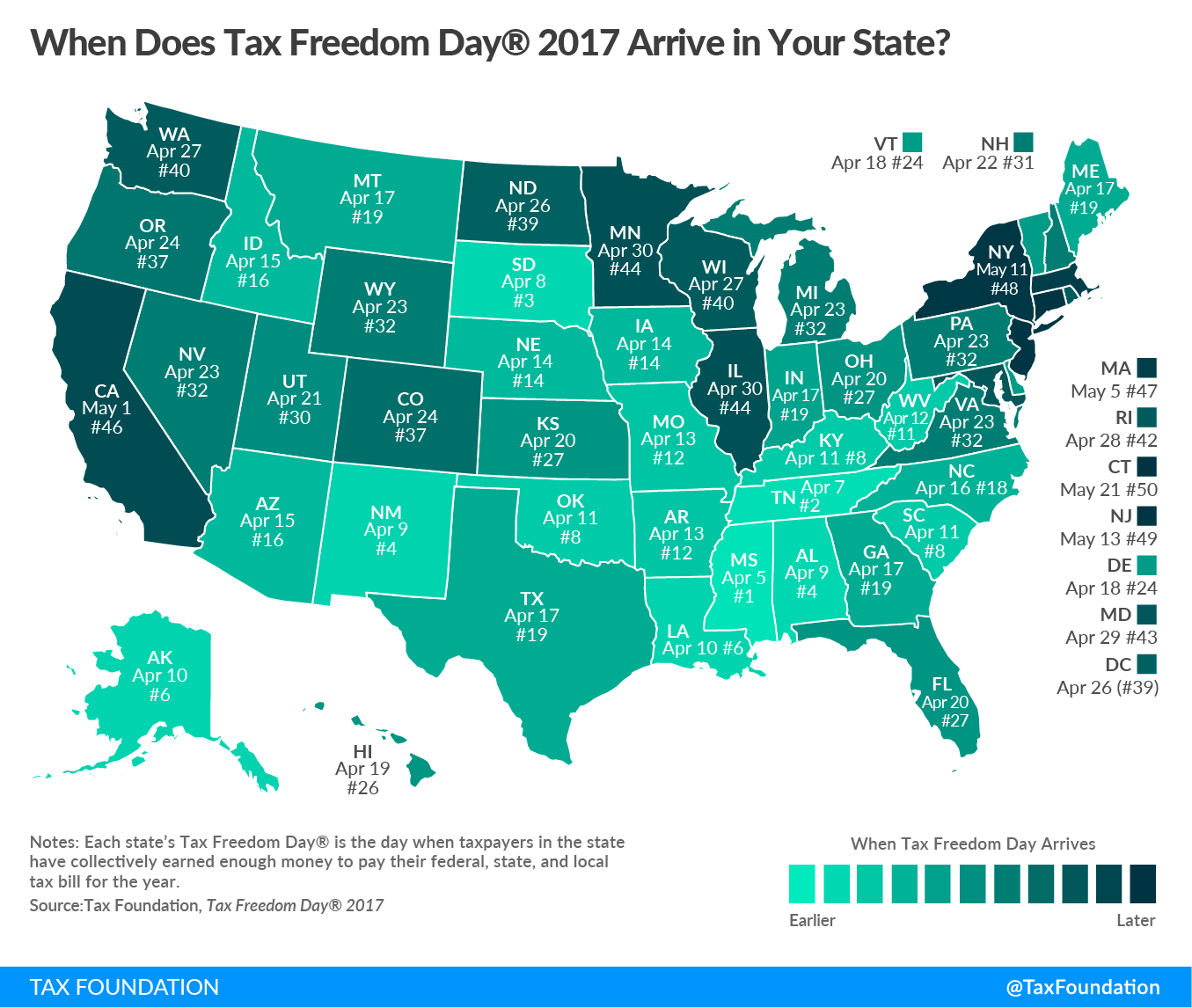
Wisconsin has the 40th latest Tax Freedom Day, which means this state has the 11th highest federal, state and local taxes as a percentage of income. Only Minnesota and Illinois have higher tax bites out of their income than Wisconsin in the Midwest.
Tax Freedom Day was April 12 in 2010, April 16 in 2011, April 21 in 2012, April 20 in 2013, April 22 in 2014, April 25 in 2015, and April 27 last year. You’ll notice that that is not a positive direction. I would wonder why people vote for Republicans who promise to cut taxes and then don’t cut taxes meaningfully, except that Democrats could not care less about cutting taxes in a remotely meaningful way. (As it is, Republican supporters should ask their Republican elected officials that question.) No, $4.7 billion in tax cuts this decade are not sufficient, and $600 million in the proposed 2017–19 state budget are not sufficient either.
The second time I noted Tax Freedom Day on this blog, I listed what paying nearly $1 out of your $3 in income (as opposed from the 10 percent God asks):
- A substandard education system. (The fact that there are some above-average schools doesn’t change that reality.)
- Teacher unions that spread lies during elections. (Though their political power has shrunken in the post-Act 10 world.)
- A statewide teacher union that pays its management six-digit salaries and pays its employees on average $95,000 per year, almost twice as much as the median family income in this state.
- An extremely substandard business climate and perennially underperforming economy. (Very small steps have been made in the correct direction, which are the result, again, of our bad tax system.)
- 3,120 units of government.
- A political culture that is out of touch with the rest of the planet, let alone the rest of the state.
- Insufficient political will to change any of these realities.
It is my contention that Wisconsinites overpay for government services, including, yes, schools and the UW System. As I wrote on a previous Tax Freedom Day, think of the worst teacher, the laziest or most incompetent government employee you can think of, or the politician you wouldn’t vote for if he or she were running against Joseph Stalin, and then remember: your taxes are paying his or her salary and (Rolls–Royce-style) benefits.
It is a fact that our quality of life is not improved by government; quite the opposite, in fact. It is also my contention that, rather than rely on one political party to hold the line on taxes and spending, taxpayers need to be protected from elected officials regardless of party (or lack thereof) by enacting constitutional (as opposed to legislative) controls on taxes and spending and requiring referendum approval for all tax increases.
-
It figures that just as I started to get interested in the Milwaukee Bucks again, they would flop in two playoff games and now stand one loss away from having their season end.
So before the Bucks lose tonight or Saturday, you should read what Jabari Parker has to say:
The moment I went down … I knew.
As soon as I felt my knee buckle, and I hit the ground — I knew right away what had happened. I knew right away what it would mean.
I had torn my ACL.
Again.
Not exactly how I pictured my comeback season coming to an end.
But as tough as the injury itself was … where it really has hurt? It’s not where some people think. It’s not for what it means for my future: I’ve been through this before, and I came back better. And I know the player that I’ll be when I’m back on the court again. That doesn’t scare me. But the fact that I can’t be out there with my team, right now, during these playoffs — to finish what we started? Knowing the team that we’ve been growing into together … and not being able to see that through with them?
That’s what has hurt the most.
See, this year … it’s meant a lot to this team. This year, from the very beginning, was about us making a name for the Bucks — about us forcing our way into the argument of who the East’s top contenders are. We knew, going into the season, that we weren’t a team with a ton of playoff experience, or with a ton of veterans who’d been in these situations before, or with résumés like some other guys have in our division. We didn’t know our peak … and neither did anyone else.
And that was part of the fun.
This year, we vowed not to be one of those teams that other teams picked on. We vowed not to be one of those teams that guys felt they could rest their stars against, or relax against in any way. And, honestly, it’s not like we had some master plan, or that we did anything special. We just went out and played. That’s it. We went out every night, and we kept our composure, and we found our confidence, and we took each challenge as it was presented to us. We figured — what fun is it to play in the NBA if we’re not taking on those challenges? If we’re not getting hyped for the Clevelands, the Golden States, the San Antonios? If we’re not working hard to perfect our late-game plays, and flip the results on some of those last-second losses? If we’re not holding our own with the teams that we’re using as our standard?
And up until the night of my injury, we took on those challenges on the court together. So, you know, that’s what has really hurt: Not being able to be out there with my team, while they’ve kept this thing going.
And that’s exactly what they’ve done: They’ve just kept going. They’ve just kept playing. They’ve just kept making strides — and I’ve been so proud of them. And I know they’ve been proud of me, too, as I’ve had to take on new challenges of my own, with my rehab.
And through it all: We’ve both had the city of Milwaukee.
Milwaukee, man … it’s home. You know I’m a Chicago kid, and Chicago will always have a big piece of my heart. But with Milwaukee — for me it was just love at first sight. As soon as I got here, I was like, Wow, this is the place for me.
I love this city.
It’s funny — I always think about this one day, pretty soon after I got here, when I took my car out for a drive around town. I pulled up to this spot … and I saw these olds guys, hanging out, sitting outside with their hot rods. I mean some real nice cars. And I parked my ride, I got out, and, man … we just got to talking. You’d look at us, and you’d probably be thinking that we have nothing in common — these old white guys, and then here I am, this young black ball player who’s bumpin’ rap music? No way. But it turned out we did. And it was just this really great day. I’ll still go back there, sometimes, and me and those guys, we’ll just catch up. I’ll ask them about cars. They’ll tell me stories about going to Bucks games in the ‘70s. It’s just very Milwaukee. We can talk about anything.
And that’s what I love about this city. It’s — well, it’s the love.
Honestly, I love this city so much that it scares me sometimes, in a way, you know? Like, I’ve seen other guys get traded and leave since I’ve been here … and you realize, Wow, as players we really don’t have that much control over it all. But one thing I do have control over, regardless of my playing career, is knowing that I want to raise my own family here someday. It’s that deep.
The Bucks have indeed taken big steps this season. It looked as if they had taken additional big steps by winning game one of this playoff series at Toronto and then just crushing the Raptors in game three. And then came games four and five, and the Bucks will have to win at home tonight and at Toronto Saturday to probably lose to Cleveland in the next series.
My concern with the Bucks dates back to their old days:
With the exception of the 1971 champions and the 1974 runners-up, the Bucks have always been not quite good enough. They had Marques Johnson and Sidney Moncrief and acquired Bob Lanier in the late 1970s, but were not as good as either Boston or Philadelphia. The Kareem Abdul-Jabbar dynasty ended when Abdul-Jabbar decided he didn’t like Milwaukee anymore.
The Bucks now have one of the best players in the NBA in Giannis Antetokounmpo. (And you thought “Abdul-Jabbar” was hard to pronounce in the ’70s. I had to announce Antetokounmpo’s younger brother in a state championship game.) What if the Greek Freak decides he doesn’t like Milwaukee anymore? All the work the Bucks have done to build a team that is on the way up would be for naught. Again.
-
The number one single today in 1963 was recorded by a 15-year-old, the youngest number one singer to date:
The number one British single today in 1967 was that year’s Eurovision song contest winner:
The number one single today in 1985:
-

This Facebook meme says that Bill Nye the Science Guy is not a scientist. (If he were a competent engineer, he’d be working in engineering, not TV.) Nor is he a constitutional expert, as Michael Bastasch reports:
Bill Nye the “Science Guy” tried to claim the Constitution supported the concerns of thousands of scientists and environmental activists who took to the streets on Earth Day to protest the Trump administration’s proposed budget cuts to federal agencies.
“If you suppress science, if you pretend climate change isn’t a real problem, you will fall behind other countries that do invest in science, that do invest in basic research,” Nye told CNN Saturday as the “March for Science” took place.
The march took place in dozens of cities across the world, and the main march took place in Washington, D.C., Saturday. Nye spoke at the rally where thousands carried signs deriding skeptics of global warming and cuts to the Environmental Protection Agency (EPA) and other bureaucracies that fund or conduct scientific research.
“And it is interesting to note, I think, that Article 1 Section 8 of the U.S. Constitution refers to the progress of science and the useful arts,” Nye said.
“Useful arts in 18th Century usage would be what we call engineering or city planning or architecture,” Nye said.
Nye’s used the argument before to underscore how “unpatriotic” it is to not have the federal government hand out billions of taxpayer dollars to universities, corporations and research institutions.
“Article I, Section 8 of the Constitution says the government shall ‘promote the progress of science and useful arts,’” Nye told Vox in 2015 — Vox didn’t correct him or fact check his claim.
“So if you’re a politician looking to derail the progress of science, I think you’re not doing your job,” Nye said.
And, like last time, he’s 100 percent incorrect.
Nye is referring to the Constitution’s Copyright Clause. The clause is one in a laundry list of Congress’s enumerated powers.
It reads: “To promote the Progress of Science and useful Arts, by securing for limited Times to Authors and Inventors the exclusive Right to their respective Writings and Discoveries.”
The Copyright Clause has nothing to do with government-funded science, but everything to do with establishing a legal framework to protect intellectual property rights.
This is why Nye is not known as the “Constitution Guy.”
On the other hand, Nye’s not good on TV either when he’s required to not read from a script. Slate reports:
“Science Guy” Bill Nye was none too happy that CNN put him on the same panel as a climate change skeptic on Earth Day. “I will say, much as I love the CNN, you’re doing a disservice by having one climate change skeptic, and not 97 or 98 scientists or engineers concerned about climate change,” Nye said during an appearance on CNN’s New Day Saturday to discuss the March for Science that was taking place in more than 100 cities across the world.
During the segment, William Happer, a physicist and climate change skeptic, argued that the Earth is getting greener and that carbon dioxide is good for the atmosphere. “There’s this myth that’s developed around carbon dioxide that it’s a pollutant, but you and I both exhale carbon dioxide with every breath. Each of us emits about two pounds of carbon dioxide a day, so are we polluting the planet?” Happer said. “Carbon dioxide is a perfectly natural gas, it’s just like water vapor, it’s something that plants love. They grow better with more carbon dioxide, and you can see the greening of the earth already from the additional carbon dioxide in the atmosphere.”
An obviously exasperated Nye responded: “What he claims to not understand is the rate. it’s the speed at which we’re adding carbon dioxide.” He latter accused Happer of “cherry picking a certain model” and that the consensus view on climate change “is not controversial in mainstream science.” Plus, Nye added, acting like climate change doesn’t exist is bad for the economy. “If you pretend that climate change isn’t a real problem, you will fall behind other countries that do invest in science—that do invest in basic research,” Nye said.
Happer, who has met with Trump and has been described as the man who may take over the role as top science adviser, later appeared to shock everyone when he compared the Paris Agreement on climate change with the Munich Agreement and Nazi appeasement. “It’s definitely appeasement,” Hopper said. “It’s an appropriate comparison because it was a treaty that was not going to do any good.”
Boo hoo, Billy. Nye, it turns out, is nothing more than a poor entertainer who like all the envirowackos (see Gore, Al) wants to control our lives and gain for themselves political power and money.
For instance, John Nolte reports:
Yes, according to Nye’s guest Travis Rieder, who holds the creepy title of a Bioethics Ethicist, you and I and our precious children are what Rieder calls “individual emitters,” meaning we are inconvenient to the Greater Good because our individual emissions of carbon contribute to global warming (which is a hoax).
But we are not all guilty of doing “a lot of emitting.”
Even though they have one of the highest fertility rates in the world, the good people of Niger, according to Rieder, are totally awesome because they “are doing almost no emitting.” Yes, these amazing people emit only “0.1 metric tons of carbon annually,” while we American pigs emit “160 times” that amount.
Oddly enough, though, what Nye and Rieder fail to tell us is that Niger is a hellhole of humanity that ranked as the country with the world’s worst standard of living in 2009, a standard that has only gotten worse since. The “absolute poverty rate” in Niger was 61% and climbing in 2012.
But when his guest mentioned Niger, Nye said approvingly, “They burn some charcoal [only] now and then.”
Well, when all you own is a wooden bowl, an old blanket, and herd of bed bugs…
Anyway, things then got super-creepy….
Billy Nye: So, should we have policies that penalize people for having extra kids in the developed world?
Travis Rieder: I do think that we should at least consider it.
Bill Nye: Well, “at least consider it” is like “Do it.”
Travis Rieder: One of the things that we could do that’s kind of least policy-ish is we could encourage our culture and our norms to change, right?
Couple points…
1) HITLER!
2) Niger has an infant mortality rate of 71.2 deaths per 1000 live births — one of the highest in the world. America’s infant mortality rate, which the left-wing Washington Post called an “embarrassment,” is only 6.1 per 1000.
Life expectancy in Niger is 61 years (the same age as Tom Hanks!). Life expectancy in America is 79 years. America’s poor live like kings compared to the average Nigerian.
So maybe instead of penalizing developed countries, we should use all that activist energy to help develop Niger?
But the inhuman tyrants we call environmentalists actually fight against the modern development of countries like Niger. Like real-life Bond villains, all they care about is their golden calf of Gaia. While they sip lattes and burn more carbon with their television shows than I will in ten lifetimes, they are comforted by the fact that the people of Niger — although miserable, dying, exploited, and despairing — are living worse than animals do on American farms.
The other truth that goes unmentioned is that developed countries like ours are much, much, much cleaner than human hellholes like Niger. Our water and air is cleaner. We use much better methods to dispose of our garbage and sewage. We preserve, recycle, and replenish our natural resources. For example, no one plants more trees than the private logging industry. America has more trees today than we did 100 years ago. Nothing produces a clean environment better than private ownership. You take care of what is yours.
Developed countries that allow for human freedom are not the problem, they are the solution. People are not the problem, they are a blessing and the very ones who invent, create, and come up with the ideas that have, overall, improved both living and environmental conditions throughout the world.
But science-denying monsters like Bill Nye would have us believe the opposite is true. Because it is not about the science. It is about the depraved power that comes with controlling the lives of others.
-
Imagine having tickets to today’s 1964 NME winner’s poll concert at Wembley Empire Pool in London:
-
Former Democratic presidential candidate and Democratic National Committee chair Howard Dean claimed Thursday evening that speech from conservative author and commentator Ann Coulter is not protected by the First Amendment.
“Hate speech is not protected by the First Amendment,” Dean tweeted in reference to Coulter’s scheduled speech at Berkeley, which campus administrators cancelled due to the threat of leftist violence. …
Dean, the former Democratic governor of Vermont, made his comment in reply to a tweet from someone who had written: “Free Speech Defenders Don’t Forget: Ann Coulter once said: My only regret w/ Timothy McVeigh is he did not go to the New York Times building.” …
Best-selling author and conservative columnist Ann Coulter was scheduled to speak at the University of California, Berkeley, on April 27, but the university canceled the speech this week, saying it could not provide adequate security, given recent riots to shut down other conservative speakers, such as Milo Yiannopoulos.
Coulter subsequently told The Hollywood Reporter: “They can’t stop me. I’m an American. I have constitutional rights.”
The university announced it would reschedule the event for the afternoon of May 2, during final exam week, but attorneys for the groups that had invited Coulter, including Young Americans for Freedom, blasted university officials in a letter, saying it was attempting to impose “discriminatory” time and place restrictions and warned of “imminent litigation” if the university does not confirm by today, April 21, that it will cooperate with plans for the April 27 event.
Dean is not a constitutional scholar. Washington Post columnist Eugene Volokh is:This leads me to repeat what I’ve said before: There is no hate speech exception to the First Amendment. Hateful ideas (whatever exactly that might mean) are just as protected under the First Amendment as other ideas. One is as free to condemn, for instance, Islam — or Muslims, or Jews, or blacks, or whites, or illegal immigrants, or native-born citizens — as one is to condemn capitalism or socialism or Democrats or Republicans. As the Supreme Court noted in Christian Legal Society v. Martinez (2010), the First Amendment’s tradition of “protect[ing] the freedom to express ‘the thought that we hate’ ” includes the right to express even “discriminatory” viewpoints. (The quote comes from the four liberal justices, plus Justice Anthony Kennedy, but the four more conservative justices would have entirely agreed with this, though also extended it to university-recognized student groups’ freedom to exclude members, and not just their freedom to express their thoughts.)
To be sure, there are some kinds of speech that are unprotected by the First Amendment. But those narrow exceptions have nothing to do with “hate speech” in any conventionally used sense of the term. For instance, there is an exception for “fighting words” — face-to-face personal insults addressed to a specific person, of the sort that are likely to start an immediate fight. But this exception isn’t limited to racial or religious insults, nor does it cover all racially or religiously offensive statements. Indeed, when the City of St. Paul tried to specifically punish bigoted fighting words, the Supreme Court held that this selective prohibition was unconstitutional (R.A.V. v. City of St. Paul (1992)), even though a broad ban on all fighting words would indeed be permissible.
The same is true of the other narrow exceptions, such as for true threats of illegal conduct or incitement intended to and likely to produce imminent illegal conduct — i.e., illegal conduct in the next few hours or maybe days, as opposed to some illegal conduct some time in the future. But these are very narrow exceptions. Dean’s post came in response to a Steven Greenhouse tweet saying, “Free Speech Defenders Don’t Forget: Ann Coulter once said: My only regret w/ Timothy McVeigh is he did not go to the New York Times building”; but if Dean meant that such speech by Coulter is constitutionally unprotected, he’s wrong. Indeed, even if Coulter was speaking seriously (which I doubt), such speech isn’t unprotected incitement, because it isn’t intended to promote imminent illegal conduct. Compare, e.g., Rankin v. McPherson (1987), which upheld the right to say, after President Ronald Reagan was wounded in an assassination attempt, “If they go for him again, I hope they get him” — and that was in a case involving a government employee being fired for her speech; the First Amendment offers even stronger protection to ordinary citizens whose speech is more directly restricted by the government.
Returning to bigoted speech, which is what most people use “hate speech” to mean, threatening to kill someone because he’s black (or white), or intentionally inciting someone to a likely and immediate attack on someone because he’s Muslim (or Christian or Jewish), can be made a crime. But this isn’t because it’s “hate speech”; it’s because it’s illegal to make true threats and incite imminent crimes against anyone and for any reason, for instance because they are police officers or capitalists or just someone who is sleeping with the speaker’s ex-girlfriend.
The Supreme Court did, in Beauharnais v. Illinois (1952), uphold a “group libel” law that outlawed statements that expose racial or religious groups to contempt or hatred, unless the speaker could show that the statements were true and were said with “good motives” and for “justifiable ends.” But this, too, was treated by the court as just a special case of a broader First Amendment exception — the one for libel generally. And Beauharnais is widely understood to no longer be good law, given the court’s restrictions on the libel exception. See New York Times Co. v. Sullivan (1964) (rejecting the view that libel is categorically unprotected, and holding that the libel exception requires a showing that the libelous accusations be “of and concerning” a particular person); Garrison v. Louisiana (1964) (generally rejecting the view that a defense of truth can be limited to speech that is said for “good motives” and for “justifiable ends”); Philadelphia Newspapers, Inc. v. Hepps (1986) (generally rejecting the view that the burden of proving truth can be placed on the defendant); R.A.V. v. City of St. Paul (1992) (holding that singling bigoted speech is unconstitutional, even when that speech fits within a First Amendment exception); Nuxoll ex rel. Nuxoll v. Indian Prairie Sch. Dist. # 204, 523 F.3d 668, 672 (7th Cir. 2008) (concluding that Beauharnais is no longer good law); Dworkin v. Hustler Magazine Inc., 867 F.2d 1188, 1200 (9th Cir. 1989) (likewise); Am. Booksellers Ass’n, Inc. v. Hudnut, 771 F.2d 323, 331 n.3 (7th Cir. 1985) (likewise); Collin v. Smith, 578 F.2d 1197, 1205 (7th Cir. 1978) (likewise); Tollett v. United States, 485 F.2d 1087, 1094 n.14 (8th Cir. 1973) (likewise); Erwin Chemerinsky, Constitutional Law: Principles and Policies 1043-45 (4th ed. 2011); Laurence Tribe, Constitutional Law, § 12-17, at 926; Toni M. Massaro, Equality and Freedom of Expression: The Hate Speech Dilemma, 32 Wm. & Mary L. Rev. 211, 219 (1991); Robert C. Post, Cultural Heterogeneity and Law: Pornography, Blasphemy, and the First Amendment, 76 Calif. L. Rev. 297, 330-31 (1988).
Finally, “hostile environment harassment law” has sometimes been read as applying civil liability — or administrative discipline by universities — to allegedly bigoted speech in workplaces, universities and places of public accommodation. There is a hot debate on whether those restrictions are indeed constitutional; they have generally been held unconstitutional when applied to universities, but decisions are mixed as to civil liability based on speech that creates hostile environments in workplaces (see the pages linked to at this site for more information on the subject). But even when those restrictions have been upheld, they have been justified precisely on the rationale that they do not criminalize speech (or otherwise punish it) in society at large, but apply only to particular contexts, such as workplaces. None of them represent a “hate speech” exception, nor have they been defined in terms of “hate speech.”
For this very reason, “hate speech” also doesn’t have any fixed legal meaning under U.S. law. U.S. law has just never had occasion to define “hate speech” — any more than it has had occasion to define rudeness, evil ideas, unpatriotic speech or any other kind of speech that people might condemn but that does not constitute a legally relevant category.
Of course, one can certainly argue that First Amendment law should be changed to allow bans on hate speech (whether bigoted speech, blasphemy, blasphemy to which foreigners may respond with attacks on Americans, flag burning, or anything else). I think no such exception should be recognized, but of course, like all questions about what the law ought to be, this is a matter that can be debated. Indeed, people have a First Amendment right to call for speech restrictions, just as they have a First Amendment right to call for gun bans or bans on Islam or government-imposed race discrimination or anything else that current constitutional law forbids. Constitutional law is no more set in stone than any other law.
But those who want to make such arguments should acknowledge that they are calling for a change in First Amendment law and should explain just what that change would be, so people can thoughtfully evaluate it. Calls for a new First Amendment exception for “hate speech” shouldn’t rely just on the undefined term “hate speech” — they should explain just what viewpoints the government would be allowed to suppress, what viewpoints would remain protected and how judges, juries and prosecutors are supposed to distinguish the two. And claiming that hate speech is already “not protected by the first amendment,” as if one is just restating settled law, does not suffice.
Law professor Glenn Harlan Reynolds:I tell my constitutional law students that there are a couple of statements that indicate that a speaker is a constitutional illiterate who can safely be ignored. One is the claim that the Constitution views black people as ⅗ the worth of white people (actually, it was all about power in Congress, with slaveowners wanting black people to count 100% toward apportionment so that slaveowners would get more seats in Congress, and abolitionists wanting them not counted at all so that slaveowners would get fewer seats in Congress; the ⅗ compromise was just that, a compromise).
The other hallmark of constitutional illiteracy is the claim that the First Amendment doesn’t protect “hate speech.” And by making that claim last week, Howard Dean, former governor of Vermont and Democratic presidential candidate, revealed himself to be a constitutional illiterate. Then, predictably, he doubled down on his ignorance.
In First Amendment law, the term “hate speech” is meaningless. All speech is equally protected whether it’s hateful or cheerful. It doesn’t matter if it’s racist, sexist or in poor taste, unless speech falls into a few very narrow categories — like “true threats,” which have to address a specific individual, or “incitement,” which must constitute an immediate and intentional encouragement to imminent lawless action — it’s protected.
The term “hate speech” was invented by people who don’t like that freedom, and who want to give the — completely false — impression that there’s a kind of speech that the First Amendment doesn’t protect because it’s hateful. What they mean by “hateful,” it seems, is really just that it’s speech they don’t agree with. Some even try to argue that since hearing disagreeable ideas is unpleasant, expressing those ideas is somehow an act of “violence.”
-
The number one single today in 1960:
The number one single today in 1970:
The number one album today in 1987 was U2’s “The Joshua Tree”:
-
GM Inside News reports:
General Motors has announced the leftist-led Venezuelan authorities have illegally seized its manufacturing plant and industrial hub in Valencia, reports Reuters.
The country of Venezuela, which remains in a deep economic crisis, did not respond to a request for comment on the situation when forwarded to the information ministry.
“Yesterday, GMV’s (General Motors Venezolana) plant was unexpectedly taken by the public authorities, preventing normal operations. In addition, other assets of the company, such as vehicles, have been illegally taken from its facilities,” the company said in a statement.
GM vowed to “take all legal actions” to defend its rights after the seizing halted operations in the country. GM estimates irreversible damage to take place and fears the worst for its 2,678 workers, 79 dealers and local suppliers.
The Venezuelan government isn’t a stranger to temporary taking things over. In 2014, the government seized two plants belonging to U.S. cleaning products maker Clorox Co which had left the country.
Many plants in the country are barely producing much of anything at all, thanks to dwindling raw materials and currency controls. In 2015, Ford wrote off its entire investment in the country by taking an $800 million pre-tax write-down.
If I were GM management I wouldn’t be holding my breath about those “legal actions.” I once erred on Wisconsin Public Radio when I mentioned that Hugo Chavez was president of Venezuela after he had died. Of course, the only discernible difference between Chavezuela and post-Chavez Venezuela is that the latter’s president is still breathing air.
Earlier, Venezuelan sources had reported the seizure stemmed from a 17-year-old lawsuit with a dealer group in Maracaibo, but it turns out the situation is much worse than first thought.
Enrique Tahan, head of corporate and government relations for General Motors in Venezuela, told the New York Times that the plant has effectively been occupied for the last 42 days after being taken over by one of the company’s unions.
GM did ask the government for help reclaiming the facility, but instead, in a stunning show of socialism, the government took over the Valencian plant for itself.
“In other words, we are twice out of control of our plant,” Mr. Tahan told The Grey Lady. Members of the union were still able to enter the plant after the takeover, but the government was still barring GMV’s managers from setting foot inside. …
This isn’t the first, nor the last time the Venezuelan government will take someone else’s stuff, since 1998 it has expropriated more than 1,400 private businesses.
Part of GM’s problem, according to CNN, is that it didn’t bail out of Venezuela fast enough:
A slew of global firms have pulled out of the country or been forced to halt operations as a result of government interference or moves to put key sectors of the economy under state control.
ExxonMobil (XOM) pulled the plug on its operations in Venezuela in 2007 after former President Hugo Chavez attempted to nationalize one of its projects. The oil producer then took the government to court.
In 2016, Kleenex maker Kimberly-Clark (KMB) suspended its operations in Venezuela, citing the country’s “rapidly escalating inflation” and the “continued deterioration of economic and business conditions.”
The government called the closure illegal. It took over operations at the facility days later, according to state-run media.
Coca-Cola (KO) was also forced to halt production of Coke and other sugar-sweetened beverages last year due to a sugar shortage.
The irony of Government Motors, bailed out by this country’s government (when it should not have been) almost a decade ago (losing the taxpayers $10.5 billion in the process), having its assets seized by another country’s government is certainly rich. Between GM’s illegal bailout (and associated unconscionable Cash for Clunkers) and its failure to figure out it needed to leave (even though GM had been in the country for seven decades because it wanted to sell cars in South America), I can’t say I have much sympathy for GM, though there is no case where nationalizing an industry is an appropriate government activity.
Jazz Shaw adds:
If nothing else, this incident will provide an enlightening, educational moment for the rest of the world. It’s a given that this is bad news for General Motors, for the workers there… let’s just say it. This is bad news for everyone except Maduro and his cronies. But it also serves to further pull away the mask, allowing the rest of the world to see what’s actually going on. So gather around, kids, because we’re not only seeing how socialism ends (and it always ends this way) but also how the socialist machinery operates through the various phases of its life cycle.
Originally, the government tolerates the presence of foreign manufacturing entities such as General Motors to fill needs they have which can’t be handled domestically. (GM has been there for roughly seven decades.) It’s not that the Venezuelan people are incapable of innovation or creation… there’s simply no motivation for them to strive for success. Anything they create simply becomes the property of the state anyway, so the hard working, innovative person doesn’t realize much more success than the guy who can barely keep his eyes open to show up for his job sweeping the sidewalk. There’s no point to being particularly innovative.
So companies such as GM are allowed to go to work. But once the system inevitably begins to implode, the tyrant in charge begins looking for new resources to grab. In the name of the socialist concept wherein everything “belongs to the people” he seizes the GM plant. They take the cars which are there to hand out to high ranking party officials and divide up the assets while demanding that the workers get back to producing automobiles. This is, of course, impossible because they don’t have the parts to do it and the people who actually know how to run things are fleeing.
These are the fruits of socialism. It’s a humanitarian disaster to be sure, but it’s also a teachable moment. Watch and learn.
-
A leftover from the Obama (mis)administration will screw up your next pizza unless canceled, reports Craig Bannister:
A costly and burdensome 400-page regulation in the Affordable Care Act (Section 4205) is set to go into effect on May 5 requiring any “restaurant” with 20 or more locations to post in-store menu boards with separate nutrition information for every food item and combination served.
The regulation would ensnare not only traditional sit-down restaurants, but also other businesses that sell food, such as:
- Pizza companies,
- Convenience stores,
- Microbreweries, and
- Movie theaters.
Businesses like Domino’s pizza would potentially have to display menu listings for millions of permutations of their offerings. The American Pizza Community (APC), which represents pizza companies like Pizza Hut, Papa John’s and Dominos, as well as smaller franchises, explains:
“From the 34 million combinations of Domino’s pizza to the hot and salad bar at a local supermarket or convenience store, complying with the rule as written will financially harm many small businesses, not to mention the criminal penalties that can come with technical non-compliance.”
The menu board required would be both excessively detailed and complicated, as well as extremely difficult to comprehend, APC warns.
AFP also cites U.S. Office and Management and Budget (OMB) analysis estimating that the menu-labeling regulation would require businesses to spend 14.5 million hours complying with its mandates.
Likewise, the Food Marketing Institute (FMI), whose members operate 37,000 supermarkets, estimates the first-year cost of compliance at more than $1 billion – a cost that will be passed on to consumers.
Supermarket menus won’t just be costly and cumbersome, they’ll also cause local food providers, such as bakeries and specialty food companies, to lose their supermarket business. Local providers won’t be able to afford to provide the extensive nutrition information required and, since liability ultimately rests with the food retailers, these locally-produced products will be dropped. This would not only hurt local businesses, but it would also reduce consumer choice, FMI Senior Director, Food & Health Policy, Food Marketing Institute Robert Rosado says.
Confusion about the regulation’s exact requirements will also lead to wildly inconsistent implementation and enforcement. Offerings of packaged, sliced produce would need the new menus, but what about loose produce sold by weight? “Nobody knows,” Rosado says.
And, for each restaurant affected, it could cost business owners thousands of dollars a year to maintain their in-store menu boards. For pizza retailers, this would be particularly onerous, since less than two percent of their customers actually use menu boards. …
Trade groups with members threatened by the regulation are urging lawmakers to delay, withdraw and rewrite the rule to make it less burdensome, more consumer-friendly, and accommodate industry differences.
While legislative improvements to regulation would ultimately be required, an executive order by President Donald Trump or a new Food and Drug Administration (FDA) rule might be required to provide relief before May 5.
“This certainly seems to fall in the realm of other executive orders” issued by the previous administration under auspices of the current health care law, Rosado says, adding that “The FDA’s square-peg-in-round-hole approach to ‘menu labeling’ is completely bizarre and ineffective.”
Worse yet, consumers will end up paying the price, Rosado explains:
“This Obama era regulation will financially punish grocery stores, already operating on less than a 2% profit margin, by causing them to incur $1 billion in compliance costs for the first year alone. These are costs that will ultimately be absorbed by customers.
“We hope that before the May 5 enforcement deadline begins, the Trump Administration will take action to revisit these rules, which the FDA has not only characterized as a ‘thorny’ issue, but has delayed implementation twice because of its complexities.
“Consumers deserve access to locally prepared foods and more effective nutrition information and there are less costly, more efficient methods readily available which can accomplish both goals.”
 Steve Prestegard.com: The Presteblog