No comments on Presty the DJ for April 28

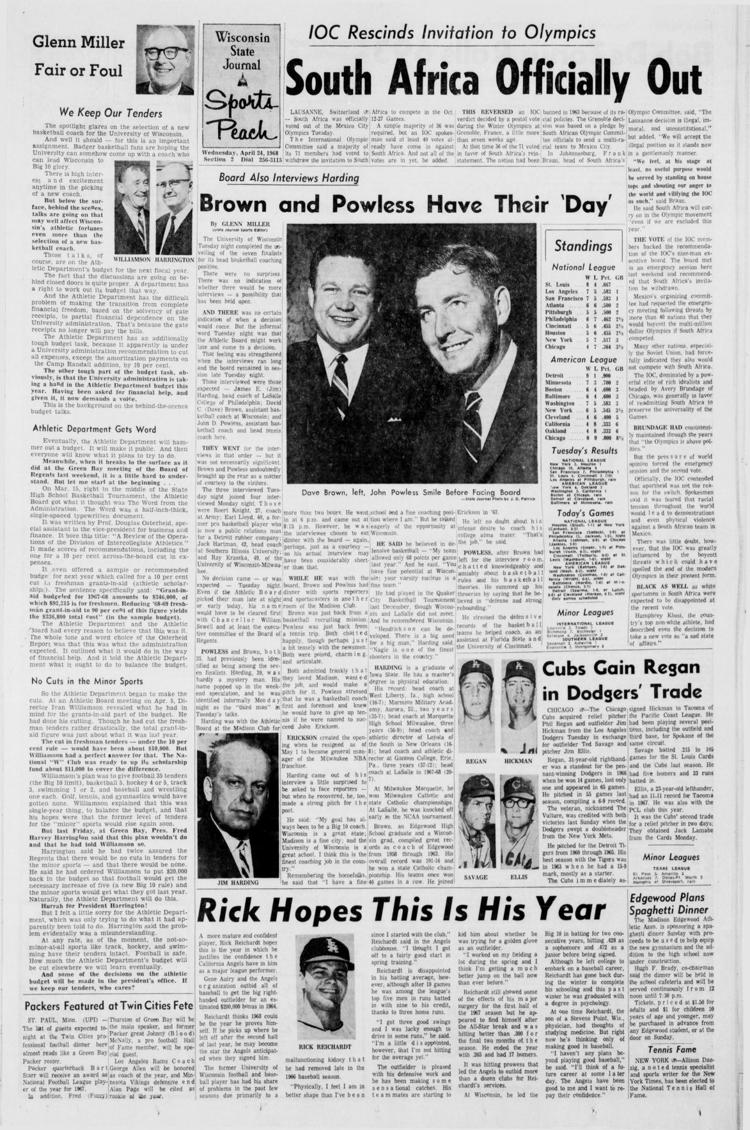
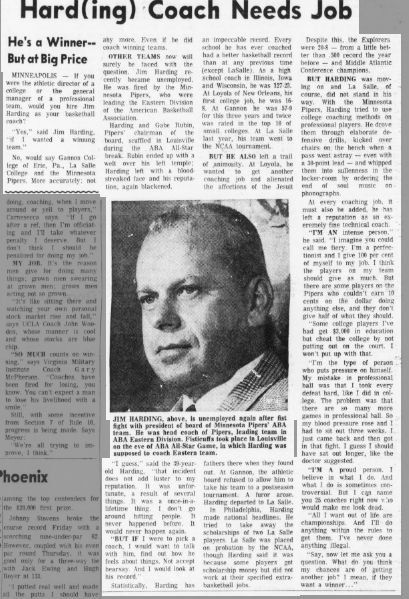
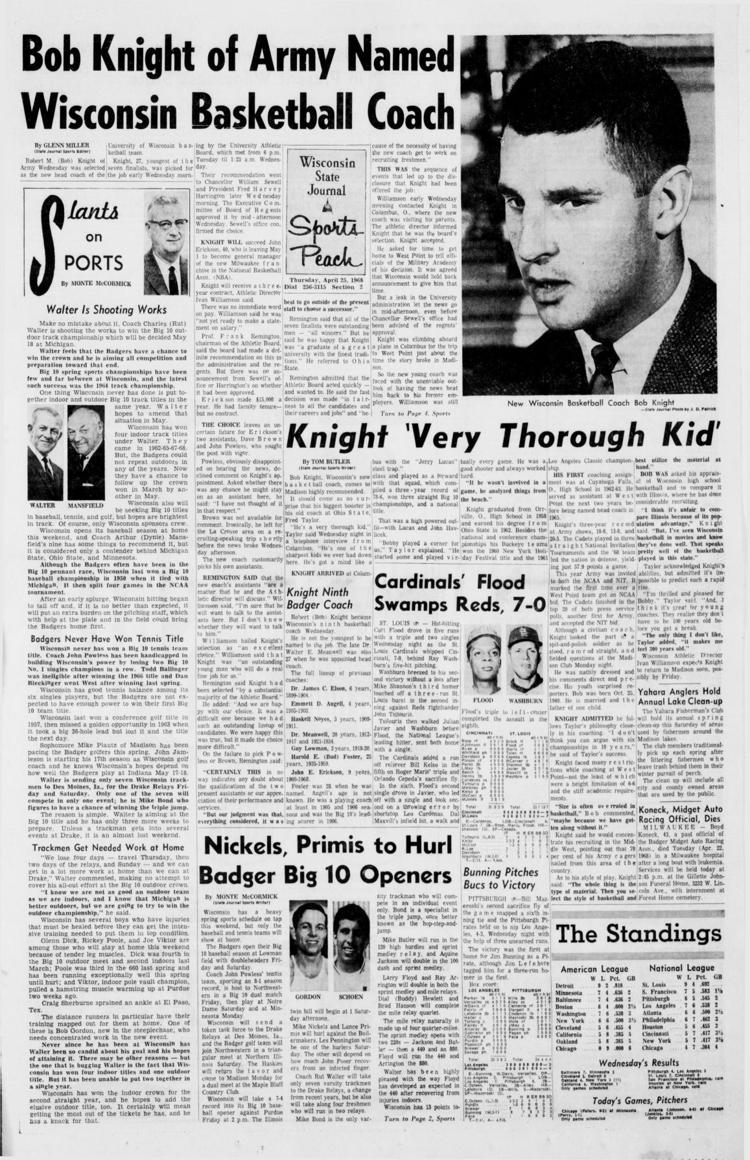
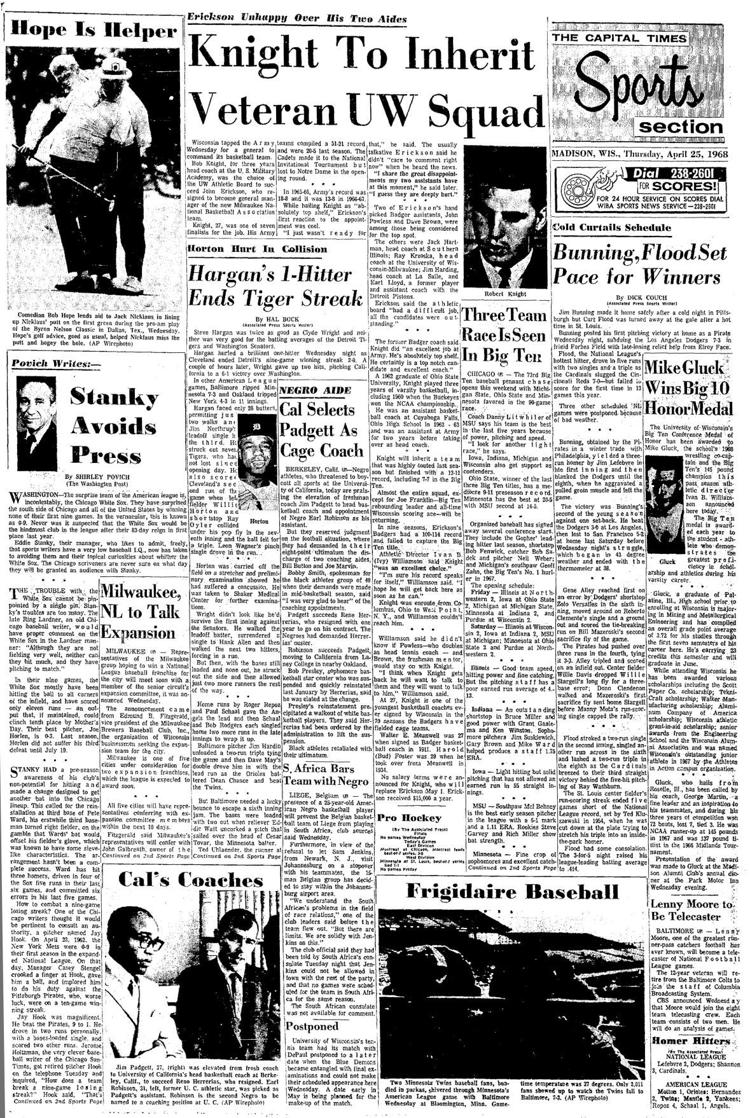
And so …
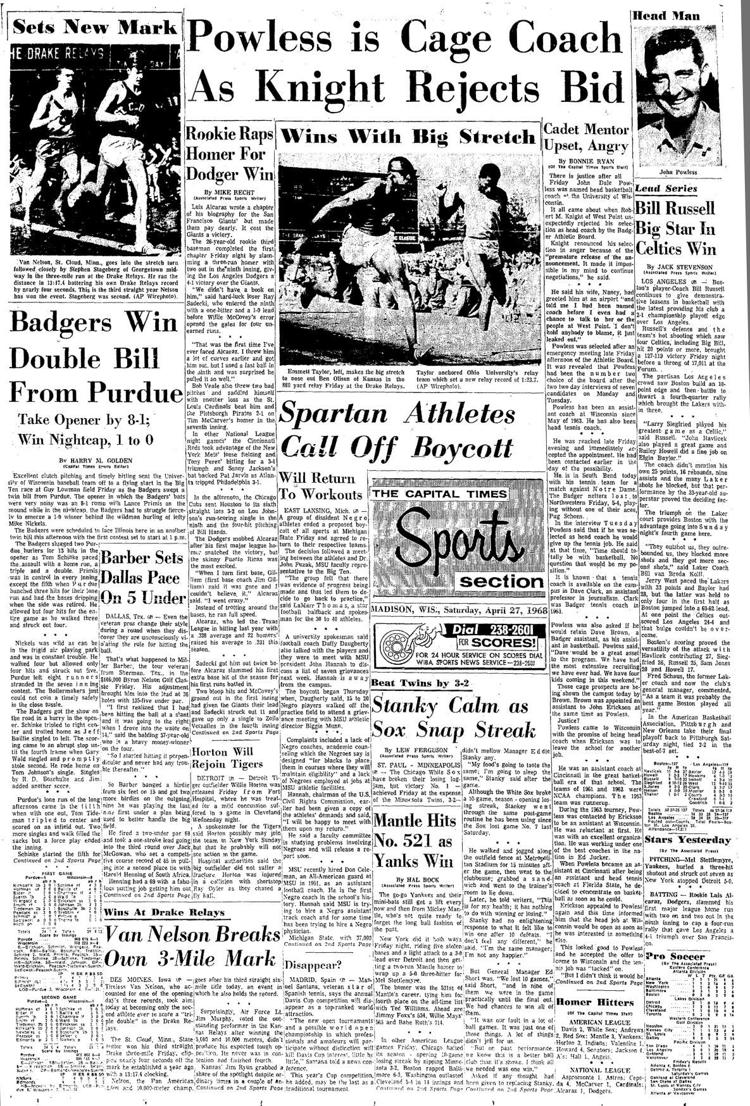
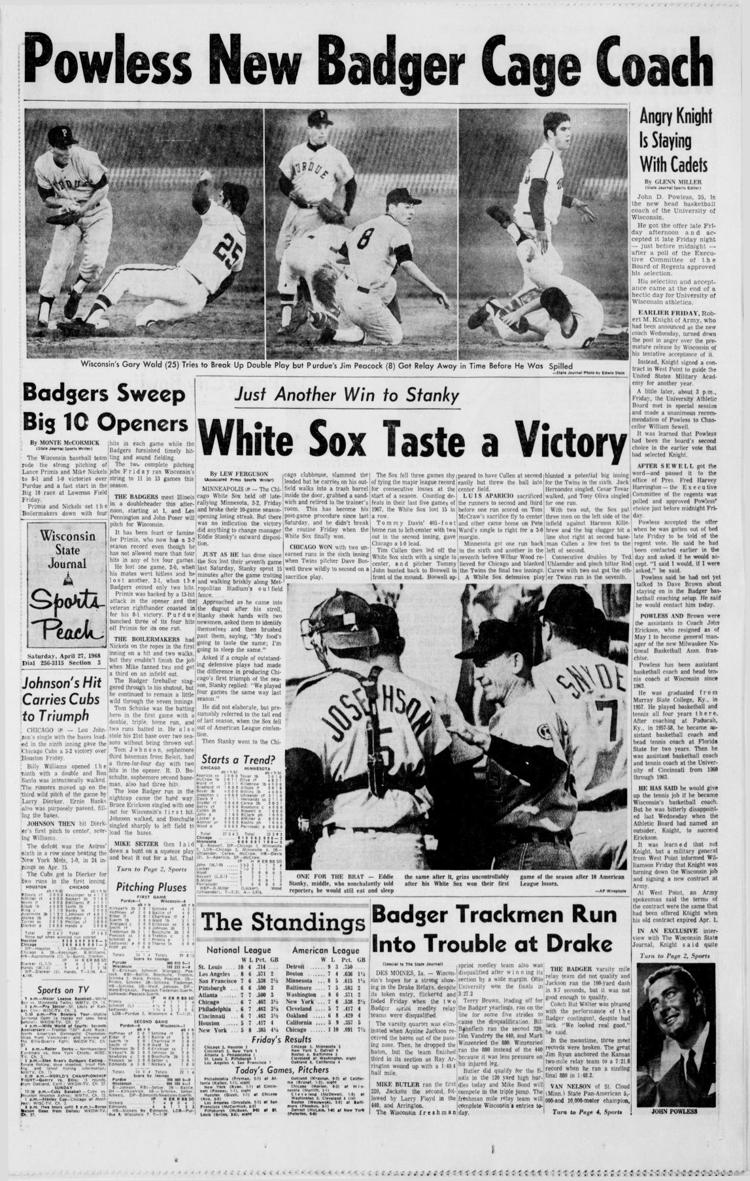
So did Knight quit over the premature notice or because of what Schembechler said about why he turned down UW? We report, you decide.
This was not the last time UW had to get coach choice number two, or failed to hire the right coach. After Coatta was fired …
… UW offered the football job to North Dakota State coach Ron Ehrhardt, who turned UW down. (Ehrhardt went to the pros instead, becoming an assistant coach, then head coach of the New England Patriots. After his firing, he was hired as an assistant coach for the New York Giants under Ray Perkins, then Bill Parcells, then going to Pittsburgh, getting him three Super Bowl appearances and two wins as an offensive coordinator.)
UW ended up hiring UCLA assistant John Jardine, who had one winning season in eight years, but it was exciting:
Jardine was replaced (though to his credit he remained a UW football supporter until his death) by Dave McClain, who coached Wisconsin to the Badgers’ first bowl win …
… plus two other bowl games …
… including the only bowl game I got to march in …
… before his death of a heart attack at 48 in April 1986.
McClain was replaced by defensive coordinator Jim Hilles. UW had most of its starters back, including eight players who were drafted by the NFL — running backs Joe Armentrout and Larry Emery, linebackers Rick Graf, Tim Jordan (who was one year ahead of me at Madison La Follette), Michael Reid and Craig Raddatz, and defensive backs Nate Odomes and Bobby Taylor — plus five players who would be drafted in the next year’s draft.
That 1986 team might be one of the biggest what-ifs in UW athletic history. They played four nonconference games that were winnable, but went 1–3 instead, and they won only two games after that.
Would that have happened had McClain lived? Hilles was the logical choice to replace McClain since he was assistant head coach, but what if Hilles had, as some head coaches do, focused on his side of the ball and let the offensive coaches run the offense?
Hilles was quoted in the UW media guide that “I will take the responsibility for the offense, and I will also take the blame. We will definitely be more aggressive physically; we want to knock some people off the line of scrimmage — let them know who we are. Since we feel our strengths are in the offensive line and our running backs, we will first set out to be as strong a running team as we can be. An effective running game will open up the throwing game for us, and that’s how we’re going to approach things.”
That is not different from the approach UW had under McClain once McClain switched from the option to the pro set when quarterback Randy Wright transferred in from Notre Dame. They had the same two quarterbacks, Mike “The Springfield Rifle” Howard and Green Bay’s Bud Keyes, though they were minus their top two receivers from the 1985 season, tight end Scott Sharron and wide receiver/kick returner Tim Fullington and one of their offensive linemen, Bob Landsee, who preceded Gruber and Derby into the NFL.
In a sense, though, Hilles’ offensive problems predated Hilles’ one year as head coach. Wright was a good enough quarterback to play for the Packers. His best receiver was Al Toon, who also played in the NFL. The season after Wright graduated, the Badgers had Toon, plus two other good wide receivers, Michael Jones and Thad McFadden, plus tight end Bret Pearson, who was drafted (though did not play) by the San Diego Chargers. None of them arguably were capably replaced, and when a team can’t move the ball through the air, defense becomes easier for their opponent.
Once the 1986 season started going south, UW started looking for a new coach. The five semifinalists included Hilles, Wyoming coach Dennis Erickson (right after Wyoming beat Wisconsin in Madison in Erickson’s first season), West Virginia coach Don Nehlen, Northwestern coach Francis Peay (a former Packer offensive lineman), and Tulsa coach Don Morton.
That list includes one coach who won two national championships, Erickson, and another who coached in a national championship game, Nehlen, winner of 202 games in his career. Neither were finalists for the job. Morton was hired over Hilles, and it could be argued that neither choice was the right choice. Morton won six games in three years, and his ineptitude resulted in the death of the UW baseball and gymnastics teams and nearly the rest of the UW Athletic Department.
If that seems like a mess, the mess of four years earlier was even worse. Erickson’s (and Knight’s) replacement, Powless, had only two winning seasons in eight seasons as coach. Powless’ replacement was Virginia assistant Bill Cofield, who had only one winning season in six seasons as coach. (Cofield died of cancer two years after he coached his last game.)
The options to replace Powless included Boston College coach Tom Davis, who grew up in Ridgeway and graduated from UW–Platteville. UW should have hired Davis, but didn’t. Davis went to Stanford, then to Iowa, where he beat on UW with regularity until he retired in 1999. Instead, UW hired UW–Eau Claire coach Ken Anderson, who then backed out of the job three days later. (One version of the reason was that he got wind of NCAA rule violations that resulted in the Badgers’ forfeiting all eight of their wins the next season; another is that he was making too much money as a landlord to UW–Eau Claire students to leave.) UW hired Ball State coach Steve Yoder, who at least got UW in a couple of NIT tournaments before he quit in 1991.
It should be pointed out that the fact that Schembechler was highly successful at Michigan (though he has two fewer Rose Bowl wins than UW), Knight was highly successful at Indiana (as in three national championships), Hartman was successful at Kansas State, Davis was highly successful at Stanford and Iowa, Nehlen was highly successful at West Virginia, and Erickson was highly successful at Miami (though not so in the NFL) does not necessarily mean any of them would have been successful at UW.
Two years after Schembechler declined to go to UW, he went to Michigan, replacing Bump Elliott (who ended up becoming Iowa’s athletic director and hiring football coach Hayden Fry as well as Davis). Michigan wasn’t at its usual standards, but Schembechler inherited the remainder of a team that had gone 8–2 the previous season. UW was five seasons removed from a Rose Bowl trip, but had finished tied for seventh in the three previous seasons before Schembechler was not hired.
Three years after Knight changed his mind about UW, he went to Indiana, inheriting a team that had gone 17–7 and had long-standing basketball tradition, though they had slipped in the seasons before Knight arrived. Erickson left of his own accord after two 13–11 seasons, but he had had only one other winning season in nine seasons.
UW had issues in the late 1960s that Michigan may not have had. In addition to more intense turmoil over the Vietnam War, The Cap Times chronicles 1968:
After threatening to boycott the final game of the season against Minnesota, 18 black Wisconsin football players skip the team’s season-ending banquet. The group earlier filed a list of grievances with the UW Athletic Board, saying the coaching staff lacked rapport with the black players and that coaches stacked black players at one position. Assistant coach Gene Felker resigns, complaining of “weak, frightened administrators, black athletes and their grievances.” The Athletic Board recommends establishment of a coach-player committee to address grievances, but it also gives unanimous endorsement to John Coatta, who was 0-19-1 in his first two seasons as head coach.
I’m sure Schembechler and Knight would have been successful somewhere besides Michigan and Indiana. I’m not sure they would have been successful at Wisconsin over the long run. I could see them sticking it out at Wisconsin for a few seasons, butting heads with faculty and administration because of their different views of who should be in charge (i.e. themselves) and, in Schembechler’s case, academic standards preventing certain players from admission (Knight never had that issue, but Michigan is not really a strong academic school, contrary to what Wolverine backers would like you to think), and leaving for greener pastures elsewhere. Irrespective of Knight’s late-1980s comments, I wonder if two big personalities like Schembechler and Knight could have coexisted on the same campus, given battles for resources.
Davis turned things around at Stanford somewhat (though his career record was 58–59), and inherited a better situation at Iowa than Yoder did at Wisconsin. Morton was a disastrously bad hire, and should have been fired after his second season. However, UW’s Athletic Department was a financial mess that was bolstered by decent football attendance before Morton got there. Once Morton drove the football program into the ground, the Athletic Department’s financial issues got exposed. (Read Rick Telander’s From Red Ink to Roses and you’ll see how bad things were.)
Nehlen probably would have been a success at Wisconsin. I’m not sure Dennis Erickson would have, given that his formula for revitalizing a program involved junior college transfers, something unlikely to work with UW’s academic tradition. Erickson clearly had the next level in mind since he left Wyoming after that season for Washington State and left Washington State for Miami after two seasons.
Here is a demonstration of how things eventually work out. Jardine hired as one of his assistants Madison Edgewood’s George Chryst. Chryst’s son, Paul, played for Wisconsin, was an assistant coach for Barry Alvarez and Bret Bielema, and then was hired by AD Alvarez to be the Badgers’ coach. Cofield hired William Ryan as an assistant coach. You know Ryan as Bo, who was chosen to coach the Badgers in 2001 over more well known coaches including Milwaukee’s own Rick Majerus. Ryan had one more Final Four trip than Majerus.
 Steve Prestegard.com: The Presteblog