The song of the day (even though tax day is not until April 17 this year):
The number one single today in 1972:
No comments on Presty the DJ for April 15
The song of the day (even though tax day is not until April 17 this year):
The number one single today in 1972:
WMTV in Madison reports:
Organizers of a pro-gun rights rally scheduled for Saturday say many supporters plan on legally and openly carrying guns. The rally is happening on the same day as the first Dane County Farmers’ market of the season.
The rally is being organized by the local chapter of The National Constitutional Coalition of Patriotic Americans.
“We want to celebrate our right to bear arms and we kind of like want to be an outreached hand to the community. We don’t want to be intimidating in any way,” said Thomas Leager, National Constitutional Coalition of Patriotic Americans Wisconsin organizer.
Leager said a few hundred people are expected to attend, many of them openly carrying a gun. It is legal to openly carry a gun on the Wisconsin State Capitol grounds.
“It’s just one of the things that we want to celebrate our rights and kind of help inform the public,” Leager said.
Some farmers’ market vendors are concerned about how the rally could impact safety and business.
Jennifer Patrello, a manager at Stella’s Bakery said they will not be at the market this weekend because of the weather, but she said she is worried the guns could turn shoppers away and negativity impact business for vendors.
“We believe that everyone in our group is intelligent and knows how to carry a gun responsibly,” Leager said.
Organizers of the event say they’re working with Capitol Police. The rally is set to start at 1 p.m. Capitol Police and the Madison Police will be monitoring the event.
The organizer of the farmers’ market said they do not have an opinion on the rally. She said shoppers who don’t want to be around the protest are encouraged to get to the market early. It opens at 6:15 a.m.
Those last two sentences prompted James Wigderson to comment:
There is a gun rights rally scheduled for Madison [today] for 1:00 PM. WMTV says families who want to attend the farmer’s market without being around people lawfully carrying guns should get there early. We’re looking forward to WMTV’s future warnings to families who want to avoid obscene signs at leftwing rallies at our state capitol.
A former boss of mine was a huge fan of the Rolling Stones. His wife was a huge fan of the Beatles. The two bands crossed paths today in 1963 at the Crawdaddy Club in Richmond, England.
The number one British single today in 1966:
Today in 1971, the Illinois Crime Commission released its list of “drug-oriented records” …
You’d think given the culture of corruption in Illinois that the commission would have better and more local priorities. On the other hand, the commission probably was made up of third and fourth cousins twice removed of Richard Daley and other Flatland politicians, so, whatever, man.
As you know, I am a connoisseur of both Corvettes and movies where cars play prominent roles.
One of the downsides of the latter is the dearth of quality movies with Corvettes in them. No, “Corvette Summer” does not count, nor, probably, “Last Stand”:
For whatever reason, a New York Times book excerpt popped up about probably the first Corvette made famous in entertainment, from the TV series “Route 66”:
Actor Martin Milner was one of those celebrities at whom Chevrolet aimed the 1953 Corvette. Herbert B. “Bert” Leonard was an even bigger target. Leonard had risen through television’s ranks to become an executive producer, the man who developed and ran successful and popular series shows. In late 1953 he introduced a drama starring a German shepherd and a young boy, called The Adventures of Rin Tin Tin. Milner had appeared in television’s Dragnet, and other series and films through the early and mid-1950s. Neither of them, however, was impressed enough to pay much attention to the car until they had to.
In writing schools, instructors teach young talents to “write what you know.” A slice of Leonard’s life, of what he knew from his youth, grew into a very popular series. In a 1982 interview in Emmy magazine with film writer Richard Maynard, Bert recalled a lunch with his friend, Naked City writer Stirling Silliphant in 1959 while that show was in production. As a child in New York, Leonard had a much wealthier friend who was a prep school student. Over lunch he and Silliphant imagined what it might have been like to hit the roads in his friend’s sports car. An idea gelled immediately and by the time lunch was over, they had their show name, The Searchers, and a pilot story roughed out. Leonard and Silliphant had created an idea that took another popular TV series of the mid-1950s Wagon Train into the next decade. In their proposal, they wrote:
The theme – search, unrest, uncertainty, seeking answers, looking for a way of life.
The people – are young enough to appeal to the youthful audience, old enough to be involved in adult situations.
The stories – will be about something, [Italics were Silliphant’s] will be honest, and will face up to life, look for and suggest meanings, things people can identify with, and yet there will be the romance and escape of young people with wanderlust.
The locales – the whole width and breadth of the U.S., with stories shot in the actual locations, a la Naked City. What we did for one city, we now propose to do for a country and for many of its industries and businesses.
In late 1959, Leonard and Silliphant pitched this idea to Columbia-Screen Gems. They were an acknowledged success; Naked City had established new standards for storytelling and cinematography in television. This idea, however, was different. As Screen Gems executives explained when they rejected the series initially, this was “about two bums on the road.”
The Searchers verged on late 1950s European Existentialism, a philosophy that questioned why humans exist. Because he suspected this was a bit too deep for television executives at the time, Silliphant brought it back to more comfortable territory. He concluded their pitch by promising that each episode would be “packed with at least two or three top-staged brawls (built into the character of Buz).” To demonstrate his faith in the idea, Leonard funded the pilot himself. In exchange, if Columbia bought the show, he would own 80 percent of the series.
Screen Gems execs reminded Leonard and Silliphant that New York’s Broadway had recently staged a play titled The Searchers, so the pair adopted the name of America’s emotionally-laden “mother road,” Route 66.
Regular viewers know that the 115 episodes over four years rarely found stories along U.S. Highway 66. That mattered only to those obsessed with detail. Leonard’s crew shot the pilot, called “The Wolf Tree,” in Concord, Kentucky, calling it the fictional Garth, Alabama, in February 1960. The show debuted on a Friday night, October 7, 1960, with the episode renamed “Black November.” By then the production crew was leapfrogging across the country. Leonard, Silliphant, and a production assistant scouted areas that gave them several nearby towns around which to craft two or three episodes. Four weeks later, the production caravan arrived and began filming. Silliphant sometimes wrote from hotel rooms near the locations, delivering script pages that day to the waiting cast, each story faithfully adhering to his promise to show America, its industries and its businesses, and a fist fight or two thrown in for good measure.
The premise of the show was that Tod Stiles, played by Martin Milner, had just lost his father, a New York City shipping company owner. Stiles, a junior at Yale, educated and thoughtful, well-bred and polite, came home for the funeral to discover a bankrupt business and a legacy that included nothing more than a new 1960 Corvette convertible.
“I’ve been seriously wrong about a lot of things in my life,” Milner admitted in an interview in 1998. “And I said to Bert Leonard, ‘A Corvette isn’t that exciting a car. Why don’t we do this in a Ferrari?’” Milner laughed.
“‘Well,’ Bert said to me, ‘we’ve got a pretty good chance of getting sponsorship from Chevrolet. And there’s a pretty good chance of not getting anything from Ferrari.’”
Milner related this story to documentary producer John Paget while they were completing a retrospective two-hour show tracing the actual route of Route 66. For that production Milner drove a 1960 Roman Red convertible (with white coves), which gave rise to yet another of the countless myths about the television series.
An actor Leonard had used and liked on Naked City, George Maharis, was hired even before Milner to play a dockside employee named Buz Murdoch. Maharis’ character Buz was a native of New York City’s Hell’s Kitchen, streetwise and cynical, equally quick to react or to joke. Now Buz was jobless. Suddenly uprooted in every sense, the two clean-cut handsome young men, friends from summers working on Stiles’ docks, took off to find themselves.
“Tod says,” Maharis announced in that first episode, written by Silliphant, “if we keep moving we’ll find a place to plant roots . . .. But with me, it’s fine just moving.”
Screen Gems and CBS picked up the series, and listings in publications such as TV Guide identified Milner and Maharis as the principal players. But there were four stars apparent to those who watched the show carefully: Maharis, Milner, the Corvette (often written in to Silliphant’s scripts as a character itself), and The Road Across America. As television historian Mark Alvey wrote in The Road Movie Book, “Route 66 is a tale both of search and flight, and as a serial narrative characteristic of American commercial television, its central meaning lies not in some finite goal at the end of the road, but in the discoveries made along the way.”
The show’s travels rooted much of America to their television sets every Friday for four seasons. The audience’s vicarious restlessness brought Chevrolet back year after year as principal sponsor. “See the U.S.A. in your Chevrolet,” was more than an advertising jingle for this show—it was close as existentialism was to being the show’s philosophical foundation.
Chevrolet’s advertising agency’s Los Angeles office provided Leonard a pair of Tasco Turquoise blue convertibles. As Leonard and Silliphant had promised, the show hit the road and travelled . . . and travelled. Maharis recalled recently that they covered 40,000 miles each year. Production manager Sam Manners ran a road train, as he explained to show historian James Rosin. A transporter carried the two Corvettes as well as a Chapman Crane, a truck with an arm capable of lifting the camera nearly 50 feet in the air. A station wagon supported the camera for moving front shots; a Corvair missing its front trunk lid served as camera car for rear views. Another dozen vehicles made up the convoy with portable dressing rooms, costumes, and the camera equipment, lenses, lighting gear, and generators cinematographer Jack Marta needed to get each episode on film.
For Chevrolet, it was the natural “vehicle” to promote their sports car. Similar motives attracted GM executives and viewers: There was no need to wait for a vacation to see the country in the family station wagon—hopefully a Chevy. Every week millions of individuals went on an adventure, imagining themselves as the third (or fourth or fifth) rider stuffed into the Corvette between Buz and Tod.
The show provided adventure, with Tod, Buz, and the Corvette as tour guides. Events, tumultuous and timely, befell the two young men just as they arrived in one locale or another. Silliphant, a writer profoundly in sync with America’s psyche, steered them to women’s rights, racial inequality, corporate malfeasance, land and water rights, international espionage, murder, theft, assault, marital and familial discord, war crimes, revolutionary terrorists, drug addiction and abuse, the role of the government in an individual’s rights, and the responsibilities of an individual to a town or nation. The episodes were self-contained, an anthology type of storytelling that introduced conflicts involving guest stars outside the Corvette. By the time the sleek luggage-encumbered convertible left town, all was right with the world and it was time to move on.
In an interview in Time magazine in August 1963, Silliphant said, “The meaning of Route 66 has to do with ‘a search for identity in contemporary America. It is a show about a statement of existence. If anything, it is closer to Sartre and Kafka than to anything else. We are terribly serious, and we feel that life contains a certain amount of pain.’”
The show caused some pain for cinematographer Marta, who worked hard to illuminate actors’ faces in bright sunlight against a pale blue car that reflected so much light. For the 1961–1962 season, the Campbell-Ewald agency provided the show with Fawn Beige convertibles. That darker color choice remained through 1964, when the series ended.
Some viewers picked up the difference between the tones of the cars, even filmed in black-and-white. They noticed that each year the seemingly penniless Stiles and Murdock (who often said they took jobs just for gas money) travelled in a current model Corvette. That question fit right in with, “How can they be in Maine if the show is called Route 66?”
As a title, The Searchers was not “catchy,” just as a Ferrari convertible would have been unbelievable—why wouldn’t Tod sell a car like that and go back to Yale? But Dad’s two-seat American-made Corvette enticed the two young men onto the road, letting Stiles search for roots and Murdock keep moving without taking much baggage or other passengers.
Chevrolet’s design studio began planning updates to the Corvette’s first-generation body even before introduction in 1953. Poor sales slipped the redesign back from the 1956 to 1958, when quad headlights appeared. Stylists Peter Brock, Chuck Pohlman, and others slaved away on the “next” Corvette, first called the “Q” and then nicknamed just “the next one.” In 1961 the car received a new rear end that hinted at The Next One. Quad headlights stayed through 1962 season and subsequent generations. The Sting Ray showed up for the 1962–1963 season and a new one carried on for the 1963–1964 programs.
About every 3,000 miles, Campbell-Ewald replaced the show’s cars, reconditioning them and sending them off to friendly dealers to sell as “executive” vehicles. Sam Manners remembered running though three or four cars per season. With each season’s renewal, new models arrived in time for the caravan to leave L.A. By 1963, that road show had grown to fifty vehicles on the road covering 40,000 miles each year. By then Chevrolet provided Corvettes to Milner and Maharis, Manners, and others for personal use as well.
The car shown here is not a vehicle from the show. Its white coves betray it, as does its unrestored survivor status. Pennsylvania owner Mike Nardo and his father know the history of the car and it did not include television stardom. But Nardo’s car is a survivor with 37,000 miles, a four-speed transmission, and the same factory steel wheels and wheel covers that Tod ended up with after Episode 22. In that show, “Eleven, The Hard Way,” the two men helped a small town confront the risks of gambling in order to save itself. To stake a loan to the town’s auditor in a make-or-break game of dice, Tod sold the wire wheels that drove the car through two-thirds of the premiere season.
The show itself was a gamble. There are reports that CBS didn’t care for it. Network president Jim Aubrey complained to Leonard that the show was “too downbeat,” and that he wanted more “broads, bosoms, and fun.” But, as Leonard told Mark Alvey, Chevrolet “liked the hard hitting show they bought . . . They wanted the reality, the drama, and the movement; not the sexy women and cliché characters.” GM’s marketing studies revealed that the show attracted huge audiences of young people between the age of 10 and 14, a prime target then and now. The show ran for four seasons, surviving the disappearance of co-star Maharis who was suffering with hepatitis brought on by the exhausting pace of travel and six-day shooting weeks. Milner drove on, searching for roots and meaning. The show finally slowed to a halt months after Glenn Corbett, playing Lincoln Case, replaced a still-ailing Maharis. “Linc” was more like Tod than Buz and the interplay and counterpoint that worked so well with Maharis and Milner never reappeared.
Critics have analyzed the show’s writing, its acting, and its stories. Some have compared it to beatnik author Jack Kerouac’s seminal travel story On the Road. Kerouac sued Silliphant and Leonard, accusing them of plagiarism. But as Paul Goodman explained in his book Growing up Absurd, “The entire action of On the Road is the avoidance of interpersonal conflict.” Route 66 was precisely the opposite, and viewer surveys commissioned in 1961 by Chevrolet and other sponsors learned that the audience understood the role of the stars as knights in shining armor, riding in week after week to save damsels—or entire towns—in distress. It is their co-star in this noble pursuit, their trusty steed, their white charger—well, first blue and then beige—that is the subject of this chapter.
The book is …
.jpg&h=369&w=369)
… Legendary Corvettes: ’Vettes Made Famous On Track And Screen, which I have not read, and apparently is not available through the local library system. It appears from the Amazon preview that there is only one other movie/TV Corvette in the book …
… this abomination.

My blog last week about the Chevrolet Caprice (a French word meaning “behemoth,” I believe) may somehow cosmically have gotten me to see this:

What the what, you ask? This is (apparently because I can’t see if the headlights are rectangular or round) a 1976 Caprice Landau, to which has been added … T-tops.
A T-top, according to Heacock Classic, is …
… a beautiful example of compromise. If you want the open-air fun of a convertible but don’t want to completely sacrifice structural rigidity and add the weight of a drop top, the T-Top was made for you. It’s also not a feature you’ll find in any car being manufactured today. Meaning if you want the red-jeans-wearing, mullet-having, John Cougar Mellencamp-blaring awesomeness of a T-Top, you’re more than likely going to need to buy a classic car.
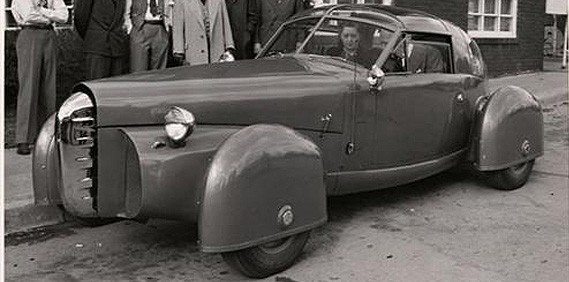
While many credit GM for the T-Top, it was actually invented and patented by car designer Gordon Buehrig. It was first used in a 1948 prototype by The American Sportscar Company or “Tasco.”
See those wheel covers? They turn with the wheels!
While Tasco had an excellent roof, they never made more than one prototype of the car.
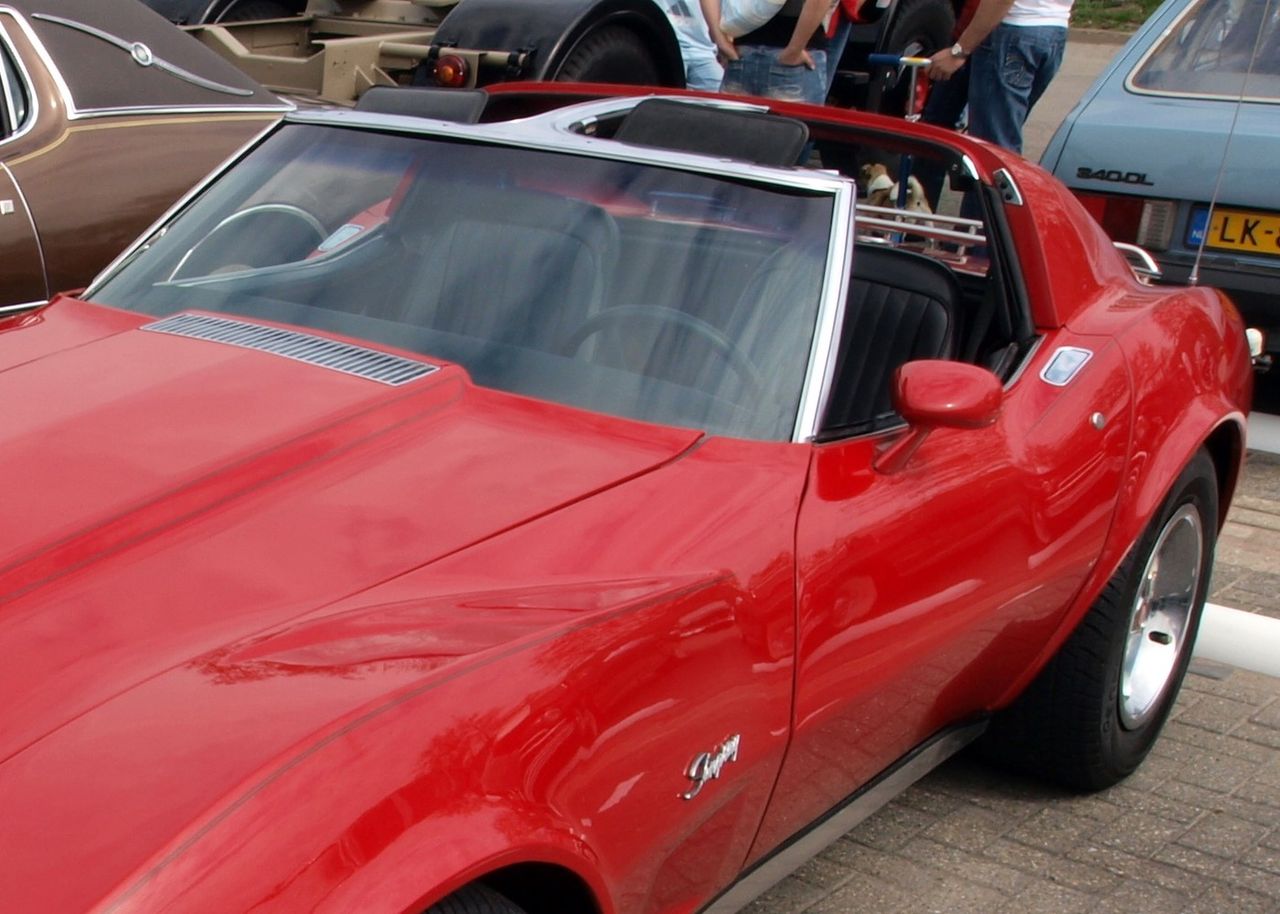
The T-Top wasn’t seen again until GM introduced it on the 1968 Corvette, at which point Gordon Buehrig promptly sued them. While his suit was successful, the settlement is said to be relatively small.
The Corvette’s T-Tops were so well-liked they were cited as the reason Chevy discontinued Corvette convertibles in the 1976 model year and didn’t resume production of them until 1986.
What late C3 ‘Vette lacked in forward visibility and stingray badging, it completely made up for in roof-awesomeness.
Perhaps the most iconic application of the T-Top was on the second-generation Pontiac Firebird. Offered for the first time in 1976, these T-Tops were originally provided by Hurst until 1978, when they were replaced by larger, less leaky panels manufactured by Fisher. The “Smokey and The Bandit” Trans Am, pictured above, features Hurst tops.
Eventually, all of the Big Three American car manufacturers tried their hands at making cars with T-Tops. They even made their way onto less performance-oriented models like the Chrysler Cordoba and seventh-generation Ford Thunderbird. Overseas, this roof is featured on a variety of Japanese and British automobiles, even on quirky utility vehicles like the Subaru Brat and Suzuki X-90 (you may not recognize it without a giant Red Bull can on the back).
While none of today’s car companies have the good sense to make cars with these truly awesome roofs anymore, the Chevy Camaro and Pontiac Firebird brought the T-Top into the 21st century, if only just. T-Tops went the way of Pontiac and its Firebird in 2002. Until manufacturers come to their senses, car-buyers with discriminating tastes, i.e. those who adore T-Tops, will just have to look to classic cars to get their open-air performance fix. And that’s just fine by us!
The T-top was only on the C3 Corvette, replaced on C4s thereafter by a targa top, which covers between the top of the windshield and the B-pillar. The bar between hatch panels was because merely cutting off the roof would have made the car unstable. Stiffening from the C4 onward (the C5 was designed as a convertible to which the roof was added) helped deal with that problem.
There is one other GM T-top not mentioned …

… the 1977 Olds Toronado XSR, one of which was built with not just a T-top, but …

… a power T-top. This is the only one American Sunroof Corp. built for Olds, because they couldn’t get the power top mechanism to work. (Imagine GM rejecting new technology because it didn’t work right.) Olds instead sold the Toronado XS, which had merely a sunroof.
I once owned a car with a dealer-installed sunroof. It leaked somewhat, but that was the least of the problems with that car. Sunroofs designed with the vehicle generally don’t leak, but the downside is that power sunroofs reduce headroom, which is an issue for us tall drivers. We have a Honda Pilot that came with a sunroof as standard equipment. It’s cool to drive it with the roof open, assuming it’s not too cold or windy. (The former can be dealt with by, obviously, turning up the heat; the latter is dealt with somewhat with an air deflector that deploys when the roof is open, but it’s best to not have any windows open in that case. The other downside is if your hair is a little bit, uh, light on top.)
The most desirable of the big Chevrolet B-bodies (the Chevy Impala and Caprice, Pontiac Bonneville and Grand Ville, Olds Delta 88 and Buick LeSabre) are the convertibles. (As are the pre-1971 Cadillac Coupe de Ville and the post-’70 Eldorados.) Targa tops and T-tops are the next best thing. Convertibles today are either sports cars (ranging from the Corvette to the Mazda Miata) or otherwise small cars (the late Chrysler Sebring). Detroit doesn’t make big cars anymore, so Detroit doesn’t make big two-doors, let alone big convertibles.
This photo came from this web page, which claimed that the owner had also modified the car’s axles to put on 14-inch wheels (one inch smaller than the originals) for the reprehensible practice of “donking.” (Usually “donking” involves installing much larger wheels, not smaller, as in the case of this Caprice.) If you were going to put different wheels on the Caprice, the logical choice would not be 14-inch wheels, but reproductions of the old Chevrolet Rally wheels. Ironically, Rally wheels were not offered on the ’71–76 Chevy B-bodies, while they were available on everything from Malibus to Corvettes. (The B-body bolt circle was too large. I found that out the hard way.)

So for reasons known only to GM, one could not get Impala or Caprice Rally wheels, even though you could get sport wheels on your big Pontiac …

… or Buick, though not, for some reason, the big Olds.

The B-bodies (built at Chevy’s late Janesville plant, by the way) were designed thusly for 1971. (The C-bodies — the Olds 98, Buick Electra and Cadillac Coupe and Sedan de Ville — were even bigger; “C” probably stood for “colossal.”) The ’71–76 Chevys model offerings did not include the Impala SS, combining both size and horsepower from 1961 to 1969. The Impala SS’ death is too bad given that Chevy could have put together a ’71–76 Impala SS from its own parts bin, using, for instance, its 454 V-8 and the swivel bucket seats and console of the mid-’70s Monte Carlo and Laguna S-3. Of course, someone “restomodding” a big Chevy could do that too, as long as you’ve already departed from originality with your T-top.
You might think the number one British single today in 1967 is …
The number one single today in 1974:
Today in 1980, Grease was no longer the word: The musical closed in New York, after 3,883 performances.
From the category of surprising-but-not-surprising news, James Wigderson reports:
House Speaker Paul Ryan announced [Wednesday] that he is not running for re-election. Ryan began his remarks by saying that when you become Speaker of the House, you realize that it’s only for a short period in the nation’s history.
“You all know that I did not seek this job,” Ryan said. “I took it reluctantly, but I have given it everything that I have, and I have no regrets whatsoever about accepting this responsibility.”
Saying that the job of Speaker is all-time consuming, Ryan said that it interfered with his family obligations.
“That’s why today I am announcing that this year will be my last one as a member of the House,” Ryan said. “To be clear, I am not resigning. I will serve my full term as I was elected to do.”
In his remarks, Ryan talked about the effect of serving as the Republican leader for another term would have on his family.
“What I realize is, if I am here for one more term, my kids will only have ever known me as a weekend dad,” Ryan said. “I just can’t let that happen.”
During the 2016 race for president, Ryan’s name was frequently mentioned as a possible candidate to unite the Republican Party. However, Ryan declined to run and often cited his young family as a reason.
In his remarks, Ryan said the two biggest achievements of his time as Speaker of the House were tax reform and re-building the nation’s military. “These I see as lasting victories that will make our country more prosperous and more secure for decades to come,” Ryan said.
Ryan also thanked the voters in Wisconsin for electing him to the House of Representatives.
“I also want to thank the people of southern Wisconsin for placing their trust in me as their representative for the last 20 years,” Ryan said. “I have tried to bring as much Wisconsin to Washington as I can in that time. It’s been a wild ride, but it’s been a journey well worth taking to be able to do my part to strengthen the American Idea.”
Ryan was first elected to the House of Representatives in 1998, replacing former Congressman Mark Neumann. In October 2015, Ryan replaced Congressman John Boehner (R-OH) as Speaker of the House. Ryan was a reluctant candidate for the position, but was chosen by his colleagues as a compromise between the moderate ahd hardline factions.
Ryan’s departure means Wisconsin Republicans find themselves defending an open congressional seat that already has one well-funded Democrat, Randy Bryce, running, as well as another candidate, teacher and school board member Cathy Myers.
Now speculation will begin on both sides about candidates jumping into the race, with Republicans needing to recruit a solid candidate to hold the seat. State Sen. Van Wanggard (R-Racine) has already announced he is not running, according to Jay Weber on WISN. Possible candidates include Assembly Speaker Robin Vos (R-Rochester), Rep. Samantha Kerkman (R-Burlington), state Sen. Dave Craig (R-Town of Vernon), Assembly Speaker Pro-Tem Tyler August (R-Lake Geneva), Rep. Amy Loudenbeck (R-Clinton) and former Republican National Committee Chairman Reince Priebus. Another possible candidate is Bryan Steil, a member of the University of Wisconsin System Board of Regents.
Vos issued a statement today on Ryan’s retirement that did not mention a potential run. “Paul has been perhaps the best congressman Wisconsin has ever sent to Washington and also one of the best speakers to have gaveled Congress into session,” Vos said. “His commitment to serving the people of Wisconsin and the United States is unparalleled.”
“I am happy for my friend and his family, but sad for the 1st Congressional District and our country because men like him don’t come around often,” Vos said.
More prominent Democrats may enter the race as well. Former Assembly Minority Leader Peter Barca (D-Kenosha) represented the district in the House of Representatives after winning a special election to succeed Congressman Les Aspin when he became the Defense Secretary for President Bill Clinton.
Nationally, Ryan’s departure signals Republicans are not likely to hold onto control of the House of Representatives after this November’s elections. Other congressional retirements could be expected as a result.
As a member of Congress and when he ran for Vice President on the Republican ticket with former Massachusetts Governor Mitt Romney in 2012, Ryan was an advocate for bringing entitlement spending under control. With his departure, neither party has a prominent leader on that issue.
This is, first, not good news for Wisconsin at all. The only Wisconsinites with as much power over national politics that come to mind are former Defense Secretary Melvin Laird and, in non-positive ways, U.S. Sens. Joe McCarthy and “Fighting Bob” La Follette. Whether you like it or not, Congress is driven by (1) seniority and (2) the majority party in the House. Wisconsin’s next senior representative is U.S. Rep. Ron Kind (D–La Crosse), who looks moderate only compared with the other two Wisconsin Democrats, U.S. Reps. Mark Pocan (D–Black Earth) and Gwen Moore (D-Milwaukee). Does anyone think Kind, Pocan or Moore represent the interests of Wisconsin Republicans? How about the last Democratic speaker, Nancy Pelosi?
The high-fives of those who view Ryan as a Republican In Name Only are, frankly, stupid. (For instance: Republicans support free trade; RINOs, including Trump, favor stupid trade wars.) It is not Ryan’s fault that legislation that passed the House of Representatives fails to get considered in the Senate due to its cloture rules or the lack of leadership of Senate Majority Leader Mitch McConnell. (And some legislation dies on its merits.) Republicans have been complaining about the House speaker since 1994, when they got control of the House. The speaker may be first in line to the presidency, but House speakers have to lead more than propose.
Facebook Friend Louis D’Alfabeto says to Ryan and then to his supposedly conservative detractors …
In an alternate and better universe, you’re halfway through your second term as VP and preparing to run for the White House – and our policy discourse is the better for it.
Those who purport to be conservatives spewing negativity right now can spare us your lack of critical thinking and reasoning skills. You’re clueless as to how the game is played, mere infants throwing tantrums because you can’t have the impossible, completely ignorant that “politics is the art of the possible…”
… which prompted this response from Facebook Friend Tim Nerenz:
I could probably stand on pure libertarian principle with the best of them, and I bet Ryan could too if that were his wont. I don’t know him well, but I have done a couple things with him and heard him in some thoughtful forums. He is a) one of the highest quality human beings in politics, and b) the smartest person in the room, you pick the room. He knows the both economics and the pragmatics down dead cold and should have stayed as committee chair where he could maneuver budget and economic policy legislation – what he knows and does best. People who expect Republicans to be Libertarians are pissing at windmills – Ron Paul was the RINO, Rand Paul is the RINO, Donald Trump is the RINO. Paul Ryan is center-cut, straight out of central casting Republican. I think the GOP missed a YUGE opportunity to write their script with Trump in the white house to sign whatever came out of the sausage grinder on the Hill – I wouldn’t have taken a lunch break, let alone all the recesses and retreats over the past year. But to the Ryan-haters, the simple question is who’s next. Ryan got the Speaker’s job because Boehner was a mess and there was nobody else to take it. He never wanted it. There is still nobody else. It’s not my party and so I don’t care all that much, but seriously, who is the GOP going to turn to as Speaker and face of the Party now? Lou – you probably know.
Readers know what I think of 2012 Barack Obama voters, and there is literally no possible comparison between Romney’s character and Donald Trump’s character, such as that is. The only thing people know about Mike Pence is that he’s not president, but he might be president if the fevered dreams of Democrats come true.
I recall being on Wisconsin Public Radio’s Week in Review when Ryan chaired the House Ways and Means Committee and was saying he wasn’t interested in becoming speaker. When asked who should, I didn’t say Ryan, I said U.S. Rep. Justin Amash (R–Michigan), who is about as libertarian as it gets in Congress for someone whose last name is not Paul. For Amash to become the next speaker (assuming he’s even interested, and given Ryan’s term as speaker maybe he shouldn’t be) requires the GOP’s winning the House, which isn’t looking good now, though in these turbulent political times much can happen between now and Nov. 6.
Pelosi has already vowed to undo the tax cut passed earlier this year. House Democrats have proposed, with the support of Pocan and Moore, banning all semi-automatic weapons. If you seriously think that’s better than Ryan as Speaker of the House, for all Ryan’s faults, you’re not a conservative.
The Wisconsin Newspaper Association convention is this weekend. (No, I’m not going.)
I wonder if this Politico Special Report! will get discussed:
President Donald Trump’s attacks on the mainstream media may be rooted in statistical reality: An extensive review of subscription data and election results shows that Trump outperformed the previous Republican nominee, Mitt Romney, in counties with the lowest numbers of news subscribers, but didn’t do nearly as well in areas with heavier circulation.
POLITICO’s findings — which put Trump’s escalating attacks on the media in a new context — were drawn from a comparison of election results and subscription information from the Alliance for Audited Media, an industry group that verifies print and digital circulation for advertisers. The findings cover more than 1,000 mainstream news publications in more than 2,900 counties out of 3,100 nationwide from every state except Alaska, which does not hold elections at the county level.
President Donald Trump’s attacks on the mainstream media may be rooted in statistical reality: An extensive review of subscription data and election results shows that Trump outperformed the previous Republican nominee, Mitt Romney, in counties with the lowest numbers of news subscribers, but didn’t do nearly as well in areas with heavier circulation.
POLITICO’s findings — which put Trump’s escalating attacks on the media in a new context — were drawn from a comparison of election results and subscription information from the Alliance for Audited Media, an industry group that verifies print and digital circulation for advertisers. The findings cover more than 1,000 mainstream news publications in more than 2,900 counties out of 3,100 nationwide from every state except Alaska, which does not hold elections at the county level. …
“I doubt I would be here if it weren’t for social media, to be honest with you,” Trump told Fox Business Network in October. Without it, he said at the time, he “would never … get the word out.”
POLITICO’s analysis shows how he succeeded in avoiding mainstream outlets, and turned that into a winning strategy: Voters in so-called news deserts — places with minimal newspaper subscriptions, print or online — went for him in higher-than-expected numbers. In tight races with Clinton in states like Wisconsin, North Carolina and Pennsylvania, the decline in local media could have made a decisive difference.
To assess how the decline in news subscriptions might have affected the presidential race, POLITICO made a county-by-county comparison of data from AAM. Almost all daily newspapers report their subscription numbers, print and online, to AAM for verification in order to sell to advertisers. (Some of the smallest outlets do not, though, including weekly publications.) After ranking the counties on subscription rates, POLITICO compared election results between counties with high and low subscription rates, and used regression analysis to determine the correlation between news circulation and election results.
Among the findings:
• Trump did better than Romney in areas with fewer households subscribing to news outlets but worse in areas with higher subscription rates: In counties where Trump’s vote margin was greater than Romney’s in 2012, the average subscription rate was only about two-thirds the size of that in counties where Trump did worse than Romney.
• Trump struggled against Clinton in places with more news subscribers: Counties in the top 10 percent of subscription rates were twice as likely to go for Clinton as those in the lowest 10 percent. Clinton was also more than 3.7 times as likely to beat former President Barack Obama’s 2012 performance in counties in the top 10 percent compared to those in the lowest 10 percent — the driest of the so-called news deserts.
• Trump’s share of the vote tended to drop in accordance with the amount of homes with news subscriptions: For every 10 percent of households in a county that subscribed to a news outlet, Trump’s vote share dropped by an average of 0.5 percentage points.
To many news professionals and academics who’ve studied the flow of political information, there’s no doubt that a lack of trusted local media created a void that was filled by social media and partisan national outlets. …
Starting in the 1970s, when the control of the nominating process shifted from party elites to primary-election voters, a common sight at rallies, conventions and debates was small groups of journalists, men and women, most of them having traveled in from Washington, gathering to compare observations. Together, they would decide what news had been made — which candidate handled himself better, which exchanges were the most relevant, which assertions were the most questionable.
In the days before the Internet, about a dozen news outlets dominated national political coverage. They included the major television networks, weekly news magazines, The Associated Press, and about a half-dozen newspapers. Wire services such as The New York Times News Service and The Washington Post-Los Angeles Times service sent out their articles to smaller papers across the country, guaranteeing vastly wider circulation for their stories.
There is a giant error here. (Actually more than one, but follow me for a bit.) To call an area — say, Ripon, where I used to live — a “news desert” because it doesn’t have a weekly newspaper is a gross misrepresentation. Ripon has a weekly newspaper, and an award-winning weekly newspaper at that. A lot of communities have award-winning weekly newspapers that are doing better in a business sense than the nearest daily newspaper.
In fact, across the newspaper industry weeklies are doing considerably better than dailies. Dailies face more competition for the advertising dollar (which is the majority of income for newspapers) than weeklies in smaller markets do, and often competition that relies on ad revenue for all of its revenue (radio and TV).
Dailies focus on the community whose name is in their masthead (i.e. the Milwaukee Journal Sentinel), showing up in small towns only when there’s something they think is meaty. The weekly newspaper, meanwhile, covers things that don’t get the attention of the daily, such as school events, local sports, etc. The competently run weekly newspaper doesn’t focus on state or national issues except to the extent those issues affect their readers. So if Paul Ryan comes to town, they’ll cover Ryan, but they’re not going to write about politics beyond their market every week.
Chain ownership is a reality of journalism today, as it is in many fields of business. Though there is nothing innately wrong with chain ownership in the same way there is nothing innately wrong with ownership by a publicly traded company, chain ownership hasn’t worked out so well for daily newspaper readers. Gannett owns most of the daily newspapers east of the Interstate 39 corridor. None are considered quality newspapers (other than by themselves) except for the Milwaukee Journal Sentinel (and the JS certainly has its non-fans, which is probably a growing group, given the USA Today-ization of the Journal Sentinel). Gannett newspapers outside the Journal Sentinel run a page or two of news from the previous day’s edition of USA Today (which makes those pages USA Yesterday, actually two-day-old news, which should be unacceptable for a “daily” newspaper).
Other daily newspapers have made business decisions seemingly designed to alienate their audience. The Wisconsin State Journal decided to stop covering the southwestern part of the state at the same time the Dubuque Telegraph Herald stopped printing its own newspaper. So, you ask? The issue is that the TH’s print deadlines for a morning daily newspaper are the previous early afternoon, except for page 1 stories. Both the State Journal and the TH have simultaneously cut back on sports coverage in the area where they previously had overlap, reducing readers’ daily choices from two to none. Readers stop reading, or don’t start reading, due to (in their definition) bad product.
The Internet is a difficult problem for those who are used to getting customers to pay for their product. A lot of daily newspapers started putting their work online for free, and then discovered that people don’t like paying for something they used to get for free. The online model that seems to work best is to charge for the product but include it in a print subscription package, but a lot of daily newspapers haven’t figured that out.
The State Journal is the daily newspaper I grew up reading (starting at age 2, according to my parents, which did not compel the State Journal to hire me, not that I’m bitter or anything). It has been owned by Lee Newspapers for decades. State Journal readers if asked might say that the State Journal has gone backward in quality since Lee decided it wanted to buy bigger newspapers, such as the St. Louis Post-Dispatch, that had increasing business problems. For all The Capital Times’ numerous faults, it was locally owned, and still is, though it is no longer a daily newspaper and still has those numerous faults.
Strange though this sounds, the Cap Times’ (as it calls itself now as a weekly tabloid) ending daily publication wasn’t a benefit to the State Journal’s non-liberal readers. The State Journal, both editorially and in its news coverage, has lurched leftward ever since then, while continuing to print Sunday screeds of editor Paul Fanlund and his predecessor, Dave Zweifel. The State Journal used to have a moderate-to-conservative editorial page, but that hasn’t been the case for years. (Similarly, the merger of the former Milwaukee Journal and Milwaukee Sentinel resulted in a generally slightly-less-than-liberal Journal Sentinel editorial page.)
What Politico terms “news deserts” are simply markets not large enough to support a daily newspaper. It’s pretty arrogant to assume that journalism occurs only in daily newspapers, but that’s one of the (often valid) criticisms of my line of work.
And speaking of that, David Harsanyi adds:
We’re now into our second year of theorizing about what went wrong in 2016, which is itself illustrative of the prejudice in much of political media. Most of these stories have nothing to do with Donald Trump’s policies or his behavior — topics well worth covering — and everything to do with creating the impression that the electoral process was dangerously flawed. Whether The Comey Letter swung the election or Fake News swung the election or Facebook data mining swung the election, there have been so many stories intimating that our democratic institutions have been subverted, that you sense certain people might be reluctant to accept the sanctity of the process.
I bring this up, because this week, a new Politico piece theorizes that a lack of “trusted news sources” in rural areas, rather than any particular issues, gave Donald Trump victory in 2016. It is perhaps the most unconvincing, inference-ridden, self-aggrandizing piece in the entire “What Went Wrong?” genre. The premise, basically, is that a lack of local media sources left a void that was filled by Donald Trump’s tweets and unreliable conservative sites, and that factor turned the 2016 election, “especially in states like Wisconsin, North Carolina and Pennsylvania,” where hapless Americans were unable to make educated choices without proper guidance from journalists.
“The results,” Shawn Musgrave and Matthew Nussbaum write, “show a clear correlation between low subscription rates and Trump’s success in the 2016 election, both against Hillary Clinton and when compared to Romney in 2012.” Setting aside the problem of correlational/causation and all that, every one of these stories is driven by the unstated notion that Clinton was predestined to win the 2016 election, and any other outcome means something went wrong. There’s simply no way, a year into Hillary’s presidency, that major outlets would be doing a deep dive into the viewing habits of urbanites to try and comprehend how they could have been crazy enough to elect her.
It’s true, the world is changing and also it is inarguable that places with larger populations that have the means to support local newspapers (like the scrappy New York Times) would be more inclined to vote for Clinton, while in rural areas where subscription-based outlets are more difficult to maintain, they would not not. Both these things are true. Yet, there is no data in the piece — despite nearly 4,000 words and a number of graphs to create a scientific veneer — offering any compelling evidence that the dynamics of a race would be altered if the Bedford Falls Examiner was still in business.
In the old days, we’re told, the local reliable church-going editor would run dispassionate stories from trustworthy sources.
In the days before the Internet, about a dozen news outlets dominated national political coverage. They included the major television networks, weekly news magazines, The Associated Press, and about a half-dozen newspapers. Wire services such as The New York Times News Service and The Washington Post-Los Angeles Times service sent out their articles to smaller papers across the country, guaranteeing vastly wider circulation for their stories.
For people who care about the news, larger papers and stations still exist, but they exist online. Rural Americans, like urban Americans, get most of their news online. They follow national trends in their news consumption. After decades of skewed coverage, they’ve become skeptical. But like other voters, they rarely alter their positions, and when they do seek out the news they seek our news that feeds their predominant political prejudices. You may not like that rural Republicans get their news from FOX and Sinclair rather than CNN and MSNBC, but that’s a matter of ideological taste.
It is almost also certainly true that Trump’s “relentless use of social media” had something to do with perceptions of his voters (his obsession with Hillary is another story.) But would his successful application of new media, once celebrated when the appropriate people won elections, been any less effective because there was a Washington Post wire story running in the local paper? Would Trump voters have traded in the MAGA hat for an “I’m with her” bumper sticker if they read Paul Krugman in their paper? This seems unlikely.
What’s far more plausible is that a combination of factors made Trump in 2016 a marginally more agreeable Republican candidate to rural voters than Mitt Romney in 2012. Or, perhaps, even more relevant, that Hillary Clinton was far less likeable, and had far less political acumen, than the candidate Romney faced in 2012, Barack Obama. But even without factoring in the personalities, comparing turnout and voting patterns in different years in the way Politico does is fraught with other problems. Americans are fickle, and national events, trends, local economic factors, and thousands of other variables can alter results, as well.
The idea that a lack of a local newspaper is a determinative factor in swinging enough people to turn a national election is probably a reflection of journalism’s self-importance and an inability to live with the idea that Americans could vote for Trump without being hoodwinked in some way. Because, let’s face it, Democrats never really lose an election, do they? If the Supreme Court isn’t stealing the presidency then propaganda outfits are weaponizing social media mindbots to control your vote or the Constitution is getting in the way of proper “democracy.” We’re going to keep doing this until Americans make the right choice.
Trump may or may not get reelected (or even run) in 2020. But daily newspapers have probably lost those Trump voters permanently, and that is the daily media’s own fault. Alienating vast numbers of paying customers is not a successful recipe for staying in business.
Today in 1966, Jan Berry of Jan and Dean crashed his Corvette into a parked truck in Los Angeles, suffering permanent injuries.
The number one single today in 1969:
Today in 1975, David Bowie announced, “I’ve rocked my roll. It’s a boring dead end, there will be no more rock ‘n’ roll records from me.”
The Associated Press reports the latest Democrat verbal diarrhea:
Wisconsin Republican Gov. Scott Walker is accusing Democrats of being driven by “anger and hatred,” a line of attack the two-term incumbent began emphasizing last week that his opponents say more accurately reflects the tactics of President Donald Trump.
Walker, who is up for a third term in November, made the charge against Democrats on Twitter the night a liberal-backed candidate for Wisconsin Supreme Court trounced her conservative opponent. Walker has repeated it many times in the week since, as he also sounds an alarm about Wisconsin being hit by a “blue wave” in November.
“Their rhetoric is increasingly not just liberal, but filled with hatred and anger towards me, towards the president, towards Republicans in general,” Walker said on the “Fox and Friends” show broadcast nationwide Monday.
Democrats said the new line of attack is desperate.
“For all his boasting about being unintimidated, it is clear Scott Walker is panicked, and he should be,” said Mahlon Mitchell, one of more than a dozen Democratic gubernatorial candidates.
Walker said Democrats running against him were once “mild-mannered, low-key people” but “to win that primary they’re going to have to show that they can match the rhetoric of hate and anger.”
When asked for specific examples of what Walker was referring to, the Wisconsin Republican Party pointed to a January story in the Hudson Star-Observer newspaper in River Falls, Wis., where Democratic gubernatorial candidate Tony Evers called Walker an “idiot” for rejecting federal Medicaid matching funds.
The state GOP also mentioned a radio interview where challenger Matt Flynn called Walker “too stupid to be governor.” The party also produced a sampling of profane comments posted on Twitter in reaction to Walker that came from random people, not Democratic candidates for office.
Walker has long been the subject of vitriol from some political opponents after he effectively ended collective bargaining for public workers shortly after taking office in 2011. That anger fueled the ultimately failed attempt to recall him in 2012.
But Democrats running against Walker this year reject the claim they’re fueled by hate and anger, and say Walker’s accusation ignores Trump’s behavior.
“Hate and anger — he must be reading the president’s 3 a.m. tweets!” said Democratic gubernatorial candidate Andy Gronik.
Another Democratic gubernatorial candidate — state Rep. Dana Wachs, of Eau Claire — called Walker’s claims “ridiculous and disingenuous.” Wachs said Walker and Republicans “accuse Democrats of being hateful while practicing the politics of hate — it’s classic smoke and mirrors.” …
Walker is urging Republicans to spread an optimistic and positive message, something Democrats say their own candidates and party are already doing.
“We reject the politics of anger, hatred, and division that have turned neighbor against neighbor over the past eight years,” said candidate Kelda Roys.
Mike McCabe, a longtime political activist, said his campaign isn’t even focused on criticizing Walker.
“I challenge anyone to find anger and hate in what I say as I’m traveling the state or in any of our campaign videos,” McCabe said. “We have to focus on what we love, not what we hate. We have to focus on what we’re for, not what we’re against. I say that everywhere I go.”
McCabe’s comments notwithstanding, I suppose, none of the Democrats quoted here would dare say any of this to Walker’s own face, or the face of anyone who could provide physical repercussions for their verbal hatred. That, of course, is a major reason why social media has become such a cancer on our society — people feel perfectly free to write things they would never say to someone in person. (Or say things to reporters they’d never say to someone close enough to respond with a punch to the face.)
Well, two can play that game. The 1988 Democratic presidential field was known derisively as the Seven Dwarfs. This year’s Democratic gubernatorial field could well be called the 17 Dwarfs, or whatever number of Democrats have decided to run for reasons known only to themselves. Comrade Soglin persists under the delusion that the People’s Republic of Madison’s Mayor for Life has created Madison’s prosperity instead of having the state capital and a world-class university there, neither of which Soglin has anything to do with. Tony Evers keeps sending out news releases announcing himself as “State Superintendent,” as if he has more power than he actually as. I wonder why a successful business person (Gronik, according to himself) would run for office. I wonder why a former political party head (Flynn) who has never been elected to public office thinks he’s qualified to be governor. For that matter, on what planet is a firefighter union head qualified to run anything other than a public employee union? Who is Wachs? Who is Roys?
There is a difference between them and me. I would say exactly what I wrote one paragraph ago to their faces if they had the guts to show up. As you know, I hate politicians. I hate the politicians I vote for slightly less than the politicians I oppose.
Yesterday I posted the opinion that one reason why most school referenda passed April 3 was because the state had finally corraled, in the opinion of voters, sky-high school property taxes. The comment a regular reader made it appear that he believes that the responsibility of taxpayers is to (1) provide schools with as much money as they want and teachers unlimited autonomy and then (2) shut up. That, of course, is not how it works. Any government service gets the money and authority the Legislature authorizes, and not one cent more.
The thing voters who voted for Walker in 2010, 2012 and 2016 should remember is these and other Democratic dirtbags are not merely insulting Walker — they are personally insulting everyone who voted for Walker. (In the same way that Hillary Clinton and other Democrats continue to insult people who voted for Trump in 2016.) That seems like a strange way to attract voters to yourself, unless their interest, beyond demonstrating their low character, is to wind up Democratic-leaning voters. That says a lot about Democratic-leaning voters.
Libertarians will point out, correctly, that this is the logical result of government that has grown far too large and taxes and controls too much, which has led to increasing the stakes in elections, made the zero-sum-game aspect of politics far worse, and thus requires winning at all costs.
I continue to read these comments from Democrats, both nationally and in this state, and conclude that Democrats’ number one goal is to exact revenge on Republicans following the Nov. 6 elections. I also wonder how in the world we haven’t had assassinations of politicians and/or their supporters in this country and this state in this decade. Yet.
 Steve Prestegard.com: The Presteblog