Today in 1967, the Beatles released “All You Need Is Love” …
… which proved insufficient for the Yardbirds, which disbanded one year later:
No comments on Presty the DJ for July 7
Today in 1967, the Beatles released “All You Need Is Love” …
… which proved insufficient for the Yardbirds, which disbanded one year later:
Baseball gets serious at the All-Star break, which is not until July 17.
Baseball is, however, already past the halfway mark, so Jay Sorgi suggests:
Yes, the Milwaukee Brewers’ latest video discussing “expectations” has gone viral as it showcased how the team is focusing on the task of making the postseason for the first time since 2011.
But it also uncovers a precedent from incredible circumstances that could be a portent of really good things to come.
The Brewers shared this video in recent days about the team’s expectations and focus on making 2018 all it can be, and they are getting the job done so far as the National League’s No. 1 seed for playoff positioning as of this writing.
But notice the moment of the first scene in the video: The dejection of losing the second-to-last game of the 2017 season on September 30 to the St. Louis Cardinals in walk-off fashion by one run. That one run that cost the Brewers the postseason, as Milwaukee finished one game out of the NL Wildcard.
OK, Brewers fans, it’s now way-back-machine time for you…to 1956. September 29, 1956 to be specific.
On that day, the second-to-last game of the regular season, the Milwaukee Braves played the St. Louis Cardinals. In Busch Stadium. (The first edition, of course. They’re in the 3rd edition now.)
The Brewers entered that must-win game against St. Louis in the midst of a race for the postseason with the Brooklyn Dodgers.
Warren Spahn threw an absolute gem of a 12-inning game, but lost in walk-off fashion – yes – by one run.
That one run cost the Braves the NL pennant. Just like the 2017 Brewers, despite a last-game victory, they lost out in the standings by one game.
What did they do the next year?
Well, they rededicated themselves like never before under the drive of Fred Haney, used the most prolific home run hitting lineup in baseball that year and the National League’s second-best pitching staff (by team ERA) to earn that spot in the postseason.
Fast forward to now, and the continued list of similarities between Aaron, Spahn and company and these Brewers.
Just like the 1957 Braves , Milwaukee is currently second in the NL in ERA. (The Brewers are No. 2 in the NL in home run hitting.)
Just like the 1957 Braves on July 6 of that year, these Brewers currently own a small lead over their nearest pursuers.
Just like the 1957 Braves who picked up Red Schoendienst to bring added bat, defense and experience, the Brewers made massive moves to grab Lorenzo Cain & Christian Yelich (and may have another move up their sleeve).
Part of my skepticism is the fouled-up mess that is Major League Baseball management. It is ridiculous and insulting to the paying customers for teams to deliberately tank — that is, fail to put a competitive product out on the field every day of every season. (See Brewers, 2015 and 2016 seasons.) The grotesque competitive imbalance baseball’s finances have created means that some teams are literally out of contention for the playoffs on Opening Day, while big-market teams can just open the checkbook and buy what they want from the non-contenders right about now.
Sorgi’s comparison to 1957 is a bit of a stretch. The 1957 team included the National League Most Valuable Player, Henry Aaron, and Cy Young Award winner, Warren Spahn. The 1957 team may have been sparked by their new manager, Fred Haney, who perhaps unlike his predecessor wasn’t there to be liked. Hazle, one of the great stories of Milwaukee baseball history — he was a midseason callup and, yes, hit .401 in less than a half-season — wasn’t on the radar at the start of the season, while people knew who Aguilar was, even though he couldn’t regularly play due to Eric Thames. The ’57 Braves also were helped tremendously by a midseason trade for second baseman Red Schoendienst.
What about 1982, the second greatest moment in Milwaukee baseball history? That team had the American League MVP, Robin Yount, and Cy Young winner, Pete Vuckovich. For most of the season it also had the previous year’s Cy Young winner and MVP, relief pitcher Rollie Fingers. That team was sparked by a midseason managerial change, with Bob “Buck” Rodgers, who piloted the team to its first playoff berth one season earlier, dumped one day before my 17th birthday in favor of hitting coach Harvey Kuenn, who got the team to relax and play to its potential. That team was helped tremendously by a late-season trade for starting pitcher Don Sutton, without whom there would have been no playoffs.
Coming into tonight, here is the National League Central standings:
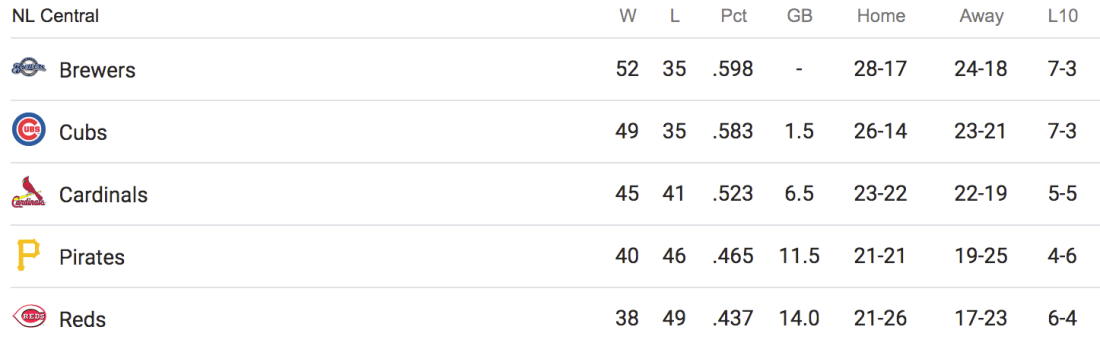
The Brewers have the best record in the entire National League, and are on pace to win 97 games. In the (over)expanded baseball playoffs it’s hard to imagine not getting a playoff berth with 97 wins. There are four American League teams with better records — Boston, the Yankees, defending champion Houston and Seattle (see previous comment about big-market teams) — but to get your league’s number one postseason seed you need not top every team, only the teams in your own league.
Is a 97-win season reasonable? The first baseball stats junkie, Bill James, created the Pythagorean Theorem of Baseball, which posited that a team’s win percentage could be determined by dividing the square of the team’s runs scored by the sum of the square of runs scored and runs allowed. That projects the Brewers to win 94 games, which if correct still makes the Brewers likely to get in the playoffs if they keep playing like they’ve been playing.
At the risk of sinking into diamond nerddom, let’s look at how the Brewers are doing compared with everyone else. Their offense is actually below average — they are 17th in the league in runs scored per game, in part a result of their all-or-nothing offensive approach — they are eighth in baseball in home runs, but 15th in runs scored. They have been shut out 10 times this season, so Harvey’s Wallbangers this team is not.
But here is a stat that someone familiar with the Brewers’ dreadful pitching history may not believe: The Brewers have one of the best pitching staffs in baseball right now. (I’ll pause to let that sink in.) They are second in runs allowed per game, 3.72; fourth in earned run average, 3.53; and sixth in WHIP (walks plus hits per innings pitched), 1.206. They have eight shutouts this season, even though they have no complete games pitched by their starters.
Statistically their starting pitchers are average. Their relievers are not. For one, the bullpen is 20–10, which is fourth best in baseball. They have three relievers — righthander Jeremy Jeffress (6–1, 3 saves, 1.07 ERA), lefty Josh Hader (2–0, 7 saves, 1.21 ERA, and averaging almost two strikeouts per inning) and righthander Corey Knebel (2–0, 10 saves, 3.32 ERA after a slow start) — who turn games into six-inning games, like the 1990 Cincinnati Reds “Nasty Boys” trio of Norm Charlton, Rob Dibble and Randy Myers did. (That team swept the 1990 World Series, by the way.)
Aguilar is the best offensive Brewer right now, and he might get MVP consideration if he keeps hitting at his present pace (.299, 19 home runs, 57 RBI and a .958 OPS, all of which lead the team). The offseason pickups of outfielders Lorenzo Cain and Christian Yelich have immeasurably improved the team, which is fortunate given that two of last year’s starters, right fielder Domingo Santana and shortstop Orlando Arcia are in Class AAA because of their bad hitting, and that no other regular could be considered to be a complete hitter in terms of average and power. (For instance, third baseman Travis Shaw has 15 HR and 49 RBI, second best on the team, but is hitting .244.)
If you compare this year’s offense to the ’57 Braves and ’82 Brewers, there really isn’t much comparison. Besides Aaron the Braves had Eddie Matthews (32 HR and 98 RBI) and seven other regulars bat over .270, and besides Yount the Brewers had Paul Molitor, Cecil Cooper, Ted Simmons, Ben Oglivie and Gorman Thomas — basically, until the World Series not a weak spot in the lineup. This year’s Brewers aren’t at that level on offense.
Pitching-wise is a more interesting question. The ’57 Braves were second in the NL in ERA. The ’82 Brewers were sixth in the AL in ERA, which I guess you can get away with if you are number one in your league in runs scored. (If you’re second in ERA and first in runs scored, well, you win the 1957 World Series.)
If you believe in the aforementioned Pythagorean Theorem of Baseball, by the way, and assuming everyone scores and gives up runs at their current paces, the Brewers won’t win the NL Central; they will end up with 94 wins, nine games back of the Cubs, though that would give them the top wild card spot. (Said theorem would make, in the AL, Houston, Boston and Cleveland as AL division champions, with the Damn Yankees and Arizona the wild cards, and in the NL, the Cubs, Dodgers and Atlanta as division champs, with the Brewers and Arizona as wild cards. Check back in three months to see if that’s correct.)
That brings up one flaw in the previous paragraph of this long treatise — the assumption that everyone would stand pat, when in fact they certainly will not. Contenders will made deals to augment their rosters from those whose motto is “Wait ’til (insert future year here).” It’s only one opinion, but Bleacher Report‘s ranking of the six teams in best position to make a deal doesn’t include the Brewers.
On the one hand, the Brewers did pick up Yelich and Cain in the offseason to improve the team, and they certainly have improved the team. On the other hand, there seems skepticism among the baseball experts on Facebook Brewers pages that the Brewers would make a Sutton-like trade, or a deal like the 2008 deal that brought pitcher C.C. Sabathia to win a playoff berth.
Rather than list who might come to Miller Park, click here for the current rumormongering, which still includes Baltimore third baseman Manny Machado and Toronto starting pitcher J.A. Happ but does not include Mets’ starters Noah Syndergaard or Jacob deGrom, nor a player I’d like to see the Brewers get, Miami catcher J.P. Realmuto.
The likelihood of a big deal depends on whether Brewers management thinks they can go deep in the playoffs this year, and whether they’re willing to risk becoming a future non-contender. That’s how the stupid economics of baseball works. The likelihood of whether the Brewers can remain a contender if teams around them — particularly the Cubs and Cardinals — make deals and the Brewers don’t seems pretty low, particularly if the few hot hitters stop hitting and the bullpen starts getting worn out.
Christians recently celebrated Easter, a Sunday where many churches are robust and full. But, if current trends continue, mainline Protestantism has about 23 Easters left.
The news of mainline Protestantism’s decline is hardly new. Yet the trend lines are showing a trajectory toward zero in both those who attend a mainline church regularly and those who identify with a mainline denomination 23 years from now.
While the sky isn’t falling, the floor is dropping out.
The trajectory, which has been a discussion among researchers for years, is partly related to demographics. Mainline Protestants, which has been the tradition of several U.S. presidents, aren’t “multiplying” with children as rapidly as evangelicals or others of differing faiths. And geography matters. Places where Protestants live are now in socio-economic decline, and parts of the country like the Sun Belt are become more evangelical with every passing winter.
And as Episcopal researcher Kirk Hadaway explained in 1998, “nontraditional groups, including once-marginal Protestant churches, smaller sects and non-Western religions, have increased. At the same time, a growing number of people have shed their particular religious affiliations, saying they are just ‘religious, spiritual’ or have no religion at all.”
But I think something deeper is going on. …
It’s not the whole story, but here’s an argument for at least part of what has happened. Over the past few decades, some mainline Protestants have abandoned central doctrines that were deemed “offensive” to the surrounding culture: Jesus literally died for our sins and rose from the dead, the view of the authority of the Bible, the need for personal conversion and more.
Some of mainline Protestants leaders rejected or minimized these beliefs — beliefs that made the “protest” in Protestantism 500 years ago — as an invitation for more people to join a more culturally relevant and socially acceptable church. But if the mainline Protestant expression isn’t different enough from mainstream culture, people turn to other answers.
I’m an evangelical (which, I assure you, has its own set of problems). However, I became a Christian in the (very mainline) Episcopal Church. I take no delight in mainline Protestantism’s decline and am hoping and praying for a reversal. And I know many in the mainline Protestant tradition seek to follow Jesus and are working to change the trend line of decline.
And, ultimately, mainline Protestants likely do have many more than 23 Easters left. Churches will be restarted and revitalized and there will be advancement initiatives. Mainline Protestants won’t cease to exist completely in 23 years because they trend will probably slow, but the data does not give us good hope for their future.
My personal hope is that mainline Protestantism will experience a resurrection of sorts, something Christians tend to have faith in. However, such a move won’t come from following the trajectory it has been following.
The future of mainline Protestantism is connected to Christianity’s essential past, where the resurrection can be proclaimed again unabashedly. Jesus is not just a good person who suffered unjustly. Jesus’s death and resurrection makes our dead souls alive again.
In the 1970s, Dean Kelly wrote an often-cited book on why conservative churches are growing, stating that even amid hostility toward organized religion, conservative churches seemed to grow.
Is part of the answer for mainline Protestantism to grow more conservative?
It depends on how you define “conservative.” For some, they hear a call to become Trump supporters, deny climate change science or support huge tax cuts. That’s not what I’m talking about.
But a recent study published in the Journal for the Scientific Study of Religion, based upon a Canadian sample, goes into the theology of the mainline. As David Haskell explained in The Washington Post, “[W]e found 93 percent of clergy members and 83 percent of worshipers from growing churches agreed with the statement ‘Jesus rose from the dead with a real flesh-and-blood body leaving behind an empty tomb.’ This compared with 67 percent of worshipers and 56 percent of clergy members from declining churches.”
Of course, you can’t say, “Mainliners all believe this or that,” but the numbers above suggest a theological gap, even on something as basic as what Easter means, and that gap has both theological and statistical implications.
If mainline Protestantism has a future, it will need to engage more deeply with the past — not the past of an idealized 1950s, but one that is 2,000 years old. The early Christians saw a savior risen from the dead, heard a message that said he was the only way and read scriptures that teach truths out of step with culture, both then and now.
I imagine that many mainline Protestants would agree, and perhaps the supernatural message of Easter, believed and shared widely, could bring the resurrection that mainline Protestantism needs.
And 2039 is just not that far away.
Can one wish a happy birthday to an entire band? If so, I volunteer to wish Jefferson Airplane a happy birthday:
Or perhaps you’d like to celebrate Bill Haley’s birthday around the clock:
<!–more–>
Gene Chandler:
Who is Terrence “Jet” Harris? He is credited with popularizing the bass guitar in Britain and helping give Jimmy Page and John Paul Jones (who ended up in Led Zeppelin) their starts:
Rik Elswit of Dr. Hook and the Medicine Show:
Madison native John Jorgenson of the Desert Rose Band:
Michael Grant of Musical Youth, which asks you to …
There is a second-season episode of the original Star Trek that includes this:
(Not bad for a Canadian, eh?)
Robert Shibley must have been channeling his inner Kirk:
Should all of our fellow Americans enjoy the right to free speech?
[Wednesday], we as a nation will have 242 years under our belt, and I’m happy to report that after nearly a quarter of a millennium, most of us continue to answer “yes” to this important question. But this outcome was hardly inevitable. For much of the last century, political forces in our nation, most of them on the political right, fought to make sure they didn’t.
They repeatedly lost. Could Americans be forced to salute the flag? Kept from joining the Communist Party? Prohibited from protesting the Vietnam war in school? Denied the ability to use swear words, or to look at “indecent” publications? No, no, no, and no.
Yet despite this record of losses, an increasing number of thought leaders on today’s political left now appear to be talking themselves into launching their own long war against the very First Amendment principles that enabled them to argue for the societal changes they so value.
For example, a front-page article in Sunday’s New York Times was titled “How Conservatives Weaponized the First Amendment.” The story quotes a number of left-leaning figures, including feminist scholar Catharine MacKinnon and consumer advocate Ralph Nader, who signal their frustration with recent court cases protecting conservative speech.
Another academic cited in the article, Georgetown Law professor Louis Seidman, recently made waves in legal circles with a forthcoming law review article whose title asks, “Can free speech be progressive?” He asserts, “The answer is no,” lamenting that progressives “just can’t shake their mindless attraction to the bright flame of our free speech tradition.”
Mindless? The modern era of First Amendment jurisprudence turns 100 this year. Regardless of your political persuasion, it’s awfully hard to argue that the United States of 2018 is less progressive than it was in 1918—a year in which universal women’s suffrage, for instance, was still two years away.
Those on the left who argue that it’s time to jettison our nation’s uniquely liberal conception of free speech are making a grievous mistake, but not a new one. British philosopher John Stuart Mill identified this error in his famous 1859 tract On Liberty, and his observation is as accurate now as it was the day he wrote it.
“All silencing of discussion is an assumption of infallibility,” wrote Mill. “[W]hile every one well knows himself to be fallible, few think it necessary to take any precautions against their own fallibility, or admit the supposition that any opinion of which they feel very certain, may be one of the examples of the error to which they acknowledge themselves to be liable.”
The underlying assumption of the new First Amendment critics is that it is self-evident that progressive positions (whatever those may be) are correct. Therefore, if the application of free speech principles makes accomplishing their aims more difficult, it’s freedom of speech that is the problem. There can be little doubt that Anthony Comstock, Joseph McCarthy, and the myriad other right-leaning censors of the past felt the very same way when the ideals of free speech got in the way of their own plans to “improve” American society.
Censors of all stripes worry that without proper guidance and regulation, our society might make the “wrong” choices, as determined by, well, them. But policies adopted under conditions where all sides have a right to be heard carry the legitimacy they do precisely because free discussion and debate increase people’s confidence in the conclusions that are ultimately reached. As Mill also wrote, “Complete liberty of contradicting and disproving our opinion, is the very condition which justifies us in assuming its truth for purposes of action.”
Whether in science, in a criminal trial, or in society at large, there is no reason to trust a conclusion that was reached without access to and consideration of all of the relevant information—the very information that censors wish to suppress.
Furthermore, the idea that freedom of speech has ceased to be of use to those on the political left simply doesn’t comport with reality. Within just the last year, the Foundation for Individual Rights in Education used the First Amendment to successfully vindicate the rights of college students in Iowa to advocate for marijuana legalization, and in Illinois, to pass out flyers attacking capitalism. Was this not helpful to progressive causes?
Sometimes those seeking recourse through the First Amendment are not discernibly members of either the right or the left; sometimes, the expression at issue isn’t political at all. For example, in the past few years, the Supreme Court has struck down laws that restricted the kinds of signs that could be placed in public areas and that provided for the punishment of people who pretend to be decorated veterans for their own personal gain.
What’s more, the fact that the logic of freedom of speech can be used by both sides, or that your side can’t win them all, is hardly a new discovery. The principles are viewpoint-neutral. They can be utilized by all of us, regardless of our ideological bent. In the campus context, for example, FIRE uses the same legal arguments to defend a student’s right to pass out flyers about animal abuse as we do when defending a libertarian student group trying to hand out copies of the Constitution.
Especially in today’s hyper-polarized politics, labeling an idea or proposition as merely a weapon for, or a conspiracy by, the other side is akin to giving partisans a permission slip to turn off their brains. It’s an easy, expedient measure that gives your “team” one less thing to think about in a world deluged with news and information. It’s much harder to step back and consider that what you see as a “sword” in the hands of your opposition—a metaphor sometimes used by the left-leaning thinkers discussed above—might look a whole lot more like a shield to the other side.
Trying to see the argument from the other side is hard work. But then, governing a heterogeneous nation of more than 300,000,000 is hard work, and in our political system, we all share in that responsibility. When asked on the last day of the Constitutional Convention what kind of government the Framers had produced, Benjamin Franklin famously replied, “A republic, if you can keep it.” The First Amendment, and the culture of free speech for which it serves as a touchstone, is a key part of what makes our great experiment work.
If we intend to keep our nation going into its 243rd year and beyond, we had better continue to avoid the temptation to forcibly silence our opponents rather than persuade them to our side. On this Independence Day, FIRE pledges to continue its work to ensure that the promise of free speech for all continues to be a reality—regardless of our political disagreements.
It appears as though the Fond du Lac City Council considers public input beneath itself, based on what the Fond du Lac Reporter reports:
New Fond du Lac City Council member Donna Richards raised the ire of some veteran members at the last council meeting when she said city government could do a better job of informing its citizens.
“As our bosses, the citizens need to learn more from us, to decide if we represent them well,” Richards said.
Hoping for change, she extended an offer to members to “initiate discussion,” on how to engage citizens and “let them know what the city is doing,” she said. Council meetings rarely pack the legislative chambers unless there’s some hot topic.
Suggestions include extending the elected terms of council members beyond two years, creating a three-stage decision-making process, adding transparency to closed session meetings and bringing questions to the table that are asked of city staff through personal phone calls.
Council member Catherine Block, the most vocal opponent after hearing Richard’s ideas, said she believes the election cycle brings “new and fresh ideas to the council.”
Block said the council’s job is “not to lecture an apathetic public” and added “if they care, they can approach us.”
“You are new and we have been a cohesive unit and trying to throw a wrench in the cog at this stage of the game, before you actually have a sense of the meetings and how meetings work and how the process works — I respectfully disagree with changing it at this time,” Block said.
Under her plan, Richards said an agenda item up for discussion could be briefly introduced at one meeting, followed by a formal presentation at a second meeting so “there is better flow of information,” she said. A final decision and vote could then take place at a third meeting.
“Citizens should be able to speak both before and after staff presents an item, and before we have our discussion,” Richards said. Currently, audience members can address the council only at the start of each meeting.
In comparison, Fond du Lac School Board meetings offer audience sessions at the beginning and end of each school board meeting. Fond du Lac County Board offers no open audience sessions, but citizens may ask before the meeting to speak publicly about an issue and will then be given an opportunity to speak.
Richards said she sees council members being too dependent on department staff for information, and says too often questions are answered outside meetings, which defeats the spirit of open meeting laws.
“It seems something comes up on the agenda and it is passed because all the discussion was done in committees,” she said.
Notices for closed session topics should be clearer she said, as the law indicates notices should be as descriptive as possible.
In the future, Richards said she anticipates holding public informational meetings that staff and council members are invited to, for wider discussions of broad issues and agendas with citizens.
Council president Karen Merkel said community participation is dependent on what people are passionate about, and voiced concerns about being able to speak freely with staff.
“In general, I would like to see the public more informed, but the reality is most people don’t have an interest unless it directly affects them,” said council member Brian Kolstad. “They trust us to make decisions on their behalf.”
Council member Greg Giles said “We live in a society so incredibly busy, the more communication we give people, the more it just glosses over.”
Block, taking issue with the majority of Richard’s comments, called to end debate and bring an immediate vote to not change anything about the council structure.
Kolstad said a move like that would be too far reaching and could deny future actions.
Block’s request was voted down, with Kolstad, Kay Miller, Greg Gilles and Richards voting to continue future discussions. Along with Block, Merkel and another new member, Ben Gilles, voted yes to essentially stifle the idea of change.
“I think a year will give you a better understanding of our process,” Merkel told Richards.
Today is the anniversary of the Beatles’ first song to reach the U.S. charts, “From Me to You.” Except it wasn’t recorded by the Beatles, it was recorded by Del Shannon:
Five years later, John Lennon sold his Rolls–Royce:

Sharing my daughter’s birthday are Smiley Lewis, who first did …
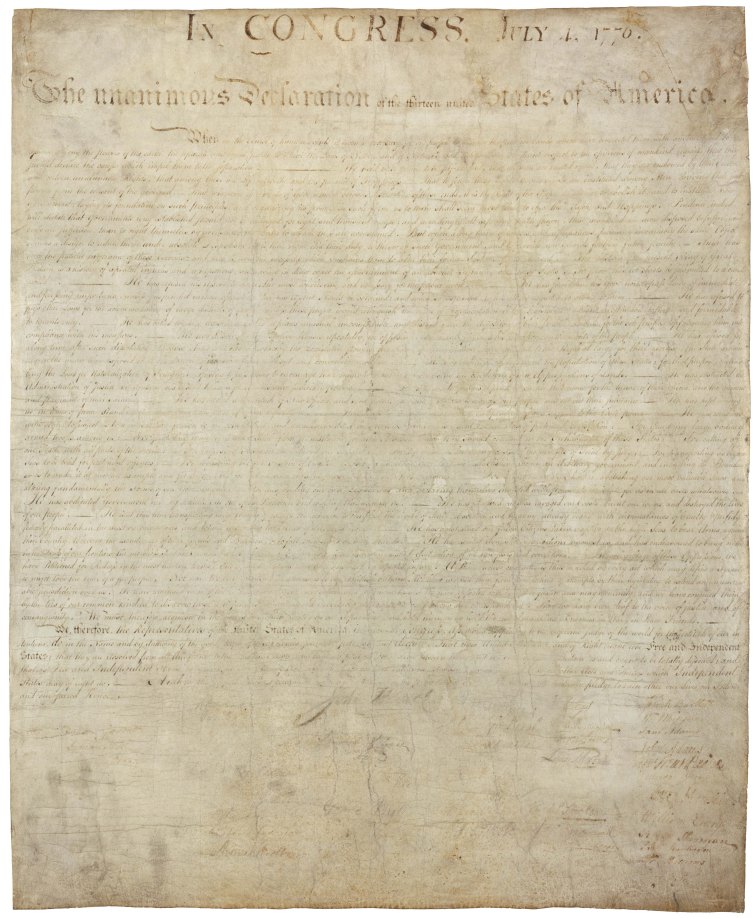
IN CONGRESS, July 4, 1776.
The unanimous Declaration of the thirteen united States of America,
When in the Course of human events, it becomes necessary for one people to dissolve the political bands which have connected them with another, and to assume among the powers of the earth, the separate and equal station to which the Laws of Nature and of Nature’s God entitle them, a decent respect to the opinions of mankind requires that they should declare the causes which impel them to the separation.
We hold these truths to be self-evident, that all men are created equal, that they are endowed by their Creator with certain unalienable Rights, that among these are Life, Liberty and the pursuit of Happiness.–That to secure these rights, Governments are instituted among Men, deriving their just powers from the consent of the governed, –That whenever any Form of Government becomes destructive of these ends, it is the Right of the People to alter or to abolish it, and to institute new Government, laying its foundation on such principles and organizing its powers in such form, as to them shall seem most likely to effect their Safety and Happiness. Prudence, indeed, will dictate that Governments long established should not be changed for light and transient causes; and accordingly all experience hath shewn, that mankind are more disposed to suffer, while evils are sufferable, than to right themselves by abolishing the forms to which they are accustomed. But when a long train of abuses and usurpations, pursuing invariably the same Object evinces a design to reduce them under absolute Despotism, it is their right, it is their duty, to throw off such Government, and to provide new Guards for their future security.–Such has been the patient sufferance of these Colonies; and such is now the necessity which constrains them to alter their former Systems of Government. The history of the present King of Great Britain is a history of repeated injuries and usurpations, all having in direct object the establishment of an absolute Tyranny over these States. To prove this, let Facts be submitted to a candid world.
He has refused his Assent to Laws, the most wholesome and necessary for the public good.
He has forbidden his Governors to pass Laws of immediate and pressing importance, unless suspended in their operation till his Assent should be obtained; and when so suspended, he has utterly neglected to attend to them.
He has refused to pass other Laws for the accommodation of large districts of people, unless those people would relinquish the right of Representation in the Legislature, a right inestimable to them and formidable to tyrants only.
He has called together legislative bodies at places unusual, uncomfortable, and distant from the depository of their public Records, for the sole purpose of fatiguing them into compliance with his measures.
He has dissolved Representative Houses repeatedly, for opposing with manly firmness his invasions on the rights of the people.
He has refused for a long time, after such dissolutions, to cause others to be elected; whereby the Legislative powers, incapable of Annihilation, have returned to the People at large for their exercise; the State remaining in the mean time exposed to all the dangers of invasion from without, and convulsions within.
He has endeavoured to prevent the population of these States; for that purpose obstructing the Laws for Naturalization of Foreigners; refusing to pass others to encourage their migrations hither, and raising the conditions of new Appropriations of Lands.
He has obstructed the Administration of Justice, by refusing his Assent to Laws for establishing Judiciary powers.
He has made Judges dependent on his Will alone, for the tenure of their offices, and the amount and payment of their salaries.
He has erected a multitude of New Offices, and sent hither swarms of Officers to harrass our people, and eat out their substance.
He has kept among us, in times of peace, Standing Armies without the Consent of our legislatures.
He has affected to render the Military independent of and superior to the Civil power.
He has combined with others to subject us to a jurisdiction foreign to our constitution, and unacknowledged by our laws; giving his Assent to their Acts of pretended Legislation:
For Quartering large bodies of armed troops among us:
For protecting them, by a mock Trial, from punishment for any Murders which they should commit on the Inhabitants of these States:
For cutting off our Trade with all parts of the world:
For imposing Taxes on us without our Consent:
For depriving us in many cases, of the benefits of Trial by Jury:
For transporting us beyond Seas to be tried for pretended offences
For abolishing the free System of English Laws in a neighbouring Province, establishing therein an Arbitrary government, and enlarging its Boundaries so as to render it at once an example and fit instrument for introducing the same absolute rule into these Colonies:
For taking away our Charters, abolishing our most valuable Laws, and altering fundamentally the Forms of our Governments:
For suspending our own Legislatures, and declaring themselves invested with power to legislate for us in all cases whatsoever.
He has abdicated Government here, by declaring us out of his Protection and waging War against us.
He has plundered our seas, ravaged our Coasts, burnt our towns, and destroyed the lives of our people.
He is at this time transporting large Armies of foreign Mercenaries to compleat the works of death, desolation and tyranny, already begun with circumstances of Cruelty & perfidy scarcely paralleled in the most barbarous ages, and totally unworthy the Head of a civilized nation.
He has constrained our fellow Citizens taken Captive on the high Seas to bear Arms against their Country, to become the executioners of their friends and Brethren, or to fall themselves by their Hands.
He has excited domestic insurrections amongst us, and has endeavoured to bring on the inhabitants of our frontiers, the merciless Indian Savages, whose known rule of warfare, is an undistinguished destruction of all ages, sexes and conditions.In every stage of these Oppressions We have Petitioned for Redress in the most humble terms: Our repeated Petitions have been answered only by repeated injury. A Prince whose character is thus marked by every act which may define a Tyrant, is unfit to be the ruler of a free people.
Nor have We been wanting in attentions to our Brittish brethren. We have warned them from time to time of attempts by their legislature to extend an unwarrantable jurisdiction over us. We have reminded them of the circumstances of our emigration and settlement here. We have appealed to their native justice and magnanimity, and we have conjured them by the ties of our common kindred to disavow these usurpations, which, would inevitably interrupt our connections and correspondence. They too have been deaf to the voice of justice and of consanguinity. We must, therefore, acquiesce in the necessity, which denounces our Separation, and hold them, as we hold the rest of mankind, Enemies in War, in Peace Friends.
We, therefore, the Representatives of the united States of America, in General Congress, Assembled, appealing to the Supreme Judge of the world for the rectitude of our intentions, do, in the Name, and by Authority of the good People of these Colonies, solemnly publish and declare, That these United Colonies are, and of Right ought to be Free and Independent States; that they are Absolved from all Allegiance to the British Crown, and that all political connection between them and the State of Great Britain, is and ought to be totally dissolved; and that as Free and Independent States, they have full Power to levy War, conclude Peace, contract Alliances, establish Commerce, and to do all other Acts and Things which Independent States may of right do. And for the support of this Declaration, with a firm reliance on the protection of divine Providence, we mutually pledge to each other our Lives, our Fortunes and our sacred Honor.
The 56 signatures on the Declaration appear in the positions indicated:
Column 1
Georgia:
Button Gwinnett
Lyman Hall
George WaltonColumn 2
North Carolina:
William Hooper
Joseph Hewes
John Penn
South Carolina:
Edward Rutledge
Thomas Heyward, Jr.
Thomas Lynch, Jr.
Arthur MiddletonColumn 3
Massachusetts:
John Hancock
Maryland:
Samuel Chase
William Paca
Thomas Stone
Charles Carroll of Carrollton
Virginia:
George Wythe
Richard Henry Lee
Thomas Jefferson
Benjamin Harrison
Thomas Nelson, Jr.
Francis Lightfoot Lee
Carter BraxtonColumn 4
Pennsylvania:
Robert Morris
Benjamin Rush
Benjamin Franklin
John Morton
George Clymer
James Smith
George Taylor
James Wilson
George Ross
Delaware:
Caesar Rodney
George Read
Thomas McKeanColumn 5
New York:
William Floyd
Philip Livingston
Francis Lewis
Lewis Morris
New Jersey:
Richard Stockton
John Witherspoon
Francis Hopkinson
John Hart
Abraham ClarkColumn 6
New Hampshire:
Josiah Bartlett
William Whipple
Massachusetts:
Samuel Adams
John Adams
Robert Treat Paine
Elbridge Gerry
Rhode Island:
Stephen Hopkins
William Ellery
Connecticut:
Roger Sherman
Samuel Huntington
William Williams
Oliver Wolcott
New Hampshire:
Matthew Thornton
This seems appropriate to begin Independence Day …
… as is this, whether or not Independence Day is on a Saturday:
This being Independence Day, you wouldn’t think there would be many music anniversaries today. There is a broadcasting anniversary, though: WOWO radio in Fort Wayne, Ind., celebrated the nation’s 153rd birthday by burning its transmitter to the ground.
Independence Day 1970 was not a holiday for Casey Kasem, who premiered “America’s Top 40,” though it likely was on tape instead of live:
Adam Liptak‘s opinion masquerades as “analysis” in the New York Times:
On the final day of the Supreme Court term last week, Justice Elena Kagan sounded an alarm.
The court’s five conservative members, citing the First Amendment, had just dealt public unions a devastating blow. The day before, the same majority had used the First Amendment to reject a California law requiring religiously oriented “crisis pregnancy centers” to provide women with information about abortion.
Conservatives, said Justice Kagan, who is part of the court’s four-member liberal wing, were “weaponizing the First Amendment.”
The two decisions were the latest in a stunning run of victories for a conservative agenda that has increasingly been built on the foundation of free speech. Conservative groups, borrowing and building on arguments developed by liberals, have used the First Amendment to justify unlimited campaign spending, discrimination against gay couples and attacks on the regulation of tobacco, pharmaceuticals and guns.
“The right, which had for years been hostile to and very nervous about a strong First Amendment, has rediscovered it,” said Burt Neuborne, a law professor at New York University.
The Citizens United campaign finance case, for instance, was decided on free-speech grounds, with the five-justice conservative majority ruling that the First Amendment protects unlimited campaign spending by corporations. The government, the majority said, has no business regulating political speech.
The dissenters responded that the First Amendment did not require allowing corporate money to flood the political marketplace and corrupt democracy.
“The libertarian position has become dominant on the right on First Amendment issues,” said Ilya Shapiro, a lawyer with the Cato Institute. “It simply means that we should be skeptical of government attempts to regulate speech. That used to be an uncontroversial and nonideological point. What’s now being called the libertarian position on speech was in the 1960s the liberal position on speech.”
And an increasingly conservative judiciary has been more than a little receptive to this argument. A new analysis prepared for The New York Times found that the Supreme Court under Chief Justice John G. Roberts Jr. has been far more likely to embrace free-speech arguments concerning conservative speech than liberal speech. That is a sharp break from earlier eras.
As a result, liberals who once championed expansive First Amendment rights are now uneasy about them.
“The left was once not just on board but leading in supporting the broadest First Amendment protections,” said Floyd Abrams, a prominent First Amendment lawyer and a supporter of broad free-speech rights. “Now the progressive community is at least skeptical and sometimes distraught at the level of First Amendment protection which is being afforded in cases brought by litigants on the right.”
Many on the left have traded an absolutist commitment to free speech for one sensitive to the harms it can inflict.
Take pornography and street protests. Liberals were once largely united in fighting to protect sexually explicit materials from government censorship. Now many on the left see pornography as an assault on women’s rights.
In 1977, many liberals supported the right of the American Nazi Party to march among Holocaust survivors in Skokie, Ill. Far fewer supported the free-speech rights of the white nationalists who marched last year in Charlottesville, Va.
There was a certain naïveté in how liberals used to approach free speech, said Frederick Schauer, a law professor at the University of Virginia.
“Because so many free-speech claims of the 1950s and 1960s involved anti-obscenity claims, or civil rights and anti-Vietnam War protests, it was easy for the left to sympathize with the speakers or believe that speech in general was harmless,” he said. “But the claim that speech was harmless or causally inert was never true, even if it has taken recent events to convince the left of that. The question, then, is why the left ever believed otherwise.”
Some liberals now say that free speech disproportionately protects the powerful and the status quo.
“When I was younger, I had more of the standard liberal view of civil liberties,” said Louis Michael Seidman, a law professor at Georgetown. “And I’ve gradually changed my mind about it. What I have come to see is that it’s a mistake to think of free speech as an effective means to accomplish a more just society.”
To the contrary, free speech reinforces and amplifies injustice, Catharine A. MacKinnon, a law professor at the University of Michigan, wrote in “The Free Speech Century,” a collection of essays to be published this year.
“Once a defense of the powerless, the First Amendment over the last hundred years has mainly become a weapon of the powerful,” she wrote. “Legally, what was, toward the beginning of the 20th century, a shield for radicals, artists and activists, socialists and pacifists, the excluded and the dispossessed, has become a sword for authoritarians, racists and misogynists, Nazis and Klansmen, pornographers and corporations buying elections.”
In the great First Amendment cases in the middle of the 20th century, few conservatives spoke up for the protection of political dissenters, including communists and civil rights leaders, comedians using vulgar language on the airwaves or artists exploring sexuality in novels and on film.
In 1971, Robert H. Bork, then a prominent conservative law professor and later a federal judge and Supreme Court nominee, wrote that the First Amendment should be interpreted narrowly in a law-review article that remains one of the most-cited of all time.
“Constitutional protection should be accorded only to speech that is explicitly political,” he wrote. “There is no basis for judicial intervention to protect any other form of expression, be it scientific, literary or that variety of expression we call obscene or pornographic.”
But a transformative ruling by the Supreme Court five years later began to change that thinking. The case, a challenge to a state law that banned advertising the prices of prescription drugs, was filed by Public Citizen, a consumer rights group founded by Ralph Nader. The group argued that the law hurt consumers, and helped persuade the court, in Virginia State Board of Pharmacy v. Virginia Citizens Consumer Council, to protect advertising and other commercial speech.
The only dissent in the decision came from Justice William H. Rehnquist, the court’s most conservative member.
Kathleen M. Sullivan, a former dean of Stanford Law School, wrote that it did not take long for corporations to see the opportunities presented by the decision.
“While the case was litigated by consumer protection advocates,” she wrote in the Harvard Law Review, “corporate speakers soon became the principal beneficiaries of subsequent rulings that, for example, struck down restrictions on including alcohol content on beer can labels, limitations on outdoor tobacco advertising near schools and rules governing how compounded drugs may be advertised.”
That trend has continued, with businesses mounting First Amendment challenges to gun control laws, securities regulations, country-of-origin labels, graphic cigarette warnings and limits on off-label drug marketing.
“I was a bit queasy about it because I had the sense that we were unleashing something, but nowhere near what happened,” Mr. Nader said. “It was one of the biggest boomerangs in judicial cases ever.”
“I couldn’t be Merlin,” he added. “We never thought the judiciary would be as conservative or corporate. This was an expansion that was not preordained by doctrine. It was preordained by the political philosophies of judges.”
Not all of the liberal scholars and lawyers who helped create modern First Amendment law are disappointed. Martin Redish, a law professor at Northwestern University, who wrote a seminal 1971 article proposing First Amendment protection for commercial speech, said he was pleased with the Roberts court’s decisions.
“Its most important contributions are in the commercial speech and corporate speech areas,” he said. “It’s a workmanlike, common sense approach.”
Liberals also played a key role in creating modern campaign finance law in Buckley v. Valeo, the 1976 decision that struck down limits on political spending by individuals and was the basis for Citizens United, the 2010 decision that did away with similar limits for corporations and unions.
One plaintiff was Senator Eugene J. McCarthy, Democrat of Minnesota, who had challenged President Lyndon B. Johnson in the 1968 presidential primaries — from the left. Another was the American Civil Liberties Union’s New York affiliate.
Professor Neuborne, a former A.C.L.U. lawyer, said he now regrets the role he played in winning the case. “I signed the brief in Buckley,” he said. “I’m going to spend long amounts of time in purgatory.”
To Professor Seidman, cases like these were part of what he describes as a right-wing takeover of the First Amendment since the liberal victories in the years Chief Justice Earl Warren led the Supreme Court.
“With the receding of Warren court liberalism, free-speech law took a sharp right turn,” Professor Seidman wrote in a new article to be published in the Columbia Law Review. “Instead of providing a shield for the powerless, the First Amendment became a sword used by people at the apex of the American hierarchy of power. Among its victims: proponents of campaign finance reform, opponents of cigarette addiction, the L.B.G.T.Q. community, labor unions, animal rights advocates, environmentalists, targets of hate speech and abortion providers.”
The title of the article asked, “Can Free Speech Be Progressive?”
“The answer,” the article said, “is no.”
Liberals were correct in their advocacy of free speech in the 1960s. Liberals and progressives who condemn free speech are 100 percent wrong today. I recently checked, and the First Amendment contains no phrases like “unless someone is offended” or “unless someone’s feelings are hurt by your free expression.”
 Steve Prestegard.com: The Presteblog