Today is the 58th anniversary of what I used to consider the greatest radio station on the planet in its best format:
No comments on Presty the DJ for May 2
Today is the 58th anniversary of what I used to consider the greatest radio station on the planet in its best format:
The Washington Times tries to follow the dots in the blowback from Saturday night:
The journalism biz had ink on its face after comedian Michelle Wolf’s hard-to-watch attack on Sarah Huckabee Sanders at the White House Correspondents’ Dinner, but there was no apology forthcoming from the organizer.
Margaret Talev, president of the White House Correspondents’ Association, refused Sunday to second-guess her speaker selection after Ms. Wolf reamed the White House press secretary for “lies” and took veiled shots at her appearance.
“What I told you is what I have already told Sarah Sanders, that I speak for myself and the association, and that my interest is in the spirit of unity and in the spirit of serious journalism,” said Ms. Talev on CNN’s “Reliable Sources.”
Did Ms. Wolf’s anti-Sanders screed promote unity? Maybe not, acknowledged Ms. Talev.
“My interest overwhelmingly was in unifying the country, and I understand that we may have fallen a little bit short on that goal,” said Ms. Talev, Bloomberg’s senior White House reporter. “I hope everyone will allow us to continue to work toward that goal.”
On Sunday evening, Ms. Talev issued a statement that again stopped short of an apology, saying that the program was intended to “offer a unifying message” and not “to divide people.”
“Unfortunately, the entertainer’s monologue was not in the spirit of that mission,” she said.
Ms. Talev added that she and the next WHCA president, Olivier Knox, were “committed to hearing from members on your views on the format of the dinner going forward.”
Her comments appeared jarringly out of touch with the reaction to Ms. Wolf’s routine from conservatives, administration officials and even leading journalists, who spent Sunday evaluating the damage done to the industry at Saturday’s televised dinner.
Howard Kurtz, host of Fox’s “Media Buzz,” said Sunday he had “never seen a performance like that,” adding that “she was not only nasty but she was dropping f-bombs on live television.”
The comedian herself, a contributor to “The Daily Show,” was unrepentant, insisting her Sanders jokes were “about her despicable behavior,” not her looks.
“The question now is whether comedian Michelle Wolf went too far and maybe damaged the journalism profession,” said CNN host Brian Stelter.
A number of prominent media figures — including Ed Henry of Fox News, MSNBC’s Andrea Mitchell and Mika Brzezinski, and the [U.K.] Guardian’s David Martosko — called for the WHCA to apologize.
“I think it’s long past time, hours later, for the association to put out a simple, one-sentence statement saying, ‘We do not agree with this,’ these personal, vile attacks on Sarah Huckabee Sanders, who is a good person,” said Mr. Henry on “Media Buzz.”
The former WHCA president added, “We invited her to the dinner, we should have treated her with respect.”
The Associated Press’s Meg Kinnard tweeted that the dinner “made the chasm between journalists and those who don’t trust us, even wider.”
Margaret Sullivan, columnist for The Washington Post, upped the ante by calling on journalists to cancel the dinner entirely in a Sunday op-ed headlined, “For the sake of journalism, stop the annual schmoozefest.”
She argued that the dinner “plays right into the hands of President Trump’s press-bashing,” a sentiment echoed by Jonah Goldberg, who said the event has become “an East Coast version of the Oscars.”
“As someone who has dinged President Trump often for his narcissism, the institutional narcissism that was on display last night from the correspondents’ dinner I think was a gift to President Trump,” said Mr. Goldberg on CBS’s “Face the Nation.” “The crudeness toward Sarah Huckabee Sanders was a gift to the White House.”
The president seconded the sentiment personally on Sunday night, tweeting the event was “an embarrassment to everyone associated with it. The filthy “comedian” totally bombed.”
“Put Dinner to rest, or start over!” Mr. Trump concluded.
The outrage over Ms. Wolf’s routine comes with the public’s trust in the press at what may be an all-time low amid Mr. Trump’s ongoing feud with the media.
A Quinnipiac University poll released last month found that 22 percent of those surveyed agreed that the press was the “enemy of the people,” as Mr. Trump has said, a figure that jumped to 51 percent among Republicans.
“We’ve had awkward dinners before, no question, but this is a different time,” said USA Today’s Susan Page on “Face the Nation.”
A composed but unsmiling Mrs. Sanders watched from the dais a few feet away as Ms. Wolf let loose on her and a number of other administration officials, although her anti-Sanders jabs came across as the most offensive.
“I’m never really sure what to call Sarah Huckabee Sanders. Is it Sarah Sanders? Is it Sarah Huckabee Sanders? Is it cousin Huckabee? Is it anti-Huckabee Sanders?” asked Ms. Wolf. “What’s ‘Uncle Tom’ but for white women who disappoint other white women? Oh, I know, Aunt [Ann] Coulter.”
At one point she told Mrs. Sanders that “I love you as aunt Lydia in ‘The Handmaid’s Tale,’ ” referring to the frumpy, scowling older woman who indoctrinates the handmaids in the Hulu series.
“I actually really like Sarah, I think she’s really resourceful. Like she burns facts and then uses that ash to create a perfect smoky eye,” said Ms. Wolf. “Like maybe she’s born with it, maybe it’s lies.”
The episode may well have set back press relations with the White House. While Mr. Trump pointedly was not there, headlining a rally instead in Michigan, several administration officials did attend, breaking last year’s boycott.
Not everyone in the press corps was on the same page. A number of White House reporters defended Ms. Wolf’s routine, saying critics were making too much of it.
“I think the White House Correspondents’ Association is taking sort of undue blame for this,” said Politico correspondent Eliana Johnson on “Reliable Sources.” “The country is polarized, and the dinner I think showcases that.”
Comedian Don Imus drew outrage over his skewering of President Bill Clinton at the 1996 dinner. Ten years later, Stephen Colbert delivered a searing roasting of President George W. Bush.
Jamelle Bouie, chief political correspondent for Slate magazine, was among those who called the outrage ironic, given Mr. Trump’s putdowns and vulgarities, adding that “the press’s problems of legitimacy with the public goes back decades.”
“To think something like this dinner encapsulates or represents the problem, I don’t think it’s quite true,” said Mr. Bouie on “Face the Nation.” “I agree with Jonah’s criticisms of the spectacle of it all, but this problem of press legitimacy goes back a long time.”
The Washington Post’s Amber Phillips takes a sort-of different stance:
Was she a bully or speaking truth to power? Did the Trump administration and journalists on the receiving end of her caustic jokes get what they deserve, or did she take it too far?
Everyone agrees on one thing: Inviting comedian Michelle Wolf to address journalists and politicians in Washington, D.C., on Saturday at the annual White House correspondents’ dinner did not go as planned.
The controversy around the most hyped annual event in Washington isn’t just a Washington problem: It touches on the role of the media in covering politicians, how much people like you trust the media and whether the Trump administration deserves stronger-than-usual criticism.
Here are three arguments and counterpoints about Wolf’s performance that touch on all that:
1. She gave Washington what it deserves: Americans have low opinions of Congress, of the media and of the president. It’s why “drain the swamp” was one of President’s Trump’s more memorable campaign lines. So when the creatures of Washington got dressed up, had some drinks and invited a comedian to entertain them, why were they surprised when that person opened her mouth and spit fire at everyone?
“Trump is racist, though.”
“Mike Pence is what happens when Anderson Cooper isn’t gay.”
“He’s helped you sell your papers and your books and your TV. You helped create this monster, and now you’re profiting off of him.”
But is journalism really a laughing matter right now? Journalists are under attack. The president has called journalists “the enemy of the American people,” frequently derides Pulitzer Prize-winning news organizations as fake, and has even tweeted cartoons of him tackling CNN. Outside the United States, at least nine journalists were killed on Monday in Afghanistan, targeted for doing their jobs. Politicians, love them or hate them, face dangers too.
2. She gave Sarah Huckabee Sanders and Kellyanne Conway what they deserve: If you’re one of the 70 percent of Democrats who would vote for a candidate who wants to impeach Trump, you probably thought Wolf’s jokes about pinning senior White House adviser Conway under a tree (“I’m not suggesting she gets hurt; just stuck”) or White House press secretary Huckabee Sanders being “Uncle Tom but for white women who disappoint other white women” (i.e. a sellout for women’s rights) were spot on.
But she gave Washington journalists the unhelpful perception that they are out to get Trump: The vast majority of the journalists who attend this dinner are committed to doing their jobs: attempting to hold power accountable. And yet there we were (yes, I was at the dinner) being entertained by a comedian who flat-out insulted power in some very cheap-shot ways. Meanwhile, Trump was in Michigan addressing “real” America. It was a huge PR win for the president when it comes to his war on the media and on Washington.
3. She proved why this dinner is a mess: The cocktails. The schmoozing. The coziness. Fairly or not, the White House correspondents’ dinner has the reputation of epitomizing all that’s wrong with Washington. Maybe journalists needed Wolf’s controversial performance to finally get them to realize that.
But … Actually I don’t have a good counterpoint for the dinner being a mess: The dinner’s purpose is to protect and celebrate the First Amendment and to invite politicians and celebrities to join in on that cause. That’s worthy. But journalists are kidding ourselves if we think hosting comedians to make fun of an increasingly serious state of affairs accomplishes that.
Here’s a guide to how to think about this: What if this had happened in reverse when Obama was president? Would you have been OK with that?
The Post’s Callum Borchers has an ironic observation:
Stephen Colbert insulted George W. Bush’s intelligence in 2006. Joel McHale mocked Nancy Pelosi’s face in 2014. Conan O’Brien called Pat Buchanan racist in 1995. Cecily Strong suggested Joe Biden is a groper in 2015.
Jokes at the annual White House correspondents’ dinner have often been edgy, cutting and personal, but Michelle Wolf’s comedy routine on Saturday has triggered uncommon regret among journalists. Margaret Talev, president of the White House Correspondents’ Association, went so far as to tell fellow reporters that she and incoming president Olivier Knox “are committed to hearing from members on your views on the format of the dinner going forward” — an indication that the traditional roast of Washington political figures could be scrapped in the future.
Humor is subjective, so it is impossible to say definitively whether Wolf was harsher than her predecessors. What’s clear, however, is that the current occupant of the White House is more inclined than his predecessors to weaponize any remarks that might effectively cast the media as hostile and biased. …
Other recent presidents never missed the event and never lashed out in such fashion, however sharp the barbs. …
In a strange way, Trump, who has coarsened political rhetoric, has actually raised the bar of civility for the media. Journalists now have to consider that the kinds of comedic burns that previous administrations simply absorbed, albeit grudgingly, will be used to discredit the work of the press.
In short, the White House correspondents’ dinner can’t get away with what it once did.
Colbert’s act 12 years ago, for example, was a prolonged, sarcastic takedown of Bush.
“It’s my privilege to celebrate this president,” Colbert said. “We’re not so different, he and I. We get it. We’re not brainiacs on the nerd patrol. We’re not members of the factinista.”
Bush did not appear to be amused, and neither were many journalists. In The Washington Post, columnist Richard Cohen wrote that “Colbert was not just a failure as a comedian but rude.”
Rudeness is one accusation leveled against Wolf. Some reporters have objected to her skewering of White House press secretary Sarah Huckabee Sanders, whom Wolf unflatteringly compared to the character Aunt Lydia in “The Handmaid’s Tale.”
Sanders “burns facts, and then she uses the ash to create a perfect smoky eye,” Wolf also quipped.
But reporters have expressed an additional worry, based not on principle but on possible fallout — that Wolf’s wisecracks reinforced Trump’s characterization of the media as his “opposition party.”
Meg Kinnard, an Associated Press reporter based in South Carolina, tweeted that the event “made the chasm between journalists and those who don’t trust us even wider.” She added that “those of us based in the red states who work hard every day to prove our objectivity will have to deal with it.” …
Kinnard’s concern is well-founded. All presidents complain about the media, to some degree, but Trump has made whipping up his base’s suspicion of the press a pillar of his career in politics.
Starker than any difference between Wolf and other comedians who performed at the White House correspondents’ dinner is the difference between previous presidents’ stoicism and Trump’s strategic decision to use the dinner as an anti-media talking point.
The fact is that this is an event that should not be taking place, regardless of who the president is. Media schmoozing up to people in power, described by the Post’s Eugene Scott thusly …
… the dinner is one part of a weekend filled with elaborate galas, parties and brunches, where journalists laugh and drink with the lawmakers and others that the public expects them to cover objectively. When partisans who regularly appear on cable news shows voraciously attacking the integrity of their political opponents are then seen socializing with the journalists who cover them, some Americans lose trust in the mainstream media.
… is precisely why people’s trust in the media is dropping and should be dropping, whether “power” has an R or D or no partisan label. As I wrote last week, if people in the media want a friend, they should get a dog.
As for as Trump’s being anti-media, read this space tomorrow.
The Wisconsin State Journal shows how the 3,294 Democratic candidates for governor want to raise your taxes:
Madison Mayor Paul Soglin wants to lower homeowner property taxes statewide by up to 25 percent while raising income taxes on the top 3 percent of earners.
Because Soglin doesn’t want to take the heat for his own city’s overspending and stupid spending.
Former Wisconsin Democracy Campaign executive director Mike McCabe is calling for a reduction in the sales tax from 5 percent to 4.5 percent, and also applying it to currently exempt goods and services such as airplane parts, health club fees and professional services.
Former Rep. Kelda Roys would repeal a recently adopted fee on hybrid and electric vehicles, but would be willing to slap a new fee on certain heavy trucks to help pay for road repairs.
In other words, eliminate a tax on liberals and tax businesses.
The Democrats running for governor this year have several ideas for how to rewrite the state’s tax laws, with an emphasis on higher taxes for the rich, and lower taxes for the working and middle class. They largely support more state revenues to pay for things like better roads and schools, expansion of BadgerCare and free technical college tuition.
There are also some issues where the Democrats disagree with each other and others where they present a unified contrast with Gov. Scott Walker — most notably their support for legalizing marijuana and taxing sales of it, something Walker opposes.
Notice that not a single Democrat is pledging to lower our overall tax burden?
Walker, who is seeking a third term, has cut taxes across the board by about $8 billion over his first two terms with lower income tax rates, a large tax credit for manufacturers and farmers that effectively eliminates their income tax liability, and most recently the elimination of the state forestry property tax. He also pledged during his last re-election campaign that property taxes in 2018 would be lower than in 2014 — a goal his latest budget set the state on pace to achieve through an increase in school levy credits and a continuation of tight caps on school and municipal revenue authority.
Despite the tax cuts, Wisconsin still ranks among the more highly taxed states in the country, according to the Washington-based Tax Foundation. Wisconsin celebrated its “Tax Freedom Day” — the day when an average worker in the state made enough to pay the average amount of tax — on April 19, or 34th in the nation. Its “business tax climate” ranks 38th, down from 39th in 2014.
So far, Walker isn’t offering any new tax cut proposals for a possible third term, though an Assembly committee is researching a possible rewrite of the tax code.
“While it is clear that our opponents are open to raising taxes, I want to continue to reduce the burden on the hard-working taxpayers of Wisconsin,” Walker said. “Wisconsin families and senior citizens deserve a governor who will not raise their overall tax burden over the next four years. I am that candidate.”
Democrats are critical of Walker’s approach to tax cuts, which have delivered a significant benefit to the wealthy. According to the liberal-leaning Wisconsin Budget Project, the top 1 percent of earners — who make on average $1.7 million a year — received 24 percent of the tax cuts between 2011 and 2016, or about $10,015 per person. Those in the middle 20 percent, who make $53,000 on average, received an average cut of $379.
State Superintendent of Public Instruction Tony Evers and four other top Democratic candidates want to eliminate the manufacturing and agriculture tax credit, noting 93 percent of the benefit goes to taxpayers who make more than $250,000 a year.
“Scott Walker and legislative Republicans have rigged Wisconsin’s economy to benefit millionaires, billionaires and big corporations,” Evers said. “Everywhere I go, I continue to hear the same thing from Wisconsin families, ‘What about the rest of us?’”
This is what happens when you have spent your entire life at the public trough and failed to pay attention to two-thirds of the state’s economy.
Sen. Kathleen Vinehout, D-Alma, wants to reduce the manufacturing credit and preserve the credit for farmers. Rep. Dana Wachs, D-Eau Claire, and Milwaukee businessman Andy Gronik said they want to restructure the credit and tie it to actual job creation. Soglin was the only candidate who said he wouldn’t make any changes to the credit.
So it’s much better to stick it to one-third of the state’s economy instead of two-thirds.
But Soglin offered the most specific plan for changes to property and income taxes, calling for a major reduction in property taxes through either an income tax deduction or tax credit targeted at residential property owners. He said he would put in place measures to ensure renters derive some benefit from the property tax reduction, and also to limit the benefit for owners of “McMansions.”
That, of course, would require a change the state’s Constitution’s uniformity clause, previously attempted and failed.
Soglin also would create a new tax rate for the top 3 percent of income earners, or those making $194,000 or more, and use those funds to pay for additional revenue to municipalities to keep property taxes low. He also said he would suspend and possibly eliminate revenue limits, which are the chief way the state has kept a lid on property taxes.
“We have to stop driving families and retirees out of their homes when their limited incomes cannot keep pace with rising property taxes,” Soglin said. “It is outrageous that we squander billions of tax cuts on unnecessary gifts to wealthy foreign corporations and ask the rest of us to pay. Enough is enough.”
Soglin is an expert on rising property taxes. Comrade Soglin is a dunce on what creates jobs, which is not any level of government.
Soglin’s focus on lowering property taxes comes as the public’s frustration with high property taxes may be waning, according to a recent poll commissioned by Wisconsin Manufacturers & Commerce, the state’s largest business lobby and a supporter of Walker’s policies.
The December 2017 poll found 42 percent favored cutting the income tax, 33 percent favored cutting the property tax and 12 percent favored cutting the sales tax. The survey included 504 likely voters and had a margin of error of +/-4.5 percentage points.
The result was a reversal from the December 2016 survey that found 43 percent wanted to cut property taxes and 31 percent preferred income taxes. The December 2015 survey found 39 percent for both options. The only Marquette Law School Poll that asked a similar question in January 2014 found 42 percent supported cutting property taxes, 34 percent chose cutting incomes taxes and 22 percent wanted to cut the sales tax.
Scott Manley, WMC’s vice president of government relations, said new limits on technical college revenues plus the recent elimination of the state forestry tax have shifted public attitudes. Last year net property taxes in the state totaled 3.55 percent of personal income, the lowest at any point since World War II, according to the Wisconsin Policy Forum.
“I think a big part of it is people are seeing more tangible property tax relief,” Manley said.
Professional Firefighters of Wisconsin president Mahlon Mitchell is calling for reinstatement of the state forestry tax, saying it “took up a small portion of a homeowner’s property tax bill, but this was crucial revenue for our state forests,” which “are a public good and should be protected for generations to come.”
Mitchell was the only Democrat who suggested completely eliminating the personal property tax, which Walker and Republicans scaled back in the previous budget. The tax may be one of the reasons Wisconsin’s business tax ranking hasn’t budged, Manley said.
Mitchell and Roys mentioned eliminating the new $100 hybrid and electric vehicle fees, though Roys was the only one who said she was open to a new fee on heavy trucks.
Transportation funding has been a major debate for the past three budget cycles with Walker increasing borrowing to pay for road projects, while Assembly Republicans have urged upping revenues such as the gas tax. Democrats have made the state’s poor road quality compared with other states a key issue in the campaign.
Former Democratic Party of Wisconsin chairman Matt Flynn, McCabe, Mitchell, Roys and Wachs said they support indexing the gas tax to inflation, while Soglin supports a five-cent increase and indexing to inflation. Vinehout supports a five-cent increase and finding more efficiencies in the Department of Transportation. Gronik and Evers didn’t offer a specific position on a gas tax hike, but said all options are on the table.
Gimme, gimme, gimme, gimme …
Soglin suggested allowing the creation of regional transportation authorities with the ability to raise a half-cent sales tax.
More taxes!
The fact is that there is enough money for road projects if, as everyone else has to do, the state cuts spending elsewhere.
McCabe offered a specific plan to lower the sales tax by a half-cent, while also proposing it be applied to a wide range of goods and services, including aircraft parts, health clubs, travel clubs, stowing nonresident aircraft and boats in Wisconsin, public relations, interior design, tax preparation, real estate broker commissions, advertising and beauty services.
“We don’t need any new taxes,” McCabe said. “But we do need to make sure everyone pays the ones we already have.”
The number one single today in 1965:
Today in 1970, the Jimi Hendrix Experience played the first of its 13-show U.S. tour at the Milwaukee Auditorium:
James Wigderson writes on what some people watched Thursday instead of the NFL Draft, game six of the NBA Eastern Conference quarterfinals, or the Brewers and the Cubs:
After a mostly pleasant evening of general agreement on the issues, the two Republican candidates for U.S. Senate turned their fire on each other during chaotic closing remarks at the end of their first debate Thursday evening.
The debate between Delafield businessman Kevin Nicholson and Brookfield Republican state Sen. Leah Vukmir, sponsored by Americans for Prosperity (AFP), went smoothly for most of the evening as the two addressed issues about trade, the First Amendment, government spending and taxes.
Nicholson and Vukmir are the two Republican candidates competing in the August U.S. primary. The winner of the GOP primary will take on the incumbent, Democratic Senator Tammy Baldwin, in November.
While the two candidates had a different emphasis, with Nicholson staying on message about being an outsider and Vukmir touting her conservative record in Madison, they largely agreed on the substance of the issues. However, at the end of the debate, the gloves started to come off and the ringside bell was ignored. Vukmir gave her closing remarks first, hitting the theme of her proven conservative record in Madison.
“It’s not enough to elect just any Republican to the United States Senate,” Vukmir said. “We can’t take chances on the unknown. We have to elect a strong, proven consistent conservative.”
In his closing remarks, Nicholson said Vukmir was referring to him when she referred to the “unknown.”
“I feel like I might be the unknown in that variable,” Nicholson said. “I am. I’m clearly different, folks. Clearly different kind of candidate. That is what we need.”
Nicholson then referred to a statement made by Republican consultant Keith Gilkes, a strategist for Governor Scott Walker, at a WisPolitics.comluncheon without naming him, saying it reflected the view of “the Madison swamp.”
“He thought she was responsive to voters. Anyone here believe that?” Nicholson asked. After citing the Iran deal and the problems at the Tomah VA hospital, Nicholson continued. “That is the bubble. That is the establishment. That is why we lost that Supreme Court race recently.”
Debate moderator Dan O’Donnell, a conservative talk show host on WISN-AM, ruled that Vukmir was mentioned in Nicholson’s remarks and so she was granted a minute to respond. Vukmir noted that Nicholson seemed to be allowed to go over his allotted time of three minutes and said she would speak longer than a minute.
After stating that she appreciated his military service, Vukmir said Nicholson is going to have to prove his conservative track record. “I don’t have to prove that to you. You know what my track record is,” said Vukmir. “We know more about his track record as a Democrat than we know about his track record as a Republican.”
After the bell rang indicating her time was up, Vukmir announced that she would continue talking. She spoke about how her experience of what was accomplished in Wisconsin will be taken to Washington. Then she spoke about Nicholson’s comment on the Wisconsin Supreme Court race and the Republican Party.
“It’s a personal affront to hear that Party being maligned,” Vukmir said. “That Party being told the reason why we lost that election was because of some comments by somebody. Everyone in this room stood with the governor and with me when that Capitol was taken over, under siege. You were there with us. You never wavered. You lifted us up. And we made the right decision and we did the right thing and we changed Wisconsin.”
Because Vukmir went long in her answer, O’Donnell granted more time to Nicholson.
“My track record? My track record? I would look to the battlefields of Iraq and Afghanistan if you want it. That’s where I’d look first,” Nicholson said. “I know that doesn’t mean much to certain politicians. I know that darn well.”
Vukmir started shaking her head at this point and said, “That’s wrong. That’s, that’s wrong.” Some in the crowd also appeared to be objecting to Nicholson’s statement and a few boos could be heard before O’Donnell reminded the audience to be quiet.
“Those that I served with know that darn well,” Nicholson continued. “I’m going to be blunt. For those that have said that leading Marines in combat during the course of two wars does not qualify as conservative credentials need to look inside them and decide what they think conservative credentials are.”
Nicholson then said “time and industry” were also his conservative credentials, working in the private sector and time with his family.
“This country will sink or swim because citizens stand up and say we’re sick of the political class flushing its future down the toilet,” Nicholson said.
O’Donnell tried to wrap up the debate at that point but Vukmir announced she had to respond. “That was a very, very low blow to say that I don’t respect you,” Vukmir said, looking at Nicholson. “And I want to make sure everyone in this room knows that. I respect your service and I’m grateful for your service, Kevin. And I didn’t, really, that was a low blow on your part and I, I would ask you to apologize. I get it as a military mom. We must respect our military. I do.”
Nicholson responded, “If it makes you feel better, I feel respected.”
While the crowd muttered it’s disapproval, O’Donnell announced the end of the debate and the two candidates shook hands before leaving the stage. With that, some in the crowd began to sing Happy Birthday to Vukmir who was celebrating her birthday on Thursday.
Nicholson’s team led him out of the hall before he could be questioned, but he did shout back an answer to how well he thought he did at the debate. “I think we nailed it,” Nicholson said.
Vukmir also thought she did well. “I represented our conservative values,” Vukmir said. “That’s what I stand on, that’s what I believe in, that’s what I’ll take to Washington.”
O’Donnell talked afterward with RightWisconsin about the end of the debate. “It was interesting,” O’Donnell said. “They were able to hold it together for the entire question and answer portion. And I think it just hit a little close to home for both of them.”
“This is what we want from debates, right?” O’Donnell said. “It didn’t get overly personal. It was something that quite frankly I didn’t expect after the tone and tenor of, what, the sixty minutes that preceded that? So it was unexpected but it’s a debate, and sometimes that sort of stuff happens.”
When asked about how both candidates decided to ignore the clock, O’Donnell said while laughing, “Yeah, that’s pretty typical of debates, too.”
“Well, what I did at the end was I said, okay, Vukmir is going to finish,” O’Donnell said. “I told Nicholson, alright, whatever time she gets, you get back, too. And he did, and at the very end, that was unexpected, her directly confronting… That was just wild.”
“For the first debate, I can’t imagine what the next debates are going to be like,” O’Donnell said.
O’Donnell said the debate was a sign that the GOP couldn’t hope for a peaceful primary. “It’s going to be a rough primary,” O’Donnell said. “It’s going to be a tough primary and it’s going to be, I hope not direct like that, but this is what an election is.”
“When two people want the same job, this is what happens,” O’Donnell said. “Passions and emotions and just pent up energy can kind of get the best of you.”
O’Donnell agreed with the idea that the primary is more acrimonious because the debate is about each of the candidate’s credentials rather than policy. “This is when you make a campaign about who you are and what you’ve been which, in a sense, it’s all campaigns are,” O’Donnell said. “But what happened when they were talking about themselves and developing that contrast, and this election is really about the contrast.”
“Vukmir is clearly presenting herself as I’ve been there and I’ve done that,” O’Donnell said. “And I think Nicholson is more the unknown. He’s saying, look, sure, I have the leadership experience with the U.S. Marines and being a businessman. And sure you need to take a flyer on me but look what happened with Donald Trump.”
Eric Bott, the director of AFP in Wisconsin, said he thought both candidates “articulated a very positive vision, a very conservative vision, for how they want to reform Washington and bring the Wisconsin approach to D.C.”
Regarding the debate’s end, Bott said a little bit of fireworks are to be expected. However, Bott focused on the policy discussion.
“From our perspective we were thrilled that they both firmly and strongly came out in support of free speech,” Bott said. “That was clear. They were both strong advocates for Right to Try and for repealing Obamacare. They shared a very clear vision against cronyism and in favor of more tax reform. Overall, we’re pleased with the policy positions they articulated.”
Nicholson was a veteran. So were John Kerry, Al Gore and Wesley Clark. Anyone think they should be president?
Ronald Reagan was a Democrat. He was not, however, part of Democratic Party leadership, as Nicholson was.
While I may vote for Nicholson if he gets the nomination, I don’t believe Nicholson is the best Republican candidate to take on U.S. Sen. Tammy Baldwin (D–Wisconsin) by a long shot.
The number one single today in 1960:
The number one British album today in 1966 was the Rolling Stones’ “Aftermath”:
Today in 1976, after a concert in Memphis, Bruce Springsteen scaled the walls of Graceland … where he was arrested by a security guard.
Today in 2003, a $5 million lawsuit filed by a personal injury lawyer against John Fogerty was dismissed.
The lawyer claimed he suffered hearing loss at a 1997 Fogerty concert.
The judge ruled the lawyer assumed the risk of hearing loss by attending the concert. The lawyer replied, “What?”
This week is the 50th anniversary of one of the strangest incidents in the history of UW athletics, summarized by Madison.com:
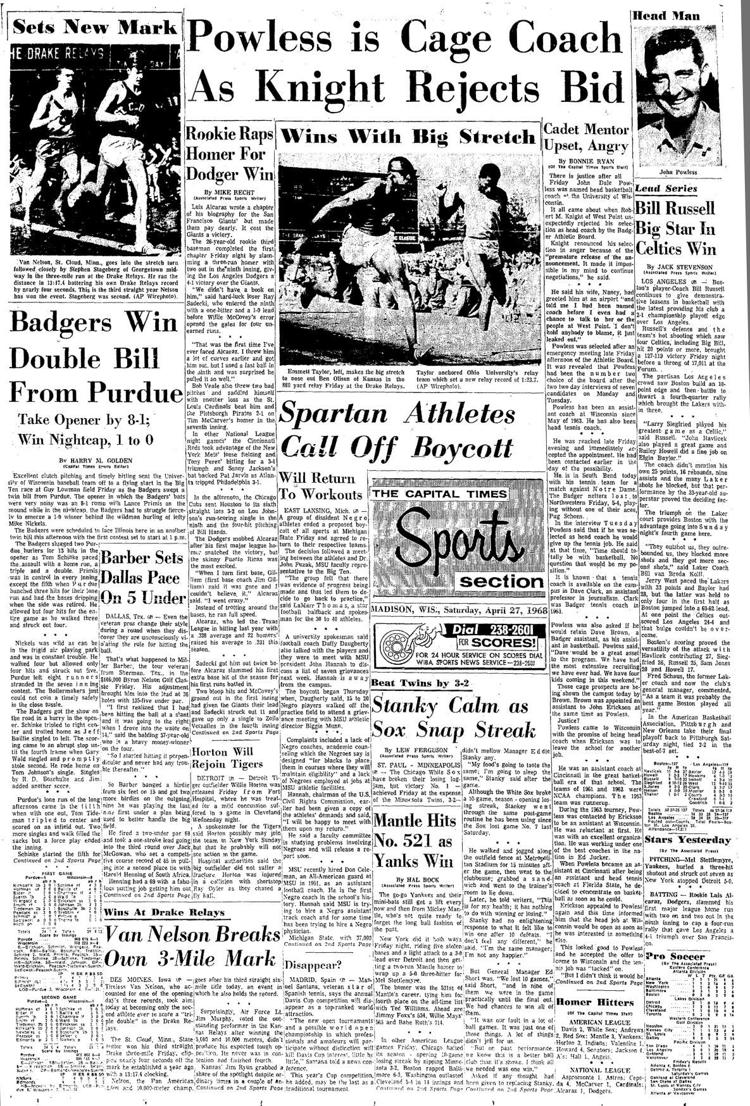
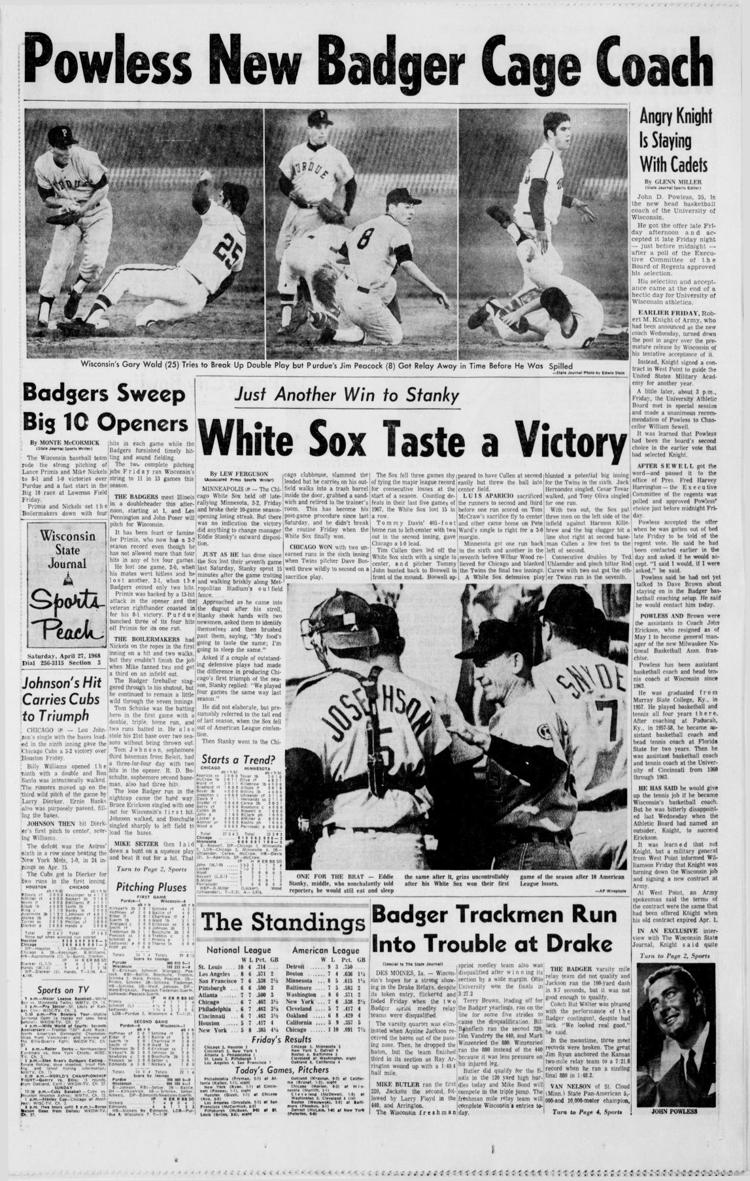
In 1968, the University of Wisconsin interviewed seven finalists for its vacant head basketball coaching position, before choosing Army coach Robert Knight, 27. The UW Athletic Board was searching for a replacement for John Erickson, who resigned to accept the position of general manager of the NBA’s new franchise in Milwaukee.
Knight, announced as the new coach on April 25, renounced his selection in anger 2 days later, over the premature release of his acceptance.
John Powless, the number two choice, and an assistant under Erickson since 1963, was then selected after an emergency meeting of the Athletic Board.

The rest of the “first four” besides Knight were UW–Milwaukee coach Ray Krzoska, Southern Illinois coach Jack Hartman, and Earl Lloyd, who played in the NBA in the 1950s and after this coached the Detroit Pistons.
Hartman might have been a good choice. (Read on for why I write “might.”) He got Southern Illinois from the NCAA’s Division II to Division I, moved on to Kansas State, and between junior college, the Salukis and the Wildcats won 578 games in 24 seasons, getting to the D1 Elite Eight four times and the Sweet Sixteen twice at K-State. Krzoska went 86–87 in seven seasons at UWM, and left two seasons after applying at UW. Lloyd went 22–55 with the Pistons.
The “last three” included two UW assistants, John Powless and Dave Brown.
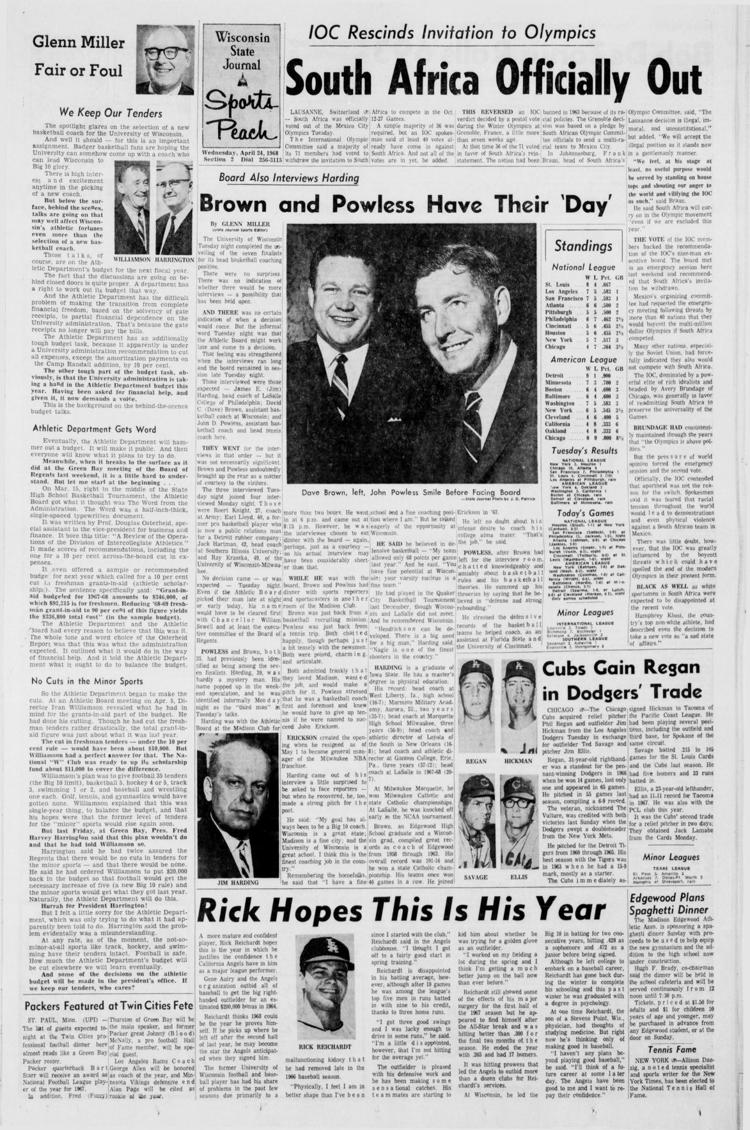
Also included was a guy with some similarities to Knight, Jim Harding, the coach at La Salle in Philadelphia. Harding coached one season at La Salle and went 20–8, though La Salle was then placed on NCAA probation over two players’ revoked scholarships, and Harding was fired. One of his players, eventual American Basketball Association player Roland “Fatty” Taylor, said, “Forty years later, if I saw him today sitting in a wheelchair, I’d walk over and smack him.”
Instead of going to Wisconsin (or to the Bucks, where he reportedly was a candidate for their coaching position), Harding then went to the American Basketball Association’s Minnesota Pipers, and, well, here’s what happened there, according to Stew Thornley:
The Pipers would open the season in Minnesota with a new leader. Vince Cazzetta, who had coached the Pipers to the championship, resigned after Erickson and Rubin refused to give him a raise to cover moving his wife and six children to the Twin Cities. Hired to replace Cazzetta was 39-year old Jim Harding, who had compiled a 93-28 record in five seasons at LaSalle College in Philadelphia.
Harding had been equally successful in coaching tenures at two other colleges, but he left behind a trail of NCAA violations and endless turmoil, the latter a pattern that followed him to the professional ranks. …
The tension between Harding and the players came to a head after an altercation between the coach and center Tom Hoover. Unhappy that the incident was reported in the newspapers, Harding ordered his players not to talk to sportswriters and closed all practices to the press. The Minnesota management, in turn, refused to back Harding and all restrictions on the press were lifted.
During the next week, Harding began experiencing chest pains and underwent an electrocardiogram. Just before the team was to fly to Houston for a December 20 game, it was announced that Harding would not be making the trip. Concerned by the coach’s chest pains and dangerously-high blood pressure, doctors ordered Harding to take an indefinite leave of absence.
[General manager Vern] Mikkelsen assumed the coaching duties in the interim. The Pipers won only six of thirteen during that time but still maintained the lead in the division. Originally, Harding was to be gone for six weeks, and the Pipers said Mikkelsen would take his place as coach of the East squad in the All- Star Game. Harding, however, returned three weeks early and was back on the bench in mid-January. …
Harding was angered, however, by Washington and Williams absence at a banquet the night before the All-Star Game and attempted to fine them $500 each. His anger increased when he was overruled by team officials, and he sought out part-owner Gabe Rubin.
The result was a bloody midnight confrontation that left Rubin with a welt on his temple (and Harding with a scratched face). Harding was immediately relieved of his All-Star duties by Commissioner [George] Mikan; two days later, he was fired as coach of the Pipers.
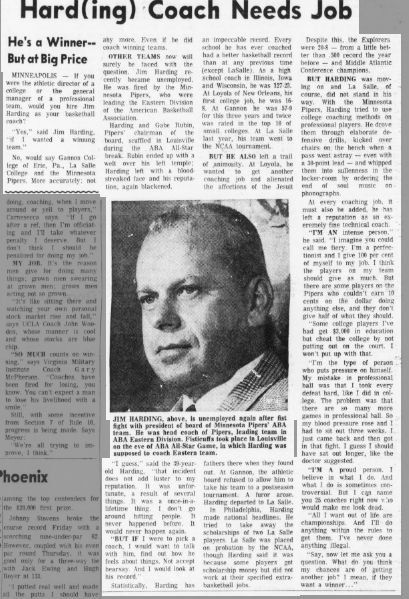
Harding then spent four years at Detroit Mercy (after being the Titans’ second choice when first-choice Don Haskins of Texas–El Paso quit two days after he was hired — yes, there’s a theme developing here), going 55–45 while apparently alienating all his players due to his methods to the point where, at the beginning of his second season, all of his players quit. Harding, who had coached high school basketball in Wisconsin, Illinois and Iowa before going to La Salle, had only one losing season in six years of college coaching, but never coached after leaving Detroit Mercy. (Harding’s eventual replacement: Dick Vitale. Really.) Harding eventually became athletic director at UW–Milwaukee from 1975 to 1980 and is in the Gannon University Athletic Hall of Fame.
So apparently Wisconsin had two, shall we say, volatile coaches to choose from. Their choice was Knight:
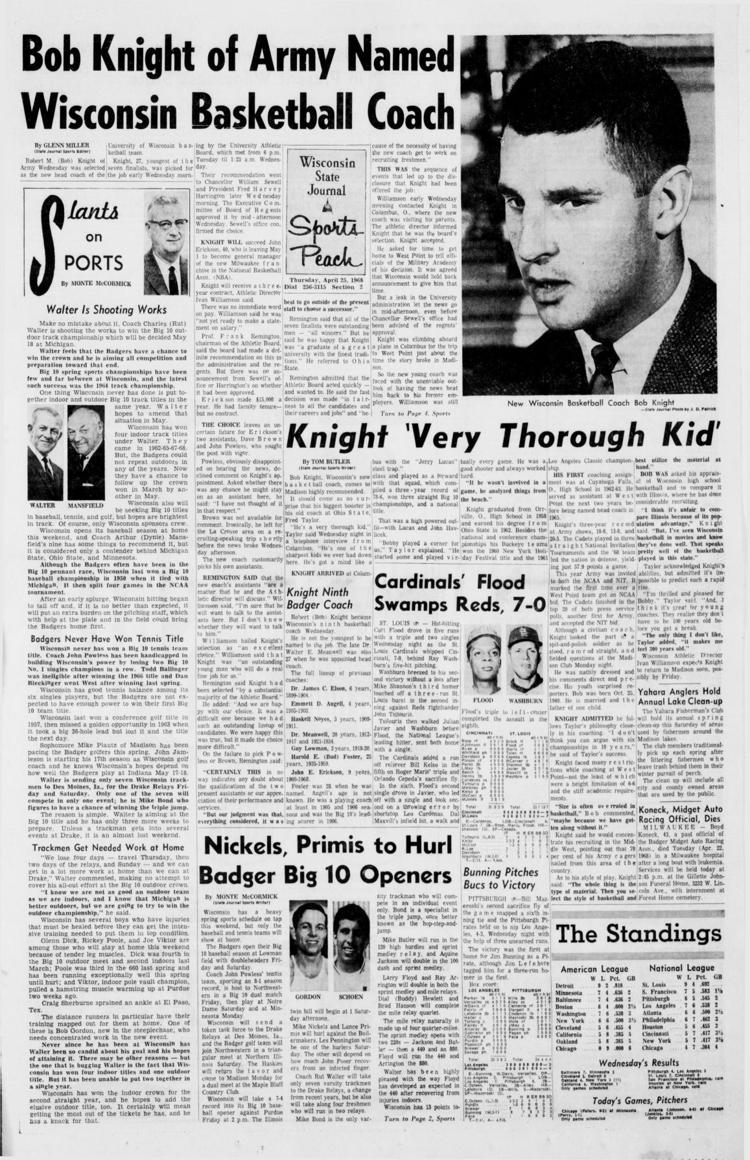
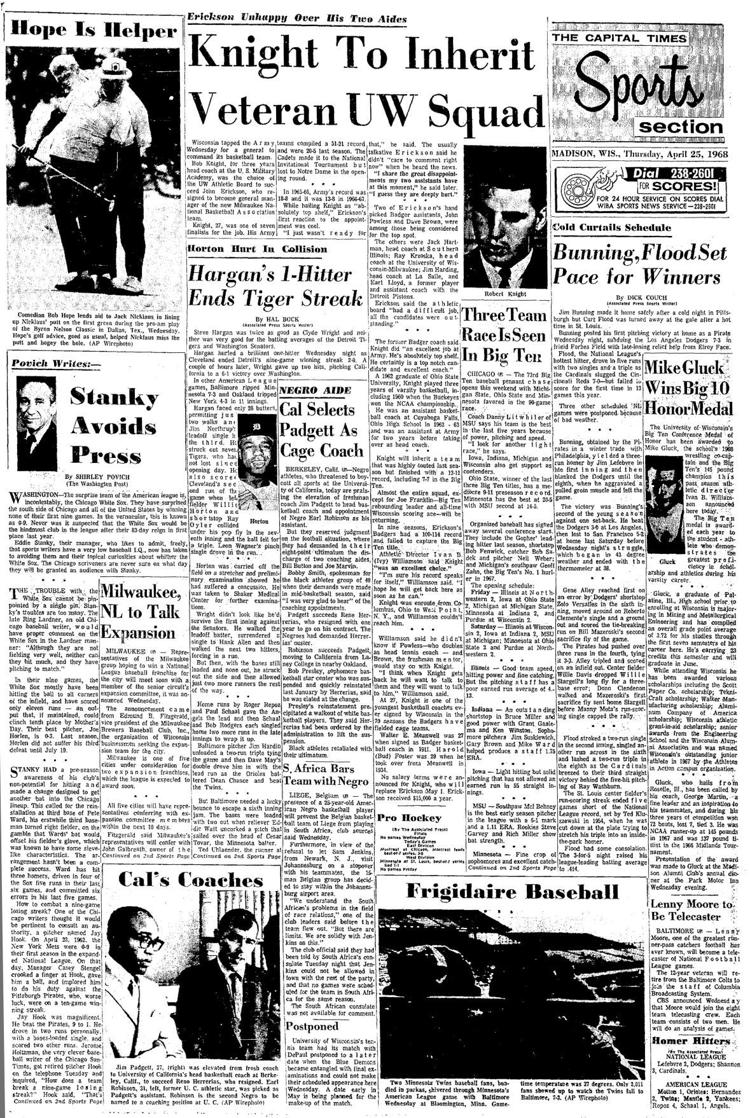
Here, however, is where things get murky. Madison.com’s version is that Knight quit due to anger over reporting of his hiring before he had a chance to tell his wife and his bosses. (That would not be the last time Knight had a run-in with the media, of course.)
A slightly different version comes from a coach named Bo but not Ryan — Bo Schembechler, a candidate to replace Milt Bruhn as UW football coach in 1967:
After we won our conference title in my third and fourth seasons at Miami–1965 & 1966–Wisconsin called. From the outside, it seemed like a pretty good job. Wisconsin’s a good school in a great league. It was about ten o’clock on a Sunday when I walk into this meeting room to face twenty guys sitting around–and some board member falls asleep, right there in front of me! Now what does that tell you?
They also had a student on the committee, and this kid asks me how I would handle Clem Turner, a Cincinnati kid, who was always in trouble. Well, how the heck do I know how I would handle Clem Turner? I’ve never met him! And that’s exactly what I told that kid. But I’m thinking, Who the hell’s running this show?
The whole thing lasted maybe forty minutes, and the second I was out that door I walked to the nearest pay phone and called Ivy Williamson, the Wisconsin athletic director, and told him to withdraw my name from consideration.
Jesse Temple adds:
“They brought in all the candidates at the same time but put us up at different hotels,” Schembechler said in the book. “Real secret agent stuff. They asked Johnny Ray and me to come down together, and he goes in first before the committee. I guess it’s about 10 (p.m.) before it’s my turn.
“You have to picture this. They’ve got 20 guys sitting around, and one of them — a board member, I guess — is sound asleep. He is sitting there asleep. I mean, how the hell would you feel? I’m mad. Really mad. I don’t even want to be there. I don’t want to answer any of their questions.”
According to author John U. Bacon, the entire interview lasted all of 40 minutes. Schembechler also wasn’t thrilled that a student seemed to relish asking smart-aleck questions during the interview. He promptly walked out the door, found the nearest pay phone and called Wisconsin athletics director Ivy Williamson to withdraw his name from consideration.
“I really got miffed when I got there,” he said. …
The story behind Knight’s near-hire is equally maddening for Badgers fans. In 1968, he was a coach on the rise at Army and arrived in Madison as one of seven candidates to appear before the athletics board for the vacant men’s basketball coaching position. The previous coach, John Erickson, had resigned to become general manager of the Milwaukee Bucks.
Knight wowed the board and was offered the Wisconsin job. There is some dispute as to whether he outright accepted the position or whether he asked simply for more time to think about it upon his return to West Point — which he claimed was the case in his book, Knight: My Story. Either way, he was not prepared for school officials to leak any news of his hiring to a local newspaper. That move, however, is exactly what happened.
“Almost as soon as I left, they announced me as their new coach,” Knight said in his book. “When I arrived home at West Point, I heard what they had done. Now, I was in a hell of a spot. I was up all night trying to figure out what I should do.”
The only person Knight could think of to run his decision by was Schembechler, who was still coaching at Miami (Ohio). Schembechler had served as an assistant to Woody Hayes when Knight was in school at Ohio State, and Knight was aware of his situation one year earlier at Wisconsin.
“I told him how Wisconsin had released my name as the new coach before I’d had a chance to talk to them about what was necessary for them to do — that I’d have liked to take the job but I didn’t think I could, under those circumstances,” Knight said. “He listened to everything I said, then told me, ‘Just call them and tell them you have no interest in the job.’ I did.” …
Knight recalled that about 20 years after he spurned the Badgers, an alumnus of Wisconsin approached him at a golf course and asked for his version of what happened when he almost became Wisconsin’s coach. He told the man about his situation and the one a year earlier with Schembechler
“If Wisconsin had handled both situations a little better, Bo and I might have been coaching there together for a long time,” Knight told him.
After relaying the story, Knight could sense disgruntlement on the alum’s face. “I think the football part bothered him the most,” he said.
So did Knight quit over the premature notice or because of what Schembechler said about why he turned down UW? We report, you decide.
This was not the last time UW had to get coach choice number two, or failed to hire the right coach. After Coatta was fired …
… UW offered the football job to North Dakota State coach Ron Ehrhardt, who turned UW down. (Ehrhardt went to the pros instead, becoming an assistant coach, then head coach of the New England Patriots. After his firing, he was hired as an assistant coach for the New York Giants under Ray Perkins, then Bill Parcells, then going to Pittsburgh, getting him three Super Bowl appearances and two wins as an offensive coordinator.)
UW ended up hiring UCLA assistant John Jardine, who had one winning season in eight years, but it was exciting:
Jardine was replaced (though to his credit he remained a UW football supporter until his death) by Dave McClain, who coached Wisconsin to the Badgers’ first bowl win …
… plus two other bowl games …
… including the only bowl game I got to march in …
… before his death of a heart attack at 48 in April 1986.
McClain was replaced by defensive coordinator Jim Hilles. UW had most of its starters back, including eight players who were drafted by the NFL — running backs Joe Armentrout and Larry Emery, linebackers Rick Graf, Tim Jordan (who was one year ahead of me at Madison La Follette), Michael Reid and Craig Raddatz, and defensive backs Nate Odomes and Bobby Taylor — plus five players who would be drafted in the next year’s draft.
That 1986 team might be one of the biggest what-ifs in UW athletic history. They played four nonconference games that were winnable, but went 1–3 instead, and they won only two games after that.
Would that have happened had McClain lived? Hilles was the logical choice to replace McClain since he was assistant head coach, but what if Hilles had, as some head coaches do, focused on his side of the ball and let the offensive coaches run the offense?
Hilles was quoted in the UW media guide that “I will take the responsibility for the offense, and I will also take the blame. We will definitely be more aggressive physically; we want to knock some people off the line of scrimmage — let them know who we are. Since we feel our strengths are in the offensive line and our running backs, we will first set out to be as strong a running team as we can be. An effective running game will open up the throwing game for us, and that’s how we’re going to approach things.”
That is not different from the approach UW had under McClain once McClain switched from the option to the pro set when quarterback Randy Wright transferred in from Notre Dame. They had the same two quarterbacks, Mike “The Springfield Rifle” Howard and Green Bay’s Bud Keyes, though they were minus their top two receivers from the 1985 season, tight end Scott Sharron and wide receiver/kick returner Tim Fullington and one of their offensive linemen, Bob Landsee, who preceded Gruber and Derby into the NFL.
In a sense, though, Hilles’ offensive problems predated Hilles’ one year as head coach. Wright was a good enough quarterback to play for the Packers. His best receiver was Al Toon, who also played in the NFL. The season after Wright graduated, the Badgers had Toon, plus two other good wide receivers, Michael Jones and Thad McFadden, plus tight end Bret Pearson, who was drafted (though did not play) by the San Diego Chargers. None of them arguably were capably replaced, and when a team can’t move the ball through the air, defense becomes easier for their opponent.
Once the 1986 season started going south, UW started looking for a new coach. The five semifinalists included Hilles, Wyoming coach Dennis Erickson (right after Wyoming beat Wisconsin in Madison in Erickson’s first season), West Virginia coach Don Nehlen, Northwestern coach Francis Peay (a former Packer offensive lineman), and Tulsa coach Don Morton.
That list includes one coach who won two national championships, Erickson, and another who coached in a national championship game, Nehlen, winner of 202 games in his career. Neither were finalists for the job. Morton was hired over Hilles, and it could be argued that neither choice was the right choice. Morton won six games in three years, and his ineptitude resulted in the death of the UW baseball and gymnastics teams and nearly the rest of the UW Athletic Department.
If that seems like a mess, the mess of four years earlier was even worse. Erickson’s (and Knight’s) replacement, Powless, had only two winning seasons in eight seasons as coach. Powless’ replacement was Virginia assistant Bill Cofield, who had only one winning season in six seasons as coach. (Cofield died of cancer two years after he coached his last game.)
The options to replace Powless included Boston College coach Tom Davis, who grew up in Ridgeway and graduated from UW–Platteville. UW should have hired Davis, but didn’t. Davis went to Stanford, then to Iowa, where he beat on UW with regularity until he retired in 1999. Instead, UW hired UW–Eau Claire coach Ken Anderson, who then backed out of the job three days later. (One version of the reason was that he got wind of NCAA rule violations that resulted in the Badgers’ forfeiting all eight of their wins the next season; another is that he was making too much money as a landlord to UW–Eau Claire students to leave.) UW hired Ball State coach Steve Yoder, who at least got UW in a couple of NIT tournaments before he quit in 1991.
It should be pointed out that the fact that Schembechler was highly successful at Michigan (though he has two fewer Rose Bowl wins than UW), Knight was highly successful at Indiana (as in three national championships), Hartman was successful at Kansas State, Davis was highly successful at Stanford and Iowa, Nehlen was highly successful at West Virginia, and Erickson was highly successful at Miami (though not so in the NFL) does not necessarily mean any of them would have been successful at UW.
Two years after Schembechler declined to go to UW, he went to Michigan, replacing Bump Elliott (who ended up becoming Iowa’s athletic director and hiring football coach Hayden Fry as well as Davis). Michigan wasn’t at its usual standards, but Schembechler inherited the remainder of a team that had gone 8–2 the previous season. UW was five seasons removed from a Rose Bowl trip, but had finished tied for seventh in the three previous seasons before Schembechler was not hired.
Three years after Knight changed his mind about UW, he went to Indiana, inheriting a team that had gone 17–7 and had long-standing basketball tradition, though they had slipped in the seasons before Knight arrived. Erickson left of his own accord after two 13–11 seasons, but he had had only one other winning season in nine seasons.
UW had issues in the late 1960s that Michigan may not have had. In addition to more intense turmoil over the Vietnam War, The Cap Times chronicles 1968:
After threatening to boycott the final game of the season against Minnesota, 18 black Wisconsin football players skip the team’s season-ending banquet. The group earlier filed a list of grievances with the UW Athletic Board, saying the coaching staff lacked rapport with the black players and that coaches stacked black players at one position. Assistant coach Gene Felker resigns, complaining of “weak, frightened administrators, black athletes and their grievances.” The Athletic Board recommends establishment of a coach-player committee to address grievances, but it also gives unanimous endorsement to John Coatta, who was 0-19-1 in his first two seasons as head coach.
I’m sure Schembechler and Knight would have been successful somewhere besides Michigan and Indiana. I’m not sure they would have been successful at Wisconsin over the long run. I could see them sticking it out at Wisconsin for a few seasons, butting heads with faculty and administration because of their different views of who should be in charge (i.e. themselves) and, in Schembechler’s case, academic standards preventing certain players from admission (Knight never had that issue, but Michigan is not really a strong academic school, contrary to what Wolverine backers would like you to think), and leaving for greener pastures elsewhere. Irrespective of Knight’s late-1980s comments, I wonder if two big personalities like Schembechler and Knight could have coexisted on the same campus, given battles for resources.
Davis turned things around at Stanford somewhat (though his career record was 58–59), and inherited a better situation at Iowa than Yoder did at Wisconsin. Morton was a disastrously bad hire, and should have been fired after his second season. However, UW’s Athletic Department was a financial mess that was bolstered by decent football attendance before Morton got there. Once Morton drove the football program into the ground, the Athletic Department’s financial issues got exposed. (Read Rick Telander’s From Red Ink to Roses and you’ll see how bad things were.)
Nehlen probably would have been a success at Wisconsin. I’m not sure Dennis Erickson would have, given that his formula for revitalizing a program involved junior college transfers, something unlikely to work with UW’s academic tradition. Erickson clearly had the next level in mind since he left Wyoming after that season for Washington State and left Washington State for Miami after two seasons.
Here is a demonstration of how things eventually work out. Jardine hired as one of his assistants Madison Edgewood’s George Chryst. Chryst’s son, Paul, played for Wisconsin, was an assistant coach for Barry Alvarez and Bret Bielema, and then was hired by AD Alvarez to be the Badgers’ coach. Cofield hired William Ryan as an assistant coach. You know Ryan as Bo, who was chosen to coach the Badgers in 2001 over more well known coaches including Milwaukee’s own Rick Majerus. Ryan had one more Final Four trip than Majerus.
The number one single today in 1963 was recorded by a 15-year-old, the youngest number one singer to date:
The number one British single today in 1967 was that year’s Eurovision song contest winner:
The number one single today in 1985:
 Steve Prestegard.com: The Presteblog