• A new coach, a new arena, and intrigue therein

    May 11, 2018
    Sports

    A phrase common to professional sports, and increasingly to college sports, is that a coach is hired to be fired.

    What else would explain this, from Bleacher Report?

    The Toronto Raptors finished with the best record in the Eastern Conference this season. Dwane Casey was named the National Basketball Coaches Association’s Coach of the Year.

    That wasn’t enough to save his job.

    The Raptors fired Casey after seven seasons Friday, just four days after the Raptors were swept by the Cleveland Cavaliers in the second round, according to ESPN.com’s Adrian Wojnarowski. Toronto went 320-238 under Casey and made five postseason appearances, but the team’s playoff struggles led to his dismissal.

    “After careful consideration, I have decided this is a very difficult but necessary step the franchise must take,” Raptors president Masai Ujiri said in a statement, according to USA Today‘s Jeff Zillgitt. “As a team, we are constantly trying to grow and improve in order to get to the next level.”

    After earning a conference finals berth in 2016 and coming within two games of reaching the first Finals in franchise history, the Raptors fell apart each of the last two seasons—thanks in large part to one LeBron Raymone James.

    The Cavaliers swept the Raptors out of the second round in 2017 and 2018, the latter being the death knell to Casey’s tenure. Cleveland entered the series having just barely scraped by the Indiana Pacers in seven games, only to beat Toronto twice on their home floor before closing things out in Cleveland. The Cavs had no real set rotation and were still juggling around lineups due to their revamped roster, but it mattered not in the sweep. …

    Moving on from the coach is the easiest deck-shuffling move they can make without tearing the team to its core. Casey will rightfully be billed as the unfair fall guy, but every NBA coach knows that comes as part of the job.

    There are numerous examples in pro sports of somewhat successful teams making a coaching change for the purpose of getting to the “next level.” It almost never works.

    In 1980, after three consecutive wild card playoff berths and two trips to the AFC championship game (because they kept running into the Pittsburgh Steelers), the Houston Oilers fired coach Bum Phillips. That stopped the run of playoff berths.

    The Milwaukee Brewers have done that for decades. It’s unclear whether manager Harvey Kuenn was fired or resigned, but he was out the door one season after managing the Brewers to the 1982 World Series. Kuenn’s replacement, Rene Lachemann, was out the door after one disastrous season.

    Kuenn is not really an example of this approach working. He was named manager in June 1982 after the Brewers fired manager Buck Rodgers, who was accused of overmanaging. The difference is that Kuenn was already a Brewers coach, so it’s not as if he represented a huge change, except in temperament. Kuenn told his players to have fun, and they had fun all the way to the 1982 World Series and were a contender throughout the 1983 season. Nor is Dale Sveum, who replaced Ned Yost as Brewers manager in mid-September 2008, and got the Brewers into the playoffs for the first time since 1982.

    At any rate, Casey now becomes an obvious candidate for the Bucks’ vacant coaching job, along with several assistant coaches with connections to the San Antonio Spurs, who unlike most NBA teams actually play team basketball.

    Maybe the most intriguing candidate from that group is Becky Hammon, a Spurs assistant since 2014 after her career in the Women’s National Basketball Association. Hammon was the coach of the Spurs’ summer-league team, which won the summer league title in 2015. Hammon interestingly was interviewed for the Bucks’ general manager position one year ago, but wasn’t hired.

    Hammon gets a vote of confidence from one of her Spurs players, Pau Gasol:

    That part is obvious: One, she was an accomplished player — with an elite point guard’s mind for the game. And two, she has been a successful assistant for arguably the greatest coach in the game. What more do you need? But like I said — I’m not here to make that argument. Arguing on Coach Hammon’s behalf would feel patronizing. To me, it would be strange if NBA teams were not interested in her as a head coach.

    The argument that I see most often is thankfully the one that’s easiest to disprove: It’s this idea that, at the absolute highest level of basketball, a woman isn’t capable of coaching men. “Yeah, female coaches are fine coaching women’s college basketball, or the WNBA,” the argument goes. “But the NBA? The NBA is different.”

    First, I’ve just gotta tell you: If you’re making that argument to anyone who’s actually played any high-level basketball, you’re going to seem really ignorant. But I also have a simple response to it — which is that I’ve been in the NBA for 17 years. I’ve won two championships … I’ve played with some of the best players of this generation … and I’ve played under two of the sharpest minds in the history of sports, in Phil Jackson and Gregg Popovich. And I’m telling you: Becky Hammon can coach. I’m not saying she can coach pretty well. I’m not saying she can coach enough to get by. I’m not saying she can coach almost at the level of the NBA’s male coaches. I’m saying: Becky Hammon can coach NBA basketball. Period.

    I’ll tell you a quick story to illustrate my point. This year, in a practice a few months back, I was drilling the pick-and-roll with Dejounte Murray. It was a standard drill, just the two of us alone at one basket: I would set the screen and either pop out for the jumper or roll to the lane. If I popped, Dejounte would hit me with a chest pass. If I rolled, a bounce pass. Like I said, a very standard drill — we’ll do this a million times.

    But what I remember about this particular drill is that, at some point during it, Coach Hammon stopped us mid-motion. Coaches Hammon, Borrego and Messina walk over, and Becky says to Dejounte, “D.J., O.K. — your bounce pass? It’s too low. You’ve got to hit Pau exactly where he needs it. Run that again.” We then talk some more as a group about how I need the ball a little more precise, with a little more zip, so I could have a better chance to finish the action at the rim. And then we repeat the drill a few times, alternating from the left and right sides of court. Of course, Dejounte being Dejounte, he figures it out fast — and pretty soon we’re flying through. But something about that moment has just always stuck with me. Just, like … the level of knowledge of the game that Becky showed, you know what I mean?

    She noticed a small detail out of the corner of her eye — and then instantly located both the problem and the solution. And not only that, but we were also able to communicate with each other in such a way that we got the result that we needed. It’s a good reminder, I’d say, of the importance of communication between team members — especially at the NBA level. I don’t think I caught another stray pass the rest of the season.

    Another argument that I’ve seen tossed around — maybe even sillier than the previous one — is that Becky rose to her current position because having her on staff was “good p.r.” for the Spurs.

    What?

    Seriously: What?

    No. We’re talking about the NBA here — a business where there’s a lot of money on the line, and little patience for mediocrity. Also we’re talking about the San Antonio Spurs, one of the most successful NBA franchises of this century: a system that has produced David Robinson, Tim Duncan, Manu Ginóbili, Tony Parker — and that’s just the Hall of Famers. This is a team that won 50+ games for 18-straight seasons, and five championships in the last 20 years.

    Would you really expect Coach Pop to develop his staff any differently than he develops his players? Of course not.

    Pop’s only standard for doing anything is whether it’ll help us in just one way … and it isn’t getting good p.r.

    It’s getting W’s. And getting those W’s The Spurs Way.

    Teams in need of new management do best to emulate consistently successful organizations. The Packers did that by getting Ron Wolf from the Oakland/Los Angeles Raiders and Mike Holmgren from the San Francisco 49ers. UW did that by getting Barry Alvarez, who coached for Hayden Fry at Iowa and Lou Holtz at Notre Dame, to coach football.

    There is an additional reason the Bucks may hire Hammon. The Bucks’ owners have a new arena that opens next season. The owners, big Democratic Party donors, are reported to be bidding for the 2020 Democratic National Convention. Having the NBA’s first female head coach might be the tipping point in their favor with the party that invented identity politics.

    Which is not to say that Hammon shouldn’t get the job. She appears to know the sport, and she is part of a highly successful organization. The issue that arguably applies to every candidate is their people skills, since the skill levels of the rotations of NBA teams are probably relatively equal talent-wise, at least for teams that don’t employ LeBron James or Steph Curry.

    Share this on …

    • Share on X (Opens in new window) X
    • Share on Facebook (Opens in new window) Facebook
    • Share on LinkedIn (Opens in new window) LinkedIn
    • Email a link to a friend (Opens in new window) Email
    • Print (Opens in new window) Print
    Like Loading…
    No comments on A new coach, a new arena, and intrigue therein
  • For those wondering about a birthday present for me …

    May 11, 2018
    Packers

    How can one story combine two of my favorite things, the Packers (of which I am an owner) and Corvettes (of which I am not)?

    The answer comes from Motor Authority:

    On January 15, 1967, Green Bay Packers quarterback Bart Starr completed 16 of 23 passes for 250 yards, with two touchdowns and one interception as the Packers rolled over the Kansas City Chiefs 35-10 in the first AFL-NFL World Championship game (which would later become known as Super Bowl I). For his efforts, Starr was named the game’s MVP and was awarded a shiny new 1967 Chevrolet Corvette Sting Ray convertible. That Corvette is now going up for auction.

    The car is documented with a tank sticker that says “Courtesy Delivery – B. Starr.” It presents with its original and patinated Goodwood Green paint, which was chosen to match the Packers’ home jerseys and is only slightly touched up. Just 48,000 miles show on the odometer and the listing says they are believed to be original.

    According to the listing, Starr owned the car until the 1980s, and eventually it came into the hands of a woman in Wausau, Wisconsin, in a divorce settlement. In 1994, she sold it to Michael Anderson, owner of Thunder Valley Classic Cars of St. Joseph, Minnesota, which specializes in Corvettes. Anderson has several Bloomington Gold restorations under his belt, but instead of restoring the car, which had been in storage for years, he decided to take the body off the frame and clean and recondition the underside.

    Anderson replaced the body mounts, rubber suspension components, U-joints, seals, and bearings. He also installed a new Dewitts radiator, though the original is also included with the auction, overhauled the brake system, and upgraded the calipers with stainless-steel piston sleeves.

    The rest he left as time had treated it.

    Under the hood sits a 300-horsepower, 327-cubic-inch V-8 hooked to a Muncie 4-speed manual transmission. Anderson says the car runs and drives well, and the numbers-matching engine has never been out of the car and retains its original gaskets and paint.

    The Corvette rides on bias-ply Redline tires mounted on Rally wheels, and those tires should be able to lay down two black stripes on the pavement thanks to a 3.36:1 positraction differential.

    The car also features the original black interior, black soft top, and Soft Ray-tinted windshield. Inside, it has a telescoping steering column and an AM/FM radio.

    Head to Indianapolis for the Mecum Auction May 15-20 for your chance to buy this piece of automotive and NFL history.

    This is like the Holy Grail for the Packer/Corvette fan. Starr was the MVP of the first two Super Bowls, the last two of his five NFL titles as the Packers’ quarterback. That places him in Joe Montana/Tom Brady territory in the conversation about the best NFL quarterbacks of all time, because of the only metric that actually counts in the NFL — winning.

    This Corvette isn’t that powerful, with the base V-8, but it has the correct transmission for any Corvette. I like green Corvettes, and it’s the right color anyway for a Packer player or fan. This doesn’t say whether it has power steering or brakes. I’ve driven both a Corvette and a similar car without power brakes, and I can live with that. I’ve also driven a Corvette without power steering and other vehicles that were supposed to have power steering but didn’t. (They’re easier to drive when moving; turns from a stop or slow speed are the hardest.) Driving this is likely to be easier than driving, say, a Corvette with a big block but without power steering.

    In those days the late Sport magazine awarded cars to the Super Bowl MVP. SI.com reports that Starr donated his second MVP Corvette …

    … to be auctioned off for funds to start Rawhide Boys Ranch near New London.

    I was not aware that Starr actually owned a Corvette, which puts him the company of other famous Corvette owners. The story was that Starr had requested a station wagon instead of the Corvette, but that is evidently incorrect. (The wagon substitution request came from Roger Staubach, and the wagon replaced a Dodge Charger, because, he said, “We had three kids. What was I going to do with a Dodge Charger?” The Charger had seating for four, but on the other hand the Corvette had seating for two, two fewer than the number of kids in the Starr household.)

    Starr tends to get a bit underrated for his contribution to the Glory Days Packers perhaps because he didn’t throw for a bazillion yards in the days where the game was considerably different from now. But remember that Starr called all the plays in those days, including the improvised quarterback sneak that won the Ice Bowl. Starr was the 1966 NFL MVP. Starr was 9–1 as a starting quarterback in the postseason and had the best postseason passer rating in NFL history. Not even Montana or Brady can say that.

    (Aaron Rodgers, by the way, got a Chevy Camaro for being the Super Bowl XLV MVP.)

    The Packers’ two Super Bowl teams were the last two Glory Days champions, and the Packers were not as run-dominated as they did in the early Glory Days, because by the Super Bowls running backs Jim Taylor and Paul Hornung were at the end of their careers. No Starr, no Super Bowls.

    Starr was also the general manager/coach of the Packers. That didn’t go so well, although he did get them into as many playoff berths as his predecessor, Dan “Lawrence Welk Trade” Devine, and more than his successors, Forrest Gregg and Lindy Infante (zero each). I’ve written before here about the mess he inherited and how he really shouldn’t have been GM/coach because no one should be GM/coach anymore. Packer fans clearly look at Starr more as the great quarterback he was than as the coach he became.

    If I somehow got this car, I would do three things with it — (1) replace the bias-ply tires with radials (and find someone who manufactures red-stripe radials), (2) get it to wherever Starr now lives to meet him (I was 2 years old when the Packers won Super Bowl II, so by the time I knew the Packers they were quite bad, which made the Glory Days seem unlikely to have occurred) and show off the car, and then (3) drive it.

    Let’s see. Mega Millions is $45 million tonight, and Powerball is $257 million Saturday night …

    Share this on …

    • Share on X (Opens in new window) X
    • Share on Facebook (Opens in new window) Facebook
    • Share on LinkedIn (Opens in new window) LinkedIn
    • Email a link to a friend (Opens in new window) Email
    • Print (Opens in new window) Print
    Like Loading…
    No comments on For those wondering about a birthday present for me …
  • Presty the DJ for May 11

    May 11, 2018
    Music

    The number one British single today in 1958 was a cover of a song written in 1923:

    The number one British album today in 1963 was the Beatles’ “Please Please Me,” which was number one for 30 weeks:

    (more…)

    Share this on …

    • Share on X (Opens in new window) X
    • Share on Facebook (Opens in new window) Facebook
    • Share on LinkedIn (Opens in new window) LinkedIn
    • Email a link to a friend (Opens in new window) Email
    • Print (Opens in new window) Print
    Like Loading…
    No comments on Presty the DJ for May 11
  • Another undone Obama bad idea

    May 10, 2018
    International relations, US politics

    Facebook Friend Michael Smith explains why the Iran deal deserved to die:

    1. The “deal” did not end their capability to build a bomb, it only slowed it down and postponed their “breakout” for a few years so some future administration would have to deal with a nuclear Iran.

    2. The number of centrifuges necessary for enrichment of uranium were reduced – to a number too small for nuclear fuel for power reactors but more than adequate for producing a bomb.

    3. The “deal” removed sanctions, allowing Iran open access to world markets.

    4. The US repatriated billions of dollars held since the mullahs deposed the Shah, giving them immediate cash to fund their military and terrorist programs.

    5. EU countries have violated sanctions for decades and continued to trade with Iran. France has been one of the worse offenders and one of Iran’s greatest defenders. Only the US has honored all prohibitions.

    6. Israel has proven that Iran lied about their bomb making research and had continued even though the swore they had stopped.

    7. Satellite photographs show continued construction of nuclear facilities in contravention to the “deal” and international inspectors were denied access to these sites.

    In short, the US and other western parties gave up much for nothing but a temporary delay that wasn’t even a delay, got nothing but a bunch of lies in return and Iran basically got everything and had to change nothing (other than being a little more stealthy as they continued doing what they were doing).

    It was a bad deal. Rescinding it didn’t increase the chance of war because that chance never went away. The Obama/Kerry ‘deal” only papered over the issues and made the contemporary Neville Chamberlian Democrats claim they had secured “peace in our time” as they waved the deal in the air.

    The Weekly Standard posted this two years ago, but it applies because of the events of this week:

    It’s hardly any wonder that Deputy National Security Adviser Ben Rhodes has a “mind meld” with his boss, the president. According to a David Samuels New York Times Magazine article to be published Sunday and already posted to the website, Rhodes, like Barack Obama, is contemptuous of “the American foreign-policy establishment.” What Obama calls the “Washington playbook” dictating the sorts of responses available to American policymakers, Rhodes calls the “Blob.”

    The Blob includes “editors and reporters at The New York Times, The Washington Post, The New Yorker,” etc. It also encompasses, according to Rhodes, Obama’s former secretary of state Hillary Clinton, and the administration’s first defense secretary Robert Gates. Presumably Leon Panetta, former Pentagon chief and CIA director, who goes on the record to criticize Rhodes and the president, is also part of the Blob, alongside “other Iraq-war promoters from both parties who now whine incessantly about the collapse of the American security order in Europe and the Middle East.” In other words, the emotion driving the administration’s foreign policy is contempt—contempt for allies, colleagues, and the generations of American policymakers who built the post-WWII international order, ensuring relative global stability, and peace and prosperity at home.

    Samuels’s profile is an amazing piece of writing about the Holden Caulfield of American foreign policy. He’s a sentimental adolescent with literary talent (Rhodes published one short story before his mother’s connections won him a job in the world of foreign policy), and high self regard, who thinks that everyone else is a phony. Those readers who found Jeffrey Goldberg’s picture of Obama in his March Atlantic profile refreshing for the president’s willingness to insult American allies publicly will be similarly cheered here by Rhodes’s boast of deceiving American citizens, lawmakers, and allies over the Iran deal. Conversely, those who believe Obama risked American interests to take a cheap shot at allies from the pedestal of the Oval Office will be appalled to see Rhodes dancing in the end zone to celebrate the well-packaged misdirections and even lies—what Rhodes and others call a “narrative”—that won Obama his signature foreign policy initiative.

    “Like Obama,” writes Samuels:

    Rhodes is a storyteller who uses a writer’s tools to advance an agenda that is packaged as politics but is often quite personal. He is adept at constructing overarching plotlines with heroes and villains, their conflicts and motivations supported by flurries of carefully chosen adjectives, quotations and leaks from named and unnamed senior officials. He is the master shaper and retailer of Obama’s foreign-policy narratives, at a time when the killer wave of social media has washed away the sand castles of the traditional press.

    As Rhodes admits, it’s not that hard to shape the narrative. “All these newspapers used to have foreign bureaus,” Rhodes said. “Now they don’t. They call us to explain to them what’s happening in Moscow and Cairo. Most of the outlets are reporting on world events from Washington. The average reporter we talk to is 27 years old, and their only reporting experience consists of being around political campaigns. That’s a sea change. They literally know nothing.”

    In Rhodes’s “narrative” about the Iran deal, negotiations started when the ostensibly moderate Hassan Rouhani was elected president, providing an opening for the administration to reach out in friendship. In reality, as Samuels gets administration officials to admit, negotiations began when “hardliner” Mahmoud Ahmadinejad was still president. It was Rhodes who framed the Iran deal as a choice between peace and war, and it was Rhodes who set up a messaging unit to sell the deal that created an “echo chamber” in the press. “[Al Monitor reporter] Laura Rozen was my RSS feed,” says Tanya Somanader, the 31-year-old who managed @TheIranDeal twitter feed. “She would just find everything and retweet it.”

    “In the spring of last year,” Samuels writes:

    legions of arms-control experts began popping up at think tanks and on social media, and then became key sources for hundreds of often-clueless reporters. “We created an echo chamber,” [Rhodes] admitted, when I asked him to explain the onslaught of freshly minted experts cheerleading for the deal. “They were saying things that validated what we had given them to say.” When I suggested that all this dark metafictional play seemed a bit removed from rational debate over America’s future role in the world, Rhodes nodded. “In the absence of rational discourse, we are going to discourse the [expletive] out of this,” he said. “We had test drives to know who was going to be able to carry our message effectively, and how to use outside groups like Ploughshares, the Iran Project and whomever else. So we knew the tactics that worked.” He is proud of the way he sold the Iran deal. “We drove them crazy,” he said of the deal’s opponents.

    It’s not clear whether or not Panetta supported the deal, but he admits he was wrong about Obama’s willingness to take all measures to stop Iran from getting a bomb.

    As secretary of defense, he tells me, one of his most important jobs was keeping Prime Minister Benjamin Netanyahu of Israel and his defense minister, Ehud Barak, from launching a pre-emptive attack on Iran’s nuclear facilities. “They were both interested in the answer to the question, ‘Is the president serious?’ ” Panetta recalls. “And you know my view, talking with the president, was: If brought to the point where we had evidence that they’re developing an atomic weapon, I think the president is serious that he is not going to allow that to happen.” Panetta stops. “But would you make that same assessment now?” I ask him. “Would I make that same assessment now?” he asks. “Probably not.”

    Rhodes tells Samuels that Don DeLillo is his favorite novelist. “That’s the only person I can think of who has confronted these questions of, you know, the individual who finds himself negotiating both vast currents of history and a very specific kind of power dynamics,” he tells Samuels. “And that’s what it’s like to work in the U.S. foreign-policy apparatus in 2016.”

    So that’s it. For the last seven years the American public has been living through a postmodern narrative crafted by an extremely gifted and unspeakably cynical political operative whose job is to wage digital information campaigns designed to dismantle a several-decade old security architecture while lying about the nature of the Iranian regime.

    Regardless of what you think of Donald Trump, and there is plenty to criticize even for right-leaning voters, the fact Trump is president means that people like Rhodes are not in power. That is another Trump accomplishment.

    Then there is this, from Investors.com:

    Democrats went gaga over a little-known law they claimed an advisor to President Trump violated following the 2016 presidential campaign. Now, the shoe’s on the other foot, and both the Democrats and the media that supported them have grown strangely quiet.

    The law in question is the 219-year-old Logan Act, which makes it a felony for Americans to negotiate with foreign powers in an effort to undermine the U.S. in a dispute.

    The law is little-known for a reason: Just two people have ever been tried under the Logan Act, and neither was convicted.

    But that didn’t stop Democrats and their Deep State allies when they wanted to use it to investigate Trump’s former national security advisor, Lt. Gen. Mike Flynn, in 2016. Democrats and the media laughably claimed that Flynn’s conversations with Russia’s U.S. ambassador, Sergey Kislyak, somehow was a violation of the Logan Act. Let’s be clear: Under no reasonable legal interpretation could one assume that Flynn violated the Logan Act.

    But now a report in the Boston Globe asserts that former Secretary of State John Kerry may have stepped over the line when it comes to the Logan Act.

    “With the Iran (nuclear) deal facing its gravest threat since it was signed in 2015, Kerry has been on an aggressive yet stealthy mission to preserve it, using his deep lists of contacts gleaned during his time as the top U.S. diplomat to try to apply pressure on the Trump administration from the outside,” the Globe wrote. “President Trump, who has consistently criticized the pact and campaigned in 2016 on scuttling it, faces a May 12 deadline to decide whether to continue abiding by its terms.”

    Kerry met with Iranian Foreign Minister Javad Zarif at the U.N. about preserving the deal. He also has contacted German President Frank-Walter Steinmeier, European Union official Federica Mogherini and French President Emmanuel Macron to interfere in President Trump’s possible decision to abrogate the Obama administration’s terrible nuclear deal with Iran.

    If there ever was a violation of the Logan Act, this is it. Kerry is not an elected official. He’s a private citizen. He’s undermining the position of a sitting, elected U.S. president and his duly appointed representatives.

    Surely the Democrats and the media, who made themselves such strong advocates of the Logan Act back in 2016 that they misapplied it against Lt. Gen. Flynn, will now respond to what looks like a clear violation now?

    Of course not. Both the Democratic Party and the leftist media continue to make a mockery of the rule of law and the idea that both sides play by the same rules. The media and Democrats have downplayed any idea of the Logan Act being applicable in the case of leftist millionaire John Kerry, even though President Obama himself dragged out the Logan Act to threaten Republicans.

    Former Democratic Sen. Joe Lieberman, once the Democrats’ vice presidential candidate, now a party pariah (because he dared to support President George W. Bush on Iraq and opposes the Iran deal), criticizes Kerry.

    “In my opinion, what (Kerry’s) doing is inappropriate and he shouldn’t be doing it,” Lieberman said. “It’s a duly elected administration so I hope John Kerry stops.”

    Using that party’s own standard, Kerry should be prosecuted for his freelance diplomacy, which will inevitably undermine President Trump’s efforts to undo the ill effects of Kerry’s failed diplomatic efforts while serving under the Obama administration.

    We shouldn’t be surprised. This is part of a new trend among the progressive left, from campuses and entertainment to politics and sports: to criminalize political differences with your foes, while pretending anything your political opponents do somehow violate cultural norms, decency or the Constitution. President Obama used it too.

    It’s clear Kerry broke the law here — just as one of his idols, Sen. Teddy Kennedy, may have done when he secretly held back-channel talks with Soviet leaders in 1984 to thwart President Reagan.

    If Attorney General Jeff Sessions wants to do something constructive, he should prosecute Kerry. Then either Kerry will be punished (how about sending him to Guantanamo, since Obama administration foreign policy could be described as terrorism) or the law will be found unconstitutional in the legal system.

    Share this on …

    • Share on X (Opens in new window) X
    • Share on Facebook (Opens in new window) Facebook
    • Share on LinkedIn (Opens in new window) LinkedIn
    • Email a link to a friend (Opens in new window) Email
    • Print (Opens in new window) Print
    Like Loading…
    No comments on Another undone Obama bad idea
  • The Iranians’ crisis

    May 10, 2018
    International relations, US politics

    In 1979, Jimmy Carter and Leonid Brezhnev signed the SALT II, resulting from the second round of the Strategic Arms Limitations Talks treaty.

    Then the Soviet Union invaded Afghanistan and the U.S. Senate declined to ratify SALT II. Carter lost the 1980 presidential election to Ronald Reagan, who, when asked what his strategy was to take on the Soviet Union, simply replied, “We win, they lose.”

    That history came to the mind of a Facebook Friend of mine when he posted this story from the New York Times:

    TEHRAN — The sense of crisis in Iran runs deep and wide. The economy is in free fall. The currency is plummeting. Rising prices are squeezing city dwellers. A five-year drought is devastating the countryside. The pitched battle between political moderates and hard-liners is so perilous that there is even talk of a military takeover.

    Now, the lifeline offered by the 2015 nuclear deal, which was supposed to alleviate pressure on Iran’s economy and crack open the barriers to the West, is falling apart, too: President Trump announced Tuesday that he was withdrawing the United States from the agreement, which he called a “disastrous deal.”

    The chief loser will be the country’s moderate president, Hassan Rouhani, who now looks weakened, foolish and burned for the risk he took in dealing with the Americans.

    Addressing the nation on live television after Mr. Trump’s announcement, Mr. Rouhani said Iran would take no immediate action to restart uranium enrichment and that it would negotiate with the other parties to the agreement, Britain, China, France, Germany and Russia.

    Rouhani is not a moderate, but he is a President In Name Only. The real power in Iran are the successors of Ayatollah Khomeini, who you might recall did this …

    … the failed rescue of whom cost eight American lives.

    But in the long term, the unraveling of the nuclear agreement could be bad news for the entire Iranian leadership, already buffeted by mounting popular dissatisfaction over the economy and a lack of freedoms and prospects. It could be bad news for average Iranians, too.

    “We will see more migration, more unemployment, more bankruptcies, more impoverishment,” said Amirhossein Hasani, who once made kitchen equipment but now tries to make a living selling foreign exchange. “Some might think this will lead to regime change, but protests will be cracked down and the government will be able to run the country. We will just get poorer.”

    Even before Mr. Trump’s decision, the nuclear deal had not lived up to its promise of economic salvation for Iranians. Mr. Rouhani sold it as the solution to many of the country’s problems. He promised that foreign companies would flood Iran with investment and know-how, bringing jobs and opportunity to millions of unemployed people.

    He also said that the compromise would lift Iran out of its international isolation. Indeed, several airlines resumed connections to Tehran after the deal was struck.

    But deeper-rooted problems such as uncompetitive investment laws, widespread corruption and arrests of dual nationals by hard-line security forces dampened the boom the president had promised. Foreign businesses showed up in sizable numbers but balked at the conditions that confronted them.

    But what really diminished the potential benefits of the agreement were the American sanctions that remained in place despite the agreement, and which have continued to prevent any serious bank from working in Iran. They also prevent almost all normal financial transactions, depriving Iran of much-needed credit and foreign investments.

    The return of even broader sanctions could put even more pressure on the economy.

    “Someone, please change our fate, whoever, even Trump,” said Ali Shoja, a cleaner who said he can’t afford to support his three sons. “I used to be a driver, now I clean. What’s next? I cannot become a beggar.”

    Hard-liners, who have long lost popular support but control security forces, the judiciary and state television, were set to declare victory, since they have always argued that the United States could never be trusted in any deal.

    They will use the opportunity to undermine Mr. Rouhani and to try to seize power. But Mr. Rouhani came in after eight years with a hard-liner, Mahmoud Ahmadinejad, at the helm. That both moderate and hard-line approaches have now failed has only deepened the sense of crisis.

    Dissatisfaction over state policies is so widespread that many wonder if the Islamic Republic and its current ideology are even sustainable, fueling talk of bringing in a military strongman to set things straight.

    The answer, of course, is for the Iranian people to get rid of their leaders.

    “This is a big failure for Mr. Rouhani — America has cheated on him by not keeping its promises,” said Jalal Jalalizadeh, a former member of Parliament. “But in the end we are all losers. Now it is clear that only direct and open talks with the United States can ever solve this.”

    In fact, the collapse of the nuclear deal doesn’t leave Iran with many options. Iran’s every move will be scrutinized by the United States and Israel, perhaps setting off a military confrontation the country can hardly afford.

    Hard-liners say Iran should return to enriching uranium, as it was doing before the nuclear agreement.

    “We will break the cement of Arak; we will reopen the heart of the nuclear plant,” Abolfazl Hassan Beigi, a hard-line member of Parliament, told local media, referring to a nuclear site Iran said it has disabled as part of the deal. “The Islamic Republic of Iran will start its nuclear activities again more powerfully than before, which will be a loss for America and its allies.”

    But others point out that such moves could invite military action.

    “I am for direct talks and transparent talks between Iran and America, the sooner the better,” said Abolghasem Golbaf, an analyst promoting change in the country. The talks should be open, for all to follow, he said. “When they talk secretly, they may make mistakes and nothing can be corrected. Iran and America should sit face to face at negotiation table.” …

    Some say they are surprised to even hear people saying they support Mr. Trump, whom they see as someone willing to solve their problems.

    “When I sit in the taxi or bus I sometimes overhear common people saying they adore Trump, he at least honors his promises in campaign, they say,” said Ali Sabzevari, a now-unemployed publisher. “Powerless people take resort to a hero, no matter who is the hero — Hitler or Trump, anyone can be their hero.”

    There are leaders in the Middle East to which the U.S. should reach out — King Abdullah of Jordan and Crown Prince Mohammed bin Salman of Saudi Arabia, to name two. And of course there is Israel, this country’s longest standing Middle Eastern ally, but now once again a target of Iran’s military. Iran is a country that needs regime change, from within if possible, but from the outside if necessary.


    Share this on …

    • Share on X (Opens in new window) X
    • Share on Facebook (Opens in new window) Facebook
    • Share on LinkedIn (Opens in new window) LinkedIn
    • Email a link to a friend (Opens in new window) Email
    • Print (Opens in new window) Print
    Like Loading…
    No comments on The Iranians’ crisis
  • Presty the DJ for May 10

    May 10, 2018
    Music

    You may remember a couple weeks ago I noted the first known meeting of the Beatles and the Rolling Stones. Today in 1963, upon the advice of George Harrison, Decca Records signed the Rolling Stones to a contract.

    Four years to the day later, Stones Keith Richard, Mick Jagger and Brian Jones celebrated by … getting arrested for drug possession.

    I noted the 54th anniversary May 2 of WLS in Chicago going to Top 40. Today in 1982, WABC in New York (also owned by ABC, as one could conclude from their call letters) played its last record, which was …

    Four years later, the number one song in America was, well, inspired by, though not based on, a popular movie of the day:

    (more…)

    Share this on …

    • Share on X (Opens in new window) X
    • Share on Facebook (Opens in new window) Facebook
    • Share on LinkedIn (Opens in new window) LinkedIn
    • Email a link to a friend (Opens in new window) Email
    • Print (Opens in new window) Print
    Like Loading…
    No comments on Presty the DJ for May 10
  • Dead deal

    May 9, 2018
    International relations, US politics

    National Review reports:

    President Trump announced Tuesday that he will withdraw from the Iran nuclear deal, defying European allies and escalating tensions with an Iranian regime that vowed not to return to the negotiating table should the U.S. abandon the Obama-era nonproliferation agreement.

    “It is clear to me we cannot prevent an Iranian nuclear bomb, under the decaying and rotten structure of the current agreement..the Iran deal is defective at its core,” Trump said during his announcement from the White House.

    “If the regime continues its nuclear aspirations it will have bigger problems than it has ever had before,” he added.

    The announcement marks the beginning of a three to six month day delay period, after which the U.S. will reimpose the harsh economic sanctions that were lifted in 2015 in exchange for the regime’s commitment to cease developing its nuclear program for ten years. Trump has repeatedly maligned the 2015 deal, known as the Joint Comprehensive Plan of Action, calling it “one of the worst and most one-sided transactions the United States has ever entered into.”

    Trump and his newly-minted national security advisor John Bolton believe the agreement does not grant international inspectors enough access to verify Iranian compliance and serves only to provide Iran a temporary respite from crippling economic sanctions until the ten-year deadline is reached, at which point the regime will be free to continue building its nuclear program.

    The decision to reimplement all of the sanctions lifted under the agreement, not just the ones that were set to expire in the coming days, represents the most aggressive approach on offer — one that will almost certainly scuttle the deal for its remaining five signatories: France, the United Kingdom, China, Russia and Germany.

    The White House released a list of demands following the announcement that will serve as a prerequisite to renegotiation. In addition to requiring that Iran abandon all efforts to develop a nuclear weapon, they must also cease developing inter-continental ballistic missiles, end support for terrorist organizations, and refrain from further escalating the conflict in Yemen, among other requests.

    European allies, including French president Emmanuel Macron, German chancellor Angela Merkel, and British foreign secretary Boris Johnson, had traveled to Washington in recent weeks to try and convince Trump to abandon his hostility to the deal, but their visits proved ineffective.

    Macron has been particularly pessimistic about the geopolitical implications of U.S. withdrawal from the deal, to which France is also a signatory.

    “That would mean opening Pandora’s box, it could mean war,” Macron told Der Spiegel over the weekend. “I don’t believe that Donald Trump wants war.”

    Kremlin Spokesman Dmitry Peskov also predicted a bleak future should the U.S. withdraw, telling reporters Tuesday that such such a move would result in “inevitable harmful consequences.”

    All I can conclude from the overwhelmingly negative reaction is that Russia, France and other European countries, and American Democrats are afraid of Iran. But Trump is not.

    Matthew Continetti observes:

    The deal, announced to such fanfare in July 2015, did not live to see its third birthday. And for that, I am grateful.

    Why? Because the president said not only that America will be leaving the accord. He declared that the period of waxing Iranian influence in the Middle East is at an end. The deal financed several years of Iranian expansion through Shiite proxies in Iraq, Syria, Lebanon, and Yemen. By reimposing sanctions, President Trump will weaken an already ailing Iranian economy. The Iranian currency, the rial, has plummeted in recent weeks. Inflation is rampant. The financial system is corrupted, dysfunctional. Strikes are proliferating, and often turn into displays against the government. This is a situation the United States should seek not to mitigate but to exacerbate.

    Removing ourselves from the deal puts Iran on the defensive. Its people and government are divided and uncertain how to respond. Its leverage is minimal. Iranian citizens have seen their leaders use the money from the deal not to improve the economic lot of the average person but to fund the military, IRGC, and other instruments of foreign adventurism. Implicit in the deal was recognition of the Islamic regime as a legitimate member of the so-called “international community.” President Trump has rescinded that recognition and the standing that came with it. The issue is no longer Iranian compliance with an agreement that contained loopholes through which you could launch a Fateh-110 heavy missile. The issue is whether Iran chooses to become a responsible player or not, whether it curbs its imperial designs, cuts off its militias, abandons terrorism, opens its public square, and ceases its threats to and harassment of the United States and her allies. That choice is not Donald Trump’s to make. It is the Iranian regime’s.

    Trump has made his choice. Like he did with the Supreme Court, the Paris Climate Accord, and the U.S. embassy in Jerusalem, Trump kept a promise made many times throughout the campaign. In truth, anyone who has listened to Trump over the last several years should not be surprised by his decision. From the beginning, he understood that any deal which gives the weaker party benefits up front in exchange for minimal temporary concessions is not a deal worth taking. And since he does not accept the worldview that inspired the deal, there is no reason for Trump to remain in it.

    The worldview Trump opposes privileges therapy and dialogue over realism and hard decisions. It imagines that the Iranian theocracy is a reliable or trustworthy hedge against Sunni power and will liberalize gradually as the arc of justice progresses. These are the ideas that motivated the presidency of Barack Obama. The Iran deal was the signature achievement of Obama’s second term, and it is now gone. In truth, though, Obama’s legacy was disappearing long before Trump made his announcement. Obama’s legacy, like much of his self-presentation, was a mirage, a pleasing and attractive image that, upon closer inspection, loses coherence.

    Because he governed so extensively through executive order and administrative fiat, because he was so contemptuous of criticism and had a “my way or the highway” approach to negotiations with Republicans (though not with Iranians), the longevity of Obama’s agenda depended heavily on his party winning a third consecutive term in the White House. As Tom Cotton warned the Iranians years ago, an agreement entered into by a president and not submitted to the Senate as a treaty can be abrogated by the next man who holds the office. Hillary Clinton’s failure doomed the Iran deal and the reputations it had established. It was Barack Obama and John Kerry who allowed Donald Trump to exit the deal by rejecting longstanding procedure. Perhaps it was knowledge of this fact that inspired Kerry in his desperate attempt to preserve the agreement.

    Trump has spent much of his time in office reversing Obama policies that were made outside of, or in opposition to, America’s constitutional framework. He has had the hardest time repealing Obamacare, for the very reason that the Affordable Care Act was passed by the Congress and upheld by the Supreme Court. That is a lesson for any president: To have a long-lasting influence on American life, work within the system bequeathed to us by the Founders.

    Because Republicans widely shared a negative attitude toward the Iran deal, many people assume that President Trump is doing what any other GOP president would do. But I am not sure. Another Republican president who had come up through the political system, or been enmeshed in the foreign policy establishment, or held elite opinion in esteem may well have given in to pressure to remain in the Paris accord, keep the U.S. embassy in Tel Aviv, and stay, at least partly, in the JCPOA. Trump’s outsider status and independence give him the freedom not only to flout political correctness but to repudiate the international and domestic consensus in ways his supporters love.

    It took a small boy to say the emperor had no clothes. And it took Donald Trump to say that Barack Obama’s foreign policy legacy was a superficial and dangerous mirage.

    Iran has been an enemy of this country ever since …

    You do not negotiate with enemies. You defeat enemies.


    Share this on …

    • Share on X (Opens in new window) X
    • Share on Facebook (Opens in new window) Facebook
    • Share on LinkedIn (Opens in new window) LinkedIn
    • Email a link to a friend (Opens in new window) Email
    • Print (Opens in new window) Print
    Like Loading…
    No comments on Dead deal
  • Presty the DJ for May 9

    May 9, 2018
    Music

    The number one single today in 1964 was performed by the oldest number one artist to date:

    The number one single today in 1970:

    The number one British single today in 1981:

    (more…)

    Share this on …

    • Share on X (Opens in new window) X
    • Share on Facebook (Opens in new window) Facebook
    • Share on LinkedIn (Opens in new window) LinkedIn
    • Email a link to a friend (Opens in new window) Email
    • Print (Opens in new window) Print
    Like Loading…
    No comments on Presty the DJ for May 9
  • Small business and business taxes

    May 8, 2018
    US business, US politics, Wisconsin business, Wisconsin politics

    Small business owner Wm. Michael Simmons:

    This week is National Small Business Week. It’s an opportunity to emphasize the big role small businesses play in the economy and labor market. Small businesses account for half of GDP and half of all jobs. And they create the majority of new jobs and new inventions. I have been fortunate enough to lead several small businesses over my career and witness their outsized importance first-hand.

    While we recognize the small business backbone of the economy this week, we should also take a moment to examine the public policies that allow small businesses to thrive in the first place. I am continually amazed that so many people — including politicians and community leaders — believe that small businesses are simply a part of nature — like Lake Michigan — that they aren’t affected by broader economic trends or public policies.

    In reality, public policy has a major impact on small business success. Take it from me: Entrepreneurs consider the costs of taxes and regulations before making any decision to hire or expand. For decades, over-taxation had an especially damaging effect on small business creation and expansion, ranking among the biggest hurdles small businesses faced.

    Recently passed federal tax cuts have changed that. They created a new 20 percent small business tax deduction — the biggest small business tax cut in the country’s history. Though this aspect of the tax cuts has been overlooked by the media, it arguably has the biggest impact on the economy and the small business dreams of entrepreneurs in Wisconsin and throughout the country. These necessary tax cuts provided me the opportunity to start two Wisconsin businesses: Flags For Schools and eTOP Sports Innovations.

    Prior to the tax cut, small businesses faced a top marginal tax rate of 40 percent — not including state and local taxes. At this level of taxation surviving is difficult for many small businesses — let alone thriving. This is reflected in the declining small business creation of recent years — one of the few economic indicators not to recover from the Great Recession.

    The new 20 percent tax deduction effectively lowers the top small business tax rate from 40 percent to 30 percent — a 25 percent tax cut. It allows small business owners to protect one-fifth of their earned income from taxes. This capital can instead be used to expand into new product lines, open new locations, hire new employees, and give existing ones raises. No wonder small businesses support the new tax cuts by a margin of ten-to-one, according to a recent national survey.

    Given small businesses’ major role in the economy, their benefits are shared by everyone. Less money extorted from Wisconsin small businesses by the IRS means more money stays at home in communities where it is needed. Less taxes means more investment, consumption, and jobs.

    The nonpartisan Congressional Budget Office has recognized this tax cut stimulus. It recently raised its growth forecast for the year to 3.3 percent, a level that mainstream economists said couldn’t be achieved. At this level of growth — more than twice the rate of the last year of the Obama Administration — living standards rise noticeably.

    This economic growth will create a feedback loop for small businesses, giving them new customers, with more disposable income — something every small business wants. In this sense, the tax cuts are a gift that keeps on giving.

    So while we celebrate small businesses this week, we should also reflect on the public policies that go hand-in-hand with their success. These should also be celebrated during National Small Business Week this week.


    Share this on …

    • Share on X (Opens in new window) X
    • Share on Facebook (Opens in new window) Facebook
    • Share on LinkedIn (Opens in new window) LinkedIn
    • Email a link to a friend (Opens in new window) Email
    • Print (Opens in new window) Print
    Like Loading…
    No comments on Small business and business taxes
  • Presty the DJ for May 8

    May 8, 2018
    Music

    Today in 1954, the BBC banned Johnny Ray’s “Such a Night” after complaints about its “suggestiveness.”

    The Brits had yet to see Elvis Presley or Jerry Lee Lewis.

    The number one British single today in 1955:

    Today in 1965, what would now be called a “video” was shot in London:

    (more…)

    Share this on …

    • Share on X (Opens in new window) X
    • Share on Facebook (Opens in new window) Facebook
    • Share on LinkedIn (Opens in new window) LinkedIn
    • Email a link to a friend (Opens in new window) Email
    • Print (Opens in new window) Print
    Like Loading…
    No comments on Presty the DJ for May 8
Previous Page
1 … 453 454 455 456 457 … 1,035
Next Page

Website Powered by WordPress.com.

Steve Prestegard.com: The Presteblog

The thoughts of a journalist/libertarian–conservative/Christian husband, father, Eagle Scout and aficionado of obscure rock music. Thoughts herein are only the author’s and not necessarily the opinions of his family, friends, neighbors, church members or past, present or future employers.

  • Steve
    • About, or, Who is this man?
    • Facebook
    • Twitter
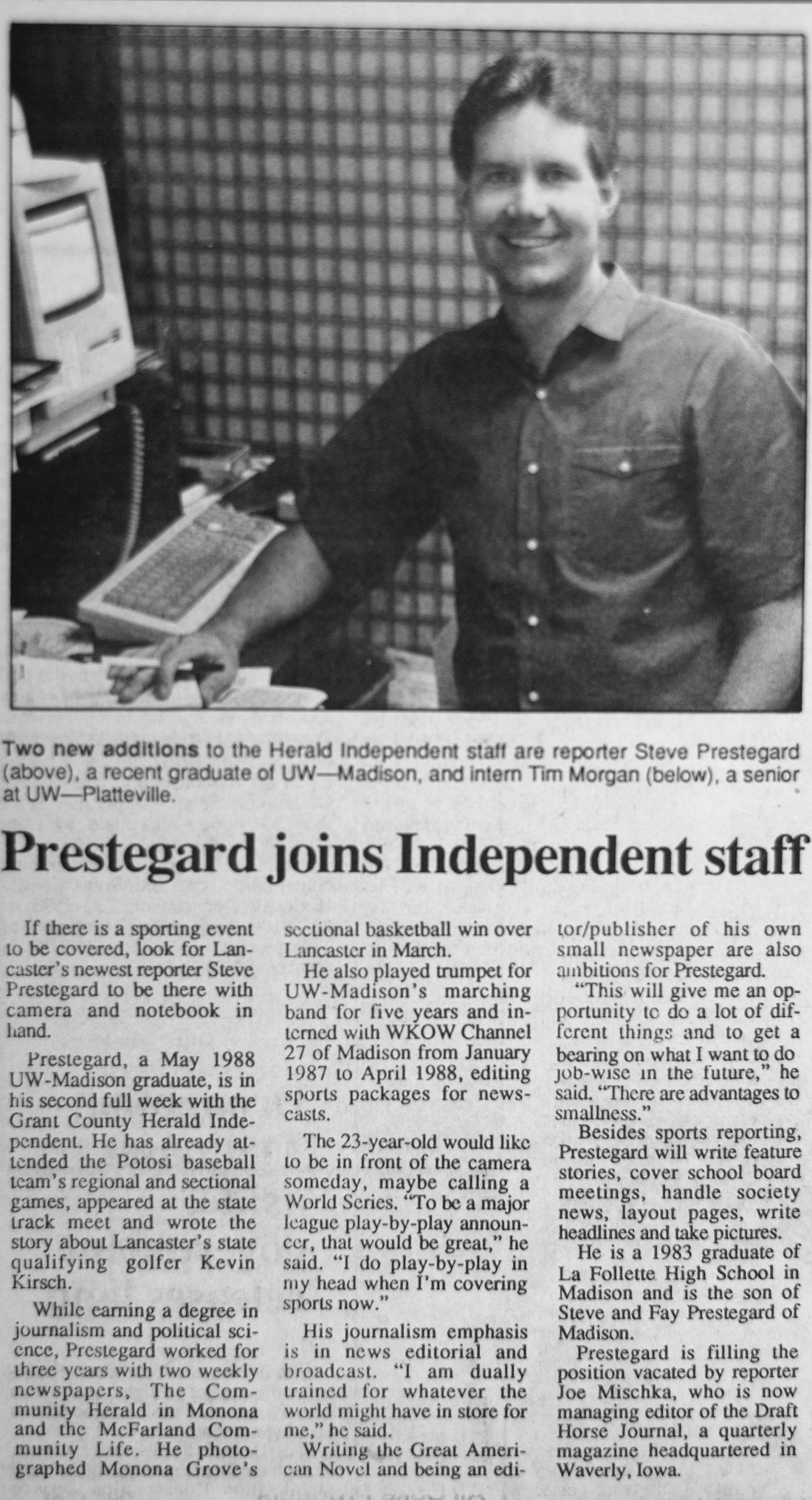
    • Adventures in ruralu0026nbsp;inkBack in June 2009, I was driving somewhere through a rural area. And for some reason, I had a flashback to two experiences in my career about that time of year many years ago. In 1988, eight days after graduating from the University of Wisconsin, I started work at the Grant County Herald Independent in Lancaster as a — well, the — reporter. Four years after that, on my 27th birthday, I purchased, with a business partner, the Tri-County Press in Cuba City, my first business venture. Both were experiences about which Wisconsin author Michael Perry might write. I thought about all this after reading a novel, The Deadline, written by a former newspaper editor and publisher. (Now who would write a novel about a weekly newspaper?) As a former newspaper owner, I picked at some of it — why finance a newspaper purchase through the bank if the seller is willing to finance it? Because the mean bank lender is a plot point! — and it is much more interesting than reality, but it is very well written, with a nicely twisting plot, and quite entertaining, again more so than reality. There is something about that first job out of college that makes you remember it perhaps more…
    • Adventures in radioI’ve been in the full-time work world half my life. For that same amount of time I’ve been broadcasting sports as a side interest, something I had wanted to since I started listening to games on radio and watching on TV, and then actually attending games. If you ask someone who’s worked in radio for some time about the late ’70s TV series “WKRP in Cincinnati,” most of them will tell you that, if anything, the series understated how wacky working in radio can be. Perhaps the funniest episode in the history of TV is the “WKRP” episode, based on a true story, about the fictional radio station’s Thanksgiving promotion — throwing live turkeys out of a helicopter under the mistaken belief that, in the words of WKRP owner Arthur Carlson, “As God is my witness, I thought turkeys could fly.” [youtube=http://www.youtube.com/watch?v=ST01bZJPuE0] I’ve never been involved in anything like that. I have announced games from the roofs of press boxes (once on a nice day, and once in 50-mph winds), from a Mississippi River bluff (more on that later), and from the front row of the second balcony of the University of Wisconsin Fieldhouse (great view, but not a place to go if…
    • “Good morning/afternoon/evening, ________ fans …”
    • My biggest storyEarlier this week, while looking for something else, I came upon some of my own work. (I’m going to write a blog someday called “Things I Found While Looking for Something Else.” This is not that blog.) The Grant County Sheriff’s Department, in the county where I used to live, has a tribute page to the two officers in county history who died in the line of duty. One is William Loud, a deputy marshal in Cassville, shot to death by two bank robbers in 1912. The other is Tom Reuter, a Grant County deputy sheriff who was shot to death at the end of his 4 p.m.-to-midnight shift March 18, 1990. Gregory Coulthard, then a 19-year-old farmhand, was convicted of first-degree intentional homicide and is serving a life sentence, with his first eligibility for parole on March 18, 2015, just 3½ years from now. I’ve written a lot over the years. I think this, from my first two years in the full-time journalism world, will go down as the story I remember the most. For journalists, big stories contain a paradox, which was pointed out in CBS-TV’s interview of Andy Rooney on his last “60 Minutes” Sunday. Morley Safer said something along the line…
  • Food and drink
    • The Roesch/Prestegard familyu0026nbsp;cookbookFrom the family cookbook(s) All the families I’m associated with love to eat, so it’s a good thing we enjoy cooking. The first out-of-my-house food memory I have is of my grandmother’s cooking for Christmas or other family occasions. According to my mother, my grandmother had a baked beans recipe that she would make for my mother. Unfortunately, the recipe seems to have  disappeared. Also unfortunately, my early days as a picky, though voluminous, eater meant I missed a lot of those recipes made from such wholesome ingredients as lard and meat fat. I particularly remember a couple of meals that involve my family. The day of Super Bowl XXXI, my parents, my brother, my aunt and uncle and a group of their friends got together to share lots of food and cheer on the Packers to their first NFL title in 29 years. (After which Jannan and I drove to Lambeau Field in the snow,  but that’s another story.) Then, on Dec. 31, 1999, my parents, my brother, my aunt and uncle and Jannan and I (along with Michael in utero) had a one-course-per-hour meal to appropriately end years beginning with the number 1. Unfortunately I can’t remember what we…
    • SkålI was the editor of Marketplace Magazine for 10 years. If I had to point to one thing that demonstrates improved quality of life since I came to Northeast Wisconsin in 1994, it would be … … the growth of breweries and  wineries in Northeast Wisconsin. The former of those two facts makes sense, given our heritage as a brewing state. The latter is less self-evident, since no one thinks of Wisconsin as having a good grape-growing climate. Some snobs claim that apple or cherry wines aren’t really wines at all. But one of the great facets of free enterprise is the opportunity to make your own choice of what food and drink to drink. (At least for now, though some wish to restrict our food and drink choices.) Wisconsin’s historically predominant ethnic group (and our family’s) is German. Our German ancestors did unfortunately bring large government and high taxes with them, but they also brought beer. Europeans brought wine with them, since they came from countries with poor-quality drinking water. Within 50 years of a wave of mid-19th-century German immigration, brewing had become the fifth largest industry in the U.S., according to Maureen Ogle, author of Ambitious Brew: The Story of American Beer. Beer and wine have…
  • Wheels
    • America’s sports carMy birthday in June dawned without a Chevrolet Corvette in front of my house. (The Corvette at the top of the page was featured at the 2007 Greater Milwaukee Auto Show. The copilot is my oldest son, Michael.) Which isn’t surprising. I have three young children, and I have a house with a one-car garage. (Then again, this would be more practical, though a blatant pluck-your-eyes-out violation of the Corvette ethos. Of course, so was this.) The reality is that I’m likely to be able to own a Corvette only if I get a visit from the Corvette Fairy, whose office is next door to the Easter Bunny. (I hope this isn’t foreshadowing: When I interviewed Dave Richter of Valley Corvette for a car enthusiast story in the late great Marketplace Magazine, he said that the most popular Corvette in most fans’ minds was a Corvette built during their days in high school. This would be a problem for me in that I graduated from high school in 1983, when no Corvette was built.) The Corvette is one of those cars whose existence may be difficult to understand within General Motors Corp. The Corvette is what is known as a “halo car,” a car that drives people into showrooms, even if…
    • Barges on fouru0026nbsp;wheelsI originally wrote this in September 2008.  At the Fox Cities Business Expo Tuesday, a Smart car was displayed at the United Way Fox Cities booth. I reported that I once owned a car into which trunk, I believe, the Smart could be placed, with the trunk lid shut. This is said car — a 1975 Chevrolet Caprice coupe (ours was dark red), whose doors are, I believe, longer than the entire Smart. The Caprice, built down Interstate 90 from us Madisonians in Janesville (a neighbor of ours who worked at the plant probably helped put it together) was the flagship of Chevy’s full-size fleet (which included the stripper Bel Air and middle-of-the-road Impala), featuring popular-for-the-time vinyl roofs, better sound insulation, an upgraded cloth interior, rear fender skirts and fancy Caprice badges. The Caprice was 18 feet 1 inch long and weighed 4,300 pounds. For comparison: The midsize Chevrolet of the ear was the Malibu, which was the same approximate size as the Caprice after its 1977 downsizing. The compact Chevrolet of the era was the Nova, which was 200 inches long — four inches longer than a current Cadillac STS. Wikipedia’s entry on the Caprice has this amusing sentence: “As fuel economy became a bigger priority among Americans…
    • Behind the wheel
    • Collecting only dust or rust
    • Coooooooooooupe!
    • Corvettes on the screen
    • The garage of misfit cars
    • 100 years (and one day) of our Chevrolets
    • They built Excitement, sort of, once in a while
    • A wagon by any otheru0026nbsp;nameFirst written in 2008. You will see more don’t-call-them-station-wagons as you drive today. Readers around my age have probably had some experience with a vehicle increasingly rare on the road — the station wagon. If you were a Boy Scout or Girl Scout, or were a member of some kind of youth athletic team, or had a large dog, or had relatives approximately your age, or had friends who needed to be transported somewhere, or had parents who occasionally had to haul (either in the back or in a trailer) more than what could be fit inside a car trunk, you (or, actually, your parents) were the target demographic for the station wagon. “Station wagons came to be like covered wagons — so much family activity happened in those cars,” said Tim Cleary, president of the American Station Wagon Owners Association, in Country Living magazine. Wagons “were used for everything from daily runs to the grocery store to long summer driving trips, and while many men and women might have wanted a fancier or sportier car, a station wagon was something they knew they needed for the family.” The “station wagon” originally was a vehicle with a covered seating area to take people between train stations…
    • Wheels on theu0026nbsp;screenBetween my former and current blogs, I wrote a lot about automobiles and TV and movies. Think of this post as killing two birds (Thunderbirds? Firebirds? Skylarks?) with one stone. Most movies and TV series view cars the same way most people view cars — as A-to-B transportation. (That’s not counting the movies or series where the car is the plot, like the haunted “Christine” or “Knight Rider” or the “Back to the Future” movies.) The philosophy here, of course, is that cars are not merely A-to-B transportation. Which disqualifies most police shows from what you’re about to read, even though I’ve watched more police video than anything else, because police cars are plain Jane vehicles. The highlight in a sense is in the beginning: The car chase in my favorite movie, “Bullitt,” featuring Steve McQueen’s 1968 Ford Mustang against the bad guys’ 1968 Dodge Charger: [youtube=http://www.youtube.com/watch?v=GMc2RdFuOxIu0026amp;fmt=18] One year before that (but I didn’t see this until we got Telemundo on cable a couple of years ago) was a movie called “Operación 67,” featuring (I kid you not) a masked professional wrestler, his unmasked sidekick, and some sort of secret agent plot. (Since I don’t know Spanish and it’s not…
    • While riding in my Cadillac …
  • Entertainments
    • Brass rocksThose who read my former blog last year at this time, or have read this blog over the past months, know that I am a big fan of the rock group Chicago. (Back when they were a rock group and not a singer of sappy ballads, that is.) Since rock music began from elements of country music, jazz and the blues, brass rock would seem a natural subgenre of rock music. A lot of ’50s musical acts had saxophone players, and some played with full orchestras … [youtube=http://www.youtube.com/watch?v=9CPS-WuUKUE] … but it wasn’t until the more-or-less simultaneous appearances of Chicago and Blood Sweat u0026amp; Tears on the musical scene (both groups formed in 1967, both had their first charting singles in 1969, and they had the same producer) that the usual guitar/bass/keyboard/drum grouping was augmented by one or more trumpets, a sax player and a trombone player. While Chicago is my favorite group (but you knew that already), the first brass rock song I remember hearing was BSu0026amp;T’s “Spinning Wheel” — not in its original form, but on “Sesame Street,” accompanied by, yes, a giant spinning wheel. [youtube=http://www.youtube.com/watch?v=qi9sLkyhhlE] [youtube=http://www.youtube.com/watch?v=OxWSOuNsN20] [youtube=http://www.youtube.com/watch?v=U9U34uPjz-g] I remember liking Chicago’s “Just You ‘n Me” when it was released as a single, and…
    • Drive and Eat au0026nbsp;RockThe first UW home football game of each season also is the opener for the University of Wisconsin Marching Band, the world’s finest college marching band. (How the UW Band has not gotten the Sudler Trophy, which is to honor the country’s premier college marching bands, is beyond my comprehension.) I know this because I am an alumnus of the UW Band. I played five years (in the last rank of the band, Rank 25, motto: “Where Men Are Tall and Run-On Is Short”), marching in 39 football games at Camp Randall Stadium, the Hubert H. Humphrey Metrodome in Minneapolis, Michigan Stadium in Ann Arbor, Memorial Stadium at the University of Illinois (worst artificial turf I had ever seen), the University of Nevada–Las Vegas’ Sam Boyd Silver Bowl, the former Dyche Stadium at Northwestern University, five high school fields and, in my one bowl game, Legion Field in Birmingham, Ala., site of the 1984 Hall of Fame Bowl. The UW Band was, without question, the most memorable experience of my college days, and one of the most meaningful experiences of my lifetime. It was the most physical experience of my lifetime, to be sure. Fifteen minutes into my first Registration…
    • Keep on rockin’ in the freeu0026nbsp;worldOne of my first ambitions in communications was to be a radio disc jockey, and to possibly reach the level of the greats I used to listen to from WLS radio in Chicago, which used to be one of the great 50,000-watt AM rock stations of the country, back when they still existed. (Those who are aficionados of that time in music and radio history enjoyed a trip to that wayback machine when WLS a Memorial Day Big 89 Rewind, excerpts of which can be found on their Web site.) My vision was to be WLS’ afternoon DJ, playing the best in rock music between 2 and 6, which meant I wouldn’t have to get up before the crack of dawn to do the morning show, yet have my nights free to do whatever glamorous things big-city DJs did. Then I learned about the realities of radio — low pay, long hours, zero job security — and though I have dabbled in radio sports, I’ve pretty much cured myself of the idea of working in radio, even if, to quote WAPL’s Len Nelson, “You come to work every day just like everybody else does, but we’re playing rock ’n’ roll songs, we’re cuttin’ up.…
    • Monday on the flight line, not Saturday in the park
    • Music to drive by
    • The rock ofu0026nbsp;WisconsinWikipedia begins its item “Music of Wisconsin” thusly: Wisconsin was settled largely by European immigrants in the late 19th century. This immigration led to the popularization of galops, schottisches, waltzes, and, especially, polkas. [youtube=http://www.youtube.com/watch?v=yl7wCczgNUc] So when I first sought to write a blog piece about rock musicians from Wisconsin, that seemed like a forlorn venture. Turned out it wasn’t, because when I first wrote about rock musicians from Wisconsin, so many of them that I hadn’t mentioned came up in the first few days that I had to write a second blog entry fixing the omissions of the first. This list is about rock music, so it will not include, for instance, Milwaukee native and Ripon College graduate Al Jarreau, who in addition to having recorded a boatload of music for the jazz and adult contemporary/easy listening fan, also recorded the theme music for the ’80s TV series “Moonlighting.” Nor will it include Milwaukee native Eric Benet, who was for a while known more for his former wife, Halle Berry, than for his music, which includes four number one singles on the Ru0026amp;B charts, “Spend My Life with You” with Tamia, “Hurricane,” “Pretty Baby” and “You’re the Only One.” Nor will it include Wisconsin’s sizable contributions to big…
    • Steve TV: All Steve, All the Time
    • “Super Steve, Man of Action!”
    • Too much TV
    • The worst music of allu0026nbsp;timeThe rock group Jefferson Airplane titled its first greatest-hits compilation “The Worst of Jefferson Airplane.” Rolling Stone magazine was not being ironic when it polled its readers to decide the 10 worst songs of the 1990s. I’m not sure I agree with all of Rolling Stone’s list, but that shouldn’t be surprising; such lists are meant for debate, after all. To determine the “worst,” songs appropriate for the “Vinyl from Hell” segment that used to be on a Madison FM rock station, requires some criteria, which does not include mere overexposure (for instance, “Macarena,” the video of which I find amusing since it looks like two bankers are singing it). Before we go on: Blog posts like this one require multimedia, so if you find a song you hate on this blog, I apologize. These are also songs that I almost never listen to because my sound system has a zero-tolerance policy — if I’m listening to the radio or a CD and I hear a song I don’t like, it’s, to quote Bad Company, gone gone gone. My blonde wife won’t be happy to read that one of her favorite ’90s songs, 4 Non Blondes’ “What’s Up,” starts the list. (However,…
    • “You have the right to remain silent …”
  • Madison
    • Blasts from the Madison media past
    • Blasts from my Madison past
    • Blasts from our Madison past
    • What’s the matter with Madison?
    • Wisconsin – Madison = ?
  • Sports
    • Athletic aesthetics, or “cardinal” vs. “Big Red”
    • Choose your own announcer
    • La Follette state 1982 (u0022It was 30 years ago todayu0022)
    • The North Dakota–Wisconsin Hockey Fight of 1982
    • Packers vs. Brewers
  • Hall of Fame
    • The case(s) against teacher unions
    • The Class of 1983
    • A hairy subject, or face the face
    • It’s worse than you think
    • It’s worse than you think, 2010–11 edition
    • My favorite interview subject of all time
    • Oh look! Rural people!
    • Prestegard for president!
    • Unions vs. the facts, or Hiding in plain sight
    • When rhetoric goes too far
Privacy & Cookies: This site uses cookies. By continuing to use this website, you agree to their use.
To find out more, including how to control cookies, see here: Cookie Policy
 

Loading Comments...
 

    • Subscribe Subscribed
      • Steve Prestegard.com: The Presteblog
      • Join 198 other subscribers
      • Already have a WordPress.com account? Log in now.
      • Steve Prestegard.com: The Presteblog
      • Subscribe Subscribed
      • Sign up
      • Log in
      • Report this content
      • View site in Reader
      • Manage subscriptions
      • Collapse this bar
    %d