We begin with our National Anthem, which officially became our National Anthem today in 1931:
No comments on Presty the DJ for July 28
We begin with our National Anthem, which officially became our National Anthem today in 1931:
Apparently this is Discovery Channel’s Shark Week. (No, I’m not watching.)
Andy Bolig writes about different kinds of sharks:
It’s easy to look at something and say whether or not you like it and why, but to create something from nothing that will have lasting, world-wide appeal is a gift given to a rare few. When speaking about Corvettes, there are several names that constantly rise to the surface as undoubtedly having that gift.
In the late-50s and early 60s, designing a car was laid squarely on the shoulders of those who wielded a pen and paper. Their thoughts and souls flowed upon the canvas, and without any assistance from computers or electronics, they fostered designs that inspired generations. Gentlemen such as Bill Mitchell and Larry Shinoda came together to bear prototypes that would lead Corvette for generations and capture the hearts and minds of enthusiasts to this day.
Bill Mitchell took over the styling department when Harley Earl retired. At the time, styling made the rules, which put Bill high atop the food chain at GM.
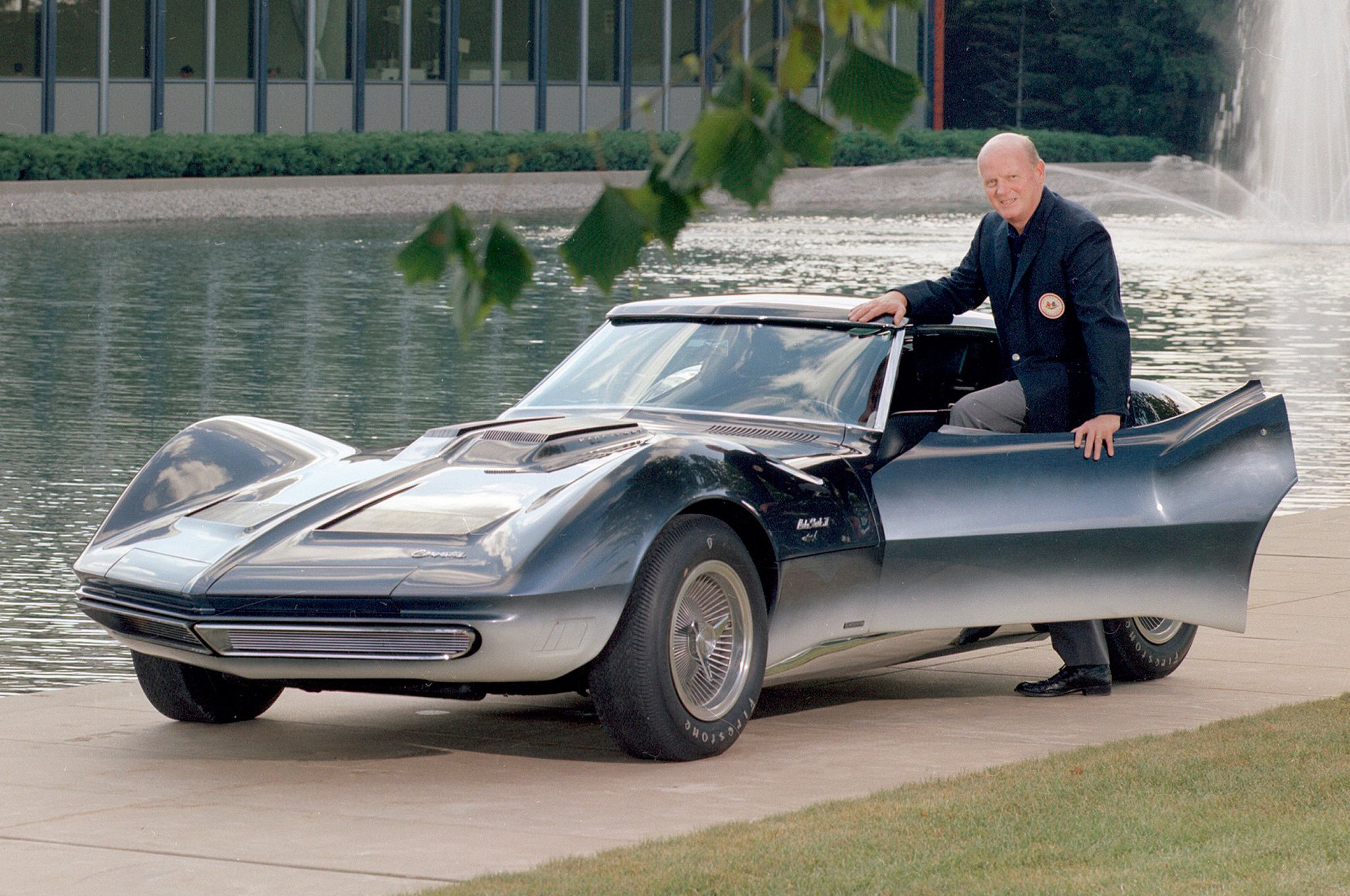
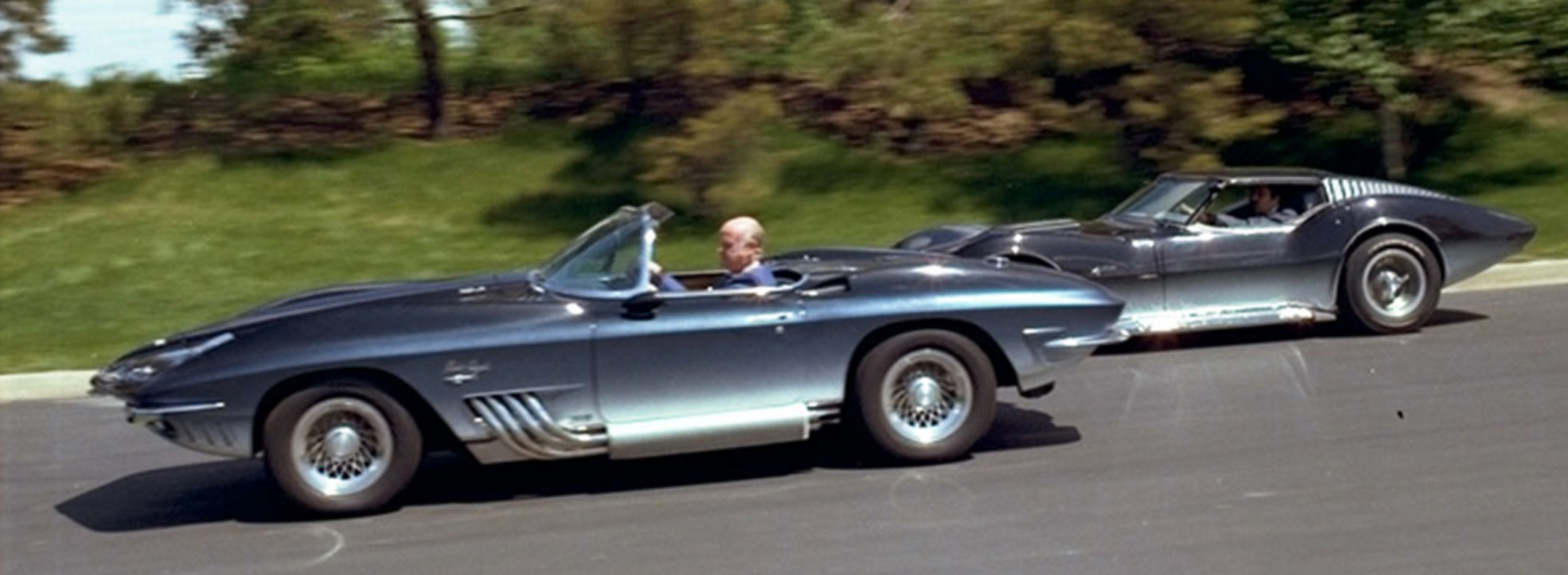
Two cars that exemplify this are the “Mako Sharks”, a duo of forward-looking vehicles that used technologies of the day to inspire and captivate enthusiasts with their futuristic design and styling. The basis for these cars, of which they both were dutifully named, has its roots in Bill Mitchell’s love for deep sea fishing, and the shark that he reportedly caught while on one such endeavor.
Bill enjoyed deep-sea fishing and cars he designed had a definite connection to the sport.
In The Beginning
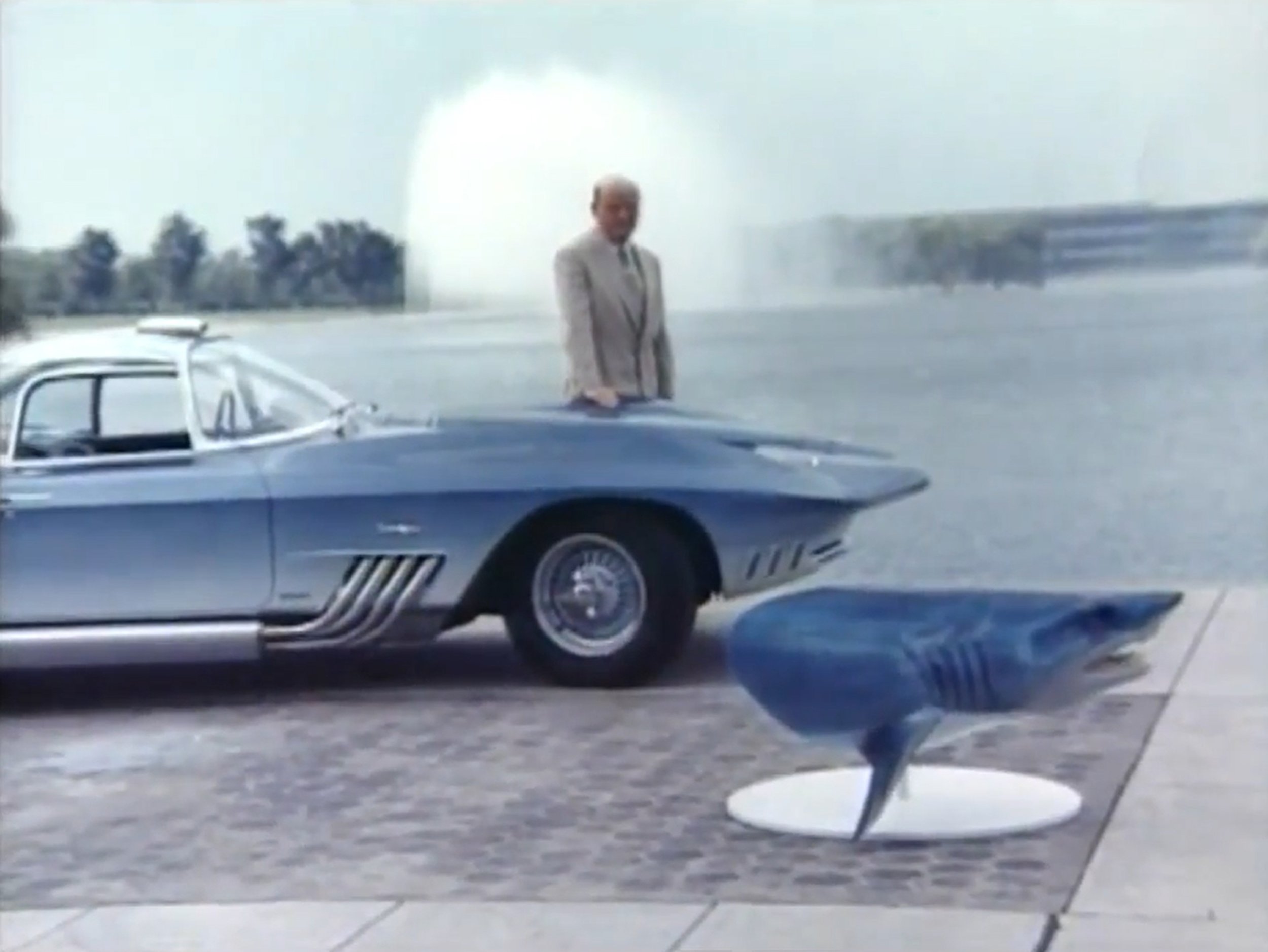
Larry Shinoda reported in an interview on more than one occasion how Mr. Mitchell caught a shark and was so enthralled in the color and shape of the animal that he used it as the design basis for the cars. He wanted to create a car that had the same appearance of speed and agility, as well as the ability. Of course, no other platform provided such a solid starting point as Corvette.
Larry Shinoda worked under Bill Mitchell and was responsible for many of the designs that rolled out of the styling department at GM. He recalls that when the paint team couldn’t match the colors of the shark that Mr. Mitchell had above his desk, they simply “borrowed” the shark and re-painted it to match the car!
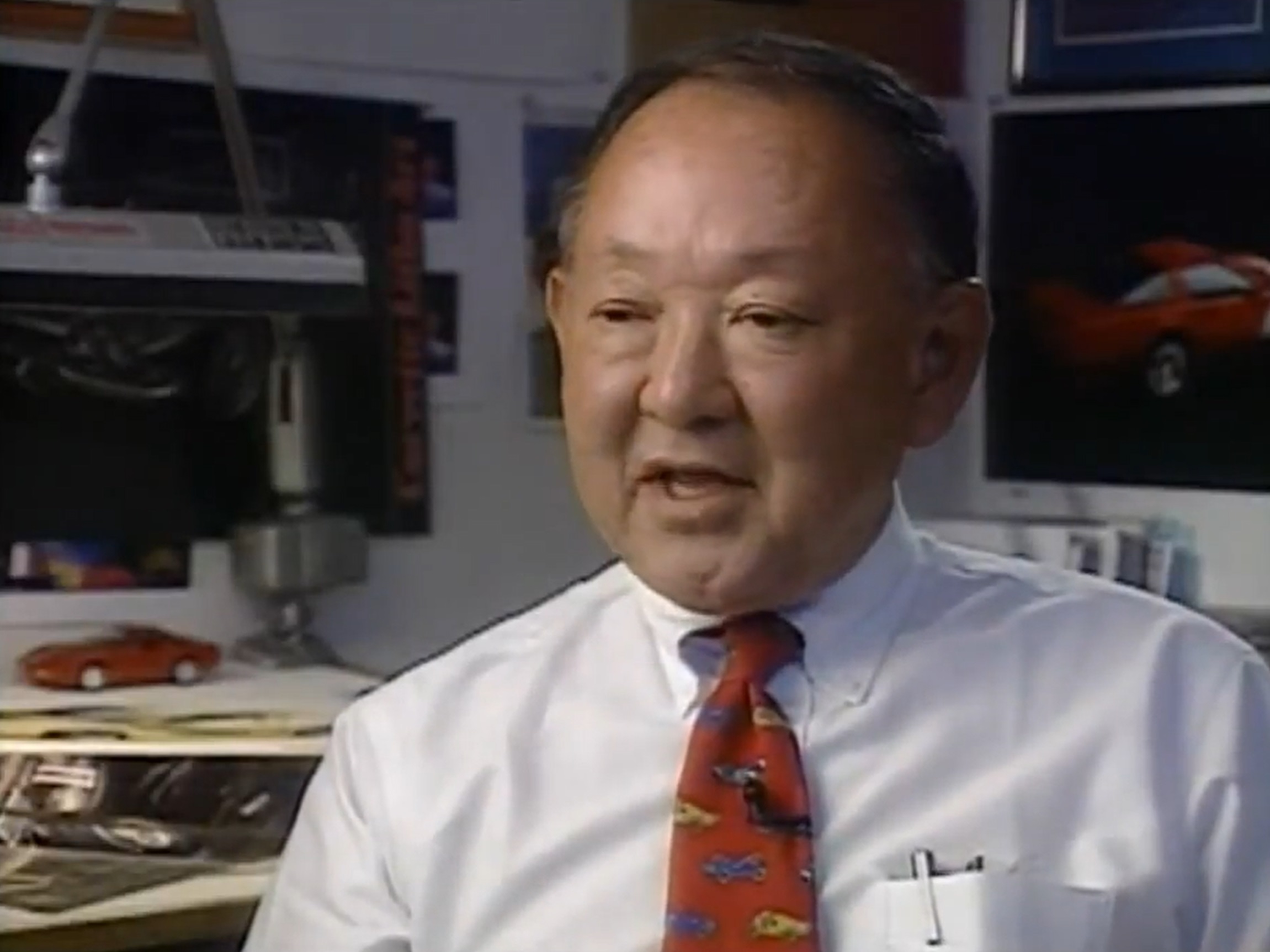
In an interview with Wayne Ellwood, Corvette Designer Larry Shinoda once explained how the Mako Shark came about. The design work for the new-for-1963 Corvette was completed by 1962, and Chevrolet wanted something to help promote the new car. Larry was ordered to do some sketches that would build excitement for the new offering using cues from the new car, as well as taking some styling license with the design. After several designs, the final result was XP-755, the Mako Shark as we know it.
The first Mako Shark was as much a styling car as it was a driver. Reportedly, Bill Mitchell had as many as 50 cars specially built for his use during his tenure as design chief.
Even if anyone had seen the new 1963 Sting Ray Corvettes, they hadn’t seen anything like the Mako Shark! It’s pointy nose, flowing lines and a paint scheme that flowed from shark-skin blue to silver underneath were undeniable cues to the feared predator that shared its name.
Mako Shark II
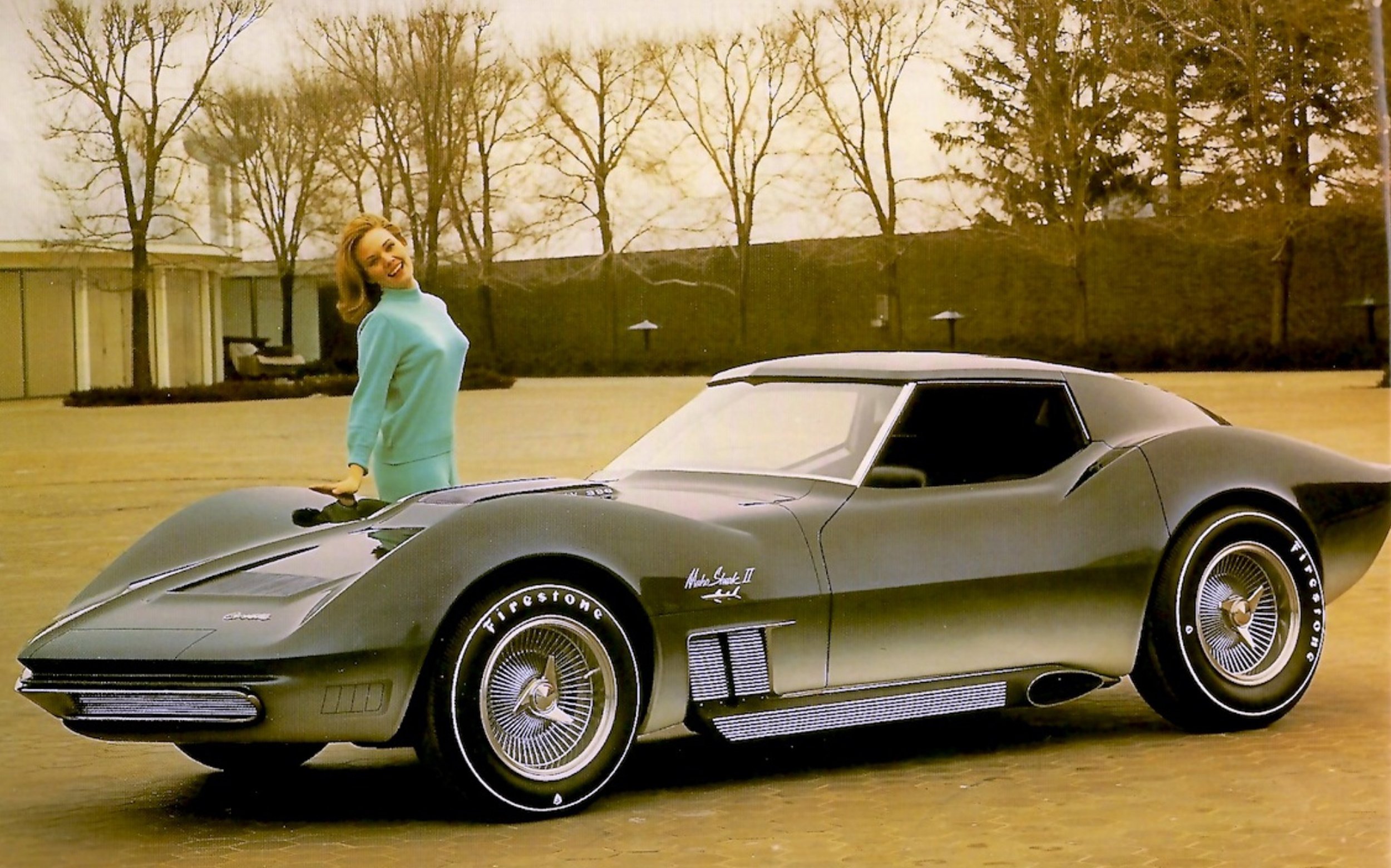
Just three years later, Chevrolet churned out the next chapter in their Mako-based Corvettes. There is some confusion surrounding this car, partly due to its transformation as it would adjust to responses that it garnered while travelling the show circuit. In fact, there are three iterations of this stylized icon; the first being a non-powered styling exercise, then a drivable version carrying the same name. Lastly, the car was updated with a revised roof line that featured a mail-slot opening as a rear window and the movable rear louvers were removed. The car was also upgraded with the new ZL-1, all-aluminum 427 engine and was now known as the Manta Ray.
In its original configuration, the Mako Shark II was a “pusher”, wearing stylized side pipes and unable to move under its own power. It DID make for a great photo though!
The Mako Shark II was first introduced to the public in 1965, at the New York International Auto Show of that year. As such, it was unmistakably all Bill Mitchell. The “coke-bottle” shape was the brain-child of Mr. Mitchell and reportedly, vexed Corvette’s Chief Engineer, Zora Duntov greatly. That is, until Zora was testing the pre-production 1968 Stingray on GM’s high-speed test track and had a tire failure. Resting the car against the wall at speed until it stopped, the concrete barrier ground the wider wheel housings down until they were even with the narrow waistline of the rest of the car’s body. Reportedly, Zora exited the car and said, “Ah, bulges SAVE Zora!”
More than simply a styling car, the Mako Shark II encompassed features that wouldn’t be seen on production cars for decades, and some that have yet to be realized. The hidden wipers made it into production quickly on the ’68 Corvette, but items like the adjustable pedals are just making it onto production lines. Other items like the motorized rear louvers never really took hold, and the pop up taillights (in Manta Ray trim), and rear spoiler may have missed their moment, or we just haven’t realized how much we need them – yet. Time will tell.
In it’s first iteration, the Mako Shark II was not intended to be driven as much as it was a styling exercise to gauge public opinion on various ideas. In this form, the car can be seen with side-pipes akin to those used on several earlier styling cars, such as the World’s Fair ’64 Corvette. As Chevrolet designers gained insight into what the public wanted to see, the car changed to a rear-exiting exhaust, albeit in stylized form.
Other changes to the car throughout the year included a more standardized round steering wheel that replace the squared-off version it originally had, and the car, originally equipped with a Mark IV (396ci) engine later received the all-aluminum ZL-1. By the time the Mako Shark II made its appearance at the Paris Auto Show in October of ’65, it was a runner.
Even with the various changes, the Mako Shark cars have proven the lasting, timeless virtue of good design. We would have to look long and hard to find another example of styling cars of that era that have made such an impact or have withstood the test of time.
Most Corvette fans acknowledge that the C2, inspired by the Mako Shark, was a better car than the C1. Corvette fans have been split on the C3, inspired by Mako Shark II, given that it was bigger outside but smaller inside than the C2 it replaced, and had rather useless storage space. (Not that the C2’s was better, since it was not a hatchback either.)
I’ve never mentioned this before now, but I once owned a Mako Shark.



It went as fast as I could push it.
Today in 1977, John Lennon did not get instant karma, but he did get a green card to become a permanent resident, five years after the federal government (that is, Richard Nixon) sought to deport him. So can you imagine who played mind games on whom?
Mitch Daniels was never going to be president. Too bad.
There was a brief boomlet around the former Indiana governor before the 2012 election, but people quickly found out who he really was: Daniels was too boring, too wonky, too level-headed, too focused on fiscal policy, too unwilling to fight the culture wars. And as some observers noted, he was short.
He was, in other words, too competent and too sensible for a political office that, especially now, could benefit from some competence and common sense.
Since leaving the governor’s office, Daniels has stepped away from politics and taken the top job at Purdue University, which, as George Will wrote in 2016, now has the president the entire country should.
As president of Purdue, Daniels has preached the virtues of hard work and self-determination. He has also put the university itself on excellent footing. Since Daniels took the job in 2013, tuition has been frozen. Accounting for inflation, the Ohio University economist Richard Vedder estimates that the effect is something like a 10 percent reduction in tuition, even as costs at other universities have soared.
The school has also created an unusual financing mechanism called an Income Share Agreement. Under this system, the school contributes a portion of the tuition fees in exchange for a small cut of the student’s post-graduation income, treating students, essentially, as investments. In other words, it makes the school more affordable and accessible to the student body while creating a revenue stream for the institution.
Vedder notes that the school has also started making and selling one of the most important elements of the college experience in-house: beer.
Boiler Gold American Golden Ale is the first beer developed by Purdue, quickly selling out at this year’s first football game. As President Daniels has explained to me, Purdue has a rich agricultural tradition, and beer is an agricultural product—I believe the hops are grown nearby under Purdue’s direction. Purdue has a Hops and Brewing Analysis Lab, a School of Food Science, and so forth.
Improving the productivity and utility of agriculture was a core mission of schools like Purdue created out of the 1862 Morrill Act. Money made from beer sales is supporting agricultural research (as well as Purdue athletics). Research into developing craft beers has led to a partnership with an alumnus who does the actual brewing for Purdue.
Although he has focused on running the university, Daniels hasn’t gone completely silent on national political issues. In an op-ed for The Washington Post [Tuesday], Daniels tackles state-level budget problems, arguing against a federal rescue plan:
Sooner or later, we can anticipate pleas for nationalization of these impossible obligations. Get ready for the siren sounds of sophistry, in arguments for subsidy of the poor by the prudent.
In fact, this balloon was already floated once, during the crunch of the recent recession. In 2009, California politicians called for a “dynamic partnership” with the federal government. Money from other states, they said, would be an “investment” and certainly not a bailout. They didn’t succeed directly, although they walked away with $8 billion of federally borrowed “stimulus” money. Such a heist will be harder to justify in the absence of a national economic emergency.
In the blizzard of euphemisms, one can expect a clever argument might appear, likening the bailout to another important compromise of the founding period: the assumption of state debts by the new federal government. But that won’t wash. Those were debts incurred in a battle for survival and independence common to all 13 colonies, not an attempt to socialize away the consequences of individual states’ multi-decade spending sprees.
[Tuesday], President Donald Trump announced plans to spend $12 billion bailing out businesses harmed by the trade war he started. The contrast is revealing—and more than a little depressing.
As a national politician, Daniels might not have been as exciting or charismatic as some of his competitors (although he was plenty appealing, in an understated way). He might not have tweeted, and if he did, it probably would have been about things like the congressional budget process or the federal deficit. He might have had a domestic policy agenda beyond deficit-financed tax cuts and bipartisan spending deals. I doubt that Daniels, whose personality is defined by a gentle Midwestern reserve, would have started a pointless, unwinnable trade war predicated on proving personal dominance over America’s international rivals.
Which is to say, he almost certainly would not have treated the Oval Office as the set of political reality show on which he was the star. He probably wouldn’t have sparked very many internet flame wars, and the ones he did prompt probably would have been relatively low-heat. But he would have been good at the job of being president—at the nuts and bolts of information gathering and decision making and operational efficiency and level-headed communication about policy decisions.
I’m glad Mitch Daniels is president of Purdue, where he appears to be making a real difference in showing a path forward for public higher ed. But I wish that American voters had been more interested in giving him a bigger job, and every now and then I find myself wistfully imagining what a Daniels presidency might have been like. He’ll never be president of the United States, but he’ll always be president of my heart.
There were other issues beyond Daniels’ disinterest in the job. (Arguably, as someone once put it, anyone who wants to be president is unqualified to, or should not, be president.) Cultural conservatives would have tsk-tsked at Daniels’ being divorced from his wife, even though they remarried. (Reportedly that’s why he decided not to run. Whether that matters anymore in an era where the major parties nominate, a thrice-married candidate and a candidate Married In Name Only is up to the reader to decide.) In terms of buzz (which is blamed on the media, but the media does what its viewers/listeners/readers and advertisers generally want), how could Daniels compete against Donald Trump and Hillary Clinton? If Americans were OK with boring candidates who focused on the deficit, we could have had Paul Tsongas as president in 1992 instead of Slick Willie.
Today in 1965, the Rolling Stones were to release “Beggar’s Banquet,” except that the record label decided that the original cover …

… was inappropriate, and substituted …

… angering one member of the band on his birthday.
The number one single …
… and album today in 1975:
Robert Gebelhoff of and in the Washington Post:
Nowadays, if you want to be an incompetent — or even corrupt — elected official, there’s a place for you to work where the risk of facing recourse is fast getting smaller: local government.
That’s because so few people are paying attention. Not only has voter participation in local elections fallen to dangerously low levels, but the health of local newspapers, traditional watchdogs for the most direct and abundant form of government in the United States, has also been deteriorating.
This is a crisis for democracy in general. But politically speaking, the Republican Party — yes, the same party whose leader derides the media as “fake news” and “the enemy of the people” — should be particularly alarmed. Because if conservatives are concerned about keeping government as efficient and local as possible, they need the hundreds of local newspapers to make the system work across the country.
Researchers have illuminated a sort of symbiotic relationship between local papers and the governments they cover. The governments provide papers with content to fill their pages; the papers, in turn, offer a healthy level accountability and make information more accessible among the electorate. If a newspaper is suddenly forced to close due to economic forces — for example, if competition from online advertising sites suddenly dries up its revenue — the government, too, becomes sick.
This isn’t just theoretical; it translates to hard dollars and cents, as illustrated by a new paper, presented this week at the Brookings Institution’s Municipal Finance Conference.
The paper, which is in the process of being peer-reviewed, looked at newspaper closures between 1996 and 2015 and found that once a newspaper goes under, it becomes more expensive in the long run for its local government to borrow money. In the three years following a closure, the study found, municipal borrowing costs for counties where newspapers closed increased by .05 to .11 percentage points. That might not sound like a lot, but when we’re talking about borrowing millions of dollars, it’s nothing to sneeze at.
Authors of the paper theorize that this is the result of less information being publicly available, resulting in poorer-quality governance. And as a result, local investors in such communities are more likely to see municipal bonds as risky, driving up interest rates.
Before you say “correlation is not causation,” consider the strong evidence that the link between newspaper closures and higher borrowing costs is causal. First, the authors compared counties where newspapers closed to neighboring counties with operating newspapers. On average, the counties where newspapers folded had bond yields that were .07 percentage points higher.
The effect was also dependent on the number of papers covering a government. Counties with multiple papers saw no significant effect if one of their papers went under. But counties with only one paper that closed did.
In fact, the authors were able to track this effect on rising borrowing costs with the expansion of Craigslist. The advertising website, which drained local newspapers of revenue from classified ads, was gradually rolled out across the country over time. They found that Craigslist-induced newspaper closures increased municipal bond yields by .04 to .06 percentage points.
All of this is to say that the health of local newspapers is intensely connected with government efficiency. And it’s not just bond markets. Newspaper closures are also linked to rising wages for government employees and to growing numbers of government employees per capita in a county. Other research shows that elected officials from areas with little local media coverage are less responsive to their constituents.
For conservatives who say they want as much government responsibility allocated to state and local governments as possible, these trends should be terrifying. We can only support a federalist political system if it is well oiled at each level, and local reporting is an invaluable grease for the machine to function.
There’s no easy solution to the decline of local newspapers. Market forces are fundamentally changing the media landscape, and it remains to be seen what will happen to small outlets that can’t so easily transition online. But one thing is for sure: The decline of the local free press is a threat to the decentralized system of government envisioned by the Founding Fathers.
That is an interesting study conclusion if it’s correct.
That study was reported last week. Earlier this week came this news reported by the New York Times:
The meeting lasted less than a minute. By the time it was over, reporters and editors at The Daily News, the brawny New York tabloid that was once the largest-circulation paper in the country, learned that the newsroom staff would be cut in half and that its editor in chief was out of a job.
In the hours that followed, journalists in various departments, from sports to metro, received formal notification that they had been laid off by Tronc, the media company based in Chicago that bought the paper last year.
“People were crying and hugging each other,” said Scott Widener, a researcher who had worked at The News since 1990. “I’ve dodged a lot bullets over the years, and I just couldn’t dodge this one.”
In its heyday, The News was a staple publication of the city’s working class, an elbows-out tabloid that thrived when it dug into crime and corruption. It served as a model for The Daily Planet, the paper that counted Clark Kent and Lois Lane among its reporters, and for the scrappy tabloid depicted in the 1994 movie “The Paper.”
With Tronc’s firing of more than 40 newsroom employees — including 25 of 34 sports journalists and most of the photo department — The News joins the ranks of walking-wounded papers at a time when readers have gravitated toward the quick-hit convenience of digital media.
Under Jim Rich, the editor who lost his job on Monday, The News positioned itself as an unapologetically liberal counterpuncher to Rupert Murdoch’s New York Post. Mr. Rich, who declined to comment for this article, transformed the front page — “the wood,” in tabloid parlance — into a venue for criticizing and often ridiculing President Trump.
Last Tuesday, The News commemorated the president’s appearance with President Vladimir V. Putin of Russia in Helsinki, Finland, with the headline “Open Treason.” Beneath the bold black letters was a cartoon of Mr. Trump holding hands with a shirtless Mr. Putin; with his other hand, Mr. Trump was firing a pistol at Uncle Sam’s head.
Hmmm. Ridiculing Trump. How has that worked out?
Tronc announced on Monday that Mr. Rich’s replacement would be Robert York, a media executive who has spent most of his career in San Diego. In 2016, Tronc named Mr. York the editor and publisher of The Morning Call, a newspaper owned by the company in Allentown, Pa.
The layoff did not come out of nowhere. The News has lost millions of dollars as it struggled to replace the revenue once reliably provided by the advertisements that fattened its papers and the readers whose morning routines included a stop at the newsstand.
“The web kind of changed the DNA of every paper,” said Joel Siegel, a former managing editor at The News who is now managing editor of the cable news channel NY1.
Grant Whitmore, an executive at Tronc, presided over the brief meeting, which took place shortly after 9 a.m. in the paper’s seventh-floor newsroom in Lower Manhattan. About 50 staff members were in attendance, a group that did not include Mr. Rich or Kristen Lee, the managing editor, who was also laid off.
Afterward, human resources workers delivered the bad news to employees, including the sports columnist John Harper, the arts reporter Joe Dziemianowicz and the City Hall reporter Erin Durkin.
“I firmly believe that today’s actions will position The Daily News for growth in the years ahead,” Mr. Whitmore said in a memo to the remaining staff members at the end of the day, “and I look forward to working with this group to capture the opportunities in front of us.” He added that Tronc remained “committed to print.” …
It is hard to fathom what the paper’s next issues will look like, given that the newsroom had shrunk significantly under its previous owner, Mortimer B. Zuckerman, the New York real estate developer and media mogul who bought the paper out of bankruptcy in 1993.
Ambitious projects like the series on New York Police Department’s abuse of eviction rules — for which The News shared a Pulitzer Prize with ProPublica in 2017 — would seem difficult to pull off with an even smaller staff. Sarah Ryley, the editor of the series, who left The News last year, said it had taken three years to complete because reporters and editors were stretched thin after the layoffs under Mr. Zuckerman.
“You used to go into the office and feel the energy,” said Frank Isola, a sports columnist at The News for nearly 25 years, who was among those laid off on Monday. “I’ve probably been in the office, I would say, maybe three times in the last three years. People tell me: ‘Don’t come in. It’s depressing.’”
Since Tronc bought the ailing tabloid from Mr. Zuckerman in September 2017 — for a reported $1; yes, one dollar — the company has been working to transform The News into something more digital.
“But we have not gone far enough,” the company said in a memo to the staff that announced its decision to reduce “the size of the editorial team by approximately 50 percent” and to shift its focus to breaking news.
Some News employees started packing last week, after the media newsletter Study Hall reported that the company planned to lay off a large portion of the staff.
Although daily print circulation had sunk to roughly 200,000, Mr. Rich breathed new life into the paper. During two stints as editor — a 13-month run that ended in 2016, and an encore that began in January — he regularly published front pages that captured the staccato energy of social media.
He was typically combative in a Twitter post on Monday: “If you hate democracy and think local governments should operate unchecked and in the dark, then today is a good day for you,” he wrote. Mr. Rich also dropped the Daily News affiliation from his Twitter bio. “Just a guy sitting at home watching journalism being choked into extinction,” it reads.
The News had a digital reach of 23 million, but it wasn’t enough. The challenge of wringing profits from page views has eluded much of the industry, and the paper proved unable to end its losing streak. According to securities filings, it lost $23.6 million in 2016. Since then, its business has continued to suffer.
In naming Mr. York as the replacement for Mr. Rich, Tronc is following a playbook that did not have success at The Los Angeles Times, when, in similar fashion, it gave the job of top editor to an outsider with a business background.
Lewis D’Vorkin, an executive at Forbes Media who specialized in broadening the company’s native-advertising offerings, was Tronc’s choice for the Los Angeles job. The newsroom greeted his appointment with skepticism, and Mr. D’Vorkin lasted two months in the role. After tensions between the newsroom employees and Tronc continued, the company sold the paper to Dr. Patrick Soon-Shiong in February for $500 million.
The longtime home of the columnists Jimmy Breslin, Dick Young and Liz Smith and the cartoonist Bill Gallo, The News reveled in its role as the voice of the average citizen. Etched into the stone above the entrance of its former home, the Daily News Building on East 42nd Street, is a phrase attributed to Abraham Lincoln: “God must have loved the common man, he made so many of them.”
“You used to see everybody reading the newspaper on the subway,” said Michael Daly, a onetime News columnist who now writes for The Daily Beast. “The News was the right size. It was the perfect size for the biggest city.”
“You used to see everybody reading the newspaper on the subway,” said Michael Daly, a onetime News columnist who now writes for The Daily Beast. “The News was the right size. It was the perfect size for the biggest city.”
One of its most famous headlines — “Ford to City: Drop Dead,” from 1975 — summed up President Gerald R. Ford’s refusal to send federal aid to a city on the verge of bankruptcy. Ford later said the headline had played a role in his losing the 1976 presidential election.
The News, winner of 11 Pulitzers in its 99-year history, underwent a crisis when 10 unions walked off the job in 1990. The Tribune Company, its owner since its founding in 1919, threw the paper into bankruptcy at the end of the long strike — and the man who rescued it, the British mogul Robert Maxwell, became tabloid fodder himself when his body was found floating near his yacht soon after he entered the New York media fray.
Mr. Zuckerman took control in 1993, but times were hard, even then, well before digital media threatened the business model that had produced newspaper barons, star columnists and city reporters with steady paychecks. Before rolling out the first issue under his ownership, Mr. Zuckerman laid off 170 employees. It was a sign of layoffs to come, as a bustling newsroom morphed into a workplace populated with a bare-bones staff of fewer than 100 on his watch.
You will not believe! what the Washington Examiner reports what happened next:
New York Gov. Andrew Cuomo, a Democrat, said he would put state resources behind the New York Daily News if it will help curb mass layoffs that reportedly just hit the left-leaning tabloid’s newsroom.
Cuomo said in a statement Monday that the state “stands ready to help” after the New York Times reported that the tabloid’s reporting staff would be reduced by about half.
“The Daily News, now owned by Tronc, Inc., is apparently firing a major portion of their reporting staff,” he said. “This will undoubtedly devastate many households and hurt an important New York institution and one of our nation’s journalism giants. These layoffs were made without notifying the state or asking for assistance.”

I was unaware that Mario Cuomo had bailed out the Post. That was a horrible idea, and bailing out a media outlet with government money is a hideous idea.
Little Cuomo’s tweet provoked these responses:
Exactly.
This week, The Washington Post published an op-ed headlined “It’s not wrong to compare Trump’s America to the Holocaust.” As with similar examples of this genre, it’s a sickening display of moral relativism that belittles the suffering and murder of millions in the service of some shortsighted and crass partisan fearmongering.
Elsewhere, Politico published an opinion piece headlined “Putin’s Attack on the U.S. Is Our Pearl Harbor,” which demeaned the sacrifice of American service members by likening a military attack on American soil that brought us into the bloodiest war mankind has ever experienced to phishing.
On MSNBC, where illiterate histrionic analogies litter coverage every day, a contributor compared Donald Trump’s meeting in Helsinki with Vladimir Putin to Pearl Harbor and Kristallnacht, just to be safe.
Social media are teeming with similar hyperbole—”treason,” “traitor,” etc.—and not just from anonymous trolls. It’s difficult to accept that people with working brains actually believe this rhetoric, and they certainly don’t act like it. But if well-heeled pundits keep telling everyone the Fourth Reich is imminent before retiring to their town houses in D.C. every night, some people may actually start believing them. And if phishing and hacking are truly comparable to Pearl Harbor or Kristallnacht or the Holocaust, there’s really no reason those accepting these analogies shouldn’t also support military reprisals abroad and a coup at home.
Defenders of this hyperbole often claim that they’re not making an exact equivalence to the lives lost but rather speaking to the intent of all those attackers. All such attacks, they say, are intended to destabilize “our democracy.” Well, yes. But one aspect of similarity doesn’t make the events comparable. It would be like saying Iran’s spying on the United States—spying that resulted in our military technology’s being sold to China—was comparable to 9/11 because both sets of attackers intended to harm our democracy. If this were so, it would be treasonous to make peace with these nations and completely rational to wage war. Surely, we can find less feverish analogies.
Russia attempted to meddle in our domestic affairs, and there should be retribution and condemnation for those efforts. But our electoral system was not undermined. It withstood, as it has for many decades, Russian attempts to mess with institutions. The reaction to those hacking efforts, on the other hand, does no favors to democracy, and it certainly does no favors to Democrats who are suddenly horrified by the Putin threat.
You may remember how liberals lectured Americans after 9/11 about appropriate ways to deal with terrorists. For the most part, it amounted to saying, “Don’t kill them! That’s exactly what they want!” Well, it’s certain that this is what Putin wants. Few things destabilize democracy more than imbuing a foreign strongman from a second-rate power with the imaginary capability of deciding our elections.
Nor is Trump’s ham-fisted, misguided, and transparent Putin-coddling tantamount to sedition. For a number of reasons—including an inability or refusal to make any distinction between Russian “meddling” and attacks on the legitimacy of his election, a trait shared by many of Trump’s detractors—the president is a fan of Putin’s. Even though his administration has been tougher on Russia in many respects than the previous ones, there’s no way around the fact that the president admires strongmen.
That doesn’t make his foreign policy position an act of treason, any more than it was treason for Barack Obama to coddle the Iranians—even though the former president sided with Iran (and Hezbollah) over American law enforcement. Democrats’ hysterics make it impossible for many people to even concede that they have a point to make.
Since Trump met with Putin in Helsinki, many Republicans, including the speaker of the House and the Senate majority leader, have come out in support of the intelligence community’s assessment of Russian meddling, weakening the argument that the GOP always walks in lockstep behind the president.
There could even have been some consensus in Washington over how to move forward. Instead, we had elected Democrats spinning melodramatic political fairy tales about the Russkies controlling the GOP, about the need to start a coup and about the presence of kompromat. Earlier this week, an army of blue checkmarks was retweeting and oohing and aahing over an erroneous report about how a Russian spy had infiltrated the Oval Office, simply because the woman in question had red hair and looked vaguely similar to an accused spy.
Today in 1964, the Beatles’ “A Hard Day’s Night” hit number one and stayed there for 14 weeks:
Today in 1973, George Harrison got a visit from the taxman, who told him he owed £1 million in taxes on his 1973 Bangladesh album and concert:
Facebook Friend Tim Nerenz:
Everybody has had their say about what Trump said in Helsinki, including Trump himself. I don’t care about that; I want to talk about what Putin said in Helsinki, which seems to have sailed right over the heads of Ken and Barbie press posers who look good in clothes and read virtuous words for lots of money. The Putin story is much better.
Trump was weird from the opening bell; all amped up about the DNC servers for no apparent reason. But Putin was on it; steady and focused like a pointer pinning a quail with a stare. Granted he has a dozen years of practice at these events, but my own decades of doing deals and watching deal-masters told me instinctively to pay close attention, and the boy did not disappoint.
After Mueller dropped his turd in the Helsinki punch bowl with his second round of non-prosecutable indictments a couple days prior, Putin responded with his kind offer of co-operation under a 1999 Treaty that none of us knew existed and then pulls the pin and throws the grenade of a charge that U.S. intelligence officials aided an international tax fugitive in funneling $400 million to the Clinton campaign. Ba-bam! We can help each other investigate international interference in your elections, says Putin…ALL of it.
Wait, what? $400 million? Aided by our own intelligence officials? Browder is his name? And we are hearing this in now in 2018 not from any of our own watchdog news media? So I quickly Google Browder – sure enough, a real guy with Interpol warrants for massive tax evasion and global skullduggery. Not a phantom like Guccifer 2.0. Renounced his American citizenship and went to loot Russia after the collapse of the Soviet Union – foreigner who meddled in Maryland campaigns and paid to get federal legislation passed. Living in the UK. Seems like a well connected filthy-rich globalist sleaze ball, passes the Clinton orbit instant background check.
Bombshell of the century and the press does not bother ask a follow-up question – not the story they were sent there to write. Somebody please Make Journalism Great Again.
That was not Donald Trump talking – the fellow on the left with all the hair who is prone to hyberbolic off-script nonsense. That was Vlad the Impaler, the most disciplined public figure on the planet, who does not utter a syllable that is unplanned or un-purposed. He used complete sentences and his charges were specific and he waited to make them until the entire world was watching. Cold, methodical, surgical.
I’ll see your 32 hackers and $200k in Facebook ads and raise you $400 million, the DNC, the heads of your own intelligence services, and the Clinton Foundation. Here’s a soccer ball, Deep State, it’s your move. The charges are so outrageous, so over the top, that no thinking person would make them unless they were in possession of some evidence to back them up. Say what you will about Putin – he is every bit of bad that you can imagine and worse – but he is not stupid and he is not reckless and that must mean….ruh-roh.
Which brings me to John Brennan, former head of CIA and chief hysteric in the aftermath of the Helsinki presser. He thinks Putin ordered the hack of the DNC, CF, Clinton campaign, and their network or fund-scrubbing operations, and this week he declared it an act of treason to fail to publicly believe him. And the same Trump-hating lefties who wanted to erase borders, shut down ICE, and let illegal aliens vote four days ago are suddenly right-wing uber-patriots ready to start WWIII to defend the honor of the CIA and protect election integrity from foreign interference. I pledge allegiance to the former head of the CIA, and to the shadow government for which he stands… Bizarro world.
Well, I’m no traitor, so I believe you, Mr. Brennan; I think you are right that Putin ordered the hacks that succeeded at DNC and other places run by incompetent nincompoops and I think he was behind the successful hacks at CIA under your watch, too. I think he told WikiLeaks what to release and what to hold back in 2016, and he is sitting on the good stuff, including the dirt on Browden, Clinton, and our American intel traitors. That would explain a lot.
That might be what he and Trump talked about for two hours that made Trump so excited about DNC servers and emails. Who knows? I certainly don’t, but Robert Mueller does and his response to Putin’s offer of cooperation over the next couple of weeks will be very telling.
James Wigderson first reported:
Wisconsin Republicans are hoping that an expensive dinner and reception for large GOP donors will bring unity to the U.S. Senate race after a divisive primary.
Sen. Ron Johnson (R-WI) and Sen. Cory Gardner (R-CO), chairman of the National Republican Senatorial Committee (NRSC), will be the guests of honor at a minimum donation $1000 per person event to support the eventual Republican nominee for Senate in Wisconsin. The “event chairs” are Diane Hendricks, a major Republican donor backing state Sen. Leah Vukmir (R-Brookfield), and Dick Uihlein, a major Republican donor backing Delafield business consultant Kevin Nicholson.
The dinner will be held on Friday, August 17 in Milwaukee, three days after the Republican primary for Senate. The winner of the Republican primary will face Sen. Tammy Baldwin (D-WI) in November.
This is not the first time an attempt has been made to achieve some sort of unity in the GOP ranks in what has been a divisive Senate primary between Vukmir and Nicholson. Earlier this year, Johnson and the Republican Party of Wisconsin sponsored a “unity pledge” that required both candidates to agree to support the eventual winner of the Republican primary and to respect the rules of the state Republican convention as it considered making an endorsement.
Vukmir won the party’s endorsement with nearly 72 percent of the vote at the convention in May. She has also gotten the endorsements of many major Republican Party leaders in Wisconsin, including Speaker of the House Paul Ryan (R-WI1), Rep. Jim Sensenbrenner (R-WI5), Rep. Sean Duffy (R-WI7) and Rep. Glenn Grothman (R-WI6).
Despite Vukmir receiving the party’s endorsement, Nicholson has continued to lead in fundraising and most polls, including the Marquette University Law School poll released on June 20.
The unity pledge has not prevented the two candidates or their supporters from criticizing each other. Especially their supporters.
In December, the national Club for Growth, an endorser of Nicholson backed by Uihlein, criticized Vukmir for supporting Gov. Scott Walker’s first budget after the passage of Act 10, claiming there was too much spending. This prompted angry denunciations of the organization from many Wisconsin conservatives and even Grover Norquist of Americans for Tax Reform.
A debate in April between Nicholson and Vukmir sponsored by Americans for Prosperity- Wisconsin remained free of personal attacks until the final moments when Vukmir said Republican voters should not trust “the unknown” when choosing their next senator.
Nicholson responded, saying she was clearly referring to him, and then accused “the Madison swamp” of losing a Wisconsin Supreme Court election. Nicholson also accused Vukmir of not respecting his military service as sufficient conservative credentials, which prompted a strong objection from Vukmir and a demand for an apology.
Both campaign’s surrogates have taken to the airwaves in recent days to attack the other candidate. Wisconsin Next PAC, funded by Hendricks, criticized Nicholson in an ad for things he said as president of the College Democrats about abortion and the party’s values. Club for Growth has an ad attacking Vukmir for evading an open records request, sending a letter to a judge on behalf of former state Rep. Bill Kramer (R-Waukesha) who was convicted of fourth-degree sexual assault, and voting to increase per diems for expenses for state legislators.
Republicans may be hoping that the fundraiser will prevent what happened in 2012 when former Governor Tommy Thompson won a three-way Republican primary but lacked the campaign funding to respond to Baldwin’s attacks.
The money raised by the fundraiser will go to the Win Wisconsin Fund, a joint fundraising venture of the Wisconsin Senate Nominee Fund, Republican Party of Wisconsin, and the NRSC. Money allocated to the Wisconsin Senate Nominee Fund from the fundraiser will go directly to the party’s nominee, while the remaining money will be spent on behalf of the party’s nominee by the other two campaign organizations.
The $1,000 per person is the low end of the fundraiser which just gets a person into the reception. For $5,000 or more, the organizers will place a couple’s name in the program, they’ll receive two tickets for the dinner and the reception, and there is a photo opportunity. The donor tiers climb higher from there to the “Host” level of $50,000 for a table of eight at the dinner and the reception, plus a photo opportunity.
George Mitchell added:
When Sen. Ron Johnson passes Sen. Tammy Baldwin in the corridors of the U.S. Senate, he likely understands the big smile on her face. Baldwin has to be pleased that her re-election chances are buoyed by the intra-party squabble between supporters of state Sen. Leah Vukmir (R-Brookfield) and Kevin Nicholson.
Not a minute too soon, Wisconsin’s senior senator has stepped in to organize a post-primary unity fundraiser featuring Diane Hendricks and Dick Uihlein. Hendricks sponsors a Super-PAC that supports Vukmir, while Uihlein is Nicholson’s primary patron.
Their joint attendance at the August 17 event is a reminder that (1) only one outcome matters to conservatives, namely, the November election of either Vukmir or Nicholson and (2) as in 2012, that outcome is threatened by the back-and-forth slings and arrows cast by supporters of GOP candidates.
Six years ago Baldwin was the main beneficiary of a three-way fight between Eric Hovde, former Rep. Mark Neumann, and former Governor Tommy Thompson. Thompson, the winner, emerged cash-poor and drained by a divisive primary. Baldwin, meanwhile accumulated a sizable treasury and entered the general election campaign largely unscathed by serious GOP attacks.
There were early signs that this year would produce a similar dynamic. With their eyes almost solely focused on winning the primary, supporters of both candidates challenged the core legitimacy of the other’s credentials.
In the case of Team Vukmir, it has been unable to get past Nicholson’s history as a Democrat. Clips of him speaking at the Democratic convention show exactly what? That his current views are not valid? That he’s not a “real” Republican?
And then there’s the Club for Growth. Instead of emphasizing Nicholson’s strengths, it unleashed laughable RINO attacks on Vukmir. Is this history repeating itself? In 2012 the Club poisoned the waters with attacks on Hovde and Thompson aimed at bolstering Neumann. In many respects, the Club owns Tammy Baldwin. She should name her Senate conference room in its honor if she wins a second term.
Kudos to Johnson for understanding the real stakes. Time will tell whether his leadership in forging unity will be sufficient.
Then Wigderson wrote:
I like a good meal just like anyone else, and I’m even willing to occasionally splurge on a really good meal at the right restaurant with the right chef. However, is there anyone who can’t get a photo with Nicholson or Vukmir for free right now? I’m betting they would love to pose with you at a county fair or Republican picnic near you, and somebody with the campaign will even take the picture. For $5,000, either the photo is being taken by the next Ansel Adams or the food had better be cooked by Emeril himself.
And don’t get me started on the $50,000 “host” level. For that kind of money, you should at least be allowed to keep the dining room table.
Needless to say it’s pretty unlikely I’ll be attending unless someone gives me a comp ticket or they pay me to park cars. And I’m guessing most of you won’t be attending, either. In fact, I doubt that I know very few people that can afford to attend.
I understand the need to fund the eventual winner of the GOP primary, and that’s what this is really about. They don’t want Vukmir or Nicholson to be caught without the money to run a campaign immediately following the primary. However, if the two billionaires are already promising to get along and support the other person’s chosen candidate if they win the primary, then are the braised hummingbird wings, foie gras and vin de pricey really necessary to seal the deal?
I’m reminded of Braveheart, when the Scottish nobles would cut a deal. The English would get concessions in the north, the Scottish nobles would get some lands in the south, and the peasants get to die if the negotiations break down.
Hendricks and Uihlein are spending money convincing the GOP peasantry that either Nicholson or Vukmir is the worst person in the world. And then, when the fighting is done, they’ll raise a glass and the peasants are supposed to go along with the new peace agreement. At least Marie Antoinette offered cake. (Yes, I know she’s French, not Scottish or English.)
So let me offer a suggestion. Instead of Japanese Wagyu steaks, sea urchin and caviar, how about serving brats, burgers and beer at a Waukesha County park? Have Nicholson and Vukmir work the grills and have the billionaires pour the beer? Charge ten bucks a head and invite, you know, the GOP voters that are being told how evil Nicholson and Vukmir really are every night on television. Let the Republican voters see for themselves that Nicholson and Vukmir are not secret clones of Joseph Stalin or Jane Fonda.
Who knows? The Republican Party might make a little money out of it and the voters might not be so easily swayed by the next round of scaremongering ads being paid for by a billionaire with a pet candidate.

 Steve Prestegard.com: The Presteblog