Speaking out about the unsubstantiated accusations of sexual misconduct launched against him, Supreme Court nominee Brett Kavanaugh told Fox News’ Martha MacCallum that he did not engage in sexual relations throughout his high school years and many years thereafter.
This flies in the face of the wild allegations of sexual misconduct, which all apparently happened when Mr. Kavanaugh was in high school and college. …
“We’re talking about allegations of sexual misconduct. I’ve never sexually assaulted anyone. I did not have sexual intercourse or anything close to sexual intercourse in high school or for many years thereafter. And the girls from the schools I went to and I were friends,” says Kavanaugh, sitting alongside his wife.
“So you’re saying through all these years that you were in question you were a virgin?” asks MacCallum.
The judge responds, “That’s correct.”
“Never had sexual intercourse with anyone in high school?” the Fox News host follows up.
“That’s correct,” Kavanaugh responds.
“And through what years in college, since we’re probing through your personal life here?” she asks.
“Many years, many years after,” he responds. “I’ll leave it at that, many years after.”
Kavanaugh and his accuser(s) reportedly will be testifying Thursday. I wonder if their testimony will get an R rating.
Regardless of that, someone should remind them that lying is a sin and perjury is a crime.
Well, maybe they won’t testify Thursday. Mediaite reports:
Dr. Christine Blasey Ford‘s legal team has sent a letter (which can be seen below via NBC’s Frank Thorp) to the Senate Judiciary Committee amid continuous negotiations ahead of Thursday’s scheduled hearing.
In the letter addressed to Sen. Judiciary Chairman Chuck Grassley (R-IA), Ford’s legal team cited Sen. Majority Leader’s Mitch McConnell’s (R-KY) speech on the Senate floor on Monday afternoon as “flatly inconsistent” to Grassley’s promise of a “fair and credible process.”
“In our view, the hiring of an unnamed ‘experienced sex crimes prosecutor’ as Mr. Davis described in his email, is contrary to the Majority’s repeated emphasis on the need for the Senate and this Committee’s members to fulfill their constitutional obligations,” attorney Michael Bromwich wrote. “It is also inconsistent with your stated wish to avoid a ‘circus,’ as well as Dr. Blasey Ford’s repeated requests through counsel that senators conduct the questioning. This is not a criminal trial for which the involvement of an experienced sex crimes prosecutor would be appropriate.”
Ford’s team requested the identity of the sex crimes prosecutors the Committee would invite to the hearing along with their resume.
The letter also blasts the the White House’s refusal to order an FBI investigation into Ford’s allegation.
“The hearing plan that Mr. Davis described does not appear designed to provide Dr. Blasey Ford with fair and respectful treatment,” Bromwich said.
Americans should be thankful not only for the rare genius that assembled in Philadelphia in 1787 to draft the Constitution, but for the unique circumstances under which they met.
Not all moments in time are ripe for founding a nation. Nor is every citizenry equally prepared to receive new modes and orders. The Founders’ time and generation presented just such an opportunity. Our time would not.
Earlier this month, University of Texas law professor Sanford Levinson wrote that “not enough people connect the dots … between our political dysfunctions and the sacred Constitution of 1787.”
What dysfunctions does he have in mind? President Donald Trump’s “near dictatorial powers with regard to mobilization of the American military, control of immigration, or the imposition of tariffs against one and all countries around the world.”
Levinson is not the only person questioning the wisdom of our constitutional design now that Trump occupies the White House. Weeks after the 2016 election, in which Trump won the Electoral College but lost the popular vote by a small margin, the editorial board of The New York Times demandedthat we replace our “antiquated system” of presidential selection and impose direct popular elections.
Similarly, after Republicans took control of the Senate, Jacobin’s Daniel Lazare advocated abolishing the upper chamber, which he contends “grossly marginalized” voters in states such as California and New York.
It is difficult to reason about the proper structure of government in the midst of partisan tumult. This is true of Republicans as well. Immediately after the 2016 election, Republican support for direct election of the president dropped from 54 percent to 19 percent.
Both Democrats and Republicans know what institutional arrangements benefit their side and, if given the opportunity, would rig the system in their favor.
Thankfully, party conflict at the time of the founding was virtually nonexistent, and factional strife was tamped down. According to James Madison, going through the crucible of the Revolutionary War bound the nation together and “repressed the passions most unfriendly to order and concord.”
The unity born of this great existential threat “stifled the ordinary diversity of opinions on great national questions.” Hence, “no spirit of party connected with the changes to be made.” So too did the near universal experience of the failures of the Articles of Confederation.
This national unity did not last long. George Washington was still in the White House when the battle lines were drawn between the Federalists led by Alexander Hamilton and the Democratic-Republicans led by Madison and Thomas Jefferson.
Had the Constitution been drafted only a few years later, these inchoate parties already might have become sufficiently developed to give a partisan taint to both the convention and ratification debates that would have followed.
The revolution not only tempered factionalism and forestalled partisanship, it also elevated a cadre of universally revered national figures capable of effectively championing the Constitution. As Madison writes, the war imbued the public with “enthusiastic confidence … in their public leaders”—men such as Washington, Hamilton, Ben Franklin, and Madison.
If not for the public reputations of these men, citizens may have been understandably hesitant to accept a wholly new and untested form of government. Leaving the familiar shores of the status quo is always a dangerous risk. But, with trusted captains at the helm, the nation was able to face down the fear of the unknown.
Imagine if a constitutional convention were held in a political climate more like our own. Would the public have “enthusiastic confidence” in their political leaders—the delegates to such a convention? There is no public figure that enjoys the sort of near-universal public adoration that Washington did at the time of the founding. Collectively, our national politicians are less trusted than at any point since the beginning of scientific public opinion polling.
Trust in politicians is particularly low today, but political figures rarely enjoy widespread, bipartisan support. Even when politicians lead the nation through great existential threats, goodwill tends to evaporate very quickly—just ask former President George W. Bush.
Even the reputations of our Founding Fathers eventually were sullied as the revolutionary unity dissolved into partisan rancor. The election of 1800, which pitted Jefferson against John Adams, was famously vicious.
Adams’ supporters publicly claimed that Jefferson’s election would usher in an epoch during which “murder, robbery, rape, adultery, and incest will be openly taught and practiced.” Jefferson’s allies retorted that Adams was a “repulsive pedant” who “behaved neither like a man nor like a woman but instead possessed a hideous hermaphroditical character.”
The fortuitous conditions Madison points to only set the stage for what unfolded in Philadelphia 231 years ago. Without the genius and public spiritedness of the Founders, the moment might have slipped by.
But at a time so taken with the idea of progress, among a people convinced that time confers useful experience, if not greater wisdom, it is important to celebrate both the men and the moment that gave rise to our Constitution.
We begin with an odd moment today in 1962: Elvis Presley’s manager, Col. Tom Parker, declined an invitation on Presley’s behalf for an appearance before the Royal Family. Declining wasn’t due to conflicting film schedules (the stated reason) or anti-royalism — it was because Parker was an illegal immigrant to the U.S. from the Netherlands (his real name was Andreas Cornelis van Kuijk), and he was afraid he wouldn’t be allowed back into the U.S.
Today in 1969, the Northern Star, the Northern Illinois University student newspaper, passed on the rumor that Paul McCartney had died in a car crash in 1966 and been impersonated in public ever since then. A Detroit radio station picked up the rumor, and then McCartney himself had to appear in public to report that, to quote Mark Twain, rumors of his death had been exaggerated.
(Thirty-five years to the day later, in 2004, Slipknot’s Corey Taylor issued a statement denying his death after a Des Moines radio station announced he had died from a drug overdose, then correcting to say Taylor had died in a car crash.)
Today in 1967, a few days after their first and last appearance on CBS-TV’s “Ed Sullivan Show,” the Doors appeared on the Murray the K show on WPIX-TV in New York:
Today in 1969, ABC-TV premiered “Music Scene” against CBS-TV’s “Gunsmoke” and NBC-TV’s “Laugh-In”:
This probably says nothing about how the Redskins will finish this season, but I think it’s safe to say there’s not one single player on the team’s roster you would pay good money to watch, if you weren’t a committed fan. (And maybe you wouldn’t even pay good money to watch all 53 of them, even if you were a committed fan, based on last week’s crowd.) The player who seemed most likely to achieve that status, almost incredibly, was a rookie running back, but then Derrius Guice got hurt, and so now the team’s most prominent star player is … Josh Norman? I guess? …
But there are still NFL players worth the price of admission by themselves, if you’re into that kind of thing, players you can’t keep your eyes off when they’re on the field. That’s what Baker Mayfield was last night. That’s what Khalil Mack has been this season. (Here’s a great look at Mack, from Kent Babb.) That’s definitely what Patrick Mahomes and Tyreek Hill are, and what Odell Beckham Jr. is, and it’s what Aaron Rodgers is, on one or two legs, as a Super Bowl contender or with a non-playoff team, playing with a lead or coming from behind.
If I were to pay to go to Sunday’s Redskins game (hahahahaha! Ha!), Rodgers is certainly the player I’d be most eager to watch. (Good seats are still available, by the way.)
The worst part about playing against Aaron Rodgers is the dread. Opponents forever wonder how the Green Bay Packers quarterback is going to beat them this time. Will it be a pass fired on the run? A lob over the linebacker’s head? A Hail Mary heaved high into the sky?
Redskins linebacker Mason Foster has a story. Back in 2011, his Tampa Bay Buccaneers went to Green Bay to play the Packers, who were 10-0 at the time. For three quarters, the Bucs held close, training only 21-19. They thought they might win.
“Then on one drive, [Rodgers] just picked up on something, went up-tempo and just went crazy for the rest of the game,” Foster says. “He just figured it out, was calling out the blitzes, calling out all the looks and just went up and down the field on us.”
Tampa Bay lost, 35-26.
But here’s the thing about that game: Foster remembers the Bucs being up 21-0 at the moment Rodgers tore them apart. In fact, he is certain of it.
But who can blame Foster for thinking Rodgers had led the Packers back from three touchdowns down that day? Rodgers has led so many comebacks and crushed so many dreams they become a part of opponents’ memories, making players believe it has happened to them, too. Two weeks ago, he was knocked from the Packers’ opening game with a knee injury that required him to be carted to the locker room, only to hobble back in the second half with Green Bay down 20-3 and lead the Packers to a 24-23 victory. It was the 13th fourth-quarter comeback of his career.
On Sunday, the Redskins will face Rodgers and the Packers at FedEx Field. For a team that lost last week after giving up three 75-yard touchdown drives to the Colts and quarterback Andrew Luck, the thought of playing Rodgers can’t be a good one.
“He does so many things that are unscripted,” says former Cardinals Coach Bruce Arians, now an analyst for the NFL on CBS.
There is no real way to prepare for Rodgers. Meticulously designed schemes become useless because eventually he figures them out. Before each snap, he stands behind his line, scanning the defense for hints of what might be coming. Those who play against him have learned to reveal nothing about their intent, disguising formations for as long as they can, all in the desperate hope of somehow fooling him.
“If you show at the start that you are coming with the blitz, you are dead,” says former Redskins linebacker London Fletcher, who, like Arians, is an analyst for the NFL on CBS.
Even if Rodgers doesn’t recognize the defense, he can beat it with his voice. Opposing players say his cadence is impossible to judge. He might not wave his arms or shout “Omaha!” like Peyton Manning, but the small jerks of the head and strange vocal inflections are impossible to interpret.
Because most agree the best way to beat Rodgers is to send an aggressive pass rush up the middle, putting big hands in his face, pass rushers and defensive linemen are especially eager to jump at the snap of the ball. Rodgers plays to their impatience, changing the sound of his voice with what seems like each snap. Deciphering his hard count is close to impossible. Sooner or later, someone is going to jump.
“He’ll go, ‘Hut-hut!’ and it’s, ‘Oh, shoot,’ ” Fletcher says with a laugh.
The best thing to do when this happens, Fletcher says, is to keep coming and be absolutely sure to tackle him. There is nothing the Packers quarterback loves to do more than lure defenses offside, drawing a penalty and essentially earning a free play. Almost always, he will throw deep, realizing there is no loss in aiming for the end zone. If he completes the pass, Green Bay can decline the penalty. If it’s incomplete or intercepted, the Packers can take the call and keep moving.
“He has all the tricks in the book,” Foster says.
Once the ball is snapped, there’s no knowing what Rodgers might do. Arians says that even though Rodgers is not a runner, teams have to treat him like one because he is so elusive inside and outside the pocket. Such players are particularly challenging for defenses because they stymie pass rushes, making it harder to get sacks or force quarterbacks into frantic, hurried throws.
There has been a lot of talk this week about Rodgers’s injured knee, leading many commentators and Redskins fans to believe the quarterback who comes to FedEx Field will be somehow diminished, unable to move and vulnerable to Washington’s pass rush. Rodgers himself has fueled some of this speculation by wearing an enormous brace on his knee in last Sunday’s tie with the Minnesota Vikings and openly worrying that playing on the knee might make the injury worse.
Fletcher scoffs at the idea of a hobbled Rodgers, saying: “I’ve played on multiple [medial collateral ligament] sprains; the knee loosens up as the game goes on. He can just play with a wrap on his knee and be fine.”
Given the 281 yards for which Rodgers threw against the Vikings on Sunday, while moving robotically around the field, Fletcher’s sense is probably right. There’s no such thing as a diminished Rodgers. Not as long as he is able to throw.
“A cannon,” is what Washington safety D.J. Swearinger calls Rodgers’s arm.
In the end, teams probably fear Rodgers’s throwing ability more than anything else. Coaches like to talk about quarterbacks “making all the throws,” as in being able to complete passes to all levels of the field. Most NFL quarterbacks can “make all the throws” at some level, usually excelling at a few of those passes.
Rodgers, those who have played against him marvel, can make every throw.
Really. Every throw.
“The big thing is he makes them accurately,” Arians says.
“He squeezes it in there,” says Foster.
“Whether he’s on the run or he’s falling back or he’s throwing it downfield, throwing it short. It doesn’t matter,” Swearinger says, shaking his head. “He’s always accurate.”
Fletcher sighs. “Nobody else can make those throws,” he says.
Yet it’s not just that Rodgers can make all the throws, it’s that he throws his passes hard. Very hard.
“You just see it, it’s a faster ball than anyone else,” Swearinger says.
Fletcher has a Rodgers pass in his mind, one he saw the quarterback make in a game against the Redskins years ago. Evading a rush, Rodgers turned to his left and started running toward the sideline. Then, while still running, he fired a pass into a receiver’s arms at a velocity that still has Fletcher trying to figure out the physics of such a throw.
“Think about that — he’s right-handed, and he’s running to his left,” Fletcher says. “That’s a hard throw to make because you are running and you have to turn your shoulders to make the throw. But he doesn’t turn his shoulders, he just throws it.”
One would think that if Rodgers is throwing harder than any other quarterback in football while running from side-to-side or falling backward that his passes would be difficult to grab. But his 65 percent completion percentage is seventh-best in NFL history, and his 103.9 passer rating is the best ever, according to the statistics website Pro Football Reference.
“Some guys’ passes are like rocks,” Arians says. “Some are like marshmallows. He throws marshmallows but with a lot of speed.”
“It’s a zip, but it’s always a spiral,” Swearinger says.
Then, just in case Rodgers hasn’t already won by deciphering the defense, or drawing pass rushers offside, or throwing speedy marshmallows into his receivers’ hands, he has one last trick: the Hail Mary. Three times in the last three years, Rodgers has won or tied games with long, desperation heaves. Swearinger, who was part of a secondary victimized by the second — thrown at the end of regulation in a 2016 playoff game against Swearinger’s Cardinals, who went on to win the game in overtime — says Rodgers’ ability to make Hail Marys work is because he throws the ball higher than any other quarterback, allowing his wide receivers and tight ends to jump for the ball.
Arians, who was Swearinger’s coach that day, has another explanation.
“Luck,” he says.
“But I’ll tell you what,” Swearinger says, standing in the Redskins’ locker room late Wednesday afternoon, “I’m approaching this like it’s one of the biggest games of my career. You got the best quarterback or one of the best quarterbacks in football, and you got to approach it like a Super Bowl.”
Two of Swearinger’s teammates chuckle as he says this. Swearinger does not laugh back. This is Aaron Rodgers. “No. 12,” as he likes to say.
“There’s definitely only one of him,” Swearinger adds. “No. 12 is a different species.”
Which is enough for anyone to dread playing against.
One of the first blog entries when this blog began in 2011 was “Adventures in radio,” chronicling such events as driving four hours to do a game and then driving back the same night, driving 800 miles over two days to cover four games, announcing games from the top of a ravine, losing your partner before the game due to injury, etc.
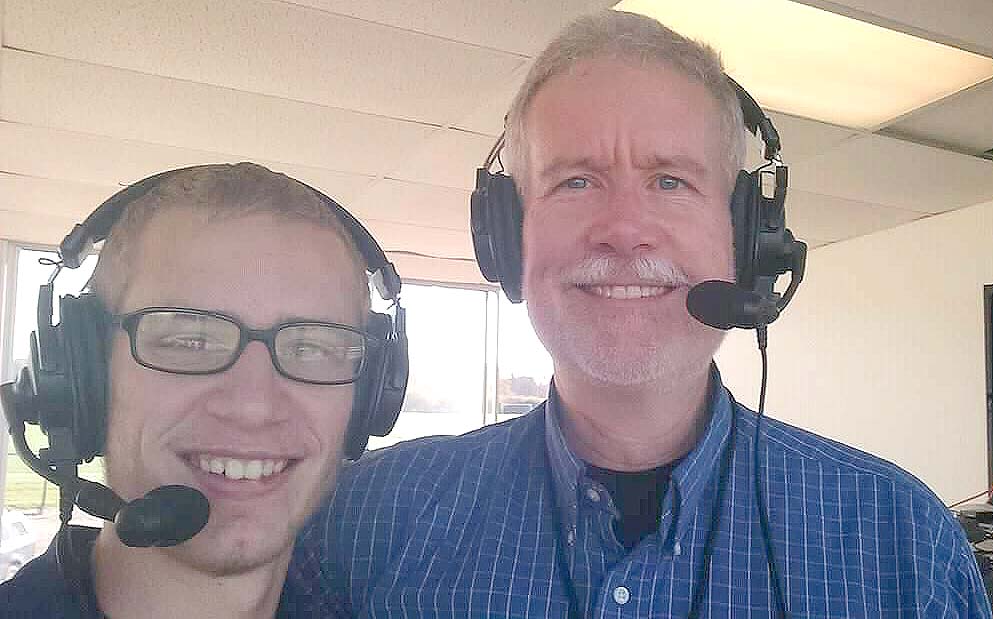
It just occurred to me that this year is not just the 30th anniversary of my entrance into the full-time work world, but it is also the 30th anniversary of my announcing sports on a part-time basis. The first game I ever announced on the radio was a Friday afternoon football game between Lancaster and Cuba City Sept. 25, 1988. (Cuba City 28, Lancaster 27 in overtime.)
I returned to Southwest Wisconsin, from whence my career and announcing began, six years ago, and as with seemingly everything in my life, I have experienced enough for a second volume.
I’ve written here before that my favorite sports announcer of all time is the late Dick Enberg. I don’t sound like Enberg, but one thing he had, and one thing I hope comes across when I do games, is that Enberg sounded as if there was no place he would have rather been than calling the game he was calling. I am unaccountably lucky to be doing something I wanted to do from around the time I started watching games on TV, and, since I’m part-time, without all the downsides of working in broadcasting.
Adventures in Radio Volume 2 starts with the second game that I wasn’t exactly scheduled to announce. I was asked to go to Highland and do reports of the Black Hawk–Highland game. I was told before the game that the regular game would probably be a blowout, so I might get to call the second half of the game. That turned out to be pessimistic, because the station called me and put me on with two minutes left in the first half, when I was not quite ready to report. There were no commercials for my part of things, which I discovered when I threw it back to the station and the on-air host/engineer immediately threw it back to me.
Complicating matters further (that phrase perhaps should be engraved on my gravestone) was the fact that I ad a cellphone whose battery had seen better days. I was hoping (because apparently I didn’t bring a charger with me) that the charge would be sufficient to announce the second half, so coming on before the half was a complication. And sure enough, a few minutes into the second half, my phone died.
What did I do, you ask? I simply said, loudly in the press box, “Does anyone have a cellphone that I can borrow?” The public address announcer, who I was standing next to, held up his, and so I called the radio station back and announced the rest of the game.
People unfamiliar with radio have no reason to know this, but cellphones generally don’t produce great sound quality. If you’re fortunate, the quality of the game overcomes technical issues, or your lack of ability as an announcer. Fortunately, it was a great game, with the winning quarterback scoring the fourth of his four touchdowns with about three minutes left for the come-from-behind home team win.
The next year I did more games, including the entire football season of an unlikely state finalist, the 2013 Platteville Hillmen. (Alma mater of UW football coach Paul Chryst, by the way.) The second game of that season featured a Super Bowl-length game due to one team’s throwing the ball a lot (the clock stops more often in high school and college games than in pro games), and a lengthened halftime due to the fact that the officials saw the lightning in the southern sky that they had either not seen or ignored the entire second quarter. The game ran so long that we were bonus coverage on the other radio stations doing games that night. The game ended with Dodgeville beating Platteville 51–45 at 10:50 p.m., and we left the stadium at 11:10 p.m., 4½ hours after the broadcast start.
More unusual than that was the conference’s decision to have each team play three teams in their conference twice. (The conference has only six teams, which means just five conference games except for this season.) That was meeting number one; meeting number two ended with the home team, which had scored 51 the first meeting, scoring 51 fewer points and losing their Homecoming game.
Platteville’s problem was that the three teams they played twice turned out to all be playoff teams. Add their season-opening nonconference opponent, and Platteville arguably had the most difficult schedule in the entire state, with seven of nine games against playoff opponents, including three games against teams that would get to state. After their 1–3 start, the Hillmen needed, we figured out, to win four of their last five games to have any chance of all of getting in the playoffs.
That is what ended up happening, including two wins over teams to which Platteville had lost earlier in the season. The coaches in Platteville’s playoff bracket were either impressed or persuaded by Platteville’s regular season to give the Hillmen a third seed, despite barely getting into the playoffs. That meant, believe it or don’t, a third meeting with Dodgeville, which Platteville shut out fo the second time. (That was the first time, and I guarantee you the last, that any team will play another team three times in one Wisconsin high school football season.)
Platteville then went on the road and knocked off the number two seed, setting up a trip to Big Foot High School in Walworth to play the number-one-ranked and number-one-seeded Big Foot Warriors. That turned out to be a grim defensive struggle thanks to 35-mph winds from one end of the stadium. But Platteville scored, sort of, all the points in the game — one touchdown, and then one safety when the long-snapper, snapping into the wind, missed the punter and lined the snap off the goalpost for a safety. Ironically, that turned out better for Platteville than it could have, since on a safety the resulting free kick comes from the 20-yard line. Platteville ended Big Foot’s undefeated season 7–2, and, it turned out, the career of the coach, who left after the season.
(I found out why he left some time later, which explained why the people in the press box were acting as if their last chance to go to state had just ended. It turned out the Big Foot coach had been dealing with parent complaints during the season about their children’s lack of playing time. During their undefeated season. Parents can be, and perhaps are becoming more of, a problem in high school sports.)
One week later, Platteville played Manitowoc Roncalli in Watertown for a trip to state. The end-of-the-game highlight was from one of Platteville’s best players, whose absence due to injury was much of the reason for the Hillmen’s 1–3 start. Roncalli had two quarterbacks, one of which was obviously a better passer than the other. So it might seem odd that the lesser thrower was in on the potential game-tying or game-winning drive, but he was. And the last pass was intercepted by our formerly fallen hero, who figured out what was happening, got out of position and made the end-zone interception to send Platteville to state. I was yelling so much that no one needed a radio to hear me back in Platteville.
After 25 years of announcing that included several state semifinal games but no championship game (and two times where the team I was covering got to go to state, but we couldn’t broadcast state), that also sent me to cover state football for the first time. There is really nothing bad I can say about announcing at Camp Randall (other than parking, but you knew that). Making matters even greater is that four teams from the radio stations’ coverage area got to state, which prompted wall-to-wall football from 9:40 a.m. until 10 p.m. The Division 5 game ended, the announcers went to commercial, and we jumped in like we were the second drivers at Le Mans, in what we called the Cinderella Bowl, because Platteville, having finished the regular season 5–4, faced Winneconne, which ended the regular season 4–5. The Wolves’ win over the Hillmen left both teams with 9–5 records — and I believe they are the only two teams in history of state high school football to finish with those records — but, as I have said numerous times, getting a silver trophy at state beats getting no trophy at state.
That fall also saw me announce for the first time a sport I played — if you want to call sitting on the bench for two seasons “playing” — but had never announced before, girls volleyball. Until then, the only announcer I had ever heard do volleyball was Chris Marlowe, who announced Olympic and college volleyball. Marlowe can get very excited, which is not really my style. I had heard very little volleyball on the radio, so I wasn’t really sure how to announce volleyball on the radio, where nothing happens unless you say it happened.
The radio stations had four teams get to the sectional semifinals, and had games on three stations, because that’s all the announcers they had. That is, until I called the news/sports director and said I’d never done volleyball before before volunteering to do the fourth match. And so, on Halloween night, driving throughj several small towns while hoping to not hit little Trick-or-Treaters (because that would have made me late for the broadcast), there I was, stuck on one end on the second floor, with a telephone, not broadcast equipment (because they now had more announcers than available equipment), trying to announce. I say “trying” because it turned out that a technical problem at the station knocked me off the air before the match began. (What did I write about “complicating matters further” again?)
The station managed to find someone to go to the station to put me back on the air, but that meant he had to engineer for me. (The system that failed was supposed to allow me to do everything from the game site.) I didn’t get on until halfway through the second set. After stumbling through set two, I threw it back to the station for commercials, only to hear in my earpiece, “I don’t have any commercials!” So I ended up doing the final two sets of the four-set match by rereading the reader spots I have, and that was it. Fortunately again, they were close sets, and I heard afterward a group of peoiple were listening to me call the final moments of the final set, and apparently they could tell what was going on by what I was saying, which meant that a good game saved not-so-good announcing again.
That moved me into doing volleyball the next season. That was a good season to announce, because two area teams got to state. One of the regular-season matches I did featured Platteville’s volleyball archrival, River Valley, which had beaten Platteville twice in the previous regular season, only to lose to the Hillmen in the regional final. In their second regular-season meeting, River Valley took a 2–0 set lead, only to have Platteville come back and win the last three sets and the match. Match number three was back in the regional final, and it again went to five sets, with the Hillmen winning in a two-hour-long heart attack of a match.
Platteville breezed through the sectional semifinal, taking less time to win than it took to get to the game site. That set up the sectional final the following Saturday night in Whitewater, one night after I had to announce a football playoff game. And then the radio station called and asked me to announce another game, a secodn-round playoff game the afternoon before the vollleyball final, without, it turned out, another announcer or (as I found out when I got to the station) equipment. Fortunately the one thing I did have was my phone charger, and so I announced a football game and the volleyball match on my cellphone. (The lack of equipment was matched by the fact that the high school that hosted the sectional final didn’t apparently know I was coming, so they had no place for me.)
That sent me to the Resch Center in Ashwaubenon for state volleyball in the morning and late afternoon … until another radio station owner called me and wondered if I could do one of his team’s early-afternoon semifinal. As long as I was up there, why not? (And as long as I could get to my broadcast position, which was for someone unfamiliar with the Resch a trip approximating climbing to the top of Camp Randall Stadium.) So three matches Friday, and after the first team chronologically speaking won a state championship match Saturday morning, during which I looked at the lack of radio station for the opponent and I concluded I was the only radio announcer in the entire world announcing that match.
I forgot to mention, though, how that Green Bay trip started. The previous Sunday I got a call from the radio station that when I got it I assumed I was either going to be told I was going to Green Bay or told that I was not. Instead I was asked if I were interested in doing UW–Platteville basketball, starting Thursday. So I started at the former Milwaukee Arena Thursday night, where a few minutes before the broadcast began (after they fed me — really) I thought to myself that I was about to announce a game on the floor where Kareem Abdul-Jabbar and other NBA greats played and Al McGuire coached. And then I drove to Waupaca, where my parents lived at the time, that night, got up before sunrise the next day, drove to Green Bay for three volleyball matches, drove back to Waupaca (after doing a pregame interview in the station van for the next day), then went back to Green Bay for the early-morning championsnip match.
The weird part was when I got back home and covered the next Platteville school board meeting, where the announcement had been made that the coach was fired. To quote a popular phrase, it’s … complicated.
I announced both men’s and women’s basketball for UWP for two seasons, and I’ve filled in some (due to a radio station hiring) since then, including one football game, which happened to feature the two highest-ranked teams in Division III playing each other that day. That game went to overtime, with a 28–7 deficit erased thanks to this:
Since they feed you (three hours) before and after the basketball game (I was known as the pasta with marinara and Subway Club Sub guy), and since sports information people do all your stats for you and compile stats for your game prep, I have no cause for complaining about anything about that experience.
I did get to announce the final UWP men’s basketball game at UW–Superior, at least as a conference game. That game started the day before when we bused to Eau Claire for a practice, dinner and night at the hotel. (Where I did halftime segments with the entire team for the rest of the season’s games.) The next day we went up to Superior on U.S. 53 through a part of the state where there are more trees than people. That night, we got to the arena the usual two hours before tipoff, and I chatted with UW–Superior’s radio and cable announcers.
In the lobby of that arena is a photo of UWS’ most famous graduate, Arnold Schwarzenegger, as a cheerleader. Since I knew where Ahnuld went to college, I concluded the pregame interview with his most famous line …
I mentioned that to the Superior announcers, and they laughed and said they’d never thought to do that, which I find hard to believe. So of course I mentioned Superior’s upcoming new conference by using Schwarzenegger’s second most famous line …
… to announce their departure from the Wisconsin Intercollegiate Athletic Conference.
Then we left. We stopped in Sparta at 1 a.m., and the bus driver got out, to be replaced a few minutes later by a new bus driver. (You know you’ve gone a long way when the trip requires a second bus driver.) She apparently had not been told we were going to Platteville, because she tried to turn onto U.S. 61/151 to go to Dubuque, at 3:30 a.m., making us about a half-hour late getting home. The players and coaches could wander in whenever they wished, but there was one person on that bus who was expected to go to work at the usual time on two hours sleep.
The bus is the way everyone goes in the WIAC. So in my two years I saw more college-age-demographic movies than I ever needed to, since I cannot sleep on buses. (Well, I did once.) I saw some good movies that the kids won’t be seeing, including “The Wolf of Wall Street” on the Superior trip. There was one movie that I saw part of on two trips, but I have never seen the whole movie …
… not that I probably need to.
The second year I announced UWP was the year that coach Jeff Gard’s father, Glen, died just before the season. Jeff’s brother, of course, is UW–Madison coach Greg Gard. We stopped at a Subway in Madison on the way, and when Jeff paid the bill, the clerk looked at the credit card and said, “Are you related to our coach Gard?” (Who I announced when he was playing in high school, by the way.) That seemed to be a good omen for the evening.
Platteville and Whitewater have been archrivals since the Bo Ryan vs. Dave Vander Meulen days, and probably before that. The year before was a White Out game in Platteville, and so to follow the spirit of the evening I found a white sport coat, shirt and tie and white pants, and wore all of those, making me look, I suppose, like the Good Humor Man at the microphone. That also required bumper music for the occasion:
Unfortunately Platteville lost on White Out Night. A year later in Whitewater, though, Platteville won in overtime, one night after UW beat Indiana in overtime with “their” coach Gard as the interim coach. So during the postgame I brought that up, and Jeff started to get emotional, and I had to avoid doing the same because I still had a broadcast to finish. Having our blue Gatorade mysteriously disappear from the bus and dumping spaghetti on my lap were minor in comparison to the thrill of that win.
I had another highlight last year, when I announced UWP’s women’s game against Wisconsin at the Kohl Center. It was the first time I had ever announced a game with my alma mater, though they were the opponent of the team I was covering. I got to talk about the UW Band (which was there, though Mike Leckrone wasn’t). And I also got, for the third consecutive year, to announce my own last name belonging to a player (though she spells her last name with an additional A). Between my uncommon last name and my lack of athletic ability, the first time I heard her name on the PA was a startling moment.
Remember Enberg’s advice to never say no? One day I got a phone call from the radio station asking if I knew anyone who announced soccer. A radio station in northwest Wisconsin was looking for someone to announce Rice Lake’s state game, or games. I said I didn’t know anyone but would think about it. And then after I hung up I realized I did know someone who had announced soccer — me, on cable TV.
To make a long story slightly shorter, after I got the gig I wondered who I could do the match with, since I really didn’t know soccer that well. And then I realized the soccer player in the house could help, and so …
… we made our soccer debut. We probably didn’t do a great job. For one thing, the scoreboard was not actually visible from the broadcast position, so I had to give the score and he hd he had to lean way to the right to see the scoreboard off to the left. Fortunately, it was a compelling listen only because the game went into overtime and penalty kicks. (With Michael critiquing the goalies rather severely.)
That was part one of the day’s doubleheader, since after driving from Platteville (leaving before sunrise in the fog) to Milwaukee, I drove to Clinton to announce a football playoff game, returning home, of course, in the dark.
Proving yourself reliable has gotten me asked to announce three state girls basketball tournaments (with four state champions) and two boys basketball tournaments (with the teams ending as runners-up), and three state football championship games, in the Resch Center, the Kohl Center and Camp Randall. No football team has won the gold ball yet, but from the announcer’s perspective if you get to state you can’t announce any more games.
This spring I added high school baseball and softball to the list of things to do. One baseball game was not interesting, but what happened to me may have been. The game started late due to a rain delay, and then had another rain delay during the game. The tech we use makes the announcer sound as if he’s sitting next to you, but there is one problem — there is no way to stop the broadcast and then resume it in case of, let’s say, a rain delay. So when the heavens reopened, I had to fill an hour of airtime by myself. (At least I had brought an umbrella.) So I said what else was going on, did play-by-play of efforts to remove water from the field, talked about watching rain delay coverage on cable TV … whatever it took to fill the hour.
That experience got me to Fox Cities Stadium for state baseball. It was just one game, but afterward my partner and I sat in the stands, sun shining, and watched the next game, just like a couple of guys who made up some excuse to get out of work.
For someone who has never done this more than part-time (and has learned to not want to do this full-time), I have been unaccountably lucky to have done as many games, and great games, as I have. Unlike in my day job, where I will complain about something I feel isn’t right (sometimes in a passive/aggressive sense), I am quite laid back at this. Want me to drive to Onalaska on a Tuesday night for basketball? Fine by me. Want me to cover a seven-hour-long wrestling regional? OK, wwhere is it? The game I’m supposed to do is postponed so you want me to do another game tonight? I better find out how long it takes to get there.
Unless I am having technical problems, my blood pressure and pulse probably drop when I’m announcing. It is my favorite thing to do, and unlike most hobbies, I get paid to do it.
I’d write more, but I have a game tonight and a game Saturday afternoon. Click here to listen if you dare.
Watch out Trump supporters! Former Vice President Joseph R. Biden is on the trail and has downgraded you from “deplorables” to the “dregs of society.” It’s the September before an election, and like well-oiled machines, Democratic leadership crawls out of their basement, ready to instill fear, division and loathing into the American electorate. And they hate you even more than they did before.
One would think they would have learned that denigrating the American people is passe, but it’s all they have, and yet they still have to have you rubes, rednecks and deplorables for your vote. But their biggest insult is to their own base whom they believe are so unhinged and lacking of a moral compass, that casting their neighbors as something less than human will inspire them.
People keep insisting that the Democrats and media hate President Trump. Actually, they don’t. The political and media establishment have known him and liked him for decades. It’s you they loathe, and now Mr. Trump is our stand-in, taking the heat, lies and insults. Until the Democratic cup of hate overfloweth.
Let’s take Uncle Joe, shall we? A man who’s marketed as a happy-go-lucky nice guy; the man you can trust, because he’s … nice. For Barack Obama, Mr. Biden was the perfect choice for vice president as he would do as he was told. And he had as much contempt for the American people as Mr. Obama and Hillary Clinton did. He fit right in.
It was at the annual Human Rights Foundation dinner where Mr. Biden decided to appeal to the attendees’ worst selves.
“Former Vice President Joseph R. Biden assailed President Trump’s supporters during a speech Saturday at the annual Human Rights Campaign dinner in Washington, lamenting that ‘virulent people’ and the ‘dregs of society’ still had a friend in the White House,” The Washington Times reported.
” ‘They’re a small percentage of the American people, virulent people,’ he continued. ‘Some of them the dregs of society. And instead of using the full might of the executive branch to secure justice, dignity [and] safety for all, the president uses the White House as a literal, literal bully pulpit, callously exerting his power over those who have little or none.’”
So nice to see the Democrats are now relying on inspiring messages, lifting people up and focusing on how to improve the quality of people’s lives. Said no one ever.
When it comes to the Democrats, it’s clear we will never have our own Sally Field moment where we can genuinely exclaim, “You like me, right now, you like me!” Why? Because Democratic leadership doesn’t like us. Democratic leadership has clearly decided that insulting half of America is still a good idea.
Make no mistake, this pathetic effort to demonize the American people is a calculated, strategic choice. Mr. Biden’s comments are remarkably similar to Mrs. Clinton unleashing the insult strategy in September 2016. Her “deplorables” remark was astounding because it indicated her campaign had decided they couldn’t win undecideds over, so it was best to demonize them which they thought would excite their base. What does that tell you?
In September 2016, The Guardian reported on Mrs. Clinton’s remarks at a fundraiser in New York featuring Barbra Streisand, “… Trump’s supporters belonged in ‘a basket of deplorables’ which she described as consisting of ‘the racist, sexist, homophobic, xenophobic, Islamaphobic — you name it.’ She went to note ‘some of those folks — they are irredeemable, but thankfully they are not America.’ “
It’s not just Mr. Biden picking up that machete, it’s also echoed by Obama pal, former Attorney General Eric H. Holder Jr. who lobbed the more familiar accusation of “racist” at people who support the president.
At the same dinner where Mr. Biden demonized tens of millions of Americans, Mr. Holder was fast and furious with his accusations.
” ‘This sort of thinking, this ‘Make America Great’ mindset is not only flawed, it’s rooted in fear,’ ” Mr. Holder said. He also “questioned to what period of American history the ‘Make America Great Again’ slogan was referring. ‘Certainly, it was not when people were enslaved. …’ ‘I’ll never call him the president,’ Mr. Holder said, noting the message would be directed to ‘the extremists who surround [Trump] and to those that support him…’ ” Fox News reported.
Earlier this month, in a tour consisting of rallies praising himself and attacking Mr. Trump, Mr. Obama also added to the Democratic narrative by declaring Americans who don’t pay allegiance to the liberal agenda are angry and suffering from mental illness.
Fox News reported this about his remarks, “I have to say this … Over the past few decades, the politics of division and resentment and paranoia has unfortunately found a home in the Republican Party.”
As we approach the midterms, the Democrats are determined to punish you for being right in 2016 and to malign Mr. Trump for being successful. “Deplorable” is so 2016 and simply won’t do. We are now the dregs of society, a virus, racist, bullies, fearful, resentful and paranoid. These obscene attacks on the American people were rejected before, and the only way to reject them again is to take nothing for granted in November.
Wisconsin’s version of Biden in the verbal diarrhea department is Democratic lieutenant governor candidate Mandela Barnes, reported upon by the Milwaukee Journal Sentinel:
During a candidate forum on Wednesday in Milwaukee, Barnes told the audience that the race hinges on persuading Wisconsinites who voted for former President Barack Obama in 2008 and 2012 but didn’t come to the polls in 2016 to vote for former Secretary of State Hillary Clinton, who did not campaign in Wisconsin after the state’s presidential primary election. …
In making that point, Barnes said: “It’s not about the Obama-Trump voters. If they voted for Obama then they voted for Trump, and they’re still with him, they can — you can keep ’em.” …
That drew the ire of Republicans, who said Barnes was dismissing “millions of hard-working Wisconsinites” who voted for Trump in 2016.
“The outrageous remarks from the Evers campaign are insulting to millions of hard-working Wisconsinites and speak volumes about his priorities,” Republican Party of Wisconsin spokesman Alec Zimmerman said.
 Steve Prestegard.com: The Presteblog