Did you recently run your little red Corvette right into the ground? Or is the Chevy sports car still on your bucket list, so far remaining just out of reach of your bank account? Either way, if you’re interested in a new ‘Vette, now is the time to buy.
After it was revealed back in February that dealerships were weighed down with 9,000 C7 Corvettes, Chevrolet is offering a once-in-a-lifetime deal on the model: zero-percent financing for a whole 72 months (yes, six years), available until April 1st.
That’s not all. Individual dealers are also offering additional discounts, a rare occurrence alongside the flatlined APR — normally, you get one or the other, not both. As the Drive points out, a quick search found a 2018 Corvette Z06 for $71,194 (down from $86K) and a 2018 Chevy Corvette Grand Sport for $62,297 (down from $78K). But the Corvette Stingray is also part of the offer, as you can see on Chevrolet’s Current Deals page.
The reason for the surplus isn’t necessarily that these cars are undesirable, but that the next Corvette is so desirable that buyers are willing to wait until the eighth generation rolls out.
But the Corvette C8 still hasn’t debuted, so as Carscoops notes, there will most likely be additional discounts for 2019 C7 models. So if you can’t decide in the next week, don’t despair — be on the lookout
That is fortunate since i probably don’t have time to buy one by Monday.
I decided to spec one out wigh minimum equipment…
… and came up with $58,155 for a base Vette with only the darker red paint and transparent top. (I forgot Corvette Museum delivery for $990.) Going to the top of the line (while avoiding frivolous options like red brake pad calipers and Stingray logos )…
In continued pursuit of bringing to light obscure media, what do these two things (besides the obvious) have in common?
Obviously they both starred Burt Reynolds, after Reynolds had left “Gunsmoke” …
… but before “Deliverance,” “White Lightning” and “Smokey and the Bandit.” Each was an ABC-TV police series that lasted just one season (1966 for “Hawk” and 1970 for “Dan August”), though each was repeated on a different network — 1973 and 1975 on CBS in August’s case, and 1976 in Hawk’s case — to take advantage of Reynolds’ movie popularity.
Each had a cool jazz theme. “Hawk” was created by Kenyon Hopkins, who previously worked on another New York-based series …
… while “Dan August” had Dave Grusin:
GetTV carried both series after Reynolds’ death last year. Of “Hawk,” get (get it?) this:
Who do you think of when you think of Burt Reynolds?
Is it the macho star of groundbreaking 1970s classics like Deliverance? How about the winking bad boy of Smokey and the Bandit? The Oscar-nominated silver fox of Boogie Nights? The director of Sharky’s Machine and other gritty action thrillers? All are good answers, but what about Burt Reynolds the Native American character actor?
If you’re drawing a blank on that portion of the recently deceased icon’s resume, you’re probably not alone. But Reynolds, who has Cherokee ancestry on his father’s side, was cast as “Indian” or “half-breed” characters on TV and film throughout the first decade of his career. Beginning in 1962, the then-26-year-old played a half-Comanche blacksmith on CBS’ long-running Gunsmoke. After three years in Dodge City, Reynolds moved on to NBC’s Branded, where he guest starred as a young brave. Next he was the title character in Navajo Joe, a cartoonishly violent Spaghetti Western that was supposed to propel him to Clint Eastwood-style superstardom. (Spoiler Alert: it didn’t.)
Navajo Joe still enjoys a cult following today, despite the fact that Reynolds’ wig makes him look like the fifth Beatle. But his work in the 1960s should perhaps be best-remembered for Hawk, an innovative 1966 crime drama that brought the actor his first solo starring role on TV.
Filmed on the streets of New York City (and at the East Harlem studio where The Godfather movies were shot), this short-lived ABC series told the story of Detective Lieutenant John Hawk, a full-blooded Iroquois Indian working for the District Attorney’s office. Over 17 hour-long episodes, Hawk spun noir-ish tales of a disappearing city where newsstand owners still doubled as informants and cops still wore fedoras. But it was a New York in transition, infiltrated by drugs and on the verge of economic and social collapse, and the frank storytelling reflected that.
John Hawk was tightly wound, judgmental, and distant to the point of insensitivity – a necessity, he says in an early episode, of the job. What Hawk was not, however, was stereotypically “Indian” in his physical appearance, dress, or demeanor.
“When they asked me about Hawk and said he was an Indian, I immediately thought of a fellow with a feather in his hair running around New York, and I wouldn’t do it,” Reynolds told The Chicago Tribune in November of 1966. “I wanted to play this Indian my way – after all those years of watching TV Indians getting undignified treatment.”
Hawk pulls no punches in its depiction of discrimination. From off-handed jokes to hateful epithets, Hawk’s outsider status informs both Reynolds’ portrayal and the show’s ongoing narrative. And that’s not surprising considering the series was created by Emmy and Peabody Award-winner Allan Sloane, a writer known for socially conscious scripts stretching back to the days of network radio. New York Times critic Jack Gould wrote in 1963 that Sloane “wielded one of the most sensitive pens in television,” and his commitment to informing while entertaining makes Hawk stand out in an era when cop shows were often simple morality plays. One standout episode revolves around a witness with autism, with a surprisingly nuanced depiction of a condition that’s still misunderstood half a century later.
Ironically, Reynolds’ portrayal of a “minority” lead in the racially charged mid-1960s disguises the fact that Hawkalso features an African-American series regular – Wayne Grice as Hawk’s partner Dan Carter – which was a rarity in 1966 (and, sadly, still is today). Like Law & Order a generation later, Hawk fields an all-star team of New York actors: Broadway veterans; familiar faces from daytime soaps; and young actors on the verge of breaking out. The pilot features an unforgettable performance by Gene Hackman as a serial killer motivated by religious fanaticism. Other memorable guest stars include Martin Sheen, Robert Duvall, Billy Dee Williams, Scott Glenn, Kim Hunter,Diane Baker, and soon-to-be Dark Shadows star John Karlen.
Outside of nostalgia, there are a handful of reasons classic TV dramas resonate for contemporary viewers: writing, directing, acting, and music. Hawk is solid in all regards. The writing team featured playwrights, authors, and short story scribes, including Emmy winner Ellen Violett (Go Ask Alice) and Oscar nominee Don Mankiewicz, the son of Citizen Kane screenwriter Herman J. Mankiewicz and nephew of All About Eve director Joseph Mankiewicz. Directors included Paul Henreid, who had a long career behind the camera after iconic roles in Casablanca and Now, Voyager. And all the action is driven by a percussive jazz score by Kenyon Hopkins, Shorty Rogers, and Nelson Riddle. (Riddle’s episode features a rousing fistfight that seemed choreographed with the knowledge he would be scoring it.)
Why Hawk didn’t last longer is hard to say. It was a thematically complex show, progressive in storytelling but conservative in its main character. It’s delightfully dark, and not just because most of the episodes take place at night. And it also had stiff completion Thursdays at 10 pm in Dean Martin’s hugely popular variety show on NBC. But Reynolds blamed a different culprit: the theatrically released films counter-programmed by CBS.
“It’s absolutely impossible for a show that costs $150,000 to go up against a movie that costs $3 million,” he told The Chicago Tribune.
Ironically, Reynolds would soon be starring in big budget feature films, and would go on to direct a few of them. His first directorial assignment: the final episode of Hawk.
Hawk was definitely tightly wound. He also took quite a beating in some episodes.
(Notice how much they liked harpsichords.)
The nighttime setting was interesting. (In the pilot Hawk pulls down the shades in his apartment on his way to bed as the sun rises.) Also interesting to note is that by episode two, Hawk and other characters are lighting up every five minutes or so. (Probably due to their sponsor, Camel cigarettes.)
Both Hawk and August were working in their hometowns. The latter was a more interesting setting (“Santa Luisa,” which was supposed to represent Santa Barbara, though filming was in Oxnard) because August kept running into, and sometimes arresting, people from his youth.
Hawk was based only on the creator’s imagination. Dan August was based on a TV movie, “The House on Greenapple Road,” from the novel of the same name:
After a decade on television, Reynolds had sought movie stardom in action-packed Spaghetti Westerns, but what worked for Clint Eastwood in the “Man with No Name” trilogy didn’t bring Burt the same fistful of film roles. So the 34-year-old went back to the primetime grind, guest starring on shows like Love, American Style. And he waited for his next big break.
Meanwhile, prolific producer Quinn Martin (The Untouchables, The Fugitive, The F.B.I.) was expanding his empire into made-for-TV movies. His first starred Christopher George as Lt. Dan August, a homicide detective in the fictional Southern California city of Santa Luisa. Based on the novel of the same name, House onGreenapple Road was a ratings success, and ABC ordered a spin-off series for the fall of 1970 to be called Dan August.
But there was a problem. Christopher George didn’t want to be Dan August.
“Chris wanted to do (the sci-fi series) The Immortal instead,” his widow Lynda Day George remembered in the 2008 book Quinn Martin, Producer: A Behind-the-Scenes History of QM Productions and Its Founder. “Chris and Burt Reynolds were good friends and Chris kept saying to Quinn, ‘Look! You’ve gotta get Burt.’”
George – who had recently wrapped the military action series The Rat Patrol – went so far as to screen tapes of Reynolds’s 1966 cop show Hawk for Martin. But the producer was unmoved, and briefly attempted to negotiate a compromise with Paramount (producers of The Immortal) wherein George would star in both shows. Eventually he relented, and Burt Reynolds became the new Dan August.
With a younger actor in the title role, Dan August went through some changes on its journey from Greenapple Road. Norman Fell (age 46) was cast as Dan’s partner Sgt. Charlie Wilentz, replacing 54-year-old Keenan Wynn. Richard Anderson took on the role of chief-of-police George Untermeyer, played in the telefilm by Barry Sullivan (14 years Anderson’s senior). Returning from the pilot were Ned Romero as Sgt. Joe Rivera and Ena Hartman as investigative assistant Katie Grant.
By the time Dan August debuted on September 23, it had evolved from a middle-aged police procedural to a kinetic action series with stories ripped from the headlines. As a plainclothes detective barely out of his 20s, August advocates for younger characters and gives voice to their concerns – a sea change for the older-skewing primetime cop show format. While Dan August is no Mod Squad, and Reynolds’ straight-laced hero was hardly counterculture, there was a clear effort to tailor stories to viewers who today might be described as “woke.”
In one episode, Dan detoxes a teen junkie. In another, he visits a gay bar (one of the first depictions of such an establishment in primetime, according to the book Queer TV: Theories, Histories, Politics). He quells a campus uprising, saves a hippie from being set-up for murder (by the man!), advocates for low-paid migrant workers, helps a young priest in love with a woman, and prevents a black activist from taking a phony rap. With its socially conscious narrative and ethnically diverse cast (including an African-American woman as a member of his team), Dan August has an unusual degree of contemporary resonance. But for Quinn Martin, the controversial content was a surprise – and not necessarily a welcome one.
“Quinn said to me, “Are we doing propaganda here?’” producer Anthony Spinner said in Quinn Martin: Producer. “I said, ‘Yeah, because I’m tired of diamond heists and kidnapped girls and all that stuff. How many times can you do that?”
While Martin may have been skittish about the “relevant dramas,” he was surprisingly comfortable with his name-above-the-title star risking serious injury by doing his own stunts. Reynolds’ go-for-broke stunt work can be almost disconcerting. It’s him in literally every shot – fighting, falling, jumping off moving cars, flying in helicopters, and running through burning houses – and that realism adds a different dimension to the standard QM Productions formula.
“It was very important to Burt that Dan August succeed,” series director Ralph Senensky remembered. “This was his fourth series. If Burt didn’t make it this time, where did he go next?”
While Reynolds’ groundbreaking Hawk should have lasted longer, Dan August improves upon the earlier show’s greatest flaw: relentless intensity. Unlike the winking antihero of Smokey and the Bandit and Cannonball Run, the Burt Reynolds of this era was serious as a heart attack. And while he smiles more in one episode of Dan August than in the entirety of Hawk, the latter series benefits from what Hawk lacked: an ensemble that humanizes Reynolds.
Norman Fell, best known today for Three’s Company, is hilariously deadpan as Dan’s neurotic, hypochondriac partner. (There’s even an episode with John Ritter, six years before Jack Tripper would meet Mr. Roper.) And Richard Anderson, unforgettable as mentor Oscar Goldman in The Six Million Dollar Man and The Bionic Woman, is surprisingly effective here as Dan’s boss and primary antagonist. Like all Quinn Martin shows, Dan August benefits from an incredible group of guests, including some before they were stars such as Harrison Ford and Billy Dee Williams (nine years before they would face off as Han Solo and Lando Calrissian in The Empire Strikes Back) as well as Martin Sheen and Gary Busey. There were still other guests who were established actors from classic Hollywood like Mickey Rooney, Ricardo Montalban, and Vera Miles. The series also boasts a memorable theme song – one of the oddest in the Quinn Martin oeuvre – from composer Dave Grusin.
Though Reynolds was nominated for a Golden Globe for his work on Dan August, the series was not renewed for a second season. But the story doesn’t end there. According to production manager Howard Alston, the show’s editors assembled an outtakes reel demonstrating how charming and funny Reynolds could be when he didn’t think the cameras were rolling.
“Burt took that gag reel, he went on these talk shows, and he changed his whole career around,” Alston remembered. “He had this whole personality change in front of the camera as a result. He became a motion-picture actor on the basis of that gag reel!”
It may have happened after the show was cancelled, but Dan August was Burt Reynolds’ big break after all.
Reynolds had other police roles, some serious …
… others not so much:
Of the two we focus on here, August probably gets the nod because of the more interesting setting. August was a football star in high school (Reynolds was a running back at Florida State, where one of his teammates was quarterback Lee Corso), but needed a scholarship funded by a local rich guy (who — spoiler alert! — meets his end during one episode) to go to college. Then he comes back home where he gets to arrest, among others, a high school teammate in the den of murder (August is a homicide detective and has plenty to keep him busy), adultery (from the episodes I’ve seen it seems at least one couple per episode is playing around on each other) and various other sins that is August’s hometown.
The common flaw in each is what should be a TV trope by now — police lieutenants as investigators (not just Hawk and August, but Frank Ballinger of “M Squad,” San Francisco’s Frank Bullitt and Mike Stone, Columbo, Kojak, Jim Brannigan, Lon McQ, John McClane, etc.) instead of administrators patrolling from their desk. Santa Luisa (which is named for a real mountain range that runs between Monterey and San Luis Obispo, so points for verisimilitude) is apparently large enough for a homicide unit within its police department (with at least two sergeants in addition to August), but not big enough for a chief of detectives, because August reports directly to the police chief.
The series could have been broader if, like “Hawk,” August was not specifically a homicide detective. It strains credulity to have a three-person homicide bureau in a town with at least one homicide each week. But no one ever accused Quinn Martin of realism. (In one episode August ducks a court order to release a defendant by going for a drive with said defendant, turning off his police radio, and somehow he avoids being fired. That scene does have a nice aside between August’s two sergeants speculating on what their next jobs will be.) Broadening August’s work could have broadened story ideas beyond the ways to kill the victim(s) this week.
But that’s second-guessing and nitpicking. Both series were and are entertaining to watch, if nothing else as period pieces. Fell, who had played cops before (including Detective Meyer Meyer — yes, that was his name — in “87th Precinct” and brownnosing Captain Baker in “Bullitt”) may have been the inspiration for one of the great TV detectives, Lennie Briscoe in “Law & Order” for deadpan wit. Anderson was also great as a police chief that was simultaneously political, mostly supportive of his homicide lieutenant, yet questioning of his homicide lieutenant’s work.
The story is not over. It may never be over in our lifetimes. But an important chapter has come to an end, and it had a happy ending for the president.
Contrary to what we’re already beginning to hear from some quarters of the left, the Mueller probe almost certainly puts to rest the extreme version of the Russia–collusion narrative.
James Freeman:
The Mueller report confirms that the Obama administration, without evidence, turned the surveillance powers of the federal government against the presidential campaign of the party out of power. This historic abuse of executive authority was either approved by President Barack Obama or it was not. It’s time for Mr. Obama, who oddly receives few mentions in stories about his government’s spying on associates of the 2016 Trump campaign, to say what he knew and did not know about the targeting of his party’s opponents.
If he was briefed, for example, on plans by the Justice Department to seek wiretaps on Trump campaign associates, it’s hard to believe Mr. Obama would not have been highly interested in the matter. Going all the way back to his campaign for a U.S. Senate seat in Illinois, Mr. Obama had aggressively advocated for preventing federal abuse of surveillance powers.
C.J. Ciaramella covers an interesting dimension of the report:
Last Friday, special counsel Robert Mueller delivered his long-awaited report on Russian interference in the 2016 election, possible coordination between Russia and the Trump campaign, and whether President Trump obstructed the investigation. But it remains very unclear how much the public will actually get to read of the most anticipated political document in recent history.
Attorney General William P. Barr and Justice Department staff will have the task of reviewing the Mueller report to determine how much of it contains classified information, grand jury materials, sensitive law enforcement records, and other portions shielded from public release by executive privilege.
The fight over the scope and breadth of the redactions to the public version of the Mueller report will pit privacy, national security, and presidential privilege against the considerable public interest in the Russia investigation. It will play out on two fronts: the Justice Department will face off against Congress, where the House recently voted 420-0 to urge the DOJ to make the Mueller report public; and the DOJ will also have to battle private groups in federal court.
Barr’s initial review could take weeks, and FOIA lawsuits can drag on for years. It will be months before EPIC’s lawsuit even gets rolling, and the government is notorious for stringing out public record suits as long as it can.
The federal court system is already jammed with a record number of FOIA lawsuits against the federal government by advocacy groups and news outlets. This is a result of both news organizations’ zeal for investigating the Trump administration and the regrettable fact that the only reliable way to get public records from federal agencies in a useful timeframe is to sue them. (As a general matter, the federal government should release more records proactively and not fight FOIA lawsuits tooth and nail, which would speed up the release of public records.)
When the public version of the Mueller report is released, expect a lot of black boxes covering “sensitive” information. Some of these redactions will be the result of executive privilege—a power that allows the White House to withhold records concerning the president and his close advisers, under the reasoning that public disclosure would chill the president’s ability to receive candid advice.
Bradley Moss, an attorney in Washington, D.C., who specializes in national security and FOIA litigation, says executive privilege will most likely come into play in the sections of the Mueller report on potential obstruction of justice by Trump.
“It’s going to concern the nature of discussions and interviews with the president’s inner circle—people like Hope Hicks and Don McGahn—who were there when he was ranting about wanting to fire Sessions or Mueller,” Moss says. “The precedents in the Nixon and Clinton cases give us some guidance, but we don’t know how it will play out.”
Richard Nixon and Bill Clinton’s attempts to invoke executive privilege in the Watergate and Monica Lewinsky scandals, respectively, were both rejected by federal courts, which have held that executive privilege is not a blanket protection against investigations into the Oval Office. The Obama White House likewise lost a bid to use executive privilege to withhold records tied to the Fast and Furious scandal from Republican-led congressional committees.
But executive privilege is still a powerful tool. For example, the White House Office of National Drug Control Policy recently invoked executive privilege to deny a FOIA request by Reason for 33 pages of fact-sheets from various federal agencies reportedly describing the dangers of marijuana legalization.
Executive privilege, like the ever-growing executive office itself, could stand to be rolled back. In the case of the Mueller report, the relevant conversations don’t concern the Cuban Missile Crisis or any existential threat to the nation, but rather the president’s handlers trying to control his intemperate outbursts.
Intelligence agencies routinely withhold records under a “sources and methods” exemption, which will likely cover materials in the Mueller report on Russia’s efforts to influence the 2016 presidential election.
“A lot of national security information might remain classified,” says Jake Laperruque, senior counsel at the Project on Government Oversight, a government watchdog group. “The ‘source and methods’ exemption gets applied overbroadly, but it’s certainly feasible to imagine that some of the information that led Mueller to make the conclusions he did would touch on sources and methods.”
Courts give wide deference to intelligence agencies in such matters, and as Laperruque noted, FOIA offices use this to their advantage to frivolously withhold records.
Any national security redactions in the Muller report should be scrutinized. Unfortunately, it takes patience, a lot of money, and a bit of luck to defeat national security exemptions in court.
Under normal circumstances, there are privacy protections for records gathered by the government on private citizens, and rightfully so. Capricious, malicious, or incompetent government investigations can ruin private citizens’ reputations—not just for the main subject of investigations, but also minor figures who are caught up in them.
But courts also balance privacy protections against the public interest, and in this case the circumstances are rather extraordinary. The bigger obstacle to releasing the full Mueller report will be restrictions against releasing grand jury information.
“The degree to which Privacy Act protections could apply I think would be limited [due to law enforcement exceptions to that law],” Laperruque says. “As a broad principle, in a case like this government has to balance privacy against efforts to report or inform the public. A main item that would be sealed are grand jury materials. A lot of fact-finding occurs through that, and those are not necessarily open to public disclosure.”
Federal courts have on rare occasions released grand jury information, but the fact that the Mueller report did not conclude that Trump obstructed justice, or that the Trump campaign “colluded” with Russia, weighs heavily against disclosure.
In his four-page letter summarizing the Mueller report, Barr noted the restrictions on releasing grand jury information “protects the integrity of grand jury proceedings and ensures that the unique and invaluable investigative powers of a grand jury are used strictly for their intended criminal justice function.”
The government’s unfettered power to investigate potential crimes demands strong skepticism of the government’s claims, and strong protections for the reputations of those investigated but never charged or convicted.
Rep. Justin Amash (R-Mich.) tweeted along similar lines today: “Whether it relates to Hillary Clinton, Donald Trump, or Jussie Smollett, it’s inappropriate for a prosecutor to declare someone not exonerated. Either prosecute or don’t, but the burden of proof is on the government.”
The public can rest assured, though, that the Justice Department will likely be extremely vigilant in applying all the relevant exemptions it can to the Mueller report.
Moss says he expects the Justice Department “is going to take a broader view in the beginning, and then there will be negotiation back and forth to see how much they can ultimately agree to make public.”
It will be up to transparency advocates and the public to see how much of the report they can claw back.
In fact, the latter fight has already begun. On Friday, the same day Mueller delivered his report to Barr, the Electronic Privacy Information Center (EPIC) filed a Freedom of Information Act (FOIA) lawsuit seeking the report and other Special Counsel materials.
The irony, of course, is that while purporting to worry about Russian interference in American politics, by advancing this story the press was actually doing the work of President Vladimir Putin, sowing division and confusion through the American polity.
As former Clinton pollster Mark Penn tweeted, we wasted two years, at least $30 million and a lot of institutional credibility at the FBI and Department of Justice over “a false story of Russia collusion based on oppo research that was always unsubstantiated and preposterous.”
Liberal journalist Matt Taibbi was even harsher, calling the Russia-collusion story WMD times a million. Taibbi noted that the news media’s credibility is a major victim:
Nothing Trump is accused of from now on by the press will be believed by huge chunks of the population, a group that (perhaps thanks to this story) is now larger than his original base. As (New York Times’ Peter) Baker notes, a full 50.3 percent of respondents in a poll conducted this month said they agree with Trump the Mueller probe is a “witch hunt.”
Well, that’s because it was. Leftist journalist Glenn Greenwald administered a Twitter beat-down to some of his colleagues in the news media, saying: “If you constantly went on TV or wrote things to mislead millions into believing Mueller was coming to arrest Trump, Jr., Jared and a whole slew of others for conspiring with the Russians, just admit it. Save yourselves the embarrassment of all this whitewashing & pretending.”
Don’t expect any such apologies.
We might someday need a press we can trust. But I hope not, because we certainly don’t have one.
So what’s next? Well, there may not have been Russian collusion, but there certainly was collusion between FBI agents and journalists, with agents leaking information and journalists paying them off with “tickets to sporting events, golfing outings, drinks and meals, and admittance to nonpublic social events,” according to the Office of the Inspector General of the Department of Justice.
And the connections between the Justice Department and the political opposition-research firm Fusion GPS (where the wife of senior Justice Department official Bruce Ohr was paid to dig up dirt on Trump) were particularly egregious.
Roger Simon of of PJ Media writes that there is a lot of corruption yet to be investigated and prosecuted, on the part of Trump’s accusers: “It was a conspiracy and, worse yet, a conspiracy ignited and carried out from within the FBI and the Department of Justice. Nothing could be more dangerous to a democratic society than that. How high this conspiracy went is still somewhat unclear. I say ‘somewhat’ because the likelihood of it having reached into the White House of the previous administration is great. It’s hard to imagine how it could have happened otherwise.”
Will we see any accountability for the many ethical — and probably legal — breaches involving Trump’s bureaucratic opposition? Stay tuned. But the “Russian collusion” narrative has now imploded.
On Tuesday, April 2 Wisconsin voters have a choice between two very different candidates for Wisconsin Supreme Court. Brian Hagedorn has focused his campaign on one simple message – judges should say what the law is, not what they wish it to be. His opponent, Lisa Neubauer, has refused to articulate any coherent judicial philosophy. Instead of debating on substance, she has either directly leveled personal attacks or has sat back and watched as the media has done her dirty work.
Last week’s decision out of Dane County finding the legislature’s special session bills unconstitutional should serve as a wakeup call throughout the state. The stakes could not be higher.
The philosophy advanced by Brian’s opponent is nothing more than a poorly veiled political doctrine. Instead of tracking closely the unambiguous and plain meaning of statutory language, like the Dane County judge, Neubauer believes a judge has the power to “correct” the legislature when it has advanced a policy that it believes to be “unjust.” While judges must certainly serve as guardians of constitutional rights, they should only exercise authority when legislative acts are clearly inconsistent with core constitutional principles.
Correcting what it views as “bad” policy is nothing more than tyranny of the judiciary. And this is exactly the philosophy advanced by Neubauer and her special interest allies like Planned Parenthood.
But there is even more at stake on April 2. The attack on Brian and his family has been nothing more than a character assassination, carefully orchestrated by Neubauer and executed by her media compatriots. The attack began with the unearthing of various blog posts authored by Brian. Anything written is fair game during a campaign. However, what has transpired since then should shake to the core any voter.
Not satisfied to simply hold Brian accountable for past writings, Neubauer and the media turned their collective attention to Brian’s speaking engagements before Alliance Defending Freedom (ADF), a respected national organization that prides itself on “defending Christians to protect religious freedom for all.” The discredited Southern Poverty Law Center has wrongly characterized ADF as a “hate group.” So naturally Neubauer’s media henchmen immediately advanced the theory that Brian had previously been paid a meager stipend to speak to a “hate” group.
And in truly Orwellian move, Neubauer and the media attacked Brian and wife for starting a private school. Their offense? Expecting students, parents, and teachers to adhere to widely-held traditional values, views presumably still held by the Catholic Church, the Wisconsin and Missouri Synods of the Lutheran faith, Baptists, and numerous other Protestants denominations. Nevertheless, that has not stopped the media from targeting Brian and even the parents of children who have decided to send children to the religious based school.
The attacks have had the intended result. In addition to painting Brian, a committed husband and father who has honorably served as a Supreme Court Law Clerk, an Assistant Attorney General, Chief Legal Counsel to Governor Scott Walker, and now a respected Court of Appeals Judge, as an unqualified bigot, it has resulted in otherwise conservative allies wilting under the scrutiny. The Wisconsin Realtors Association withdrew their support and requested a return of a relatively sizable donation. Then the national Chamber of Commerce indicated it would not work with Wisconsin Manufacturers and Commerce in financially supporting Brian’s efforts. Both moves were interpreted as extremely harmful to Brian’s prospects.
Make no mistake. In addition to attempting to eliminate a conservative judicial philosophy from the Wisconsin political landscape, Neubauer and her allies are attempting to eliminate those of faith from the public square. Who they wish to take their place are those who adhere to the philosophy advanced by Neubauer, one premised on the supreme nature of the judicial branch with its members sitting as overlords over the meager people’s representatives. And along with this super-technocratic view comes disdain for people of faith. Sadly, these sorts of attacks have resulted in otherwise strong allies of judicial conservatives creeping into the shadows, afraid of also being labeled a hate group by the media and other members of the PC Police.
Don’t back down.
Every reader should be familiar with the beginning of the First Amendment, “Congress shall make no law respecting an establishment of religion, or prohibiting the free exercise thereof …” but should be familiar with Article VI section 3, which ends, “no religious Test shall ever be required as a Qualification to any Office or public Trust under the United States.”
U.S. Sen. Mike Lee (R–Utah) uses the fine skill of ridicule:
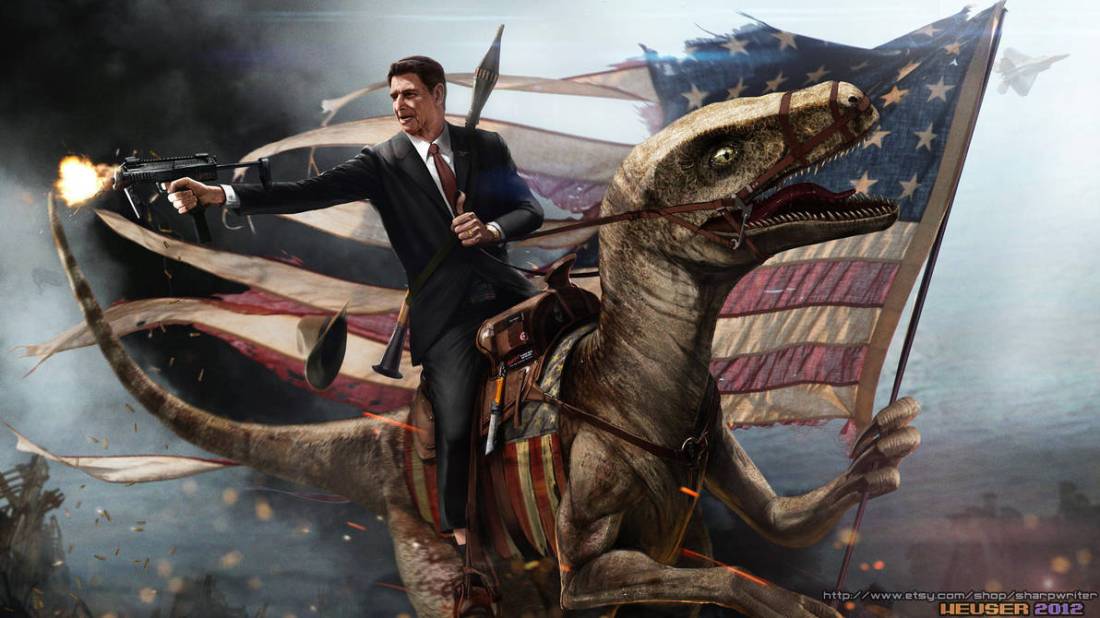
I don’t know where this came from, but this is my new favorite piece of art:
The Senate vote on Alexandria Ocasio-Cortez’s Green New (Bad) Deal was 57 Nos, including three Democrats, Sens. Joe Manchin (D–West Virginia), Kyrsten Sinema (D–Arizona) and Doug Jones (D–Alabama), along with independent Sen. Angus King of Maine; zero Yes votes, and 43 “present” votes, including U.S. Sen. Tammy Baldwin (D–Wisconsin). Yes, Baldwin ducked out of a vote in favor of a scheme that would destroy the three biggest business sectors in this state — agriculture (because cow farts!), tourism (no airplanes, no tourists flying here) and manufacturing.
Sen. Elizabeth Warren insists she’s a capitalist who “sees the value of markets.” But an exclusive Yahoo Finance analysis of her policy proposals puts her on the more socialistic edge of the Democratic field, barely to the right of Bernie Sanders.
Former Colorado Gov. John Hickenlooper, by contrast, has resisted efforts to label him a capitalist. Yet he lands at the more capitalistic end of the Yahoo Finance analysis, along with Washington Gov. Jay Inslee and former Maryland Rep. John Delaney.
As the field of Democratic presidential contenders swells, the primary-election process is shaping up as a tug-of-war over what type of economy is best for the nation. Leftists want far more government intervention in health care, energy, transportation and other sectors, to address worsening income inequality. Centrists insist pragmatic, market-based policies can solve pressing problems. And some candidates claim to be one thing while backing policies suggesting they are something else.
To clear the smoke and identify who stands for what, Yahoo Finance analyzed four key economic policies of 15 leading candidates (including Joe Biden, reportedly set to announce soon), and placed each of them on a spectrum ranging from more socialistic to more capitalistic. We used a 3-point scale to rank the candidates’ policies on health care, taxes, trade and climate change, then tallied the scores to reveal an overall economic orientation for each. (Please check out our complete methodology.)
Here’s where each of the 15 candidates stands:
There are several useful takeaways for voters. It’s no accident that the two declared candidates with gubernatorial experience—Hickenlooper and Inslee—are at the capitalistic end of the field, since governors have to work with businesses to develop pragmatic tax and regulatory policies that generate jobs. Joining them at the capitalist frontier is Delaney, who made millions starting and running two successful businesses, and only ran for office after that.
Sen. Bernie Sanders, not surprisingly, is the most socialistic candidate among Democrats, with a well-developed plan to sharply raise taxes, nationalize health care, cover college costs for many families and roll out other generous government benefits. Sanders has also signed on to the Green New Deal, which would border on a government takeover of the energy sector and force radical change in transportation, as well.
At least 7 of these candidates—Sanders and Warren, along with Senators Kirsten Gillibrand, Kamala Harris and Cory Booker, plus Rep. Tulsi Gabbard and businessman Andrew Yang—support Medicare for all, which would essentially nationalize the health care industry and eliminate the private insurance that now covers nearly 180 million Americans. That might lower the total cost of health care, while covering more people, but it would also be massively disruptive and require sharp tax hikes. There are other ideas for working toward universal coverage with a broader government role, while keeping the private health care system mostly intact.
On taxes, we considered plans to redistribute wealth through taxation—such as Elizabeth Warren’s wealth tax—as more socialistic. Politicians don’t often tout tax hike plans, but they do sometimes favor sweeping new programs—such as Sanders’ free-college plan—that necessitate higher taxes. We also rated those more socialistic. Tax hikes aren’t inherently bad, but economists generally say growth is strongest with the lowest possible level of taxation needed to meet public needs. And there are other ways to raise up those left behind, such as Delaney’s plan to incentivize investment in underperforming parts of the country.
On climate policy, we consider the Green New Deal to be the most socialistic plan out there for addressing global warming. At least five of the candidates—Booker, Harris, Sanders, Warren and Gabbard—support the GND, which would put the government in charge of the much of the energy and transportation sectors and require large tax increases. In this instance, there are clear market-based alternatives that are more capitalistic, such as imposing carbon taxes and letting the market sort out the most efficient way to cut pollution. Inslee, who’s campaigning primarily on a “climate mission,” would push reforms down to the state and local level, end existing carbon subsidies (capitalistic!) and involve businesses in his crusade to reduce emissions.
On trade, Trump-style protectionism is the socialist bookend, and only Bernie Sanders favors such an aggressive effort to protect American jobs by raising the prices consumers pay for imports. Trump has effectively, if mistakenly, vilified free trade, and few candidates these days are full-throated globalists. But Inslee, Hickenlooper, Delaney and to a lesser extent former Rep. Beto O’Rourke are all on record touting the virtues of open trade. Biden, as President Obama’s vice president, supported the Trans Pacific Partnership, which the Obama administration cultivated.
Some of the candidates, including O’Rourke and former San Antonio mayor Julian Castro, haven’t spelled out their views on every one of these issues, so we analyzed past actions and other policy positions to estimate where they’re likely to fall on the socialism-capitalism spectrum. And Biden, widely expected to enter the race soon, hasn’t detailed his economic views since he ran for president in the primaries in 2008. Much has changed since then, and Biden will have to update his views to account for Medicare for all, the Green New Deal and other recent developments. We’ll track all the moves as socialism and capitalism duke it out over the next 20 months.



 Steve Prestegard.com: The Presteblog