In case you ever wondered why Donald Trump does what he does, the Washington Times explains:
STEUBENVILLE, Ohio — A hush fell over the crowd at the lunch counter Wednesday at Pee Dee’s Brunch and Bar as President Trump filled the overhead TV screen and responded to Iran’s missile strikes on U.S. bases in Iraq.
As Mr. Trump delivered the verdict that Iran “appeared to be standing down” and offered the Islamic regime an opening for negotiation and peace, there was a collective sigh of relief in the small restaurant, where customers conversed and argued like family.
“He called their bluff,” said Dan, 35, a warehouse manager and Trump voter in this hardscrabble Rust Belt town. He declined to give his last name.
Diane Woods, the restaurant owner who frequently voices strong dislike for Mr. Trump, said she was pleased that the president did not escalate the confrontation.
“Of course, I want the president to do great. It’s our country,” Ms. Woods, 55, said from behind the counter.
The president’s address to the nation mostly hit the right notes in this corner of Ohio, where Mr. Trumpin 2016 won over voters dissatisfied with politics as usual after the demise of the region’s steel mill economy. His address satisfied both Mr. Trump’s fans who want him to stand tough and provided comfort to Trump critics who feared he was rushing headlong into a Middle East war.
“You’ve got to have some balls. The Democrats have no balls,” chimed in Kirk Mobley, 65, a retired member of the Boilermakers union and former Democrat who switched parties because of Mr. Trumpand vowed never to go back.
Ms. Woods said she feared war after the U.S. drone strike last week that killed Iranian Gen. Qassem Soleimani and that prompted Iran’s retaliatory missile attack Tuesday, which did not kill any U.S. troops.
“That stuff scares me,” she said. “They should have been more strategic about it. … Why aren’t you killing Kim Jong-un and [Vladimir] Putin?”
Ms. Woods said there was still no chance that she would vote for Mr. Trump, regardless of who is the Democratic presidential nominee.
“We can’t let them have a nuclear bomb,” said Rita Wigal, 77, a retired electric company clerk who voted for Mr. Trump in 2016 and “absolutely” plans to vote for him again this year.
She was impressed by Mr. Trump’s declaration that the U.S. achieved energy independence that puts it in a stronger footing in the Middle East.
“That’s wonderful that we are oil self-sufficient,” she said.
I posted last week about the movie “Richard Jewell,” hated by the news media, and posted yesterday about CNN’s undisclosed settlement with a Covington, Ky., high school student who sued CNN for defamation.
With more than three decades (or parts of five decades) in this line of work, I know more than most where the media does its job less than adequately. And I think I’ve figured out why my line of work is below politicians and used car salesmen as portrayed the movie “Used Cars” in the public’s eye, not merely for things like this:
Proving how to be your own worst enemy is the Atlanta Journal Constitution’s Bill Torpy:
In the newspaper business, they say nothing beats shoe leather reporting. That means getting out there on the scene. Knocking on doors. Pulling documents from the courthouse. Getting reluctant people in the know to talk.
A classic case of such shoe leather was my AJC colleague Bill Rankin’s four-minute-and-45-second walk in August 1996 from a row of pay phones in downtown Atlanta to Centennial Olympic Park. In that hike, Rankin traced the path from where a bomb threat was called in to 911 to the site of the deadly explosion that occurred in the early morning hours of July 27, 1996.
Rankin’s reporting, his five-block walk, and his basic understanding of physics — that a person can’t be in two places at once — ended with him writing a front-page story headlined, “Timing indicates Jewell didn’t make bomb threat.”
It was the first public break in the case that went Richard Jewell’s way. And it gave Jewell’s defense team an opening to fight back against federal authorities who were investigating the security guard as the possible Olympic Park bomber.
Jewell’s story is well known and tragic, a cautionary tale for both law enforcement and the media. Jewell was famously made infamous by this newspaper after we reported that he, the man who found the pipe-bomb-filled backpack at the crowded park, was being investigated as the one who planted it. The feds believed he fit “the profile of a lone bomber” and was a wannabe cop who longed to be a hero.
The story set off a media feeding frenzy that placed Jewell in a crucible where in the space of a few weeks, he went from unknown guy to modest hero to suspected villain to wronged man. He died in 2007 at age 44.
Now there’s a new movie, “Richard Jewell,” directed by Clint Eastwood that takes to task both the feds and the media. This newspaper in particular has been much criticized for breaking the story that the FBI was investigating Jewell, and for not revealing its sources. After 15 years in court, The Atlanta Journal-Constitution prevailed because it printed the truth, as ugly and as messy as it all was.
Eastwood’s movie has been disparaged by some for portraying AJC reporter Kathy Scruggs as a stop-at-nothing journalist who’ll even have sex with a source to get a story. The movie, however, does a great job of portraying Jewell as a salt-of-the-earth fellow who just wanted to do his job. It is wonderful to see him get his due.
The newspaper? We’re the bad guys who will roll over anyone for an exclusive. The movie is heavy-handed on that end, and I sort of get it. Movies based on the truth usually synthesize characters and invent scenes for dramatic effect. It’s playing to the cheap seats. Nuance and fact get in the way of a two-hour celluloid romp.
But the thing that’s really irksome (apart from the portrayal of Scruggs) is that the movie goes all out to stick to its cartoonish notion that this newspaper went all out to stick it to Jewell. Any sense that we can be fair, forget it. It doesn’t work with the script.
In the movie, it is defense attorney Watson Bryant who walks from the park to the phone booth, looks at his watch and says, “He couldn’t have done it,” realizing that Jewell would’ve had to make the nearly five-minute walk in one minute. It’s a turning point in the film that changes the momentum of the case in favor of Jewell.
One thing is true. It was a turning point for Jewell. But it was brought about by an AJC reporter, not a defense lawyer. I know, I know. We’re the bad guys in bed with the feds. It runs counter to Eastwood’s preconceived ideas to show the paper breaking stories that help prove Jewell’s innocence.
Here’s how it really went down. Rankin, who’s about as square a fellow as you’d ever want to meet, was assigned to the AJC’s ongoing coverage of the park bombing after the Olympics ended. He had wondered about the timing of the 911 call and the timing of when Jewell found the backpack. As Rankin started his assignment, he says he got a mailer from his pastor, Larry Burgess, who then headed Clairmont Hills Baptist Church. Burgess talked about how Jewell couldn’t have done anything like that.
“I’m always skeptical,” Rankin recalled. “But this was the first account from someone I know who had talked to him (Jewell). It had a profound effect.”
In fact, Jewell’s mother, Bobi, watched kids at Sunday school, including Rankin’s.
A couple of days into his stint, on Thursday, Aug. 8, authorities released documents saying the 911 call was made at 12:58 a.m. at a pay phone at Baker and Spring streets. “There is a bomb in Centennial Park, you have 30 minutes,” said the caller.
The pipe bombs in the knapsack exploded at 1:20 a.m.
So, Rankin needed the other piece of the puzzle: Where was Jewell at that time?
He knew that GBI Agent Tom Davis, who was stationed in the area, had said that Jewell pointed out the suspicious green knapsack near a sound tower during a concert.
Rankin was hoping Davis would talk. So on Friday, Aug. 9, he called. And called. And called. Rankin avoided the official channels — calling the GBI spokesman — because he figured he’d get brushed off with a “no comment.”
Finally, on the seventh or eighth call, Davis picked up.
“It was clear he knew exactly what I wanted. He knew how important it was,” Rankin recalled. “It was like he wanted to tell me. I suppose he knew Jewell didn’t have anything to do with it.”
Davis told Rankin he called the bomb squad right after Jewell pointed out the knapsack. “The log says that call was made at three minutes to 1,” Davis told him. That’s 12:57 a.m. Remember, the 911 call five blocks away came at 12:58 a.m.
Rankin asked Davis if he had waited several minutes before making the call. “No way,” the GBI agent said.
“I hung up the phone and said, ‘Holy crap,’” Rankin recalled.
He then did the walk from the phones to the park. It was a brisk walk on uncrowded streets, certainly far less jammed than they were during the night of the bombing.
Rankin’s story was a life preserver to a drowning man.
“The next morning the Jewell camp was thrilled. They finally had a truly positive news break,” according to a new book, “The Suspect: An Olympic Bombing, the FBI, the Media, and Richard Jewell, the Man Caught in the Middle,” written by former U.S. Attorney Kent Alexander and journalist Kevin Salwen.
According to the book, Jewell’s criminal defense lawyer Jack Martin (who was cut out of the movie) decided to “use the AJC story to create good theater and flip the narrative. On August 13, he summoned the media to the bomb site. Then, in a perfect made-for-TV moment, Martin led the journalists to the bank of pay phones outside the Days Inn, while dramatically timing the walk. …”
“News organizations finally had a galvanizing event that portrayed Jewell as the possible victim.”
I called Martin on Thursday. Rankin’s story “was the first big break for us,” he said. “That was the first definitive fact that would have reflected the investigators were onto the wrong man.”
Early on, investigators knew the timing meant that Jewell couldn’t have been at both places at once and that he wasn’t a “lone bomber.” They then trotted out a theory that he had an accomplice. But the tide had turned for Richard Jewell. The public started to believe he wasn’t the terrorist. A couple of months later, Alexander delivered a letter to Martin clearing Jewell of anything to do with the crime.
Years later, Eric Rudolph was arrested for a string of deadly bombings, including the one at Centennial Olympic Park. He is serving life imprisonment.
Rankin, who was taking care of his 100-year-old mom when I spoke with him, remains extremely proud of his Jewell story. He has been The Atlanta Journal-Constitution’s lead legal affairs reporter for decades, writing 4,674 stories over 30 years. He takes on both prosecutors and defenders, not to mention judges, investigators and all others who play a part in this thing called justice. He tells it straight, and goes wherever the story leads. He once had to flee his home under guard after getting death threats from a prisoner’s family. It’s a tough business sometimes. But it’s in his DNA: His father was a longtime editor at the paper.
“This is a story where the pressure was intense,” Rankin said. “We didn’t want to get beat. But we wanted to be fair.”
He continued, “You don’t get to write stories like that very often.”
He’s so glad he did. Almost as glad as Richard Jewell’s team.
All of which might be persuasive were it not for this:
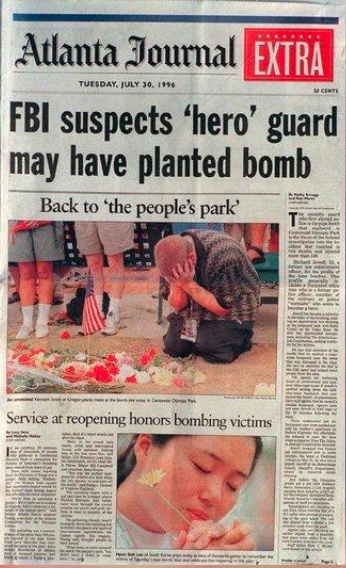
The newspaper congratulating itself is the same newspaper that turned Jewell into a terrorist by reporting that the FBI suspected Jewell was the bomber. That front page was posted on Torpy’s column, which makes you wonder if Torpy reads his own newspaper. The AJC also congratulated itself on winning a lawsuit, which means that the AJC accurately reported an inaccuracy that destroyed Jewell’s life. And neither winning a lawsuit nor Rankin’s later story eliminated that front page. Just as you can’t unring a bell, you can’t unreport something you reported that was wrong.
Atlanta Magazine:
When the Atlanta Journal broke the story late that following Tuesday afternoon, it set off an avalanche of attention. Under the hypothetical FBI scenario, Jewell had planted the knapsack and then rushed to a bank of pay phones a couple of blocks away from Centennial Olympic Park and placed a 911 call to warn police of the bomb. He then raced back to the light and sound tower, “discovered” the bomb and heroically moved people out of harm’s way.
The media quickly all but pronounced him guilty.
“Richard Jewell, 33, a former law enforcement officer, fits the profile of the lone bomber,” wrote Kathy Scruggs and Ron Martz in the second paragraph of a story in an “Extra” edition of The Atlanta Journal on July 30, 1996. “This profile generally includes a frustrated white man who is a former police officer, member of the military or police ‘wanna-be’ who seeks to become a hero.
“Jewell has become a celebrity in the wake of the bombing, making an appearance this morning at the reopened park with Katie Couric on the Today show. He also has approached newspapers, including The Atlanta Journal-Constitution, seeking publicity for his actions.”
NBC’s Tom Brokaw told viewers, “The speculation is that the FBI is close to ‘making the case,’ in their language. They probably have enough to arrest him right now, probably enough to prosecute him, but you always want to have enough to convict him as well. There are still some holes in this case.” …
AJC columnist Dave Kindred, in his second column on Jewell in two days,compared the scene to the time law enforcement officers sought evidence against Wayne Williams, the man convicted of two murders in Atlanta’s missing children case when “federal agents came to this town to deal with another suspect who lived with his mother. Like this one, that suspect was drawn to the blue lights and sirens of police work. Like this one, he became famous in the aftermath of murder.”
Kindred later offered a spirited defense of his column, saying he was comparing scenes, not characters. «The column was a comparison of the media frenzy more than it was a comparison of Richard Jewell and Wayne Williams,” he says. “Also, I quoted a neighbor in the column, saying Jewell is a good fellow,and I said the FBI has done this before and come up empty.”
Meanwhile, Jewell’s past was quickly put under a microscope; Jewell was villainized and vilified. Even Jay Leno joked about him on The Tonight Show, calling him the “Una-doofus.”
Then, as the weeks passed with no arrest, a debate ignited within the journalistic community. Had everyone overreacted? Had the FBI used them to put pressure on their main suspect in the hope of breaking him into a confession? Should they have more vigorously challenged the FBI to produce evidence before trumpeting Jewell’s name and his past? Many thought the answers were all yes.
“I think the media’s performance has been downright embarrassing,” says Howard Kurtz, a media critic for The Washington Post. “Every news organization in the country has contributed to ruining this guy’s life without the faintest idea of whether he’s guilty or innocent.”
At particular issue was the original Atlanta Journal article printed in the “Extra” edition, with the big, bold headline on Page 1, FBI SUSPECTS ‘HERO’ GUARD MAY HAVE PLANTED BOMB. The article contained no attribution and quoted no sources, leaving the reader to wonder whether the claims came from a legitimate law enforcement official or from a proclamation of God.
“I find it appalling, quite frankly, at how quickly everybody leapt to finger this guy,” says David Shaw, the media writer at the Los Angeles Times. “To write about it in the context of a larger story about the explosion, down in the sixth or eighth paragraph —that’s one thing. But to bring out a special edition and start leading your newscast and putting out Page 1 stories on it — that’s over the top.”
Earl Casey, CNN’s domestic managing editor, defends the overall coverage. CNN quickly followed the AJC in naming Jewell as a suspect, and Casey says remembering the context of the event is important. A TWA jet had just crashed near Long Island, and a bomb was suspected. There was an extreme fear of terrorism at the Olympic Games. The international media was gathered in Atlanta. Then the bomb exploded in the park intended as the center of the Olympic celebration.
And by that point Jewell was already famous. “Had this been some anonymous bloke, would his name have emerged? Maybe not,” says Casey. “Maybe the stories that day would have read that law enforcement are considering a security guard without the identity. But I think it’s difficult for journalists at a distance or on the academic level to really make value judgments on this thing. They’re often right in theory,but when you get down to the application, something in that theory falls apart.”
Well, if reporters can’t make value judgments, their bosses are supposed to. And didn’t in this case. (Which should also prove that reporters should be skeptical of law enforcement as well, yet they usually are unless they’re pushing their own agendas of blanket condemnations of law enforcement.)
Vanity Fair wrote about the movie’s script writer Billy Ray:
Marie Brenner, who wrote the Vanity Fair feature on which the film is based, hopes that Richard Jewell might impact audiences the way the story affected her in 1996. “Reporting what happened to Richard Jewell and his mother profoundly changed me as a reporter and caused me to rethink many of the assumptions and quick judgments we can all unwittingly make under deadline pressure without attempting to find out a larger truth that lurks behind breaking news,” Brenner told Vanity Fair. …
“This movie is about a hero whose life was completely destroyed by myths created by the FBI and the media, specifically the AJC,” Ray told Deadline. “The AJC hung Richard Jewell, in public…. They editorialized wildly and printed assumptions as facts. They compared him to noted mass murderer Wayne Williams. And this was after he had saved hundreds of lives. Now a movie comes along 23 years later, a perfect chance for the AJC to atone for what they did to Richard and to admit to their misdeeds. And what do they decide to do? They launch a distraction campaign. They deflect and distort…opting to challenge one assertion in the movie rather than accepting their own role in destroying the life of a good man. The movie isn’t about Kathy Scruggs; it’s about the heroism and hounding of Richard Jewell, and what rushed reporting can do to an innocent man. And by the way, I will stand by every word and assertion in the script.”
Said Brenner, “I was appalled by the reflexive snobberies and obliviousness of consequences that the AJC never addressed. The most important rule of reporting is never to reveal a suspect’s name without corroborating evidence. They had none—and neither did the FBI. I am sorry, but it is not enough to say, “law enforcement thinks.” And they didn’t even say that.” Citing the paper that reported there was no evidence against Jewell, Brenner said, “The New York Times and its editor Joe Lelyveld knew better.”
[Former AJC editor Mike] King acknowledged that the Richard Jewell case “was a turning point in a lot of newspaper discussions about where to draw the line when on identifying suspects. … And I think those are good lessons to share with a movie-going audience, that there are people who are the subject of newspaper stories and of government investigations who look as guilty as Richard appeared to look in those initial stories but who ultimately are totally innocent and whose reputations are dragged through the mud for all the wrong reasons.”
Well, congratulations to the news media who learned lessons. Jewell suffered a premature death as a result of this, but hey, sacrifices have to be made. (Apparently something got messed up when I got hired in this line of work since I have a conscience.)
And there’s this postscript that proves that part about maybe some in the media should be compared to weasels:
And even though the Atlanta Journal-Constitution is engaged in a full-blown battle with Warner Bros., King said that a group of his colleagues from the newspaper have plans to see the movie, covertly, on Saturday: “They don’t want to give Clint the benefit of movie ticket sales, so they’ve cut a deal with movie theaters to buy tickets for another movie.”
CNN agreed Tuesday to settle a lawsuit brought by Covington Catholic High School student Nicholas Sandmann.
Sandmann sought $275 million from CNN over their coverage of the confrontation he and his classmates had with an elderly Native American man while visiting Washington, D.C. on a school trip in January of last year. The amount of the settlement was not made public during a hearing at the federal courthouse in Covington on Tuesday, according to a local Fox affiliate.
“CNN brought down the full force of its corporate power, influence, and wealth on Nicholas by falsely attacking, vilifying, and bullying him despite the fact that he was a minor child,” reads the suit, which was filed in March.
Sandmann and his family still have lawsuits pending against NBC Universal and the Washington Post over their coverage of the incident. The Sandmann family sought a combined $800 million in damages from CNN, the Post, and NBC Universal.
“This case will be tried not one minute earlier or later than when it is ready,” Sandmann’s attorney Lin Wood said of the remaining lawsuits.
Numerous national media outlets painted Sandmann and his classmates as menacing — and in some cases, racist — after an edited video emerged of Sandmann smiling inches away from the face of Nathan Phillips, an elderly Native American man, while attending the March for Life on the National Mall. A more complete video of the encounter, which emerged later, showed that Phillips had approached the Covington Students and began drumming in their faces, prompting them to respond with school chants.
The lawsuit filed by Sandmann’s attorneys in the Eastern District of Kentucky identified 53 statements included in CNN’s coverage of the incident as defamatory. One such statement, included in a CNN opinion piece, accused the students of acting with “racist disrespect” towards Phillips. Meanwhile, Bakari Sellers, a CNN contributor, publicly mused about assaulting the 16-year-old Sandmann while HBO host Bill Maher called him a “little prick.”
CNN filed a motion to dismiss the suit in May on the grounds that accusations of racism are not actionable in defamation cases because the allegation can’t be proven true or false. They similarly argued they could not be held liable for uncorroborated claims that Sandmann and his classmates chanted “build the wall” during the encounter.
It is not defamatory to say the Covington students “expressed support for the President or that he echoed a signature slogan of a major political party,” CNN’s motion to dismiss states.
An investigation conducted by an outside firm contracted by the Diocese of Covington found “no evidence that the students performed a ‘Build the wall’ chant” and further found that Phillips’s account of the incident “contain some inconsistencies” that could not be explored because investigators were unable to reach him.
Phillips initially claimed that the boys approached him but later admitted that he walked into their group after a video emerged debunking his initial claim. According to his second account, Phillips was attempting to defuse a confrontation between the students and a group of Black Hebrew Israelites, who can be heard on video shouting racial and homophobic slurs at the boys.
Roger J. Foys, the bishop of Covington, celebrated the report as a vindication of the students.
“Our students were placed in a situation that was at once bizarre and even threatening,” he said in a statement. “Their reaction to the situation was, given the circumstances, expected and one might even say laudatory.”
The settlement most likely won’t include a publicly reported monetary amount (because legally civil lawsuits settlements are a contract between the winner and the loser), nor will, I’m sure, it include an admission of guilt, fault or wrongdoing on CNN’s part. But the fact a settlement exists and is being reported indicates that the monetary amount is more than zero and that either CNN decided it was going to lose, or settled for some amount to make the lawsuit go away.
Maybe, though, it will give national media a reason to rethink, or think over more closely, its news coverage if they start not just getting sued, but losing, and regardless of what mealymouthed lawyers want you to believe, CNN obviously lost. The media is neither perfect nor infallible.
Did you know that CNN has a reporter on the “disinformation” beat?
I’ll skip the cheap joke about his never having to leave the office, and note that the network is now grousing about the Christian conservative satire site the Babylon Bee, which has earned the ire of a number of liberals for making jokes at their expense.
The story drawing CNN’s outrage — “Democrats Call For Flags To Be Flown At Half-Mast To Grieve Death Of Soleimani” — is good satire. It slightly exaggerates the reaction many on the left have had to the killing of the Iranian mass murderer. Anyone who read the Washington Post’s headline calling Soleimani a “most revered military leader,” watched ABC’s Martha Raddatz offering adulatory treatment of the terrorist from Iran, or listened to Elizabeth Warren struggle to call him a murderer after her initial statement is in on the joke.
That some people believe the Babylon Bee piece is also a sign that it is good satire. How many Americans, after all, still believe that Sarah Palin, rather than Tina Fey, said, “I can see Russia from my house?” Satire relies on a level of plausibility. If the only brand of political humor permitted is vapid enough for even the dumbest or most humorless person to comprehend, we’re going to end up in a world with a lot more Andy Borowitzes.
CNN’s Donie O’Sullivan offers only three examples of gullible conservatives buying the satire — the Babylon Bee piece has over 500,000 shares on Facebook — but he’s alarmed that too many Americans have been hoodwinked. “To put this in perspective,” he writes, “this is the same number of engagements the top NY Times and CNN stories on Facebook had over the past week. A lot of people sharing this ‘satirical’ story on Facebook don’t know it is satire.”
There will always be chumps who fall for bogus news stories — in particular, bogus news stories that comport with their preconceived notions about the world. Yet media coverage of “disinformation” is a highly specialized concern. In 2006, more than half of Democrats still thought it likely, or somewhat likely, that George W. Bush had had advance knowledge of the 9/11 attacks. I don’t remember panicky reporters signing up for the disinformation beat back then. Last I looked, 67 percent of Democrats believed it was “definitely true” or “probably true” that the Russkies had altered votes to get Donald Trump elected. Why no concern over this dangerous falsehood? Perhaps because the call is coming from inside the house.
You might recall the decade-long love affair with The Daily Show. If not, a recent piece in the Washington Post — headlined “Jon Stewart’s ‘Daily Show’ changed how we consume news. His political influence still endures” — is here to remind you that the show
made Stewart a household name, trusted implicitly by the left and respected, if grudgingly, by many on the right. Twenty years after he began hosting the satirical show that changed how we consume news, Stewart remains a uniquely influential figure in politics. The comedian doesn’t just fight the system — he understands how it works.
Years ago, a producer from The Daily Show called me to discuss the possibility of being interviewed about a book I’d written. In this case, the producer claimed to be supportive of my positions. One thing was certain, though: If The Daily Show disagreed with you, it was going to edit the interview to make you look like a simpering idiot. Why? Because Stewart’s satirical show, often funny, featured jokes almost exclusively mocking conservatives. The widely celebrated Colbert Report’s satirical conceit was to paint conservatives as cartoonishly irrational buffoons. Stewart was the most trusted source of political news for Millennials. How many young liberals had their worldview formed by these “selectively edited” segments?
The Babylon Bee’s real crime, of course, is that it mocks all the wrong people. Many of the people it mocks, incidentally, are now part of a concerted effort to inhibit political speech — or to shame tech companies into inhibiting political speech. As always, a lot of this effort is nothing but cynical partisanship. But some of it taps into a longstanding anxiety about conservative susceptibility to deception. I mean, how else could these people possibly believe the dumb things they do — right?
“Having a disclaimer buried somewhere on your site that says it’s ‘satire’ seems like a good way to get around a lot of the changes Facebook has made to reduce the spread of clickbait and misinformation,” O’Sullivan notes. I’m certain there was a good reason that Juvenal didn’t slap a “THIS IS SATIRE” warning on his poems. Notifying people of impending satire is the most effective way to kill the mood.
The gravest contention O’Sullivan makes — and he’s not the only one — is that the Babylon Bee isn’t merely in the business of being a funny conservative site, but that it also exists to spread misinformation about Democrats. Where is his evidence? Did the Babylon Bee once put “satire” on all its headlines, and change that policy to circumvent Facebook’s ridiculous policing of speech?
What’s most annoying about all this situational and insincere freakout about the veracity of social-media news feeds is that the people who claim to be most concerned about it have done far more damage to the public’s trust than has any satirical site — not only by spreading half-truths and stoking political hysteria, but by undermining their reputation and leaving millions of Americans without any reliable mainstream news organizations to count on.
The number one single today in 1959, which (1) extended Christmas beyond where non-Episcopalians (who would tell you that Christmas lasts until Epiphany) would want it, and (2) proves yet again that there is no accounting for taste:
Today in 1970, the Who’s Keith Moon was trying to escape from a gang of skinheads when he accidentally hit and killed chauffeur Neil Boland.
The problem was Moon’s attempt at escape. He had never passed his driver’s license test.


 Steve Prestegard.com: The Presteblog