The past two weeks have seen two important updates to the statewide lockdown in place. First, on April 16, acting through Department of Health Services Secretary-Designee Andrea Palm, Governor Evers amended his so-called “Safer at Home” Order and extended it through May 26. Second, on April 20, Governor Evers announced the “Badger Bounce Back” plan (“the Badger Plan”). Under the Badger Plan, many of the restrictions now imposed on Wisconsin citizens and businesses will be gradually lifted when the Department of Health Services is satisfied that certain conditions specified in the Plan have been satisfied. Finally, on April 27, Secretary-Designee Palm made certain amendments to the “Safer at Home” order.
We have already written about the legality (or lack thereof) of the continuing lockdown order when and if the Governor’s declaration of public health emergency expires on May 11 (here). But assuming that the continuing lockdown orders are lawful, significant practical questions arise. How does the new Safer at Home Order compare to the old one? How soon will the Badger Plan allow Wisconsinites to get back to work and resume some semblance of their normal lives? The answers are going to leave many Wisconsinites dissatisfied.
While the new Safer at Home Order includes a few notable changes, it is more or less a continuation of the old order and in many cases actually imposes additional restrictions rather than fewer. And while the Badger Plan appears to set up some numerical standards and tests for relaxing the Safer at Home Order in stages, in fact, it really provides that the Governor and the Department of Health Services (“DHS”) can pretty much do whatever they want, whenever they want to do it. After a careful reading it’s hard to see how the Plan does much to inform Wisconsinites about when and how the government will end the lockdown.
“Safer at Home” 2.0
Governor Evers’ first “Safer at Home” Order was issued on March 24. Although the details of that order (the “March Order”) will not be recounted here, a brief summary helps frame the discussion. The March Order was actually issued by Secretary-designee of DHS Andrea Palm, relying on her own authority and a separate order issued by Governor Evers declaring a public health emergency.
Many Wisconsinites may not realize that the March Order begins by forbidding them to leave their homes. Doing so is made a crime, unless it falls within one of a number of “exceptions” to the lockdown. These include “Essential Activities” (such as obtaining necessary supplies and engaging in outdoor exercise), “Essential Governmental Functions” (such as law enforcement and child protection services), “Essential Businesses and Operations” (such as grocery stores and pharmacies), “Minimum Basic Operations” (such as inventory maintenance), “Essential Travel” (such as travel to care for vulnerable persons), and certain other “Special Situations.” The order also sets forth the now-ubiquitous “Social Distancing Requirements” and provides that failure to follow them is also a crime.
Given the expiration of the March Order by its terms on April 24 and the state of Emergency on May 11, Governor Evers needed to make a decision as to whether to lift the lockdown, involve legislative leaders in crafting a new plan, or continue to act on his own. He chose the latter, issuing a second Safer at Home Order (the “April Order”) that will take effect when the first one expires and last through most of May.
The new order adopts the same approach as the old one — criminal penalties for leaving the home unless one of the above-mentioned general exceptions applies. There were some key revisions, however. Most importantly from a legal perspective, the order no longer relies on the Governor’s emergency declaration, which expires in May. That means DHS is relying entirely on its own statutory authority for this new iteration of the lockdown. The legal issues are discussed at the link above and are the subject of a pending petition for an original action before the Wisconsin Supreme Court.
In issuing the April order, the Governor touted the success of the existing lockdown. The evidence for that claim is unclear. Since there were very few confirmed cases, deaths, or hospitalizations at the time of the March order, the only way to assess its impact is by comparison to models that purport to estimate what “would have happened” in the absence of social distancing measures. But none of these models have been shown to accurately project the course of the pandemic nor could they. The uncomfortable fact is that while the Governor may believe that the March order had some unquantifiable impact, no one can know for sure.
In fact, there is reason to believe that the models may be unduly pessimistic. Modeling done by Johns Hopkins and described by the Governor as “compelling” projected 2,100 deaths and 11,900 hospitalizations in Wisconsin by May 1 if the “Safer at Home” order was implemented and kept in place for two months (extending it through and beyond that date). But, as of April 27, DHS reported only 281 deaths and, according to an April 24 letter from Governor Evers to State Senator Van Wanggaard, cumulative hospitalizations were at 1,252 as of April 21.
In any event, the April Order cannot be characterized as “relaxing” the restrictions set forth in the March order, as may have been expected if the March Order “worked.” Many of its changes actually result in tighter standards rather than looser ones. For example:
Essential Businesses and Operations are directed to “[r]estrict the number of workers present on premises” to the extent possible; to “[i]ncrease standards of facility cleaning and disinfection”; and to “[a]dopt policies to prevent workers from entering the premises if they display respiratory symptoms or have had contact with a person with a confirmed diagnosis of COVID-19.”
Stores that permit in-person sales are directed to limit the number of customers in the store, establish special hours for vulnerable populations, and “use alternatives to lines.”
“[L]ocal health officials” are permitted to close “[p]ublic parks and open space” if certain conditions are met such as repeated violations of the Order or too many visitors to permit compliance with social distancing requirements.
Essential Travel is left in place as an exception, but “[i]ndividuals are strongly encouraged to remain at their primary residence or home” and again “strongly discouraged from engaging in unnecessary travel.”
But the April Order is not entirely a one-way ratchet. Probably most notable is the expansion of “Minimum Basic Operations.” Originally, these appeared to be business operations that were deemed non-essential, yet were permitted from some compelling reason. In the March Order, this included, for instance, “[t]he minimum necessary activities to maintain the value of the business’s inventory,” to “process payroll and employee benefits,” and to permit remote work. DHS has added delivery and mailings, curb-side pick-up, and “aesthetic or optional exterior work” (i.e. construction and lawn care) if strict guidelines are complied with. To give one example, curb-side pick-up for non-essential businesses is generally permitted if, among other things, “all of the operations are performed by one person in a room or confined space at a time.” For “aesthetic or optional exterior work,” only one person may be present at the job site.
Finally, the April Order removes a level of restrictions from a handful of discrete types of businesses or services, including public libraries, golf courses, and arts and crafts stores.
But in most ways, Safer at Home 2.0 is just more of the same.
The justification for a continuation of the status quo once again lies in a model. Modeling done for the Department of Health Services by Johns Hopkins projects peaks that will substantially exceed hospital capacity if the Safer at Home level is lifted. The Hopkins projections appear to have substantially overstated the number of deaths, hospitalizations, commitments to the ICU, and ventilator use for the period following the March order, suggesting that it may be overly pessimistic. But it is important to note that, even accepting the model, this peak will be hit even if the order is extended to June 26.
Badger Bounce Back or Dead Badger Bounce?
After weeks of confinement, the most pressing question for many Wisconsinites has been when the lockdown requirements will ultimately lift. Shortly after imposing Safer at Home 2.0, Governor Evers released a plan to reopen the state that his administration is calling the “Badger Bounce Back.” Alliteration aside, what does Evers’ plan look like?
The Badger Plan is in large part modeled off of President Trump’s Guidelines for Opening Up America Again, with some notable exceptions. It utilizes three concepts: Phases, Gating Criteria, and Core Responsibilities. Examination of each discloses that the Plan is short on substance, based on milestones that are unclear and difficult to measure, and leaves the decisions about when and how to reopen the Wisconsin economy up to the unfettered discretion of DHS.
Phases. Evers envisions a gradual loosening of restrictions in three phases. The descriptions are brief enough that they may be quoted in full here:
Phase One “will include allowing mass gatherings of up to 10 people; restaurants opening with social distancing requirements; removal of certain restrictions including retail restrictions for Essential Businesses and Operations; additional operations for non-essential businesses; K-12 schools to resume in-person operation; and child care settings resuming full operation.”
Phase Two “will include allowing mass gatherings of up to 50 people; restaurants resuming full operation; bars reopening with social distancing requirements; non-essential businesses resuming operations with social distancing requirements; and postsecondary education institutions may resume operation.”
Phase Three “will resume all business activity and gatherings, with minimal protective and preventative measures in place for the general public and more protective measures for vulnerable populations.”
Importantly, these descriptions are intended merely as summaries and may or may not reflect what activities will be forbidden or permitted during each phase. DHS “shall announce the transition to each Phase with an order fully articulating the activities that will [or will not] resume.”
The most we can say is that Phase One will be whatever DHS says it is.
The Gating Criteria track the federal guidelines with one addition and one subtraction. Unlike the federal guidelines, the Badger Plan requires a “[d]ecreasing number of infected healthcare workers.” And while the federal guidelines would allow a “[d]ownward trajectory of documented cases within a 14-day period” as an alternate to the “positive tests” benchmark described above, the Badger Plan does not permit this substitution.
The Plan does not explicitly say when and how the decision that the State has satisfied these gating requirements will be made. The absence of direction is significant since the gating requirements themselves are unclear. How DHS will define or measure the number of cases with “influenza” or “COVID-19” symptoms is not specified. Nor does the order explain how “Influenza” symptoms and “COVID-19” symptoms are to be distinguished since the Badger Plan treats them separately and requires that both experience a 14-day decline.
Even more fundamentally, the Badger Plan does not explain what constitutes a 14-day decline. Is it a decline in the number of reported cases or positive tests for each day within a 14-day period or a decline from the number of new cases or positive tests on the first day of the period as compared to the final day? Is it a decline in daily averages for a 14-day period as compared to the prior 14 days? Must a curve fitted to daily totals during the 14 days have a negative slope? Initially, the Governor was quoted as saying there must be a 14 consecutive day decline although consideration would be given to making allowance for an “anomalous” day. More recently it was suggested that a “rolling average” would be used.
The most we can say is that the gating requirements will be met when DHS says so.
Core Responsibilities. These are additional benchmarks in five key areas: testing; tracing; tracking; personal protective equipment; and health care capacity. Although the criteria appear to be loosely based on the federal guidelines, the origin of the exact numbers (e.g., 85,000 tests per week or approximately 12,000 tests per day) is not evident from the text of the order.
And, more importantly, “benchmark” is a bit of a misnomer. The Badger Plan states only that “[t]o move to the next Phase, the state must make progress toward” the Core Responsibilities. That presumably includes Phase 1, which means that the existing lockdown will continue until such progress has been made. “Progress,” of course, can mean a lot of different things.
The most we can say is that the Core Responsibilities will be met when DHS says that they have been met.
Taken together, then, the Badger Plan is not much of a plan at all. It says that there are certain necessary conditions for reopening the state, but never explains what conditions are sufficient for reopening or even for moving from one phase to another. In addition, the Plan reserves to DHS the ability to loosen restrictions “if it is determined that removing the restrictions will have minimal impact on the state’s ability to meet its Core Responsibilities and Gating Criteria” and to tighten restrictions in particular areas to address “localized outbreaks.” This gives DHS the “flexibility” to make far-reaching decisions about how the Wisconsin economy will be permitted to operate, and to make them up as it goes along.
Who knows, and who could possibly know, what that might mean? A hint may be provided by the administration’s reliance on modeling done by Johns Hopkins. That model purports to show that the state can avoid exceeding hospital capacity only by South Korean-style testing, isolation, and contact tracing. In a letter to Senator Van Wanggaard, Governor Evers declined to say when the testing objective — much less those for isolation and contact tracing — might be met.
Conclusion
While flexibility has value, so does a clear set of guidelines. Those Wisconsinites looking for a glimpse of the return to normalcy are going to be disappointed and will have to look elsewhere for a ray of hope. It is not simply that the Badger Plan does not make any promises. It does not even describe a set of concrete conditions for a presumptive re-opening. Its Gating Criteria are not only not binding; they are inadequately defined. Each phase is vaguely defined and subject to revision. Progress toward Core Responsibilities is undefined.
Wisconsinites have been asked to live under unprecedented restrictions. They have been told that doing so is necessary to “flatten the curve” so the virus spreads more slowly and does not overwhelm the health care system. Over a month in, there is still no clear definition of “success.” At a certain level, this is understandable. Given that there is still much we do not know about the virus, continuing or beginning to lift the lockdown will require an assessment of costs and benefits rooted in probabilities and educated guesses, rather than scientific certainty. Hedging is an all too human response. But that doesn’t mean that it is an adequate one.
COVID-19 has taken a devastating toll on Wisconsin, some of this is attributable to the disease itself — fear, serious illness or, even worse, the loss of a loved one. Some of it has been caused by our response to the disease — the loss of a job or the destruction of a family business. While the novel coronavirus is dangerous and requires a serious response (It is not the equivalent of the flu), “sheltering in place” and waiting for the virus to go away is not sustainable. Businesses will fail and families will be unable to support themselves. Supply chains will break down and trillions of dollars in wealth will be destroyed. A second Great Depression could exceed the devastation wrought by the first with its own devastating impact on our mental and physical health. A “hard pause” to “flatten the curve” was not intended to — and cannot — be maintained indefinitely.
So Wisconsin’s economy must open and soon. However, wholesale reopening with no social distancing whatsoever could prove to be equally devastating. In addition, allowing businesses to reopen will do little good unless we can devise some way for Wisconsinites to assess the risk of renewed activities and take appropriate steps for their own safety.
The approach put forth by Wisconsin Manufacturers and Commerce (WMC) and State Senator Chris Kapenga represents a middle ground between Governor Evers’ “Safer at Home” and President Trump’s “Re-Open America.” The model provides for a smart and nimble response to local outbreaks as they might occur. It will also provide Wisconsin businesses with predictable and sensible guidelines to re-open — moving beyond the often arbitrary “essential” vs. “non-essential” distinctions. It provides a way for us to properly assess the risk associated with patronizing a particular business.
The ‘Back to Business’ Plan
The WMC ‘Back to Business’ proposal to reopen Wisconsin takes into account four factors at the county level: hospital capacity, infection rates, population density, and the extent to which a particular business involves close human interaction. The plan recognizes that Wisconsin is a big state and that the spread of the virus differs dramatically across the state. Put differently, while the virus travels, it is not present to the same degree everywhere.
The WMC plan takes this variation into account. It uses this seven-day rolling average for each County. Population density is based on census data for each county. Interactive concentration is a measure of how much person-to-person contact a business requires. Retail establishments, for example, will be in the highest risk category while businesses where more social distancing is possible, such as an accounting firm, will be in lower risk categories. Hospital capacity represents the extent to which local resources are currently being taxed by COVID-related cases. Because the overall goal of curve-flattening is to keep case loads within our capacity to treat them, this is a vitally important measure to include in any plan to re-open.
Each of these factors are equally weighted and are measured on a 3-point scale on a weekly basis. These factors are multiplied together to create a risk score. Each week, every business in the county will visit a website to determine their score for the week, and the amount of social distancing that will be required.
Factor 1: Accounting for Variation in Infection Rates
“One size fits all” solutions that fail to take into account the variance in local conditions generally aren’t the best fit. The same is true with COVID-19. Risk of infection is based on the number of people you interact with who have been infected. One measure we could use is the number of confirmed cases. It is not perfect. The actual number of infections is certainly much higher due a lack of testing over time and because it appears that a high percentage of infected persons COVID are either asymptomatic or have only mild symptoms. The number of confirmed cases will presumably reflect most of the cases severe enough to have sought medical attention.
The WMC plan uses a different measure. It focuses on the percentage of persons who test positive for the virus. This can be a good measure because it tells us what’s happening recently (as opposed to a cumulative infection rate which tells us what has happened from the inception of the crisis.). More fundamentally, if testing is sufficiently widespread, it can capture the trend in cases where persons have mild symptoms or are asymptomatic, ensuring that any differing trend in that population will be reflected in our measure. With adequate testing, it may also be an earlier indicator of spread of the disease. So using this measure does require a certain level of testing and a consistency in the criteria for who is being tested (so that changes in the percentage of those testing positive is not caused by changes in who is being tested). But it does not require universal testing.
Just as with infection rates, this measure shows that the spread of the virus throughout the state is uneven. Particularly in rural areas, the risks have remained quite low. …
The variation in infection rate across the state is substantial. If infection rates in Vilas County are less than half that in Brown County, it is simply not reasonable to require the same level of social distancing in both places. The WMC proposal deserves credit for taking into account this variation in county infection rates and allowing for local variation in the levels of social distancing depending on local circumstances. The Governor’s plan does not. We should not keep the entire state under lockdown because of problems in a few places. To be sure, vigilance against spread of the disease is appropriate everywhere. But “sheltering in place” and other more extreme measures may not be.
It should also be noted that it is not only conservatives who are endorsing more regionalized reopening plans. Pennsylvania under Democratic Governor Tom Wolf, for example, has announced that certain parts of Pennsylvania with low infection rates may begin a phased reopening plan soon.
While it is true that the virus can “travel,” this pattern has been consistent over the past six weeks. More importantly, by looking at the rate of positive tests, the WMC plan uses a “sentinel” method that can pick up changes in the presence of the disease rather than lock down places where there is no substantial risk.
Factor 2: Accounting for Population Density
Population density is among the most important factors in predicting the spread of epidemics. This is intuitive. Where people live closer together, social distancing is more difficult and there are more readily available “hosts” for the spread of the virus. We see this in our own state, where among the highest rates of infection and death have been around Milwaukee, and nationwide where New York has experienced the greatest devastation. The bottom line is that the more people who are in close contact, the more risk for contracting the virus. While including population density as a static measure in the model is likely to cause pain for residents (like myself) of Milwaukee County and other urban areas, this is based on sound science. While one can argue about the weight that should be placed on this factor, it should be part of the assessment. There are, in fact, studies that show this variable can be among the most important predictors of spread of the disease.
Factor 3: A Dynamic Model
The local circumstances vary on an almost daily basis with COVID-19. New “hot spots” have popped up all over the country, while other areas have peaked and faded in the level of urgency required. By requiring that companies “check in” on a weekly basis with regard to their county’s status, this changing status can be accounted for. If a particular area has a spike in infections, or a straining of their hospital capacity, more social distancing will be implemented to stem the growth of the virus. At the same time, if circumstances in an area improve, more regular economic activity can begin again much more rapidly than is the case under our current blanket, statewide order.
In order for this plan to be effective, it is vital that we continue to grow our testing capacity. We must be confident that the rate of infection found for a particular area is actually representative of the true extent of infection, and we are not there yet. But a few caveats are in order. It is not necessary that testing be universal as long as it is sufficiently broad. To date, we have focused testing on certain occupational groups and persons exhibiting certain symptoms. But we would also do well to conduct a certain number of tests of the general population. One promising proposal would be to test all of those who present at a physician’s office or clinic for routine care. While this is not a perfectly representative population, it may be adequate to pick up changes in the spread of the disease. There may be other proposals for more randomizes testing as well.
If we cannot adequately ramp up testing by the date that we wish to begin using something like the WMC plan to reopen, policymakers might want to consider using the infection rate for risk rating until adequate testing comes on line. To the extent that this testing challenge can be met, the approach that is being put forth by business leaders represents a viable approach to get Wisconsin working again without requiring the whole state to be closed for an indeterminate amount of time.
Unfortunately, whoever does Gov. Tony Evers’ thinking for him will reject the WMC approach piecemeal, unless they are made to work with it. That can only happen if the state Supreme Court invalidates Safer at Home. More on that shortly.
All my life, I have dismissed paranoids on the right (“America is headed to communism”) and the left (“It can happen here”—referring to fascism).
It’s not that I’ve ever believed liberty was guaranteed. Being familiar with history and a pessimist regarding the human condition, I never believed that.
But the ease with which police state tactics have been employed and the equal ease with which most Americans have accepted them have been breathtaking.
People will argue that a temporary police state has been justified because of the allegedly unique threat to life posed by the new coronavirus. I do not believe the data will bear that out. Regardless, let us at least agree that we are closer to a police state than ever in American history.
“Police state” does not mean totalitarian state. America is not a totalitarian state; we still have many freedoms.
In a totalitarian state, this article could not be legally published, and if it were illegally published, I would be imprisoned and/or executed.
But we are presently living with all four of the key hallmarks of a police state:
No. 1: Draconian laws depriving citizens of elementary civil rights.
The federal, state, county, and city governments are now restricting almost every freedom except those of travel and speech.
Americans have been banned from going to work (and thereby earning a living), meeting in groups (both indoors and outdoors), meeting in their cars in church parking lots to pray, and entering state-owned properties such as beaches and parks—among many other prohibitions.
No. 2: A mass media supportive of the state’s messaging and deprivation of rights.
The New York Times, CNN, and every other mainstream mass medium—except Fox News, The Wall Street Journal (editorial and opinion pages only), and talk radio—have served the cause of state control over individual Americans’ lives just as Pravda served the Soviet government.
In fact, there is almost no more dissent in The New York Times than there was in Pravda. And the Big Tech platforms are removing posts about the virus and potential treatments they deem “misinformation.”
No. 3: Use of police.
Police departments throughout America have agreed to enforce these laws and edicts with what can only be described as frightening alacrity.
After hearing me describe police giving summonses to, or even arresting, people for playing baseball with their children on a beach, jogging alone without a mask, or worshipping on Easter while sitting isolated in their cars in a church parking lot, a police officer called my show.
He explained that the police have no choice. They must respond to every dispatch they receive.
“And why are they dispatched to a person jogging on a beach or sitting alone in a park?” I asked.
Because the department was informed about these lawbreakers.
“And who told the police about these lawbreakers?” I asked.
His answer brings us to the fourth characteristic of a police state:
No. 4: Snitches.
How do the police dispatchers learn of lawbreakers such as families playing softball in a public park, lone joggers without face masks, etc.? From their fellow citizens snitching on them.
The mayor of New York City, Bill de Blasio, set up a “snitch line,” whereby New Yorkers were told to send authorities photos of fellow New Yorkers violating any of the quarantine laws.
Los Angeles Mayor Eric Garcetti similarly encouraged snitching, unabashedly using the term.
It is said that about 1 in every 100 East German citizens were informers for the Stasi, the East German secret police, as superbly portrayed in the film “The Lives of Others.” It would be interesting, and, I think, important, to know what percentage of New Yorkers informed on their fellow citizens.
Now, again, you may think such a comparison is not morally valid, that de Blasio’s call to New Yorkers to serve a Stasi-like role was morally justified given the coronavirus pandemic. But you cannot deny it is Stasi-like or that, other than identifying spies during World War II, this is unprecedented in American history at anywhere near this level.
This past Friday night, I gathered with six others for a Shabbat dinner with friends in Santa Monica, California. On my Friday radio show, I announced I would be doing that, and if I was arrested, it would be worth it.
In my most pessimistic dreams, I never imagined that in America, having dinner at a friend’s house would be an act of civil disobedience, perhaps even a criminal act.
But that is precisely what happens in a police state.
The reason I believe this is a dress rehearsal is that too many Americans appear untroubled by it; the dominant force in America, the left, supports it, and one of the two major political parties has been taken over by the left.
Democrats and their supporters have, in effect, announced they will use state power to enforce any law they can to combat the even greater “existential” crisis of global warming.
On the CNN website this weekend, in one of the most frightening and fanatical articles in an era of fanaticism, Bill Weir, CNN chief climate correspondent, wrote an open letter to his newborn son.
In it, he wrote of his idealized future for America: “completely new forms of power, food, construction, transportation, economics, and politics.”
You cannot get there without a police state.
If you love liberty, you must see that it is jeopardized more than at any time since America’s founding. And that means, among other things, that at this time, a vote for any Democrat is a vote to end liberty.
Throughout the current public health emergency, MacIver has made two critical contributions allowing the public to track the spread of coronavirus in Wisconsin and understand the public policies attempting to address it.
First, as a think tank, the MacIver Institute collects data from the Wisconsin Department of Health Services (DHS), records the daily changes, and produces a series of charts to help people visualize the data. These charts are vital in understanding the spread of coronavirus in the state, and no other organization has taken on this project.
The charts show the daily changes in new cases, deaths, counties reporting new cases, tests processed, positive test results, etc. Most of this data is essentially “raw,” which allows individuals to draw their own conclusions. The only calculations we apply to this data are counting and finding averages.
The MacIver Institute does not attempt to make any predictions with this data. However, when public officials make official predictions, we do chart those predictions and compare them to reality. (We’ve learned that holding public officials accountable for their predictions is a controversial expectation.)
In this sense, DHS Secretary-Designee Andrea Palm has been the gift that keeps on giving. Since the start of the public health emergency, Palm has repeatedly struck out attempting to answer softball questions like, what are Wisconsin’s anticipated surge needs? How many people have recovered? Who did you buy the ventilators from?
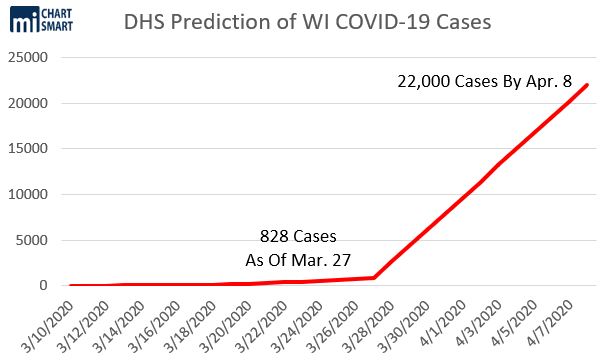
In one of our most popular stories, Palm makes a series of direpredictions for the following two weeks if Wisconsinites don’t follow Safer at Home. Palm then goes on to say that Safer at Home won’t have any impact on the numbers for “several weeks.” When her predictions didn’t come true, Palm attempts to redefine what her predictions were in the first place.
The best part is you don’t have to take MacIver’s word for any of this. Palm said all this on camera and the videos are still posted to DHS’ YouTube account.
Additionally, Palm did not share DHS’ model when she first made her prediction on Mar. 24th. To illustrate her prediction, MacIver released a simple chart showing Wisconsin’s numbers for that date and what Palm said those numbers would be in two weeks. The resulting visual was jaw-dropping, revealing more flaws in the official narrative. When DHS finally released its model, the public learned it wasn’t a model so much as it was a simple equation. The department planned on Wisconsin’s number of new cases doubling every 3 days, and continued that assumption even after it was disproven.
Our video story and accompanying charts prevented Palm from pulling the wool over the public’s eyes. That’s what authentic journalism is all about. Since you can’t find stories like this anywhere else, it’s safe to say the MacIver News Service is your only source for authentic journalism in Wisconsin.
Incredibly, there are those who believe calling out public officials and challenging government narratives like this “muddies the waters.” Sure, this might be difficult for, say, a “cyber security expert” to grasp. However, not everyone is trained to understand the fundamentals of journalism or statistics. Even some freelance “journalists” struggle with these concepts. All we can do is encourage them to keep trying.
We’re fortunate at the MacIver Institute and the MacIver News Service to have lots of loyal followers, who know what we bring to the table. By applying the basic principles of statistics and journalism to data produced by the state government, we’re able to provide some of the most unique and valuable coverage you can’t find anywhere else.
It doesn’t always support the official narrative, but if that’s what you’re looking for, you have plenty of other options out there.
I joked the other day that the media doesn’t do multivariate, but it wasn’t a joke. Sometimes it imposes a hard cap on what we can achieve with public policy when the press can’t fulfill its necessary communication function.
This column isn’t about Sweden, but the press now claims Sweden’s Covid policy is “failing” because it has more deaths than its neighbors. Let me explain again: When you do more social distancing, you get less transmission. When you do less, you get more transmission. Almost all countries are pursuing a more-or-less goal, not a reduce-to-zero goal. Sweden expects a higher curve but in line with its hospital capacity. Sweden’s neighbors are not avoiding the same deaths with their stronger mandates, they are delaying them, to the detriment of other values.
The only clear failure for Sweden would come if a deus ex machina of some sort were to arrive to cure Covid-19 in the near future. Then all countries (not just Sweden) might wish in retrospect to have suppressed the virus more until their citizens could benefit from the miracle cure.
Please, if you are a journalist reporting on these matters and can’t understand “flatten the curve” as a multivariate proposition, leave the profession. You are what economists call a “negative marginal product” employee. Your nonparticipation would add value. Your participation subtracts it.
Let’s apply this to the U.S. Americans took steps to counter the 1957 and 1968 novel flu pandemics but nothing like indiscriminate lockdowns. Adjusted for today’s U.S. population (never mind our older average age), 1957’s killed the equivalent of 230,000 Americans today and 1968’s 165,000. So far, Covid has killed 57,000.
Before patting ourselves on the back, however, notice that we haven’t stopped the equivalent deaths, only delayed them while we destroy our economy and the livelihoods of millions of people.
That’s because public officials haven’t explained how to lift their unsustainable lockdowns while most of the public remains uninfected and there’s no vaccine.
Hopefully we will demonstrate our mettle in the next chapter but I have yet to see it.
More than 50 people who voted in person or worked the polls during Wisconsin’s election earlier this month have tested positive for COVID-19 so far.
The state Department of Health Services reported the latest figures on Tuesday, three weeks after the April 7 presidential primary and spring election that drew widespread concern because of voters waiting in long lines to cast ballots in Milwaukee.
Wisconsin Emergency Management spokesman Andrew Beckett says several of the 52 people who have tested positive and were at the polls also reported other possible exposures.
Vince Vitrano of WTMJ-TV in Milwaukee:
There was no election day surge.
I appreciate the compliments from many of you that suggest you agree I’ve been presenting math without bias or opinion. I share here, no politics… just numbers on this important issue.
Out of an abundance of caution (popular phrase) I waited an additional week beyond the typical 14-day incubation window for COVID-19 to allow for delayed reporting and/or test results that would indicate a spike in positive cases surrounding in-person polling on April 7th.
It didn’t materialize.
Highest number of daily COVID-19 deaths (19) reported back on April 4. Pre election.
Highest number of daily COVID-19 hospitalizations in Wisconsin (446) reported April 9th. Only 2 days post election.
April 22nd, we did see the highest number of positive COVID-19 tests as a percentage of the sample size, at 11.9%. Front end of the election day surge?
It didn’t hold. It was a one day jump, followed by another two days decline that has now fallen in the latest numbers to 7.6%. See the attached chart which reflects exactly what health officials have been preaching for weeks… a “flat” curve. It’s up. It’s down. It’s up. It’s down. It’s net is flat.
Both State DHS Secretary Designee Andrea Palm and Dr. Ryan Westergaard, the State’s Chief Medical Officer both answered last week direct questions on the election and neither said they could see an election related spike.
Nothing has changed since those statements were made as the green line reflects on the attached graph… a flat trend.
WHAT I DID NOT SAY
I didn’t say having in-person voting on April 7th was a good idea. I take no public position on that, as it’s a matter of opinionated debate.
I didn’t say none of the people who voted or worked the polls got sick.
I didn’t say Governor Tony Evers was right or wrong to try to postpone the election.
I didn’t say Republican leadership was right or wrong to block the effort.
I didn’t say the courts made the right or wrong decisions with regard to the questions put before them.
You’re entitled to your opinion on the wisdom of proceeding with the election in the manner that we did.
I simply now report three weeks post election that the surge some feared, others predicted, did not happen.
FINALLY
Regardless of whether you thought there’d be a surge or not… shouldn’t this be regarded as good news? This much I share my opinion on… I want Wisconsin and our people to be healthy and strong and vibrant.
Nobody likes the Packers fan who predicts we’re going to get blown out on Sunday… and then actively roots against his own team just to prove he was right. Every time I’ve ever bet against the Pack, which at times is where the smart money is, I’ve wanted in my heart to be wrong.
Let’s all breathe a sigh of relief and continue to hope we’re closer every day to getting people back to work.
According to The New York Times coronavirus report, as of Sunday, April 19, 2:48 p.m. Eastern Standard Time, there were 35,676 COVID-19 deaths in the United States. Of those deaths, 18,690 were in the New York metropolitan area.
(The New York metropolitan area is generally regarded as consisting of the five boroughs of New York City, the five New York State counties surrounding New York City — Nassau, Suffolk, Westchester, Rockland and Orange — and the populous parts of New Jersey and Connecticut.)
That means that more than half (52%) of all deaths in America have occurred in the New York metropolitan area.
What makes this statistic particularly noteworthy is that the entire death toll for 41 of the other 47 states is 7,661. In other words, while New York has 52% of all COVID-19 deaths in America, 41 states put together have only 21% of the COVID-19 deaths. And all the 47 states other than New York, New Jersey and Connecticut have less than half (48%).
Now let us imagine that the reverse were true. Imagine that Georgia and North Carolina — two contiguous states that, like the New York metro area, have a combined total of 21 million people — had 18,690 COVID-19 deaths, while metro New York had 858 deaths (the number of deaths in North Carolina and Georgia combined).
Do you think the New York metro area would close its schools, stores, restaurants and small businesses? Would every citizen of the New York area, with the few exceptions of those engaged in absolutely necessary work, be locked in their homes for months? Would New Yorkers accept the decimation of their economic and social lives because North Carolina and Georgia (or, even more absurdly, Colorado, Montana or the rest of what most New Yorkers regard as “flyover” country) had 18,960 deaths, while they had a mere 858?
It is, of course, possible. But I suspect that anyone with an open mind assumes that New Yorkers would not put up with ruining their economic and social lives and putting tens of millions of people out of work because of coronavirus deaths in North Carolina and Georgia, let alone Montana and Idaho (and, for the record, I would have agreed with them).
Even more telling, the media, which controls American public opinion more than any other institution, including the presidency and Congress — but not churches and synagogues, which is why they loathe evangelicals, traditional Catholics, faithful Mormons and Orthodox Jews — would not be as fixated on closing down the country if it were killing far more people in some Southern, Midwestern, Mountain or Western states than in New York City.
The media is New York-based and New York-centered. New York is America. The rest of the country, with the partial exception of Los Angeles (also a media center) and Silicon Valley, is an afterthought.
Having grown up and attended college and graduate school in New York, and having lived in three of the city’s five boroughs, I know how accurate the most famous New Yorker magazine cover ever published was. The cover’s illustration depicted a New Yorker’s map of America: New York City, the George Washington Bridge and then San Francisco. The rest of the country essentially didn’t exist.
One would have to visit people who had never left their rural village in a developing country to find people more insular than New York liberals, which is what nearly all New Yorkers are.
One of the turning points of my life occurred when I was 24 years old and went to give a talk in Nashville, Tennessee. My assumption, having lived all my life in New York, was that I would be meeting and talking to what essentially amounted to country bumpkins. Not only were they not New Yorkers; they were Southerners.
What I found instead was a beautiful city with kind and highly sophisticated people. No one I met was as cynical as most New Yorkers, who confuse cynicism with sophistication. It was on that trip that I decided to leave New York. When I moved to California two years later, my friends, and every other New Yorker I spoke to on visits back to New York, asked why I left and when I was coming back. To most New Yorkers, to leave New York is to leave the center of the world; it is leaving relevance for irrelevance.
In his latest column, New York Times columnist Thomas Friedman inadvertently revealed how New York-centric his view of America is. Friedman, like virtually all his colleagues at The New York Times, opposes opening up any state in America at this time. He writes: “Every person will be playing Russian roulette every minute of every day: Do I get on this crowded bus to go to work or not? What if I get on the subway and the person next to me is not wearing gloves and a mask?”
Only a New Yorker would write those two sentences. In the 40 years I have lived in the second-largest city in America, I have never ridden on the subway or any other intraurban train or bus. In fact, it is common for New Yorkers to look at Los Angeles with disdain for our “car culture.” Like the vast majority of Americans everywhere outside of New York City, in Los Angeles, most of us get to work, visit family and friends, and go to social and cultural events by car — currently the life-saving way to travel — not by bus or subway, the New Yorker way of getting around.
But Friedman is a New Yorker, and because his fellow New Yorkers walk past one another on crowded streets and travel in crammed buses and subway cars, South Dakotans should be denied the ability to make a living.
The same thing is happening in Wisconsin. Milwaukee County has half of the state’s coronavirus cases, and six counties — Milwaukee, Brown, Dane, Waukesha, Racine and Kenosha counties — comprise 80 percent of this state’s cases. But the Evers administration wants to quarantine the entire state because of the possibility someone could get the coronavirus.
If they wanted to cordon off those six counties, fine. (For that matter, if Milwaukee and Dane counties disappeared into hell I wouldn’t lose sleep.) Evers does not have the right to destroy the entire state’s economy because his voters breed disease.
The MacIver Institute reports what state media won’t about Gov. Tony Evers’ Badger Bounce Back:
Governor Evers released his Badger Bounce Back plan earlier this week, a supposed guide on what needs to happen for the Governor to start easing his shelter-in-place order, lifting oppressive restrictions on businesses and slowly beginning the process of reopening Wisconsin. While the Governor has tried to portray the Badger Bounce Back plan as a legitimate attempt to systematically reopen the economy in an orderly fashion, our analysis finds that the Governor’s metrics are not attainable in the next couple of weeks or even the next few months. Instead, the requirements seem both incredibly difficult to achieve and deliberately vague so the Governor can keep all of us trapped in our homes this summer and keep Wisconsin’s economy closed until the fall.
On March 24, Governor Evers and his administration issued Safer at Home, the shelter-in-place order that confined Wisconsinites to their homes, allowed only “essential” businesses to stay open with restrictions, closed schools and severely limited normal, everyday activity. The rationale for taking this drastic step was that Safer at Home would slow the spread of COVID-19 and “prevent spikes in COVID-19 cases that could further strain our healthcare system and risk more lives.” The most recent data shows that we accomplished both of these goals.
During the first two weeks of Safer at Home, Wisconsin averaged 152 new cases a day. The next two weeks, the state averaged 146 new cases a day. Since then, because of a localized spike in Brown County, the average jumped to 216 a day. Without that incident in Brown County, Wisconsin would still be averaging about 150 cases a day. The large spike of diagnosed cases and the need to hospitalized those who voted in Milwaukee on April 7th has not materialized as some predicted. There will be isolated situations like the meat packing plant in Green Bay that pop up from time to time but we have generally flattened the curve here in Wisconsin. Remember, we needed to shelter in place so that we could flatten the curve to prevent our health care system from being overwhelmed.
Even now, as testing increases statewide, the percentage of positive diagnoses out of all tests conducted remains at an average low of 9.8%. But now that the original Safer at Home goals have been satisfied, the Badger Bounce Back seems to be moving the goal line back just as we are about to go in for a touchdown. Instead of talking about opening up our economy and how we return to some resemblance of normalcy, Evers is moving the target and making it unlikely we will be allowed out of our homes and allowed to go back to work any time soon.
According to Badger Bounce Back, in order to eventually move beyond Safer at Home, Wisconsin will need to show progress in several “gating criteria” and demonstrate the capacity to reach certain “core responsibilities.” Essentially, the gating criteria and core responsibilities are two different types of requirements that will be used by the Governor to determine if we are ready to open back up. If and when we reach or accomplish these 14 new and separate conditions, we move to a less restrictive phase of the Governor’s plan.
The first requirement is 14 consecutive days where reports of influenza-like illness show a downward trend. The second requirement is 14 consecutive days where reports of COVID-19-like illness show a downward trend. The third requirement is a “downward trajectory of positive [COVID-19] tests as a percent of total tests within a 14-day period.”
What immediately jumps out is the strange addition of the requirement that flu-like illness show a downward trend. This is a COVID-19 public health emergency, not an influenza public health emergency. The two diseases have not been connected nor discussed in tandem since this began. Why now? Every flu season is widespread across Wisconsin and the entire country. According to DHS, there were 17,000 diagnosed flu cases last season, and that’s with a flu vaccine. We haven’t been able to prevent the spread of the flu before COVID-19, so why does the Evers administration think we will be able to show a downward trend of the flu for 14 consecutive days while we are trying to contain COVID-19?
As for the second requirement of 14 consecutive days of a downward trend in COVID-19-like illness, Wisconsin’s daily new diagnoses of COVID-19 has been bouncing around between 130 – 200 a day for a few weeks now. This week, because of Brown County, we are up to 216. Some days we are up. Some days we are down. Everyone agrees that we have successfully contained the spread of COVID-19 in Wisconsin but we have not experienced 14 consecutive days heading down. It is improbable that Wisconsin will see daily diagnoses decrease each day for 14 days straight any time soon. In reality, it would be six months from now, at the earliest, that we would see such a complete and absolute drop.
Evers clarified for reporters during his announcement that the requirement is, indeed, for 14 “straight” days of decline. So if we are heading downward for 7 consecutive days and then on the 8th day, we pop back up, maybe back up even for a couple of days, the timeline to satisfy this requirement resets all the way back to day 1. He also explained that everything must decline simultaneously. Therefore, if there is one day of increased reporting for flu-like symptoms, which is likely given how widespread the flu is, we start the count over for everything.
What if it takes until the fall for COVID-19 symptoms and diagnoses to be on the decline for two weeks? By then, the seasonal flu may be back on the rise, which will prevent the state from meeting the conditions to move to the next phase, or even stay in whatever phase in which we happen to be.
The fourth requirement that must be met before Evers will begin the process of reopening Wisconsin is for hospitals “to treat all patients without crisis care.” Notice, it does not specify COVID-19 patients without crisis care but ALL patients without crisis care. Again, why Governor Evers would inject a non-COVID metric into his plan to combat COVID-19 is a real head-scratcher. If only MacIver had access to his public press events so we could ask him these basic questions that all Wisconsinites want to know the answers to but he never seems to get asked. If only…
The fifth requirement is that hospitals must have “robust” COVID-19 testing programs for “at-risk healthcare workers.” The sixth requirement is that the testing programs at these hospitals show a “decreasing number of infected healthcare workers.”
What a “robust” testing program for healthcare workers looks like is not defined in the plan. It’s not defined on the DHS’ resource page for health care providers either. One would think that a “robust” testing program for frontline workers would have been a first priority at the beginning of the state of emergency back in March.
The seventh requirement to be met before reopening the state is having enough testing capacity in the state so that every Wisconsin resident who has COVID-19 symptoms is tested. Right now, we have the capacity to test approximately 7,200 individuals a day or 49,000 tests per week. In reality, however, Wisconsin is only testing approximately 1,500-1,600 individuals every day. The greatest amount of tests administered in a day was 2,246 on April 3. Gov. Evers has never explained why we test so few individuals for COVID-19 when our existing capacity is so high. DHS’ Chief Medical Officer Dr. Westergaard has said it’s possible that, “There’s not a demand because there are not that many sick people.” If we cannot reach the full number of the testing capacity we have now, why is the Governor adding an even more exacting standard into the mix?
The eighth requirement would mandate that COVID-19 test results be available to the patient and to local public health officials within 48 hours of testing. This is a laudable goal and, quite frankly, we are not sure why this requirement isn’t being met right now. If we are truly in a public health emergency, one of the keys to responding to the spread of the disease should be quick turnaround on testing. How long is it taking right for test results to come back? Again, if only we could ask Gov. Evers questions.
At the end of this requirement, Gov. Evers mentions that the ultimate goal is to conduct 12,000 tests per day or 85,000 tests per week in the state. Again, right now we have testing capacity of over 7,000 tests per day but we only test approximately 1,800 to 2,000 individuals a day. How realistic is it, then, to think we could nearly double testing capacity or find 12,000 people every day to test anytime soon?
The tenth requirement would see DHS hire up to 1,000 new contact tracers to combat COVID-19. Contact tracers are paid to keep tabs on every person identified as COVID-19 positive, force them to quarantine or self-isolate, interview the diagnosed to identify individuals the diagnosed may have been in contact with while infected, and then work to get those contacts to quarantine or isolate. There are currently thousands of vacant or unfilled positions in state government so there is no need to create1000 brand new jobs for these tracers. We also have deep privacy concerns about how this army of investigators conducts themselves. We will leave that discussion for another day.
The eleventh requirement is that DHS “implement technology solutions to ensure everyone who is infected or exposed will safely isolate or quarantine.” We find number eleven even more unnerving than the contact tracers. The plan doesn’t define “technology solutions to ensure everyone who is infected or exposed will safely isolate or quarantine” but it sounds eerie and Orwellian. Are we talking about ankle bracelets to ensure those infected stay in their home or in a certain room? Or drones that hover 24/7 over your house or apartment and monitor your every move?
Requirement number twelve states that we must build “on systems used to track influenza and the COVID-19 pandemic, track the spread of COVID-19 and report on the Wisconsin Gating Criteria and other related metrics.” Aren’t we doing this right now? Was the DHS not tracking the coronavirus spread already? By including a requirement for a tracking system as a requirement for advancing through phases, it suggests that we do not or cannot currently track the spread of COVID-19. That can’t be true, can it? Very strange.
The thirteenth requirement lays out what Wisconsin needs in terms of Personal Protective Equipment (PPE) to reopen. It requires the Evers administration to “procure PPE and other necessary supplies to support health care and public safety agencies.” Again, the order doesn’t specify or detail exactly how much PPE we need. The press has even asked Evers for a specific goal on PPE but he has refused to put a number on it. “Well, certainly, we aren’t satisfied with the amount of PPE we do have,” Governor Evers said on April 20. “We know what adequate isn’t and that’s where it is right now. We believe we can get to that point where we feel confident that the equipment going forward is adequate. I don’t have any recent numbers…” The wording is just vague enough for the Evers administration to one day say “nope, still not enough PPE” and derail the state’s progression to reopening.
The fourteenth requirement is probably the most ambiguous of all the requirements, and that is saying something. The fourteenth requirement states that we must “assess the need for and readiness to support surge capacity for our healthcare system.” Again, Governor Evers is scant on details or metrics. What exactly “support surge capacity” would look like isn’t given a framework in this plan. Does this refer to the alternative care facilities at the State Fair Park and the Alliant Energy Center, or does it refer to other measures the administration has yet to tell us about? The requirement also raises the question, yet again, what has the DHS been doing up until now if number fourteen is a brand new concept that needed to be included in this new plan? The language is extremely generic and allows for the Evers administration to decide–without measurement–that the state is still not doing enough to meet this requirement and keep us in lockdown for however long they see fit.
We will need to “make progress” towards satisfying all fourteen of the above requirements before we move out of the current shelter-in-place order to Phase 1. How much progress must be achieved towards the 14 requirements is not specified in the order nor is the administration giving any sincere indications of what that progress looks like. The same 14 requirements will then need to be met again before moving to another phase. This means that if even one condition isn’t met, there’s potential to fall back a phase or more, or stay trapped in a phase until all conditions are met again.
When Wisconsin finally reaches Phase 1, the state will allow gatherings of up to 10 people, K-12 schools and child care facilities to resume normal in-person operations, and restaurants will be open with some limitations. Non-essential businesses may remove some limitations, but those remain unspecified until the Phase 1 order is issued by the DHS.
As Emergency Order #28 states, “Public and private K-12 schools shall remain closed for pupil instruction and extracurricular activities for the remainder of the 2019-2020 school year.” If schools are not allowed to reopen until Phase 1 of the Badger Bounce Back plan, this implies again that Phase 1 won’t be achieved until the fall, five months from now. Phase 1 also allows gatherings of up to 10 people. How exactly are schools supposed to be in session with only nine students and one teacher allowed in a room? You could argue that this would allow summer schools to open for classrooms of 10 people, but then that begs for clarity from Order #28 on when exactly the “2019-2020 school year” ends. The more probable interpretation is Phase 1 taking place in the fall. In any case, the contradictions make for a confusing transition to reopening the state.
Phase 2 will allow gatherings of up to 50 people, restaurants to fully operate, bars and non-essential businesses to open with restrictions, and post-secondary schools to consider reopening. This phase doesn’t clarify why restaurants can reopen before bars and doesn’t clarify why K-12 schools can reopen before post-secondary schools can even consider reopening (see the language in the chart below). What Phase 2 does make clear is that post-secondary schools can’t even plan to reopen until at least 14 days after K-12 schools have.
Phase 3 will open the state almost completely, end physical distancing requirements, and recommend only minimal protective measures for the general public. More strict protective measures are prescribed for the vulnerable population. Until Phase 3 people above the age of 60 are told to still shelter in place. Sorry if you are a teacher, bartender, or business owner above 60 years old. Even if your workplace is allowed to reopen earlier, you won’t be able to go back to work until Phase 3, many months down the road.
“Unnecessary” visits to group living settings and hospitals are banned even after Phase 3. Such visits are cancelled indefinitely “until a vaccine is available.”
The Badger Bounce Back allows the DHS and WEDC to issue additional orders to remove restrictions on “certain businesses or sectors” if removing them won’t have a huge impact on meeting the gating criteria. While this sounds encouraging, the tone of the order itself and lack of specificity contained within the order does not give us hope that WEDC will look for reasons for businesses to reopen. We fear that WEDC will be creating even more hurdles that prevent a private business from determining for themselves how to safely reopen and ensure their workers can do their jobs safely.
Here is again where the plan contradicts itself and the Governor. When asked about the Safer at Home extension, Evers said on April 16, “This is a statewide, comprehensive plan and we can’t just parcel off parts in the state and leave them high and dry.” This would suggest that just days before announcing the Badger Bounce Back, Evers preferred a one-size-fits-all approach to reopening the state. But the powers given to local health authorities and the DHS say the exact opposite. Instead, local health officials may clamp down on and stunt the progress of local economies as they see fit. That’s a scary concept when Evers’ generic language in the plan doesn’t limit what those officials can decide.
What the Badger Bounce Back plan lacks the most is common sense and reality. Wisconsin is not New York. Wisconsin is not California. As of April 22, Wisconsin had identified 4,845 COVID-19 virus diagnoses, 1,302 hospitalizations, and 246 of our fellow Wisconsinites have passed away from the virus. Life is precious and the loss of life cannot and should not be minimalized. Thank God we have experienced far fewer deaths and hospitalizations than any of the hot spot states. Unlike other states, Wisconsin has also never experienced the surge that overwhelmed our hospitals and our healthcare system that some gravely predicted. So why is Evers forcing on Wisconsin a plan more appropriate for a hot spot state? The same plan that is necessary for New York to respond and recover will not work for Wisconsin and is unnecessary. Gov Evers needs to start creating a solution that works for Wisconsin.
Rather than establishing a tailored plan for Wisconsin to get back to work, the Badger Bounce Back is merely a plan to think of a plan to come up with a plan… to maybe reopen the state this fall. By then, it will be too late for countless Wisconsinites, business owners, home owners, employees, everyone. Everyone except the chosen few, lucky enough to work for government. For the rest of us Wisconsinites, the BBB plan, like Safer at Home before it, leaves us with more questions and concerns about the vague language and unquantified metrics.
Since the state Legislature appears to lack the resolve to vote to overturn the latest Safer at Home order, apparently we are reliant on the Supreme Court to make the correct decision. Swell.

 Steve Prestegard.com: The Presteblog