“Since the beginning of Wisconsin’s Covid-19 response we have repeatedly witnessed an uneven leadership from Governor Tony Evers and DHS Secretary-Designee Andrea Palm in regards to their use of public health orders. In early March, they utilized modeling developed by DHS with dire projections of cases and deaths to justify enactment of harsh restrictions on the people and businesses of Wisconsin. That model was proven to be flawed since it relied heavily on questionable data from China and Italy.
Each passing week, Secretary-Designee Palm increasingly stoked fears in her briefings of pending and unavoidable spikes in Covid-19 cases statewide, even though actual data on Covid-19 has been stable and the so-called “curve” has flattened.
Governor Evers and DHS have shown no concerns regarding the highly negative impacts of their orders on the economy and the ability of the public to access health care treatments for other serious medical concerns. That lack of addressing broader health care access for non-Covid-19 issues in fact jeopardizes the health of many citizens in need of care.
[Thursday], Governor Evers and Secretary-Designee Palm extended the order but claimed there were significant loosening of the rules. However, upon closer inspection of the new order it has key parts that are in reality tightening of the current rules for many businesses. The new order even seems to encourage local governments to close their parks and public spaces if a small number of citizens don’t cooperate.
It is now abundantly clear that Governor Evers’ administration will not act reasonably in developing a phased plan to safely reopen Wisconsin without being forced to by the people, the legislature and the courts.
I recommend the following actions should be taken in response:
1.) Impacted citizens, businesses and the legislature should consider filing lawsuits challenging elements of the order and the constitutionality of provisions of Chapter 252 of the Wisconsin Statutes (the power of DHS and local health departments to issue public health orders).
2.) An extraordinary session of the legislature should be convened to pass legislation limiting the expansive powers of the DHS and local health departments in issuing public health orders without proper justification and a process for reasonable legislative oversight and ability to end orders by joint resolution.
3.) During the same extraordinary session the State Senate should consider the executive appointment of Andrea Palm as DHS Secretary and reject it.
4.) Call upon Governor Evers to work with the legislature to craft a plan to address public health in response to Covid-19 and safely reopen Wisconsin utilizing CDC guidelines on social distancing, operation of businesses, K-12/higher education and churches/religious entities. The plan should prioritize compliance with constitutional limitations on government, provide the necessary Covid-19 testing resources and enhancing the supply of PPE.”
In these unprecedented times, citizens and business across our state have been drastically impacted by the government shutdown of our economy during the COVID-19 crisis. However, the Executive Branch does not have unchecked authority in such a crisis. To impair fundamental rights – as gathering bans, etc. do – the government must have a compelling state interest to do so AND must do so in a narrowlytailored and least restrictive means possible under the constitution. Without additional clarity by the executive branch, it is clear that this authority has been exceeded. During this and future times of crisis, the people of Wisconsin need the surety, specificity, and constitutional consideration that would come from actions of the Legislature done in coordination with the Executive Branch. In an effort to alleviate the uncertainty surrounding the cascade of Emergency Orders and the negative impacts they have had on our fundamental civil liberties and the state’s economy, I am introducing legislation to provide legislative oversight of the Executive Branch during times of emergency or pandemic. The measures include: – Requiring legislative approval of any statewide “shelter-in-place” order for reasons of pandemic or infectious disease – Requiring legislative passive review of any “Emergency Declaration” after 30 days, with affirmative approval needed for a state of emergency lasting longer than 60 days – Requiring a written report detailing the satisfaction of strict scrutiny concerns be given to the legislature prior to a ban of gatherings of 50 or fewer is to be in effect – Requiring an immediate report to the legislature of arrests for mass gathering violations These are measured and appropriate checks which re-assert the Legislature’s role in establishing the appropriate, constitutionally-required balance between public safety, economic impact, and constitutional rights in times of emergency.
Remember when legislators were concerned about the role of the legislative branch in balance of power in government? Notice how silent Democrats in the Legislature have been about their governor’s usurping power? (Republicans didn’t bring that up either under Gov. Scott Walker.)
Palm needs to go, and Evers and whoever replaces Palm needs to be reigned in. No one elected a DHS secretary — or, for that matter, county health departments — to have dictatorial power.
As we complete the fourth week of lockdown, many Wisconsinites are wondering how long this extraordinary state of affairs can continue and how it might end. And what happens if the Governor and Legislature cannot agree on what happens next?
These questions were given fresh urgency [Thursday] after DHS Secretary-designee Angela Palm unilaterally determined that the “Safer at Home” order would continue through May 26, 2020, beyond the expiration of the Governor’s emergency declaration. But does the Evers administration really have the authority to order the widespread closure of churches, schools and businesses for another month without legislative input?
The following is an analysis of whether the Governor has that authority. While a stay-at-home order is subject to various constitutional limitations, it does not address what particular combination of legally permissible social-distancing provisions would be best.
Wisconsin under a Public Health Emergency
On March 24, Governor Evers issued Emergency Order #12, the so-called “Safer at Home” Order. The Order currently expires on its own terms at 8:00 a.m. on Friday, April 24, 2020, and cites two sources of legal authority. While it is on the joint letterhead of Governor Evers and Secretary-designee Andrea Palm, the Acting Secretary of the Department of Health Services (“DHS”), it is signed solely by Secretary-designee Palm, who claims the authority under Wis. Stat. 252.02(3) and (6). The Order also relies upon Governor Evers’ Executive Order #72 (declaring a public health emergency).
Then, with the expiration of Order #12 looming, on April 16, 2020, Secretary-designee Palm issued an updated version of the Order, Order #28, which takes effect upon the expiration of the first order and is itself set to expire at 8:00 a.m. on Tuesday, May 26, 2020. Like Order #12, Order #28 is on joint letterhead and signed solely by Secretary-designee Palm. Unlike Order #12, however, it does not rely on Governor Evers’ Executive Order #72; it relies on Wis. Stat. 252.02(3), (4), and (6).
The legal authority of Governor Evers and Acting Secretary-designee Palm
The Governor’s Emergency Declaration. Governor Evers issued Executive Order #72 on March 12, 2020. In that Order, he declared that a public health emergency existed in Wisconsin due to COVID-19 and designated the Department of Health Services (DHS) as the lead agency to respond to this emergency. Once an emergency is declared, the Governor has apparently broad power under Chapter 323 of our statutes. For example, Wis. Stat. 323.12(4)(b) says that, upon the declaration of a state of emergency, the Governor may issue “such orders as he or she deems necessary for the security of persons and property.” But these powers are not as extensive as they might first appear to be. They are subject to limits imposed by the state constitution and may be construed narrowly by the courts. For example, the Wisconsin Supreme Court recently held that Chapter 323 does not authorize the Governor to rewrite or suspend statutes and, therefore, ruled that he may not postpone an election set by state statute. Wisconsin Legislature v. Evers, Case №2020AP608-OA (Wis. Apr. 6, 2020)
In addition, declarations of an emergency have a shelf life. They may continue for sixty days unless they are revoked by a joint resolution of the Legislature. They may be extended beyond those sixty days only by a joint resolution of the Legislature. In other words, the emergency can be ended by the Legislature at any time and can continue after sixty days only if the Legislature votes to extend it. For this reason, the emergency declared by Executive Order #72 will end on May 11, 2020. Unless the Legislature passes a joint resolution extending the emergency, the Governor’s emergency powers under Chapter 323 will expire. The second Safer at Home order appears to recognize this fact; gone is any reliance on authority provided under Order #72.
DHS Powers Under Chapter 252. But that is not the end of the matter. As noted earlier, Order #12 ordering Wisconsin residents to stay home subject to certain sections also invokes powers granted to it by Sections 252.02(3) and (6). And Order #28 adds reliance on 252.02(4).
Section 252.02(3) states that “[t]he department may close schools and forbid public gatherings in schools, churches, and other places to control outbreaks and epidemics, and Section 252.02(6) states that “[t]he department may authorize and implement all emergency measures necessary to control communicable diseases.” Finally, sub. (4) authorizes Secretary-designee Palm to “promulgate and enforce rules or issue orders for guarding against the introduction of any communicable disease into the state, for the control and suppression of communicable diseases, for the quarantine and disinfection of persons, localities and things infected or suspected of being infected by a communicable disease and for the sanitary care of jails, state prisons, mental health institutions, schools, and public buildings and connected premises.”
The powers of DHS without a Public Health Emergency declaration
To begin, we must engage in some close legal reasoning. Courts must construe the powers conferred on the Governor by Chapter 323 and those conferred by on DHS by chapter 252 together. They cannot read one (chapter 252 giving DHS the power to, among other things, forbid public gatherings) in a way that renders the other (chapter 323 giving the Governor the power to declare a public health emergency) superfluous. If chapter 252 allows a gubernatorial appointee (Secretary-designee Palm) to do everything that the Governor can do under Chapter 323, only without the limits imposed on the declaration of a public emergency, then Chapter 323 becomes meaningless. That won’t happen.
So, we begin with at least a very strong presumption that the powers conferred by Chapter 252 are different than those authorized by Chapter 323. What might that mean? We have almost no case law construing these statutes. But if the Legislature ends the state of emergency, it is reasonable to conclude that DHS would lose its powers under section 252.02(6), since that section only refers to “emergency” measures. In fact, DHS may also lose its authority under section 252.02(3) and (4) to close schools and forbid public gatherings and the like because, even though those provisions do not reference an “emergency,” it would make no sense to grant broader powers to DHS than to the Governor. In addition, if there is no longer a public health emergency, there is no longer a legal basis to conclude that closing schools or forbidding public gatherings or issuing similar orders is required to “control outbreaks and epidemics” or to “control and suppress[] . . . communicable diseases.” Whether the Legislature would be correct to decline to extend the public health emergency is a different question. It is a matter of policy and not law which courts are very unlikely to second guess.
Thus, the bases for the Safer at Home Order (or any similar order) would likely not survive an end to the Governor’s emergency declaration.
Second, even if it could be argued that DHS’s powers under Section 252.02(3)-(4) could survive the Legislature’s refusal to extend a state of emergency, there would still be significant constitutional and statutory limitations on what DHS could lawfully do.
Let’s begins with limits imposed by the statute itself. Under sub. (3), DHS’s powers are specifically limited to closing schools and forbidding “public gatherings in schools, churches and other places.” Closing schools is relatively straightforward but what is a “public gathering?” The statute doesn’t tell us and the term has not been considered by the courts. At minimum, it cannot apply to small groups of friends and family.
Nor does it seem likely to apply to the operation of many businesses. Patronage of a retail store or business providing personal services would not normally be considered a “public gathering.” The functioning of an office or a factory would not typically be called a public gathering. A landscaper or painter coming to a home does not create a public gathering. In addition, under standard rules of statutory construction, the “other places” referred to must be places like schools and churches. Residences and private businesses are not in that category.
While counter-arguments can and will be made, it seems likely that, even if Secretary-designee Palm can continue to issue orders under Chapter 252 after Governor Evers may no longer issue them under Chapter 323, the public gatherings that she can forbid are likely to be limited to large assemblies.
At first glance, sub. (4) might appear to be a more open-ended grant of authority in terms of what it allows Secretary-designee Palm to regulate. But the power delegated by sub. (4) is bounded by the requirement that Secretary-designee Palm “promulgate and enforce rules or issue orders.” The promulgation of a rule involves substantial legislative oversight and an opportunity for public comment. And it would be absurd to allow Secretary-designee Palm to circumvent these safeguards by simply issuing orders. Consequently, the ability to issue an order is best read to allow Secretary Palm to enforce compliance with existing laws or rules, not to create new administrative powers out of whole cloth. In addition, the provision permitting DHS to take steps “for the control and suppression of communicable diseases” must itself be read consistently with sec. 252.03 and, to the extent that DHS seeks to forbid assemblages of persons, it may not go beyond the limitations implicit in the latter section.
Constitutional limits on emergency powers
That’s just the statutory analysis. In addition, any order issued by either Governor Evers or Acting Secretary-designee Palm are subject to constitutional limitations. As a general matter, the interest that the government seeks to advance must be balanced against the restriction on liberty and must be sufficiently narrow. That balancing will be most exacting when a restriction — here the forbidding of a public gathering, for example — burdens a fundamental constitutional right such as the freedom of speech and assembly, the right to worship, and the ability to maintain family relationships. Closing of schools in a way that impairs the right to a free and uniform public education may also be more closely scrutinized. Other fundamental rights may be implicated as well. This judicial scrutiny will ask not only if some restriction is warranted, but also whether the particular restriction is narrowly tailored to what is necessary to control the spread of the virus.
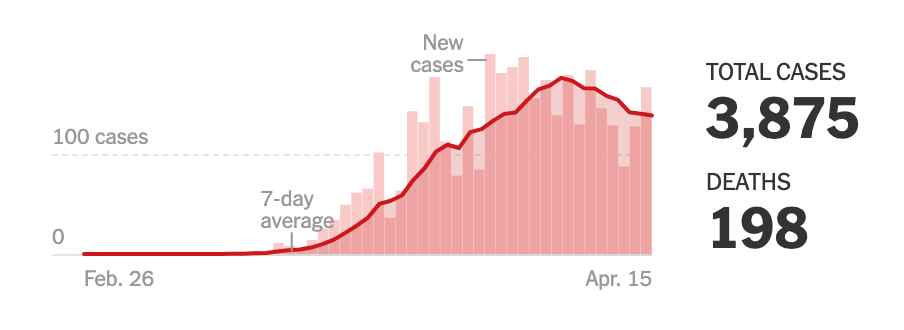
While courts will be more deferential to restrictions on public gatherings that do not implicate fundamental rights, the state will have to offer some justification. Whether a fundamental right is implicated or not, as time goes on, the underlying circumstances of the pandemic may limit whatever authority DHS retains. For example, when the Safer at Home Order was issued the number of COVID-19 cases in Wisconsin was rising rapidly. That is no longer true. Per the graph published by the New York Times on April 16, 2020, the curve in Wisconsin has flattened and even bent downward:
Whether or not the trend in the spread of the virus is due to social distancing or what turned out to be an overly pessimistic view of the virus’ likely course, the situation on the ground will eventually impact the constitutional analysis. While this may not be true today — courts are likely to be broadly deferential — a continuation of what seems to be the current trend will matter.
Finally, something must be said about the Legislature’s ability to delegate authority to Secretary-designee Palm and the Department of Health Services. Under what is known as the nondelegation doctrine, the Legislature may not simply give away its legislative power to an executive branch agency. It must either provide strict standards on its exercise or adequate procedural safeguards to ensure that the agency does not become a miniature Legislature. DHS’ ability to issue sweeping orders only vaguely authorized by broadly-worded statutes is far from clear.
Conclusion
My purpose here is not to suggest what “should” happen in the coming weeks. That question is separate from the legal analysis which goes to who decides and what constitutional limits they face. Nor is this a law review article or a brief to a court. I have provided a broad and general summary about which more can and will be said. But claims that the Governor — or his appointee — can unilaterally extend the current state of affairs indefinitely may very well be wrong. If that’s so — and I think it is — then the next phase of Wisconsin’s response to the virus not only has to comport with our Constitution, but has to be agreed to by the Governor and the Legislature. It has to enjoy bipartisan support. And in extraordinary times such as these, that is how it should be. Unfortunately, Governor Evers’ new Safer at Home Order eliminates that possibility.
None of these are questions the state media have been asking. The state media has been a giant steaming heap of failure during the coronavirus crisis, failing to ask such Journalism 101 questions as “how” and “why,” and failing to question premises.
The creator of the video mispronounced the last name of Jaqueline “bis-SET,” but otherwise the video is entertaining since it includes the key Lalo Schifrin music.
Another video compares the 1968 locations to today:
Apparently the best car chase in the history of entertainment …
Hundreds of demonstrators lined the streets around the Michigan Capitol Wednesday for a rally to protest Gov. Gretchen Whitmer’s stay-at-home order, which aims to protect public health during the coronavirus pandemic.
Several of the vehicles participating in “Operation Gridlock” sported American flags and MAGA (Make America Great Again) banners. A banner across the Capitol lawn read “Security without liberty is called prison.”
Drivers laid on their horns repeatedly for hours ahead of the event, and others had megaphones. About 400 vehicles filled Allegan Street, which runs along the Capitol, for at least four blocks. Hundreds of other vehicles crowded other Lansing streets.
Michigan State Police troopers will only take enforcement action, traffic or otherwise, in the case of vandalism or if there is a threat to human life, said Lt. Brian Oleksyk, public information officer for the State Police’s First District.
“Our goal is to provide a safe and secure environment for visitors to the Capitol while also protecting the Capitol complex as well as the governor’s residence,” Oleksyk said. “We’re trying to do that while protecting the First Amendment rights of people attending the event.”
Shortly after 3 p.m., Michigan State Police responded to an altercation among protesters at Michigan and Capitol avenues but it was quickly dispersed, said State Police Lt. Darren Green. An individual was led away from the scene, and there was one arrest, Green said.
Around that same time, police began to create makeshift barricades with their bicycles at crosswalks in front of the Capitol to discourage individuals from blocking traffic.
Mike Vennix, 58, of Kalamazoo was among dozens of protesters who got out of their vehicles and gathered in front of the Capitol.
Asked if he had ever seen anything like the demonstration, he said no.
“Not like this,” he said. “This is great stuff.”
Like others, Vennix argued that Whitmer should let more people return to work and lift restrictions on public outings. But many health officials have backed Whitmer’s policies, arguing they will prevent hospitals from being overwhelmed.
“People can make up their own minds and play it smart as far as what we’re faced with,” Vennix said.
House Speaker Lee Chatfield, R-Levering, joined protesters by waving American flags from the first floor windows of his Capitol office. He argued the governor should be allowing reasonable changes to the stay-home order to allow people to start returning safely to work.
“My only goal is hopefully to ensure that government does hear them,” Chatfield said. “I know I’ve heard them. I have their back and I want to do all I can to ensure their constitutional rights are protected and they can get their livelihoods back and take care of their families.”
Todd Harden of Flushing was one of a few counter protesters at the rally, carrying a neon sign that said “We back ‘that woman,’” a reference to a remark by President Donald Trump in which he referred to Whitmer as “the woman in Michigan.”
Whitmer is a “smart lady,” Harden said, but he predicted she would likely “come down a notch” on some restrictions associated with the stay-home order.
“I always thought she was top notch and I believe in her decisions,” he said. “I just want a little more quiet quarantine time.”
It would be interesting to know if Harden is presently employed or not.
Several physicians also came to Whitmer’s defense in a Wednesday statement, including Michigan State Medical Society President Dr. Mohammed Arsiwala who said physicians “are still in the middle of the battle.”
“This cannot and will not go on forever,” Arsiwala said. “We continue to work to put the needs of patients first while supporting physicians in protecting their personal health and the financial health of the many medical practices that have been shuttered during this time.”
Denny Bradley, 33, of Jackson carried a yellow sign that read, “I want to work.”
The auto supplier that employs him has been shut down since March 24, Bradley said. And he is the lone source of income for his family.
On whether he was concerned about catching the virus during the event, he responded, “I think that the curve has turned and I am just not afraid.”
As of Wednesday, Michigan had more than 29,000 confirmed cases of COVID-19 with over 1,900 deaths. The state ranks among the top four nationally for both cases and deaths and has been labeled a “hot spot” by federal health officials.
In contrast, Wisconsin as of yesterday has 3,721 cases and 182 deaths.
The Wednesday protest is organized by the Michigan Conservative Coalition, which told supporters to “come ready for a potentially major traffic jam around the (taxpayer-funded) Michigan Capitol Building.”
A press release from the group warned attendees to “display signs, make noise and be disruptive, but stay in your vehicle so that the ‘Whitmer police’ cannot say you are ignoring the ‘social distancing’ order.”
Dozens of people milled about with signs and flags on the sidewalk in front of the Capitol despite the directive.
One person wearing a medical mask stood on Allegan Street and waved a Confederate flag early on in the protest.
A sign on a vehicle said, “Free us from tyranny.” Two men carried another sign in the street that read, “Recall Whitmer.” And writing on the back of a white Suburban said, “essential home school field trip on freedom/liberty.”
Her order also does not include updated guidance from the federal government that would have allowed more people in certain professions to work during the crisis.
Another participant in Wednesday’s protest, Erik Lane of Grand Rapids, argued that Whitmer should be quarantining the sick instead of forcing the majority of people to stay inside their homes.
“Quarantine the high risk and let the low-risk people work,” Lane said.
But health officials have supported Whitmer’s restrictions.
Last week, Stephen Hawes, an epidemiology professor at the University of Washington, cautioned that lifting population-based interventions, such as the stay-at-home order, too early may result “in future upticks” in COVID-19 cases.
Also not asked of health officials is how they feel right now about having this much power over our lives and when they intend to give it back. For people like Dr. Anthony Fauci and (unqualified) state Department of Health Services secretary-designee Andrea Palm, they’ve never had this much power in their lives, and you can bet your next stimulus check they won’t give it back without force.
Apparently there are plans for a similar protest at the State Capitol in Madison Friday, April 24 at 1 p.m. Check the Facebook group.
Times were tough down on the farm before the COVID-19 outbreak. Now, each new day is filled with dread, filled with collapsing markets, looming bankruptcies and ruined lives.
“At this point, we’re all looking at a train barreling over a cliff, not really sure if anyone is going to survive when we hit the bottom,” Brodhead-area farmer Rob Riemer told Vicki McKenna this week on NewsTalk 1310 WIBA.
The pasture-raised cattle and egg Riemer Family Farm dates back nearly a century. The third generation now wonders if their southcentral Wisconsin farm will survive the coming months.
The pandemic and Gov. Tony Evers’ sweeping Safer at Home order locking down much of Wisconsin has hit America’s Dairyland particularly hard.
Dan Smith, president and CEO of Cooperative Network, said the agriculture industry in general was just beginning a slow recovery from a painful downturn over the last four or five years. The severity of the coronavirus shutdown of the economy at large was like “pouring gasoline on a fire,” Smith said.
Overnight, the dairy industry lost about 40 percent of its marketplace — the food service industry. A big chunk of that market includes schools, which began closing en masse a month ago. Markets instantly changed, as Evers ordered most consumers to stay home. Food processors couldn’t turn on a dime to meet the changes, and everything seemed to slow to a crawl.
Riemer said last year was bad enough. His farm suffered a “six-figure loss.” The reserves are gone. Now, if the economic shutdown continues, his family farm, like so many family farms, won’t make it.
“We’re just talking a matter of months basically. Most of us will probably survive a month or two, some will not. But if this goes on extended, by the end of the summer, fall, or later, I don’t think you’re going to have more than a handful of farms survive this,” the farmer said.
A report earlier this month, Institute for Reforming Government lays out the rising challenges confronting Wisconsin farmers and calls on the Legislature to finish the business of passing reform legislation that will help bring back prosperity to the Dairyland’s farms.
Smith said farmers do need help, but just throwing money at the problem isn’t going to cut it. He said it’s time for systemic changes to sustain agriculture and promote a safe and reliable food system.
But things are going to have to change quickly if Wisconsin wants to save its family farms, the ag expert said.
“Agriculture was already the at-risk patient, to put it in the language of the pandemic,” Smith said. “This really hits at the worst possible time.”
Listen to the Vicki McKenna’s interview with Rob Riemer here.
Today in 1969, MC5 demonstrated how not to protest a department store’s failure to sell your albums: Take out an Ann Arbor newspaper ad that says “F— Hudsons” (without the dashes).
Not only did Hudsons not change its mind, Elektra Records dropped MC5.
Detective Kenneth Hutchinson of a California police department had the number one single today in 1977:
Given the most recent mortality rates and modeling, it appears that the death toll in America from coronavirus will end up looking a lot like the annual fatality numbers from the flu. The Institute for Health Metrics and Evaluation in Washington state is now projecting 68,841 potential deaths in America. It is also estimating lower ranges than that. The flu season of 2017-2018 took 61,099 American lives. For this we have scared the hell out of the American people, shut down the economy, ended over 17 million jobs, taken trillions of dollars out of the economy, closed places of worship, and massively disrupted civic life as we know it. Some of our major public officials tell us, still, that there will be no returning to a status quo, that we will have to get used to a new normal. We strongly disagree with that mindset.
A panic and hysteria over a pandemic that does not look to be what so many frightened us into thinking has radically degraded this country. What should be the major lessons learned here? How did we go from an ethos of “Let’s Roll!” when America was hit by a major attack from outside forces two decades ago to “Let’s roll up in a ball”?
First, New York City is where the epidemic has struck the hardest. The media is centered in New York City. Although sensationalism is not new, something in the 21st century media landscape is: Reporting the news has been replaced with raising alarms, heightening political tensions, and funneling information through a strictly partisan lens. Lost is the notion that if something is too bad to be true — or too good to be true — it probably is not true. Conspiracy theories and extreme rhetoric have replaced fact and reason, as well as reasonableness. These dark impulses have been aided and abetted by a series of left-wing notions that have come to dominate our politics, giving us a new “paranoid style in American politics.”
In the 1970s, professor Paul Ehrlich, author of The Population Bomb, gained a huge following for predicting, incorrectly, that “hundreds of millions of people will starve to death.” In the 1980s, we were scared into believing a nuclear winter would create a human and climatic catastrophe, killing over one billion people because of “a precipitous drop in the Earth’s temperatures and widespread failure of crops, leading to deadly famine.” In the 1990s up through Greta Thunberg’s “Person of the Year” designation, climate change (no longer a warming or a cooling, just “change”) presaged “no tomorrow,” while “entire ecosystems are collapsing.” We have seen much the same fright-inducing extreme rhetoric with our domestic politics.
Aided and abetted by its mainstream media enablers and ideological soulmates, the left has warped our political rhetoric to a point beyond reason, impeding our ability to make calm and rational assessments. President Trump, for example, is not wrong or too conservative — he’s an “existential threat to America” and “worse than Hitler,” and, of course, responsible for all the deaths from COVID-19. From the left’s social to political rhetoric of extremism and worst-case scenarios, we’ve been conditioned to hyperbolic exaggeration; we’ve been numbed into implausible raving.
Thus, when the virus came to our shores, Americans were primed enough to accept and cower in front of models of death telling us that two million of us would be killed. Now, after the damage was ignited by shutdowns and panic, the social destruction of this irresponsible fearmongering will take a long time to undo. Whipping the population into a frenzy and panic, is, as Abraham Lincoln warned us long ago, not healthy for the perpetuation of our political institutions.
Or any other institution. As part of our national affright, we engaged in a shuttering of our best forces of composition — such as churches, synagogues, schools — and our venues for physical exercise. Just at the time of their greatest needs, these services were ordered to be shut down. Thus, no surprise: over the course of the past six weeks, suicide hotline calls, alcohol abuse, and other instances of substance abuse and domestic violence have increased. More social destruction will ensue.
Lesson Two: Although houses of worship were closed this past weekend, the message of strength, courage, and “be not afraid” should be our first instincts as Americans.
Ronald Reagan popularized the notion of “Trust, but verify.” Americans need to use that approach with our own leaders, and with the “experts” who issue dire warnings. Even those who are well-meaning and highly credentialed are not omniscient. We should listen, but verify. Medical patients given a grim prognosis usually want a second opinion. We should want that as a polity, too.
Lesson Three: Disaggregate the data. If there is a vulnerable population — and there is here — encourage appropriate and reasonable measures. Resist zealous generalizations that lead to vast distributions of misery and hardship. The chances of a younger person and an older person acquiring this disease, much less dying from it, are not the same. And both are small. No doctor would treat a 40-year-old from Boise the same way he or she would treat an 80-year-old from Queens. Neither should our nation treat the body politic the same way.
Lesson Four: Understand there is public health, and there is public health. Does a virus that may take as many Americans as the seasonal flu require an upending of literally everything in our life, work, and recreational activity, affecting so much more of our other health, including mental health? Does it require a response that will lead to other deaths and diseases of despair from substance abuse and suicide ideation to domestic violence, all while curbing of our civic health and constitutional rights as well?
Lesson Five: Do not be impervious to good or hopeful news. Compare this virus’ numbers and prognoses to other numbers and prognoses we have taken for granted without even knowing it. When data reveals that there is a .007% chance of dying from this disease in America, report that. When evidence shows there may be extant medicines that can treat the virus, encourage rather than anathematize that.
If there is one over-arching lesson uniting all others, it is to remember our Lincoln. Early on, he asked, “At what point then is the approach of danger to be expected?” He answered that if danger ever reaches our shores, “it must spring up amongst us. It cannot come from abroad. If destruction be our lot, we must ourselves be its author and finisher. As a nation of freemen, we must live through all time, or die by suicide.”
Ignoring these lessons will augur poorly for us in the near term and perhaps severely in our next crisis, setting precedents we may never be able to overcome.
Americans generally and Wisconsinites specifically have been great big steaming piles of … well, failure during the coronavirus pan(dem)ic. Most Wisconsinites and all of the state-level news media have accepted the Evers Edicts without protest or even questioning, and have questioned nothing coming out of the Department of Health Services, which, contrary to public belief, is as political a state agency as any. The supposedly Republican-controlled Legislature has failed to even debate one of Evers’ executive orders when at least some of them are blatantly unconstitutional at both the federal and state levels. Church leaders have also knuckled under to the Evers Edicts, as if going to church really isn’t as important as church leadership has been claiming all these decades.
Thursday’s unemployment update confirms that over the last three weeks, nearly 17 million Americans have been laid off because of the shutdown. That’s one-tenth of the nation’s workforce. It’s not just an economic fact. It’s a public health disaster. If the shutdown is dragged on, as many public health experts recommend, it is almost certain to kill more Americans than coronavirus.
The academics and public health officials who have concocted models of the virus’s spread are telling us that we have to continue the shutdown to save thousands of lives. But none of their models considers the deaths that will be caused by unemployment.
Before the virus hit, America’s unemployment rate was 3.5%, the lowest in 50 years. Now Goldman Sachs predicts unemployment could spike to 15% by midyear. A St. Louis Federal Reserve economist grimly predicts 32% unemployment — worse than during the Great Depression.
No model or guesswork is required to foresee the deadly impact. Job losses cause extreme suffering. Every 1% hike in the unemployment rate will likely produce a 3.3% increase in drug overdose deaths and a 0.99% increase in suicides according to data provided by the National Bureau of Economic Research and the medical journal Lancet. These are facts based on experience, not models. If unemployment hits 32%, some 77,000 Americans are likely to die from suicide and drug overdoses as a result of layoffs. Scientists call these fatalities deaths of despair.
Then add the predictable deaths from alcohol abuse caused by unemployment. Health economist Michael French from the University of Miami and a co-author found a “significant association between job loss” and binge drinking and alcoholism.
The impact of layoffs goes beyond suicide, drug overdosing and drinking. Overall, the death rate for an unemployed person is 63% higher than for someone with a job, according to findings in Social Science & Medicine.
Layoff-related deaths are likely to far outnumber the 60,400 coronavirus deaths predicted through August.
This comparison is not meant to understate the horror of coronavirus for those who get it and their families.
But heavy-handed state edicts to close all “nonessential businesses” need to be reassessed in light of the predictable harm to the lives and health of the uninfected.
The shutdown was originally explained as a way to “flatten the curve,” allowing time to expand health care capacity, so lives would not be needlessly lost in overwhelmed hospitals.
When the shutdown is lifted, cases will increase. And some epidemiologists predict the virus could return in a second wave this fall. But as President Donald Trump reported Friday, hospitals are ready now, supplied with ventilators, caregivers and beds. Some cities are now oversupplied. Even New York state, with half the cases in the nation, reports enough beds. Temporary bed capacity there provided by the U.S. Navy and the U.S. Army Corps of Engineers is largely empty and unneeded.
Trump’s social distancing guidelines expire April 30, suggesting the possibility of restarting parts of the economy shortly thereafter.
To make any reopening possible, schools should resume in most places, so working parents can return to jobs. Even in New York state, the coronavirus epicenter with almost half the deaths, only one child under 10 has died. Some 84% of fatalities in New York are people over 60.
When America faced a polio epidemic in the 1950s, schools were shutdown because polio disproportionately impacted children. It makes little sense with coronavirus, which usually spares the young.
On Tuesday, Trump [announced] a committee focused on how to reopen America for business. That’s a reassuring sign. It won’t be done by a flick of the switch. It will depend on testing, on accommodations employers make to help workers feel safe and on the confidence level of consumers who ultimately decide when it’s again safe to patronize restaurants and theaters.
The president’s public health advisers are saying the virus will “determine the timetable.” Mr. President, listen also to the silent majority, who will suffer most from an indefinite shutdown. It’s not just their jobs that are on the line. Their lives are, too.
That’s not the only unintended consequence of shutting down the country. Amanda Prestigiacomo:
Veteran scholar of epidemiology Dr. Knut Wittkowski, formerly the head of the Department of Biostatistics, Epidemiology, and Research Design at Rockefeller University in New York City, argued in a interview published earlier this month that shelter-in-place policies could actually result in more deaths in the long term.
The general argument made by Dr. Wittkowski is that lockdown orders prolong any efforts in developing so-called herd immunity, which is our only weapon in “exterminating” the novel coronavirus outside of a vaccine, and that could optimistically take longer than 18 months. Focusing on shielding the most vulnerable to the virus (our elderly and folks with comorbidities) while allowing the young and healthy to build up immunity would, in the end, save more lives, Wittkowski argued.
“With all respiratory diseases, the only thing that stops the disease is herd immunity,” the epidemiologist said. “About 80% of the people need to have had contact with the virus, and the majority of them won’t even have recognized that they were infected, or they had very, very mild symptoms, especially if they are children.”
“So, it’s very important to keep the schools open and kids mingling to spread the virus to get herd immunity as fast as possible, and then the elderly people, who should be separated, and the nursing homes should be closed during that time, can come back and meet their children and grandchildren after about 4 weeks when the virus has been exterminated,” he continued.
Herd immunity, Wittkowski argued, would stop a “second wave” headed for the United States in the fall.
“If we had herd immunity now, there couldn’t be a second wave in autumn,” he said. “Herd immunity lasts for a couple of years, typically, and that’s why the last SARS epidemic we had in 2003, it lasted 15 years for enough people to become susceptible again so that a new epidemic could spread of a related virus. Because typically, there is something that requires cross-immunity, so if you were exposed to one of the SARS viruses, you are less likely to fall ill with another SARS virus. So, if we had herd immunity, we wouldn’t have a second wave.”
“However, if we are preventing herd immunity from developing, it is almost guaranteed that we have a second wave as soon as either we stop the social distancing or the climate changes with winter coming or something like that,” added Wittkowski. …
Dr. David L. Katz, president of True Health Initiative and the founding director of the Yale-Griffin Prevention Research Center, writing at The New York Times on March 20, suggested our “fight” against COVID-19 could be worse than the virus itself.
“The ‘unique’ nature of COVID-19 —that it results in only ‘mild’ symptoms in 99% of cases and that it appears to only pose a high risk to the elderly —Katz contends, makes it particularly suited for a more strategic containment effort, rather than our current unsustainable, society-wide approach that threatens to upend the economy,” The Daily Wire reported at the time.
“The clustering of complications and death from Covid-19 among the elderly and chronically ill, but not children (there have been only very rare deaths in children), suggests that we could achieve the crucial goals of social distancing — saving lives and not overwhelming our medical system — by preferentially protecting the medically frail and those over age 60, and in particular those over 70 and 80, from exposure,” Dr. Katz explained.
“I am deeply concerned that the social, economic and public health consequences of this near total meltdown of normal life — schools and businesses closed, gatherings banned — will be long lasting and calamitous, possibly graver than the direct toll of the virus itself,” he added.
Moreover, John P.A. Ioannidis, a professor at Stanford University School of Medicine with focuses on medicine, epidemiology, population health and biomedical data science, warned last month that we are working off incomplete data and potentially causing more harm in our response.
What happens as well when the next bacteria- or virus-caused illness outbreak proves to be resistant to all our germ warfare of the past couple of months? (Note the numerous studies that report that children who grow up with pets are less likely to get serious illnesses than those who live in homes without dogs and/or cats. We have two of each, by the way.) It is safe to assume that nature is cooking up something that could make the coronavirus look like the sniffles, and how we are treating the coronavirus might make us suspectible to the next bad thing.


 Steve Prestegard.com: The Presteblog