No comments on Presty the DJ for April 28
-
-
Two months ago, it had been mandatory in my local grocery to use only shopping bags brought from home. Plastic bags were illegal by local ordinance. Then the virus hit. Suddenly the opposite was true. It was illegal to bring bags from home because they could spread disease. Plastic bags were mandatory. As a huge fan of plastic bags, I experienced profound Schadenfreude.
It’s amazing how the prospect of death clarifies priorities.
Before the virus, we indulged in all sorts of luxuries such as dabbling in dirtiness and imagining a world purified by bucolic naturalness. But when the virus hit, we suddenly realized that a healthy life really matters and that natural things can be very wicked. And then when government put everyone under house arrest and criminalized freedom itself, we realized many other things too. And we did it fast.
Lots of people are predicting how life will fundamentally change in light of our collective experience this last month. I agree but I don’t think it will turn out quite as people think. This whole period has been an unconscionable trauma for billions of people, wrecking lives far beyond what even the worst virus could achieve. I’m detecting enormous, unfathomable levels of public fury barely beneath the surface. It won’t stay beneath the surface for long.
Our lives in the coming years will be defined by forms of blowback in the wake of both the disease and the egregious policy response, as a much needed corrective. The thing is that you can’t take away everyone’s rights, put a whole people under house arrest, and abolish the rule of law without generating a response to that in the future.
1. Blowback Against Media
I’m a long-time fan of the New York Times. Jeer if you want but I’ve long admired their reporting, their professionalism, their steady hand, their first draft of history, even if I don’t share the paper’s center-left political bent.
Something about this virus caused the paper to go completely off the rails. In early March, they began to report on it as if it were the Black Death, suggesting not just closing schools and businesses but actually calling for a complete totalitarian policy. It was shocking and utterly preposterous. The guy who wrote that article has a degree in rhetoric from Berkeley and yet he was calling the shots on the paper’s entire response to disease on a national level. They’ve gone so far as to falsify dates in their reporting in order to manipulate the timeline (I called them outon a case in point; the paper made the change but never admitted the error.)
I’m sure that in the coming days and weeks, the paper will dial back all this blather just as they did their certainty that Hillary Clinton would win the 2016 election. In fact, they have already started with an admission that the virus was already widespread in the months before the lockdown (which suggests that most everything else the paper has written since March has been wrong). But it will be too late. They bear some moral culpability for what has happened to our country.
Anyway, I don’t want to pick on the Times alone; the media has been nearly in lockstep on the need for lockdown forever and on the claim that this virus is universally lethal for everyone. You can read in various spots alternative opinions from experts (here here here here here here hereplus a thousand others plus videos with serious voices).
But notice that all these links point to sites that do not enjoy viral traffic. AIER has been a leading voice, obviously.
Once you get up to speed on the real story here, with authoritative voices, you turn on Fox, CNN, NYT, CNBC, and all of the rest (the WSJ has been slightly better), and you hear nothing about any of this. They merely spin tales. People glued to the tube have almost no clue about any basics, such as how long the virus has been here, how gigantic is the denominator that makes up the fatality ratio, how many people have zero symptoms so that it’s not even an annoyance, the true demographic makeup of the victim population, and the unlikelihood that many of these deaths would have been preventable through any policy.
Watching this disgusting parade of media-driven ignorance, genuine experts or even people passingly curious about data, have become demoralized. Surely many people have already stopped listening to the news completely because it is nothing but a distraction from the reality on the ground.
Why and how did this happen? An obvious answer seems almost too simple: the media wants people at home staring at the television. Maybe that’s the whole thing. But it almost seems too cynical to be the full explanation. In any case, I’m not the only one noticing this. I seriously doubt that the credibility of the mainstream media will survive this. There will be blowback. Much needed!
2. Blowback Against Politicians
You do recall, don’t you, that the governors and mayors who imposed the lockdowns never asked their citizens about their views about instantly getting rid of all rights and freedoms. They didn’t consult legislatures. They didn’t consult a range of expert opinion or pay attention to any serious demographic data that showed how utterly preposterous it was to force non-vulnerable populations into house arrest while trapping vulnerable populations in nursing homes that became Covid-soaked killing fields.
They thought nothing of shattering business confidence, violating contractual rights, wrecking tens of millions of lives, prohibiting freedom in association, tanking the stock market, blowing all budgets, shutting down international travel, and even closing the churches. Amazing. Every government executive except a few became a tin-pot dictator.
The first hint of the possible blowback came from Henry Kissinger who warned in the Wall Street Journal on April 8: “Nations cohere and flourish on the belief that their institutions can foresee calamity, arrest its impact and restore stability. When the Covid-19 pandemic is over, many countries’ institutions will be perceived as having failed.”
Yes, that’s quite an understatement.
From testing failures to policy failures to profligate fiscal and monetary policies to straight up brutalism in its shutdown antics, the reputation of government in general will not fare well. When the dust settles on this, a whole generation of leaders could be wiped out, provided we return to democratic forms of government, which surely we will. Left or right, Republican or Democrat, there will be a serious price to pay. Politicians acted rashly for fear of their political futures. They will find that they made the wrong choice.
3. Blowback Against Environmentalism
Wash your hands, they kept telling us. But we turn on the faucet and hardly anything comes out. They ruined them some years ago with flow stoppers. The water isn’t hot because the hot-water heaters don’t work as well due to regulations. Keep your clothing and dishes clean but our washing machines and dishwashers hardly work. And let us not forget that our toilets are also non-functional.
Government has wrecked sanitation by ruining our appliances in the name of conservation. And now we suddenly discover that we care about cleanliness and getting rid of germs: nice discovery! Implementing this is going to require that we upend the restrictions, pull out the flow stoppers, permission new and functioning toilets, turn up our water heaters, fix the detergents and so on. We played fast and loose with germs and now we regret it.
So yes, plastic bags are back, and the disease-carrying reusables are gone, but that’s just the beginning. Recycling mandates will go away. Hand dryers in bathrooms will be rethought. Bring back single-use items and universalize them! We will care again about the quality of life as a first priority. As for nature and nature’s germs, be gone!
4. Blowback Against Social Distance
Staying away from direct contact with sick people is a good idea; we’ve known since the ancient world. Vulnerable populations need to be especially careful, such as elderly people have always known. But government took this sensible idea and went crazy with it, separating everyone from everyone else, all in the name of “flattening the curve” to preserve hospital capacity. But then this principle became a general one, to the point that people were encouraged to believe silly things like that standing too close to anyone will magically cause COVID-19 to appear. Going to the grocery today, it’s pretty clear that people think you can get it by talking or looking at people.
Several friends have pointed out to me that they already detect a blowback against all this. And why? There is a dubious merit to the overly generalized principle, and that will become more than obvious in the coming months. Then the blowback hits. I expect a widespread social closening movement to develop here pretty quickly. You will see the bars and dance floors packed, and probably a new baby boom will emerge in a post-COVID19 world.
And the handshake will again become what it began as, a sign of mutual trust.
5. Blowback Against Regulation
In the midst of panic, we discovered that many rules that govern our lives don’t make sense. The regulations on disease testing clogged the system and gave us an epistemic crisis that kicked off this insanity in the first place. Fortunately many politicians did the right thing and repealed many of them. The Americans for Tax Reform has assembled a list of 350 regulations that have been waived. This is hugely encouraging. Let’s keep them waived and never go back.
6. Blowback Against Digital Everything
We keep hearing how this trauma is going to cause everyone to communicate more with video. I don’t believe it. Everyone is experiencing tremendous burnout of these sterile digital environments. Hey, it’s great that they can happen but they are far from ideal.
“Can you hear me?”
“I can’t hear you.”
“Is my picture blurry?”
“Why am I looking up your nose?”
“Change your settings.”
“Silence your mic!”
And so on. At first we thought this was merely a period of adjustment. Now we know that we just don’t like all this nonsense. It’s no way to live.
There is nothing like real people in a real room.
7. Blowback Against Anti-Work
I suppose many workers weren’t entirely unhappy when the boss said work from home. But millions of people have now discovered that this comes at a cost. There is loneliness. The dog. The kids. The spouse. The depressing failure to dress up like a civilized human being. Everyone I know misses the office. They want to be back, be on a schedule, see friends again, experience the joy of collaboration, share jokes, munch on the office donuts.
It was only recently that everyone seemed to be complaining about the workplace. There were endless squabbles about pay, pay equity, race, metoo, executive compensation, family leave policies, and you name it. No one seemed happy.
We didn’t know how good we had it.
8. Blowback Against Experts
The media from the beginning trumpeted some experts over others. We went credential crazy. How many letters you have after your name determines your credibility (unless you have the wrong opinion). But soon we discovered some interesting realities. The experts that everyone wanted to cite were wrong or so loose with their predictions that their predictions were uselessin practice. Dr. Fauci himself wrote on February 28 that this would be a normal flu. Merely a week later, everything changed from calm to panic, and with that change came the wild government response, long after people on their own realized that being careful would be a good idea. Under expert guidance, we swung from one end to the other with very little evidence, exactly against the strong and compelling advice of one of the few experts with credibility remaining.
9. Blowback Against Academia
Just like that, we went from enormously expensive campuses and a huge administrative apparatus to a series of Zoom calls between professor and students, leaving many to wonder what the rest is really worth. Surely many colleges and universities will not survive this. The other problem concerns the marketability of degrees in a world in which whole industries can be shut down in an instant. The college degree was supposed to give us security; the lockdowns took it all away. Also there is the problem of the curriculum itself. Of what value are these soft degrees in social justice in a world in which you are struggling to pay next month’s rent regardless?
As for elementary and secondary education, homeschooling anyone? Its existed under a cloud for decades, before suddenly it became mandatory.
10. Blowback Against Unhealthy Lifestyles
There has been no small effort to suppress the demographics of COVID-19 fatalities but the word is still getting out. This BBC headline sums it up: Nine in 10 dying have existing illness. And here’s another: Obesity is the number one factor in COVID deaths. This should not be lost on people considering improving their overall health and reducing disease vulnerability. Maybe you already feel it and are using your quarantine time to reduce and get fit or at least stop advancing too quickly toward your final demise. There are things we can do, people!
This would be an enormous change in American culture, to say the least.
11. Blowback Against Spending
You are likely saving lots of money from cutting entertainment. Feels good, doesn’t it? Regret not having saved more to prepare for these days? This will change dramatically. Those mattresses are going to get stuffed with cash in the coming year or two. It’s all fine: savings leads to investment, provided people have an ironclad promise that nothing like the monstrous destruction of the last month will ever occur again.
-
As of the end of last week, according to the state Department of Health Services, Wisconsin had 5,687 coronavirus-positive people, with 1,376 hospitalizations and 266 deaths.
(The latter number is what DHS claims, irrespective of what number of those 266 dead Wisconsinites died of the coronavirus, as opposed to testing positive for the coronavirus after death.)
As of the end of last week, according to the state Department of Workforce Development, Wisconsin had 392,408 first-time unemployment claims over the past five weeks. Put another way, each coronavirus positive result has cost 69 Wisconsin jobs so far.
One of the first lessons in an economics class is everything has a cost. That’s in stark contrast to lessons in the political arena where politicians talk about free stuff. In our personal lives, decision-making involves weighing costs against benefits. Businessmen make the same calculation if they want to stay in business. It’s an entirely different story for politicians running the government where any benefit, however minuscule, is often deemed to be worth any cost, however large.
Related to decision-making is the issue of being overly safe versus not safe enough. Sometimes, being as safe as one can be is worthless. A minor example: How many of us before driving our cars inspect the hydraulic brake system for damage? We’d be safer if we did, but most of us just assume everything is OK and get into our car and drive away. The National Highway Traffic Safety Administration estimates that 40,000 Americans lose their lives each year because of highway fatalities. Virtually all those lives could be saved with a mandated 5 mph speed limit. Fortunately, we consider costs and rightfully conclude that saving those 40,000 lives aren’t worth the costs and inconvenience of a 5 mph mandate.
With the costs and benefits in mind, we might examine our government’s response to the COVID-19 pandemic. The first thing to keep in mind about any crisis, be it war, natural disasters or pandemics, is we should keep markets open and private incentives strong. Markets solve problems because they provide the right incentives to use resources effectively. Federal, state and local governments have ordered an unprecedented and disastrous shutdown of much of the U.S. economy in an effort to slow the spread of the coronavirus.
There’s a strictly health-related downside to the shutdown of the U.S. economy ignored by our leadership that has been argued by epidemiologist Dr. Knut Wittkowski, formerly the head of the Department of Biostatistics, Epidemiology, and Research Design at Rockefeller University in New York City. Wittkowski argues that the lockdown prolongs the development of the “herd immunity,” which is our only weapon in “exterminating” the novel coronavirus — outside of a vaccine that’s going to optimistically take 18 months or more to produce. He says we should focus on shielding the elderly and people with comorbidities while allowing the young and healthy to associate with one another in order to build up immunities. Wittkowski says, “So, it’s very important to keep the schools open and kids mingling to spread the virus to get herd immunity as fast as possible, and then the elderly people, who should be separated, and the nursing homes should be closed during that time, can come back and meet their children and grandchildren after about 4 weeks when the virus has been exterminated.” Herd immunity, Wittkowski argues, would stop a “second wave” headed for the United States in the fall. Dr. David L. Katz, president of True Health Initiative and the founding director of the Yale-Griffin Prevention Research Center, shares Wittkowski’s vision. Writing in The New York Times, he argued that our fight against COVID-19 could be worse than the virus itself.
The bottom line is that costs can be concealed but not eliminated. Moreover, if people only look at the benefits from a particular course of action, they will do just about anything, because everything has a benefit. Political hustlers and demagogues love promising benefits when the costs can easily be concealed. By the way, the best time to be wrong and persist in being wrong is when the costs of being wrong are borne by others.
The absolute worst part of the COVID-19 pandemic, and possibly its most unrecoverable damage, is the massive power that Americans have given to their federal, state and local governments to regulate our lives in the name of protecting our health. Taking back that power should be the most urgent component of our recovery efforts. It’s going to be challenging; once a politician, and his bureaucracy, gains power, he will fight tooth and nail to keep it.
-
There is a persistent belief that “they,” whoever that is, is trying to divide this country, and we must stay unified against “them.”
Conversely, there seems to be considerable disagreement, even among people who vote similarly come election time, as to whether the current government response to the coronavirus is adequate or excessive.
On that, Michael Barone writes:
In the clashing commentary about whether lockdowns and stay-at-home orders should continue or whether businesses and stores should be reopened, one senses a yearning for consensus. Why can’t everybody just agree?
One reason is that we continue to be ignorant of many important points. How many people have been infected with the disease? We don’t know. Some fragmentary evidence has come in, but many infected people are asymptomatic, so no one knows the death rate per infection.
How is the virus disseminated in different environments? No one really knows. Some attribute the high number of deaths in New York to transmission in the subways. Others disagree. One governor is blocking superstore shoppers from buying garden equipment and seeds.
The yearning for definitive information and the assumption that it will produce policy consensus are understandable but deeply wrongheaded. In this crisis, as in the other unanticipated, regime-shaking crisis of the post-Cold War era (the financial crisis of 2008-09), the facts are unclear, and change so rapidly that even the most experienced experts cannot be sure what’s happening. In such circumstances, mistakes are not just possible — they’re inevitable.
Consider the financial crisis. The Federal Reserve chairman then was Ben Bernanke, the leading economic historian of the Depression of 1929-33. Yet even he did not see the crisis coming.
Neither did the Treasury secretaries of 2008-09 — Hank Paulson, former head of the premier investment bank Goldman Sachs, and Timothy Geithner, former president of the New York Federal Reserve. Impeccable credentials, imperfect foresight.The Trump administration’s leading infectious disease expert is Dr. Anthony Fauci, who filled similar roles in the Reagan administration, the Clinton administration, both Bush administrations, and the Obama administration. No one has superior credentials or greater accomplishments. Yet in February, relying as he had to on Chinese government information, he said COVID-19 wasn’t a pandemic.
It’s possible to argue further that these two crises were the product — the inevitable product, perhaps, in hindsight — of public policies enjoying broad bipartisan consensus.
The policy behind the financial collapse was encouraging homeownership by easing requirements for obtaining mortgages, especially for Hispanic and black people supposedly barred from the market by racial discrimination. Regulators from the Clinton and Bush administrations rewarded firms that issued such mortgages and sanctioned the packaging of the often shaky results in mortgage-backed securities. These became worthless when, contrary to consensus expectations, housing prices crashed nationwide.
The COVID-19 pandemic can be seen as a result of the policy followed by the United States and other Western nations for almost half a century — integrating China into a keystone position in the world economy. A key moment came in 2000, when Congress, urged on by President Bill Clinton and later by President George W. Bush, voted for normal trade relations with China.
The consensus argument, the hope, was that China would embrace free markets, the rule of law, and ultimately some form of democracy. Unfortunately, that hasn’t happened. China’s paranoid, secretive, optics-obsessed regime concealed and lied about the virus, allowing it to spread around the world before even acknowledging its existence.
In this crisis, experts at centralized government agencies have failed at their tasks. The Centers for Disease Control and Prevention, for example, failed to develop working tests for the coronavirus, as has been documented by extensive reporting by the Washington Post and the New York Times.
The Food and Drug Administration’s rigid bureaucracy prevented private firms from developing tests. Its nitpickers delayed approval of antibody tests, as Wall Street Journal columnist Andy Kessler noted, by requiring that a copy be submitted “by paper mail with a CD-ROM with the files burned on it.”
It’s easy to criticize such bureaucratic incompetence, just as it’s easy to criticize what in retrospect seems to be the failure, in February and into March, of President Trump, Gov. Andrew Cuomo, and many, many others to recognize the potential for a pandemic. Not many experts got it right either.
But private, profit-making firms and nonprofit research institutions have stepped into the breach, researching and developing tests and vaccines. “Part of the genius of America,” as Bush administration official and advocate of many consensus policies Robert Zoellick recently wrote, “is not what comes out of the White House, it’s what comes out of the private sector and our institutions.”
And part of that genius is a recognition that one-size-fits-all consensus policies don’t always work well in a nation that has always been economically, culturally, and ethnically diverse. We don’t need a consensus on when to move from lockdown to reopening. We need, as Trump seems to recognize, to let states and governors grapple with the question and learn from the results.
And if a one-size-fits-all approach doesn’t work for the entire country, it doesn’t work for states either.
The bigger point here, independent of any one issue, is that serious disagreement exists now not merely on how to fix our problems, but what our problems really are. The coronavirus is just the current example, with some thinking health is most important, and others seeing financial disaster in progress. In our zero-sum either–or politics, how do you fix that?
-
The number one single today in 1963 was recorded by a 15-year-old, the youngest number one singer to date:
The number one British single today in 1967 was that year’s Eurovision song contest winner:
The number one single today in 1985:
-
Imagine having tickets to today’s 1964 NME winner’s poll concert at Wembley Empire Pool in London:
-
Laughter has been banned indefinitely during the pandemic, by order of all but a few holdout governors, on the unanimous recommendation of health experts.
Many people, however, found it challenging to abide by the rules early in the crisis, when libertarian Sen. Rand Paul of Kentucky announced that he had caught coronavirus (or, more precisely, that coronavirus had caught him). They had to conceal their amusement by directing laughter and potential airborne germs into bent elbows.
Well, the kind of person who enjoys discovering new evidence that the Political Gods have a sense of humor. Just as there are famously no atheists in a foxhole, it would seem that there are few small-government libertarians in the midst of a pandemic.
Paul himself was out of the Senate in quarantine, so he was spared the indignity a few days later of joining a 96 to zero vote of his colleagues (including many self-described fiscal conservatives) in passing a $2 trillion emergency coronavirus recovery bill, which it is now clear is only a down payment on the eventual cost of federal efforts to protect the country from economic catastrophe after a nationwide shutdown. Ideology, it seems, has been suspended; everyone is counting on Big Government now.
Now that Paul has recovered—he says he felt fine and symptom-free the whole time—it is a good time to ask: Are we sure that the pandemic joke will ultimately be on him?What if the opposite is true? Far from rendering Paul’s brand of politics irrelevant, it seems possible, even probable, that the wake of the coronavirus will be a powerful boost to the animating spirit of libertarianism: Leave me alone.
Among the questions looming over American politics is about the nature of what promise to be multiple backlashes over different dimensions of the coronavirus crisis. Most obvious is what price President Donald Trump pays for his administration’s tardiness in responding to the contagion in its early stages. Less obvious is what price supporters of activist government pay for the most astounding and disruptive intervention in the everyday life of the nation since World War II.
The imminent libertarian surge is not a sure thing but it is more than a hunch. In informal conversations, one hears the sentiment even from people I know to be fundamentally progressive and inclined to defer to whatever health officials say is responsible and necessary to mitigate the worst effects of coronavirus. It is possible both to support the shutdown and powerfully resent it—the draconian nature of the response, and the widespread perception that to voice skepticism of any aspect of its necessity is outside respectable bounds.
The absolutist nature of the country’s shutdown and the economic rescue package have democratic consent—enacted by a bipartisan roster of governors and overwhelming votes in Congress—but it was the kind of consent achieved by warning would-be dissenters, Are you serious? There is no choice!
Almost always, this is an illusion. Ideology hasn’t been suspended. It has been forcibly suppressed—in ways that inevitably will come roaring back, sometimes in highly toxic ways.
The most vivid example in American history likely was around World War II. As the world was aflame, but the United States not yet engaged in hostilities, the country was bitterly and intensely divided over the all-consuming question of that era: intervention or isolation. Then came Pearl Harbor, and the debate ended in an instant. Isolationism looked to be a defunct ideological force. Except it wasn’t really. The movement’s essential spirit—fear of corrupt and scheming interests beyond American borders—found new and malicious expression in McCarthyism in the late 1940s and early 1950s.
In the modern era, two other moments of crisis produced the illusion of ideological interruptus. Recall that the votes authorizing war with Iraq in 2002 and the bailout of banks during the financial crisis of 2008 were passed in the Senate with majority support of both parties. Both issues, Iraq and the bailout, generated fierce ideological backlashes that echo to this day.
We will learn over the course of 2020 what relevance these familiar ideological dynamics have to the politics of pandemic. Do you trust Trump and his impulsive, personality-driven style is the more flamboyant question. Do you trust interventionist government—supported by nearly all governors of both parties, following the dictates of health professionals—is the more fundamental question.The pandemic response arguably could represent a caricature of what critics disdain about liberalism. Government, responding in a panicky way to headlines and hysteria, ran roughshod over individual freedom and the private sector, a problem whose only remedy was even more remorseless expansion of government.
The fact that even tough-minded Republican governors like Larry Hogan of Maryland or Mike DeWine of Ohio ordered shutdowns to curb coronavirus weakens the intellectual case for the second argument. But what matters politically is the emotional case, which looks to be strong. There were protesters in Ohio, Michigan and elsewhere this week demanding faster action to lift stay-at-home orders and reopen the economy.
These protesters surely would cite the widespread shaming of people who go to the beach instead of sheltering at home or refuse to wear masks as evidence of the scolding, sanctimonious character of the supposedly progressive mind.
Scolding, meanwhile, brings us back to Rand Paul and his not especially nasty case of Covid-19. Laughter may be forbidden in the pandemic but finger-wagging is encouraged, so long as it’s done from a distance of 6 feet or more. Paul was excoriated by many for working out at the Senate gym while awaiting his coronavirus test results.
He responded that he took a test only out of an abundance of caution on his own initiative, not because he was feeling symptoms or required by official guidelines. Maybe so, but the consensus was clear: shame on him.
But the shame game can be tricky for accusers no less than accused. Chicago Mayor Lori Lightfoot has drawn praise, and some mockery, for driving around Chicago sternly scolding people at parks and trails to go home. But then she got skewered when she personally ignored the order that haircuts are a verboten nonessential activity. Lightfoot responded that as mayor she is the “public face of this city” and has to look good. She said her stylist was wearing gloves and mask, though when they posed on social media neither was wearing those.
The controversy was making it hard, once again, to ignore the no-laughing rule. But it highlighted a serious point: The nature of the crisis and stay-at-home orders represent a collision of public policy with the intimate details of daily life.
Even nonlibertarians, for instance, might be glad to have someone like Paul being heard about the proper rules if government proceeds with proposals to use mobile phone apps to track the movements of people who test positive for coronavirus. The pandemic may be one of those historical moments that rewrite ideological lines—but we can be sure it won’t erase them.
-
There is a moral core to the argument against draconian use of stay-at-home orders that has yet to be well articulated in the public sphere.
Reactionary governmental responses to the spread of coronavirus have been catastrophic. We have inflicted job loss upon tens of millions of American workers. We have put a quarter of small businesses at risk of permanently shutting down. And we have inflicted untold mental distress upon hundreds of millions. All this in the last few weeks.
Yet extreme response measures still hold an aura of moral superiority for many. There is a touch of the surreal in the oblivious manner with which many talking heads have savagely put down any resistance to intrusive measures with a simplistic, “This will save lives,” or, “Our goal must be to minimize deaths.”
Point out the compounded economic and personal hardship that our response has inflicted, and in many quarters you will meet at best the dismissive retort that one can’t measure lives against the economy and at worst with the accusation that you are a selfish &^%$# who values your freedom over others’ wellbeing.
Now, there is a kernel of insight in this response. As a severe critic of libertarianism, I find it heartening that people are expressing at least subconscious recognition that freedom is not an intrinsic good. Valuable as it is, it is only a means to human excellence and happiness. So if the tradeoff were really as simple as amoral freedom versus the wellbeing of the nation, then this response would be entirely appropriate.
What is disheartening, on the other hand, is the intense poverty of moral vision that the response reveals. It takes for granted the moral irrelevance of work, study, human interaction, sightseeing, dating, going to the gym, attending sacred services, and all of the million and one things that the current restrictions have largely put on hold.
It is not true that those who value the plethora of activities that make up human life are prioritizing selfishness over the real wellbeing of the nation. Exactly the contrary. Months of people’s lives are slipping away forever. It is those who dismiss that who devalue the human.
The jobs we have taken from tens of millions of our fellow citizens cannot simply be dismissed as amoral dollars and cents. They are sources of meaning and provision, arenas of excellence of profound moral worth—and especially valuable, one might add, to the less economically privileged, who are disproportionately suffering under our new rules.
The hundreds of thousands of small businesses that we are driving into the ground are not simply abstract “companies.” They represent the investment of the dreams and life work of millions of our fellow citizens. A class is not merely an instrument for increasing average worker productivity. It is a sacred activity—opening the mind to truth, crafting the character, unfolding the understanding.
The personal, face-to-face human interactions that we have cut off at the source are the very stuff of meaningful life. To respond that all of these activities can be moved online would be to engage in an exercise in self-delusion.
Many have partial online substitutes, but many do not, and none of the substitutes fully compensates even where they do exist. We are embodied persons. We are not merely immaterial souls. There is no wireless substitute for a hug, a firm handshake, or beers and a long evening of conversation, face to face.
So the barbaric, panicky elevation of mere life as the only good worth conserving is becoming increasingly shameful. Please do not misunderstand. I do not use the word “mere” to denigrate the value of human life. Rather, it is the morally impoverished elevation of simple biological subsistence to the exclusion of all those things that make up a real, meaningful life that is becoming more and more disgraceful as the weeks pass on.
It is supposed to be reassuring when various establishments inform me that “Your safety is our first concern.” Dear heaven above, I hope not! Excellence? Virtue? Yes. Development as a complete human being? Sure. But safety? Our first concern?
Has our society become so pampered that we have forgotten we live in a world where risk is an intrinsic part of every moment of every life? Where tens of thousands of people die in car crashes every year? Where people trade years of life for an increased daily intake of sugar and salt? Where people may kill you for little reason, bad reason, or no reason at all?
All worthwhile activities always involve risk of death—to oneself and others. That is no excuse for assuming a fetal position and failing to live one’s life. Complete human beings will live in awareness and acceptance of their own and others’ mortality.
As the sense of panic caused by the unfamiliarity of the new virus passes away, the quality of much elite moral discourse over the past few weeks will hopefully be recognized for the embarrassment it is. Where is the vitality that led a young Jewish queen to say, “If I perish, I perish?” That led a mad German genius to say “You have given your life to your work and now your work has taken your life. Therefore I will bury you with my own hands”?
That led a medieval Japanese warlord to counsel that people “should not bring on eternal disgrace by solicitude for their limited lives…Sneaking past the proper time to die, they regret it afterward”? That led a doomed Greek king to laugh at a call to surrender his arms with the laconic witticism, “Coming, take!”? That has led generations of faithful Christians to say with the Psalmist, “The Lord is on my side; I will not fear. What can man do to me?”
This is not a call to throw aside all precautions and simply embrace the worst that can happen. Preserving biological life is a good, as well. Prudent safety measures are of course called for. And those of us who are at low risk should cheerfully bear with some constraints on our behavior for the sake of those who face the danger more directly.
But: Our discussion of what constitutes prudent safety measures should take place in the context of the awareness that there are far worse things than death, and refusing to live for fear of death is one of them. A healthy human life is lived in recognition of the fact that we all have to die. The question is whether we will remember to teach ourselves what it means to live.
The actions of major institutions communicate moral messages that deeply affect people’s subconscious minds.The actions of major institutions communicate moral messages that deeply affect people’s subconscious minds. I fear the collective response of our governmental and social institutions to this crisis is in great danger of providing an experiment in the inculcation of cowardice.
The media have gone to great lengths to make sure young people know that they too are at risk: “Look out! Don’t do things that are worthwhile! You might die!” But a brief glance at the numbers is enough to confirm that if this is the real concern, the authors of these articles have a breathtaking case of the helicopter parenting syndrome.
An appeal to duty to care for others may be called for. This attempt to corrupt our moral character is not. Yes, there’s a chance we may die. We know. It’s okay. Calm down.
Of course, the hardest bit of this argument for the unreflecting to swallow is that living life puts others at risk as well as oneself. But as anyone who has stopped to think about it realizes, that too is an inescapable fact of life. Every drive to the grocery store imposes real risk of death upon others. So does buying a family pet. So does living around people, period. I hope it isn’t news to anyone that we all carry germs, at all times.
The same argument applies. Reasonable precautions make sense. But to cease living for fear or guilt over inevitable deaths is wrong. No one would be better off if we all made ourselves miserable “for others.” And none of us has a right to impose massive burdens on others for the sake of preventing a small risk of death to ourselves.
Too great a part of the country’s moral discourse over the past few weeks has resembled nothing so much as chorus of decadent, privileged elites demanding that the entire country abandon life and participate in the most rigorous of measures—cramping lives and destroying livelihoods regardless of real need—to diminish their panic in the face of possible deaths. It is time to raise our chins and be a bit more stoic about things going forward.
-
The number one single today in 1960:
The number one single today in 1970:
The number one album today in 1987 was U2’s “The Joshua Tree”:
-
Some time ago I mused about what might be the ultimate vehicle for a journalist who needed to be able to do his work anywhere anytime.
And then, to my amazement, I found it. Hypebeast introduces:

Upgraded from its 2019 model, Rezvani has now created the world’s most powerful production SUV with the 2020 Rezvani Tank.
The SUV — which the company calls an “Extreme Utility Vehicle” — is now powered by a Dodge Demon 6.2L supercharged V8 engine, capable of producing 1,000 horsepower, along with 870 pound-feet of torque. With special FOX suspension, 16-inch 8-piston caliper brakes, and T6061 aircraft-grade aluminium design wheels, the on-demand four-wheel-drive vehicle excels in the off-road arena.
Rezvani’s military-inspired SUV also comes equipped with an array of mil-spec tech, including full ballistic armor, electromagnetic pulse protection, and thermal night vision. The top of the windshield is equipped with high intensity LEDs capable of turning night into day. As for the interior, Rezvani has kitted out the SUV with white leather panelling and seats that can be heated or cooled, a 7.9-inch central infotainment screen, and a Focal sound system.
Prices start at $155,000 USD for the 2020 Rezvani Tank, and orders are already being taken. Head over to the brand’s site to learn more now.
Or go to YouTube:
Choice of engines from standard V-6 (from Chrysler, 3.6 liters and 285 horsepower) to 1,000-horsepower V-8, plus a six-cylinder diesel option. And — be still my beating heart — a choice of an eight-speed automatic or a six-speed manual transmission.
This is not necessarily the largest vehicle out there; it’s about the same size as the largest Jeep Wrangler, a few inches shorter than a Jeep Grand Cherokee, and a full foot shorter than a Honda Pilot. (More on that later.)
It seems a bit analogous to the Carbon Motors police car, which was supposed to revolutionize police vehicles as a purpose-built squad car, with BMW diesel engine, built-in emergency lights and radio, and other features. In part because of the bad timing of the Great Recession, only one of what was inevitably called the “RoboCop” car was built.
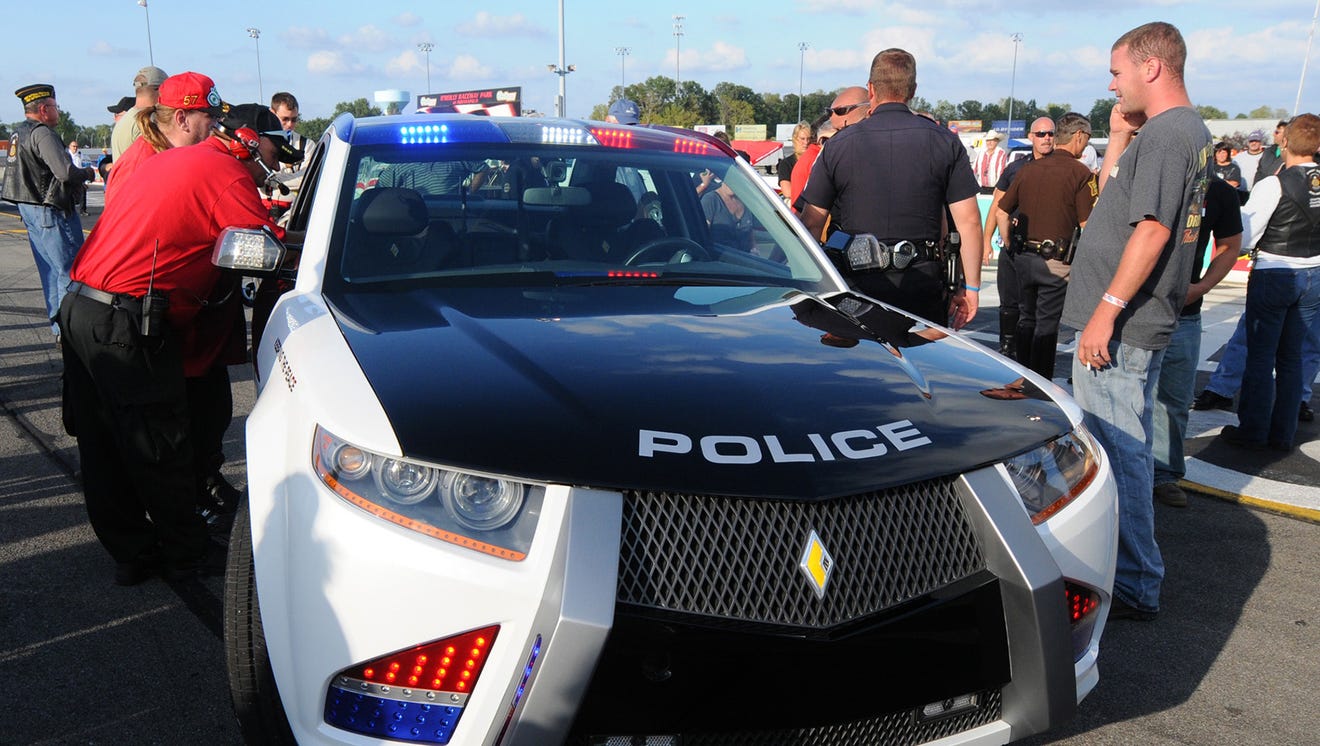
The Carbon prototype sold at auction for $74,000 in 2014. Rezvani has managed to build more than one. Rezvani also has managed to generate positive PR from reviews, including:
- TopGear: “The face may be aggressive, but it masks a vehicle that’s deeply likeable. The Rezvani Tank is ready for nuclear war.”
- The Driver: “You could rule the roads like the evil genius that you’ve always wanted to be.”
- Motor1: “For what you pay the Rezvani Tank offers a lot. It looks good, it’s powerful and with optional features you can’t get on any other SUV.”
- Univision: “Rezvani ofrece el 4 x 4 más radical que merece una gran película de acción.” I mean, “Rezvani offers the most radical 4 x 4 deserving of a major action film.”
This screams for configuration, don’t you think? And to not suck too much money out of my employer, I’ll start with the $159,000 base version, instead of the Military Edition for another $100,000, or the TankX, which doubles the price to $349,000. (At these prices the Tank may cost more than what many weekly newspapers are worth at the moment.)

I chose red just for how it photographs. There is a Military Green, but it’s not particularly attractive. I could choose a custom color, for $5,000, which seems like a bargain compared with some of the other options (such as in the next paragraph).
Much as I like the idea of a 1,000-horsepower V-8 (the Dodge Demon), I’m not sure that’s worth $149,000. So instead I will economize and, for $40,000, take the SRT 6.4-liter Hemi V-8 and its mere 500 horsepower. (The transmission choice should be obvious.) I decided to splurge on the Sport Exhaust, for $1,750. To stop those 500 horsepower, I spent $5,600 on the Big Brake Kit with eight-piston calipers and 16-inch disc brake rotors.
Towing ability is important, so I added the Towing Package (Dana 60 rear end and tow hitch, for $8,500). Off-road ability may be important, so I added the 2.5 Fox shocks (two per wheel) and four-inch lift kit, for $3,500. On the front end, I chose the steel front bumper and winch, for $5,500. Between the two ends, I chose the Interior Lighting Package (interior and footwell lighting), for $2,500, and in case I have to shoot night photos when people may not want me to, I chose the Thermal Night Vision Package, for $6,500, along with side ($850) and Black Vue front and rear cameras ($500). (The Black Vue cameras record continuously to The Cloud, by the way.)
Again to show I’m not just trying to waste money, I got the Nappa leather seats ($3,500), but not the leather interior ($3,500 more), though I did get the heated seats ($500). And I went with the Premium audio system (four Audison speakers, five-channel amplifier, 10-inch subwoofer, for $4,500) instead of the Ultimate ($10,000 for six Focal speakers, a four-channel amp, two JKL Audio subwoofers and two custom amp racks). If you choose to spend $500 to match your instrument color to your vehicle, you get …

I think it only wise to get the center console safe ($950), dual battery ($2,500), auxiliary gas tank ($7,500), and, of course, electromagnetic pulse protection ($2,500), because it’s a jungle out there.
Total it up, and this can be mine for just $212,150, plus whatever sales tax is in California. I have to scrape up $35,000 for a deposit, and then pay the rest upon completion in 10 to 12 weeks.
So what’s wrong with this? (Besides the concept that a journalist could afford a $212,150 truck, that is.) For one thing, at Cherokee size the Tank seems, believe it or don’t, on the small side. The journalist needs room to, for instance, plug cameras into laptops to download or upload photos, or room to write on said laptop. Room is also needed for the public-service-band radio with which to monitor what police and firefighters are doing. I can’t tell from online views how much room there is. (Which made me think, when I first started this exercise, that the ideal base vehicle was a full-size pickup or SUV.)
It appears to lack comprehensive instrumentation, which should include a voltmeter and oil pressure gauge. A sunroof also might be useful, and that is not the Starry Night Headliner (for $6,250).
At $212,000 I’m not buying. (For one thing, Powerball and Mega Millions jackpots have shrunk in the coronavirus world.)
For those who don’t like the SUV idea, though, Rezvani does have an alternative …

… the Beast, a sports car powered by a Honda racing engine.
 Steve Prestegard.com: The Presteblog