• The wrong person is leaving, and the right people are not

    July 15, 2020
    media, US politics

    The New York Times reports on itself:

    Bari Weiss, a writer and editor for the opinion department of The New York Times, has resigned from the paper, citing “bullying by colleagues” and an “illiberal environment.”

    In a nearly 1,500-word letter addressed to A. G. Sulzberger, the publisher, Ms. Weiss offered a deep critique of Times employees and company leadership, describing a “hostile work environment” where co-workers had insulted her or called for her removal on Twitter and in the interoffice communications app Slack. …

    Mr. Sulzberger declined to comment. In a statement, Eileen Murphy, a Times spokeswoman, said, “We’re committed to fostering an environment of honest, searching and empathetic dialogue between colleagues, one where mutual respect is required of all.”

    After working at The Wall Street Journal and Tablet, an online magazine of Jewish culture and politics, Ms. Weiss joined The Times as an Op-Ed staff editor and writer in 2017 as part of the paper’s effort to broaden the ideological range of its opinion staff after President Trump’s inauguration.

    Ms. Weiss, who did not immediately respond to a request for comment, has been known to question aspects of social justice movements that have taken root in recent years. She was critical of a woman who described an uncomfortable encounter with the comedian Aziz Ansari and questioned whether the sexual assault charges leveled against Supreme Court justice nominee Brett Kavanaugh should disqualify him from the post.

    She was also criticized for a tweet suggesting that the California-born U.S. Olympic figure skating competitor Mirai Nagasu was an immigrant. (Ms. Weiss said in a later tweet that she knew Ms. Nagasu was a daughter of immigrants.)

    In 2018 she wrote on the massacre at the Tree of Life synagogue, where she became a bat mitzvah, in Pittsburgh’s Squirrel Hill neighborhood. The murder of 11 Jews led her to write the book “How to Fight Anti-Semitism,” which won the 2019 National Jewish Book Award.

    Ms. Weiss recently came under fire for online comments on the staff unrest that followed the publication of a Times Op-Ed piece by Senator Tom Cotton calling for a military response to civic unrest in American cities during the widespread protests against racism and police violence.

    More than 1,000 Times staff members signed a letter protesting the Op-Ed’s publication, and James Bennet, the editorial page editor, resigned days after it was published. An editors’ note was added to the essay, saying it “fell short of our standards and should not have been published.” The opinion department of The Times is run separately from the newsroom.

    In a tweet, Ms. Weiss described the turmoil inside the paper as a “civil war” between “the (mostly young) wokes” and “the (mostly 40+) liberals.” Many staff members objected on Twitter to her comment, saying it was inaccurate or misrepresented their concerns. …

    Kathleen Kingsbury, the acting editorial page editor, said, “We appreciate the many contributions that Bari made to Times Opinion. I’m personally committed to ensuring that The Times continues to publish voices, experiences and viewpoints from across the political spectrum in the Opinion report.”

    Weiss wrote this to Sulzberger:

    It is with sadness that I write to tell you that I am resigning from the New York Times.

    I joined the paper with gratitude and optimism three years ago. I was hired with the goal of bringing in voices that would not otherwise appear in your pages: first-time writers, centrists, conservatives and others who would not naturally think of the Times as their home. The reason for this effort was clear: The paper’s failure to anticipate the outcome of the 2016 election meant that it didn’t have a firm grasp of the country it covers. Dean Baquet and others have admitted as much on various occasions. The priority in Opinion was to help redress that critical shortcoming.

    I was honoured to be part of that effort, led by James Bennet. I am proud of my work as a writer and as an editor. Among those I helped bring to our pages: the Venezuelan dissident Wuilly Arteaga; the Iranian chess champion Dorsa Derakhshani; and the Hong Kong Christian democrat Derek Lam. Also: Ayaan Hirsi Ali, Masih Alinejad, Zaina Arafat, Elna Baker, Rachael Denhollander, Matti Friedman, Nick Gillespie, Heather Heying, Randall Kennedy, Julius Krein, Monica Lewinsky, Glenn Loury, Jesse Singal, Ali Soufan, Chloe Valdary, Thomas Chatterton Williams, Wesley Yang, and many others.

    But the lessons that ought to have followed the election—lessons about the importance of understanding other Americans, the necessity of resisting tribalism, and the centrality of the free exchange of ideas to a democratic society—have not been learned. Instead, a new consensus has emerged in the press, but perhaps especially at this paper: that truth isn’t a process of collective discovery, but an orthodoxy already known to an enlightened few whose job is to inform everyone else.

    Twitter is not on the masthead of the New York Times. But Twitter has become its ultimate editor. As the ethics and mores of that platform have become those of the paper, the paper itself has increasingly become a kind of performance space. Stories are chosen and told in a way to satisfy the narrowest of audiences, rather than to allow a curious public to read about the world and then draw their own conclusions. I was always taught that journalists were charged with writing the first rough draft of history. Now, history itself is one more ephemeral thing moulded to fit the needs of a predetermined narrative.

    My own forays into Wrongthink have made me the subject of constant bullying by colleagues who disagree with my views. They have called me a Nazi and a racist; I have learned to brush off comments about how I’m “writing about the Jews again.” Several colleagues perceived to be friendly with me were badgered by coworkers. My work and my character are openly demeaned on company-wide Slack channels where masthead editors regularly weigh in. There, some coworkers insist I need to be rooted out if this company is to be a truly “inclusive” one, while others post ax emojis next to my name. Still other New York Times employees publicly smear me as a liar and a bigot on Twitter with no fear that harassing me will be met with appropriate action. They never are.

    There are terms for all of this: unlawful discrimination, hostile work environment, and constructive discharge. I’m no legal expert. But I know that this is wrong.

    I do not understand how you have allowed this kind of behaviour to go on inside your company in full view of the paper’s entire staff and the public. And I certainly can’t square how you and other Times leaders have stood by while simultaneously praising me in private for my courage. Showing up for work as a centrist at an American newspaper should not require bravery.

    Part of me wishes I could say that my experience was unique. But the truth is that intellectual curiosity—let alone risk-taking—is now a liability at the Times. Why edit something challenging to our readers, or write something bold only to go through the numbing process of making it ideologically kosher, when we can assure ourselves of job security (and clicks) by publishing our 4000th op-ed arguing that Donald Trump is a unique danger to the country and the world? And so self-censorship has become the norm.

    What rules that remain at the Times are applied with extreme selectivity. If a person’s ideology is in keeping with the new orthodoxy, they and their work remain unscrutinised. Everyone else lives in fear of the digital thunderdome. Online venom is excused so long as it is directed at the proper targets.

    Op-eds that would have easily been published just two years ago would now get an editor or a writer in serious trouble, if not fired. If a piece is perceived as likely to inspire backlash internally or on social media, the editor or writer avoids pitching it. If she feels strongly enough to suggest it, she is quickly steered to safer ground. And if, every now and then, she succeeds in getting a piece published that does not explicitly promote progressive causes, it happens only after every line is carefully massaged, negotiated and caveated.

    It took the paper two days and two jobs to say that the Tom Cotton op-ed “fell short of our standards.” We attached an editor’s note on a travel story about Jaffa shortly after it was published because it “failed to touch on important aspects of Jaffa’s makeup and its history.” But there is still none appended to Cheryl Strayed’s fawning interview with the writer Alice Walker.

    The paper of record is, more and more, the record of those living in a distant galaxy, one whose concerns are profoundly removed from the lives of most people. This is a galaxy in which, to choose just a few recent examples, the Soviet space program is lauded for its “diversity”; the doxxing of teenagers in the name of justice is condoned; and the worst caste systems in human history includes the United States alongside Nazi Germany.

    Even now, I am confident that most people at the Times do not hold these views. Yet they are cowed by those who do. Why? Perhaps because they believe the ultimate goal is righteous. Perhaps because they believe that they will be granted protection if they nod along as the coin of our realm—language—is degraded in service to an ever-shifting laundry list of right causes. Perhaps because there are millions of unemployed people in this country and they feel lucky to have a job in a contracting industry.

    Or perhaps it is because they know that, nowadays, standing up for principle at the paper does not win plaudits. It puts a target on your back. Too wise to post on Slack, they write to me privately about the “new McCarthyism” that has taken root at the paper of record.

    All this bodes ill, especially for independent-minded young writers and editors paying close attention to what they’ll have to do to advance in their careers. Rule One: Speak your mind at your own peril. Rule Two: Never risk commissioning a story that goes against the narrative. Rule Three: Never believe an editor or publisher who urges you to go against the grain. Eventually, the publisher will cave to the mob, the editor will get fired or reassigned, and you’ll be hung out to dry.

    For these young writers and editors, there is one consolation. As places like the Times and other once-great journalistic institutions betray their standards and lose sight of their principles, Americans still hunger for news that is accurate, opinions that are vital, and debate that is sincere. I hear from these people every day. “An independent press is not a liberal ideal or a progressive ideal or a democratic ideal. It’s an American ideal,” you said a few years ago. I couldn’t agree more. America is a great country that deserves a great newspaper.

    None of this means that some of the most talented journalists in the world don’t still labour for this newspaper. They do, which is what makes the illiberal environment especially heartbreaking. I will be, as ever, a dedicated reader of their work. But I can no longer do the work that you brought me here to do—the work that Adolph Ochs described in that famous 1896 statement: “to make of the columns of the New York Times a forum for the consideration of all questions of public importance, and to that end to invite intelligent discussion from all shades of opinion.”

    Ochs’s idea is one of the best I’ve encountered. And I’ve always comforted myself with the notion that the best ideas win out. But ideas cannot win on their own. They need a voice. They need a hearing. Above all, they must be backed by people willing to live by them.

    It appears that the Times has done a poor job of hiring employees, which management has made worse by not firing employees who behave as Weiss depicts.

    Across town, the New York Post reacts in its usual restrained way …

    … with columnist Michael Goodwin writing:

    Back in 2012, a Goldman Sachs banker famously quit his job in a New York Times op-ed. On his last day at work, Greg Smith got on the biggest soap box he could find to declare that Goldman’s culture is “toxic and destructive.”

    Bari Weiss has now done the same thing to the Times itself. Her resignation letter, posted on her Web site, is a classic example of going out with a bang.

    Yet Weiss does something more than just make noise as she’s making her exit. She lays bare a hostile, coercive workplace and describes incidents and insults that reveal how the Times is the same bully in-house that it is to those on the outside who don’t subscribe to its warped views. …

    In a chilling paragraph, Weiss cites “constant bullying by colleagues who disagree with my views. They have called me a Nazi and a racist; I have learned to brush off comments about how I’m ‘writing about the Jews again.’ ”

    That would make her a Nazi who supports Israel. The bullies need to work on their insults.

    Although Weiss was a writer and editor on the opinion section, she makes the entire operation, especially the newsroom, sound like a college campus where dissent is demonized and silenced by threats. Who knew the Gray Lady could be so nasty?

    Weiss does something else too — she dumps the whole mess in the lap of 39-year-old publisher A. G. Sulzberger. She addresses her letter to him and charges he personally stood by silently while a mob mentality seized control.

    “I do not understand how you have allowed this kind of behavior to go on inside your company in full view of the paper’s entire staff and the public,” she writes. “And I certainly can’t square how you and other Times leaders have stood by while simultaneously praising me in private for my courage.”

    As extra zingers, she quotes an 1896 line from Times patriarch Adolph Ochs — the current publisher’s great, great grandfather — who promised that the paper would always “invite intelligent discussion from all shades of opinion.”

    Sulzberger himself had quoted the same line in a statement when he assumed the job of publisher from his father in January of 2018, and Weiss is cleverly reminding him that he has failed to deliver.

    In that statement, Sulzberger, the fifth member of his family to run the Times since Ochs died in 1935, all of them men, also promised the paper would “continue to resist polarization and groupthink by giving voice to the breadth of ideas and experiences — because we believe journalism should help people think for themselves.”

    In fact, the Times is doing the opposite. As Weiss notes, groupthink now dominates the paper’s coverage from front to back and readers are encouraged to obey, not think.

    If Sulzberger is looking for someone to blame, he should grab a mirror. His firing of opinion editor James Bennet last month was a green light to the Twitter mob that the publisher would bow before it, no matter how outlandish the ­demands.

    Bennett’s sin was to publish an op-ed from Sen. Tom Cotton that said President Trump was right to consider using the military to quell riots in American cities. In a shocking breach with tradition, more than 800 Times staff members, the vast majority from the newsroom, signed a petition denouncing the piece and pushed for Bennett to be fired.

    By surrendering, Sulzberger betrayed journalism’s best principles and there’s a straight line from that moment to Weiss’ resignation.

    The publisher should pay special attention to one section of her letter. Noting she was hired after the Times failed to detect even a hint that Donald Trump would win the 2016 election, Weiss writes that the clear aim was to add “voices that would not otherwise appear in your pages.”

    But instead of being open to those voices, she complains that “a new consensus has emerged in the press, but perhaps especially at this paper: that truth isn’t a process of collective discovery, but an orthodoxy already known to an enlightened few whose job is to inform everyone else.”

    She’s absolutely right, which is why I have been saying that the Times no longer functions as an actual newspaper. Its “mission” is to rewrite the story of America, one that dovetails with the paper’s obsession with race, gender and every new form of identity politics.

    The current crisis actually began two years before Sulzberger became publisher. In the summer of 2016, executive editor Dean Baquet abandoned the paper’s traditional standards of fairness and impartiality in its news pages in a bid to block Trump’s election. Since then, virtually every article on every page has been an editorial where the reporters’ opinions dominate.

    Baquet’s decision to take away the guardrails against bias created a vacuum that was filled with a radical agenda. The paper is now published not to give readers facts and information, but to browbeat them with the far, far left political and social positions of the writers.

    It’s a predictable Lord of the Flies outcome, where the official party line is the only acceptable position and you either go along or get out. So day after dreary day, from front to back, the Times reeks with the delusion that it knows best about everything.

    That bloated hubris is a key reason why I revealed the Confederate roots of the Ochs-Sulzberger family in my Sunday column. The knowledge that members of the family, including Och’s mother, Bertha Levy, supported slavery and Ochs himself donated large sums of money to Confederate memorials should lead the staff to demand a full accounting of the family’s history. My fantasy is that the Times will apply the same standards to its own conduct that it applies to other people and institutions, and, humbled by what it learns, will be cured of its arrogance.

    In that sense, Weiss and I are on the same page. We want the Times to be what it used to be and what Sulzberger promised it would be — a real newspaper.

    Or is that too much to ask?

    The New York Sun opines:

    If we were A.G. Sulzberger — a stretch to be sure — we would tell Bari Weiss that we just won’t accept her resignation. Far be it from us to tell the publisher of the New York Times how to run his newsroom; his paper makes more in a morning than The New York Sun nets in a year. It’s hard to see, though, how the New York Times survives in the long run if it can’t make welcome a writer and editor like Ms. Weiss.

    We first encountered Ms. Weiss in 2005, when the Sun still had a print edition. Then a sophomore at Columbia, she was quoted by our reporter, Jacob Gershman, in a story on anti-Semitism on campus. By 2008, the gutsy graduate was a regular reporter for the Sun, cranking out scoops — about, say, the warm reception President Ahmadinijad of Iran got in New York or the battle to bring back ROTC to Morningside Heights.

    When we closed our print edition, Ms. Weiss ended up with the plumest post for an idealistic young journalist — a spot on the editorial page of the Wall Street Journal. Eventually, she moved to Tablet, then the Times to help, as she reminded Mr. Sulzberger, bring in voices that would not otherwise appear in the paper. She speaks of “centrists, conservatives and others who would not naturally think of The Times as their home.”

    Such an effort was needed, Ms. Weiss also reminded Mr. Sulzberger, because the “paper’s failure to anticipate the outcome of the 2016 election meant that it didn’t have a firm grasp of the country it covers.” Ms. Weiss says the Times top editor others “admitted as much on various occasions.” Redressing the shortcoming was the “priority” in the opinion section. It was a good plan, and Ms. Weiss did a splendid job.

    In her letter, which we’ve reprinted, Ms. Weiss catalogs some of the new voices she brought to the Times. But, she wrote to Mr. Sulzberger, “the lessons that ought to have followed” — about understanding other Americans, resisting tribalism, and the free exchange of ideas — have “not been learned.” Instead, the paper has become a place where truth is “an orthodoxy already known to an enlightened few.”

    Ms. Weiss writes that she herself faced “constant bullying by colleagues who disagree with my views.” She writes that they “have called me a Nazi and a racist.” She adds that she has learned to “brush off comments about how I’m ‘writing about the Jews again.’” She has too much grace to mention that her writing about Jews included covering the murders at her hometown’s Tree of Life synagogue in Pittsburgh.

    Ms. Weiss’s tenure at the Times became an ordeal. Friendly colleagues were “badgered by coworkers,” she told Mr. Sulzberger. “My work and my character are openly demeaned on company-wide Slack channels where masthead editors regularly weigh in. There, some coworkers insist I need to be rooted out if this company is to be a truly ‘inclusive’ one, while others post ax emojis next to my name.”

    “I do not understand how you have allowed this kind of behavior to go on inside your company in full view of the paper’s entire staff and the public,” Ms. Weiss wrote Mr. Sulzberger.

    This is why we suggest that the right move is to refuse to accept Ms. Weiss’s resignation, even if to keep her Mr. Sulzberger has to concede her case. The part of valor is to stand with her and address the leftist, ideological bullying in which the Times engages against, as Ms. Weiss makes clear, not only its staff but also its readers. Ms. Weiss has handed him an opportunity to begin to turn his paper around.

    Is he up to it? Are there any terms on which Ms. Weiss would be prepared to stay and help? We haven’t discussed it with her. We do know that Ms. Weiss has built up an astounding readership. We glimpsed it at her address on left-wing anti-Semitism, delivered at Manhattan’s Temple Emanuel, whose vast sanctuary was packed with readers. It’s hard to see how Mr. Sulzberger’s paper can truly prosper in their exclusion.

    Jonathan Turley adds:

    We have been discussing the shocking abandonment of journalistic principles by the New York Times in its recent apology for publishing a column by a United States Senator and forcing out an editor who had the audacity to publish an opposing view of the current protests.  The newspaper effectively declared echo-journalism to be its new mission.  Now another opinion writer and editor, Bari Weiss, has resigned after what she called an “illiberal environment” where she has been harassed and abused by other reporters without any intervention from the management. In a scathing resignation letter, Weiss called the Times a “Digital Thunderdome.”

    In the Cotton controversy, various writers falsely claimed that the senator’s column contained false and unconstitutional statements.  Simply the act of publishing the column led to the removal of the editor. Yet, one of those writers recently spread a clearly false conspiracy theory about police with no such outcry.

    After the removal of the editor and cringing apology of the newspaper, Weiss said that the environment at the newspaper became openly intolerant and hostile for anyone deemed insufficiently obedient to the new orthodoxy at the newspaper.  She wrote in her resignation letter that “showing up for work as a centrist at an American newspaper should not require bravery.”  She claims to have been called a “nazi” and “rascist” for holding opposing views: “a new consensus has emerged in the press, but perhaps especially at this paper: that truth isn’t a process of collective discovery, but an orthodoxy already known to an enlightened few whose job is to inform everyone else.” …

    The last few weeks have seen the rapid acceleration of attack on free speech and the free press. The most chilling aspect of this period is that the attacks has come from universities and the press itself.  Faculty and reporters have remained silent as their colleagues have been abused. Many are fearful that they will also be labeled as racist.  These attacks have succeeded in chilling speech.  Indeed, Weiss describes how management encouraged her in private but remained conspicuously silent in public.  She stated “Even now, I am confident that most people at The Times do not hold these views. Yet they are cowed by those who do.” It is an account that is all too familiar for those of us in academia. However, the collapse of the New York Times — long the iconic paper of record in the United States — has been the most chilling development in this glacial period.

    I have previously said that the actions of the New York Times on the Cotton column would stand alone in journalistic infamy.  It is not surprising that the New York Times has allowed an environment of intolerance and abuse to expand in the vacuum left by by its earlier abandonment of core principles.  None of this matters to most readers or reporters.  Readers now have a newspaper that will not challenge their assumptions or their positions.  Reporters will be allowed to continue to write so long as they do not challenge the orthodoxy of the new order.  It is a pattern that we have seen played out repeatedly in history and it has never ended well.

    Share this on …

    • Share on X (Opens in new window) X
    • Share on Facebook (Opens in new window) Facebook
    • Share on LinkedIn (Opens in new window) LinkedIn
    • Email a link to a friend (Opens in new window) Email
    • Print (Opens in new window) Print
    Like Loading…
    No comments on The wrong person is leaving, and the right people are not
  • Fun with left-wing infighting

    July 15, 2020
    US politics

    T.S. Furey:

    June has been marked in recent years by a flurry of orange-clad marchers promoting National Gun Violence Awareness Month. This year’s planned gatherings, however, fell victim to the COVID-19 pandemic and were overshadowed by Black Lives Matter’s nationwide protests against institutional racism within policing. But the gun-control lobby’s reticence isn’t out of respect for the lives of George Floyd or Breonna Taylor but rather concern for its own preservation.

    For decades, gun-control advocates promoted greater police power as well as known practices of institutional racism within police firearms-licensing divisions. Now that there are calls to “defund the police,” many leaders of the gun-control lobby, who are mostly white, should rightly fear that their history of siding with the police and promoting policies now deemed racist by progressives may make them the next casualty of cancel culture.

    Gun control in the U.S. has historically been rooted in racism of the blatant “no blacks allowed” variety. Fundamentally, it is difficult to subjugate a group if it’s armed. This is why restrictions on minority gun ownership pre-date not only the institution of slavery in the U.S. but the Founding itself. The modern gun-control movement has supported a more insidious method of using police discretion and biased background checks to suppress firearms-license issuance.

    New York’s Sullivan Act is one of the best examples of gun-control laws that put minorities at a disadvantage, and it has been widely copied. Passed in 1911, the law addressed what was considered a growing problem of gun ownership among minorities, immigrants, labor organizers, and anyone seen as a threat.

    The law accomplished this by allowing majority-white police departments broad leeway to determine licensing requirements. Police departments can add their own requirements; even if applicants deemed undesirable checked all the required boxes, the law’s “good moral character” clause could be used as a catchall to deny them. Reminiscent of practices any segregationist would appreciate, the NYPD License Division, with its perpetually white leadership and the blessings of the New York City Council, has used exorbitant fees, long English-only applications, expansive ID requirements, the need for applicants to take time off from work, and numerous other unconventional tactics to restrict license issuance. The NAACP and other civil-rights groups have denounced these impediments as unfairly putting blacks and other minorities at a disadvantage.

    Organizations that support such discretionary licensing requirements, such as Brady United Against Gun Violence, seem to believe that the same police who allegedly beat, shoot, and asphyxiate people of color in the street would turn around and equitably issue them firearms permits. This makes no sense.

    And what about background checks, the holy grail of the gun-control agenda? The public seems to have little idea of what goes into them. For example, the NYPD License Division’s background check includes marijuana offenses — and not just convictions, but mere arrests. The ACLU’s research shows that African Americans are 3.64 times more likely to be arrested for marijuana possession (in New York the figure is in the double digits). You would think that inclusion of such arrests on background checks would raise social-justice concerns. There is a broad movement dedicated to reforming a racist justice system, yet the gun-control lobby doesn’t seem to have gotten the memo. Moreover, and perhaps most egregiously, peaceful protesters who came out to support the Black Lives Matter movement and were arrested for minor infractions stand to lose their gun licenses or their right to ever have one. Still, the gun-control lobby remains silent.

    Maybe we shouldn’t be surprised. After all, groups like Everytown for Gun Safety were founded by Mr. Stop-and-Frisk himself, former New York City mayor Michael Bloomberg. Like Bloomberg, most funders behind gun-control initiatives are wealthy whites who can afford to hire private security. But even if gun-control groups believe that minority groups shouldn’t be armed, why take the additional step of providing special privileges to the police?

    We’ve all balked at the armored military vehicles that start in Fallujah, get bought up by police departments, and end up in Farmingdale. So why does every gun-control bill since the 1934 Firearms Act contain clauses that exempt police officers from “common sense restrictions”? The 2004 Law Enforcement Safety Act, for example, promoted by gun control enthusiasts such as Senator Charles Schumer (D, N.Y.), ​allows active or retired officers the right to carry weapons nationwide. Assault-weapon-weary New York, Connecticut, and New Jersey certainly think it’s okay for their police officers to possess military arms and jam as many rounds into them as desired. And if keeping guns in the home is so dangerous, why are police officers encouraged to do so? Don’t blue lives matter too?

    If we are trying to instill in our police that they are of and for the people, why do gun-control advocates grant them a status akin to super-citizen? One of the simplest ways to reduce the number of police shootings is to hold police officers to the same standard of self-defense the rest of us are held to. Surely the gun-control lobby’s mantra that “only the police should have guns” no longer holds.

    Perhaps the most striking contradiction inherent in the gun-control lobby is that its promotion of licensing discrimination and special police privileges comes on the backs of those seeking to reduce gun violence. Rank-and-file members of the gun control movement are good people, many of whose lives have been tragically touched by gun crime. It’s only right that they seek to stem further violence and advocate laws to help prevent the mass shootings and killings we witness in this country. But these folks know little about the discriminatory nature of the policies that the gun-control lobby’s leadership supports.

    Some groups have seen the light: that the gun-control lobby is violating the tenets of progressivism even as it’s nestled amongst the progressive Left. In 2017, New York’s Gays Against Guns was one of the first to acknowledge that gun control is a tool “of American white supremacy.” But this is far from the norm. So far, the gun-control lobby has refused to comment on policy changes in response to the Black Lives Matter movement, nor have leaders apologized for their role in perpetuating institutional racism.

    If the Black Lives Matter movement is going to rid America of every vestige of racism, it must hold America’s gun-control lobby to the same standard and demand the resignation of its leadership. As the movement’s slogan goes: Their silence is violence.

    Share this on …

    • Share on X (Opens in new window) X
    • Share on Facebook (Opens in new window) Facebook
    • Share on LinkedIn (Opens in new window) LinkedIn
    • Email a link to a friend (Opens in new window) Email
    • Print (Opens in new window) Print
    Like Loading…
    No comments on Fun with left-wing infighting
  • Presty the DJ for July 15

    July 15, 2020
    Music

    Today in 1963, Paul McCartney was fined 17 pounds for speeding. I’d suggest that that may have been the inspiration for his Wings song “Hell on Wheels,” except that the correct title is actually “Helen Wheels,” supposedly a song about his Land Rover:

    Imagine having tickets to this concert at the Anaheim Civic Center today in 1967:

    Today in 1984, John Lennon released “I’m Stepping Out.” The fact that Lennon stepped out of planet Earth at the hands of assassin Mark David Chapman 3½ years before this song was released was immaterial.

    (more…)

    Share this on …

    • Share on X (Opens in new window) X
    • Share on Facebook (Opens in new window) Facebook
    • Share on LinkedIn (Opens in new window) LinkedIn
    • Email a link to a friend (Opens in new window) Email
    • Print (Opens in new window) Print
    Like Loading…
    No comments on Presty the DJ for July 15
  • The news media and conservatives

    July 14, 2020
    media, US business, US politics

    Former U.S. Rep. Jason Chaffetz (R–Utah):

    This may come as a surprise to those who assume that all news media are liberal, but if you live outside of a major city, think for a moment about your small- to mid-sized hometown newspaper, not The New York Times. This kind of journalism—local papers that are rooted in communities—is disappearing, and the places most at risk of losing their local news are places where a lot of conservatives happen to live.

    COVID-19 has wrought havoc on newsrooms, and massive layoffs continue to occur at newspapers across the country. But even before the pandemic, the crisis in local journalism was well established. There are more than a few credible studies that have examined the situation, finding that the news media industry saw a 68 percent decrease in its primary source of revenue between 2008 and 2018, and that 47 percent of newsroom staff have been lost since 2004.

    The causes of the decline are pretty straightforward. People still want local news. But most people now consume news primarily online, and the digital space is dominated by a handful of Big Tech companies who gobble up almost all of the advertising revenue. Equally important, online news consumption is subject to the vagaries of Big Tech algorithms, which decide what news people get to see and when.

    Which local sources are most at risk? More than 200 U.S. counties have no local newspaper at all, and another 1,500 have only one local news source, most often a weekly newspaper. These “news deserts” are dominated by rural and suburban areas that have a high concentration of conservative voters.

    Ohio’s Highland County, where 76 percent of residents voted for Donald Trump in 2016, has only one newspaper, the Hillsboro Times-Gazette. The Hillsboro Times-Gazette is a strong conservative voice for the county and endorsed Trump in 2016, but it is subject to the same forces that have caused 138 local Ohio papers to close since 2004.

    While some U.S. publishers can turn to readers for direct support, it is harder for papers like the Hillsboro Times-Gazette. In Highland County, 48 percent of households live in poverty or are struggling to make ends meet, according to a 2017 report from the United Way. People who can barely cover the essentials, such as rent and groceries, are unlikely to have the disposable income that would allow them to jump over paywalls.

    The Bowling Green Daily News in Warren County, Kentucky, faces similar challenges. The county’s only paper, The Bowling Green Daily News, not only serves to inform locals of the goings-on in their community, but also provides access to conservative voices and viewpoints that readers might not find in other regional publications. Unfortunately, 18 percent of county residents live below the poverty line, making it hard for the people who rely on The Bowling Green Daily News to make up for the revenue lost to Big Tech.

    Local papers like these work to keep their communities informed, while also demonstrating an understanding of their readers’ conservative viewpoints. That understanding is harder to come by as news deserts grow and local publishers struggle to stay afloat. There is no grand political conspiracy at work here; many of these communities are subject to a wide range of forces that are damaging to their economies, including deindustrialization and the migration of prosperity to coastal and suburban areas.

    But the loss of local newspapers has two particular and profound effects. First, it tears at the fabric of communities, leaving the field wide open for political corruption and malfeasance of every form.

    That right there is your first reason to support your local newspaper.

    Second, it ensures that the news people see is dominated by urban and coastal sources that have much less understanding of the people who live and work in rural and suburban communities. Google and Facebook may decide what news you see when you’re online, but if there is no local news source to begin with, it won’t matter how well their algorithms are attuned.

    So how can we save local news? One easy way to ensure continued access is to subscribe to your local newspaper and, if possible, advertise there. But even that may not be enough. Some folks have advocated for direct government subsidies for news publishers. I personally don’t believe that it’s a good idea for the fourth estate to be on the government payroll. It certainly isn’t a conservative idea.

    I prefer a much less government-intensive solution: the Journalism Competition & Preservation Act, which wouldn’t require the government to spend any tax dollars. The bill, with four Republican senators and three Democratic senators as co-sponsors, simply gives news publishers the ability to solve their own problems by giving them the right to work together to negotiate with Google and Facebook for a better deal for the use of their news content.

    As legal expert Adam White of the American Enterprise Institute explained in the conservative publication National Review, antitrust law is designed to protect consumers from monopolistic power, and allowing newspaper publishers to band together to negotiate might be the best way to accomplish that goal.

    It is currently impossible for any individual publisher to stand up to the tech giants. Since Facebook and Google benefit disproportionately from free local news content, they should have to negotiate like any other company for that deal, and return more of the value back to the people who deliver it in the first place. News consumers will then have continued access to the full variety of media sources they prefer.

    But most important, my fellow conservatives should understand that local journalism is essential to having our voices heard—and if Congress refuses to act, the news sources that disappear first may well be the ones that most reflect our views.

    Share this on …

    • Share on X (Opens in new window) X
    • Share on Facebook (Opens in new window) Facebook
    • Share on LinkedIn (Opens in new window) LinkedIn
    • Email a link to a friend (Opens in new window) Email
    • Print (Opens in new window) Print
    Like Loading…
    No comments on The news media and conservatives
  • Conservatives, liberals and the Founding Fathers

    July 14, 2020
    US politics

    Jonah Goldberg:

    I googled the phrase “Trump defends the Founders” and got some interesting results. The first page of results was almost entirely filled with links to editorials by liberals explaining that “Trump is the president the Founding Fathers feared” as a headline to a column by Richard Cohen put it.

    It should surprise no one who thinks there’s merit to that argument, but that’s not what I want to talk about.

    I googled the phrase because I was looking for examples of people claiming that Trump is a grand defender of the founding and our constitutional heritage—I’ll get to all that in a moment.

    But these arguments from liberals—which have been thick in the air for four years now—are a good amuse-bouche for the repast to come.

    If you step back for a moment, you’ll plummet to your death if you’re standing on the edge of a roof. But if you do it figuratively, the fact that so many liberals like to invoke the Founders to condemn Trump is a bit odd, given that we’re in the middle of an insane panic about the moral degeneracy of the Founders because some were slaveholders.

    But even before the current spectacle of St. Vitus’s Dance, liberals had an annoying schizophrenia about the wisdom of the Founders. I’ve probably written a dozen columns about the habit of liberals to talk about the “living Constitution” when on offense, but whenever conservatives suggest amending the Constitution, the same liberals suddenly retreat to extolling the genius and wisdom of the Founders and their sacred text. When they want to do something the Constitution doesn’t allow, the Founders were naïfs who couldn’t imagine the needs of a complex modern society. It’s a living document that takes new meaning in every generation, you fools! But when a conservative wants to amend it—the only legitimate way to change its meaning—suddenly it’s an outrage:

    “I respect the wisdom of the Founders to uphold the Constitution, which has served this nation so well for the last 223 years,” Senator Patrick Leahy (D-Vt.) proclaimed from the saddle of his very high horse in 2011, in opposition to a balanced-budget-amendment proposal. “Let us not be so vain to think we know better than the Founders what the Constitution should prescribe.”

    It’s weird how no one is trying to cancel Leahy for his unconstrained admiration for a bunch of slaveholders.

    Anyway, as I said, I was googling for examples of conservatives celebrating Trump as the Great Protector of our Constitution and the principles of the founding. This has always been a refrain of Trump’s defenders, sometimes for defensible reasons given the importance of judicial appointments.

    But it’s gone into overdrive since his Mt. Rushmore speech, in which he denounced “cancel culture” as an “attack on our liberty, our magnificent liberty.” He vowed to “expose this dangerous movement, protect our nation’s children, end this radical assault, and preserve our beloved American way of life.” “Make no mistake,” he added, “this left-wing cultural revolution is designed to overthrow the American Revolution.”

    Never mind that Donald Trump has no problem with cancelling people he dislikes—including yours truly. This is bigger than that, this is about preserving and defending the glorious principles of the founding! And there has been no shortage of over-the-top praise for Trump’s alleged tour de force. To take a couple examples among dozens, Newt Gingrich proclaimed it a masterstroke for repudiating “the anti-American worldview.” In this moment, “President Trump understood that the greatest threat was the rise of the anti-American left—and its desire to destroy American history, symbols, and culture.”

    Conrad Black (who was pardoned by the president last year, and who in 2010 wrote that “no taxation without representation” and the Boston Tea Party and so forth were essentially a masterly spin job on a rather grubby contest about taxes) announced that, “Trump delivered the greatest speech of his career on Friday evening at Mount Rushmore, devoted altogether to celebrating the idealism of the American Revolution.” It takes a subtler mind than mine to see how Donald Trump can turn the grubbiness of the American Revolution into idealism.

    But here’s the thing: As terrible as the idiot mobs tearing down statues are, the more serious—at least more intellectually serious—attack on the founding and its principles isn’t actually coming from the left. It’s coming from the right.

    I just finished a “debate” of sorts with Patrick Deneen for Newsweek in which Deneen echoes his book-length denunciation of the culture of liberty ratified by the American founding. Patrick, a brilliant and decent guy, is one of the leaders of an intellectual movement very popular on the right that says the Founders blew it. Trump extols our “magnificent liberty.” Deneen argues that we must “transcend liberalism’s cramped idea of liberty.” Just to be very clear: The “liberalism” he refers to here is the liberalism of the Founders. For Deneen, the effort by George Will and others to frame the American tradition as one dedicated to liberty is “comparable to Pravda’s efforts to color the Russian tradition as exclusively communist.” Adrian Vermeule, Sohrab Ahmari, Yoram Hazony and numerous others heap scorn on the “Lockean”—by which they mean liberty-obsessed—understandings of the founding.

    I may have missed it, but I don’t think any of these dedicated opponents of the “magnificent liberty” Trump was extolling have offered much criticism of his speech. To be sure, one reason for that might be tactical. Trump is also an avatar for the nationalist and integralist crowd’s culture war agenda. Sohrab even thinks that Trump is a force for “social cohesion”—though in fairness he wrote that before the president was impeached, one of Trump’s Supreme Court appointees recognized that being trans or gay is a protected status, face masks became a flashpoint in the culture war, and mass protests and riots shutdown cities. If the claim that Trump was a force for social cohesion seemed weak and fragile back then, now it looks like what remains after you take a sledgehammer to a bowl of overcooked pasta.

    Another possible reason for remaining silent on Trump’s ode to “magnificent liberty” might be that these conservative opponents of magnificent liberty understand that Trump didn’t actually mean it, but his homage to it is a useful counterweight to the opponents of magnificent liberty on the left. Embedded deep in this idea is a recognition that talking about freedom is a winning issue with Americans because Americans actually value freedom a great deal. This goes to the heart of one of my main disagreements with Deneen and Hazony, who seem convinced that John Locke is the author of all the woes of the West.

    I think Locke made valuable and important contributions to the West and to the American Founders, but I think his enemies today exaggerate his influence more than his fans do. John Locke no more created liberalism than Adam Smith created capitalism. Oscar and Lilian Handlin make a powerful case that Locke is more of a stand-in or shorthand for a whole bundle of ideas in wide currency at the time. Locke isn’t mentioned in the Federalist Papers. Locke wrote extensively about slavery, but as the Handlins note, there’s no record of any Founder invoking him during the debates over slavery at the time. When writing my book, I searched the National Archives database for references to Locke during the founding era. I was shocked by how paltry the results were. There’s ample evidence that his work in epistemology and psychology—then called “natural philosophy”—impressed the Founders greatly. But the Second Treatise on Government—basically the Necronomicon of evil libertarian thought among his detractors—simply wasn’t the Book That Changed Everything.

    I don’t say any of this to disparage Locke, but simply to note that Locke reflected ideas and principles that were already thick on the ground at the time, in England and, later, America. American culture is still a liberty-loving culture—not as much as I’d like, of course. But just as 99 percent of the socialists out there screaming about the evils of capitalism have read little to no Marx, most of the Americans who cherish liberty know next to nothing about Locke, and they still cherish liberty just the same. Certainly Donald Trump is not deeply versed in his writings.

    Anyway, I don’t have a grand takeaway from this very weird disconnect between these very serious opponents of the magnificent liberty Trump extolled nor their lack of opposition to Trump for extolling it. You can make of it what you will. But I do think it is very strange that many of the same conservatives who sound like the cast of Team America—“America F*** Yeah!”—when Trump talks about the founding, and who sound like Woodrow Wilson in their give-no-quarter to the “leftwing fascists” Trump denounced, are so accommodating of an intellectual movement that agrees with the left-wing fascists on some very big ideas. Sure, they disagree about who should be in power—and what should be done with that power—once the great error of liberalism is corrected, but both sides agree that the liberalism of the Funders was, indeed, a terrible mistake and should be replaced by one faction’s definition of the Highest Good.

    I don’t want to see any of these illiberals canceled. They are conducting themselves far better than the Jacobins in the streets. They’re behaving lawfully, politely, and decently; they’re making arguments, criticizing the regime (in the proper sense of the word), and trying to persuade people to change the role of government. I think they’re a threat to the system of magnificent liberty the Founders bequeathed to us (arguably more of a threat than Drag Queen Story Hour). But one of the features—not bugs—of that system is that we tolerate such speech and, when warranted, we engage with it. That’s one of the bedrock guarantees that defines our system. Ironically, it doesn’t necessarily define the system they seek to replace it with.

    Share this on …

    • Share on X (Opens in new window) X
    • Share on Facebook (Opens in new window) Facebook
    • Share on LinkedIn (Opens in new window) LinkedIn
    • Email a link to a friend (Opens in new window) Email
    • Print (Opens in new window) Print
    Like Loading…
    No comments on Conservatives, liberals and the Founding Fathers
  • Presty the DJ for July 14

    July 14, 2020
    Music

    This being Bastille Day, it seems appropriate to bring you some French rock music. (Despite my 2.5 years of middle school and four years of high school French, I understand none of the words.)

    Outside of France, today in 1967, the Who opened the U.S. tour of … Herman’s Hermits.

    Today in 1986, Paul McCartney released his “Press” album:

    Other than Woody Guthrie, who was not a member of the rock or pop music worlds, the only birthday of today is Jos Zoomer, drummer for Vandenberg:

    Today in 1984, Philippe Wynne, former member of the Spinners, died of a heart attack while performing in Oakland:


    Share this on …

    • Share on X (Opens in new window) X
    • Share on Facebook (Opens in new window) Facebook
    • Share on LinkedIn (Opens in new window) LinkedIn
    • Email a link to a friend (Opens in new window) Email
    • Print (Opens in new window) Print
    Like Loading…
    No comments on Presty the DJ for July 14
  • The Mount Rushmore speech, one week later

    July 13, 2020
    media, US politics

    Michael Barone:

    ‘I don’t think I’ve ever seen such dishonest and biased coverage of any event.” That was Brit Hume, who has been covering events for more than 50 years for Fox News, ABC News and investigative reporter Jack Anderson.

    The event was President Trump’s Independence Day speech at Mount Rushmore.

    The speech was, according to The New York Times, “dark and divisive,” designed to deliver a “divisive culture war message.” The Washington Post called it a “dystopian speech” and a “push to amplify racism.”

    Absent from their stories were quotations supporting racism. Nor did Illinois Democratic Sen. Tammy Duckworth supply any quotations to support her claim that Trump “spent all his time talking about dead traitors.” Trump mentioned no Confederates but did quote the “Battle Hymn of the Republic.”

    The great bulk of Trump’s speech was a celebration of American history, American principles, American leaders. He spoke extensively of the four presidents whose visages were sculpted on the mountain above him and paid tribute more succinctly to others.

    He said: “We are the country of Andrew Jackson, Ulysses S. Grant and Frederick Douglass. We are the land of Wild Bill Hickock and Buffalo Bill Cody. We are the nation that gave rise to the Wright brothers, the Tuskegee Airmen, Harriet Tubman, Clara Barton, Jesse ­Owens, George Patton — Gen. ­George Patton — the great Louie Armstrong, Alan Shepard, Elvis Presley and Muhammad Ali.”

    Dark and divisive? Dystopian? Amplifying racism?

    What really seems to have raised the press’ hackles was Trump’s dissent from their reverent attitudes toward Black Lives Matter and apparent indifference to those tearing down statues of Lincoln, Douglass, Grant, abolitionists and women’s-rights advocates.

    “Angry mobs are trying to tear down statues of our Founders, deface our most sacred memorials and unleash a wave of violent crime in our cities,” Trump said, accurately.

    That’s not the message most in the media want voters receiving in the months running up to ­November. TV viewers have been assured Black Lives Matter protests are “mostly peaceful,” even while fires are blazing fiercely within camera view.

    Newspaper readers have been assured that those seizing streets and ousting police are promoting, in the Seattle mayor’s words, a “summer of love,” even as their camp becomes the scene of multiple homicides.

    Opinion writers are avoiding mention of the fact that homicides and murders in New York, Chicago and numerous other cities have suddenly risen far above the numbers for 2019 and previous years. Most of the dead are black, but ­apparently, those black lives don’t really matter.

    Media sensibilities may have also been injured when Trump spoke of a “far-left fascism,” one of whose “political weapons is ‘cancel culture’ — driving people from their jobs, shaming dissenters and demanding total submission from anyone who disagrees.”

    This may cut uncomfortably close to home, coming just a few weeks after the defenestration of The New York Times editorial-page editor for running an article urging the deployment of federal troops, the same tactic that ended rioting and bloodshed in Los Angeles in 1992 and Detroit in 1967.

    For these media denizens, verbal disagreement is violence, while violent rioting is “mostly peaceful” verbal disagreement. They say, or feel compelled by newsroom pressure to say, that Trump is divisive because he’s accusing them, accurately, of being divisive.

    During the Charlottesville controversy around the statue of Robert E. Lee, Trump was ridiculed for predicting that statue protesters would target Washington and Jefferson. Well, The New York Times has run opinion articles coming after Washington and ­Jefferson.

    National Review editor Rich Lowry writes, “I suspect that the very journalists who scoff at Trump’s description of the culture war all know that if they or their colleagues say something disparaging or even skeptical about Black Lives Matter, their jobs would ­instantly be at risk.”

    Hence the dishonest and biased press coverage of Trump’s Mount Rushmore speech.

    Expect more in the months to come.

    Share this on …

    • Share on X (Opens in new window) X
    • Share on Facebook (Opens in new window) Facebook
    • Share on LinkedIn (Opens in new window) LinkedIn
    • Email a link to a friend (Opens in new window) Email
    • Print (Opens in new window) Print
    Like Loading…
    No comments on The Mount Rushmore speech, one week later
  • The Wisconsinite’s real chances of dying from the coronavirus

    July 13, 2020
    Wisconsin politics

    The MacIver Institute supplies these coronavirus numbers:

    No photo description available.

    I (who have already been tested and found negative) meet two of these qualifications. The one thing MacIver doesn’t include (because the state Department of Health Services apparently isn’t measuring the percentage of diagnosed or hospitalized people who test positive, or those who die after diagnoses, who have preexisting health conditions.


    Share this on …

    • Share on X (Opens in new window) X
    • Share on Facebook (Opens in new window) Facebook
    • Share on LinkedIn (Opens in new window) LinkedIn
    • Email a link to a friend (Opens in new window) Email
    • Print (Opens in new window) Print
    Like Loading…
    No comments on The Wisconsinite’s real chances of dying from the coronavirus
  • Presty the DJ for July 13

    July 13, 2020
    Music

    The short list of birthdays begins with Roger McGuinn of the Byrds:

    (more…)

    Share this on …

    • Share on X (Opens in new window) X
    • Share on Facebook (Opens in new window) Facebook
    • Share on LinkedIn (Opens in new window) LinkedIn
    • Email a link to a friend (Opens in new window) Email
    • Print (Opens in new window) Print
    Like Loading…
    No comments on Presty the DJ for July 13
  • Presty the DJ for July 12

    July 12, 2020
    Music

    Today is the anniversary of the Rolling Stones’ first public performance, at the Marquee Club in London in 1962. They were known then as the “Rollin’ Stones,” and they had not recorded a song yet.

    If you’re going to record just one song that gets on the charts, ending at number one would be preferable, whether in 1969, or in the year 2525:

    Today in 1979 was one of the most bizarre moments in baseball history and/or radio station history:

    (more…)

    Share this on …

    • Share on X (Opens in new window) X
    • Share on Facebook (Opens in new window) Facebook
    • Share on LinkedIn (Opens in new window) LinkedIn
    • Email a link to a friend (Opens in new window) Email
    • Print (Opens in new window) Print
    Like Loading…
    No comments on Presty the DJ for July 12
Previous Page
1 … 277 278 279 280 281 … 1,034
Next Page

Website Powered by WordPress.com.

Steve Prestegard.com: The Presteblog

The thoughts of a journalist/libertarian–conservative/Christian husband, father, Eagle Scout and aficionado of obscure rock music. Thoughts herein are only the author’s and not necessarily the opinions of his family, friends, neighbors, church members or past, present or future employers.

  • Steve
    • About, or, Who is this man?
    • Facebook
    • Twitter
    • Adventures in ruralu0026nbsp;inkBack in June 2009, I was driving somewhere through a rural area. And for some reason, I had a flashback to two experiences in my career about that time of year many years ago. In 1988, eight days after graduating from the University of Wisconsin, I started work at the Grant County Herald Independent in Lancaster as a — well, the — reporter. Four years after that, on my 27th birthday, I purchased, with a business partner, the Tri-County Press in Cuba City, my first business venture. Both were experiences about which Wisconsin author Michael Perry might write. I thought about all this after reading a novel, The Deadline, written by a former newspaper editor and publisher. (Now who would write a novel about a weekly newspaper?) As a former newspaper owner, I picked at some of it — why finance a newspaper purchase through the bank if the seller is willing to finance it? Because the mean bank lender is a plot point! — and it is much more interesting than reality, but it is very well written, with a nicely twisting plot, and quite entertaining, again more so than reality. There is something about that first job out of college that makes you remember it perhaps more…
    • Adventures in radioI’ve been in the full-time work world half my life. For that same amount of time I’ve been broadcasting sports as a side interest, something I had wanted to since I started listening to games on radio and watching on TV, and then actually attending games. If you ask someone who’s worked in radio for some time about the late ’70s TV series “WKRP in Cincinnati,” most of them will tell you that, if anything, the series understated how wacky working in radio can be. Perhaps the funniest episode in the history of TV is the “WKRP” episode, based on a true story, about the fictional radio station’s Thanksgiving promotion — throwing live turkeys out of a helicopter under the mistaken belief that, in the words of WKRP owner Arthur Carlson, “As God is my witness, I thought turkeys could fly.” [youtube=http://www.youtube.com/watch?v=ST01bZJPuE0] I’ve never been involved in anything like that. I have announced games from the roofs of press boxes (once on a nice day, and once in 50-mph winds), from a Mississippi River bluff (more on that later), and from the front row of the second balcony of the University of Wisconsin Fieldhouse (great view, but not a place to go if…
    • “Good morning/afternoon/evening, ________ fans …”
    • My biggest storyEarlier this week, while looking for something else, I came upon some of my own work. (I’m going to write a blog someday called “Things I Found While Looking for Something Else.” This is not that blog.) The Grant County Sheriff’s Department, in the county where I used to live, has a tribute page to the two officers in county history who died in the line of duty. One is William Loud, a deputy marshal in Cassville, shot to death by two bank robbers in 1912. The other is Tom Reuter, a Grant County deputy sheriff who was shot to death at the end of his 4 p.m.-to-midnight shift March 18, 1990. Gregory Coulthard, then a 19-year-old farmhand, was convicted of first-degree intentional homicide and is serving a life sentence, with his first eligibility for parole on March 18, 2015, just 3½ years from now. I’ve written a lot over the years. I think this, from my first two years in the full-time journalism world, will go down as the story I remember the most. For journalists, big stories contain a paradox, which was pointed out in CBS-TV’s interview of Andy Rooney on his last “60 Minutes” Sunday. Morley Safer said something along the line…
  • Food and drink
    • The Roesch/Prestegard familyu0026nbsp;cookbookFrom the family cookbook(s) All the families I’m associated with love to eat, so it’s a good thing we enjoy cooking. The first out-of-my-house food memory I have is of my grandmother’s cooking for Christmas or other family occasions. According to my mother, my grandmother had a baked beans recipe that she would make for my mother. Unfortunately, the recipe seems to have  disappeared. Also unfortunately, my early days as a picky, though voluminous, eater meant I missed a lot of those recipes made from such wholesome ingredients as lard and meat fat. I particularly remember a couple of meals that involve my family. The day of Super Bowl XXXI, my parents, my brother, my aunt and uncle and a group of their friends got together to share lots of food and cheer on the Packers to their first NFL title in 29 years. (After which Jannan and I drove to Lambeau Field in the snow,  but that’s another story.) Then, on Dec. 31, 1999, my parents, my brother, my aunt and uncle and Jannan and I (along with Michael in utero) had a one-course-per-hour meal to appropriately end years beginning with the number 1. Unfortunately I can’t remember what we…
    • SkålI was the editor of Marketplace Magazine for 10 years. If I had to point to one thing that demonstrates improved quality of life since I came to Northeast Wisconsin in 1994, it would be … … the growth of breweries and  wineries in Northeast Wisconsin. The former of those two facts makes sense, given our heritage as a brewing state. The latter is less self-evident, since no one thinks of Wisconsin as having a good grape-growing climate. Some snobs claim that apple or cherry wines aren’t really wines at all. But one of the great facets of free enterprise is the opportunity to make your own choice of what food and drink to drink. (At least for now, though some wish to restrict our food and drink choices.) Wisconsin’s historically predominant ethnic group (and our family’s) is German. Our German ancestors did unfortunately bring large government and high taxes with them, but they also brought beer. Europeans brought wine with them, since they came from countries with poor-quality drinking water. Within 50 years of a wave of mid-19th-century German immigration, brewing had become the fifth largest industry in the U.S., according to Maureen Ogle, author of Ambitious Brew: The Story of American Beer. Beer and wine have…
  • Wheels
    • America’s sports carMy birthday in June dawned without a Chevrolet Corvette in front of my house. (The Corvette at the top of the page was featured at the 2007 Greater Milwaukee Auto Show. The copilot is my oldest son, Michael.) Which isn’t surprising. I have three young children, and I have a house with a one-car garage. (Then again, this would be more practical, though a blatant pluck-your-eyes-out violation of the Corvette ethos. Of course, so was this.) The reality is that I’m likely to be able to own a Corvette only if I get a visit from the Corvette Fairy, whose office is next door to the Easter Bunny. (I hope this isn’t foreshadowing: When I interviewed Dave Richter of Valley Corvette for a car enthusiast story in the late great Marketplace Magazine, he said that the most popular Corvette in most fans’ minds was a Corvette built during their days in high school. This would be a problem for me in that I graduated from high school in 1983, when no Corvette was built.) The Corvette is one of those cars whose existence may be difficult to understand within General Motors Corp. The Corvette is what is known as a “halo car,” a car that drives people into showrooms, even if…
    • Barges on fouru0026nbsp;wheelsI originally wrote this in September 2008.  At the Fox Cities Business Expo Tuesday, a Smart car was displayed at the United Way Fox Cities booth. I reported that I once owned a car into which trunk, I believe, the Smart could be placed, with the trunk lid shut. This is said car — a 1975 Chevrolet Caprice coupe (ours was dark red), whose doors are, I believe, longer than the entire Smart. The Caprice, built down Interstate 90 from us Madisonians in Janesville (a neighbor of ours who worked at the plant probably helped put it together) was the flagship of Chevy’s full-size fleet (which included the stripper Bel Air and middle-of-the-road Impala), featuring popular-for-the-time vinyl roofs, better sound insulation, an upgraded cloth interior, rear fender skirts and fancy Caprice badges. The Caprice was 18 feet 1 inch long and weighed 4,300 pounds. For comparison: The midsize Chevrolet of the ear was the Malibu, which was the same approximate size as the Caprice after its 1977 downsizing. The compact Chevrolet of the era was the Nova, which was 200 inches long — four inches longer than a current Cadillac STS. Wikipedia’s entry on the Caprice has this amusing sentence: “As fuel economy became a bigger priority among Americans…
    • Behind the wheel
    • Collecting only dust or rust
    • Coooooooooooupe!
    • Corvettes on the screen
    • The garage of misfit cars
    • 100 years (and one day) of our Chevrolets
    • They built Excitement, sort of, once in a while
    • A wagon by any otheru0026nbsp;nameFirst written in 2008. You will see more don’t-call-them-station-wagons as you drive today. Readers around my age have probably had some experience with a vehicle increasingly rare on the road — the station wagon. If you were a Boy Scout or Girl Scout, or were a member of some kind of youth athletic team, or had a large dog, or had relatives approximately your age, or had friends who needed to be transported somewhere, or had parents who occasionally had to haul (either in the back or in a trailer) more than what could be fit inside a car trunk, you (or, actually, your parents) were the target demographic for the station wagon. “Station wagons came to be like covered wagons — so much family activity happened in those cars,” said Tim Cleary, president of the American Station Wagon Owners Association, in Country Living magazine. Wagons “were used for everything from daily runs to the grocery store to long summer driving trips, and while many men and women might have wanted a fancier or sportier car, a station wagon was something they knew they needed for the family.” The “station wagon” originally was a vehicle with a covered seating area to take people between train stations…
    • Wheels on theu0026nbsp;screenBetween my former and current blogs, I wrote a lot about automobiles and TV and movies. Think of this post as killing two birds (Thunderbirds? Firebirds? Skylarks?) with one stone. Most movies and TV series view cars the same way most people view cars — as A-to-B transportation. (That’s not counting the movies or series where the car is the plot, like the haunted “Christine” or “Knight Rider” or the “Back to the Future” movies.) The philosophy here, of course, is that cars are not merely A-to-B transportation. Which disqualifies most police shows from what you’re about to read, even though I’ve watched more police video than anything else, because police cars are plain Jane vehicles. The highlight in a sense is in the beginning: The car chase in my favorite movie, “Bullitt,” featuring Steve McQueen’s 1968 Ford Mustang against the bad guys’ 1968 Dodge Charger: [youtube=http://www.youtube.com/watch?v=GMc2RdFuOxIu0026amp;fmt=18] One year before that (but I didn’t see this until we got Telemundo on cable a couple of years ago) was a movie called “Operación 67,” featuring (I kid you not) a masked professional wrestler, his unmasked sidekick, and some sort of secret agent plot. (Since I don’t know Spanish and it’s not…
    • While riding in my Cadillac …
  • Entertainments
    • Brass rocksThose who read my former blog last year at this time, or have read this blog over the past months, know that I am a big fan of the rock group Chicago. (Back when they were a rock group and not a singer of sappy ballads, that is.) Since rock music began from elements of country music, jazz and the blues, brass rock would seem a natural subgenre of rock music. A lot of ’50s musical acts had saxophone players, and some played with full orchestras … [youtube=http://www.youtube.com/watch?v=9CPS-WuUKUE] … but it wasn’t until the more-or-less simultaneous appearances of Chicago and Blood Sweat u0026amp; Tears on the musical scene (both groups formed in 1967, both had their first charting singles in 1969, and they had the same producer) that the usual guitar/bass/keyboard/drum grouping was augmented by one or more trumpets, a sax player and a trombone player. While Chicago is my favorite group (but you knew that already), the first brass rock song I remember hearing was BSu0026amp;T’s “Spinning Wheel” — not in its original form, but on “Sesame Street,” accompanied by, yes, a giant spinning wheel. [youtube=http://www.youtube.com/watch?v=qi9sLkyhhlE] [youtube=http://www.youtube.com/watch?v=OxWSOuNsN20] [youtube=http://www.youtube.com/watch?v=U9U34uPjz-g] I remember liking Chicago’s “Just You ‘n Me” when it was released as a single, and…
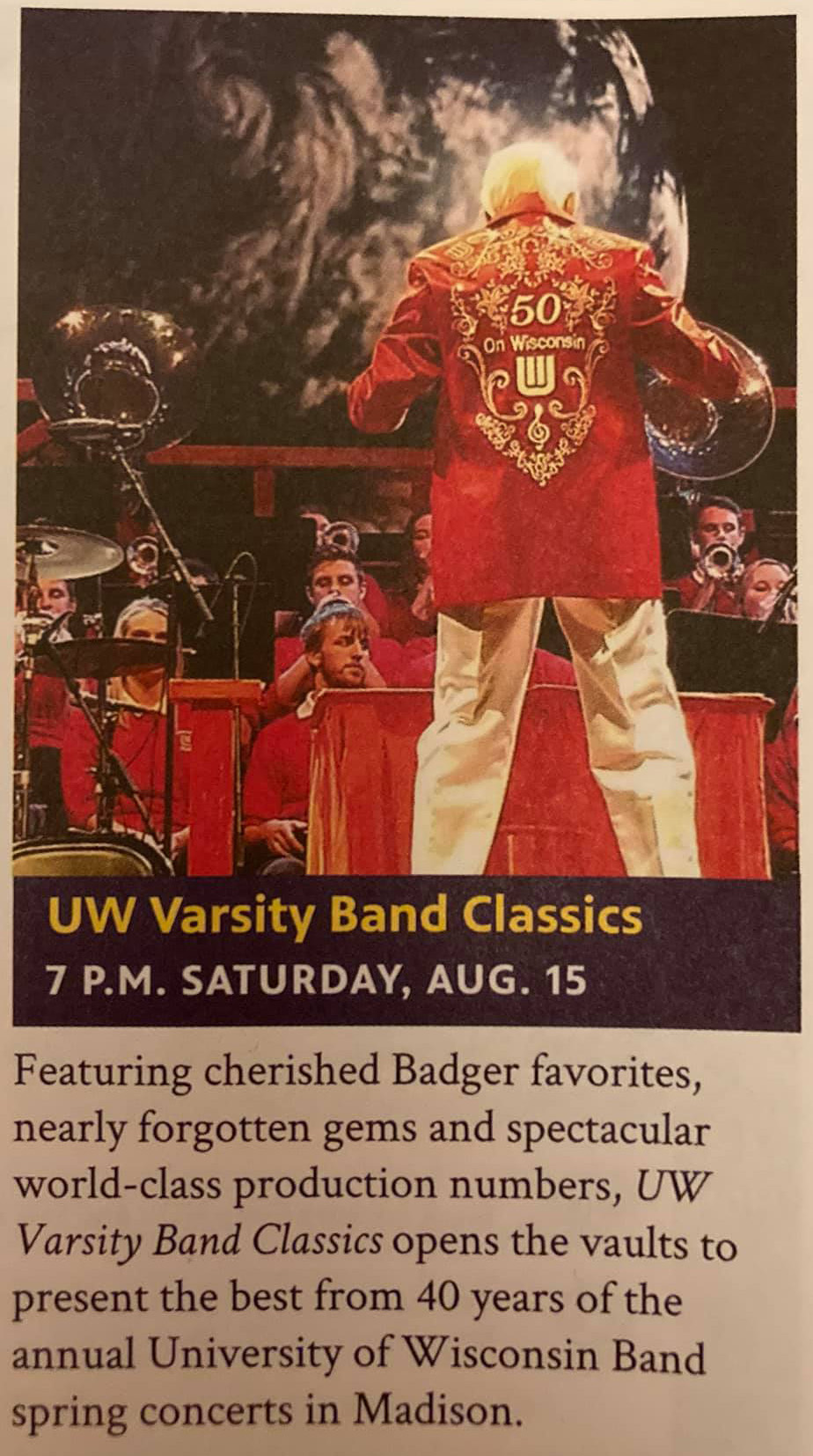
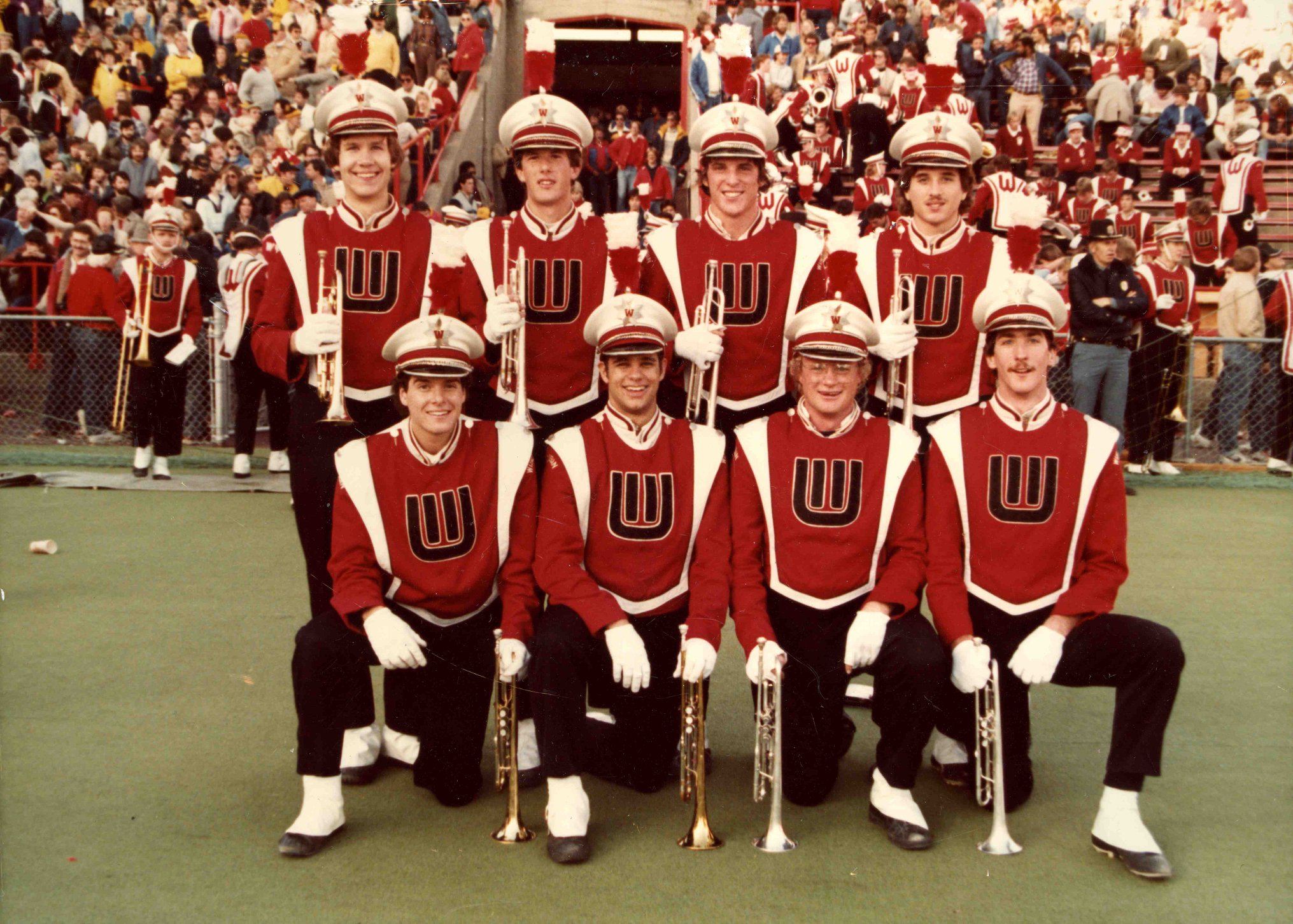
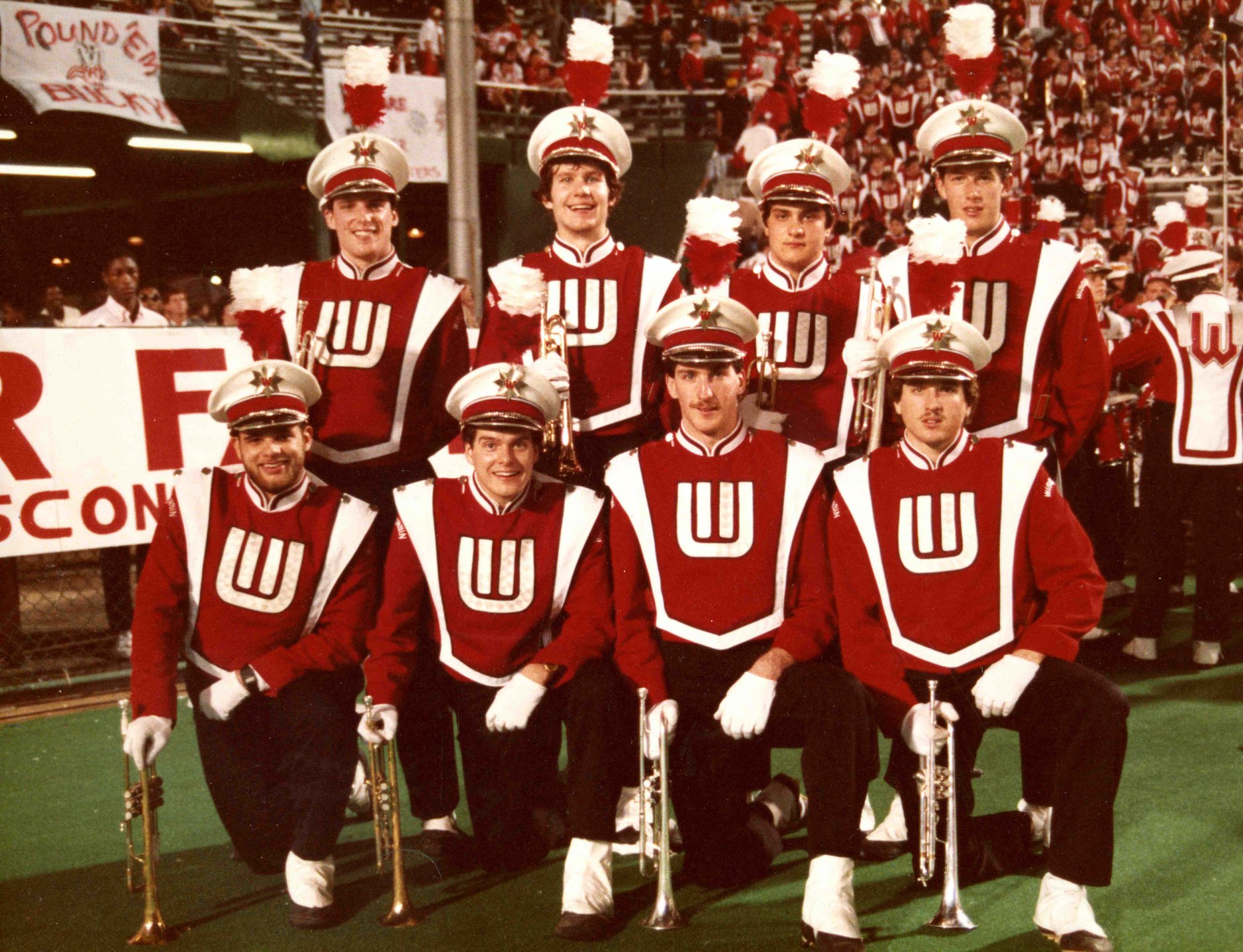
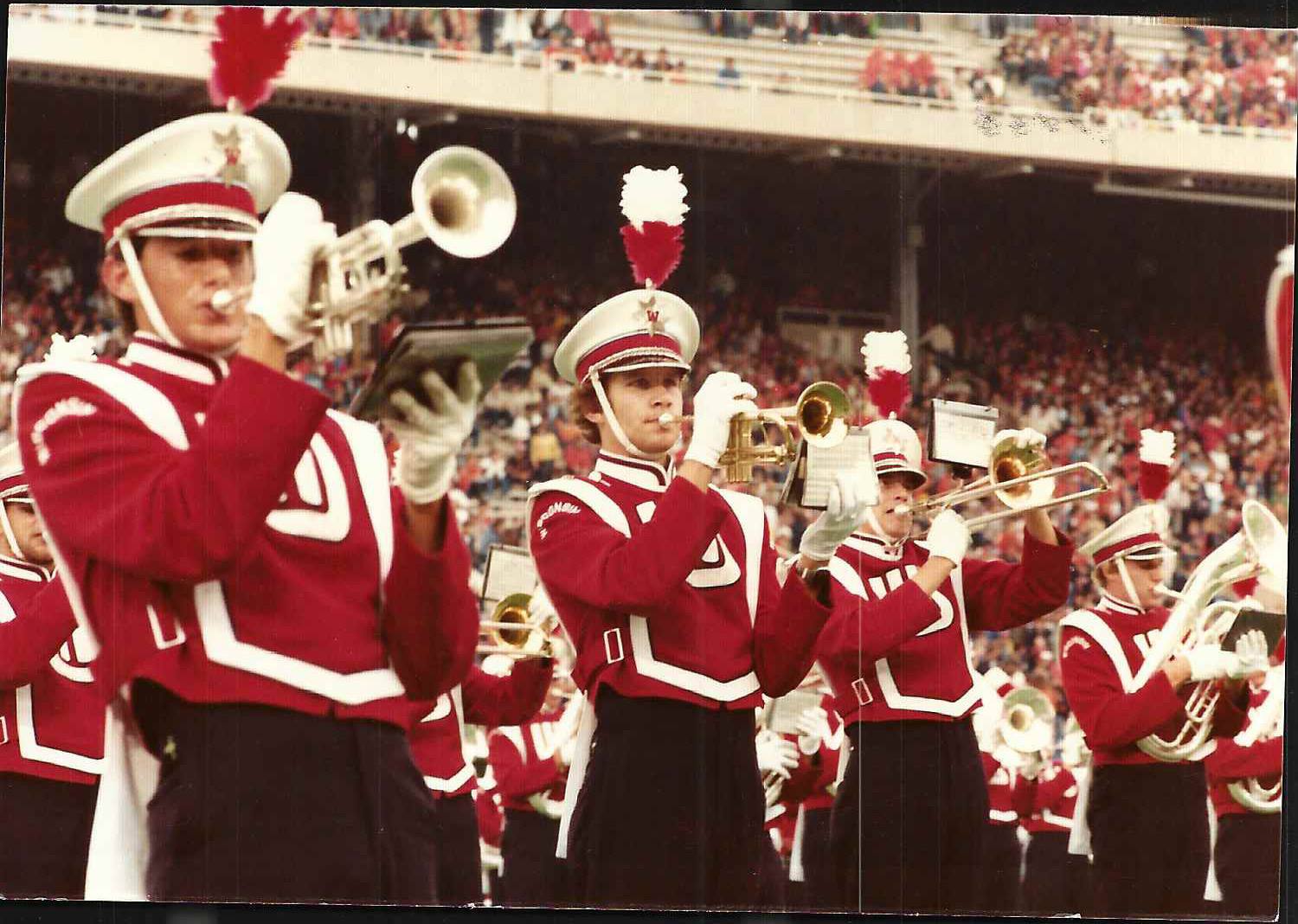
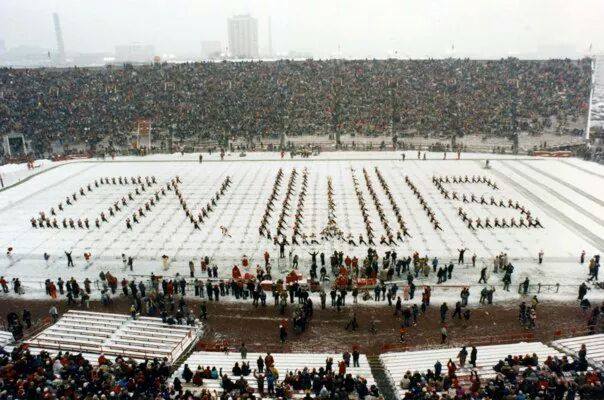
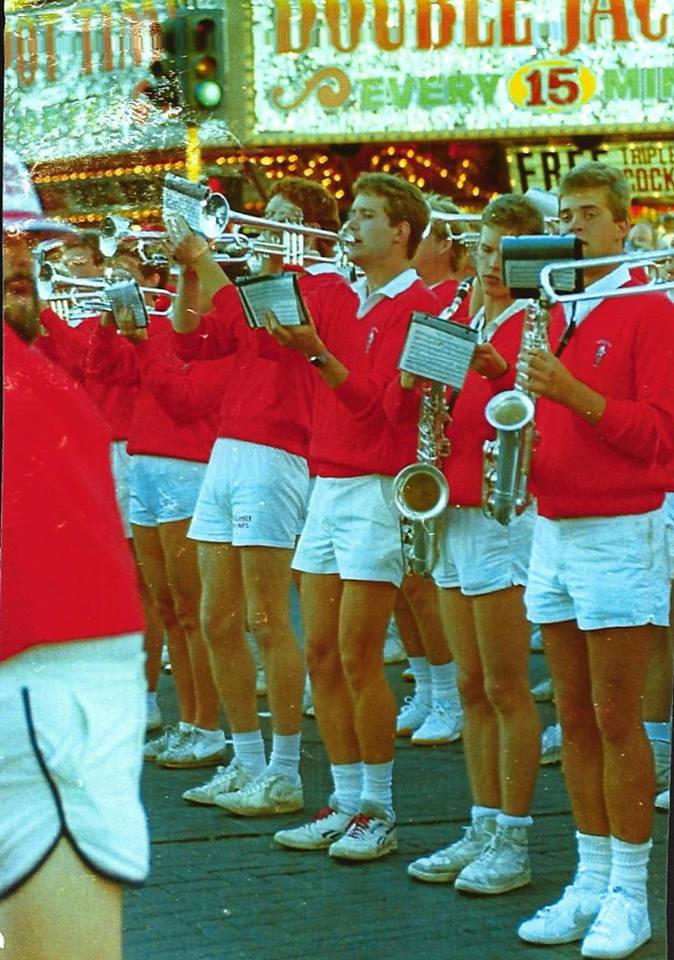
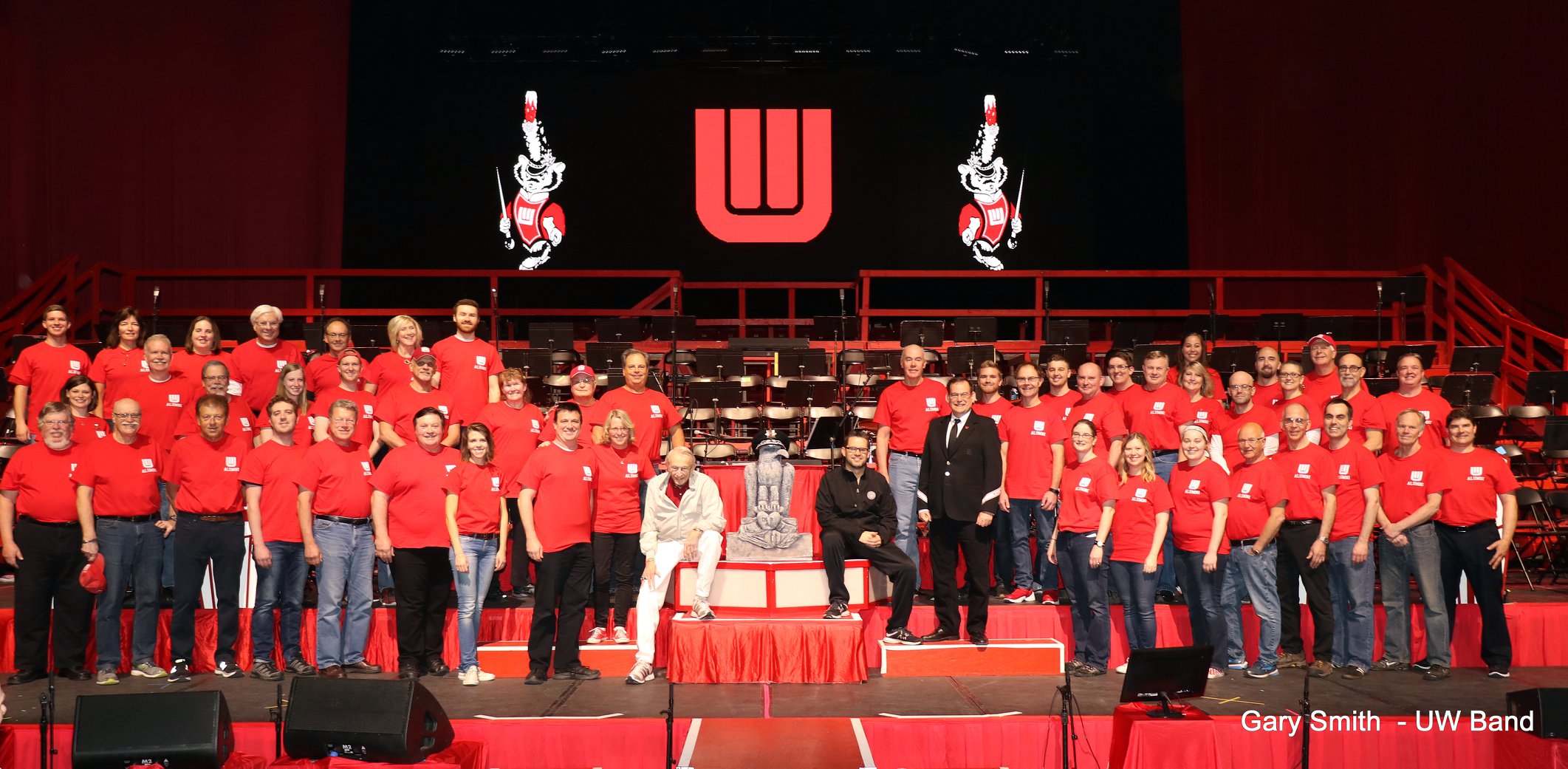
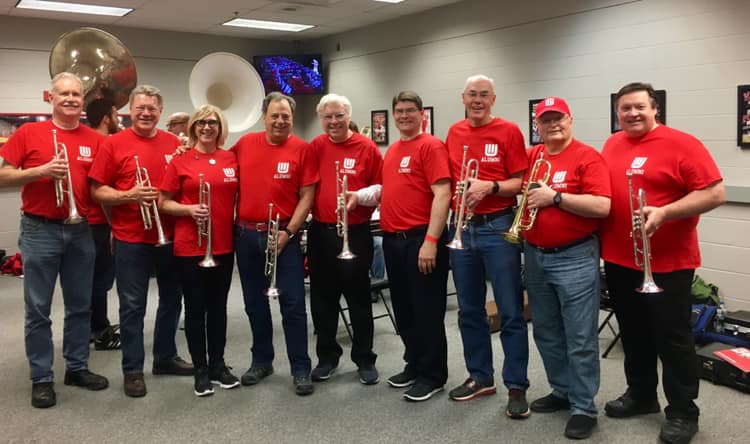
    • Drive and Eat au0026nbsp;RockThe first UW home football game of each season also is the opener for the University of Wisconsin Marching Band, the world’s finest college marching band. (How the UW Band has not gotten the Sudler Trophy, which is to honor the country’s premier college marching bands, is beyond my comprehension.) I know this because I am an alumnus of the UW Band. I played five years (in the last rank of the band, Rank 25, motto: “Where Men Are Tall and Run-On Is Short”), marching in 39 football games at Camp Randall Stadium, the Hubert H. Humphrey Metrodome in Minneapolis, Michigan Stadium in Ann Arbor, Memorial Stadium at the University of Illinois (worst artificial turf I had ever seen), the University of Nevada–Las Vegas’ Sam Boyd Silver Bowl, the former Dyche Stadium at Northwestern University, five high school fields and, in my one bowl game, Legion Field in Birmingham, Ala., site of the 1984 Hall of Fame Bowl. The UW Band was, without question, the most memorable experience of my college days, and one of the most meaningful experiences of my lifetime. It was the most physical experience of my lifetime, to be sure. Fifteen minutes into my first Registration…
    • Keep on rockin’ in the freeu0026nbsp;worldOne of my first ambitions in communications was to be a radio disc jockey, and to possibly reach the level of the greats I used to listen to from WLS radio in Chicago, which used to be one of the great 50,000-watt AM rock stations of the country, back when they still existed. (Those who are aficionados of that time in music and radio history enjoyed a trip to that wayback machine when WLS a Memorial Day Big 89 Rewind, excerpts of which can be found on their Web site.) My vision was to be WLS’ afternoon DJ, playing the best in rock music between 2 and 6, which meant I wouldn’t have to get up before the crack of dawn to do the morning show, yet have my nights free to do whatever glamorous things big-city DJs did. Then I learned about the realities of radio — low pay, long hours, zero job security — and though I have dabbled in radio sports, I’ve pretty much cured myself of the idea of working in radio, even if, to quote WAPL’s Len Nelson, “You come to work every day just like everybody else does, but we’re playing rock ’n’ roll songs, we’re cuttin’ up.…
    • Monday on the flight line, not Saturday in the park
    • Music to drive by
    • The rock ofu0026nbsp;WisconsinWikipedia begins its item “Music of Wisconsin” thusly: Wisconsin was settled largely by European immigrants in the late 19th century. This immigration led to the popularization of galops, schottisches, waltzes, and, especially, polkas. [youtube=http://www.youtube.com/watch?v=yl7wCczgNUc] So when I first sought to write a blog piece about rock musicians from Wisconsin, that seemed like a forlorn venture. Turned out it wasn’t, because when I first wrote about rock musicians from Wisconsin, so many of them that I hadn’t mentioned came up in the first few days that I had to write a second blog entry fixing the omissions of the first. This list is about rock music, so it will not include, for instance, Milwaukee native and Ripon College graduate Al Jarreau, who in addition to having recorded a boatload of music for the jazz and adult contemporary/easy listening fan, also recorded the theme music for the ’80s TV series “Moonlighting.” Nor will it include Milwaukee native Eric Benet, who was for a while known more for his former wife, Halle Berry, than for his music, which includes four number one singles on the Ru0026amp;B charts, “Spend My Life with You” with Tamia, “Hurricane,” “Pretty Baby” and “You’re the Only One.” Nor will it include Wisconsin’s sizable contributions to big…
    • Steve TV: All Steve, All the Time
    • “Super Steve, Man of Action!”
    • Too much TV
    • The worst music of allu0026nbsp;timeThe rock group Jefferson Airplane titled its first greatest-hits compilation “The Worst of Jefferson Airplane.” Rolling Stone magazine was not being ironic when it polled its readers to decide the 10 worst songs of the 1990s. I’m not sure I agree with all of Rolling Stone’s list, but that shouldn’t be surprising; such lists are meant for debate, after all. To determine the “worst,” songs appropriate for the “Vinyl from Hell” segment that used to be on a Madison FM rock station, requires some criteria, which does not include mere overexposure (for instance, “Macarena,” the video of which I find amusing since it looks like two bankers are singing it). Before we go on: Blog posts like this one require multimedia, so if you find a song you hate on this blog, I apologize. These are also songs that I almost never listen to because my sound system has a zero-tolerance policy — if I’m listening to the radio or a CD and I hear a song I don’t like, it’s, to quote Bad Company, gone gone gone. My blonde wife won’t be happy to read that one of her favorite ’90s songs, 4 Non Blondes’ “What’s Up,” starts the list. (However,…
    • “You have the right to remain silent …”
  • Madison
    • Blasts from the Madison media past
    • Blasts from my Madison past
    • Blasts from our Madison past
    • What’s the matter with Madison?
    • Wisconsin – Madison = ?
  • Sports
    • Athletic aesthetics, or “cardinal” vs. “Big Red”
    • Choose your own announcer
    • La Follette state 1982 (u0022It was 30 years ago todayu0022)
    • The North Dakota–Wisconsin Hockey Fight of 1982
    • Packers vs. Brewers
  • Hall of Fame
    • The case(s) against teacher unions
    • The Class of 1983
    • A hairy subject, or face the face
    • It’s worse than you think
    • It’s worse than you think, 2010–11 edition
    • My favorite interview subject of all time
    • Oh look! Rural people!
    • Prestegard for president!
    • Unions vs. the facts, or Hiding in plain sight
    • When rhetoric goes too far
Privacy & Cookies: This site uses cookies. By continuing to use this website, you agree to their use.
To find out more, including how to control cookies, see here: Cookie Policy
  • Subscribe Subscribed
    • Steve Prestegard.com: The Presteblog
    • Join 198 other subscribers
    • Already have a WordPress.com account? Log in now.
    • Steve Prestegard.com: The Presteblog
    • Subscribe Subscribed
    • Sign up
    • Log in
    • Report this content
    • View site in Reader
    • Manage subscriptions
    • Collapse this bar
%d