ESPN broadcaster Mark Jones doesn’t need to be fired. He needs help. He needs an intervention. Like the network that pays him, Jones has been radicalized by his Twitter feed.
In reaction to a Louisville grand jury failing to indict the officers who shot Breonna Taylor in an attempt to subdue her boyfriend who shot a police officer, Jones declared on his Twitter feed that he would no longer accept a police escort to the games he broadcast.
“Saturday at my football game,” Jones tweeted, “I’ll tell the police officer on duty to ‘protect’ me he can just take the day off … I’d rather not have the officer shoot me because he feared for his life because of my black skin or other dumb ish. I’m not signing my own death certificate.”
Saturday at my football game I’ll tell the police officer on duty to “protect” me he can just take the day off. Fr.
I’d rather not have the officer shoot me because he feared for his life because of my black skin or other dumb ish.
The tweet is insanity. It reveals a dangerous level of paranoia and delusion. Broadcasters of all ethnicities have been receiving police escorts to and from sporting events for at least 50 years. Not one police officer has ever assassinated a broadcaster. Not one.
Mark Jones is crying for help. Twitter is feeding his delusion. Unfortunately so is ESPN. Black Lives Matter cult leaders Colin Kaepernick and LeBron James have indoctrinated the entire network. The Worldwide Leader exists today as a virtual cult compound for racial radicalism.
The network’s reaction to the Louisville grand jury was unprofessional, bizarre and cult-like. Tall broadcasters with no expertise in criminal justice or fact-based journalism ranted and whined. Former University of Georgia basketball player Maria Taylor and former college and NBA star Jalen Rose emoted on ESPN’s NBA Countdown Show.
“I just want people to know that blacks are hurting,” Rose said. “And, uh, as we related to sports that are predominantly black, the WNBA, the NBA, the NFL, all of those players are performing with heavy hearts. And we’re still showing up to try to do our jobs, and I was in that position. I can’t lie to y’all. I was looking in my closet like, ‘I’m going to wear something fresh today, because if I say something to get me fired, then I was crisp.’ That’s what I was thinking.”
I’m not sure if Rose is aware that President John F. Kennedy’s assassination was shown on television and Americans went to work afterward. Breonna Taylor’s been dead for months. It’s also been obvious for months that the police officers who responded to the gunfire of her boyfriend were not going to be charged with murder. BLM cult leader LeBron James and his NBA flock misled their followers into believing the state of Kentucky would waste taxpayer money on a criminal prosecution it could not win.
But Rose wasn’t done. He pivoted into a deeper form of illogic.
“Because when Kyle Rittenhouse in (Kenosha), as a 17-year-old, kills two people and yet three cops aren’t directly charged for killing Breonna Taylor, it shows you how they feel about black lives in America.”
Rittenhouse is white. He killed two white BLM cult members. Rittenhouse has been charged with their murders despite the fact there is quite a bit of evidence that he shot them in self-defense.
Jalen Rose is drowning in the deep end of the pool. ESPN should not allow Rose, Taylor or any of their ex-jocks to swim in the criminal justice waters. It’s too deep. Too dangerous.
If the Worldwide Leader wants to discuss police work, grand juries and race, why not hire former police officers, lawyers and historians to do it at a high level? Why not let trained, experienced journalists lead the discussion? Why let the blind lead the blind?
I’ve known Jalen Rose since he was 19 and a sophomore at Michigan. In the past, I’ve supported his charter school in Detroit. Rose, I believe, wants to make a positive impact on the world. Like all of us, he has blind spots. Wealth invites delusion.
Rose and Jones fit the profile of men vulnerable to Black Lives Matter radicalization. They’re black men married to white women.
I am not disparaging their marriage choices. No one who knows my dating history could argue I have a problem with inter-racial dating. No one.
But, as I’ve written previously, your choice in partners can complicate your racial worldview, particularly in this social media era. Black men who date or marry white women face an incredible amount of racial backlash in the real world and in the social media world. Random people, friends and family members question your blackness.
Swearing allegiance to Black Lives Matter ideology is a protective shield against the criticism. Mixed-race black people use BLM as a shield in the same fashion. It’s not a coincidence that Colin Kaepernick is the head of this cult. Racial radicalism makes him feel black.
I know some of you feel I’m out of bounds discussing the racial makeup and dating preferences of BLM cult members. I’m not. BLM cult members speculate about the racial motivations of police officers, district attorneys and grand juries.
There’s no proof that former Minneapolis cop Derek Chauvin was motivated by George Floyd’s black race. There’s no proof the three Louisville police officers were motivated by Breonna Taylor’s black race. The evidence points to the Louisville cops being motivated by gunfire that struck a police officer with a lawful warrant.
It’s not a coincidence that many of the most strident BLM cult members are mixed race or involved in a mixed-race relationship. Kaepernick, Kenny Stills, Jussie Smollett, Bubba Wallace, Chuba Hubbard. BLM Grand Wizard Shaun King is a white man who has adopted a black identity.
BLM is a cult for people with identity issues. When I worked at ESPN, the common complaint from black male employees was that it was difficult for black men married to black women to rise in the management pyramid.
ESPN disrupted the Western-prescribed all-black nuclear family long before Black Lives Matter called for it on its website.
Let me repeat. I have NO problem with inter-racial marriage. None. If you’re going to do it, just make sure you’re man or woman enough to handle the complications without joining a race-bait cult.
Someone at ESPN should convince Mark Jones to delete his Twitter account and seek counseling. He’s melting down. In 2018, he posted a picture of himself smiling and praising police in Syracuse. Thursday, he tweeted that the picture was actually him thanking a black dude for finding a bag he lost. I’m not exaggerating. Look at the tweet below.
A young Black dude actually found the bag which had popped out of our SUV. He was heading to the game and saw it in the ditch. He recognized my face on my iPad in the bag. He handed it off to Police at the parking lot✊🏽😂😂 https://t.co/UGf7tuJXhs
What we’ve seen at ESPN over the past several years and in the last 48 hours in particular is why sports fans should ‘Kick their ESPN habit. We’re not perfect here at Outkick. But we’re not a radical cult promoting a race war in America.
The number eight song today in 1958, one week or almost a month after the end (depending on your definition) of summer:
Today in 1967, the Beatles mixed “I Am the Walrus,” which combined three songs John Lennon had been writing. The song includes the sounds of a radio going up and down the dial, ending at a BBC presentation of William Shakespeare’s “King Lear.” Lennon had read that a teacher at his primary school was having his students analyze Beatles lyrics, Lennon reportedly added one nonsensical verse, although arguably none of the verses make much sense:
The recent murder of George Floyd at the hands of the Minneapolis Police, and the riots and protests that have followed, have forged an essential discussion on police brutality that has been long in the making. In the past, many of us have responded to publicized incidents of police brutality by giving officers the benefit of the doubt because we believe that the other side of the story will justify their actions. We must now reckon that the “other side of the story” does not always absolve police officers’ of wrongdoing. For the first time, many of us now stare directly into the eyes of police brutality’s harsh existence, the same existence that Black people have known to be true their entire lives.
The reignition of the Black Lives Matter movement was undoubtedly justifiable, expected, and necessary in the aftermath of George Floyd’s murder. As the movement gains steam, it forces us to have difficult conversations and continue to stare into the eyes of police brutality’s existence.
Naturally, the recent movement has stirred up intense passion, coupled with anger and frustration – which is a good thing. How could someone not watch the horrific video of George Floyd’s murder and not be angry? What’s not so good is the burning desire that many Americans have to argue with one another. We’ve seen this desire play out as cancel culture’s recent growth has swarmed and infested public and private life.
We should take solace in the fact that virtually all Americans agree – police brutality is a problem, and police reform is necessary. The idea that a vast swath of the country rejects this idea is unfounded. A CBS News poll recently found that 91% of Americans believe that police reform is necessary. We have been witnesses to the spawning of a significant culture shift in our country, and that’s a good thing.
The vast majority of Americans believe that if we want communities, particularly the African American community, to feel protected against gross negligence and abuse of power, police reform must be pursued and enacted. While we’re virtually all in agreement on the problem, the discourse begins when deliberating the solutions to the problem.
In Wisconsin, we’ve seen the calls for police reform amplified, peacefully and violently, in its two largest cities, Milwaukee and Madison. If you’re from Wisconsin, you know that the state’s residents typically don’t share the same grievances as those who live in the Milwaukee and Madison area.
Despite this, rallies and marches against police brutality have occurred across the entire state since the death of George Floyd. The grievances against police brutality are not limited to Milwaukee and Madison area residents, as towns across the state such as Oshkosh, Appleton, Platteville, and Kenosha have seen residents join in the fight against police brutality.
Since this issue is not specific to any part of the state, the state’s Assembly, Senate, and Governor must expostulate with one another to address police brutality. People can post on their Instagram stories all they want. Still, no structural change will be created without thoughtful, comprehensive legislation at the state level.
So, what should police reform look like?
The call to “Defund the Police” has been thrust into the forefront of the police reform debate.
In Milwaukee and Madison, street murals reading “Defund the Police” have been painted in giant yellow letters on major city streets. The Milwaukee Common Council is exploring a 10% budget reduction to the police department that would amount to a nearly $30-million-dollar budget cut. State Rep. David Bowen, (D-Milwaukee), and State Rep. Jonathan Brostoff, (D-Milwaukee) have come out in support of Defunding the Police.
This is a bad idea. The majority of the money allotted to police budgets goes towards the officer’s salaries. If we decide to pay our officers less, they have less incentive to do their job well. If we pay officers more, they have an incentive to perform at a high level in efforts to maintain a high paying job. The National Economic Bureau even found statistical evidence that when officers are paid more, their performance increases.
If we’re expecting police officers to be better, why would we be taking money away from them? When schools are failing, we don’t “Defund Schools,” we give them more money and implement new plans to ensure their success. The city of Milwaukee has been defunding the police department for years. This past year the city cut the department’s budget by 60 officers, and the homicide rate in Milwaukee has more than doubled.
We should increase funding for police departments. The solution to police brutality is better policing, not less policing. We should be training our officers more. By paying more and training more, we can improve the performance of our local police officers.
In addition to increasing funding for police departments, the state should extend Act 10 to cover police unions. Police unions present the same danger that other public section unions present; they place their members’ interests over the broader community. Police unions around the country have lobbied against greater transparency in day-to-day policing, public record laws that would make filed complaints against officers’ public, merit-based pay, and banning contracts with private trainers.
Gov. Scott Walker (R-Wisconsin), passed the controversial union reform Act in 2011. However, the Act did not apply to police unions. The Act restricted collective bargaining, ended mandatory union dues, and required contributions to benefits. The implementation of Act 10 allowed school districts to evaluate teacher’s disciplinary decisions on an individual basis and not worry about letting a lousy teacher go even if they had tenure. The same would be true if Act 10 were extended to police unions. Instead of an officer being shielded by the union, the department could evaluate disciplinary decisions on an individual basis and have the ability to fire the officer for any wrongdoing.
Under the Milwaukee Police Union contract, officers can only be interrogated during certain hours of the day, which leaves the officers time to get their story straight. Last year, 93 Milwaukee police officers were disciplined for egregious misconduct, but all kept their jobs. If Act 10 were extended to police unions, it would have the same effect that it’s had on teachers’ unions. It would provide departments the ability to promote their officers based on performance, not age. And the ability to individually evaluate the misconduct of their officers without police union protection. All in all, extending Act 10 to police unions would make for a more accountable and effective police force.
As we continue to stare directly into the eyes of police brutality’s harsh existence, let’s continue to fight for solutions. Let’s increase training and funding for police while extending Act 10 to cover police unions. By creating a more prepared, effective, and accountable police force, we can take the first step in helping the African American community feel protected against abuse of power from which George Floyd suffered.
Grebe wrote that for the Badger Herald, which when I was a UW student was the campus’ independent and conservative newspaper. Apparently that is no longer the case, as the College Fix reports:
The Badger Herald, one of two student newspapers at the University of Wisconsin Madison, has dismissed a columnist following his submission of an op-ed that argued against defunding the police and instead spelled out ways to reform police departments.
Tripp Grebe, its author, called for better pay, better training, and police union reforms.
“If we’re expecting police officers to be better, why would we be taking money away from them? When schools are failing, we don’t ‘Defund Schools,’ we give them more money and implement new plans to ensure their success,” Grebe wrote in his submission.
“The city of Milwaukee has been defunding the police department for years. This past year the city cut the department’s budget by 60 officers, and the homicide rate in Milwaukee has more than doubled,” he argued. “… As we continue to stare directly into the eyes of police brutality’s harsh existence, let’s continue to fight for solutions. Let’s increase training and funding for police while extending Act 10 to cover police unions.”
After he submitted it, he was told by the Herald’s opinion editor Samiha Bhushan via email in late August that although the piece was “well written” that it was “too much of a hot take,” and that upper management of the paper was worried it may “alienate” incoming freshmen, according to a screenshot of the email.
“Additionally,” the email continues, “we just posted an editorial board supporting BLM and another article publicly endorsing two candidates who want to defund the police. As a result, your article would cause a lot of backlash that we cannot afford right now.”
Bhushan said if Grebe was open to edits, there was a chance it may be able to run.
But a later email from upper management at the paper changed tune, next suggesting that the issue with Grebe’s piece was solely with sourcing, despite the piece containing nearly 20 different sources from news outlets such as CBS News, the Milwaukee Journal Sentinel and the National Economic Bureau.
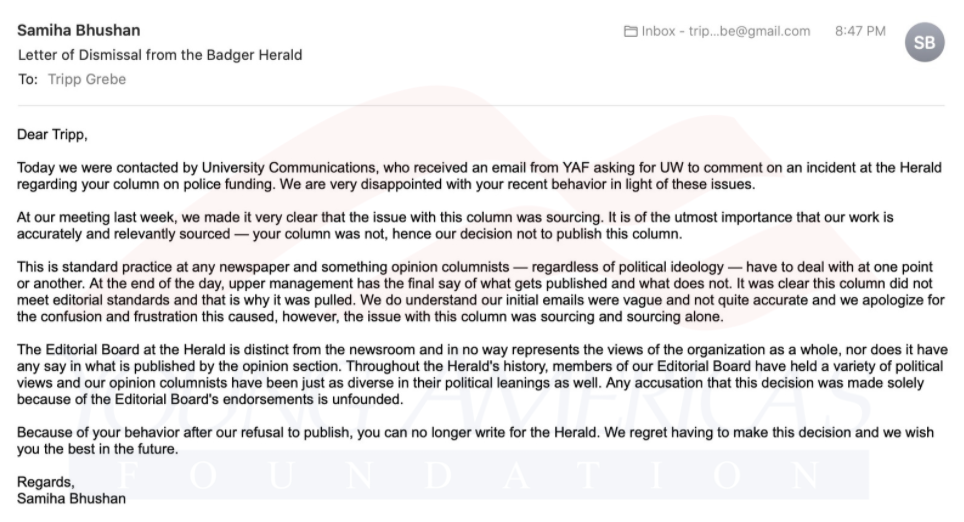
Grebe was later dismissed from the Herald via email after they were tipped off to an inquiry on the issue by the Young America’s Foundation. YAF originally reached out to UW media affairs division, which apparently alerted the campus paper of the situation.
“It is of the utmost importance that our work is accurately and relevantly sourced,” reads Grebe’s dismissal letter, “your column was not, hence our decision not to publish this column.”
In a statement to YAF, Badger Herald Editor in Chief Harrison Freuk defended the paper’s decision, saying their emails to Grebe were unclear; he denied that their pro-BLM editorials had anything to do with not running the column, and instead told YAF it was a matter of Grebe’s column containing “inaccurate/irrelevant information.”
Freuk did not respond to a request from The College Fix seeking comment.
On their website, the Badger Herald describes itself as “the nation’s largest fully independent student newspaper,” and states it published items that “reflect the interests and tastes of the University of Wisconsin community.”
Grebe was arguably the most prominent conservative opinion voice at the Herald, which has published five of his op-eds this year, such as the “Constitution should be interpreted as written, not as public opinion changes” and “While racialized attacks are unjustified, Chinese government mishandled COVID-19 pandemic.”
Grebe told The Fix he “enjoyed being the only conservative columnist for a publication like the Badger Herald.
“It’s frustrating that my column was censored because its viewpoint was different from the paper’s editorial stance. Like any writer, I want to work for a paper that will permit me to express my viewpoint in a responsible way without being required to change my opinion to satisfy others,” he said via email.
“It was disappointing to see the Badger Herald editorial staff claim my article wasn’t published due to a sourcing issue, once the story became public,” Grebe continued. “The Herald made it very clear both in their emails and when I met with them personally, that my article was well written and there was no sourcing issue.”
The FBI and the Pennsylvania State Police, investigating reports of issues with mail-in ballots at the Luzerne County Board of Elections in Pennsylvania, have recovered a number of discarded military ballots.
The U.S. Department of Justice on Thursday announced the findings of their ongoing inquiry. According to the DOJ, officials recovered nine military ballots so far, all of which were cast in support of Republican presidential candidate Donald Trump.
The DOJ states the investigation has been ongoing since Monday and Election officials in Luzerne County have been cooperative.
It is unclear from the DOJ statement why the ballots were discarded and where they were found. The DOJ said some of the discarded ballots could be attributed to specific voters and others could not.
“Our inquiry remains ongoing and we expect later today to share our up to date findings with officials in Luzerne County,” the DOJ statement reads. “It is the vital duty of government to ensure that every properly cast vote is counted.”
The news of the discarded ballots comes as Trump has raised concerns, on multiple occasions, about the potential for problems with widespread mail-in balloting.
The Federal Bureau of Investigation has found a number of mail-in ballots in Pennsylvania discarded in the trash. They were ballots cast for President Donald Trump.
The Office of Inspector General is conducting an investigation after a box of mail was found in a ditch in Outagamie County.
According to a social media post shared with WFRV Local 5, the box was found on Tuesday and turned over to the Outagamie County Sheriff’s Office.
WFRV Local 5 reached out to the U.S. Postal Service for comment. Officials provided us with this statement:
We are aware of some mail, including absentee ballots, recovered in Greenville, Outagamie County earlier this week. The United States Postal Inspection Service has asked the Office of Inspector General (OIG) to conduct an investigation regarding these issues. The Postal Service will respond to the OIG findings once the investigation is concluded. We have no further information to provide at this time.
Today in 1965, Roger Daltrey was fired from The Who after he punched out drummer Keith Moon. Fortunately for Daltrey and the Who, he was unfired the next day. (Daltrey and Pete Townshend reportedly have had more fistfights than Muhammad Ali and Joe Frazier.)
My first car was a 1957 Chevrolet Bel Air ragtop. I was 17 and it was one of the most beautiful vehicles I had ever seen. I treasured that car and six decades later it occasionally pops up in my dreams.
But it had two shortcomings: The engine was topped with a measly two-barrel carburetor (remember those?) and, more important, it was burdened with an automatic transmission. At the time no self-respecting high-school male wanted to drive an automatic—that was for parents and grandparents. I wanted a stick shift that would make me look cool. Plus, I could burn rubber in a manual, even with a two-barrel carburetor.
The baddest car in town was George Cameron’s black 1957 fuel-injected Chevy. This was a car only God himself could have placed on earth. In my boyhood home of Rushville, Ind., George spent weekend evenings cruising Main Street at a slow creep with no need to race the engine or squeal the tires. Everyone already knew this was the fastest car in the county. His Chevy sported a three-on-the-column stick shift.
Sadly, the end of the manual transmission is near, and the unfortunate truth is few people will miss it. Most young adults don’t know how to drive a vehicle with a manual transmission, and they aren’t interested in learning. Many modern automatics offer better fuel efficiency and quicker acceleration than their manual counterparts. Porsche now delivers 75% of its 718 and 911 sports cars with automatic transmissions. The new C8 Corvette is only available with one. When the stick shift loses Porsche and Corvette buyers, you know it’s quickly heading for the rearview mirror.
But there is more bad news. In the future, cars won’t only be automatics; it appears they’ll increasingly be automated, electric vehicles. The satisfying throbbing of the exhaust and the pleasure of driving will also become victims of progress. Traveling in a personal vehicle will be as exciting as riding in an elevator with windows.
Despite impressive improvements in vehicle technology, my devotion for manually shifting gears, listening to the rumble of the exhaust, and maintaining a tight grip on the steering wheel through a sharp curve remains undiminished. Gripping the shifter knob allows a driver to become part of the vehicle rather than someone who is little more than a passenger. Manually accelerating through the gears and downshifting into a curve are two of motoring’s most satisfying experiences.
The sound, feel and thrill of driving are to be relished, not relegated to the trash heap and memories along with carburetors, fender skirts, steel wheels and hubcaps. Drive the Blue Ridge Parkway in a sports car with a manual transmission and you too will become a believer.
Ruth Bader Ginsburg has died, and the country — or at least its political class — is descending into what will no doubt be a multi-week screaming fit. In fact, the screaming has already begun.
But that fact tells us something about the state of our nation, and it’s not anything good. When your political system can be thrown into hysteria by something as predictable as the death of an octogenarian with advanced cancer, there’s something wrong with your political system. And when your judicial system can be redirected by such an event, there’s something wrong with your judicial system, too.
The mess of our political system
Our political system, of course, is a mess in general. Partly because of the influence of social media, as I argued in my book, The Social Media Upheaval, and partly because America has arguably the worst political class in its history, pretty much everything seems to send it into screeching hysteria. (I’m old enough to remember when “activists” threatened FCC Chair Ajit Pai and his family over Network Neutrality, something that was a source of screeching hysteria a few years ago but that now hardly anyone even remembers). I have some ideas on how to fix that, but those will have to wait for another column. Suffice it to say that if what we’re looking for is a long time horizon, self-discipline, and a willingness to forego immediate advantages for the long-term good of the nation, we’ve got the wrong political class.
So let’s look at the Supreme Court.
Why does Justice Ginsburg’s replacement matter so much that even “respectable” media figures are calling for violence in the streets if President Trump tries to replace her? Because the Supreme Court has been narrowly balanced for a while, with first Justice Anthony Kennedy, and later Chief Justice John Roberts serving as a swing vote. Ginsburg’s replacement by a conservative will finally produce a long-heralded shift of the Supreme Court to a genuine conservative majority.
That shift matters because, for longer than I have been alive, all sorts of very important societal issues, from desegregation to abortion to presidential elections and state legislative districting — have gone to the Supreme Court for decision. Supreme Court nominations and confirmations didn’t used to mean much — Louis Brandeis was the first nominee to actually appear before the Senate Judiciary Committee — because the Court, while important, wasn’t the be-all and end-all of so many deeply felt and highly divisive issues. Now it very much is.
The point isn’t whether the Court got the questions right. The point is that it decided these important issues and, having done so, took them off the table for democratic politics. When Congress decides an issue by passing a law, democratic politics can change that decision by electing a new Congress. When the Court decides an issue by making a constitutional ruling, there’s no real democratic remedy.
That makes the Supreme Court, a source of final and largely irrevocable authority that is immune to the ordinary winds of democratic change, an extremely important prize. And when extremely important prizes are at stake, people fight. And get hysterical.
Almost as bad, the Court is highly unrepresentative. That doesn’t matter when it’s deciding technical legal issues, but once it starts ruling on social issues of sweeping importance to all sorts of Americans, its lack of diversity becomes a problem. And not just the usual racial and gender diversity. Every current member of the Court is a graduate of Harvard or Yale Law Schools. (Justice Ginsburg offered a bit of diversity there, having spent her third year, and gotten her degree from, that scrappy Ivy League upstart, Columbia University. But she spent her first two years at Harvard). All of them were elite lawyers, academics, or appellate judges before arriving on the Court. They are all card-carrying credentialed members of America’s elite political class. Which, as I mentioned earlier, is in general pretty terrible.
Justices used to come from much more diverse backgrounds. Until well into the 20th Century, many Justices — Justice Robert Jackson was the last — didn’t have law degrees, having “read law” after the fashion of Abraham Lincoln, and for that matter pretty much every lawyer and judge until the 20th Century. Many had been farmers, military officers, small (and large) businessmen, even in one case an actuary. But now they are all, in Dahlia Lithwick’s words, “judicial thoroughbreds” with very similar backgrounds, backgrounds that make them very different from most Americans, or even from most lawyers.
Our politics is dominated by a court that decides political issues
So to break it down: All the hysteria about a Ginsburg replacement stems from the fact that our political system is dominated by an allegedly nonpolitical Court that actually decides many political issues. And that Court is small (enough so that a single retirement can throw things into disarray) and unrepresentative of America at large.
In an earlier article, responding to Democrats’ plans to “pack” the Court with several additional justices whenever they get control back, I suggested going a step further, and add fifty new justices, one each to be appointed by every state’s governor. My proposal wasn’t entirely serious, being meant to point up the consequences of opening the door on this topic. But on reflection, maybe it was a better idea than I realized.
Under my proposal, the death or retirement of a single justice wouldn’t be much more than a blip in the news, instead of something serious enough that there are people talking about violence in the streets. A Supreme Court composed of 59 justices wouldn’t have the mystique of the current Court — you might believe in 9 Platonic Guardians, but the notion of 59 such is absurd. And since governors would presumably select people from their own states, it would bring a substantial increase in diversity to the Court.
Would my approach have problems? Sure. But would it be likely to bring America to the brink of Civil War? No. Which is a pretty major advantage over our present situation. Keep that in mind as we navigate the coming storm.
 Steve Prestegard.com: The Presteblog