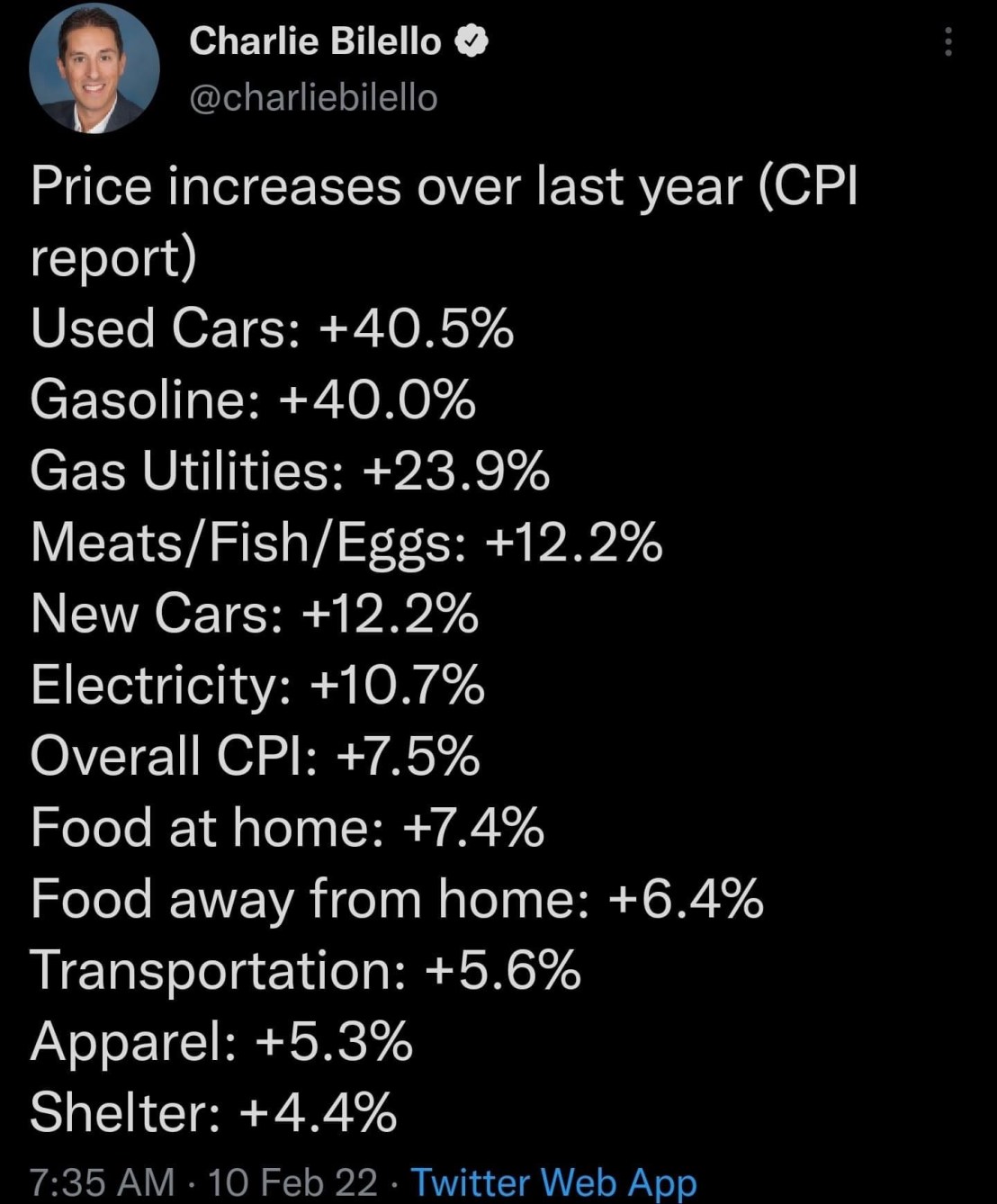
Quiet desperation stalks the White House. The President who promised to bring Americans together has thrown himself into the arms of his party’s radical progressives. The thin Democratic majority fractured when pressed to massively expand the US welfare state. Rapid and excessive monetary and fiscal expansion triggered inflation rates not seen for decades. Democratic pols believe their House majority is already lost and Senate control is in jeopardy.
Internationally the President has done no better. He appears torn between representing the American people, who have tired of policing the globe, and listening to his appointees, who still imagine enforcing Pax Americana. He acted courageously in facing down the Washington foreign policy “Blob” and leaving Afghanistan, but badly botched the withdrawal. He earned an indelible reputation for incompetence, which now taints his every international action.
After running as the anti-Trump he adopted his predecessor’s hostile policy toward China, enforced mostly by huffing and puffing. He blundered away the best chance to reinstate the nuclear deal with Iran, and has no answer to North Korea as the latter continues testing missiles. After promising to emphasize human rights he embraced the brutal Saudi monarchy and continued support for its murderous war against Yemen.
Most serious today, he won’t take the one step necessary to resolve the Ukraine crisis: end US support for NATO expansion toward Russia. Instead, his insistence on a theoretical possibility which virtually no member supports could lead to war at Europe’s periphery, which would speed conflict and disruption across Europe and beyond. The president’s latest gambit has been to ask the People’s Republic of China to help keep the peace in Ukraine.
Seriously.
After nearly a half-century in Washington, the President acquired the reputation as a seasoned foreign policy hand. However, only a naïf would imagine that President Xi Jinping, busy acting as Mao reincarnated—returning to totalitarianism, strengthening party authority, and crushing his enemies as he assembles a personal dictatorship—would take Washington’s side against Moscow.
Start with the bizarre choice of messenger, Under Secretary of State for Political Affairs Victoria Nuland, to deliver the administration’s message: “We are calling on Beijing to use its influence with Moscow to urge diplomacy, because if there is a conflict in the Ukraine it is not going to be good for China either.” She explained, “There will be a significant impact on the global economy. There will be a significant impact in the energy sphere.”
Nuland did her best to create the current crisis over Ukraine. In 2014 the US backed a street putsch against the elected (though highly corrupt) and Russo-friendly president of Ukraine. Nuland was caught roaming the streets of Kyiv talking with US colleagues about who she believed should take over the new government.
Unfortunately though, while Beijing said nothing about Nuland’s role, it almost certainly took note. The CCP is a malign force, but it’s not attempting to rule the rest of the world. What it most reviles is outside intervention and apparent efforts at regime change. Washington’s attempts are likely to backfire. Warned the Carnegie Endowment’s Evan S. Medeiros and Ashley J. Tellis: “Few U.S. allies and partners would support undermining the Chinese party-state—blunting perhaps the most important tool in Washington’s strategic arsenal. Such an approach would isolate the United States and intensify its already deep rivalry with Beijing.” If the CCP believes its overthrow is Washington’s ultimate objective, East Asia could become an even more dangerous tinderbox. Yet Nuland is a symbol of America’s policy of constant intervention.
Then there is the overall bilateral relationship which is not, shall we say, very friendly these days. To the contrary, America is increasingly locked in what appears to be a new cold war with the PRC. And that’s a cold war that could go hot.
The Trump administration initiated a trade war against China while targeting leading Chinese telecommunication and chip manufacturers, urging “decoupling” of supply chains, sanctioning Beijing over human rights, blaming the PRC for the Covid-19 pandemic, and launching an ideological campaign against the Chinese Communist Party.
And now another administration has taken a more aggressive military role in the Asia-Pacific to counter Chinese maneuvers and pressed American allies to commit to supporting Taiwan against the PRC. Although neither Beijing nor Washington wants war, the increasing number of military activities in the Asia-Pacific could lead to confrontations between China and American treaty allies or US forces directly.
Candidate Biden tagged Russia as America’s primary security threat and merely treated China as an economic competitor, but has since gone Trump-lite, maintaining Trump policies, just with less contentious rhetoric. Indeed, in some ways this administration has been more aggressive, responding sharply to Chinese intimidation of Taiwan while policymakers debated making an unambiguous commitment to the island’s security. The administration has tightened relations with Australia and Japan to work against China. Congress is moving forward on a mammoth piece of legislation targeting the PRC. And the president launched a “diplomatic boycott” of China’s ongoing Winter Olympic games.
An important impact of Washington’s hostile policy toward both Russia and China has been to push them together. This is a dramatic reversal of Richard Nixon’s opening to the PRC in 1971, which resulted in a loose partnership against the Soviet Union. There is much that divides Moscow and Beijing; indeed, in civilizational terms Russia belongs with the West. However, the US has suffered from the classic vice of hubris, needlessly insulting and confronting friend and foe alike. Mutual antagonism toward Washington has encouraged increasing economic, political, and even security cooperation between America’s two most important competitors/adversaries. A Chinese lurch toward Moscow against the US and Europe would only increase the Putin government’s indebtedness to Beijing.
Yet the administration believes the PRC will take America’s side against Russia?
[Wild laughter ensues, only slowly subsiding.]
After Nuland made her pitch, Chinese Foreign Minister Wang Yi spoke with Secretary of State Antony Blinken. Helping settle Ukraine did not appear to be high on Wang’s list of priorities. He complained that “what the world sees is that the tone of US policy toward China has not undergone substantive change; nor [have] President Biden’s statements been truly implemented.” In particular, noted Wang, “As a matter of urgency, the U.S. should stop interfering in the Beijing Winter Olympics, stop playing with fire on the Taiwan issue and stop creating various anti-China ‘cliques’ to contain China.”
Preventing the start of World War III in Europe is apparently not so important. Wang cleverly dissed the US by exhibiting moral equivalence in calling on all parties to “remain calm and refrain from doing things that stimulate tension.” Then he went on to join Moscow, insisting that “Russia’s reasonable security concerns should be taken seriously and resolved.”
So much for the administration gambit!
It’s hard not to think back to President Jimmy Carter, a good, decent man, but also hopelessly naïve and incompetent, and in the end, desperate. After the Soviet invasion of Afghanistan in December 1979, Carter wailed, “My opinion of the Russians has changed more drastically in the last week than even the previous two and a half years.” Didn’t he realize that the ruling regime murdered and imprisoned millions of people? Apparently not. He seemed personally offended that Communist Party General Secretary Leonid Brezhnev lied—well, Carter wouldn’t use that word, instead noting that the Soviet leader provided a “completely inadequate and completely misleading” response. Sigh.
There is no easy solution to the Ukraine crisis. The only realistic strategy is diplomatic. The US should state the obvious—it isn’t going to fight a nuclear war to defend Kyiv. Washington also should recognize that America would never have accepted its own behavior. Imagine if Brezhnev had backed a coup in Mexico City, publicly discussed who he wanted in the new government, and encouraged Mexico to join the Warsaw Pact. Washington would be in a war frenzy. Neutralizing Ukraine militarily while ensuring its political and economic independence is likely the best possible outcome today.
However, China isn’t going to help. Indeed, America’s relationship with the PRC is more difficult than that with Russia. Beijing possesses the world’s largest population, second biggest economy, and third most powerful military. It is an ancient civilization with global influence, and it poses a multi-front challenge, including political, ideological, economic, technological, and security. Instead of courting war with Russia and hoping for aid from China, the US should find a modus vivendi with Moscow and concentrate on Beijing.
That won’t be easy for any administration. It might be impossible for one headed by a president who is incompetent, naïve, and desperate. Buckle up, as the fabled (though probably faux) Chinese curse, “May you live in interesting times,” comes true.

President Biden is facing the possibility of truck driver protests mirroring those in Canada over vaccine mandates that would come as the administration works to combat supply chain disruptions, vaccinate more Americans and strengthen the U.S. economy.
The Department of Homeland Security (DHS) on Wednesday warned police partners of protests similar to those in Canada that it said could even disrupt the Super Bowl or the State of the Union address.
DHS “has received reports of truck drivers potentially planning to block roads in major metropolitan cities in the United States in protest of, among other things, vaccine mandates. The convoy will potentially begin in California early as mid-February, potentially impacting the Super Bowl scheduled for 13 February and the State of the Union address scheduled for 1 March,” DHS wrote in a memo shared with police partners.
Protests in Canada have created a huge political problem for Prime Minister Justin Trudeau and could become an issue for Biden soon while plans for a similar protest in Washington, D.C., next month are being made on social media.
For the last two weeks, protests in Ottawa have shut down traffic and aggravated citizens of Canada’s capital city as truckers honk in anger over requirements that truck drivers must be fully vaccinated to be permitted entry into Canada, a requirement the U.S. government has also implemented.
The protests have come to be seen as a reflection of fatigue with pandemic restrictions that exists around the world and is a threat to existing governments. Pandemic fatigue has been seen as a factor in Biden’s low approval ratings and the dismal outlook for Democrats in this year’s midterms.
It’s unclear how serious plans are for a similar protest in the U.S., though groups have announced plans on social media as the Canadian protests draw more attention.
“The People’s Convoy” group on Facebook is already plotting a “March for Freedom Convoy to DC 2022.”
Facebook posts from organizers state that truckers will arrive in Coachella Valley in Indio, Calif., on March 4 for a rally “to defeat the unconstitutional mandates.”
The convoy will then “roll out of California,” with details to come on forthcoming rallies.
The protests in Canada have been linked to far-right extremism, an issue for Biden and law enforcement following the Jan. 6, 2021, attack on the U.S. Capitol.
In Ottawa, some protesters have been seen carrying signs and flags with swastikas on them, and one reportedly danced on the Tomb of the Unknown Soldier in the city.
Trudeau has called the protesters a “fringe majority” and associated them with the rise of misinformation online and conspiracy theories.
In the U.S., the original group organizing demonstrations in Washington was removed from Facebook after it hit more than 100,000 members because it violated the platform’s policies about QAnon.
The Grid reported on Tuesday that a GoFundMe page for the Canadian truckers, which raised more than $8 million before it was shuttered, could have been influenced by right-wing donors in the U.S. White House press secretary Jen Psaki this week didn’t have a comment about this reporting.
Biden announced in October a mandate that requires essential foreign travelers who cross into the U.S. by land borders to be fully vaccinated. The mandate includes truck drivers and went into effect in January soon after Canada’s mandate went into effect.
The White House has expressed worries about how protests might affect the free flow of goods and people across the U.S.-Canada border. Truckers this week blocked the Ambassador Bridge in Ontario, which 25 percent of trade between U.S. and Canada flows through.
The White House is watching the situation at the bridge “very closely” and the president is focused on it, Psaki said on Wednesday. She noted that the blockage “poses a risk to the supply chain” and could disrupt automakers because parts can’t travel.
While the protesters have been characterized as a fringe group in Canada, the vaccine mandate for truckers has received attention from Democrats and trade groups in the U.S.
Democratic Sen. Jon Tester (Mont.) called on the Biden administration last month to halt its requirement for truck drivers entering the U.S. over concerns from farmers and ranchers that the requirement will make it more difficult for them to get supplies such as fertilizers.
“[Tester] supports the right to peacefully protest, but shutting down the border does nothing to support Montana’s truckers, producers, or our economy, which is why these folks should stop blocking traffic and let travel resume,” a Tester spokesperson told The Hill on Wednesday.
The Owner-Operator Independent Drivers Association, a trade group made up of more than 150,000 North American truckers, wrote to Biden on Monday requesting that professional truck drivers be exempted from the vaccination requirements for non-U.S. essential workers seeking to enter the U.S. via land ports of entry.
A spokeswoman said the trader group supports its members’ choice to legally and peacefully protest but would not officially participate as a trade association.
“We would like for leaders in D.C. to listen to, and take action on, the concerns of truck drivers that have been expressed to them for years such as the truck parking shortage, detention time, retention of drivers and government overreach. If the U.S. does see the same situation happening here as in Canada, it is a result of Congress and current and past administrations failing truckers for too long,” said Norita Taylor, spokeswoman for the association.
The American Trucking Associations, a trade group for the U.S. trucking industry, did not respond to a request for comment on whether it supports a possible U.S. protest.
Samir Kapadia, the head of the trade practice at the Vogel Group, argued that if truckers in the U.S. mirror the protests seen in Canada, Biden will be criticized for any impact it has on the supply chain.
“The unique element of this scenario is how a social protest around vaccine mandates crippled the supply chain—it wasn’t systemic. We’ve been facing supply chain constraints for almost two years, but this is the first time a social issue prompted such a significant collapse. Should this persist or U.S. truckers mimic the Canadian protests, the president will face greater scrutiny on a national level,” Kapadia said.
Among other Biden screwups, current and future diesel and gas prices would be worthy of protest.
 Steve Prestegard.com: The Presteblog