There seems to be a blue theme today, starting with the first birthday, Harold Melvin, who had Blue Notes:
Carly Simon:
There seems to be a blue theme today, starting with the first birthday, Harold Melvin, who had Blue Notes:
Carly Simon:
Proving that there is no accounting for taste, I present the number six song today in 1972:
Twenty years later, Billy Joel got an honorary diploma … from Hicksville High School in New York (where he attended but was one English credit short of graduating due to oversleeping the day of the final):
Scott Meslow begins:
The first time 007 crossed over with the Beatles ranks as one of the rare times in the spy’s 60-year history in which he comes off as uncool. In 1964’s Goldfinger, Sean Connery drops a one-liner that has aged about as well as the flat champagne he would no doubt refuse to drink. “My dear girl, there are some things that just aren’t done, such as drinking Dom Perignon ’53 above the temperature of 38 degrees Fahrenheit,” smirks Connery to a blonde bedmate. “That’s just as bad as listening to the Beatles without earmuffs!”
At the time, this line was intended to reveal 007’s sophistication. A worldly, debonair man like himself might put on some jazz to set the mood, but he’d never bother with anything as crass as “I Want to Hold Your Hand.” But like so many things about James Bond, his taste in music has evolved with the times—to the point that Paul McCartney was tapped to write and perform “Live and Let Die” less than a decade after Connery slagged off the Beatles.
But wait! There’s more from Tobias Carroll:
Pop culture was forever changed on October 5, 1962 — twice over. That was the date on which The Beatles’ first single, “Love Me Do,” hit record stores in the U.K. It was also the date on which the first James Bond film, Dr. No, began its theatrical run.
It’s out of that unlikely convergence that John Higgs began working on his new book, Love and Let Die: James Bond, the Beatles, and the British Psyche. Higgs has written about subjects as varied as Timothy Leary, William Blake and the concept of monarchy — and his breadth of knowledge suits the limitless permutations of his subjects well.
For Higgs, both James Bond and The Beatles provide a way to examine questions of masculinity and class — along with how audiences’ perceptions of both have changed in the decades since that fateful day in 1962. We spoke with Higgs about the genesis of his book, Ian Fleming’s writing routines, and the ubiquitous nature of Christopher Lee.
InsideHook: When did the idea first come to you to look at the areas in which — culturally speaking and biographically speaking — the Beatles and James Bond dovetailed in unexpected ways?
John Higgs: It was more the moment that I realized that the first Bond film and the first Beatles seven inch came out on the same day. It was one of those days when you just got a bit distracted and you’ve gone down a Wikipedia hole and you find yourself on the Wikipedia page of Dr. No. We’ve all been there, surely. And I just saw that the release date was the fifth of October, 1962.
I’m enough of a Beatles nerd to think, “No, that can’t be right. Surely that can’t be right.” I checked. Once I saw that it was true that the first Bond film and the first Beatles single, came out on the same afternoon, something about putting the two of them together just started to reveal so much about each other. They’re both so familiar, but the moment you bring them towards each other it’s like a dialogue. All these views on masculinity or class or you know culture in general just started blowing out of them.
I was very interested in how you used both to talk about masculinity. You have the individual masculinity of the members of the Beatles, but also James Bond — both as written by Ian Fleming and portrayed on film — and Ian Fleming himself. How did you deal with that in both the collective and individual senses?
I think it was more a case of how they differed and ho they clashed. When young men were growing up after the Second World War, growing up on war comics, there was a sense of masculinity where you had to be brave and strong and good at fighting, and that was what made you a man. And then came that weird realization that that really wasn’t what the girls wanted at all — they were screaming at these somewhat feminine-looking hairy guys who were singing openly about emotions.
For a lot of boys and men, suddenly there were options. There were choices to be made — did you want to be the brave, strong, good at fighting, emotionally closed off type of man, or was what the Beatles were offering more fun? It seemed like there was a better life than that way.
In a lot of cases, that idea of masculinity also relates to class — whether it was the working-class origins of the Beatles or Fleming’s more aristocratic background. And then that gets complicated as well, as the members of the Beatles became wealthy and Sean Connery, who had a working-class background, became the definitive cinematic Bond.
It’s one of those things you’d rather slightly tiptoe around, but when you have a story like this, you can’t just ignore it. In the book, I mentioned something that the writer Hanif Kureshi wrote about — how when he was growing up in school, he was taught that the Beatles were a hoax. His teacher told him that there was no way that those four lads from Liverpool weren’t from the right families, they didn’t go to the right schools; there was no way they could be making music that was self-evidently better than all the right people.
Hanif Kureshi really perceptively noted that he understood that his music teacher had to believe that conspiracy theory because otherwise it would take too much else away. It went right to the heart of his, sense of identity and his worldview, his belief system. That, in particular, highlights to me just what a blow to the English class system the brilliance of the Beatles was. It was something that I don’t think has ever been the same since, to be honest.
After the Beatles, you get things like Monty Python constantly mocking the upper class, with “The Upper-Class Twit of the Year,” where it’s just a joke. So yeah, the Beatles are responsible for a lot of change. I do think that is an important one. …
To shift directions a little, how did you decide what to include and not include in the book? In terms of James Bond, for instance, you covered Ian Fleming’s books and many of the films, but not things like, say, the Bond novel Kingsley Amis wrote after Fleming’s death.
With the book, I had to have my own parameters and decide if I was going too far. I decided to just stick to to the main characters, just Fleming and the character of James Bond and how he evolved on screen. How he changed in the books was less interesting to me, I think, because it was more faithful to the novels and things like that, whereas the Bond on screen, which is the Bond that most of the culture knows, was changing a lot more as men were changing.
I mean, if I didn’t have a deadline, I could still be writing it. The Beatles alone are infinite. You never run out of things to say about the Beatles. And once you’ve got something like Bond and the Beatles, those huge cultural touchstones, it was a case of selecting what I could say that hasn’t really been said about them. …
In Love and Let Die, you cover a handful of figures who were in both the Beatles and Bond worlds — especially Christopher Lee. Did you find that any of the people who overlapped in the Beatles world and the Bond world had anything in common?
Nothing other than a remarkable ability to have been the right place at the right time — to be at the really exciting edge of things. Christopher Lee’s life was just extraordinary when you look at how he lived and everything that happened to him. It would be amazing if he didn’t meet people like the Beatles and James Bond at the same time.
Certainly, once you get to the 1970s, the individual Beatles are very much accepted parts of the celebrity system. You read so many accounts in memoirs — like when Ringo and Maureen [Starkey Tigrett] split up they had just gotten back from Roger Moore’s house; things like that. Whether it was anything that unites those people, I’m not entirely sure.
The interview didn’t mention this, uh, tribute before “Help”:
And someone decided to create a Beatles/Bond scene:
As it happens, “Live and Let Die” is my favorite 007 movie due in large part to the soundtrack …
… and in part due to modifying the usual car chase thing with chases involving, as you can see in the trailer, a double-decker bus, an airplane, and boats. Plus a bad guy with an inflated opinion of himself.
Today in 1956, perhaps the first traffic safety song, “Transfusion,” reached number eight:
Today in 1975 was not a good day for Alice Cooper, who broke six ribs after falling off a stage in Vancouver:
Today in 1979, the Knack released “My Sharona”:
Today in 1959, along came Jones to peak at number nine:
Today in 1968, here came the Judge to peak at number 88:
Today in 1985, Glenn Frey may have felt the “Smuggler’s Blues” because it peaked at number 12:
The Wisconsin news today will be that an historic (however that’s defined) deal on spending taxpayer dollars was enacted into law after a deal between the Republican Legislature and Democratic Gov. Tony Evers.
What would have been really historic is what is in place in Colorado, but not in Wisconsin because the incumbent party refuses to enact it. Daniel Mitchell explains:
The Center for Freedom and Prosperity has a video on spending caps that focuses on international evidence, such as Switzerland’s debt brake.
Here’s a video from the American Legislative Exchange Council that that looks at a successful domestic spending cap – Colorado’s Taxpayer Bill of Rights.
Here’s the short and simple explanation of how the Taxpayer Bill of Rights (TABOR) constrains spending.
Under the constitutional provision, state tax revenue cannot grow faster than population plus inflation. Any revenues above that amount have to be returned to taxpayers.
And since the state has a requirement for a balanced budget, that means that spending also can only grow as fast as population plus inflation.
Has TABOR been successful?
Colorado has out-performed other states, as measured by the growth of personal income, which presumably is a key variable.
Another key variable is the amount of money that TABOR has returned to taxpayers. Here are some excerpts from a new study, authored by Professor Barry Paulson and published by the American Legislative Exchange Council.
This year, the Colorado General Assembly announced a taxpayer rebate of $3.6 billion in surplus revenue. …These rebates are mandated by TABOR, a fiscal rule that limits the growth of revenue and spending at all levels of government and requires that surplus revenue be rebated to taxpayers. …It is important to understand why TABOR has been successful and resilient. TABOR is designed to limit the rate of growth in state revenue and spending to the sum of inflation plus the rate of growth in population while allowing a majority of voters to increase the revenue and spending limit when needed. This prevents many new taxes increases. If the state government collects more tax dollars than TABOR allows, the money is returned to taxpayers as a TABOR refund. …As a result, the state has not incurred deficits or accumulated debt as much as other states, like California. …tax rebates…totaling $8.2 billion since TABOR passed in 1992, has strengthened Colorado citizens confidence in the TABOR Amendment over the years.
The last sentence is key. TABOR has resulted in $8.2 billion in tax rebates. More important, it has prevented Colorado politicians from spending $8.2 billion.
Taxpayers seem to understand that TABOR is a very important protection against over-taxing and over-spending.
Here are some excerpts from a column by Ben Murrey of Colorado’s Independence Institute.
Every time voters speak on key issues related to TABOR, they send the same unambiguous message: “Leave TABOR alone and let us keep our money!” …In 2019 after voters gave Democrats unified control over state government, legislators thanked them by sending Proposition CC–which would have permanently ended TABOR refunds–to the November ballot, where Coloradans soundly rejected it. …In 2020, voters had the choice between two competing citizen-led ballot initiatives. One would have raised taxes and repealed TABOR’s requirement that Colorado maintains the same income tax rate for all taxpayers. The other, put on the ballot by my organization, Independence Institute, reduced the state’s income tax rate from 4.63 to 4.55 percent. The latter passed with a wide margin. The former failed even to gather enough signatures to appear on the ballot. …Fast forward to 2022. …Initiative 63 would have taken TABOR refunds from taxpayers and given the money back to the state to spend on public education. Like the tax increase measure from 2020, the initiative failed even to make the ballot. Conversely, Independence Institute worked to put Proposition 121 on the ballot. The measure won with more than a 30-point margin and lowered the state income tax rate from 4.55 to 4.4 percent, saving taxpayers over $400 million per year.
Colorado voters don’t always reject tax increases. At the local level, such measures often are approved.
But Murrey’s article shows that voters want to preserve TABOR and don’t want to give state politicians a blank check for more taxes and more spending.
Needless to say, a TABOR-style spending cap would be very helpful in other states. And at the national level as well.
P.S. The ALEC study looked at 30 years of evidence. There’s also a study that looked at the first 20 years of evidence.
Mitchell follows up by saying that balanced-budget requirements …
… are mostly ineffective.
Or, if you want to be pessimistic, such rules actually give politicians an excuse to raise taxes.
What makes TABOR so successful is that it is designed to control the variable that really matters, which is the growth of government.
TABOR basically tells politicians they can increase spending every year, but no faster than population plus inflation.
Has it worked perfectly? Of course not. But it has returned more than $8 billion to the taxpayers of Colorado.
And Colorado definitely has out-performed other states economically, as measured by the growth of per-capita income.
This is the approach we need in Washington. Heck, even international bureaucracies have acknowledged that spending caps are the only effective fiscal rule.
It is also worth noting that the German government recently endorsed that approach for Europe, which is a positive development since the European Union’s anti-deficit rules obviously have not been effective.
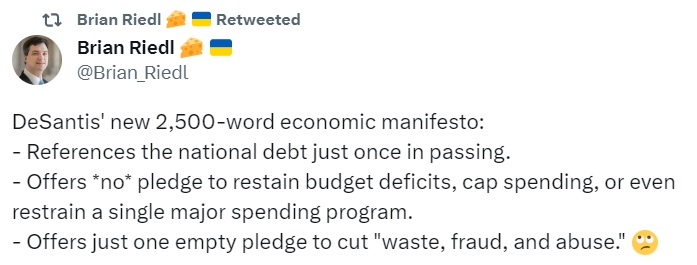
So I’ll be very curious to see whether any 2024 presidential candidates decide to embrace this approach (whether they are sincere is a different issue, needless to say).
No one I’m aware of in the state GOP has advocated, or even brought up, a TABOR mechanism as something Wisconsin should do. Maybe that lack of difference between Republicans and Democrats is why voters keep electing Democrats to statewide offices.
Today’s takeaway is that in 1982, Paul McCartney released “Take It Away”:
Birthdays today start with the great Lalo Schifrin:
The President of the United States should be very competent. America has many such people. Millions even. And this basic litmus test shouldn’t be controversial. Yet the current president doesn’t pass. Joe Biden’s recent onstage fall at the U.S. Air Force Academy was yet another reminder of his declining physical and mental capacities.
Now Biden, to be sure, has had a storied political career. His intentions are in the right place. And his administration is brimming with intelligent and highly competent public servants. But the man at the top — POTUS himself — is well past his prime.
The main Republican contender, meanwhile, also fails the litmus test. But Donald Trump isn’t just far from very competent. He’s outright incompetent. He’s also — in stark contrast to Biden — dishonest, disloyal and concerned more with himself than America’s interests. He also happens to be very popular among Republicans. Current polls point to another Biden-versus-Trump presidential showdown.
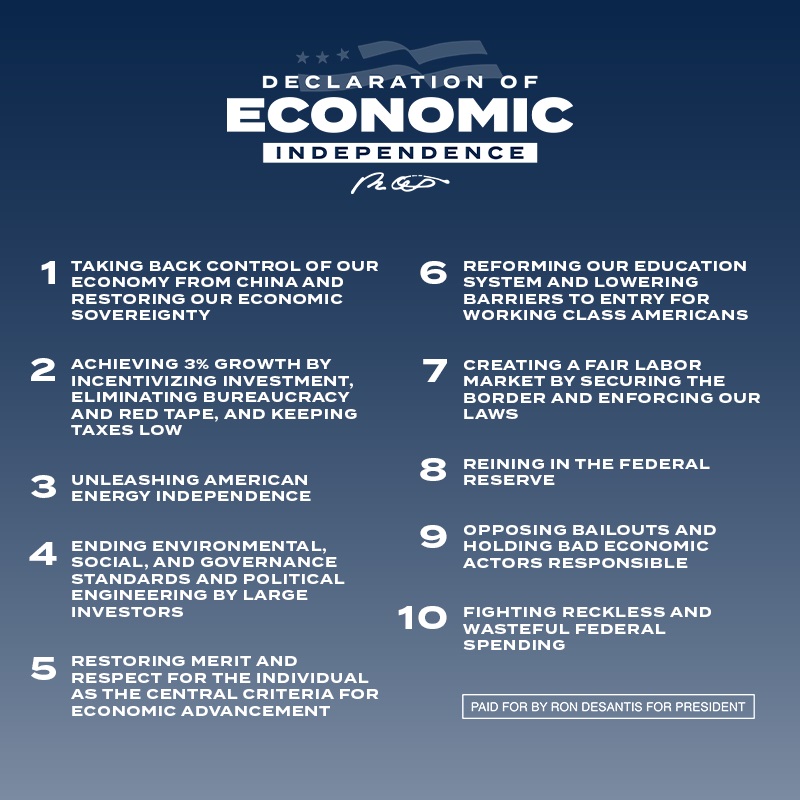
But what about the third most-likely person to be inaugurated president in January 2025, Ron DeSantis? DeSantis is boring and stiff. He’s mean. He’s as likable as a stinky sock. And he’s on the wrong side of numerous important policy debates — from immigration, to taxes, to judicial appointments.
But unlike Biden and Trump, DeSantis passes the litmus test. He’s very competent. A Yale- and Harvard-educated lawyer, DeSantis served in the Navy (including on a tour in Iraq) before entering Congress and then becoming Florida’s governor. And he’s effectively achieved his objectives in Florida — regarding both politics and policy.
DeSantis’ competence matters. Why? Because the most important quality to have in a U.S. president is competence. The biggest questions facing the country do not fall comfortably along some left-right axis but instead require prudent and empirically effective leadership to address. How should we approach our global rivalry with China? How should we regulate artificial intelligence? How should we participate in an international economy complicated by dysfunction and violence around the world? And so on.
Indeed, domestic issues matter less and less the more interconnected the world gets — and it’s getting exponentially more interconnected as time marches on. This, in turn, decreases the relevance of a president’s political party and increases the importance of a president’s competence. Far better to get the culture wars wrong but get China right than vice versa. Same with taxation: Better to tilt the code a little more toward the rich if it means we also get smarter regulations protecting humanity from the downside of artificial intelligence. Appoint conservative judges all day long if it means America’s international effectiveness and leadership improves.
America’s domestic squabbles just don’t mean as much as they used to. And it’s a sign of our national decadence and complacency that our political focus is nonetheless still insular and myopic. The world is a dangerous and complicated place and the president of the United States should be — above all else — very good at dealing with global challenges.
A simple question establishes the point. Which candidate would be better at the helm in a global crisis: an 80-year-old who can’t walk straight (Joe Biden); a 76-year-old with the emotional intelligence of a 10-year-old (Donald Trump); or a 44-year-old Harvard-law-trained Navy vet who skillfully runs his home state (Ron DeSantis)?
This election, American voters will likely once again be asked to choose the least-worst option for the nation’s most important job. It would be much better if a highly competent, intelligent and well-intentioned candidate replaced Biden on the Democratic ticket. Until then, DeSantis all the way.
The Harvard/Harris poll, here, is not exactly known for beating the drum for conservative causes. So when it produces numbers like the ones it published yesterday, you can’t help but feel a bit better about the Republican Party’s chances next year. Let’s take a look.
— Country’s on the right track = 30%; wrong track = 62%.
— Roughly twice as many voters say their financial situation is getting worse than say it’s getting better, 49% to 26%.
— Biden is way underwater, with 53% disapproving his performance and 43% approving it. It’s been this way since last autumn.
— Biden is also in the tank on a big variety of specific issues. Oddly, he does best on handling COVID, with 49% approval. On no other issue does his approval reach even 45%. On dealing with crime and violence, it’s 37%; handling inflation comes in at 36%; and immigration (not surprisingly) brings up the rear at 35%.
— Neither political party is real popular. Republican approval is at 46% and the Democrats are at 45%. In my view, it’s remarkable that the parties are anywhere close, given the loud Democratic lean of almost all the MSM.
— None of the public figures the poll asked about is viewed favorably by a majority. Trump, Robert F. Kennedy and Elon Musk come closest with 45%. Right behind them are DeSantis (43%), Bernie Sanders (42%), and President Biden (41%). Hillary Clinton leads in public disapproval with 54%, followed by Biden (52%) and Trump (48%). Clinton also leads in strong disapproval with 40%, followed closely by Trump with 36%. The least disapproved figure among the arguably major candidates is Tim Scott, with only 25% disapproval.
— Public respect for major institutions has been falling for years if not decades, but two remain widely respected: the US military, viewed favorably by 79%, and the police, with 66%. Contrary to much of what we’ve been hearing from the press, the Supreme Court retains a decent favorability rating with 49%, well above the other two branches. Bringing up the rear are Black Lives Matter, CNN and MSNBC. But dead last are MAGA Republicans, the only group whose negative rating significantly exceeds its positive one.
— Trump overwhelms his Republican opposition for the nomination. This is hardly news, but the Harvard/Harris poll gives Trump even a bigger edge than I’ve seen before, 3 to 1 over Tim Scott and 2 to 1 over DeSantis. Biden is massively ahead of his Democratic rivals,
and totally swamps the field with those in assisted living(sorry, some things I write by instinct).— Biden’s major deficit (apart from ruinous policy), continues to be the public’s view that he’s just not up to it. By 3 to 2, respondents say he lacks the mental acuity for the office, and by 2 to 1, they say he’s too old. The press can hide a lot, and it does, but its ability to hide these facts has about run out.
— Trump wins a hypothetical matchup with Biden 45% to 39%, and with VP Harris, 47% to 40%. This is almost identical to the results the Washington Post/ABC poll found last month. DeSantis does not do nearly as well in such a matchup, barely edging out each. If this continues for very long, it’s going to do massive damage to DeSantis’ argument that he can beat Biden but Trump can’t.
— Of course Trump, like Biden, is no spring chicken. While 62% say Biden should not run for a second term, a reasonably close 55% say that Trump shouldn’t either. Big majorities of both parties (71% of Democrats and 61% of Republicans) say the county needs another choice beyond Biden v. Trump. (This tells me two things — that a third party could make some noise next year; and that despite their very large current leads, neither Biden nor Trump is a sure thing to get nominated. And the chance that public appreciation of either man will improve over time is, as we’ve seen, approximately zero).
— On the issues, Republicans retain their usual advantage when the discussion turns to taxes. Over 80% favor cutting taxes in their state while not even 20% oppose — although respondents were about evenly split on the idea of raising taxes on corporations and upper income individuals. On strengthening parents’ rights over their kids’ education and encouraging more charter schools, those in favor massively outnumber those opposed, by better than 3 to 1 (this was the issue that won Glenn Youngkin the Governor’s chair in blueish Virginia a year and a-half ago).
Abortion remains a potential trouble spot for Republicans. Evidence from last year persuades me that it’s a motivating issue for suburban voters who are vital to Republican success, but a majority of respondents (53% to 47%) were opposed to a law, like the one DeSantis recently sponsored in Florida, that would ban most abortions after six weeks of pregnancy. A ban that firm and that early is simply not where the country is, and in my view, DeSantis is going to have to move toward the center on this question. Emphasizing his opposition to late term abortions (which opposition the poll finds wins a strong majority); or to abortions for sex selection or to harvest body parts, is one place he could start. With abortion as with everything else, you do not let the opposition frame the debate.
On the other hand, immigration is a DeSantis strong suit. More than two-thirds say that we should discourage illegal immigrants from settling in the United States. DeSantis’ bus rides and plane rides to states previously bellowing about their “compassionate” sanctuary status has been a masterstroke.
The poll also asked about the Trump indictment. I’ll save coverage of that for a later discussion, and will say for now only that decent majorities (55% and 56%, respectively) say that the prosecution is politically motivated and amounts to interference in the 2024 election, yet a slightly larger majority (58%) says that the Justice Department’s case is either somewhat or very strong — necessarily meaning that it thinks that Trump is probably guilty of some or perhaps many felony-level offenses. How that perception changes as the case unfolds is one of the head-scratching imponderables of the next several months.