Skip to content
  • One is a fluke, two is a coincidence, three is …

    August 9, 2011
    US business, US politics

    One week ago, we were being told that Congress absolutely needed to make a debt ceiling deal to prevent economic calamity, beginning with the stock market. President Obama signed that debt deal into law one week ago.

    On Thursday, the Dow Jones Industrial Average dropped 512 points, or 4.3 percent, in its worst day since 2008, erasing all the gains of the entire year. The S&P 500 dropped 60 points, or 4.8 percent, and Nasdaq did even worse,  losing 136 points, or 5.1 percent.

    But Thursday looked good compared to Monday, when the DJIA dumped another 634.76 points, or 5.5 percent, the S&P 500 lost 79.92 points, or 6.66 percent, and Nasdaq dropped 174.72 points, or 6.9 percent, erasing Thursday for the Worst Day of the Market Year title. The DJIA now has lost 14 percent in two weeks.

    This came after Standard & Poor’s downgraded U.S. long term debt from AAA to AA+. CNNMoney reports:

    Market observers tried to say the downgrade by itself shouldn’t matter — that it was expected and that the United States still has a strong credit rating.

    But the market wasn’t buying it. …

    Even if investors dismissed the downgrade, they’d still have to contend with the European debt crisis and rising fears of a new U.S. recession.

    And what do you suppose will happen today after this news gets wider reporting:

    The White House and much of the chattering class cooed on Friday when unemployment dropped to 9.1 percent and 117,000 jobs were reportedly created in July. But these numbers, upon closer inspection, show no progress on the jobs front.

    Buried in the job stats was a number — 193,000 — that dwarfed all the rest. That is the number of workers who left the job market. If 193,000 left and only 117,000 jobs were added, we lost 76,000 jobs. Moreover, this is not an aberration.

    When President Obama took office in January of 2009, the labor participation rate was 65.7 percent. Now, “The labor force participation rate is currently 63.9 percent. That is the lowest level since 1984,” says Matt McDonald, a communications and business strategist who previously worked in the Bush administration. “If the labor force participation rate today were 65.7 percent, there would be an additional 4.2 million people in the workforce.” In that case, the unemployment rate would be 11.5 percent not 9.1 percent.

    The Wall Street Journal added both perspective and irony Monday, before the latest market tank:

    Investors and markets—not any single company’s rating—are the ultimate judge of a nation’s creditworthiness. And after their performance in fanning the credit and mortgage-security mania of the last decade, S&P, Moody’s and Fitch should hardly be seen as peerless oracles.

    Their views are best understood as financial opinions, like newspaper editorials, and they’re only considered more important because U.S. government agencies have required purchasers of securities to use their ratings. We’ve fought to break that protected oligopoly, even as liberals in the Senate led by Minnesota’s Al Franken have tried to preserve it. …

    Yet is there anything that S&P said on Friday that everyone else doesn’t already know? S&P essentially declared that on present trend the U.S. debt burden is unsustainable, and that the American political system seems unable to reverse that trend.

    This is not news.

    In that context, the Obama Administration’s attempt to discredit S&P only makes the U.S. look worse—like the Europeans who also want to blame the raters for noticing the obvious. …

    The real reason for White House fury at S&P is that it realizes how symbolically damaging this downgrade is to President Obama’s economic record. Democrats can rail all they want about the tea party, but Republicans have controlled the House for a mere seven months. The entire GOP emphasis in those seven months—backed by the tea party—has been on reversing the historic spending damage of Mr. Obama’s first two years.

    The Bush Presidency and previous GOP Congresses contributed to the current problem by not insisting on domestic cuts to finance the cost of war, and by adding the prescription drug benefit without reforming Medicare. But as recently as 2008 spending was still only 20.7%, and debt held by the public was only 40.3%, of GDP.

    In the name of saving the economy from panic, the White House and the Pelosi Congress then blew out the American government balance sheet. They compounded the problem of excessive private debt by adding unsustainable public debt.

    No reputable financial advisor would tell stockholders to panic and sell after one bad market day. The market tanked on Black Monday 1987, losing 22.61 percent of its value in one day, forcing President Ronald Reagan to give an unscheduled address to tell the American people that the economy’s fundamentals were still strong. And indeed, within a year the market gained back everything it had lost.

    Anyone out there think the economy’s fundamentals are strong?

    I agree with four-fifths of Harvard University Prof. Robert Barro‘s ways to get back the AAA bond rating?

    The way for the U.S. government to earn back a AAA rating is to enact a meaningful medium- and long-term plan for addressing the nation’s fiscal problems. I have sketched a five-point plan that builds on ideas from the excellent 2010 report of the president’s deficit commission.

    First, make structural reforms to the main entitlement programs, starting with increases in ages of eligibility and a shift to an economically appropriate indexing formula. Second, lower the structure of marginal tax rates in the individual income tax. Third, in the spirit of Reagan’s 1986 tax reform, pay for the rate cuts by gradually phasing out the main tax-expenditure items, including preferences for home-mortgage interest, state and local income taxes, and employee fringe benefits—not to mention eliminating ethanol subsidies. Fourth, permanently eliminate corporate and estate taxes, levies that are inefficient and raise little money.

    Fifth, introduce a broad-based expenditure tax, such as a value-added tax (VAT), with a rate around 10%. The VAT’s appeal to liberals can be enhanced, with some loss of economic efficiency, by exempting items such as food and housing.

    I recognize that a VAT is anathema to many conservatives because it gives the government an added claim on revenues. My defense is that a VAT makes sense as part of a larger package that includes the other four points.

    Introducing a new tax is a terrible idea unless it replaces another tax in its entirety. (Eliminating corporate and estate taxes without eliminating the 16th Amendment guarantees that at some future point we will have both high income taxes and high VAT taxes.) But lower and simpler taxes worked to propel the economy through the 1980s so well that even Bill Clinton’s 1993 tax increases didn’t stall the economy, and the post-Gulf War recession wasn’t noticeable to most people.

    This recession and this lack of economic growth is noticeable to most people. It may soon be noticeable to the Obama reelection campaign, says the University of Virginia Center for Politics:

    In November 2012, voters will probably be focused on the moribund economy, not the debt. Almost lost in the shuffle of the last week’s real or manufactured crisis was the sobering news that the United States’ gross domestic product grew only at a paltry 1.3% clip in the second quarter. The first quarter was downgraded to a truly miserable 0.4% growth rate. President Obama needs that number to be close to 3%, if not higher, to achieve a comfortable reelection.  If the economy doesn’t pick up soon, Obama’s once-bright prospects for reelection could be history, along with his White House tenure—assuming, of course, Republicans nominate a mainstream candidate that can appeal to swing voters and appears to be a credible possible occupant of the Oval Office.

    Share this on …

    • Share on X (Opens in new window) X
    • Share on Facebook (Opens in new window) Facebook
    • Share on LinkedIn (Opens in new window) LinkedIn
    • Email a link to a friend (Opens in new window) Email
    • Print (Opens in new window) Print
    Like Loading…
    No comments on One is a fluke, two is a coincidence, three is …
  • Presty the DJ for Aug. 9

    August 9, 2011
    Music

    We begin with our National Anthem, which will be sung today by birthday girl Whitney Houston:

    Today in 1975, the Bee Gees hit number one, even though they were just just just …

    Birthdays start with Harry Mills of the Mills Brothers:

    Billy Henderson of the Spinners (sometimes called the Detroit Spinners in contrast to a British group of the same name):

    Rinus Gerritsen of the Golden Earring:

    The late Benjamin Orr of the Cars:

    And a moment of silence for Jerry Garcia of the Grateful Dead, who became dead today in 1995:

    Share this on …

    • Share on X (Opens in new window) X
    • Share on Facebook (Opens in new window) Facebook
    • Share on LinkedIn (Opens in new window) LinkedIn
    • Email a link to a friend (Opens in new window) Email
    • Print (Opens in new window) Print
    Like Loading…
    No comments on Presty the DJ for Aug. 9
  • Whom to vote for Aug. 9

    August 8, 2011
    Wisconsin politics

    Amy Kremer, the head of the Tea Party Express nicely summarized what’s at stake in Tuesday’s recall elections when she spoke in North Fond du Lac Sunday:

    “This is ground zero for the 2012 campaign,” Kremer said. “And the reason this is happening … is because we are a threat to their power. We are going to take away the power of the unions. It’s not the union bosses that should control the government, it’s we the people and our elected representatives.”

    The public employee unions,  remember, have lied throughout the recall campaigns about why the recall elections are taking place. They claimed the Walker campaign said nothing about wanting to curb public employee collective bargaining, which was provably false. And they haven’t uttered the magic words “collective bargaining” at all when asserting that the recall elections are about Gov. Scott Walker’s alleged radical agenda (because if you’re not a Republican, balanced budgets are radical?) and the current Legislature’s unwillingness to spend more money on education or social services or institute 100-percent taxes on all of the “rich” and evil corporations.

    Another example of revisionist history comes from the mouth of Mark Zillges, president of the Mercury Marine union, who appears to have buyer’s remorse over the contract his union’s employees signed with Mercury Marine to prevent the company from ending its Fond du Lac manufacturing operations. Zillges now claims that Sen. Randy Hopper (R–Fond du Lac) “shamelessly has been exaggerating on television ads his role in the fight to keep Mercury Marine in Wisconsin.”

    That is a claim neither Zillges nor anyone else was making when Hopper talked about phoning Gov. James Doyle during a wedding in the early days of the efforts to keep Mercury Marine in Wisconsin. I know that because I was at the press conference at Mercury Marine when Doyle specifically credited Hopper’s efforts in keeping Mercury Marine in Fond du Lac. (Along with the efforts of many others. And here’s a sound bite to prove it.) I’m not sure if Zillges was at that press conference, but Zillges’ superiors at the International Association of Machinists were there. I also know that Doyle, Hopper, IAM officials and others were at Marian University’s Business & Industry Awards when they were all honored for their efforts at preventing more than 10,000 (direct and indirect) jobs from leaving Fond du Lac.

    I doubt any reader will be surprised at my strong suggestion that you vote for the six Republicans — Hopper, Sens. Robert Cowles (R–Green Bay), Alberta Darling (R–River Hills), Sheila Harsdorf (R–River Falls), Luther Olsen (R–Ripon) and Dan Kapanke (R–La Crosse) — against their illegitimate Democratic opposition in the illegitimate recall elections. Each did what grownups in office do — they made the difficult but correct decision to wrest control of state government from the public employee unions, which are a blight on the Wisconsin landscape. Each decided in favor of a budget that is much closer to balanced than anything the previous governor and Legislature created in the entirety of the Doyle administration. Each made the decision that the state’s business climate needed to be vastly improved from what the Walker administration inherited in January.

    (One other item about Hopper: Whether you agree with his, shall we say, personal decisions, I find it interesting that Hopper is getting criticized from Democrats and their apparatchiks over what’s going on in his personal life. President Bill Clinton was accused of “bimbo eruptions,” and we were told at the time that sex is a private matter. The Democrats’ supporters’ discovery of personal morality seems conveniently timed, doesn’t it?)

    Back on July 12 I pointed out the reasons that the Democratic candidates that won their primaries were bad choices. Nothing that has happened since has caused me to change my mind. Particularly Rep. Fred Clark (D–Baraboo), who still has yet to give a good answer to the question of why anyone in the 14th Senate District should vote for him … or, for that matter, why anyone in the 42nd Assembly District should vote for him in November 2012.

    There has, in fact,  been no legitimate alternative vision raised by any Democratic candidate for governing the state other than essentially going back to the way things were before the Nov. 2 election — higher taxes, yet more red budget ink, and public employee union control of every level of government. Wisconsinites knew exactly what they were getting when they chose to not choose Democrats left and, well, left Nov. 2. And there is no reason to change horses in the middle of the stream.

    Share this on …

    • Share on X (Opens in new window) X
    • Share on Facebook (Opens in new window) Facebook
    • Share on LinkedIn (Opens in new window) LinkedIn
    • Email a link to a friend (Opens in new window) Email
    • Print (Opens in new window) Print
    Like Loading…
    2 comments on Whom to vote for Aug. 9
  • Truth from a cartoon

    August 8, 2011
    US politics

    Share this on …

    • Share on X (Opens in new window) X
    • Share on Facebook (Opens in new window) Facebook
    • Share on LinkedIn (Opens in new window) LinkedIn
    • Email a link to a friend (Opens in new window) Email
    • Print (Opens in new window) Print
    Like Loading…
    No comments on Truth from a cartoon
  • Presty the DJ for Aug. 8

    August 8, 2011
    Music

    Two anniversaries today demonstrate the fickle nature of the pop charts. This is the number one song today in 1960:

    Three years later, the Kingsmen released “Louie Louie.” Some radio stations refused to play it because they claimed it was obscene. Which is ridiculous, because the lyrics were not obscene, merely incomprehensible:

    Today in 1969, while the Beatles were wrapping up work on “Abbey Road,” they shot the album cover:

    One year later, Blood Sweat & Tears’ “Blood Sweat & Tears 3” hit number one:

    Birthdays start with Philip Baisley, one of the Statler Brothers:

    Jay David of Dr. Hook and the Medicine Show:

    Airrion Love of the Stylistics:

    Ali Score played drums for A Flock of Seagulls:

    Chris Foreman of Madness:

    Ricki Rockett of Poison:

    Who is Dave Evans? The Edge of U2:

    Share this on …

    • Share on X (Opens in new window) X
    • Share on Facebook (Opens in new window) Facebook
    • Share on LinkedIn (Opens in new window) LinkedIn
    • Email a link to a friend (Opens in new window) Email
    • Print (Opens in new window) Print
    Like Loading…
    No comments on Presty the DJ for Aug. 8
  • Presty the DJ for Aug. 7

    August 7, 2011
    Music

    Birthdays today start with the singer of perhaps the most inappropriate song for a Western in the history of movies, B.J. Thomas:

    Kerry Chater of Gary Puckett and the Union Gap:

    Richard Joswick of the one-hit-wonder Bo Donaldson and the Heywoods (and exactly which war does this song refer to?):

    Bruce Dickinson (not this Bruce Dickinson) of Iron Maiden:

    Jacquie O’Sullivan of Bananarama:

    One death anniversary: Esther Phillips, today in 1984:

    The Bananarama birthday brings up this cover that, like yesterday, was done in the same key:

    Share this on …

    • Share on X (Opens in new window) X
    • Share on Facebook (Opens in new window) Facebook
    • Share on LinkedIn (Opens in new window) LinkedIn
    • Email a link to a friend (Opens in new window) Email
    • Print (Opens in new window) Print
    Like Loading…
    No comments on Presty the DJ for Aug. 7
  • Presty the DJ for Aug. 6

    August 6, 2011
    Music

    Today in 1965, the Beatles sought “Help” in purchasing an album:

    Birthdays start with Green Bay native Pat Macdonald of Timbuk 3, which formed in Madison and found that …

    Randy DeBarge of DeBarge:

    Time for another trip to coverland, because …

    Share this on …

    • Share on X (Opens in new window) X
    • Share on Facebook (Opens in new window) Facebook
    • Share on LinkedIn (Opens in new window) LinkedIn
    • Email a link to a friend (Opens in new window) Email
    • Print (Opens in new window) Print
    Like Loading…
    No comments on Presty the DJ for Aug. 6
  • Blasts from our Madison past

    August 5, 2011
    Culture, media

    A month ago, I discovered a few old pieces of Madison media on YouTube, and posted them on this blog.

    Then on Tuesday, I was trying to write Wednesday’s blog item when I checked on Facebook.

    Several hours later, I decided to start writing this to make up for all the time I lost in the Facebook “If you grew up in Madison you remember” group. I think I once mentioned that most of my high school graduating class appeared to be on Facebook. Apparently everyone else who grew up in Madison the same time, or before then, is on Facebook too.

    On Tuesday, the activity on this group slowed down my laptop and threatened to bring the Internet to a screeching halt more effectively than an electromagnetic pulse. It was like feeding bread to ducks, with people fighting to get their memories of Madison online.

    In the four hours between when I was let into the group and when I finally turned off the email notifications, there were more than 500 posts. The group jumped over 1,000 members and 3,000 posts less than 24 hours after it was created. (As someone posted, “Hooray! We broke Facebook!”) By the end of its second day it exceeded 3,400 members and 7,500 posts. By the end of its third day it exceeded 4,600 members (and jumped over 5,000 members shortly thereafter) and 11,000 posts. WIBA (1310 AM) in Madison is doing a segment about this group today at 10:30 a.m. This site may need to be spun off of Facebook onto its own domain — maybe www.ifyougrewupinmadisonyouremember.com.

    A lot of the memories, not surprisingly for Wisconsin, involved bars and drinking. (I’ll pause while you recover from the shock.) I was part of the last high school class that could legally drink at 18. One of my first mixed drinks was something called Swampwater, which was the color of antifreeze and was usually served in mason jars. I have been unable to determine what was in it. (I drank that in a campus bar where I was in more than any other campus bar; in a previous location, it was a favorite of my father’s back when he was a UW student.) There were also fond memories of Long Island Ice Teas, which, for those who can’t decide between gin, rum, vodka or whiskey, combines all four, plus triple sec, sour mixer and cola. As one poster put it, “This site is proof you can’t kill all your brain cells no matter how hard you tried.”

    Many of the other memories (including the aforementioned  memories involving adult beverages) undoubtedly were of the if-our-parents-only-knew variety. (The amusing point to ponder is how many of the members’ parents are also on Facebook.) The future corollary is when parents ask themselves how much of what they did when they were their children’s age would they want their own children to do.

    In rough alphabetical order, what also came up included:

    The A&W drive-in that sold root beer in the baby-size mugs quite inexpensively. Ask my parents, and they will tell you how on summer nights they would give their boys baths, put them in their pajamas, and take them to this drive-in, where they would order three root beers and one orange. (Guess who got the orange because he didn’t like root beer.) And the boys in the back seat would have one orange smile and one brown smile.

    Arlans, a discount retailer that had a store on Milwaukee Street, and Eagle, the grocery store on the other half of the same building. Swiss Colony owned the building last time I saw it. The building is west of the “new” Madison post office, opened in Gerald Ford’s presidency.

    Barnaby’s, a pizza place where numerous birthday parties were held. People placed orders and then picked them up when a light at their table informed them dinner was ready. It offered pizza-and-root beer combinations, which was fine unless you didn’t like root beer.

    Bridgeman’s, a restaurant and ice cream parlour (that’s how they spelled it) that was my first employer. There was a Dairy Queen in the neighborhood before Bridgeman’s, but when Bridgeman’s arrived it blew DQ out of the water. (On the other hand, there is still a restaurant in the original DQ building, whereas the old Bridgeman’s is now, ironically, a dental office.) The best thing about working at Bridgeman’s was eating the mistakes, particularly the Tin Roof sundae (hot fudge, butterscotch and pecans, I think). Drinks were free, but food was full price unless, oops, someone made a mistake. (Perhaps that’s why it went out of business less than a decade after it opened.)

    The C&P shopping center with a sloped parking lot. Most of the store was level with the west side of the lot, but there was a ramp that went from the main level to the ground level where shoppers could bring their cars and pick up their groceries. (Another thing you never see anymore.) Of course, five-year-olds loved to race down the ramp ahead of Mom’s grocery carts.

    Cars we drove or owned, which were on the large side in the case of the former and were barely functioning in the case of the latter.

    “Choi,” a term of approval at La Follette (I assume it’s short for “choice”), and the more superlative “choi to the max!” At the time I thought this was just an ’80s term. Based on posts, however, it appears to have been limited to only Madison. That makes one wonder who started “choi,” in the same way that La Follette alumni of the early ’80s still wonder who started the epic spring 1982 outdoor food fight.

    Concerts in various venues ranging from the Shuffle Inn (Van Halen) to Headliners (Joan Jett) to Merlin’s (U2) to the Dane County Coliseum (Janis Joplin, Jimi Hendrix, the Doors, the Doobie Brothers, Elvis Presley, Cheap Trick opening for Queen, REO Speedwagon opening for every other act, Foreigner, Chicago more than once) to the Orpheum Theater (Bob Marley and the Wailers) to the Dane County Junior Fair (Rick Springfield) to the Memorial Union Terrace (the Violent Femmes) to Breese Stevens Field (Ready for the World and Sheila E) to … an East High School TWIRP (The Woman Is Required to Pay) dance, where Cheap Trick supposedly played.

    Madison’s first convenience stores, Stop & Go and PDQ.

    The drive between Madison and Cottage Grove, which was posted at 55 mph except for one 50-mph stretch. So much development has taken place in the intervening years that Dane County BB is now posted at 35 mph.

    Department stores in the pre-mall era, including Gimbel’s, Manchester’s and Yost’s. Some offered not just clothing, but restaurants or hair styling. Similar to …

    Several old drug stores, including Gerhardt’s (now a Walgreen’s) and Rennebohm’s, owned by a former governor of Wisconsin. I believe Gerhardt’s was where I purchased my first record (Rhythm Heritage’s “Theme from ‘SWAT’”). My parents remember the downtown Madison Rennebohm’s because it had a lunch counter (where I ate once before interviewing the mayor of Madison, who had just replaced the mayor who had replaced Paul Soglin.)

    Our various doctors, dentists, etc. It turns out that our pediatrician, Dr. William Ylitalo of Quisling Clinic, was also the pediatrician of numerous other people in this group. (Quisling Clinic was started by two physicians who were cousins of Vidkin Quisling, who was to Norway what Vichy was to France. For running Norway for the Nazis, Vidkun was executed after the right side won.) Dr. Ylitalo’s son is in this group too, so I imagine he’s been enjoying the reading. And most of us also had in common various dental appliances to correct our overbites, underbites, or poorly spaced teeth.

    The East Side Business Men’s Association festival on Milwaukee Street. Everyone who attended was of the age where they didn’t notice how rickety the Ferris wheel was. (The ESBMA building on Atwood Avenue/Monona Drive was also the site of the La Follette High School Class of 1983 post-graduation party, our final formal event as a class before the 1988 reunion. It’s now called the East Side Club.)

    The early days of East Towne Mall, which in its first decade or two had fountains, smoking areas, a Burger King, County Seat (preferred source of Levi’s), the Aladdin’s Castle video arcade, a bar, a two-screen theater and the Moon Fun Shop, a head shop. East Towne also had York Steak House, where I had my first and last dates (and a few in between) with my first girlfriend.

    The back road to East Towne, which before development there meant driving through a weird intersection that included a right-hand curve and a steep hill that ended at a stop sign. My brother was driving our 1975 Chevrolet Caprice to work one day when he was rear-ended at the multi-level intersection by a one-ton van. The van appeared as though a giant fist had smashed the front end. The Caprice suffered … a bent rear bumper.

    The Hungry Hungry (or possibly Hungry Hungry Hungry), a drive-in I vaguely remember occasionally visiting across the street from Olbrich Park on the east shore of Lake Monona.

    Ironic repositioning of store chains. What you know as Kohl’s, Wisconsin’s finest retail chain, was also a chain of grocery stores, most in buildings with curved roofs. What you know as Copps’ supermarkets also was a group of discount retail stores. The East Side had a Kohl’s grocery store and a Copps discount retail store, neither of which are in existence today. (The Kohl’s building on Monona Drive is still there, though.)

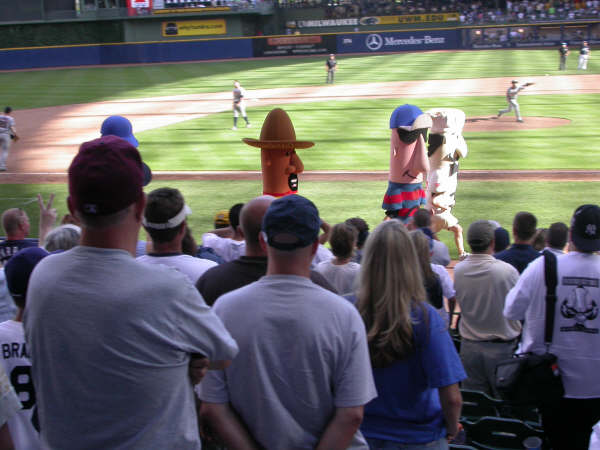
    Kelly’s, a former fast-food chain in at least Madison. The difference between Kelly’s and McDonald’s was that Kelly’s had hot dogs, and its mascot was a dancing pickle reportedly named Pete.

    Marc’s Big Boy, a restaurant on East Washington Avenue (the chain still exists, but not that restaurant) that featured fish in buckets wrapped with wax paper with London newspaper print, and Big Boy comic books.

    Various off-brand gas stations, including Fisca, Kickapoo, Martin and Transport.

    Paisan’s, which, in its fourth location, still has the best pizza in Madison.

    The Pig’s Ear, a high-end restaurant (which I never went to) with garish pink walls. It is now called Talula and has gotten at least one good review.

    Pizza Pit, which still runs this commercial:

    Public employee strikes — the 1976 Madison teacher strike (which prompted the mediation/arbitration law), which got us two weeks off right after winter vacation for the price of (1) losing our entire spring vacation, (2) having to go to school on a Saturday, and (3) adding two days at the end of the school year) and the 1977 and 1980 Madison Metro bus strikes, which forced those who didn’t live near our middle and high schools to find alternative transportation to and from school.

    Queen of Apostles High School, which was just east of Interstate 90. I didn’t go to “QAS,” but when I joined the Boy Scouts our meetings were there until it closed in the late 1970s. It’s now some kind of high-tech business.

    The Catholic church many of us attended, St. Dennis, the only Catholic church in the entire La Follette attendance district. (St. Bernard was on Atwood Avenue, and Immaculate Heart of Mary were in Monona, but it still seems like poor planning to have a farther east or farther south Catholic church for the far East side’s exploding growth.) Until my senior year of high school, St. Dennis Masses were held in either a very small church, or the school gym. (For the first few years of my life, I thought every Catholic church had backboards and a scoreboard.) St. Dennis pre-adult parishioners were in two groups — those who also went to St. Dennis School between first and eighth grades, and those who attended the Madison public schools. St. Dennis didn’t have a church big enough for the enormous congregation until 1983, in a building project funded by monthly Friday fish fries in the 1970s, where I bused in exchange for free fish afterward.

    Paul Soglin, when he was mayor of Madison the first time, from 1973 to 1979. And then he was mayor from 1989 to 1997. And then he was elected mayor again in April. (Perhaps when Soglin passes on they’ll just prop up his body El Cid-like in the City–County Building council chambers and have an assistant push keys on a laptop for “Motion to approve,” “those in favor say aye,” and so on.

    Teachers, including former La Follette choir teacher Rod  Witte (who was very popular with his singers) and Pete Olson, physical education and driver education teacher and (twice-state-championship-winning) boys basketball coach at La Follette, who now apparently can be found fishing on a lake in Vilas County. Any student or player of Olson’s knows exactly what he would have said about all this: “Not very impressive.”

    Theaters,  including the Cinema Theater on Atwood Avenue (where as previously noted my brother and I saw our first movie, “Lady and the Tramp”) and the Badger and Big Sky drive-ins.

    The Wisconsin term for an ATM: a TYME machine, standing for “Take Your Money Everywhere.”

    The old UW–Madison registration process. In the days before online registration, and even before the days you could register by phone, you were assigned a registration start time by your last name. Students at the state’s only world-class university started at the UW Stock Pavilion (just the place you want to be on a hot August day), then raced to various buildings corresponding with subject areas on campus, where the student would check with the academic department registration committee to see if any spots were available for the desired class. Repeat the process until you get your classes (if you have an early registration time), or, if not, figure out alternatives. One semester this process went so well that I had classes two days from 8:25 a.m. to 8:30 p.m., no classes at all two other days, and a morning full of classes on Friday. This is one of the excuses I have for not giving money to my alma mater.

    The Vietnam War protests, well chronicled in the Academy Award-nominated documentary “The War at Home.” I had relatives outside Wisconsin who, not knowing the layout of Madison, assumed from what they saw on the evening news that their nephew and his young family was in danger of being assaulted by marauding college students. (There was no need for concern because (1) college students probably didn’t know Madison existed outside campus, and besides that (2) we were in bed by bartime.) The nadir of the antiwar movement occurred Aug. 24, 1970, when UW’s Sterling Hall was bombed by four people (one of whom disappeared shortly after the event and has never been found), killing one UW grad student. Many people remember the middle-of-the-night bombing for the sound it made and the damage it caused. I was a religious watcher of ABC-TV’s “The FBI” at the time, a show that ended with star Efrem Zimbalist Jr. doing a piece about someone on the FBI’s 10 Most Wanted list, and I remember the night those four were on.

    “When we could road trip all night on $5 worth of gas!!!” And indeed you could do that, even with 11-mpg cars, because gas was less than $1 a gallon into the 1980s.

    Various features of the Henry Vilas Zoo, including a polar bear that played with a bowling ball and the Mold-a-Rama machine. If that’s the polar bear I remember, I believe it came to a premature end when, after a mentally ill man jumped into the polar bear pit, Madison police shot the bear to protect the man. That led some people to suggest that the police had chosen which to shoot incorrectly. I went on a field trip with my oldest son to the zoo, and it, of course, blew my mind.

    Younger readers and non-Madisonians will probably wonder what the hell these 3,000-plus people are babbling about. My prediction, however, is that you too will be reminiscing about the good old days (no matter how old you are) before you even realize it. My wife (who after her first La Follette reunion with me claimed she had more in common with my classmates than hers) recalls fondly driving around the courthouse square in Lancaster the wrong way, with her best friend screaming the whole way. (Or perhaps it was the mouse hiding in the headliner of the car — the stories sometimes get confused.)

    I have no idea how many of the 3,000-plus members of the “If you grew up in Madison you remember” group still live in Madison. Based on what they remember, they, and I, grew up in a Madison that had fewer of the problems that Madison has today. (The weather, however, is unchangeable.) A number of posts included mention of going someplace by foot or on bus, by themselves, with no harm occurring, something you wouldn’t be likely to recommend doing today. So while Mad City was a good place to grow up, I don’t think it is a good place to grow up today, assuming you could even afford to live there.

    These memories have also been softened, in one direction or another, by time. Distance makes us forget that, when we were in middle school, we wanted to get to high school, and when we were in high school (the giant angst factory), we wanted to get out of high school (whether “out” meant college, a job, or just out of Madison). Either we remember things as being better than they were, or things were better then than we thought they were at the time.

    Most of us (certainly me) probably need to thank our parents for their contributions to the Madison in which they raised us. Many, including my parents, came to Madison from various other places, sometimes for better occupational opportunity, or perhaps because they thought Madison would be a better place to raise their kids than where they grew up. They were the people went to work every weekday (or more), paid the high taxes, took up their free time with various civic involvements, endured the institutional strangeness, and made the other sacrifices parents make for their kids. And the memories on this insanely popular Facebook page were one of the results.

    Share this on …

    • Share on X (Opens in new window) X
    • Share on Facebook (Opens in new window) Facebook
    • Share on LinkedIn (Opens in new window) LinkedIn
    • Email a link to a friend (Opens in new window) Email
    • Print (Opens in new window) Print
    Like Loading…
    16 comments on Blasts from our Madison past
  • Presty the DJ for Aug. 5

    August 5, 2011
    Music

    First, a non-rock anniversary: Today is the 90th anniversary of the first broadcasted baseball game, on KDKA in Pittsburgh: Harold Arlen described Pittsburgh’s 8–0 win over Philadelphia. (Things have changed since then.)

    Today in 1966, the Beatles recorded “Yellow Submarine” …

    … and “Eleanor Rigby” …

    … while also releasing their “Revolver” album.

    One year later, the pirate rock radio station Radio London, eight miles off the British coast in the ship MV Galaxy, broadcasted for the final time after the British Parliament passed a law making it illegal:

    Today in 1974, Joan Jett formed the Runaways:

    Birthdays begin with Rick Huxley, one of the Dave Clark Five:

    Sammi Smith was a one-crossover-hit wonder:

    Who is Rick Zehringer? You know him better as Rick Derringer …

    Another one-hit wonder: Samantha Sang, who sang …

    Pete Burns of Dead or Alive:

    Mike Nocito of Johnny Hates Jazz:

    Two deaths of note: Jeff Porcaro, drummer for Toto, in 1992 …

    … and the Real Don Steele in 1997:

    Share this on …

    • Share on X (Opens in new window) X
    • Share on Facebook (Opens in new window) Facebook
    • Share on LinkedIn (Opens in new window) LinkedIn
    • Email a link to a friend (Opens in new window) Email
    • Print (Opens in new window) Print
    Like Loading…
    No comments on Presty the DJ for Aug. 5
  • Your tax dollars at (poorly planned) work

    August 4, 2011
    Wisconsin politics

    We Wisconsinites who now pay the fourth highest state and local taxes in the nation have been told for decades that high taxes are the price we must pay for the quality of our public services.

    Which is a highly debatable concept, particularly for those who (unlike me) have lived in other states and can see that their public services are not appreciably different from or inferior to ours.

    This came to mind during a road construction (one of Wisconsin’s two seasons) adventure on the way to southwest Wisconsin for a few days.

    No, Leo is not driving the minivan.

    The drive from Ripon to Platteville was uneventful, including a couple of construction zones, except for the annoyance of the stoplight-to-stoplight drive on Verona Road leaving Madison. Then we got to Platteville, and I noticed the U.S. 151 exit we take to head toward Lancaster had a board over the word under “Platteville” on the Big Green Sign that indicates the Wisconsin 80/81 exit. And when I saw detour signs, I realized that the Big Green Sign covered up the word “Lancaster.”

    OK, this is not a problem. I lived in Grant County long enough to know there are alternate routes from Platteville to Lancaster. The closest one to Lancaster is Grant County B, which runs from Platteville to Rockville, north of Potosi. Except that County B was also closed, with, unlike the 81 detour, no marked detour route. Several minutes of driving around the periphery of Platteville later, we found Grant County O, which runs from Platteville to Tennyson and is the detour for County B.

    Grant County O, however, is winding, lacks shoulders, and appeared to have not had its center stripes (double yellow the whole way) painted in a year beginning with the number 2. And, of course, we were stuck behind a pickup truck pulling a horse trailer. But we finally did get to Tennyson and U.S. 61, which splits Tennyson and Potosi. Where we discovered that U.S. 61 is in the midst of a repaving project. While U.S. 61 is open, parts of it have only one lane open during said repaving.

    This only made us late for my mother-in-law’s delectable chicken drumsticks and corn on the cob. (Not to mention giving me column fodder. Attention politicians: Bloggers with followers are the wrong people to make angry.) But the Grant County sheriff’s car ahead of us did make us wonder how fire trucks or ambulances would navigate the barely paved roads. And the inconvenience to farmers and trucking companies means lost revenue.

    I don’t know who is at fault for this poor planning — the Wisconsin Department of Transportation, the Grant County Highway Department, the City of Platteville, or all three — of having not only a road closed (for, as it turns out, one bridge) and a detour route closed at the same time. Or having one of the county’s main highways coming out of the county’s largest city closed and a potential detour route (plus a second, Grant County A from Arthur to Lancaster, as we found out in the Grant County Herald Independent) also being repaved at the same time. (We didn’t follow the posted detour because, as those who live near Wisconsin 23 between Green Lake and Princeton know, WisDOT has a habit of extremely lengthy detours for its road projects on the principle that detouring traffic onto similar roads is preferable to detouring traffic on the most direct alternate route. The marked detour, U.S. 61/151 from Platteville to Dickeyville and 61 from Dickeyville to Lancaster, is both twice as long and, yes, also being repaved.) Someone didn’t plan the calendar correctly, given that road projects are planned years in advance. And if you are stuck in traffic or stuck behind a slow-moving vehicle, you don’t really care whose fault it is.

    So for those who have noticed a lack of respect for government employees during the first six months of the Walker administration from the voters, well, that lack of respect may be for reasons unrelated to salaries or benefits. Saying you have great schools (this means you, WEAC!) or high-quality public services does not necessarily mean that is the case. Perhaps voters are unsympathetic to the public employee (collective bargaining, two words you haven’t heard) cause because they don’t think their tax dollars are being wisely spent.

    Share this on …

    • Share on X (Opens in new window) X
    • Share on Facebook (Opens in new window) Facebook
    • Share on LinkedIn (Opens in new window) LinkedIn
    • Email a link to a friend (Opens in new window) Email
    • Print (Opens in new window) Print
    Like Loading…
    No comments on Your tax dollars at (poorly planned) work
Previous Page
1 … 1,017 1,018 1,019 1,020 1,021 … 1,044
Next Page

Website Powered by WordPress.com.

Steve Prestegard.com: The Presteblog

The thoughts of a journalist/libertarian–conservative/Christian husband, father, Eagle Scout and aficionado of obscure rock music. Thoughts herein are only the author’s and not necessarily the opinions of his family, friends, neighbors, church members or past, present or future employers.

  • Steve
    • About, or, Who is this man?
    • Facebook
    • Twitter
    • Adventures in ruralu0026nbsp;inkBack in June 2009, I was driving somewhere through a rural area. And for some reason, I had a flashback to two experiences in my career about that time of year many years ago. In 1988, eight days after graduating from the University of Wisconsin, I started work at the Grant County Herald Independent in Lancaster as a — well, the — reporter. Four years after that, on my 27th birthday, I purchased, with a business partner, the Tri-County Press in Cuba City, my first business venture. Both were experiences about which Wisconsin author Michael Perry might write. I thought about all this after reading a novel, The Deadline, written by a former newspaper editor and publisher. (Now who would write a novel about a weekly newspaper?) As a former newspaper owner, I picked at some of it — why finance a newspaper purchase through the bank if the seller is willing to finance it? Because the mean bank lender is a plot point! — and it is much more interesting than reality, but it is very well written, with a nicely twisting plot, and quite entertaining, again more so than reality. There is something about that first job out of college that makes you remember it perhaps more…
    • Adventures in radioI’ve been in the full-time work world half my life. For that same amount of time I’ve been broadcasting sports as a side interest, something I had wanted to since I started listening to games on radio and watching on TV, and then actually attending games. If you ask someone who’s worked in radio for some time about the late ’70s TV series “WKRP in Cincinnati,” most of them will tell you that, if anything, the series understated how wacky working in radio can be. Perhaps the funniest episode in the history of TV is the “WKRP” episode, based on a true story, about the fictional radio station’s Thanksgiving promotion — throwing live turkeys out of a helicopter under the mistaken belief that, in the words of WKRP owner Arthur Carlson, “As God is my witness, I thought turkeys could fly.” [youtube=http://www.youtube.com/watch?v=ST01bZJPuE0] I’ve never been involved in anything like that. I have announced games from the roofs of press boxes (once on a nice day, and once in 50-mph winds), from a Mississippi River bluff (more on that later), and from the front row of the second balcony of the University of Wisconsin Fieldhouse (great view, but not a place to go if…
    • “Good morning/afternoon/evening, ________ fans …”
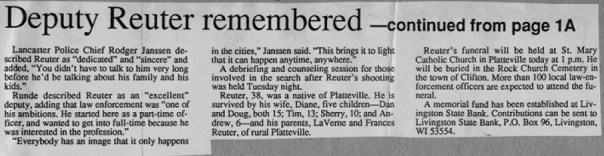
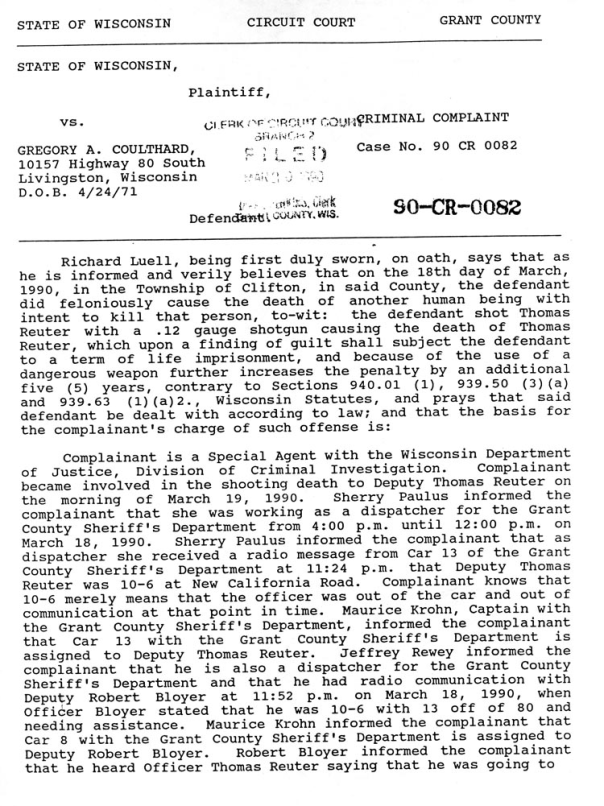
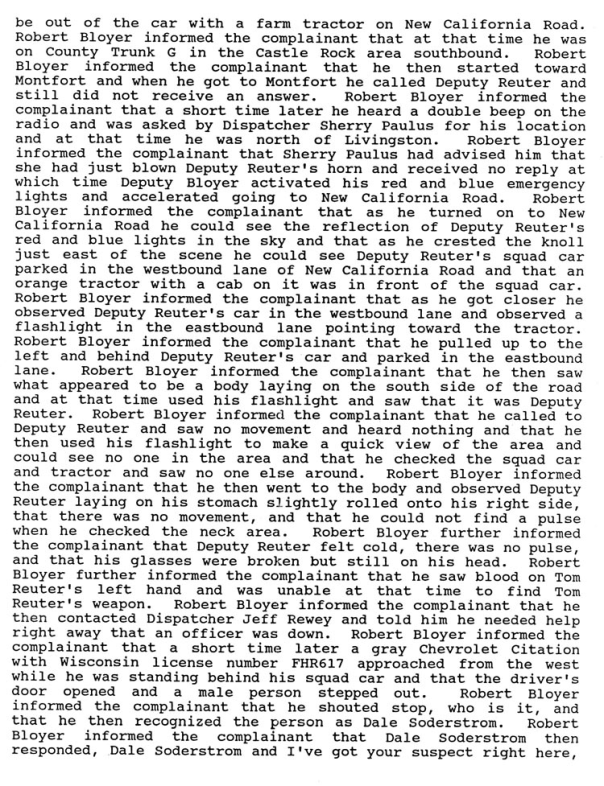
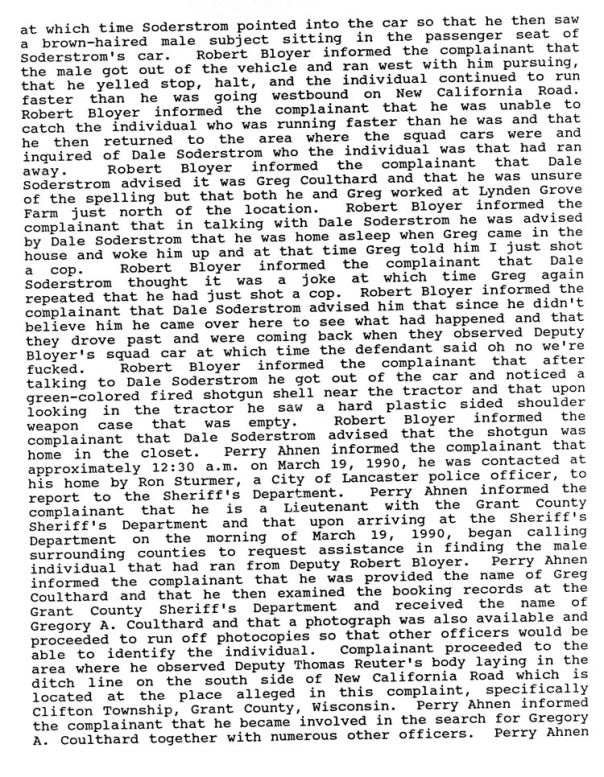
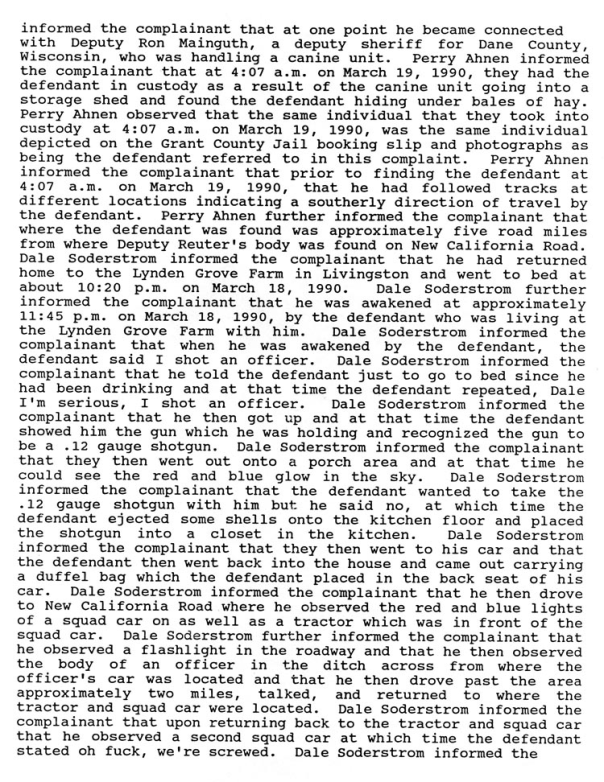
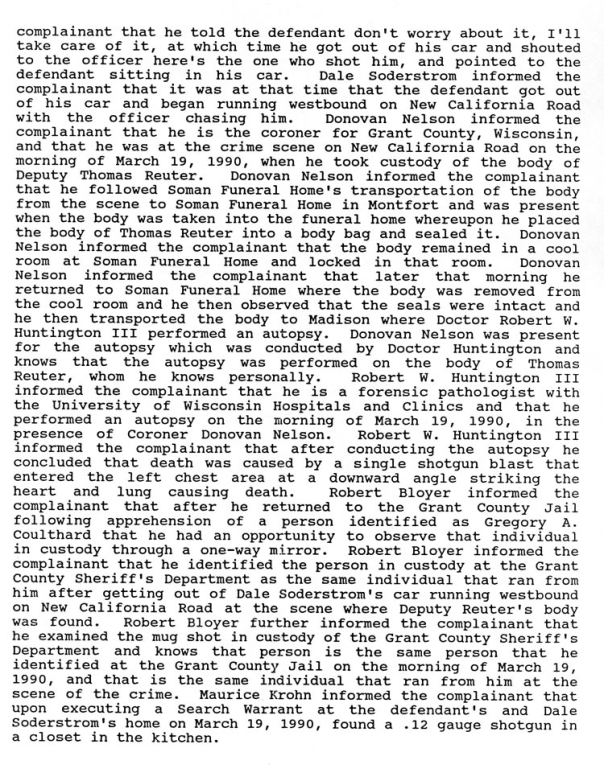
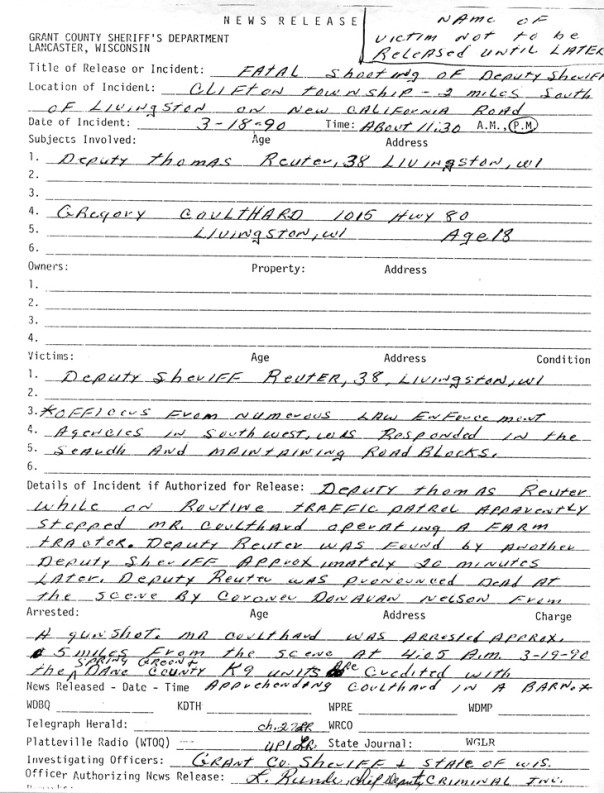
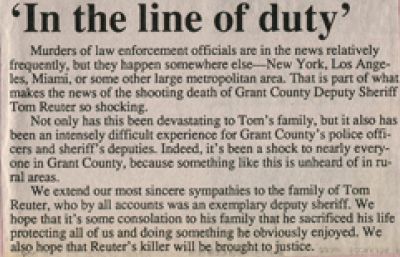
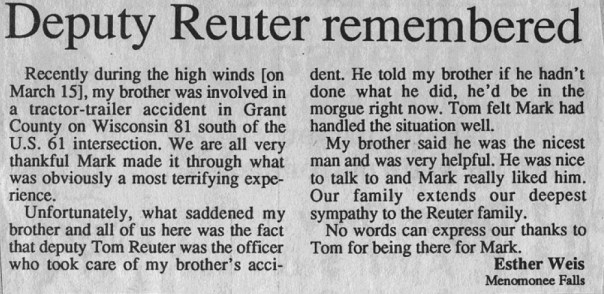
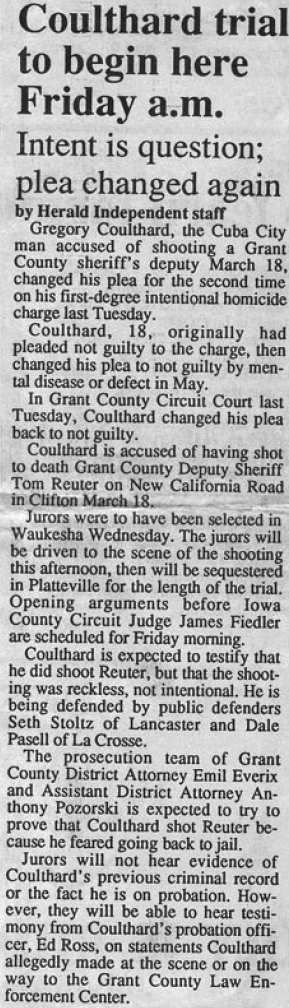
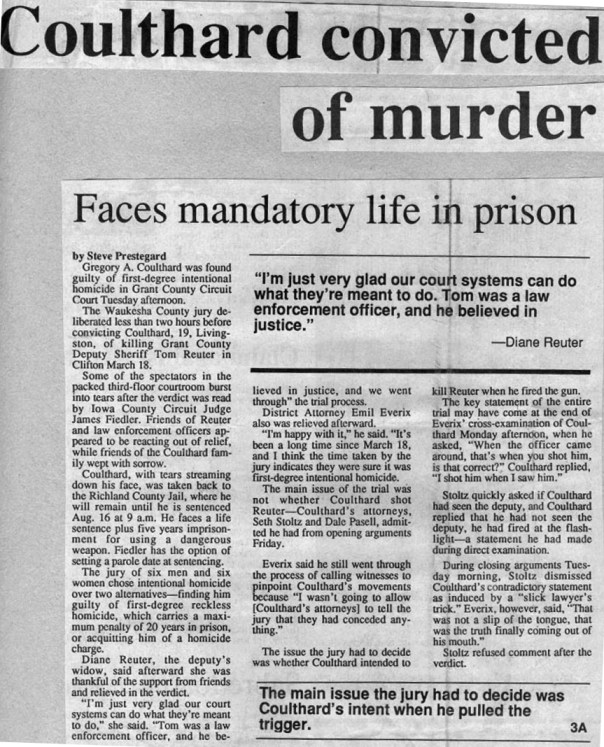
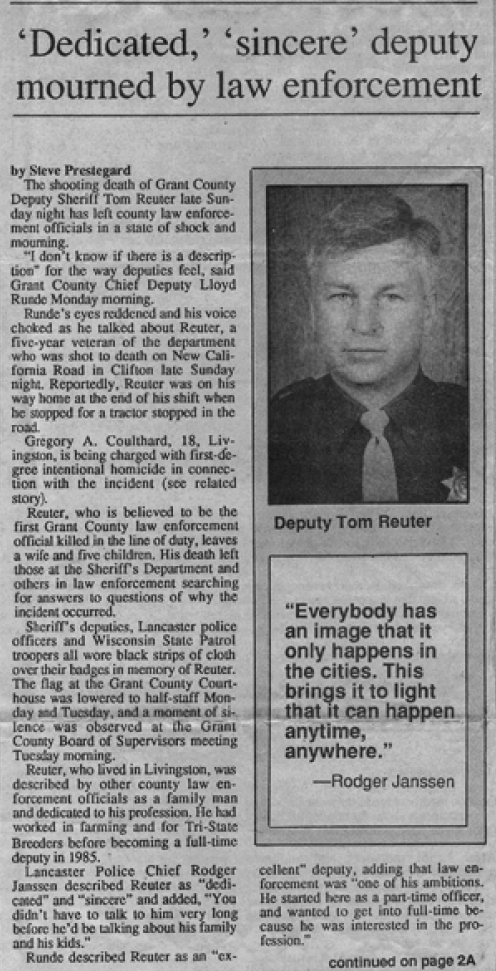
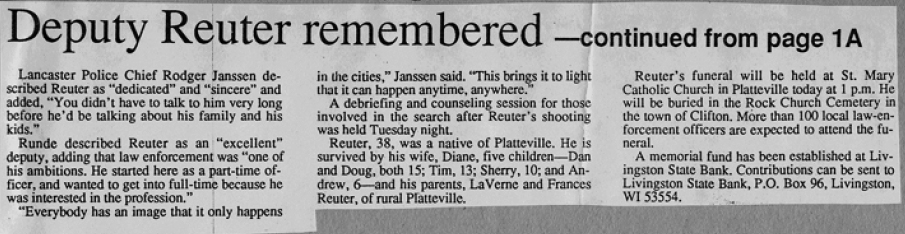
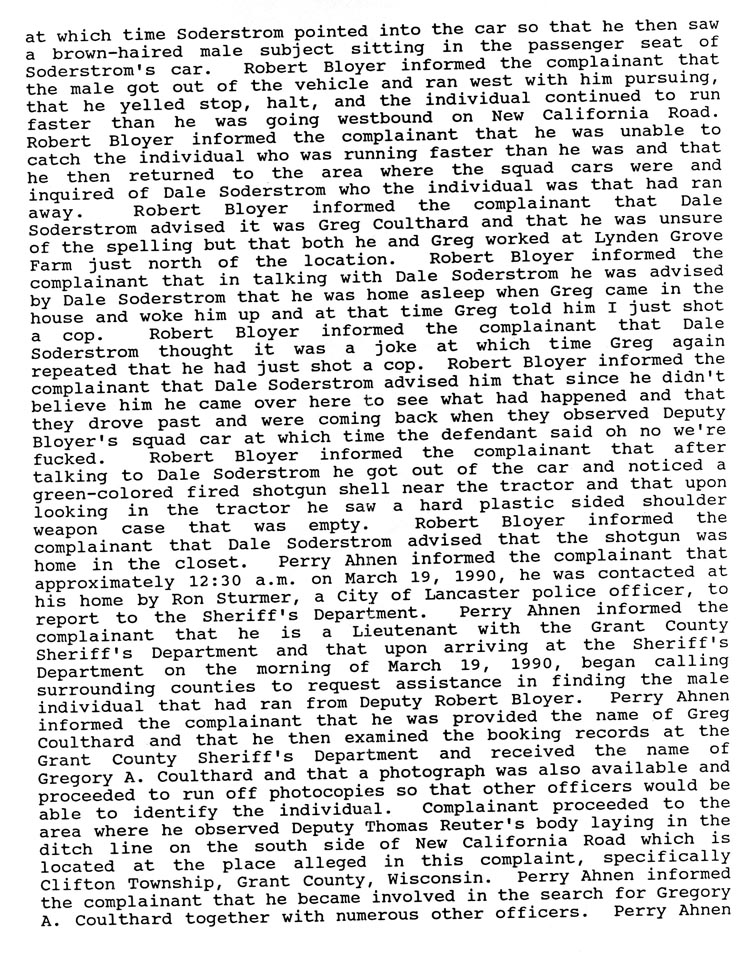
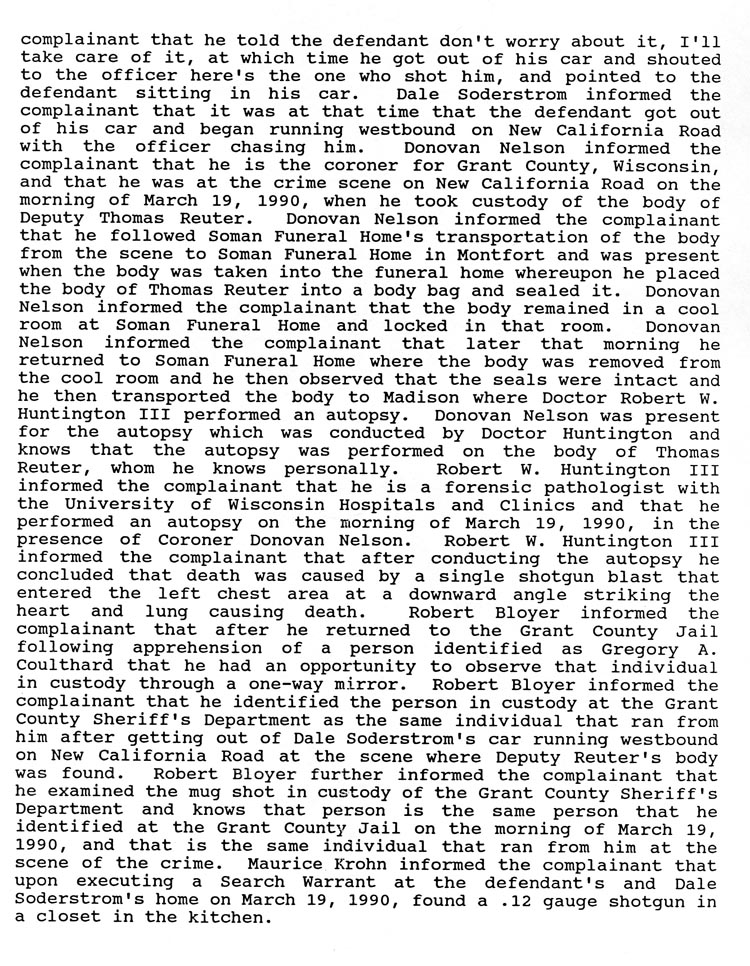
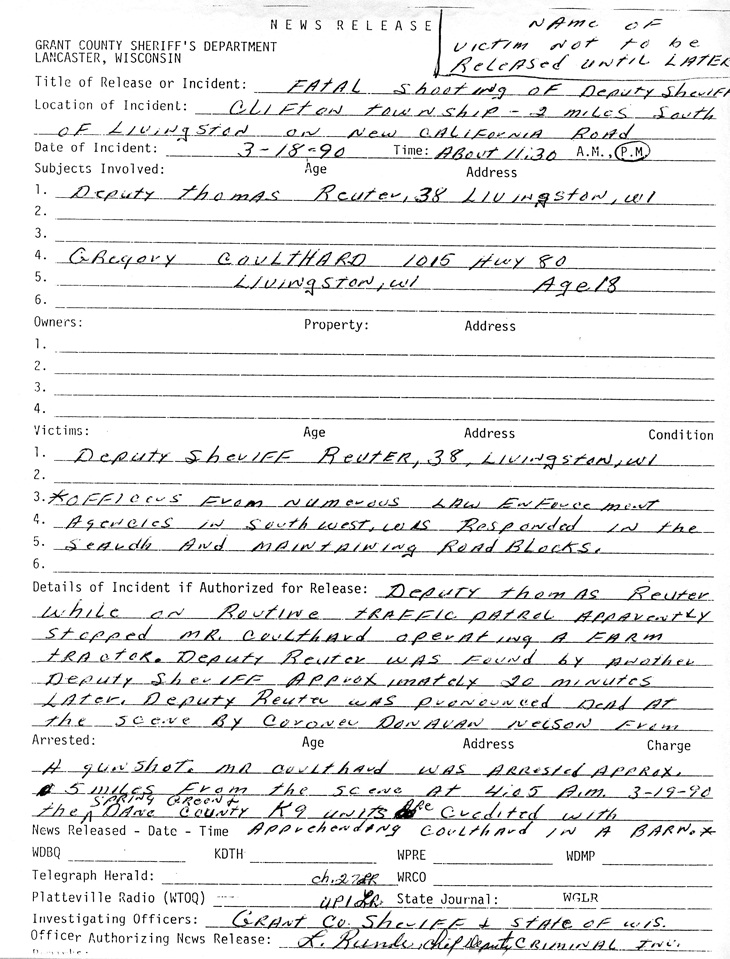
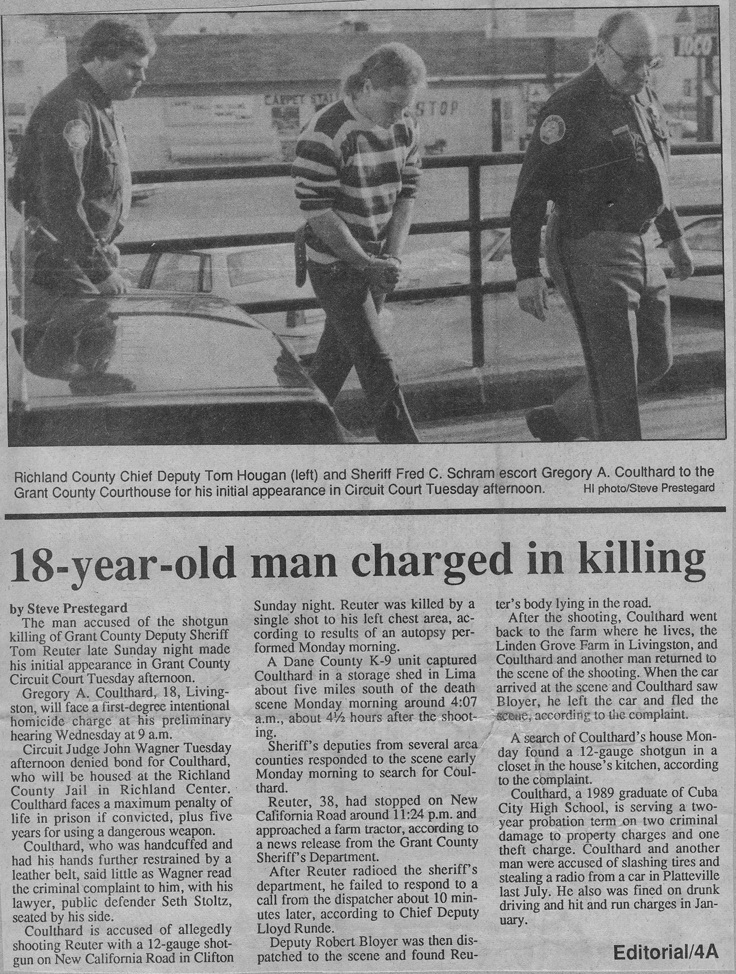
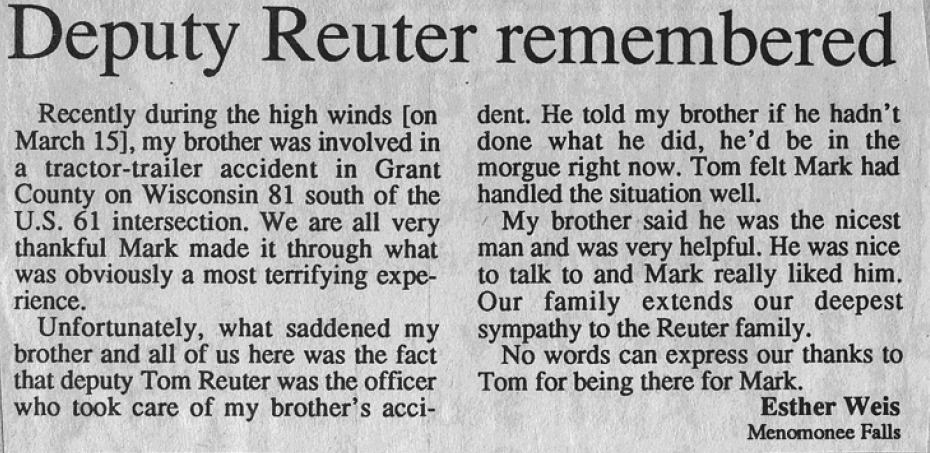
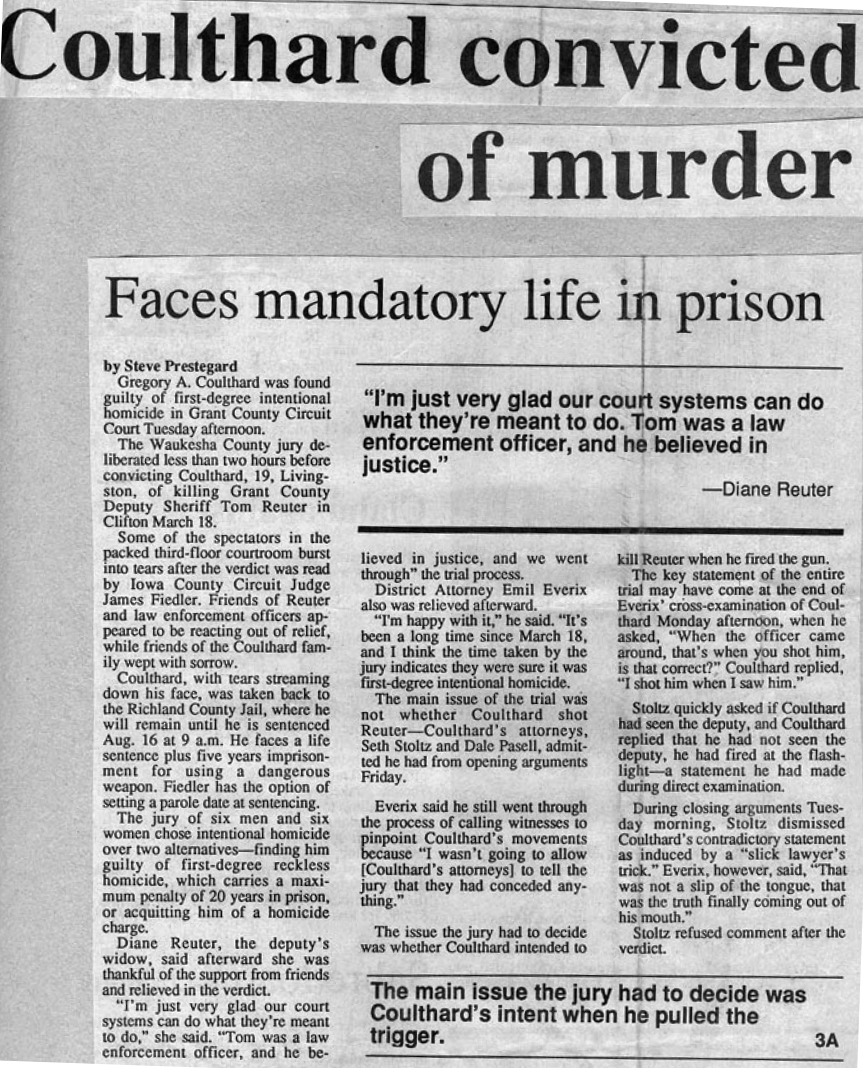
    • My biggest storyEarlier this week, while looking for something else, I came upon some of my own work. (I’m going to write a blog someday called “Things I Found While Looking for Something Else.” This is not that blog.) The Grant County Sheriff’s Department, in the county where I used to live, has a tribute page to the two officers in county history who died in the line of duty. One is William Loud, a deputy marshal in Cassville, shot to death by two bank robbers in 1912. The other is Tom Reuter, a Grant County deputy sheriff who was shot to death at the end of his 4 p.m.-to-midnight shift March 18, 1990. Gregory Coulthard, then a 19-year-old farmhand, was convicted of first-degree intentional homicide and is serving a life sentence, with his first eligibility for parole on March 18, 2015, just 3½ years from now. I’ve written a lot over the years. I think this, from my first two years in the full-time journalism world, will go down as the story I remember the most. For journalists, big stories contain a paradox, which was pointed out in CBS-TV’s interview of Andy Rooney on his last “60 Minutes” Sunday. Morley Safer said something along the line…
  • Food and drink
    • The Roesch/Prestegard familyu0026nbsp;cookbookFrom the family cookbook(s) All the families I’m associated with love to eat, so it’s a good thing we enjoy cooking. The first out-of-my-house food memory I have is of my grandmother’s cooking for Christmas or other family occasions. According to my mother, my grandmother had a baked beans recipe that she would make for my mother. Unfortunately, the recipe seems to have  disappeared. Also unfortunately, my early days as a picky, though voluminous, eater meant I missed a lot of those recipes made from such wholesome ingredients as lard and meat fat. I particularly remember a couple of meals that involve my family. The day of Super Bowl XXXI, my parents, my brother, my aunt and uncle and a group of their friends got together to share lots of food and cheer on the Packers to their first NFL title in 29 years. (After which Jannan and I drove to Lambeau Field in the snow,  but that’s another story.) Then, on Dec. 31, 1999, my parents, my brother, my aunt and uncle and Jannan and I (along with Michael in utero) had a one-course-per-hour meal to appropriately end years beginning with the number 1. Unfortunately I can’t remember what we…
    • SkålI was the editor of Marketplace Magazine for 10 years. If I had to point to one thing that demonstrates improved quality of life since I came to Northeast Wisconsin in 1994, it would be … … the growth of breweries and  wineries in Northeast Wisconsin. The former of those two facts makes sense, given our heritage as a brewing state. The latter is less self-evident, since no one thinks of Wisconsin as having a good grape-growing climate. Some snobs claim that apple or cherry wines aren’t really wines at all. But one of the great facets of free enterprise is the opportunity to make your own choice of what food and drink to drink. (At least for now, though some wish to restrict our food and drink choices.) Wisconsin’s historically predominant ethnic group (and our family’s) is German. Our German ancestors did unfortunately bring large government and high taxes with them, but they also brought beer. Europeans brought wine with them, since they came from countries with poor-quality drinking water. Within 50 years of a wave of mid-19th-century German immigration, brewing had become the fifth largest industry in the U.S., according to Maureen Ogle, author of Ambitious Brew: The Story of American Beer. Beer and wine have…
  • Wheels
    • America’s sports carMy birthday in June dawned without a Chevrolet Corvette in front of my house. (The Corvette at the top of the page was featured at the 2007 Greater Milwaukee Auto Show. The copilot is my oldest son, Michael.) Which isn’t surprising. I have three young children, and I have a house with a one-car garage. (Then again, this would be more practical, though a blatant pluck-your-eyes-out violation of the Corvette ethos. Of course, so was this.) The reality is that I’m likely to be able to own a Corvette only if I get a visit from the Corvette Fairy, whose office is next door to the Easter Bunny. (I hope this isn’t foreshadowing: When I interviewed Dave Richter of Valley Corvette for a car enthusiast story in the late great Marketplace Magazine, he said that the most popular Corvette in most fans’ minds was a Corvette built during their days in high school. This would be a problem for me in that I graduated from high school in 1983, when no Corvette was built.) The Corvette is one of those cars whose existence may be difficult to understand within General Motors Corp. The Corvette is what is known as a “halo car,” a car that drives people into showrooms, even if…
    • Barges on fouru0026nbsp;wheelsI originally wrote this in September 2008.  At the Fox Cities Business Expo Tuesday, a Smart car was displayed at the United Way Fox Cities booth. I reported that I once owned a car into which trunk, I believe, the Smart could be placed, with the trunk lid shut. This is said car — a 1975 Chevrolet Caprice coupe (ours was dark red), whose doors are, I believe, longer than the entire Smart. The Caprice, built down Interstate 90 from us Madisonians in Janesville (a neighbor of ours who worked at the plant probably helped put it together) was the flagship of Chevy’s full-size fleet (which included the stripper Bel Air and middle-of-the-road Impala), featuring popular-for-the-time vinyl roofs, better sound insulation, an upgraded cloth interior, rear fender skirts and fancy Caprice badges. The Caprice was 18 feet 1 inch long and weighed 4,300 pounds. For comparison: The midsize Chevrolet of the ear was the Malibu, which was the same approximate size as the Caprice after its 1977 downsizing. The compact Chevrolet of the era was the Nova, which was 200 inches long — four inches longer than a current Cadillac STS. Wikipedia’s entry on the Caprice has this amusing sentence: “As fuel economy became a bigger priority among Americans…
    • Behind the wheel
    • Collecting only dust or rust
    • Coooooooooooupe!
    • Corvettes on the screen
    • The garage of misfit cars
    • 100 years (and one day) of our Chevrolets
    • They built Excitement, sort of, once in a while
    • A wagon by any otheru0026nbsp;nameFirst written in 2008. You will see more don’t-call-them-station-wagons as you drive today. Readers around my age have probably had some experience with a vehicle increasingly rare on the road — the station wagon. If you were a Boy Scout or Girl Scout, or were a member of some kind of youth athletic team, or had a large dog, or had relatives approximately your age, or had friends who needed to be transported somewhere, or had parents who occasionally had to haul (either in the back or in a trailer) more than what could be fit inside a car trunk, you (or, actually, your parents) were the target demographic for the station wagon. “Station wagons came to be like covered wagons — so much family activity happened in those cars,” said Tim Cleary, president of the American Station Wagon Owners Association, in Country Living magazine. Wagons “were used for everything from daily runs to the grocery store to long summer driving trips, and while many men and women might have wanted a fancier or sportier car, a station wagon was something they knew they needed for the family.” The “station wagon” originally was a vehicle with a covered seating area to take people between train stations…
    • Wheels on theu0026nbsp;screenBetween my former and current blogs, I wrote a lot about automobiles and TV and movies. Think of this post as killing two birds (Thunderbirds? Firebirds? Skylarks?) with one stone. Most movies and TV series view cars the same way most people view cars — as A-to-B transportation. (That’s not counting the movies or series where the car is the plot, like the haunted “Christine” or “Knight Rider” or the “Back to the Future” movies.) The philosophy here, of course, is that cars are not merely A-to-B transportation. Which disqualifies most police shows from what you’re about to read, even though I’ve watched more police video than anything else, because police cars are plain Jane vehicles. The highlight in a sense is in the beginning: The car chase in my favorite movie, “Bullitt,” featuring Steve McQueen’s 1968 Ford Mustang against the bad guys’ 1968 Dodge Charger: [youtube=http://www.youtube.com/watch?v=GMc2RdFuOxIu0026amp;fmt=18] One year before that (but I didn’t see this until we got Telemundo on cable a couple of years ago) was a movie called “Operación 67,” featuring (I kid you not) a masked professional wrestler, his unmasked sidekick, and some sort of secret agent plot. (Since I don’t know Spanish and it’s not…
    • While riding in my Cadillac …
  • Entertainments
    • Brass rocksThose who read my former blog last year at this time, or have read this blog over the past months, know that I am a big fan of the rock group Chicago. (Back when they were a rock group and not a singer of sappy ballads, that is.) Since rock music began from elements of country music, jazz and the blues, brass rock would seem a natural subgenre of rock music. A lot of ’50s musical acts had saxophone players, and some played with full orchestras … [youtube=http://www.youtube.com/watch?v=9CPS-WuUKUE] … but it wasn’t until the more-or-less simultaneous appearances of Chicago and Blood Sweat u0026amp; Tears on the musical scene (both groups formed in 1967, both had their first charting singles in 1969, and they had the same producer) that the usual guitar/bass/keyboard/drum grouping was augmented by one or more trumpets, a sax player and a trombone player. While Chicago is my favorite group (but you knew that already), the first brass rock song I remember hearing was BSu0026amp;T’s “Spinning Wheel” — not in its original form, but on “Sesame Street,” accompanied by, yes, a giant spinning wheel. [youtube=http://www.youtube.com/watch?v=qi9sLkyhhlE] [youtube=http://www.youtube.com/watch?v=OxWSOuNsN20] [youtube=http://www.youtube.com/watch?v=U9U34uPjz-g] I remember liking Chicago’s “Just You ‘n Me” when it was released as a single, and…
    • Drive and Eat au0026nbsp;RockThe first UW home football game of each season also is the opener for the University of Wisconsin Marching Band, the world’s finest college marching band. (How the UW Band has not gotten the Sudler Trophy, which is to honor the country’s premier college marching bands, is beyond my comprehension.) I know this because I am an alumnus of the UW Band. I played five years (in the last rank of the band, Rank 25, motto: “Where Men Are Tall and Run-On Is Short”), marching in 39 football games at Camp Randall Stadium, the Hubert H. Humphrey Metrodome in Minneapolis, Michigan Stadium in Ann Arbor, Memorial Stadium at the University of Illinois (worst artificial turf I had ever seen), the University of Nevada–Las Vegas’ Sam Boyd Silver Bowl, the former Dyche Stadium at Northwestern University, five high school fields and, in my one bowl game, Legion Field in Birmingham, Ala., site of the 1984 Hall of Fame Bowl. The UW Band was, without question, the most memorable experience of my college days, and one of the most meaningful experiences of my lifetime. It was the most physical experience of my lifetime, to be sure. Fifteen minutes into my first Registration…
    • Keep on rockin’ in the freeu0026nbsp;worldOne of my first ambitions in communications was to be a radio disc jockey, and to possibly reach the level of the greats I used to listen to from WLS radio in Chicago, which used to be one of the great 50,000-watt AM rock stations of the country, back when they still existed. (Those who are aficionados of that time in music and radio history enjoyed a trip to that wayback machine when WLS a Memorial Day Big 89 Rewind, excerpts of which can be found on their Web site.) My vision was to be WLS’ afternoon DJ, playing the best in rock music between 2 and 6, which meant I wouldn’t have to get up before the crack of dawn to do the morning show, yet have my nights free to do whatever glamorous things big-city DJs did. Then I learned about the realities of radio — low pay, long hours, zero job security — and though I have dabbled in radio sports, I’ve pretty much cured myself of the idea of working in radio, even if, to quote WAPL’s Len Nelson, “You come to work every day just like everybody else does, but we’re playing rock ’n’ roll songs, we’re cuttin’ up.…
    • Monday on the flight line, not Saturday in the park
    • Music to drive by
    • The rock ofu0026nbsp;WisconsinWikipedia begins its item “Music of Wisconsin” thusly: Wisconsin was settled largely by European immigrants in the late 19th century. This immigration led to the popularization of galops, schottisches, waltzes, and, especially, polkas. [youtube=http://www.youtube.com/watch?v=yl7wCczgNUc] So when I first sought to write a blog piece about rock musicians from Wisconsin, that seemed like a forlorn venture. Turned out it wasn’t, because when I first wrote about rock musicians from Wisconsin, so many of them that I hadn’t mentioned came up in the first few days that I had to write a second blog entry fixing the omissions of the first. This list is about rock music, so it will not include, for instance, Milwaukee native and Ripon College graduate Al Jarreau, who in addition to having recorded a boatload of music for the jazz and adult contemporary/easy listening fan, also recorded the theme music for the ’80s TV series “Moonlighting.” Nor will it include Milwaukee native Eric Benet, who was for a while known more for his former wife, Halle Berry, than for his music, which includes four number one singles on the Ru0026amp;B charts, “Spend My Life with You” with Tamia, “Hurricane,” “Pretty Baby” and “You’re the Only One.” Nor will it include Wisconsin’s sizable contributions to big…
    • Steve TV: All Steve, All the Time
    • “Super Steve, Man of Action!”
    • Too much TV
    • The worst music of allu0026nbsp;timeThe rock group Jefferson Airplane titled its first greatest-hits compilation “The Worst of Jefferson Airplane.” Rolling Stone magazine was not being ironic when it polled its readers to decide the 10 worst songs of the 1990s. I’m not sure I agree with all of Rolling Stone’s list, but that shouldn’t be surprising; such lists are meant for debate, after all. To determine the “worst,” songs appropriate for the “Vinyl from Hell” segment that used to be on a Madison FM rock station, requires some criteria, which does not include mere overexposure (for instance, “Macarena,” the video of which I find amusing since it looks like two bankers are singing it). Before we go on: Blog posts like this one require multimedia, so if you find a song you hate on this blog, I apologize. These are also songs that I almost never listen to because my sound system has a zero-tolerance policy — if I’m listening to the radio or a CD and I hear a song I don’t like, it’s, to quote Bad Company, gone gone gone. My blonde wife won’t be happy to read that one of her favorite ’90s songs, 4 Non Blondes’ “What’s Up,” starts the list. (However,…
    • “You have the right to remain silent …”
  • Madison
    • Blasts from the Madison media past
    • Blasts from my Madison past
    • Blasts from our Madison past
    • What’s the matter with Madison?
    • Wisconsin – Madison = ?
  • Sports
    • Athletic aesthetics, or “cardinal” vs. “Big Red”
    • Choose your own announcer
    • La Follette state 1982 (u0022It was 30 years ago todayu0022)
    • The North Dakota–Wisconsin Hockey Fight of 1982
    • Packers vs. Brewers
  • Hall of Fame
    • The case(s) against teacher unions
    • The Class of 1983
    • A hairy subject, or face the face
    • It’s worse than you think
    • It’s worse than you think, 2010–11 edition
    • My favorite interview subject of all time
    • Oh look! Rural people!
    • Prestegard for president!
    • Unions vs. the facts, or Hiding in plain sight
    • When rhetoric goes too far
Privacy & Cookies: This site uses cookies. By continuing to use this website, you agree to their use.
To find out more, including how to control cookies, see here: Cookie Policy
 

Loading Comments...
 

    • Subscribe Subscribed
      • Steve Prestegard.com: The Presteblog
      • Join 197 other subscribers
      • Already have a WordPress.com account? Log in now.
      • Steve Prestegard.com: The Presteblog
      • Subscribe Subscribed
      • Sign up
      • Log in
      • Report this content
      • View site in Reader
      • Manage subscriptions
      • Collapse this bar
    %d