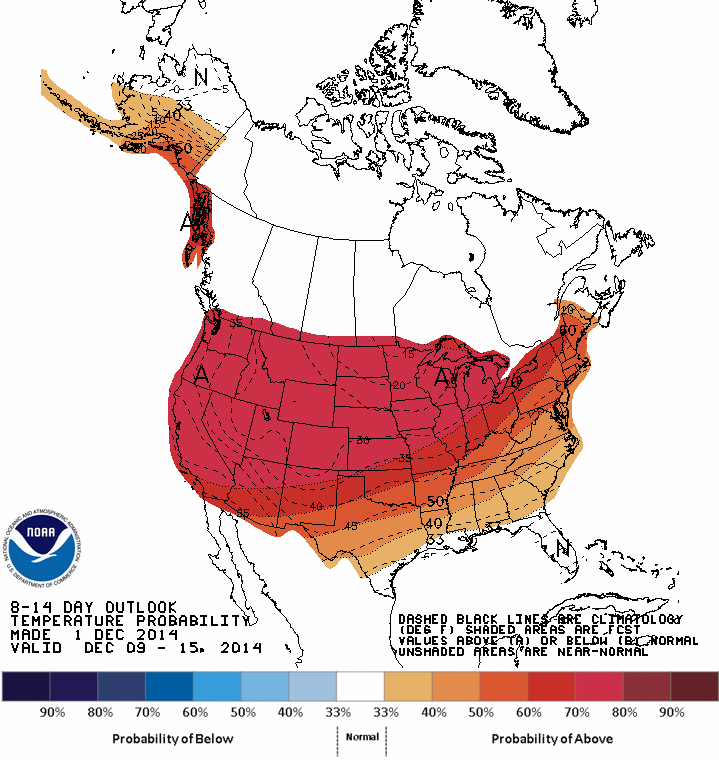
For those rightly disgusted with our early winter (which is not abnormal, only sucky), here are the National Weather Service Climate Prediction Center temperature outlooks for the next 10 …
… and 14 days …
… and December in general:
For those who haven’t seen these maps before, you can surmise that blue means cold and tan/orange/red means not.
All day Sunday, they filled the streets of Manhattan for a march that featured Al Gore, New York City mayor Bill de Blasio, and various Hollywood actors.
But they certainly didn’t act like a movement that was winning. There was a tone of fatalism in the comments of many with whom I spoke; they despair that the kind of radical change they advocate probably won’t result from the normal democratic process. It’s no surprise then that the rhetoric of climate-change activists has become increasingly hysterical. Naomi Klein, author of a new book on the “crisis,” This Changes Everything: Capitalism vs. the Climate, said, “I have seen the future, and it looks like New Orleans after Hurricane Katrina.” In her new book she demands that North America and Europe pay reparations to poorer countries to compensate for the climate change they cause. She calls her plan a “Marshall Plan for the Earth” and acknowledges that it would cost “hundreds of billions if not trillions of dollars.” But she has an easy solution on how to pay for it: “Need more money? Print some!” What’s a little hyperinflation compared to “saving the planet”?
Nor is Klein alone in her hysteria. Actor Leonardo DiCaprio is releasing a new film in which he warns that the world is threatened by a “carbon monster” that is treated like a kind of Godzilla that must be killed off by ending the use of carbon-based fuels.
One reason the rhetoric has become so overheated is that the climate-change activists increasingly lack a scientific basis for their most exaggerated claims. As physicist Gordon Fulks of the Cascade Policy Institute puts it: “CO2 is said to be responsible for global warming that is not occurring, for accelerated sea-level rise that is not occurring, for net glacial and sea-ice melt that is not occurring . . . and for increasing extreme weather that is not occurring.” He points out that there has been no net new global-warming increase since 1997 even though the human contribution to carbon dioxide in the atmosphere has risen by 25 percent since then. This throws into doubt all the climate models that have been predicting massive climate dislocation.
Other scientists caution that climate models must be regarded with great care and skepticism. Steven Koonin, the undersecretary for science in the Energy Department during President Obama’s first term, wrote a pathbreaking piece in Saturday’s Wall Street Journal in which he concluded:
We often hear that there is a “scientific consensus” about climate change. But as far as the computer models go, there isn’t a useful consensus at the level of detail relevant to assessing human influence. . . . The models roughly describe the shrinking extent of Arctic sea ice observed over the past two decades, but they fail to describe the comparable growth of Antarctic sea ice, which is now at a record high. . . . Any serious discussion of the changing climate must begin by acknowledging not only the scientific certainties, but also the uncertainties, especially in projecting the future. Recognizing those limits, rather than ignoring them, will lead to a more sober and ultimately more productive discussion of climate change and climate policies. To do otherwise is a great disservice to climate science itself.
Even scientists who accept the conventional scientific treatment of the subject by the U.N. International Panel on Climate Change increasingly question just how much it would help to curb emissions or to radically redistribute wealth, as activists like Klein urge us to do. Bjørn Lomborg, director of the Copenhagen Consensus Center, told me that all of the carbon-reduction targets advocated by the U.N. or the European Union would result in imperceptible differences in temperature, at enormous cost. “We would be far better off and richer if we did simple things like painting roofs in hot climates white and investing in new technologies that could help us adapt to any change that is coming,” he says. Even the U.N.’s own climate panel admits that so far, climate change hasn’t included any increase in the frequency or intensity of so-called extreme weather. …
Maybe that’s why the climate-change extremists are basing fewer of their appeals on fact and more on hysteria. You scream the loudest when the opposition is about to tip over on you and pin you down.
Fund quotes climate scientist Roy Spencer:
For many years we had been hearing from the “scientific consensus” side that natural climate change is nowhere near as strong as human-caused warming . . . yet the lack of surface warming in 17 years has forced those same scientists to now invoke natural climate change to supposedly cancel out the expected human-caused warming!
C’mon guys. You can’t have it both ways! They fail to see that a climate system capable of cancelling out warming with natural cooling is also capable of causing natural warming in the first place. . . . To me, it feels like a climate skepticism tipping point has been reached.
The New York Times has a taste of the rhetoric being bandied about on the ground today:
“I’m here because I really feel that every major social movement in this country has come when people get together,” said Carol Sutton of Norwalk, Conn., the president of a teachers’ union. “It begins in the streets.” […]
“The climate is changing,” said Otis Daniels, 58, of the Bronx. “Everyone knows it; everyone feels it. But no one is doing anything about it.” […]
“Climate change is no longer an environmental issue; it’s an everybody issue,” Sam Barratt, a campaign director for the online advocacy group Avaaz, which helped plan the march, said on Friday.
“The number of natural disasters has increased and the science is so much more clear,” he added. “This march has many messages, but the one that we’re seeing and hearing is the call for a renewable revolution.”
It was the usual post-communist leftie march. That is, it was a petit-bourgeois re-enactment of meaningless ritual that passes for serious politics among those too inexperienced, too emotionally excited or too poorly read and too unpracticed at self-reflection or political analysis to know or perhaps care how futile and tired the conventional march has become. Crazed grouplets of anti-capitalist movements trying to fan the embers of Marxism back to life, gender and transgender groups with their own spin on climate, earnest eco-warriors, publicity-seeking hucksters, adrenalin junkies, college kids wanting a taste of the venerable tradition of public protest, and, as always, a great many people who don’t think that burning marijuana adds to the world’s CO2 load, marched down Manhattan’s streets. The chants echoed through the skyscraper canyons, the drums rolled, participants were caught up in a sense of unity and togetherness that some of them had never known. It was almost like politics, almost like the epochal marches that have toppled governments and changed history ever since the Paris mob stormed the Bastille.
Almost. Except street marches today are to real politics what street mime is to Shakespeare. This was an ersatz event: no laws will change, no political balance will tip, no UN delegate will have a change of heart. The world will roll on as if this march had never happened. And the marchers would have emitted less carbon and done more good for the world if they had all stayed home and studied books on economics, politics, science, religion and law. Marches like this create an illusion of politics and an illusion of meaningful activity to fill the void of postmodern life; the tribal ritual matters more than the political result. …
In the annals of serious climate policy, however, an explosive essay landed in the Wall Street Journal this past Friday. Titled “Climate Science Is Not Settled“, it will have more impact than anything said or chanted by the misguided marchers. Its author, Dr. Steven A. Koonin, was the Undersecretary for Science in the Energy Department during President Barack Obama’s first term. Dr. Koonin argues that while certain things about the climate are in fact settled science, there is much that is still disputed among climate researchers. A taste:
The crucial scientific question for policy isn’t whether the climate is changing. That is a settled matter: The climate has always changed and always will. Geological and historical records show the occurrence of major climate shifts, sometimes over only a few decades. We know, for instance, that during the 20th century the Earth’s global average surface temperature rose 1.4 degrees Fahrenheit.
Nor is the crucial question whether humans are influencing the climate. That is no hoax: There is little doubt in the scientific community that continually growing amounts of greenhouse gases in the atmosphere, due largely to carbon-dioxide emissions from the conventional use of fossil fuels, are influencing the climate. There is also little doubt that the carbon dioxide will persist in the atmosphere for several centuries. The impact today of human activity appears to be comparable to the intrinsic, natural variability of the climate system itself.
Rather, the crucial, unsettled scientific question for policy is, “How will the climate change over the next century under both natural and human influences?” Answers to that question at the global and regional levels, as well as to equally complex questions of how ecosystems and human activities will be affected, should inform our choices about energy and infrastructure.
But—here’s the catch—those questions are the hardest ones to answer. They challenge, in a fundamental way, what science can tell us about future climates.
It is this uncertainty about accurately predicting future outcomes, on both the local and aggregate levels, that makes sound policy decisions almost impossible:
Policy makers and the public may wish for the comfort of certainty in their climate science. But I fear that rigidly promulgating the idea that climate science is “settled” (or is a “hoax”) demeans and chills the scientific enterprise, retarding its progress in these important matters. Uncertainty is a prime mover and motivator of science and must be faced head-on. It should not be confined to hushed sidebar conversations at academic conferences.
Society’s choices in the years ahead will necessarily be based on uncertain knowledge of future climates. That uncertainty need not be an excuse for inaction. There is well-justified prudence in accelerating the development of low-emissions technologies and in cost-effective energy-efficiency measures.
But climate strategies beyond such “no regrets” efforts carry costs, risks and questions of effectiveness, so nonscientific factors inevitably enter the decision. These include our tolerance for risk and the priorities that we assign to economic development, poverty reduction, environmental quality, and intergenerational and geographical equity.
Individuals and countries can legitimately disagree about these matters, so the discussion should not be about “believing” or “denying” the science. Despite the statements of numerous scientific societies, the scientific community cannot claim any special expertise in addressing issues related to humanity’s deepest goals and values. The political and diplomatic spheres are best suited to debating and resolving such questions, and misrepresenting the current state of climate science does nothing to advance that effort.
All of this is so very spot on—and so refreshing coming from a former Obama Administration official. We can’t encourage you enough to read the whole thing.
One thing we would add to the Koonin essay is that the rapidly developing information revolution is already contributing to declining carbon emissions in countries like the United States and the potential for changing technologies to create a cleaner, less energy-intensive economy is becoming more evident all the time. Fixing the environment isn’t about donning hair shirts and eating granola; it’s about harnessing the marvelous technological breakthroughs that will allow us and our descendants to live richer and more abundant lives on a more flourishing planet.
This year is the 25th anniversary of Hurricane Hugo, which arrived in Georgia the same night as a nationally televised football game at Georgia Southern University:
I’ve announced games during rain (while we announcers were outside), snow, heat, cold and wind. Two years ago, I announced a three-day-long baseball game that started on Wednesday, included a tornado warning, and then was postponed due to lightning. Two days later, the rescheduling having to be rescheduled due to pools of water on the field, the game ended during, of course, a severe thunderstorm watch.
Last year, our second game of the season ended up taking four hours because of a 45-minute halftime lightning delay. We arrived at the stadium around 6 p.m., and left at 11:10 p.m., having announced a game that was literally the length of a Super Bowl.
A hurricane would be a first, though. Hurricanes don’t get up this far north, of course, though the remnants of hurricanes can, as low-pressure areas with geographically appropriate inclement weather.
The online meteorologist who refuses to succumb to climate change propaganda, Mike Smith:
Back in April I wrote a posting called Climafornication. Showtime Networks debuted a series called “Years of Living Dangerously.” It ran (and repeats still run) on Sunday evenings immediately after its series, “Californication.” In that blog post, I wrote:
Now, I guarantee you that the current drought in Texas and California will not be presented in this scientifically factual manner. It will be presented as some type of drought that has never occurred before complete with special effects to make it appear worse than it actually is.
I’d say that comment was accurate. The series (since it is still running) lasted longer than the supposedly unprecedented drought!
While reasonable people can and do disagree about global warming, the series used sleazy techniques to convey its propaganda point. For example, noted climate scientist Don Cheadle went to the small town of Plainview, Texas, to talk about the drought it was then experiencing. Nothing wrong with that. But, that is not where the producers stopped. Look at this screen capture. The brown tint in the air was added post-production to exaggerate the drought! They employed a number of these production tricks to make things look worse than they were. That is propaganda, not science.
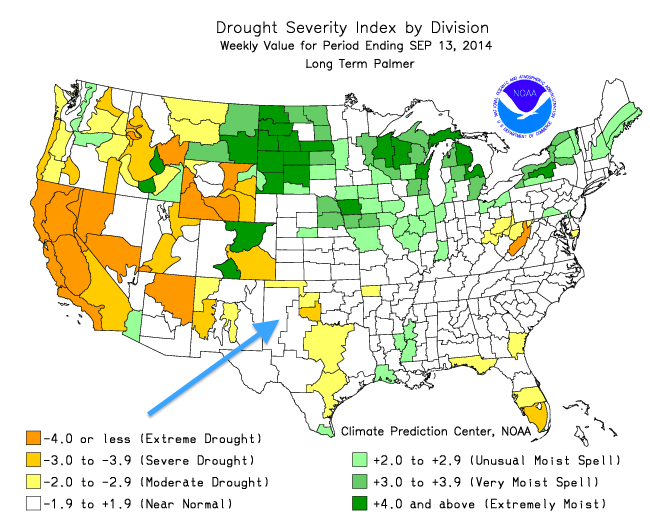
We also heard how the west Texas (already dry) climate has “changed” and droughts were going to be more frequent. Only one problem with all of this: The drought is over. The official National Weather Service drought metric is below. I’ve placed an arrow pointing to Plainview.
Less than five months later, the drought is officially gone. That is not to say the region does not have challenges, it does. More rain is needed to fill reservoirs (so as to be prepared for the next drought) and the depletion of the Ogallala Aquifer is a huge problem.
The series also starred frequent private jet commuter Arnold Schwarzenegger and private jet owner and pilot Harrison Ford. Nothing like being lectured to decrease our carbon footprints by people whose footprints are the size of Alaska.
Instapundit’s Glenn Reynolds says,
I’ll believe global warming is a crisis when the people telling me it’s a crisis start acting like it’s a crisis.
Once again, in difficult economic times, people trying to make a living and support their families are misleadingly lectured about carbon footprints by Hollywood hypocrites who crisscross the world in private jets.
Harrison Ford in “Years” (left) and with his jet
I like Harrison Ford as an actor and I would use a private jet extensively if I could afford to do so. But, he is in absolutely no position to tell me about the size of my carbon footprint.
Readers are reminded of Al Gore’s 11,000-square-foot house, where he apparently lives in between flying across the world to lecture the masses on their carbon footprints. That also applies to Secretary of State John Kerry, who married into money before he started lecturing the masses on their carbon footprints. The Kerrys are not living in an 800-square-foot apartment and taking mass transit to work.
Smith points out things the mainstream media doesn’t — for instance, the number of tornadoes and hurricanes, and the number of most violent tornadoes and hurricanes, is down, not up.
But hey, don’t let the facts get in the way of your narrative, as is reported by National Review:
According to a top environmentalist organizer, climate change is responsible for this summer’s violence in Ferguson, Missouri.
“To me, the connection between militarized state violence, racism, and climate change was common-sense and intuitive,” 350.org Strategic Partnership Coordinator Deirdre Smith wrote.
“Oppression and extreme weather combine to ‘incite’ militarized violence,” she continued. Weeks of rioting followed the killing August 9 of 18-year-old Michael Brown by Ferguson police officer Darren Wilson. Observers around the nation criticized the police for a heavy-handed response to protests in the town, but while the rioting received international attention, it did not result in any loss of life.
Smith explained that not only do poor minority communities have fewer resources to deal with the impacts of climate change, but that “people of color also disproportionately live in climate-vulnerable areas,” which makes climate change a race issue. …
According to the National Weather Service, the St. Louis area was not notably warmer this summer than it has ever been. At 80.3 degrees Fahrenheit, this August’s average temperature in the Gateway to the West was only the seventh-warmest of the last 20 years, substantially cooler than the two-decade high of 83.9 degrees in August 1995.
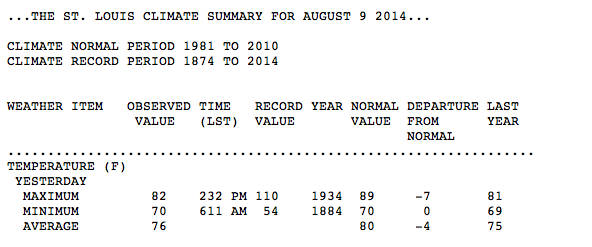
Connection between climate change and Ferguson??? Hmmm. Perhaps, because of her lack of background in climate science, she didn’t know how to research the temperature on August 9, 2014, the day of the horrible shooting of Michael Brown in Ferguson, a north suburb of St. Louis.
So, I did a little research:
The high temperature that day was a very pleasant 82° which was seven degrees cooler than usual. The record high of 110° occurred in 1934 when world climate was cooler than it is today.
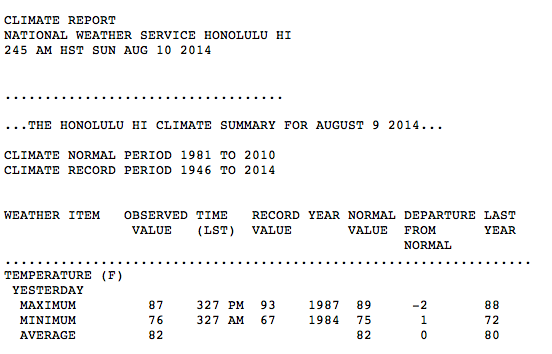
To put St. Louis’ high of 82° in perspective, thousands of people pay thousands of dollars every day to fly to Honolulu to enjoy and vacation in Hawaii’s pleasant climate. What was the high in Honolulu the same day?
It was 87°, five degrees warmer than St. Louis.
Obviously, a high of 82 degrees had nothing to do with the tragic shooting and terrible events that unfolded in Ferguson. While I am tempted to make other comments, I’ll stop here.
And of course you have to opine, in part because you did one week earlier, in both cases hopefully saying something, instead of the usual Wisconsin daily newspaper approach along the lines of “Tornadoes: We oppose them!”
One thing from the column bears repeating. There was no tornado warning before Platteville’s two tornadoes, because none of the trained, veteran weather spotters saw the tornadoes (the bigger of which formed right outside the city), nor did anyone else, nor did weather radar until after the fact. Weather radio and weather sirens have useful purposes, but there is no substitute for using your own brains. Ultimately you are responsible for your own safety.
Yesterday was the 40th anniversary of an event central to online meteorologist Mike Smith‘s career and life:
… at this time 40 years ago, I was gobbling down a quick lunch while I got ready to go back to work at WKY TV and Radio. I had been called in about 3am to cover severe thunderstorms and we were in between storms. I knew the afternoon and evening storms were going to be much worse.
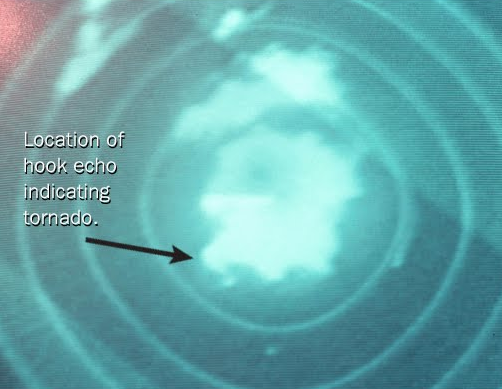
In those days, we had black and white radar. The photo below shows a “hook” echo moving into Oklahoma City, with the tornado about to strike Will Rogers World Airport.
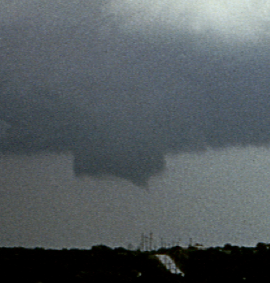
As a result of starting to chase storms two years prior, I knew the storm would pass southeast of the TV station and we had a chance to get a picture of the tornado. Amazingly, we did. Fellow chaser Steve Tegtmeier got this photo of the tornado before it touched down. It was only the second time (the first was KAUZ TV in Wichita Falls in 1959) a tornado had been broadcast live.
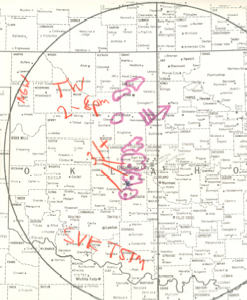
To keep track of each of the storms and so I could remember everything that I needed to tell our viewers, we did radar tracings like the one below. I would hold it in my left hand while gesturing to the map with my right. TW = tornado watch from 2 until 8pm and SVR TSTM = severe thunderstorm warnings in effect for several counties.
As you can imagine, the systems we were using were primitive compared to today’s. Yet, somehow, we were able to get tornado warnings out for every one of the central Oklahoma tornadoes in our viewing area and there were no fatalities.
In northeast Oklahoma, none of the TV stations had radar or meteorologists (but they did have a popular puppet doing weather!) and there were 16 fatalities.
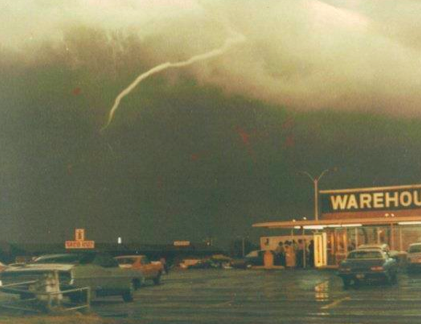
Tulsa tornado, June 8, 1974, NOAA
Because of the tornadoes and flash floods in the Tulsa area, all of the television stations were knocked off the air. The WKY weather department got a call from the cable company serving Tulsa informing us of their stations’ situation and wanted to know if we would cover Tulsa until their stations were back on the air. If so, he would put our signal on their cable. We did. The contrast between our approach and what the Tulsa stations were able to do was striking.
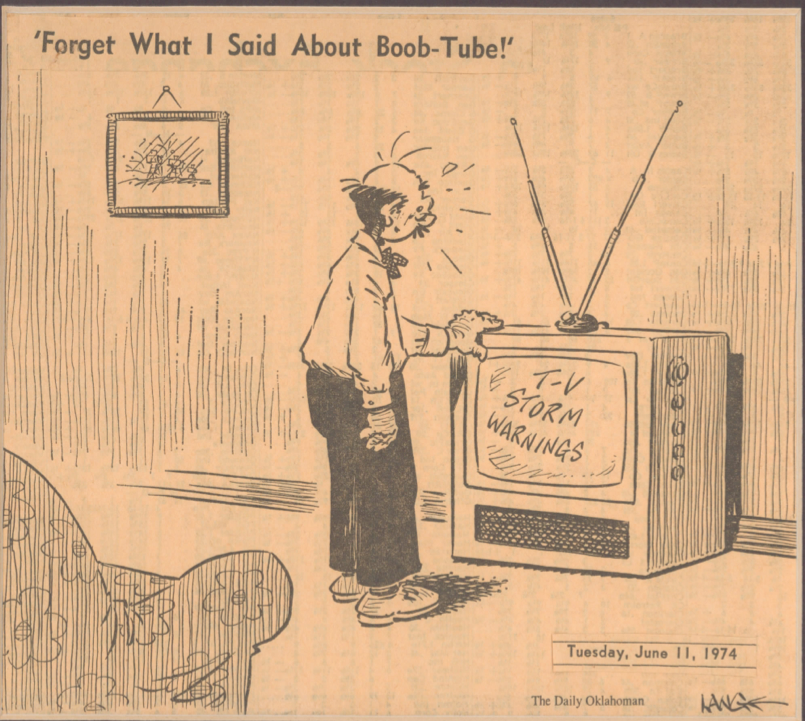
Back in Oklahoma City, the outpouring of appreciation was simply overwhelming. More than seventy letters, an editorial cartoon and countless phone calls from people thanking us for saving their lives.
Today is the 70th anniversary of the Allied invasion of Europe, D-Day.
I hadn’t planned on writing about D-Day because so many others are commemorating it today … until I found something that I think well symbolizes D-Day specifically and the difference between Americans and others on this planet. It was written by Thomas D. Hazlett in 1999 about Stephen Ambrose’s D-Day: The Climactic Battle of World War II:
Even today we think of the Wehrmacht as a mighty force. Certainly, its well-trained, well-armed, battle-tested soldiers struck a fearsome pose at Normandy, the most heavily fortified coastline in history. The Allies viewed the Germans as an unforgiving piece of iron.
So doubts ran high as 175,000 Allied troops–Yanks, Brits, Canadians, and Aussies–traversed the English Channel. Could the children of democracy prove themselves warriors? Would they freeze in mortal combat? Adolf Hitler, who slept until noon on D-Day, believed the disciplined defenders of Third Reich would crush the soft soldiers of the liberal West.
Yet Ambrose shows that it was the rigid Nazi war command that fell apart on D-Day. The Allied soldier kept his head while all about him were (all too often) losing theirs. Such resilience proved necessary. The best-laid plans of the Supreme Allied Command were almost immediately rendered moot; the massive landing amounted to a chaotic dumping of troops into a very hostile environment. Allied forces landed out of position, units were a shambles, and radio communications were knocked out.
But Ambrose identifies a crucial difference between the German and Allied fighting men. The Germans were hamstrung by sweeping orders issued from far away. In contrast, the Allies relied on mid-level and junior-grade officers issuing impromptu commands based on facts gleaned first-hand.
There is no more dramatic example of F.A. Hayek’s seminal discovery: the importance of dispersed information–“knowledge of time and place.” Hayek, who was to win the Nobel Memorial Prize in Economic Science in 1974, published his memorable essay, “The Use of Knowledge in Society,” in the American Economic Review just the year after D-Day. It explained the motive force driving Adam Smith’s “invisible hand” by noting that great efficiencies resulted when millions of dispersed individuals, motivated by market incentives, utilized the information uniquely available to them to make decisions. It’s why a decentralized competitive system beats a top-down bureaucracy, even when the planners are “experts.”
The bloody beaches of France graphically illustrate the advantages. German soldiers had been commanded to defend every inch of coastline. They were rendered immobile by strict orders to stay put–why trust low-level soldiers to freelance when the High Command had it planned out already? But that strict Wehrmacht policy saved Allied troops even in places where they were extremely vulnerable. The ferocious Panzer tank divisions set aside for counter-attack were too precious to trust to field commanders; only Der Führer had the right to deploy those. As the military genius in Berlin snoozed, German positions were overrun. Even then, despite reports from the front, Hitler held back his elite motorized units, convinced the real landing was to come at Pas-de-Calais.
Meanwhile, Allied soldiers dodged mines and intense enemy fire. They were hopelessly ill-equipped–in the chaos of the landing, their best heavy equipment never made it to shore–but they improvised. Mid-level commanders–sometimes a sergeant was the highest-surviving rank–seized the moment, issuing orders and rallying soldiers. Empowered by a flexible command structure, leaders emerged instantly, spontaneously. Fighting units were reconstituted and assault plans redefined on the fly.
Perhaps the classic demonstration was the landing on Utah Beach at 6:30 a.m.–the first wave. Due to unexpectedly strong tides, landing craft deposited units over 1,000 meters from their pre-arranged positions. Heavy machine gun fire pinned down those who managed to survive long enough to reach the beach. Crouching for cover, U.S. infantrymen assembled and spread out their maps. They had no radio contact, and most of their commanders could not be located. What the hell to do? Should they get down the beach to where they were supposed to be, or attack the German artillery directly in front of them?
The ranking officer quickly made a decision: “Let’s start the war from here.” With that, brave Americans charged Nazi fortifications straight ahead, knocked out guns, scaled the bluff, and circled around to capture the ground they had originally been assigned to take.
While no lowly soldier in the Wehrmacht had the authority to revamp official orders, the Allied invasion consisted of little besides ad hoc heroism. Decentralized information stormed the beaches on June 6, 1944, and irreparably breached the Atlantic Wall by dusk. Pretty good theory for one day’s work. Pretty good work for one day’s theory.
That night (in the U.S.), Franklin Roosevelt, president and senior warden of his Episcopal church, led the nation in prayer:
Forty years later:
Sunday, meanwhile, is the 30th anniversary of one of the worst tornadoes in Wisconsin history, in Barneveld shortly after midnight, without warning:
I’ve written about Barneveld before here. The summer of 1984 was the summer after my grandfather’s death, so I was tasked with driving to Boscobel to pick up my grandmother for my brother’s graduation. I went down Thursday, stayed overnight, and we went back to Madison Friday morning. Iowa TV was reporting on severe weather to the west, but where I was all it did was thunder off in the distance.
The next morning, though, as we left, I flipped through the FM radio and heard some strange reports about civil defense and people saying they were all right. They made no sense given that we had heard nothing about a tornado the night before; no Madison TV had live coverage from Barneveld, and we hadn’t seen anything on TV about a tornado. Then we drove through Black Earth, where the tornado had gone after flattening much of Barneveld, and saw, on the east side of town, a huge tree uprooted.
The next day was my brother’s graduation. His graduation party was interrupted by a tornado warning, for a funnel cloud sighting one mile from our house. (I remain skeptical because that funnel cloud should have been visible from our house.) Three days later, another tornado warning was issued in Dane County.
Less than a year later, I did a journalism-class story on the one-year-later aftermath. I was struck then by the incongruous combination of brand new houses, empty concrete slabs where houses had been, and scrape marks on Barneveld’s water tower far higher than any vandal could have accomplished. And, of course, there were a group of gravestones in the Barneveld cemetery with the same date of death on them — June 8, 1984.
Last week Secretary of State John Kerry warned graduating students at Boston College of the “crippling consequences” of climate change. “Ninety-seven percent of the world’s scientists,” he added, “tell us this is urgent.”
Where did Mr. Kerry get the 97% figure? Perhaps from his boss, President Obama, who tweeted on May 16 that “Ninety-seven percent of scientists agree: #climate change is real, man-made and dangerous.” Or maybe from NASA, which posted (in more measured language) on its website, “Ninety-seven percent of climate scientists agree that climate-warming trends over the past century are very likely due to human activities.”
Yet the assertion that 97% of scientists believe that climate change is a man-made, urgent problem is a fiction. The so-called consensus comes from a handful of surveys and abstract-counting exercises that have been contradicted by more reliable research.
One frequently cited source for the consensus is a 2004 opinion essay published in Science magazine by Naomi Oreskes, a science historian now at Harvard. She claimed to have examined abstracts of 928 articles published in scientific journals between 1993 and 2003, and found that 75% supported the view that human activities are responsible for most of the observed warming over the previous 50 years while none directly dissented.
Ms. Oreskes’s definition of consensus covered “man-made” but left out “dangerous”—and scores of articles by prominent scientists such as Richard Lindzen, John Christy, Sherwood Idso and Patrick Michaels, who question the consensus, were excluded. The methodology is also flawed. A study published earlier this year in Nature noted that abstracts of academic papers often contain claims that aren’t substantiated in the papers.
Another widely cited source for the consensus view is a 2009 article in “Eos, Transactions American Geophysical Union” by Maggie Kendall Zimmerman, a student at the University of Illinois, and her master’s thesis adviser Peter Doran. It reported the results of a two-question online survey of selected scientists. Mr. Doran and Ms. Zimmerman claimed “97 percent of climate scientists agree” that global temperatures have risen and that humans are a significant contributing factor.
The survey’s questions don’t reveal much of interest. Most scientists who are skeptical of catastrophic global warming nevertheless would answer “yes” to both questions. The survey was silent on whether the human impact is large enough to constitute a problem. Nor did it include solar scientists, space scientists, cosmologists, physicists, meteorologists or astronomers, who are the scientists most likely to be aware of natural causes of climate change.
The “97 percent” figure in the Zimmerman/Doran survey represents the views of only 79 respondents who listed climate science as an area of expertise and said they published more than half of their recent peer-reviewed papers on climate change. Seventy-nine scientists—of the 3,146 who responded to the survey—does not a consensus make.
In 2010, William R. Love Anderegg, then a student at Stanford University, used Google Scholar to identify the views of the most prolific writers on climate change. His findingswere published in Proceedings of the National Academies of Sciences. Mr. Love Anderegg found that 97% to 98% of the 200 most prolific writers on climate change believe “anthropogenic greenhouse gases have been responsible for ‘most’ of the ‘unequivocal’ warming.” There was no mention of how dangerous this climate change might be; and, of course, 200 researchers out of the thousands who have contributed to the climate science debate is not evidence of consensus.
In 2013, John Cook, an Australia-based blogger, and some of his friends reviewed abstracts of peer-reviewed papers published from 1991 to 2011. Mr. Cook reported that 97% of those who stated a position explicitly or implicitly suggest that human activity is responsible for some warming. His findings were published in Environmental Research Letters.
Mr. Cook’s work was quickly debunked. In Science and Education in August 2013, for example, David R. Legates (a professor of geography at the University of Delaware and former director of its Center for Climatic Research) and three coauthors reviewed the same papers as did Mr. Cook and found “only 41 papers—0.3 percent of all 11,944 abstracts or 1.0 percent of the 4,014 expressing an opinion, and not 97.1 percent—had been found to endorse” the claim that human activity is causing most of the current warming. Elsewhere, climate scientists including Craig Idso, Nicola Scafetta, Nir J. Shaviv and Nils- Axel Morner, whose research questions the alleged consensus, protested that Mr. Cook ignored or misrepresented their work.
Rigorous international surveys conducted by German scientists Dennis Bray and Hans von Storch —most recently published in Environmental Science & Policy in 2010—have found that most climate scientists disagree with the consensus on key issues such as the reliability of climate data and computer models. They do not believe that climate processes such as cloud formation and precipitation are sufficiently understood to predict future climate change.
Surveys of meteorologists repeatedly find a majority oppose the alleged consensus. Only 39.5% of 1,854 American Meteorological Society members who responded to a survey in 2012 said man-made global warming is dangerous.
Finally, the U.N.’s Intergovernmental Panel on Climate Change—which claims to speak for more than 2,500 scientists—is probably the most frequently cited source for the consensus. Its latest report claims that “human interference with the climate system is occurring, and climate change poses risks for human and natural systems.” Yet relatively few have either written on or reviewed research having to do with the key question: How much of the temperature increase and other climate changes observed in the 20th century was caused by man-made greenhouse-gas emissions? The IPCC lists only 41 authors and editors of the relevant chapter of the Fifth Assessment Report addressing “anthropogenic and natural radiative forcing.”






 Steve Prestegard.com: The Presteblog
