The federal debt is one of those political issues brought up by the political party that is not in power, because it makes the party in power look bad.
But even with Republicans controlling the White House and the Senate, the Heritage Foundation brings it up:
President Ronald Reagan’s famous maxim, “Freedom is never more than one generation away from extinction,” remains true today. Yet during times of great prosperity, it’s easy to take things for granted and assume that the good times will remain forever.
Today, despite the present economic boom, two types of bankruptcy threaten America’s fortunes.
The second bankruptcy is more literal: America’s skyrocketing national debt.
Even though economic booms are usually a time to bring deficits under control, the federal government is increasingly relying on the national credit card to pay the bills.
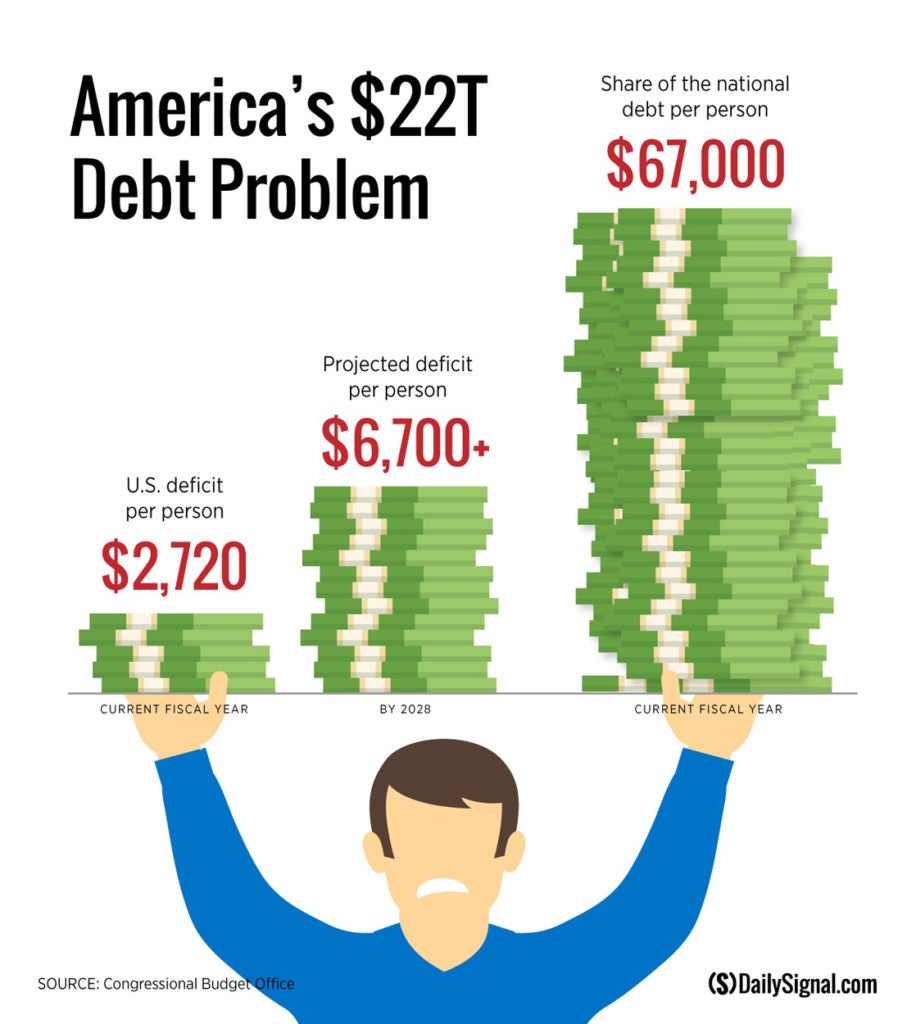
The nonpartisan Congressional Budget Office estimates that the current fiscal year deficit will be $896 billion, or more than $2,720 for every American (including children). With a disaster spending bill in the works and Congress discussing another possible caps deal, the deficit could surpass $1 trillion this year.
The last time America incurred such high deficits was in 2012, following the Great Recession. We have no such excuse today.
And it gets worse. The deficit is projected to climb to $1.4 trillion in 2028, which means we would be about $4,000 deeper in the red per person, unless Congress acts to control spending.
All that is on top of the current gross debt of $22 trillion. Each person’s share of today’s debt is already a staggering $67,000—exceeding what the typical American household earns in a year by several thousands of dollars.
This high and rising debt burden has many harmful effects.
For starters, the government will pay $382 billion in interest this year just to service the debt, or $1,160 for each of us. That kind of money would go a long way for most American families, but instead we send it to our creditors—many of whom are foreign nations. China alone owns over $1 trillion in U.S. treasuries.
As the debt increases and interest payments rise, that creates a heavier drag on the economy. Although it is hard to measure how much economic growth we miss out on because of the debt, even relatively small growth effects add up to thousands of dollars lost per year for every worker.
This is maddeningly unfair to younger and future generations. Not only are today’s children being saddled with tens of thousands of dollars in national debt, but they may also have to navigate an economy that offers them less opportunity than they would have if political leaders were more responsible with the nation’s finances.
It is tempting to look at all of that bad news and throw up our hands. But that is not how Americans respond to a challenge.
The Heritage Foundation has the solution to big deficits and a slower economy: the “Blueprint for Balance.”
Drawing on the work of dozens of policy analysts, the blueprint provides policymakers with a comprehensive approach to taxing, spending, and protecting vital liberties.
The impact of adopting the blueprint’s 250-plus specific policy proposals would be enormous. Over the course of a decade, the blueprint would:
Shift the budget from annual deficits to a surplus.
Achieve over $30,000 per person in accumulated savings by eliminating wasteful programs, reforming Social Security and Medicare so they are sustainable, and returning control and responsibility for programs best administered by the private sector, states, and local governments to those entities.
Reduce taxes by roughly $2,500 per person through making the Tax Cuts and Jobs Act permanent, while eliminating many tax subsidies for politically-connected groups and businesses.
Shrink the national debt as a share of the economy by over a third from current projections, making it manageable.
Ensure that America’s military has the resources it needs to keep the nation secure.
Enacting the blueprint will require a sustained effort and political courage. At a time when the Senate seems unable to legislate and the House would rather spend than budget, this seems like a daunting task.
Political leaders must make a choice. They can choose to do nothing—in which case debts will continue to pile up, Social Security will run out of money to pay benefits, and the federal government will remain too big to be managed properly—or, they can choose to move toward socialism, which would concentrate power and money in Washington, D.C., while throttling the economy with high taxes and reducing freedom and choices for Americans.
By following the “Blueprint for Balance,” though, lawmakers can secure more economic growth, a solvent retirement system, and a federal government focused on its core constitutional priorities, such as protecting the nation.
The choice is clear. America’s present and its future depend on a commitment to the principles of free enterprise, limited government, individual freedom, and a strong national defense. These are the principles embodied in the “Blueprint for Balance.”
To those who don’t like this blueprint: What’s your plan?
Residents of Republican-leaning states may be feeling better this tax season.
The controversial limit on state and local tax deductions in the federal tax code overhaul is making for “a small but important difference” for red states than blue state, according to a new study distributed [April 22] by the National Bureau of Economic Research. President Trump’s new tax law reduced the maximum amount you can deduct for state and local taxes to $10,000 or $5,000 if you use married filing separate status.
Households in Republican “red” states are projected to see an average 1.6% increase in remaining lifetime spending in the wake of the Tax Cuts and Jobs Act of 2017, while households in Democratic “blue” states will see an average 1.3% increase.
Without the cap, blue-state consumers would have experienced a 2.1% increase in lifetime spending under the new tax law compared to the 1.9% rise for red state residents, the study said. Case in point: Wyoming, a robust red state with the largest percentage gain in lifetime spending, will rake in an extra $33,679 over their lifetime.
But people living in deeply Democratic California will see the smallest gains and only reap $21,548, according to researchers at the Federal Reserve Bank of Atlanta, Boston University and University of California, Berkeley. “It appears every state on average benefitted from tax reform,” said Boston University economics professor Laurence Kotlikoff, one of the authors.
The blue versus red state trend becomes even more pronounced higher up the earnings ladder. The richest top 10% in red states will see a 2% increase, but the same high-earning blue state residents will have a 1.2% increase, said the findings. The richest residents in Democratic-leaning states didn’t benefit as much.
The $10,000 cap will currently expire in 2025, but Kotlikoff said researchers went with a lifetime spending analysis expecting the limit would stay put. “It’s not trivial, but it’s not enormous,” he said.
It’s another look at tax code with possibly uneven effects. One MarketWatch analysis said states backing President Donald Trump in the 2016 election would reap the majority of money from tax cuts while paying minority share.
Until Trump enacted sweeping 2017 changes to the personal and corporate tax system, there wasn’t a deduction limit for state and local taxes — which happen to be higher in certain Democratic-leaning states. Median state and local taxes were $7,950 in blue states, $5,219 in red states and $6,371 in middle-of-the-road purple states.
The new law, which didn’t earn one Democratic vote in the House or Senate, put a $10,000 limit on state and local tax deductions. Among other things, it also enlarged the standard deduction for taxpayers who thought they’d fare better on that route than itemizing write-offs like state and local tax expenses.
Jared Walczak, senior policy analyst at the Tax Foundation, a conservative-leaning think tank, said the new tax code has been a victory for taxpayers. Before the new laws, people with high state taxes were effectively getting a subsidy from the rest of the country with their unlimited deduction, he said. Walczak said that the latest data has effectively confirmed this.
As far as tax seasons go, it’s been a wild one. There’s been frustration from taxpayers who suddenly owe money and joy from those getting a surprisingly high refund. H&R Block said a large part of the refund let-down could be the fact that many taxpayers didn’t update their tax witholding during 2018. H&R Block tallies said there were fewer tax liabilities across the board for its clients.
The federal government has paid $7.6 billion less in refunds this tax season compared to the last one. When the Internal Revenue Service compared the week ending April 12, 2019 with a comparable point last year, it said filed tax returns were up 0.7% while the number of refunds were down almost 2%. (IRS tallies don’t break out state-by-state refunds.)
Some Democratic states are suing the Treasury Department over the cap on state and local tax deductions (SALT), calling them an “unconstitutional assault.” In February, New Jersey federal lawmakers offered a bill to repeal the cap, while New York Governor Andrew Cuomo has slammed the limits.
The plaintiffs in the ongoing Manhattan Federal Court are New York, New Jersey, Connecticut and Maryland. When the new study ranked lifetime spending within the 50 states and Washington D.C., it put Maryland in 19th place and placed Connecticut in 36th place. New Jersey ranks in 42nd place and New York in 45th place.
In response, federal lawyers argued, “Many taxpayers in these states who previously benefitted most from the [state and local tax] deduction are projected to have consistently lower tax bills due to the combined effect of the act’s many provisions.”
Boy, that Trump is sure a moron, isn’t he, getting a tax cut through Congress that rewards states that voted for him and penalizes states that didn’t vote for him, and/or rewards states with low(er) taxes and penalizes states with high(er) taxes. The irony is that if you believe Republicans have more money than Democrats, that $10,000 SALT limit probably affected a fair number of Wisconsinites who voted for Trump in. (On the other hand, given this state’s seventh-circle-of-tax-hell status under previous governors, the tax cuts, insufficient as they were, signed into law by Gov. Scott Walker may have been the difference between some Wisconsinites’ paying more taxes under the Trump tax cuts and paying less.)
But as Milton Friedman put it …
Congress is responsible for federal taxes, not state and local taxes. Though there is an argument for SALT deductibility on the grounds that one shouldn’t have to pay taxes multiple times, the fact is that SALT was a subsidy to higher-tax states paid for by lower-tax states. The latter group might reasonably ask why they should be penalized for their fiscal responsibility.
Supporters of abortion rights are fond of saying that Roe v. Wade is “settled law.” The phrase is supposed to convey a finality that borders on irrevocability. But, of course, what the Supreme Court gives, the Supreme Court can take away. That appears to be the reasoning behind the new laws passed in Alabama and Georgia, which would virtually outlaw abortion in both states.
Obviously, these laws will be challenged by abortion-rights activists; just as obviously, the laws will be struck down by lower courts, whereupon Alabama and Georgia will appeal all the way to the Supreme Court. And shortly thereafter, the country will probably find out just how settled Roe v. Wade really is.
The showdown looms because Justice Brett M. Kavanaugh now occupies the Supreme Court seat once held by the now-retired Anthony M. Kennedy. Pro-lifers and pro-choicers alike suspect that Kavanaugh is less supportive of sweeping abortion rights than Kennedy was. But the confrontation arguably was inevitable from the moment Roe was decided in 1973; the settled right may actually have been inherently unstable. When the court finally rules and all the shouting has stopped, we may eventually come to wonder whether it could ever have turned out any other way.
No legal case has done more than Roe to define how the left sees the Supreme Court: not as a somewhat boring final arbiter of words recorded in law books, but as the oracle that tells us what rights the Constitution ought to guarantee. Consequential cases such as Brown v. Board of Education (1954) and Miranda v. Arizona (1966), concerning racial segregation and the rights of police suspects, respectively, dealt with matters that clearly involved the Constitution. There was no question that resolving just such ambiguity is the Supreme Court’s job.
But by the 1970s, the court was, one suspects, a little drunk on the moral and legal triumph of those earlier cases. The justices were now going well beyond the words in the law books and into the unwritten law of what used to be called “enlightened opinion.” In 1972, they abolished the death penalty in all 50 states, even though the Constitution clearly contemplates government-administered capital punishment.
The following year, the justices gave the country a new right to abortion. The right is nowhere mentioned in the Constitution, but had apparently been lurking there undetected for the better part of two centuries before the justices finally coaxed it into the open. From this era dates the solemn invocations of “settled law” issued by “the highest court in the land.”
That view of constitutional interpretation works precisely as long as you happen to agree with the judicial interpreters. When the other side of the political spectrum gets wise and starts stocking the courts with judges who share their opinions — Catastrophe! Ruination! Citizens United!
Which makes this a good time for the left to step back and ask whether it was ever a good idea to urge such sweeping powers on unelected judges. The benefit of going the judicial route is that you can occasionally achieve outcomes you could never obtain through legislatures; that is how America, a center-right nation, got one of the most liberal abortion regimes in the world. The problem with going the judicial route is that it short-circuits public debate and forces the opposition to take radical action — like, say, a decades-long project to fill the courts with right-leaning judges — to amend that “settled law.”
The consequences of the counterreaction can go well beyond the issue at hand. If not for Roe, it seems eminently possible that the conservative-court project would have been less urgent, and the decisions in District of Columbia v. Heller on gun rights or Citizens United on campaign finance might never have happened. If it hadn’t been for Roe, evangelicals might also have balked at electing Donald Trump.
Of course, if it hadn’t been for Roe, there also wouldn’t have been more than 50 million abortions since 1973; whether that’s a good or bad thing will be left as an exercise for the reader. But many abortions would have been performed anyway, because before the court took the issue away from voters, polls showed public opinion steadily trending in favor of legalized abortion, and the procedure was already legal in several states.
If the Supreme Court hadn’t intervened on abortion, political debate might have sorted voters along a spectrum, rather than forcing them into the unforgiving yes-no binary. And if you fear you’re about to end up on the wrong side of that binary, you might wish your side had settled for something less grandiose, but more enduring.
I’m not sure I buy Tyler Cowen‘s claim, but it is an interesting point of view:
With the U.S.-China trade talks now at a halt, odds are that the recent U.S. tariffs on China will continue — and perhaps even rise and multiply. So it’s worth considering what effects those tariffs will have. One prominent argument, which can also serve as a criticism of President Donald Trump, is that the U.S. consumer is the loser. Yet in reality, China is probably in the more vulnerable position.
To be clear, there are well-done studies showing that the recent tariffs have translated into higher prices for U.S. consumers. I am not contesting that research. The question is whether those studies give sufficient weight to all relevant variables for the longer run.
To see why the full picture is more complicated, let’s say the U.S. slaps tariffs on the industrial inputs (whether materials or labor) it is buying from China. It is easy to see the immediate chain of higher costs for the U.S. businesses translating into higher prices for U.S. consumers, and that is what the afore-mentioned studies are picking up. But keep in mind China won’t be supplying those inputs forever, especially if the tariffs remain. Within a few years, a country such as Vietnam will provide the same products, perhaps at cheaper prices, because Vietnam has lower wages. So the costs to U.S. consumers are temporary, but the lost business in China will be permanent. Furthermore, the medium-term adjustment will have the effect of making China’s main competitors better exporters.
Obviously, no final long-run estimates are possible right now. But it is quite plausible that China will bear the larger costs here, not the U.S.
Another risk for China is this: As its access to U.S. markets becomes more difficult, China may be tempted to look to Europe. It remains to be seen whether the European Union will adopt additional protectionist measures, but China must consider that the possibility is more than zero.
To understand another feature of the longer-term perspective, consider that the impact of tariffs can be felt in at least two ways. In highly competitive markets, prices have to match costs, and so a cost-boosting tariff really does translate into higher consumer prices. (This is the case with many of the recent U.S. tariffs on China.) But for profitable branded goods, the economics aren’t the same. If the U.S. puts higher tariffs on Mercedes-Benz, for example, the prices of those cars will still exceed their costs of production. Mercedes, wishing to keep some of its strong market position, will probably decide to suffer some of the cost of the tariffs in the form of lower profits, rather than passing them along to its customers.
China has prominent brands as well, be it Huawei in electronics or other firms in exotic food products, and over time it aspires to climb the value chain and sell more branded goods to Americans. In fact China has an industrial policy whose goal is to be competitive in these and other areas. Tariffs will limit profits for these companies and prevent Chinese products from achieving full economies of scale. So this preemptive tariff strike will hurt the Chinese economy in the future, even if it doesn’t yet show up in the numbers.
There is also a broader reason why a trade war with the U.S. hurts China, and this gets to an important point with trade agreements more generally. A U.S. trade agreement with China would (if enforceable) certify China as a place where foreigners can invest and be protected against espionage, intellectual property theft and unfair legal treatment. That prospect of certification is now suspended. That makes investing in China less desirable for many multinationals, not just U.S. ones. That, in turn, limits Chinese domestic wages as well as long-term learning and technology transfer. A U.S. certification of China might even boost Chinese domestic investment, but again that is now off the table.
In my numerous visits to China, I’ve found that the Chinese think of themselves as much more vulnerable than Americans to a trade war. I think they are basically correct, mostly because China is a much poorer country with more fragile political institutions.
And finally: My argument isn’t about whether Trump’s policy toward China is correct. I am only trying to get the basic economics straight. Next time you hear that the costs of the trade war are simply being borne by Americans, be suspicious. In their zeal to make Trump look completelywrong, on tariffs or other issues, too many commentators pick and choose their arguments. A more fair and complete economic analysis indicates that China is also a big loser from a trade war. Trump’s threats are exerting some very real pressure on the country.
This question of who is worse off omits one important detail. If Trump wants to stay president, he has to run for reelection next year, as do Congressional Republicans supporting and opposing his trade policies. China’s leaders have no such concern; they could tank their entire country’s economy and remain in power. So ask yourself what China really has to lose from this trade war.
Sure, the Democratic governor of Montana is popular with his own people. But nationally, he is probably not even the 20th—or 22nd!—name to come to mind if you had to name all the Democratic candidates. Meanwhile, the Montana Senate seat held by freshman Republican Steve Daines is up in 2020. Democrats need to take only three seats to recapture the chamber. If Bullock were running for the Senate in Montana, the race would instantly become a toss-up and the map would suddenly go from iffy to meh for the GOP.
But Bullock isn’t alone.
Former Colorado governor John Hickenlooper is running for president, too. Spoiler: He’s not going to be the Democratic nominee. There is literally no way he could become the Democratic nominee. Even if he showed up in Iowa in February with a copy of the Pee Tape. Not gonna happen.
But Hickenlooper would be a very formidable candidate against Senator Cory Gardner in a state that’s trending purple and which, if a Democrat wins the White House, will likely be carried by the Dems at the top of the ticket.
Then there’s Texas, where John Cornyn is up for re-election while both Julian Castro and Beto O’Rourke are running for president. O’Rourke is at least polling above the margin of error. But that’s about the best thing you can say at this point.
What’s going on here?
Democrats have a real pathway to take the Senate in 2020. It’s not easy, but it’s doable: Republicans are defending 22 seats; Democrats are defending only 12.
Of the Democratic seats only one, Alabama, is a serious candidate to flip.
On the Republican side, Maine, Arizona, North Carolina, and Georgia are all gettable if the Democratic presidential nominee is outperforming Hillary Clinton. If Montana, Colorado, and Texas drew top-tier Democratic challengers, the party’s chances of flipping the Senate would increase dramatically.
So why are these Democrats running for president instead of statewide office?
The answer may be: Joe Biden.
Biden is, so far, a runaway frontrunner. He’s leading every poll by double digits. His primary opponent at this point is an aged socialist who isn’t even a Democrat. And he has history on his side: Just about every vice president in the modern era who has sought his party’s nomination, has won it. (The exception being Dan Quayle.)
But if he were to win in 2020, it would mean that Biden would be 81 years old on Election Day in 2024. It seems at least possible that part of the deal with a Biden presidency is that—either explicitly or implicitly—he would be a one-term president.
Which means that whoever he picks as a running mate this go-round would begin the 2024 cycle as the presumptive Democratic nominee.
So imagine that you’re John Hickenlooper and you want to be president. Former Gov. John Hickenlooper is never going to win the Democratic nomination.
But Vice President John Hickenlooper could. And the chances of Hickenlooper acquitting himself well in a couple of debates and then looking like a sensible veep pick because he’s from a swing state and reinforces Biden’s moderate value-proposition is . . . well, let’s be honest, this isn’t a high percentage play.
But compared with Hickenlooper trying to win the nomination himself, it’s much, much more plausible. In fact, if you’re Hickenlooper, this is the onlyconceivable way in which you could become president.
You could become another senator from Colorado any time. But if you want to win it all, this is the only shot you’re ever going to get.
You could say the same about Bullock, though his longshot-bankshot is even longer and banksier than Hickenhlooper’s. Ditto for Castro.
O’Rourke alone is a plausible presidential contender on his own, and you can understand why taking a shot at Cornyn would actually be a bigger risk for him than running for president. It’s one thing to lose a Senate race and then lose a presidential primary. It’s another thing to lose back-to-back Senate races. It’s not clear what the path forward from that would be.
If the Democrats are serious about contesting the Senate, at some point they’re going to have to sit some of their presidential candidates down and talk to them about their duty to take one for the team.
The real question is how long they can wait to have those talks.
Believe it or don’t, Donald Trump has, at last count, 52 opponents for the Republican presidential nomination.
The Guardian for some reason decided to do a story about some of the 52:
Donald Trump won the Republican nomination with ease in 2016, defeating more than a dozen rivals before going on to win the presidential election.
In advance of 2020, all eyes are now on the spectacularly crowded Democratic primary race. But it is easy to forget, or not notice, that Trump will need to beat off 52 Republican challengers, from across the country, if he is to have any chance of a second term.
The president’s declared rivals are less vaunted this time round. So far only Bill Weld, who was governor of Massachusetts from 1991 to 1997, has anything approaching national name recognition.
But the rest of the class of 2020 are serious about their unlikely task of defeating an incumbent president with the Republican party mostly united behind him, even as observers believe they have virtually no chance of winning.
Some have pumped their life savings into their presidential quests, others have quit their careers, all with the dream of becoming the 46th president of the United States. Those dreams range from cautiously optimistic to … uncautiously optimistic.
“I want to be candid and honest and not sound like a lunatic,” said James Peppe, a financial adviser from Houston. “But I think if I can get the exposure for enough people to see what I’m about, and what I represent, then I think that not only will I win, but I’ll win big.”
Peppe, whose campaign website shows him wearing a shirt, tie and a pair of Stars-and-Stripes boxing gloves, has previous experience in politics – he said he worked for the former Minnesota senator Rudy Boschwitz and former governor Arne Carlson – and an ambitious set of proposals.
He wants to abolish the Department of Veterans Affairs and instead scoop health coverage for former military members under the apron of Medicare – he calls the proposal Veticare – and has has suggested a series of updates to the constitution, tweaking archaic language to establish clearer positions on guns, free speech and privacy.
Peppe, 52, plans to pitch up in Iowa and New Hampshire – the first states to vote in the 2020 primaries – and take his message to the people, hoping to slowly gain exposure. “When they see me and they see I’m a pretty plainspoken, common sense-oriented kind of guy, I think that’s the tipping point where you’ll see a flood of people move my way.
“And I don’t think it’ll be very close, honestly. Starting with those early primary states, I think they’ll flood my way. The real question is: can I get that exposure?”
The former Ohio governor John Kasich and current Maryland governor Larry Hogan are also rumored to be considering runs, but they too face a daunting task to overhaul Trump, given the Republican National Committee – effectively the GOP leadership – voted unanimously to back Trump earlier this year.
Nevertheless, there is something of a precedent for long-shot candidates. Former presidents Jimmy Carter and Bill Clinton were considered outliers when they ran. But they were hardly quite as long-shot as this crowd.
Republican candidate Chris Brainard’s political experience pales in comparison: he has none.
The Texas property developer is running on an atypical platform which fuses the leftwing economic policies of Bernie Sanders with a hard-right stance on social issues.
“I have progressive ideas,” Brainard told the Guardian. “And my core fundamental values are more traditionally Republican.”
Brainard promises universal healthcare and a $15 minimum wage, but is anti-abortion. He believes in free college tuition and closing tax loopholes exploited by the rich, but thinks calls for stricter gun control are “senseless”.
To the casual bystander it might seem this manifesto creates a difficult path to victory, alienating – for different reasons – both the left and right. Brainard disagrees.
“I think that it actually has a much better chance of winning enough of the electorate to achieve the presidency than Trump’s current positions,” he said.
Brainard plans to travel to Iowa and New Hampshire in June and July – currently the only event he has lined up is the Iowa corn belt forum, a presidential town hall which Collins will also attend – and essentially just approach people and tell them he’s running for president.
“People actually value meeting the person and shaking their hand and actually having a conversation about what our values are and what we think can happen,” he said.
Doing that costs money, and the Trump campaign has lots of it – the president raised $30m in the first three months of 2019.
The candidates the Guardian spoke to have – so far – raised less than that, although Brainard had managed to rake in $101,225.45 by the end of March, $101,000 of which came from his own pocket.
“We put enough money in there to make sure that we can go do whatever we need to do right now,” Brainard said. His savings will currently go toward hiring a campaign manager to guide him in the early primary states.
Even with a manager in place, Brainard is realistic about his prospects.
“Very, very, very slim,” he said of his chances of defeating Trump. “Not zero, but pretty close.”
Every four years hundreds of people like Brainard register to run for president, partly because it isn’t very difficult. Hopefuls fill in a very short form on the Federal Election Commission website, send it off, and they are officially in the race.
To run for the Republican nomination, however, gets more difficult from there. In some states candidates have to pay to make it on to the Democratic or Republican primary ballot. According to Ballotpedia, it costs $1,000 to be listed in New Hampshire, while other states demand a certain number of signatures from party members. Either way, it’s expensive.
For Robert Eugene Smith, a data entry specialist from Nevada, Missouri, it proved too costly.
The 35-year-old had high hopes when he launched his campaign. Smith wanted to fix social security, tackle the spiraling national debt and perhaps even heal the country a little bit.
“I wanted to be a uniter, not a divider,” Smith said.
He pumped more than $1,000 into his campaign, buying business cards, Facebook advertisements and a website, but his campaign struggled to gain traction. There was little interest from the media, which made it difficult to attract a core base of supporters.
“You think people are going to be interested in what you have to say. But nobody will give you the time of day to speak with you,” Smith said. “I spent one weekend sending maybe 100 emails to different news organizations across the US. I didn’t get a single reply.”
Dispirited, Smith suspended his campaign in early April.
“I’ve no regrets,” he told the Guardian at the time. “Plenty of people waste a thousand dollars on a lot of sillier stuff.”
That could have been the end of the road for the Missourian: another aspiring politician crushed by the party elite. But a week after we first spoke, Smith got in touch with some good news. He had been recruited to run for the House of Representatives by the Alliance party, a freshly formed, conservative third party.
In 2020, Smith will go up against Vicky Hartzler, a Republican who has represented Missouri’s fourth congressional district since 2011.
“I don’t want people to give up on their dreams,” he said.
“Don’t give up, don’t sell yourself short. Always hold true, and a door will open.”
Since hitting new all-time highs two weeks ago, the S&P 500 has fallen about 2.2% as trade negotiations with China hit a snag. Last week, the US announced new tariffs on Chinese imports. This morning, China announced new tariffs on some US goods. Many fear a widening trade war.
Don’t get us wrong. We want free trade, and we understand the dangers of trade wars and tariffs (which are just taxes on consumers). At the same time, we think trade deficits themselves are not a reason for trade wars. We all run personal trade deficits with the local grocery store and benefit from that. Even if the entire world went to zero tariffs, the US would almost certainly still run trade deficits, even with China.
But today, the trade deficit with China is partly due to the fact that China has higher tariffs on imports than the US does – working to eliminate these lopsided tariffs is worthwhile.
In 1980, China was an impoverished nation. Then it began adopting tools of capitalism – property rights, markets, free prices and wages. Chinese businesses started to import the West’s technology, and growth accelerated.
Initially, China didn’t have to worry about intellectual property. When you replace oxen with a tractor, all you have to do is buy the tractor, not reinvent the internal combustion engine. But China has now picked, and benefited from, the lowest hanging fruit. So, China decided to steal the R&D of firms located abroad. Some estimates of this collective theft run into the hundreds of billions of dollars.
That’s why normal free market and free trade principles don’t neatly apply to China.
Remember President Reagan’s old story supporting free trade? “We’re in the same boat with our trading partners,” Reagan said. “If one partner shoots a hole in the boat, does it make sense for the other one to shoot another hole in the boat?” The obvious answer is that it doesn’t, and so our own protectionism would hurt us.
But China hasn’t just shot a hole in the boat, they’ve become pirates. If Tony Soprano and his cronies robbed your house, would free market principles require you to trade with them to buy those items back? Of course not!
It’s true tariff increases will not help the US economy. But $100 billion of tariffs spread over $14 trillion of consumer spending is not a recession inducing drag. It’s true some business, like soybean farmers, are hurt. But the status quo means accepting hundreds of billions in theft from companies that are at the leading edge of future growth.
Either way, if tariffs nick our economy, China’s gets hammered. Last year we exported $180 billion in goods and services to China, which is 0.9% of our GDP. Meanwhile, China exported $559 billion to the US, which is 4.6% of their economy. We have enormous economic leverage that they simply can’t match.
An extended US-China trade battle means US companies will shift supply chains out of China and toward places like Singapore, Vietnam, Mexico, or “Made in the USA.” If that happens, the Chinese economy is hurt for decades.
Anyone can invent a scenario where some sort of Smoot-Hawley-like global trade war happens. Realistically, though, that appears very unlikely. We’re not the only advanced country China’s piracy has victimized, and China may realize it’s more isolated than it thought. In the end, China wants to trade with the West, not North Korea, Russia, and Venezuela. China needs the West. And all these trade war hysterics just aren’t warranted.
First, a commercial: Some of the readers of this blog get blog links from Facebook. Some get blog links from Twitter. Some get it via email. Some have it bookmarked on their favorite browser.
Why should you sign up for email delivery? Because that way you won’t have to run the risk of not being able to read it in what some claim is a purge of conservatives from social media.
Last week, the Poynter Institute for Media Studies, a non-profit journalism and research organization, published a list of 500 unreliable new websites. But the list, which included many conservative news and think tank websites, was itself unreliable, and Poynter has since retracted it.
“Soon after we published, we received complaints from those on the list and readers who objected to the inclusion of certain sites, and the exclusion of others,” explained Poynter editor Barbara Allen in a statement. “We began an audit to test the accuracy and veracity of the list, and while we feel that many of the sites did have a track record of publishing unreliable information, our review found weaknesses in the methodology. We detected inconsistencies between the findings of the original databases that were the sources for the list and our own rendering of the final report.”
How exactly the list found its way onto the Poynter website in the first place is a bit of a mystery. Poynter confirmed that its author, Barrett Golding, is a freelancer rather than an employee, but did not answer other questions about the process of greenlighting this project.
Golding’s LinkedIn account lists him as a freelance podcast producer for the Southern Poverty Law Center. The SPLC did not respond to my questions about whether other SPLC staff had any influence or involvement over the list. Golding did not immediately respond to my request for comment, either. According to his Twitter feed, he works with the SPLC’s “Teaching Tolerance” project. He was formerly a research fellow at the Donald W. Reynolds Journalism Institute and a producer for NPR.
It’s worth trying to understand these connections because Poynter’s retracted list of news sites list was shoddy and overly broad in a manner reminiscent of the SPLC’s own work on tracking hate groups. As I explained in a recent piece for Reason detailing the group’s personnel issues, the SPLC tallies hate groups in a manner that suggests hate is always rising, even if it’s not:
According to the SPLC’s hate map, there were more than 1,000 hate groups in the U.S. in 2018—nearly twice as many as existed in 2000. The number has increased every year since 2014.
The map is littered with dots that provide more information on each specific group, and this is where the SPLC gives away the game. Consider a random state—Oklahoma, for example, is home to nine distinct hate groups, by the SPLC’s count. Five of them, though, are black nationalist groups: the Nation of Islam, Israel United in Christ, etc. The SPLC counts each chapter of these groups separately, so the Nation of Islam counts as two separate hate groups within Oklahoma (its various chapters in other states are also tallied separately). The map makes no attempt to contextualize all of this—no information is given on the relative size or influence of each group.
Additionally, the SPLC takes a very broad view of what constitutes hate: It considers the Alliance Defending Freedom, a legal group that defends religious liberty, as an extremist organization. It claims that American Enterprise Institute scholar Charles Murray is a white nationalist.
The Poynter list made similar errors. It included InfoWars (a literal conspiracy site) but also conservative new websites like The Washington Examiner, National Review, and The Washington Free Beacon. These sites get things wrong from to time, but so do mainstream and left-of-center news sources. (Indeed, this entire episode is a prominent example of a mainstream source making a mistake.) But those publications are not misleading in the same sense that Alex Jones is misleading.
Poynter has done some good work in the past. Moving forward, it should be more careful about outsourcing its fact-checking to people who work for the SPLC.
Wisconsin Conservative Union, a popular Facebook group for conservatives in the state, was apparently taken offline during Facebook’s targeting of offensive personalities and fan pages Thursday.
“I was surprised by this,” said Wisconsin Conservative Union administrator Bob Dohnal, who said on The Dan O’Donnell Show that a friend called him Thursday night to let him know that his page had vanished. “It’s about 2,000 of the conservative leaders around this state. Nobody is talking about revolution or anything like that. It’s just been a place where everybody can exchange ideas and talk about candidacies and stuff.”
Dohnal added that he never received any warnings about any of the group’s posts or any notice that it had violated Facebook standards. He isn’t even sure if the group has been suspended or permanently removed from Facebook. He merely logged on and found it was gone.
On Thursday, Facebook permanently banned a number of fringe right-wing figures, including Alex Jones, Laura Loomer, and Paul Nehlen in addition to Nation of Islam leader Louis Farrakhan. Dohnal doesn’t know why (or even if) his group was lumped in with and removed alongside them.
“There’s never been anything [posted] against gays or anyone of any race or sex or anything like that,” he said. “If there were, I would take them off right away.”
As of the publication of this article, Dohnal was trying to contact Facebook to determine why Wisconsin Conservative Union was pulled.
As of Wednesday, however, the site is back on Facebook.
Last weekend, conservatives discovered that both Twitter and Facebook had launched a grand purge of nationalist-populist (as they prefer to call themselves) users. Alex Jones, Milo, Paul Joseph Watson, Tommy Robinson, and Laura Loomer were all targeted, albeit not all by the same social media at the same time. The bans and suspensions inspired Human Events editor Raheem Kassam to predict that there were more waves to come:
This prediction is right on the money: Monday night, several other rightwing accounts were banned. Among them a parody account of Alexandra Occasio-Cortez, Jewish conservative @OfficeOfMike, and even the @MAGAphobia account whose admin was Jack Posobiec (the same Jack Posobiec mentioned by Kassam in his tweet about who’d be targeted next).
I started @Magaphobia as an acct to track violence against Trump supporters all in one place
In its explanation of the ban on the AOC parody account, Twitter pretended that it wasn’t made clear in the user’s name and bio that it was indeed parody. However, that’s not true at all:
So @twitter has today suspended @AOCPress, which had “parody” in both its name AND its bio. Yet they claim to allow parody in the suspension email itself. Hey @realdonaldtrump your followers are now being mass culled ahead of the election. #meddlingpic.twitter.com/XguTnO28jP
It’s clear: liberal Silicon Valley has picked a side with regards to the upcoming 2020 elections. All those who dare disagree are at risk of losing their accounts and therefore their audience.
This issue is, to use a word I hate, problematic. To no one’s surprise, Facebook is trying to have this both ways, as Jane Coaston reports:
For years, social media giants tried to avoid the question altogether, recognizing that under American law, digital platforms have unique protections that guard against lawsuits aimed at the content posted on those platforms. But users complained about extremism and misinformation weaponized on Facebook and elsewhere, putting Facebook, Twitter, and other tech companies under immense pressure to increase moderation and close the accounts of bad actors — the same way a publisher might reject an article or a writer.
In doing so, they’ve gotten sucked into the political fray they wanted to avoid. Conservatives, pointing out that Facebook and Twitter are self-described platforms, are arguing that banning some users while permitting others based on a “vague and malleable” rubric is infringing on free expression on sites that they view as more like a town square where all voices should be heard. …
Infowars is a publisher. Alex Jones, who has been the publisher and director of Infowars since its launch in 1999, can publish what he wants on it. If I pitched Alex Jones on an article for Infowars, he would be under no obligation whatsoever to publish it.
Amazon Kindle is a platform, which means Amazon provides the means by which to create or engage with content, but it doesn’t create most of the content itself — or do a lot of policing of it. If I wanted to read Mein Kampf on my Amazon Kindle, Amazon would be unable to stop me from doing so.
An even better example of a platform might be a company like Verizon or T-Mobile, which provides software and the network for you to make phone calls or send texts, but doesn’t censor your phone calls or texts even if you’re arranging to commit a crime.
But for Facebook, and all similar social media sites, this seemingly dense legal question is deeply important — for how it treats figures like Jones and Farrakhan, and even how Facebook arbitrates speech at all.
If Facebook is a platform, it then has legal protections that make it almost impossible to sue over content hosted on the site. That’s because of Section 230 of the Communications Decency Act, which protects websites like Facebook from being sued for what users say or do on those sites.
Passed in 1996, the act reads in part, “No provider or user of an interactive computer service shall be treated as the publisher or speaker of any information provided by another information content provider.”
Back in 2006, the act protected the website MySpace when it was sued after a teen met an adult male on the site who then sexually assaulted her. The court found that the teen’s claims that MySpace failed to protect her would imply MySpace was liable for content posted on the site — claims that butted up against Section 230.
But if Facebook is a publisher, then it can exercise editorial control over its content — and for Facebook, its content is your posts, photos, and videos. That would give Facebook carte blanche to monitor, edit, and even delete content (and users) it considered offensive or unwelcome according to its terms of service — which, to be clear, the company already does — but would make it vulnerable to same types of lawsuits as media companies are more generally.
If the New York Times or the Washington Post published a violent screed aimed at me or published blatantly false information about me, I could hypothetically sue the New York Times for doing so (and some people have).
So instead, Facebook has tried to thread an almost impossible needle: performing the same content moderation tasks as a media company might, while arguing that it isn’t a media company at all.
Facebook is trying to have its cake and eat it too
At times, Facebook has argued that it’s a platform, but at other times — like in court — that it’s a publisher.
In public-facing venues, Facebook refers to itself as a platform or just a “tech company,” not a publisher. Take this Senate committee hearing from April 2018, for example, where Facebook CEO Mark Zuckerberg argues that while Facebook is responsible for the content people place on the platform, it’s not a “media company” or a publisher that creates content.
But in court, Facebook’s own attorneys have argued the opposite. In court proceedings stemming from a lawsuit filed by an app developer in 2018, a Facebook attorney argued that because Facebook was a publisher, it could work like a newspaper — and thus have the ability to determine what to publish and what not to. “The publisher discretion is a free speech right irrespective of what technological means is used. A newspaper has a publisher function whether they are doing it on their website, in a printed copy or through the news alerts.”
And even the language Zuckerberg has used about Facebook when appearing before Congress, as he did last spring, shows that he thinks of the service as a publisher — while his company simultaneously argues that it’s not.
In his opening statement to committee members, Zuckerberg said, “We didn’t take a broad enough view of our responsibility, and that was a big mistake. It was my mistake, and I’m sorry. I started Facebook, I run it, and I’m responsible for what happens here.” And then he added, “I agree we are responsible for the content” on Facebook, while noting again that Facebook doesn’t produce content itself.
Why the line between platform and publisher matters
Facebook is far from alone in attempting to walk an almost impossible line between responding to users’ demands for moderation and editing while attempting to avoid the legal responsibilities of being a publisher.
Take Tumblr’s recent ban on nudity, Twitter’s continued back-and-forth on suspending and banning extremist users, Facebook’s recent efforts to curtail misleading ads that may have contributed to misinformation surrounding the 2016 presidential campaign: All of these moderating efforts are attempts to get out ahead of users who are dismayed by a constant cavalcade of bad actors and bots that make these sites less enjoyable to use (and less profitable for ad companies that post on these platforms, and thus, for the platforms).
And with the threat of impending regulations arising from European courts where American digital media protections don’t exist, Facebook is keener than ever to stay within the good graces of American users — and politicians.
So companies like Facebook, YouTube, and Tumblr are trying to be more, as Zuckerberg put it, “responsible.” But that’s landed them in a supercharged political environment, drawing the ire of the figures they’ve deemed dangerous and many others. For companies like Facebook, they’re damned if they do moderate content — both legally and politically — and damned if they don’t. …
Facebook wants to enjoy the benefits of being a content publisher — major moderation and editing powers along with the power to ban users for whatever reasons it wants — while also accessing the legal freedoms that come with being a platform under American law. And right now, Facebook is basically a publisher that keeps arguing that it isn’t.
That muddy legal territory has people worried that the social media giant will fail on both accounts — that it won’t handle material on its site as responsibly as a media outlet might, but will also stop providing an online “town square” where controversial voices can be heard.Since Facebook is now apparently reviewing the actions of users even when they’re not on Facebook, some are arguing that the stated terms of service that should dictate what’s permitted on Facebook and Instagram don’t do so in reality. That’s why organizations focused on digital civil liberties are just as concerned about Facebook’s decisions as some on the right.
Jillian York, a Electronic Freedom Foundation director, said in a statement, “Given the concentrated power that a handful of social media platforms wield, those companies owe their users a clear explanation of their rules, clear notice to users when they violate those rules, and an opportunity to appeal decisions.”
In April 2018, Facebook launched the “Facebook Here Together” campaign, stating that Facebook would “do more to keep you safe” from privacy violations and seemingly from bad content.
But that’s the role of a publisher — one that Facebook has argued time and time again that it doesn’t have. And that’s a big, big problem for the world’s most powerful social media company.
Banning fringe voices from social media networks may be popular among tech and political elites, but it will only further embolden the people with truly dangerous ideas.
The fresh wave of censorship is being led by the reaction to the actions of the deranged terrorist, motivated by very bad ideas, who opened fire on peaceful worshippers at mosques in Christchurch, New Zealand, in March, killing 51 people and leaving 41 injured.
He livestreamed the entire rampage, peppering his deadly killing spree with commentary and phrases found on seedy online chat rooms and websites.
Political leaders in western nations want global regulations on the social media platforms used by the shooter, which you or I use everyday to communicate with our friends and family.
In the rush to prevent another attack, however, we should be warned against any crackdown on social media and Internet freedom. These are the tools of dictatorships and autocracies, not freedom-loving democracies.
But penalizing social media companies and its users for a tragic shooting that took place in real life abrogates responsibility for the individual alleged of this attack, and seeks to curb our entire internet freedom because of one bad actor.
What’s more, trying to play whack-a-mole with bad ideas on the internet in the form of bans or criminal liability will only embolden the seediest of platforms while putting unreasonable expectations on the major platforms. And that leads us to miss the point about this tragedy.
Social media platforms like Facebook or Twitter already employ tens of thousands of moderators around the world to flag and remove content like this, and users share in that responsibility. It will be up to these platforms to address concerns of the global community, and I have no doubt their response will be reasonable.
But on the other hand, this tragedy occurs in the context in which Big Tech is already being vilified for swinging elections, censoring speech of conservatives, and not reacting quickly enough to political demands on which content should be permissible or not.
As such, we are set to hear anti-social media proposals that have very little to do with what happened on that tragic day in Christchurch in idyllic New Zealand.
Australian Prime Minister Scott Morrison wants the G20 to discuss global penalties for social media firms that allow questionable content. Democrats like Sen. Elizabeth Warren, among many congressional Republicans, want to use antitrust regulations to break up Facebook.
A recent national poll found that 71 percent of Democratic voters want more regulation of Big Tech companies.
In the wake of a tragedy, we should not succumb to the wishes of the terrorist who perpetuated these attacks. Overreacting and overextending the power of our institutions to further censor and limit online speech would be met with glee by the killer and those who share his worldview. Reactionary policies to shut these voices out so they cannot read or listen to alternative views will only embolden them and make the internet a seedier place.
Many individuals and companies are now fully reliant on social media platforms for connecting with friends, attracting customers or expressing their free speech. They are overwhelmingly a force for good.
Yes, internet subcultures exist. Most of them, by definition, are frequented by very small numbers of people who are marginalized. But clamping down on social media will only radicalize this minority in greater numbers, and maybe lead to more blowback.
Cooler heads must prevail. Social media does more good than harm, and we cannot use the actions of a fraction of a minority to upend the experience for billions of users.
We can use these tools to condemn and prevent extremist ideas and behavior rather than the force of law or outright bans of controversial figures who make convenient targets.
Banning pages or certain people you don’t like violates the spirit of the First Amendment, without which social media really couldn’t exist. (Yes, I am aware that the First Amendment prohibits governments, not private individuals or corporations.) Someone once said that the correct way to counteract speech you don’t like is more speech, not banning speech.
The birth of Prince Harry and Meghan‘s baby boy has signalled the first time that a person has had the right to become both the British monarch and the US President.
Baby Sussex is automatically a British citizen based on the Duke of Sussex’s citizenship status and also due to being born in the UK.
But assuming Meghan did not voluntarily give up her own US citizenship when she married Harry, which she was no required to do by law, the baby will also be granted American citizenship himself.
The implication of being naturally-born citizen of the United States means Baby Sussex could one day run for office as US President.
However the US constitution states that any runner for the job must also have lived in the US for at least 14 years, as well as be over the age of 35.
In order for a child who was born abroad to a US citizen parent who is married to a non-US citizen, the citizen, who would be Meghan in this case, must have lived in the United States for at least five years, and two of those years must have been after the age of 14.
The birth of Baby Sussex must then be officially reported to an American consulate in order for him to obtain US citizenship.
US law does not officially recognize dual citizenship, but it doesn’t prohibit it either.
Baby Sussex’s British citizenship would not be affected if the Duke and Duchess of Sussex choose to obtain US citizenship for their child.
However, US tax implications could prevent the couple from seeking American citizenship for their new bundle of joy.
All US citizens are required by law to report income from all sources within and outside of the US, meaning Baby Sussex could face a tax bill in the States.
Despite now living at Frogmore Cottage in the grounds of Britain’s Windsor Palace, Meghan is still expected to file tax returns to the US due to her citizenship.
Should Baby Sussex decide he wants to renounce his US citizenship, he would not be able to do so until he reaches the age of 16.
The royal baby is also now in the succession line to the British throne, despite six others sitting in front of him.
While Baby Sussex is not expected to ever become monarch, it is not unheard of for children of second-born royal sons to become king or queen.
The Queen was, like Baby Sussex, the child of a second-born royal son – George VI – and Princess Elizabeth was not thought likely to be a sovereign when she was born.
When Edward VIII abdicated, his younger brother the Duke of York became king as George VI, eventually paving the way for the princess to reign as Elizabeth II.
Queen Anne was also the second daughter, and fourth child, of a second son – James II – who was a brother of Charles II.
But monarchy expert Dr Jonathan Spangler said Harry and Meghan’s son, who will be seventh in line, will not wear the crown unless there is a ‘twist of dynastic fate’.
This is unlikely, given that the Duke of Cambridge has three children – future king Prince George, and two spares Princess Charlotte and Prince Louis.
The first six places remain unchanged – the Prince of Wales, the Duke of Cambridge, Prince George, Princess Charlotte, Prince Louis and then Harry.
But the youngest member of the Windsor family has now bumped Harry’s uncle, the Duke of York, from seventh place down into eighth.
“Baby Sussex” is actually Archie Harrison Mountbatten-Windsor, according to People.com. (I loathe myself for passing on a People.com post.) “Harry” for short?
For all those who fantasize about Chelsea Clinton, one of the Obama daughters or Barron Trump someday becoming president, this is wilder yet. Imagine the American presidency being a consolation prize for being too far down the line of succession to become king. On the other hand, recall that Winston Churchill was half-American. And if you’re going to have a royal parent, one could do worse than Harry, who is certainly more fun than his father … assuming that Prince Charles is really his father.
That is more fun speculation than claims that Archie is the British Barack Obama. As someone in America once pointed out, we should be judged not by the color of our skin (and of our parents) than by the content of our character.
Over the last decade, journalists have held up Germany’s renewables energy transition, the Energiewende, as an environmental model for the world.
“Many poor countries, once intent on building coal-fired power plants to bring electricity to their people, are discussing whether they might leapfrog the fossil age and build clean grids from the outset,” thanks to the Energiewende, wrote a New York Times reporter in 2014.
With Germany as inspiration, the United Nations and World Bank poured billions into renewables like wind, solar, and hydro in developing nations like Kenya.
But then, last year, Germany was forced to acknowledge that it had to delay its phase-out of coal, and would not meet its 2020 greenhouse gas reduction commitments. It announced plans to bulldoze an ancient church and forest in order to get at the coal underneath it.
After renewables investors and advocates, including Al Gore and Greenpeace, criticized Germany, journalists came to the country’s defense. “Germany has fallen short of its emission targets in part because its targets were so ambitious,” one of them argued last summer.
“If the rest of the world made just half Germany’s effort, the future for our planet would look less bleak,” she wrote. “So Germany, don’t give up. And also: Thank you.”
But Germany didn’t just fall short of its climate targets. Its emissions have flat-lined since 2009.
Now comes a major article in the country’s largest newsweekly magazine, Der Spiegel, titled, “A Botched Job in Germany” (“Murks in Germany“). The magazine’s cover shows broken wind turbines and incomplete electrical transmission towers against a dark silhouette of Berlin.
“The Energiewende — the biggest political project since reunification — threatens to fail,” writeDer Spiegel’s Frank Dohmen, Alexander Jung, Stefan Schultz, Gerald Traufetter in their a 5,700-word investigative story (the article can be read in English here).
Over the past five years alone, the Energiewende has cost Germany €32 billion ($36 billion) annually, and opposition to renewables is growing in the German countryside.
“The politicians fear citizen resistance” Der Spiegel reports. “There is hardly a wind energy project that is not fought.”
In response, politicians sometimes order “electrical lines be buried underground but that is many times more expensive and takes years longer.”
As a result, the deployment of renewables and related transmission lines is slowing rapidly. Less than half as many wind turbines (743) were installed in 2018 as were installed in 2017, and just 30 kilometers of new transmission were added in 2017.
Solar and wind advocates say cheaper solar panels and wind turbines will make the future growth in renewables cheaper than past growth but there are reasons to believe the opposite will be the case.
Der Spiegel cites a recent estimate that it would cost Germany “€3.4 trillion ($3.8 trillion),” or seven times more than it spent from 2000 to 2025, to increase solar and wind three to five-fold by 2050.
Between 2000 and 2019, Germany grew renewables from 7% to 35% of its electricity. And as much of Germany’s renewable electricity comes from biomass, which scientists view as polluting and environmentally degrading, as from solar.
Of the 7,700 new kilometers of transmission lines needed, only 8% have been built, while large-scale electricity storage remains inefficient and expensive. “A large part of the energy used is lost,” the reporters note of a much-hyped hydrogen gas project, “and the efficiency is below 40%… No viable business model can be developed from this.”
Meanwhile, the 20-year subsidies granted to wind, solar, and biogas since 2000 will start coming to an end next year. “The wind power boom is over,” Der Spiegel concludes.
All of which raises a question: if renewables can’t cheaply power Germany, one of the richest and most technologically advanced countries in the world, how could a developing nation like Kenya ever expect them to allow it to “leapfrog” fossil fuels?
The Question of Technology
The earliest and most sophisticated 20th Century case for renewables came from a German who is widely considered the most influential philosopher of the 20th Century, Martin Heidegger.
In his 1954 essay, “The Question Concerning of Technology,” Heidegger condemned the view of nature as a mere resource for human consumption.
The use of “modern technology,” he wrote, “puts to nature the unreasonable demand that it supply energy which can be extracted and stored as such… Air is now set upon to yield nitrogen, the earth to yield ore, ore to yield uranium…to yield atomic energy.”
The solution, Heidegger argued, was to yoke human society and its economy to unreliable energy flows. He even condemned hydro-electric dams, for dominating the natural environment, and praised windmills because they “do not unlock energy in order to store it.”
These weren’t just aesthetic preferences. Windmills have traditionally been useful to farmers whereas large dams have allowed poor agrarian societies to industrialize.
In the US, Heidegger’s views were picked up by renewable energy advocates. Barry Commoner in 1969 argued that a transition to renewables was needed to bring modern civilization “into harmony with the ecosphere.”
The goal of renewables was to turn modern industrial societies back into agrarian ones, argued Murray Bookchin in his 1962 book, Our Synthetic Environment.
Bookchin admitted his proposal “conjures up an image of cultural isolation and social stagnation, of a journey backward in history to the agrarian societies of the medieval and ancient worlds.”
But then, starting around the year 2000, renewables started to gain a high-tech luster. Governments and private investors poured $2 trillion into solar and wind and related infrastructure, creating the impression that renewables were profitable aside from subsidies.
Entrepreneurs like Elon Musk proclaimed that a rich, high-energy civilization could be powered by cheap solar panels and electric cars.
Journalists reported breathlessly on the cost declines in batteries, imagining a tipping point at which conventional electricity utilities would be “disrupted.”
But no amount of marketing could change the poor physics of resource-intensive and land-intensive renewables. Solar farms take 450 times more land than nuclear plants, and wind farms take 700 times more land than natural gas wells, to produce the same amount of energy.
Efforts to export the Energiewende to developing nations may prove even more devastating.
The new wind farm in Kenya, inspired and financed by Germany and other well-meaning Western nations, is located on a major flight path of migratory birds. Scientists say it will kill hundreds of endangered eagles.
“It’s one of the three worst sites for a wind farm that I’ve seen in Africa in terms of its potential to kill threatened birds,” a biologist explained.
In response, the wind farm’s developers have done what Europeans have long done in Africa, which is to hire the organizations, which ostensibly represent the doomed eagles and communities, to collaborate rather than fight the project.
Kenya won’t be able to “leapfrog” fossil fuels with its wind farm. On the contrary, all of that unreliable wind energy is likely to increase the price of electricity and make Kenya’s slow climb out of poverty even slower.
Heidegger, like much of the conservation movement, would have hated what the Energiewende has become: an excuse for the destruction of natural landscapes and local communities.
Opposition to renewables comes from the country peoples that Heidegger idolized as more authentic and “grounded” than urbane cosmopolitan elites who fetishize their solar roofs and Teslas as signs of virtue.
Germans, who will have spent $580 billion on renewables and related infrastructure by 2025, express great pride in the Energiewende. “It’s our gift to the world,” a renewables advocate toldTheTimes.
Tragically, many Germans appear to have believed that the billions they spent on renewables would redeem them. “Germans would then at last feel that they have gone from being world-destroyers in the 20th century to world-saviors in the 21st,” noted a reporter.
Many Germans will, like Der Spiegel, claim the renewables transition was merely “botched,” but it wasn’t. The transition to renewables was doomed because modern industrial people, no matter how Romantic they are, do not want to return to pre-modern life.
The reason renewables can’t power modern civilization is because they were never meant to. One interesting question is why anybody ever thought they could.
Go back to farm windmills. For those of us in the developed world, the future of renewable energy may not be in large windmills (which use a large amount of petroleum products) or solar farms, but in house- or factory-sized windmills and building-size solar. In the developing world, fossil fuels are better than wood fires.

:format(webp):no_upscale()/cdn.vox-cdn.com/uploads/chorus_asset/file/16213391/Screen_Shot_2019_05_06_at_9.07.14_AM.png)
 Steve Prestegard.com: The Presteblog