It is possible that no political party has had a worse two days than the Democrats have had Monday and Tuesday, to the level of …
First was the Iowa Caucuses, where partial results weren’t released until Tuesday afternoon. That should make everyone think the results were cooked to not show Comrade Bernie Sanders as Iowa’s actual winner.
Maybe the fiasco of the late reporting results from the Iowa caucus this year will have a positive legacy — the end of the caucus process and the invitation to another state to start the delegate selection process.
The caucuses are an embarrassment to the Democratic Party and the United States. This is no way to pick a nominee.
It’s not just that the Iowa caucus is unrepresentative demographically — more than 90% white. It’s far more white than a national party that prizes its diversity. The problem is even more fundamental.
Consider the secret ballot, a foundational value in democratic systems. The caucus is a public process, so that neighbors must advertise their choices in public. This is just wrong.
But the problem is much worse. The caucuses — especially in this cursed year — demand hours of commitment. This limits the number, and kind, of people who can attend, despite Iowa Democrats allowing satellite caucuses this year. Many people who work at night still cannot attend. People who care for children or other relatives cannot attend. People who have other commitments cannot attend.
Then there is the 15% viability threshold. Typically, candidates who don’t draw 15% in the first round don’t receive any delegates. Why? (The Republican caucuses in Iowa have no such rule.) Especially in a first contest, there is no reason to exclude the lesser candidates. And the multiple rounds add to delays.
One of the worst reasons to do anything is … that’s the way we’ve always done it. That’s pretty much the only justification for continuing to have (a) a caucus (b) in Iowa. It’s time for a change — in the process and in the location.
Then came Tuesday’s State of the Union address, when Speaker of the House Nancy Pelosi channeled her inner 2-year-old and ripped up Trump’s speech.
House Speaker Nancy Pelosi barely let President Donald Trump wrap his State of the Union, and she was already putting on the show, standing dramatically and tearing a paper copy of the speech for all of the watching world to see — and then, later explaining her no-class act as the “courteous” thing to do.
Make no mistake about it. Pelosi’s performance wasn’t aimed just at the president. It was a show of disdain for all the president’s supporters — for all of patriotic America. For all the deplorables out there she hasn’t been able to control and conquer.
This is a woman who’s done nothing but divide to conquer since Trump took over the White House.She’s called for summers of resistance; deceived the American people about impeachment — saying on one hand, impeachment wasn’t a possibility without nonpartisan support, while ultimately pushing impeachment on the wings of utter partisanship; saying on one hand the president’s offenses were national security issues that warranted immediate conviction, while ultimately allowing the articles to be held in the House for more than a month to allow her Democratic minions to pressure and shame senators into voting “guilty.” The list goes on.
Don’t forget the famous Pelosi claim that Trump even admitted — practically, pretty much, almost partly, anyway — to bribery, an impeachable offense. Yet where was bribery in the final articles of impeachment?
Don’t forget the famous Pelosi speeches on the House floor to push for impeachment alongside a poster board of a blown-up American flag, while citing Founding Father principles, while speaking of her “heart full of love for America” — all the while deceiving, spinning and outright lying, committing atrocities and offenses against the very nature of the words she spoke.
It’s all that Trump represents — which is to say, America First. America the Great. America the Exceptional.\And global elites, secretive, behind-the-doors’ political wheelings and dealings, shady, shadowy bargains that enrich the Capitol Hill crowd, but not the average Jane and Joe Q. American — not so much.
Pelosi, and her ilk, are the antithesis of the deplorable. Which is to say: the enemy of the outside-the-Beltway and outside-the-liberal-bubble people.
When she ripped Trump’s speech, she wasn’t just ripping paper. She wasn’t just expressing rage at Trump.
She was showing her fury and disdain for all the MAGAs in America. She’s forgotten her allegiance and oath of office. She’s allowed her personal ambition and quest for power overcome her ability to serve.
That she did it just as Trump actually finished saying, “and God bless America,” is only a remarkable underscore of where her heart genuinely sits: against America.
Democrats tried to justify her petty speech-ripping performance as payback for the president’s avoidance of shaking her hand. But the American people know better. Pelosi, as one Twitter critic wrote, “is a 2 [bit] partisan hack.”
It’s time for Pelosi to go. It’s time for another to take her seat. Americans don’t need politicians who think they’re better than the people who pay their salaries. And you know what? It’s almost assured voters will be making that clear this November, at the polls.
… and Rick Esenberg concludes:
If the Democrats are going to beat Trump, they have to do it by appealing to swing voters who want a return to normalcy and more respectable behavior in their leaders. In other words, they have to offer a contrast to Trump and not simply appeal to their base. This little stunt was quite Trumpian. I don’t think the Democrats are going to beat him at his own game.
Meanwhile, here in Wisconsin, WTMJ radio reports:
Just one day after being placed on administrative leave, 2020 DNC President Liz Gilbert and Chief of Staff Adam Alonso have been fired.
The host committee board issued a statement saying that the group’s president, Liz Gilbert, and its chief of staff, Adam Alonso, were no longer employed by the organization effective immediately.
The firings came a day after Gilbert and Alonso were placed on leave
Democratic National Convention CEO Joe Solmonese told the Associated Press that “the gravity of the concerns raised” and that it demanded a serious response.
While the search for a new president and chief of staff is taking place, Teresa Vilmain, a Wisconsin resident and convention veteran will handle day-to-day operations.
Their firing came after complaints of harassment against women by those working to set up the Democratic National Convention. Yes, Democrats sexually harassing Democrats.
As President Trump gives his annual State of the Union address, Americans in general continue to rejoice over the economy, job creation and an improved U.S. presence in the global trade and national security arenas. Mr. Trump also has a very reassuring agenda.
“In this State of the Union, the president is calling for an end to resistance and retribution politics, and calling for cooperation and compromise. He really wants to unify the nation as its commander-in-chief and its president — the leader of the nation, not the leader of a political party,” White House counselor Kellyanne Conway tells Fox News.
And as the election year picks up speed, a big majority of Republicans still believe in the “Trump Train” — the ebullient symbol of can-do spirit and practical determination that has become a hallmark of the Trump administration despite endless pushback from Democrats and the mostly hostile news media.
With no Iowa Caucus results after midnight due to reported counting problems, we recall one of the more infamous moments in American political history, the “Dean Scream” of Vermont Gov. Howard Dean, who finished third in Iowa and was, shall we say, overcome with enthusiasm.
Which prompted this. (Warning: May cause epilepsy or a stroke.)
One of the most significant developments in 2020 politics is how Democratic presidential candidates have embraced hard-left economic policies.
Prominent analysts on the left have noted that even Joe Biden, ostensibly the most moderate of the candidates, has a very statist economic platform when compared to Barack Obama.
And “Crazy Bernie” and “Looney Liz” have made radicalism a central tenet of their campaigns.
So where does Michael Bloomberg, the former mayor of New York City, fit on the spectrum?
The New York Times has a report on Bloomberg’s tax plan. Here are some of the key provisions, all of which target investors, entrepreneurs, small business owners, and other high-income taxpayers.
Former Mayor Michael R. Bloomberg of New York unveiled a plan on Saturday that would raise an estimated $5 trillion in new tax revenue… The proposal includes a repeal of President Trump’s 2017 tax cuts for high earners, along with a new 5 percent “surcharge” on incomes above $5 million per year. It would raise capital gains taxes for Americans earning more than $1 million a year and…it would partially repeal Mr. Trump’s income tax cuts for corporations, raising their rate to 28 percent from 21 percent. …Mr. Bloomberg’s advisers estimate his increases would add up to $5 trillion of new taxes spread over the course of a decade, in order to finance new spending on health care, housing, infrastructure and other initiatives. That amount is nearly 50 percent larger than the tax increases proposed by the most fiscally moderate front-runner in the race, former Vice President Joseph R. Biden Jr. …Mr. Bloomberg’s advisers said it was possible that he would propose additional measures to raise even more revenue, depending on how his other domestic spending plans develop.
These are all terrible proposals. And you can see even more grim details at Bloomberg’s campaign website.
Every provision will penalize productive behavior.
Though it would be more accurate to say that there’s a partial absence of additional bad news.
Bloomberg hasn’t embraced some of the additional bad ideas being pushed by other Democratic candidates.
It would…maintain a limit on federal deductions of state and local tax payments set under the 2017 law, which some Democrats have pushed to eliminate. …the plan notably does not endorse the so-called wealth tax favored by several of the more liberal candidates in the race, like Senators Elizabeth Warren and Bernie Sanders.
I’m definitely happy he hasn’t embraced a wealth tax, and it’s also good news that he doesn’t want to restore the state and local tax deduction, which encouraged profligacy in states such as California, New Jersey, and Illinois.
It also appears he doesn’t want to tax unrealized capital gains, which is another awful idea embraced by many of the other candidates.
But an absence of some bad policies isn’t the same as a good policy.
And if you peruse his website, you’ll notice there isn’t a single tax cut or pro-growth proposal. It’s a taxapalooza, what you expect from a France-based bureaucracy, not from an American businessman.
To add insult to injury, Bloomberg wants all these taxes to finance an expansion in the burden of government spending.
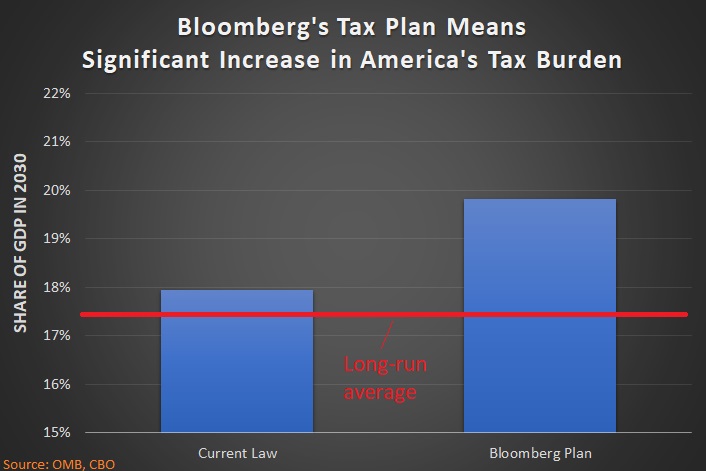
For what it’s worth, this is my estimate of what will happen to America’s tax burden (based on the latest government data) if Bloomberg is elected and he successfully imposes all his proposed tax increases. We’ll have a more punitive tax system that extracts a much greater share of people’s money.
P.S Take these numbers with a grain of salt because they assume that Bloomberg’s tax increases will actually collect $5 trillion of revenue (which won’t happen because of the Laffer Curve) and that GDP won’t be adversely affected (which isn’t true because there will be much higher penalties on productive behavior).
Not even your fonts are safe.
If it feels like everything has become politicized in these hyper-partisan times, there’s more where that came from: Researchers have found that people perceive certain fonts and font styles as more liberal and others as more conservative.
Serif fonts, or the ones with the little flourishes at the end of letters, are seen as more conservative, while sans serif fonts, the ones without the flourishes are seen as more liberal, according to a study published in the journal Communication Studies last month.
For example, study participants saw Times New Roman as more conservative than Gill Sans. Blackletter, which looks like it belongs on a newspaper masthead, was seen as the most conservative font, while Sunrise, a cartoonish-looking script, was seen as the most liberal.]
“If you think about serifs being used in more formal types of print or communications, maybe they’re viewed as more traditional and sans serifs are viewed as more modern,” Katherine Haenschen, an assistant professor of communications at Virginia Tech and the lead author of the study, told CNN. “There’s a small but significant difference in how people perceive these fonts.”
People also tended to view fonts that they liked as more aligned with their own ideology.
The more that Republicans liked a font, the more conservative they thought it was. The more Democrats liked a font, the more liberal they thought it was — a phenomenon known as “affective polarization.”
Haenschen decided to look into whether fonts can be seen as liberal or conservative after noticing something peculiar while driving through Virginia.
A candidate running for state legislature was using different signs in rural areas than he was in a more liberal college town.
Haenschen used to work on political campaigns, so she said she knew there had to be a reason behind the varying signs.
So she turned to her co-author Daniel Tamul, also an assistant professor of communications at Virginia Tech, and the two decided to test the theory to find out.
Turns out, there was something to it.
Haenschen and Tamul conducted two experiments to shed light on the topic.
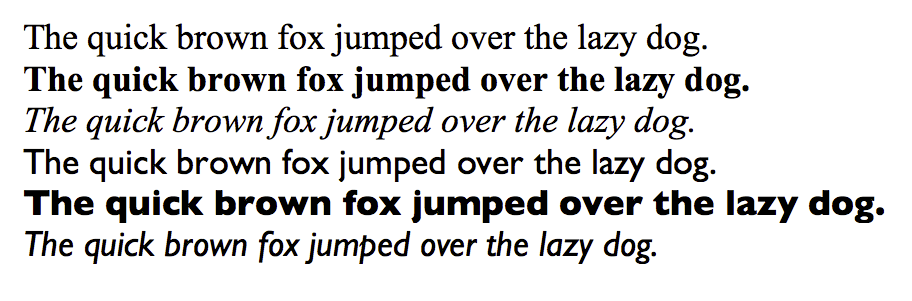
For the first, 987 participants were shown the phrase “The quick brown fox jumped over the lazy dog” in one of six fonts and styles: Times New Roman regular, Times New Roman bold, Times New Roman italic, Gill Sans regular, Gill Sans bold or Gill Sans italic.
Because the phrase that participants were shown was neutral and didn’t contain a political message in itself, researchers were able to test whether the font itself was actually influencing people’s perceptions.
Participants then rated the various fonts as liberal or conservative, and answered questions about their political party affiliations, their political ideologies, age, gender and race.
For the second experiment, 1,069 participants were shown either the phrase “A large fawn jumped quickly” or the name “Scott Williams” in one serif font (Jubilat or Times New Roman), one sans serif font (Gill Sans or Century Gothic) and one display font (Sunrise, Birds of Paradise or Cloister Black Light).
Jubilat was the font that Bernie Sanders used in his 2016 presidential campaign, while Century Gothic was similar to a font that Barack Obama used in his 2008 presidential campaign, researchers said.
So naturally, Jubilat was viewed as more liberal than Times New Roman, even though they’re both serif fonts. And Century Gothic was viewed as more liberal than Gill Sans, even though they’re both sans serif fonts.
“Even within font families, there are differences in how voters are perceiving them,” Haenschen said.
Researchers didn’t look at why exactly people viewed certain fonts as more liberal or conservative, but Haenschen said that’s something that could be explored in future studies.
So what do we do with the knowledge that even fonts are seemingly no longer neutral?
If you’re someone who works on a political campaign, there are a few implications, Haenchen said.
For one, candidates running for political office should work with professional designers when designing their campaign materials to choose fonts that will be effective.
Secondly, designers should think about whether the fonts they’re using convey any sort of political quality, and whether that political quality aligns with that candidate’s message.
Generally though, the effect that fonts have on people’s perceptions is relatively small, Haenschen said.
For example, if Bernie Sanders changed the font on his campaign materials, there probably wouldn’t be much of a difference in how people see him because he’s already a widely known figure.
The choice of font could, however, make a difference for a new candidate, like someone running for school board, town council or state legislature, Haenschen said. While researchers don’t know for sure whether a font would change people’s perceptions of a candidate, that’s another question that could be explored in the future.
“Does support for something like the Green New Deal change if we market it in a conservative versus a liberal font? I don’t know, and that’s something worth exploring,” she said.
No, the Green New Deal is a stupid idea regardless of font choice.
For what it’s worth, I have switched two newspapers and one magazine from Times to New Century Schoolbook, because the latter has a larger X-height (size of each character) and is therefore easier to read.
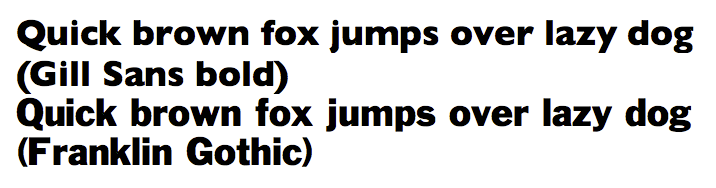
In fact I’ve never used Gill Sans for anything, just because I don’t like how it looks. My preference for headlines is a Franklin Gothic variant, in part because it may be named for my favorite Founding Father.
There may be something to this serif vs. sans serif thing, though.
The headline is a serif font. The subhead isn’t, but it’s in authoritative ALL CAPS.
The way things look, President Trump will almost certainly not be removed from office. The precedents set by the articles of impeachment, however, will endure far longer. And regrettably, the House of Representatives has transformed presidential impeachment from a constitutional parachute — an emergency measure to save the Republic in free-fall — into a parliamentary vote of “no confidence.”
The House seeks to expel Mr. Trump because he acted “for his personal political benefit rather than for a legitimate policy purpose.” Mr. Trump’s lawyers responded, “elected officials almost always consider the effect that their conduct might have on the next election.” The president’s lawyers are right. And that behavior does not amount to an abuse of power.
Politicians pursue public policy, as they see it, coupled with a concern about their own political future. Otherwise legal conduct, even when plainly politically motivated — but without moving beyond a threshold of personal political gain — does not amount to an impeachable “abuse of power.” The House’s shortsighted standard will fail to knock out Mr. Trump but, if taken seriously, threatens to put virtually every elected official in peril. The voters, and not Congress, should decide whether to reward or punish this self-serving feature of our political order.
The first article of impeachment turns on President Trump’s request that President Volodymyr Zelensky of Ukraine announce an investigation of Hunter Biden’s role with the energy company Burisma. Mr. Trump wanted to learn about potential financial corruption concerning Hunter, realizing that such an investigation would, perhaps, yield greater scrutiny of Joe Biden. The House argues that this request to potentially harm Mr. Trump’s political rival was an “abuse of power.”
Mr. Trump’s lawyers respond that the call was “perfectly normal.” Yes, that phrase actually appears in the brief. Regrettably, parts of the brief are written in a far-too-political tone. But the president’s lawyers have raised an important threshold issue.
“In a representative democracy,” they write, “elected officials almost always consider the effect that their conduct might have on the next election.”
President Trump did not stand to receive any money or property from the Ukrainian president. (The House wisely chose not to charge Mr. Trump with bribery.) As a policy matter, I disagree with Mr. Trump’s decision to ask for an investigation of the Bidens. Even if warranted, it should have been avoided at all reasonable costs. The Republic would have been fine if we never learned more about Burisma. But receiving a “personal political benefit” does not transform an otherwise legal action — requesting an investigation — into impeachable conduct.
Mr. Trump is not the first president to consider his political future while executing the office. In 1864, during the height of the Civil War, President Lincoln encouraged Gen. William Sherman to allow soldiers in the field to return to Indiana to vote. What was Lincoln’s primary motivation? He wanted to make sure that the government of Indiana remained in the hands of Republican loyalists who would continue the war until victory. Lincoln’s request risked undercutting the military effort by depleting the ranks. Moreover, during this time, soldiers from the remaining states faced greater risks than did the returning Hoosiers.
Lincoln had dueling motives. Privately, he sought to secure a victory for his party. But the president, as a party leader and commander in chief, made a decision with life-or-death consequences. Lincoln’s personal interests should not impugn his public motive: win the war and secure the nation.
Consider a more recent example. In 1967, President Lyndon B. Johnson sought to put Thurgood Marshall, the prominent civil rights advocate, on the Supreme Court. But there were no vacancies. Not a problem for Johnson, who nominated as attorney general Ramsey Clark, the son of Supreme Court Justice Tom C. Clark. Johnson knew that this move would, as Wil Haygood wrote in “Showdown: Thurgood Marshall and the Supreme Court Nomination That Changed America,” raise questions “about a perceived conflict of interest because [Ramsey] Clark’s father sat on the high court.” Indeed, Johnson hoped that Justice Clark would retire to avoid having to recuse from cases in which Attorney General Clark was a party.
The stratagem worked. Justice Clark soon retired, and Johnson appointed Thurgood Marshall to fill the vacancy. Here, Johnson engineered a move that would have created conflicts that would keep a sitting Supreme Court justice from deciding countless appeals, where the primary purpose was to create a vacancy on the court. (Imagine if President Trump selected Chief Justice Roberts’s wife as attorney general!) Ultimately, Johnson did not run for re-election in 1968, but appointing the first African-American justice could have improved his popularity, and perhaps his party’s electoral standing.
Politicians routinely promote their understanding of the general welfare, while, in the back of their minds, considering how those actions will affect their popularity. Often, the two concepts overlap: What’s good for the country is good for the official’s re-election. All politicians understand this dynamic, even — or perhaps especially — Mr. Trump. And there is nothing corrupt about acting based on such competing and overlapping concerns. Politicians can, and do, check the polls before casting a difficult vote. Yet the impeachment trial threatens to transform this well-understood aspect of politics into an impeachable offense.
What separates an unconstitutional “abuse of power” from the valorized actions of Lincoln and Johnson? Not the president’s motives. In each case, a president acted with an eye toward “personal political benefit.” Rather, Congress’s judgment about what is a “legitimate policy purpose” separates the acclaimed from the criticized. Preserving a unified nation during the Civil War? Check. Creating a vacancy so the first African-American can be appointed to the Supreme Court? Check. But asking a foreign leader to investigate potential corruption? Impeach.
An impeachable offense need not be criminal. But our Constitution does not allow Congress to take a vote of “no confidence” for a president who pursues legal policies that members of the opposition party deem insufficiently publicly spirited. Presidents who take such actions with an eye toward the ballot box should be judged by the voters at the ballot box.
Historian Niall Ferguson has slammed Greta Thunberg’s climate change hypocrisy at Davos, asking why “I don’t see her in Beijing or Delhi.”
Teenage environmentalist Thunberg gave another hysterical speech at the global confab yesterday in which she claimed, “Our house is still on fire. Your inaction is fueling the flames by the hour. We are still telling you to panic, and to act as if you loved your children above all else.”
“We don’t want these things done in 2050, 2030, or even 2021,” Thunberg said. “We want this done now.”
Ferguson, Senior Fellow at Stanford University’s Hoover Institution, questioned why Thunberg isn’t directing her message to the biggest polluters on the planet.
“60% of CO2 emissions since Greta Thunberg was born is attributable to China… but nobody talks about that. They talk as if its somehow Europeans and Americans who are going to fix this problem… which is frustrating because it doesn’t get to the heart of the matter,” said Ferguson.
“If you’re serious about slowing CO2 emissions and temperatures rising it has to be China and India you constrain,” he added, noting that while Greta travels to New York and Davos, “I don’t see her in Beijing or Delhi.”
Ferguson is right. Take the UK for example.
“Britain’s CO2 emissions peaked in 1973 and are now at their lowest level since Victorian times,” reports the Spectator. “Air pollution has plummeted since then, with sulphur dioxide levels down 95 per cent. Britain’s population is rising but our energy consumption peaked in 2001 and has since fallen by 19 per cent.”
This global pollution map published by the WHO perfectly illustrates Ferguson’s point.
Even if you believe wholeheartedly in the decidedly shaky science behind man-made global warming, the west is more than doing its part. But we’re the ones being lectured to not travel, not eat meat and not have children despite already being in massive demographic decline.
Meanwhile, Africa, India and China continue to wantonly pollute and none of Greta Thunberg’s fury or the attention of the media is ever directed their way.
On top of this, Greta continues to have her message amplified by the likes of Prince ‘4 private jet trips in 11 days’ Harry and Arnold ‘garage full of tanks and muscle cars’ Schwarzenegger.
Given their overt statism, I’ve mostly focused on the misguided policies being advocated by Bernie Sanders and Elizabeth Warren.
But that doesn’t mean Joe Biden’s platform is reasonable or moderate.
Ezra Klein of Vox unabashedly states that the former Vice President’s policies are “far to Obama’s left.”
The rhetorical clash between “leftists” and “moderates” is obscuring the deeper truth: This is the most progressive Democratic primary in history, and even if, say, Biden won the nomination, he’d be running on a platform far to Obama’s left. https://t.co/x3CMj5XqAn
This is an issue where folks on both ends of the spectrum agree.
In a column for the right-leaning American Spectator, George Neumayr also says Biden is not a moderate.
Biden likes to feed the mythology that he is still a moderate. …This is, after all, a pol who giddily whispered in Barack Obama’s ear that a massive government takeover of health care “was a big f—ing deal,”…and now pronouncing Obamacare only a baby step toward a more progressive future. It can’t be repeated enough that “Climate Change” Joe doesn’t give a damn about the ruinous consequences of extreme environmentalism for Rust Belt industries. His Climate Change plans read like something Al Gore might have scribbled to him in a note. …On issue after issue, Biden is taking hardline liberal stances. …“I have the most progressive record of anybody running.” …He is far more comfortable on the Ellen show than on the streets of Scranton. He has given up Amtrak for private jets, and, like his lobbyist brother and grifter son, has cashed in on his last name.
If you want policy details, the Wall Street Journalopined on his fiscal plan.
Mr. Biden has previously promised to spend $1.7 trillion over 10 years on a Green New Deal, $750 billion on health care, and $750 billion on higher education. To pay for it all, he’s set out $3.4 trillion in tax increases. This is more aggressive, for the record, than Hillary Clinton’s proposed tax increases in 2016, which totaled $1.4 trillion, per an analysis at the time from the left-of-center Tax Policy Center. In 2008 Barack Obama pledged to raise taxes on the rich while cutting them on net by $2.9 trillion. Twice as many tax increases as the last presidential nominee: That’s now the “moderate” Democratic position. …raising the top rate for residents of all states. …a huge increase on today’s top capital-gains rate of 23.8%… This would put rates on long-term capital gains at their highest since the 1970s. …Raise the corporate tax rate to 28% from 21%. This would…vault the U.S. corporate rate back to near the top in the developed world. …the bottom line is big tax increases on people, capital and businesses. There’s nothing pro-growth in the mix.
And the ever-rigorous Peter Suderman of Reason wrote about Biden’s statist agenda.
Biden released a proposal to raise a slew of new taxes, mostly on corporations and high earners. He would increase tax rates on capital gains, increase the tax rate for households earning more than $510,000 annually, double the minimum tax rate for multinational corporations,impose a minimum tax on large companies whose tax filings don’t show them paying a certain percentage of their earnings, and undo many of the tax cuts included in the 2017 tax law. …as The New York Times reports, Biden’s proposed tax hikes are more than double what Hillary Clinton called for during the 2016 campaign. …Hillary Clinton…pushed the party gently to the left. Four years later, before the campaign is even over, the party’s supposed moderates are proposing double or even quadruple the new taxes she proposed.
The former Veep isn’t just a fan of higher taxes and more spending.
Joe Biden says he is 100% in favor of banning plastic bags in the U.S. …let’s take a quick walk through the facts about single-use plastic bags at the retail level. …the plastic bags typically handed out by retailers make up only 0.6% of visible litter. Or put another way, for every 1,000 pieces of litter, only six are plastic bags. …They make up less than 1% of landfills by weight… 90% of the plastic bags found at sea streamed in from eight rivers in Asia and two in Africa. Only about 1% of all plastic in the ocean is from America. …Thicker plastic bags have to be used at least 11 times before they yield any environmental benefits. This is much longer than their typical lifespans. …Though it might seem almost innocuous, Biden’s support for a bag ban is symptom of a greater sickness in the Democratic Party. It craves unfettered political power.
Here are some excerpts from a Peter Schweizer column in the New York Post.
Political figures have long used their families to route power and benefits for their own self-enrichment. …one particular politician — Joe Biden — emerges as the king of the sweetheart deal, with no less than five family members benefiting from his largesse, favorable access and powerful position for commercial gain. …Joe Biden’s younger brother, James, has been an integral part of the family political machine…HillStone announced that James Biden would be joining the firm as an executive vice president. James appeared to have little or no background in housing construction, but…the firm was starting negotiations to win a massive contract in war-torn Iraq. Six months later, the firm announced a contract to build 100,000 homes. …A group of minority partners, including James Biden, stood to split about $735 million. …With the election of his father as vice president, Hunter Biden launched businesses fused to his father’s power that led him to lucrative deals with a rogue’s gallery of governments and oligarchs around the world. …Hunter’s involvement with an entity called Burnham Financial Group…Burnham became the center of a federal investigation involving a $60 million fraud scheme against one of the poorest Indian tribes in America, the Oglala Sioux. …the firm relied on his father’s name and political status as a means of both recruiting pension money into the scheme.
I only excerpted sections about Biden’s brother and son. You should read the entire article.
And even the left-leaning U.K.-based Guardian has the same perspective on Biden’s oleaginous behavior.
Biden has a big corruption problem and it makes him a weak candidate. …I can already hear the howls: But look at Trump! Trump is 1,000 times worse! You don’t need to convince me. …But here’s the thing: nominating a candidate like Biden will make it far more difficult to defeat Trump. It will allow Trump to muddy the water, to once again pretend he is the one “draining the swamp”, running against Washington culture. …With Biden, we are basically handing Trump a whataboutism playbook. …his record represents the transactional, grossly corrupt culture in Washington that long precedes Trump.
I’ll close by simply sharing some objective data about Biden’s voting behavior when he was a Senator.
According to the National Taxpayers Union, he finished his time on Capitol Hill with eleven-consecutive “F” scores (hey, at least he was consistent!).
And he also was the only Senator who got a lifetime rating of zero from the Club for Growth.
Though if you want to be generous, his lifetime rating was actually 0.025 percent.
Regardless, that was still worse than Barack Obama, Bernie Sanders, and Elizabeth Warren.
Now that we’re just [two] weeks away from the Iowa caucuses and the real start to the 2020 voting process, there are still three basic facts the Democrats need to accept if they hope to have any chance to win the White House.
If you are a Democrat reading this, I warn you that this isn’t going to be easy. But no pain, no gain. So here goes:
Trump didn’t steal the 2016 election
Let’s start with what is still the toughest pill to swallow for Democrats: Trump won the White House fair and square.
The two-plus years of laser focus and high hopes connected to special counsel Robert Mueller’s investigation were the clearest examples that all too many Democrats believe the only reason Donald Trump is president is because the Russians somehow helped him cheat. Even the release of the Mueller Report showing no direct evidence of that hasn’t stopped this narrative from continuing to be promoted regularly.
But let’s face it, this is a very good way for the Democrats to lose to Trump again in 2020. Just like in sports, the worst way to overcome a loss in politics is to go around believing you didn’t “really” lose and no real improvements or changes need to be made by your team to win next time.
Now just imagine if the Democrats spent as much time and effort on winning back the battleground states of Pennsylvania, Michigan, and Wisconsin as they have been in pursuing the Russia collusion obsession and the impeachment process. If the latest polls in those states tell us anything, those other efforts have only made things worse for the anti-Trump forces. It’s time to cut bait on the stolen election illusion.
The economy is doing well, even for the little guy
Whether they deserve it or not, Democrats have consistently been viewed by most American voters as the party that is more concerned with the poor and lower middle-income earners in this country. In many ways, that’s been a golden ticket to victory for Democrats in almost every major election. They only seem to mess it up when a Democratic administration presides over a worsening economy, (like under Jimmy Carter in 1980), or when Democratic candidates latch on to non-economic themes like social issues or foreign policy.
But all is not lost for Democrats when it comes to economics, thanks to the sticky issue of health care. As health care insurance costs continue to rise, voters from both parties are still ranking health care very high on their list of top concerns going into 2020.
Some of the Democratic presidential candidates have made ‘Medicare for All’ a key part of their campaign promises. But compare that to the way then-candidates Barack Obama and Hillary Clinton actively paraded their health coverage plans around in 2008, and you can see how no Democrat has really mined this issue properly this time around.
This issue is simply not going away, and any Democrat willing to offer an attention-grabbing new idea on lowering insurance costs stands to gain substantially in the polls. Of course, that opportunity is also still available for President Trump. So the Democrats don’t have any time to waste.
But the nastiness has really only been effective when it’s directed at opposing candidates or parties. One of the rules just about every major American politician has followed is to never actually go after the opposing candidate’s or party’s voters. It’s an important distinction.
More and more these days, that rule is being broken and it’s mostly being broken by Democrats. The most egregious example from 2016 was Hillary Clinton’s description of Trump voters as a “basket of deplorables,” a term those Trump supporters have since taken on as a badge of honor.
But in another example of not learning from 2016′s mistakes, we’re still seeing 2020 Democrats and their supporters following this line. That includes the Democrat with perhaps the best “nice guy” persona, Mayor Pete Buttigieg, who recently said Trump voters are “at best, looking the other way on racism” when asked by a cable news host if casting a vote for Trump could be considered a “racist act.”
So far, Buttigieg’s comments are the most egregious slam on Trump voters from an actual candidate. But prominent liberals and Never Trumpers are increasing their attacks lately. Filmmaker Michael Moore said this week that since two out of three white men voted for Trump in 2016, that means two out of three white men in America are “not good people,” and “you should be afraid of them.” Former CBS News anchor Dan Rather said last month that Trump voters are part of a “cult,” a comment that major news media outlets including CNN echoed days later. Never Trumper Republican Jennifer Rubin has recently been pushing the line that Trump voters are poorly educated.
If the DNC has any power to put a lid on these kinds of comments from Democratic candidates and their supporters, it needs to exert that power right now. The “we think you’re stupid and we hate and fear you… now vote for us” line has never worked because there’s no way it can.
The above three points may seem very simple and logical, but anyone who has been watching the Democrats since 2016 knows that this is kind of like an intervention for a stubborn drug addict. Each of the above truths is something many Democrats have been fiercely fighting against for some time.
The irony is, they need to give up that fight to win the contest that should be much more important to them overall.
Many in the media and political class see Donald Trump as the face of America’s autocratic future. They’ve had less to say about Michael Bloomberg, a far more successful billionaire with the smarts, motivation, and elitist mentality not only to propose but actually carry out his own deeply authoritarian vision should he be elected president.
Bloomberg, who’s quickly moved up in national polls on an unprecedented tsunami of spending and despite sitting out the Democratic debates, represents, in a way never seen in modern American politics, the melding of oligarchal power with political willfulness. His campaign remains a wild long shot, but ask New York City how that can play out—and how difficult it is to dislodge this oligarch once he’s in office, even when the law demands that he leave.
Compared to Bloomberg, Trump’s estimated $3 billion fortune is paltry. Bloomberg is the world’s ninth richest man, with a fortune of nearly $60 billion. The two post-retirement-age party-jumpers share not only flimsy medical excuses for staying out of Vietnam, long histories of locker-room talk, and joint refusals to fully disclose their taxes while running or to step away from their private business interests while serving in public office but, perhaps most fundamentally, a habit of naming things after themselves and a narcissistic sense that common rules don’t apply to them.
Already a modern-day Crassus, Bloomberg has both the wealth and the brains to emerge as a true Caesar, albeit a short-statured and aging one. Just as Caesar used the wealth of Gaul to finance his takeover of the Republic, Bloomberg can use his private fortune to bribe, cajole and otherwise promote his ascendancy. In his 12 years as ruler of New York, he showed his willingness to “buy” elective office, spending half a billion dollars on his three runs. To match the $174 per vote he spent to win his final term, Bloomberg—who’s has already spent $200 million on TV ads—would need to spend an unheard of $12 billion. He could afford it.
None of this seems beyond a man who demonstrated his l’état c’est moi attitude in 2009, when, after reluctantly giving up a run in the 2008 presidential election, he changed city law and overrode the will of the voters to allow himself to run for a third term after personally meeting with the owners of the city’s three major papers to get their editorial boards to reverse themselves and endorse that undemocratic move. Rules, in the Bloombergian universe, only apply to people with less than ten zeros in their net worth. He spent $102 million—not counting off-the-books hush money to keep activist groups quiet, among other things—for a 15-to-one spending advantage as he eked out a narrow win in a city that was so sick and tired of him that it elected corrupt schmendrick Bill de Blasio once Bloomberg’s name was finally off of the ballot.
Bloomberg is a man of undisguised arrogance. As mayor, he already saw himself as a sort of little president, once boasting that “I have my own army in the NYPD, which is the seventh largest army in the world… I have my own State Department, to Foggy Bottom’s annoyance. We have the UN in New York, so we have entree into the diplomatic world that Washington does not have. I don’t listen to Washington very much, which is something they’re not thrilled about.” Should he gain access to the real Army and State Department, he’ll use them as he sees fit, and with little concern for the will of the voters.
Unlike Trump, or some of his leading Democratic rivals, Bloomberg is not playing the populist card but seeking to bury “the great revolt” that has overturned elite control of the country. A fierce defender of Wall Street, Silicon Valley and the corporate elite, he is hoping, as a recent editorial in Bloomberg Opinion suggested, that “populism will probably just fade away” so that the ruling class can again “relax.”
The plutocracy would relax with Bloomberg in a way they have not with the erratic Trump. Most of those in the big corporate suite, according to a recent poll inChief Executive magazine, would prefer to see the president impeached and out of office. Bloomberg is a friend to many owners of mainstream media properties, and an owner of those properties himself, as we were reminded when Bloomberg News announced it would no longer aggressively cover his Democratic rivals, though Trump would remain fair game, an absurd standard that poured news on the fire of Trump’s attacks on “fake news.” The executive staff of Bloomberg Opinion, meantime, left their positions to join his campaign.
What would a Bloomberg regime look like? In contrast with Trump, Sanders or Warren, Bloomberg is offering the politics of the gentry liberals who have dominated the party’s big-dollar fundraising in recent decades.
This typically means strong support for combating climate change, advocating ever more mass immigration, free trade and banning guns—all positions that don’t cost the plutocracy money.
Bloomberg’s big idea, if you want to call it that, is that rather than buy a candidate, he can be the candidate.
The problem Bloomberg needs to solve lies in being a billionaire oligarch running in a Democratic Party that’s moved farther to the left, as Sanders and others have found ways to create a “party of the people” that can raise enough money to reject the policies preferred by Wall Street, Silicon Valley and the rest of the globalized ruling class. As Sanders aptly put it when Bloomberg announced his intentions: “The billionaire class is scared and they should be scared.”
Resentment of Sanders’ detested “billionaire class” is widespread and well-deserved. Over the past few decades they have consolidated both financial and corporate assets into few hands. Public support for large corporations, including key industries controlled by the oligarchs—banking, media and tech—are all near historic lows. Corporate consolidation also has been linked to ever greater inequality and a diminishing of the middle class. Despite a strong economy, roughly half of Americans, according to Gallup, have negative views of large corporations, while nearly 90 percent favor small business.
The Trump-opposed billionaire class had hoped to align behind former Vice President Biden but as his campaign has struggled they fear that the 2020 race could be gentry liberalism’s Stalingrad. Bloomberg hopes that his money can liberate him from political gravity; that while other candidates are putting scarce resources into a handful of states ahead of their caucuses and primaries that he can afford to spend nationwide, and, if none of his rivals breaks all the way through, put himself in a position to be the powerbroker at a brokered convention. That’s a long-shot bet, but he’s bet big against the odds before and won.
In the process, he steadily weakened the city’s once diverse, if chaotic character into plutocratic-driven monoculture. His disinterest in the will of the voters, as captured in his jihad against sugar and his insistence of ever more stop and frisk policing even as popular opposition to it grew along with its overuse, was in many ways policy made possible by the power implicit in his wealth, a function of his fortune.
Another mayor with such an agenda would have faced major opposition. But as Sol Stern and Fred Siegel wrote in 2011, “the most discomfiting aspect of the Bloomberg mayoralty” was his ability to curb criticism by handing out what Ben Smith of BuzzFeed called ”protection money” to the city’s many nonprofits, activist groups, religious and community associations. Bloomberg even cleverly uses his largesse to win over journalists, offering hugely remunerative salaries to those willing to follow his party line.
In the end, however, the Bloomberg legacy proved unable to survive Midas’ reign. Without his checkbook to smooth conflicts, the city has devolved under his leftist successor, the scandal-prone Bill de Blasio, who ran on an anti-Bloomberg “tale of two cities” platform.
If there’s a good parallel to Bloomberg it would be Silvio Berlusconi, the media magnate who served, somewhat disastrously, as Italy’s prime minister between 1994 and 2011. Like Bloomberg, Berlusconi, long his neighbor in Bermuda, used his own media to promote his political ascendancy. Bloomberg has a similarly impressive media empire including the former Business Week, Bloomberg News, Bloomberg View (formerly Bloomberg Opinion), and Bloomberg TV. He has also reportedly expressed interest at times in purchasing the Financial Times, The New York Times, and The Wall Street Journal.
While the media, including Bloomberg’s own mouthpiece, has compared Trump to Berlusconi, holding up a mirror might be more accurate. With his existing web of information providers, Bloomberg, like Berlusconi, has some power to create his own political reality. Bloomberg’s touch may be lighter, but the Bloomberg-controlled media tends to follow the “boss’s” party line; as a long-time writer for the magazine now called Bloomberg BusinessWeek told me, “we’re not even allowed to use the word ‘oligarch’” in their articles. One would have to wonder how thrilled progressives would be if, for example, an American-born Rupert Murdoch announced a White House bid.
A Bloomberg presidency would be very different from this one. Trump is annoying but has scaled back the power of the administrative state. Bloomberg would likely seek to expand federal power to dictate the minutiae of everyday life in terms of diet, how we use energy, the kind of houses we live in and how we get to work.
And for all of Trump’s conflicts as the chief executive of both the United States of America and the Trump Organization, his businesses have little influence on anything beyond some slivers of the real-estate market.
Yes, Trump roars like an authoritarian, and admires those with power—but that’s a trait he shares with Bloomberg, who recently made the preposterous claim that China’s Xi Jinping is “not a dictator.” He portrays the communist regime, notedNew York magazine as “ecologically friendly, democratically accountable, and invulnerable to the threat of revolution.” Of course, this is the same Bloomberg whose news operation gave up on reporting on corruption in China when that reporting started damaging the terminal sales that made his fortune.
If Bloomberg somehow manages to buy this election, we would not see a repeat of the haphazard and sometimes nonetheless effective Trump presidency, but rather a softer version of Xi’s rule here in America— dictatorial, intolerant of dissent, controlling, and friendly to the oligarchy so long as it produces economic growth. Having made themselves hysterical about our current tin-pot petty authoritarian president, progressive Americans could look forward to experiencing the real thing under the all-knowing guise of Michael Bloomberg.




 Steve Prestegard.com: The Presteblog