I’m skeptical of “common-good capitalism” in the same way I’m suspicious about “nationalist conservatism” and “reform conservatism” (and it should go without saying that I didn’t like the “kinder-and-gentler conservatism” and “compassionate conservatism” we got from the Bushes).
Here’s what I prefer.
Whether you call it libertarianism or small-government conservatism, this is the approach I wish Republicans would follow (or Democrats, if the spirit of Grover Cleveland still exists in that party).
But there are many self-styled conservatives who disagree. They think Reagan and his successful policies are passé.
Interestingly, the desire to move beyond Reaganism comes from pro-Trump and anti-Trump outlets.
David Brooks, a never-Trumper with a column in the New York Times, thinks Reagan’s anti-government approach is misguided.
If you came of age with conservative values and around Republican politics in the 1980s and 1990s, you lived within a certain Ronald Reagan-Margaret Thatcher paradigm. It was about limiting government, spreading democracy abroad, building dynamic free markets at home and cultivating people with vigorous virtues… For decades conservatives were happy to live in that paradigm. But as years went by many came to see its limits. It was so comprehensively anti-government that it had no way to use government to solve common problems. …Only a return to the robust American nationalism of Alexander Hamilton, Henry Clay and Theodore Roosevelt would do: ambitious national projects, infrastructure, federal programs to increase social mobility. The closest National Greatness Conservatism came to influencing the party was John McCain’s 2000 presidential bid. He was defeated by a man, George W. Bush, who made his own leap, to Compassionate Conservatism. …The Reformicons tried to use government to build strong families and neighborhoods. …Most actual Republican politicians rejected all of this. They stuck, mostly through dumb inertia, to an anti-government zombie Reaganism long after Reagan was dead and even though the nation’s problems were utterly different from what they were when he was alive. …there is a posse of policy wonks and commentators supporting a new Working-Class Republicanism… But if there is one thing I’ve learned over the decades, it is never to underestimate the staying power of the dead Reagan paradigm.
Maybe I’m just an “anti-government zombie,” but my response is to ask why Brooks thinks the federal government should be in charge of state and local infrastructure.
Even more important, it would be nice if he could identify a government program that successfully promotes social mobility. There are several hundred of them, so the fact that he doesn’t offer any examples is quite revealing.
By contrast, the Reagan approach of of free markets and limited government works anywhere and everywhere it is tried. And he was right that big government is bad government.
But at least Brooks’ column reminds me to add “national greatness conservatism” to my list of failed philosophical fads.
Now let’s shift to an article from the Trump-friendly American Conservative. Rod Dreher also argues that Reaganism is no longer relevant.
Reagan nostalgia has long been a bane of contemporary conservatism, because it prevented conservatives from recognizing how much the world has changed since the 1980s and how conservatism needed to change with it to remain relevant. …by the time Trump came down that escalator, Reagan conservatism was about as relevant to the real world as FDR’s New Deal liberalism was in 1980. It is no insult to Reagan to say so. Until Trump arrived on the scene, it was difficult for right-wing dissenters from orthodox Reaganism—critics of free trade, immigration skeptics, antiwar conservatives, and others—to break free of the margins to which establishment conservatives had exiled them. …It is impossible to see the clear outlines of a post-Trump future for the Republicans, but…Reaganism—the ideology of globalized free markets, social and religious conservatism, and American military and diplomatic domination—is never coming back.
Sadly, I don’t think Dreher is correct about “New Deal liberalism” being irrelevant.
How else, after all, would someone categorize Obama’s policies? Or Biden’s platform? It’s “We shall tax and tax, and spend and spend, and elect and elect,” just as FDR advisor Harry Hopkins stated.
And Reagan’s policies are definitely still relevant, at least if the goal is to improve the well-being of the American people.
Yes, Dreher is right that “the world has changed since the 1980s,” but that doesn’t mean that good policy in 1980 is no longer good policy in 2020.
I think the problem may be that people think Reaganomics is nothing more than lower tax rates, perhaps combined with a bit of inflation fighting. And it’s definitely true that Reagan’s tax rate reductions and his restoration of sound money were wonderful achievements.*
But the Reagan economic agenda was also about spending restraint, deregulation, trade liberalization (he got the ball rolling on NAFTA and the WTO), and other pro-market reforms.
To be sure, Reagan’s policy record wasn’t perfect. But the policies he preferred were the right ones to restore American prosperity in the 1980s.
And while there are different problems today (the need for entitlement reform, for instance), the Reaganite approach of smaller government is still the only good answer.
*Let’s also remember to applaud Reagan for the policies that resulted in the unraveling of the Soviet Empire.
P.S. As explained in the Fourth Theorem of Government, pro-growth, Reagan-style policy can be smart politics.
Category: US politics
-
No comments on The preferable presidential candidate
-
House Speaker Nancy Pelosi (D-CA) demonized Republicans during an MSNBC interview on Monday afternoon, calling them “enemies of the state” and “domestic enemies.” Pelosi’s comments come as violent riots from left-wing activists have plagued cities across the U.S. in recent months.
“We take an oath to protect and defend the Constitution from all enemies, foreign and domestic,” Pelosi said. “And sadly the domestic enemies to our voting system and our, honoring our Constitution are right [at] 1600 Pennsylvania Avenue with their allies in the Congress of the United States.”
“But again, let’s just get out there, mobilize, organize, and not let the president deter anybody from voting and again, support the postal system which is election central,” she continued. “They’re doing everything they can, suppress the vote, with your actions, scare people, intimidate by saying law enforcement will be there, diminish the role of the postal system in all of this.
“It’s really actually shameful,” she added. “Enemies of the state.”
Pelosi’s comment come as far-left rioters have marched through suburban neighborhoods with guillotines, burning American flags, intimidating people at restaurants, shining lights into people’s homes, attacking police officers, attacking people, and making allegedly threatening remarks to people.
Rep. Steve Scalise responded: “Disgusting: Nancy Pelosi just called Republicans ‘domestic enemies.’ I was shot because of this kind of unhinged rhetoric. Where’s the media outrage?”
Rep. Brad Wenstrup (R-OH) responded to Scalise’s tweet, writing: “Now THIS puts lives in danger. Believe me, I know firsthand. And, @SteveScalise knows better than anyone.”
House Minority Leader Kevin McCarthy tweeted out the incident, writing: “In 2016, they called you ‘Deplorables.’ Now, Nancy Pelosi calls all Republicans ‘domestic enemies.’ Never forget —> They despise you. And the worst part is they don’t even try to hide it.”
Rep. Doug Collins (R-GA) responded by saying, “Her words are beneath the office of Speaker and she should resign immediately.” …
One political commentator weighed in on Pelosi’s remarks by saying, “If you met this person in a Walmart you’d grab your kid’s hand and quickly walk down another aisle.”
Had Donald Trump said what Pelosi said (I think he hasn’t, but with Trump you never know), Pelosi would have started another round of impeachment.
Pelosi’s comment brings to mind a quote from Patrick Henry: “Caesar had his Brutus — Charles the First, his Cromwell — and George the Third … may profit by their example. If this be treason, make the most of it.”
If Pelosi is the state, the state is the enemy of the people.
-
There’s an awful lot these days that can rightly be called “unprecedented.” Whether it’s the pandemic itself, the government lockdowns, or the massive bailout programs, it seems like everything we’re contending with is unexplored territory.
The hardest part about having no precedent is that it complicates the decision-making process. Normally, precedent acts as a guide that helps us determine our approach, and it plays a vital role in simplifying the decisions we face. In these times, however, the absence of precedent has made us desperate for simplicity, and in our desperation, I believe we have subconsciously succumbed to our natural predilection for mental shortcuts, also known as cognitive biases.
The study of cognitive biases is fascinating, but also unsettling. Increasingly, researchers are realizing that our biases cause significant errors in judgment, often more than we realize. In light of this, I think it’s worth taking some time to reflect on how our biases have influenced our response to this pandemic. To this end, let’s start by thinking back to when this whole fiasco began.
Before the Lockdowns
Back in mid-March, a number of biases played a role in shaping our initial response. One of the most significant biases in this regard was the availability heuristic. First described by Kahneman and Tversky in 1973, the availability heuristic is the tendency to misjudge the importance, frequency, or likelihood of events by giving excessive weight to events that are easier to recall (such as events that are more recent). This concept is closely related to salience bias, which is the tendency to focus on things that are more prominent or vivid and ignore things that are inconspicuous.
When considering the events leading up to the lockdowns, it’s not hard to see how these biases were at play. The imminent danger of a global pandemic dominated the media discourse in a matter of days, so it makes sense that we gave it a lot of attention.
But while COVID-19 infections and deaths were widely publicized and therefore widely salient, the negative impacts of the impending lockdowns went largely unnoticed. In fact, the disregard for these impacts eventually got so perilous that a group of over 600 physicians sent a letter to President Trump warning about “the exponentially growing negative health consequences of the national shutdown,” and pointing out that “the downstream health effects…are being massively underestimated and under-reported”.
The unintended consequences of the lockdowns have proven to be a sobering reminder of what can happen when we fail to look beyond the immediate intentions of narrow-minded policies. Indeed, this shortsightedness is the very thing Hazlitt warned us about in his book, Economics In One Lesson. But even though our blindness to these secondary effects is natural and understandable, it is by no means inevitable. We are perfectly capable of seeing the unseen so long as we remember to look.
Another consequence of the media’s preoccupation with COVID-19 is that we quickly became familiar with a host of ominous projections. This familiarity likely produced an illusory truth effect, which is the tendency to believe information to be true as a result of repeated exposure, even if it turns out to be false. On top of that, many people developed exaggerated expectations (arguably another bias) and displayed a great deal of overconfidence and hubris.
Finally, as more and more people bought into the alarmist narrative, there was an ever-increasing amount of availability, salience, repetition, and overconfidence. The ensuing positive feedback loop was inexorable, as was the corresponding bandwagon effect.
During the Lockdowns
A few weeks after the lockdowns were imposed it became apparent that the curve had been flattened and the extreme risk had subsided. But as weeks turned into months, the bureaucrats were incredibly reluctant to lift the lockdowns, and when they finally did it was a slow and gradual process. But why was that? Well, the official answer is that they were concerned for our health (unintended consequences be damned), but I think there’s another factor involved called status quo bias.
Status quo bias is our inclination to prefer the current state of affairs and avoid change. To be sure, it didn’t stop the politicians from imposing the lockdowns in the first place, largely because other factors took precedence. But once the lockdowns were imposed, they became the new status quo, the “new normal,” and this meant that there was now a psychological resistance to removing them.
Many explanations for status quo bias have been proposed, and it’s likely that they each contribute to varying degrees. Some of the more common explanations are loss aversion, omission bias, and the sunk-cost fallacy. Let’s briefly explore these in turn.
Loss aversion is the idea that we generally prefer avoiding losses to acquiring equivalent gains. What this means practically is that we often reject a change on account of its potential drawbacks, even if they are outweighed by its potential benefits.
Another explanation is omission bias, which is our proclivity to favor acts of omission over acts of commission. In the trolley problem, for instance, people feel more justified in allowing harm to happen than in actively causing harm. This preference for inaction seems to reflect an underlying moral sentiment, but it may also involve a fear of regret, since we might expect to regret our actions more than our inactions.
Lastly, the sunk-cost fallacy is the tendency to justify the status quo on account of past investments, even when it has become apparent that the investments were misguided and the approach should be revised. Under this framework, our resistance to change stems from our unwillingness to admit we were wrong. The temptation is that as long as we don’t change course, we don’t have to acknowledge that we made a mistake.
Even after we manage to deviate from the status quo, we are still reluctant to change too quickly. This hesitancy is likely a manifestation of conservatism bias, which is the tendency to insufficiently revise our beliefs when presented with new evidence. Although it’s impossible to ascertain the full extent of its influence, conservatism bias offers a compelling explanation for why the restrictions were eased so slowly even after the curve had been flattened. “The lockdowns are already in place,” we told ourselves. “Why not just a little longer, just to be safe?”
The common element in all of these concepts is fear. Fear of loss, fear of regret, and hence, fear of change. And it makes sense, because our natural reaction to fear is paralysis. It feels safer to stay the course than to begin moving in a different direction.
But the politicians aren’t just worried about loss and regret. They’re also worried about optics. And though they wouldn’t like to admit it, their concern for their reputation has probably played a considerable role in their decisions.
Just imagine how it would look if the lockdowns were lifted any faster. First, it would be an implicit admission that the initial lockdowns had been misguided and probably weren’t necessary in the first place. Second, they would run the risk of getting blamed for a rise in infections. But as long as they kept the strict lockdowns in place then they could blame any outbreaks on us because they were “doing everything they could”.
In short, it was much better optics for them to extend the lockdowns “for your safety” than to admit that they were wrong and that they overreacted. And if a few million people had to lose their jobs so the politicians could save face, so be it.
After the Lockdowns
Now that the lockdowns are being lifted and life is slowly returning to normal, another slew of biases is taking hold. The most obvious example here is hindsight bias, which is the tendency to perceive historical events as being more predictable than they actually were. In the same way that many people displayed overconfidence before the lockdowns, many people are now patting themselves on the back, confident that they “knew it all along”.
This ties in closely with confirmation bias, which is our proclivity to search for, interpret, favor, and recall evidence in a way that confirms our pre-existing beliefs. As Sherlock Holmes puts it, we “twist facts to suit theories instead of theories to suit facts.” A great example of this has been our propensity to interpret declining infection rates as a confirmation that the lockdowns “worked”, when in fact this is a textbook example of the post hoc fallacy.
The apparent success of the lockdowns has also led many people to conclude that the initial decisions were necessary and justified. But this conclusion is merely an example of outcome bias, whereby we judge the quality of the decision based on the quality of the outcome. In reality, the presence of a positive outcome doesn’t necessarily prove that the initial decisions were justified. And besides, if we consider the unintended consequences, there’s a decent chance that the lockdowns did more harm than good anyway.
The Most Dangerous Bias
Though all of the biases mentioned so far are important, there’s one that concerns me the most, and it’s called authority bias. Authority bias is the tendency to attribute greater accuracy to the opinion of an authority figure and be more influenced by that opinion. It was most notably established by the infamous Milgram experiment in 1961, which demonstrated people’s surprising propensity to trust and obey authority figures even to the point of violating their own conscience.
The pervasive influence of authority bias throughout the pandemic has been particularly disconcerting. From the very beginning, people have blindly trusted “the experts” even as they shut down our businesses, undermined our response efforts, and trampled our civil liberties.
And quite frankly, that scares me.
Whatever happened to having a healthy distrust of authority? When did we lose our skepticism and suspicion? Have we forgotten that they too are mere mortals? Have we forgotten how to think for ourselves and how to take responsibility for our own lives?
Perhaps. Or perhaps we have simply forgotten to be mindful of our biases. Perhaps we were unwittingly drawn to the easy answers, the herd mentality, the status quo, and the confirming evidence. If that’s the case, then I think there is still hope. But if we’re going to overcome our biases, we need to begin by learning to identify them.
And then we need to lead by example. We need to be honest about our own susceptibility to error. We need to model a healthy suspicion of our own predispositions. We need to take responsibility for our own blindness and be open to correction. And perhaps, in this way, we can show the world what true rationality looks like.
-
The American Mind writes about …

Wisconsin Right Now 
Facebook 
Facebook 
Kenosha News Events in Kenosha, Wisconsin this week highlight the importance of our note Friday to the GOP convention: “Call out the Left and the Democratic Party for what they’ve inspired by falsely sanctifying the riots: a revolutionary insurrection against the American Way of Life. Show the American people specific examples.”
Another tragic but incomplete video—this time of police shooting an uncooperative criminal with a warrant out for his arrest after he lunged into his car—is being shamelessly used by the Left to inflame the populace.
Another cowardly Democratic Governor has immediately thrown law enforcement under the bus even as he admits in the same breath that “we do not have all the details yet.”
While we do not have all of the details yet, what we know for certain is that he is not the first Black man or person to have been shot or injured or mercilessly killed at the hands of individuals in law enforcement in our state or our country.
— Governor Tony Evers (@GovEvers) August 24, 2020
And, predictably, the outrageous irresponsibility of the Democratic party in partnership with domestic terrorist activists is leading directly to more violence, looting, and arson in yet another American city.
BLM arson attacks overnight in Kenosha, Wisc. spread to the Bradford Community Church, a far-left universalist religious organization. The church’s sign in support of #BlackLivesMatter was consumed in flames. pic.twitter.com/u02CIwsnIm
— Andy Ngô (@MrAndyNgo) August 24, 2020
Sunday night, activists tried to burn down a courthouse. Bricks and more were thrown at officers and their vehicles. A car dealership was looted, vandalized, and set ablaze. And that was just the beginning, although most Americans did not hear about it from the mainstream press on Monday.
This shameful dynamic is now more than “normalized”—it is a central part of the Democratic Party’s campaign strategy. It must be rigorously exposed and denounced by Republicans and all Americans of good will.
Thank you to the people of Kenosha. This is how we get them to bend the knee. This is an essential part of the path to our Freedom Dreams. Leftists who claim this limits our ability to win lack a meaningful understanding of movement history and the politics of insurrections. https://t.co/wc9pop2zSx
— Iola Ella (@IolaElla) August 24, 2020
Republicans are not without responsibility for this regime crisis. Those who now hold onto power in America are plunging our country into economic depression, rabidly encouraging racial tension and violence, radically revising and lying about our nation’s history and heroes, and seeking to banish all public opposition in order to remain in power. They will succeed unless they are called to account and stopped.
The Democratic Party is now the BLM-Antifa Party, and both of these organizations need to be exposed and investigated. Why have more Republican leaders not pointed out that convicted terrorist Susan Rosenberg is on the Board of Directors for the fundraising arm of BLM, for instance? Google her and the 1983 bombing of the United States Capitol Building, the U.S. Naval War College, and the New York Patrolmen’s Benevolent Association. And she’s the tip of the iceberg. She’s a feature, not a bug, of what needs exposing now.
Fancy foundations that support domestic terrorism at the hands of insane Marxists and dangerous anarchists need to be targeted, the individuals and organizations involved exposed and justly defamed. Forget defending yourselves against pathetic corrupt Southern Poverty Law Center attacks. The Right needs to create its own SPLC to highlight the real and significant sources of civic unrest and violence in America.
Our failure to educate our nation’s youth—and the Left’s success in propagandizing Americans into radicalism bent on the destruction of their own nation—has had clear and direct consequences. We are merely getting what we paid for. And we need to stop paying for it, ASAP.
Our need for digitally savvy new media companies that employ citizen journalists to reveal what is actually occurring in America grows more obvious by the day. The reality on the ground will continue to be downplayed or evaded by mainstream media outlets, but as each day goes by it is our hope that more Americans will see and reject these trends. Yet the Right still waffles on taking the stern steps needed to ensure its enemies do not politically manipulate that digital technology.
A few tens of thousands of the three hundred and thirty million Americans in this nation were able to witness the events as they unfolded in Kenosha Sunday night on live online feeds. They were treated to a disturbing but riveting view of what is now routinely occurring on our nation’s streets. But we still see many Americans in denial about this violence, as well as the great exodus now occurring out of our cities, abetted by a media that refuses to give us all a direct look into our present, sordid reality. When will the Right build the media outfits our nation’s citizenry needs?
What will happen in Wisconsin in coming days? How many more American towns and cities will have to suffer the same fate in the near future? How long and to what extent can the media hide the truth between now and November? And if Republicans refuse to show the American people what is currently happening across the nation and denounce it—who will?
-
Rod Dreher:
Maybe you read my short jeremiad about “Cuties,” the upcoming Netflix series that sexualizes 11 year old girls. Well, this morning I had to go to the grocery store, and was listening in the car to a discussion on the NPR talk show1A, in which the guests were talking about the standout pop culture moments this summer.
The host asked them about the mega-hit “WAP” by Cardi B. and Megan Thee Stallion. I wrote about it here last week. Here are some of the lyrics that I posted:
Yeah, yeah, yeah, yeah
Yeah, you fu*kin’ with some wet-a*s pu*sy
Bring a bucket and a mop for this wet-a*s pu*sy
Give me everything you got for this wet-a*s pu*syThose are among the cleanest lyrics in the entire song. Here is a link to lyrics for the whole thing.
If you don’t want to read them — and I don’t blame you — you should at least know that the two women who sing it talk about how they want to be forced to perform oral sex until they are gagging and choking. They portray themselves as whores (their word) who have sex for money. And
I’m a freak bitch, handcuffs, leashes … You can’t hurt my feelings, but I like pain.
There’s even dirtier stuff, but you get the picture.
This song debuted at No. 1. It was streamed a record 93 million times in the US in its first week of release, and the video was seen over 60 million times within 48 hours of its release. Cardi B., who once worked as a stripper, and has spoken of how back then, she would invite men to hotel rooms to drug and rob them, instagrammed about being so grateful that “I want to hug the LORD.”
OK, so that’s “WAP”. It is the cultural mainstream. If you haven’t heard of it, then that just shows how far out of the mainstream you are in 2020. How mainstream is Cardi B.? Elle magazine, which put her on the cover, had Cardi B. do a live Zoom interview with the Democratic nominee for President of the United States.
Joe Biden told her that
One of the things that I admire about you is that you keep talking about what I call equity—decency, fairness, and treating people with respect.
Right. Nothing says “respect” like rapping about how you want a man to put his genitals in your mouth until you choke.
What a sick joke this culture is. I’ve said before that I believe Donald Trump is a morally repulsive man. But I don’t want to hear anyone talk about how Joe Biden is such a moral exemplar when he is willing to embrace someone who stands for the things that Cardi B. does. This is something I do not understand about the progressive elites. On NPR this morning, the guests on 1A (here, just past the 13:00 mark) were talking about “WAP” and the reaction to it. A writer for Billboard lauds “the sexual freedom of this song,” and laments the double standard that lets male rappers get away with sexually explicit songs without criticism. He adds that — “Cardi and Megan have huge young fan bases,” the writer said. He believes that the fact that women rappers have triumphed with such a sexually explicit song is therefore “really remarkable as a cultural shift.”
What he means in context — listen to it yourself to understand — is that Cardi B. and Megan Thee Stallion are teaching young girls that they can be just as raunchy as boys, with no apology.
On the show, the black writer Brooke Obiepraised the song as an example of “women singing about their own bodies and what they want.” It is “empowering,” said Obie. She added:
“People are upset because whenever a woman is actually owning her own sexuality, and not being objectified, there is a kind of conservatism that goes with this.”
Yeah, read the lyrics. There’s nothing that says “empowering” and “not being objectified” like that.
I know perfectly well that this is not the first time a rap song has had filthy lyrics. What is so remarkable to me is how completely mainstream this stuff is now, to the point where a presidential nominee wants to associate himself with a singer of this filth.
Just before our first child was born, back in 1999, my wife and I watched a PBS Frontline episode called “The Lost Children of Rockdale County.” It was about a syphilis outbreak in a high school in a prosperous Atlanta suburb. As the state (and Frontline) investigated, what emerged was a destructive culture of reckless, promiscuous sexuality — orgies with high schoolers, but including some middle schoolers — and parental neglect. Read the transcript here. Excerpt:
INTERVIEWER: Did any of the girls describe the sex as pleasurable?
Prof. CLAIRE STERK: Initially, they described the sex as pleasurable, and pleasurable in terms of it being physically pleasurable, but also psychologically, like, this was a initiation into the next step of their life. It was part of their development that was taking place. Over time, however, very few of the girls talked about the sex in terms of it being pleasurable at all. It became something that was painful, that in some cases they couldn’t even remember what they did anymore. So it became very negative.
INTERVIEWER: Do you ever think they might have done it because they wanted to be accepted by the boys?
D.J.: I don’t think it was a real pressure issue. I mean, it might have been for them. Subliminally, it might have been. Subconsciously, it might have been. But it really- I mean, there really wasn’t any pressure to. It was more of- they just gave in, really.
INTERVIEWER: How did the guys in general treat the girls?
AMY: They were mean to them a lot. They treated them like they were just- I don’t know, not trash, but not very, like, respectable. And the girls seemed not to care. I don’t know why. I guess they just- I think most of it was the alcohol that they were buying because the guys always bought alcohol. They just- they knew that we would like it, and so- but they didn’t treat us like we were anything real important.
INTERVIEWER: You never got angry at them?
AMY: I did a few times. But I couldn’t really do anything about it because they just- they wouldn’t care. They’d just tell me to go home or something.
INTERVIEWER: Why didn’t you?
AMY: I don’t know. I don’t know. I just- I would be alone then.
There’s a part where some of these attractive normie high school girls — remember, this is a school where 85 percent of the graduates would go on to college — are telling the interviewer about their favorite music:
NARRATOR: Katy and her friends are freshmen at one of Rockdale’s three public high schools.
INTERVIEWER: What’s the typical age for girls to lose their virginity?
KATY, BRIDGET, CHRISTINE: Thirteen. Fourteen. Thirteen or fourteen.
BRIDGET: Fourteen.
INTERVIEWER: That’s typical?
GIRLS: Uh-huh.
INTERVIEWER: What kind of music do you guys like?
GIRLS: Rap.
INTERVIEWER: Like what?
GIRLS: Like, Master P. Tupac, definitely. Oh, I love Tupac.
INTERVIEWER: What do you like about rap?GIRLS: The beat. The beat. And the words. And it’s just, like, loud. You can really get up and dance.
CHRISTINE: And the way that it’s, like- they can talk about something that’s, like, completely stupid, like drugs and stuff. [crosstalk] But it’s the way they put it, it sounds interesting.
INTERVIEWER: Give me an example.
CHRISTINE: I can’t think of a song.
GIRLS: [singing rap] Oh, take three witches and put ’em in a [unintelligible] I take clothes off you, and I’m blowing [unintelligible] mind. Take one more before I go [unintelligible] Seven bitches get f–ked at the same time. The [unintelligible] she can suck a ding-dong all day, all night, all evening long. Bitch has never done it. She says she never tried. [unintelligible] mother-fu–ing [unintelligible] if the bitch is a good trick. Anybody can talk to a bitch and get the bitch to f–k, but how many [unintelligible] talk to a bitch and get their d–k s–ked like me? A pimp that you never saw [unintelligible]
INTERVIEWER: That’s about group sex.
GIRLS: Yeah.
INTERVIEWER: Is that something anybody does around here?
GIRLS: Uh-huh!
Please, I’m asking you, watch or read the transcript of “The Lost Children of Rockdale County”. This was 21 years ago, but it is also completely contemporary. After we watched it back in 1999, my very pregnant wife and I talked about how we would have to be a lot more vigilant about pop culture and our children than we thought. And we have tried to be. One of the great lies that parents tell themselves about pop culture is, “Oh, they thought Elvis was outrageous back in the day.” This is an argument from relativism that serves the interest of parents who honestly don’t want to be bothered patrolling the line to protect their kids. The filth of rap music was part of a wider toxic brew that those children of affluent people in suburban Atlanta stewed in. You watch that show, and it becomes crystal clear that these kids were abandoned by their parents and the adults in their lives.
Look, with reference to the lyrics in that passage above, people aren’t wrong to say that male rappers have been getting away with filth for a long time. But come on, is that really the argument worth having, the one about the double standard? I don’t want my sons to think that this is the way to treat women, or to think about sex and sexuality, or to regard their own manhood. Nor do I want my daughter to think this way, or to consider men who do to be suitable partners. Period. The observations that the NPR commenters were making today is typically trite, self-degradation-as-empowerment garbage that we hear from the left. Unsurprisingly, one of the female commenters went on to say how much she has been enjoying a cable show about strippers in Mississippi, and the empowering messages it has been sending about the dignity of sex work.
Who are these people — the ones who make these shows and who advocate for them in the media — and why do we let them into our lives?
Behold, here is Yale-educated Washington Post columnist Alyssa Rosenberg, explaining why “WAP” is “completely filthy, and we could use a lot more pop culture like it.” Excerpts:
To get the obvious out of the way, the lyrics for “WAP” and the music video for the track are among the filthiest things I’ve ever seen in mainstream American popular culture. But at a moment when movies, music and even some TV are increasingly younged-down, and when changes in the law and an unprecedented economic environment could accelerate the homogenization of entertainment, there’s something bracing about Cardi B and Megan Thee Stallion’s vulgarity. “WAP” is decidedly not for kids, nor for all adults.
And honestly, we could use more culture that isn’t appropriate for everyone.
She writes that
The mistake conservatives who attack raunchy or violent pop culture always make is to argue that culture should be smaller rather than more expansive.
And:
I sympathize with parents who feel exasperated or frightened by the way the Internet has torn down the walls that once separated “Dora the Explorer” from the enterprising strippers of Starz’s “P-Valley,” not to mention QAnon conspiracy theories, Islamic State execution videos and actual pornography. But the fact that modern parenthood is a constant race to keep parental control settings current and to stay ahead of the almighty algorithms isn’t an argument for making pop culture itself more tame and generic.
What odd criticism — as if the only reason, or the main reason, conservatives object to “WAP” is because kids are listening to it, or might listen to it.
Not that that’s a bad reason! As the late, left-wing media critic Neil Postman argued way back in 1994, in his great little book The Disappearance of Childhood, childhood as we know it ends when, thanks to technology (in his era’s case, cable television), children can have direct access to material that was once considered something that only adults had the maturity to handle.
The broader objection is that what was once considered smutty, or at least something not fit for the public square, is now completely mainstream. The fact that Joe Biden believes (probably correctly) that his campaign will benefit from being associated with the singer who has created one of “the filthiest things [a cheerleading Washington Post columnist has] ever seen in mainstream popular culture” is a remarkable sign of our decadence and decline.
You don’t have to listen to Cardi B. and Megan Thee Stallion, of course, but you do have to share a public square with tens of millions of people who do, and who have made their raunch mainstream entertainment. Look at that high school in Rockdale County for an idea of what becomes of a community that marinates itself in these ideas and concepts.
Back when The Benedict Option was new, I would hear arguments from some Evangelicals saying that they believed that their kids needed to stay in public school to be “salt and light” to unchurched kids. Leaving aside the fact that a lot of kids who go to Christian school are probably listening to Cardi B. too, I would still say: how are your kids going to be salt and light to a community that embraces the moral code of Cardi B.? Be honest with yourself. We are in late Rome. We are in Babylon. We are in Weimar. The people in positions of culture-making (the entertainment industry) and culture-moderating (the news media) are destroying us. Don’t be complicit. Don’t be their target. Refuse, resist, and rebel!
-
Meme Nation lists the currently known COVID-19 symptoms:

There is another symptom, reported by Franklin Templeton:
The first round of our Franklin Templeton–Gallup Economics of Recovery Study has already yielded three powerful and surprising insights:
- Americans still misperceive the risks of death from COVID-19 for different age cohorts—to a shocking extent;
- The misperception is greater for those who identify as Democrats, and for those who rely more on social media for information; partisanship and misinformation, to misquote Thomas Dolby, are blinding us from science; and
- We find a sizable “safety premium” that could become a significant driver of inflation as the recovery gets underway.
What? The party that supposedly follows the science …
… gets the science wrong?
Six months into this pandemic, Americans still dramatically misunderstand the risk of dying from COVID-19:
- On average, Americans believe that people aged 55 and older account for just over half of total COVID-19 deaths; the actual figure is 92%.
- Americans believe that people aged 44 and younger account for about 30% of total deaths; the actual figure is 2.7%.
- Americans overestimate the risk of death from COVID-19 for people aged 24 and younger by a factor of 50; and they think the risk for people aged 65 and older is half of what it actually is (40% vs 80%).
These results are nothing short of stunning. Mortality data have shown from the very beginning that the COVID-19 virus age-discriminates, with deaths overwhelmingly concentrated in people who are older and suffer comorbidities. This is perhaps the only uncontroversial piece of evidence we have about this virus. Nearly all US fatalities have been among people older than 55; and yet a large number of Americans are still convinced that the risk to those younger than 55 is almost the same as to those who are older.

This misperception translates directly into a degree of fear for one’s health that for most people vastly exceeds the actual risk: we find that the share of people who are very worried or somewhat worried of suffering serious health consequences should they contract COVID-19 is almost identical across all age brackets between 25 and 64 years old, and it’s not far below the share for people 65 and older.
The discrepancy with the actual mortality data is staggering: for people aged 18–24, the share of those worried about serious health consequences is 400 times higher than the share of total COVID deaths; for those age 25–34 it is 90 times higher. The chart below truly is worth a thousand words:

Our question asks about fear of serious health consequences, not fear of death, but the evidence to-date indicates that the two follow a very similar age distribution; indeed the CDC has clearly stated on its website that “Among adults, the risk of severe illness from COVID-19 increases with age, with older adults at the highest risk.” Recent concerns of possible adverse long-term consequences are by necessity speculative, since we obviously do not have long-term data yet.
On to the next point:
For the last six months, we have all read and talked about nothing but COVID-19; how can there be still such a widespread, fundamental misunderstanding of the basic facts? Our poll results identify two major culprits: the quality of information and the extreme politicization of the COVID-19 debate:
- People who get their information predominantly from social media have the most erroneous and distorted perception of risk.
- Those who identify as Democrats tend to mistakenly overstate the risk of death from COVID-19 for younger people much more than Republicans.
This, sadly, comes as no surprise. Fear and anger are the most reliable drivers of engagement; scary tales of young victims of the pandemic, intimating that we are all at risk of dying, quickly go viral; so do stories that blame everything on your political adversaries. Both social and traditional media have been churning out both types of narratives in order to generate more clicks and increase their audience.
The fact that the United States is in an election year has exacerbated the problem. Stories that emphasize the dangers of the pandemic to all age cohorts and tie the risk to the Administration’s handling of the crisis likely tend to resonate much more with Democrats than Republicans. This might be a contributing factor to why, in our survey results, Democrats tend to overestimate the risk of dying from COVID-19 for different age cohorts to a greater extent than Republicans do.
Our susceptibility to how the information is presented also plays a role. The same data can be portrayed in different forms on a graph—some reassuring and some alarming. Our study finds that how the data are presented has a very strong impact on people’s attitudes. For example, respondents who were shown COVID-19 case trends for Texas and Florida in isolation were much less willing to reopen schools and businesses than those who were shown the same trends compared to New York. And more alarming graphics tend to be used more frequently, as they generate greater engagement.
Note: Rate expressed as deaths per million residents. Source: USA Facts: usafacts.org This misinformation has a very concrete adverse impact. Our study results show that those who overstate deaths among young people are more cautious about making purchases, more reluctant to travel, and favor keeping businesses and schools shut.Here again, we find a significant difference across partisan lines. According to our study, political affiliation is as powerful as age in predicting whether someone would be likely to eat at a restaurant indoors; Democrats have roughly the same willingness to eat in a restaurant at 25% capacity as Republicans do in a restaurant at full capacity. Individual risk from COVID-19 depends on age and health, but perceived risk depends on one’s politics— and it’s perceived risk that drives behavior. Conversely, previous Gallup research has found that Republicans have been less likely to accept public health guidelines like wearing a mask, regardless of the local rate of infection—again evidence that partisanship plays an important role.
This misinformation also causes another fundamental problem. The policy decision of what activities to keep shut and for how long is a very difficult and consequential one. It requires balancing two opposite effects of uncertain scale: on the one hand the benefits in terms of slowing COVID-19 contagion, on the other hand the harm to the economy and to people’s long-term health and livelihoods. This decision is strongly influenced by public perceptions of dangers, not only because politicians are sensitive to the public’s concerns but also because politicians are people too, subject to some of the same biases. Our poll results suggest fundamental misperceptions of the risk of death or serious adverse health consequences from COVID-19 could be distorting these decisions.
Click on the link for the third piece of depressing news.
-
The best feature of libertarians is that we are very principled and look at everything through the lens of the non-aggression principle.
By contrast, the worst feature of politics, as explained by the Ninth Theorem of Government, is that it encourages people look at everything through the lens of partisanship.
In other words, there’s a desire to always make your team look good and the other team look bad, even if you have to torture data.
Here’s an example.
In a column for the New York Times, Michael Tomasky asserts that Democratic presidents have a much better track record on the economy than their Republican counterparts.
Mr. Biden and his party’s No. 1 job between now and Election Day: Make it clear that Democrats have been better stewards of the economy — for decades, and by far.
Many people don’t believe this. …But it’s true. …the country has done better for decades under Democrats, by nearly every major economic measure. From John Kennedy through Barack Obama — 56 years during which, as it happens, we had a Democratic president for 28 years and a Republican president for 28 — we saw more than 50 million jobs created under Democrats and just 24 million jobs created under Republicans. Even the stock market has performed better under Democratic presidents. …just toting up numbers by the months each party had in power is imprecise. But there’s no better way to do it.
Any decent social scientist will quickly identify are all sorts of problems with Tomasky’s methodology.
- What about the impact of which party has full or partial control of Congress?
- Is it right to blame (or credit) presidents for what happens in their first year or two, before they’ve had a chance to enact and implement new policies?
- Should other variables be measured, such as median household income or labor force participation?
But let’s set aside these concerns, as well as others that can be listed, and accept Tomasky’s numbers. Does this mean that the economy does better when Democrats are in the White House?
That’s certainly a possible interpretation, but it’s far more accurate to say that the economy does better when a president – regardless of party – adopts good policy (or, to be more accurate, if good policy is implemented during their presidency).

I’ve previously ranked presidents based on what happened to the burden of government spending during their tenures. And one thing that stands out is that Republicans seem to be even worse than Democrats – even when looking at what happened to domestic spending (with Reagan and Johnson being the only two exceptions).
And I’ve also graded many of the modern presidents (Richard Nixon, Ronald Reagan, George H.W. Bush, Bill Clinton, George W. Bush, Barack Obama) based on their overall record on economics. If you peruse their performances, you’ll see there’s no obvious connection between good policy and partisan affiliation.
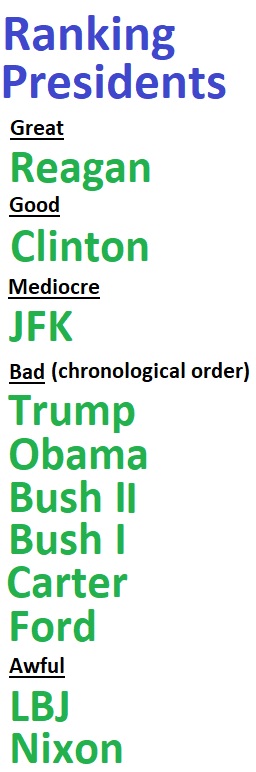
But I’ve never put together a best-to-worst list, so here’s my ranking of every president since Kennedy.

Let me elaborate – and also add some caveats.
For what it’s worth, I don’t think there’s good modern-quality data on JFK (or, to be more accurate, I’ve never searched for it), but I included him since he’s part of Tomasky’s analysis. That being said, he may be ranked too low. Yes, he spent too much money and implemented some bad policies, but he also lowered tax rates and pushed for free trade.
I also think it’s too early to grade Trump, but I included him since I know that will be of interest to readers. As you might imagine, I like what he’s done on taxes and red tape, but his record on other issues is bad – and getting worse. I’m especially concerned about the consequences and impact of the Fed’s easy-money policy, an approach Trump certainly supports.
Johnson and Nixon are unambiguously terrible, while Reagan is the star performer.
Clinton was surprisingly good (feel free to give the credit to Newt Gingrich if you want, but we didn’t need veto overrides to get the good policies of the 1990s).
The rest of the presidents were generally bad. I put them in reverse chronological order since I didn’t see any logical way of differentiating between them.
I can’t resist citing one more segment from Tomasky’s column.
Republican failures are not an unhappy coincidence. They’re a result of conservative governing practice. Republicans no longer fundamentally believe in the workings of government, so they don’t govern well. Their contempt for government is a result of conservative economic theory.
This is nonsense, as should be obvious from what I’ve already written. Republicans do not have a track record of “conservative governing.”
With one exception. We had relatively competent governance from the one GOP president who did have a “contempt for government” (actually, just contempt for big government).
-
Democrats appearing Wednesday night via their party’s virtual national convention certainly appeared somber and sincere. But the content of their oratory naturally raises the question of how seriously viewers should take them.
Former President Barack Obama said:
The one Constitutional office elected by all of the people is the presidency. So at minimum, we should expect a president to feel a sense of responsibility for the safety and welfare of all 330 million of us — regardless of what we look like, how we worship, who we love, how much money we have — or who we voted for.
But we should also expect a president to be the custodian of this democracy. We should expect that regardless of ego, ambition or political beliefs, the president will preserve, protect and defend the freedoms and ideals that so many Americans marched for and went to jail for; fought for and died for.The former president’s delivery was outstanding. But his message would have been more compelling if–four years ago today–his FBI had not sent an informant to record a conversation with someone participating in the political opposition’s presidential campaign. The exculpatory evidence collected that day from Trump supporter Carter Page–like much of the other exculpatory evidence the Obama administration collected on him–would not be shared with the Foreign Intelligence Surveillance Court as the government improperly seized wiretap authority.
The Justice Department’s Obama-appointed inspector general would later identify “at least 17 significant errors or omissions” in the government’s applications to surveil Mr. Page.
If there is one person in America who should not be lecturing us about the duty of a president to ensure our rights are protected regardless of our political beliefs, it is Barack Obama.
But give our 44th president credit for nerve. He was appearing just hours after news broke of a related courtroom development involving an anti-Trump government attorney. Dustin Volz and Alan Cullison report in the Journal:
On Wednesday, FBI lawyer Kevin Clinesmith pleaded guilty to altering a document investigators presented to a judge for approval to continue surveilling former Trump campaign adviser Carter Page… Mr. Clinesmith is set to be sentenced in December.
Wednesday night offered Mr. Obama a timely opportunity to apologize for the surveillance abuses that began on his watch. But instead he offered yet another smear of the man his FBI targeted for abuse. Said Mr. Obama:
I have sat in the Oval Office with both of the men who are running for president. I never expected that my successor would embrace my vision or continue my policies. I did hope, for the sake of our country, that Donald Trump might show some interest in taking the job seriously, that he might come to feel the weight of the office and discover some reverence for the democracy that had been placed in his care.
As Mr. Obama spoke, the text of the Constitution formed a lovely backdrop to his remarks. Perhaps he found a moment to read it.
Another of Wednesday night’s speakers was former Secretary of State Hillary Clinton, whose comments raised similar questions right from the start. Mrs. Clinton said:
Good evening. After the last election, I said, “We owe Donald Trump an open mind and the chance to lead.” I really meant it.
She first uttered those words on Nov. 9, 2016, which would have been a good time to repudiate the bogus Steele dossier of accusations against Mr. Trump that her campaign funded and which the FBI used to secure the improper surveillance warrants.
That day of her concession speech, delivered the morning after Mr. Trump’s victory, also represented a good opportunity to decide that she would not spend the next several years refusing to accept the results of the 2016 election and making baseless allegations about members of both parties. But she did not seize the day.
So what did she really mean?
Speaking of Clintons, the Washington Times reports:
Former President Bill Clinton used his Democratic National Convention speech Tuesday to lecture President Trump on decorum, drawing charges of hypocrisy even before a photo of the former Democratic president with an Epstein accuser went viral.
“At a time like this, the Oval Office should be a command center,” Mr. Clinton said in his remote speech. “Instead, it is a storm center. There’s only chaos. Just one thing never changes — his determination to deny responsibility and shift the blame. The buck never stops there.”
Leading off the mockery was “Late Show” host Stephen Colbert, who alluded to Mr. Clinton’s Oval Office affair with then-White House intern Monica Lewinsky.
“All right, that’s true, that’s a good point,” Mr. Colbert replied. “But I don’t think Bill Clinton gets to lecture anyone on what should happen in the Oval Office. Those in glass houses should not be allowed near the interns.”
The same day, the [U.K.] Daily Mail ran a photo showing Mr. Clinton receiving a neck message from Chauntae Davies, then 22, who has accused the late Jeffrey Epstein of raping her. Mr. Clinton has come under fire for his friendship and travel with Epstein, a convicted sex offender.
The caption read: “Clinton, then 56, had complained of having a stiff neck after falling asleep on Epstein’s notorious private jet while on a humanitarian trip with the pedophile to Africa in September of 2002. After Maxwell’s insistence, Clinton asked the twenty-something: ‘Would you mind giving it a crack?’”Trump attorney Rudy W. Giuliani called the second night of the convention “a parade of hypocrites,” tweeting, “Bill Clinton wants to cleanse the Oval Office?”
Added Juanita Broaddrick, who accused Mr. Clinton of raping her in 1978, which he has denied: “Where is MeToo?”
Mr. Colbert also posted a photo of Mr. Clinton looking surprised, joking that he was “seen here finding out Ghislaine Maxwell was just arrested.” Ms. Maxwell, an Epstein ally, was arrested last month on charges related to sexual abuse of young women.
The conservative Media Research Center accused reporters covering the convention of avoiding Mr. Clinton’s Epstein connection. Mr. Clinton has insisted he knew nothing about Epstein’s crimes and took trips on the billionaire financier’s private plane in connection with his work for the Clinton Foundation.
“Democrats claim to embraced women speaking out against harassment in a #MeToo era,” said MRC’s Scott Whitlock. “So it’s awkward to see journalists look the other way at Bill Clinton speaking on night two of the Democratic National Convention. It’s even more awkward with newly unearthed photos of the former president getting a massage from an alleged Jeffrey Epstein victim.”
Meanwhile, the Associated Press reports:
House Speaker Nancy Pelosi and former Attorney General Eric Holder delivered a stark reminder to Wisconsin Democrats on Thursday about the importance the battleground state plays in the presidential election less than 11 weeks away.
“No pressure, it’s all riding on Wisconsin,” Pelosi told more than 100 Democrats during a virtual meeting tied to the final day of the Democratic National Convention. “No pressure.”
Democrats, as well as President Donald Trump, have made no secret how essential winning Wisconsin is to the race this year. Wisconsin did not get the national attention it hoped for when the Democratic convention originally planned for Milwaukee moved online. But Trump and his surrogates have flooded the state this week, drawing a sharp contrast with Democratic nominee Joe Biden, who decided against traveling to the state to accept the nomination due to concerns over COVID-19.
Still, after Trump’s narrow victory of less than 23,000 votes in 2016, and polls showing another close race this year, Democrats are pledging not to downplay the importance of Wisconsin in Biden’s efforts to defeat Trump.
“The road to the presidency runs through Wisconsin,” said Holder, who was attorney general under former President Barack Obama. “The fate of the United States, the fate of the western world, is on your shoulders. Not too much pressure.”
Holder and Gov. Tony Evers also stressed the importance of denying Republicans the six seats needed in the Wisconsin Legislature to have a veto-proof super majority headed into the once-a-decade process of redistricting next year. Wisconsin has been at the front of the national battle over redistricting, with Democrats taking a challenge of the current maps all the way to the U.S. Supreme Court.
Republicans need to pick up three seats in the Senate and three in the Assembly to have super majorities that could override any Evers veto. That would enable the GOP-controlled Legislature to enact any map it wishes after redistricting next year, just as it did in 2011 when Republican Scott Walker was governor.
Evers and Democrats have rallied around a “Save the Veto” message, with the first-term Democrat saying Thursday he had temporarily suspended fundraising for his own reelection to focus on that effort.
Interesting last sentence. Wisconsin is in a health emergency as declared by Evers, but it’s not too much of an emergency to suspend usual politics.
Saying is one thing. Doing is another. On that, RightWisconsin reports:
Remember the good old days when nearly everyone was excited the Democrats chose Milwaukee to host the Democratic National Convention?
Okay, a few us worried about the rioting, but it turns out the left can destroy businesses and ruin lives without having the Democratic National Convention as an excuse. Look how successful they are in Madison.
But we were supposed to get thousands of visitors, a ton of publicity and goodwill, and millions of tourist dollars.
Instead, we don’t even get a visit from the party’s nominee. Thousands of delegates? Nope. How about press coverage from all over the world? Nope again. We don’t even rate a silhouette in the convention logo anymore because Democrats don’t want anyone to think they visited Wisconsin. And when the roll call of the states showed the best of what each state had to offer, Wisconsin‘s Democrats had Lt. Gov. Mandela Barnes, who made Biden a plural earlier, in a conference room instead of some wonderful Wisconsin location.
Of course, it’s not like Barnes could drive anywhere.
But if you wonder what Hollywood and the Democrats really think of Wisconsin, late night talk show host Stephen Colbert has the answer. Thank you for your contempt, and you can stop wondering how Donald Trump won Wisconsin in 2016.What about Colbert?
-
Author and radio and TV show host Charlie Sykes was one of the leaders of Wisconsin’s conservative movement.
How influential was Sykes? State legislators talked about the “Sykes Effect,” his influence on Republican legislators within the range of the radio station that carried his morning talk show, and his lack of influence on GOP legislators outside the station’s signal (it is the most powerful AM radio station in the state).
And for a while I got to participate.


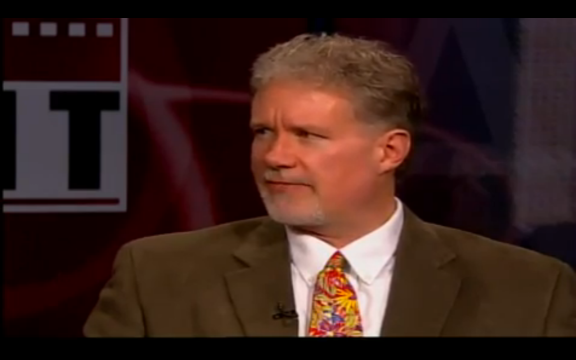
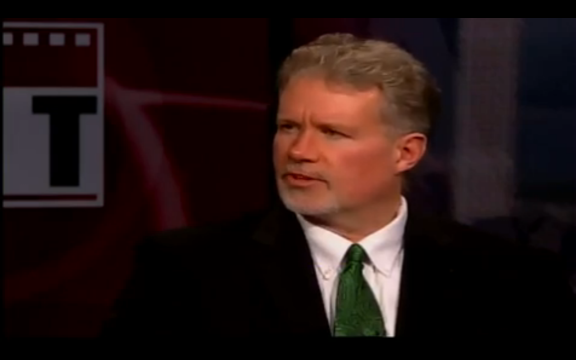
Things change. Sykes isn’t on Milwaukee radio or TV anymore. “Sunday Insight” is no more. Journal Communications (former owner of my business magazine, R.I.P., Sykes’ radio and TV stations, and the biggest newspaper in the state) is no more. And thanks to Donald Trump, Sykes evidently doesn’t consider himself a Republican supporter anymore.
Dan McLaughlin comments thereupon:
C. S.Lewis, writing in 1941, coined his famous definition of the logical fallacy of Bulverism:
You must show that a man is wrong before you start explaining why he is wrong. The modern method is to assume without discussion that he is wrong and then distract his attention from this (the only real issue) by busily explaining how he became to be so silly. . . . I have found this vice so common that I have had to invent a name for it. I call it “Bulverism.” . . . Its imaginary inventor, Ezekiel Bulver . . . heard his mother say to his father — who had been maintaining that two sides of a triangle were together greater than the third — “Oh, you say that because you are a man.” “At that moment,” E. Bulver assures us, “there flashed across my opening mind the great truth that refutation is no necessary part of argument. Assume your opponent is wrong, and then explain his error, and the world will be at your feet. Attempt to prove that he is wrong or (worse still) try to find out whether he is wrong or right, and . . . our age will thrust you to the wall.” . . . But of course it gets us not one inch nearer to deciding whether, as a matter of fact, the Christian religion is true or false. That question remains to be discussed on quite different grounds — a matter of philosophical and historical argument. However it were decided, the improper motives of some people, both for believing it and for disbelieving it, would remain just as they are.
I don’t have time to psychoanalyze Sykes (though that would be an interesting project to compare current Sykes to the commentator who was on the front lines of every worthwhile conservative fight in this state for three decades).
Facebook Friend Devin observes of Trump that “Trump has passed the most conservative agenda while being the least conservative Republican since Eisenhower. Further, Trump is the least fiscally conservative president in my lifetime (I was born in 1985).” Another Facebook Friend suggests that Sykes feels “a bit smarter and more principled than the rabble,” which, he adds, is not an approach likely to persuade people. (It works almost as well as insulting people, a lesson Democrats resolutely refuse to learn.)
Ronald Reagan famously observed that “The person who agrees with you 80 percent of the time is a friend and an ally, not a 20 percent traitor.” I think Trump passes the 80 percent test, as far as what he has done (as opposed to said or Tweeted) while president, but I may be wrong about that precise number. I am positive Biden will not pass that test. It requires a valid explanation of why someone who claims to be conservative should vote for someone who will not do remotely conservative things while in office.
-
Dan McLaughlin on the non-moderate Democratic presidential candidate (for now):
The Democrats’ pundit class has a Joe Biden agenda problem. On the one hand, they are devoted to reassuring centrist voters that Biden is a soothing moderate because of things he did decades ago (say, the 1994 crime bill), because he talked down some of the most ridiculous of the left wing’s policy proposals (notably “Medicare for All”) in the primary, or because he does not speak the language of the woke “defund the police” faction. But at the same time, they are hard at work loudly telling the Bernie/Warren/AOC wing of their party: Don’t worry, Joe won’t stop you from getting what you want. He’s actually going to help you.
The problem is: We can read. This stuff is all out there. And voters who are being sold the “moderate Joe” line need to understand that the people selling it are simultaneously building support to govern with a much more radical agenda.
Let’s walk through some samples — the headlines, the arguments, the quotes from Democratic sources, some of the policy examples they cite, and the smug certainty that most voters aren’t noticing. This is all out in the open. Peter Beinart in The Atlantic, “Biden Goes Big Without Sounding Like It. Perceived as a moderate, he has embraced strikingly progressive goals without facing any political backlash”:
Despite embracing an agenda that is further to the left than that of any Democratic nominee in decades, he’s avoided the specific policy proposals and catchphrases that Republicans find easiest to attack. As a result, he appears more centrist than he actually is . . . on issue after issue, he’s adopted policies that are strikingly progressive while stopping just shy of the specific formulations that might leave him vulnerable to Republican attack.
Paul Waldman in the Washington Post, “How Joe Biden is moving left while still being seen as a moderate”:
When Sen. Bernie Sanders said recently that if Joe Biden implements his policy agenda, the presumptive Democratic nominee could be “the most progressive president since FDR,” he was probably right. In fact, something extraordinary is happening: Biden is getting more progressive in substance, yet it has done nothing to change his image as a moderate. . . . [This is] pretty clearly the product of a careful strategy on Biden’s part . . . the continuing evolution of Biden is a fascinating story, and one most of the public is probably unaware of.
Take, for instance, the climate change plan Biden released this week. . . . The average voter — who right now is paying attention to the presidential campaign on only the most superficial level — probably heard next to nothing about it. But the reaction from progressives and climate activists ranged somewhere between surprise and joy. As one co-founder of the Sunrise Movement tweeted, the plan is “a VERY BIG DEAL, and is a huge victory for the #GreenNewDeal movement.”
. . . . There’s a kind of shift we expect from presidential candidates: In the primaries they appeal to their party with pledges of ideological fealty, then when the nomination is secured, during the general election, they head back to the center. Biden, however, is doing the opposite, in substance if not in rhetoric.
Oh, that silly, superficial, “average voter,” blissfully unaware of Biden’s agenda.


 Steve Prestegard.com: The Presteblog