A student at an Ivy League university just wrote to me:
I’m a senior college student at [X] and back in March when we shut down, I was genuinely concerned about COVID.
However, I study hospitality and as I read about layoffs at restaurants and hotels, my heart broke for the staff there. By May, I was fully skeptical. At first, I thought we’d be done with this by now. Back home in NY, my high school friends are terrified and the one time we saw each other, we sat in my backyard 6+ ft apart from each other. As a business student, I hope that I understand how the markets work and how every single week of lockdown affects our society in every shape and form.
Where I live, we are a wealthy town and most parents are businessmen/lawyers and can afford to stay home. However, having worked in the hospitality industry, I understand how so many people are being affected while families in my community are ordering for $100+ delivery and $200+ Instacart orders. They’re so phony — they think that the federal government could snap their fingers for small businesses and its employees and they’ll be saved. Whether it’s Trump or Biden, these people are not being helped.
One interesting anecdote: my friend’s sister has really, really bad eyesight. Both of her parents are doctors and she’s still scared to go get her eyes checked. When I was with her, I had to read her the menu from her phone when we were ordering in. She’s 22 years old. 22!
Trust me, I know I’m privileged but was disgusted by the lack of empathy. I worked in restaurants and hotels and I know that these workers are suffering. Meanwhile, my high school friends think that the federal government will help them. They don’t understand how it works. They keep thinking that we’re going to have a vaccine or treatments by next year. I tried to explain that the US population is over 300 million across the country and that you can’t vaccinate everyone overnight. Somehow all my friends go to Ivy League schools and they don’t understand that logic. And trust me, my major at [X] is known to be the “dumb” major and compared to the engineers, they have no clue.
Now, for some good news. I’m now back at [X] University. Some challenges is having to wear masks everywhere and having twice weekly tests. Aside from that, it’s almost like being back in college. I’ve hosted parties with my best friends hosting pong, getting drunk, and being a college student. The first few days back, my friends and I were a bit scared to hug and all. Since then, we’ve had so many great social events. We even played spin the bottle and had such great experiences. While when I meet another friend that I haven’t seen for a while, we don’t hug or do anything… Soon after, after a drink or two, we’ve all hugged. I talked to my friends about COVID and we’re all under the impression that by March 2021, somehow life has to go on.
Lastly, I do not understand this conversation about waiting until a vaccine or treatment. How long can we go on? Luckily, I’m a senior and will have had most of my college years. But how will education be affected? When I was in high school, I worked with students on the spectrum and with autism; I can’t imagine what they are living.
Now much of this is quite discouraging: the 22-year-old woman who’s terrified to get her eyes checked, even though she quite literally has a greater chance of dying in a car accident on the way to the eye exam than she does of COVID, is beyond ridiculous.
At the same time, I’m glad to hear that when push comes to shove, college students are being college students, regardless of the hysteria, and that they seem to have decided on a date in their minds beyond which the insanity simply cannot go on.
Category: US politics
-
1 comment on COVID and millennials
-
We’re weeks from Election Day. There’s still time for the polls to tighten, and the polls might just be wrong anyway.
But boy, do those polls not look good right now. The most likely outcome at this point is for the Republicans to lose the presidency and the Senate, giving the Democrats control of the entire federal-lawmaking apparatus.
At this writing, FiveThirtyEight gives Democrats an 87 percent chance at the presidency, a 73 percent shot at reclaiming the Senate, and a 95 percent chance to keep the House. The “no toss-ups” maps at RealClearPolitics have Biden winning the Electoral College 374–164 and Democrats taking the Senate 51–49. (Bear in mind that the vice president breaks ties in the Senate, so a 50-50 split coupled with a Biden-Harris victory would still give the edge to the Democrats.) For weeks the betting market PredictIt has given the Democrats a better-than-even shot at a “clean sweep.”
If the Democrats do in fact win everything, we could be in for a miserable and acrimonious couple of years.
Toward the top of the agenda will be an intra-party debate over whether to kill the legislative filibuster and pack the Supreme Court. I highly doubt they’ll have the votes for the latter, and with a narrow margin even the former will be out of reach because some moderates are sure to balk. But there’s at least a chance the Democrats could have unified control and no limits on how they use it.
If the filibuster goes, the Democrats can pass just about anything that 50 senators agree to. And even with the filibuster intact, the party can achieve many things through the “budget reconciliation” process. That’s how the Republicans passed their tax bill in 2017, and it’s how they tried to handle health-care reform too. (The big rule for a reconciliation bill is that each provision must affect the budget.)
Democrats’ priorities will obviously depend on their margin of victory. But Biden wants to ban “assault weapons”; further expand the government’s role in health care, including by having a public plan “compete” with private options and lowering the age for Medicare eligibility at great cost; hike taxes, especially, but not exclusively, on higher earners; and much more.
-
A Centers for Disease Control report released in September shows that masks and face coverings are not effective in preventing the spread of COVID-19, even for those people who consistently wear them.
A study conducted in the United States in July found that when they compared 154 “case-patients,” who tested positive for COVID-19, to a control group of 160 participants from the same health care facility who were symptomatic but tested negative, over 70 percent of the case-patients were contaminated with the virus and fell ill despite “always” wearing a mask.
“In the 14 days before illness onset, 71% of case-patients and 74% of control participants reported always using cloth face coverings or other mask types when in public,” the report stated.
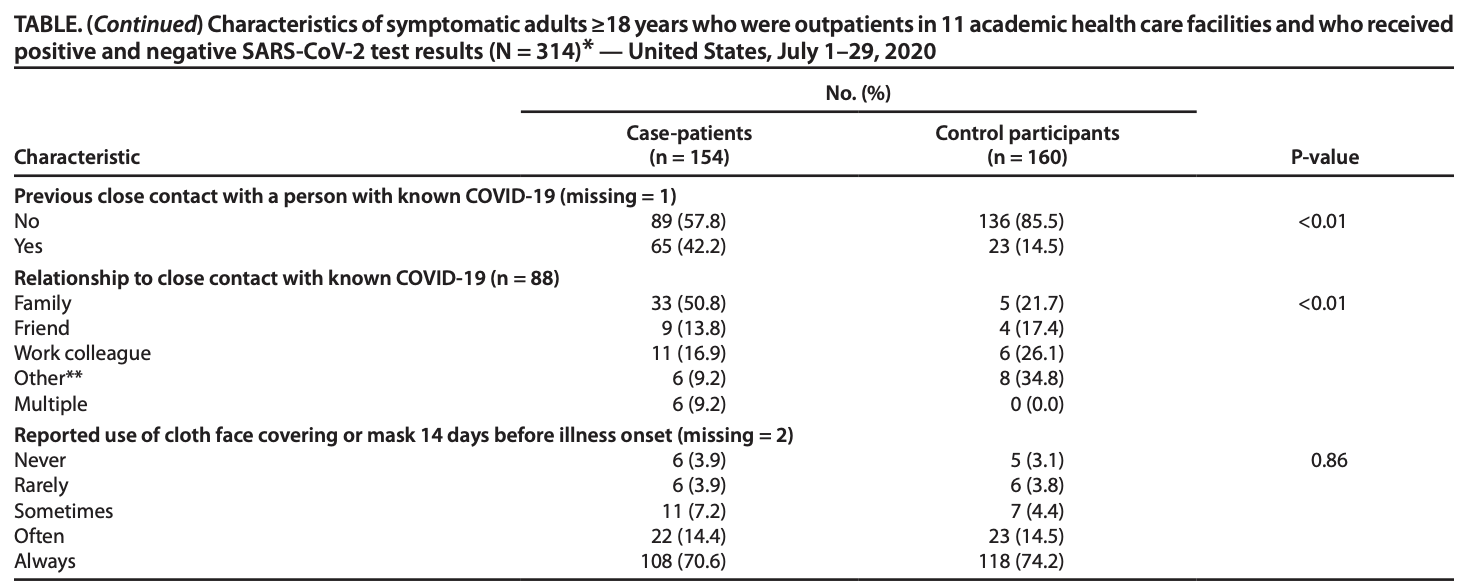
In addition, over 14 percent of the case-patients said they “often” wore a face covering and were still infected with the virus. The study also demonstrates that under 4 percent of the case-patients became sick with the virus even though they “never” wore a mask or face covering.
Despite over 70 percent of the case-patient participants’ efforts to follow CDC recommendations by committing to always wearing face coverings at “gatherings with ≤10 or >10 persons in a home; shopping; dining at a restaurant; going to an office setting, salon, gym, bar/coffee shop, or church/religious gathering; or using public transportation,” they still contracted the virus.
While the study notes that some of these people may have contracted the virus from the few moments that they removed their mask to eat or drink at “places that offer on-site eating or drinking,” the CDC concedes that there is no successful way to evaluate if that was the exact moment someone became exposed and contracted the virus.
“Characterization of community exposures can be difficult to assess when widespread transmission is occurring, especially from asymptomatic persons within inherently interconnected communities,” the report states.
In fact, the report suggests that “direction, ventilation, and intensity of airflow might affect virus transmission, even if social distancing measures and mask use are implemented according to current guidance.”
Despite this new scientific information, the CDC, Director of the National Institute of Allergy and Infectious Diseases Dr. Anthony Fauci, and many political authorities are still encouraging people to wear masks. Many states and cities have even mandated masks, citing them as one of the main tools to “slow the spread” of coronavirus and keep case numbers in their area down.
I wonder how long it will take — Nov. 4? — for public health to admit that there is nothing government can do to stop or even slow down COVID-19. Nothing has worked so far.
-
At least 15 million Americans every week tune into one of the top 15 talk radio programs. They are not monolithically conservative, but they are overwhelmingly so. A dozen of the top 15 shows feature conservative or libertarian hosts — with devoted followings like Rush Limbaugh’s “Dittoheads” or Michael Savage’s “Savage Nation” — and only one leans left.
Talk radio may face an aging audience, a decline in ad revenue and competition from new mass media forms like podcasts, but there are still millions of Americans whose politics are shaped by what they listen to on talk radio all day, every day. Fox News gets more of the attention for shaping conservative opinion and for its influence on the Trump administration, but we shouldn’t overlook the power of conservative talk radio.
The conservatism of talk radio only partly overlaps with institutional conservatism, that of right-wing Washington think tanks, magazines and the Republican Party itself. By the early 2000s, it had embraced a version of conservatism that is less focused on free markets and small government and more focused on ethnonationalism and populism. It is, in short, the core of Trumpism — now and in the future, with or without a President Trump.
Talk radio’s power is rooted in the sheer volume of content being produced each week. The typical major talk radio show is produced every weekday and runs three hours, so just the top 15 shows are putting out around 45 hours of content every day. Even setting aside hundreds of additional local shows, the dedicated fan can listen to nothing but conservative talk radio all day, every day of the week, and never catch up.
Yet talk radio still somehow manages to fly below the national media radar. In large part, that is because media consumption patterns are segregated by class. If you visit a carpentry shop or factory floor, or hitch a ride with a long-haul truck driver, odds are that talk radio is a fixture of the aural landscape. But many white-collar workers, journalists included, struggle to understand the reach of talk radio because they don’t listen to it, and don’t know anyone who does.
Moreover, anyone who wants to make an effort to understand talk radio runs into a barrier immediately: Because of the ocean of content, one must listen to it at great length, a daunting task for anyone not already sympathetic with a host’s conservative views. The time commitment suggests the depth of listener loyalty.
Each show has its own long-running inside jokes and references, a kind of linguistic shorthand that unites fans and repels outside examination. And since shows have begun to regularly publish online transcripts only in the past decade or so, journalists and scholars have found it hard to wade through all the content.
As Jim Derych, the author of “Confessions of a Former Dittohead,” put it, Rush Limbaugh “makes you feel like an insider — like you know what’s going on politically, and everyone else is an idiot.” There is power in that feeling, the proposition that you and the radio elect have been awakened to a hidden truth about the real way the world works while the rest of the American “sheeple” slumber.
Like single-issue voters, talk radio fans are able to exercise outsize influence on the political landscape by the intensity of their ideological commitment. Political scientists have long noted the way in which single-issue voters can punch above their numerical weight. An organization like the National Rifle Association, which says it has about five million members, has been able to outlobby gun control supporters despite broad (but diffuse) public backing for at least incremental gun control measures.
Talk radio listeners make up a group at least three times as large as the N.R.A. and are just as committed to a particular vision of America. To take one example, since the mid-2000s, talk radio listeners have played a big part in steering Republicans toward the virulent anti-immigration stance of Mr. Trump. Mr. Limbaugh once proposed a set of “Limbaugh Laws” requiring immigrants to speak English, barring them from holding government office or having access to government services, and excluding unskilled workers from the country.
Talk radio is not bounded by physical space. It can follow listeners wherever they go, from the car radio while commuting to the radio resting on the workbench to a radio app on a smartphone. It has the potential to dominate the construction of a person’s worldview in a way that other media simply cannot (until, perhaps, the advent of its white-collar cousin, the podcast).
This was true of conservative radio long before the current generation of talk radio hosts emerged in the 1980s. By the early 1960s, a group of AM radio broadcasters had built an informal national syndicated network of hundreds of radio stations; the largest of the broadcasters, a fundamentalist preacher in New Jersey named Carl McIntire, reached an estimated audience of 20 million listeners a week (which, for sake of comparison, is as many as Rush Limbaugh reportedly hit at his peak four decades later). Americans could tune into a station airing conservative programming all day, every day.
By 1963 President John F. Kennedy was so worried about what an aide called this “formidable force in American life today,” which was able to “harass local school boards, local librarians and local government bodies,” that he authorized targeted Internal Revenue Service audits and the use of the Federal Communications Commission’s Fairness Doctrine to silence these pesky conservative broadcasters. The result was the most successful episode of government censorship of the last half century.
Conservative broadcasters have never forgotten it, and it is a key reason that a conspiracist mind-set has such a grip on listeners. Since 2003, Rush Limbaugh, who got his start working in radio as a teenager in the mid-1960s, has mentioned the Fairness Doctrine on nearly 150 episodes. He credits the rise of talk radio to the lifting of the Fairness Doctrine in 1987 by the Reagan administration. And he worries that the left could at any moment use a revived Fairness Doctrine to silence conservative radio. As Mr. Limbaugh put it in January, “They’ve been trying to nullify or negate me” for three decades.
This suspicion that elite institutions — the media, universities, government, Big Tech — are run by hostile liberal gatekeepers seeking to silence conservative voices continues to fuel right-wing anxiety. It also helps explain conservative support for Mr. Trump, who can be accused of many things but not of failing to speak his mind. When you believe that all politicians lie but that only liberal politicians rig the game, you’re more likely to vote for someone who you think will fight back even if they lie along the way.
Take talk radio’s role in spreading Covid denialism. At each stage of the backlash against government recommendations for fighting the pandemic, talk radio hosts prepared the way for broader conservative resistance. Indeed, many of Mr. Trump’s own talking points about the virus — like comparing it to the flu and accusing China of weaponizing the virus — echoed ideas already spreading on talk radio shows.
The more appropriate term is “COVID skepticism,” and, I would say, for good reason given the mix of government being wrong (remember “two weeks to flatten the curve?”) and outright lies (Gov. Tony Evers saying he wasn’t going to shut down the state three days before he did).
The fact that the New York Times solicited someone from Libertarianism.org to write this shows how out of touch the Times is, and not just about flyover country. Limbaugh, Savage and Sean Hannity are all on WABC radio in New York. You’d think the Times would know what AM radio is.
-
The Tax Foundation evaluated Democrat Joe Biden’s tax increase proposals:
Democratic presidential nominee Joe Biden would enact a number of policies that would raise taxes on individuals with income above $400,000, including raising individual income, capital gains, and payroll taxes. Biden would also raise taxes on corporations by raising the corporate income tax rate and imposing a corporate minimum book tax.
Biden’s plan would raise tax revenue by $3.05 trillion over the next decade on a conventional basis. When accounting for macroeconomic feedback effects, the plan would collect about $2.65 trillion the next decade. This is lower than we originally estimated due to the revenue effects of the coronavirus pandemic and economic downturn and new tax credit proposals introduced by the Biden campaign.
According to the Tax Foundation’s General Equilibrium Model, the Biden tax plan would reduce GDP by 1.47 percent over the long term.
On a conventional basis, the Biden tax plan by 2030 would lead to about 6.5 percent less after-tax income for the top 1 percent of taxpayers and about a 1.7 percent decline in after-tax income for all taxpayers on average.
Raise taxes by $3 trillion, cut incomes by 1.7 percent. That is apparently how Democrats think. And that does not include the economic harm caused by the nationwide shutdown Biden proposes to (fail to) stop the coronavirus, nor does it include any effects of the Green New Deal, which is designed to return the economy to the Neanderthal era.
-
The New York Post reports in its usual restrained way:

House Speaker Nancy Pelosi on Thursday threatened that Democrats are looking at using a provision of the 25th Amendment to effectively remove President Trump from office.
Pelosi (D-Calif.) teased that she and her fellow Democrats are considering invoking the constitutional provision on presidential succession — a seemingly fantastical yearning among Trump opponents.
“Tomorrow. Come here tomorrow. We’re going to be talking about the 25th Amendment, but not to take attention away from the subject we have now,” Pelosi told reporters at a press conference.
Pelosi deflected a follow-up question about whether she believes it’s time to invoke the amendment, which was ratified in 1967. Trump is recuperating at the White House after a three-night hospitalization over the weekend for COVID-19 treatment.
“I’ll talk to you about that tomorrow,” Pelosi said.
In a Thursday afternoon press release, Pelosi and Rep. Jamie Raskin (D-Md.) said they would introduce a bill establishing a new commission that could remove Trump’s powers if it finds him mentally or physically unfit.
The bill would create a Commission on Presidential Capacity to Discharge the Powers and Duties of Office that would “enable Congress to help ensure effective and uninterrupted leadership in the highest office in the Executive Branch of government,” the press release said.
The White House did not immediately comment on Pelosi’s threat.
The 25th Amendment grants a role to the House in cases of presidential succession or temporary incapacitation. It allows either the vice president and Cabinet — or some other entity designated by Congress — to declare the president unable to perform his duties. Congress never created an entity to supplant the Cabinet in making that decision.
The amendment says: “Whenever the Vice President and a majority of either the principal officers of the executive departments or of such other body as Congress may by law provide, transmit to the President pro tempore of the Senate and the Speaker of the House of Representatives their written declaration that the President is unable to discharge the powers and duties of his office, the Vice President shall immediately assume the powers and duties of the office as Acting President.”
Pelosi’s legislation is almost certain to die in the Republican-held Senate. If a commission ever were to be established, and if a vice president were to agree that a president was unable to serve, the 25th Amendment requires 2/3 of each chamber of Congress to affirm that finding if the president objects.
At the press conference, Pelosi mocked Trump’s Thursday morning declaration in a TV interview that he’s “a perfect physical specimen and because I’m extremely young” and alleged that he wanted to misdirect coronavirus stimulus funds to his own businesses.
“He’s a perfect physical specimen, did he say? Specimen, maybe I could agree with that. And young, he said he was young. His disassociation from reality would be funny if it weren’t so deadly,” Pelosi said.
Pelosi’s latest gambit is interesting (there are more profane words I could use) given that Democrat Joe Biden is in arguably worse health not because of COVID, but because of his age (77) and the residual effects of his two brain aneurysms in the 1980s. What other explanation is there for Biden’s basement campaign and how protective his handlers have been about his health status?
Pelosi seems to forget, though, that even if Trump is removed from office by the 25th Amendment, Mike Pence becomes president, and he gets to pick his vice president. It won’t be Pelosi.
-
I have no idea what is going to happen in the world even in the near future, much less ten years from now.
Imagine being at a point where you positively long for Bill Clinton, and that’s where we are now.
We turn on the TV (mistake #1) and a reporter is seriously telling us that protests are “mostly peaceful” while buildings burn directly behind him, on camera.
If you and I protested something and one of our signs had a misplaced semicolon, the news would breathlessly report on the rise of fascism in America.
Just the other day the President Tweeted something clearly true: we don’t shut the country down for the flu. We learn to live with it, in exactly the same way that we will obviously have to learn to live with COVID. We can’t shut down all of society in a monomaniacal battle against one thing. There will be horrific consequences.
At the very least, that’s an eminently defensible view, and one held by some of the best scientific minds in the world.
Twitter attached a statement saying that this is ordinarily the kind of Tweet they’d remove, but that in the public interest they’re keeping it up.
Today a senior writer with the Washington Post tried to debunk the claim that for some groups the flu is more deadly than COVID — but in order to do so he had to use CFR figures for one and IFR figures for the other. This is a top person at one of our top newspapers.
NPR just ran an item on how dangerous schools are, even though every bit of data we have, from all over the world, tells us the exact opposite.
Three months ago, Washington, D.C., reached numbers indicating that it should have been at phase 3 of reopening, but it’s still in lockdown limbo, indefinitely.
They told us 15 days to slow the spread. It’s day 205. They said we could have our lives back when we got a vaccine — as if that were a guarantee. Now they’re saying we can’t have our lives back even with a vaccine.
Joe Biden — the man leading in the polls — promises more of the same. Lockdown forever.
Your countrymen are begging to have their life savings depleted and be confined to their homes — or at least that’s what the poll numbers seem to suggest.
To call this insanity wouldn’t come close to the scope of what’s happening here.
If you’re not disoriented, concerned, even frightened, well, you’re very much an outlier.
Chances are, you’re all three of those things.
Rationally speaking, when it comes to protecting your life and livelihood from the anti-life cultists you realize that it isn’t if but when. You have to do something at some point.
But this, too, likely has you frightened. And understandably so: anything involving finances and the unknown can be frightening.
Even more frightening, though, is staying in that holding pattern forever.
At some point you will have to step out of your comfort zone if you’re going to survive, much less thrive, in this uncertain century. You know it and I know it.
The question is when.
The sooner you take your fate into your own hands and start figuring all this stuff out, the better off you’ll be.
I’m not telling you anything you don’t already know.
-
If you read presidential candidate Joe Biden’s economic plans (“Build Back Better” and “Made in America”), you get a feeling of déjà vu, of having heard it all before: “America, good. China, bad.”
If it was not sprinkled with obligatory “Trump, bad” quips you might think it was lifted from Trump’s program. The leitmotif is: “I am going to do the same things as Trump, but better.”
To be fair, there is nothing wrong with wanting a strong economy, a manufacturing presence on US soil, and aspirations for American companies to become better than their foreign competitors. In these divided times, it is reassuring that, regardless of their differences, both Trump and Biden, at least on paper, want to improve the economy.
But will Biden’s Trump-ish plan actually do that?
One of Biden’s proposals is to Make “Buy American” Real. Basically, if the federal government is paying for a bridge, the contractor must get its steel, cement, and other materials from American companies. This, according to the plan, should help US companies compete with foreign rivals.
This creates the impression that the main global trade issue is companies participating in US public procurement and sourcing work and materials abroad.
Biden talks a lot about public procurement of steel and other construction materials. Yet, steel imports make up less than one percent of what Americans import (and that’s including all steel imports, not just steel for public procurement). Americans spend more on foreign wine, beer and other alcoholic beverages (see page 9 here) than they do on foreign steel.
“Drink American” would have a much larger impact on the trade deficit.
There is nothing wrong with wanting to have a strong domestic steel, or battery, or medical supply industry in the US The issue is how to achieve it.
If we stick to the steel example, in order to qualify for “Buy American” public procurement, all the steel products would have to be “mined, melted, and manufactured” in the US. Which means that bolts and nuts used in construction would have to be manufactured in US/ from a steel melted in the US from the iron ore mined in the US.Once again, nothing wrong with the notion of making America a good place for an entire supply chain of the steel industry (or any industry). But just to put things in perspective, US iron ore production is 20 times smaller than that of Australia, nine times smaller than China, and constitutes a mere 2 percent of global production.
Is the Democratic Party ready to make the US a good place for mining, smelting and making steel? Perhaps. But it will be interesting to see how this is received by the left wing of the Democratic Party with their Green New Deals (Andrea Ocacio-Cortez and Bernie Sanders each have one) proposing energy taxes, decarbonization, 100 percent renewables, and an emphasis on the environment over industry.
The plan also includes a tax credit that “promotes revitalizing, renovating, and modernizing existing – or recently closed down – facilities.” Once again, nothing wrong with a tax regime under which companies pay less taxes. But this money comes with strings attached—only the chosen ones will be able to benefit from lower taxes.
Who will be the chosen ones? The plan says “[companies with] strong labor standards, including paying workers a prevailing wage(…).” It looks like the government might be picking the winners based on politics—their stance toward unions.
The whole plan suffers from the arrogant premise that if the government is buying something, it can pressure private companies to support certain political objectives. Government already exerts control on the economy. First, by taking a part of your paycheck (like taxes), second by spending your taxes on what they think is needed (like infrastructure). But here you have a third degree of influence—government rewarding or penalizing companies according to political beliefs. To be fair, Biden is not the only one proposing that, but this should be troubling.
To be fair, the plan is not terrible in the parts where Biden sounds pro-development and pro-enterprise. However, these vague sentiments contrast starkly with some of the measures proposed. Can you be for business, mining, and manufacturing in one paragraph, and for big-government labor and environmental policies in another?
Also, “Buy American” is a worthy slogan. But does it imply a policy where American companies produce superior products that everyone wants to buy? Or a policy where American are forced to buy American products?
One is clearly better than the other.
-
We’re told that life is never getting back to normal, so we need to suck it up and accept a world of mask-wearing, economic disruption, and social distancing. It’s a denatured echo of the warnings we’ve heard before that government responses to COVID-19 are pushing the world toward authoritarianism—but dressed up as if that’s a good thing.
That’s unfortunate, given that less-intrusive responses to the pandemic are proving at least as effective as heavy-handed ones. And that’s before we even discuss the inherent value of the freedom that looks destined to be pushed aside by public health concerns and by disingenuous government officials.
“As 2020 slides into and probably infects 2021, try to take heart in one discomfiting fact: Things are most likely never going ‘back to normal,’” wrote CNN International Security Editor Nick Paton Walsh last week. In his piece he discusses the likely permanency of mask mandates, telecommuting, reduced physical contact, and similar changes to life.
Some of the alterations Walsh mentions may be matters of personal choice, but a good many of them are imposed by “politicians who pretend that ‘normal’ is just around the corner,” as Babson College’s Thomas Davenport says in the article.
We’re supposed to accept our newly constrained lives as “the new normal”—in a phrasing that’s already very tired, indeed.
Actually, repeated references to a “new normal” aren’t just tired; they’re ominous.
“As the need for an extension of quarantine into the summer or beyond seems likelier, the new normal will certainly include unanticipated trade-offs,” Andy Wang warned in May in the Harvard International Review. “The central irony of the crisis may be that the very methods that liberal democracies are currently using to effectively fight the virus are the same tactics that authoritarian leaders use to dominate their people. While the world is not sinking into authoritarianism, a post-quarantine world could be less democratic than its previous iteration; the tools that have been temporarily deployed in the fight against a once-in-a-lifetime disease may become permanent.”
These authoritarian tools may become permanent because government officials are rarely punished for doing something, even if the something is awful and counterproductive. It’s leaving things alone to be worked out by individuals according to their own priorities and preferences for which politicians get called out.
In addition, people who go into government tend to be the sort who naturally gravitate toward using power. And crises are excellent excuses for accumulating unprecedented authority and using it in novel ways.
“For authoritarian-minded leaders, the coronavirus crisis is offering a convenient pretext to silence critics and consolidate power,” Human Rights Watch cautioned in April.
“The ‘lockdown measures’ adopted by many European states have disproportionately impacted racialized individuals and groups who were targeted with violence, discriminatory identity checks, forced quarantines and fines,” Amnesty International reported in June. TOP ARTICLES1/5An Overdue Rebuke to Politicians Who Think Anything Goes in a Pandemic
“Governments around the world must take action to protect and promote freedom of expression during the COVID-19 pandemic, which many States have exploited to crack down on journalism and silence criticism,” the UN Special Rapporteur on Freedom of Expression noted in July.
The U.S. has hardly been immune to public health-driven authoritarianism during the pandemic.
“In halls of power across the country, the growing novel coronavirus pandemic has sometimes been used to stretch, bend or ignore established law and policy,” Jenny B. Davis wrote for the ABA Journal in April. “Fundamental freedoms, privacy protections and access to justice have been curtailed in the name of public safety, with legal justifications ranging from appropriate to patently inaccurate.”
Since then, judges have overruled some officials, including the governors of Michiganand Pennsylvania, who overstepped their authority and violated fundamental rights.
“The Constitution cannot accept the concept of a ‘new normal’ where the basic liberties of the people can be subordinated to open-ended emergency-mitigation measures,” wrote U.S. District Judge William S. Stickman IV in his September 14 decision regarding Pennsylvania’s public health rules. “Rather, the Constitution sets certain lines that may not be crossed, even in an emergency.”
And yet, local Florida authorities vow to keep fining people who don’t wear masks in public even after the governor told them to stop. And New York City is forcing schools, restaurants, and other businesses to close again in nine neighborhoods, all in the name of fighting the spread of COVID-19. Public health excuses continue to ride roughshod over protections for individual rights.
This should be remarkable even to people who, for some reason, don’t especially care about “fundamental freedoms” and constitutional “lines that may not be crossed,” because authoritarian lockdowns are certainly not the only way forward.
“In Sweden, new infections, if tipping upward slightly, still remained surprisingly low,” The New York Times noted last week. “Almost alone in the Western world, the Swedes refused to impose a coronavirus lockdown last spring, as the country’s leading health officials argued that limited restrictions were sufficient and would better protect against economic collapse,” the article added.
It’s not that Sweden did everything right on the issue, or that it completely avoided the effects of COVID-19. Instead, the country seems to have pulled through a difficult period at least as well as other countries without disrupting life or indulging the power-grab fantasies of government officials.
Sweden serves as an indication that respecting people’s liberty doesn’t inherently pose a health threat, and that a virus shouldn’t be used as an automatic excuse for forcibly curtailing normal life. And, once the virus passes, there will be a minimum of authoritarian detritus for Sweden’s residents to clear away.
Lucky Sweden.
For the rest of us, the pandemic is likely to leave lingering damage. The “new normal” of life after COVID-19 threatens to look a lot like old-fashioned authoritarianism.
-
During a Democratic presidential debate last year, Cory Booker weaponized one of Joe Biden’s proudest accomplishments. The New Jersey senator noted that the former vice president, who represented Delaware in the Senate for 36 years, “has said that, since the 1970s, every major crime bill—every crime bill, major and minor—has had his name on it.”
Said was an understatement. Biden has not just noted his leading role in passing those laws; he has crowed about it repeatedly over the years, throwing it in the face of Republicans who dared to think they could be tougher on crime and fellow Democrats he viewed as too soft. Now here he was, after a notable shift in public opinion about criminal justice issues, bemoaning the excessively, arbitrarily punitive policies he had zealously promoted for decades.
“The house was set on fire, and you claimed responsibility for those laws,” Booker continued. “You can’t just now come out with a plan to put out that fire.”
Biden’s response was telling. Those crime bills, he said, “were passed years ago, and they were passed overwhelmingly.” More recently, he noted, he had tried to ameliorate some of their worst consequences—for example, by sponsoring a 2007 bill that would have eliminated the unjust, irrational sentencing disparity between the smoked and snorted forms of cocaine, which led to strikingly unequal treatment of black and white drug offenders. That gloss brushed over the fact that, just a few years before he entered the 2020 presidential race, Biden was still bragging about the incarceration-expanding Violent Crime Control and Law Enforcement Act—or, as he preferred to call it, “the 1994 Biden Crime Bill.”
Booker, one of three African-American senators, was not impressed by Biden’s excuses. “You are trying to shift the view from what you created,” he said. “There are people right now in prison for life for drug offenses because you stood up and used that ‘tough on crime’ phony rhetoric that got a lot of people elected but destroyed communities like mine. This isn’t about the past, sir. This is about the present right now. I believe in redemption. I’m happy you evolved. But you’ve offered no redemption to the people in prison right now for life.”
The exchange was a powerful reminder of Biden’s faults. The Democratic nominee’s main qualification for office, aside from the fact that he is not Donald Trump, is his long history of public service. But that history is littered with egregious misjudgments on a wide range of issues, some of which he sticks with still. Even when Biden changes his positions—as he has on issues such as gay marriage, immigration, the Iraq war, and the death penalty, as well as drug policy and mandatory minimum sentences—he tends to rewrite history, saying he only did what everybody else was doing, implying that he acted based on the best information available at the time, or suggesting that he voted strategically to prevent even worse outcomes.
Biden’s reluctance to forthrightly acknowledge his errors blurs the contrast with Trump, a man who seems incapable of taking the blame for anything. Biden magnified that problem by choosing as his running mate Sen. Kamala Harris (D–Calif.), a former prosecutor who, like Biden, has recently recast herself as a criminal justice reformer while airbrushing her hardline past. More to the point, Biden’s persistently misguided policy instincts, spanning nearly half a century, make you wonder what fresh disasters his presidency would bring.
‘A Big Mistake’
Biden’s handiwork in the Senate included the Comprehensive Crime Control Act of 1984, which he introduced along with Sen. Strom Thurmond (R–S.C.), an archconservative and former segregationist. That law abolished parole in the federal system, increased drug penalties, established mandatory sentencing guidelines, and expanded civil asset forfeiture.
Two years later, Biden wrote the Anti–Drug Abuse Act of 1986, which prescribed new mandatory minimums for drug crimes and created the notorious weight-based sentencing distinction that treated crack cocaine as if it were 100 times worse than cocaine powder, even though these are simply two different ways of consuming the same drug. Under that law, possessing five grams of crack with intent to distribute it triggered the same five-year mandatory minimum sentence as 500 grams of cocaine powder; likewise, the 10-year mandatory minimum required five kilograms of cocaine powder but only 50 grams of crack. Two years later, Biden co-sponsored another Anti–Drug Abuse Act, which established the “drug czar” position he had been pushing for years and created additional mandatory minimums, including a five-year sentence for crack users caught with as little as five grams, even if they were not involved in distribution.
As Biden explained it on the Senate floor in 1991 while holding up a quarter, “we said crack cocaine is such a bad deal that if you find someone with this much of it—a quarter’s worth, not in value, but in size—five years in jail.” To be clear: Biden was not marveling at the blatant injustice of that punishment but touting his anti-drug bona fides.
Because federal crack offenders were overwhelmingly black, while cocaine powder offenders were more likely to be white or Hispanic, the rule Biden championed meant that darker-skinned defendants received substantially heavier penalties than lighter-skinned defendants for essentially the same offenses. As that trend became clear, the African-American legislators who had supported the law turned against it. By the early 1990s, pressure was building for reform of crack penalties.
“We may not have gotten it right,” Biden conceded 16 years after he helped establish the 100-to-1 rule. Five years later, during an unsuccessful bid for his party’s 2008 presidential nomination, he introduced a bill to equalize crack and cocaine powder sentences. That was the bill he cited in response to Booker’s criticism, suggesting he had seen the injustice of excessively harsh drug penalties by then. Yet as vice president in 2012, he was still citing his work with Thurmond on the 1984 crime bill, which started the ball rolling on mandatory minimums, as an inspiring example of bipartisan collaboration.
The distinction between smoked and snorted cocaine “was a big mistake when it was made,” Biden admitted in a speech he gave just before entering the presidential race in 2019, nine years after Congress approved a law that shrank but did not eliminate the sentencing gap. “We thought we were told by the experts that crack…was somehow fundamentally different. It’s not different.” The misconception, he added, “trapped an entire generation.”
That was by no means Biden’s only mistake. Even as some of his fellow Democrats in Congress were beginning to question the conventional wisdom that drug penalties can never be too severe, he was working to make them more draconian.
Biden was eager to portray himself as tougher on drugs than the Republicans. In a televised response to a 1989 speech in which then-President George H.W. Bush announced yet another escalation of the war on drugs while waving a plastic bag of crack, Biden questioned the administration’s zeal. “Quite frankly,” he said, “the president’s plan’s not tough enough, bold enough, or imaginative enough to meet the crisis at hand,” which he called “the No. 1 threat to our national security.”
‘Hold Every Drug User Accountable’
Biden’s record as a drug warrior is so appalling that Trump has attacked him from the left on the issue. “Anyone associated with the 1994 Crime Bill will not have a chance of being elected,” the president tweeted last year. “In particular, African Americans will not be able to vote for you. I, on the other hand, was responsible for Criminal Justice Reform, which had tremendous support, & helped fix the bad 1994 Bill!” Trump was alluding to the FIRST STEP Act, a package of modest reforms that he signed in 2018.
After Bill Clinton was elected in 1992, Biden joined forces with the president to outflank the Republicans on crime issues, long a vulnerability for Democrats. Thus was born Biden’s pride and joy, the biggest crime bill in U.S. history.
The 1994 law created 60 new capital offenses, increased drug penalties yet again, established a federal “three strikes” rule requiring a life sentence for anyone convicted of a violent crime after committing two other felonies (one of which can be a drug offense), and provided $10 billion in subsidies for state prison construction, contingent on passage of “truth in sentencing” laws that limited or abolished parole, along with funding to hire 100,000 police officers. Biden, who bragged that he had conferred with “the cops” instead of some namby-pamby “liberal confab” while writing the bill, was proud of all the extra punishment. Like a crass car salesman hawking a new model with more of everything, Biden touted “70 additional enhancements of penalties” and “60 new death penalties—brand new—60.” He denounced as “poppycock” the notion, which would later be defensively deployed by Clinton, that “somehow the Republicans tried to make the crime bill tougher.”
Decades later, Biden was still defending his toughness. “I knew more people would be locked up across the board,” he told The New York Times in 2008, “but I also said it would drive down crime.” Yet a long downward trend in violent crime had already begun by the time Congress approved the 1994 bill. The violent crime rate, which includes homicide, rape, robbery, and aggravated assault, peaked in 1991 and fell for three consecutive years before the law took effect.
Although Biden said he was trying to lock up the sort of dangerous thugs who would “knock my mother on the head with a lead pipe,” “shoot my sister,” or “beat up my wife,” his ire was not restricted to predatory criminals. Equating peaceful transactions involving arbitrarily proscribed intoxicants with “a rising tide of violence,” he wanted to imprison low-level drug dealers and punish their customers. “We have to hold every drug user accountable,” he said in his 1989 response to Bush’s speech, “because if there were no drug users, there would be no appetite for drugs, and there would be no market for them.”
Biden likewise had no reservations about civil asset forfeiture, a system of legalized theft that allows police to seize cash and other property based on a bare allegation that it is connected to drug offenses. At that point, the owner has the burden of challenging the forfeiture, a process that often costs more than the property is worth. “The government can take everything you own,” Biden exulted in 1991, “everything from your car to your house, your bank account.”
Nor did Biden think through the implications of his Reducing Americans’ Vulnerability to Ecstasy (RAVE) Act, part of a long campaign against “club drugs.” The RAVE Act, which Biden renamed the Illicit Drug Anti-Proliferation Act in 2003 after critics complained that he was attacking a specific musical genre and the lifestyle associated with it, amended the so-called crack house statute, a provision of the Anti–Drug Abuse Act of 1986 that made it a felony, punishable by up to 20 years in prison, large fines, and property forfeiture, to “manage or control any building, room, or enclosure” and knowingly make it available for illegal drug use.
Biden thought that language was inadequate to go after rave promoters—”the scum who should be put in jail”—because they often used spaces owned by other people. So he expanded the provision to cover temporary venues used for raves or other events where people consume drugs.
A month after the law was enacted, the Drug Enforcement Administration (DEA) used it to shut down a fundraising concert in Billings, Montana, sponsored by two groups critical of the war on drugs, the National Organization for the Reform of Marijuana Laws and Students for Sensible Drug Policy. During a July 2003 confirmation hearing for DEA Administrator Karen Tandy, Biden pronounced himself “disturbed” by that use of his law. He asked Tandy to explain how she planned to “reassure people who may be skeptical of my legislation that it will not be enforced in a manner that has a chilling effect on free speech.”
In addition to chilling the exercise of First Amendment rights, Biden’s anti-rave law discouraged efforts to reduce drug hazards. Rave promoters who tried to protect MDMA users from dehydration and overheating by distributing water bottles and providing “chill out” rooms, or who let organizations such as DanceSafe distribute harm reduction literature, would thereby be providing evidence that they knowingly made a place available for illegal drug consumption. In recent years, the Justice Department has cited Biden’s legislation while threatening to prosecute any organization that sets up supervised consumption facilities where people can use opioids in a safe environment monitored by medical personnel.
‘Joe Biden Wrote Those Laws’
“Mass incarceration has put hundreds of thousands behind bars for minor offenses,” says a Trump campaign video released in May. “Joe Biden wrote those laws.” In a June 2 blog post, the campaign slammed Biden as “the chief architect of mass incarceration and the War on Drugs, which targeted Black Americans.”
Today Biden portrays himself as a criminal justice reformer, calling for the abolition of the mandatory minimums and death penalties he once championed. He also says the federal government should let states legalize pot. But unlike most of the candidates he beat for the Democratic nomination, he resists repealing the national ban on marijuana, saying he is waiting for science to clarify “whether or not it is a gateway drug”—a rationale for prohibition that drug warriors have been citing for 70 years.
Given the current climate of opinion in the Democratic Party, it seems unlikely that Biden could get away with reverting to his old drug-warrior ways. But his history on drug policy and criminal justice epitomizes his readiness to react mindlessly whenever he perceives a menace to public safety or national security.
One part of the 1994 crime bill that Biden definitely does not regret is the federal ban on semi-automatic guns that Congress described as “assault weapons,” which expired in 2004. Biden favors a new and supposedly improved version of that law, including a requirement that current owners of the targeted firearms either surrender them to the government or follow the same tax and registration requirements that apply to machine guns. During an argument with a Detroit autoworker in March, Biden suggested that the Second Amendment no more protects the right to own guns he does not like than the First Amendment protects the right to falsely cry “Fire!” in a crowded theater.
In a New York Times op-ed piece last year, Biden conceded that the 1994 “assault weapon” ban had no impact on the lethality of legal guns, because manufacturers could comply with the new restrictions “by making minor modifications to their products—modifications that leave them just as deadly.” But that is a problem shared by all such bans, since they draw lines based on features, such as folding stocks, barrel shrouds, and flash suppressors, that make little or no difference in the hands of criminals. The distinction that Biden perceives between guns with those features and functionally identical models without them is just as spurious as the distinction he once perceived between crack and cocaine powder.
As he did when confronting “the drug problem” in the 1980s and ’90s, Biden feels an overpowering urge to do something, whether or not that thing makes any sense. “There’s no excuse for inaction,” he tweeted after the 2017 massacre in Las Vegas. “We must act now,” he insisted after the 2019 mass shooting in Virginia Beach (which, like most such crimes, was committed with ordinary handguns rather than “assault weapons”). Such comments reflect the same sort of knee-jerk urgency that, by Biden’s account, “trapped an entire generation” because he did not bother to educate himself about matters on which he was legislating.
An ‘Epidemic’ of Sexual Assault on Campus
Biden’s career was built on the politics of panics. In the 1990s, he supported a Trump-like crackdown on illegal immigration, including a border fence and expedited removals, that resembled tactics he now deplores. A decade later, he was still calling for more border barriers, saying employers who hire unauthorized residents should go to prison, opposing driver’s licenses for people who can’t prove their citizenship, and condemning “sanctuary cities” that refuse to cooperate with immigration enforcement.
When he was vice president, Biden played a key role in Department of Education guidelines that undermined the due process rights of college students facing sexual assault allegations. To comply with the department’s new advice regarding Title IX, which prohibits sex discrimination in educational programs that receive federal money, colleges dramatically expanded their definitions of punishable behavior and adopted streamlined procedures that effectively presumed the guilt of accused students.
As critics such as the journalist Emily Yoffe have noted, the new rules commonly denied students the right to testify, the right to present exculpatory evidence, and even the right to know the details of the charges against them. The upshot was that students were suspended or expelled based on conflicting recollections of frequently drunken encounters that both parties agreed started consensually.
Biden said the regulatory guidance that gave rise to these kangaroo courts was necessary to address an “epidemic” of sexual assault on campus. He repeatedly cited a discredited estimate that “one in five” female college students is sexually assaulted by graduation, eight times the rate indicated by Justice Department data. And he falsely claimed that “we’ve made no progress” in reducing sexual assault of young women since the early 1990s, when in fact the rate of victimization among female college students had been cut in half.
After 9/11, Biden did not just vote for the PATRIOT Act, which expanded the federal government’s surveillance authority in the name of fighting terrorism. He bragged that it was essentially the same as legislation he had been pushing since 1994. And when President George W. Bush reacted to Al Qaeda’s attacks by targeting a country that had nothing to do with them, Biden did not just vote to authorize the use of military force against Iraq. He steadfastly defended the administration’s strategy, warning his colleagues that “failure to overwhelmingly support” the resolution was “likely to enhance the prospects that war will occur.”
Biden later claimed he never thought Bush actually would go to war, seeing the authorization as a way to pressure Saddam Hussein into cooperating with international arms inspectors. “Immediately, the moment it started, I came out against the war at that moment,” he told NPR last year. But that is not true. Although he occasionally criticized Bush for acting too hastily and with insufficient international backing, Biden repeatedly voiced support for the war. He did not publicly acknowledge that his vote to authorize it was a mistake until November 2005, more than two years after the U.S. invasion.
If Biden has learned anything from the Iraq debacle, it was not apparent in his response to a New York Times questionnaire about executive power last year. Biden argued that presidents have the authority to use military force without congressional approval “when those operations serve important U.S. interests and are of a limited nature, scope, and duration.” Since “U.S. interests” are in the eye of the beholder and the president unilaterally decides when military operations are “limited” enough that they do not qualify as “war,” that formulation amounts to a blank check.
At 78, Biden would be the oldest president ever elected in the United States. But there is little sign that he has acquired much wisdom during a career filled with lessons about the limits of government power and the fallible judgments of the people who wield it.
Should the government tax violent entertainment and use the proceeds to help crime victims? Biden sees “no legal reason” why not. Should the president fight COVID-19 by requiring all Americans to mask up, notwithstanding the lack of a plausible legal basis for such an order? “Yes, I would,” Biden says. Should Congress repeal Section 230 of the Communications Decency Act, which made the internet as we know it possible by protecting online platforms from liability for content posted by users, because Biden is mad at Facebook? You bet. What could possibly go wrong?
It’s a question that Biden, who presents himself as an alternative to an intolerably impulsive and shortsighted president, never seems to ask.
 Steve Prestegard.com: The Presteblog
As the phrase goes, expect the worst. Do that, and humans, including voters, will never disappoint you.