President Joe Biden so frequently and willfully tells lies about firearms that, if he were a podcaster talking about anything other than guns, aging rockers would trip over their walkers in a rush to sever even the most tenuous ties to him. Of course, we live in an age of misinformation and disinformation and probably should expect nothing better from the White House. But Biden proposes to impose ever-tougher rules based on his repetitive malarkey, illustrating the problem of governments wielding their vast regulatory apparatus based on misunderstandings and malice.
“Congress needs to do its part too: pass universal background checks, ban assault weapons and high-capacity magazines, close loopholes, and keep out of the hands of domestic abusers — weapons, repeal the liability shield for gun manufacturers,” Biden huffed last week in New York. “Imagine had we had a liability — they’re the only industry in America that is exempted from being able to be sued by the public. The only one.”
Big, if true! But it’s not. As it turns out, gun manufacturers are not immune from lawsuits for flaws in their products. The law that Biden seemingly references and to which others making similar claims point to is the Protection of Lawful Commerce in Arms Act, passed in 2005 after a spate of lawsuits accusing gun makers and dealers of creating a public nuisance. It immunizes the industry against lawsuits when some end user engages in “the criminal or unlawful misuse of a firearm.”
“The 2005 law does not prevent gun makers from being held liable for defects in their design,” Adam Winkler, professor of law at UCLA, told NPR in 2015 after Hillary Clinton made a nearly identical untrue claim. “Like car makers, gun makers can be sued for selling a defective product. The problem is that gun violence victims often want to hold gun makers liable for the criminal misuse of a properly functioning product.”
The law, then, was intended to prevent weaponization of the courts against firearms manufacturers and dealers for products that might be misused somewhere down the line by people unknown. It explicitly exempts from protection anybody “who transfers a firearm knowing that it will be used to commit a crime of violence.”
Such protection is also not unique to the firearms industry. For example, as we’ve been reminded over the past year, the pharmaceutical industry enjoys some protection against liability over vaccines. Congress also implemented limits on liability for the general aviation industry.
“Congress has passed a number of laws that protect a variety of business sectors from lawsuits in certain situations, so the situation is not unique to the gun industry,” PolitiFact pointed out in 2015 as it ruled Clinton’s accusations against the firearms industry “false.”
Biden really has no excuse at this late date to be repeating long-since debunked claims about the firearms industry. Unfortunately, he’s also a serial bullshitter about the parameters of Second Amendment protections.
When the amendment was passed, it didn’t say anybody can own a gun and any kind of gun and any kind of weapon,” Biden insisted with regard to the Second Amendment during the same speech last week. “You couldn’t buy a cannon in — when the — this — this amendment was passed. And so, no reason why you should be able to buy certain assault weapons.”
Once again, that’s just not true.
“There were no federal laws about the type of gun you could own, and no states limited the kind of gun you could own” when the Bill of Rights was implemented, the Independence Institute’s David Kopel told the Washington Post last summer after an earlier iteration of Biden’s “cannon” claim.
“In fact, you do not have to look far in the Constitution to see that private individuals could own cannons,” the Post‘s Glenn Kessler noted, pointing to letters of marque and reprisal which commissioned private warships to act on behalf of the United States. “Individuals who were given these waivers and owned warships obviously also obtained cannons for use in battle.”
“Biden has already been fact-checked on this claim — and it’s been deemed false,” Kessler added. “We have no idea where he conjured up this notion about a ban on cannon ownership in the early days of the Republic, but he needs to stop making this claim.”
These falsehoods matter because they’re repeated by a powerful government official who uses them to argue for changes in law and further restrictions on human activity. Either he’s too profoundly thick to learn new information, or else motivated by malice and unconcerned by the truth, but either way he shouldn’t be threatening to use the armed power of the state against people based on nonsense.
The regulatory state is already powerful to the point of being incredibly dangerous. Government authority is abused to implement backdoor restrictions on firearms and marijuana that the law itself won’t allow. It was used to coerce banks into selling stock to the feds and to force business mergers. Operation Choke Point was a formalized federal scheme to deny financial services to perfectly legal businesses that some politicians just don’t like.
“The clandestine Operation Choke Point had more in common with a purge of ideological foes than a regulatory enforcement action,” Frank Keating, former governor of Oklahoma and previously an FBI agent and U.S. Attorney, wrote in 2018. “It targeted wide swaths of businesses with little regard for whether legal businesses were swept up and harmed.”
And now we have Biden, who wants to expand the reach of government based on repeated misstatements that he’s been told time and again are completely untrue. Laws and regulations rooted at their birth in presidential malarkey don’t bode well for the future. Proposed in bad faith, we could reasonably expect them to be enforced abusively along the lines of earlier legal and regulatory powers that are used to achieve political ends rather than to address nonexistent problems.
Cancelling people is a bad idea, so even if Biden were a podcaster it would be an error to try to deny him a platform for his misinformation. Instead, perhaps we could, now and for future officeholders, delegate an aide to whisper in the presidential ear from time to time, in the style of heroes’ companions during ancient Roman triumphs: “False! We have no idea where you conjured up this notion. But you need to stop making this claim.”
Category: US politics
-
No comments on Biden the lying gun coward
-
Last month, seven school boards announced they were suing Republican Governor Glenn Youngkin over his executive order banning mask mandates in schools. The ACLU is also suing Youngkin over the order, despite the fact that it used to sue to protect liberties, not infringe on them. Youngkin, meanwhile, is suing the Loudoun County School Board, which is also being sued by parents incensed over its mask policies as well as all of its other policies.
Cut to me sitting in my Alexandria apartment terrified that a lawyer is about to knock at the door. Certainly a blizzard of lawsuits is nothing extraordinary in modern-day America — or many other powerful nations for that matter. All the way back in the 5th century BC, the playwright Aristophanes was mocking Athens for its culture of litigation. It may be that comfortable peoples with open court systems just really like to sue each other.
What’s makes Virginia’s legal onslaught curious is that Republicans have gotten involved. Wind back the clock a couple decades and lawsuits were viewed with suspicion by many on the right. Tort reform and malpractice reform were staples of any GOP platform — it was easy to understand why. The judicial system back then was dominated by powerful left-wing attorney lobbies and feminist superlawyers like Gloria Allred. Adversarial Supreme Court decisions still stung, from Roe v. Wade to civil liberties cases that defanged the Bush administration’s war powers.
Yet today, lawsuits have become a sharp tool in the conservative chest. What’s changed?
For one, Republicans wield more power over the judicial system than they used to. Roe sparked a movement on the right to field friendly legal thinkers and get them onto the bench. These efforts found a powerful ally in Senate Majority Leader Mitch McConnell, who, though a careful tactician, was willing to wage procedural (and possibly literal) nuclear war to get good judges through Congress. Cut to today, when six out of the nine Supreme Court justices were appointed by GOP presidents, along with 94 out of 179 appeals court judges and just under half of district court judges. Donald Trump alone has seated more than a quarter of the federal bench.
Yet while the right has made inroads into the courts, they’ve also become increasingly alienated from other institutions like universities, the education establishment, and legacy news outlets. This sense of persecution at the hands of an imperialistic left has molded a conservative politics that cares less about ironclad principle (i.e. stop suing your neighbor) and more about institutional counterattack (i.e. sue your neighbor because we own the courts and he’s a BLM fanatic who just reported you to the local homeowner’s association). This new approach has ironically tapped into old arguments, which hold that courts are a fundamentally conservative force, shielded from the fashionable radicalisms of the day.
This brings us back to Youngkin. The man who campaigned in a fleece vest has apparently traded it in for a Kevlar. Youngkin hasn’t just taken the mask fetishists to court; he’s established a tip line so parents can report woke teachers to the government. He’s banned the instruction of critical race theory, opened an investigation into the clown-car Loudoun County school board, and replaced the state’s “equity” office with an emphasis on opportunity and protecting the unborn, then appointed as its head a former Heritage Foundation exec.
He’s blazed through left-wing shibboleths with surprising speed — and progressives have noticed. Recently, at a grocery store in Northern Virginia, Youngkin was accosted by a shopper for not wearing a mask. “You’re in Alexandria!” the woman shouted. “Read the room, buddy!” (Given that “reading the room” in Alexandria means double-masking outdoors while walking a rodent-sized dog that’s also double-masked, I think Youngkin’s optics are going to be okay.)
Youngkin is no Nelson Rockefeller, no creature from the Carlyle Group sent to wreak havoc on the estate tax and exactly nothing else. The Virginia governor is, in fact, a herald of the new post-Trump conservatism. This conservatism doesn’t need Trump per se. It doesn’t buy into some of the seedier conspiracy theories and vanity projects of his presidency. But it is determined to fight this institutional war with every stone it can grab. That means lawsuits and executive orders, concerns about torts and legislative primacy respectively be damned.
There is a risk to this kind of populism (beyond just that tort reform and legislative primacy are good ideas). It is that the leader acts largely for show, that he rallies the people with visceral yet empty gestures while ultimately achieving very little. Executive orders can be canceled by future governors, after all, while it’s difficult to imagine an anti-teacher tip line sorting out the valid grievances from the invalid ones.
We’ll see what Youngkin is able to do with his mandated single term of four years. But at least for now, it looks like the woman in Alexandria got it wrong, like Youngkin has actually read the room quite well.
-
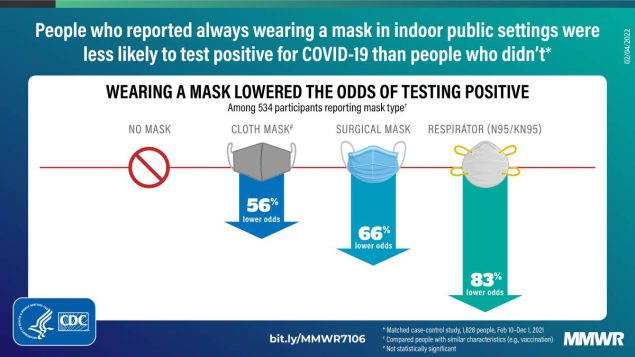
A new study published by the Centers for Disease Control and Prevention (CDC) supposedly shows that wearing a face mask in public places dramatically reduces your risk of catching COVID-19. The CDC summed up the results in a widely shared graphic that says wearing a cloth mask “lowered the odds of testing positive” by 56 percent, while the risk reduction was 66 percent for surgical masks and 83 percent for N95 or KN95 respirators.
If you read the tiny footnotes, you will see that the result for cloth masks was not statistically significant. So even on its face, this study, which was published in the CDC’s Morbidity and Mortality Weekly Report on Friday, did not validate the protective effect of the most commonly used face coverings—a striking fact that the authors do not mention until the end of the sixth paragraph. And once you delve into the details of the study, it becomes clear that the results for surgical masks and N95s, while statistically significant, do not actually demonstrate a cause-and-effect relationship, contrary to the way the CDC is framing them.
-
Wisconsin Right Now posted on Facebook:
We have a new article posted on https://www.wisconsinrightnow.com/ that deals with an issue that is being censored. Since we are already on super-secret double probation and have been threatened with the complete removal of our pages and profiles for our coverage of the KR trial, we have chosen not to share the story on FB.
The article is from Stephanie Soucek:
“We had to do this! It was life or death!” He took the first dose and started to feel better within a few hours.
As we look around the world and even right here in the United States of America, it is clear that there has been an overall effort to take away our freedoms under the guise of keeping us safe. When it comes to COVID, only the government-sanctioned experts know best—even though they’ve been wrong and flip-flopped many times the past two years. One could easily argue that more harm than good has been done by restricting our freedoms in order to “keep us safe.”
It is alarming when debate about what treatments work best is shut down and the government will decide what doctors and “science” you should trust and listen to. alternative COVID treatments including inexpensive repurposed drugs like Ivermectin and hydroxychloroquine that have been approved for human use by the FDA for decades have been suppressed and made difficult to obtain for the purposes of treating COVID.
And expensive treatments like Remdesivir are pushed as one of the only drugs used for the treatment for COVID. Yet in November 2020 the WHO came out with a study claiming Remdesivir should not be used to treat COVID patients in hospitals because it was ineffective.
According to an article from NBC News: “In light of the interim data from the WHO’s ‘Solidarity’ trial — which included data from more than 11,200 people in 30 countries — “remdesivir is now classified as a drug you should not use routinely in Covid-19 patients,” the president of the European Society of Intensive Care Medicine, Jozef Kesecioglu, said in an interview with Reuters.” Yet it’s the main drug still being pushed by the CDC and many hospitals in the US today. Why?
I suppose nothing has disturbed me more than hearing about the first-hand accounts of patients being refused alternative COVID treatments they request, even after being told by the hospital that nothing else can be done for them and they will likely die. On top of that, some of these hospitals have refused to release patients when they or their families request to be released in order to get a second opinion or alternative COVID treatments somewhere else. Second opinions have saved people’s lives at times and a patient has the right to get a second opinion or try another treatment in order to potentially save their lives.
There are stories right here in Wisconsin of families who have suffered because of hospital protocols. One such story comes from a woman who shared the heartbreaking story of her husband, who died last year at the age of 55 after being admitted into a Milwaukee area hospital. Out of respect for her family’s privacy she asked to remain anonymous. Her husband became sick in late September 2021 and tested positive for Covid shortly after.
After about a week of not getting better on his own she took her husband to the hospital. Shortly after being admitted his oxygen levels dropped and he was transferred to the ICU. She says she was unable to go into the hospital to be with him during this time and the communication between her and the hospital was poor. He was given 4 treatments of Remdesivir before his liver started being negatively affected. She requested they stop using Remdesivir and try other potential alternative COVID treatments such as ivermectin, hydroxychloroquine, and monoclonal antibodies but was told that wasn’t allowed because of hospital protocol (based on the CDC guidance).
She says once she became power of attorney she requested to have a meeting of care for her husband but the doctor refused. They continued with four more treatments of Remdesivir. A little more than a week after being admitted to the ICU he was put on a ventilator. His kidneys were failing, which is a potential side-effect of Remdesivir. Disagreements occurred among doctors about whether or not he should be transferred and he ended up being transferred to another hospital and sadly died the next day.
She believes (with good reason) that treating him with Remdesivir and the hospital not being willing to try alternative COVID treatments is what truly took his life. She hopes telling her husband‘s story will help raise awareness and help other people avoid similar tragedies.
Another woman I talked to named Debbie tells the story of her father who was diagnosed with Covid and Pneumonia last year December. He wasn’t doing well so he was admitted into a hospital in northeast Wisconsin where he was sent to the ICU and put on oxygen, plus they started treating him with Remdesivir.
He started to get worse and the family was told he would likely need to be put on a ventilator soon. The family was distraught and thought he would likely die based on everything happening. They asked to stop treatment of Remdesivir and asked if the hospital could try an alternative COVID treatment like Azithromycin with Ivermectin. The family was told it wasn’t approved and it doesn’t work.
But this family was desperate and decided to get a prescription for ivermectin along with a Z pack from a doctor in Michigan. They couldn’t get the prescription filled initially because the pharmacy they went to refused, so thankfully they found a pharmacy out of town that would fill it.
They ended up hiding the treatment for her dad with some of his belongings they sent into the hospital. When recalling what they did Debbie’s words were “We had to do this! It was life or death!” He took the first dose and started to feel better within a few hours. He took a second dose the next day and within 24 hours his oxygen levels were improving and he was ready to go home within days of taking the treatment and was home by Christmas.
The family strongly believes that had they not given him the treatment they snuck into the hospital he likely would have died. How sad that they had to hide what they were doing because the hospital refused to allow this type of treatment.
As I am writing this article, two men on ventilators—Daniel Pisano, 70, in Florida and Stephen Judge, 69, in Arizona—died within a day of each other, even as their families were still fighting with hospitals for the chance to try alternative treatments including Ivermectin.
There are many great healthcare facilities and doctors out there. But there are many other stories like this of families battling hospital protocol over their loved one’s lives.
We have to ask ourselves why isn’t there more of a willingness to try alternative COVID treatments, especially when other efforts have failed? Why are some hospitals ignoring the family‘s wishes and telling them “it’s protocol directed by the CDC” as if there’s no other choice?
Why is our government working with big tech to suppress the voices of doctors, scientists, and others who disagree with certain government protocols, even as those protocols fail at times?
According to an editorial in the Association of American Physicians and Surgeons, “The CARES Act provides incentives for hospitals to use treatments dictated solely by the federal government under the auspices of the NIH, providing hospitals with bonus incentive payments for all things related to COVID-19 (testing, diagnosing, admitting to hospital, use of remdesivir and ventilators, reporting COVID-19 deaths, and vaccinations) and (2) waivers of customary and long-standing patient rights by the Centers for Medicare and Medicaid Services (CMS).”
We have to ask ourselves why these incentives were put in place.
Thomas Jefferson once said, “Every government degenerates when trusted to the rulers of the people alone. The people themselves, therefore, are it’s only safe depositories.” We should not be putting such blind faith in what our government or big tech tells us is right. Our government has too much control over what we can watch and listen to, what we must inject into our bodies, and what type of treatments we are allowed to use even if our own doctors disagree with the government’s protocols.
I wonder how many lives could have been saved if alternative COVID treatments and information weren’t being suppressed. We must demand more transparency and accountability from our government, and we must fight for our liberties before it’s too late.
You don’t have to believe anything you just read to ask the question of why the government is handling COVID as it is. -
Remember this?
The Hill:
The United States economy added more than 7 million jobs over the last 12 months for the first time in history. Wages are rising, the national gross domestic product is booming, and the end of the pandemic appears just around the corner after the vast majority of Americans opted to take the safe and effective vaccines created by American scientists.
(See today’s 6 a.m. post for the correct description of that jobs number.)
But Americans aren’t feeling it. In fact, they are in a historically bad mood, about the country, about their leaders and about their own lives.
For nearly two decades, more Americans have said the country is on the wrong track than heading in the right direction. More than half the country has said the country is moving in the wrong track in every Gallup poll since December 2003.
Since George W. Bush won reelection in 2004, Americans have disapproved of a president’s job performance more than they approve in 142 of 203 months, according to those same Gallup polls.
Blame hyperpartisan politics, which have cut into any president’s chances of building a multiparty coalition. Blame the Great Recession, which continues to exert its influence over everything from our outlook on the economy to child fertility rates. Blame rising gas prices and inflation, which dampens any gleam of hope that might come from low unemployment rates and a jobs bonanza.
And, most obviously, blame a pandemic that has killed nearly a million Americans, shuttered schools and businesses and left a frustrated and angry populace.
“We’re pushing a million deaths and the total disruption of our existence first with a president who denied it and secondly with a president who’s had difficulty communicating where we are and where we’re headed,” said Lee Miringoff, who runs polling at Marist College. “It’s made for a lot of dissatisfaction and frustration.”
The result is a population that is unsatisfied not just with politics, but with life. Data from the General Social Survey (GSS), conducted by the National Opinion Research Center, found that for the first time in 2021, more Americans said they were not too happy than the share who said they were very happy.
As recently as 2018, twice as many Americans said we were very happy than those who said they were not too happy, a trend that stretches back to the GSS’s earliest work in the 1970s.
Fewer Americans say they are living an exciting life, too. Just 36 percent called their lives exciting, according to the latest GSS data, the lowest figure ever recorded and down from 49 percent three years ago. Meanwhile, 59 percent said their lives were routine, the highest that share has ever been and the first time since 1991 that more than half of Americans have described themselves that way.
A recent Gallup survey found just 69 percent of Americans are satisfied with their overall quality of life, down 15 points from 2020. Only 1 in 5 Americans are satisfied with the moral and ethical climate of the nation. The share who are satisfied with the state of the economy dropped 25 points between 2020 and 2021, and another 10 points over the last year.
“There may be not a lot to be happy about,” said Jeffrey Jones, a senior editor at Gallup. “It’s kind of hard to see the bright side.”
Today’s bleak outlook is fueling pessimism in tomorrow, as well. Just 49 percent of Americans said they were generally more optimistic about what is ahead for the world in 2022, compared with 47 percent who said they were more pessimistic, according to a Marist College poll released in December.
In recent years, the share who were more optimistic than pessimistic has hovered around or just below 60 percent.
“We feel like we’re sliding backwards in so many ways,” Miringoff said. “Sliding backwards does not make for a happy people.”
American voters almost always take out their frustrations on the party in power, especially when that party’s leader, the president, is not on the ballot.
There are a thousand caveats about money and strategy and the candidates who will stand for office in this year’s midterm elections, but the historical record is unambiguous: The last time a president’s party gained seats in a midterm election, in 2002, twice as many Americans reported being very happy as not too happy, half thought the country was on the right track, and Bush’s approval rating was in the 60s.
Now, after so long in the doldrums, there is virtually nothing a president — or, for that matter, the opposition — can do to snap America out of its pessimistic streak.
Getting America back to a positive outlook “is usually a slower process,” Jones said. “The record would suggest probably not a lot is going to change.”
Certainly not with this administration. Nor with a future Trump administration 2.0. The Democratic Party is hopeless and should never be allowed to govern at any level again, but the Republican Party needs to move past Trump (who even in the unlikely event he got elected in 2024 would only result in a four-year presidential election campaign in all parties) and find the correct leader for our times.
How did Carter’s “malaise” speech work out?
-
Tim Nerenz:
78 economists’ forecasts make up the “consensus” forecast for job growth each month, and the January consensus forecast was +125,000.
A few days ago, ADP’s payroll print surprised the consensus with a net loss of 301,000 jobs, influenced by supply chain disruptions, Omicron business interruption, and termination of unvaccinated employees not factored into the forecasts.
But then [Friday], the government (Bureau of Labor Statistics) reported a huge gain of 476,000 jobs in January – a 3 sigma deviation from consensus and twice the number of the highest forecast. The financial press describes the reaction of analysts as “gobsmacked”. It takes quite a bit to smack the gobs of professional market manipulators; kudos, BLS.
But wait…there’s more; they also retroactively added 709,000 jobs to November and December prints. Where did those jobs come from? By re-allocating previously claimed gains from the “it’s working” months of April, May and June. “It” gets to work twice, apparently. Who knew?
When pressed by the gobsmacked financial publication reporters, BLS explained that the miracle 467k January bump resulted from “adjustments” to seasonal and annual benchmark parameters in their models; the unadjusted count was a LOSS of 2.8 million jobs in January, or so they say.
Wait, what? Are the Packers’ special teams filling in at Dept. of Labor for its vax-terminated and Omicron-sheltered stat jockeys? And where do I find the seasonal adjustment knobs on my bathroom scale, sleep number bed, and fit-bit?
In meteorological terms, January payroll counts show a temperature of 30 below but BLS came up with a balmy 48 wind chill index. Do you put on the parka, chook, and swampers or just throw on a hoodie to take the dog out for a squirt? Your dog will figure out who got it right in a minute, but dogs don’t tweet.
BLS tweaking their model parameters is not new or particularly newsworthy; it happens every year. This administration has made two that are historically unprecedented, removing jobs for January of 2021 and creating jobs for January 2022. The year over year results will be fodder for the mememeisters in memistan – my newsfeed is filling up already.
 Why should you believe ADP and not BLS? If ADP is proven long, it loses business. What do the BLS bureaucrats lose by having their statistical fudging exposed? Certainly not their jobs
 -
Matt Taibbi
The Gallup agency released a picture of the comet that is the Joe Biden presidency on its first anniversary. This is what a one-year, 14-point party affiliation swing looks like:

The pollsters put the numbers in context:
Both the nine-point Democratic advantage in the first quarter and the five-point Republican edge in the fourth quarter are among the largest Gallup has measured for each party in any quarter since it began regularly measuring party identification and leaning in 1991.
How great was life for Joe Biden a year ago? MSNBC’s John Heilemann compared him to Lincoln; PBS White House correspondent Yamiche Alcindor said the return of the Democrats “felt like we are being rescued from the craziness and now here are the superheroes to come and save us all”; Rachel Maddow went through “half a box of Kleenex” in joy; even Chris Wallace on Fox said Biden’s half-coherent inauguration speech was “the best inaugural address I ever heard,” JFK’s iconic “Ask Not” included.
Biden looks bad. During the campaign, when he was challenging strangers to pushup contests and doing sternum-pokes in crowds while nervous aides bit their lips, you could make the argument he was merely in steep mental decline, which was okay. Against Trump the standard of “technically alive” worked for a lot of voters. Biden now looks like a man deep into the peeing-on-houseplants stage, and every appearance is an adventure.
He might say, “Even Dr. King’s assassination did not have the worldwide impact that George Floyd’s death did,” or repeat his evolving fantasy about getting arrested with Nelson Mandela (who according to the president also later came to Washington to say, “You got arrested trying to see me!”), or let it slip that aides are shielding him from all news (a logical takeaway from his “Let’s Go Brandon, I agree” Christmas moment). Or, he might just collapse into syllable-piles before casting around in fright, like this gut-wrenching “Where’s Tim?” scene:
It’s reached the point where MSNBC is permitting guests like Donny Deutsch to say things like, “He seems old.” In a panic, Party spokestool Paul Begala went on the network this week to deliver a real-life version of the old Mel Brooks “the peasants are revolting” joke, saying “the problem for the Democrats… is not that they have bad leaders. They have bad followers.”
-
The Omicron surge has triggered a mutation in the conventional wisdom about Covid-19. The virus “is here to stay,” oncologist Ezekiel Emanuel and two other experts who advised the Biden transition proclaimed in a Jan. 6 article for the Journal of the American Medical Association, “A National Strategy for the ‘New Normal’ of Life With Covid.” That means no more “perpetual state of emergency”: “The goal for the ‘new normal’ . . . does not include eradication or elimination.”
Joseph Ladapo reached the same conclusion almost two years earlier. “Please don’t believe politicians who say we can control this with a few weeks of shutdown,” Dr. Ladapo, then a professor at UCLA’s medical school and a clinician on Covid’s frontline, wrote in USA Today on March 24, 2020. “To contain a virus with shutdowns, you must either go big, which is what China did, or you don’t go at all. . . . Here is my prescription for local and state leaders: Keep shutdowns short, keep the economy going, keep schools in session, keep jobs intact, and focus single-mindedly on building the capacity we need to survive this into our health care system.”
“That was before it became political,” Dr. Ladapo, 43, says in an interview conducted in person, indoors and unmasked. An orthodoxy soon hardened in the medical establishment and most of the media. He says his UCLA faculty colleagues’ reactions to his commentaries went from “Thanks, Joe, for providing us another perspective” to “How can we make Joe stop writing?” He believes USA Today “would never have published anything along that vein later in the pandemic.” But the Journal would: Since April 2020, I have accepted a dozen of Dr. Ladapo’s articles for these pages. One of them, in September 2020, was headlined “How to Live With Covid, Not for It.”
As policy makers’ views began to converge with Dr. Ladapo’s, he became a policy maker. His writings caught the attention of Florida Gov. Ron DeSantis, who in September 2021 appointed him surgeon general, the state’s top health official. “It’s fun that I’m sitting here because of you,” Dr. Ladapo tells me—though he’s also sitting here because Mr. DeSantis had been quicker than most politicians to see the folly of lockdowns and the necessity of living with Covid.
The governor declared a state of emergency in early March 2020, followed in April by the first in a series of executive orders reopening the state. Restaurants, bars, gyms and movie theaters were back in business by June 2020, and public schools were in session that fall. In May 2021 Mr. DeSantis suspended all local Covid-19 restrictions, including mask mandates, and signed legislation ending them permanently. Last summer’s Delta wave hit Florida hard, but the Sunshine State imposed no new restrictions. The state became a punching bag for journalists and other enthusiasts for harsh Covid policies. The hashtag #DeathSantis periodically trended on Twitter.
In Florida as elsewhere, Omicron has brought an unprecedented explosion in reported cases but a considerably smaller increase in severe ones. “It’s been really a blessing that the Omicron variant is less virulent,” Dr. Ladapo says, though he cautions: “We don’t know what’s around the corner, because these case counts are still very high.” Florida recorded an average of 65,551 cases a day for the week ending Jan. 12, up 165% from the Delta wave’s August peak. But hospitalizations of Covid-positive patients, at 10,526, were 41% lower than the August high.
One way to bring the case count down is by testing fewer people. “Historically in public health, for respiratory viruses in the general population, we consider ‘cases’ to be people who have symptoms, not a PCR test,” Dr. Ladapo says. “But during the pandemic, you can have a positive PCR and be completely healthy but be considered a case and be required to behave like a case, which is to isolate and those types of things.”
On Jan. 6 Dr. Ladapo issued guidance that only people who have Covid symptoms and a risk factor (old age, certain diseases, or current or recent pregnancy) “should” get tested. Those with symptoms but no risk factors are advised to “consider” a test. For the asymptomatic, the guidance discourages testing, saying it “is unlikely to have any clinical benefits.”
“A test is most valuable when it’s most likely to lead to a change in a decision, a change in management,” he says. “I mean, that’s so basic.” To keep hospitalizations down, he adds, the state has made clear “that we expect clinicians to treat patients with risk factors” using therapies including monoclonal antibodies, new antivirals from Pfizer and Merck, and fluvoxamine and inhaled budesonide, two medications that have shown promise in off-label use against Covid-19.
He describes the asymptomatic as “a very special group, because this group—you can’t feel any better than not having symptoms. So this group can only be harmed from treatment”—not to mention the “personal downside to them” of being expected to isolate.
-
It is startling when two speeches within 24 hours, neither much heralded in advance—the second wouldn’t even have been given without the first—leave you knowing you have witnessed a seminal moment in the history of an administration, but it happened this week. The president’s Tuesday speech in Atlanta, on voting rights, was a disaster for him. By the end of Senate Minority Leader Mitch McConnell’s answering speech on Wednesday you knew some new break point had occurred, that President Biden might have thought he was just crooning to part of his base but the repercussions were greater than that; he was breaking in some new way with others—and didn’t know it. It is poor political practice when you fail to guess the effects of your actions. He meant to mollify an important constituency but instead he filled his opponents with honest indignation and, I suspect, encouraged in that fractured group some new unity.
The speech itself was aggressive, intemperate, not only offensive but meant to offend. It seemed prepared by people who think there is only the Democratic Party in America, that’s it, everyone else is an outsider who can be disparaged. It was a mistake on so many levels. Presidents more than others in politics have to maintain an even strain, as astronauts used to say. If a president is rhetorically manipulative and divisive on a voting-rights bill it undercuts what he’s trying to establish the next day on Covid and the economy. The over-the-top language of the speech made him seem more emotional, less competent. The portentousness—“In our lives and . . . the life of our nation, there are moments so stark that they divide all that came before them from everything that followed. They stop time”—made him appear incapable of understanding how the majority of Americans understand our own nation’s history and the vast array of its challenges
By the end he looked like a man operating apart from the American conversation, not at its center. This can be fatal to a presidency.
He was hardly done speaking when a new Quinnipiac poll showed the usual low Biden numbers, but, most pertinently, that 49% of respondents say he is doing more to divide the country, and only 42% see him as unifying it.
In the speech Mr. Biden claimed he stands against “the forces in America that value power over principle.” Last year Georgia elected two Democratic senators. “And what’s been the reaction of Republicans in Georgia? Choose the wrong way, the undemocratic way. To them, too many people voting in a democracy is a problem.” They want to “suppress the right to vote.” They want to “subvert the election.
This is “Jim Crow 2.0,” it’s “insidious,” it’s “the kind of power you see in totalitarian states, not in democracies.”
The problem is greater than Georgia. “The United States Senate . . . has been rendered a shell of its former self.” Its rules must be changed. “The filibuster is not used by Republicans to bring the Senate together but to pull it further apart. The filibuster has been weaponized and abused.” Senators will now “declare where they stand, not just for the moment, but for the ages.”
Most wince-inducing: “Will you stand against election subversion? Yes or no? . . . Do you want to be on the side of Dr. King or George Wallace ? Do you want to be on the side of John Lewis or Bull Connor ? Do you want to be on the side of Abraham Lincoln or Jefferson Davis?”
If a speech can be full of itself this speech was.
From the floor of the Senate the next day came Mr. McConnell’s rebuke. It was stinging, indignant to the point of seething. He didn’t attempt to scale any rhetorical heights. The plainness of his language was ferocious.
Mr. Biden’s speech was “profoundly unpresidential,” “deliberately divisive” and “designed to pull our country further apart.” “I have known, liked and personally respected Joe Biden for many years. I did not recognize the man at the podium yesterday.” Mr. Biden had entered office calling on Americans to stop the shouting and lower the temperature. “Yesterday, he called millions of Americans his domestic ‘enemies.’ ” That, a week after he “gave a January 6th lecture about not stoking political violence.”
“Twelve months ago, this president said that ‘disagreement must not lead to disunion.’ But yesterday, he invoked the bloody disunion of the Civil War to demonize Americans who disagree with him. He compared a bipartisan majority of senators to literal traitors.”
“Twelve months ago, the president said that ‘politics need not be a raging fire destroying everything in its path.’ . . . Yesterday he poured a giant can of gasoline on that fire.”
“In less than a year, ‘restoring the soul of America’ has become: Agree with me, or you’re a bigot.”
“This inflammatory rhetoric was not an attempt to persuade skeptical Democratic or Republican senators. In fact, you could not invent a better advertisement for the legislative filibuster than a president abandoning rational persuasion for pure demagoguery.”
American voters, said Mr. McConnell, “did not give President Biden a mandate for very much.” They didn’t give him big majorities in Congress. But they did arguably give him a mandate to bridge a divided country. “It is the one job citizens actually hired him to do.” He has failed to do it
Then Mr. McConnell looked at Mr. Biden’s specific claims regarding state voting laws. “The sitting president of the United States of America compared American states to ‘totalitarian states.’ He said our country will be an ‘autocracy’ if he does not get his way.” The world has now seen an American president “propagandize against his own country to a degree that would have made Pravda blush.”
-
There’s no reason for Kamala Harris to participate any longer in the failing presidency of Joe Biden. If she chooses to assert her constitutional authority and seeks to build a majority political coalition, she can unify the country, ensure American prosperity and win election to the presidency in 2024. Starting today she can simply decide unilaterally to dominate policy-making in what’s left of the Biden era.
This week brings more reports of her struggle to add value to Team Biden. But this team is losing and she can best help the country and herself by entering the political equivalent of the NCAA transfer portal.
Recent polling finds that Americans increasingly view President Biden as incompetent, untrustworthy, and partisan. His hateful and dishonest rhetoric this week on the subject of voting laws gives voters no reason to alter their views.
As Senate Minority Leader Mitch McConnell (R., Ky.) ably described the problem on Wednesday:
Twelve months ago, a newly-inaugurated President Biden stood on the West Front of the Capitol and said this: “My whole soul is in this: bringing America together, uniting our people, and uniting our nation.” Yesterday, the same man delivered a deliberately divisive speech that was designed to pull our country farther apart
Twelve months ago, this President said we should “see each other not as adversaries, but as neighbors.” Yesterday, he called millions of Americans his domestic “enemies.”
…Twelve months ago, this President said that “disagreement must not lead to disunion.” But, yesterday, he invoked the bloody disunion of the Civil War to demonize Americans who disagree with him. He compared a bipartisan majority of Senators to literal traitors…
He used the phrase “Jim Crow 2.0” to demagogue a law that makes the franchise more accessible than in his own state of Delaware. He blasted Georgia’s procedures regarding local elections officials while pushing national legislation with almost identical language on that issue.
The President implied things like widely-popular voter I.D. laws are “totalitarian” on the same day Washington D.C.’s Democratic mayor told citizens to bring both a photo I.D. and a vaccine card anytime they leave their house.
The President repeatedly invoked the January 6th riot while himself using irresponsible, delegitimizing rhetoric that undermines our democracy.
The sitting President of the United States of America compared American states to “totalitarian states”. He said our country will be an “autocracy” if he does not get his way.
The world saw our sitting Commander-in-Chief propagandize against his own country to a degree that would have made Pravda blush.
Vice President Harris has also engaged in destructive rhetoric and she may even believe it, but she enjoys a historic political opportunity to cast it aside, move toward centrism and sensibility, and be the leader who unites America.
First, she needs to reject the modern Beltway conventions of her office. In yet another press account about efforts to overhaul her role in the Biden administration and her public image, Francesca Chambers of McClatchy reports:
In interviews, 11 people familiar with Harris’ operation — some of whom requested anonymity to speak candidly about private conversations — described the effort to reshape the narrative around her vice presidency. A White House official said that no dramatic shift in direction was underway, even as Harris hired a new communications director and worked to fill other high-level press and public relations positions…
Elaine Kamarck, a senior fellow at the Brookings Institution who was a senior policy adviser to former Vice President Al Gore, said higher visibility could help with public criticism, but Harris is supposed to be “invisible.” If Harris draws more attention to herself, Kamarck said, she could jeopardize her relationship with Biden and make him look weak.
“I think that there’s been a profound misunderstanding — and it comes from some of her supporters as well as from some of her critics — about what this job is,” Kamarck said.
Kamarck said Harris backers who thought the job would be different because she is the first woman and person of color to hold the position were mistaken.
“Things are not going to be different about the job itself,” Kamarck said. “The job is still to support Joe Biden and what Joe Biden does.”
No, it is not. The vice president, who has expressed a refreshing desire to literally spend more time outside of Washington, should also spend more time figuratively standing outside the Beltway. She might wish to reread a New York Sun editorial from November:
Could Kamala Harris become a truly radical vice president, meaning one who would restore the highest office in the Senate to its original constitutional concept? We ask because of the reports that the relationship between her and President Biden has collapsed…
Our own suggestion is that Ms. Harris should quit. We don’t mean that she should resign the vice presidency. On the contrary, she should quit the White House. The thing for her to remember is that — constitutionally — the vice president doesn’t report to the president. The vice president can’t be fired by the president. She can’t even be told what to do. She was elected in her own right.
The fact is that in some technical sense it’s not clear whether she is even part of the executive branch. We grasp that there are differences of opinion on this head. Her one constitutional assignment, though, is as president of the Senate, where she has the not-so-insignificant power to break ties. One would think that in a divided Senate in which each party has 50 seats, she could make quite an impact.
So the logic, in our view, is for her to pack up her desk in the Executive Office Building and the other desk in the West Wing, pick up her brief case, get in her limo, and go to the Senate. It happens that one of the stateliest offices in Washington, known as the vice president’s room, is always there for her. She could then send a note to Mr. Biden (and the newspapers) letting them know that she’s moved her base of operations.
Observing how poorly voters have reacted to Mr. Biden’s effort to govern from the left, Ms. Harris should recognize the power she holds to move Washington lawmaking toward the center. By putting her vote in play she can take the leading role in fashioning federal legislation. Leave Mr. Biden the chore of trying to run all the dysfunctional programs already enacted and take over the fun job of deciding what gets enacted next week.
She could not be dismissed by fellow Democrats as an ambassador from Trump country. Ms. Harris’s history as a politician of the left from deep-blue California would give her the leverage to break the progressive left’s disastrous lock on Democratic policy-making and poisonous anti-American rhetoric.
And she wouldn’t need to move all that far toward the center to appear reasonable and become formidable as a 2024 contender. Stop pretending that voter ID requirements amount to tyranny. Stop trying to tear up the structure and traditions of American governance. Stop casting political opponents as enemies. Stop trying to enact a Sandernista revolution in the U.S. economy.
It’s really not that hard picturing Kamala Harris as the most powerful person in the country. Perhaps some people already do. Andrew Mark Miller reports for Fox News:
President Biden Tuesday referred to his vice president, Kamala Harris, as “President Harris” in yet another verbal flub by the gaffe-prone leader…
Biden, who was speaking about voting rights to students at the Atlanta University Center Consortium on the campus of Clark Atlanta University and Morehouse College, apparently didn’t notice his mistake, not bothering to correct himself.
Mr. Biden could be on to something.
 Steve Prestegard.com: The Presteblog