You might think after the 2010 elections, three rounds of recall elections, and the 2012 elections, Wisconsinites would be sick of politics.
One, however, apparently is not: Reince Priebus, former chair of the Wisconsin Republican Party, and now chair of the national GOP. At the state convention last weekend, Priebus said, according to Wisconsin Report:
“When we talk about the growth and opportunity plan, we’re talking about being a permanent party, a party that understands we’re in permanent politics all the time,” Priebus told the hundreds gathered at the Republican Party of Wisconsin‘s Republican State Convention at the Patriot Center in the Marathon County village of Rothschild.
“The other side is engaged in a permanent, across-the-board campaign that started five years ago and never ended….We are becoming a granular, coast-to coast-operation that will go toe-to-toe and surpass our opponents, but it’s got to start now,” said Priebus, key-note speaker for the weekend event. …
Part of that growth, he said, hinges on changing the presidential nomination process, including halving the number of primary debates – “a travelling circus” – and moving the national convention, where the presidential nominee is officially named, from August to June.
That announcement led Priebus to answer attacks from within the party that he’d become “too establishment.”
“It’s not an establishment takeover; it’s using your head,” the Kenosha native quipped.
The thought that comes to mind is a quote from some wit about most people’s (supposed) attitude about their employer’s management, that they want them to stop managing them. While replacing idiot Democrats with Republicans would be preferable, what would be most preferable is for government to stop trying to run, or ruin, our lives. Politicians are not your friend, whether they have a D or an R after their names. Political parties are not run in your best interests; political parties are run in their best interests.
Why, for instance, should voters choose Republicans when they appear to offer very little different from Democrats? The state budget is now cash-balanced (as opposed to correctly balanced, as in according to Generally Accepted Accounting Principles), but nearly all of Gov. James Doyle’s $2.2 billion tax increase remains in place. The state still buys tens of millions of dollars of land for no reason and no use (the Knowles–Nelson Stewardship Program). Government-employee unions still exist. The job-killing Department of Natural Resources still exists unchanged. State and local governments, all 3,120 of them, still employ far, far, far too many people, and nothing at all has been done to reduce Govzilla’s sucking the marrow out of us Wisconsinites.
Now that a few weeks have passed since the Boston Marathon bombings, it should be clear that, from the failure to catch the brothers planting their bombs before the race to their (probably unconstitutionally) locking Bostonians in their houses (those houses they didn’t raid, that is) to find the one surviving brother, government screwed up much more than it did well. The only people who appear to have done their jobs well are the first responders after the bombs went off. Recall that the surviving brother was caught only after the stay-in-your-homes order was lifted.
The lesson that has been repeated time and again is that politicians, regardless of party, will work to consolidate their power unless they are prevented from doing so. That is why we have a Bill of Rights in the U.S. Constitution. That is why we need a Taxpayer Bill of Rights in the state Constitution. Government does much, much, much, much more to us than for us, particularly in an overgoverned state like Wisconsin.
I posted last week about global climate change and the silliness of trying to predict same, since the meteorologists cannot get even forecasts five days in advance correct.
Mike Smith, a meteorologist, found something interesting:
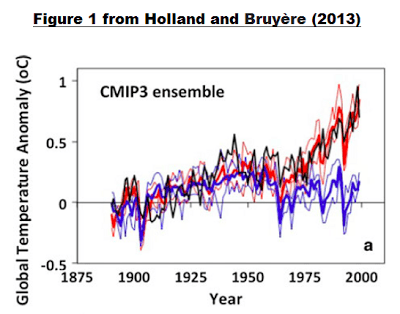
Anthony Watts has an article about a recent paper that purports to tie computer model simulations (what else?) to changes in hurricane intensity. While that is a topic of interest, what struck me was this graph showing actual temperatures (red) for the last 50 years and, in blue, what the climate models hindcast the temperatures to have been if humans had not been adding CO2 to the atmosphere. For the sake of this discussion, let’s assume they are correct.
In the original paper, authors Holland and Bruyere explain their finding that the bulk of human-caused global warming occurred “in the past four decades.” If you view the above graph (the red lines) you see temperatures rise rapidly from about 1970 to 2000 (of course, temperatures have flattened since). According to the authors, had humans not injected so much carbon dioxide into the atmosphere (blue lines), temperatures would have been stable or have fallen slightly.
So, what was the world like in the late 1960’s and 70’s?
Does the word “famine” mean anything to you?
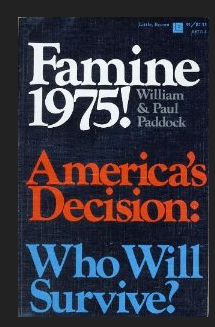
Take a look at two of the best-sellers of that era:
They suggest a system of triage in which the United States must “divide the underdeveloped nations into three categories: 1) Those so hopelessly headed for or in the grip of famine (whether because of overpopulation, agricultural insufficiency, or political ineptness) that our aid will be a waste; these “can’t-be-saved nations” will be ignored and left to their fate; 2) Those who are suffering but who will stagger through without our aid, “the walking wounded”; and 3) Those who can be saved by our help.”
The Paddocks were aware that their policy of abandoning food aid to the “hopeless countries” for example India and Egypt, would lead to an immediate worsening of the situation there, but they wrote “to send food is to throw sand in the ocean.” Using the triage system they hoped to avoid a broader catastrophe and stabilize the global population.
Early editions of The Population Bomb began with the statement:
The battle to feed all of humanity is over. In the 1970s hundreds of millions of people will starve to death in spite of any crash programs embarked upon now. At this late date nothing can prevent a substantial increase in the world death rate…
Much of the book is spent describing the state of the environment and the food security situation, which is described as increasingly dire. Ehrlich argues that as the existing population was not being fed adequately, and as it was growing rapidly it was unreasonable to expect sufficient improvements in food production to feed everyone. He further argued that the growing population placed escalating strains on all aspects of the natural world.
Why were so many starving? Why were the forecasts for more starvation becoming more dire by the year? Because world temperatures had been falling since about 1944 (see graph above). The growing season had shortened to the point that world agriculture could not support the world’s population which, in 1970, was 3.7 billion.
The population of the world today is just over 7 billion. But, “famine” is rarely in the news*. Why? Two reasons: The Green Revolution and the fact that temperatures warmed. The growing season has lengthened to where we can feed the world.
Had temperatures continued to fall, causing the growing seasons to continue to shorten, there would have been starvation on a scale unprecedented in world history. Let that sink in for a moment. Hundreds of millions more people in grinding poverty going to bed hungry every night.
I constantly ask climate scientists, including in articles on this blog,”What is the ideal temperature for humanity?” I never get an answer. One would think this temperature would have been determined, or at least estimated, decades ago. Yet, the “consensus” is we are currently too warm.
What’s that? You say the world still has starving people in it? Smith has an answer:
Of course, there are hungry people in the world but it is not due to a shortage of food. Per capita food production (measured in calories) is more than adequate to feed the world’s population especially if we stop using food grains (corn, for example) for fuel.
Or if countries replace their bad governments with better governments. (Pick your favorite Eastern European country under the late Warsaw Pact.)
Is climate change occurring? Obviously, because climate change has occurred as long as anyone can count. Are human activities contributing to climate change? Human activities change the environment, and that’s pretty necessary for human survival, unless you don’t care about eating. Neither of those statements requires you to be an acolyte of Al Gore or Thomas Friedman, who hypocritically pontificate about the need to starve and bankrupt people to prevent global climate change from the comfort of their five-digit-square-foot houses.
People forget or ignore history. The Industrial Revolution pumped who knows how many tons of unfiltered pollutants into the sky. Earth survived that. Watch any TV show based in Los Angeles in the 1960s or 1970s and you’ll see something less than a clear sky. The American sky is clearer, and American water is cleaner, than other industrialized countries’ air and water. (See: China.) You know what affects the climate the most on Earth? The sun. Read a few of these links for evidence.
The idea that mankind — too many people, people using fossil fuels, and/or people engaged in too much economic activity — is destroying Earth is not only not backed up by evidence, but impugns the credibility of those who make those claims. They’re in it for the power to control others’ lives to fit their own misbegotten ideas of the proper way to live.
One of the most salutary developments in American business is the growth of the microbrewery.
Tom Acitelli explains how the growth of microbrewing proves the converse of the phrase “if you want less something of it, tax it”:
Today there are more than 2,300 breweries in the United States—where beer production is second only to China’s—but it wasn’t long ago that American beer was an international punch line. Embodied by yellowy lagers in aluminum cans, nearly all domestic beer was made by a handful of breweries like Miller and Anheuser-Busch. As recently as 35 years ago, there were fewer than 50 breweries in the whole country, and the fastest-growing type of American beer was light, which Miller introduced in 1975.
The story of the U.S. ascent to the top tier of world beer began in the late 1970s, when brewing was liberated from government taxation and regulation that had held it back since Prohibition.
In 1976, Henry King, a gregarious World War II hero whose favorite drink was a whiskey-based Rob Roy, trained the attention of his U.S. Brewers Association, the industry’s biggest trade group, on Congress. The brewing industry had been trying unsuccessfully for years to get Washington to lower excise taxes on beer produced by smaller brewers.
King was determined to change things. In an impressive feat of bridge-building, he lined up support from the industry’s labor unions as well as its owners. Steelworker and glassworker unions called in favors; the big brewery owners wrote personal checks. These owners, whose excise taxes would remain the same, figured that by helping their smaller brethren, they would ultimately help themselves by inspiring more beer consumption in an American alcohol market suddenly awash with California wines.
Brewer Peter Stroh—whose family name was a mainstay of Midwestern beer—lobbied a fellow Michigander, President Gerald Ford, to sign the bill that King’s efforts finally steered through Congress. H.R. 3605 cut the federal excise tax on beer to $7 from $9 per barrel on the first 60,000 barrels produced, so long as a brewery produced no more than two million barrels annually. (There were few breweries that did, which was another reason King’s association went to bat for the tax cut.)
The tax cut unleashed a revolution in American brewing. Hundreds of smaller breweries began to open across the country selling what came to be called craft beer. But as significant as the numbers was the rise of American brewers and consumers as the industry’s tastemakers. …
Some of the stars of American craft beer, such as Ken Grossman of Sierra Nevada and Sam Calagione at Dogfish Head, got their start with home brewing—an activity that until the late 1970s was illegal in the U.S.
The repeal of Prohibition in 1933 legalized home winemaking, but, because of an oversight, did not legalize home-brewing of beer. Stores that sold supplies for winemaking also sold supplies for making beer at home, and the government did little to enforce the anti-home-brewing law. …
Gradually, though, the secretive home brewers grew bolder. In the 1970s—about when Henry King was lobbying Congress to cut the beer tax—home-brewing clubs in California, where America’s craft-beer revolution began, joined with trade groups representing the winemaking shops that sold home-brewing supplies. They lobbied California Sen. Alan Cranston to introduce legislation legalizing home-brewing at the federal level.
Cranston introduced legislation that was reconciled with a House bill in August 1978. President Carter signed the law that October, and it took effect the following February. Home-brewing of up to 200 gallons a year per household was suddenly permitted.
Following the federal example, state legislatures also began rewriting their bans on home-brewing, and it is legal now in every state except Alabama. The result: Home-brewing took off, helping to spur the movement toward craft beer that had been touched off by the beer tax reduction.
Keep all this in mind the next time you read about a state legislator wanting to increase alcohol taxes. Keep this in mind as well when you read calls for higher taxes, as Acitelli concludes:
The rise of American beer wasn’t an accident. It was spurred by efforts to cut taxes and regulation that unleashed entrepreneurship. Too bad Washington doesn’t raise a toast to that idea more often.
In the 1970s, we were regularly being told to worry about a coming ice age. I can remember reading about it in Weekly Reader. Time magazine ran this story, right, in 1979. Here’s the introduction to a 1978 documentary warning us about it. And here’s a whole boatload of other predictions from the ’70s assuring us that we were facing serious cooling.
Then everything switched. The popular theory was suddenly that we faced global warming. We were told over and over again that the science was settled and decided. The Earth was warming up — and it was the burning of fossil fuels that was responsible. We must change our standard of living and quit using so much energy. …
The only problem is that reality hasn’t matched the predictions. Climate scientists — still wedded to their dear theory — are struggling now to explain why warming isn’t happening as their models predicted.
I don’t have a clue what the climate is going to do. I really don’t. But I do know that the people loudly telling us what’s going to happen have no credibility, as far as I’m concerned. When predictions change this much over a 40-year period, it’s impossible to have confidence in the people making the predictions. …
The world might warm up a bit. It might cool a bit instead. It’ll probably do some of both, if you want my brilliant scientific opinion. There’s not enough data. The current models can’t explain what’s actually happened recently. And despite improvements in our understanding of climate, we’re still theorizing about why certain things happen as they do. The idea that we have an understanding of how to predict what’s going to happen (and why) is looking pretty foolish right now.
What’s worse is that these people want us to reorder the entire world economy on the basis of their clearly flawed predictions. They keep saying, in essence, “Well we were wrong about that … or, well, sorta wrong … but we’ve got it right now.”
On the basis of that, they want us to use the force of government to require everyone on the planet to change how they live. That’s lunacy.
In a normal world, you could call that “lunacy.” In this world, you call it “politics.”
One reason I’m so bullish on Australia is that the nation has a privatized Social Security system called “Superannuation,” with workers setting aside 9 percent of their income in personal retirement accounts (rising to 12 percent by 2020).
Established almost 30 years ago, and made virtually universal about 20 years ago, this system is far superior to the actuarially bankrupt Social Security system in the United States.
Probably the most sobering comparison is to look at a chart of how much private wealth has been created in Superannuation accounts and then look at a chart of the debt that we face for Social Security.
To be blunt, the Aussies are kicking our butts. Their system gets stronger every day and our system generates more red ink every day.
And their system is earning praise from unexpected places. The Center for Retirement Research at Boston College, led by a former Clinton Administration official, is not a right-wing bastion. So it’s noteworthy when it publishes a study praising Superannuation.
Australia’s retirement income system is regarded by some as among the best in the world. It has achieved high individual saving rates and broad coverage at reasonably low cost to the government.
Since I wrote my dissertation on Australia’s system, I can say with confidence that the author is not exaggerating. It’s a very good role model, for reasons I’ve previously discussed.
Mitt Romney’s secretly recorded comment that 47 percent of Americans are “dependent on the government” and “believe they are victims” isn’t the only reason he lost the presidential campaign. But the candidate himself acknowledged after the election that the comments were “very harmful.”
He added, “What I said is not what I believe.”
But many Republicans still believe it, and the “makers vs. takers” theme has a deep hold on the party. In private conversations, many in the GOP are whispering that Romney was right and that his only mistake was saying it out loud.
I can’t tell you how many times I’ve heard people say something like, “Well, the half who favor government programs is the half who don’t pay any taxes.”
This is ridiculous — on many levels.
First, the overwhelming majority of those who don’t pay federal income taxes pay a whole variety of other taxes, including state and local taxes, payroll taxes, sales taxes, property taxes, sin taxes and more. They don’t feel excluded from sharing the tax burden just because they don’t pay one particular tax.
It’s also worth noting that these aren’t the people pushing for higher taxes. At Rasmussen Reports, our most recent polling shows that people who make $100,000 or more each year are more supportive of higher taxes than those who make less.
Second, the 47 percent who don’t pay federal income taxes include large chunks of the Republican base. Many senior citizens fall into this category because their primary income is from Social Security. They don’t consider themselves “takers.” They paid money into a Social Security system throughout their working lives and now simply expect the government to honor the promises it made.
Third, low-income Americans aren’t looking for a handout. Among those who are living in poverty, 81 percent agree that work is the best solution to poverty. Most would rather replace welfare programs with a guaranteed minimum-wage job. Sharing the mainstream view, 69 percent of the poor believe that too many Americans are dependent upon the government. …
If they want to seriously compete for middle-class votes, Republicans need to get over the makers vs. takers mentality. We live in a time when just 35 percent believe the economy is fair to the middle class. Only 41 percent believe it is fair to those who are willing to work hard. Those problems are not created by the poor.
GOP candidates would be well advised to shift their focus from attacking the poor to going after those who are really dependent upon government — the Political Class, the crony capitalists, the megabanks and other recipients of corporate welfare.
Now that the second of the two Boston Marathon bombers has been captured …
… it’s time to evaluate.
That begins with law enforcement and intelligence, from Steve Spingola:
As far as the lock down, call it 20/20 hindsight, but the tactic itself may have actually helped the suspect elude capture, as thousands of eyes remained inside. Ironically, once the “stay sheltered” ban was lifted, a set of eyes observed something suspicious. Plus, this tactic sends a message to other wannabe Jihadists that they can shutter an entire metro area with a few pressure cookers.
Certainly, the boots to the ground teams on the street did an outstanding job. However, I think this case merits a thorough, top-to-bottom policy review. Once again, all the intelligence fusion centers, NSA electronic listening, etc. failed to provide the intelligence needed to prevent the attack. The shoe bomber hopped aboard an airliner undetected; the underwear bomber successfully took a commercial flight, even though he was on the no-fly list (due to his name being misspelled by one letter); while a bombing in Time Square was prevented by a faulty detention device and a vender who had spotted a suspicious SUV. In each of these instances, surveillance—as a method to prevent terror attacks—failed miserably.
So much for sacrificing liberty for security—a doctrine Benjamin Franklin warned against.
Sure, after the fact, video surveillance has proved valuable; although it appears private video footage broke the Boston case open. Moreover, during this investigation Americans learned that suspect #1 traveled overseas for six months, posted strange things on social media, and was red flagged by a foreign government (probably Russia), which asked the FBI to check into his activities. One would have thought suspect #1 would have been one of a hundred individuals fusion center operatives would have kept close tabs on.
So, the question needs to be asked: was the $500 billion our nation has spent since 9/11 to employ over 800,000 people and create a vast electronic intelligence apparatus worth the expense? …
What can the government do to prevent terrorism? Discontinue the surveillance of large swaths of the American populace, 99.999 percent of whom will never commit an act of terror, and, instead, focus our resources on those with a motive. Think about it: how do the surveillance cameras mounted atop traffic control signals on 124th and Burleigh prevent acts of terrorism? Wasting taxpayer dollars to conduct surveillance of Americans diverts resources from the real problem: extremist groups and foreign nationals overstaying student visas that pose a real threat to this nation’s security.
As far as the media, they continue to report that this was the first terror attack since 9/11, which is simply Obama administration propaganda. Ft. Hood was a terrorist attack. As was the case in Boston, Hassan was radicalized from within and took his orders from afar. Classifying Ft. Hood as “work place violence” is akin to claiming that Kim Kardashian’s pregnancy is an immaculate conception.
The Washington Post’s Chris Cillizza evaluates the media:
The events in Boston over the last four days have riveted the nation — and put journalism, the profession that I love, under the microscope. I’ve been thinking about what lessons I can learn as a political reporter from everything that has happened over these last 96 hours. …
1. Better safe than sorry. For all of the things that reporters got right this week, the after-action report will focus on what we got wrong. The reporting that a suspect had been taken into custody on Wednesday became a story of its own, a development that no serious journalist wants to see.
The reality of a news environment driven by Twitter (more on that below), cable television and constantly updating news on the web is that the desire to be first has become all-encompassing. Everyone, of course, still wants to get it right but in the race to be first judgment about being right can get skewed. …
2. Twitter is a reporter’s best friend…until it’s not. I am a big believer in the power of Twitter. I use it daily. I think it has revolutionized journalism (and news consumption generally) in ways we are just now beginning to grapple with and understand. And, as expected, Twitter was the de facto news source for many people — including most journalists not in Boston — this week.
That was a good thing — at times. Twitter helped me understand where the bombs had gone off, sent me to reporters on the ground in Watertown Thursday night and provided images of an empty Boston and the SWAT teams searching for the suspects.
It was a bad thing too. The immediacy of Twitter means that one moment of bad judgment by someone with lots of followers (or even someone without lots of followers) can distort coverage for minutes or hours. …
So, trust but verify.
3. Primary sources matter…: Because of the general dearth of experts on any subject — the Boston bombings included — it’s important to identify the people who really are authoritative sources and give them priority.
So, what the FBI and the Boston police department say (or don’t) matters more than what some random person on Twitter — even one affiliated with a news organization — says or what an anonymous source might tell a reporter on TV. …
Pete stood out by reporting only what he KNEW to be true and making clear that there was plenty he didn’t know. Ditto the Post’s Sari Horwitz and Doug Frantz. (One of the bad tendencies of journalists is an unwillingness to acknowledge what we don’t know. The truth is NO ONE expects us to know everything about every topic.)
Good reporters are the ones who take in all of the incoming — from Twitter, from their own sources, from colleagues — and filter out what doesn’t matter or can’t be proven. “The essence of journalism is the process of selection,” Williams noted in a National Journal profile. He couldn’t be more right. Judgment — knowing what is and isn’t news — is the single most important trait distinguishing good reporters from the rest of the pack.
By the way: Never love your job, because your job does not love you.
Speaking of the media, Thomas Friedman, the New York Times’ biggest waste of space not named Paul Krugman, should learn that sometimes he should stop at his column’s first half-sentence …
Until we fully understand what turned two brothers who allegedly perpetrated the Boston Marathon bombings into murderers, it is hard to make any policy recommendation …
… instead of proving his own point with several hundred words of irrelevancies, illogic (a carbon tax has exactly what to do with Chechen terrorists?) and plain stupid ideas (see “carbon tax”).
Jonah Goldberg makes infinitely more sense:
… we now live in a climate where there’s a ghoulish appetite to transform every act of terror and murder into a useful plot point in a political narrative. This is a bipartisan phenomenon, and while I think you could make the case that the Left is worse (in fact, I will in just a minute), it’s silly to deny that we don’t do the same thing.
Moreover, given where we are as a country, it is unavoidable. This sort of thing is too seductive. The Left desperately wants every terrorist attack to be conducted by Rush Limbaugh’s biggest fan, so it’s impossible not to cheer when the Left is disappointed. And given the outrageous double standards that the Left — and the elite “responsible” media — use to demonize the Right, the urge to throw it back their face is irresistible. …
The Left likes to claim that conservatives want these terrorist incidents to turn out to be al-Qaeda attacks in order to justify an often-bigoted “war on terror” narrative, which in turn fuels the military-industrial complex, imperialism, and meat-eating, or something like that. And at the margins there is some of that on the right. Some folks are eager, for one reason or another, to see the Muslim world as a monolithic threat, more powerful and sophisticated than it is.
But here’s the thing. Al-Qaeda exists. The Muslim Brotherhood exists. Islamist terrorism exists. We know this because these people keep trying to kill us — often successfully. Moreover, they clarify things by admitting it. They say things like, “Hey, you guys! We the Islamist terrorists are trying to kill you! We will remind you about this every 15 minutes until you are dead, converts, or slaves.”
I’m paraphrasing, but you get the point. These are not literary interpretations or academic exaggerations of the sort that cause people to think that football is a crypto-fascist metaphor of nuclear war. …
Islamic terrorism is not some subtext, discernible with the sort of magic decoder ring that they give out in English departments. It’s the text, found in weekly, if not daily, headlines. So sure, sometimes people on the right might exaggerate the threat from Islamist terrorism, but it is a wholly understandable exaggeration. You can only exaggerate the truth, you cannot exaggerate a lie. An exaggerated lie is simply an even bigger lie. …
The reason why most Muslim or developing-world terrorists are treated as representative of something larger is that, wait for it, they are representative of something larger. And to the extent white non-Muslim terrorists are usually cast as lone wolves, the reason is: That is what they are.
And, as far as I can tell, those white guys that are part of larger conspiracies, ideologies, and religions are pretty much always associated with them. In fact, there’s far more evidence that lone wolves who don’t have such associations are routinely cast by the media — and certainly by people like [Slate’s David] Sirota — as if they do. Jared Loughner was a deranged isolated individual. That didn’t stop the Left from immediately associating him with the tea parties, Sarah Palin, etc. (By the way, have they found Sarah Palin’s Facebook map of Chechnya yet?) Timothy McVeigh is still treated as a leader of the militia movement, even though he didn’t belong to any militia movement. And President Clinton was perfectly happy to associate mainstream conservatives with McVeigh.
This is an old and truly disgusting game for Democrats. FDR played it relentlessly. Going so far as to claim — in a State of the Union message! — that anyone who wanted to restore the “normalcy” — i.e. peace, prosperity, and liberty — of the 1920s under Republicans was in fact seeking to install the very fascism we were fighting abroad. Lyndon Johnson and the mainstream media did everything but declare Barry Goldwater a Nazi on national television. Oh wait, they pretty much did that too.
In many ways this is a replay of the smug anti-American asininity of the Left during the Cold War. The idea that the Soviet Union was a threat was often treated as a paranoid delusion, while the “real” threat from the domestic American right was a grave danger. Hitler was dead. Germany and Japan were U.S. allies. But Communism, which was killing and enslaving hundreds of millions before our eyes, just wasn’t something to get worked up about — at least not compared with the super-scary John Birch Society.
Proving the maxim about stopped clocks being right once (digital) or twice (analog) a day, the Daily Caller reports:
On HBO’s “Real Time” on Friday night, host Bill Maher entertained CSU-San Bernardino professor Brian Levin, director of the Center for Study of Hate and Extremism, who maintained that despite the events in recent days, religious extremism isn’t only a product of Islam.
But Maher took issue with that claim, calling it “liberal bullshit” and said there was no comparison.
“You know what, yeah, yeah,” Maher said. “You know what — that’s liberal bullshit right there … they’re not as dangerous. I mean there’s only one faith, for example, that kills you or wants to kill you if you draw a bad cartoon of the prophet. There’s only one faith that kills you or wants to kill you if you renounce the faith. An ex-Muslim is a very dangerous thing. Talk to Salman Rushdie after the show about Christian versus Islam. So you know, I’m just saying let’s keep it real.” …
“I am not an Islamophobe,” Maher replied. “I am a truth lover. All religious are not alike. As many people have pointed out — ‘The Book of Mormon,’ did you see the show? … OK, can you imagine if they did ‘The Book of Islam?’ Could they do that? There’s only one religion that threatens violence and carries it out for things like that. Could they do “The Book of Islam” on Broadway? …
“Now, obviously, most Muslim people are not terrorists. But ask most Muslim people in the world, if you insult the prophet, do you have what’s coming to you? It’s more than just a fringe element.”
Then, shortly after 11:30 this morning, Ruslan Tsarni, an uncle of the two suspects, stepped out of his house in Maryland and delivered an extraordinary message about character, shame, and collective responsibility. …
Tsarni said he was coming out to express condolences to the families of the victims in Boston. He spoke with anguish and specificity about each of the dead. He had nothing to do with the bombings, yet he felt an awful connection to them. He couldn’t imagine, he said, that “the children of my brother would be associated with them.”
Association is a hard thing. The suspects are Tsarni’s nephews. He’s related to them, but he’s also separate from them. “We have not been in touch with that family for a number of years,” he said. …
A reporter asked what might have provoked the violence. “Being losers,” Tsarni shot back. “Hatred to those who were able to settle themselves” in this country. Then Tsarni raised his voice to make a point: “Anything else to do with religion, with Islam—it’s a fraud. It’s a fake.” He went on: “We are Muslims. We are Chechens.” But that didn’t explain his nephews’ violence, he said. “Somebody radicalized them.”
Tsarni tried to explain that his birth family had drifted apart. Speaking of his brother, the father of the two suspects, Tsarni said, “My family has nothing to do with that family.” In fact, he continued, “This family [has] had nothing to do with them for a long, long time.” When a reporter asked why, he refused to say more than, “I just wanted my family [to] be away from them.”
The press wouldn’t let go. “Are you ashamed by what has unfolded?” a reporter asked. “Of course we are ashamed!” Tsarni exclaimed. “They are [the] children of my brother.” But even his brother, he cautioned, “has little influence” on the two young men.
A reporter asked Tsarni how he felt about the United States. Tsarni, his voice rising, declared it the “ideal” country, a microcosm of the “entire world.” He went on: “I respect this country. I love this country—this country which gives a chance to everybody else to be treated as a human being.”
A reporter asked whether the young men had ever been caught up in the fighting in Chechnya. Tsarni spat back, “No! They’ve never been in Chechnya. This has nothing to do with Chechnya. Chechens are different. Chechens are peaceful people.” The young men weren’t even born there, he said. One was born in Dagestan, the other in Kyrgyzstan.
Muslims, Chechens, immigrants, the family, even the parents—it wasn’t fair to hold any of these people responsible. And yet Tsarni couldn’t escape the feeling of collective disgrace. “He put a shame on our family,” he told the reporters. “He put a shame on the entire Chechen ethnicity.”
In the end, Tsarni raised his hands and asked to say one more thing: “Those who suffered, we’re sharing with them, with their grief—and ready just to meet with them, and ready just to bend in front of them, to kneel in front of them, seeking their forgiveness. … In the name of the family, that’s what I say.”
Finally, Iowahawk sums up the week by channeling his inner Billy Joel.
Back in my business magazine days, at the behest of higher management I created a section of the magazine I called “Green Business.”
As you can imagine from the title it had to do with environment-related businesses or green-related business issues. I insisted, however, that the section be about more than jumping on the green fad, that it show how businesses could make more money (as in higher revenues or lower expenses) through “green” things.
Perhaps “green” isn’t a fad, except that the environmental movement keeps damaging its own credibility with hysterical end-of-the-world predictions, such as those chronicled by FreedomWorks around the first Earth Day in 1970:
“Civilization will end within 15 or 30 years unless immediate action is taken against problems facing mankind.” — Harvard biologist George Wald
“We are in an environmental crisis which threatens the survival of this nation, and of the world as a suitable place of human habitation.” — Washington University biologist Barry Commoner
“Man must stop pollution and conserve his resources, not merely to enhance existence but to save the race from intolerable deterioration and possible extinction.” — New York Timeseditorial
“Population will inevitably and completely outstrip whatever small increases in food supplies we make. The death rate will increase until at least 100-200 million people per year will be starving to death during the next ten years.” — Stanford University biologist Paul Ehrlich
“Most of the people who are going to die in the greatest cataclysm in the history of man have already been born… [By 1975] some experts feel that food shortages will have escalated the present level of world hunger and starvation into famines of unbelievable proportions. Other experts, more optimistic, think the ultimate food-population collision will not occur until the decade of the 1980s.” — Paul Ehrlich
“It is already too late to avoid mass starvation,” — Denis Hayes, Chief organizer for Earth Day
“Demographers agree almost unanimously on the following grim timetable: by 1975 widespread famines will begin in India; these will spread by 1990 to include all of India, Pakistan, China and the Near East, Africa. By the year 2000, or conceivably sooner, South and Central America will exist under famine conditions…. By the year 2000, thirty years from now, the entire world, with the exception of Western Europe, North America, and Australia, will be in famine.” — North Texas State University professor Peter Gunter
“In a decade, urban dwellers will have to wear gas masks to survive air pollution… by 1985 air pollution will have reduced the amount of sunlight reaching earth by one half.” — Life magazine
“At the present rate of nitrogen buildup, it’s only a matter of time before light will be filtered out of the atmosphere and none of our land will be usable.” — Ecologist Kenneth Watt
“Air pollution…is certainly going to take hundreds of thousands of lives in the next few years alone.” — Paul Ehrlich
“By the year 2000, if present trends continue, we will be using up crude oil at such a rate… that there won’t be any more crude oil. You’ll drive up to the pump and say, ‘Fill ‘er up, buddy,’ and he’ll say, ‘I am very sorry, there isn’t any.’” — Ecologist Kenneth Watt
“[One] theory assumes that the earth’s cloud cover will continue to thicken as more dust, fumes, and water vapor are belched into the atmosphere by industrial smokestacks and jet planes. Screened from the sun’s heat, the planet will cool, the water vapor will fall and freeze, and a new Ice Age will be born.” — Newsweek magazine
“The world has been chilling sharply for about twenty years. If present trends continue, the world will be about four degrees colder for the global mean temperature in 1990, but eleven degrees colder in the year 2000. This is about twice what it would take to put us into an ice age.” — Kenneth Watt
Making a profit is the first responsibility of a business, after all, and maximizing profits for the owners is the fiduciary responsibility of a business’ management. If a business can make more money by, for instance, energy efficiency or figuring out how to use less water during a product’s manufacturing process, that’s sustainability.
Extrapolate global average GDP per capita into the future and it shows a rapid rise to the end of this century, when the average person on the planet would have an income at least twice as high as the typical American has today. If this were to happen, an economist would likely say that it’s a good thing, while an ecologist would likely say that it’s a bad thing because growth means using more resources. Therein lies a gap to be bridged between the two disciplines.
The environmental movement has always based its message on pessimism. Population growth was unstoppable; oil was running out; pesticides were causing a cancer epidemic; deserts were expanding; rainforests were shrinking; acid rain was killing trees; sperm counts were falling; and species extinction was rampant. For the green movement, generally, good news is no news. Many environmentalists are embarrassed even to admit that some trends are going in the right direction.
Why? The underlying assumption is that pessimism is what drives change. But great innovators from Archimedes to Steve Jobs generally lived in the richest parts of the world in their day. Driven by ambition, not desperation, they changed the world for optimistic reasons.
Pessimism should no longer be a prerequisite for being an environmentalist. It can be counterproductive because it is a counsel of despair. People do not respond well to being told disaster is unavoidable. Instead, the environmental movement should try optimism.
There is a wonderful chance that the current century is going to be a golden age for nature. Not everything is going to go right, but it is possible that by the end of the century we will have more forests, more wildlife, and cleaner air. …
The “forest transition”—the point at which a country stops losing forest and starts regaining it—is happening all over the world: Forest cover is increasing in Bangladesh, China, Costa Rica, Cuba, Denmark, Dominican Republic, El Salvador, France, Gambia, Hungary, Ireland, Morocco, New Zealand, Portugal, Puerto Rico, Rwanda, Scotland, South Korea, Switzerland, the United States, and Vietnam. …
Why are environmental trends mainly positive? In short, the gains are due to “land sparing,” in which technological innovation allows humans to produce more from less land, leaving more land for forests and wildlife. The list of land sparing technologies is long: Tractors, unlike mules and horses, do not need to feed on hay. Advances in fertilizers and irrigation, as well as better storage, transport, and pest control, help boost yields. New genetic varieties of crops and livestock allow people to get more from less. Chickens now grow three times as fast in they did in the 1950s. The yield boosts from genetically modified crops is now saving from the plow an area equivalent to 24 percent of Brazil’s arable land.
What is really making a positive dent in the environmental arena is the unintended effects of technology rather than nature reserves or exhortations to love nature. Policy analyst Indur Goklany calculated that if we tried to support today’s population using the methods of the 1950s, we would need to farm 82 percent of all land, instead of the 38 percent we do now. The economist Julian Simon once pointed out that with cheap light, an urban, multi-story hydroponic warehouse the size of Delaware could feed the world, leaving the rest for wilderness.
It is not just food. In fiber and fuel too, we replace natural sources with synthetic, reducing the ecological footprint. Construction uses less and lighter materials. Even CO2 emissions enrich crop yields. …
Catastrophic climate change might undo us. Yet moderate climate change will only help with land sparing. Moreover, the empirical data increasingly support the probability that climate change will be mild and slow for many decades. One should be more concerned about the effects of climate change policies, which are horribly land-hungry and harsh toward nature. This includes biofuels, wind power, hydroelectric power, and the refusal to back fossil fuels for the rural poor, which results in the continued exploitation of forests for fuel. In other words, when it comes to climate change, the cure might be worse than the disease.
Organic farming is another example of ecologically good intentions that would pave the road to environmental hell. Organic farming is nice enough as a local fad, but if it were pursued on a global scale it would require a doubling of the amount of land devoted to agriculture, because organic yields are necessarily much lower than those using synthetic fertilizer. In effect, organic farmers have to grow their own fertilizer as “green manure” or dung from livestock, which takes up far more land than making fertilizer in a factory. If the world were to go organic, it would require a renewed and massive assault on forests, wetlands, and nature reserves to feed the global population.
Paradoxically, economics has done more for nature than ecology has. Yet, as discussed at PERC’s recent forum, there is still much that both fields can learn from the other. Economics could learn something from Charles Darwin and ecology could evolve from revisiting Adam Smith. Indeed, Charles Darwin read Smith, so there is an ancestral connection between the two fields: they both stress the emergence of phenomena rather than their direction from above. And, there is much activity in evolutionary biology and ecology that is parallel to what is occurring in economics and vice versa.
On April 22, in cities across America, some environmental activists will celebrate Earth Day, claiming only increased government control can protect the environment. Those celebrations will expose a couple ironies.
First, many activists will arrive in a Toyota Prius, which has become the symbol of environmental consciousness. Ironically, however, the Prius is not a triumph of political planning but of the free market. In the 1990s, while California was requiring “zero-emission” vehicles, leaders at Toyota and Honda saw an opportunity to sell cars to people who want to spend less on gasoline, drive a car that emits less carbon dioxide, or both. Thus was born the hybrid vehicle. Even though it did not meet California’s regulation, it sold well, causing Golden State politicians to change the law.
Jumping on the bandwagon, politicians began to give preferences to hybrids. Politicians did not lead, but followed the innovation of the free market. Most Prius drivers, however, don’t know that history and some will spend Earth Day opposing the free-market policies that created the car they are so proud of. …
Across the country, the parts of the nation that most consistently support free-market candidates are those surrounded by stunning natural beauty. The most vocal environmental activists — who are quick to lecture others about caring for nature — tend to live in cities, where nature has been thoroughly controlled, constrained and paved. …
Environmentalism has become trendy and a way to show you are a good person, rather than actually helping the environment. Environmental activists and politicians choose government-mandated approaches not because they help the environment, but because the policies make them feel good about themselves and make them look good to others. …
In fact, a strong concern for the environment is part of believing in personal responsibility and the free market. Conservatives believe people have freedom, but must take responsibility for the impact they cause. If you commit a crime, you don’t get to blame society. A reason conservatives live near nature is that we love to hike, hunt, fish and marvel at the awe-inspiring natural beauty with which our nation is so blessed.
Finally, the free market is the greatest system for allocating scarce resources and doing more with less, both of which are at the heart of a true environmental ethic.
Rather than forcing behavior change, conservatives promote technological solutions that respect the freedom of individuals while reducing environmental impact. Rather than falling for the latest trendy environmental policy, conservatives demand that the government measure success or failure.
As you know, the Tax Foundation’s Tax Freedom Day is the day when we taxpayers are done paying our federal, state and local taxes for the year, and everything from here until Dec. 31 goes to such frills as housing, food and clothing.
As you know, Wisconsin has the fifth highest state and local taxes in the country.
So it shouldn’t be surprising that today, Tax Freedom Day in Wisconsin, is the 11th latest Tax Freedom Day in the nation.
I bring this up not just because Tax Freedom Day is today, but because of a snarky comment The Capital Times made about a blog of earlier this week:
Wisconsin right-wing bogger Steve Prestegard, convinced that Wisconsin under Scott Walker is doing just fine, quotes another right-wing blogger, Christian Schneider, to explain why Wisconsin is lagging so far behind other states in job creation and economic growth. The conclusions are, well, interesting.
At the risk of appearing to not appreciate the attention for my “bog,” whoever wrote this clearly didn’t read what I wrote, which was that things under Walker are not just fine, but they have been not just fine well before Walker took office. My proof is in this appalling comparison of taxes to personal income dating back to the days of Gov. Patrick Lucey:
This graphic (from this page) shows this state’s percentage of income in taxes, and (in the third column) its national ranking. (We are apparently supposed to believe that ranking fifth is better than first or second.) The last column is national average per capita income, and two columns to the left is Wisconsin’s average per capita income for that same year.
Since 1977, when Jimmy Carter was president and Martin Schreiber (who took over as governor after Carter named Lucey ambassador to Mexico), and I was in middle school, Wisconsin’s per capita average income was higher than the nation’s in only three years, 1978 through 1980. Every year since then, Wisconsin’s per capita average income has been less than the national average. (And the gap was particularly bad between 2005 and 2009, when James Doyle was governor. Contrary to Christian Schneider‘s assertion that Wisconsin fared relatively well in the late 2000s recession, state per capita average income was $6,700 less than the national average between 2008 and 2010.)
Think you could have used another $1,600 of income (the 2010 difference between Wisconsin average income and national average income)? Well, thanks to the state government and the 3,120 local governments, you can’t have it. (Imagine what the state’s economy might be like if every Wisconsinite had $1,600 more in his or her wallet every year. Well, you can’t have that either.)
Politicians who oppose radical state and local tax reform would claim the link between high state and local taxes and below-average personal income is correlation, not causation. That link has been the case every year since 1980. That’s not an accident, and that’s not a coincidence. Remember the economic rule that if you want less of something, tax it? Apparently Wisconsin voters are fine with less income; they’ve been voting that way for decades.
So, for the illiterates at The Capital Times: No, Wisconsin is not “just doing fine.” Wisconsin hasn’t been “doing just fine” for a long, long time. Wisconsin will not do “just fine” until Wisconsin takes the radical step of substantially lower taxes (how about ranking 25th in state and local taxes instead of fifth?) and a much smaller government to match. That means cutting taxes a hell of a lot more than 27 cents per day and making it impossible to raise them without taxpayer approval (remember the Taxpayer Bill of Rights?).
It is popular wisdom that President Obama’s progressive social agenda is predicated on widespread support from the younger, hip generation. Certainly, concerns like gay marriage, marijuana legalization, abortion, the DREAM Act, gun control, women in combat, and blocking gas and oil exploration and pipeline transportation all get a lot of play on campuses and in popular culture. And these wedge issues supposedly represent the future direction of the country — a wise agenda for liberals eager to cement a majority constituency for decades to come.
But aside from the common-sense recognition that people become more conservative as they age and mature — and start paying taxes, and become financially responsible for their own children’s future — there is just as much likelihood that Barack Obama may inadvertently be building a conservative youth movement. Indeed, the new liberalism in all its economic manifestations is reactionary and anti-youth to the core. The administration seems aware of the potential paradoxes in this reverse “What’s the matter with Kansas?” syndrome of young people voting against their economic interests. Thus follows the constant courting of the hip and cool Beyoncé, Jay-Z, Lena Dunham, Occupy Wall Streeters, and others who blend pop culture, sex, youth, energy, and fad — almost anything to avoid the truth that today’s teenagers are starting out each owing a lifetime share of the national debt amounting to more than three-quarters of a million dollars. …
University tuition has soared well beyond the rate of inflation, increases brought about by an inexcusable surge in administrative staffs, the reduction in teaching loads over the last few decades, the costs of subsidizing overly specialized and esoteric research, all sorts of costly new race/class/gender explorations, and a general expansion of non-teaching support staffs. Justification of such escalating costs was always based on the truism that college degrees represented a wise lifetime investment that ensured increased salary and better job security. That may still be true — in the long run — but bleak immediate employment prospects for those under 25, along with ballooning college loans, will eventually prompt a reexamination of such received wisdom. …
Apart from the elite of the Ivy League, most indebted students no longer look back at their professors and administrators as paragons of virtue or avatars of social change; instead, they see them as part of an establishment that sold them a bill of goods, one more interested in getting ever more customers than in finding jobs for those who bought their product on credit. The latest job figures show that among 20-to-24-year-olds, unemployment has risen (alone among various age cohorts) to 13.3 percent. For those in their prime working years (e.g., 25 to 34) unemployment is still high, at 7.4 percent. National debt per person has soared to over $53,000, a $20,000 surge in just the first 50 months of the Obama presidency. Most of the borrowing — both the Obama administration’s new borrowing and the older borrowing for payouts to those receiving pensions, Medicare, and Social Security — was the property of the Baby Boomer cohorts.
Those over 50, who mostly run the nation, have popularized something called “internship,” a non-paid or low-paid apprenticeship that might or might not eventually lead to employment, but that typically does not even pay the room and board of the worker in question. Fifty years ago such “jobs” would have been the source of labor unrest, as thousands hit the streets to argue that they were little more than indentured serfs, and their employers virtual feudal lords. Yet few complain today because these interns are largely middle class, and they have been told that obedience and subservience are just the sorts of traits that employers appreciate. …
Tomorrow’s public employee is not likely to receive a generous defined-benefit retirement plan — but will still hear whining from his far-better-compensated superiors as to how unfair it is to question whether their own compensation is sustainable. And far fewer in the future will so easily land a government job at all: In California the unsustainable cost of the public work force is due not to overstaffing, but to too few younger taxpayers to meet the state’s existing obligations, given the lucrative compensation and retirement packages of a select elder few, who somehow believe that their own privilege is proof of their egalitarianism. Forgotten in the national acrimony over unfunded defined-benefit retirement plans for public employees is that the divide is not public versus private sector, or left versus right, but older versus younger. …
The offspring of well-connected journalists, politicians, academics, professionals, and celebrities assure us in their documentaries and op-eds, and through their parents’ voices, that conservatives have lost the war for America’s youth. They certainly have, at least for a while, at in-the-news, private liberal-arts campuses. But for the vast majority of the state-schooled who have no such connections, little if any expectation of an inheritance, and lots of accumulated debt, there is nothing liberal about the values inherent in the present economy.
Given a choice between gay marriage, legalization of pot, and the banning of so-called assault rifles on the one hand, and, on the other, a good job with lower taxes, most young people will quietly prefer the latter. For that reason, conservatives should not outbid liberals to appear cool to new voters, but simply explain that a fair economy for all generations is no longer on the liberal agenda.



 Steve Prestegard.com: The Presteblog