The George Mason University Mercatus Center has some bad news for those who want the minimum wage increased, in graphic form:
The X axis shows the unemployment rate, and the Y axis shows the minimum wage as a percentage of the average hourly wage. The chart shows unemployment rates by age and educational level since 1985. You’ll notice that as the relative minimum wage goes up, so does unemployment among those with a high school diploma, or less education than that.
The data reflects logic. If an employer is going to be mandated to increase wages of his employees with no guarantee of increased profitability or even worker output, the employer is going to be more picky about who gets hired. Tough luck for someone who didn’t get a college degree, and even more tough luck for someone who didn’t get a high school diploma.
The last thing we need is more government policies that create more unemployment, given that the correctly measured unemployment rate is at least 12 percent.
Despite the significant decrease in the official U.S. Bureau of Labor Statistics (BLS) unemployment rate, the real unemployment rate is over double that at 12.6%. This number reflects the government’s “U-6” report, which accounts for the full unemployment picture including those “marginally attached to the labor force,” plus those “employed part time for economic reasons.”
“Marginally attached” describes individuals not currently in the labor force who wanted and were available for work. The official unemployment numbers exclude them, because they did not look for work in the 4 weeks preceding the unemployment survey. In July, this marginally attached group accounted for 2.2 million people. To put that in perspective, there are currently 16 states in the U.S. with populations smaller than 2.2 million.
741,000 discouraged workers – workers not currently looking for work because they believe no jobs are available for them – are included within the list of marginally attached people. Another 7.5 million were not considered unemployed because they were employed part-time for economic reasons. Those people are also called involuntary part-time workers – working part-time because their hours were cut back or because they were unable to secure a full-time job.
When you look at state populations – using the 7.5 million – the number represents more than the population of Washington, Massachusetts, or Arizona.
These numbers mean the U.S. has nearly 10 million workers only marginally engaged in their work situation. They don’t contribute their full potential to their households, the economy or society in general. While reporting a low, declining unemployment number may comfort people, we can’t ignore the millions of workers feeling the pain of the real unemployment number rising from 12.4% to 12.6% last month.
Dan Diamond’s Forbes article, Why The ‘Real’ Unemployment Rate Is Higher Than You Think highlights another disturbing fact that compounds the challenge: The longer you’re without a job, the less likely you’ll get called back for an interview. By the eighth month of unemployment the callback rate falls by about 45%. The article concludes “many employers see these would-be workers as damaged goods.” These same people could be contributing greatly to the economy. Instead, they are spending their days trying to secure employment or working in unfulfilling and part-time jobs while depleting their savings and 401K’s to supplement their income. Or worse yet, living off their credit cards just to survive.
Working on behalf of the high-tax nations that fund its activities, the OECD wants to rig the rules of international taxation so that companies can’t engage in legal tax planning.
The Wall Street Journal’s editorial page is not impressed by this campaign for higher taxes on employers.
The Organization for Economic Cooperation and Development last week released its latest proposals to combat “base erosion and profit shifting,” or the monster known as BEPS. The OECD and its masters at the G-20 are alarmed that large companies are able to use entirely legal accounting and corporate-organization strategies to shield themselves from the highest tax rates governments try to impose. …The OECD’s solution to this “problem” boils down to suggesting that governments tax the profits arising from operations in their jurisdiction, regardless of where the business unit that earned those profits is legally headquartered. The OECD also proposes that companies be required to report to each government on the geographic breakdown of profits, the better to catch earnings some other country might not have taxed enough.
What’s the bottom line?
This is a recipe for investment-stifling compliance burdens and regulatory uncertainty…the result of implementing the OECD’s recommendations would be lower tax revenues and fewer jobs.
…
The high-tax nations will move the goal posts every year or two in hopes of grabbing more revenue.
The end goal is to create a system based on “formula apportionment.”
…the OECD hints at its intended outcome when it says that the effort “will require some ‘out of the box’ thinking” and that business activity could be “identified through elements such as sales, workforce, payroll, and fixed assets.” That language suggests that the OECD intends to push global formula apportionment, which means that governments would have the power to reallocate corporate income regardless of where it is actually earned. Formula apportionment is attractive to governments that have punitive tax regimes, and it would be a blow to nations with more sensible low-tax systems. …business income currently earned in tax-friendly countries, such as Ireland and the Netherlands, would be reclassified as French-source income or German-source income based on arbitrary calculations of company sales and other factors. …nations with high tax rates would likely gain revenue, while jurisdictions with pro-growth systems would be losers, including Ireland, Hong Kong, Switzerland, Estonia, Luxembourg, Singapore, and the Netherlands.
Equally important, I also pointed out that formula apportionment would largely cripple tax competition for companies, which means higher tax rates all over the world.
…formula apportionment would be worse than a zero-sum game because it would create a web of regulations that would undermine tax competition and become increasingly onerous over time. Consider that tax competition has spurred OECD governments to cut their corporate tax rates from an average of 48 percent in the early 1980s to 24 percent today. If a formula apportionment system had been in place, the world would have been left with much higher tax rates, and thus less investment and economic growth. …If governments gain the power to define global taxable income, they will have incentives to rig the rules to unfairly gain more revenue. For example, governments could move toward less favorable, anti-investment depreciation schedules, which would harm global growth.
Some people have argued that I’m too pessimistic and paranoid. BEPS, they say, is simply a mechanism for tweaking international rules to stop companies from egregious tax planning.
But I think I’m being realistic.Why? Because I know the ideology of the left and I understand that politicians are always hungry for more tax revenue.
For example, from the moment the OECD first launched its campaign against so-called tax havens, I kept warning that the goal was global information sharing.
The OECD and its lackeys said I was being demagogic and that they simply wanted “upon request” information sharing.
Philip K. Howard wrote The Death of Common Sense, and he sees common sense as, well, uncommon:
The Veterans Affairs scandal of falsified waiting lists is the latest of a never-ending stream of government ineptitude. Every season brings a new headline of failures: the botched roll-out of Obamacare involved 55 uncoordinated IT vendors; a White House report in February found that barely 3 percent of the $800 billion stimulus plan went to rebuild transportation infrastructure; and a March Washington Post report describes how federal pensions are processed by hand in a deep cave in Pennsylvania.
The reflexive reaction is to demand detailed laws and rules to make sure things don’t go wrong again. But shackling public choices with ironclad rules, ironically, is a main cause of the problems. Dictating correctness in advance supplants the one factor that is indispensable to all successful endeavors—human responsibility. “Nothing that’s good works by itself,” as Thomas Edison put it. “You’ve got to make the damn thing work.”
Responsibility is nowhere in modern government. Who’s responsible for the budget deficits? Nobody: Program budgets are set in legal concrete. Who’s responsible for failing to fix America’s decrepit infrastructure? Nobody. Who’s responsible for not managing civil servants sensibly? You get the idea.
Modern government is organized on “clear law,” the false premise that by making laws detailed enough to take in all possible circumstances, we can avoid human error. And so over the last few decades, law has gotten ever more granular. But all that regulatory detail, like sediment in a harbor, makes it hard to get anywhere. The 1956 Interstate Highway Act was 29 pages and succeeded in getting 41,000 miles of roads built by 1970. The 2012 transportation bill was 584 pages, and years will pass before workers can start fixing many of those same roads. Health-care regulators have devised 140,000 reimbursement categories for Medicare — including 12 categories for bee stings and 21 categories for “spacecraft accidents.” This is the tip of a bureaucratic iceberg—administration consumes 30 percent of health-care costs. …
Cass Sunstein appears to have found another form of discrimination:
If you are a Democrat, would you marry a Republican? Would you be upset if your sister did?
Researchers have long asked such questions about race, and have found that along important dimensions, racial prejudice is decreasing. At the same time, party prejudice in the U.S. has jumped, infecting not only politics but also decisions about dating, marriage and hiring. By some measures, “partyism” now exceeds racial prejudice — which helps explain the intensity of some midterm election campaigns.
In 1960, 5 percent of Republicans and 4 percent of Democrats said that they would feel “displeased” if their son or daughter married outside their political party. By 2010, those numbers had reached 49 percent and 33 percent. Republicans have been found to like Democrats less than they like people on welfare or gays and lesbians. Democrats dislike Republicans more than they dislike big business.
Consider one of the most influential measures of prejudice: the implicit-association test, which is simple to take. You see words on the upper corners of a screen — for example, “white” paired with either “good” or “bad” in the upper left corner, and “black” paired with one of those same adjectives in the upper right. Then you see a picture or a word in the middle of the screen — for example, a white face, an African-American face, or the word “joy” or “terrible.” Your task is to click on the upper corner that matches either the picture or the word in the middle.
Many white people quickly associate “joy” with the upper left corner when it says “white” and “good” — but have a harder time associating “joy” with the left corner when the words there are “black” and “good.” So too, many white people quickly associate “terrible” with the left corner when it says “black” and “bad,” but go a lot more slowly when the left corner says “white” and “bad.”
To test for political prejudice, Shanto Iyengar and Sean Westwood, political scientists at Stanford University, conducted a large-scale implicit association test with 2,000 adults. They found people’s political bias to be much larger than their racial bias. When Democrats see “joy,” it’s much easier for them to click on a corner that says “Democratic” and “good” than on one that says “Republican” and “good.”
To find out whether such attitudes predict behavior, Iyengar and Westwood undertook a follow-up study. They asked more than 1,000 people to look at the resumes of several high-school seniors and say which ones should be awarded a scholarship. Some of these resumes contained racial cues (“president of the African American Student Association”) while others had political ones (“president of the Young Republicans”).
Race mattered. African-American participants preferred the African-American candidates 73 percent to 27 percent. Whites showed a modest preference for African-American candidates, as well, though by a significantly smaller margin. But partisanship made a much bigger difference. Both Democrats and Republicans selected their in-party candidate about 80 percent of the time.
Even when a candidate from the opposing party had better credentials, most people chose the candidate from their own party. With respect to race, in contrast, merit prevailed.
In a further test of political prejudice, Iyengar and Westwood asked 800 people to play the trust game, well known among behavioral scientists: Player 1 is given some money (say, $10) and told that she can give some, all or none of it to Player 2. Player 1 is then told that the researcher will triple the amount she allocates to Player 2 — and that Player 2 can give some of that back to Player 1. When Player 1 decides how much money to give Player 2, a central question is how well she trusts him to return an equivalent or greater amount.
Are people less willing to trust people of a different race or party affiliation? The researchers found that race didn’t matter — but party did. People are significantly more trusting of others who share their party affiliation.
What accounts for the explosive growth of political prejudice? Modern campaigns deserve some of the blame. Iyengar and his colleagues show that when people are exposed to messages that attack members of the opposing party, their biases increase. But the destructive power of partyism is extending well beyond politics into people’s behavior in daily life.
First: It is wrong to discriminate against people based on immutable characteristics — for instance, race. It may or may not be wrong to discriminate against someone for non-immutable characteristics. Do you want a convicted child molester working with your children?
As usual, you have to sift through a load of it’s-the-other-side’s-fault comments to get to the crux of what Sunstein identifies:
While politics and party ideology are the easy targets, the culprit is the continuous expansion of the size, scope and reach of the US government.
Why would that explain the animosity towards opposing political parties which is greater than racism?
Because as more and more of your life is exposed to and impacted by politics, the more threatening someone with opposing political views becomes.
I would generally agree with that premise only to add that they become more threatening as an individual ties their own well being to that of a political party. So when their party or any of their ideas are assaulted in some manner, it’s taken personally.
Still, I’m curious why the original poster would suggest this has anything to do with the size of government. It just seems like a sidestep of the original issue presented in this article.
You’re missing the point. it’s not that people’s well being is tied to a political party, it’s that as governments grows, the non-political sphere shrinks. To paraphrase Trotsky, you may not be interested in politics, but politics is interested in you. The federal government dictates the heath insurance I must purchase, the gas mileage my car must get, what kind of light bulbs I can buy, what’s in my kid’s school lunches and a thousand other things.
If the government’s role was limited to what a strict reading of the constitution allows, very few people would be interested in anybody else’s political leanings. But, for better and for worse, that’s not the world we live in.
We have reduced politics to a sport in which people display passionate but blind loyalty to their own team while heaping vitriol on the other. The spirit of respectful and reasoned debate backed by a willingness to compromise has been lost, and our democracy can’t function effectively without it.
Maybe there isn’t anything valuable being put forth. Maybe the politicians themselves invent problems and crisis and the perception that they can fix them. Maybe Americans have finally started to realize that government is inept to solve problems and thus should be a minimized “necessary evil”
“Government, even in its best state, is but a necessary evil; in its worst state, an intolerable one.” – Thomas Paine
I’d suggest that what the article reports upon is quite real — widespread revulsion with liberal and conservative viewpoints, to the point that an increasing number of people cannot be paid off to go along with either one.
In fact, I’d go so far as to say that a fairly large number of self-described conservatives are not particularly conservative, they are best described as “vehemently opposed to the liberal agenda.” In fact, when “their” conservative agenda is attacked, they have little to say in favor of conservatism, responding almost entirely with anti-liberal venom.
Ditto a fairly large number of self-described liberals.
The political divisions that exist in this country are driven more by media than anything else.
At ground level I have friends and work associates of all political persuasions and we rarely quarrel or hate over those differences.
Want to feel hate and contempt? Turn on the TV or jump on the Internet. Want to avoid those negativities? Spend most of your time among actual people. People in person rarely quibble about politics, practical concerns make up the day.
The author not only does a poor job isolating media as a major factor but also plays up the divisiveness for the sake of a column.
The media is owned and run by the powers-that-be; evidently they’d much rather we quarrel with each other than with them.
That in fact is the crux of the matter; divide-to-rule is one of the oldest and most pervasive power strategies in the book. See the button-pushing clearly for what it is.
Attempting to draw conclusions about reality from artificial “studies” with limited participation (while a favorite hobby of Sunstein’s) is fraught with risk.
That said, are we really surprised that politics trumps race in the “trust” test? A white person and a black person are not, necessarily, adversaries in any particular sense. But political parties are, necessarily, antagonistic: in any given house, senate or presidential race, only one candidate wins. So if I give $10 to my opponent and they receive $40–and the only thing I know about that person is their political affiliation–I now know that this person has every rational reason to keep $40, even if that person is kind and trustworthy.
Of course, this has no bearing on reality. In real life, there are reasons why people may reach across the aisle–the most obvious being that life is a repetitive game and someone in a majority position today may be in a minority position tomorrow. There is zero reason to expect that to be replicated in the lab.
It may shock some readers to know that I have liberals in my own family. In fact, at one of our Christmas celebrations talking about politics was banned by the powers-that-be. (Mothers, of course.) I also have friends whose political viewpoints differ substantially from mine.
The fact is, however, that politics is a zero-sum game. One side wins, which means the other side loses. Next year maybe the winner and loser switch sides, but the zero-sum game remains, with, unlike a sporting event, no end. (Except, of course, for John Maynard Keynes’ observation that “In the long run we are all dead.”) As Douglas MacArthur said about war, in politics there is no substitute for victory, even if the victory is often fleeting and sometimes Pyrrhic.
There are some political issues that are truly zero-sum. If you believe that, for instance, abortion or war are truly evil, then the correct number of abortions or wars is zero. If you believe that life begins at conception, then reducing the number of abortions in half still means that that number of lives are being snuffed out. If war is the worst thing on this planet, then you’re not very happy with, well, any presidential administration since Herbert Hoover.
Some of this, I suppose, could be blamed on our I-am-the-center-of-the-universe society. Try talking to a diehard Bears fan about the Packers. Try talking to a Government Motors enthusiast about, say, Toyota. Suggest to a Beatles fan that the band might be overrated, but you had better have a leg pointing in an escape direction. I know huge fans of fantasy football, but I question the use of a made-up sport that, frankly, measures the wrong things instead of what counts in sports — wins and losses.
Of course, you can choose to watch the Bears or Packers (or no football at all), you can buy one brand of car instead of another, and you can choose or not to participate in a particular pastime. Trotsky’s alleged statement (which sounds like something Yakov Smirnoff would say) is absolutely and unfortunately correct.
I don’t have a sister, but I do have children. I am positive I will have no input on their choice of spouse. That question is moot, because parents don’t have a vote. (Entertaining side note: My mother, raised a Methodist, was to marry my father, raised Roman Catholic. Before the wedding day, an ex-boyfriend of my mother’s called my grandmother to implore her to forbid my mother from marrying one of those Catholics. My grandmother, also a Methodist, told the ex where he should go.)
The thing about people with political views that differ from your own, it seems to me, is the extent to which your political opponent feels the need to jam his or her views down your throat. My observation from experience is that liberals base their arguments on emotions, whereas conservatives base theirs on logic, but that doesn’t necessarily always apply. (The same could be said by replacing “liberals” with “women” and “conservatives” with “men,” irrespective of the political viewpoints being expressed, but that could be a generalization too.) I know liberals and conservatives who literally cannot shut up about politics, and even the ones I agree with can become annoying.
Politics should not be the be-all and end-all of your life. It is possible that if you meet someone who has different political views from yours, that person may have other different views that makes that person incompatible with you. Or maybe they just have different political views. Mature people should know what is important.
Jim Geraghty notes similarities among several CEOs who aren’t having very good years:
Does our president just reflect a broad cultural trend in the behavior of leaders, or does he set the tone from the top?
Consider some recent examples of leaders of large organizations with important responsibilities, once they find themselves in the public eye:
NFL Commissioner Roger Goodell told CBS This Morning he never saw the second tape of Rice striking his wife before Monday. He said, “When we make a decision we want to have all the information that’s available. When we met with Ray Rice and his representatives it was ambiguous about what actually happened.” Friday afternoon, he announced the league would be making a new effort in dealing with unacceptable player conduct . . . by forming a special committee.
Then there’s General Motors CEO Mary Barra, whose company has recalled 2.6 million cars with defective ignition switches. The faulty parts have been linked to at least 13 deaths and 54 accidents since 2009 and have led to numerous lawsuits. She said, “I don’t really think there was a cover up. I think what we had, and it was covered in the report, there were silos of information, so people had bits and pieces and didn’t come forward with the information or didn’t act with a sense of urgency, and it simply was unacceptable.”
These are all private-sector scandals, of course. Every administration and every era has its scandals. What our current moment seems to feature is a bumper crop of (alleged) leaders insisting they can wait out the storm, often displaying a glimpse of indignation at suggestions that they resign because something terrible happened on their watch. Somehow tapes of criminal behavior never reach the folks at the top, nor do reports of a defect in ignition switches.
Everybody’s got rogue-level staffers in Cincinnati, it seems.
You get that joke because you’re a well-read audience, but also because we’ve seen leaders point the finger below them so many times. The moves of the unaccountable leader, caught with a mess on his watch, are so predictable now: This is the first I’m hearing of it. I learned about it from media reports. I’m as outraged as anyone. We’re going to get to the bottom of this. I’m promising a comprehensive review. It will report to me, and I will let you know about the results of that review several news cycles from now. Subtext: Hopefully in a few weeks you’ll have forgotten about it.
No, Obama didn’t invent this “leadership” dynamic, but you can argue America’s frustration with it in the previous administration helped drive the president there: The wrong intelligence about Iraq. “Brownie, you’re doing a heck of a job.” The Abramoff scandal. The Wall Street meltdown, jeopardizing the entire economy, with the lingering sense that few of those who made the decision to invest heavily in the “toxic assets” ever paid the price for bad judgment.
The country feels deeply betrayed by its governing and economic elites. Enter Obama. He’s elected. In his inaugural, he declares, “In the words of Scripture, the time has come to set aside childish things . . . Our journey has never been one of short-cuts or settling for less. It has not been the path for the faint-hearted, for those that prefer leisure over work, or seek only the pleasures of riches and fame.”
And you know what we got. Stimulus waste; State Department employees on paid leave over Benghazi; “At this point, what difference does it make?”; the VA, where the secretary belatedly discovered an “unacceptable lack of integrity within some of our veterans health facilities”; Obamacare, where Kathleen Sebelius let the president go out and say things about the Healthcare.gov web site she knew wasn’t true, and still kept her job for several months. The NSA.
Under his management, the agency has ignored and strung out congressional demands for documents and witnesses. Mr. Koskinen waited months to tell Congress the IRS had “lost” the emails of Lois Lerner, the former IRS official at the center the probe, and arguably only did so because an outside lawsuit revealed that the email record was incomplete. He testified that there were no backup tapes with Lerner emails, but we have since learned there are 760 server drives that may contain copies.
The message has been sent, far and wide: Accountability is for suckers.
All day Sunday, they filled the streets of Manhattan for a march that featured Al Gore, New York City mayor Bill de Blasio, and various Hollywood actors.
But they certainly didn’t act like a movement that was winning. There was a tone of fatalism in the comments of many with whom I spoke; they despair that the kind of radical change they advocate probably won’t result from the normal democratic process. It’s no surprise then that the rhetoric of climate-change activists has become increasingly hysterical. Naomi Klein, author of a new book on the “crisis,” This Changes Everything: Capitalism vs. the Climate, said, “I have seen the future, and it looks like New Orleans after Hurricane Katrina.” In her new book she demands that North America and Europe pay reparations to poorer countries to compensate for the climate change they cause. She calls her plan a “Marshall Plan for the Earth” and acknowledges that it would cost “hundreds of billions if not trillions of dollars.” But she has an easy solution on how to pay for it: “Need more money? Print some!” What’s a little hyperinflation compared to “saving the planet”?
Nor is Klein alone in her hysteria. Actor Leonardo DiCaprio is releasing a new film in which he warns that the world is threatened by a “carbon monster” that is treated like a kind of Godzilla that must be killed off by ending the use of carbon-based fuels.
One reason the rhetoric has become so overheated is that the climate-change activists increasingly lack a scientific basis for their most exaggerated claims. As physicist Gordon Fulks of the Cascade Policy Institute puts it: “CO2 is said to be responsible for global warming that is not occurring, for accelerated sea-level rise that is not occurring, for net glacial and sea-ice melt that is not occurring . . . and for increasing extreme weather that is not occurring.” He points out that there has been no net new global-warming increase since 1997 even though the human contribution to carbon dioxide in the atmosphere has risen by 25 percent since then. This throws into doubt all the climate models that have been predicting massive climate dislocation.
Other scientists caution that climate models must be regarded with great care and skepticism. Steven Koonin, the undersecretary for science in the Energy Department during President Obama’s first term, wrote a pathbreaking piece in Saturday’s Wall Street Journal in which he concluded:
We often hear that there is a “scientific consensus” about climate change. But as far as the computer models go, there isn’t a useful consensus at the level of detail relevant to assessing human influence. . . . The models roughly describe the shrinking extent of Arctic sea ice observed over the past two decades, but they fail to describe the comparable growth of Antarctic sea ice, which is now at a record high. . . . Any serious discussion of the changing climate must begin by acknowledging not only the scientific certainties, but also the uncertainties, especially in projecting the future. Recognizing those limits, rather than ignoring them, will lead to a more sober and ultimately more productive discussion of climate change and climate policies. To do otherwise is a great disservice to climate science itself.
Even scientists who accept the conventional scientific treatment of the subject by the U.N. International Panel on Climate Change increasingly question just how much it would help to curb emissions or to radically redistribute wealth, as activists like Klein urge us to do. Bjørn Lomborg, director of the Copenhagen Consensus Center, told me that all of the carbon-reduction targets advocated by the U.N. or the European Union would result in imperceptible differences in temperature, at enormous cost. “We would be far better off and richer if we did simple things like painting roofs in hot climates white and investing in new technologies that could help us adapt to any change that is coming,” he says. Even the U.N.’s own climate panel admits that so far, climate change hasn’t included any increase in the frequency or intensity of so-called extreme weather. …
Maybe that’s why the climate-change extremists are basing fewer of their appeals on fact and more on hysteria. You scream the loudest when the opposition is about to tip over on you and pin you down.
Fund quotes climate scientist Roy Spencer:
For many years we had been hearing from the “scientific consensus” side that natural climate change is nowhere near as strong as human-caused warming . . . yet the lack of surface warming in 17 years has forced those same scientists to now invoke natural climate change to supposedly cancel out the expected human-caused warming!
C’mon guys. You can’t have it both ways! They fail to see that a climate system capable of cancelling out warming with natural cooling is also capable of causing natural warming in the first place. . . . To me, it feels like a climate skepticism tipping point has been reached.
The New York Times has a taste of the rhetoric being bandied about on the ground today:
“I’m here because I really feel that every major social movement in this country has come when people get together,” said Carol Sutton of Norwalk, Conn., the president of a teachers’ union. “It begins in the streets.” […]
“The climate is changing,” said Otis Daniels, 58, of the Bronx. “Everyone knows it; everyone feels it. But no one is doing anything about it.” […]
“Climate change is no longer an environmental issue; it’s an everybody issue,” Sam Barratt, a campaign director for the online advocacy group Avaaz, which helped plan the march, said on Friday.
“The number of natural disasters has increased and the science is so much more clear,” he added. “This march has many messages, but the one that we’re seeing and hearing is the call for a renewable revolution.”
It was the usual post-communist leftie march. That is, it was a petit-bourgeois re-enactment of meaningless ritual that passes for serious politics among those too inexperienced, too emotionally excited or too poorly read and too unpracticed at self-reflection or political analysis to know or perhaps care how futile and tired the conventional march has become. Crazed grouplets of anti-capitalist movements trying to fan the embers of Marxism back to life, gender and transgender groups with their own spin on climate, earnest eco-warriors, publicity-seeking hucksters, adrenalin junkies, college kids wanting a taste of the venerable tradition of public protest, and, as always, a great many people who don’t think that burning marijuana adds to the world’s CO2 load, marched down Manhattan’s streets. The chants echoed through the skyscraper canyons, the drums rolled, participants were caught up in a sense of unity and togetherness that some of them had never known. It was almost like politics, almost like the epochal marches that have toppled governments and changed history ever since the Paris mob stormed the Bastille.
Almost. Except street marches today are to real politics what street mime is to Shakespeare. This was an ersatz event: no laws will change, no political balance will tip, no UN delegate will have a change of heart. The world will roll on as if this march had never happened. And the marchers would have emitted less carbon and done more good for the world if they had all stayed home and studied books on economics, politics, science, religion and law. Marches like this create an illusion of politics and an illusion of meaningful activity to fill the void of postmodern life; the tribal ritual matters more than the political result. …
In the annals of serious climate policy, however, an explosive essay landed in the Wall Street Journal this past Friday. Titled “Climate Science Is Not Settled“, it will have more impact than anything said or chanted by the misguided marchers. Its author, Dr. Steven A. Koonin, was the Undersecretary for Science in the Energy Department during President Barack Obama’s first term. Dr. Koonin argues that while certain things about the climate are in fact settled science, there is much that is still disputed among climate researchers. A taste:
The crucial scientific question for policy isn’t whether the climate is changing. That is a settled matter: The climate has always changed and always will. Geological and historical records show the occurrence of major climate shifts, sometimes over only a few decades. We know, for instance, that during the 20th century the Earth’s global average surface temperature rose 1.4 degrees Fahrenheit.
Nor is the crucial question whether humans are influencing the climate. That is no hoax: There is little doubt in the scientific community that continually growing amounts of greenhouse gases in the atmosphere, due largely to carbon-dioxide emissions from the conventional use of fossil fuels, are influencing the climate. There is also little doubt that the carbon dioxide will persist in the atmosphere for several centuries. The impact today of human activity appears to be comparable to the intrinsic, natural variability of the climate system itself.
Rather, the crucial, unsettled scientific question for policy is, “How will the climate change over the next century under both natural and human influences?” Answers to that question at the global and regional levels, as well as to equally complex questions of how ecosystems and human activities will be affected, should inform our choices about energy and infrastructure.
But—here’s the catch—those questions are the hardest ones to answer. They challenge, in a fundamental way, what science can tell us about future climates.
It is this uncertainty about accurately predicting future outcomes, on both the local and aggregate levels, that makes sound policy decisions almost impossible:
Policy makers and the public may wish for the comfort of certainty in their climate science. But I fear that rigidly promulgating the idea that climate science is “settled” (or is a “hoax”) demeans and chills the scientific enterprise, retarding its progress in these important matters. Uncertainty is a prime mover and motivator of science and must be faced head-on. It should not be confined to hushed sidebar conversations at academic conferences.
Society’s choices in the years ahead will necessarily be based on uncertain knowledge of future climates. That uncertainty need not be an excuse for inaction. There is well-justified prudence in accelerating the development of low-emissions technologies and in cost-effective energy-efficiency measures.
But climate strategies beyond such “no regrets” efforts carry costs, risks and questions of effectiveness, so nonscientific factors inevitably enter the decision. These include our tolerance for risk and the priorities that we assign to economic development, poverty reduction, environmental quality, and intergenerational and geographical equity.
Individuals and countries can legitimately disagree about these matters, so the discussion should not be about “believing” or “denying” the science. Despite the statements of numerous scientific societies, the scientific community cannot claim any special expertise in addressing issues related to humanity’s deepest goals and values. The political and diplomatic spheres are best suited to debating and resolving such questions, and misrepresenting the current state of climate science does nothing to advance that effort.
All of this is so very spot on—and so refreshing coming from a former Obama Administration official. We can’t encourage you enough to read the whole thing.
One thing we would add to the Koonin essay is that the rapidly developing information revolution is already contributing to declining carbon emissions in countries like the United States and the potential for changing technologies to create a cleaner, less energy-intensive economy is becoming more evident all the time. Fixing the environment isn’t about donning hair shirts and eating granola; it’s about harnessing the marvelous technological breakthroughs that will allow us and our descendants to live richer and more abundant lives on a more flourishing planet.
The Washington Post’s Philip Bump misses the forest for the trees:
According to Gallup, Americans think that the federal government wastes 51 percent of every tax dollar it collects. In other words, 51 cents of every dollar. $510 for every $1,000 you pay on April 15. Which is so immediately ridiculous that it’s hard to believe anyone actually thinks that.
That estimate has gone up over time, but has been at or over 50 percent since Obama took office. Gallup made a nice little graph to demonstrate the trend. Unsurprisingly, Republicans are more likely to assume waste, estimating 59 percent of every dollar is wasted.
(Gallup)
Offering the benefit of the doubt to respondents, the odds are nearly 100 percent that this was not a conscious calculation intended to make an accurate estimate. It is probably 1) a semi-intentional exaggeration meant to express frustration with the government, in the way that you might disparage a spouse’s purchase by rounding up to the nearest million, and/or 2) because definitions of “waste” almost certainly vary. Some people think food stamps are a waste, for example, and during the Iraq War, a lot of Americans felt as though the entire endeavor was a waste, in the pejorative sense, even if the money wasn’t being wasted in an economic sense.
But that’s actually a very good analogy. Because during the conflicts in Iraq and Afghanistan, money was quite literally wasted. A commission created by the 110th Congress set out to determine exactly how much of the government’s investment in contractors in those two conflicts went to waste. And the findings were staggering: between $31 billion and $60 billion of money given to contractors went to waste.
Another investigator, the Special Inspector General for Iraq Reconstruction (SIGIR), looked at how money had been spent to rebuild that country after the war. Last year, he reported that at least $8 billion of the $60 billion spent on reconstruction had been wasted. In part, that’s thanks to the $4 billion given to military commanders to do with as they saw fit.
Waste. Tax dollars that either did no good or which cannot be traced. And in the case of that $4 billion, this is hard cash, being given away.
However! The total cost of the conflicts in Iraq and Afghanistan topped $4 trillion. Even if you target the high end of the SIGIR and commission estimates, that’s $68 billion in waste — or 1.7 percent. It would take 30 times that much waste to hit the 51 percent mark. The audits mentioned above are hardly exhaustive, looking only at a subset of spending. But it’s the most fraught subset: contracting and rebuilding versus war fighting and military spending. SIGIR found $8 billion of $60 billion wasted — or 13 percent. A lot. But much less than 51 percent.
It’s worth reiterating that point. This included a program which literallyhanded out cash to people, which is not how most government spending operates. Even when handing out cash, the amount of waste was below 50 percent. Now some of you have already moved a step ahead. What about food stamps and welfare, you ask, which is about as close to handing out cash as we’re going to get in this analogy (besides employee salaries).
In part because the programs are so politically contentious, the government tracks fraud in welfare programs closely. The most recent data provided by the Department of Agriculture puts direct food stamp fraud at1 percent. Overall waste, including errors, was at 4.07 percent according to data reported at the end of last year. Fraud in unemployment insurance was at about 3 percent in 2011, which doesn’t include other waste. Waste and fraud in Medicare? About 8.5 percent at the high end as of last year. And so on.
Lots of wasted money, which is frustrating and should certainly be a priority for government administrators. But it is very, very far from 51 percent.
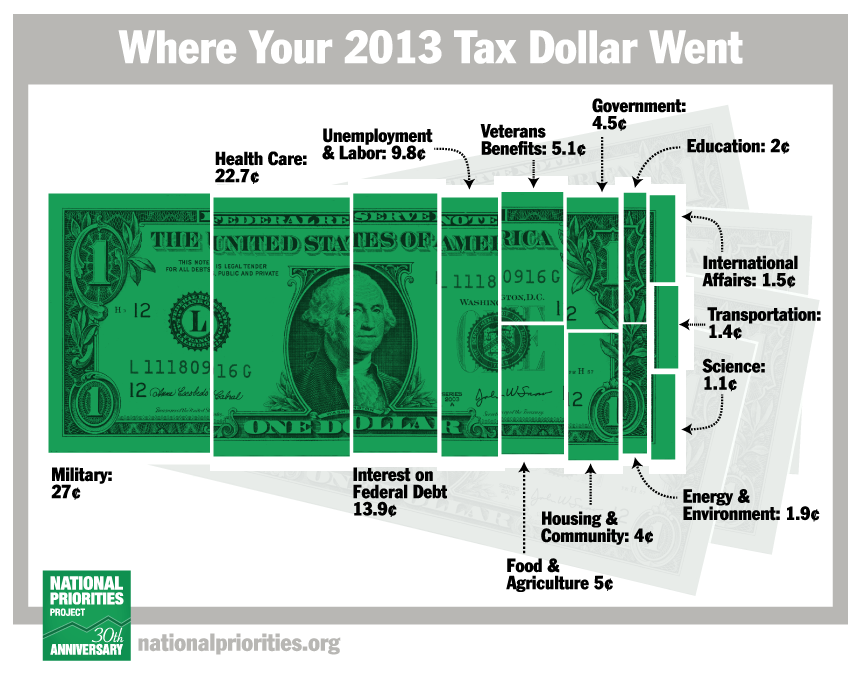
Consider what a waste rate of 51 percent would mean. In fiscal year 2013, the government took in $2.77 trillion in tax revenue (operating at a deficit of $680 billion). If 51 percent of that went to waste, that would mean over$1.38 trillion in money that the government is spending where it shouldn’t. Here we go back to our second rationale above: Maybe people just think we shouldn’t be spending money on war or foreign aid or post offices or the social safety net. Fair enough. But assuming that the tax revenue was allocated proportionate to overall spending, veterans benefits, health care programs like Medicaid and Medicare, and the military accounted foralmost 55 percent of that. So unless you think Medicaid and Medicare are complete wastes of money (and at this point we assume such people exist) or that we should drastically reduce the size of our military (same disclaimer here), you would have to think that the vast, vast majority of everything else government spends money on is wasted.
Really? The comments indicate that Mr. Bump might want to rethink his premise:
You can’t exactly believe that an agency’s self-reporting of fraud is not going to be self-serving ? When is the last time any level of government announced their incompetence ? Also, the definition of waste used here which includes money that can’t be tracked is incredibly faulty. The infamous Bridge To Nowhere, for example, was 100% tracked and accounted for. Most people would say that is a waste, but not this author. Using food stamp credit cards at casinos and on cruise ships seems wasteful but is technically tracked.
Philip, here’s where you went wrong, you feel that the government programs, all of them are worthwhile. When we read day after day about the fraud, waste and abuse of Government dollars (our tax dollars) the perception is easy. I work with our “civil servants” and can tell you straight up you could go to any public building (Fed) and pull the fire alarm and fire every 3rd person out the door and the next day there would be no definable difference in performance, work output and or accuracy – in fact it might even go up as SOMEONE got fired. The federal government is to large to manage hence waste, fraud and abuse.
If instead of writing to please people like Tina Brown and Arianna Huffington (though no doubt excellent preparation for the Washington Post), Mr. Bump had spent several decades in the federal government as I did, he might be chiding American taxpayers for underestimating the waste that goes on.
MR. Bump, you sadden me. By your own definition, “dollars that either did no good or which cannot be traced,” we’d have to declare 100% of the Pentagon’s budget to be “Waste” (since the DoD will not / cannot be audited).
Clearly, every penny spent in the “War on Drugs” is a “waste.” It’s a waste of money, of time, of lives and of revenue opportunities.
The fact that the government has so much “surplus” military hardware that they can equip, e.g., the Ferguson, MO police department with combat gear is evidence of the waste.
Loosey-goosey billing and payment practices in Medicare and Medicaid; three- and four- and more-levels of duplication of functions…. the list goes on and on.
FIX, please get out of your ivory press room.
Go work as a grocery checker for a week. Better yet: a year.
You will plainly see:
1) A lot of people receiving food stamps are fully able bodied.
2) A lot of food stamps are spent on junk foods, i.e. wasted. (soda pop, candy bars, energy drinks, chips, etc.)
3) Food stamp recipients spend their stamps on food and then, in the same transaction, spend their cash on beer, wine and cigarettes. Giving them the food assistance was a waste – they could have used their own cash, they simply don’t.
4) For many recipients, receiving food stamps is a way of life – an entitlement they teach their kids how to use in the checkout aisle.
Come on Phillip! A simple recitation of all of the events involving federal waste are legion. Does one have to recount all of the WAPO articles in recent years that highlight one federal agency after another acknowledging that they have screwed up or going to great lengths to hide their obvious incompetence in the handling of USA tas dollars. Why should we believe anything that comes out of the federal government when bureaucrats obviously do not know what the word “accountability” means. What the taxpayer does get from politicians and bureaucrats in return for questioning waste and incompetence is obfuscation, delay, misdirection, lies and non-response. It is so bad inside the DC beltway that the comedic events of politicians lying to bureacrats and bureaucrats lieing to politicians is just an ordinary every day activity. 51% in my view demonstrates an uninformed public who have not been watching the game of dodge-ems daily played inside the DC beltway!
Yes and Medicare waste and fraud is estimated by CBO at $60-90B a year. The IRS admited to sending out 11M fraudulent refund checks in 2012, sometime a thousand to the same address. HHS has found 100’s of thousands of fraudulent ObamaCare applications. If you want to blame the results of this poll on the military and the war on terror, you are not a journalist, you are just a political hack.
Our government spends 6.85 million dollars every minute, and borrows 43 cents of every dollar spent. So, what is it that they are doing right?
Keep this in mind: The worst teacher, the police officer who is a bully, the laziest municipal employee, and, of course, all 535 members of Congress and all 132 state legislators are being paid by your tax dollars.
The online meteorologist who refuses to succumb to climate change propaganda, Mike Smith:
Back in April I wrote a posting called Climafornication. Showtime Networks debuted a series called “Years of Living Dangerously.” It ran (and repeats still run) on Sunday evenings immediately after its series, “Californication.” In that blog post, I wrote:
Now, I guarantee you that the current drought in Texas and California will not be presented in this scientifically factual manner. It will be presented as some type of drought that has never occurred before complete with special effects to make it appear worse than it actually is.
I’d say that comment was accurate. The series (since it is still running) lasted longer than the supposedly unprecedented drought!
While reasonable people can and do disagree about global warming, the series used sleazy techniques to convey its propaganda point. For example, noted climate scientist Don Cheadle went to the small town of Plainview, Texas, to talk about the drought it was then experiencing. Nothing wrong with that. But, that is not where the producers stopped. Look at this screen capture. The brown tint in the air was added post-production to exaggerate the drought! They employed a number of these production tricks to make things look worse than they were. That is propaganda, not science.
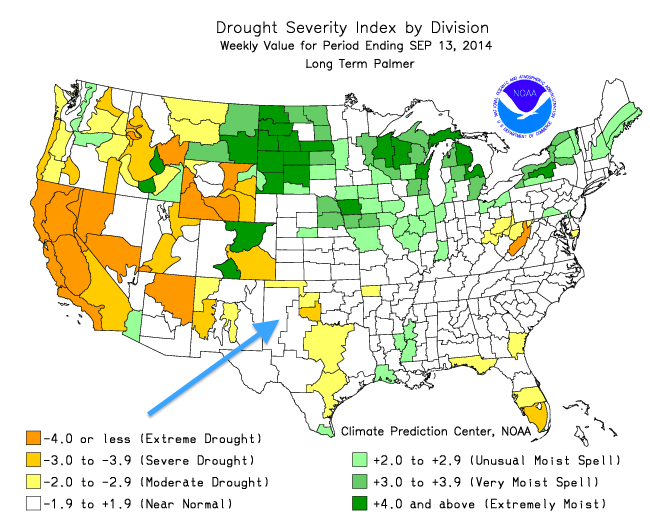
We also heard how the west Texas (already dry) climate has “changed” and droughts were going to be more frequent. Only one problem with all of this: The drought is over. The official National Weather Service drought metric is below. I’ve placed an arrow pointing to Plainview.
Less than five months later, the drought is officially gone. That is not to say the region does not have challenges, it does. More rain is needed to fill reservoirs (so as to be prepared for the next drought) and the depletion of the Ogallala Aquifer is a huge problem.
The series also starred frequent private jet commuter Arnold Schwarzenegger and private jet owner and pilot Harrison Ford. Nothing like being lectured to decrease our carbon footprints by people whose footprints are the size of Alaska.
Instapundit’s Glenn Reynolds says,
I’ll believe global warming is a crisis when the people telling me it’s a crisis start acting like it’s a crisis.
Once again, in difficult economic times, people trying to make a living and support their families are misleadingly lectured about carbon footprints by Hollywood hypocrites who crisscross the world in private jets.
Harrison Ford in “Years” (left) and with his jet
I like Harrison Ford as an actor and I would use a private jet extensively if I could afford to do so. But, he is in absolutely no position to tell me about the size of my carbon footprint.
Readers are reminded of Al Gore’s 11,000-square-foot house, where he apparently lives in between flying across the world to lecture the masses on their carbon footprints. That also applies to Secretary of State John Kerry, who married into money before he started lecturing the masses on their carbon footprints. The Kerrys are not living in an 800-square-foot apartment and taking mass transit to work.
Smith points out things the mainstream media doesn’t — for instance, the number of tornadoes and hurricanes, and the number of most violent tornadoes and hurricanes, is down, not up.
But hey, don’t let the facts get in the way of your narrative, as is reported by National Review:
According to a top environmentalist organizer, climate change is responsible for this summer’s violence in Ferguson, Missouri.
“To me, the connection between militarized state violence, racism, and climate change was common-sense and intuitive,” 350.org Strategic Partnership Coordinator Deirdre Smith wrote.
“Oppression and extreme weather combine to ‘incite’ militarized violence,” she continued. Weeks of rioting followed the killing August 9 of 18-year-old Michael Brown by Ferguson police officer Darren Wilson. Observers around the nation criticized the police for a heavy-handed response to protests in the town, but while the rioting received international attention, it did not result in any loss of life.
Smith explained that not only do poor minority communities have fewer resources to deal with the impacts of climate change, but that “people of color also disproportionately live in climate-vulnerable areas,” which makes climate change a race issue. …
According to the National Weather Service, the St. Louis area was not notably warmer this summer than it has ever been. At 80.3 degrees Fahrenheit, this August’s average temperature in the Gateway to the West was only the seventh-warmest of the last 20 years, substantially cooler than the two-decade high of 83.9 degrees in August 1995.
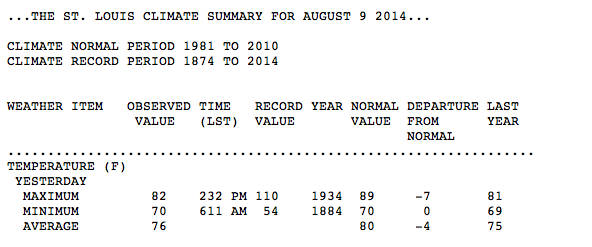
Connection between climate change and Ferguson??? Hmmm. Perhaps, because of her lack of background in climate science, she didn’t know how to research the temperature on August 9, 2014, the day of the horrible shooting of Michael Brown in Ferguson, a north suburb of St. Louis.
So, I did a little research:
The high temperature that day was a very pleasant 82° which was seven degrees cooler than usual. The record high of 110° occurred in 1934 when world climate was cooler than it is today.
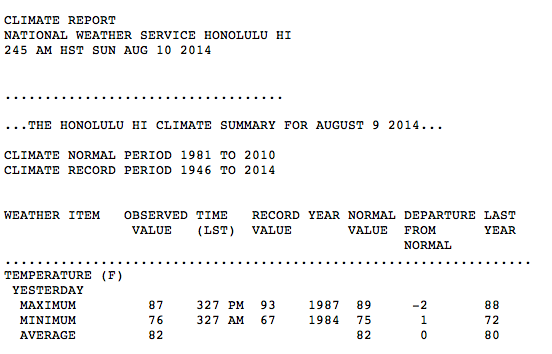
To put St. Louis’ high of 82° in perspective, thousands of people pay thousands of dollars every day to fly to Honolulu to enjoy and vacation in Hawaii’s pleasant climate. What was the high in Honolulu the same day?
It was 87°, five degrees warmer than St. Louis.
Obviously, a high of 82 degrees had nothing to do with the tragic shooting and terrible events that unfolded in Ferguson. While I am tempted to make other comments, I’ll stop here.
Sept. 11, 2001 started out as a beautiful day, in Wisconsin, New York City and Washington, D.C.
I remember almost everything about the entire day. Sept. 11, 2001 is to my generation what Nov. 22, 1963 was to my parents and Dec. 7, 1941 was to my grandparents.
I had dropped off our oldest son, Michael, at Ripon Children’s Learning Center. As I was coming out, the mother of one of Michael’s group told me to find a good radio station; she had heard as she was getting out with her son that a plane had hit the World Trade Center.
I got in my car and turned it on in time to hear, seemingly live, a plane hit the WTC. But it wasn’t the first plane, it was the second plane hitting the other tower.
As you can imagine, my drive to Fond du Lac took unusually long that day. I tried to call Jannan, who was working at Ripon College, but she didn’t answer because she was in a meeting. I had been at Marian University as their PR director for just a couple months, so I didn’t know for sure who the media might want to talk to, but once I got there I found a couple professors and called KFIZ and WFDL in Fond du Lac and set up live interviews.
The entire day was like reading a novel, except that there was no novel to put down and no nightmare from which to wake up. A third plane hit the Pentagon? A fourth plane crashed somewhere else? The government was grounding every plane in the country and closing every airport?
I had a TV in my office, and later that morning I heard that one of the towers had collapsed. So as I was talking to Jannan on the phone, NBC showed a tower collapsing, and I assumed that was video of the first tower collapse. But it wasn’t; it was the second tower collapse, and that was the second time that replay-but-it’s-not thing had happened that day.
Marian’s president and my boss (a native of a Queens neighborhood who grew up with many firefighter and police officer families, and who by the way had a personality similar to Rudy Giuliani) had a brief discussion about whether or not to cancel afternoon or evening classes, but they decided (correctly) to hold classes as scheduled. The obvious reasons were (1) that we had more than 1,000 students on campus, and what were they going to do if they didn’t have classes, and (2) it was certainly more appropriate to have our professors leading a discussion over what had happened than anything else that could have been done.
I was at Marian until after 7 p.m. I’m sure Marian had a memorial service, but I don’t remember it. While I was in Fond du Lac, our church was having a memorial service with our new rector (who hadn’t officially started yet) and our interim priest. I was in a long line at a gas station, getting gas because the yellow low fuel light on my car was on, not because of panic over gas prices, although I recall that one Fond du Lac gas station had increased their prices that day to the ridiculous $2.299 per gallon. (I think my gas was around $1.50 a gallon that day.)
Two things I remember about that specific day: It was an absolutely spectacular day. But when the sun set, it seemed really, really dark, as if there was no light at all outside, from stars, streetlights or anything else.
For the next few days, since Michael was at the TV-watching age, we would watch the ongoing 9/11 coverage in our kitchen while Michael was watching the 1-year-old-appropriate stuff or videos in our living room. That Sunday, one of the people who was at church was Adrian Karsten of ESPN. He was supposed to be at a football game working for ESPN, of course, but there was no college football Saturday (though high school football was played that Friday night), and there was no NFL football Sunday. Our organist played “God Bless America” after Mass, and I recall Adrian clapping with tears down his face; I believe he knew some people who had died or been injured.
Later that day was Marian’s Heritage Festival of the Arts. We had record attendance since there was nothing going on, it was another beautiful day, and I’m guessing after five consecutive days of nonstop 9/11 coverage, people wanted to get out of their houses.
In the decade since then, a comment of New York City Mayor Rudy Giuliani has stuck in my head. He was asked a year or so later whether the U.S. was more or less safe since 9/11, and I believe his answer was that we were more safe because we knew more than on Sept. 10, 2001. That and the fact that we haven’t been subject to another major terrorist attack since then is the good news.
Osama bin Laden (who I hope is enjoying Na’ar, Islam’s hell) and others in Al Qaeda apparently thought that the U.S. (despite the fact that citizens from more than 90 countries died on 9/11) would be intimidated by the 9/11 attacks and cower on this side of the Atlantic Ocean, allowing Al Qaeda to operate with impunity in the Middle East and elsewhere. (Bin Laden is no longer available for comment.) If you asked an American who paid even the slightest attention to world affairs where a terrorist attack would be most likely before 9/11, that American would have replied either “New York,” the world’s financial capital, or “Washington,” the center of the government that dominates the free world. A terrorist attack farther into the U.S., even in a much smaller area than New York or Washington, would have delivered a more chilling message, that nowhere in the U.S. was safe. Al Qaeda didn’t think to do that, or couldn’t do that. The rest of the Middle East also did not turn on the U.S. or on Israel (more so than already is the case with Israel), as bin Laden apparently expected.
The bad news is all of the other changes that have taken place that are not for the better. Bloomberg Businessweek asks:
So was it worth it? Has the money spent by the U.S. to protect itself from terrorism been a sound investment? If the benchmark is the absence of another attack on the American homeland, then the answer is indisputably yes. For the first few years after Sept. 11, there was political near-unanimity that this was all that mattered. In 2005, after the bombings of the London subway system, President Bush sought to reassure Americans by declaring that “we’re spending unprecedented resources to protect our nation.” Any expenditure in the name of fighting terrorism was justified.
A decade later, though, it’s clear this approach is no longer sustainable. Even if the U.S. is a safer nation than it was on Sept. 11, it’s a stretch to say that it’s a stronger one. And in retrospect, the threat posed by terrorism may have been significantly less daunting than Western publics and policymakers imagined it to be. …
Politicians and pundits frequently said that al Qaeda posed an “existential threat” to the U.S. But governments can’t defend against existential threats—they can only overspend against them. And national intelligence was very late in understanding al Qaeda’s true capabilities. At its peak, al Qaeda’s ranks of hardened operatives numbered in the low hundreds—and that was before the U.S. and its allies launched a global military campaign to dismantle the network. “We made some bad assumptions right after Sept. 11 that shaped how we approached the war on terror,” says Brian Fishman, a counterterrorism research fellow at the New America Foundation. “We thought al Qaeda would run over the Middle East—they were going to take over governments and control armies. In hindsight, it’s clear that was never going to be the case. Al Qaeda was not as good as we gave them credit for.”
Yet for a decade, the government’s approach to counterterrorism has been premised in part on the idea that not only would al Qaeda attack inside the U.S. again, but its next strike would be even bigger—possibly involving unconventional weapons or even a nuclear bomb. Washington has appropriated tens of billions trying to protect against every conceivable kind of attack, no matter the scale or likelihood. To cite one example, the U.S. spends $1 billion a year to defend against domestic attacks involving improvised-explosive devices, the makeshift bombs favored by insurgents in Afghanistan. “In hindsight, the idea that post-Sept. 11 terrorism was different from pre-9/11 terrorism was wrong,” says Brian A. Jackson, a senior physical scientist at RAND. “If you honestly believed the followup to 9/11 would be a nuclear weapon, then for intellectual consistency you had to say, ‘We’ve got to prevent everything.’ We pushed for perfection, and in counterterrorism, that runs up the tab pretty fast.”
Nowhere has that profligacy been more evident than in the area of homeland security. “Things done in haste are not done particularly well,” says Jackson. As Daveed Gartenstein-Ross writes in his new book, Bin Laden’s Legacy, the creation of a homeland security apparatus has been marked by waste, bureaucracy, and cost overruns. Gartenstein-Ross cites the Transportation Security Agency’s rush to hire 60,000 airport screeners after Sept. 11, which was originally budgeted at $104 million; in the end it cost the government $867 million. The homeland security budget has also proved to be a pork barrel bonanza: In perhaps the most egregious example, the Kentucky Charitable Gaming Dept. received $36,000 to prevent terrorists from raising money at bingo halls. “If you look at the past decade and what it’s cost us, I’d say the rate of return on investment has been poor,” Gartenstein-Ross says.
Of course, much of that analysis has the 20/20 vision of hindsight. It is interesting to note as well that, for all the campaign rhetoric from candidate Barack Obama that we needed to change our foreign policy approach, President Obama has changed almost nothing, including our Afghanistan and Iraq involvements. It is also interesting to note that the supposed change away from President George W. Bush’s us-or-them foreign policy approach hasn’t changed the world’s view, including particularly the Middle East’s view, of the U.S. Someone years from now will have to determine whether homeland security, military and intelligence improvements prevented Al Qaeda from another 9/11 attack, or if Al Qaeda wasn’t capable of more than just one 9/11-style U.S. attack.
Hindsight makes one realize how much of the 9/11 attacks could have been prevented or at least their worst effects lessened. One year after 9/11, the New York Times book 102 Minutes: The Untold Story of the Fight to Survive Inside the Twin Towers points out that eight years after the 1993 World Trade Center bombing, New York City firefighters and police officers still could not communicate with each other, which led to most of the police and fire deaths in the WTC collapses. Even worse, the book revealed that the buildings did not meet New York City fire codes when they were designed because they didn’t have to, since they were under the jurisdiction of the Port Authority of New York and New Jersey. And more than one account shows that, had certain people at the FBI and elsewhere been listened to by their bosses, the 9/11 attacks wouldn’t have caught our intelligence community dumbfounded. (It does not speak well of our government to note that no one appears to have paid any kind of political price for the 9/11 attacks.)
I think, as Bloomberg BusinessWeek argues, our approach to homeland security (a term I loathe) has overdone much and missed other threats. Our approach to airline security — which really seems like the old error of generals’ fighting the previous war — has made air travel worse but not safer. (Unless you truly believe that 84-year-old women and babies are terrorist threats.) The incontrovertible fact is that every 9/11 hijacker fit into one gender, one ethnic group and a similar age range. Only two reasons exist to not profile airline travelers — political correctness and the assumption that anyone is capable of hijacking an airplane, killing the pilots and flying it into a skyscraper or important national building. Meanwhile, while the U.S. spends about $1 billion each year trying to prevent Improvised Explosive Device attacks, what is this country doing about something that would be even more disruptive, yet potentially easier to do — an Electromagnetic Pulse attack, which would fry every computer within the range of the device?
We haven’t taken steps like drilling our own continent’s oil and developing every potential source of electric power, ecofriendly or not, to make us less dependent on Middle East oil. (The Middle East, by the way, supplies only one-fourth of our imported oil. We can become less dependent on Middle East oil; we cannot become less dependent on energy.) And the government’s response to 9/11 has followed like B follows A the approach our culture has taken to risk of any sort, as if covering ourselves in bubblewrap, or even better cowering in our homes, will make the bogeyman go away. Are we really safer because of the Patriot Act?
American politics was quite nasty in the 1990s. For a brief while after 9/11, we had impossible-to-imagine moments like this:
And then within the following year, the political beatings resumed. Bush’s statement, “I ask your continued participation and confidence in the American economy,” was deliberately misconstrued as Bush saying that Americans should go out and shop. Americans were exhorted to sacrifice for a war unlike any war we’ve ever faced by those who wouldn’t have to deal with the sacrifices of, for instance, gas prices far beyond $5 per gallon, or mandatory national service (a bad idea that rears its ugly head in times of anything approaching national crisis), or substantially higher taxes.
Then again, none of this should be a surprise. Other parts of the world hate Americans because we are more economically and politically free than most of the world. We have graduated from using those of different skin color from the majority as slaves, and we have progressed beyond assigning different societal rights to each gender. We tolerate different political views and religions. To the extent the 9/11 masterminds could be considered Muslims at all, they supported — and radical Muslims support — none of the values that are based on our certain inalienable rights. The war between our world, flawed though it is, and a world based on sharia law is a war we had better win.
In one important sense, 9/11 changed us less than it revealed us. America can be both deeply flawed and a special place, because human beings are both deeply flawed and nonetheless special in God’s eyes. Jesus Christ is quoted in Luke 12:48 as saying that “to whomsoever much is given, of him shall be much required.” As much as Americans don’t want to be the policeman of the world, or the nation most responsible for protecting freedom worldwide, there it is.





 Steve Prestegard.com: The Presteblog