Mitch Daniels was never going to be president. Too bad.
There was a brief boomlet around the former Indiana governor before the 2012 election, but people quickly found out who he really was: Daniels was too boring, too wonky, too level-headed, too focused on fiscal policy, too unwilling to fight the culture wars. And as some observers noted, he was short.
He was, in other words, too competent and too sensible for a political office that, especially now, could benefit from some competence and common sense.
Since leaving the governor’s office, Daniels has stepped away from politics and taken the top job at Purdue University, which, as George Will wrote in 2016, now has the president the entire country should.
As president of Purdue, Daniels has preached the virtues of hard work and self-determination. He has also put the university itself on excellent footing. Since Daniels took the job in 2013, tuition has been frozen. Accounting for inflation, the Ohio University economist Richard Vedder estimates that the effect is something like a 10 percent reduction in tuition, even as costs at other universities have soared.
The school has also created an unusual financing mechanism called an Income Share Agreement. Under this system, the school contributes a portion of the tuition fees in exchange for a small cut of the student’s post-graduation income, treating students, essentially, as investments. In other words, it makes the school more affordable and accessible to the student body while creating a revenue stream for the institution.
Vedder notes that the school has also started making and selling one of the most important elements of the college experience in-house: beer.
Boiler Gold American Golden Ale is the first beer developed by Purdue, quickly selling out at this year’s first football game. As President Daniels has explained to me, Purdue has a rich agricultural tradition, and beer is an agricultural product—I believe the hops are grown nearby under Purdue’s direction. Purdue has a Hops and Brewing Analysis Lab, a School of Food Science, and so forth.
Improving the productivity and utility of agriculture was a core mission of schools like Purdue created out of the 1862 Morrill Act. Money made from beer sales is supporting agricultural research (as well as Purdue athletics). Research into developing craft beers has led to a partnership with an alumnus who does the actual brewing for Purdue.
Although he has focused on running the university, Daniels hasn’t gone completely silent on national political issues. In an op-ed for The Washington Post [Tuesday], Daniels tackles state-level budget problems, arguing against a federal rescue plan:
Sooner or later, we can anticipate pleas for nationalization of these impossible obligations. Get ready for the siren sounds of sophistry, in arguments for subsidy of the poor by the prudent.
In fact, this balloon was already floated once, during the crunch of the recent recession. In 2009, California politicians called for a “dynamic partnership” with the federal government. Money from other states, they said, would be an “investment” and certainly not a bailout. They didn’t succeed directly, although they walked away with $8 billion of federally borrowed “stimulus” money. Such a heist will be harder to justify in the absence of a national economic emergency.
In the blizzard of euphemisms, one can expect a clever argument might appear, likening the bailout to another important compromise of the founding period: the assumption of state debts by the new federal government. But that won’t wash. Those were debts incurred in a battle for survival and independence common to all 13 colonies, not an attempt to socialize away the consequences of individual states’ multi-decade spending sprees.
[Tuesday], President Donald Trump announced plans to spend $12 billion bailing out businesses harmed by the trade war he started. The contrast is revealing—and more than a little depressing.
As a national politician, Daniels might not have been as exciting or charismatic as some of his competitors (although he was plenty appealing, in an understated way). He might not have tweeted, and if he did, it probably would have been about things like the congressional budget process or the federal deficit. He might have had a domestic policy agenda beyond deficit-financed tax cuts and bipartisan spending deals. I doubt that Daniels, whose personality is defined by a gentle Midwestern reserve, would have started a pointless, unwinnable trade war predicated on proving personal dominance over America’s international rivals.
Which is to say, he almost certainly would not have treated the Oval Office as the set of political reality show on which he was the star. He probably wouldn’t have sparked very many internet flame wars, and the ones he did prompt probably would have been relatively low-heat. But he would have been good at the job of being president—at the nuts and bolts of information gathering and decision making and operational efficiency and level-headed communication about policy decisions.
I’m glad Mitch Daniels is president of Purdue, where he appears to be making a real difference in showing a path forward for public higher ed. But I wish that American voters had been more interested in giving him a bigger job, and every now and then I find myself wistfully imagining what a Daniels presidency might have been like. He’ll never be president of the United States, but he’ll always be president of my heart.
There were other issues beyond Daniels’ disinterest in the job. (Arguably, as someone once put it, anyone who wants to be president is unqualified to, or should not, be president.) Cultural conservatives would have tsk-tsked at Daniels’ being divorced from his wife, even though they remarried. (Reportedly that’s why he decided not to run. Whether that matters anymore in an era where the major parties nominate, a thrice-married candidate and a candidate Married In Name Only is up to the reader to decide.) In terms of buzz (which is blamed on the media, but the media does what its viewers/listeners/readers and advertisers generally want), how could Daniels compete against Donald Trump and Hillary Clinton? If Americans were OK with boring candidates who focused on the deficit, we could have had Paul Tsongas as president in 1992 instead of Slick Willie.
Nowadays, if you want to be an incompetent — or even corrupt — elected official, there’s a place for you to work where the risk of facing recourse is fast getting smaller: local government.
That’s because so few people are paying attention. Not only has voter participation in local elections fallen to dangerously low levels, but the health of local newspapers, traditional watchdogs for the most direct and abundant form of government in the United States, has also been deteriorating.
This is a crisis for democracy in general. But politically speaking, the Republican Party — yes, the same party whose leader derides the media as “fake news” and “the enemy of the people” — should be particularly alarmed. Because if conservatives are concerned about keeping government as efficient and local as possible, they need the hundreds of local newspapers to make the system work across the country.
Researchers have illuminated a sort of symbiotic relationship between local papers and the governments they cover. The governments provide papers with content to fill their pages; the papers, in turn, offer a healthy level accountability and make information more accessible among the electorate. If a newspaper is suddenly forced to close due to economic forces — for example, if competition from online advertising sites suddenly dries up its revenue — the government, too, becomes sick.
This isn’t just theoretical; it translates to hard dollars and cents, as illustrated by a new paper, presented this week at the Brookings Institution’s Municipal Finance Conference.
The paper, which is in the process of being peer-reviewed, looked at newspaper closures between 1996 and 2015 and found that once a newspaper goes under, it becomes more expensive in the long run for its local government to borrow money. In the three years following a closure, the study found, municipal borrowing costs for counties where newspapers closed increased by .05 to .11 percentage points. That might not sound like a lot, but when we’re talking about borrowing millions of dollars, it’s nothing to sneeze at.
Authors of the paper theorize that this is the result of less information being publicly available, resulting in poorer-quality governance. And as a result, local investors in such communities are more likely to see municipal bonds as risky, driving up interest rates.
Before you say “correlation is not causation,” consider the strong evidence that the link between newspaper closures and higher borrowing costs is causal. First, the authors compared counties where newspapers closed to neighboring counties with operating newspapers. On average, the counties where newspapers folded had bond yields that were .07 percentage points higher.
The effect was also dependent on the number of papers covering a government. Counties with multiple papers saw no significant effect if one of their papers went under. But counties with only one paper that closed did.
In fact, the authors were able to track this effect on rising borrowing costs with the expansion of Craigslist. The advertising website, which drained local newspapers of revenue from classified ads, was gradually rolled out across the country over time. They found that Craigslist-induced newspaper closures increased municipal bond yields by .04 to .06 percentage points.
All of this is to say that the health of local newspapers is intensely connected with government efficiency. And it’s not just bond markets. Newspaper closures are also linked to rising wages for government employees and to growing numbers of government employees per capita in a county. Other research shows that elected officials from areas with little local media coverage are less responsive to their constituents.
For conservatives who say they want as much government responsibility allocated to state and local governments as possible, these trends should be terrifying. We can only support a federalist political system if it is well oiled at each level, and local reporting is an invaluable grease for the machine to function.
There’s no easy solution to the decline of local newspapers. Market forces are fundamentally changing the media landscape, and it remains to be seen what will happen to small outlets that can’t so easily transition online. But one thing is for sure: The decline of the local free press is a threat to the decentralized system of government envisioned by the Founding Fathers.
That is an interesting study conclusion if it’s correct.
That study was reported last week. Earlier this week came this news reported by the New York Times:
The meeting lasted less than a minute. By the time it was over, reporters and editors at The Daily News, the brawny New York tabloid that was once the largest-circulation paper in the country, learned that the newsroom staff would be cut in half and that its editor in chief was out of a job.
In the hours that followed, journalists in various departments, from sports to metro, received formal notification that they had been laid off by Tronc, the media company based in Chicago that bought the paper last year.
“People were crying and hugging each other,” said Scott Widener, a researcher who had worked at The News since 1990. “I’ve dodged a lot bullets over the years, and I just couldn’t dodge this one.”
In its heyday, The News was a staple publication of the city’s working class, an elbows-out tabloid that thrived when it dug into crime and corruption. It served as a model for The Daily Planet, the paper that counted Clark Kent and Lois Lane among its reporters, and for the scrappy tabloid depicted in the 1994 movie “The Paper.”
With Tronc’s firing of more than 40 newsroom employees — including 25 of 34 sports journalists and most of the photo department — The News joins the ranks of walking-wounded papers at a time when readers have gravitated toward the quick-hit convenience of digital media.
Under Jim Rich, the editor who lost his job on Monday, The News positioned itself as an unapologetically liberal counterpuncher to Rupert Murdoch’s New York Post. Mr. Rich, who declined to comment for this article, transformed the front page — “the wood,” in tabloid parlance — into a venue for criticizing and often ridiculing President Trump.
Last Tuesday, The News commemorated the president’s appearance with President Vladimir V. Putin of Russia in Helsinki, Finland, with the headline “Open Treason.” Beneath the bold black letters was a cartoon of Mr. Trump holding hands with a shirtless Mr. Putin; with his other hand, Mr. Trump was firing a pistol at Uncle Sam’s head.
Hmmm. Ridiculing Trump. How has that worked out?
Tronc announced on Monday that Mr. Rich’s replacement would be Robert York, a media executive who has spent most of his career in San Diego. In 2016, Tronc named Mr. York the editor and publisher of The Morning Call, a newspaper owned by the company in Allentown, Pa.
The layoff did not come out of nowhere. The News has lost millions of dollars as it struggled to replace the revenue once reliably provided by the advertisements that fattened its papers and the readers whose morning routines included a stop at the newsstand.
“The web kind of changed the DNA of every paper,” said Joel Siegel, a former managing editor at The News who is now managing editor of the cable news channel NY1.
Grant Whitmore, an executive at Tronc, presided over the brief meeting, which took place shortly after 9 a.m. in the paper’s seventh-floor newsroom in Lower Manhattan. About 50 staff members were in attendance, a group that did not include Mr. Rich or Kristen Lee, the managing editor, who was also laid off.
Afterward, human resources workers delivered the bad news to employees, including the sports columnist John Harper, the arts reporter Joe Dziemianowicz and the City Hall reporter Erin Durkin.
“I firmly believe that today’s actions will position The Daily News for growth in the years ahead,” Mr. Whitmore said in a memo to the remaining staff members at the end of the day, “and I look forward to working with this group to capture the opportunities in front of us.” He added that Tronc remained “committed to print.” …
It is hard to fathom what the paper’s next issues will look like, given that the newsroom had shrunk significantly under its previous owner, Mortimer B. Zuckerman, the New York real estate developer and media mogul who bought the paper out of bankruptcy in 1993.
Ambitious projects like the series on New York Police Department’s abuse of eviction rules — for which The News shared a Pulitzer Prize with ProPublica in 2017 — would seem difficult to pull off with an even smaller staff. Sarah Ryley, the editor of the series, who left The News last year, said it had taken three years to complete because reporters and editors were stretched thin after the layoffs under Mr. Zuckerman.
“You used to go into the office and feel the energy,” said Frank Isola, a sports columnist at The News for nearly 25 years, who was among those laid off on Monday. “I’ve probably been in the office, I would say, maybe three times in the last three years. People tell me: ‘Don’t come in. It’s depressing.’”
Since Tronc bought the ailing tabloid from Mr. Zuckerman in September 2017 — for a reported $1; yes, one dollar — the company has been working to transform The News into something more digital.
“But we have not gone far enough,” the company said in a memo to the staff that announced its decision to reduce “the size of the editorial team by approximately 50 percent” and to shift its focus to breaking news.
Some News employees started packing last week, after the media newsletter Study Hall reported that the company planned to lay off a large portion of the staff.
Although daily print circulation had sunk to roughly 200,000, Mr. Rich breathed new life into the paper. During two stints as editor — a 13-month run that ended in 2016, and an encore that began in January — he regularly published front pages that captured the staccato energy of social media.
He was typically combative in a Twitter post on Monday: “If you hate democracy and think local governments should operate unchecked and in the dark, then today is a good day for you,” he wrote. Mr. Rich also dropped the Daily News affiliation from his Twitter bio. “Just a guy sitting at home watching journalism being choked into extinction,” it reads.
The News had a digital reach of 23 million, but it wasn’t enough. The challenge of wringing profits from page views has eluded much of the industry, and the paper proved unable to end its losing streak. According to securities filings, it lost $23.6 million in 2016. Since then, its business has continued to suffer.
In naming Mr. York as the replacement for Mr. Rich, Tronc is following a playbook that did not have success at The Los Angeles Times, when, in similar fashion, it gave the job of top editor to an outsider with a business background.
Lewis D’Vorkin, an executive at Forbes Media who specialized in broadening the company’s native-advertising offerings, was Tronc’s choice for the Los Angeles job. The newsroom greeted his appointment with skepticism, and Mr. D’Vorkin lasted two months in the role. After tensions between the newsroom employees and Tronc continued, the company sold the paper to Dr. Patrick Soon-Shiong in February for $500 million.
The longtime home of the columnists Jimmy Breslin, Dick Young and Liz Smith and the cartoonist Bill Gallo, The News reveled in its role as the voice of the average citizen. Etched into the stone above the entrance of its former home, the Daily News Building on East 42nd Street, is a phrase attributed to Abraham Lincoln: “God must have loved the common man, he made so many of them.”
“You used to see everybody reading the newspaper on the subway,” said Michael Daly, a onetime News columnist who now writes for The Daily Beast. “The News was the right size. It was the perfect size for the biggest city.”
“You used to see everybody reading the newspaper on the subway,” said Michael Daly, a onetime News columnist who now writes for The Daily Beast. “The News was the right size. It was the perfect size for the biggest city.”
One of its most famous headlines — “Ford to City: Drop Dead,” from 1975 — summed up President Gerald R. Ford’s refusal to send federal aid to a city on the verge of bankruptcy. Ford later said the headline had played a role in his losing the 1976 presidential election.
The News, winner of 11 Pulitzers in its 99-year history, underwent a crisis when 10 unions walked off the job in 1990. The Tribune Company, its owner since its founding in 1919, threw the paper into bankruptcy at the end of the long strike — and the man who rescued it, the British mogul Robert Maxwell, became tabloid fodder himself when his body was found floating near his yacht soon after he entered the New York media fray.
Mr. Zuckerman took control in 1993, but times were hard, even then, well before digital media threatened the business model that had produced newspaper barons, star columnists and city reporters with steady paychecks. Before rolling out the first issue under his ownership, Mr. Zuckerman laid off 170 employees. It was a sign of layoffs to come, as a bustling newsroom morphed into a workplace populated with a bare-bones staff of fewer than 100 on his watch.
You will not believe! what the Washington Examiner reports what happened next:
New York Gov. Andrew Cuomo, a Democrat, said he would put state resources behind the New York Daily News if it will help curb mass layoffs that reportedly just hit the left-leaning tabloid’s newsroom.
Cuomo said in a statement Monday that the state “stands ready to help” after the New York Times reported that the tabloid’s reporting staff would be reduced by about half.
“The Daily News, now owned by Tronc, Inc., is apparently firing a major portion of their reporting staff,” he said. “This will undoubtedly devastate many households and hurt an important New York institution and one of our nation’s journalism giants. These layoffs were made without notifying the state or asking for assistance.”
I was unaware that Mario Cuomo had bailed out the Post. That was a horrible idea, and bailing out a media outlet with government money is a hideous idea.
Little Cuomo’s tweet provoked these responses:
Governor offers to rescue a friendly media outlet. Doesn’t that muddy the concept of a free press?
I guess he thinks it’s a state-run media outlet and the state will decide whether to lay people off or use taxpayer money to prop up a failing political propaganda machine.
So former Gov Mario Cuomo “came to the aid of the New York Post when it was facing difficult financial times.” Huh. I’m SURE that didn’t affect their objectivity at all when it came to covering Cuomo, his admin, or Democrats in general.
You want state-run news? This is how you get state-run news. Your ideals are not ideals if you can’t apply them across the board (or aisle); they’re just additions to the hypocrisy of which there’s already enough.
government money mixing with the media–what could possibly go wrong?
This week, The Washington Post published an op-ed headlined “It’s not wrong to compare Trump’s America to the Holocaust.” As with similar examples of this genre, it’s a sickening display of moral relativism that belittles the suffering and murder of millions in the service of some shortsighted and crass partisan fearmongering.
Elsewhere, Politico published an opinion piece headlined “Putin’s Attack on the U.S. Is Our Pearl Harbor,” which demeaned the sacrifice of American service members by likening a military attack on American soil that brought us into the bloodiest war mankind has ever experienced to phishing.
On MSNBC, where illiterate histrionic analogies litter coverage every day, a contributor compared Donald Trump’s meeting in Helsinki with Vladimir Putin to Pearl Harbor and Kristallnacht, just to be safe.
Social media are teeming with similar hyperbole—”treason,” “traitor,” etc.—and not just from anonymous trolls. It’s difficult to accept that people with working brains actually believe this rhetoric, and they certainly don’t act like it. But if well-heeled pundits keep telling everyone the Fourth Reich is imminent before retiring to their town houses in D.C. every night, some people may actually start believing them. And if phishing and hacking are truly comparable to Pearl Harbor or Kristallnacht or the Holocaust, there’s really no reason those accepting these analogies shouldn’t also support military reprisals abroad and a coup at home.
Defenders of this hyperbole often claim that they’re not making an exact equivalence to the lives lost but rather speaking to the intent of all those attackers. All such attacks, they say, are intended to destabilize “our democracy.” Well, yes. But one aspect of similarity doesn’t make the events comparable. It would be like saying Iran’s spying on the United States—spying that resulted in our military technology’s being sold to China—was comparable to 9/11 because both sets of attackers intended to harm our democracy. If this were so, it would be treasonous to make peace with these nations and completely rational to wage war. Surely, we can find less feverish analogies.
Russia attempted to meddle in our domestic affairs, and there should be retribution and condemnation for those efforts. But our electoral system was not undermined. It withstood, as it has for many decades, Russian attempts to mess with institutions. The reaction to those hacking efforts, on the other hand, does no favors to democracy, and it certainly does no favors to Democrats who are suddenly horrified by the Putin threat.
You may remember how liberals lectured Americans after 9/11 about appropriate ways to deal with terrorists. For the most part, it amounted to saying, “Don’t kill them! That’s exactly what they want!” Well, it’s certain that this is what Putin wants. Few things destabilize democracy more than imbuing a foreign strongman from a second-rate power with the imaginary capability of deciding our elections.
Nor is Trump’s ham-fisted, misguided, and transparent Putin-coddling tantamount to sedition. For a number of reasons—including an inability or refusal to make any distinction between Russian “meddling” and attacks on the legitimacy of his election, a trait shared by many of Trump’s detractors—the president is a fan of Putin’s. Even though his administration has been tougher on Russia in many respects than the previous ones, there’s no way around the fact that the president admires strongmen.
That doesn’t make his foreign policy position an act of treason, any more than it was treason for Barack Obama to coddle the Iranians—even though the former president sided with Iran (and Hezbollah) over American law enforcement. Democrats’ hysterics make it impossible for many people to even concede that they have a point to make.
Since Trump met with Putin in Helsinki, many Republicans, including the speaker of the House and the Senate majority leader, have come out in support of the intelligence community’s assessment of Russian meddling, weakening the argument that the GOP always walks in lockstep behind the president.
There could even have been some consensus in Washington over how to move forward. Instead, we had elected Democrats spinning melodramatic political fairy tales about the Russkies controlling the GOP, about the need to start a coup and about the presence of kompromat. Earlier this week, an army of blue checkmarks was retweeting and oohing and aahing over an erroneous report about how a Russian spy had infiltrated the Oval Office, simply because the woman in question had red hair and looked vaguely similar to an accused spy.
Everybody has had their say about what Trump said in Helsinki, including Trump himself. I don’t care about that; I want to talk about what Putin said in Helsinki, which seems to have sailed right over the heads of Ken and Barbie press posers who look good in clothes and read virtuous words for lots of money. The Putin story is much better.
Trump was weird from the opening bell; all amped up about the DNC servers for no apparent reason. But Putin was on it; steady and focused like a pointer pinning a quail with a stare. Granted he has a dozen years of practice at these events, but my own decades of doing deals and watching deal-masters told me instinctively to pay close attention, and the boy did not disappoint.
After Mueller dropped his turd in the Helsinki punch bowl with his second round of non-prosecutable indictments a couple days prior, Putin responded with his kind offer of co-operation under a 1999 Treaty that none of us knew existed and then pulls the pin and throws the grenade of a charge that U.S. intelligence officials aided an international tax fugitive in funneling $400 million to the Clinton campaign. Ba-bam! We can help each other investigate international interference in your elections, says Putin…ALL of it.
Wait, what? $400 million? Aided by our own intelligence officials? Browder is his name? And we are hearing this in now in 2018 not from any of our own watchdog news media? So I quickly Google Browder – sure enough, a real guy with Interpol warrants for massive tax evasion and global skullduggery. Not a phantom like Guccifer 2.0. Renounced his American citizenship and went to loot Russia after the collapse of the Soviet Union – foreigner who meddled in Maryland campaigns and paid to get federal legislation passed. Living in the UK. Seems like a well connected filthy-rich globalist sleaze ball, passes the Clinton orbit instant background check.
Bombshell of the century and the press does not bother ask a follow-up question – not the story they were sent there to write. Somebody please Make Journalism Great Again.
That was not Donald Trump talking – the fellow on the left with all the hair who is prone to hyberbolic off-script nonsense. That was Vlad the Impaler, the most disciplined public figure on the planet, who does not utter a syllable that is unplanned or un-purposed. He used complete sentences and his charges were specific and he waited to make them until the entire world was watching. Cold, methodical, surgical.
I’ll see your 32 hackers and $200k in Facebook ads and raise you $400 million, the DNC, the heads of your own intelligence services, and the Clinton Foundation. Here’s a soccer ball, Deep State, it’s your move. The charges are so outrageous, so over the top, that no thinking person would make them unless they were in possession of some evidence to back them up. Say what you will about Putin – he is every bit of bad that you can imagine and worse – but he is not stupid and he is not reckless and that must mean….ruh-roh.
Which brings me to John Brennan, former head of CIA and chief hysteric in the aftermath of the Helsinki presser. He thinks Putin ordered the hack of the DNC, CF, Clinton campaign, and their network or fund-scrubbing operations, and this week he declared it an act of treason to fail to publicly believe him. And the same Trump-hating lefties who wanted to erase borders, shut down ICE, and let illegal aliens vote four days ago are suddenly right-wing uber-patriots ready to start WWIII to defend the honor of the CIA and protect election integrity from foreign interference. I pledge allegiance to the former head of the CIA, and to the shadow government for which he stands… Bizarro world.
Well, I’m no traitor, so I believe you, Mr. Brennan; I think you are right that Putin ordered the hacks that succeeded at DNC and other places run by incompetent nincompoops and I think he was behind the successful hacks at CIA under your watch, too. I think he told WikiLeaks what to release and what to hold back in 2016, and he is sitting on the good stuff, including the dirt on Browden, Clinton, and our American intel traitors. That would explain a lot.
That might be what he and Trump talked about for two hours that made Trump so excited about DNC servers and emails. Who knows? I certainly don’t, but Robert Mueller does and his response to Putin’s offer of cooperation over the next couple of weeks will be very telling.
A few thoughts about Trump, actions versus talk, and negotiations with foreign leaders….
Trump understands negotiations like few others. He’s very much like Reagan in being tough on our adversaries, although they have a different style. Reagan, of course, called the Soviet Union “The Evil Empire,” and it was, and Reagan used very harsh rhetoric, and rightly so, considering the circumstances.
Trump won’t do that with Russia now, because it would be counterproductive. Putin is a genuinely bad guy. I think we all understand that, and that includes Trump. But, Russia is nowhere near as much of a threat nor is it nearly as powerful as the USSR was. Reagan’s was a different time and called for both different tactics and a different strategy. The way to get Russia to stop its nefarious ways is through a carrot-and-stick approach, much like before, except we can use a lot more carrot than stick, now, because Russia just isn’t as powerful as the old USSR was. Not even close.
Russia’s GDP in 2017 was less than a tenth of ours (1.577 trillion versus 19.390 trillion for us).
The EU’s GDP in 2017 was 17.277 trillion, also more than ten times Russia’s.
Germany’s GDP was 3.677 trillion in 2017.
France’s GDP in 2017 was 2.582 trillion.
Spain’s was 1.311 trillion.
The United Kingdom’s was 2.622 trillion.
Italy’s GDP was more than Russia’s (1.935 trillion). Even Canada’s (1.653 trillion).
It’s quite easy to tell that Russia is the 21st century’s “sick man of Europe.”
In 2015, NATO countries’ GDP totaled 36.211 trillion dollars (from the wiki link above). That’s nearly 23 times as large as Russia’s in 2018 (Link: https://tradingeconomics.com/russia/gdp) .
So, why did Trump treat Putin so nicely during the press conference? Because talk is cheap, which Trump also knows very well. Trump wants Putin’s help in corralling China and North Korea. He also wants help keeping Iran at bay and defeating ISIS, while guaranteeing Israel’s security. How does he get all that? Carrots and sticks.
That hurts. I’m sure it got Putin’s attention.This, also, is the very opposite of “collusion.” Trump has been extremely tough on the Russians. Note that those sanctions are still in effect and were put in place months before the summit earlier this week. That’s the stick. Russia’s economy sucks and Trump gutpunched them in April.
Proving to foreign leaders that he wants to get along with them, because we’re all better off as friends than we are as enemies, is the exact same play he tried with Kim Jong-Un and with China’s Xi, as well. Did it work? Kim Jong-Un hasn’t fired any rockets off since then has he? Trump’s power of persuasion is his superhuman ability.
Trump is all about trying to get along with the foreign heads of state, but he understands that we sit in the catbird’s seat. Between us and NATO, we could cripple Russia’s economy if we needed to.
If Russia were an enemy, would Germany allow itself to get so dependent on energy from Russia?
Trump is right in calling Russia a “competitor” and not an enemy, much less an “Evil Empire.” That echoes what George W. Bush said about China when he said they were a “strategic competitor.” He’s also right to try to schmooze Putin face-to-face (as well as Mr. Kim and President XI), and make nice for the cameras in order to try to get cooperation (although the press conference was a mistake).
Will all of this work? Can he make “competitors” play nice? Well, it’s all about the economy, and between us, NATO, South Korea, Japan, and all of our other allies, we have Russia bent over a barrel.
None of us know what Trump and Putin discussed in their meeting. It was probably all sorts of things, and I bet trump pursued our national interests as hard as he could. Imagine how tough he was on Putin since he was so tough on our NATO allies.
I bet we’ll see progress on that front soon enough. It would help if the EU would be tough on Putin, too.
Putin quite obviously wants to reassemble the old Soviet Un
[Monday] morning, President Trump tweeted, “Our relationship with Russia has NEVER been worse thanks to many years of U.S. foolishness and stupidity and now, the Rigged Witch Hunt!”
Some of us see it differently. Putin’s Russia is a dictatorship that kills critics, violates borders, interferes in democratic elections, etc. — and that’s why relations between it and the United States, a great liberal democracy, are bad.
Also, the Mueller team has just indicted twelve GRU agents. Does our president think that’s the fruit of a “Rigged Witch Hunt”?
When Trump sent out the above-quoted tweet, the Russian foreign ministry responded, “We agree.” That’s something that ought to give us pause — all of us Americans.
• Some conservatives are remembering Jeane Kirkpatrick today, who, in a famous 1984 speech, said Democrats (her own party at that point) tended to “blame America first.” President Trump appeared to do so in his tweet. Then, at his press conference with Putin, he was asked whether Russia bore any responsibility for bad relations between Moscow and Washington. Trump said, “I hold both countries responsible. I think that the United States has been foolish. I think we’ve all been foolish.” And a bit later: “I think we’re all to blame.”
In times past, we conservatives referred to such a posture as “moral equivalence.”
• For two years now, there has been a debate over who hacked the Democrats in the 2016 election. In a debate with Hillary Clinton, Trump said, “I don’t think anybody knows it was Russia that broke into the DNC. She’s saying Russia, Russia, Russia, but I don’t — maybe it was. I mean, it could be Russia, but it could also be China. It could also be lots of other people. It also could be somebody sitting on their bed that weighs 400 pounds, okay?”
Later, there was a theory that a Democratic staffer had leaked sensitive information and been murdered as a result.
The U.S. intelligence community holds that Russia is the guilty party, when it comes to election interference. Our intelligence community holds that Russia is still at it. H. R. McMaster, who was once Trump’s national security adviser, said that evidence of Russia’s guilt was “incontrovertible.” In February, Dan Coats, the director of national intelligence, made a blunt statement: “Frankly, the United States is under attack.” Last week, with equal bluntness, he said, “The warning lights are blinking red.”
And, of course, Robert Mueller indicted those twelve GRU men.
President Trump, at his joint press conference with Putin, was asked whom he believed: Putin or the U.S. intelligence community. He answered, “My people came to me — Dan Coats came to me, and some others. They said they think it’s Russia. I have President Putin — he just said it’s not Russia. I will say this: I don’t see any reason why it would be.”
That was corrected a day later when the White House claimed Trump meant to say “I don’t see any reason why it would not be.”
• Many of us have noted that Trump has excellent people around him — many of conservatism’s best and brightest. General McMaster was one of them. Then we have John Bolton, James Mattis, Dan Coats, Mike Pompeo, et al. But none of them was elected president. None of them ran for the office. The American people chose Trump. And “it all comes down to the man at the desk,” as George Bush the Elder said in the 1988 campaign. The president is where the buck stops, as Truman had it, or rather his sign did.
Dan Coats can be as blunt as he wants, and he does a service when he informs the public. But if the president chooses not to listen to him, or not to believe him — that’s the president’s prerogative, and the voters will react as they will.
• People have often pointed out that there seem to be two administrations, when it comes to U.S. policy on Russia: President Trump — and the rest of the administration. This idea was spelled out in a New York Times article, headed “Trump Opens His Arms to Russia. His Administration Closes Its Fist” (here).
• Sergei Magnitsky was Bill Browder’s lawyer — and a whistleblower. Magnitsky was tortured to death, real slow, by Russian authorities. Since that time, Browder has dedicated his life to human rights and justice. He has campaigned all over the world for “Magnitsky acts,” which place sanctions on Russian officials who abuse human rights. His activism has made him a prime target of Putin and the Kremlin. Bill (he is a friend of mine) has to watch his step at every turn. He has stuck his neck out, for truth and justice.
{Monday] at the joint press conference, Putin told his usual tales, his usual lies, about Bill (or some of them). All the while, Trump nodded solemnly and understandingly. It would be hard to tell you how disgusting that was to many of us.
• Putin suggested that the Kremlin and Washington cooperate in investigating Russian cyber attacks. Trump, gratified, called this “an incredible offer.” He repeated it: “I think that’s an incredible offer. Okay?”
“Incredible” is just the right word, though the president may not know it.
• Throughout this summit, Trump’s posture toward Putin has been gentle and respectful — even deferential. Contrast this with his posture toward Trudeau, Merkel, May, and their like.
• In an interview on Saturday, Trump was asked to name America’s “biggest foe globally right now.” Trump first said the European Union. Later, with Putin, he referred to the boss of the Chinese Communist Party as follows: “our mutual friend President Xi.”
People notice these things, and are right to.
• On his way to Finland, to meet Putin, Trump once again referred to the press as “the enemy of the people.” This phrase is greatly meaningful in Russia: Many, many people have been killed under that designation. What I mean is, many people have been killed as “enemies of the people.” I think American presidents should avoid this phrase, especially when talking about the free press, annoying as that press may be.
In Russia, many, many journalists have been killed, having incurred the displeasure of Putin. An American president should remember that.
• Over the weekend, I expressed the hope that Trump would bring up political prisoners, in the tradition of American presidents. (For my blogpost, go here.) Evidently, this did not happen. Some of us were especially hoping that Trump would bring up the case of Oleg Sentsov, the filmmaker and writer from Crimea who has been on hunger strike for over two months.
• In the Obama years, a lot of us made the following point: The president seemed annoyed with democratic protesters in Iran, for making it harder for him to deal as he wanted with the Iranian government. In a similar way, Trump seems annoyed with reality for intruding on his desired relations with Putin.
• I have been banging on a drum for many years (to no avail) — decades now. I don’t believe that Olympic Games, World Cups, and other such international competitions should be held in police states. President Trump said he wanted to “congratulate Russia and President Putin for having done such an excellent job in hosting the World Cup. It was really one of the best ever.”
I would greatly appreciate a president, or other leader, who said, “No more Olympic Games or World Cups in police states. Choose another place in this great broad world.”
• Over and over, Trump said, “The world wants to see us get along” — the United States and Russia. Sure. But sometimes, relations must be unsmooth between adventuring dictatorships and democracies such as ours. Every conservative, among others, knows this in his bones.
President Trump, at his joint press conference with Putin, was asked whom he believed: Putin or the U.S. intelligence community. He answered, “My people came to me — Dan Coats came to me, and some others. They said they think it’s Russia. I have President Putin — he just said it’s not Russia. I will say this: I don’t see any reason why it would be.”
Long-time political watchers have been shocked in recent months to see formerly powerful Democratic Party leaders ousted by far-left challenges within their own party. The once-proud centrist party of the working class, the Democrats are now a party of the hard left.
Recent events show just how far things have gone:
28-year-old Democratic Socialist Alexandria Ocasio-Cortes beat New York Rep. Joe Crowley, the No. 4 ranking Democrat in the House, in a primary challenge. Despite a series of embarrassing gaffes in just over a week, the Democrat-safe New York district she’s in guarantees she’ll win.
In California, far left state Senator Kevin de Leon challenged four-term incumbent Sen. Dianne Feinstein for the endorsement of the state’s Democratic Party and won hands down, 65% to just 7%. Feinstein, 85, whose liberal credentials are impeccable, wasn’t far left enough, even though she trounced de Leon in the actual primary, 44% to 12%.
House Minority Leader Nancy Pelosi faces an increasingly open challenge to her leadership in the House. Younger, more radical members of her party now push to replace her with someone from the far left of the party.
Driving the point home, on July 3 a giddy Democratic National Committee Chairman Tom Perez called self-proclaimed democratic socialist Ocasio-Cortez “the future of our party.”
These may all seem sudden. But in reality, these shifts have been in the making for years. The Democratic Party of old — mildly liberal but mostly solidly centrist — is a thing of the past.
Sure, today’s Democrats and their allies in the big media talk about the “extreme right” and “ultra right” Republican Party. They call rank and file Republicans racists and nazis.
But, as numerous studies and polls confirm, it’s the Democratic Party that has moved far left — while the Republican Party has more or less remained where it was.
Last year, a Pew report, “The Partisan Divide on Political Values Grows Even Wider,” showed that the split between Democrats and Republicans on key political values reached a record during the Obama years and grew “even larger” in President Trump’s first year.
Pew’s methodology was simple. Starting in 1994, they asked Democrats and Republicans where they stood on 10 key issues, ranging from welfare and racial discrimination, to defense and immigration.
The results were stark and unequivocal.
As we reported in October of 2017, “The results show that while the Republican center moved only slightly to the right over the past 23 years, the center of the Democratic part shifted far to the left.”
Likewise, a 2015 academic study by scholars at the University of Oregon, Princeton University and the University of Houston, found that state Democratic parties since the late 1990s have “become more liberal.” But the Republicans, again, haven’t moved ideologically much at all.
There is a deeper history to this, of course. In 1972, the Democratic Convention was hijacked by far-left supporters and delegates for progressive peace candidate George McGovern. Since then, the Democratic Party has been drifting more or less continually to the left.
Of course, during the 1980s, Democrats had to reckon with the popularity and effective leadership of Ronald Reagan. They pulled back toward the center. Moderate and conservative Democrats even helped to pass Reagan’s tax cuts and his defense buildup.
But that reversion to moderation didn’t last.
Change that seemed slow and even imperceptible for years took a quantum leap under President Obama, easily the most left-wing president since FDR.
Under Obama, the Democratic Party wholly embraced his brand of far-left progressivism, based on higher taxes, single-payer health care, bigger government, aggressive enforcement of government diversity initiatives, job-killing climate-change regulations, open borders, the whole panoply of progressive policies.
The fact is, as we’ve noted before, the Democrats for some time have been a party of the far left that only during election season would pretend to be in any way moderate. Now the mask is off.
Today, the party has no true conservatives and it treats even moderates like skunks at a garden party.
Democrats now face a tough future as a more or less socialist party. As President Trump’s victory showed, a large bloc of once-solid moderate Democratic voters will vote for alternatives to the Democrats.
And others whom Democrats think they can rely on to return to power might not be so reliable.
Blacks, Asians and Hispanics enjoy record low or near-record low unemployment rates. And polls show they have increasing confidence in their financial future.
As for Millennials, that 70 million bloc of potential voters, very bad news for the Democrats: A recent Reuters/Ipsos poll of 16,000 millennials in May found that their support for Democrats had fallen from 55% to just 46% in just two years. Many of them have found jobs, bought homes and cars, and are starting families.
The Democrats have rolled the dice with their sharp left turn. But no matter what you read in the media, it isn’t the Republicans who’ve become “extreme.” It’s the Democrats.
Ronald Reagan, himself once a proud Democrat, said it best: “I didn’t leave the Democratic Party; the Democratic Party left me.”
“Walmart’s CEO Doug McMillon made about $11,000/hour in compensation last year. I’d like to hear from him why he thinks his workers don’t deserve to be paid a living wage of $15/hour.”
One of my Facebook friends replied, correctly, with this:
$11,000/hr is $22,880,000 assuming 40 hrs a week.
Redistribute that to the 2,300,000 Walmart employees and you get a whopping $9.94 per employee PER YEAR. With the CEO working for free.
OK, so maybe we’re not going to get to $15/hr by stealing from the CEO, but maybe we can get there by expropriating the shareholders.
Walmart had a net income of $9,862,000,000 last year. Redistribute that to the 2,300,000 employees and you get about $2/hr. Still not enough to have cashiers making $15/hr.
And of course if investors knew you would expropriate them in this way they wouldn’t have put up the money to build Walmart and it literally would not exist.
(Now before you tell me that Walmart uses the government’s roads, or gets some hidden privilege, that’s all beside the point: you think Bernie or his followers are making subtle distinctions like that?)
People in the thread were explaining about the value of the CEO, and why this kind of Tweet is — at the very least — extremely unhelpful.
Someone responded with:
“yeah but 11,000$/ hr thats f***ing absurd”
Why?
“because the average person working at that company makes like 10$/hr. ceo’s are not worth 1000x of 1 person”
Then why do they make that much?
“good question”
Then I jumped in: “Since you can’t answer the question, is it possible that you’re not really understanding the way the economy works? Maybe it’s a little more complicated than ‘this phenomenon seems unreasonable to be, so I shall condemn it’? Why would you think the contribution of the janitor in one building is comparable to a CEO running a worldwide enterprise, making decisions that affect millions of people?”
He said that “1 person is not worth 1000x of another person,” and that the real value added comes from “the people working the actual jobs on the front line.”
A philosopher in the thread responded, “I don’t know if any human being is worth 1000x another human being. However, yes, some people’s labor is worth 10,000 times other people’s labor.”
Then I chimed in (bold to make it easier to read): My father was a forklift operator in a food warehouse. He was intelligent enough to understand that his brawn alone would have accomplished nothing. Thanks to the capital investment by capitalists, he had a forklift that vastly increased what his labor was able to contribute to the enterprise. Not to mention the organizational genius necessary to coordinate the almost incalculable number of moving parts involved in running hundreds of grocery stores.
“No one should earn that much money,” you say. That’s just prejudice.
According to you, since lots of people struggle to earn even a fraction of that, they should simply earn more and other people should earn less. Why? How? On what basis? Your personal prejudices? If you’re so concerned about inequality, I have news for you: you yourself are in the global 1%. To most of the world, you look like that CEO looks to you. What specific steps are you taking to make yourself more equal to them?
I never got an answer about what steps he was taking. You can imagine my surprise.
It’s always about what other people should be doing with their wealth.
The headline comes from a famous quote of Margaret Thatcher before she became prime minister of Great Britain.
And so David Blaska writes in an air of feigned shock:
In “A better way to run schools,” David Leonhardt of the New York Times records that after Hurricane Katrina 12 years ago:
New Orleans embarked on the most ambitious education overhaul in modern America. The state of Louisiana took over the system in 2005, abolished the old bureaucracy and closed nearly every school. Rather than running schools itself, the state became an overseer, hiring independent operators of public schools — that is, charter schools — and tracking their performance.
The charters here educate almost all public-school students, so they can’t cherry pick. And the students are overwhelmingly black and low-income … so gentrification isn’t a factor. Yet the academic progress has been remarkable.
Performance on every kind of standardized test has surged.… Test-score gains are translating into real changes in students’ lives. High-school graduation, college attendance and college graduation have all risen.
Let’s be clear that charter schools are public schools and that voucher schools are not. But both offer parents a choice in schooling. Alternatives, competition in the market place. Not one size fits all.
In January, Israeli spies infiltrated a warehouse in Tehran and seized roughly 50,000 pages of documents and other records related to Iran’s nuclear program. Prime Minister Benjamin Netanyahu later cited the findings as a reason President Trump should abandon the 2015 nuclear deal, which he did days later.
“They make one thing clear: Despite Iranian insistence that its program was for peaceful purposes, the country had worked in the past to systematically assemble everything it needed to produce atomic weapons.” Read their report here.
The white lab coats here at the Policy Werkes (and Tanning Salon) did speed-read Dean Mosiman’s series of articles on Gun Violence (“Cycles of Trauma”) in the Wisconsin State Journal. Very well done: deeply sourced and well written. Your Squire has conversed with many of the peer support people working with the gang bangers profiled in the series. They cannot help but do good and deserve our support. Still, the Policy Werkes believes that the WI State Journal series missed the most promising strategy for young people at risk. Get to them while they are young. Middle school. By age 18, we fear, reform is more difficult.
Another takeaway from Mosiman’s series: Cops ain’t the problem. Are you getting this Dean Loumos? Social justice warriors?
Discipline, high expectations, breaking the self-imposed stereotype that to learn and obey is to act white. Quick, Democrats, shut down school choice! …
What’s this? Promoting socialism, sky-high taxes, and open borders is not going to help Democrat/Socialists trounce the GOP in November?!“The future belongs to us,” Bernie Sanders bellows to his audience. But not so fast, John Fund cautions in National Review.Overall, voters prefer capitalism, by 54% to 24%.
What’s this? Socialist Venezuela is now considered a criminal organization, a “mafia state,” according to this expert in the New York Times. Would bombing help?
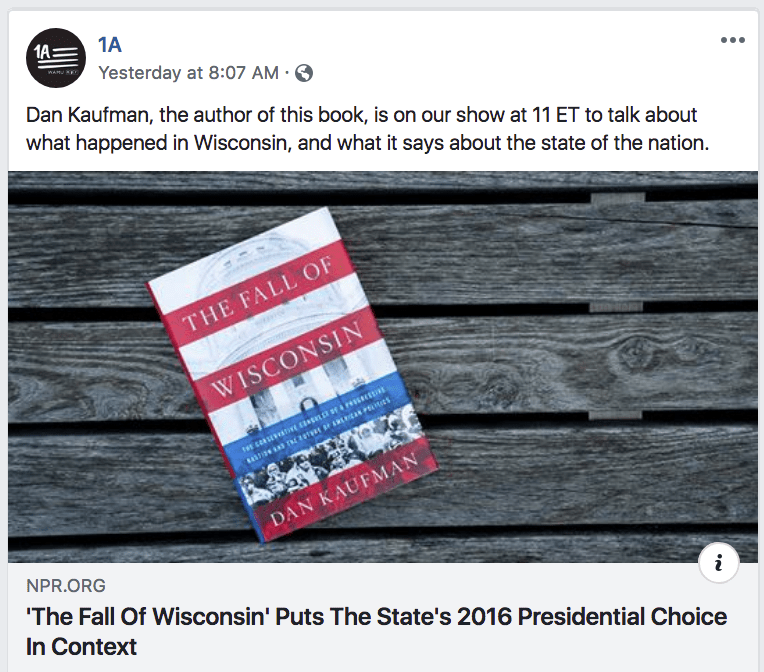
It turns out that there are a lot of people who listen to National Public Radio’s “1A.”
The list of stations that carry all, or some, of “1A,” including the Wisconsin Public Radio Ideas Network, runs from Birmingham, Ala., to Buckhannon, W.Va., the latter famous for …
… and from Concord, N.H., to Coachella, Calif., and from Miami, Fla., to Walla Walla and Yakima, Wash. It’s not on in Alaska or Hawaii, but it is on in the U.S. Virgin Islands. It’s on in states I’ve never been to, including Connecticut, Idaho, Maryland, New Hampshire, New Jersey, North and South Carolina, Oregon, South Dakota, Texas (though I was on the air once in Texarkana, Texas, broadcasting an adult amateur hockey tournament), Virginia and West Virginia, and Washington state and Washington, D.C.
That doesn’t mean that if I flew to Charlotte Amalie and asked random people if they knew me because I was on NPR on WTJX (93.1 FM) back on July 12 that they wouldn’t assume I had gotten too much sun and too much rum. I was on the BBC World Service earlier this year too, so I was theoretically on worldwide, but between the Beeb and NPR I guess I have now spoken to the biggest audience(s) in my entire life this year. As I said before, had I realized the size of the potential audience, I might have been more nervous.
The show can be heard here. It was, as is usually (but not always) the case with public broadcasting, a very civil discussion. As is always the case, there were some things I wished I had said but didn’t, and some points the other two guests made that I didn’t get to respond to, but such is the way of live radio or TV.
Read the Facebook comments on the show, and you will get an interesting look at how others (and some Wisconsinites and ex-Wisconsinites) view Wisconsin. And not favorably. I find it fascinating that there are people who base their opinion about not merely where they live, their state or the U.S., but even the state of their lives on what the government is or isn’t doing and who is or isn’t in office. (This is one reason I believe conservatism, or at least its libertarian side, is vastly superior to all the leftward “isms,” because one facet of the correct way of thinking is that government should never be the be-all and end-all of anyone’s life, even if the right people, however you define that, are in charge.) Similar statements, including some of mine, can be found on 1A’s Twitter feed.
I admit I did not get a chance to read Kauffman’s book. Charlie Sykes did:
What happened in Wisconsin should be a cautionary tale for the Left in the Age of Trump. But as this book makes clear, the Left declines to be cautioned.
According to the publisher, The Fall of Wisconsin gives “the untold story behind the most shocking political upheaval in the country.” But that story has, in fact, been told repeatedly, and author Dan Kaufman adds little to those accounts. Rather than a thoughtful critique of how progressives in a state with such a rich political tradition squandered their historical advantages, what we get is a work of ideological nostalgia, written with political rage goggles. Kaufman yearns for a return to the days of Scandinavian-style social-democratic politics, which he thinks have been defaced and degraded by a deep-pocketed and malign conservative machine.
The Fall of Wisconsin is packed with the sort of stories that progressives tell one another to account for their multiple defeats. It wasn’t anything we did, they reassure themselves; it was big money, the Koch brothers, Citizens United, voter-ID laws, gerrymandering, and a vast conservative infrastructure.
Kaufman paints a dystopian picture in which conservatives such as Governor Scott Walker (very much the villain of the book) “pitted Wisconsin citizens against one another, paving the way for the decimation of laws protecting labor unions, the environment, voting rights, and public education.” The results of those Republican victories, he writes, have been “disastrous” for just about everyone and everything, from the middle class to the environment, children, and small animals.
How awful — except that I live in Wisconsin and I can testify that, contra the title of this book, it has not “fallen.” Actually, it’s quite nice here, especially during our six weeks or so of summer. Despite his depiction of Wisconsin as a reactionary hellhole, the unemployment rate here is 2.9 percent, well below the national average; both the labor force and wages are growing; everyone in poverty is covered under Medicaid; the state has the ninth-best high-school-graduation rate in the country, and school spending is on the rise; and the state’s GDP has grown faster than that of neighboring Minnesota.
But I can certainly understand why the author and his allies on the left are rending their garments over what has happened here. Few states have flipped more decisively from blue to red, and the transformation of the state’s politics from progressivism to conservative dominance has been traumatic and disorienting.
Kaufman takes great pains to retell the story of Wisconsin’s progressive glory days and its role in pioneering progressive legislation. Wisconsin was the first state to enact an unemployment-
insurance program, the first to grant collective-bargaining rights to municipal employees, and one of the first to enact a progressive income tax. “Indeed,” he recalls, “much of Franklin Roosevelt’s New Deal, including the Social Security Act, was drafted by Wisconsinites loyal to what is called the Wisconsin Idea.”
But his history is truncated and selective, more a morality play than an attempt to chronicle the state’s idiosyncratic political history. Kaufman’s narrative sees Wisconsin locked in a decades-long battle over the question posed by its iconic former governor “Fighting” Bob La Follette: “Who shall rule — wealth or man?” In Kaufman’s telling, progressive Wisconsin Republicanism extended through the 1960s. The turning point, he writes, was the Supreme Court’s decision in Buckley v. Valeo, which removed many limits on campaign spending. From that point on, writes Kaufman, “Wisconsin’s politics started becoming more like the politics of other states.”
This fits into his preferred narrative of wealth versus people, but the result is that he glosses over quite a bit of history, including the career of Wisconsin’s red-baiting Senator Joe McCarthy. Similarly, former governor Tommy Thompson, who was elected to four terms and compiled an impressive reformist record, barely rates a mention. Nor does he spend much time analyzing the rise of Walker, suggesting at one point that he “attracted little notice during his time in the state assembly,” when in fact he was a ubiquitous presence in the local media. Kaufman devotes only a single paragraph to Walker’s improbable election as county executive in the Democratic stronghold of Milwaukee County after a pension scandal that implicated both the unions and local Democratic politicians.
And he has little to say about Walker’s deeply unpopular Democratic predecessor, Jim Doyle, except to blame the bad economy for “forcing” Doyle to ram through massive tax hikes in the midst of the financial crisis after repeatedly promising not to do so.
But Kaufman does have a great deal to say about the reactionary forces that conspired to “decimate” Wisconsin. Much of his book is devoted to documenting the “vast infrastructure conservatives [have] created over the past forty-five years,” including groups such as the Club for Growth and Americans for Prosperity. At the center of that conspiracy in Wisconsin sat the Bradley Foundation, which “distributes tens of millions of dollars in grants to think tanks, litigation centers, opposition research firms and other organizations promoting a spectrum of conservative causes such as Voter ID laws, school vouchers, the curtailing of safety net programs, and anti-union measures like right-to-work laws.” (Full disclosure: My wife formerly worked at the Bradley Foundation as director of community programs.)
Kaufman is especially troubled by the network of conservative think tanks clustered around the State Policy Network and American Legislative Exchange Council (ALEC), which allowed conservatives to share ideas and model legislation with legislators around the country. Kaufman struggles to portray the policy initiatives as sinister, highlighting, for example, the group’s support for a “Special Needs Scholarship Program Act,” which gave children with disabilities scholarships to attend schools of their choice. He quotes one Wisconsin legislator describing the ALEC-backed legislation that created education-savings accounts as “the death of public education.” You get the idea.
Not surprisingly, much of Kaufman’s account centers on the battles over Act 10, Walker’s proposal to limit the collective-bargaining powers of public employees. His account of the mass protests is nothing if not romantic, quoting speculation that the mass protests were a sign that Wisconsin was becoming the “Tunisia of collective bargaining rights” (a reference to the Arab Spring, which was then breaking out in the Middle East).
In his telling, the protesters were passionate, idealistic, and not at all to blame for their failure or subsequent electoral defeats. Reading Kaufman’s book, one would have no idea that in fact the protests backfired by alienating voters across the state.
Early polling suggested that support for Walker’s reform was soft, at best. But public opinion began to turn as the protests escalated. Demonstrators occupied and trashed the state capitol and marched on Walker’s family home in Wauwatosa, where his elderly parents lived. Others, dressed as zombies, disrupted a ceremony to honor participants in the Special Olympics. Death threats and obscene letters became commonplace, and the language of Walker’s critics was especially toxic. During one of the protests in Madison in 2011, a video captured one demonstrator repeatedly shouting the F-word at a 14-year-old girl who was speaking at a pro-Walker rally. On the floor of the state assembly a Democratic state representative turned to a female Republican colleague and shouted, “You are f***ing dead!” A progressive talk-show host mocked the state’s female lieutenant governor for having colon cancer and suggested she had gotten elected only because she had performed oral sex on talk-show hosts.
Readers won’t find any of that in Kaufman’s sanitized account and, as a result, will probably have a hard time understanding why Walker went on to be reelected twice while the GOP strengthened its hold on the legislature.
But perhaps the most revealing aspect of The Fall of Wisconsin is Kaufman’s choice of Randy Bryce as the hero. Often known as the “Iron Stache,” Bryce is an ironworker and union activist who has become something of a media/Hollywood/progressive celebrity for launching a bid to unseat U.S. House speaker Paul Ryan before Ryan announced his retirement. As it happens, even though Bryce is locally known as something of an Internet troll, perennial losing candidate, and deadbeat, Kaufman has been touting the Stache for years, including a long article featuring him in The New York Times Magazine in 2015. Even on the left, there have been growing misgivings about Bryce, for example a piece in Vice titled: “Democrats Bet Big on ‘Iron Stache.’ They May Have Made a Mistake.”
The article noted that “Bryce is perhaps more politically vulnerable than his liberal fans realize,” citing a series of failed previous campaigns and a tangled personal backstory that includes unpaid debts and multiple arrests, including a DUI. Despite that, he loaned his failed state-senate campaign $5,000 and, according to the New York Times, bought Twitter followers in 2015. He’s been dogged by reports about his offensive tweets (“If you look up the word succubus, you’ll see Ivanka Trump”) and was caught claiming nonexistent endorsements.
But Dan Kaufman has seen the future, and it is more social democracy and more Stache. “The support for Bryce,” Kaufman enthuses, “was a sign of a broader awakening.”
Perhaps not.
Two points I made more than once on the show. Coming into the 2010 election Wisconsin had a Democratic governor, Democratic-controlled Legislature, and only one Republican statewide official. All of that exactly reversed in the 2010 election, the GOP has controlled the governor’s, attorney general’s and state treasurer’s offices and, except for a few months around Recallarama, both houses of the state Legislature. Voters have four chances — the 2012 recall election and the 2012, 2014 and 2016 elections — to change that, and they have declined to do so.
Kaufman and others on his side will blame gerrymandering (which helped Walker how?), the Evil Koch Brothers, other big campaign money (which is the fault of excessive government power, which means excessive stakes in elections and the absolute need to do whatever it takes to win) or whatever boogeyman the left likes. The fact is that a majority of Wisconsin voters to this point have approved of what Walker and Republicans have done in Wisconsin, and a majority of Wisconsin voters to this point have not felt the need to restore power to Democrats. Like it or not, that is reality. And trying to shame voters for their incorrect (in the leftward opinion) views or past votes isn’t likely to make them vote correctly (in the leftward opinion) in the next election(s).

 Steve Prestegard.com: The Presteblog