>Three times as many birthdays as yesterday: Start with Alan Price, guitarist for the Animals …
… followed by Mark “Flo” Volman of Flo & Eddie and the Turtles …
… and finish with Rod Morgenstern of Winger:
No comments on >Presty the DJ for April 19
>Three times as many birthdays as yesterday: Start with Alan Price, guitarist for the Animals …
… followed by Mark “Flo” Volman of Flo & Eddie and the Turtles …
… and finish with Rod Morgenstern of Winger:
The Economist quotes Ayn Rand …
The principle of voluntary government financing rests on the following premises: that the government is not the owner of the citizens’ income and, therefore, cannot hold a blank check on that income—that the nature of the proper governmental services must be constitutionally defined and delimited, leaving the government no power to enlarge the scope of its services at its own arbitrary discretion. Consequently, the principle of voluntary government financing regards the government as the servant, not the ruler, of the citizens—as an agent who must be paid for his services, not as a benefactor whose services are gratuitous, who dispenses something for nothing.
… and then, while disagreeing that “voluntary government financing” is feasible, adds:
The general view expressed here captures much of the reasonable moral core of the movement to restore and reinforce effective constitutional limits on government. Many Americans believe, not unreasonably, that far from acting always as an instrument that serves their interests, government often acts as if citizens’ lives and labour are instruments to the special interests that control government. Indeed, the principle embedded in Mr Obama’s budget speech, that tax increases are spending cuts, suggests the objectionable idea that all income is government-owned, which it then “spends” by choosing not to hoover it up in taxes. To object to this way of picturing the relationship between citizens, their property, and their government is not to deny that the infrastructure of security, property and law maintained by government is necessary for a well-functioning economy that generates good jobs and decent incomes. It is necessary. But that infrastructure is for us. We are not for financing it. And we certainly aren’t for financing whatever extraneous functions our continually mission-creeping government happens to have taken on. Necessary taxation is not theft. But there are margins at which taxation becomes difficult to distinguish from theft.
As Abraham Lincoln said so well, “The legitimate object of government, is to do for a community of people, whatever they need to have done, but can not do, at all, or can not, so well do, for themselves—in their separate, and individual capacities.” Citizens reasonably resent a government that milks them to feed programmes that fail Lincoln’s test.
>There is, believe it or don’t, one, and only one, birthday worth noting in music today:
Mike Vickers, guitarist for Manfred Mann:
This song is obvious for today:
I originally wrote this in June 2008.
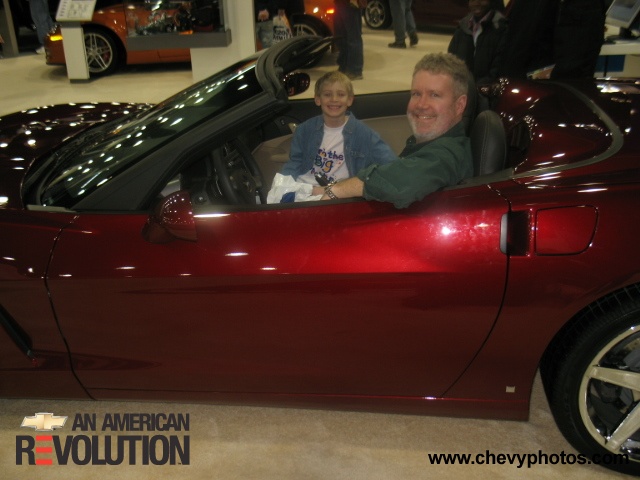
My birthday earlier this month dawned without a Chevrolet Corvette in front of my house. (The Corvette at the top of the page was featured at the 2007 Greater Milwaukee Auto Show. The copilot is my oldest son, Michael.)
Which isn’t surprising. I have three children eight and younger, and I have a house with a one-car garage. (Then again, this would be more practical, though a blatant pluck-your-eyes-out violation of the Corvette ethos. Of course, so was this.) I already had to purchase a car earlier this year (replacing a car with 228,000 miles and a cracked engine block, plus several other issues), and we try to limit our vehicle purchases to one per year. The reality is that I’m likely to be able to own a Corvette only if I get a visit from the Corvette Fairy, whose office is next door to the Easter Bunny.
(I hope this isn’t foreshadowing: When I interviewed Dave Richter of Valley Corvette for this month’s car enthusiast story, he said that the most popular Corvette in most fans’ minds was a Corvette built during their days in high school. This would be a problem for me in that I graduated from high school in 1983, when no Corvette was built.)
The Corvette is one of those cars whose existence may be difficult to understand within General Motors Corp. The Corvette is what is known as a “halo car,” a car that drives people into showrooms, even if the potential buyer is looking for something less expensive and more practical and useful than a Corvette. (Chrysler Corp.’s counterpart is the Dodge Viper, which reportedly may be on its way out in the next couple of years.) It is an oddity within Chevrolet, which has made most of its reputation on practical, though, dull cars, at least until the Corvette arrived in 1953 and the Chevrolet V-8 hit showrooms two years later. And yet, the 35 years the Corvette has been in existence, in good and bad economic times, has generated its own cult, with millions of fans backed by businesses geared toward preserving and restoring them.
The Corvette, in its first, second, third, fourth, fifth and now sixth iterations, started as GM’s response to the British and Italian sports cars, usually two-seat convertibles, that soldiers coming home from World War II were bringing with them. Over the years, Corvettes became stuffed with more power than their steering, brakes and handling could handle, adopted the most out-there styling perhaps in American automotive history, were nearly strangled by emissions regulations (the standard engine on the 1975 Corvette had just 165 horsepower), had killed and then brought back the convertible, and, by now, have the best combination of power and refinement for the price in the world — truly a world-class car, but not at world-class prices.
The first Corvette I remember seeing belonged to a neighbor down the street — a dark green 1970 coupe with the base engine, automatic transmission and AM/FM radio. It was, frankly, a scary looking car, sitting incredibly low to the ground and, to a six-year-old, looking as though it was going to bite you. I got a couple of rides in it, with my brother sitting in the passenger seat with me and the younger son of the car’s owner sitting on top of the console. (Can’t do that anymore.)
The first Corvette I drove was a 1969 coupe, but with a (conservatively rated) 435-horsepower V-8 that ran on racing or aviation gas and a four-speed transmission known by car buffs as the “rock-crusher.” It was a beast, particularly due to its lack of power steering and brakes and its ability to transfer prodigious amounts of engine heat into the cockpit. My ride in this car reached (I believe I can say this since the statute of limitations has passed) speedometer-indicated speeds that are multiples of existing speed limits. (During this ride, it occurred to me, as the scenery was going by at a really rapid rate, that I wasn’t wearing a seat belt. A moment later, it occurred to me that my lack of seat belt didn’t matter because if we hit anything at that speed, the authorities would be scraping up whatever was left of me from whatever we hit with a putty knife.)
The current and previous generations of Corvettes appear to be the best of the various worlds the Corvette has represented over the years. Styling is always an arguable point (I prefer the C5, built between 1997 and 2004, to the C6, which has been built since 2005; then again, if you really like a modern version of the C1 or C2, companies can now accommodate your wishes), but today’s Corvettes can go as fast as any that have been built before now. The difference is they handle and stop much better than any that have been built before now, and the obvious creature comforts — air conditioning, upper-end sound system, power leather seats, air bags — are either standard or, in the case of a navigation system, optional. With more than 5,000 Chevrolet dealers in the U.S., if something breaks, parts are much easier to find than for such brands as Porsche or Ferrari. (That’s not to say I don’t like Porsches or Ferraris — different strokes for different folks.)
For those who haven’t driven a Corvette, when you’re my height (6-foot-4), the overall effect is something like what driving a luge must be like. The first two generations were more conventional in design, but every Corvette since the C3 (based on the Mako Shark show car) has kind of wrapped around the occupants, which was initially criticized because that prevented the traditional American driver position of resting your left arm on top of the door (with window rolled down, of course), unless you’re tall enough. In every C5 or C6 convertible I’ve sat in at car shows, I look straight at the driver’s-side sun visor, so evidently I have to move the power seat to its lowest possible position to be able to drive the car. The result of that is that getting out requires what I had to do with my mother’s 1985 Chevy Camaro (which she owned when I was half my present age) — put my hand on the ground to brace myself to exit — or do a 90-degree left turn, stick my legs out and then get out legs first, with a limbo motion to clear the roof and stand up. (The current Corvette is about two-thirds of my height, and the seats are a long way down.) Clearly the Corvette is not a car in which to run errands.
If you like driving, this is it. It’s unquestionably a stiff-riding car, but much better than the older versions, and, as noted before, while it flies down the road like few other cars, it also will stop like few other cars. This is hyperbole to say this, but I wonder if anyone really can have a bad day if it begins and ends with a Corvette drive from your home to your office.
The Corvette hangs around GM in large part because it makes money and positive attention for GM. (Not until 1958, five years after it was introduced, did the Corvette make money for GM; in fact, Chevrolet made just 700 Corvettes in 1955.) The Corvette V-8s are found in several other GM cars, including the Pontiac G8 GT, plus several Australian Holdens (also available from Vauxhall in Britain and in the Middle East) and the upcoming Cadillac CTS-V (based on the CTS, a sedan that may be coming out in two-door and station wagon versions) and Chevrolet Camaro, assuming they actually build the Camaro. The Cadillac XLS is a Corvette under the body, although with the Cadillac Northstar engine instead of the Corvette’s.
Part of the reason for the Corvette’s popularity is the V-8 engine found in all but the first two model years. (V-8s sound much like V-twins, which is, I think, one reason for the popularity of the Harley–Davidson motorcycle over its Japanese and European competition.) Even though the first two years of Corvettes had a six-cylinder engine instead of a V-8, it’s almost impossible to imagine a Corvette without a V-8. The Corvette V-8 isn’t even the state of the art in V-8 technology (without getting too technical for non-gearheads), and yet the standard Corvette engine is rated at The 2009 Corvette ZR1, with 638 horsepower, is EPA-rated at 26 highway miles per gallon, 2 miles per gallon better than the 2008 Corvette ZO6, whose owners must make do with a mere 505 horsepower. (You can also save yourself $25,000 and purchase the base model Corvette, which, at 430 horsepower, costs $109.19 per horsepower, a better bargain than the ZO6’s $142.82 per horsepower.)
The ZR1 is supercharged, which is how you can get 638 horsepower and yet 26 mpg if you keep your foot out of it some of the time. (Remember: The most gas is used in acceleration, not at speed.) Future Corvette V-8s are likely to have more advanced engine technology and lower horsepower, but if the next-generation Vettes are lighter, they’ll have the same power-to-weight ratio, and possibly even better gas mileage. (As it is, the base Corvette gets better fuel economy than the four-cylinder Honda S2000 and the six-cylinder Nissan 350Z.) That makes it hard to imagine that any Corvette in the foreseeable future won’t have a V-8.
The Corvette generates interest that far exceeds its annual sales. In its biggest production year, 1979, Chevrolet sold 53,807 Corvettes, and in 2007 Chevy sold 40,561 Corvettes. Motor Trend magazine has a history of Corvette “scoops” (for instance, the breathless late 1973 announcement that there would be two Corvettes, both with rotary engines) that turn out to be way off base, but sell tons of issues on the newsstands anyway. Motor Trend predicted late in 2007 that the next-generation Corvette will arrive in the 2013 model year, one month after it predicted that the next-generation Corvette will arrive in the 2012 model year.
A substantial component of Corvette fans want Vettes to be more exotic, with, for instance, a mid-engine layout. (Most cars are, of course, front-engine, while a few, including the old Volkswagen Beetle and Porsche 911, are rear-engine; a mid-engine car has the engine mounted generally between the axles, usually in front of the rear axle.) A mid-engine layout seems unlikely because, for one thing, that would take the Corvette’s price well beyond $100,000, which doesn’t really fit into GM’s product portfolio. What’s more likely is that, as now, Chevy will make two versions — a “mainstream” version and a more exotic version with, for instance, lightweight materials and all-wheel drive, for perhaps twice the price of the base model.
Not everyone understands the appeal of Corvettes. (John McCain does; his first new car was a new 1958 Corvette. Former presidential candidate Joe Biden got a 1967 Corvette as a graduation present, and he still has it.) Think of Corvettes as a demonstration of what American free enterprise can do, even with federal government regulations, pressures from rising oil prices, and those nags who can’t grasp why someone might need more horsepower than the nag thinks you need. The Corvette’s overseas competition costs significantly more money, and that was even before the recent sinking dollar. American business has put together the best performing car for the money on the planet, and that’s something worth celebrating — say, on National Corvette Day June 30, celebrating the day the first Corvette drove off the assembly line in St. Louis. That would be three days after June 27, Drive Your Corvette to Work Day.
(And for those of you who think after Thursday’s weather that arks might be a better idea than Corvettes: You can buy a Corvette boat — specifically, a Malibu Corvette Sport-V Limited Edition, a boat with a Corvette engine and many Corvette trim parts. The reverse was the case in the early 1990s, when Mercury Marine’s Mercruiser division produced the LT-5 V-8 for the Corvette ZR1.)
The short list of birthdays starts with Roy Clark:
Dave Edmunds:
Keyboardist Matt Reid of Berlin:
Samantha Fox:
I will be on Wisconsin Public Radio’s Joy Cardin program Friday at 8 a.m.
Wisconsin Public Radio’s Ideas Network can be heard on WHA (970 AM) in Madison, WLBL (930 AM) in Auburndale, WHID (88.1 FM) in Green Bay, WHWC (88.3 FM) in Menomonie, WRFW (88.7 FM) in River Falls, WEPS (88.9 FM) in Elgin, Ill. (or is that Baja Wisconsin?), WHAA (89.1 FM) in Adams, WHBM (90.3 FM) in Park Falls, WHLA (90.3 FM) in La Crosse, WRST (90.3 FM) in Oshkosh, WHAD (90.7 FM) in Delafield, W215AQ (90.9 FM) in Middleton, KUWS (91.3 FM) in Superior, WHHI (91.3 FM) in Highland, WSHS (91.7 FM) in Sheboygan, WHDI (91.9 FM) in Sister Bay, WLBL (91.9 FM) in Wausau, W275AF (102.9 FM) in Ashland, W300BM (107.9 FM) in Madison, and of course online at www.wpr.org.
My foil Friday will be Ed Garvey, who was announced on this website (happy birthday Monday, Ed) as being the former executive director of the Major League Baseball Players Association. That would be a surprise to Marvin Miller or Donald Fehr, who actually headed up the MLBPA; Garvey headed the National Football League Players Association during its first strike in 1974.
A tweet from Jim Pethokoukis Tuesday:
Got an interesting hint today that there might be a surprise candidate in the GOP field. As Drudge says, developing …
I would be a surprise candidate in the GOP field, wouldn’t I? I’m sure there’s a place in the GOP field for a libertarian/conservative journalist whose sole run for office was a school board loss, and whose other political experience was four years on the City of Ripon Plan Commission.
I have done this sort of thing before, back in 2008, when I “ran” for governor. At the time, I couldn’t actually run because, independent of all the other obstacles, running for office was contrary to the code of ethics of my employer. That problem having resolved itself, I am free to join Messrs. Huckabee, Romney, Paul, Johnson, et al. (Or, for that matter, join whoever plans to run in the Libertarian Party; for that matter, I might try to win the GOP and Libertarian nominations, which seems appropriate for someone who gets two 100 scores on the World’s Smallest Political Quiz.)
There have to be, I imagine, a fair number of perks involved with being president — Air Force One at your beck and call (to, for instance, make surprise visits to the troops), getting to go to Super Bowls and other big events, the ability to host cool events (say, Chicago concerts, dog shows and your children’s Scouting campouts) on the White House lawn, instant credibility every time you open your mouth, etc. We could switch our church for four or eight years to the National Cathedral, conveniently the same religion as ours. (How many families have had this Sunday morning commandment from parent to child(ren): “The motorcade is leaving for church! Get going!”) Being the first president to have facial hair since William Howard Taft would be something on which the media could obsess. (“Katie, do you prefer the winter beard or the non-winter goatee look?”)
It would be refreshing as well for the voters to have the choice of a tell-it-like-it-is candidate. There would be no discussion of where the incumbent was born, because there is enough to criticize about President Obama without catering to the tin-foil-hat set. Most politicians are quote machines anyway, but one goal of mine would be to have someone write a book called Did the President Really Say That?
Getting elected would be relatively simple. Any Republican presidential candidate need only repeat what Ronald Reagan asked in 1980: Are you better off now than you were four years ago? And for those who feel the need to say more, add: Are we better off now than we were four years ago?
I’m sure you’ll be shocked — shocked! — to learn that I plan to be a fiscal conservative, perhaps even more so than anyone else in the GOP field. I would pledge to the voters that the federal budget would be balanced by the end of my first term, or else voters could feel free to not vote for me for a second term. Would that result in severe budget cuts and gnashing and wailing from the left? Duh. Might that result in government shutdowns in a duel with a recalcitrant Congress? That would be more fun than watching the Bears and Vikings both lose.
The thing to do would be to take all of the budget-balancing-through-cuts ideas — everything from the Paul Ryan plan rolling back spending to 2008 levels to eliminating the Education and Energy departments to killing farm price supports to selling off federal assets — and enact all of them. Wasteful spending is all over the federal government, even in areas Republicans won’t touch, like defense. And wasteful defense spending does not make our country safer.
Many years ago, I proposed simultaneous tax, Social Security and health care reform by allowing complete tax-free deductability (which would need to occur in paychecks instead of at the end of the tax year) for savings and investments and health, life and disability insurance. Social Security is not only a Ponzi scheme that would be illegal in the private sector, but a giant ripoff for anyone my age and younger. Either Social Security needs to be replaced, or it will simply collapse of its giant oncoming deficits. And taxes — all taxes — should take no more than 25 percent of anyone’s income.
I would support complete free trade, because free trade is best for consumers. I would (that is, I would work with Congress to enact legislation that would) also eliminate consumer-choice-limiting regulations such as vehicle fuel economy laws (which have served to kill station wagons). I would also support the development of all available forms of domestic energy, including those the present administration thinks are too icky to develop. I would leave many more decisions to lower levels of government that are currently enforced through the federal hammer of eliminating federal aid, such as setting drinking ages. (If you’re old enough to die for your country, you are old enough to drink.)
The reason I went from a 90 years ago to a 100 on the World’s Smallest Political Quiz personal axis is that I have finally decided that the Drug War isn’t working. Good money is being wasted on enforcing marijuana laws and the completely stupid pseudoephedrine laws. (That last sentence was written by my bad sinuses.) I would not go so far to decriminalize the definitely-bad-for-you drugs such as cocaine or heroin, but I have not seen much evidence to convince me that marijuana is either bad or good for you.
I also think neither the federal government nor the White House belongs in as many social debates as both are in now. (You can rest assured that whether I run or not, I will not be voting for Mike Huckabee.) Don’t like what’s on TV? Don’t watch. I would suggest that social conservatives seek to accomplish by personal example what they’d like to accomplish through legislation. (For one thing, if the Wall Street Journal’s James Taranto is correct with his Roe v. Wade theory, those who support abortion rights will be outnumbered by those who do not.)
What about foreign policy (something I didn’t discuss much in Marketplace of Ideas since it was usually irrelevant to the issues affecting the readers of Marketplace)? The official policy of the United States government would be to promote personal, political and economic freedom around the world. (I am very pro-immigration, but one way to reduce illegal immigration is for countries on the other side of the border to improve their own selves.) It is interesting to note that the extent to which candidate Obama complained that non-Americans didn’t like the U.S. didn’t affect President Obama’s foreign policy much. (Note as well that we are now in one more war than we were in under Obama’s predecessor.)
To sum up my campaign, I would be about improvement, not change — making things better, not merely different, since change is inevitable, but positive change is not. As an Eagle Scout (as was Gerald Ford), my credo would be to leave things in better condition than I found them.
I’m sure you’ll agree that I have as much chance of being elected president as, well, writing for the May issue of Marketplace.
>Today’s birthdays begin with Lester Chambers, vocalist for the Chambers Brothers:
The writer of one of the best movie themes of all time, Bill Conti:
Bassist Jack Casady of the Jefferson Airplane:
Singer and guitarist Lowell George of Little Feat:
Two words: Al Green:
Bassist Riff West of Molly Hatchet:
Bruce Springsteen’s drummer and Conan O’Brien’s first band leader, Max Weinberg:
Blondie’s keyboard player, Jimmy Destri:
One of the Brothers Johnson, Louis:
And finally Lou Bega, and if you play this you won’t get it out of your head all day:
And would you believe: Happy birthday to Maxwell Smart.
>Birthdays today include Richard Berry, writer and original singer of “Louie Louie” …
… along with guitarist Robert Fripp of King Crimson …
… and Chris Difford of Squeeze …
… and vocalist/guitarist Stuart Adamson of Big Country …
… and Richie Sambora of Bon Jovi …
… and Lisa Stansfield:
>Steve Howe gets listed twice, first for Yes …
… and then for Asia:
Adam Woods, the rare drummer/pianist, of the Fixx also has a birthday today:
So does Guns N Roses guitarist Izzy Stradlin …
… who was born one year to the day before Julian Lennon:
On Saturday is the birthday of satirist Tom Lehrer …
… and Elvis Presley contemporary Carl Perkins …
… and The Byrds drummer Gene Parsons …
… and Philip Wright, singer for Paper Lace, which had this one-hit wonder that has nothing to do with Da Bears:
On Sunday is the birthday of Sheb Wooley, who had this one-hit wonder:
The Flamingos, whose Nathaniel Nelson has a birthday Sunday, had more than one hit:
Bunny Waller, vocalist and percussionist of the Wailers, has a birthday Sunday …
… as does Dave Peverett of Foghat:
… and Brian Setzer of the Stray Cats and his own orchestra, and having each means you can copy yourself:
 Steve Prestegard.com: The Presteblog

