The Los Angeles Times previews the National League Championship Series, which starts in Miller Park tonight:
The Dodgers’ celebration at Atlanta’s SunTrust Park on Monday was as much about checking off a box as it was what they had accomplished. They expected to advance to the National League Championship Series, to within four wins of another trip to the World Series, after last year’s disappointment. The path this season was rockier than anticipated, but anything less would’ve been a colossal letdown.
The party the Milwaukee Brewers had at Coors Field in Denver a day earlier had a different flavor. They weren’t projected to reach the NLCS. They play in baseball’s smallest market, an afterthought in Chicago’s shadow, and have one of the majors’ slimmest payrolls. It was their first playoff series victory since 2011, the last time they were in the playoffs. They went to the NLCS that year and lost. They haven’t won a World Series or even been to one since 1982. This is unfamiliar territory.
But the clubs will have at leastone thing in common when they arrive at Milwaukee’s Miller Park for Game 1 on Friday: They’re both playing their best baseball. The Dodgers have won seven of their last eight games, outscoring opponents 47-15 during the stretch. The Brewers have been even better, winning 11 straight games and breezing through the NL Division Series by outscoring the Colorado Rockies 13-2 in a three-game sweep.
“It’s going to be great,” Dodgers shortstop Manny Machado said. “Both ballclubs have worked hard to get to this situation. They’re both two good ballclubs facing off in the championship. And we’re just going to go out there and play baseball, be ourselves, keep doing what we’ve been doing all year, and hopefully we come out on top.
Presumptive National League MVP Christian Yelich anchors a deep Brewers lineup that features a little bit of everything. They’re traditional in that regard.
But pitching is another matter. The Brewers deploy their pitchers like most analytically driven clubs; they’d rather not let a pitcher face a lineup three times, regardless of pitch count, and they’re not afraid to shift a heavier onus on to their bullpen. But the Brewers have catapulted the revolution to another level.
Manager Craig Counsell would rather not label his pitchers “starters” or “relievers.” He prefers “out-getters.” In Game 1, he ditched the traditional starter entirely, opting to begin the game with Brandon Woodruff, a reliever. Woodruff tossed three shutout innings. Traditional starters Jhoulys Chacin and Wade Miley started the final two games, but logged just 7 2/3 innings combine
The strategy is effective because Milwaukee’s bullpen — headlined by Jeremy Jeffress, Josh Hader and Corey Knebel — is one of baseball’s best, and the postseason schedule, which affords more off-days, renders the approach more viable. Jeffress, Hader and Kneble each appeared in all three NLDS wins over the Rockies. They gave up two runs and six hits and tallied 12 strikeouts in 8 2/3 innings — and they’ll be fresh Friday after a four-day layoff.
Meanwhile, the Dodgers, realizing their strength lies elsewhere, are countering the sport’s current.
Hyun-Jin Ryu threw seven scoreless innings in Game 1 against the Atlanta Braves. Clayton Kershaw tossed eight in Game 2. Walker Buehler was given enough leash to push through a five-run second inning in Game 3 before settling in to log five innings, and Rich Hill was pulled in the fifth inning in Game 4 after issuing five walks. A year after riding Kenley Jansen and a deep bullpen to Game 7 of the World Series, the Dodgers’ success is dependent on their starting rotation.
“Hyun-Jin [was] unbelievable,” Kershaw said. “And Walker, after he took his lump there in that one inning, came back and threw really well. So I think that was huge for him moving forward and Richie kept us in the game .… Yeah, we’ve got some depth there, which is huge.”
Kershaw will get the first crack on Friday. He found out about the assignment from a reporter amidst the Dodgers’ postgame celebration on Monday. It wasn’t the obvious choice, not after his bosses decided to start Ryu over him in Game 1 of the NLDS. It was the first time Kershaw didn’t start a Game 1 for the Dodgers when he was available since 2009. That order has been restored.
It will be the Dodgers’ first visit to Miller Park since they opened up the second half there. The Dodgers were an unfinished product then. Machado had just arrived from the Baltimore Orioles and made his debut in the series opener. Brian Dozier was a Minnesota Twin. Ryan Madson was with the Washington Nationals. The Pittsburgh Pirates employed David Freese.
Three of the four played significant roles in Monday’s series-clinching win. Freese cracked a pinch-hit, go-ahead, two-run single. Madson escaped a bases-loaded, one-out jam. Machado crushed a three-run home run. It was another display of the depth that buoyed the Dodgers’ internal expectations. Those expectations are high, and they include two more celebrations.
“We had a really good team last year,” Dodgers third baseman Justin Turner said. “We have a really good team this year. The only difference is we’re trying to win one more game.”
Leaving aside how many Brewers were acquired since the end of last season to get to this point, we’ll see if the traditional approach to winning baseball — starting pitching and buying however many players you want to get your championship — will triumph over the Brewers’ newfangled, yet small-market, approach.
If one former MLB official is to be believed, the Brewers won’t only be fighting the Los Angeles Dodgers in the National League Championship Series — they’ll be up against the league itself.
In an interview with Dan Le Batard and Stu Gotz on 790 AM’s “The Ticket,” former Miami Marlins President David Samson implied the fix is already in for the Dodgers:
“MLB is going to do anything they can to have the Dodgers beat the Brewers,” Samson said.
You can listen to the audio for yourself here. The relevant portion starts around 36:00.
Samson’s comment understandably caught Le Batard and Gotz by surprise.
“Wow. That is a shocking accusation,” Le Batard replied. “He knows he shouldn’t have said that.”
It’s worth noting that Le Batard had previously in the segment described Samson as “a former executive who doesn’t mind speaking the truth.” Oh — and he was born in Milwaukee (but raised in New York City).
Adding fuel to the fire are comments made earlier this week by Dodgers outfielder Yasiel Puig, who said his team would beat the Brewers in a 4-0 sweep. The Brewers are also underdogs in Vegas, according to VegasInsider.com.
It’s unclear how a player from a team that beat the Brewers four out of seven times in the regular season concludes a sweep is imminent. But certainly the history of disrespect of Wisconsin sports franchises, except for possibly the Packers, among major pro sports teams is legion. Do you seriously believe the National Basketball Association had nothing to do with moving Kareem Abdul-Jabbar from the Bucks to the second-largest market in the NBA? Major League Baseball must have jumped at the chance to have the Braves leave Milwaukee for Atlanta, which makes you wonder how MLB ever allowed the Seattle Pilots to move to Milwaukee. (Or how MLB ever thought the Pilots’ ownership group should have a franchise given their bankruptcy during their first season.)
MLB probably would love a seven-game series with the Dodgers winning. Watch what happens with umpire calls in this series.
A few things are happening in Wisconsin sports starting today, as chronicled by the Milwaukee Journal Sentinel:
There was some to-do Sunday about how the day marked the first time the Packers, Brewers and Bucks all played on the same day. But it’s nothing like what awaits.
The Bucks were playing a preseason game in Ames, Iowa (which they won), while the Packers lost in Detroit and the Brewers won in Colorado to sweep the National League Division Series.
Now, the Brewers know their next game will be Friday at Miller Park, with the first game of the National League Championship Series ahead against either the Dodgers or the Braves. So, starting Friday, you’ll have four days of interesting choices.
Friday, Oct. 12
The ALCS doesn’t start until Saturday, so the Brewers will almost certainly be playing Game 1 of the NLCS on Friday night, just as the Bucks tip off their final pre-season game at 7:30 p.m. at Fiserv Forum.
Saturday, Oct. 13
Both Major League championship series will be playing, so the Brewers could be playing in the afternoon or evening and, at the least, partially conflict with the Wisconsin Badgers huge battle at The Big House at Michigan.
Sunday, Oct. 14
Weirdly, nothing will be happening Sunday. Maybe there’s a church picnic going on?
Monday, Oct. 15
The Brewers will be back, playing on the road, in a game that will be in prime time (with the ALCS in an off day). At Lambeau Field in Green Bay, the Packers will be playing on Monday Night Football, battling the San Francisco 49ers in a 7:15 p.m. kickoff. The two events are almost certainly going to be taking place simultaneously.
Which will you choose?
Bonus: Friday, Oct. 19
Let’s say the NLCS series lasts beyond the first five games. Miller Park will again be hosting Game 6 on Oct. 19, which happens to be the same night that the Milwaukee Bucks host their first regular-season home game at brand new Fiserv Forum downtown, taking on the Indiana Pacers.
Assuming the Brewers series is still taking place, that’s going to be a memorable night in Milwaukee.
Today is also the last day of the high school football regular season, which means some teams will be playing for playoff berths and others will be playing for where they fit in the playoffs. That means next Friday will also be the first weekend of the high school football playoffs. That’s where I will be.
One of the only times a previous weekend like this comes to mind is in 1982, when Wisconsin beat Ohio State 6–0 in the rain in Columbus while the Brewers were tying the American League Championship Series in the rain in Milwaukee. One day later the Brewers completed their comeback by winning the series. The Packers … didn’t play because the NFL was on strike.
There was also 2008, when the Brewers were playing their final regular-season game needing to win and get a Mets loss to go to the playoffs while the Packers were playing. It may have been the first time in the history of WTMJ radio that the Packers, which WTMJ has carried since 1929, moved the Packers off WTMJ. (They moved to their FM, now WKTI.) Now that WTMJ and WKTI both carry the Packers, no decision needed to be made.
Speaking of radio: A colleague in my side thing pointed out that this era right now might be the zenith of Wisconsin sports broadcasting. Bob Uecker announced for ABC and NBC while announcing the Brewers …
… while Brewers TV announcer Brian Anderson is announcing the American League Championship Series for TBS …
… Wayne Larrivee, who has worked for ESPN and Westwood One, now announcing the Packers …
… and Matt Lepay, who could certainly go national if he wanted to, on the Badgers:
I didn’t watch any TV coverage of the National League Division Series, though I work only in the a.m. and p.m. on days ending in Y.
The online reaction to Fox Sports 1’s choice of Kenny Albert, former New York Mets/yankees pitcher David Cone and A.J. Pierzynski, one of the most unpopular players in Major League Baseball history, wasn’t positive, though I can’t find any reviews of their work.
Game 3 was carried by the MLB Network, which is unavailable to some people. And here’s what they missed, according to the Milwaukee Journal Sentinel:
Many fans were not pleased that Game 3 of the NLDS was broadcast on the MLB Network, a channel not everyone gets in their homes. But hey, at least Hall of Fame broadcaster Bob Costas was going to be on the call, right?
Now, let’s get this out there: Bob Costas is a dang legend. Put him in ALL the Halls of Fame. But … uh, he and color commentator Jim Kaat had a rough time with the Brewers names and facts on Sunday.
The Brewers won, 6-0, so it’s all water under the bridge, and no NLCS games will be on MLB Network. But let’s review:
Travis Shaw has not, in fact, committed double-digit errors since picking up playing time at second base around the July 31 nonwaiver trade deadline. He’s committed one in 39 games. …
Just an FYI @Brewers fans: Shaw does NOT have 13 errors at 2nd. I don’t know where that came from but not accurate .
It’s not Jesus Aguilera, but all the jokes about Genie in a Bottle (Jesus in a Bottle) are very good.
Broadcasters can’t handle his name, pitchers can’t handle his bat. But Jesus Aguilar’s 💣has the Brewers ahead 2-0 and on the verge of advancing to the NLCS. #MLBPlayoffspic.twitter.com/UFH2nLt0zG
Craig Counsell was not drafted by the Milwaukee Brewers, as the broadcast said a couple times. It’s actually a cooler note that he was drafted by the other team involved in the broadcast, the Rockies.
In fact, Counsell was taken in the 11th round in 1992 — the first year the expansion franchise selected players. Counsell essentially became one of the organization’s first employees.
Jim Kaat continues to say that Craig Counsell was drafted by the Brewers, when he was drafted by the Rockies. The broadcast corrected this, but Kaat wasn’t paying attention.
— Hot Ocean Milk with Dead Animal Croutons (@PoseidonsFist) October 7, 2018
The broadcast had some trouble with starter Wade Miley’s biography, too. He didn’t actually start the season at Double-A (though he was on a rehab start, so you can perhaps understand the confusion?). And while he’s been on a few teams so far in his career, the Rockies haven’t been one of them.
@MLBNetwork can someone please tell Bob Costas that Wade Miley plays for the #Brewers and never played for the Rockies? Also was in AA Biloxi to start the year because of an injury in spring training. Have the interns do some research before going on national tv guys!
— The Brew Crew Review: Milwaukee Brewers Podcast (@brewcrewreview1) October 7, 2018
There goes Wade Miley. Can you believe he started the season in AA?
Also, Orlando Arcia, who has had some pretty good moments in the postseason thus far (counting Game 163), was given the unusual pronunciation of “arr-SAY-uh.” It’s “ARR-see-uh.” As in “That pitch Orlando hit in the ninth over the wall Sunday was a pretty great moment; see ya later.”
I did see highlights. Costas seemed rather uninterested, I thought, which may be because the Rockies were really never in game 3 thanks to the Brewers’ pitching. I’ve always liked Jim Kaat from his days working for CBS and ABC, but highlights don’t really show off an announcer, especially in baseball.
For those who didn’t like Albert or Costas: The National League Championship Series and the World Series will be carried on Fox. Fox’s lead baseball announcer is Joe Buck. Ironically, this year is TBS’ turn to carry the American League Championship Series, which means Brewers’ announcer Brian Anderson will be announcing the other series instead of the series his weekday employer is in.
The Rockies waited nine long years to get back into the National League division series. They put together a late-season winning streak to get into the playoffs, notching 91 victories. They beat the Cubs, 2-1, at a rowdy Wrigley Field in a dramatic, 13-inning wild-card game.
But then they were undone by their bats, suspect all season, turning to sawdust.
The Brewers swept away the Rockies in three games in the National League division series. The ugly finale came Sunday afternoon at misty, 46-degree Coors Field with Milwaukee winning 6-0 and the Rockies held to four hits.
Colorado was held to two runs in the series, the fewest even in the NLDS, pending the outcome of Atlanta’s series vs. the Dodgers Sunday night. The Braves were shut out in the first two games of the series.
Things got so bad that some fans booed third baseman Arenado and all-star shortstop Trevor Story when they struck out in the sixth. In the ninth, when Orlando Arcia and Keon Broxton hit back-to-back solo home runs off closer Wade Davis, the cheers of Brewers fans took over the ballpark as Rockies’ fans headed to the exits.
The Brewers move onto the National League championship series vs. the winner of the Dodgers-Braves series. The Rockies will go into the offseason and think about what might have been had Brewers pitchers not tied them up in knots or kept them on eggshells.
In three games, the Rockies scored two runs, both coming in the ninth inning of Game 1, a game the Rockies lost 3-2 in 10 innings. Colorado hit .146 in the series with a .210 on-base percentage were shut out in the final two games after having never been blanked before in postseason play. …
The Brewers put the game on ice with a two-run sixth inning off reliever Scott Oberg, who had been one of the Rockies’ most reliable pitchers for much of the season, making it 4-0. Oberg served up a single to Mike Moustakas, followed by a double to Erik Kratz, who lit up the Rockies all series. Then Oberg made a major goof, dropping the ball when he was on the rubber and getting called for a balk. That brought in Moustakas to score and advanced Kratz to third. When Oberg uncorked a wild pitch, Moustakas scored to make it 4-0.
Colorado’s offensive failures on Sunday began in the second inning. A leadoff single by Story and a one-out walk to Carlos Gonzalez had the makings of a mini-rally. But left-handed starter Wade Miley quickly snuffed it out, getting Ian Desmond to pop out to left and inducing Tony Wolters to ground the ball softly to second base.
In the third, DJ LeMahieu, likely playing in his final game in a Rockies uniform, doubled but Arenado grounded out to short ending the inning.
The Brewers struck quickly in the first to stake a 1-0 lead. No surprise there. The Rockies’ 7.23 first-inning ERA in the regular season was the eighth-highest on record (since 1974), and by far the highest for any postseason team (the second highest was the 1999 Indians, with a 6.67 ERA). National League MVP favorite Christian Yelich drew a walk off of Marquez, raced to third on Ryan Braun’s single to right and scored on Travis Shaw’s groundout to second.
Marquez left a meatball, first-pitch curve over the plate in the fourth and Jesus Aguilar smashed it for a solo home run and a 2-0 Milwaukee lead.
Marquez, who had a breakout season that established him as one of the game’s best young pitchers, certainly pitched well enough for Colorado to win. He yielded two runs in five innings.
And thus ends Rocktober 2018, as Rockies’ postseason berths are apparently called.
First, for those who didn’t stay up, a little bit of rivalry schadenfreude from the Chicago Tribune’s Mark Gonzales:
After taking a collective shot and sharing some hugs early Wednesday morning, Cubs players reflected on their sudden elimination from the postseason in which they failed to reach the National League Division Series for the first time in four years.
Despite the team winning 95 games, breakout star Javier Baez pinpointed a flaw that seemed apparent even when the Cubs led the NL Central by five games with four weeks left in the season.
“We were never in a rhythm of winning games,” said Baez, whose two-out single scored Terrance Gore in the eighth inning for the Cubs’ lone run in a 2-1, 13-inning loss to the Rockies in the NL wild-card game. “And I think it was because were paying attention to other teams as we were going down because we lost so many people from our lineup that we were paying attention to other teams. That’s not how it works. That’s how I look at it.
“Next year we’re going to come back and fight again and make adjustments about that. I don’t want to hear nothing about other teams. We know what we’ve got.”
After pitching six innings of four-hit ball but receiving no run support, veteran left-hander Jon Lester believes the sudden elimination can serve as a learning tool.
“Sometimes you have to take the bad with the good,” said Lester, owner of three World Series rings with two years left on his contract. “Now, we’re taking the bad.
“Sometimes you need to get your (expletive) knocked in the dirt in order to appreciate where you’re at. Maybe we needed that, maybe we needed to get knocked down a peg or two to realize nothing is going to be given to us.”
Left-hander Cole Hamels hopes the Cubs will pick up his $20 million option for 2019, in part because of his positive experience after getting traded from the Rangers on July 27 and the desire to be part of a rebound.
“Hopefully this is something I can be a part of next year,” said Hamels, who threw two scoreless innings of relief in the loss. “I was very fortunate to make the postseason when I was very young (in 2007 with the Phillies). We were swept by Colorado, and that taught us what the postseason really was. And what it was to not just play to the end but play to the end of the postseason. And we won the World Series the next year. This is a tremendous experience for a lot of guys.
“You have to go through the hardships before you get to the big moments. I know there are a lot of players here who won the World Series, but there’s also a lot who didn’t have that certain participation that you look for. That’s great for them.”
But the cold reality is that the team will not stay fully intact because of free agency, payroll considerations and the need to address shortcomings.
“There’s going to be new guys in there,” pitcher Kyle Hendricks said. “That’s just the nature of the game. That’s unfortunate. There are guys we’ve grown close to. We wish it could be the same group to go back to battle next year, but there’s got to be changes.
“You got to keep the relationships close. Whoever ends up being here, they’ll be all in and remember this feeling going into next year and use that as motivation and march all the way to the end, hopefully.”
Next season could result in a bigger leadership role for Baez, who led the Cubs with 34 home runs and 111 RBIs and likely will take over at shortstop if Addison Russell doesn’t return.
Commissioner Rob Manfred told reporters before the game that a decision on Russell, who is on administrative leave while MLB investigates his ex-wife’s allegations of domestic abuse, could come shortly.
“What hurts me is the teammates that are leaving,” Baez said. “I like to learn a lot from my teammates, even if it’s good or bad.
“We have a lot of free agents this year. One is Stropy (reliever Pedro Strop), who is one of my best friends in my whole career.”
The Cubs hold a $6.25 million option on Strop with a $500,000 buyout.
That’s the Cubs’ problem. The Brewers had a different problem this year — attendance, The team with the best record in the National League finished 10th in attendance, at 2.85 million, averaging 35,195 fans (many of whom came dressed as empty seats based on visual evidence) at 41,900-capacity Miller Park. If you measure by my preferred metric, percentage of seats sold, the Brewers tied for seventh, selling 84 percent of their tickets.
The 2018 Brewers did better than last year, when they averaged 31,589 to total 2.56 million in attendance, which still was 10th best in baseball. But between 2017 and 2018 the Brewers made two huge acquisitions, outfielders Christian Yelich and Lorenzo Cain, and during the season made several acquisitions (as I did not predict) to improve their roster.
Perhaps this is what happens when a team appears to be a world-beater, trails off, and then suddenly picks things back up in the last month of the season, as the Brewers did. And there is another view …
… that claims the Brewers did better than everybody else when compared by market size. That, however, strikes me as coming up with a statistic to justify what you want to claim. Like it or don’t, fans who don’t show up (including those who bought tickets but don’t use them, which baffles me given how much money tickets now cost) don’t pay for parking or buy concessions or swag in the gift shop. Miller Park is built to extract as much money from fans as possible (as is the case with every ballpark built since the 1990s), so when that’s not happening management should be concerned.
Greater Milwaukee (including Green Bay) is considered the 36th biggest market of the 53 U.S. markets with at least one team of the four major professional sports leagues, and the smallest Major League Baseball market, as well as the fourth smallest National Football League market and the fourth smallest National Basketball Association market.
Baseball’s perpetually screwed up economics means that small-market teams (including but not limited to the Brewers) have to get practically every player acquisition decision right, because they lack the financial resources to go out and sign whoever they want to sign, as the Yankees, Cubs, Red Sox and Dodgers can do. Fortunately the big-market teams don’t always get those decisions right (see Darvish, Yu, Cubs). But we wouldn’t be discussing postseason baseball at Miller Park had the Brewers not acquired position players Yelich, Cain, Mike Moustakas, Jonathan Schoop and Curtis Granderson and pitchers Gio Gonzalez. Wade Miley and Joakim Soria.
What this says is you better enjoy this postseason however long it lasts, because it took a lot of work to get here, and the future is never guaranteed, especially when your two archrivals (the Cubs and St. Louis) had underwhelming seasons and therefore expect to make major changes to get better.
After leading the National League Central by five games on Sept. 3, the Cubs’ season has been reduced to a win-or-go-home scenario.
The Brewers applied a blend of timely hitting and dominant pitching Monday to beat the Cubs 3-1 in the division tiebreaker before 38,450 fans at Wrigley Field.
By virtue of their victory, the Brewers earned the NL Central title and won’t play until Thursday, when they host the first of two games of the best-of-five NL Division Series.
The Cubs, whose two-year reign as NL Central champions was snapped, will play host to the loser of the NL West tiebreaker between the Rockies and Dodgers on Tuesday in the NL wild-card game.
The winner will face the Brewers.
Orlando Arcia collected the first four-hit game of his career and scored the go-ahead run during a two-run eighth.
The Cubs were held to three hits, scoring their lone run on a game-tying home run by Anthony Rizzo in the fifth. …
The Cubs’ failure to solve Orlando Arcia reached a new low when Arcia hit a curve on an 0-2 pitch off left-hander Justin Wilson for a single.
Domingo Santana followed with a double down the left field line, forcing Cubs manager Joe Maddon to pull Wilson in favor of Steve Cishek, making his 80th appearance.
But Lorenzo Cain smacked a 3-2 pitch up the middle and yelled vigorously at his teammates while running to first base as Arcia scored to give the Brewers a 2-1 lead.
Left-hander Randy Rosario struck out Christian Yelich, but Brandon Kintzler allowed an RBI single to Ryan Braun to the delight of several thousand Brewers fans.
The Brewers scored twice in the top of the eighth inning, thus allowing manager Craig Counsell to go to his strength – the back end of his bullpen.
Left-hander Josh Hader struck out Jason Heyward on a slider, induced pinch-hitter Albert Almora Jr. to line out to second and whiffed Willson Contreras on a 98 mph fastball to end the eighth.
The Cubs gave it a shot. The best team in the National League wasn’t having any of it.
So much for a third straight NL Central title for a Cubs team that had the best record in the league for long enough that, at times, home-field advantage in the playoffs seemed like a foregone conclusion.
The Brewers came to Wrigley Field and ripped the title away with a 3-1 victory in a Game 163 tiebreaker. And they did it with rock-solid pitching, locked-in hitting and loud, proud fans in the Wrigley Field stands — a not-so-subtle payback for all those mass migrations of Cubs fans to Miller Park.
Not a rivalry? Please. …
For the Cubs, it’s a gut-punch. Jon Lester could steady the ship Tuesday with an outing worthy of an ace, but this team, with its already compromised bullpen, wasn’t well prepared for an audible the size of this one. The Brewers simply refused to yield, however, winning seven straight — and 27 of 37 — heading into the tiebreaker.
The Brewers earned this one. The Cubs can’t be called unlucky, let alone the better team. …
The Cubs burned through six different relievers, something that should make it hard for manager Joe Maddon to get a decent night’s sleep. This was the least desirable of all potential scenarios. Jesse Chavez put in a hard day’s work. Justin Wilson could be close to spent. Steve Cishek appears to be running on fumes. Randy Rosario, Brandon Kintzler and Jaime Garcia all pitched.
How long can Lester go on Tuesday? Will he come through in the playoffs yet again? Or will a Cubs team making its fourth straight postseason appearance turn out — just like that — to be toast?
The Brewers were in town, and hot or not, MVP candidate or no, they were the exact team the Cubs needed to see with Quintana ready to go on regular rest.
In fact, they were the one team for whom the Cubs would send a fleet of limos. Quintana might not be the consistent arm the Cubs had anticipated when they acquired him from the White Sox last season, but he had consistently owned the Brewers.
In six starts against them this season, Quintana posted a 2.17 ERA and a 0.88 WHIP. In 10 lifetime starts against Milwaukee, Quintana was even better — a 1.60 ERA and 0.82 WHIP. The Brewers were the only team against whom Quintana had a WHIP below 1.0. Yes, this was his patsy. This was his start. This was his chance to give the fatigued Cubs a couple days off before the NL Division Series and home-field advantage as long as they survive the league’s postseason.
But no. Didn’t happen. The Brewers won the NL Central in Wrigley Field, though you can’t blame Quintana. You can blame the Cubs offense and bullpen, and maybe the manager for going to the bullpen so early.
Quintana wasn’t dominant. He was barreled up at times. But he gave the Cubs a chance to win, as much as he was allowed to while throwing just 64 pitches, giving up one run in five-plus innings.
Then it became a bullpen game, which would set off the much-discussed weirdness that wove through the day and the game, one of two tiebreakers to decide NL division titles and wild-card combatants, the first in Wrigley the other in Dodger Stadium.
It wasn’t win-or-walk for the Cubs, Brewers, Dodgers or Rockies, but it was the next-closest thing when you consider the fear every team has of the coin flip that is the one-game wild card.
For the Cubs and Brewers, the importance was more acute because they would hold home-field advantage for as long as they stayed alive in the NL bracket.
That led to the big pregame question of whether the managers empty the bullpen only with a lead to avoid being forced to play Tuesday, knowing if they won Monday’s game, then they would have a couple days to let their arms recover.
With neither starter completing the sixth, we got an answer. The bullpen battle turned into a parade of high-leverage relievers in a game tied at 1. Tuesday didn’t appear to matter. Maddon used four relievers in the eighth inning, and unfortunately one was the Justin Wilson from 2017 that made your eyes bleed and another was this week’s Steve Cishek that made everyone tired and yet another was mid-season acquisition Brandon Kintzler who might as well have stayed in Washington.
Like that, the Brewers led 3-1 lead and their bullpen played to asphyxiating form. White Sox closer Joakim Soria fanned Javier Baez to end the sixth, then came Corey Knebel in the seventh and Josh Hader in the eighth and ninth. The Cubs still haven’t touched that bullpen and might not if you’d given them all night.
As they have done all season, the Cubs hitters proved mystifyingly inconsistent. After blowing up against the Cardinals on Sunday, the Cubs flat-lined Monday, managing just two hits other than Anthony Rizzo’s massive solo blast. That’s how you blow a great opportunity to sail into the postseason.
To think, a month ago the Cubs held a five-game lead over the Brewers and looked set to roll to their third straight division title. The Brewers caught them, and now have passed them.
Tuesday’s crapshoot game awaits. Win, and the Cubs advance to the NL Division Series on Thursday against these same Brewers. Quick, someone tell the Cubs offense that hitting in October is not optional.
All of baseball has the first pitch in the 2:05-2:20 p.m. time slot Sunday, a chance to make scoreboard watching a mandatory act on the final day of the regular season.
That means everyone at Wrigley Field will be watching with great interest as the numbers of the Brewers-Tigers game get posted in the innings windows of the old center-field scoreboard.
It may be outdated, anachronistic and lacking the kind of between-innings information demanded by modern-day attention spans, but on Sunday that clunky, old board that has served as the backdrop of a billion selfies finally gets its star turn.
The Cubs made sure of that Saturday, losing 2-1 to the Cardinals on a quiet afternoon at Wrigley to ensure Sunday’s games would have relevance.
Yes, the Cubs and Brewers race is good to the last drop, just the way you guessed.
After the Brewers’ 6-5 victory over the Tigers on Saturday night at Miller Park, the teams were tied for first place in the National League Central with identical 94-67 records heading into the final day of the regular season. Both teams play at home, where they both are 50-30.
It’s great for baseball, though perhaps a bit nerve-wracking for the Cubs, who have had a number of chances to put some space between them and their nearest rival in the second half, only to fail to land a knockout punch.
Now the Cubs could play the Brewers in a division tiebreaker game Monday at Wrigley Field, or in the NL Division Series which starts Thursday. Or they could lose the wild-card game and end their season with a grandiose thud.
No one really can guess what will happen thanks to the Cubs’ incredibly shrinking offense, which comes and goes like an L train through a slow zone. You almost expect a CTA-like announcement periodically informing fans: “This offense will resume service momentarily.”
There’s no safety net now. This Brewers bunch has been on the Cubs’ tails for two years running, and has refused to fade away in September.
Kris Bryant admitted last weekend he had started scoreboard watching for the first time in his big-league career.
“Yeah, that didn’t go very good,” Bryant said with a laugh.
The East Coast media honchos have ignored the Brewers as they have force-fed the Yankees, Red Sox and, yes, the Cubs, down America’s throats. But the Cubs know better that to overlook them.
This is no Cinderella story. The Brewers are a team that was on the cusp in 2017 and went for it in the offseason.
“I like a lot of their players. They have character, they’re kind of interesting,” manager Joe Maddon said. “Even the addition of (Mike) Moustakas was a great move on their part.
“I’ve liked this group for two years now — ‘Citizen Cain’ in center field. They have a nice group that provides a lot of good energy. I don’t know why (they’re overlooked). Like you’re saying, maybe (being a) small market has something to do with it.”
Bryant lauded their offseason moves, when the Brewers changed the future of the franchise on one January day with the signing of Lorenzo Cain and the trade for the Marlins’ Christian Yelich, the current MVP favorite.
“They really nailed it with Yelich and Cain, and the emergence of some of the guys in their bullpen has really helped them out,” Bryant said before the Cubs’ loss. “It’s going to be a nice battle these two games, and maybe even into the playoffs.”
Letting the Brewers hang around all year has proven to be a big mistake, which is why the Cubs need to pay close attention Sunday to the 81-year-old scoreboard.
“Obviously they’re right behind us, so it’s natural to glance at the scoreboard and see what’s going on,” Bryant said.
“But it really does no good. We have to go out there and win. That’s why I said (Friday) I’m not going to go home and watch (the Brewers) game. That’s not going to change the way we play.
“We just have to win these games, regardless of what they do.”
On Aug. 14, the Cubs began a two-game series with the Brewers at Wrigley, owning a three-game lead in the National League Central. Jose Quintana, who basically has owned the Brewers since arriving on the North Side, was on the mound, and the Cubs were coming off the natural high of the “Bote Game” — the walk-off grand slam of rookie David Bote against the Nationals.
But Cain opened with a leadoff home run, and longtime Cubs-killer Ryan Braun added a two-run shot later in the first. The Brewers wound up with a 7-0 victory, limiting the Cubs to only three hits.
“It was pretty close to a must-win,” Braun said afterward. “If you want to stay in the division race, you had to win one of two. Ideally you have to win both.”
The Cubs had a few more opportunities to put their foot on the Brewers’ neck, but lost four of six games to them in September, including the excruciating Labor Day loss at Miller Park when Bryant unsuccessfully tried to pull off a 5-3 double play on a Yelich grounder as the winning run scored from third.
If the Cubs and Brewers do play a tiebreaker game Monday, that Brewers comeback victory will be a big reason why.
When I asked him Saturday morning, Bryant wasn’t sure he would watch the Brewers game that night.
“I might be more compelled to watch because it puts us in a better position (if they lose),” he said. “But I don’t know. It kind of puts you in a weird mindset as a baseball player that you hardly ever find yourself in.
“So why go there?”
The weird part is that if the Brewers and Cubs match what the other does, the playoff Monday afternoon will send the winner to the Division Series Thursday and the loser to the wild card playoff Tuesday. That would be unprecedented, but the same thing could happen in the NL West.
Brewers outfielder Christian Yelich, the likely 2018 National League Most Valuable Player, doesn’t want to talk about himself.
Maybe I should be talking about myself here, but I don’t know … that’s just not me. The real story of this season, if you ask me, is what we’ve done together, as a unit. Without my teammates, I’d be nothing.
With Lo[renzo Cain], you’ve got a guy who’s had to scratch and claw his way to the bigs. He didn’t even start playing baseball until he was a sophomore in high school. Since then he’s had to face doubters at every turn. And, you know what? He wouldn’t have it any other way. He just competes and competes, and then he competes some more.
It’s like: Just give me a shot, and then watch what happens.
And that spirit, that energy … I’m telling you. It rubs off on everyone who plays with him.
Lo and I, we became Brewers this year on the same day. He signed his contract about an hour after I got traded here back in January. And then a few days later we found ourselves paired up at fan fest in Milwaukee. Almost immediately, I realized that … his positivity and outlook on life is incredible. He literally believes that he can accomplish anything he puts his mind to. Then he basically goes out and wills himself to reach his goals. As a team, we’ve seen him do that over and over again all season — whether it’s going 8 for 14 a few weeks ago when we took two of three at Wrigley, or bailing me out when I got caught in a rundown in June.
That one, especially, was just an insane heads-up play. And it was perfect Lo Cain: Never quitting, always hustling, giving everything he has for every single base.
And over time, that mindset and desire to compete … well it’s really become our identity as a team. I mean, you have Jesus Aguilar break up a no-hitter against the Cardinals a few months ago with a home run in the seventh … and then he wins the game in the ninth with a walk-off homer. That’s the kind of stuff we do. Because we have become a team that just … finds a way.
We have 10 walk-off wins this year, and even though we’ve also been walked off six times, we’re always just right there fighting hard every single night.
We may not always be the most talented team on paper, but you’ll never outhustle us or compete harder than we do. That’s basically our whole mindset now. It’s part of the Brewers’ culture.
Lo’s played here before, so he knew what to expect right off the bat. But, you know, I grew up in California. I’m new to Milwaukee.
And I have to say: I’ve never seen anything like this town when it comes to people being nice. For real. It’s a stereotype about the Midwest, but it’s true. It’s pretty ridiculous how nice people are in Milwaukee. It’s like you’re a member of everyone’s family or something.
Even before I arrived in town in January, I got a taste of that hospitality. After I got traded, it was like a whirlwind — tons of calls and arrangements. My head was spinning there for a second. I was back visiting my mother in Southern California at the time, and I wanted to get to Milwaukee to meet everyone at the fan fest, but there was just a lot going on at once. Everything was just super complicated.
Then, all of a sudden … it wasn’t.
Mr. Attanasio reached out to me with an invite. He was going to be flying back into Milwaukee with Brauny, and wanted to know if I’d like to join them on the plane.
Super nice.
Oh, and then, I get on the jet and find out we’re going to be stopping in Arizona to pick up … Bob Uecker and Robin Yount.
I mean, are you kidding me?
It was like a Brewers legends trip, and I was somehow lucky enough to be invited.
Everyone made me feel so welcomed. I just remember sitting there on that plane with all those guys thinking about how much this organization really does seem like one big family.
Then I got to fan fest and realized….
Just how big this family really is.
You never really know how it’s going to go when you get traded … especially if you’ve never been traded before. And for me there was even more uncertainty involved because I didn’t really know a lot about the Brewers as a team, or any of the players.
So, you know, this wasn’t something that was guaranteed to go smoothly right out the gate. But once I got to the Brewers’ spring training complex I got a pretty good sense that it was all going to work out just fine.
Literally two days into spring workouts, it was like, “Hey, new guy … we’re doing a Sandlot video.”
I’m like, Um, O.K….
“You’re playing Benny the Jet. Good luck, dude. I’m sure you’ll be great.”
Now, let’s just set it straight: Stuff like that is really, really far outside my comfort zone. I typically don’t do things like that. But I was being given the chance to bond with my new teammates and have fun with them off the field, so what am I going to do, decline the offer? Say I’m not going?
You just have to go and be with the guys; show them you’re a team player.
So that’s what I did. And then, next thing I know, I look up and it’s got thousands and thousands of views, and it’s all over social media.
We were just learning everybody’s names a day or two prior to that. And then we’re all in this viral video together? It was cool, though, and fun. We made it work. And I think it kind of shows the vibe we’ve had in our clubhouse all season.
No doubt one of the keys to that vibe, for sure, has been having thick skin and being able to laugh. This year, nobody’s been off-limits as far as people talking s*** in our clubhouse. Brauny’s the vet who knows everything about everyone. Wade Miley’s a character. He’s sort of hilarious, even when he doesn’t mean to be, if you know what I mean. Matt Albers is funny. Suter is crazy, the good kind of crazy. Erik Kratz keeps us all loose. So really you just never know.
It kind of sounds simple, right? It’s a long season, and you’ve got to stay loose. But it really is the kind of thing that shows up on the field during big games, when it matters.
For me, the best thing about this season has probably been all the big matchups against the Cubs. That sort of rivalry is something I hadn’t really experienced before in my career. It really is just two passionate fan bases that don’t like each other a whole lot. And you can feel that tension in the air.
I can’t tell you how much fun it is to be involved in games like that.
And as much as I love playing in Miller Park, I almost enjoy playing the Cubs more when we’re on the road. I like going into that hostile territory. Getting booed and screamed at … that does something to you, man. It starts during batting practice, too — Cubs fans let you hear it — and it doesn’t stop until the game is over.
When you go in there and rally together as a team — like we did in that last series at Wrigley a few weeks ago — it’s just the best part of playing baseball. And those games will stick with me for a while.
But that stuff’s all in the rearview mirror at this point. Now it’s almost the postseason. We’re hoping to make more meaningful memories this fall.
It’s like we’ve spent six months writing the opening chapters of a book. And those chapters are great — Brauny’s walk-off bomb against St. Louis during our very first home stand of the season, or a cycle or two by some new guy. Our story’s off to a cool start.
But now….
It’s all about how we end it.
I have a feeling we haven’t seen anything yet.
It’s going to take all of us.
It’s not just about the players on the field, or the coaches in the dugout. No. Our success in getting to and advancing in the playoffs is going to be just as much about you.
Because we feed off your energy.
We really, really do.
We fully understand that this team is more than just a random group of guys to you all — that the Brewers genuinely mean something to you. We realize that when we’re playing well it actually affects your lives and results in a certain level of joy and happiness throughout the city … and, actually, all across the state.
That’s big for us. We truly value that.
And at the end of the day, I keep coming back to how this organization, and all those who support it, really are like one big family.
To be at our best, and most happy … we need each other.
So, well … I’ve got a big favor I want to ask of you guys.
I need you to make Miller Park as loud as humanly possible these last few days of the season because it will probably come down to the last series.
Like, beyond loud.
And I guess that isn’t really much of a favor at all considering that you guys already do that anyway. But you know what I mean — make it even LOUDER than normal. Don’t hold anything back. And then, you know, we’ll feed off that energy and, well.…
Let’s just see what happens, Milwaukee.
We may not be a team overflowing with superstars, and we may not be on national TV all the time or get all the headlines or whatever, but I know we have something special here. And it’s largely because none of that stuff matters to us.
All we do is go out, grind and hustle, and compete like there’s no tomorrow.
But like I said before: We need you.
All of you.
So before I get out of here, I just have two more words for you.
LET’S GOOOOOOOOOO!
Ten years ago, I got to see this …
… on the way to seeing the Brewers get to the postseason for the first time in 26 years.
Three years later, there was this …
… but other than that and the 1981 and 1982 playoffs …
… Brewers fans have had not much to celebrate since 1970, until wednesday night.
This came from the Washington Post D.C. Sports B(l)og:
There’s a school of thought that everything is inherently political, which means everything in sports is inherently political, and I’m not sure I disagree. From revenue distribution to labor battles to stadium financing to racial and gender relations, sports are jam-packed with the sort of fraught larger issues that animate our most partisan battles.
And yet, I don’t think rooting for the Nationals is an inherently political decision. That’s just, like, going to Bethesda Bagels, or walking around Hains Point, or visiting the Delaware shore, maybe grabbing a slice of Grotto Pizza. It’s something you do when you live in and care about Washington, the real place where Washingtonians live because everyone lives somewhere, not the downtown theater of wicked partisan maneuvering the rest of the country imagines when they hear “Washington.”
So I always physically cringe when I read those stories about the Nats uniting divided Washington, or the Nats paralyzing the hallways of Capitol Hill, or the Nats bringing high-powered Democrats and Republicans together. Those fans exist, but that’s not whom I think of when I think of Nats fans. I think about my general practitioner, who wears his Nats jersey to work; or the retired librarian at my older daughter’s elementary school, who had the largest collection of Nats bobbleheads I’ve seen; or the Nats-loving music director at my synagogue who rides his bike to games; or the Sad Dads I sometimes meet at games, who are bureaucrats or non-profit workers or tech guys brought together by their shared memories of Nick Johnson.
For the men who make respectable livings in the nation’s capital advancing the self-serving interests of powerful reactionaries, caring about Washington’s underachieving baseball team is as much a shared article of faith as disdain for the Clean Air Act. … The stagey and shallow and inauthentic nature of elite D.C. Nats fandom owes a lot to how stagey and shallow and inauthentic powerful D.C. people tend to seem.
Here’s what I say to that: Pfffffffttttttttt. Are there stagey and shallow and inauthentic Nats fans? I’m pretty sure there are, same as for every sports franchise. Is Brett Kavanaugh (the nominal inspiration for this post) a big Nats fan? He is, same way he roots for Maryland basketball, and for the Caps (whose owner hosted a Hillary Clinton fundraiser). Would a lifelong Washingtonian be somehow more authentic if didn’t root for his local teams?
Do the men in service of powerful reactionaries unduly care about “Washington’s underachieving baseball team?” Guys, I don’t know. I know one of the first subscribers to this newsletter was a Nats-loving writer for The Nation, and that at the last game I attended my daughter invited the daughter of two labor organizers, and that the grandfather of another of her friends is another Nats-loving labor organizer.
But that’s all besides the point, because the point is that Nats fans aren’t really making some sort of political declaration (shallow or otherwise) by expressing frustration over Spring Training camels. They’re just living in Washington. It’s like dismissing “elite” Yankees fans as wolves of Wall Street, or “elite” Lakers fans as Hollywood producers, or “elite” Astros fans as oil barons. Those are caricatures, designed to elicit a weird emotional response. Real life has texture and nuance.
Rooting for the Redskins has become tainted by politics, because so much of the debate over the team’s name broke down along party lines. That’s sad, but it happened. That hasn’t happened with Nats fandom. I hope it doesn’t. Sports fandom isn’t some beautiful, pure, politics-free state of bliss. But I do think caring about the stupid local baseball team hasn’t yet become a political statement; that Brett Kavanaugh and my real-state agent pal in Ashburn cheering for the same team is an accident of geography that says nothing about the franchise; and that calling “elite” Nats fans “stagey and shallow and inauthentic” probably feels good but just adds to the trope of D.C. as a vile swamp, which seems to make everyone (on both sides!) happy, everyone except the mostly normal people who actually live here.
Anyhow, that’s what I thought when I read the piece. Then I saw this photo The Post just ran of Mark Judge, the now famous Kavanaugh friend, the grandson of Joe Judge, one of Washington baseball’s grandest heroes.
Lol. He was, of course, visiting the Delaware shore.So maybe I’m wrong about all this. Certainly it shouldn’t make me as angry as it does.
Independent of whether or not the Nationals deserve anyone’s fandom, certainly no politician or political hack does. Politics is evil. Anyone in politics is at best profoundly wrong and at worst evil themselves, because they seek to control other people’s lives. That includes the people I vote for.
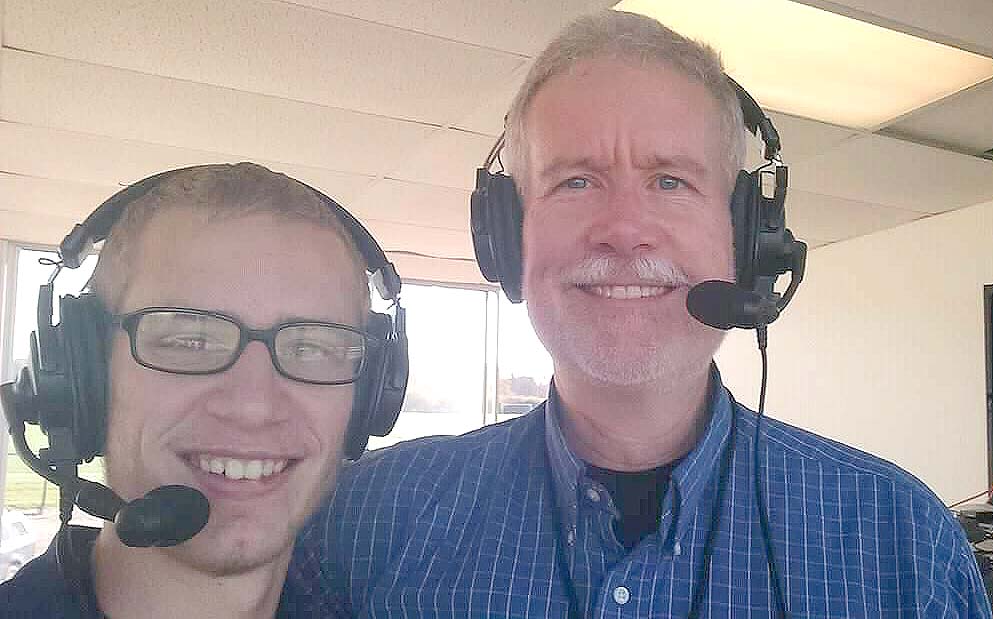
One of the first blog entries when this blog began in 2011 was “Adventures in radio,” chronicling such events as driving four hours to do a game and then driving back the same night, driving 800 miles over two days to cover four games, announcing games from the top of a ravine, losing your partner before the game due to injury, etc.
It just occurred to me that this year is not just the 30th anniversary of my entrance into the full-time work world, but it is also the 30th anniversary of my announcing sports on a part-time basis. The first game I ever announced on the radio was a Friday afternoon football game between Lancaster and Cuba City Sept. 25, 1988. (Cuba City 28, Lancaster 27 in overtime.)
I returned to Southwest Wisconsin, from whence my career and announcing began, six years ago, and as with seemingly everything in my life, I have experienced enough for a second volume.
I’ve written here before that my favorite sports announcer of all time is the late Dick Enberg. I don’t sound like Enberg, but one thing he had, and one thing I hope comes across when I do games, is that Enberg sounded as if there was no place he would have rather been than calling the game he was calling. I am unaccountably lucky to be doing something I wanted to do from around the time I started watching games on TV, and, since I’m part-time, without all the downsides of working in broadcasting.
Adventures in Radio Volume 2 starts with the second game that I wasn’t exactly scheduled to announce. I was asked to go to Highland and do reports of the Black Hawk–Highland game. I was told before the game that the regular game would probably be a blowout, so I might get to call the second half of the game. That turned out to be pessimistic, because the station called me and put me on with two minutes left in the first half, when I was not quite ready to report. There were no commercials for my part of things, which I discovered when I threw it back to the station and the on-air host/engineer immediately threw it back to me.
Complicating matters further (that phrase perhaps should be engraved on my gravestone) was the fact that I ad a cellphone whose battery had seen better days. I was hoping (because apparently I didn’t bring a charger with me) that the charge would be sufficient to announce the second half, so coming on before the half was a complication. And sure enough, a few minutes into the second half, my phone died.
What did I do, you ask? I simply said, loudly in the press box, “Does anyone have a cellphone that I can borrow?” The public address announcer, who I was standing next to, held up his, and so I called the radio station back and announced the rest of the game.
People unfamiliar with radio have no reason to know this, but cellphones generally don’t produce great sound quality. If you’re fortunate, the quality of the game overcomes technical issues, or your lack of ability as an announcer. Fortunately, it was a great game, with the winning quarterback scoring the fourth of his four touchdowns with about three minutes left for the come-from-behind home team win.
The next year I did more games, including the entire football season of an unlikely state finalist, the 2013 Platteville Hillmen. (Alma mater of UW football coach Paul Chryst, by the way.) The second game of that season featured a Super Bowl-length game due to one team’s throwing the ball a lot (the clock stops more often in high school and college games than in pro games), and a lengthened halftime due to the fact that the officials saw the lightning in the southern sky that they had either not seen or ignored the entire second quarter. The game ran so long that we were bonus coverage on the other radio stations doing games that night. The game ended with Dodgeville beating Platteville 51–45 at 10:50 p.m., and we left the stadium at 11:10 p.m., 4½ hours after the broadcast start.
More unusual than that was the conference’s decision to have each team play three teams in their conference twice. (The conference has only six teams, which means just five conference games except for this season.) That was meeting number one; meeting number two ended with the home team, which had scored 51 the first meeting, scoring 51 fewer points and losing their Homecoming game.
Platteville’s problem was that the three teams they played twice turned out to all be playoff teams. Add their season-opening nonconference opponent, and Platteville arguably had the most difficult schedule in the entire state, with seven of nine games against playoff opponents, including three games against teams that would get to state. After their 1–3 start, the Hillmen needed, we figured out, to win four of their last five games to have any chance of all of getting in the playoffs.
That is what ended up happening, including two wins over teams to which Platteville had lost earlier in the season. The coaches in Platteville’s playoff bracket were either impressed or persuaded by Platteville’s regular season to give the Hillmen a third seed, despite barely getting into the playoffs. That meant, believe it or don’t, a third meeting with Dodgeville, which Platteville shut out fo the second time. (That was the first time, and I guarantee you the last, that any team will play another team three times in one Wisconsin high school football season.)
Platteville then went on the road and knocked off the number two seed, setting up a trip to Big Foot High School in Walworth to play the number-one-ranked and number-one-seeded Big Foot Warriors. That turned out to be a grim defensive struggle thanks to 35-mph winds from one end of the stadium. But Platteville scored, sort of, all the points in the game — one touchdown, and then one safety when the long-snapper, snapping into the wind, missed the punter and lined the snap off the goalpost for a safety. Ironically, that turned out better for Platteville than it could have, since on a safety the resulting free kick comes from the 20-yard line. Platteville ended Big Foot’s undefeated season 7–2, and, it turned out, the career of the coach, who left after the season.
(I found out why he left some time later, which explained why the people in the press box were acting as if their last chance to go to state had just ended. It turned out the Big Foot coach had been dealing with parent complaints during the season about their children’s lack of playing time. During their undefeated season. Parents can be, and perhaps are becoming more of, a problem in high school sports.)
One week later, Platteville played Manitowoc Roncalli in Watertown for a trip to state. The end-of-the-game highlight was from one of Platteville’s best players, whose absence due to injury was much of the reason for the Hillmen’s 1–3 start. Roncalli had two quarterbacks, one of which was obviously a better passer than the other. So it might seem odd that the lesser thrower was in on the potential game-tying or game-winning drive, but he was. And the last pass was intercepted by our formerly fallen hero, who figured out what was happening, got out of position and made the end-zone interception to send Platteville to state. I was yelling so much that no one needed a radio to hear me back in Platteville.
After 25 years of announcing that included several state semifinal games but no championship game (and two times where the team I was covering got to go to state, but we couldn’t broadcast state), that also sent me to cover state football for the first time. There is really nothing bad I can say about announcing at Camp Randall (other than parking, but you knew that). Making matters even greater is that four teams from the radio stations’ coverage area got to state, which prompted wall-to-wall football from 9:40 a.m. until 10 p.m. The Division 5 game ended, the announcers went to commercial, and we jumped in like we were the second drivers at Le Mans, in what we called the Cinderella Bowl, because Platteville, having finished the regular season 5–4, faced Winneconne, which ended the regular season 4–5. The Wolves’ win over the Hillmen left both teams with 9–5 records — and I believe they are the only two teams in history of state high school football to finish with those records — but, as I have said numerous times, getting a silver trophy at state beats getting no trophy at state.
That fall also saw me announce for the first time a sport I played — if you want to call sitting on the bench for two seasons “playing” — but had never announced before, girls volleyball. Until then, the only announcer I had ever heard do volleyball was Chris Marlowe, who announced Olympic and college volleyball. Marlowe can get very excited, which is not really my style. I had heard very little volleyball on the radio, so I wasn’t really sure how to announce volleyball on the radio, where nothing happens unless you say it happened.
The radio stations had four teams get to the sectional semifinals, and had games on three stations, because that’s all the announcers they had. That is, until I called the news/sports director and said I’d never done volleyball before before volunteering to do the fourth match. And so, on Halloween night, driving throughj several small towns while hoping to not hit little Trick-or-Treaters (because that would have made me late for the broadcast), there I was, stuck on one end on the second floor, with a telephone, not broadcast equipment (because they now had more announcers than available equipment), trying to announce. I say “trying” because it turned out that a technical problem at the station knocked me off the air before the match began. (What did I write about “complicating matters further” again?)
The station managed to find someone to go to the station to put me back on the air, but that meant he had to engineer for me. (The system that failed was supposed to allow me to do everything from the game site.) I didn’t get on until halfway through the second set. After stumbling through set two, I threw it back to the station for commercials, only to hear in my earpiece, “I don’t have any commercials!” So I ended up doing the final two sets of the four-set match by rereading the reader spots I have, and that was it. Fortunately again, they were close sets, and I heard afterward a group of peoiple were listening to me call the final moments of the final set, and apparently they could tell what was going on by what I was saying, which meant that a good game saved not-so-good announcing again.
That moved me into doing volleyball the next season. That was a good season to announce, because two area teams got to state. One of the regular-season matches I did featured Platteville’s volleyball archrival, River Valley, which had beaten Platteville twice in the previous regular season, only to lose to the Hillmen in the regional final. In their second regular-season meeting, River Valley took a 2–0 set lead, only to have Platteville come back and win the last three sets and the match. Match number three was back in the regional final, and it again went to five sets, with the Hillmen winning in a two-hour-long heart attack of a match.
Platteville breezed through the sectional semifinal, taking less time to win than it took to get to the game site. That set up the sectional final the following Saturday night in Whitewater, one night after I had to announce a football playoff game. And then the radio station called and asked me to announce another game, a secodn-round playoff game the afternoon before the vollleyball final, without, it turned out, another announcer or (as I found out when I got to the station) equipment. Fortunately the one thing I did have was my phone charger, and so I announced a football game and the volleyball match on my cellphone. (The lack of equipment was matched by the fact that the high school that hosted the sectional final didn’t apparently know I was coming, so they had no place for me.)
That sent me to the Resch Center in Ashwaubenon for state volleyball in the morning and late afternoon … until another radio station owner called me and wondered if I could do one of his team’s early-afternoon semifinal. As long as I was up there, why not? (And as long as I could get to my broadcast position, which was for someone unfamiliar with the Resch a trip approximating climbing to the top of Camp Randall Stadium.) So three matches Friday, and after the first team chronologically speaking won a state championship match Saturday morning, during which I looked at the lack of radio station for the opponent and I concluded I was the only radio announcer in the entire world announcing that match.
I forgot to mention, though, how that Green Bay trip started. The previous Sunday I got a call from the radio station that when I got it I assumed I was either going to be told I was going to Green Bay or told that I was not. Instead I was asked if I were interested in doing UW–Platteville basketball, starting Thursday. So I started at the former Milwaukee Arena Thursday night, where a few minutes before the broadcast began (after they fed me — really) I thought to myself that I was about to announce a game on the floor where Kareem Abdul-Jabbar and other NBA greats played and Al McGuire coached. And then I drove to Waupaca, where my parents lived at the time, that night, got up before sunrise the next day, drove to Green Bay for three volleyball matches, drove back to Waupaca (after doing a pregame interview in the station van for the next day), then went back to Green Bay for the early-morning championsnip match.
The weird part was when I got back home and covered the next Platteville school board meeting, where the announcement had been made that the coach was fired. To quote a popular phrase, it’s … complicated.
I announced both men’s and women’s basketball for UWP for two seasons, and I’ve filled in some (due to a radio station hiring) since then, including one football game, which happened to feature the two highest-ranked teams in Division III playing each other that day. That game went to overtime, with a 28–7 deficit erased thanks to this:
Since they feed you (three hours) before and after the basketball game (I was known as the pasta with marinara and Subway Club Sub guy), and since sports information people do all your stats for you and compile stats for your game prep, I have no cause for complaining about anything about that experience.
I did get to announce the final UWP men’s basketball game at UW–Superior, at least as a conference game. That game started the day before when we bused to Eau Claire for a practice, dinner and night at the hotel. (Where I did halftime segments with the entire team for the rest of the season’s games.) The next day we went up to Superior on U.S. 53 through a part of the state where there are more trees than people. That night, we got to the arena the usual two hours before tipoff, and I chatted with UW–Superior’s radio and cable announcers.
In the lobby of that arena is a photo of UWS’ most famous graduate, Arnold Schwarzenegger, as a cheerleader. Since I knew where Ahnuld went to college, I concluded the pregame interview with his most famous line …
I mentioned that to the Superior announcers, and they laughed and said they’d never thought to do that, which I find hard to believe. So of course I mentioned Superior’s upcoming new conference by using Schwarzenegger’s second most famous line …
… to announce their departure from the Wisconsin Intercollegiate Athletic Conference.
Then we left. We stopped in Sparta at 1 a.m., and the bus driver got out, to be replaced a few minutes later by a new bus driver. (You know you’ve gone a long way when the trip requires a second bus driver.) She apparently had not been told we were going to Platteville, because she tried to turn onto U.S. 61/151 to go to Dubuque, at 3:30 a.m., making us about a half-hour late getting home. The players and coaches could wander in whenever they wished, but there was one person on that bus who was expected to go to work at the usual time on two hours sleep.
The bus is the way everyone goes in the WIAC. So in my two years I saw more college-age-demographic movies than I ever needed to, since I cannot sleep on buses. (Well, I did once.) I saw some good movies that the kids won’t be seeing, including “The Wolf of Wall Street” on the Superior trip. There was one movie that I saw part of on two trips, but I have never seen the whole movie …
… not that I probably need to.
The second year I announced UWP was the year that coach Jeff Gard’s father, Glen, died just before the season. Jeff’s brother, of course, is UW–Madison coach Greg Gard. We stopped at a Subway in Madison on the way, and when Jeff paid the bill, the clerk looked at the credit card and said, “Are you related to our coach Gard?” (Who I announced when he was playing in high school, by the way.) That seemed to be a good omen for the evening.
Platteville and Whitewater have been archrivals since the Bo Ryan vs. Dave Vander Meulen days, and probably before that. The year before was a White Out game in Platteville, and so to follow the spirit of the evening I found a white sport coat, shirt and tie and white pants, and wore all of those, making me look, I suppose, like the Good Humor Man at the microphone. That also required bumper music for the occasion:
Unfortunately Platteville lost on White Out Night. A year later in Whitewater, though, Platteville won in overtime, one night after UW beat Indiana in overtime with “their” coach Gard as the interim coach. So during the postgame I brought that up, and Jeff started to get emotional, and I had to avoid doing the same because I still had a broadcast to finish. Having our blue Gatorade mysteriously disappear from the bus and dumping spaghetti on my lap were minor in comparison to the thrill of that win.
I had another highlight last year, when I announced UWP’s women’s game against Wisconsin at the Kohl Center. It was the first time I had ever announced a game with my alma mater, though they were the opponent of the team I was covering. I got to talk about the UW Band (which was there, though Mike Leckrone wasn’t). And I also got, for the third consecutive year, to announce my own last name belonging to a player (though she spells her last name with an additional A). Between my uncommon last name and my lack of athletic ability, the first time I heard her name on the PA was a startling moment.
Remember Enberg’s advice to never say no? One day I got a phone call from the radio station asking if I knew anyone who announced soccer. A radio station in northwest Wisconsin was looking for someone to announce Rice Lake’s state game, or games. I said I didn’t know anyone but would think about it. And then after I hung up I realized I did know someone who had announced soccer — me, on cable TV.
To make a long story slightly shorter, after I got the gig I wondered who I could do the match with, since I really didn’t know soccer that well. And then I realized the soccer player in the house could help, and so …
… we made our soccer debut. We probably didn’t do a great job. For one thing, the scoreboard was not actually visible from the broadcast position, so I had to give the score and he hd he had to lean way to the right to see the scoreboard off to the left. Fortunately, it was a compelling listen only because the game went into overtime and penalty kicks. (With Michael critiquing the goalies rather severely.)
That was part one of the day’s doubleheader, since after driving from Platteville (leaving before sunrise in the fog) to Milwaukee, I drove to Clinton to announce a football playoff game, returning home, of course, in the dark.
Proving yourself reliable has gotten me asked to announce three state girls basketball tournaments (with four state champions) and two boys basketball tournaments (with the teams ending as runners-up), and three state football championship games, in the Resch Center, the Kohl Center and Camp Randall. No football team has won the gold ball yet, but from the announcer’s perspective if you get to state you can’t announce any more games.
This spring I added high school baseball and softball to the list of things to do. One baseball game was not interesting, but what happened to me may have been. The game started late due to a rain delay, and then had another rain delay during the game. The tech we use makes the announcer sound as if he’s sitting next to you, but there is one problem — there is no way to stop the broadcast and then resume it in case of, let’s say, a rain delay. So when the heavens reopened, I had to fill an hour of airtime by myself. (At least I had brought an umbrella.) So I said what else was going on, did play-by-play of efforts to remove water from the field, talked about watching rain delay coverage on cable TV … whatever it took to fill the hour.
That experience got me to Fox Cities Stadium for state baseball. It was just one game, but afterward my partner and I sat in the stands, sun shining, and watched the next game, just like a couple of guys who made up some excuse to get out of work.
For someone who has never done this more than part-time (and has learned to not want to do this full-time), I have been unaccountably lucky to have done as many games, and great games, as I have. Unlike in my day job, where I will complain about something I feel isn’t right (sometimes in a passive/aggressive sense), I am quite laid back at this. Want me to drive to Onalaska on a Tuesday night for basketball? Fine by me. Want me to cover a seven-hour-long wrestling regional? OK, wwhere is it? The game I’m supposed to do is postponed so you want me to do another game tonight? I better find out how long it takes to get there.
Unless I am having technical problems, my blood pressure and pulse probably drop when I’m announcing. It is my favorite thing to do, and unlike most hobbies, I get paid to do it.
I’d write more, but I have a game tonight and a game Saturday afternoon. Click here to listen if you dare.


 Steve Prestegard.com: The Presteblog