We started and ended with jazz yesterday, so it’s worth noting that today is the anniversary of the release of the first jazz record, “Darktown Strutters Ball”:
Two more Beatles anniversaries today: “Love Me Do” hit number one in 1964 …
… four years before the Beatles started work on their only double album. Perhaps that work was so hard that they couldn’t think of a more original title than: “The Beatles.” You may know it better, however, as “the White Album”:
In Cameron Crowe’s Say Anything… (1989), Lloyd Dobler sketches out a stumbling, uncertain-but-nevertheless-determined path for his and my generation:
“I don’t want to sell anything, buy anything, or process anything as a career. I don’t want to sell anything bought or processed, or buy anything sold or processed, or process anything sold, bought, or processed, or repair anything sold, bought, or processed.” “We’re not sure what we want, but not this,” was a strange but endearing generational rallying cry. Few of us who saw the film in our teens or early twenties failed to laugh with recognition.
Ascribing common traits to an entire generation of tens of millions of disparate Americans is a dubious exercise, even a fool’s errand. So call me a fool, I won’t take it personally.
For instance, assuming everyone in a particular generation has seen a particular movie. Except probably for the original “Star Wars.”
Still, a few characteristics unique to Generation X did become clear as the decades passed. Gen X was notably the first generation to have to deal with the mistakes of the Baby Boomers, and the first in which interracial relationships and homosexuality enjoyed widespread acceptance. Gen X-ers were also more emotionally damaged by divorce than the children of any previous or subsequent generation. There was fragility within us as we faced a joyous historical moment when American ways had indisputably been proven superior to those of the Soviet empire and affluence had become, for the first time, available to a huge proportion of Americans. No previous generation could simply choose wealth, but Gen X discovered that a master’s in business or a law degree was a virtual ticket to the upper class. And this created a conflict, given the anti-materialist shibboleths of the John Lennon-led Boomer culture we’d all inherited: Did access to wealth mean we ought to pursue it? Could we achieve it in some Doblerian way that preserved our sense of self? The natural optimism and excitement of youth were tinged with doubts.
Steeped as we were in Boomer rock music, we sensed it was full of questionable advice. Turning away from, or blowing up, the existing power structures so we could “get ourselves back to the garden,” as Crosby, Stills and Nash sang in Joni Mitchell’s “Woodstock,” was not an option we considered. We were not revolutionaries. The country that awaited us not only didn’t require radical overthrow, it seemed pretty good. Our first votes were likely to be for Reagan (61 percent of the youth vote in 1984) or George H.W. Bush (53 percent in 1988). We advanced into adulthood as cautious idealists, a little hopeful and a little confused.
When I arrived at college in 1985, U2 and Talking Heads were very much the bands of the moment, but there was a palpable sense that Bono and Co. still hadn’t quite fulfilled their promise, that their best days, like ours, were yet to come. Junior year, just as we returned from spring break to a New Haven that flipped overnight from gray slush to Monet efflorescence, U2 delivered its hoped-for masterpiece in The Joshua Tree, instantly and obviously the defining rock album of the decade.
Paul McCartney must like releasing albums in May. Today in 1971, he released his second post-Beatles album, “Ram,” which included his first post-Beatles number one single:
Birthdays today include Papa John Creech of the Jefferson Airplane:
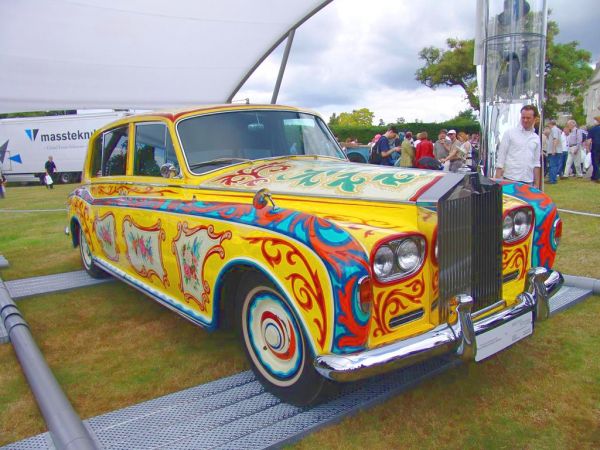
Two unusual anniversaries in rock music today, beginning with John Lennon’s taking delivery of his Rolls-Royce today in 1967 — and it was not your garden-variety Rolls:
Ten years to the day later, the Beatles released “Live! at the Star-Club in Hamburg, Germany, 1962,” which helped prove that bands don’t need to be in existence to continue recording. (And as we know, artists don’t have to be living to continue recording either.)
Meanwhile, back in 1968, the Rolling Stones released “Jumping Jack Flash,” which fans found to be a gas gas gas:
1964: The Beatles make their third appearance on CBS-TV’s “Ed Sullivan Show.”
1969: “Get Back” (with Billy Preston on keyboards) hits number one:
Meanwhile, today in 1968, Mick Jagger and Marianne Faithful were arrested for drug possession. (Those last five words could apply to an uncountable number of musicians of the ’60s and ’70s.)
Today in 1969, the Who released their rock opera “Tommy” …
… two years before Iron Butterfly disbanded over arguments over what “In a Gadda Da Vita” (which is one-third the length of all of “Tommy”) actually meant:
The number one British album today in 1970 was “McCartney,” named for you know who:
 Steve Prestegard.com: The Presteblog